Watching the Neighbours

Although I’m fairly clear about the right of photographers to photograph people in public, and to publish those pictures I do feel some unease about the work currently being shown by Arne Svenson in the Julie Saul gallery in New York, The Neighbours.

The neighbours in question don’t much like it too, and are threatening to take Svenson to court, and they may win. There was a similar controversy a few years ago, when an image in a UK portrait competition showed a person in a window of their house, taken by the photographer from the street outside. I don’t think that went to court, but probably a case against the photographer would have failed. And there has also been the work of Michelle Iverson, taken from her car deliberately parked outside likely homes; the comments on that page are generally extremely negative.

The key phrase is “a reasonable expectation of privacy“. If we are on the street or on a bus or a train or in a café window facing the street we clearly expect to be seen and have no expectation of privacy. If Svenson had restricted himself to photographing people looking out of their windows I would have no problem with his work.

But both by his choice of viewpoint – his own second floor flat in the building across the street – and the technical means used – a long telephoto lens (he refers to it as a ‘bird-watching’ lens) and carefully working “from the shadows of my home into theirs” he has penetrated into their homes in a way that would not be possible for the normal viewer on the street. Were I the judge he would lose the case.

The Photography is Not a Crime site linked above has an excellent summary of US and New York law relating to the case and concludes: “we have a reasonable expectation of privacy in our homes unless we are standing in front of a clear window where anybody walking or driving by can see us.”

It goes on to link the case with the use of surveillance by police and government, suggesting that they may not want to prosecute Svenson because they want to increasingly carry out their own surveillance using drones.

While Iverson’s black and white pictures do have an unsavoury air, Svenson’s are far more elegant, but there are a few among them that make me feel uneasy, a feeling of embarrassment at seeing something that I shouldn’t.  In real life I rather hope I would turn away rather than continue to stare, and though curiosity might get the better of me it would make me feel guilty.

Heiferman on Winogrand and Editing

I think probably there has been more nonsense written about Garry Winogrand than most well-known photographers, but the Lens blog Garry Winogrand – Nonstop and Unedited by Martin Heiferman posted last week is worth reading.

Editing is a problem we all have, and increasingly so in the digital age as Heiferman notes, although there are some ways in which digital makes editing easier. Certainly there is no longer the peering  though a magnifier we had to spend so long doing – either at negatives or contact sheets, though the 4x Ohnar loupe still at my right elbow. It still costs almost the same as I paid for mine many years ago – around £70, and if you work with 35mm film you should have one. Or you can pay several hundred for one that is about as good!

Although many (including myself) have commented on Winogrand’s gargantuan appetite for film, looking at it now it perhaps doesn’t seem so excessive. Looking behind me at the file upon file of my own negatives I didn’t quite equal his volume, but was beginning to get there – and when I look back on much of the work I am usually surprised to see how little I took – and the opportunities I missed. I haven’t checked the maths, but one of the comments equates his output to a couple of 36x cassettes a day – and I think surely it must have been more. And having spent over 10 years working with digital, I have a suspicion I may now have overtaken the master in sheer quantity! The last time I checked the number of images on My London Diary it was over 60,000, and typically I post less than 1 in 10 of the pictures I take there – that’s ‘3 per film’ in old money. Although I definitely take more pictures on digital than I ever did on film (probably around 4 times as many on a typical day) I think digital has enabled me to work more carefully rather than as usually suggested encouraging sloppy image-making.

Looking back at my old work on film – something I’ve only done systematically for my work up to 1985 at the moment is interesting, and I find that much of the work that interests me most now is the more straightforward images – some of which might be dismissed as ‘record’ images (and are by at least one of my photographer friends.)  But then I think one of my great photographic heroes – Walker Evans – was very much a maker of ‘record’ images.

Incidentally one of the comments includes a link that didn’t work for me (but was fairly easy to find here) in which Norman Bringsjord shares his memories of workshops with both Winogrand and Diane Arbus.

The Lens post also has a good selection of 20 images by Winogrand that I think includes some of his best images. Winogrand hasn’t I think always been well-served by leaving the editing to others, but at least here they have made a decent stab at it. I’m still trying to find the time and energy to lift, let alone read, the vast book on him that accompanies the SFMoMA show, which closes June 2.

Cleaners Visit Canary Wharf


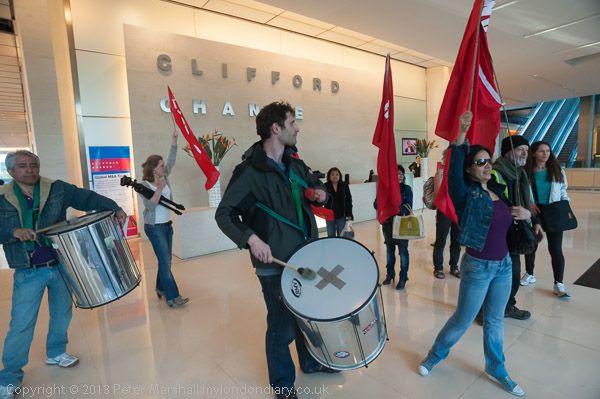
Cleaners’ leader Alberto Durango in front of Clifford Chance – a portrait format might have worked better?

I was a little worried at the prospect of photographing the cleaners protest at Canary Wharf. It’s one of these large private estates complete with its own law force who dress in a way that might get anyone else arrested for impersonating a police officer, and one with a record for harassing photographers.

My own problems there go way back, with various arguments with security while the site was being redeveloped when I would find myself arguing with security men. Then I was usually able to remind them I was standing on the public highway and had a right to take photographs if I wanted, and would suggest they called the police if they had a problem with that. But now, the whole Canary Wharf estate is private property – including the highways – and you have no legal right to take pictures.

I’ve twice had problems with taking pictures there more recently. Once when I was photographing a war memorial hidden away on one of the dockside walkways and they thought I must be planning some kind of robbery (they’d never noticed the memorial) and another time when I tried to photograph a bunch of security men beating up a drunk who they’d thrown out of one of the bars. But although I’ve heard many stories of other photographers getting stopped, I’ve also taken students there and run a couple of photo workshops in the past without permission – and on rather more occasions walked around myself taking photographs without getting bothered – as do many tourists every day. Generally if you don’t go into unusual places or use a tripod and keep a fairly low profile they don’t seem to bother you.

Protest is also banned at Canary Wharf. So the cleaners’ action hadn’t been advertised in advance outside their group, and phone calls to a few photographers and videographers the group trusted had told us where they would meet up to travel to the protest.

I was only slightly worried. The worst I expected was to be escorted off the premises, so there was just a chance it would be a waste of time. In the event I had no problems at all and the whole thing went very smoothly, as you can see from the pictures at Cleaners at Clifford Chance.

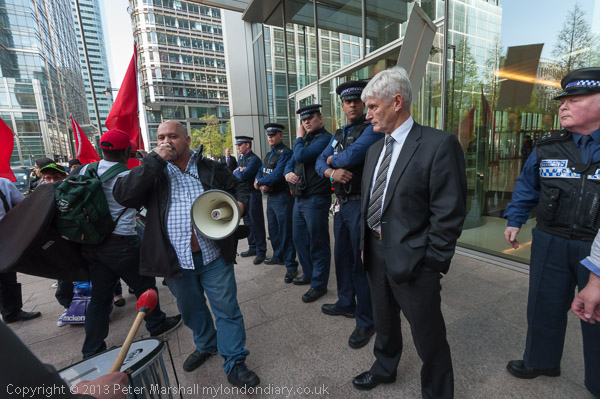
There was a fairly intense confrontation between the cleaners and the man at the right, who I think is Canary Wharf’s Head of Security. I’d photographed him before in 2007 when the Space Hijackers held their ‘Suited & Booted’ May Day party there. But neither then or on this occasion was I asked to stop taking pictures or to leave. And as you can see from this extreme wide-angle image I was very close to him.

I think the rules are generally simple. Even on private land you can take pictures, but if requested by the owner or a representative of the owner of the land to stop you should do so. I would only defy such a request if there was a clear public interest involved that I felt obliged me to do so – for example to secure evidence of a crime being committed. But any pictures that I take before being asked to stop can’t be required to delete and can use.


It was important to get the name ‘Clifford Chance’ as well as some of the protesters

When the cleaners went into the building I went in with them. Had anyone tried to stop me I would have stopped, and if I was asked to leave I would leave. But no one asked me. They did ask the cleaners, and when after a short delay they left, I left with them. But events like this are certainly ones I would be doubtful about photographing without a UK Press Card.

The cleaners had been briefed before the protest about how they should behave, and they were better briefed than some of the security staff who did at times start pushing people around. The cleaners made a lot of noise, made their point clear, showed they were angry but kept calm and simply shouted when a woman was hit, telling the security they had no right to do that.


Alberto Durango speaks at the end of the protest as security look on

The Head of Security did quite a bit of shouting and pointing, some of which you can see in my pictures, but eventually saw and talked sense, telling the protesters they had to leave. Fine, said the protesters, we’ll finish our protest and then leave. It ended with a row of security men across the front of the building, standing back and watching the protest for a few minutes before they marched away for a short meeting close to the tube station entrance before going down the stairs into the station.

Photographically there were few problems, with largely good light with a lot reflected into the shadows from the tall glass-sided buildings. I didn’t need fill flash most of the time, which was just as well as when I tried it, I couldn’t get the exposure right, with burnt out highlights. It was only a problem as the cleaners marched away, with a fairly low sun right behind them – so there are no pictures from this short part of the protest in Cleaners at Clifford Chance. It wasn’t a great problem. Later, as I described in Too Much Control? I found the problem – an incorrect setting for Custom Setting e1, the flash synch speed.

Continue reading Cleaners Visit Canary Wharf

In a Photographer’s Footsteps

Although the current series on BBC Radio 4 In a Prince’s Footsteps narrated by former hostage John McCarthy is interesting, its title and the description “John McCarthy revisits sites of the Prince of Wales’s photographic tour of 1862” rather annoy me. The important footsteps (and tripod holes) are not those of some royal prince (later better known as King Edward VII) but of photographer Francis Bedford (1816-94.)

I’m not sure how long the series of broadcasts and the image galleries that accompany them will remain on the BBC web site – and John McCarthy found some interesting people to talk with – but the Prince’s diary – which he wrote apparently in his own hand (perhaps unlike the current incumbent he actually put his own toothpaste on as well) is available in full at the Royal Collection, which also has a transcription of the pages – just as well as his handwriting would not get a gold star.

The Royal Collection entitles its exhibition more sensibly Cairo to Constantinople: Early Photographs of the Middle East, and the show continues at The Queen’s Gallery, Palace of Holyroodhouse in Edinburgh until 21 July 2013, coming to the The Queen’s Gallery, Buckingham Palace at the end of October 2014. Birmingham Library and Archive Services bought a set of these pictures a couple of years ago, and used some large version on the hoardings around the Library which was being built in Centenary Square which opens in September, and he is likely to have a major show there later – doubtless cheaper to view than in the Queens Gallery. As well as the 172 pictures from this tour they have a very large collection of 2700 glass negatives and 2049 prints by him, mostly architectural and topographical views of Great Britain in the 1970s.

Francis Bedford was the first photographer to travel on a Royal tour, and afterwards the work he took was shown in what was then described “as ‘the most important photographic exhibition that has hitherto been placed before the public’.” It was certainly work that altered ideas about the Middle East and the Holy Land in particular, and led many to follow the photographer’s example and visit these lands.

Being a Royal photographer was clearly rather different in those days, and Bedford wasn’t a press photographer but a particularly fine photographer of landscape and architecture. On the tour he had to work under difficult conditions, with at times high temperatures making the wet plate process almost unbearable to perform. The photographs are well reproduced on the site, with links to his other works in the Royal collection and a handy ‘zoom’ function to see details.

Victoria and Albert had a great interest in photography, and built up a fine collection of Victorian images. I don’t think the tradition has really been carried forward, although the current monarch has a specially monogrammed Leica M6 and almost certainly used it at times. The Duke of Edinburgh used to take pictures of birds from the royal yacht with a Hassleblad and a 250mm f4 lens, as well as a using a Minox, and although I’ve never seen it’ his 1962 ‘Birds from Brittania’ (published in the US as ‘Seabirds from Southern Waters’ and still cheap secondhand) apparently shows that either he or his valet could use it! The Minox is presumably the gold-plated version the company presented him with in 1965.

You can read more about Francis Bedford – and see more pictures – in a lengthy article by William S. Johnson.


May Day Rally

Not all of those who go on the May Day March stay for the rally, and numbers drop off fairly rapidly after the start. I’ve not always bothered with it myself, and marching a couple of miles does tend to develop a thirst for something other than standing around listening to speeches. Not that there were not some rousing speeches, but there was little novelty and it was preaching to the converted.

At the start there was the usual rush by protesters to take their flags and banners onto the plinth below Nelson, and this year there seemed to be an extra horde of photographers as well. The stewards started late to control access by the steps, but the plinth is too low for this to be effective, at least for the young and active, and even I can struggle my way up if I really have to, putting my cameras and bag up first and then scrambling after.  It’s something I try to avoid, particularly since I managed to injure a knee carefully (I thought) dropping down to the ground eight years ago. At the time I hardly noticed the jolt, but by the time I arrived home an hour or so later I could hardly walk – and it was a couple of weeks before I could work again, and several months before I could walk without any pain.

For a while there were so many people and so many banners that it was almost impossible to work, but eventually the stewards got them sorted out to leave space in front for the speeches and just about for us photographers. The ideal position for photographing the speakers there would be levitating in mid-air above the square – but failing that there are two choices – either to work from the platform to one side or to stand at ground level and look up at them. Usually I take the second alternative, but today I kept at platform level. If only the put the microphone a couple of feet back it would be much better, though as you can see I was able to get slightly in front of the speakers without falling off the plinth – though I was just a little worried I might get pushed off the edge by accident – or get so engrossed in taking pictures that I forgot where I was and just moved a little to my right…  Photographers have died falling off cliffs trying to get the composition right!

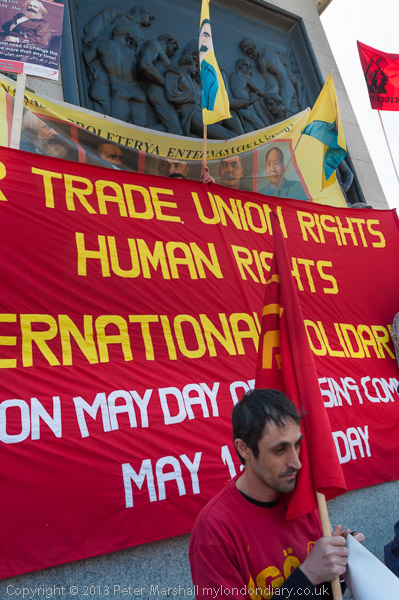
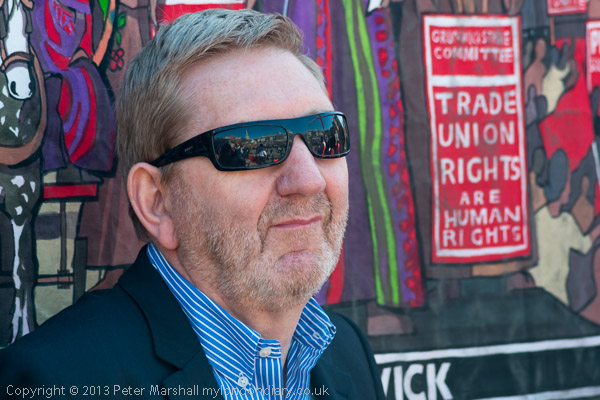
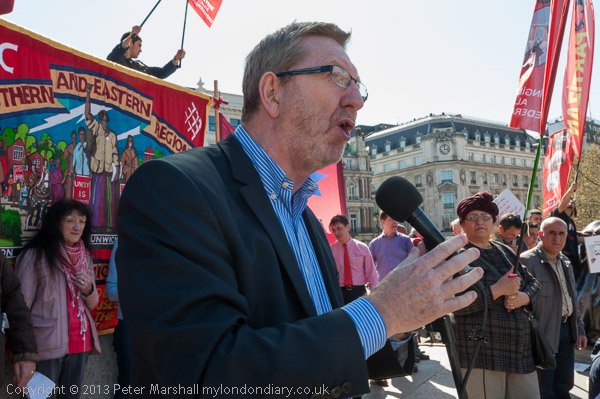
Probably the best pictures of the speakers are of them waiting to speak. Len McCluskey was in front of a Trade Union banner with the message ‘Trade Union Rights Are Human Rights’ and looking just a little sinister in dark glasses, which reflected the scene in  the square in front.

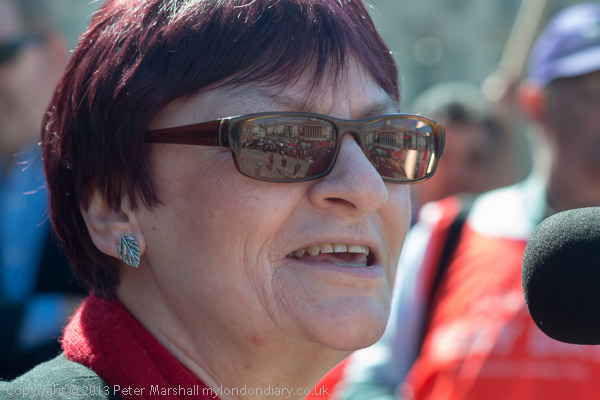
But  even with the 75-300 I couldn’t see the reflection well enough – it was better with NUT General Secretary Christine Blower who turned slightly towards me so that I could see the National Gallery in her glasses.  McCluskey took his glasses off to speak, but the sun coming from behind him made pictures a little tricky.

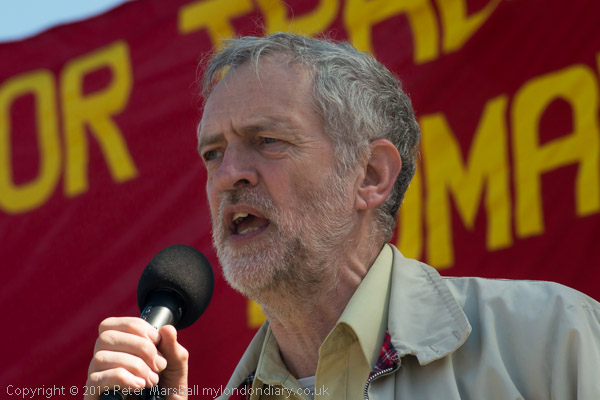
After his speech I decided it was time to get down, and I photographed MP Jeremy Corbyn as a groundling, when the 75-300 really made a difference compared to my normal 18-105mm. The image below was taken at 210mm (315mm equiv) with the sunlight just coming over his left shoulder, and most of his face in shadow. As usual he gave a fine speech, but is often a tricky subject to photograph, not least because he tends to close his eyes when speaking.

The march banner, with its deep red I thought made a good background. Despite being a cheap lens, the Nikon 70-300 is remarkably good, especially when used on the DX format, although above the focal length I used here it does get a little soft.  It’s also small and light for what it offers – and the f4-5.6 aperture is fast enough given the high ISO performance of the D800E.  I could easily have taken this image at ISO200, but there seems little reason for most purposes ever to use the camera below the ISO640 I had set for this day.  The aperture in use was probably unnecessarily small at f13, though I wanted to be sure all of Jeremy was sharp, and their isn’t a great depth of field at 315mm equiv, and it still gave me a shutter speed roughly twice as fast as the 1/focal length rule suggests necessary, at 1/640.

The 1/f rule is still one I find useful, even though most of my lenses – but not the 75-300 – now have image stabilisation. And the focal length I use is not the actual focal length but the 35mm equivalent. It still seems to be a useful guide, though I often use slower speeds, either by design or by accident.

I didn’t stay until the end – and nor had most of the marchers, with Trafalgar Square beginning to look rather empty by the half way mark. I couldn’t help thinking we were supposed to be celebrating and it didn’t look or feel much like it. Perhaps we should have had some socialist maypole dancing. In clogs?

More pictures at TUC May Day Rally.
Continue reading May Day Rally

Photoshop in the Clouds?

Adobe have just e-mailed me with a special offer of “an amazing discount – just £17.58 (incl. VAT)/month” for their annual Creative Cloud complete plan membership. Apart from the small fact that I’m not actually eligible for this special offer – as the company’s own records should have told them – I wouldn’t in any case want to take up their offer. £211 a year is several times too much.

If you been away from the web for a few days you may not have heard of Adobe’s decision announce May 7 to end selling Photoshop CS6 and other Creative Suite products, instead moving to a monthly subscription model with what they call Creative Cloud or ‘CC’ software.

You can read more about it all over the web, but there is a useful interview on Digital Photography Review that gives Adobe’s reaction to the uproar that the announcement has sparked.

Perhaps of most importance to photographers is the statement “We don’t have plans to make Lightroom a subscription-only option“, though perhaps less reassuringly it continues “but we do envision added functionality for CC members using Lightroom.” To keep LR going, Adobe will of course need to add support for new cameras as they emerge; for users of PS6 such updates are in doubt after the already promised ACR8 in June. Lightroom 5 Beta, available for free download, adds some useful features, though I can wait until the full program becomes available. But to keep their income coming in, Adobe will need to add new features to LR with each release, making Photoshop itself less of a need. But the statement above suggests they will hobble it.

I use several Adobe products, but for different purposes, and the only one which I’ve felt a need to keep updating to the current release is Lightroom. The latest version of Photoshop I have is CS2, but I normally work with the older Photoshop 7 – I’ve got used to it over the years and it still does all I need. I used to be happy with Adobe Pagemaker too, but had to upgrade to InDesign 5.5 a while back. It is a better program, but Pagemaker was easier to use and did all I needed but others could no longer use the files it produced.

There really is very little that most photographers need that is only available in Photoshop, and I think only the rich and corporate will bother to move to CC. It’s long been a problem for Adobe that a rather large proportion of photographers who use Photoshop don’t actually have a valid licence, and a large part of the reason for this has been the high cost of the software. I can’t see that increasing the price – as CC does – is going to help them. But it won’t greatly affect me either.

As well as Lightroom – which I think can do at least 99% of what most digital photographers need from software like Photoshop and rather more in other ways – Adobe will also be continuing with Photoshop Elements, probably capable of doing all of the things that most photographers currently use full Photoshop for. Often using PS rather than Elements is more a virility rather than a functionality issue. I’m told the latest version has a choice of a better interface for professional use, but haven’t tried it.

And of course there are other image editors outside Adobe, including Picture Window Pro and  Sagelight at relatively low cost, and even free software, including the GIMP. I used earlier versions of PWP and the GIMP but never quite got to grips with them, perhaps because I was so used to Photoshop, though in some respects PWP was impressive. And unlike some photographers (and perhaps more editors) I don’t believe Adobe have some special magic that gives their jpegs something those from other software don’t possess.

Until recently I worked exclusively with Photoshop on my scans from film, but a few months ago changed over to using Lightroom. Both my two most recent books, London Dérives and City to Blackwall, have been made from a Lightroom catalogue containing my 16bit archive scans. I use ‘Ctrl-E’ from LR and load the original scanned image into PS7, then spend ages retouching and adjusting before saving it and returning to LR. I then make any other basic adjustments necessary, as well as any dodging or burning that I had not done in PS – some things are easier in LR – and then output to the book directory using my book preset. Of course I can use any of my other LR presets to output the image, such as my web one which makes a suitable size copy with a copyright watermark, for those pictures I want to include on this blog or elsewhere. I could even make books direct from LR (and LR5 offers more templates etc) but I prefer the extra flexibility of using my own designs and better text handling of InDesign.

Adobe have a full place in my current workflow, and I hope this will continue. I’ll upgrade when there is real advantage to me, or when it is absolutely necessary, but I don’t think it is ever likely to involve a CC subscription

Bee-have

The trouble with bees is that they are dying, which is a disaster for us all, but also on a more trivial level that they seem unavoidably to lead to bad puns. On the morning of Friday 26th April I sat at my computer and began to type in a status update, ‘To Bee or not to Bee...’ but I think (and hope) that I came to a decision, jumped up, grabbed my camera bag and headed to the station on my way to Westminster before I pressed the enter key.

Part of the reason why I’d been in two minds whether to go had been the huge publicity about the issue, with mentions in the daily papers and that morning on Today programme and Radio 4 news; I didn’t know if it was going to be a very big protest, but I was sure the media would be swarming over it.

My indecision meant I missed my first train (not really the first, but the first without taking out a mortgage for the ticket) as well as the next slow service, and got to Parliament Square half an hour later than if I’d not prevaricated, and had missed the first 15 or so minutes of the photo-call. I’d been right about the media scrum, with almost as many photographers and videographers as people taking part in the protest.

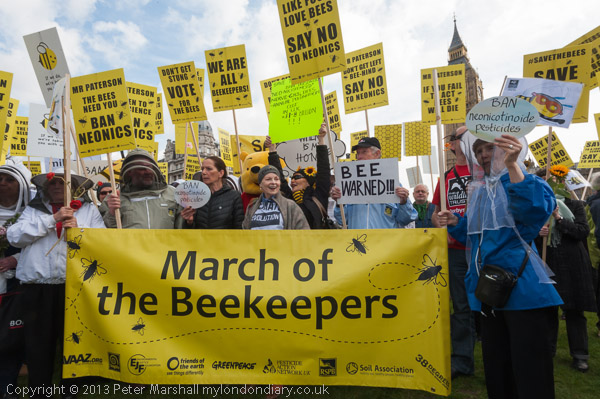
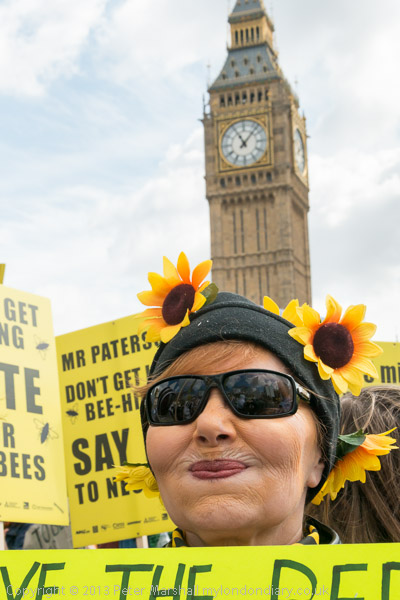
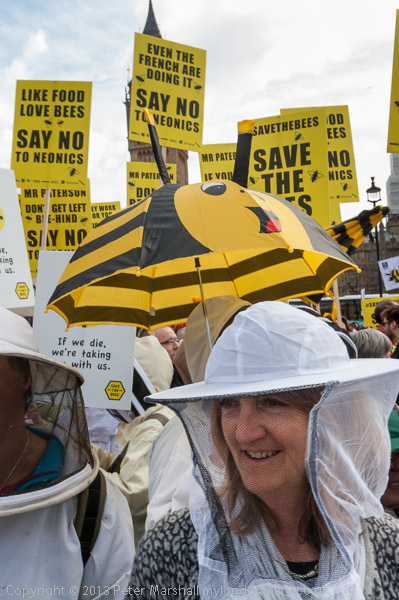
As usual, the picture that almost everyone was trying to take – in a line 3 or 4 deep – wasn’t of great interest – a big crowd behind the main ‘March of the Beekeepers‘ banner and behind that Big Ben, but I took a couple of frames just because it was there when I arrived, before moving away and into the crowd to find something more of interest. I tried to make use of the many placards close together, with glimpses of that clock tower between the placards, and concentrated on single people or small groups in the foreground, particularly those who had gone to some trouble with flowers or bee-keeping clothing.


Just how much Big Ben do you need in a picture?

Perhaps this much?

After a while I got fed up with the big clock, and tried playing with hiding it or almost hiding it, and then tried to forget it and concentrate on the people and their costumes and props. There was a group in full bee suits, but somehow I couldn’t quite get to grips with them – the costumes were just too overpowering.

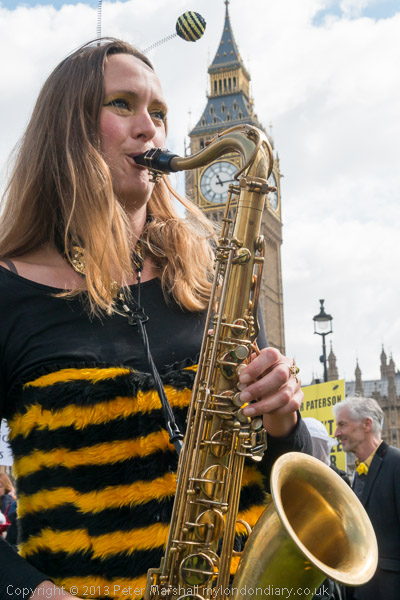
I made one picture playing with Big Ben that I did rather like, where I was able to use several circular shapes in the image of a woman in a bee costume playing a tenor sax. It wasn’t entirely straightforward because she was swaying around as she played, but I was able to frame the clock in the bend at the neck of the instrument, with one of the two balls on springs on the top of her head in the sky just to the left of the spire and the bell of the sax (elliptical rather than circular) at the bottom right of the image. Looking at if afterwards I wasn’t sure if I should have framed it a little wider to get the ball on the second of her antennae in the image as well, rather than choosing to cut off the image at the top of the bell tower (which also has a tiny ball.)

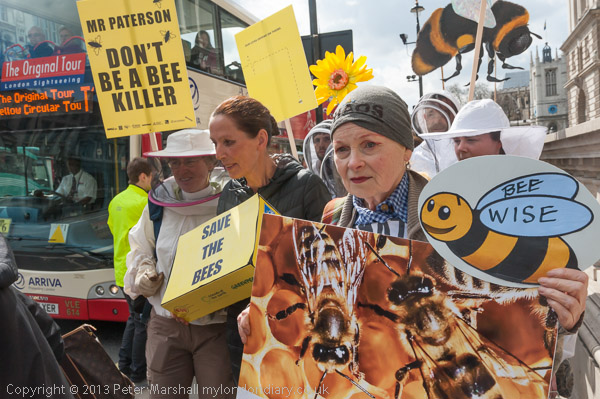
By now I’d realised that there were several celebrities present, though I hadn’t recognised them including fashion designers Dame Vivienne Westwood and Katharine Hamnett. But Katharine Hamnett was carrying the box containing the petition, a yellow box labelled ‘SAVE THE BEES’ and they were on their way to Downing St to hand it in.

Now we were in a position for one of those familiar arguments between those photographers who want to get in close and those who keep saying “lets go back, guys, so we can get a long shot.”  This got a little more acrimonious than usual when one very young lady, I think still a student, called a highly respected press photographer easily old enough to be her father, a “dirty pap“.  Anyway while the argument was continuing – and I couldn’t move back because my way was blocked by the photographers behind, I got in close to get the image I wanted, with a great feeling of movement and a four nicely placed bees, as well as the petition and the two designers with people in bee veils behind them. When I could manage to move back so that anyone who wanted a long shot had a clearer view –  a TV crew  jumped in the gap holding up the whole protest as well as greatly annoying the photographers. It wasn’t so much the camera but the large and hairy microphone on a boom that was really a pain for all the rest of us, and the interview completely stopped what was happening until the organisers broke in and said that they had to get on to meet their pre-arranged time at Downing St.

I didn’t bother to go inside through the security check at Downing St – things in there are seldom of great interest, although editors seem to like the boring pictures – and made my way back to Parliament Square for some more pictures of the bulk of the protesters who had stayed there while the small group went to deliver the petition.

The crowd there was getting quite animated, chanting various slogan, and there were a number of people taking videos and photographs. When one of the videographers walked in front of me, I decided it was time I moved in closer too, and did so, only to have another of them come and actually pull at on my jacket and tell me I had got in ‘his shot’. I ignored him as best I could while I finished photographing the person in front of me and then moved back.

These things often happen when a lot of people are working together, but it’s something you really just have to live with, and while most of us respond sympathetically to a polite request, grabbing people just is not acceptable. I hadn’t got in the scene he was taking on purpose – and was just as much a part of the event as whatever he was filming. This was an real event not something set up in a studio for his convenience.

More pictures at March of the Beekeepers.

________________________________________________________

My London Diary : Buildings of London : River Lea/Lee Valley : London’s Industrial Heritage

All photographs on this and my other sites, unless otherwise stated are by Peter Marshall and are available for reproduction or can be bought as prints.

To order prints or reproduce images

________________________________________________________

An Extra Ear

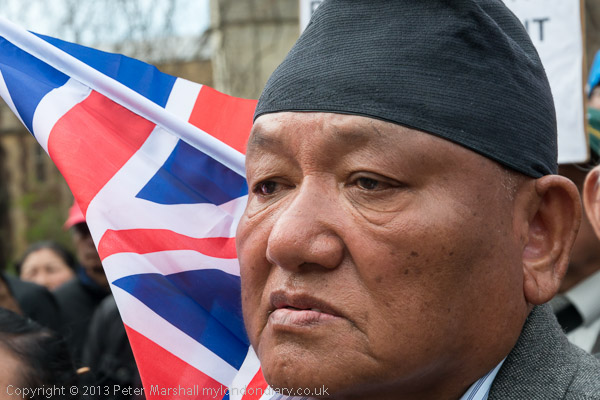
It’s often hard to know why I photograph a particular person, but this man at the protest by Ghurkas opposite the House of Lords had a face I could not pass by. He has a strength and dignity and an expression that to me expresses the disappointment of these people who served in the British Army but have been rather poorly treated by successive British governments. You can read more about their protest in Gurkhas Call for equal treatment. It’s a relic of our colonial past that still embodies the kind of attitudes that were thought acceptable – and indeed hardly questioned – 198 years ago when the army first recruited in Nepal.

One small thing that annoys me about this full-frame – that is uncropped – image is the extra ear at the extreme right. It would be simple to crop while retaining the aspect ratio by taking just a little away from the top and right of the image, and the kind of thing I often do when ‘developing’ my images in Lightroom. Using optical viewfinders – even on DSLRs has seldom if ever been precisely 100% accurate, even on cameras which have claimed this,  and the D700 only claims to show approximately 95% of the horizontal and vertical frame coverage – which means that around a tenth of the image area is invisible. Things like this extra ear can creep in and I feel entirely justified in cropping them out, despite my commitment to the uncropped image.

My commitment is not an absolute one and I’m certainly not a purist in this respect. I think trying to work in this way leads to better seeing, but when occasionally I get it entirely wrong I’ll crop if I have to. Very occasionally I’ll even realise I should have framed an image in portrait rather than landscape format and do so after the event. But mostly what I do isn’t really cropping, but a tiny bit of ‘trimming’.

Using the D800E as a DX camera, with the area around the image ‘greyed out’ (CS a6 set to ‘Off’) has several advantages, allowing you to frame in a similar way to using a rangefinder. But also, so far as I can tell, the framing seems 100% accurate. For most purposes the smaller image file at 16Mp is also a benefit, and – at least with FX lenses – you have the choice of switching to a larger 32Mb file for those few cases where it is an advantage. The disadvantage is of course the smaller image size in the viewfinder.

It has always amused me that the staunchest advocates of the uncropped image have been those who have used cameras with some of the least accurate viewfinders. I was a great fan of range-finder cameras, owning and using a number of them over the years – Leica, Konica, Minolta etc, and none of them were particularly precise – and with some lenses spectacularly wrong. And of course even that great photographer and advocate of the full frame – to the extent of producing images including the sprocket holes where he had loaded the film incorrectly – cropped what is perhaps his most famous image.

________________________________________________________

My London Diary : Buildings of London : River Lea/Lee Valley : London’s Industrial Heritage

All photographs on this and my other sites, unless otherwise stated are by Peter Marshall and are available for reproduction or can be bought as prints.

To order prints or reproduce images

________________________________________________________

Down Three, Up One

When I get news of a forthcoming protest – from any of a wide range of sources – I put it in my diary and usually on the night before I copy down the relevant details onto a small sheet of paper, usually around A6 in size to put in my pocket when I go to take pictures. Sometimes I need to do a little research, both to find out what the particular event is about, and sometimes to check on travel times, ways to travel and so on. Some days very little seems to be happening, and on other days events in London are just like the buses, they all come along together.

Saturday April 20th was one of those days when quite a few things were happening (or were supposed to be happening) and it wasn’t physically possible for one person to be at all of them. So I’d spent some time deciding which it was feasible to cover, thinking about when I would need to leave one event to be at the next one in time to take pictures and how I would travel between them.

On paper it looked good, and I left home hoping to cover five events, four protests and one of the more commercial events that take place from time to time in Trafalgar Square, that Saturday to celebrate St Georges day (which was actually 3 days later.)

The first event was an annual march to remember the Armenian Genocide, which began with a massacre on April 24, 1915 when the Turkish authorities arrested around a thousand leading members of the Armenian community in the capital city of Constantinople (now Istanbul) and murdered them. Turkey still hasn’t acknowledged its role in the atrocities which continued off and on for the next 8 years with around 1.5 million Armenians being killed. The Armenians demand that Turkey recognise it as a condition of entry into the EU, and also want it to be on the UK National Curriculum.
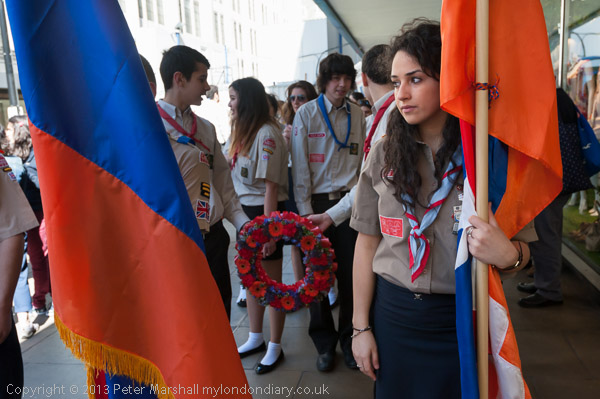
I felt that the picture I took while people were meeting for the march on a side-street on Oxford St somehow fitted well. The national flags, the uniforms, the wreath and of course the expression on the young woman at the right of the image, which for me was one of yearning or longing. Although I doubt if it was for her lost country, it served the purpose.

Technically, the lighting contrast in the scene, with the important figures in the shade and bright sunlight on the background was pretty impossible. Working with flash was out of the question as it would have alerted her and the others to what I was doing. This wasn’t the first frame, but I think the third of the situation,and with flash that girl and probably the others would have been posing for me. giving a very different – and less interesting – image. I realised as I was taking it that it would need considerable post-processing to get the effect I wanted – and it was only just possible.

There was just enough detail left in the over-bright background for me to burn down, and just enough light on the foreground figures for me to work with, altering the contrast slightly and making things a little brighter.

I walked with the Armenians to their laying of wreaths at the Cenotaph – you can see the pictures in Armenians Remember the Genocide – and then left them to go back to Trafalgar Square, where St Georges Day was being celebrated officially. But  it didn’t seem to be celebrated at all, or at least not in any interesting way – so after walking around the square and taking a good look at things I crossed that off from my list of events.

Next was a protest against the bedroom tax, also planned for Trafalgar Square, which I expected to take place on the North Terrace, and I sat down on the wall in front of the National Gallery and waited for it to start. By the time I’d finished my sandwiches, there were two people present, along with a pile of placards, and it was around half an hour after the advertised time. I decided it made more sense to do something else, and took the tube to South Kensington, where supporters of the newly elected President Maduro were preparing to protect the Venezuelan embassy from his opponents.
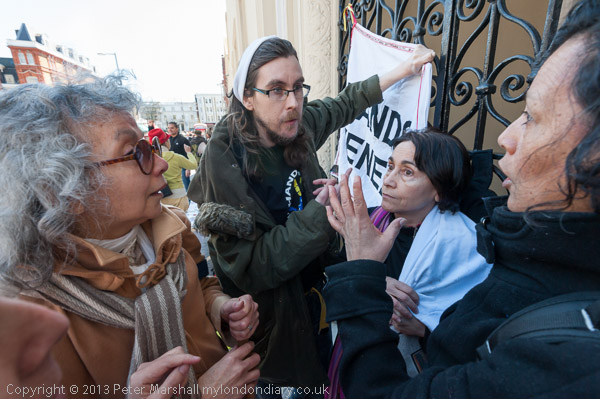

Supporters of President Maduro discuss how they should protect the embassy

There were around 30 people there when I arrived, with a megaphone and the embassy wall had a number of posters and banners stuck to it.  The opposition were due to arrive in a few minutes, and there were only a handful of them present, but soon more began to arrive, and an interesting situation developed, with considerable arguments between the two groups, who faced each other a few yards away.

The police were rather late to arrive on the scene, but came eventually and stood in a line between the two groups, though I don’t think their presence was necessary as neither side seemed likely to become physical. Shortly after this I left, intending to return later, as I expected a march to be taking place back in Westminster.

On my way back I took a second look for the bedroom tax protest. Although there is considerable outrage against it, there seem to have been many small uncoordinated protests rather than any large ones in London, and the one I was looking for was still too small to be seen! Nor could I find any sign of the march I had been expecting – so that was the third disappointment of the day.
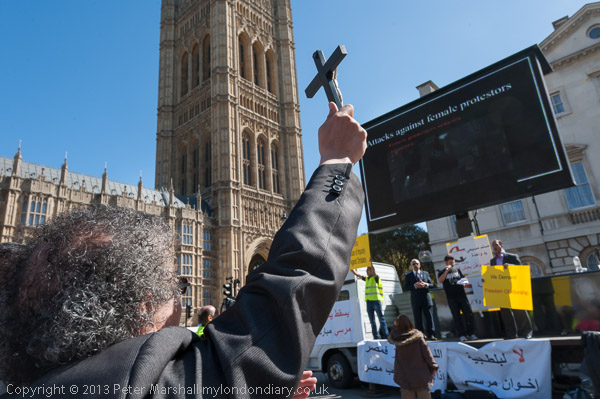
But then I came across a protest – Copts Say End Egyptian Persecution – I’d not known about, taking place in Old Palace Yard, where Copts living in the UK were protesting against the new regime in Egypt, led by President Morsi of the Muslim Brotherhood, which they accuse of being behind recent attacks on Copts, including an attack on St Mark’s Cathedral in Cairo when a funeral was being held of five men killed in earlier violent clashes in the northern suburbs of Cairo. This was something I knew little about but was pleased to be able to report. The speaker who got most applause while I was there was an Egyptian Muslim who spoke about the need for the different communities in Egypt to live and work together.
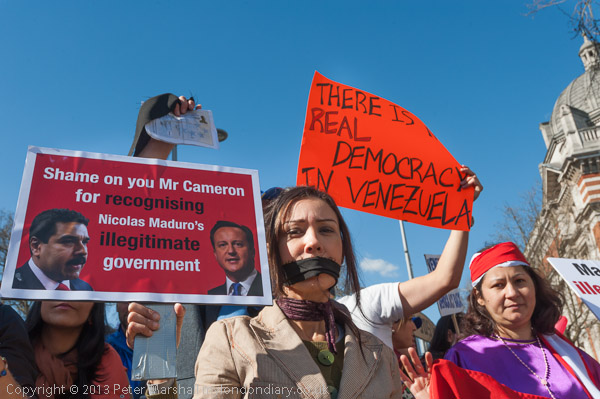
As that protest drew to a close I hurried back to South Kensington, where both sides had increased in numbers, with many more of the opposition to Maduro having turned up and making a lot of noise.  Most Venezuelans working in the UK are from the middle classes who feel threatened by the popular reforms that President Chavez brought in, and they had come to make their opposition clear.

But although they had the numbers, the supporters of Maduro – for me at least – had the winning argument. Although the margin by which Maduro won was smaller than expected, it was still a majority, and rather more convincing than that by which many other democratic leaders have been elected in recent years. More in Stand Off at Venezuelan Embassy.

From my original five stories, I’d only managed to cover two. It isn’t unusual to find the occasional event that only exists in the imagination of those posting the details on the web, or that turns out not to be worth covering, but things are not usually that bad. Fortunately it’s also not unusual in London to find things happening that I knew nothing about as I’d done on this occasion, and I felt quite pleased with my day despite the disappointments.
Continue reading Down Three, Up One
Vedanta Foiled?

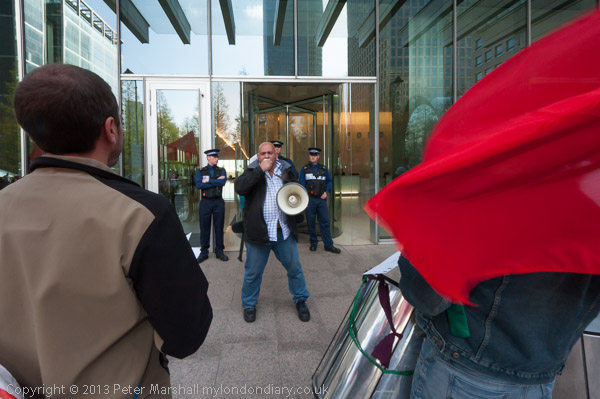
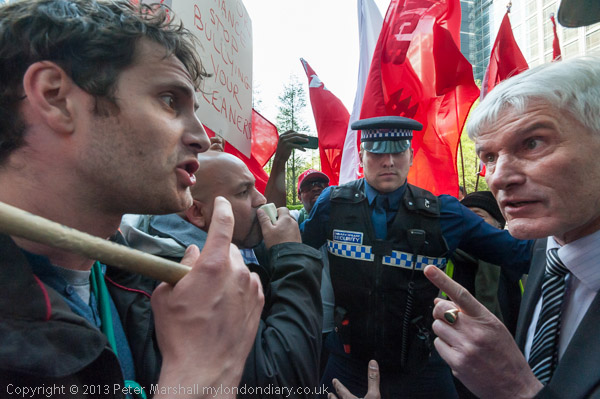
I wasn’t sure there would be a demonstration outside Vedanta’s Berkely St offices or not. It had been planned to coincide with the Indian Supreme Court giving a verdict on their appeal against a 2010 order by the Indian Ministry of Environment and Forests (MoEF) which had stopped them mining the Dongria Kondh’s sacred Niyamgiri Hills.   Although the court didn’t give a final verdict, the ruling that they made was generally seen as a defeat for Vedanta, putting the decision back to a consultation with the local councils of the tribal people. So long as Vedanta are prevented from undermining this process, it seems almost certain that they will reject the mining.

So I wasn’t sure if anyone would turn up for what would seem to be a possibly premature and rather muted celebration rather than a protest, and wondered whether it was worth going.  Fortunately I did, and so did a dozen or so protesters. Unfortunately almost as soon as the protest started, so did the rain, and with a vengeance. The protesters crowded with their banner in front of the window where they were sheltered by an overhang of the floor above, but I’d only made a handful of images, and it was coming down too hard to stand in the open in front of the banner and take pictures.

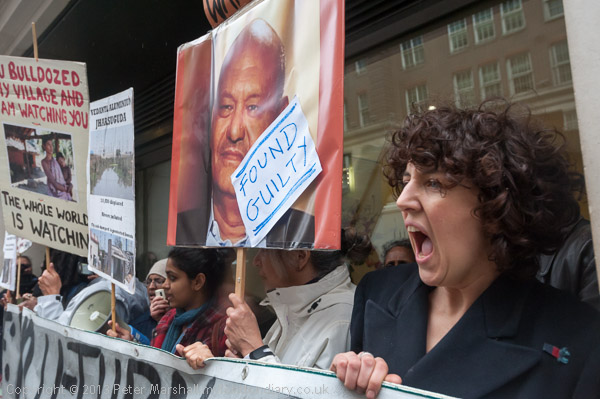
All I could do was to take shelter in a nearby doorway and wait for the rain to stop. Eventually it slackened off a little and I came out to take a few more pictures, trying to keep close to the line of protesters because it was just a little more sheltered. I might have got as close to the nearest protester anyway, but the rain perhaps served to push me a little closer, and I think it worked quite well. The woman’s mouth stretched wide open is the key element, but the angle puts the placard with the large headshot of Vedanta boss Anil Agarwal with the added caption ‘Found Guilty’  in the centre of the image, with the other placards carrying on from it. It’s perhaps a shame that the text of the end placard isn’t entirely visible, but I think there is enough to get the point of it. It may even be better to leave the viewer to work a little than make it too easy. More at: Supreme Court Nyamgiri Decision

Continue reading Vedanta Foiled?