Turkish Solidarity

Photographing the protest march which started at the Turkish Embassy on Sunday it was just a little difficult to know exactly who or what I was photographing, as my knowledge of the Turkish language is zero and of Turkish history and politics only slightly greater.  And I think it is important to understand the events that I’m photographing.

For some events I receive detailed press releases, but for others such as this, all I had was a brief listing in Facebook that gave the time and the place for meeting and that they would be marching to Downing St.
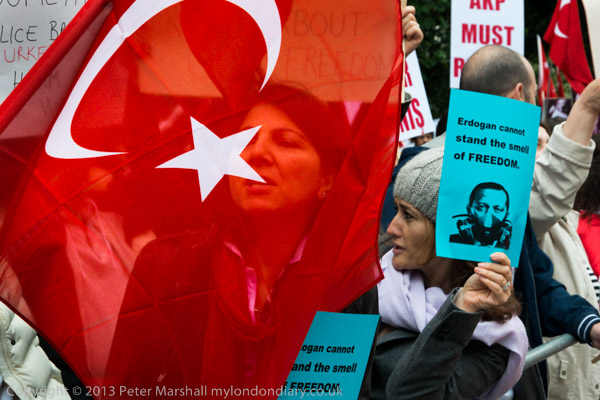
Before covering events I like to do a little research, making sure I know what the event is about, and of course the Istanbul Protests – Occupy Gezi had been in the news for some weeks, and the hashtag #direngeziparki had been trending on Twitter. So I knew the broad outline of what had been happening, and a little about leading figures including the Prime Minsiter Recep Tayyip Erdogan and about the foundation of the Turkish republic in the 1920s by Kemal Ataturk, and about Kemalism and something about the changes to the constitution made by Erdogan and the AKP (Adalet ve Kalkınma Partisi, in English, the Justice and Development Party – a truly Orwellian name.) I’d looked up such things again before photographing a previous Turkish protest the weekend before.

This protest turned out to be dominated by the TGB, the Youth Union of Turkey described on Wikipedia as “a Turkish left-wing nationalist revolutionary youth organization founded on 19 May 2006” with strong support in Turkish universities, which “claims it advocates the principles of Mustafa Kemal Atatürk and Kemalism” and to be “the pre-eminent representative youth organization of Turkey.”
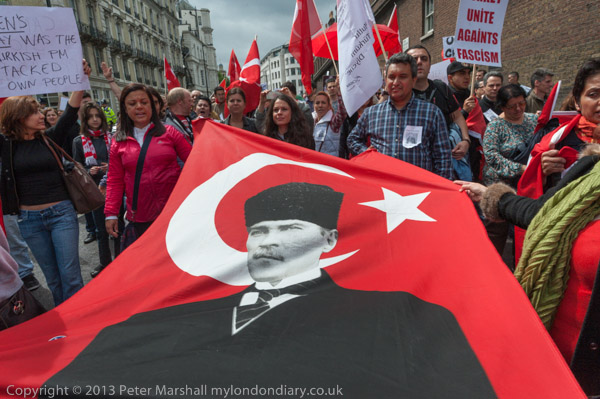
Among the images on banners, posters, placards and framed photographs at the protest were of course those of Kemal Ataturk (some harder to recognise than others). Erdogan was there too, in a caricature of him as Hitler, and many of the protesters also wore small paper images of two men killed in the recent protests, with their names, Abdullah Cömert and Ethem Sarisülük.

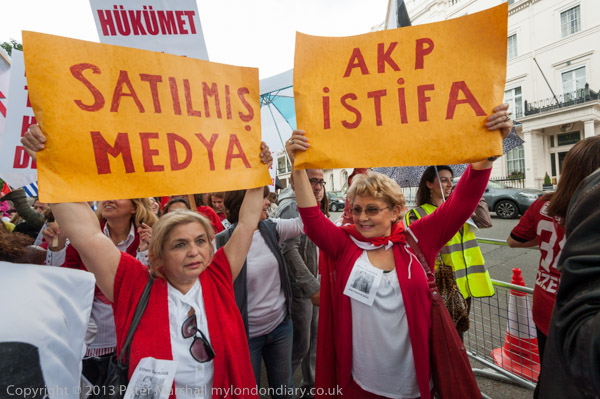
Many of the placards were in Turkish, and although I could ask what they said in English, the answers I got were not always clear, and before sending off the pictures I did check some using Web translation services. I think ‘Satilmis medya’ means ‘the media have sold out’ and ‘AKP Istifa’ is ‘AKP Resign’.
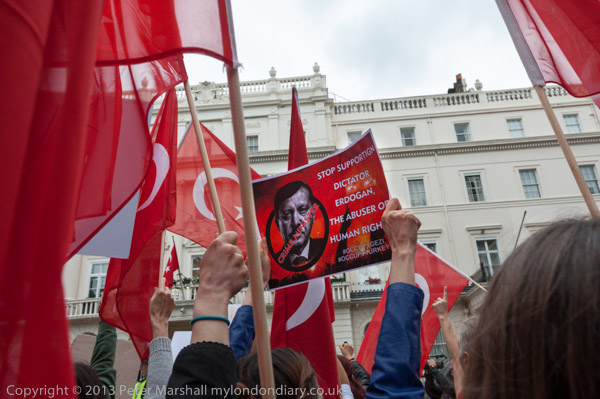
As well as the images of Ataturk and Erdogan/Hitler there were of course plenty of Turkish flags, both waved by and worn by protesters and one on the embassy itself. I spent some time trying to take a picture showing the protest and the Embassy flag, and finally did produce one, but perhaps using the wrong lens – with the 16-35 at around 28mm the flag across the road is rather small.
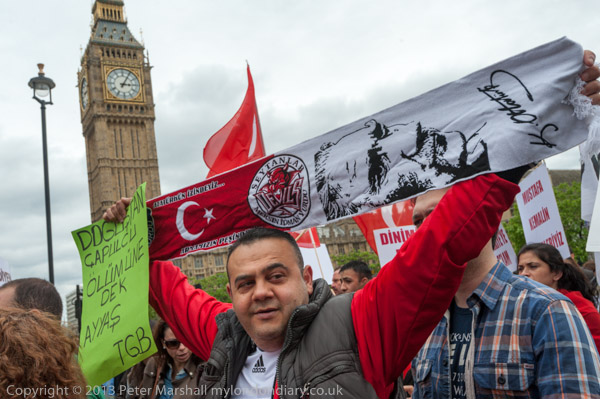
Later, as the march went along two sides of Parliament Square I stood on the corner as it went past to show it passing Parliament – and in particular Big Ben, that so clichéd indicator of London. There were just a few yards after the march turned into Parliament St where this becomes possible.

You can see more of my work from this march at Turks continue fight on My LondonDiary.
Continue reading Turkish Solidarity

Human Meat

I hadn’t known what to expect when I turned up at Piccadilly Circus to photograph a protest calling for the closure of all slaughterhouses. I’m not a vegetarian and certainly not a vegan, though I’m very much against cruelty to animals, and on environmental grounds think that most people eat too much meat. At home we eat quite a lot of vegetarian food, but I still like to have a varied diet, and although the protest took place at lunchtime, and I was feeling a little hungry, I waited until I’d gone elsewhere before getting out my ham sandwiches!

I arrived more or less dead on time (oh dear), and for a few minutes it looked as if this was going to be a rather small and not too interesting protest.  But more people arrived, including a few that I knew, and one told me that if I was lucky there would soon be some scantily dressed women arriving. I wasn’t entirely sure if he was joking.

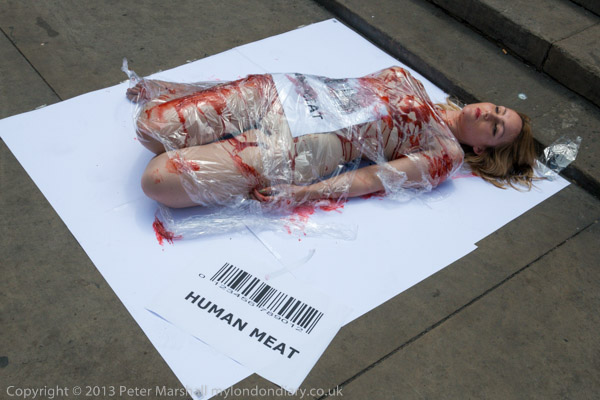
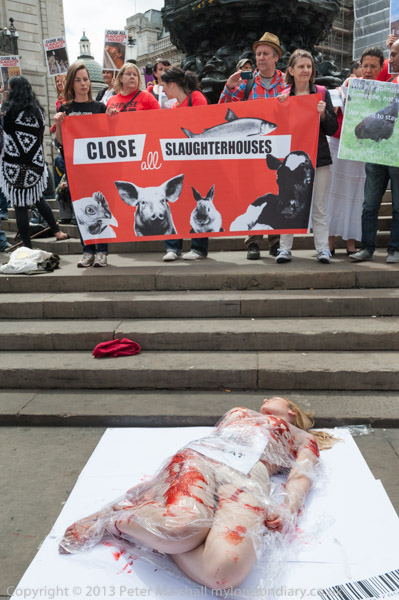
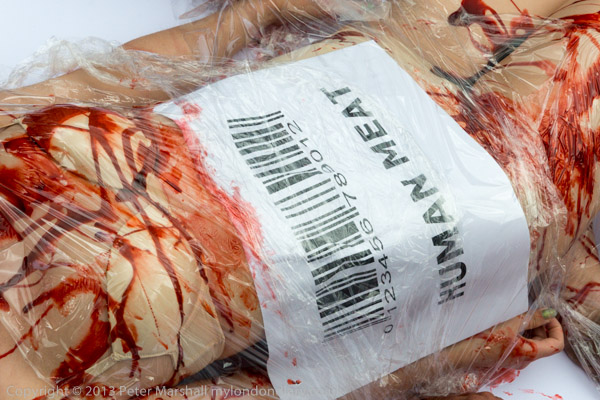
But soon I saw a woman sitting down on some large sheets of white card and removing her modelling gown to reveal she was dressed only in bra and pants.  Soon she was lying down and a man in a white suite labelled as a ‘Demon Butcher’ was dribbling fake blood over her before two others wrapped her in cling film and slapped on a large label with a bar code, ‘HUMAN MEAT’. Then a second woman was getting the same treatment.

I took quite a few pictures trying to work out the best approach. Getting in close and cropping the torso to use the white background;  taking the picture wider to show the pavement around, or including the protesters behind – and a few other variations – you can see some on ‘Human Meat’ – Close Slaughterhouses.

For a protest in the centre of London there were surprisingly few photographers, and even the many tourists around seemed a little shy about taking pictures.

The posters and placards you can see in the pictures certainly show some terrible scenes of animal cruelty, and they protesters say there is no such thing as humane slaughter and call the attitude that allows us to treat animals differently to humans ‘speciesist’. I can’t agree, because I do think we have a special relationship with others of our own species.  People do matter more than animals. But of course we shouldn’t be cruel to animals, although many animals are terribly cruel to other animals, killing them to eat in the only way that they know. We humans know better and should do better. If that’s ‘speciesist’ I’m proud to be so.

I enjoyed my ham sandwich on the bus on my way to the next protest. I hope the pig lived a decent life and was slaughtered humanely, though I can’t be sure. Though of course the pig only had a life because it was going to be eaten at the end of it.

Continue reading Human Meat

They Owe Us

I’ve photographed Canary Wharf on and off since the mid-1980s when the old West India docks were being demolished. On the ground during building the new area, and even  from the top looking down in the late 90s, when the office space in the tower was mainly still empty.


Canary Wharf station and Cabot Square

Since then I’ve been back various times, taken several photography workshops there as well as going to take pictures, and although I’ve got stopped a couple of times by security while taking pictures not really had a great deal of trouble.  I’ve photographed several protests there, most recently with the cleaners, and not been troubled by security while doing so.

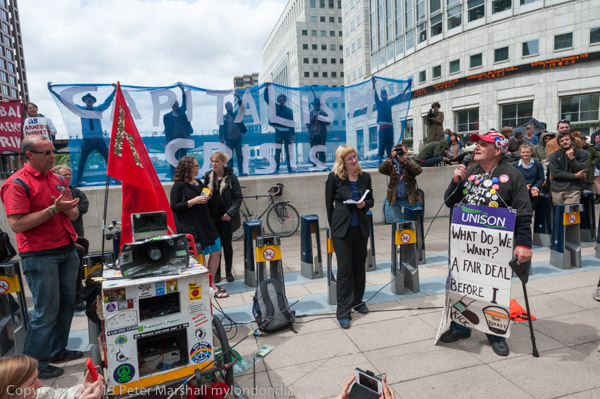
So although I know people have had problems photographing on this huge private estate with its own security force impersonating police, I didn’t share the fears voiced by some that the ‘They Owe Us’  “creative civil disobedience”  there “in one of London’s economic power centres” was likely to end in trouble, though they were promising “an element of surprise that will be revealed on the day” though of course you can never be sure what will happen.

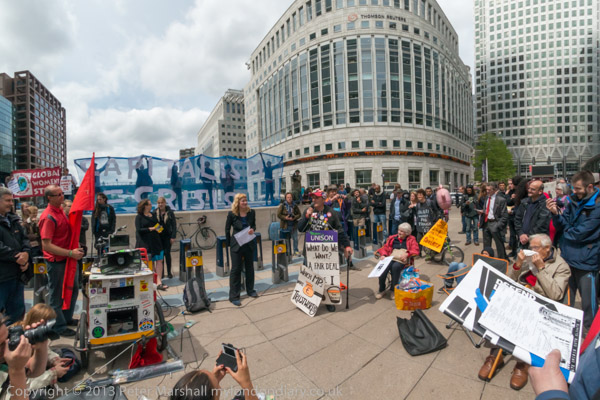
At least it was a nice bright sunny day, though rather windy, but perhaps the heavy-handed policing on Tuesday had put people off, and numbers were rather fewer than I’d expected.  Things eventually began to happen in the area in front of the tube entrance, with two adjacent areas with public address systems, one with some political speeches and performances, and the other more serious workshops and lectures, though visually neither was hugely interesting.

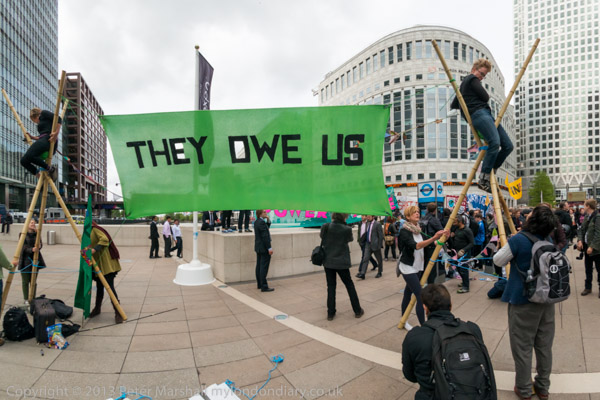
There were some seriously large banners, and in a creative area two large tripods were erected to fly the main banner – with the event’s title ‘They Owe Us’ – between.  Ultra-wide lenses were useful for these big banners, and in particular the 10.5mm fisheye let me not only show the banner but also in some pictures the tops of the high buildings to the south and north of the area.  The pictures with this seemed far more satisfying to me than those taken with longer lenses. With all those buildings with their rectangular arrays of window around almost all the fisheye images looked better after processing using the Fisheye-Hemi plugin,  which straightens the vertical lines (I’ve looked at alternatives to this, but it remains the best I’ve found.)

Of course not everything can be straight, and the sweep around of the paving slabs clearly shows this – and the buildings at left and right of the picture actually face each other.

A bit of tilt was needed to get the tops of the towers in the picture, and I was perhaps just a little too close for this picture – stepping back a few feet would have let me see more of the tripods, but I had to be more or less where I was to get the background ‘Power to the People’ banner in the image as well.

The two images above show the difference between a normal ultra-wide and the fisheye. The lower image was made with the 16-35 zoom at 23mm, about the widest for a rectilinear lens before the edge elongation becomes noticeable – the horizontal angle of view is a little over 75 degrees.  The upper image, taken from just very slightly to the left and a few second apart is almost half as wide again and gives a better impression both of the event and the surroundings.

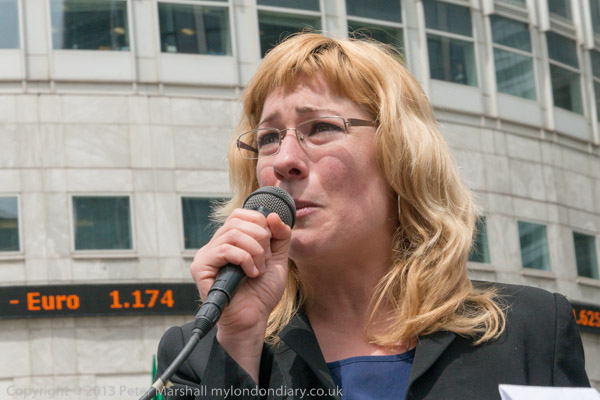
But of course there are times when you do want to want to concentrate on a smaller part of the subject, and here is a third image taken a short time before the previous two. I was possibly just slightly closer, and moved down onto my knees to put the display of exchange rates and share prices which was travelling around the building behind the speaker.  The equivalent focal length using the 18-105mm DX lens was 120mm, and at f14 the rate is almost sharp – and you can count the speaker’s eyelashes, although theoretically diffraction is dragging the performance down a little it doesn’t seem to show on the original.

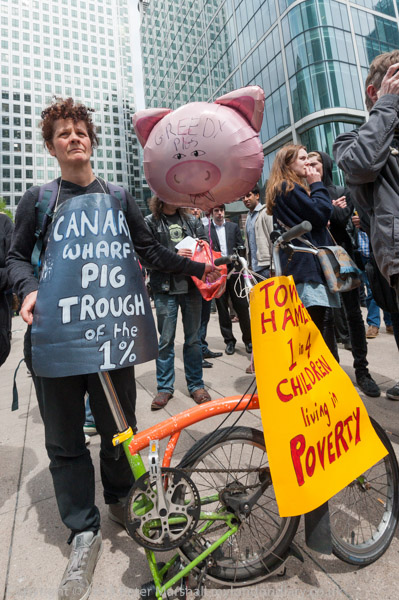
Finally, a reminder of what the protest was about. Canary Wharf, Pig Trough of the 1%, is in one of London’s most deprived boroughs, stolen from it and given over to the ultra-rich greedy pigs. In Tower Hamlets outside this private fiefdom, 1 in 4 children are living in poverty.  Getting balloons to point the right way on windy days wasn’t easy, as you can see in some of the other pictures on ‘They Owe Us’ G8 Protest on My London Diary.
Continue reading They Owe Us

Canada Day

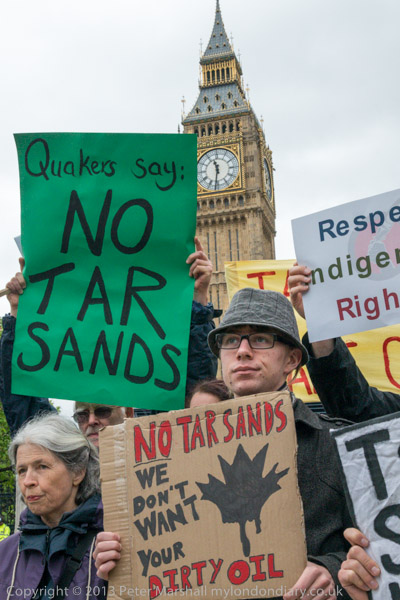
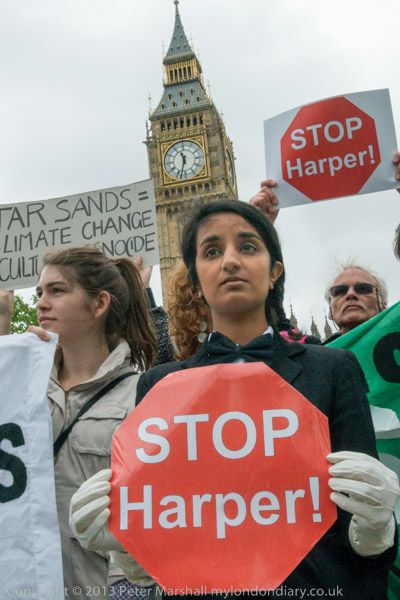
Canada Day came to London a couple of weeks early. Although there are some celebrations taking place around Canada House as I write on July 1st, on 13 June we had not one but two protests against Canadian Prime Minister Stephen Harper taking place in Westminster.

It should be a matter of national shame that Harper was invited to address our Parliament when he came over on a lobbying mission to try to force Europe to take Canadian tar sands oil, the dirtiest of dirty fuels.  Producing a barrel of tar sands oil creates three to four times more climate pollution than producing conventional crude oil in Canada or USA, and the amount already approved by the Canadian government for extraction in Alberta is enough to push the planet past the 6 degree global warming catastrophe level. And on top of that there area huge direct environmental effects, as well as tragedies for the indigenous population of the areas being devastated.  Exploiting the tar sands presents a threat to the future of human existence that is hard to exaggerate and impossible to deny – all for the sake of short-term profits of the oil companies.

I didn’t find it an easy event to photograph, or perhaps I wasn’t at my best. I’d arrived a little late a few minutes after the event started which perhaps just didn’t help, and just  as I arrived a photographer had started organising the protesters for a group picture, which seldom helps me – but perhaps he was desperate for an idea too.

I didn’t actually take a photograph of the whole group, partly because I seldom if ever find such things interesting, but here a row of ugly flagpoles in front of it didn’t help. I did try going back, but then there were too many photographers and other people in the way. So I’ve got a few little bits of the protesters in front of Big Ben. One or two aren’t bad, and press photographers only want one, but I like things to be happening and some kind of story to tell.

Perhaps I was just having an off day, but there are some times when I never quite seem to settle and find a subject that really interests me visually. Perhaps I need to try harder. Or I should have got out the 10.5mm, which stayed firmly in my bag. There does seem to be something about looking through that which makes me see differently, and I think engages me more in events, even if I don’t always get good pictures with that lens.

I’d actually got there earlier – a few minutes before the start time – to find nobody around, and wandered a little around the area. I saw what appeared to be a protest a couple of hundred yards down the road and went to investigate.  These people didn’t look like your normal protesters.

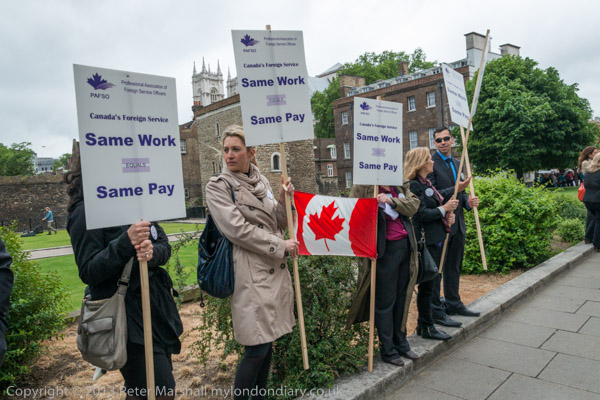
They were members of Canada’s Foreign Service, members of the Professional Association of Foreign Service Workers, aggrieved because they get paid less than some others who they say do the same work.  Perhaps you get more if you are a spy? Spread out along the edge of College Green they were at least on the route that Harper came to Parliament. They told me they thought he would arrive very soon, and I hung around a few minutes before giving up and going back to the Tar Sands event – where by now I was just a little late.

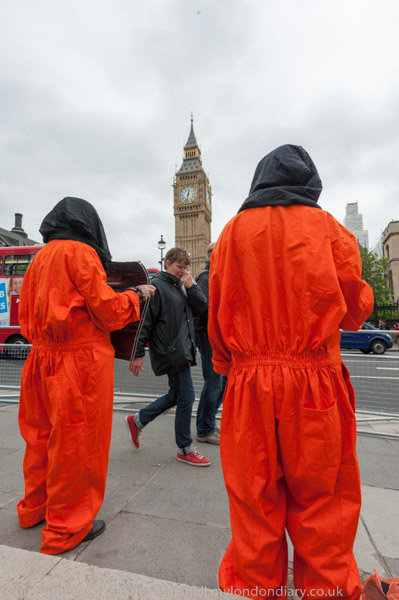
By the time the Tar Sands protesters had decided to go, the daily shift for the Save Shaker Aamer campaign had arrived, and I spent a few minutes talking to and then photographing them.  Without great results, though I rather liked the red shoes of a woman walking past.

More pictures from all three protests:

Harper, we don’t want your dirty oil!
Canadian Foreign Service Protest
Shaker Aamer Daily Vigil Continues.


________________________________________________________

My London Diary : Buildings of London : River Lea/Lee Valley : London’s Industrial Heritage

All photographs on this and my other sites, unless otherwise stated are by Peter Marshall and are available for reproduction or can be bought as prints.

To order prints or reproduce images

________________________________________________________

Police Go Over the Top

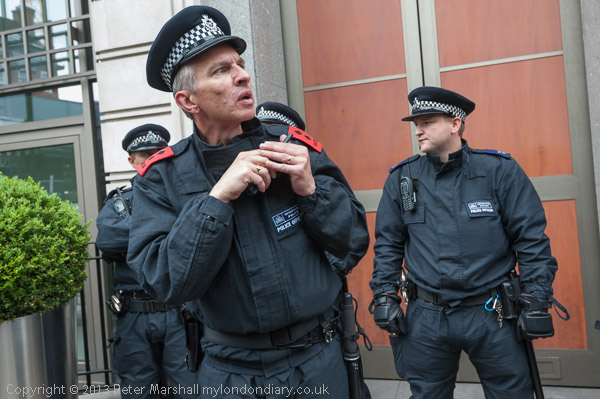
There are times when the police reaction to protests is so clearly disproportionate that even they seem shocked by it – or perhaps by the public reaction to it.

Despite the occasional efforts of the ‘black bloc’ at protests here we don’t have a great tradition – at least not recently – of violence by protesters at protests. Almost all of the incidents in recent years, for example during the student protests in 2011, were either provoked by police attacks on protesters or probably engineered by the police actions, aided by undercover police.

A few of them have been caught out, with incriminating incidents captured on video as ‘agents provocateurs’ flash their warrant cards to their uniformed mates to get through police lines or evidence comes out in trials and otherwise. Much that was already known or rumoured in activist circles about undercover policing has come out into the wider media in recent weeks, along with some new information, particularly in The Guardian, who have also revealed that police have records on around 9,000 political activists in the UK, despite the fact that they have committed no crime. Being a political activist seems to me to be a civic duty rather than a reason for the police to keep tags on you (or me!)

Several times in the past few years senior officers of the Met have given interviews to the press in advance of protests spreading rumours of violence and mayhem, drumming up panic which they then use to justify draconian police measures. Ahead of one protest they spread rumours that protesters would use catapults, and on the day thoughtfully provided these dropped in the area in a black bin bag.

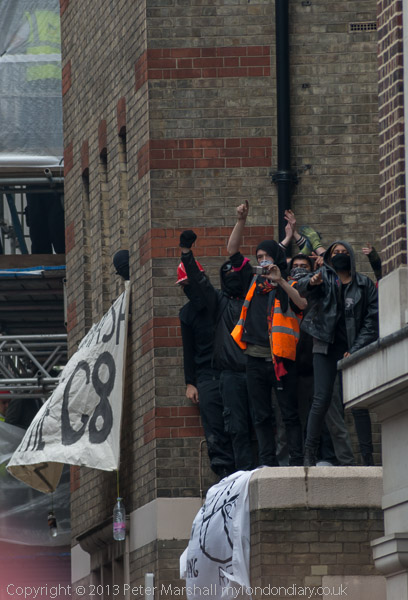
The police rationale for the huge exercise against a squat in Beak St, Soho on the morning of the first day of four of activities ahead of the G8 seemed particularly lame, even to the tamer of the media outlets. That there were rumours that some activists might be intending to use paint or paintballs seemed hardly a justification for closing down a large area of London with hundreds of police, and for the violent storming of the social centre that was acting as the ‘convergence centre’ for the protests.

Not that I approve of protesters throwing paint – and particularly not at me as happened in March 2011 while I was photographing the protests on Oxford St. But both the manner and extent of the police action seemed completely over the top, though like the rest of the press I was kept well away from the action. There was a small press area along the street east of the building, too far away to get any real view of the action. The public were being allowed roughly the same distance to the west, and from there you could see just a little more.  But the picture here was still taken at the long end of the 75-300mm using DX format – a 450mm equivalent lens.

Of course there are good reasons why the press – and the public – sometimes have to be kept back from events. Here it seemed to me more about trying to prevent people seeing what was happening than public safety or getting in the way of the police.

Since it seemed unlikely I had any real chance of seeing anything worth photographing I moved away an joined those who had managed to make it to Piccadilly Circus for the ‘J11 Carnival against Capitalism’. On my way I saw a number of people being searched on the street. One woman had just been put in a police van because a pen had been found in her handbag.

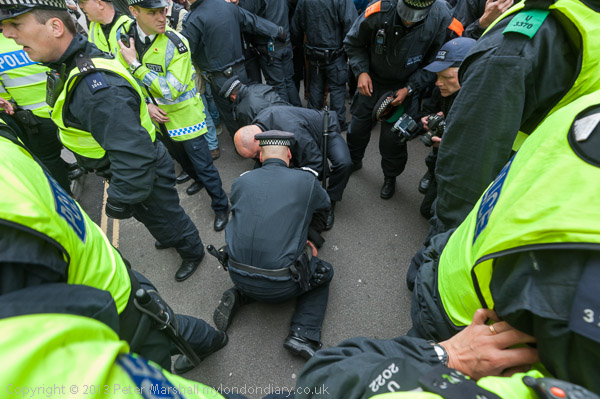
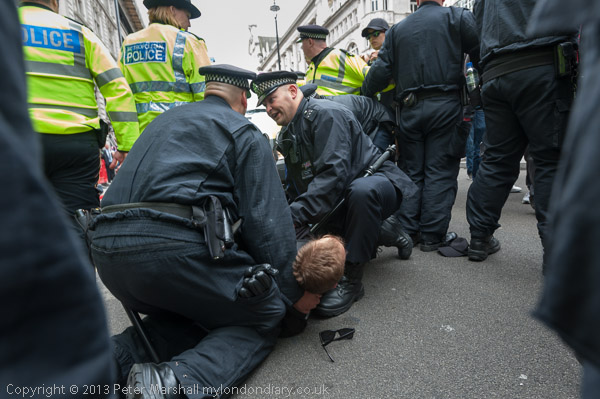
As the protesters walked with a samba band down Piccadilly, groups of police rushed into the crowd and grabbed a couple of them. Other protesters tried to grab them back from the police and there were scuffles, and police formed a ring around one of those who had been grabbed. he was on the ground and two officers appeared to be greatly enjoying punching him, but a senior officer pushed me back as I tried to get a clear view and photograph what was happening. I moved a little around the ring and managed to get a picture holding my camera up over the police heads before being pushed back. The police really did not want people to see what was happening. Eventually I went down on my knees and managed to get a picture between the legs of two of the officers before I had to move away.

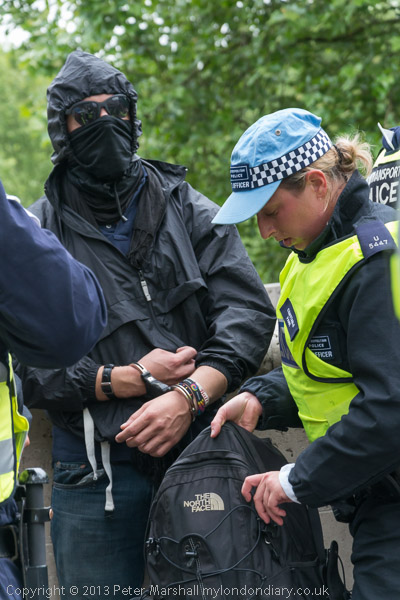
Elsewhere officers were threatening other protesters with arrest, and some of them ran down a side-street. There followed a chase around some of the side-streets of Mayfair, with again police grabbing a protester and making an arrest for no apparent reason. Eventually we emerged by Green Park Station and there were further searches and arrests. Throughout all this (and afterwards) as I report in J11 Carnival against Capitalism, ‘I saw no attacks on property and no unprovoked violence by the protesters.’  There was a great deal of shouting and some name-calling directed against the police, but all of the actual physical scuffles began when police grabbed a protester.

Later in the day the police seem to have calmed down a little and perhaps orders had gone out to stop harassing the protesters. They stood and watched and didn’t interfere as the protest continued on Piccadilly, on then Regent St.

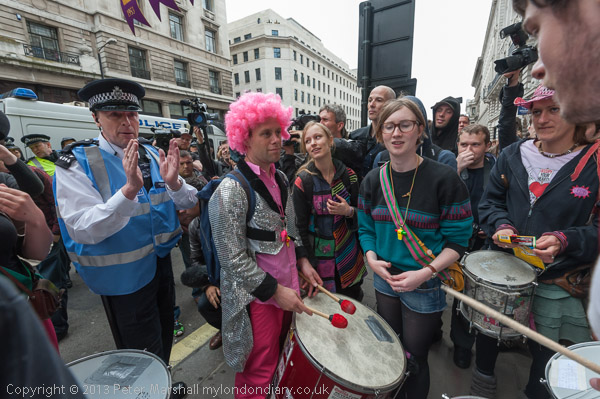
There was a little moment of farce as a ‘Police Liaison Officer’ came and warned the samba band they were breaking a City of Westminster bye-law by playing music on the street without a licence as they protested outside the offices of arms company Lockheed Martin (above),  and a few minute later police seemed close to panic as the protesters approached BP, but  really there was not a lot happening.

It seemed time to go home, and I did.
Continue reading Police Go Over the Top

Health & Safety Photocall

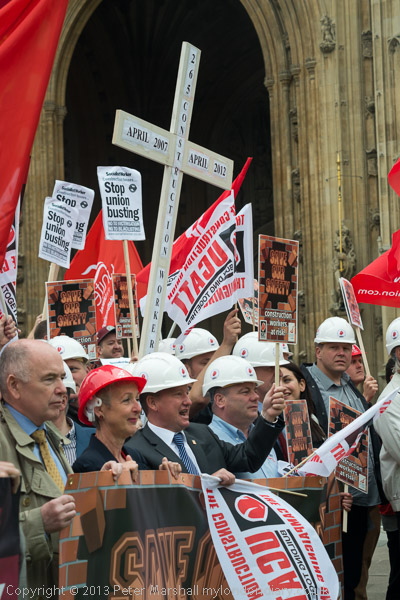
I’m not a fan of photo-calls, or of the kind of over-organised images that photographers tend to take of them, where someone – a photographer or a PR guy – has carefully arranged a group of scene for a row of photographers who simply snap what has been produced for them.

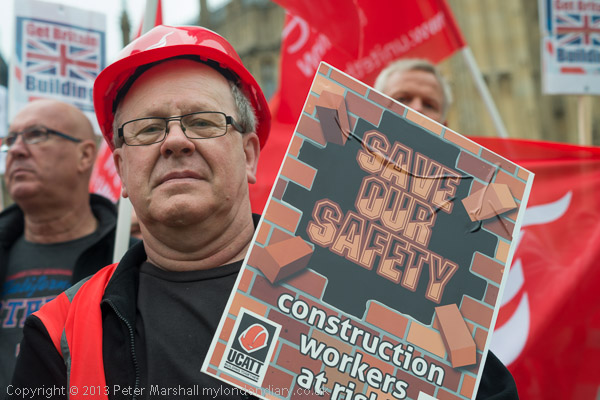
One thing that was different about this one was its subject – against the government dismantling of much of the legislation and inspections that keep most workers safe at work, though even with them in place we still see too many workplace deaths. It is a misnomer to think of these as accidents at work; almost all of them are predictable and preventable if proper safety rules are observed.

The second thing was that there was no row of photographers – only three of us had turned up (four including a guy with a video camera), despite the normal press releases to all the media. Deaths at work are generally simply not news, because they happen to ordinary working people and not to celebrities.

One of the other photographers was I think working for one of the unions involved, and they probably wanted the kind of group picture that they had set up, although I’m sure that wasn’t all he took.

I didn’t really manage to get the kind of pictures that I wanted, though a few (there are more at obby Urges ‘Save Workers Lives’) aren’t too bad. But for me the strongest visual element was the cross, with its message ‘265 Construction Workers’ who were killed at work in the five years between ‘April 2007 and April 2012’, and although I tried a few times (including some not on line) I didn’t really get what I wanted.

Continue reading Health & Safety Photocall

Naked Cyclists

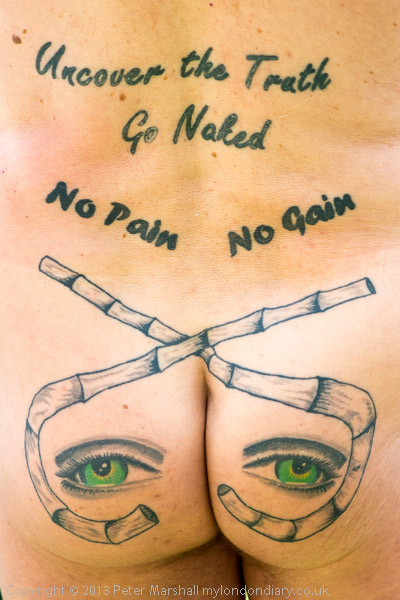
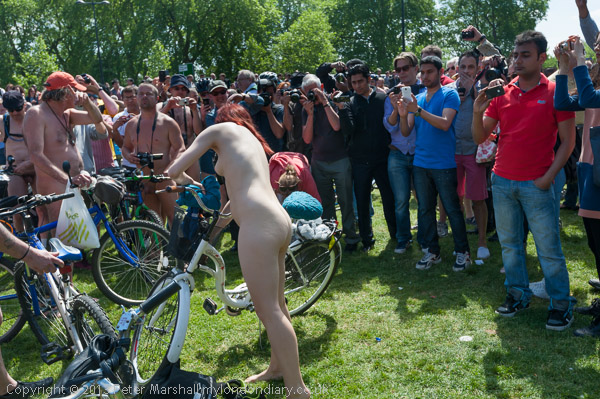
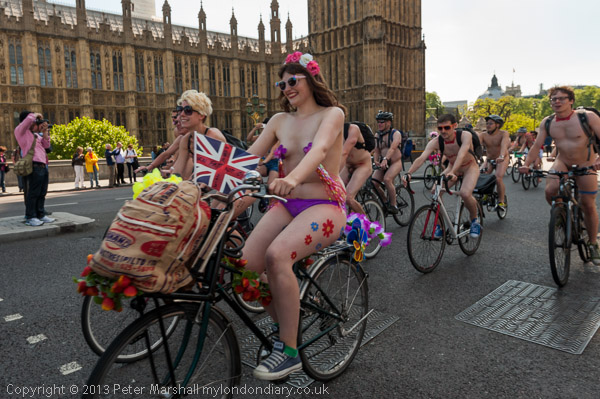
I wasn’t having a good day, and photographing the London World Naked Bike Ride turned out not to be a very pleasant experience either. Not because of the majority of the riders, but because of the unpleasantness of just of few people concerned. There has always been a small minority of those involved with the event who have had some very odd attitudes to photography – and today I met several of them.

I’ve photographed the naked ride through London most years since I first became aware of it in 2006, and still find it a rather curious affair, something between a protest and a bit of fun, attracting some strange characters both among those taking part and those watching.

If you decide to take off your clothing and ride a bicycle through the tourist-packed streets of London, you obviously expect people to notice you, to look at you and nowadays when everyone has a camera of sorts that means most of them will photograph you. There wouldn’t be much point in it as a way to protest unless this was the case. So for some people associated with the ride to harass and insult photographers seems rather odd.

There seemed to be rather more of this going on at Marble Arch than I’ve experienced in previous years, though I had no problems with the riders I photographed. But even before the event started, I’d photographed one of the event stewards having some kind of fight with a largish group of young people who independently had picked the same location for an Internet meet-up. Then there was a truly weird character walking around with a video camera standing in front of photographers and recording them.

With hundreds of people all trying to take pictures it does get difficult to work sensibly. At the start a man standing next to me kept easing his way in front of me and holding his phone camera out in front of my lens, while other people simply squeezed in front holding up their phones.

There did seem to be rather more problems this year, perhaps because rather than a single starting point the riders were split between five, and there was less organisation than in previous years. Marble Arch was probably not a great choice, with so many tourists around, and while starting through the centre arch was a nice idea, it wasn’t too practical because it was too narrow and led into an area of heavy traffic. What really should have been a mass start took more like 45 minutes.

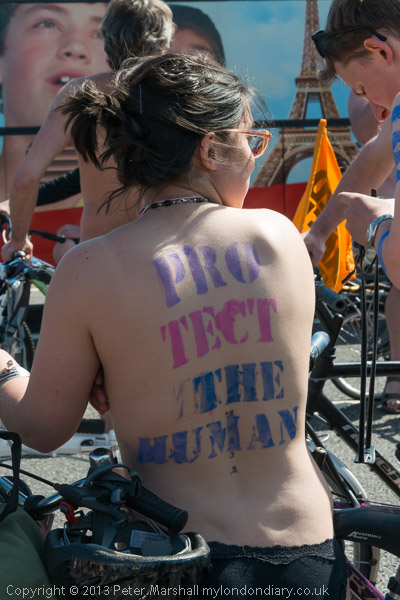
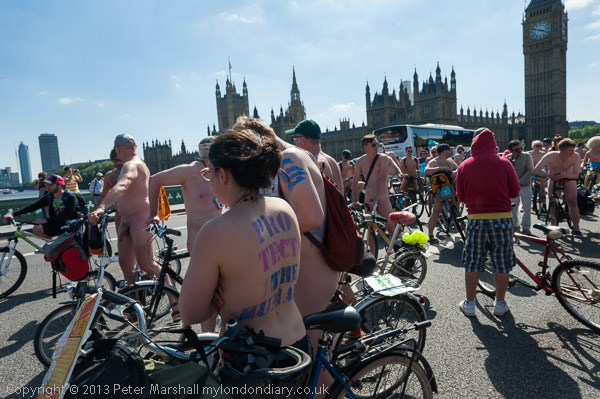
I took the tube to Westminster to photograph the ride as it came past the Houses of Parliament and Westminster Bridge. The first large group of riders stopped there for a few minutes, mainly I think to take photographs of each other, and seemed happy for me to take some too. At one point I did get a slight shock when I found the Eiffel Tower appearing in the viewfinder.

But I blinked and it really was London after all.

I wasn’t particularly happy with the pictures I took this year – I think I’ve done rather better in previous years.

There are still some problems with publishing nudity, and perhaps this year I spent a little too long trying to get saddles and handlebars into suitable positions to make the images more widely publishable.  And although it would be hard to take pictures that anyone sensible might object to, I still felt it a good idea to put a warning on the web pages that have the pictures. The pages load with the title and a large amount of white space with the line of text:

These pictures include some nudity – don’t view them if this might offend you. Click here to see them or go back to june main page)
Continue reading Naked Cyclists

G8 & Hunger

The Saturday before the G8 meetings in Ireland I went to two events about World Food supply and hunger. The first was outside the landmark Unilever House at Blackfriars where David Cameron was talking to a carefully selected audience and pushing the G8’s special initiative launched in 2012, the ‘new alliance for food security and nutrition.’

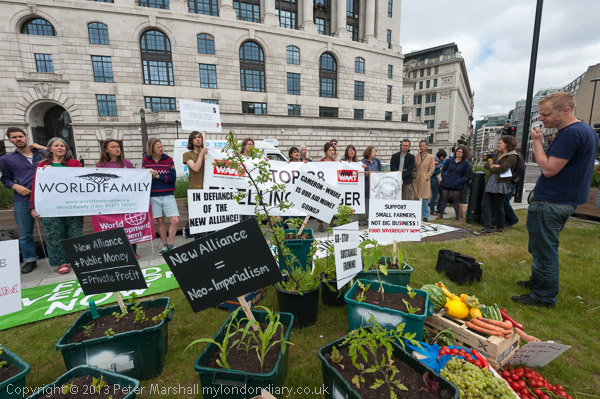
Outside were a group of protesters pointing out that while this was very good for Unilever, Monsanto, Cargill and the other global agribusinesses it was terrible news for African farmers, and the people of Africa, resulting in huge land grabs, much of the output being for biofuel or food exports, and a move of people away from the land to the city slums. The protesters argued that what is needed is not ‘food security’ through making agriculture profitable for large companies but ‘food sovereignty’ which “puts the people who produce, distribute and consume food at the centre of decisions on food systems and policies, rather than the demands of markets and corporations that they believe have come to dominate the global food systems.”

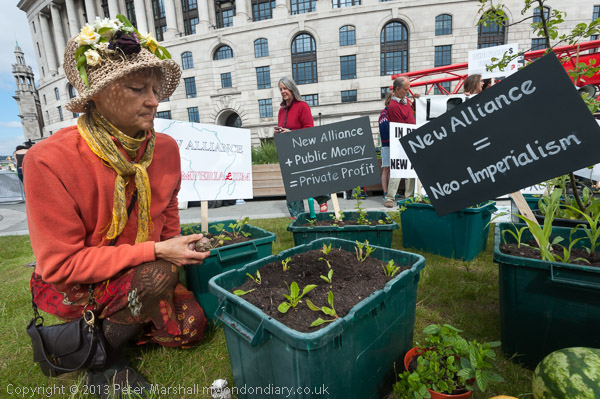
The protesters had brought with them plants in boxes and fruit and veg to form a ‘garden’, along with a lot of placards and banners, and visually it was rather a mess, as I think this picture shows.


‘visually it was rather a mess’

You can see at No to G8 New Alliance on Food Security how I told the story in pictures, and there was one which – at least for me – stood out as a better picture – and you can see it at the top of this post. Of course I didn’t pose it, though the woman I was photographing was clear I was photographing her. Often people do stop and pose, but I tell them to get on with whatever they were doing (I try to avoid saying “act natural”, surely an oxymoron) but after a while people do just ignore you.

It would perhaps have made a slightly better picture had she managed to be natural while putting out the plants into the container, rather than just after when she was planting potatoes, but neither she nor I had quite got our act together in time. But there are several things that help it. There are the green plants in the container, put in the foreground to emphasize them. The three placards although all different all clearly tell a similar story about the ‘New Alliance’. Most important of course is the woman at left, and her red jumper and hat with flowers and her yellow scarf are the main visual interest.

I wasn’t using flash, which perhaps would have made processing this image a little easier – and it did need some work (which I hadn’t done very carefully in the rush to get this image on-line.) Straw hats are a problem in sun, overlaying the features with a shadow and sun grid which I’ve had to tone down. Often this means zooming into the face and burning down the sunny areas, then lightening up the whole of the face to get more detail in the shadow areas.

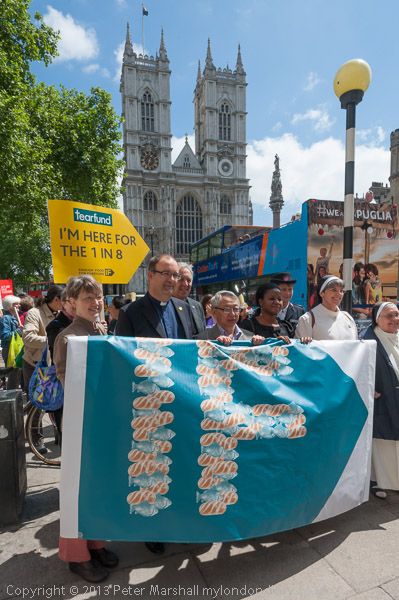
The groups and charities involved in this protest were critical of some aspects of the other much larger charity event around the same problem, the Big IF, which was taking place in Hyde Park. Since the main part of this appeared to be to construct a large display to be photographed from above and I didn’t have a helicopter handy, I wasn’t particularly keen to photograph this, even though my wife and some friends were taking part. But I’d promised to take a picture of them on the ‘solidarity walk’ from a Big IF church service in Westminster Central Hall to the main rally in Hyde Park.

After taking the picture above (or perhaps another like it), one of the other  photographers taking pictures at the event, I think for one of the charities involved, came up to me and thanked me because I had alerted him to the rather large building that made a nice background to the image.  Well, it was nice to be thanked, rather than just the more normal shoulders that suddenly appear pressing on both sides of me when I’m taking pictures, but it was just a little surprising.  It’s something that to me seems so obvious as to be unmissable.

It seemed to me a wasted opportunity that this wasn’t a proper march, and any impact that several thousand people walking through London might have had was missed by staggering their starting times, keeping to the pavement and taking a longer than necessary route along the back streets to reach the destination. And I was also a bit annoyed because even though I arrived at the starting point twenty minutes before the advertised time, they had already started on the walk.

It really would have been more sensible to hold the service in the open air in Hyde Park before the rally. You can see some of the pictures I took on Big IF Solidarity Walk, although not that of my wife and a couple of friends, which is on another web site – it wasn’t a good enough picture for me to want to include it on My London Diary. Some of the people I photograph really are uncooperative!
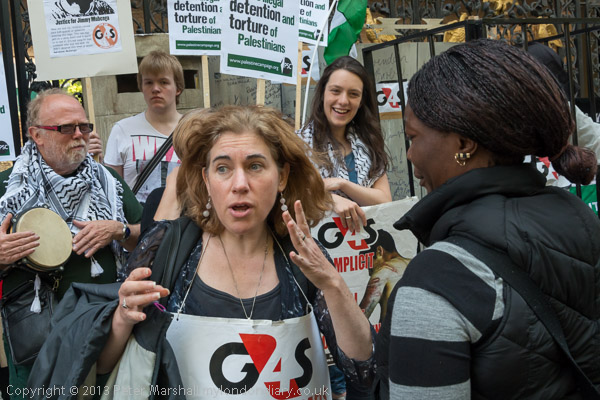
G4S = ‘G$S’

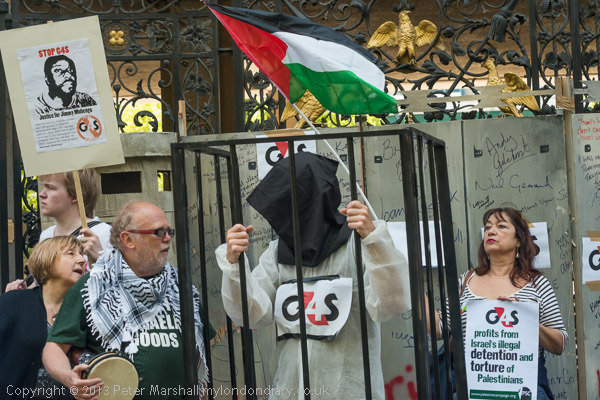
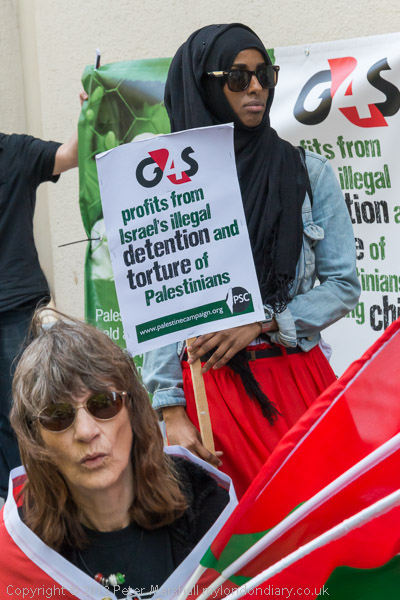
It was security guards again the following day, or rather the company that employs many of them – though couldn’t find enough for the Olympics, and don’t provide them for the University of London. But they do provide security services for the Israeli government to keep Palestinian prisoners in Israeli jails, mainly without charge and in defiance of International law. And they did employ the 4 men in whose hands Jimmy Mubenga was killed on a forced deportation flight from Heathrow.

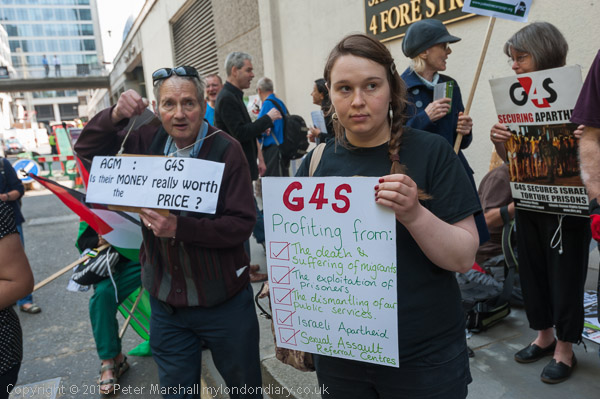
And a few other practices many of us find morally indefensible, as one placard listed. It perhaps isn’t inappropriate that most times I try to type their company name it comes out as G$S rather than G4S.

Central London at the moment is full of building sites, and the first three sets of steps I tried to go up to make my way to Salters Hall where their AGM was taking place were all blocked off; eventually I got there by pretending I was a car rather than a pedestrian and walking on a main road past another blockage. The City doesn’t seem to be suffering much from the current recession, despite having caused it.

By the time I arrived, with roadworks holding up and diverting my bus, I was a little late and missed the start of the event. The protest was perhaps just a little confused with several different groups taking part, and the Palestine Solidarity Campaign’s Apartheid Wall and prisoner in a cage were rather tucked away behind the other protesters.

It was all a little crowded, with police keeping the protesters off the road, and in this part of the city around the Barbican there isn’t a great deal of pavement, as pedestrians were planned to be segregated from traffic at first floor level on the walkways there – you can just see one of the walkway bridges at top left in top image above.

I tried my best to find something but wasn’t too happy with the results. Plenty of pictures that were OK, but somehow I couldn’t fit things quite into place, the magic just wasn’t there.

Looking at the pictures at Outrage outside G4S AGM I don’t think it was for want of trying. Some days things just don’t work out as well as others.

________________________________________________________

My London Diary : Buildings of London : River Lea/Lee Valley : London’s Industrial Heritage

All photographs on this and my other sites, unless otherwise stated are by Peter Marshall and are available for reproduction or can be bought as prints.

To order prints or reproduce images

________________________________________________________

Photography, I’m a believer

Having spent a little time reading Charlotte Cotton‘s Nine Years, A Million Conceptual Miles written for Aperture and published on page 34 of the Spring 2013 issue #210*  (if your copy isn’t to hand you can read it on line here) I decided that she and I have such different perceptions of the medium that there is probably no way we could engage. But I think that the paragraph in which she writes:

“… the very mechanisms of the medium’s dissemination—publishing houses, museums, commercial galleries, and art schools—that could be seen as having won the good fight to legitimize photography as a contemporary art form with its own medium-specific history are becoming part of the problem. These structures, with their gamut of agendas, unwittingly risk placing a stranglehold upon the evolution of the medium.”

is truly a key one. The things that she names are truly “placing a stranglehold upon the evolution of the medium“, and that stranglehold is exactly what she goes on to describe as “something magical beginning to happen“. To me the work that she describes lacks real photographic interest, although sometimes it may be mildly amusing. And it is cluttering up galleries that could be exploring the great and still developing wealth of photography.

For me that “medium-specific history” – what I prefer to call a tradition (history relegates it to the past) – is still a thriving and growing one, and growing to some extent through some of the mechanisms she goes on to describes, including the ease with which any photographer can now self-publish. Blurb (and others) has perhaps done more for photography over the last decade than a MoMA which lost any direction after Szarkowski (and almost any direction is better than none for an institution.)

But “the very mechanisms of the medium’s dissemination” have been even more radically changed by the growth of the web. It’s something I deliberately set out to play with in my own primitive way  in 2002 when I began ‘My London Diary’ though I make no great claims for the result. Like Cotton I think we have a “beautifully complex medium …” which “has been since its conception, a fabulously broad church” but unlike her I don’t feel its story has already been told.

Photography, I’m a believer.


* You might also like to read photographer Thomas Ruff’s Photograms for the New Age in the current Summer 2013 issue.

Continue reading Photography, I’m a believer