Street Isn’t Documentary

I’ve just read a rather nice essay by Evangelo Costadimas, Why Street Photography is not Documentary Photography on the Street View Photoography site, which examines the question of why street photography is so often confused with documentary photography.


Notting Hill, Peter Marshall

As he writes: “Street Photography does not concern itself with the Truth.” In fact it is largely concerned with making fictions, using a particular viewpoint or timing to create an image that misrepresents the subject.

But he goes on to write: “Street Photography concerns itself with Life” which I think is misleading. It doesn’t “concern itself” but uses life as subject matter. Usually if it concerns itself with anything it is with the reactions of the photographer and of a community of street photographers to the particular image that has been created.

Winogrand, used as an exemplar,  in some ways was not a street photographer, because his work was often if not always about wider issues of life in America, whereas much street photography is about ‘Oh what a clever and witty photographer I am.”


Peter Marshall

As I read that essay, I came along a piece of work by a photographer I know in London, Julio Etchart, a documentary photographer. In a way it isn’t special, just another typical example of his fine documentary work. But Muslims celebrate Eid Mubarak by the East London Mosque in Whitechapel is a good example of documentary photography on the street rather than street photography. Its’s important too that this is not a single image – documentary is always about project, about sets of images rather than a single picture – however fine some documentary images are, they always belong in a greater whole. The pictures made me wish I’d thought to get up early that morning and do something similar, but I live a little too far away and I’m not a morning person.


Whitechapel 1991, used on the poster for the London Street Photography show

The focus in documentary photography is always on the subject and on how you see it and what you can say about it. Street photography is about the photographer. I’ve photographed on the street for 40 years, was included in the book and  show London Street Photography, was inspired by the work of people like Winogrand, Tony Ray Jones, Lee Freidlander and others, but I hope I’ve never been just a street photographer.


Edgware Rd, Peter Marshall

________________________________________________________

My London Diary : Buildings of London : River Lea/Lee Valley : London’s Industrial Heritage

All photographs on this and my other sites, unless otherwise stated are by Peter Marshall and are available for reproduction or can be bought as prints.

To order prints or reproduce images

________________________________________________________
OMG Life But Not a Camera as we know it.

The name of the ‘OMG Life Autographer‘ is probably a pretty good sign that I am not the target audience for this device, decribed as ‘The World’s First Intelligent, Wearable Camera”, but it does look in some ways an intriguing device, though the images taken by Rankin on its web site really do less than nothing to make it appeal to me.

It seems to be a device to produce a photographic record of your day without the actual thought or effort of making photographs. It isn’t the first device that can do this, and I seem to recall artists who experimented wearing cameras set to take pictures at regular intervals way back in the days of film. And helmet cameras have really made such things commonplace. But the ‘OLA’ is at least rather less painful than ‘The Third I’ which involved New York University photography professor Wafaa Bilal having a 10Mp camera screwed into a “transdermal implant” on the back of his head and wearing it for a year (you can see some of the results on the web, and they are frankly exactly as interesting as you would expect.)

But Autographer claims to be intelligent, though it isn’t clear exactly what this intelligence entails, it does incorporate six sensors, including a PIR sensor which I think detects movement in front of the camera, as well an accelerometer which determines the wearer’s movement, and temperature, colour and compass sensors. It also keeps track of where you with GPS. But there are no clues on the web site as to how it uses any of this information to decide when to take pictures.

The images Autographer produces are 5Mp semi-fisheye, with a 136 degree angle of view, and are about as good as you would expect – this isn’t a camera for those concerned with image quality. There is an excellent  Quick Review on Digital Photography Review which has some sample images from London and gives a fairly detailed look at the device.

The image distortion is interesting, and is different from that of the two semi-fisheye lenses I own, the Nikon 10.5mm and Samyang 8mm. I removed the curvature at the edges by using the FisheyeHemi plugin in Photoshop by increasing the canvas width from 2592 pixels to 3592 (giving a rectangle on each side 500px wide in the background colour), then applying the  ‘full-frame’ version of the plugin before cropping back to an image rectangle, now around 2472 x 1936 pixels. With some noise reduction, correction of contrast and brightness and light sharpening, the images when reduced to web size –  perhaps  around 600×450 px, are just about acceptable quality. But I guess for most potential users, bad will be better, and they won’t be satisfied with the output until it’s been further freaked with Instagram.

Although usually it takes pictures without human intervention, you can tell it that you want it to be ‘active’, though apparently it waits for 10 seconds before it starts to take pictures when you’ve pressed the button. And you can stop it taking pictures by covering the lens with the bright yellow rotating lens cap. It is small, weighs around 2 ounces and is said to be stylish, which I think means black with a leather strap. Certainly you would feel less of an oddity wearing it around your neck or clipped to a jacket than wearing a helmet camera in normal situations.

Perhaps the most interesting thing on the web site is a whole page of Autography Etiquette, including advice to get the agreement of friends and family, to follow laws on photography and to respect the privacy of others. Though I suspect the most interesting images will come from people who ignore this!

Given that its 8Gb of memory can store 28,000 pictures, users are likely to have an awful lot of editing to do, and I suspect we will be inundated by masses of largely random images on Facebook, Flickr and other social media and image-sharing sites. It rather reminds me o those millions of monkeys randomly typing to produce the works of Shakespeare. One could see it as those Lomography walls taken to a logical conclusion. Of course just a few of Autographer images will have some interest but I doubt we will ever see them found from the haystack.

To Up or Not to Up?

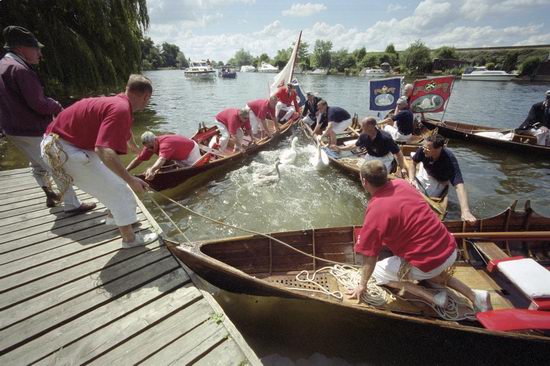
I was very much in two minds about going to see the swan upping this year. I’ve photographed in on quite a few occasions, starting on film in 2001, and I got my best pictures then or in the next few years I covered the event.


Swan Upping at Laleham in 2001.  Konica RF, Fuji film

Then it was easier, partly because there were fewer photographers and fewer spectators. Often I was the only photographer for much of the time, with perhaps two or three on the official press boat who usually arrived when the real business was over, having had to wait to be put on shore. The were often a handful of people who’d seen it happening and come to watch, some with a compact camera taking pictures, but seldom getting in my way.

In those early years I was even able to take some panoramic images with the Hassleblad X-Pan and the 30mm lens as well as images like the above, I think probably made with a 21mm on a Konica Hexar RF camera – a modernised version of a Leica M with power wind and decent auto-exposure, quite possibly the best film ‘Leica’ ever made, though not quite the build quality of the older Leicas.  The 2001 swan upping pictures start here.

Today taking the same picture I’d have at least one photographer poking his lens into the image on the left and quite possibly a guy holding his phone up next to the man in the hat – if not in front of my lens.  There just isn’t the room to work any more. I think it is all a small part of the attempt to make our royalty more popular, though perhaps a better gesture would be to give back the swans that Henry II stole from us in 1186 to the people. Though probably we wouldn’t want to eat them now.


Swan Upping 2004.  Nikon D100, Sigma 12-24mm

By the time I next went to the swan upping pictures in 2004, I was already noticing a difference, writing “i was the almost the only photographer who bothered to turn up three years ago, while today there was a press launch with a group of snappers and a film crew.” But I was still able to get some good pictures, like the one above, made with a Nikon D100 and the Sigma 12-24mm at 16mm (24mm equiv.) My bike had got there before the press launch and there was a line of photographers on either side of me, right along the edge of the bank so nobody could get in front of us. Despite being only 6Mp, this made a decent display print 2.3 metres wide.

Another thing that made it easier to work back then was that man in the hat at the left of the top picture. Those swans weren’t at that nice landing stage by accident, but because Eric – who I got to know a little as we cycled along the towpath together – had got there a quarter of an hour before the boats and lured them to a suitable position with some crushed digestive biscuits, first throwing larger lumps in their direction to gain their attention. He went ahead of the uppers on his bike, acting as their ‘spotter’ for the cygnets. This had the added advantage that most of them were attracted to the towpath side of the river for the uppers. Swans and cygnets do in any case have a certain tendency to swim on the towpath side, because that’s mainly where the public feed them.

Nowadays the spotting is done by the Queen’s Swan Warden Prof Chris Perrins  and his two assistants in a small boat with an outboard, who travel a little ahead of the rowers, and there is no luring to the towpath bank, so more are upped on the other side.

One advantage of being on the press boat is that you can get to either bank, and of course it involves rather less effort than riding a bike on the towpath. But almost always it’s better to be on a bike – you get there first. Of course you can also get a different view from the boat, but usually from too far away or from behind the uppers. The only part of the event I’d really prefer to cover from the river is the actual release of the swans after they have been checked, listed, weighed, ringed and measured and are carefully put back in the water.

One year I did apply to go on the press boat and got all the details fixed. Then a day or two before the event got an email saying sorry, there wasn’t room for me. As a freelancer working for a small agency I didn’t count when at the last minute more important people wanted to cover the event.  I’ve not bothered to apply since.

I’ve been most years since 2004, usually following the boats to Windsor, where there are still just a few things I’d like to do better than I have. Last year there was no swan upping because the river levels were too high,  and this year I wasn’t going to bother. But sitting at my computer on that hot summer morning I suddenly decided it would be a pity to miss the spectacle taking place less than half a mile away and jumped on my bike with my camera bag.


Swan uppers creep slowly in towards the birds on land. 2013

It’s always an interesting spectacle, though I didn’t really get any decent pictures in the hour or two I spent with them. The only cygnets on my side of the river were under the railway bridge, in deep shade with strong areas of sunlight, a contrast well beyond the ability of either digital or film (and I couldn’t use flash.)  The uppers did their business and rowed away across the river to the Swan Inn, and I got on my bike and rode home for my own lunch. I didn’t bother to go back and follow them that afternoon. Perhaps, if it isn’t so hot, next year.

Other pictures from this year- Swan Upping.  You can also see more from 2004, 20052006, 2007, 2008, 2010 and 2011.
Continue reading To Up or Not to Up?

Police Watch

I try not to get obsessive about the police. We need a police force of some kind, and some of the things that they do I’m thankful for, even though there are other things that I condemn. I’ve been rather glad that they were there when people have threatened to smash my cameras as I photographed them, or when a right wing crowd moved rather menacingly towards me. And there have been many other occasions when they’ve acted sensibly and professionally, as well as those others where their actions seem arbitrary and senseless. And at times downright criminal.

Of course I’ll try to photograph them when they behave badly, but equally I do my best to photograph when others attack them. But mostly I’m not at events to photograph the police except as they get themselves involved with those taking part.

But I was photographing a protest Against Undercover Police in Protests which was about police behaving badly. Police posing as protesters, living a life undercover infiltrating groups involved in legal protest. At times trying to persuade other protesters to engage in illegal acts, or starting and encouraging trouble at otherwise peaceful protests. Pretending to fall in love with other protesters – and some fathering children by them. Taking the names of dead children to produce fake identities.

Other operations like deliberately setting out to try and discredit witnesses such as Duwayne Brooks; beating up people who they claim are resisting arrest; ‘restraining’ people to death; shooting unarmed people and claiming they pulled a gun when the evidence shows otherwise; lying to protect colleagues and otherwise frustrating the attempts to investigate other officers; taking bribes and illegal payments for information and so on. It is a very long list.

Of course, not all coppers are bent and despite the song, not all are bastards, but too many are and too many get away with it despite their colleagues knowing. Just as there was (and to some extent still is) institutional racism there are other institutionalised faults in the police. But at least here in the UK we expect our police to behave properly and legally – in some countries it would be virtually unthinkable. Many of us do still feel a little surprise when we find our police behaving badly.

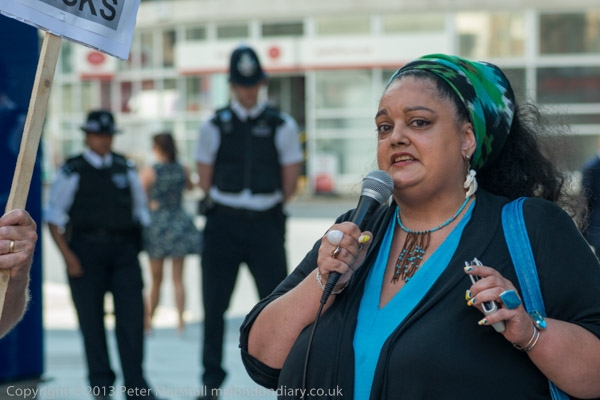
So I didn’t feel too bad about a little photographic exaggeration when I was photographing one of the speakers at the event, talking about police surveillance and harassment. Perhaps 20 yards behind her were two police standing and watching the protest, and it seemed a good idea to use a very long  lens to make them seem rather closer.  The picture above was taken at an equivalent focal length of 45mm – a standard lens.

Changing to 168mm gives a rather different impression, of the officers being much closer and I’ve also used a lower viewpoint so the male officer seems to be looking down on the speaker – Zita Holbourne of BARAC (Black Activists Rising Against Cuts) and the PCS union.

It is perhaps a little unfair, as I don’t think these two officers were actually taking a great interest in what was happening – I didn’t see either making a single note – though they had obviously been posted there to keep an eye on things.

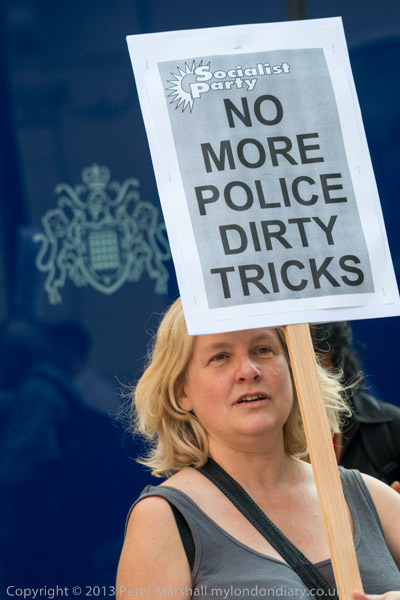
The protest was taking place in front of a wall of blue glass at Scotland Yard. I don’t think the police can see out through this, but I don’t know. It did reflect the protesters and it also had the police coat of arms at intervals, which I’ve brought out a little in the pictures, increasing the contrast a little.  The blue colour is significant too – the colour of the lamp which marked all police stations.

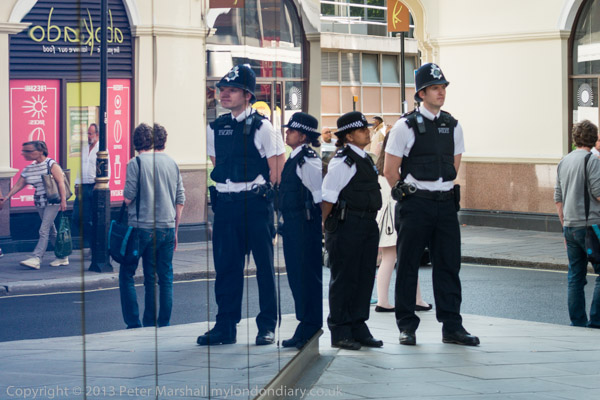
I couldn’t resist making use of that blue glass to suggest a solution to the problem of lack of police manpower. Again I’ve used a longish focal length, and have cheated a little in the post-processing, removing much but not all of the blue from the glass in the reflection at left and adjusting the contrast and brightness to almost match. It’s just a pity that I didn’t quite get the image pin-sharp – I think the focus was a little out. I needed to take it in a hurry before they noticed me and moved.

Continue reading Police Watch

Frederick Sommer

I meant to write earlier about a show that closes today, though since it was showing at the US National Gallery of Art, Washington, probably few of us would have gone to see it had I posted in time. Though of course I’m sure all of my readers within easy distance of the NGA will already have seen it.

The NGA has a long history of fine big shows of photography (and another on Charles Marville coming up at the end of September 2013, followed in March 2014 by the Winogrand show from San Francisco) but A World of Bonds: Frederick Sommer’s Photography and Friendships was one of its smaller offerings, a mere “twenty-seven photographs, prints, collages, and drawings” in one room and

Frederick Sommer (1905-1999) had some interesting friends, including Edward Weston, Max Ernst, Man Ray, Charles Sheeler and Aaron Siskind and had a philosophy that very much valued the sharing of ideas, and you can see something of the influences of his friends in some of his work, and of his ideas in theirs, in particular in some  works by Weston and Siskind.

The Art Blart review perhaps best gives a flavour of the show, with some comments by a photographer who visited Sommer as well as the author’s own comments, as well as some fine reproductions of images courtesy of the NGA. For something of a different opinion you can read a review of the show in the Washington City Paper. You can also see thumbnails of 59 of his works on the NGA site, though clicking to see a larger version of any seems to return an ‘image not available’ page. To see more of his work on the web the Frederick & Frances Sommer Foundation is the obvious place to go, and although the Catalogue Raisonne is still under construction it has many of his photographs already in place.

Many years ago, it was one of Sommer’s 1943 Arizona landscapes that came as a revelation to me (was it perhaps in the 1975 show at the Victoria and Albert Museum curated by Bill Brandt with Mark Haworth-Booth, ‘The Land’ – if not it surely should have been, though it was much later that Sommer gave them some images for their collection.) It made me aware of new possibilities in the photographic print and in creating a powerful image from seemingly highly detailed nothing much spread from corner to corner across the picture. It seemed to me a work that transcended conventional ideas about subject, foreground, background in favour of the whole field of view. I didn’t rush out and buy an 8×10 (or make much if any more use of the two 4×5 cameras I owned) but I think it did change the way I felt both about composition and about printing.

Later I read in Darkroom 2 (published by Lustrum Press  in 1978) about Sommer’s printing method using a ‘contour printing pack‘ , with a fine example by Emmet Gowin, Siena, Italy, 1975 Dedicated to Frederick Sommer: The Hint That is a Garden.’ Fortunately it was a book that sold fairly well at the time and is still available (along with the first volume Darkroom) second-hand at a sensible price for anyone who wants to know more about what is now largely a historic practice.

Sommer’s other work perhaps interests me less, though when I see so much of the more recent constructed art photography in galleries and publications I do so often think Sommer did it so much better years ago.

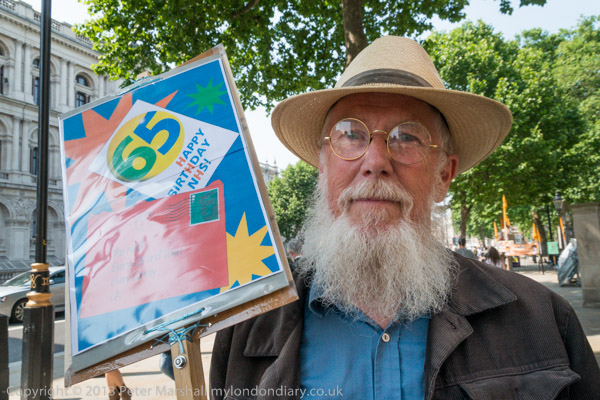
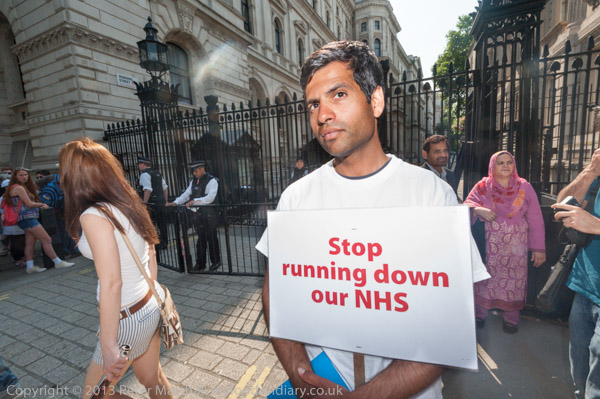
NHS 65th Birthday

I was one of the fortunate generation who grew up in the Welfare State, some of my earliest memories are of the path which led under a large Cedar of Lebanon to the clinic, where my mother took me to be weighed, measured and checked and to collect the free orange juice and (less welcome) cod liver oil.

The tree is still there, doubtless protected by a preservation order, but everything else has gone, and the NHS is rapidly being transformed into a service run for the private profit of large health companies rather than its only aim being to improve the health and welfare  of the people.

Ten years ago, after years of reasonable health, I desperately needed the NHS, and it was there for me. Nobody asked for my insurance plan or credit card details and I got the treatment I needed from dedicated and skilled professionals.

I can’t say everything was perfect – the hospital cleaning had been outsourced and two of the three hospitals in which I spent the best part of a month were filthy; there were obvious staff shortages at various levels; a glaring waste of money through the use of agency nurses and obvious inefficiencies due to poor management practices which, among other things doubled the length of my own stay in hospital – but I felt that I was in the hands of people who knew their job and were getting on with it as best they could despite some unfortunate interference from politicians (mainly but not just Tories) with no love for the system and shares in various aspects of private health care.  I’ve often felt we would get better health and education systems in this country if a condition of being in Parliament was that members and their families were obliged to make use of our national systems rather than pay as so many do for privileged treatment.

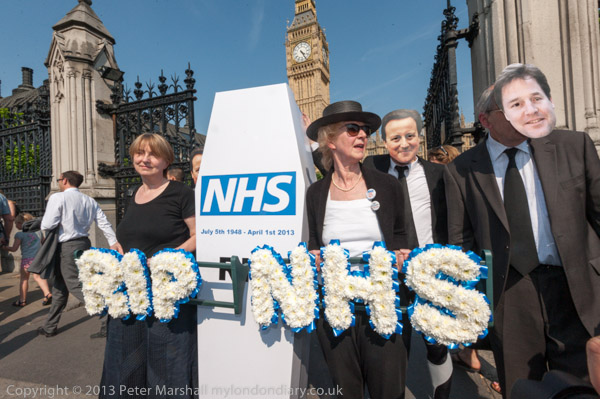
The current coalition government seems determined to undermine the NHS in any way possible and the 65th birthday seemed more of an occasion for a wake rather than celebration. So I had great sympathy with the National Health Action Party’s mock funeral procession, though I’m less convinced that the party has much hope of electoral success – except in a very few areas.

Photographically I wasn’t too happy with the results I got, partly because many of the images taken with the 16-35mm were ruined by an area of softness and flare. I think it was down to the weather, the hot afternoon sun on the black lens barrel vapourising some residual water left in the lens from our month of rain which then condensed on the less rapidly warming large chunks of glass in this heavy optic and was very slow to clear. Mostly it was hardly noticeable in the small viewfinder image, and I took quite a few pictures before realising there was a problem – and that it was inside the lens.

The above image shows it clearly because of the flare – the late afternoon sun was only just out of frame – and lens hoods are not very effective with wide-angle zooms. It also shows a second problem (even after quite a lot of post-processing) which was that the SB-800 flash was misbehaving.  It sometimes just seems to ignore all signals from the camera and fire at full power whatever, but always behaves itself when I test it! Cleaning the contacts on the flash and camera sometimes seems to help, but I think it’s something more basic.

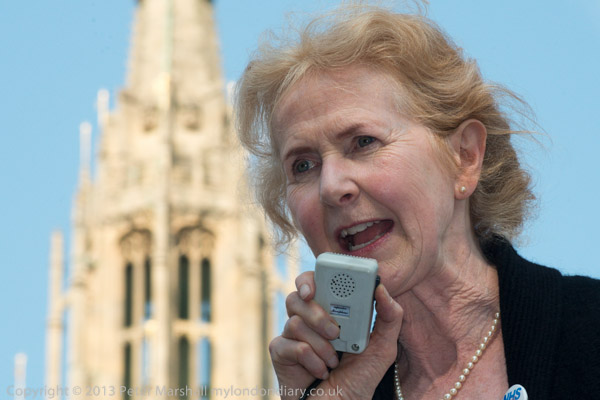
But the 70-300mm proved useful in getting images of the speakers, though I was less good at getting down everyone’s name. Whenever I think to myself ‘I’ll remember that’ it is disastrous, and even if I record sound, names are so often not pronounced clearly and can be impossible to spell. In the absence of a decent press release I should always use a notebook and ask to check. But I didn’t.

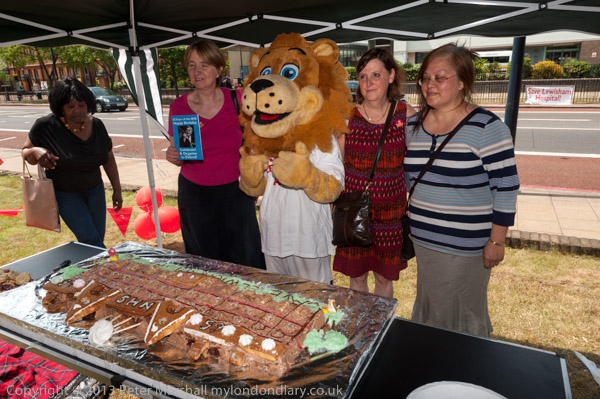
One speaker I didn’t need to ask about, as I’d photographed her earlier in the day at Lewisham, and should Save Lewisham Hospital Campaign‘s Chair Louise Irvine chose to stand for election for the National Health Action Party I think she would have a good chance of election. The campaign held a 65th birthday party opposite the hospital at lunchtime, where I enjoyed both some chicken curry and a small slice of the impressive Lewisham Hospital cake, though again I had reason to curse that misbehaving SB800 – and this image was one of its better efforts. In the picture she is holding a blue card with a picture of Nye Bevan and the message “65 Years of the NHS – Happy Birthday – Celebrate! Organise! and Defend!’ and we need to do all three.

________________________________________________________

My London Diary : Buildings of London : River Lea/Lee Valley : London’s Industrial Heritage

All photographs on this and my other sites, unless otherwise stated are by Peter Marshall and are available for reproduction or can be bought as prints.

To order prints or reproduce images

________________________________________________________
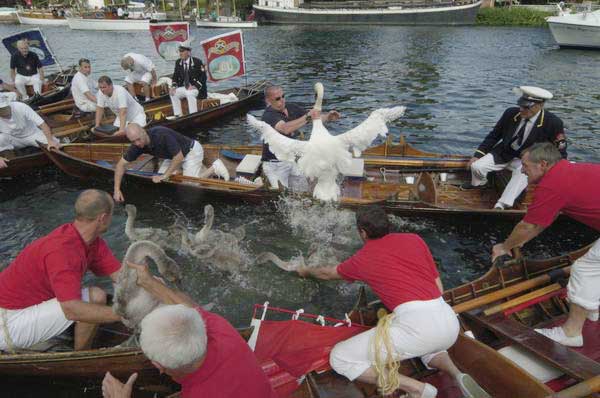
Dead End Bum Wiping

Two articles among many that relate to the future of photojournalism and documentary photography that I’ve come across in the past couple of weeks are David Hoffman‘s Dead End Streets: Photography, Protest and Social Control  and a series of questions by Charlie Campbell to the legendary Vietnam photographer Tim Page for Time World.

Tim Page’s Wikipedia entry makes interesting reading, and most of the legends about him appear to be true. His own web site contains some interesting work and together with Horst Faas he edited REQUIEM, a book and exhibition which is a memorial to the photographers who died covering conflict in Vietnam and Indochina.

Page, born in Tunbridge Wells in 1944, left England at the age of 18 to drive overland through Europe the Middle East and Asia, running out of money in Laos. He got a job with USAID and taught himself photography, becoming a stringer for  UPI and AFP.  In the Time feature, Campbell says to him

I’ve heard you comparing a degree in photography with a degree in “bum wiping.” Any advice for budding snappers out there?

Page’s answer is typically to the point:

Don’t. Being a photojournalist now is the most fraught way of making a living. I’m no longer involved in the news, but I do other type of work. To make a living as a photographer these days is impossible. I was there the other day, and there were 100 people with cameras, video cameras and iPhones. And where are you going to sell the pictures?

Hoffman‘s essay is closely thought out and more difficult to read, looking at how the changes in media have both reduced the impact of still photographs and the ability of photographers to make a living from photographing social issues.  As he says

When I began working as a photographer a single publication fee would keep me for a week.  Now it keeps me for perhaps three hours.

Photographers now have to make several saleable images a day to make a living (I think the number is rather higher than he suggests) and no longer have time to study issues seriously and work in depth.  What perhaps he doesn’t stress enough is the influence on the nature of images that ‘saleable’ implies.

He looks briefly at the promise of democratic access of Indymedia and Demotix, two very different organisations which enable at least a limited publication of work but he says fail to allow “contributors a role in shaping the audience and the context in which the work is presented.”  While agreeing with much of his criticisms, they are surely even more true of the traditional media, with both Indymedia and Demotix allowing contributors considerably more creative freedom – the only reason I still contribute through Demotix. And, as he says “open access agencies such as these that are providing the last remaining life support for independent street photographers.” Though it’s not much of a support.

Demotix is part of Corbis, which gives some of the pictures from it a wider circulation, but in general he is correct that “neither has much of an audience.”  Work posted to my own web site or on this blog generally gets seen by perhaps five or ten times as many people as on Demotix. Some pictures from Demotix get published around the world in traditional media, and I think it has had a rather more important role for many photographers around the world who don’t have even the rather slim opportunities that remain here.

The final section of the essay is about “the forces of the state subverting and hijacking the reportage photographer with a variety of tools and techniques” and is his usual penetrating analysis of the situation, particularly as regards the police.  He also talks about the mistrust of photographers by protesters, including examples from both Climate Camp and the 2010 student protests, though surprising omitting mention of the right-wing ‘fatwas’ and violence directed at us (and I’ve been attacked at protests by people who thought I was David Hoffman, as well as others who know who I am, and been with David when we have both been subjected to threats and abuse.) But I imagine he takes that for read. It isn’t a new phenomenon for someone who was a photographer for Searchlight.

His is a piece that ends with a gloomy conclusion, and one it is difficult not to share. He writes:

Whether or not the kind of documentary photography in which I have been involved will still exist in the future is not clear…  The ecosystem that once maintained those creating socially relevant work is all but gone and it’s far from clear what, if any, new support mechanisms might take its place.  

Photojournalists are an endangered species, their numbers shrinking, and once extinct they cannot be replaced.

It’s hard in a fairly short post to give a fair summary of a long and detailed presentation such as this, and I hope not to have greatly misrepresented his opinions. It is a piece worth reading and thinking about, illustrated with some of his fine images. You can see more on his web site.


Independence Day

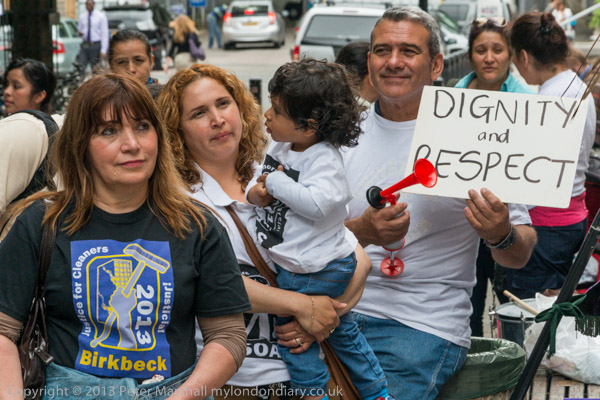
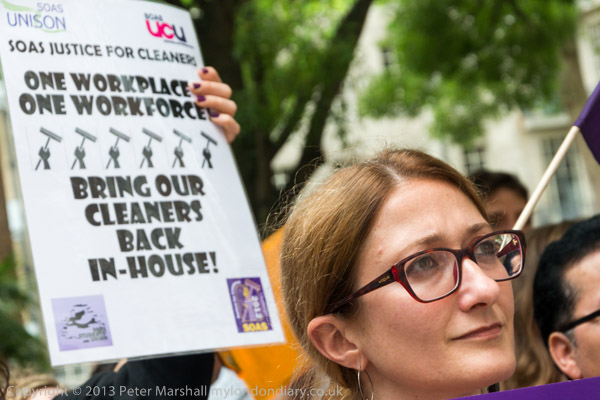
July has finally arrived for My London Diary, after some delays due to computer problems and pressure of work. I’ve already posted a couple of times about my visit to Hackney for a book launch, so the first new event in the month was SOAS Cleaners’ Independence Day at the University of London.  It was a fairly large protest for what is a relatively small institution, with a good crowd around the steps leading to the main entrance, but there wasn’t really a great deal to photograph, simply a crowd with various speakers, banners and placards.

The cleaners at SOAS get support from the students and academic and non-academic staff, with a long-running campaign for them to be directly employed by SOAS. There seems to be a very clear conflict between the principles and ethos of SOAS as an institution and the dubious employment practices involved in outsourcing work which is vital to the running of the place.

The slogan at SOAS is ‘One Workplace – One Workforce’, and the principle is that those who work there should all be treated with dignity and respect – not cheated over sick pay, pensions and holiday pay by employing them through a contractor.

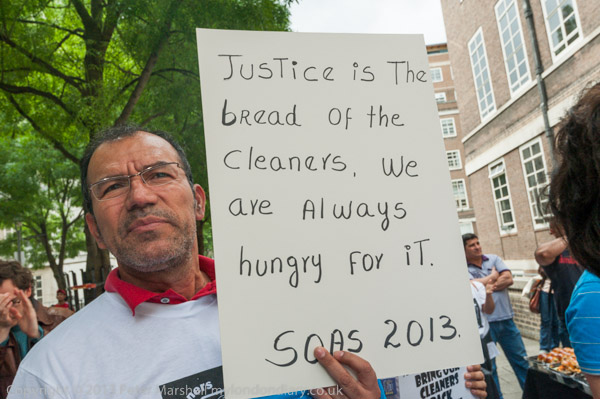
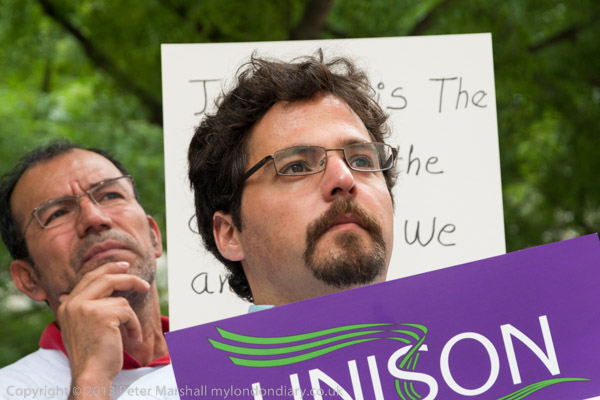
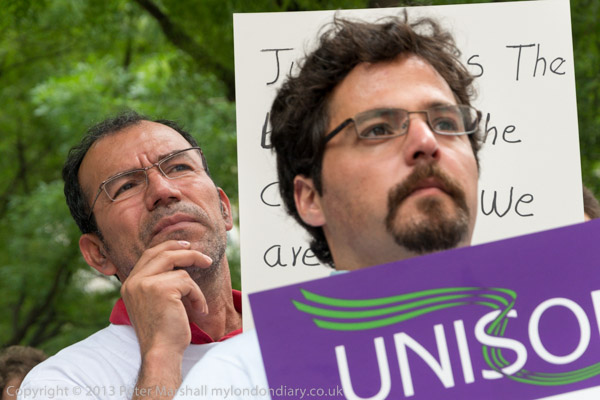
My pictures are mainly about the people taking part and their placards, and there were plenty of both to add some interest. The one above had an interesting message, but a slight difference in viewpoint presented a visually more interesting picture, but one that provided me with a dilemma. Here are the two versions of it that I produced within seconds of each other:


Right face sharp


Left face sharp

Both images were taken using an equivalent focal length of 147mm in DX mode on the D800E, and at ISO800 the exposure was 1/200 f7.1. With a long telephoto like this there was insufficient depth of field to get both faces sharp – I had to choose one or the other (though with these rather small images the difference is less obvious.) At the time I couldn’t decide which was better, so I took both. But I still can’t decide.

I could perhaps have tried increasing the ISO, giving myself a couple of stops more at ISO 3200, but even then I don’t think both could have been sharp. The image with the sharp face at left ends up probably as my choice, both because it somehow reads better from left to right going from sharp to unsharp and because the gesture with the hand makes that face more interesting. In favour of the other image, having the ‘Unison’ on the poster sharp (and more complete) is a plus.

Of course it would not be too difficult to combine the two images in Photoshop (despite a small difference in viewpoint and framing) and get both men sharp, but I think that would certainly be cheating if I did it as an afterthought. But perhaps if it was implemented in camera it would feel acceptable, but having done a quick job with a quick select, copy and paste, the result is actually less powerful without the differential focus.


Composite image to get both faces sharp – which I wouldn’t use

Focus stacking (or focus bracketing) at the moment for Nikons is so far as I’m aware limited to using specialised software with the camera tethered to a computer, and its obvious applications are for macro work. Canon DSLRs can use the cracked ‘Magic Lantern’ firmware. Getting it to work with the camera off-tripod even for relatively static subjects such as this would be tricky, and perhaps the occasions where it would be of use would not justify the effort.

You can see the rest of the pictures from the protest at SOAS Cleaners’ Independence Day.

________________________________________________________

My London Diary : Buildings of London : River Lea/Lee Valley : London’s Industrial Heritage

All photographs on this and my other sites, unless otherwise stated are by Peter Marshall and are available for reproduction or can be bought as prints.

To order prints or reproduce images

________________________________________________________
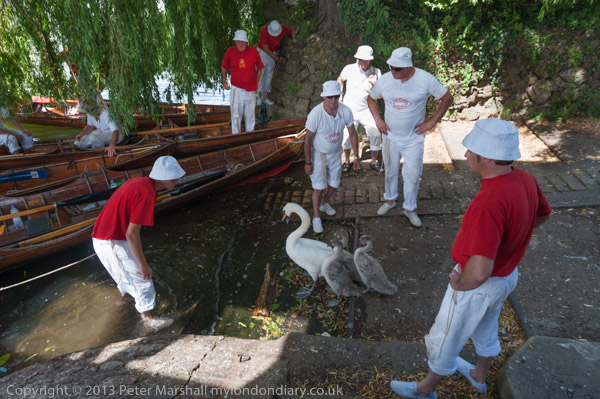
Deserted Royals for Sale

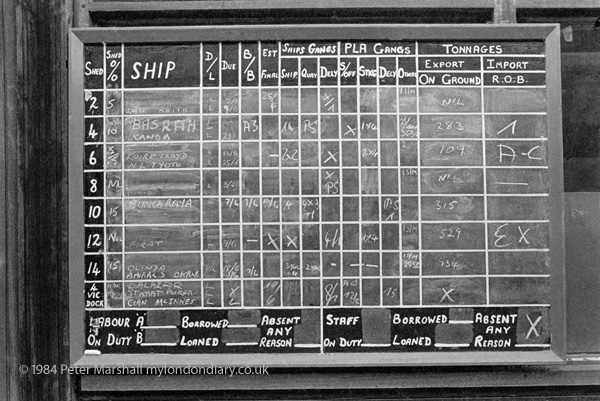
The last ships to be loaded and unloaded in London’s Royal Docks were still chalked on a board in one of the dock offices when I photographed it in the summer of 1984, although they had all left by October 1981, almost 3 years earlier.

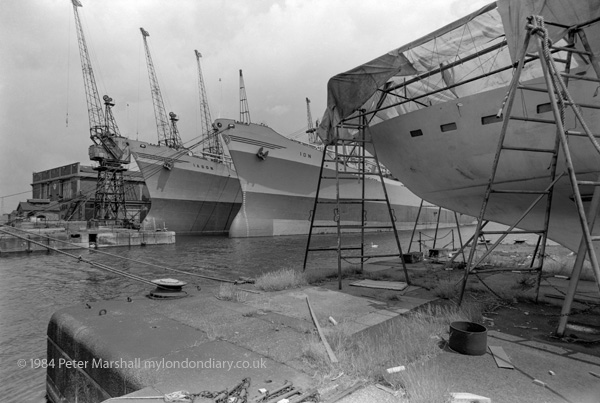
The docks themselves were virtually deserted, though there were still a few ships tied up, some stranded there due to financial problems with their owners, and a few smaller boats apparently awaiting repair or rusting to pieces.

One or two small businesses were still operating within the dock estate, but essentially the huge area of water and dockside was deserted, and in two days of photographing inside the fences that still guarded it I saw only two people.

One was a single rower practising on the 1.4 miles of open water of the Royal Albert Dock, who I’m not sure even noticed me as I took his photograph as he sculled up and back, the second a man working for a fork-lift truck company with whom I stopped to talk, and who posed for a picture. There were a couple of security guards for the whole site – roughly a mile and a half long and a third of a mile wide – and we talked briefly as they read my letter permitting entry – but they stayed in their office by the gate.

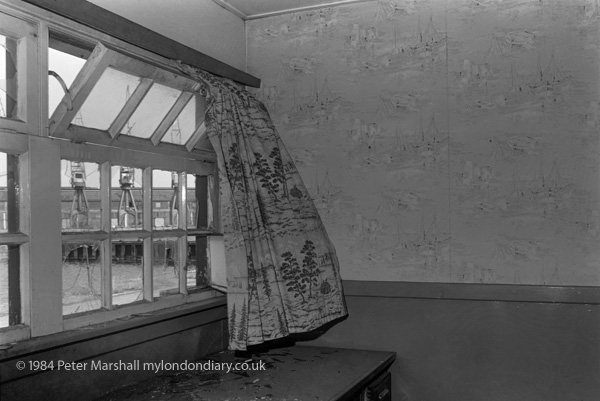
I wrote just a few weeks ago about photographing there in Royal Docks – 1984, and won’t repeat all that again, though I see I’ve chosen some of the same pictures to illustrate this post. The image above has a certain interest for me other than in the wallpaper with its ship design and the view of the docks with the curtain blowing in the wind, from a technical viewpoint. As you are probably aware from the shadow of the curtain it was taken with the aid of flash, something rare for me at the time.

Nowadays with the Nikon this would be so simple to do that about the only thing I would have to do would be to put the SB700 flash unit into the flash shoe, turn it on and press the button. i- TTL BL balanced fill flash would sort everything out automatically, and I would see the result immediately and perhaps tweak my standard -2/3 stop setting on the flash if I felt it necessary and retake the picture.

Back then, things were different. The Olympus SLR  camera I was using had a flash sync speed of 1/60 second. It was I think taken on ISO 125 film, so the first step was to take an exposure reading through the window for the outside scene and determine the aperture that was needed.  At least by this time I had an electronic flash  (an advance that has gone unnoticed by popular journalism which still thinks that celebrities are photographed with the aid of flash bulbs) but you had to work out the aperture required for a given subject distance from the guide number.

This left me with the impossibility of using two different apertures for the same exposure. One standard way to get over this was to reduce the power of the flash by holding a handkerchief in front of it, but handkerchiefs don’t come well calibrated. And you only knew if you had got it right when the film came out of the developer.  I think this image was my first success.

Later I bought a meter that could record both flash and ambient light, and flashes too became more controllable, and using flash became very much easier and more dependable, although it was really only with my first Nikon DSLR that fill flash became a simple routine.


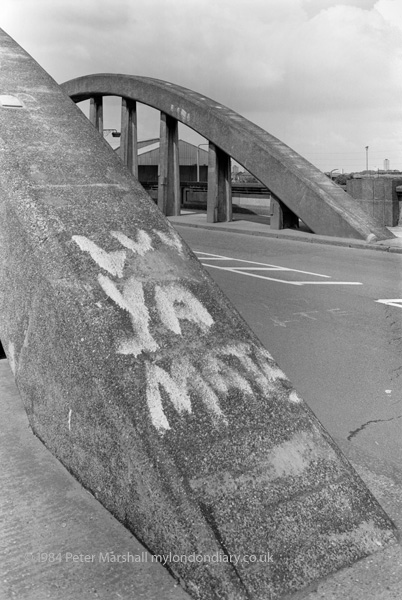
Silvertown By-Pass  bow-string bridge opened in 1935,  demolished 1990s


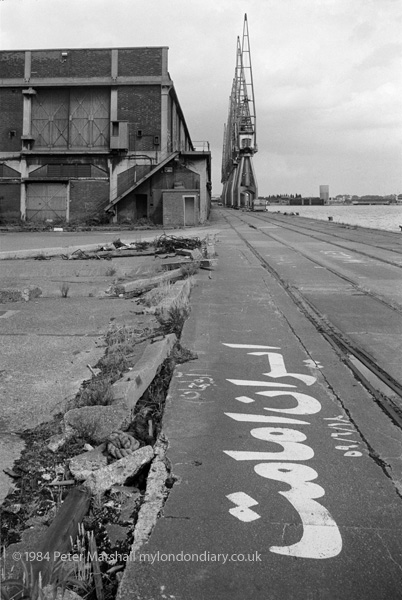
Ship’s names were written on the dockside for Lascar workers


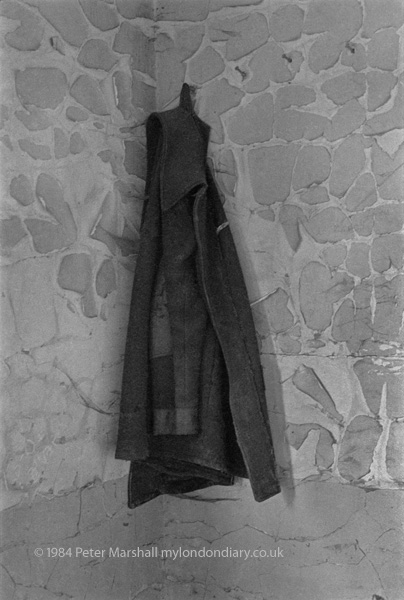
A jacket left hanging on a peg when the workers left the docks in 1981

The Deserted Royals is now available for download as a PDF from Blurb, who seem also to insist that a print version is on sale. The PDF is £3.99 as a download, the soft-cover version is £30 and postage will add another five or six pounds.  I hope later to be able to supply it for UK customers direct from me at a lower cost.

There is a preview available on Blurb which shows around half of the 90 black and white images in the book.

________________________________________________________

My London Diary : Buildings of London : River Lea/Lee Valley : London’s Industrial Heritage

All photographs on this and my other sites, unless otherwise stated are by Peter Marshall and are available for reproduction or can be bought as prints.

To order prints or reproduce images

________________________________________________________
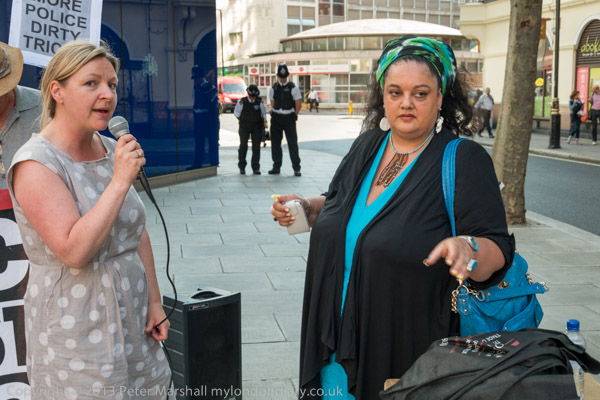
More on Traveller Children

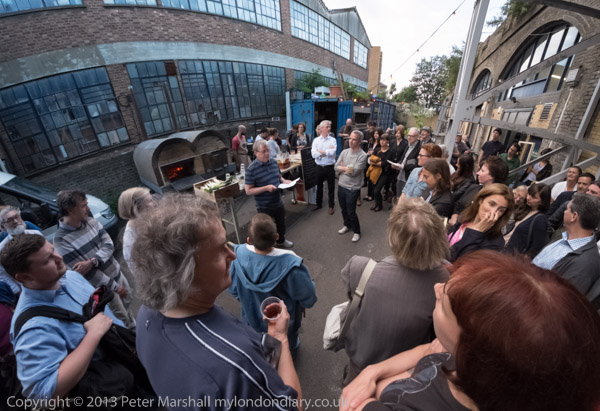
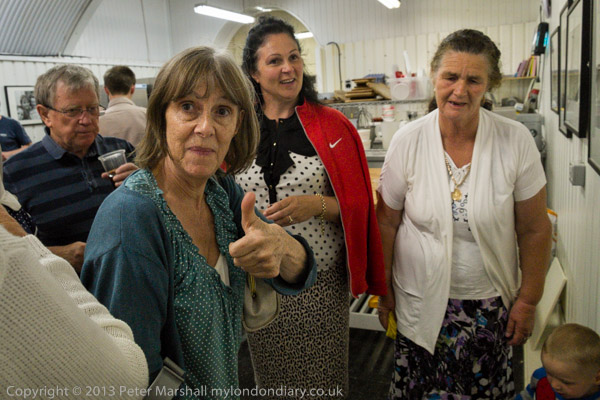
It seems a very long time ago that I wrote about the book launch of Colin O’Brien’s Traveller Children, and I’m rather surprised to find it was only 3 weeks ago. I’d just got a new lens for my Fuji X cameras, and had taken taken out the Fuji XE-1 with the Samyang 8mm f2.8 (along with the Fuji 18-55mm) to try out the Samyang.


The people close to the image edge are noticeably less distorted than with the Nikon 10.5mm

Like the 10.5mm Nikon I’ve loved to use, the Samyang is a DX format lens that gives a ‘diagonal fisheye’ view, producing an image that fills the frame with a 180 degree view across the diagonal of the image. Of course I can use the Nikon lens on the Fuji X cameras with a suitable adapter, but the Samyang is smaller, lighter and altogether more convenient to use. It also has a different – though similar – perspective,  its ‘stereographic’ projection giving less distortion of objects at the edges of the image. Like the Nikon, it also suffers from a fairly distinct degree of chromatic aberration,  which can be largely corrected in Lightroom or other software, but otherwise is optically pretty impressive.

It also, like the Nikon,  has a bulbous front element which precludes the normal use of front of the lens filters, but with a lens that cost me around £230 I’m rather less worried than with more expensive glass  It fits nicely on the Fuji XE1, and is also available for Sony E and Samsung NX mounts. It comes in both black and silver finish, so of course I choose the black.

The first – and so far only – minor disappointment is that at the back of the black finish lens barrel is a half an inch of shiny silver lens, cosmetically something of a disaster. Apart from this the build quality seems impressive for the price (actually better than many expensive lenses.)  This is a manual lens, but this isn’t really a problem. You seldom need to focus an 8mm lens, and with the shutter speed on Auto, the digital viewfinder automatically adjusts (if sometimes just a little slowly) to give a properly adjusted viewfinder image.

With the different projection, software such as my favourite Fisheye-Hemi dpn’t quite work properly, and need a little tweaking in Lightroom to get things more or less right – as in the example above. I was pretty pleased with this lens and look forward to using it more. Some of my favourite images on the Fuji-X cameras to date have been taken with the Nikon 10.5mm, and this looks to be a more convenient replacement. You don’t get any information on aperture or distance setting in the Exif data, but the scales on the lens are very clear and seem accurate.

What I didn’t say in the previous piece was that all of the images at the book launch, including the exterior images such as these were taken at ISO 6400, a full stop faster than I usually like to work, even with the Nikon D800E. I’d set the camera at this speed inside the gallery space, where the light was rather dim, and simply forgot to alter it when I came outside.

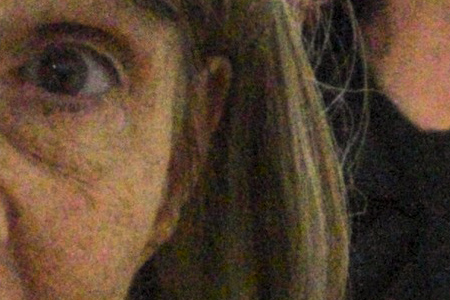
I can’t pretend the quality is the same as it would have been at say ISO 400, but it is surprisingly good and usable for many purposes. Of course it isn’t just the camera, but also the noise reduction from Lightroom. Here’s a 1:1 crop from a part of the image without any noise reduction:

and here is the more or less the same area of the image, again 1:1, after some fairly aggressive noise reduction and a little sharpening:

I probably haven’t got the settings at the optimum, but the difference is clear, with virtually all the colour noise (and some colour) removed, along with much of the luminance noice.  Very little actual detail seems to have been lost, and although at full size it seems a little low in contrast and lacking in  colour, it works pretty well at web scale, and also for reasonable size prints. And the contrast and saturation could easily be increased if necessary.

The result of the high levels of noise removal can be seen in the upper images, in particular the second image down, where the foreground figures somehow seem too smooth and lacking in detail.  But digital is certainly producing results that would have been impossible with film.
Continue reading More on Traveller Children