Moises Saman

Don’t miss the interview with Moises Saman by Pete Brook on Wired.com’s Raw File blog. Some fine pictures and an interesting discussion. Here’s just one sentence which I hope will make you click the link above to read the rest.

‘In my opinion “professional distance” and “objectivity” are vague terms, because in my work I search for the intimacy and trust that requires me to be close to the subject, to be accepted.’

You can see more about Saman on his Magnum Photographer page, which as well as pictures has a profile and his blog, although there are few recent entries – events are presumably taking up too much of his time to allow blogging.

I’ve never thought that I would be good at photographing in the kind of dangerous situations that Saman has often been in.  I think I panic too readily and now I’m sure I’m far too old for that kind of thing. But if you have an interest in Working in Hostile Environments, the presentation on that subject at the NUJ London Photographers Branch next Tuesday (24 Sept 2013) at 6pm may interest you. The two speakers, Laura El-Tantawy a British/Egyptian photographer living in Cairo and London,  represented by VII Mentor and Guy Smallman who has worked in Lebanon, Pakistan, Iraq and Latin America, and regularly in Afghanistan since 2008 will give some practical advice and answer questions, as well as explaining why it “is NUJ policy for members to undertake Hostile Environment Training, and the value of such courses in preparing journalists for the challenges faced in such situations.”

Non-members are welcome at these meetings which are free, though if you are working professionally you should join the union. Particularly if you want to work in potentially dangerous situations. And if you are not working professionally it is a very good idea as a photographer to keep well away from them.

Edinburgh & the Festival

I know Scotland isn’t London, but I’ve got into the habit of including my occasional absences from the capital on My London Diary, and so there are pictures from my week in Edinburgh now there on the web. It was only my second visit to the Scottish capital, and although I’ve enjoyed both of my times there, given the choice I prefer Glasgow, despite the language problems. It seems a rather warmer place. But Edinburgh certainly has its delights.


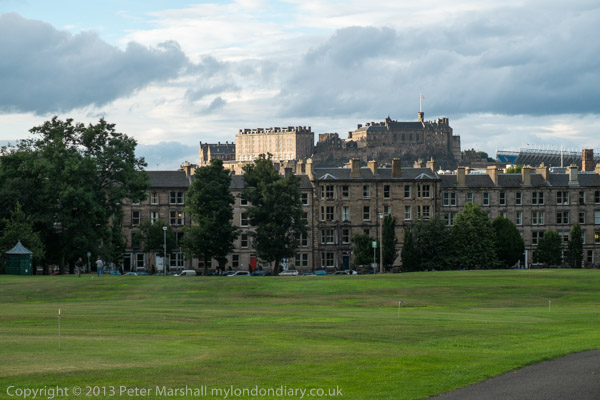
A view of the castle across the free links on the route from our flat to the city centre

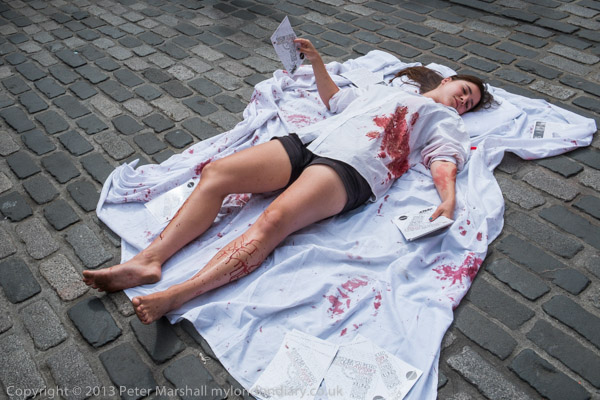
Our first visit for a week’s holiday ten years ago was in the week before the Edinburgh festival, and if you want to see Edinburgh it’s a good idea to avoid the festival. But this year we had been invited to share a large flat close to the city centre during its busiest week to go to the festival, though we did also manage to do a few other things. And it was mostly those other things that I photographed – along with some of the festival stuff that happens along the High St, mainly groups trying to get an audience for their many shows by looking silly and handing out postcards with the details.

We were very selective in what we went to. With over a thousand events on most days you have to be, and we didn’t have the stamina of true festival-goers who can cram in a dozen different performances in a day, starting around 10am and finishing in the early hours. Its easy to spend a small fortune too, with the average ticket costing around a tenner, though some of the best things we went to were part of the Free Fringe, where you contribute what you like when you’ve actually seen the show, and may be offered a CD or book for relatively small donation. And perhaps the most satisfying event I went to (twice) during the week was entirely free, although I did buy the small catalogue of the Nam June Paik exhibition that I’ve already written about here. I’d taken my notebook computer with me to Edinburgh, hoping to blog ‘live’ from there, but there just wasn’t time, and I was too tired by the time we gave up for the day to do so.


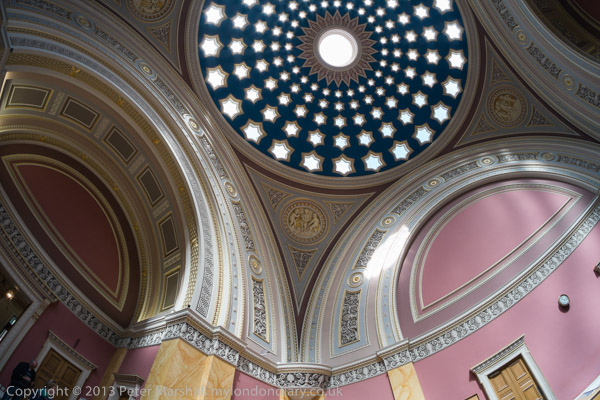
The splendid ceiling of a bank in the New Town – taken on a walk that was a Festival event.

We did go to several events after meeting people on the streets and taking their postcards, and it’s perhaps a better way to find things on the Fringe than the vast programme – available free in print or as a download or searchable on the web site, though there is a useful daily breakdown in The Scotsman.

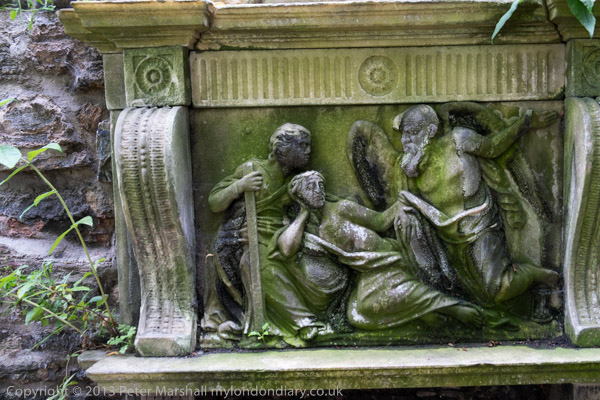
Probably the best thing about Edinburgh are its cemeteries, and I’d highly recommend the City of the Dead tours, listed as festival events but also running outside of it (beware pale imitations – we heard a little of one and it sounded appalling tourist nonsense.) We only went on it by accident, buying the tickets from others in the flat who had booked them and were called away to a funeral, but you need to go back in daylight too. They do have a certain photographic connection, as they made useful open-air studios for Edinburgh’s most famed photographers, Hill and Adamson back in the days of Calotype.


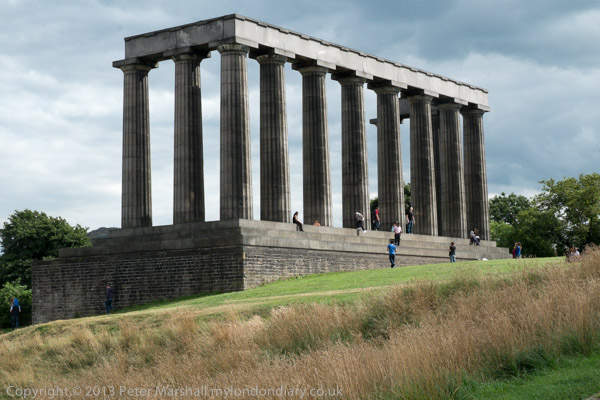
On the to of Calton Hill

Their studio was on the lower slopes of Calton Hill, Edinburgh’s free version of the London Eye, with splendid views across the city. Feeling energetic we also trekked up Arthur’s Seat, though this time we took the easy path – on our first visit I’d got fed up and decided on a more direct route – as I put it in a feature at the time: ‘I led our team up the north face of Arthur’s Seat, the extinct volcano overlooking the city.’ It turned out to be a little challenging, and could have become our final visit.

In 2003 I’d taken the D100, along with what was then the only Nikon lens I owned, a 24-85mm (36-127mm equiv.) One other limiting factor was that I only two 1 GB and a 512 Mb compact flash card, letting me take a maximum of around 250 raw images in a day, and had then to copy them over into a rather temperamental ‘Image Tank’ portable drive. The 24-85mm was a nice lens (and I’ve been sorry at times that I gave it away) but didn’t allow me to take any real wide-angle images, and looking at the pictures the difference between then and this year is obvious.

This August I had with me the Fuji X-E1 with the 18-55mm (27-82mm equiv) giving me a wider angle, but not going to a real telephoto. And if that 27mm equiv wasn’t wide enough, I also had a Voigtlander 15mm (22mm equiv) and wider still the Samyang 8mm fisheye.


City of the Dead Tour in Greyfriars Kirkyard

So there is a different look to my pictures, with the earlier set concentrating more on details, but also being rather less sharp and less detailed. The Nikon lens wasn’t bad, but the 6Mp sensor doesn’t quite compete. Fuji is one of the best lens makers around, and the 18-55mm is fine, but its zoom range is a little limited. It was good to have a small light camera, and there isn’t perhaps a lot to choose between its digital viewfinder and the poky optical one in the D100, but recent FX format Nikons have far better viewfinders, and the cameras are so much more responsive than the Fuji. Usually it was fine for a holiday camera, but there were times, particularly in the cemetery at dead of night – when I wished I was holding my D800E.

The pictures from 2003 are no longer on line, but you can see a good selection from this year at Edinburgh & the Festival
Continue reading Edinburgh & the Festival

Fracking, Dead Lambs and Putin

One of the things I like about going to photograph protests in London is that you are never quite sure what you will find. Though sometimes it can be a disappointment, and I was a little dissapointed not to find more people in Trafalgar Square to protest against fracking, as were the organisers of the Frack Off protest. I took a few pictures, and then was interrupted by perhaps around 200 people with banners and placards marching in to the square, and rushed to see what was happening.

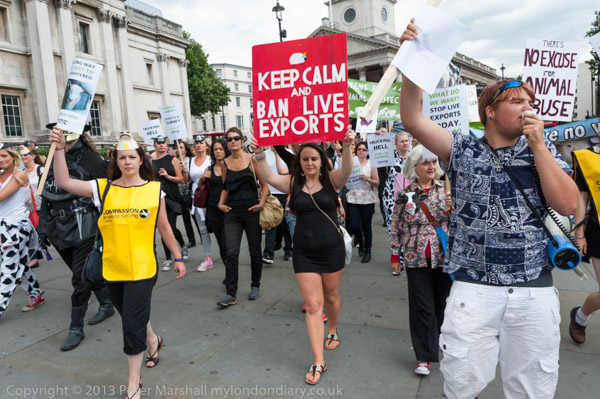
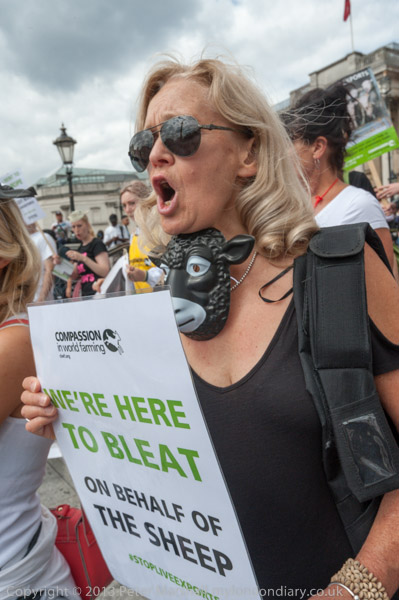
It turned out to be Compassion in World Farming who had marched from Covent Garden to Trafalgar Square Against Live Animal Exports from the UK.  It seems an unnecessary cruelty to crowd them into lorries and drive them long distances before shipping them to the continent for slaughter, but the UK government claims it cannot stop the trade under EU laws on free movement of goods. The protesters say that the EU’s recognition in 1999 of animals as sentient beings rather than “goods” means that this is no longer true.

It was mildly amusing to see a couple of ‘Heritage Wardens’ try to stop several hundred angry animal welfare protesters from coming down the steps from the North Terrace into the square – which the Mayor of London seems to think is his own private demesne and where permission is needed to protest.

But although the protesters were not about to take any notice, they did tell the wardens they would not be there long, and the body of protesters kept on the steps for the short address at the end of the protest before dispersing, not in any way interfering with a church group that was slowly setting up with a gospel choir around the plinth of Nelson’s Column (and I took a few pictures of them too.)

As the protesters against live exports left, I went back to the anti-fracking protest, and was told they would be moving to protest at Downing St in half an hour or so. As I was on my way there to photograph another protest, I promised them I’d try to photograph them there later. Unfortunately I got so involved with photographing that over event that although I looked out for them at times I completely missed them.

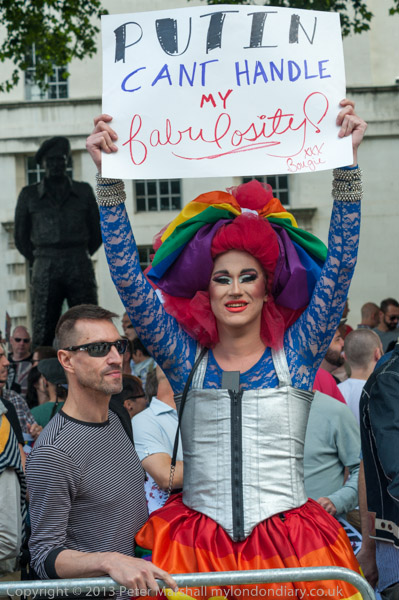
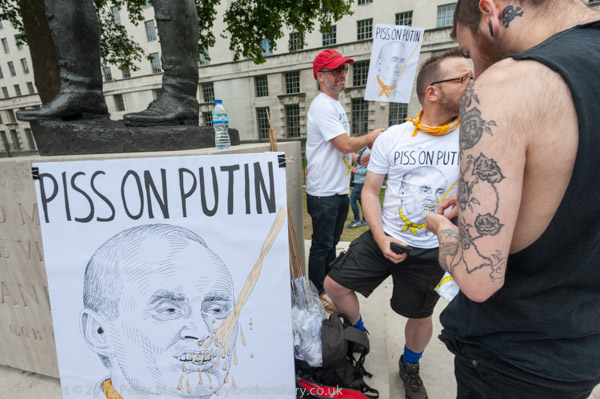
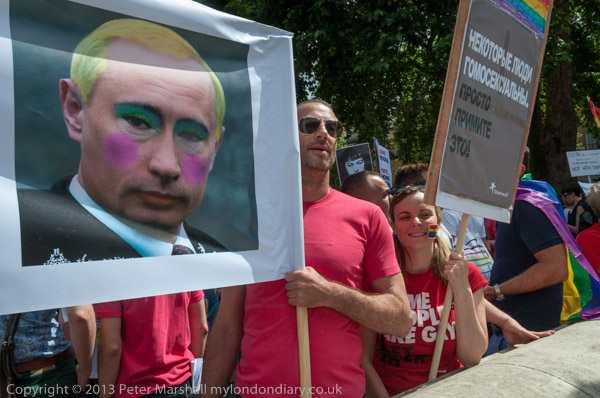
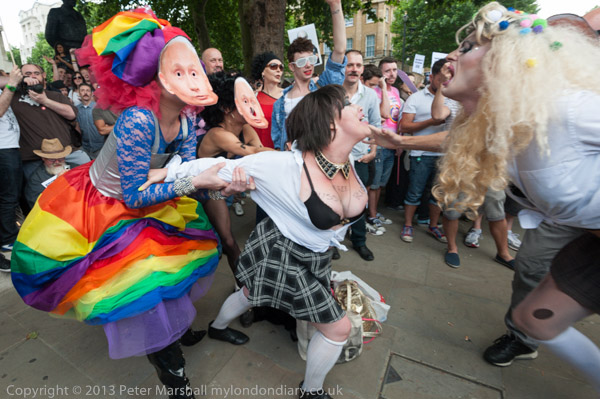
The main event I’d come to photograph was a protest against President Putin for his homophobic policies, and to support gay rights in Russia. As might be expected this was a colourful event, and well attended, but it seemed to lack any real focus, with no speeches and little organised chanting. I was just walking around photographing people with interesting placards or dress, and some of those are fine, but I felt something was lacking.

There was also a slight problem that some of the posters were probably not suitable for publication in most media – such as the image above, which was perhaps my favourite from the set. I didn’t include it the the group I sent to Demotix.

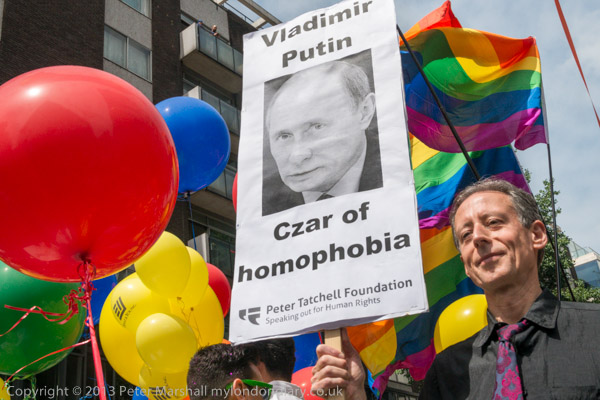
There were many images of Putin on display other than that, and many of my pictures show him, as you can see in  Putin, ‘Hands Off Queers!’.  Among them of course was Peter Tatchell with a poster ‘Vladimir Putin – Czar of homophobia’, but I think I photographed that better on an earlier occasion.


Peter Tatchell at Pride, June 2013

Later in the protest there was some street theatre about Putin and Pussy Riot, and I was lucky to be there as it was being set up, and stood shoulder to shoulder with the TV cameraman who was recording it, rather to the annoyance of another photographer who came too late (others were already by my side and pointing their lenses over my shoulder) and wanted me to move back “so we could all get the picture”. If I’d moved back I would have got a good picture of the back of the cameraman, but not a good view of the players – and other photographers, probably including the complainant – would have moved in front of me.

It would have been better if there had been more space – I was really too close to the action, even with the 16mm, but the performers had chosen to work in the middle of the crowd, and it wasn’t possible to move back.

I took too many pictures of the playlet – and have included too many on My London Diary, it was rather more dramatic than the rest of the event, but it did make me think that this was something that would have been better on video than as still images.

Putin, ‘Hands Off Queers!’
Against Live Animal Exports
Also in Trafalgar Square
Frack Off

Continue reading Fracking, Dead Lambs and Putin

Julio Etchart’s Chile

Julio Etchart was born in Uruguay but settled in England and studied documentary photography in Newport where David Hurn had arrived in 1973 to found a course that became renowned around the world. It was a course based around working hard on photographic projects and the intensive criticism of students work, an approach that has produced many fine documentary photographers.  In 1973 it was a breath of reality into photographic education, at least in the UK, and has since provided a model for many courses elsewhere.

Etchart spent time in the 1980s documenting life under the  Pinochet regime and the opposition to his regime, both in Chile and in the UK, for the international press, and in 1988 Amnesty International commissioned a show of his work for their campaign on human rights violations in Chile.

You can see some of Etchart’s work from Chile on his web site (along with other photography) and for the next few days an updated version of the 1988 exhibition is showing at the Amnesty International UK Human Rights Action Centre, 17-25 New Inn Yard, London, EC2A 3EA (weekdays 9-5 until 20 Sept 2013.)  It is a powerful record of the opposition by the people – particularly women – to the repressive regime.

The show is timed to mark the 40th anniversary of Chile’s 9/11, when on 11th September 1972 a US-backed military junta overthrew and killed the democratically elected socialist President Salvador Allende. One of its leaders was Augusto Pinochet, who later became President, stepping down in 1990. More than 40,000 people were arrested during the coup and held in the National Stadium, and many were tortured and killed. Others disappeared without trace. Wikipedia reports “1,200–3,200 people were killed, up to 80,000 were interned, and up to 30,000 were tortured by his government including women and children.” Human rights abuses including deaths and disappearances continued throughout his Presidency, and at his death “about 300 criminal charges were still pending against him in Chile for numerous human rights violations, tax evasion, and embezzlement“.

Among the other interesting sets of work on his web site is one inspired by George Orwell’s Burmese Days, produced for the 75th anniversary of its publication. Based on Orwell’s own experiences as a police officer in the Indian Imperial Police force, the book is, in Etchart’s words “one of the greatest denunciations of imperialism ever written, and a powerful critique of the colonial mindset that underpinned the system.” The photographs are best seen in the full preview of Etchart’s book Katha: In the footsteps of George Orwell in Burma (change to full page view to see it best) on Blurb. There is also a YouTube video with a spoken commentary, but to me this lacks the urgency of Etchart’s pictures and voice.

Last month I mentioned some of Etchart’s more recent work in Street Isn’t Documentary.

Getty Grants

I’m not a fan of Getty Images, but their grants certainly do support some great photography, as you can see from the winners of the 2013 grants for editorial photography.  Some of the five winners are very familiar names – Eugene Richands, for many years a member of Magnum (he joined Magnum in 1978 and left twice, in 1994 and 2006), of VII from 2006-8 and Getty’s own Reportage from 2010-12.  and Tomas van Houtryve of VII. I wrote here a while ago about his book Laos: Open Secret, published on Blurb, and earlier about his use of Flattr – and earlier still about his photography on another site.

Samuel James, whose earlier project Lagos, Area Boys won the  2010 Alexandra Boulat Award for Photojournalism  also has a VII connection -as part of that award the project as sydicated by them. More recently he was featured on the Lens blog and picked as one of BJP’s 20 photographers to watch in 2013.

Matt Eich has also previously won many awards and grants from the the Aaron Siskind Foundation, The National Press Photographer’s Association, ShootQ/Pictage, The Alexia Foundation, and National Geographic Magazine. He was one of the photographers in PDN‘s ‘Top Thirty‘ for 2010.

The  relative newcomer is Marco Gualazzini, and Italian who started work as a photographer for his local daily paper in 2004.  2013 has been a good year for him as he gained First Prize at the Premio Internazionale Marco Luchetta in 2013 and a Silver Medal at PX3 Prix De La Photographie De Paris  before receiving this grant for his project M23- Kivu: a region under siege.


The Queen Vs Trenton Oldfield

I first came across Trenton Oldfield on the web, where I read in 2008 about the ‘This is Not A Gateway‘ (TINAG) festival he had inaugurated together with his partner Deepa Naik. The first was held in Dalston and included over 40 events related to the urban environment including contributions from several photographers and film makers I’d met. The following year it moved to Spitalfields and I was one of the many who presented work at Hanbury St, presenting together with Paul Baldesare work from our then current show Taken in London and taking part in the discussions.

I’ve long had an interest in urban affairs, dating back to before I was a photographer in the 1960s, and this is reflected in some aspects of my work which you can see particularly on the ‘Urban Landscapes‘ web site and also in some of my self-published books. The first of these, written when I was aksed to contribute to a now defunct web site in 2005 but only published as a book after I’d exhibited it at the London International Documentary Festival in 2010 is the only of my books to date to have a little fictional story, setting out a series of pictures from my walks around north-east London in 1989 as having been taken in my wanderings with the legendary (and entirely fictional) author, Upton Trent. When I met Trenton a few years after writing this, his name immediately made me think of this work.

But most people will know Trenton as the man whose protest against the elitist nature of British society brought the annual rowing race between crews representing our most privileged universities to a halt. Our judicial system threw the book at him, not only giving him six months in jail, but making him pay for the privilege of being tried and found guilty, doubtless a process carried out with the involvement of many who had enjoyed a privileged education at Oxford or Cambridge.

Many – even some who thought his action wrong-headed and his ideas crazy – felt that his punishment was unduly harsh for a peaceful direct action, and there was more astonished indignation when it was learnt that Teresea May wants to deport him. As Rupert Myers commented in The Independent,  ‘the UK government is risking a cause celebre with a 21-century deportation‘. In Tories bring back Penal Transportation? here on >Re:PHOTO I wrote about the case, asking people to sign the petitions to stop the deportation on This Is Not a Gateway, and another at Change.org. If you haven’t yet done so, please consider signing them now.

But there is something more you can do. I’ve just got a copy of The Queen Vs Trenton Oldfield: A Prison Diary, published by the Myrdle Court Press (MCP) which he and his partner founded to advance the ideas of emerging urbanists and which has brought out three volumes of ‘Critical Cities‘. The book is more than the title suggests, and as it says on the site, “challenges many preconceived ideas held about prisoners and prisons. It offers an insightful critique of the prison industrial complex at the the outset of the privatisation of prisons in Britain. Importantly, it also considers the criminalisation of dissent and reductions in civil liberties.” It is available at bookshops for £12.99 or you can buy it direct online, (£2 postage to Europe including the UK and £3 worldwide) and there are some reviews on the MCP web site.

All the proceeds from the sale of the book go towards the payment of the court costs of £750, awarded against him in an unusual decision by Judge Anne Molyneux at Isleworth Crown Court. I’ve yet to finish the book, but it does seem a very interesting read for all those concerned with civil liberties and our prison system. I’m thinking of getting a second copy to give as a Christmas present too.

Vanity Press

Part 5 of S D Coleman’s There Will Be Ink is now available (I wrote about the earlier posts in Books To Go? a few days ago) and throws some interesting light on the current state of photographic publishing and on self-publishing.

Coleman talks about the well-known names in photographic publishing, and the fact that they will only consider publishing a photographic book if it can be guaranteed a sale of a thousand copies or more – or if the photographer will stump up “between $30-50K. Which makes them glorified vanity presses.

While I’m sure that imprints like Aperture will exercise at least some kind of basic quality control over what they publish, this does seem to me to explain some of the less enthralling titles that have emerged in recent years. Back in the past there were some rather odd publications that made their way into print, but either these had some kind of celebrity link or I put them down to a particular obsession by an editor, and possibly one with little connection to photography.

Obsession isn’t necessarily a bad thing, and can lead to very worthwhile publications – Robert Frank’s ‘The Americans‘ comes to mind, but more often the results can be disastrous, or even embarrassing.

The publishing business is now largely run by the accountants, who have little interest in a book’s content but only whether it will generate the beans. And they don’t care if that comes from Joe Public actually buying the title or from Jack Photographer putting it in their pockets up front.

But although it might be nice to have your book published by a well-known name in the business, photographers will surely increasingly ask – as Coleman says – if it is worth paying ten times over the odds to have someone else publish your book when you could do it yourself through print on demand. Is it worth paying tens of thousands of dollars extra just to have a well-known publisher’s name on your work? And how long will those names remain valuable if they keep on publishing for hire?

He is perhaps just a little optimistic when he suggests that print on demand can produce comparable quality – it certainly cannot yet match the best that modern high-end printing can provide though it can already match the run of the mill.

What Coleman has to say about e-books is perhaps largely stating the obvious, but it’s something many in the photographic world are still blind to. And it isn’t just theory but he intends to put some of it into practice by bringing out much of his own work in e-book or other digital formats. As he says, others are already doing so. Like me he intends to make some of the work available only in digital formats, while others will have the option of print as well.

I rather like his idea that a publisher should bring out e-book versions of some of the classics of photography, selling at reasonable e-book prices. Like him I’d happily buy copies, at least of those titles I don’t already have on my shelves.


MI6 Lies


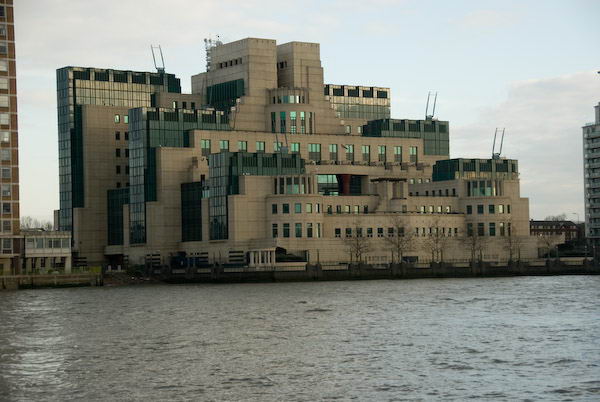
MI6 HQ at Vauxhall, 2007

Many years ago, my wife had to sign the Official Secrets Act, a curious practice that has no legal effect, since as it is a law we are all bound by its provisions.  But by now it is common knowledge that the building curiously designed by Terry Farrell (it always makes me think of Lego) on the banks of the Thames at Vauxhall Cross is the HQ of MI5, and as such has starred in several films and numerous photographs. But it still worries me a little when I take photographs of it, and carrying a camera and taking pictures around it can still arouse the interest of police and security, and on one previous occasion I’ve found myself being fairly obviously followed around while doing so, and another time told by police not to photograph near the entrance.

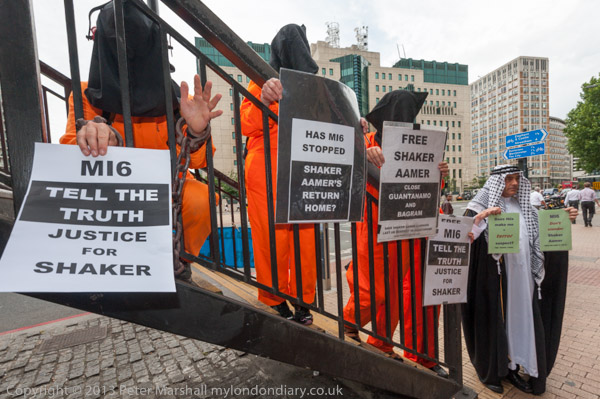
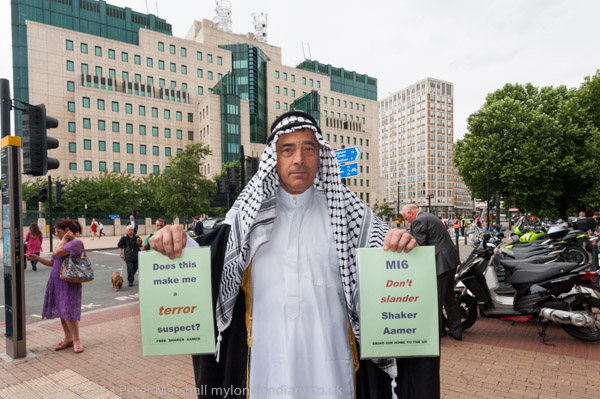
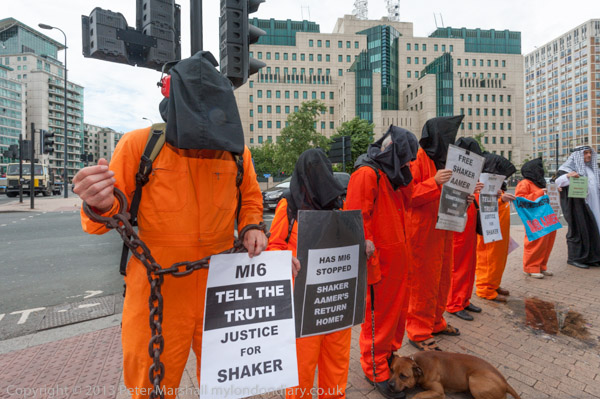
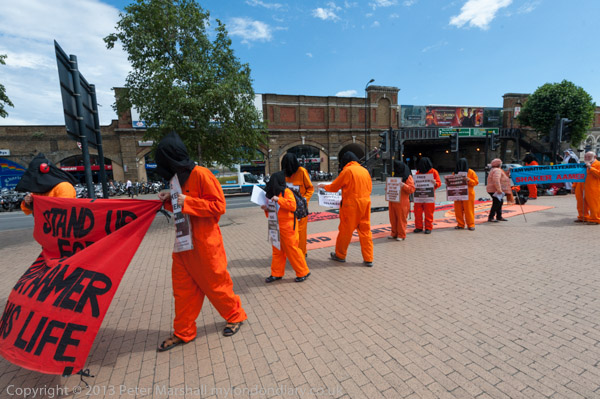
But now in some respects things about MI5 are more in the open, and police saw no problems when the Save Shaker Aamer campaign decided to hold a protest outside the building after it emerged that one possible reason that the US authorities have yet to release him from Guantanamo was that MI5 had been feeding them lies about him. Aamer, a London resident whose family live a mile or two away from the MI5 building,  was cleared for release long ago when George Bush was president, and again under Obama, but is still held there, still being routinely beaten by guards, and currently on hunger strike with violent force-feeding. Kept there because of the evidence he would give of torture by the US authorities and of the part MI5 played in this.

I arrived as the participants were getting into their orange jumpsuits in a railway arch opposite MI5, and was asked what I would like them to do.  This isn’t usually the way I work, but I have to confess I did suggest to them it would be a shame not to make use of the footbridge we were more or less next to, but after that I left it up to them. I’m not in the business of art-directing.

I’ll be very glad when the US finally closes Guantanamo, though I don’t think it can ever recover from the shame of this blot on human rights. But at least it can bring the injustice to an end. But I’ll be particularly glad as a photographer not to have to deal with the problems of those bright fluorescent orange jump suits, which overexpose and lose detail. I’ve tried various ways to deal with them, including using special ‘untwisted’ or ‘invariant’ profiles in Lightroom, but they are still difficult.  For this event, processing the images in a rush, I mainly relied on burning in the orange (the colour shifts to yellow with over-exposure and gets redder when underexposed), sometimes with a small reduction in vibrance or saturation, feeling that the unnatural brightness might help to make the figures stand out.

For many of the pictures I wanted to use flash to bring out the foreground figures, which in some pictures were in shadow, and this caused some problems with the laminated placards., which can reflect light strongly back towards the camera. They can do this with available light also, and occasionally I have to ask people to angle them a little differently, but the effect is harder to spot when using flash, except by checking on the camera back.  Uneven lamination is also a problem. giving small rise to hotspots which are tricky to tone down in Lightroom.

These were pictures of both the protesters and of the building outside which they were protesting. For this reason, mostly the pictures were taken either from the opposite side of the road or in the fairly wide central reservation, where the 16mm still let me include much of the building, if with quite a large tilt.  I wanted to correct the verticals for some images, but hadn’t always managed to get a wide enough view to do so without cropping essential elements.

Where some direction could have produced stronger images is when the protesters formed a line to walk across to the MI5 entrance. I can imagine in a film an event such as this looking much more dramatic, but in real life people don’t keep in line, they hang back, look every direction except towards the camera (except when you want them to look away) and so on. But the clichés of cinema are the clichés of cinema and I’ve no real wish to perpetuate them; reality is more messy but more interesting.

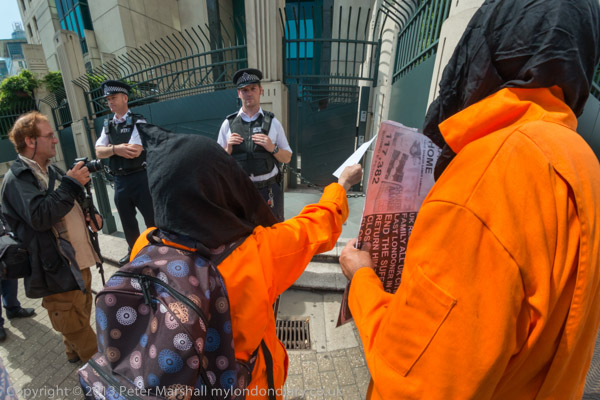
Outside the gates – where the letter (note to protesters – please write the name and address on letters in big bold letters!) was predictably refused on security grounds – was a good opportunity to work with the 10.5mm (and later Fisheye-Hemi.)  Just as the protest finished another photographer arrived, having almost missed the event and began immediately to start arranging protesters for his pictures. It was a good time to leave.

Stop MI6 Lies About Shaker Aamer

Continue reading MI6 Lies

Cleaning John Lewis

On the John Lewis web site it proudly states: ” Our founder’s vision of a successful business powered by its people and its principles defines our unique company today. The profits and benefits created by our success are shared by all our Partners.” What it fails to say is that they are not shared by all who work in their stores and pay a vital role in the running of the organisation. The cleaners are not partners, not employed by John Lewis. They get poverty wages – £6.72 per hour, over 20% less than the London Living Wage determined each year by the Greater London Authority and promoted by London Mayor Boris Johnson, backed by David Cameron. They also have much poorer working conditions, and don’t get the pension, holiday and sick pay provisions enjoyed by other workers (“partners”) in John Lewis, as well of course at missing out on the large bonuses enjoyed by the partners from the group’s profits.

John Lewis is a good place to work, unless you are a cleaner. For cleaners in John Lewis Westfield it is the same as working for other greedy employers – they are overworked, underpaid, have unsocial hours, lousy and often unsafe work environment, with management that often treats them “like the dirt they clean” while making fat profits from the contractors. They are not employed by John Lewis but by ICM, part of the Compass Group, who recently announced pre-tax profits for the year of £575 million.

The cleaners’ union IWGB has been calling for a living wage for cleaners and in particular for all who work in John Lewis to be considered as partners in its success for some time, with a series of high-profile protests at its Oxford St store last summer. Their campaign has attracted some support from those they work with in the stores, and last year one of the partners in the store overlooking the Olympic site in Stratford’s huge Westfield shopping centre gave an interview to The Guardian expressing his support. Various interviews and disciplinary procedures later and he was out of a job (an appeal against the decision is pending.)

The cleaners decided to take their protest to Westfield both as it is one of John Lewis’s highest profile stores, but also as a gesture of solidarity towards the sacked partner who came with them and spoke briefly during the protest. I received an invitation to attend and report on the event though I had no detailed information on the protest, which was unannounced, in advance, just a time and place to meet. When I got there on time there was no sign of the others, but I made a phone call to check and was assured it was going ahead, and a few minutes later people started to gather.

We’d met a short distance from Westfield, which, like other large shopping centres, is a private estate with its own security team and one that does not encourage photography. If I walked though its fairly crowded streets openly taking pictures I would expect to be quickly spotted on the many CCTV cameras, accosted and asked to stop and probably escorted out of the area – as I know has happened to some photographers. So while we walked through to John Lewis at the far end of the mall I was being very discrete in taking pictures of a group who were also trying to be unobtrusive! Unsurprisingly the pictures weren’t much.
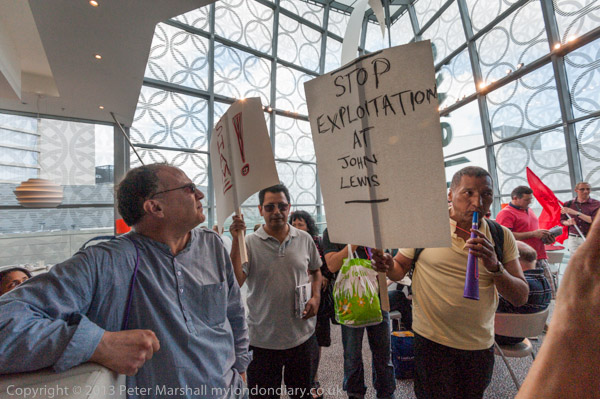

Bright windows, dim interior – but Lightroom came to my rescue

Inside John Lewis we kept a low profile as the group – I think by this time around 40 people – made its way to the eating area on the top floor where they sat at tables and brought out their placards, union flags, banners, plastic horns, whistles and megaphones from their bags and got ready to make their surprise protest. I could start photographing more openly, but the light was very difficult, bright near the large windows, but very dim in areas away from them, and the contrast too high to handle.
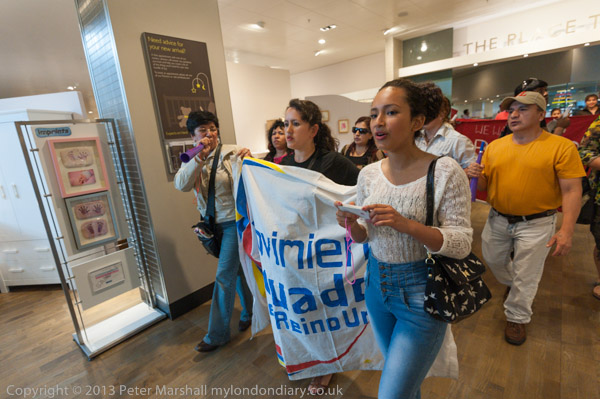
Once the protesters marched out into the brightly lit store area and began their noisy protest things became much easier. I didn’t need to be discreet, and the light levels made work easier. I needed a reasonably fast shutter speed because there was a lot of movement, and at ISO3200 was able to work at around 1/125 or 1/200th with the 16-35mm f4 lens at around f5.6. At 16mm there was enough depth of field.

The protesters made a short protest on each of three levels of the store. The staff and customers generally just stood and watched (a few of both applauded) and some of the managers told them to leave, but I saw little real argument and the whole atmosphere was really rather civilised – as you might expect from John Lewis. There was absolutely no interference with me taking pictures inside the store, no request made to me to stop, though I did as much as possible keep close to the protesters.

As often with artificial lighting, colour temperature was a problem. Working with raw images, I generally let Nikon’s auto white balance have its way and then correct in Lightroom. Using the eye dropper on a presumed neutral area is usually a good start point, though it isn’t always easy to find a true neutral. Assuming that you can, the result isn’t quite what I want, as it looks too cold. Interior lighting generally looks right a little warmer than neutral, almost whatever it was actually like, and flesh tones in particular can look almost ghoulish without a little warmth.

Much artificial lighting also departs rather from a smoothly continuous spectrum which can also cause problems. Back in the old, old days photographers had to juggle with colour correction filters when using transparency film, but fortunately we can do all that now in post production.
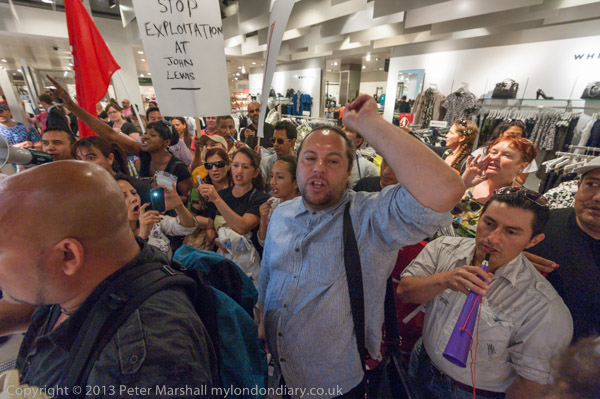
It’s a relatively simple job if you are shooting in a single area all lit by the exactly the same type of illumination – balance one image and synchronise the whole set. But inside John Lewis the protesters were moving around, on the shop floor, on the escalators and the balance changed, giving me a little more work. As you’ll see I haven’t always ended up with the same result on different images, even those taken in the same place.

Some of the images I put on the web are smaller versions of those that go into an agency within a few hours of taking the pictures, and they are certainly not perfect. So far I’ve refused to wire direct from location so I can correct and edit the images better because I want. For those stories which are covered by other photographers who get their images in hours before me this is obviously commercial suicide, but much of what I cover is unlikely to be picked up by the mass media, more likely to be used by magazines and books in months to come rather than on tomorrows front (or even inside) page.  Coming back home to look at the images on a reasonably large (24″)  high quality screen, I import the images into Lightroom (with renaming and a development preset) and then look briefly at every image, making an initial selection tagging the better images with 2 stars. I then go through the’ 2 star’ images, looking for the strongest images but also trying to select a set that tell the story – and I mark these with a colour tag.  The hardest part can come next, when I look at just the colour tagged images, and often find there are simply too many. Deciding which to choose can be tough.

Once I’ve made that choice (or if there were fairly few to start with) I then go to Lightroom’s Develop module and quickly work its magic on them. Then its back to the Library module to add keywords and captions before uploading them with the story.

For the web pages – such as Cleaners in John Lewis Westfield, I go back to the ‘2 star’ images and try to eliminate near duplicates and any weaker images (which all get put down to 1 star), and then develop the those which were not developed earlier. Usually I can take a little more time over the corrections and the results are usually better, but often different.

It’s even possible in Lightroom to make some corrections for mixed lighting, using the Adjustment Brush to paint areas of the image to alter the colour temperature and tint. So much is possible now that you could well spend all your time working in Lightroom (or Photoshop) and never have time to take another picture!

There was a slightly longer protest close to the entrance on the ground floor, with several short speeches, before the protesters, having made their point, moved into the mall outside. It had seemed a long protest, but the EXIF data shows it to have been only 15 minutes.
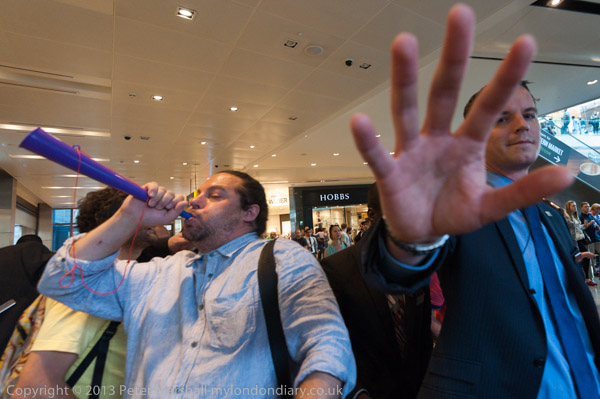
Waiting for them were the Westfield security manager and guards, who did try a little pushing people around, but were soon told to stop. One of them said to me “I think you’ve taken enough photographs” and held his had over my lens. I took a picture as I moved back and continued to photograph. After all, I hadn’t actually been told to stop, and it was purely my decision whether I had taken enough! The group was slowly and in its own time making its way out, stopping for a short protest outside another door of John Lewis, and then walking around the corner for some group photographs in front of one of the side windows of the store before dispersing after what felt like a very successful protest.

After it was all over we heard the siren as the police finally arrived. Sensibly they talked to both security and to the union’s general secretary and then stood back and did nothing. Protesters and security guards were by now chatting amicably – they too are low paid workers with often poor conditions. I walked away and through the large empty Stratford International station (at which no international trains stop) to the rather smaller DLR to start my journey home.

Continue reading Cleaning John Lewis
Zero Hour at Sports Direct

When I first heard about them, I found it hard to believe that ‘Zero Hours‘ contracts were legal. They seem to go against the very essence of what a contract of employment should be.  How can it be employment if no hours are stated? And it is surely unfair to ask anyone to make themselves always available for work – and so unavailable for any other work – without suitable recompense.


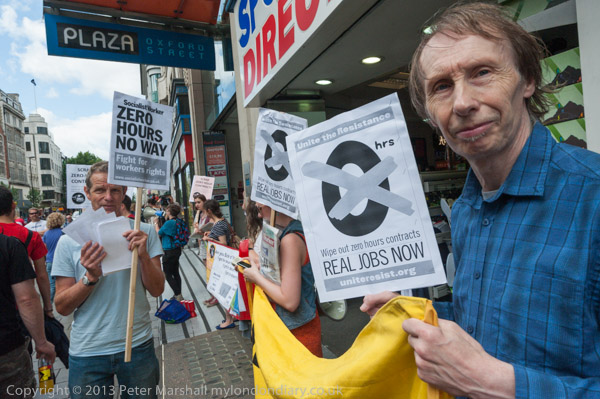
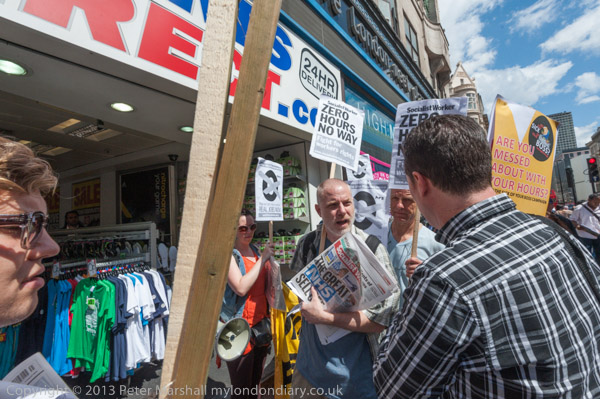
Working along the line of protesters

Essentially they seem a legal fraud which allows employers not to offer a proper contract to workers, a loophole that I hope our next responsible government will fix (I’m beyond hoping much from the current coalition, tired of reading articles about their policies that have to be prefixed with the comment “this is not satire” because the reality is so ridiculous – and constantly having to think “You just couldn’t make it up“.)

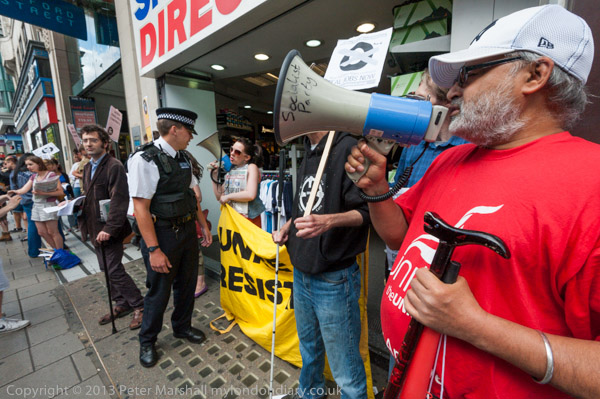
It wasn’t an easy location to work at. The pavement on this part of Oxford St is fairly narrow, and there was a bus shelter at this point making it narrower still. The police were intent on allowing shoppers to pass by, and into Sports Direct who the protest was aimed at. They kept most of the protesters in a single line along the front of the shop and tried hard to keep an opening into the shop front (though it was easier to enter by the main Plaza entrance and the side door, neither of which the protesters wanted to be on. And they tried to keep photographers and others from blocking the pavement, making it difficult to work. Protesters can and did take very little notice of the police,  moving a few inches when requested and moving back as the officers moved away, but as a journalist I have to be a little more cooperative.


Police ask protesters to move the banner across the entrance

So rather more of the pictures than usual were taken, like the one above looking along the line of protesters, along with some from the opposite edge of the pavement, and from under the bus shelter,  and rather fewer from the kind of distance I would prefer to work at directly in front of the protest.  Of course I did move and take pictures, but it isn’t the same as being able to stand in position and watch things developing.

There didn’t seem to be a great deal to photograph, and after around three quarters of an hour I was beginning to get bored. I might have drifted away to one of the nearby pubs (a couple of ones I like within a five minute walk) or gone to a nearby park to eat my sandwiches as it was lunchtime, but fortunately one of the organisers who knows me had told me that things might get more interesting to photograph around then.


It looked like it was time to occupy Sports Direct

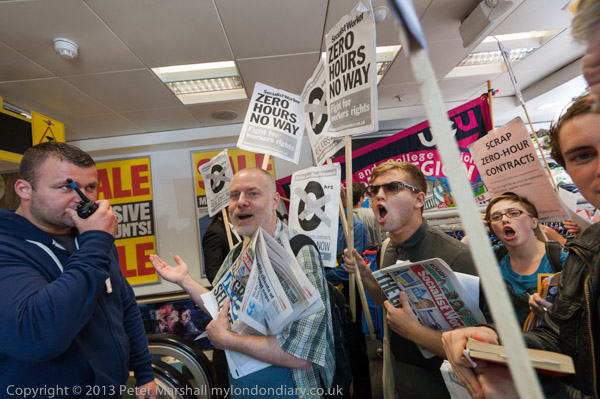
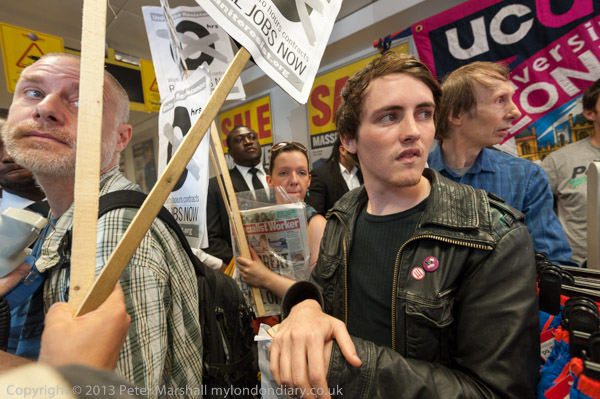
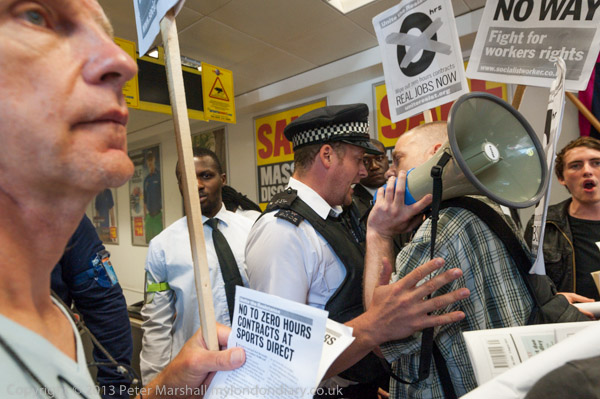
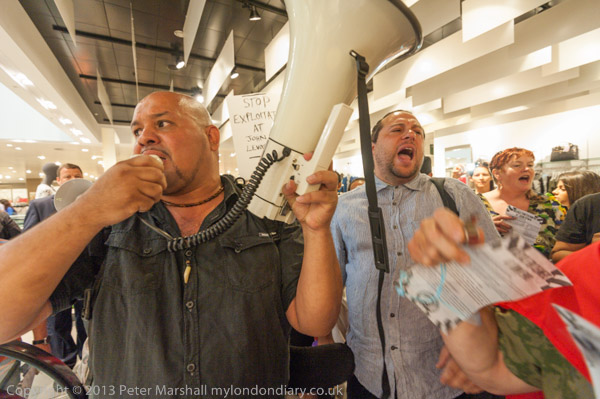
So I was ready and waiting when the protesters surged inside the shop, and went with them, keeping just behind the leading three or four. I knew that they would not be wanting to cause any damage and didn’t expect any real trouble. Sports Direct security personnel were standing beside the escalators leading down into the main shop area in the basement and as expected they stood to block the protesters, who argued with them but didn’t attempt to push them aside.

It was very crowded inside the shop, but I was able to step a little outside into the Plaza entrance to get a little distance – though this is taken with the wide-angle zoom at 16mm. Going back in with the protesters things were a little more crowded.

Movement was a little limited by the crush of protesters and the shop displays, but I was able to move around a little, and get into a good position to photograph the police officer coming in to talk to one of the protesters – the man holding the large megaphone.

I took a more tightly framed image of the conversation with the 16-35mm at around 24mm, then zoomed out and moved back just few centimetres to get the leaflet in the foreground of the conversation to tell what the protest was about.  After the police had conveyed the request to the protesters that they should leave, they did so. The occupation only lasted a little over 5 minutes, but in that time I took as many pictures as in the rest of the hour of protest. And of course it was these pictures that made the story.

More about the protest and more pictures at End Zero Hours Contracts – Sports Direct.

Continue reading Zero Hour at Sports Direct