Muslim Women on the March

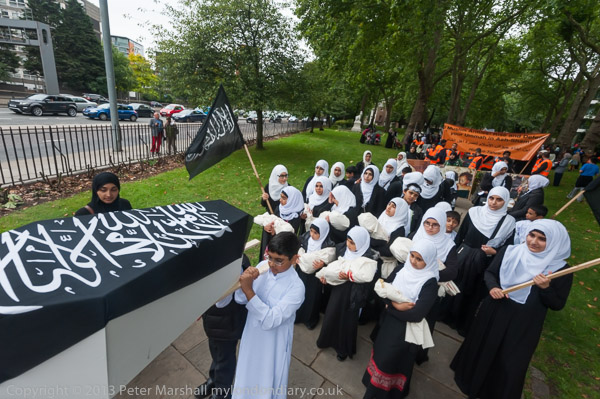
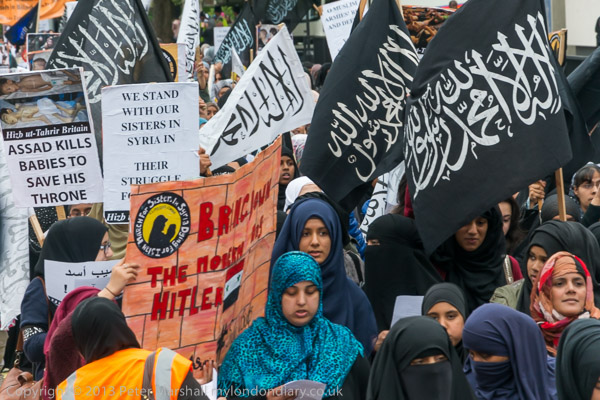
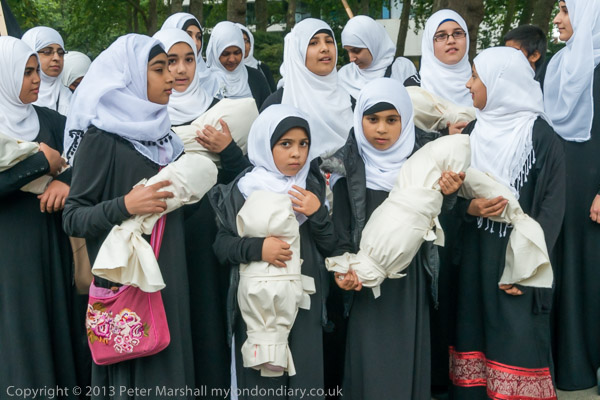
It would be hard not to be moved by the tragedy of Syria, with horrific images of massacres, mainly by the Syrian military or others backing President Bashar al-Assad, and some of the most tragic images are those of the cloth-wrapped bodies of small children. These ‘rows upon rows of dead children in their burial shrounds’ deeply affected the women of Hizb ut-Tahrir, prompting them to organise a march in London “ in solidarity with your sisters in Syria” and to “speak out against the shedding of their blood and that of their families and children.”

And at the front of the march was a small coffin carried by four young men, followed by a group of young girls carrying white bundles representing those small children in their burial shrounds.

This was another occasion when a little extra height was really needed, and fortunately there was a park seat in almost the right place at the start of the march. because that small coffin really needed to be seen from above. I was standing right at the edge of the seat, and ideally it might have been just a little more in front of the coffin.

I’d felt just a little awkward earlier, photographing the women at their pre-march rally. Although none of them objected to being photographed (a few did turn their heads away) I didn’t feel able to go into the crowd as I would have done had I been photographing most other protests. Though in my experience it is has almost always been men who have objected to me photographing Muslim women, and not the women themselves, who have often obviously welcomed it.

Once the march had started it was easier, though again I largely kept a greater distance than at most events, as I think you can see in Hizb ut-Tahrir Women March for Syria. But it could just have been that after replacing the 16-35mm on the D700 with the 70-300mm for pictures like that above I just couldn’t be bothered to change the lens again. I’d decided by then that it was time for me to go home, and only kept taking pictures as I was walking towards Edgware Road station along the same route as the marchers.

Continue reading Muslim Women on the March

Druids From On High

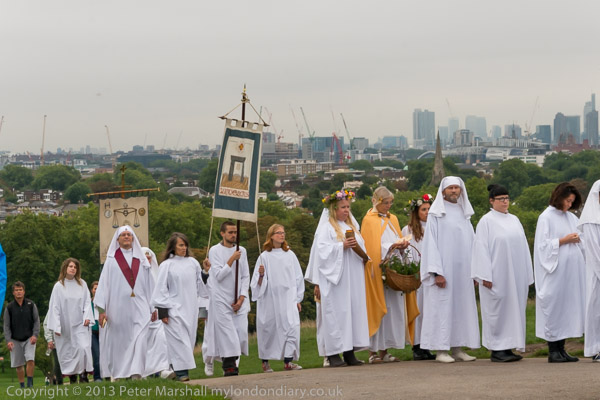
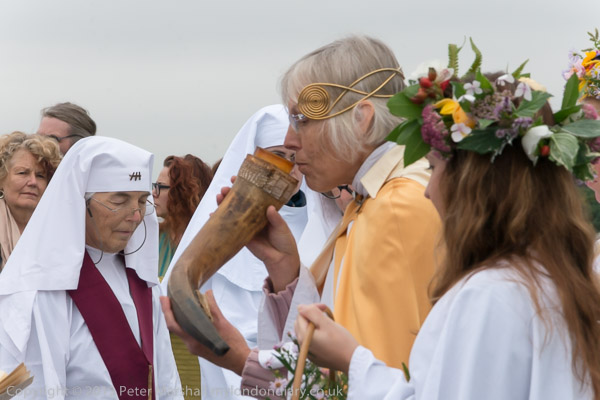
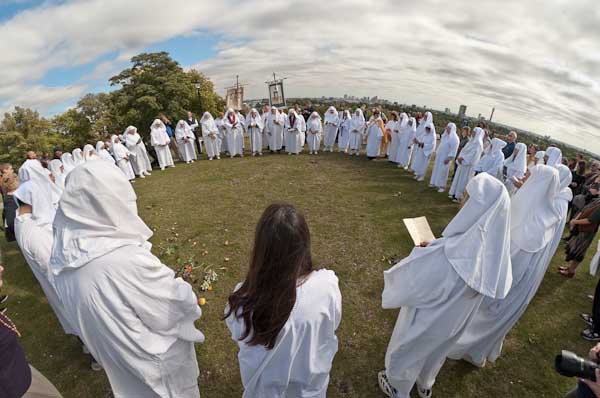
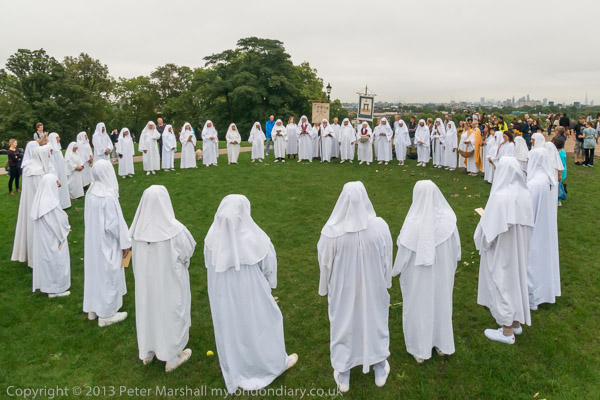
I’ve several times photographed the ceremonies of the Druid Order at both Spring and Autumn Equinoxes, and I think my work has produced a good record of what they do, and a few images of particular interest.

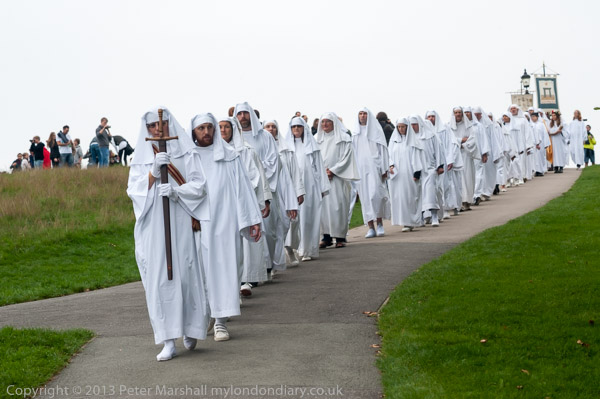
The processions they make before and after with a long line of Druids in their white cloaks are striking, and on Primrose Hill in particular the stand out against the grass of the hill or in front of the view of London.

I thought I had set out in plenty of time to photograph at Primrose Hill on September 22nd, but had reckoned without the difficulties of travel on a Sunday. Of course I’d looked up the journey on the Transport for London journey planner, which had told me that my train to Waterloo would be going by a roundabout route, and that the tube line to the closest station, Chalk Farm was closed for essential maintenance, and allowed the extra time needed. What the journey planner didn’t know was that my train would suffer from signalling problems, stopping somewhere on the outskirts of London for around 20 minutes before limping slowly towards Vauxhall, adding over half an hour to the journey.

I ran down to the tube, rushed through Green Park to change to the Jubilee Line, then hurried up the escalator and steps at Swiss Cottage to jump on a bus, finally walking and running up to the top of Primrose Hill to see as I was getting there the line of white-clad figures just breasting the top of the hill. I think there was a good picture there, but I was just to puffed to capture it, and it was really another 20 seconds or so before I was really working coherently.

As with all events, and particularly those of a religious nature, a suitable degree of respect is necessary, and in this case it means standing outside the circle and certainly not getting the the way or distracting those taking part.

The first ten minutes or so of the event has various actions to record which largely take place within the circle of druids. To photograph them means moving around the outside and taking pictures with a longish lens. So most of the time at this event I was working not with my favourite 16-35mm but with the 70-300mm on the D700, along in this first period with the 18-105mm on the D800E. For most pictures the 18-105 was long enough – as in the example above, taken at 66mm (99mm equiv.)


2009

After these initial activities, the ceremony becomes more static, with readings and a sermon, and there is little action to photograph. In previous years both here and at Tower Hill in the Spring I’ve made some images I like of the circle of white-clad figures, particularly using the 10.5mm fisheye. But holding the camera up at arm’s length above my head didn’t really get quite enough height.

So today I brought along a monopod and fixed the camera on top of this, with a cable release plugged in. At first I’d thought of using a remote release, but the lead on the cable release turned out to be exactly long enough. I lifted up the camera and took a picture, then brought it down to check the result, finding I needed to move back a foot or two to get everyone in. The tricky part was getting the camera exactly level and pointing in the right direction when I was unable to see through the viewfinder. Live view wouldn’t really have helped greatly as the rear screen was too far away and reflecting the sky nicely, so I just had to take quite a few exposures trying to get it right, then bring the camera down to look at them.

This was the best – as usual with a little help from the Fisheye-Hemi plugin. There were a few others taken with the aid of the monopod that I liked too. The extra height would be useful at some protests – and there are photographers who use a similar rig, but I’ve never got around to doing so. The problem for me is simply that the monopod is yet another thing to carry, and my bag is too heavy already even if it wasn’t too long to fit.

I’ve never managed to find a monopod that I really warm too, though I can see that they can be useful. But I think they could be much lighter and telescope to a smaller size and still be useful.

The ceremony on the hill top over, the Druids then process down the hill, giving a further opportunity for pictures (including one where I missed seeing the cranes in the background growing out of the Druids’ heads – a real beginner’s mistake.)  You can see more from the whole event at Druids Celebrate Autumn Equinox.

Continue reading Druids From On High

Moral Hazard

The Guardian at the end of last month published an interesting audio slideshow with Stephen McLaren talking about his five-year project documenting the City of London after the 2008 financial crisis, Moral Hazard.

McLaren is one of the most interesting to emerge in a new generation of ‘street photographers’, though the genre is perhaps largely meaninless, and I think it belittles his work to call him a street photographer, with so much that is now included under that title being puerile graphic observations.

What distinguishes Mclaren’s work – not that it lacks graphic interest, is an underlying seriousness of purpose. It is (as one photographer whose opinion I valued once said about my own work) “about something.” Behind the often amusing or even startling sights he records there is a an intelligence. These are not isolated aperçus but a project worked out over repeated visits to the streets of the City, building on each other.

As well as the images on the Guardian you can see more of McLaren’s work on his web site. I”d particularly recommend his ‘East End‘ and look forward to seeing more of his ‘Scotia Nova‘ and there are images in ‘Westcostism‘ that I love. But all of the projects are worth looking at.

Save Whipps Cross

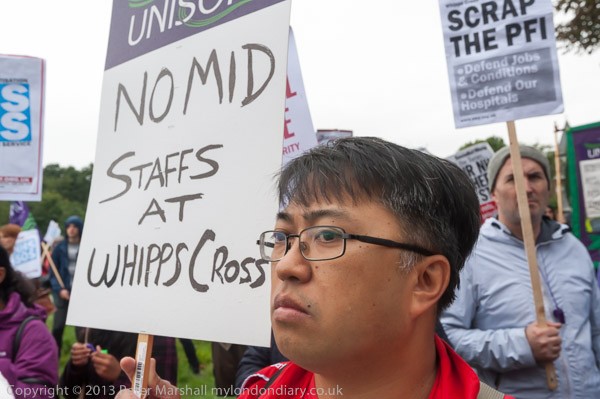
It wasn’t the best of weather as I made my way across London to Whipps Cross in the north-east of the capital. It’s on the edge where Walthamstow and Leytonstone meet Epping Forest, and around 500 years ago or more, the family of John Phyppe set up a cross to him at a lonely meeting of roads. It still feels a rather lonely place, but has a large and busy roundabout, and a hospital. It still has a cross, but a rather more modern one, a war memorial erected a mile or so away after the ‘Great War’ for the Essex Regiment of the Territorial Army, moved here when a large Victorian house became a TA centre.
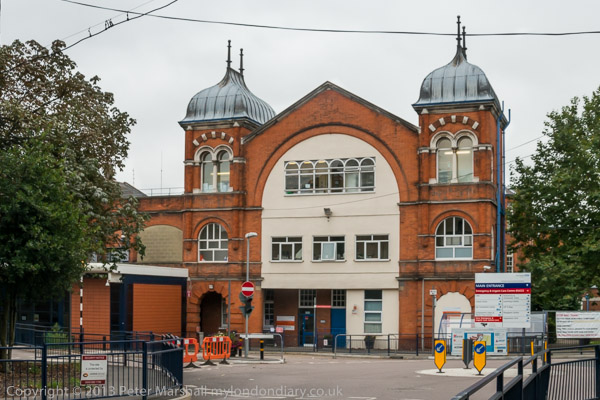
The Hospital also started – just – in the Victorian era, building starting in 1900, though it wasn’t finished until 1903 – it was a large hospital for the era, and a lot has been added since. Its now part of Barts Health NHS Trust and threatened with huge cuts not because of its own problems (largely solved by previous efficiencies) but because of the huge PFI repayments for the new Royal London Hospital in Whitechapel.

It was drizzling when I got off the bus and walked up the drive to take a look (and photograph) the old main entrance before joining the few hundred protesters who were gathering on the green next to the roundabout. Not hard enough to really get you wet, but enough to put the odd spot of rain on your lens when you least expected it, and I was keeping my microfibre cloth out and covering the lens as I walked around.
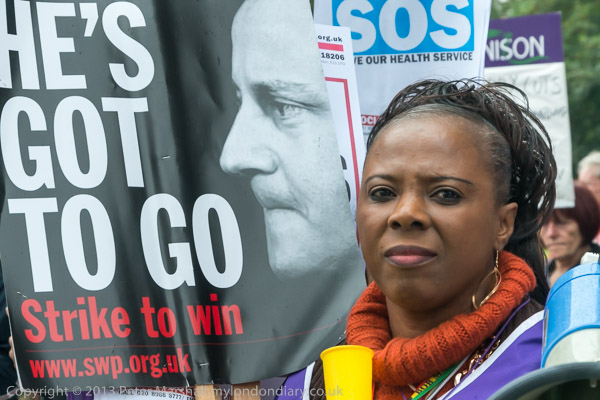

18-105mm at 75mm (112mm eq), D800E DX format

Once the speeches started it was easy to take photographs, with a nice amount of space for photographers between the audience and the small platform. There weren’t too many photographers, and better still not many videographers and it was easy to move around without getting in anyone else’s way. Working with people who are taking video is often difficult, as still photographers generally want to move around and movie photographers usually prefer to stay still, and still photographers often want to go in much closer to take pictures.  It can cause friction and often does.

I was using both the 18-105mm and the 70-300mm on the D800E, working with both on the DX format, although the 70-100 is a full-frame lens. I like being able to see the area outside the frame, and the 16Mp DX images are plenty big enough. The 70-300 was a better lens for head and shoulders or tightly frames heads of the speakers, while the 18-105mm was good for picking out individuals or small groups in the crowd. There is a useful amount of overlap between the two lenses which saves a little lens changing. The image above could have been taken with either.

16-35mm at 31mm, D700

As well as being useful for picturing larger groups, the 16-35mm also lets me get in close. Again there is a useful overlape between this lens and the 18-105mm DX (27-157mm equiv) and I could have used either for this image.
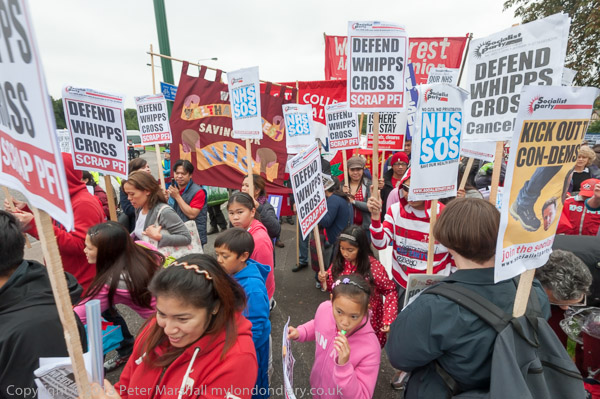

16-35m at 16mm, D700

I don’t much like climbing up on walls etc these days, and unless I’ve got something pretty good to hold on to I tend to start shaking rather a lot, and sometimes have to get down pretty quickly or I would fall off.  But there was a very handily placed seat in the right place that I could stand on and feel pretty safe while still getting to look down a little on the march
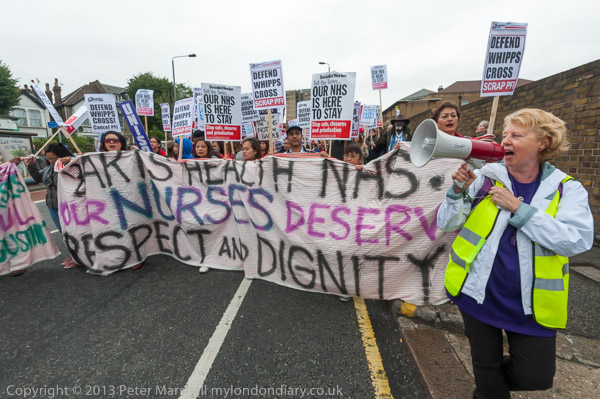

16-35m at 16mm, D700

The wide angle also came in useful as I was walking (backwards) with the march, letting me include the Unison shop steward quite close to the camera at right and the whole of the rather wide banner. It was reasonably bright and at ISO 640 the exposure was 1/400 at f10, and with a 16mm lens at those settings there is plenty of depth of field and little risk of camera shake even though I’m walking.

I think photographers somehow develop a smoother movement with practice. Back when I taught photography I had to spend a lot of time telling students how to avoid camera shake. You have to stand still, tuck those elbows in to your side, press the camera against your head and make yourself and the camera a solid block, then squeeze not jab on the the release. Yet many still managed to get camera shake. Of course they were mainly working with standard focal length lenses, and using film at ISO 125 or 400; wider lenses and higher ISO make life easier, (and so does image stabilisation) but in part I think it’s in the mind, thinking steady helps.

It’s perhaps better to keep moving than to stand still, because even in 1/400s, a person walking will move perhaps 1/8″, and if you are moving at the same speed and in the same direction  the distance won’t change. The effect of movement would in any case be less for someone walking towards you, while people walking across the field of view will show the effect of their motion more, and the effect will be greater the closer they are to the camera. Arms and legs in particular are also moving at greater speed than the actual movement, so more likely to suffer motion blur. But a little blur, particularly if the eyes and face remain sharp, is usually a good thing.

The main reason to keep moving when photographing marches is that if you stand still, people are more likely to stop. And the last thing you want people to do when you are photographing them moving is for them to stop.
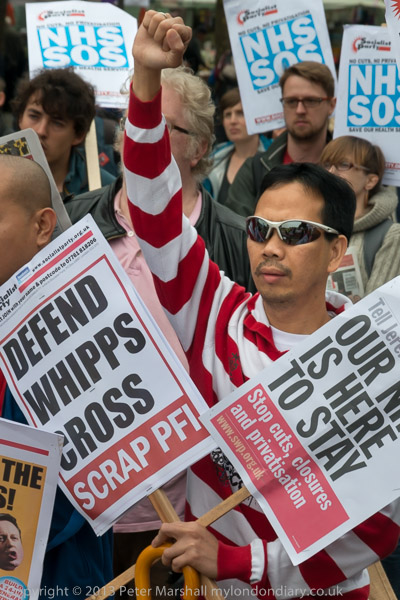
The march ended at Town Square in Walthamstow with more speeches, and again both the 70-300mm and the 18-105mm were useful, the longer lens mainly for the speakers, and the shorter for people in the crowd – though again the picture above, taken at 105mm (157mm), could have been made with either. If I know I’m unlikely to need an extreme wide angle (or a very long lens), I often put the 70-300mm on the D700 and use it full frame, though I didn’t think to do so here.

More pictures (and of course more about the protest and background) at Save Whipps Cross Hospital

Continue reading Save Whipps Cross
Hunting the Polar Bear

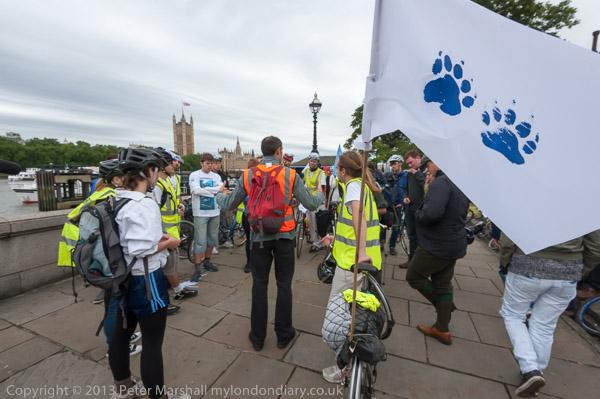
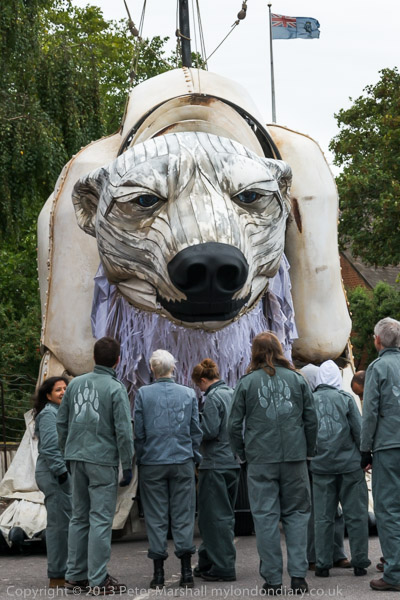
There was no sign of Aurora where the #Iceride protesters were gathering in the Victoria Tower Gardens, and the Greenpeace media people weren’t over helpful, though they did tell us to expect her coming over Lambeth Bridge. We went there and waited. And waited.


Paw marks but no bear

We found a group of #Iceride cyclists on the Albert Embankment, but they seemed equally in the dark. Then at last we saw a few Greenpeace stewards making their way across the bridge and finally they admitted they were on their way to the polar bear, and we followed them down the Lambeth Rd.

If I’d stayed on the train to Waterloo I would probably have spotted the giant bear in a yard next to the railway bridge, but on Sundays my trains call at Vauxhall, from where a bus took me directly to the advertised meeting point. But despite all the waiting we still got there before Aurora with its teams of pullers and crew left the yard for her slow journey to the Shell Centre.

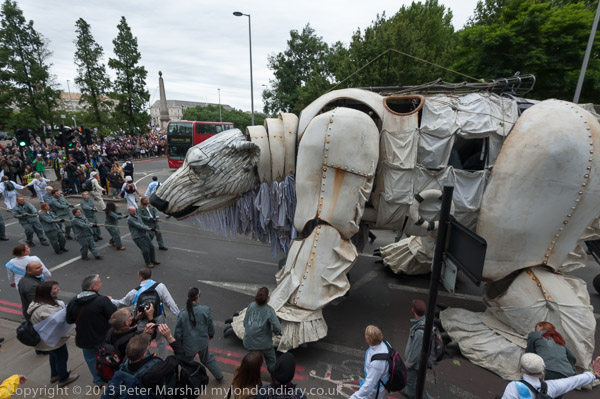
It isn’t easy to navigate a 3-ton polar bear the size of a double-decker bus crewed by a team of twenty and powered by another 20 or so on ropes, and for a while it seemed touch and go whether Aurora would make it out of her lair and on to the A3203 or not. But eventually she was making her way down the Lambeth Rd to the roundabout by Lambeth Palace.

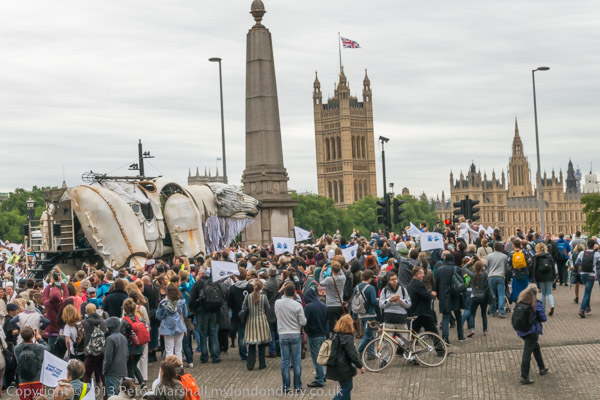
The plan had been for her to go over Lambeth Bridge and past Parliament, returning to the South Bank and the Shell Centre over Westminster Bridge. I’d already decided a key image would be on the bridge, with the Houses of Parliament behind – as had probably every other photographer out that day.

But the weather had robbed us of our cliché. High winds and a forecast of heavy rain meant the team had decided it was unsafe to cross the bridges, where strong winds blow unchecked down the river, and Aurora was to take a shorter direct route on the south bank.

By the roundabout at the ‘south’ end of Lambeth Bridge (the Thames actually runs roughly west to east, so this is a kind of liturgical south, being on that side of the river which is flowing roughly north here) on the is a large and I think rather ugly block of flats (what estate agents term a prestigious development) called Parliament View. For £3000 per calendar month you can rent a flat there with a perfect trajectory to the Houses of Parliament only around 650 yards away, though I suspect would be renters get a fairly strict vetting from the nearby MI5 in Thames House just across the river. But I went for the cheaper option of trespassing on the steps and garden area around its front.

Which was fine except for a little street furniture when Aurora came down the Lambeth Road, and I moved into position for a picture as, together now with a large crowd of followers who had swarmed across Lambeth Bridge she turned the corner to go in front of the river frontage of the HoP.

She was coming up to the right position and I took a few pictures. But at the critical moment, Aurora disappeared behind a No 3 double-decker bus, waiting to get on to the roundabout. And waiting, while I tried running back and forth to get a better view. It almost happened but not quite. It wouldn’t quite have worked event without the bus, as the bear had turned around just a little too much before coming in front to the building.

It was time to photograph some of the people who were following Aurora, some in bear costumes and other fancy dress, as well as the team of three dancers who were in front of the bear. At the Westminster Bridge roundabout we got another glimpse of Big Ben in the distance, but it didn’t make a great picture for me. There was a little too much harassment by police and stewards to make it easy.

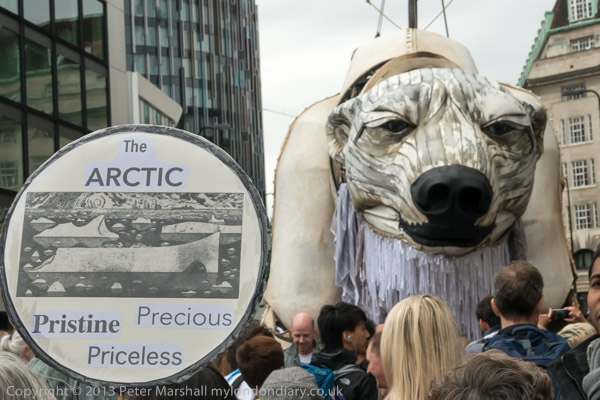
But finally on York Road, close to the end, I made an image that satisfied me. This was an event with very few placards, but I saw rather a good circular one, and an idea for a picture.

It wasn’t easy to get and keep in the right position in the crowd, as both bear and placard were moving, the placard rather more erratically. It was easy for people to get in the way too, and they did. But the main problem was the difference in size so I had to keep the two at very different distances and zoom to frame.

I took 21 frames working at the idea – the best was frame 16. The focal length needed varied from 39 to 99mm (equivalent) with the 18-105mm on the D800 and was 93mm equiv on the image above. Working at ISO800 I had closed down the aperture to f14, giving me a usable shutter speed of 1/200 but not quite enough depth of field. The placard is sharp, but the bear is just out of focus. I decided it was sharp enough for the image to work (with just a little help from Lightroom ‘Clarity’.)

There were some interesting moments at the rally at the Shell Centre, with some chances to use both the 10.5mm fisheye and the 70-300 at up to full stretch (45omm equiv) and you can see these at Aurora tells Shell – Stop Arctic Drilling.

Continue reading Hunting the Polar Bear

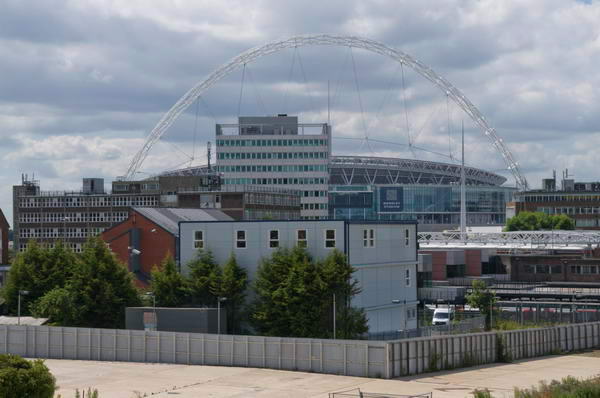
Wembley Arches

I hadn’t gone to Wembley to take photographs, but to go to the opening of a show by an old friend in a community arts centre. It was getting dark as I ran across the road from Wembley Park station and jumped on a bus.

I’d come from photographing a couple of protests, one by Sunni Muslims opposite the Iranian Embassy with Anjem Choudary – Iran ‘Release Sunnis, Don’t Hang Them’ -and a larger event in front of the National Gallery in Trafalgar Square against cuts in funding for the Arts – Human Chain over Arts Cuts, so I was carrying my camera bag, and quickly pulled out the D800 to take a picture looking down Olympic Way from the top deck.

It’s a view that certainly benefits from the extra height, and I’m always disappointed when going by bus if the service isn’t on a double-decker, as the views are generally so much better. I don’t much like the new Wembley Stadium and haven’t ever photographed it properly, though it is certainly a landmark that can be seen from many places in West London.

The only other picture I can recall taking was from the roof of a nearby building that was being occupied against the building of an unwanted academy school in 2008. Perhaps one day I’ll go and photograph it properly.

By the time I left the exhibition opening, fortified by a couple of glasses of red wine, it really was dark. Again I got on the top deck of a bus, and again saw a view with arches, though one that seemed rather more interesting. Its rather a pity that Wembley Stadium station doesn’t get more trains.

There were after all three arches, not just one (you can see just a little of the stadium arch at the left too.) But really it was the colour that caught my attention.

Of course many photographers have worked taking pictures from buses, including an interesting series of panoramic images of London High Streets by another of my friends, Mike Seaborne. And I – like others – have taken pictures of people on buses too.

But there are problems in taking pictures through bus windows. Bus companies don’t generally clean them very often, and while one can wipe the inside, the outside windows on the top deck are too high even if you could get the driver to stop while you gave them a polish. All you can do is to choose your seat carefully and then put the camera lens close to the cleanest patch you can find.

Vibration is a problem if you actually let the camera lens rest on the glass. Some bus windows shake so much it must be a design feature. Keeping a gap between the solid parts of the camera and lens and the glass is essential unless you like a bit of blur.

But if the camera lens isn’t on the glass you will get unwanted reflections. You can see a little at top right of the top image on this page.  I generally remove the lens hood to get the lens closer and hold around the lens with a hand which can rest on the window but absorbs the vibration while cutting down reflections. A better solution which I used to use was a rubber lenshood.

It’s hard to avoid reflections unless you work more or less perpendicular to the glass, and working at a close distance cuts down the effect of spots on the window.

I spend quite a lot of time travelling in London on buses, not least because I now can travel free, while on the tube or overground I have to pay. But it’s generally a more interesting way to get around, though often rather slow. I’ve often thought that when my legs get too tired to walk much (and I think they are wearing out fast) I might spend some time photographing London from the bus.

Free Sinyakov

In Russia, Conflating Journalism and ‘Hooliganism’’, posted on the New York Times Lens blog is an article by Steven Lee Myers about photographer Denis Sinyakov,  the Moscow-based freelance photographer who was arrested when Russian soldiers illegally seized the Greenpeace ship the Arctic Sunrise on the high seas on September 19.  All of those on board, including Sinyakov and were initially charged with piracy. On 26 September a court in Murmansk ordered he be put in  preventive detention for two months, according to Reporters Without Borders because ‘he “often travels abroad” and might try to elude the authorities’.

The Russian prosecutors have since reduced the charges against him and the other 29 arrested to  hooliganism, which still carries a maximum sentence of 7 years, and they could be held in jail for up to 18 months before the case comes to court.

Reporters Without Borders comment:“

Sinyakov was arrested while working as a journalist and his detention constitutes an unacceptable violation of freedom of information,. By investigating this photographer and the Greenpeace activists he was accompanying on such an absurd accusation as piracy, the Russian Investigative Committee is criminalizing both journalists and environmental activism.

They report Sinyakov’s speech to the court:

“This ‘criminal activity’ is journalism and I will continue to practice it […] Greenpeace is an organization with a 40-year history and is well known for its activities. But I don’t work for it. I am a journalist. You can see my photos in the media in Russia and all over the world. All my equipment has been seized. My only weapon is my camera.”

Sinyakov worked as a photo editor and a staff photographer at Agence France-Presse (2004-2007) and at Reuters (2007- July 2012) when he went freelance to be able to concentrate more on the stories that interested him “on the environment, human rights, politics and the economy.” According to the NY Times post, the Russian news agency Lenta.ru have provided a letter for the court that he was accredited with them.

Those who can read Russian can read his ‘Entries from Jail‘ (Записи из СИЗО) on his web site. All of us can support Sinyakov and the rest of the Arctic 30 by sending a letter to our Russian embassy from the Greenpeace site. Protests are also being organised outside many of them, including one in London this evening.

Kieron Bryan, a British freelance videographer who previously worked at The Times, the Mirror and Current TV,  leaving The Times in January to pursue freelance work, is also among the 30 arrested. He was employed by Greenpeace on a short-term contract to document the organisation’s work on Russian oil exploration in the Arctic Circle. The BBC reported today that his family are hoping to fly out shortly to visit him in prison.


Secular and Sacred

Fortunately the weather began to clear up soon after I left Lewisham, catching the train back to London Bridge and then the tube to Westminster. And although I was too late to photograph the 6th annual Secular Europe Campaign march, I was there in time for the rally opposite Downing St.

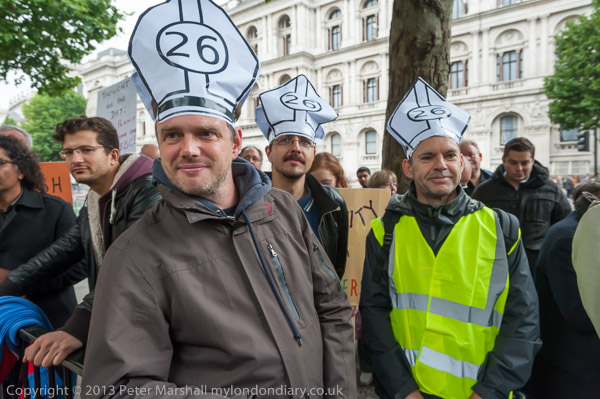
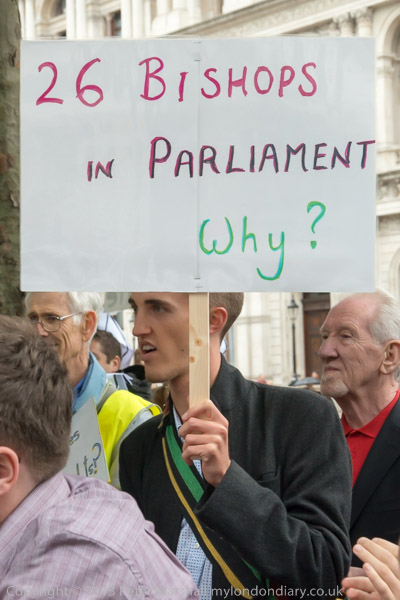
Visually the most noticeable thing were the paper hats worn by some of those taking part, in the shape of a bishop’s mitre with the number 26 on them. The point was perhaps made more clearly in a placard.

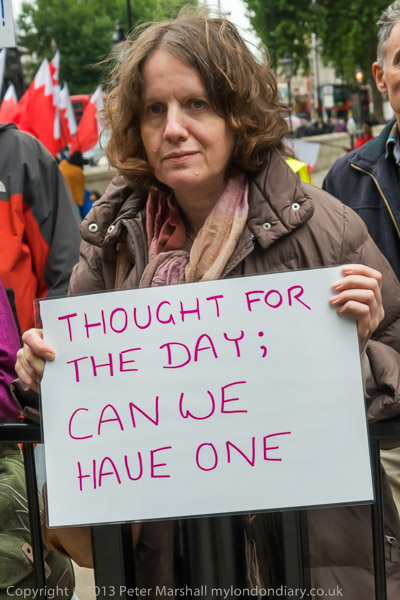
Though my favourite poster, as a regular morning listener to the ‘Today’ programme on my radio alarm, was one saying ‘Thought for the day; can we have one?’.

Although my alarm is set for much earlier, it’s nearly always ‘Thought for the Day’ which actually drives me out of bed, and I seldom hear all of this three minute interlude in the programme, though there are just a few that make me stop and listen before I rush to the bathroom. Some of them – or what I hear – strike me as pretty secular in any case, as is most of the rest of the programme, and if what I’m hearing from the speakers as I take some pictures is representative of what their ‘Thoughts for the Day’ might be, I’d be in real danger of going back to sleep.

I left the Secular Europe Protest sooner than I needed, as there seemed little chance of good pictures and a certainty of getting rather bored. I’ve no love of the established church, and certainly in favour of secularism so far as our laws are concerned, but can’t get worked up about Bishops in the House of Lords, who generally seem to do at least as good a job as the rest of that unelected body. Tackling class and elitism and the entrenched power of a small minority seem far more important issues and being anti-religious as those I heard seemed to be seems rather a matter of ‘bashing the bishop’. An activity that of course has its place.

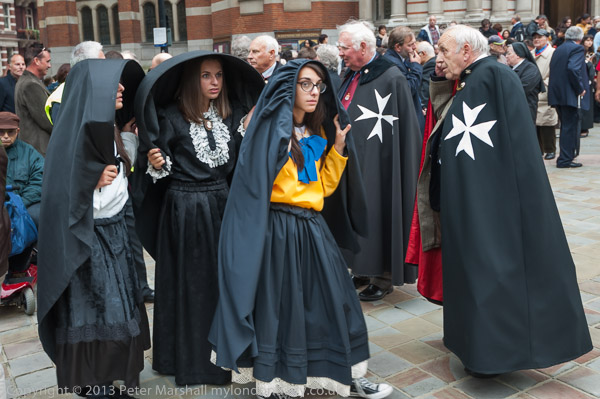
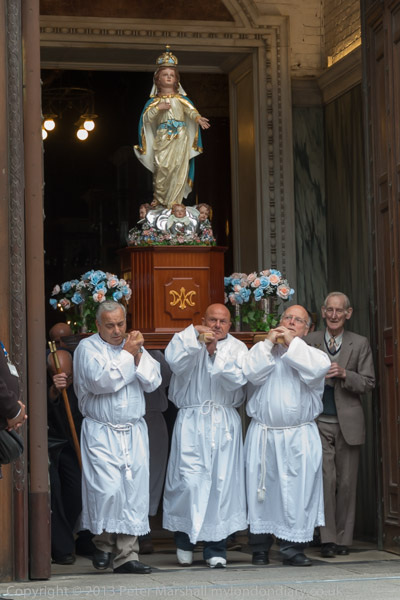
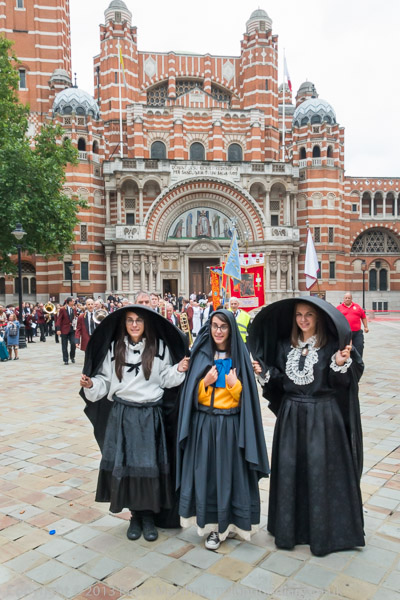
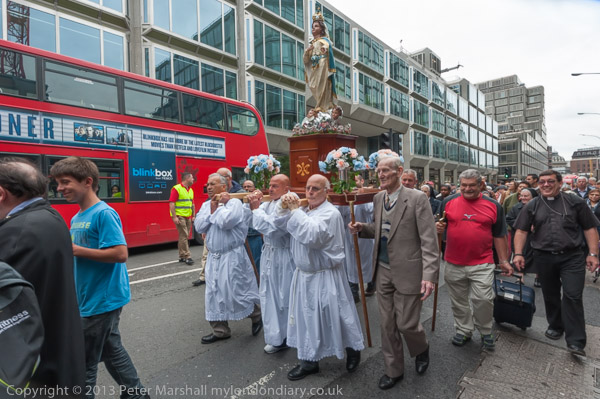
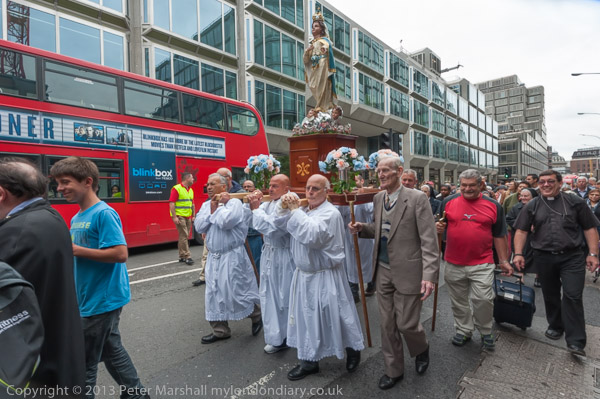
I wandered slowly to my next appointment, arriving early, and having to wait a very long time outside Westminster Cathedral as the web page for the event had misled me about the time that the Maltese would emerge from their celebratory mass for the Malta Day Procession procession to make their way carrying the rather hefty statue of the Bambina  to the Sacred Heart Chapel of Ease in Horseferry Road.

I’m not a fan of the Catholic Church, though it is a very mixed organisation, parts of which seem not to have move on since the Spanish Inquisition, while others are organising some of the more radical movements in South America. Perhaps too I still bear a personal grudge against the Maltese branch of the church, since my earliest girl friend was Maltese, her uncle a bishop. When he heard she was going out with a non-Catholic she was immediately shipped back from England to Gozo. It was a very long time ago, and I think I’ve got over it!

But while I don’t share their religion, visually the event was far more interesting. I particularly liked the view of the statue being carried out of the cathedral door.

And in its peculiar way, Westminster Cathedral is a quite splendid building which makes a good background.

I had a few technical problems, partly I think because I got a little distracted with someone talking to me. I’m generally not very sociable and need to concentrate on the job when I’m making pictures and being interrupted a lot really does put me off my stride. So a few exposures were way out – probably because of all the black cloaks and those strange hoods worn by the girls. Possibly I had the camera on ‘spot’ metering, which is fine and precise so long as you pick the right spot, but can be disastrous if you are not thinking.


Image before crop and manual processing

And for the final few frames I managed to knock the lens hood on the 16-35mm slightly out of position, getting a little total vignetting at top right and bottom left. Small enough to be easily missed in the viewfinder, but annoying, though in this case fairly easily dealt with.


Image after crop and manual processing

But its a shame that Nikon didn’t design a better bayonet fitting for their lens hoods and make them slightly more rigid. Most days when I’m out taking pictures I find myself bending down at some point to retrieve a lens hood that has self-detached.

Continue reading Secular and Sacred

Lewisham Victory Parade

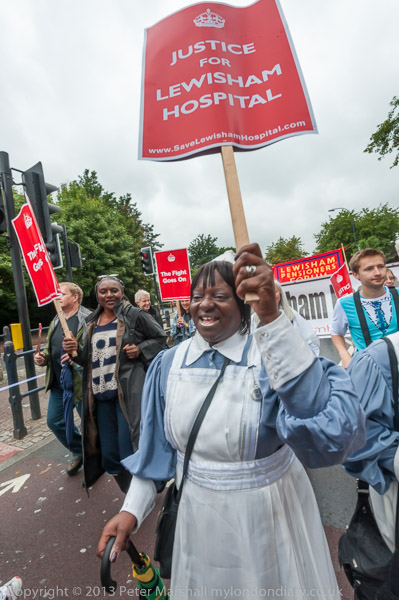
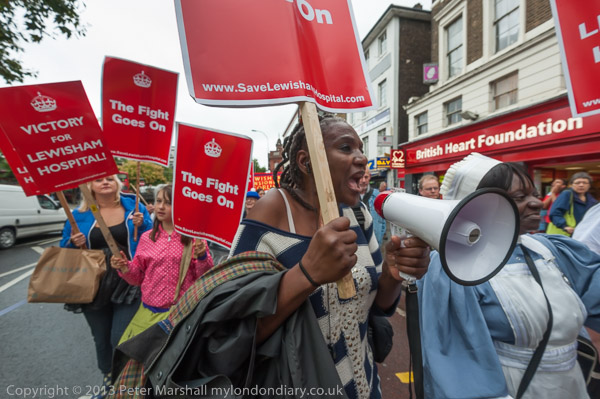
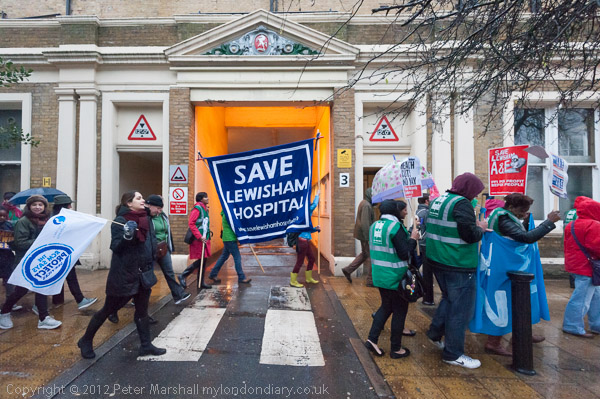
It was a shame that it was such a damp and rather chilly day for the Save Lewisham Hospital Campaign‘s Victory March. Perhaps rather more would have come on a nice day, and it would certainly have been more pleasant both to take part in and to photograph.

Fortunately the rain slackened off a little, and people could march without umbrellas, but the atmosphere was still a little dampened.

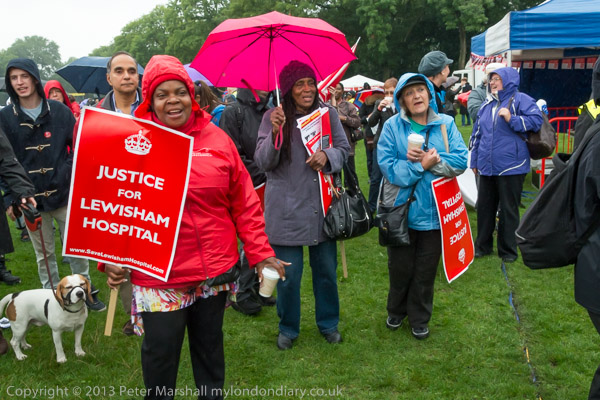
Though the umbrellas were up again for the fair at the end of the march, and it wasn’t really the weather to be dancing on the grass in Ladywell Fields.

Or even like these people, standing watching others dance.  It really was a shame, because the Lewisham campaign – which brought a huge crowd out onto the street on another rather cold and damp day last November – see Save A&E at Lewisham -Hospital and had us all wading in the mud at Mountsfield Park in January – Save Lewisham Hospital  may not always have had the weather on its side but has been very successful.

Although the minister decided to appeal when he lost the case in court (and will probably decide if he loses to pass legislation to change the rules) the strength of the local opposition has meant significant gains for the local community – and will mean fewer unnecessary deaths in the area.

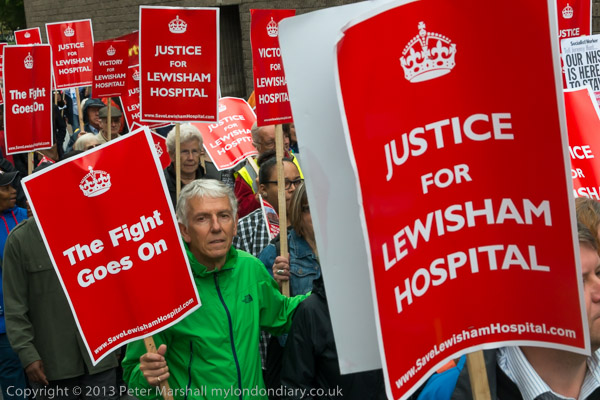
I was standing on the low wall around a roadside flowerbed, and the bright green coat being worn by one man really stood out in the sea of people in largely rather drab rain wear and carrying uniformly red placards. This was the first of four frames – with the 218-105mm at 50mm (75mm equiv) and clearly the best, partly because he is looking at me, but also because it is the one with the clearest link between the two placards in the foreground, and also because of the fairly precise framing of the placards at the top left. As usual this image is full frame.

More pictures: Lewisham Hospital Victory Parade.

Continue reading Lewisham Victory Parade

Arms Fair Die-In at Parliament

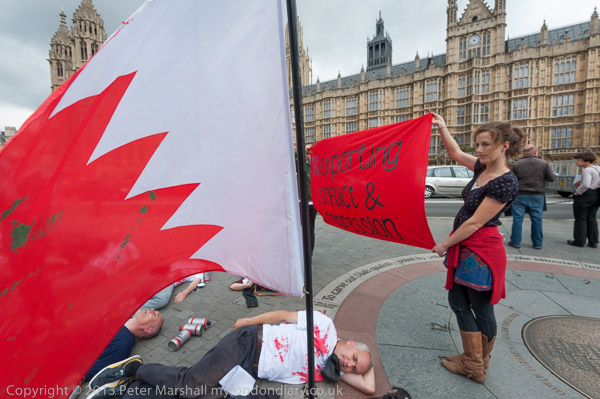
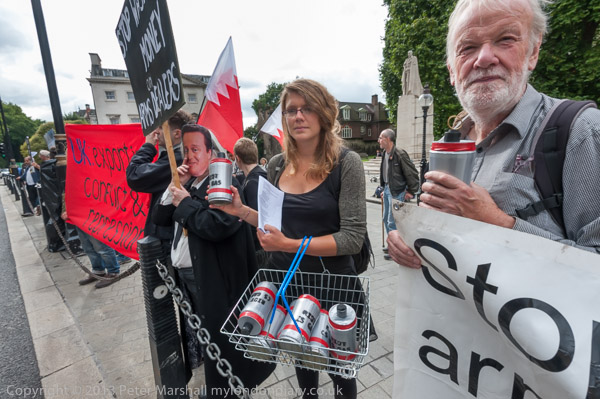
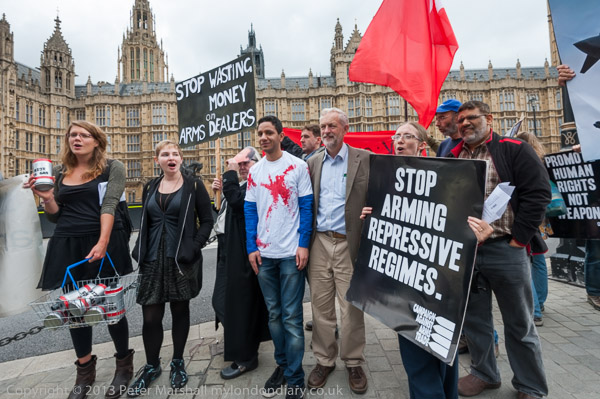
Pictures with flags blowing in the wind are always something of a challenge, and it took a little patience and luck to get this Bahraini flag blowing how I wanted it.  The picture was made during a photo-op at the Houses of Parliament organised by the Campaign Against Arms Trade (CAAT) as a part of its week of actions against the DSEI arms fair that was taking place in East London.

I don’t much like such ‘photo-opportunites’ as they usually end up with a large group of photographers, often with some kneeling and others standing behind them taking a rather boring group photograph. Most of the pictures of course look rather similar, and it’s depressing that newspapers seem to like these predictable images. So I take at least one of them, but try to provide something more interesting, though too often it will be the posed one that sells.

But I’d gone to this one partly because I think about the last thing we want in London is an arms fair, but also because I expected CAAT to provide a more varied event than most to be photographed, and I was right.

Someone did suggest that I was either holding the flag or got someone else to hold it, but that wasn’t the case, though I have to admit I have occasionally done so in the past. But this was the second of five frames I made, and they show convincingly that it was blowing free.

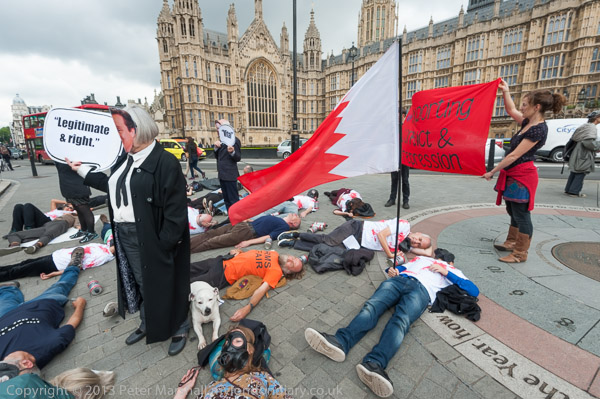
I was using the Bahraini flag for several reasons. First for the same reason that it and the Bahraini protester on the ground at my feet and just out of the picture had brought it – that arms from deals made at earlier DSEi arms fairs sold to Saudi Arabia and Bahrain had been used against peaceful protesters in Bahrain. But it was also for its graphic effect, and not least in an attempt to simplify the rather messy scene in front of me – which you can see in another image taken just a few seconds later.

Both images were with the 16-35mm on the D700 at 16mm, and at ISO 400 and exposures around 1/320 f8.

The red banner with the message ‘exporting conflict and repression’ is more or less at the centre or the top picture (though you can’t read the ‘UK’ at the start), with the red continuing into the jumper around the waist of the woman holding it and to the fake bloodstains in the ‘victim’ on the ground and also on the stripes on the ‘tear gas’ canisters.

I think it’s an image that would benefit from just a slight crop at right – not every image quite fits the 3:2 format, and I find the figure on the extreme right in a white shirt pulls my eye away a little. I suppose too that I would have rather have had a slightly more recognisable view of the Houses of Parliament as the backdrop, but you can’t see Big Ben from this part of Old Palace Yard.

Of course I took more pictures, and after the ‘photo-op’ there was also something more of a protest and a short rally, with Jeremy Corbyn coming out to talk to the protesters., and pose with them for a few pictures.

You can see more pictures at Arms Trade Die-In at Parliament.

Continue reading Arms Fair Die-In at Parliament