No Colour Bar


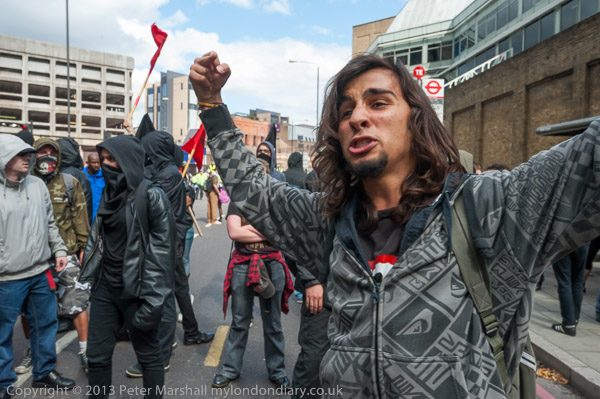
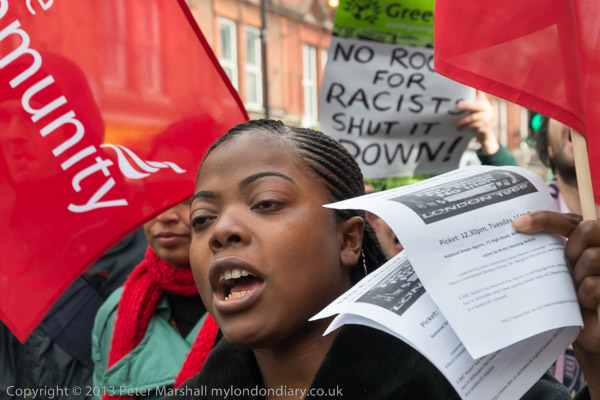
The flags were blowing wildly in the wind as the group marched down Willesden High Rd

When I heard and saw BBC London’s ‘Inside Out London‘ investigation into letting agents I thought of the 1950s and 60s, when signs saying “no blacks, no dogs, no Irish” became common on London lodging houses, and we had a ‘race riot’ in Notting Hill.  The Race Relations Act 1965 outlawed discrimination on the “grounds of colour, race, or ethnic or national origins” in public places, and he Race Relations Act 1968 extended that to housing, employment and public services.

But the programme clearly showed that letting agents – at the request of a person wanting to let a Notting Hill flat – were prepared to make sure that they were prepared not to show that vacancy to a black enquirer, even though they knew this would be illegal. Even though some of those concerned were themselves from minority communities, they were prepared to discriminate rather than risk losing the business.

The two agents who featured prominently in the feature were both on Willesden High Rd, about half a mile from each other. I didn’t expect the protest, organised for the day following the protest to be huge, but I felt it was an important issue and decided to cover it.

My journey to Willesden, never particularly straightforward, was made more difficult by a derailment in the early morning when a container came loose and brought down the overhead power lines and gantries supporting them at Camden Town. Although it had occurred at 3am, the on-line information still had trains running normally when I left home considerably later, and it was only as the train from Richmond approached Willesden Junction that we were told it would go no further. We all had to get off, and found the staff on the platform there knew little more than us. After a few minutes we were told there would be a train running as far as Gospel Oak, more than far enough for me, as I only wanted the next stop, Kensal Rise, but when it would come was still a mystery.

I was still standing wondering whether to leave the station and take a bus when it did come in, and fortunately I arrived at Kensal Rise only around 15 minutes after I had expected. I ran for a bus, but just missed it. But on main routes in London it’s seldom too long before the next one.

In the event I arrived only a few minutes after the protest was meant to start, and before many of the protesters. Its a small but sometimes tricky problem to know what the times for protests mean, but normally I try to arrive at least a few minutes early, and just occasionally that’s too late, while other protests are considerably more laid back and don’t really get going for half an hour or more after the given time.  A few I’ve waited half an hour or so, then left, assuming nothing was going to take place, only to read a report of them on Facebook the following day.
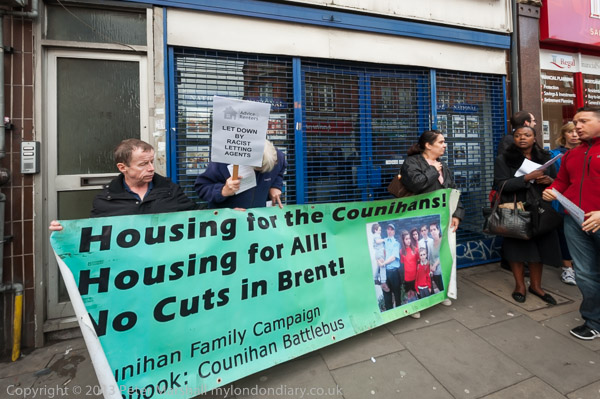
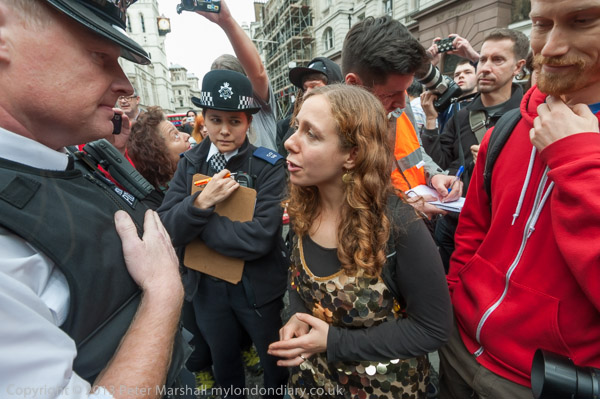
Among the protesters in a slightly larger group than I expected were several people I knew from previous events, including Isabel Counihan whose family campaign to get Brent council to rehouse them has attracted considerable attention. Their campaign soon widened to support others with having problems around social housing, including that of one man who committed suicide following loss of benefits through DWP incompetence and notice of eviction by the housing association who have plans to redevelop the property.
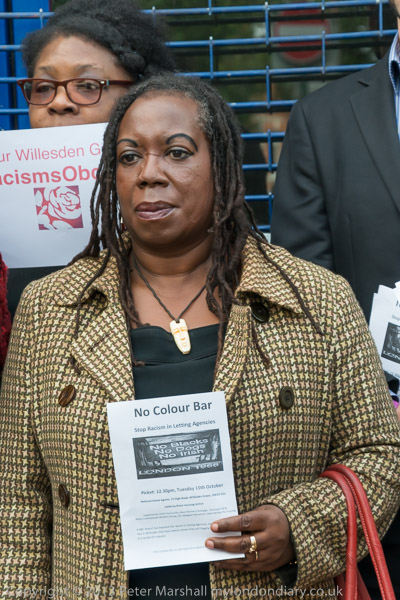
Also present at the protest were councillors and others from Brent Council, against which the Counihan family had been fighting – and whose housing department had caused their problems through initial poor advice and later what seems to be confusion and sheer malice.

A little coolness between the two parties might have been expected, but one man took it further, speaking rudely to Isabel and then standing in front of her banner in an attempt to prevent the press photographing it.  I’d already done so, and made sure it was reasonably prominent in my coverage of the event, when perhaps otherwise it might not have been used.
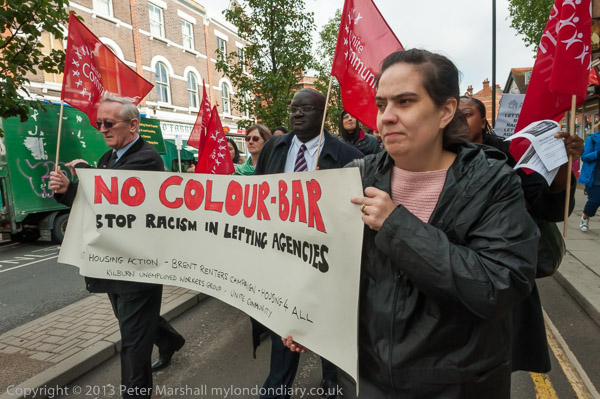
I’d already talked to her and she had told me than that they were in the process of getting a new banner for their ‘Housing For All’ campaign, and later after the unpleasant scene she decided to roll her banner up, and instead carried one end of the Brent Housing Action banner on the march.
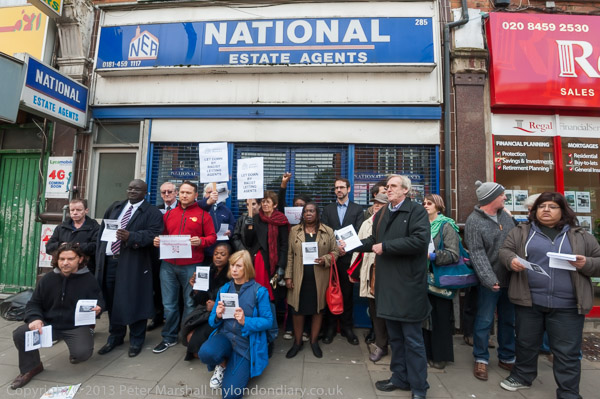
The protest was on a narrow pavement next to a bus stop on a busy road outside National Estate Agents. Fortunately the 16mm was just about wide enough to get the whole of the shop front and protest in without standing in the traffic, but a local press photographer perhaps didn’t have or didn’t want to use anything so wide, and organised people into standing on the edge of the pavement, going out in the road to take pictures. Personally I preferred to keep safe.

I’m not a fan of estate agents, who seem to me to take rather too much and do rather too little for the money. But at this protest some of them went up a little in my estimation as a couple walked out from another nearby agency, Harts, and joined the protest.

After a while and some chanting outside National Estate Agents, which was closed and shuttered, perhaps because it was Eid ul-Adha rather than for the protest, they decided to march along the road to the second letting agent, A to Z Property Services, where the protest continued, as you can see in Letting Agencies Illegal Colour Bar.

Later I read in the local paper that one of the agencies was disputing the version of events put out by the BBC. It was perhaps hardly surprising news, though having watched the programme I thought a statement more along the lines of “Its a fair cop, Guv” might have been more appropriate
Continue reading No Colour Bar
A Morning in Soho

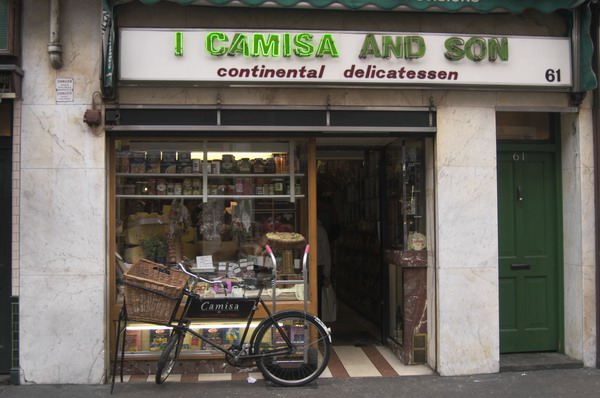
I don’t spend a lot of time in Soho, though it’s one of London’s more interesting areas, with an atmosphere of its own. As the Soho Society, formed in 1972 when the whole area was in danger from comprehensive redevelopment states, it is “a remarkable square mile with a remarkable history.”  Thanks largely to their efforts, Soho was made a Conservation Area, and although continually under threat, much has survived.


Soho 2003

Much of its character comes from the many small businesses there covering a huge range of goods and services, both for the trade and the general public. Unlike most of the rest of London (and other cities and towns) it has largely resisted the chains and franchises, although there are a few, mainly on the major roads that cut through or surround the area. Tourists flock to Chinatown – and so do London’s Chinese population, but it’s also a great place to buy Italian groceries (and perhaps the best sandwiches in London.) And so much more.

Soho has also a reputation for sex, and as well as various clubs and bars catering for various tastes, there are still open doors on some streets sometimes with a red light and a small card, ‘Model upstairs’. ( I assume this doesn’t refer to, say a model train, but can provide no  first-hand information.)  Years ago while walking through the area it was common for young (and not so young) ladies to come up to you, perhaps to ask if you had a light for their cigarette, or simply to ask “Looking for a good time, Dearie?” but now such business is apparently more often conducted by phone.  ‘Working Girls’ as they are now styled can work much more safely from a flat, with added protection from the presence of a ‘maid’, often an older woman who has retired from the ‘game’. Or so I’m told. Personally it isn’t a trade I’ve ever thought to patronise, and I have some sympathy with campaigners who want to make paying for sex by men (or women) an offence.

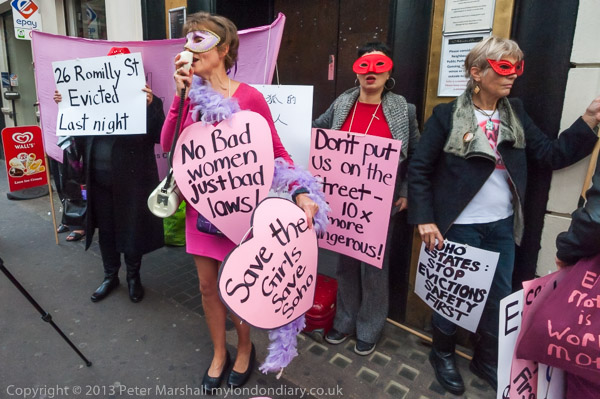
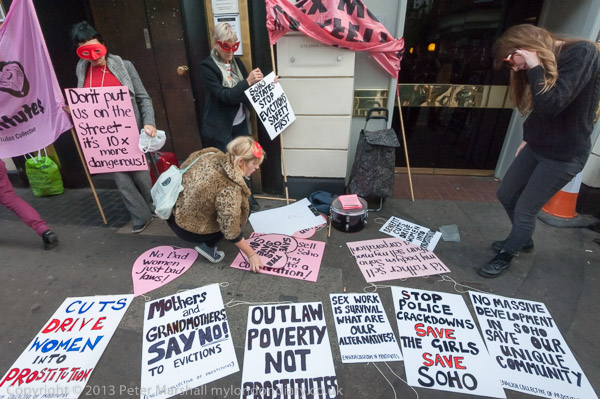
Prostitution is not illegal, but pimping and brothels are, and more than one sex worker in a flat or house makes that into a brothel.  The image above isn’t a great picture, but one that (literally) spells out rather clearly the problem. Women turn to prostitution as a way to make a living, often in desperate circumstances where they have few alternatives. It is a traditional occupation and fits in to Soho with few problems where it is a business run by the women involved. Police crackdowns on legally working prostitutes are largely prompted by those who wish to empty properties and redevelop the area.

Of course police should have a role in the matter. There is exploitation, women who are trafficked and many truly terrible things happening in the sex industry in Soho as elsewhere in London, and the police should be cracking down on it, getting evidence, arresting those responsible, taking them to court and getting convictions. But unfortunately we see very little of this. Instead they pick on the easy meat, where they can get results without having to have any evidence or take anything to court.

Police sent a threatening letter to Soho Estates, the landlord of a block in Romilly St, threatening them with prosecution for allowing their property to be used as brothels. Soho Estates then pressured the lease-holder to evict the women, who were apparently all working singly and thus legally in self-contained flats.  And they were evicted. The police can chalk up a success, and the developers, here and elsewhere, have empty buildings they can attempt to redevelop. There are still some on Westminster council who would like to see Soho disappear (and are perhaps rubbing their hands at the thought of the profits they could make from it.)
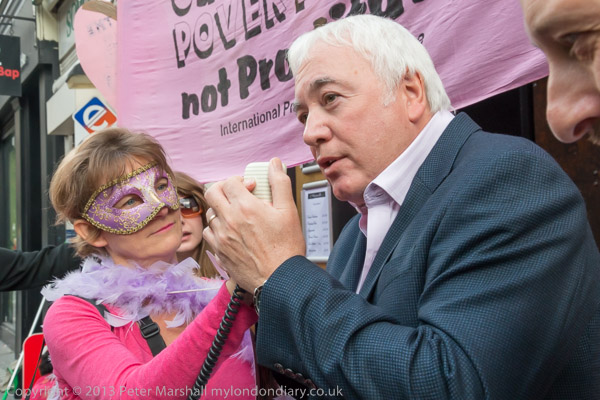
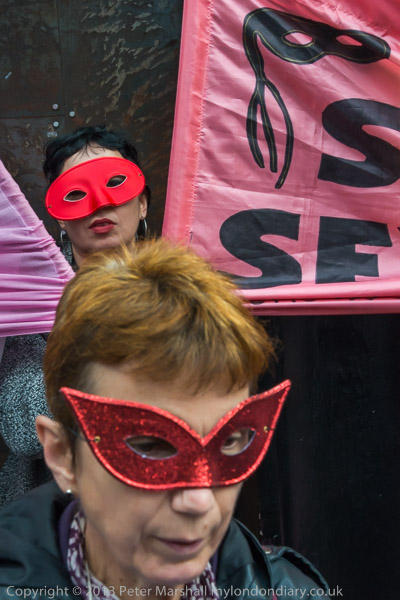
It was a popular protest with the press, with women (many if not most not themselves prostitutes but supporters of their case) wearing masks adding to the attraction.  It was also unusual, in that the boss of Soho Estates, John James (the son-in-law of the late Paul Raymond) came out with a colleague to try and justify his actions, saying the police had left him with no alternative. He was allowed to have his say, but it wasn’t an argument that cut ice with those protesting, who suggested he should have called the police bluff, as they had no evidence in support of their case.

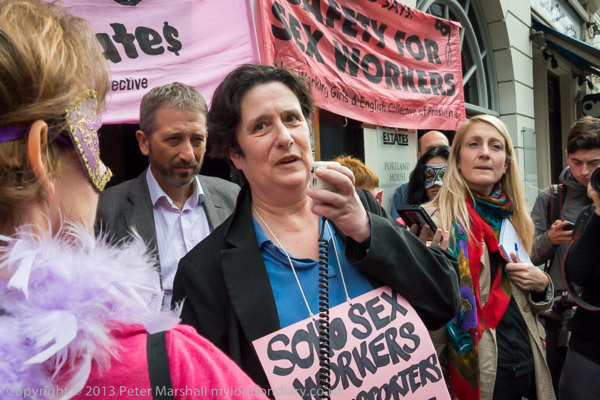
The protesters gave a much warmer welcome to a woman from the Soho Society, who came to give her support for them. Many of the women involved have families in the area and are respected as residents, carrying on one of its traditional trades, in a way that causes little if any nuisance to others who live around.  Women who work in flats contribute to the local economy and are a part of what gives Soho its unique character; taking prostitution off the streets improves the area and is ten times safer for the sex workers.

More about the event and more pictures at Police & Developers Evict Soho Working Girls.

Continue reading A Morning in Soho

Royal London

Royal London is in a right Royal mess. Not unfortunately the Royal family, an institution I would only be too pleased to see go bust, unlikely for various reasons though that is, but the Royal London Hospital, which managed quite well for the 250 years before it became Royal, but is now in trouble.

Its old building, dating from the 1750s was updated in the nineteenth century and again at the start of the twentieth, but by the twentyfirst was a mess. When I wandered around its corridors a few years ago, failing to follow the confusing signage, it still seemed a place where Flo Nightingale would have been at home, and sitting in the waiting area in the entrance or standing under the outside portico in recent years was to be in a curious limbo, with patients, some pushing drips on stands, slowly towards the ‘fresh air’ of the Whitechapel Road for a fag.


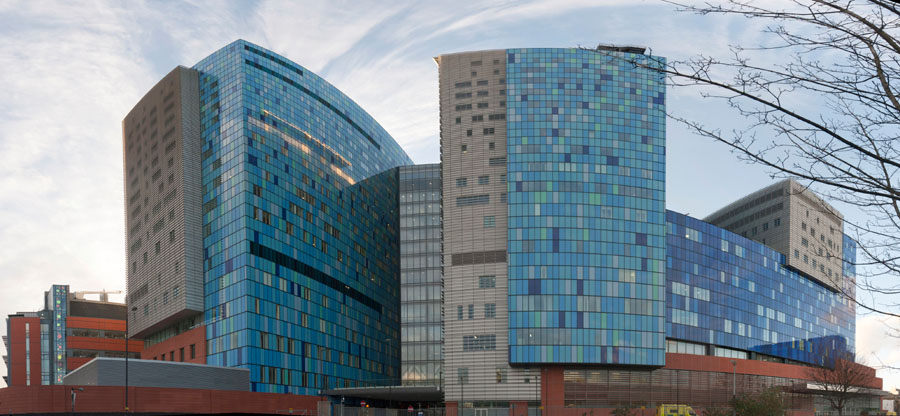
Royal London Hospital, Stepney Way, Dec 2011

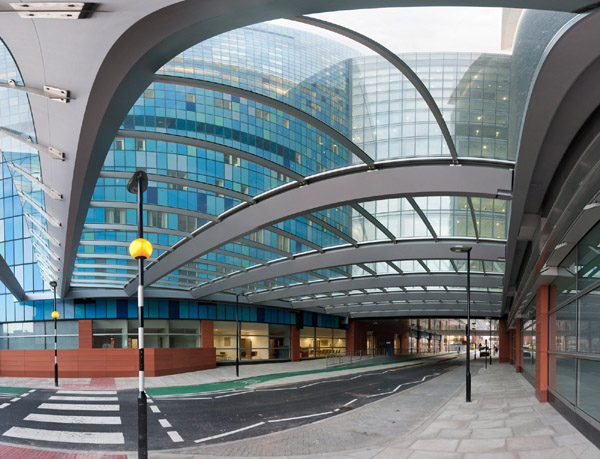
Now its all shiny new and blue, part of one of many Private Finance Initiative (PFI) schemes which are crippling the NHS. Conceived under John Major, PFI never made sense other than as a trick to make government borrowing look less than it really was. At the start, Labour opposed it, but in government went on to use the scam to a huge extent to provide new schools and hospitals in a number of disastrous schemes. The one including the Royal London was the largest of all in the NHS at £1.1 billion, and Barts Health Trust has to find £129 million this year to pay the private companies involved – an annual amount that will rise to £274 million by 2048.


Royal London Hospital from Cavell St, Dec 2011 Some views from it at Whitechapel – Hospital Views

Unsurprisingly this huge amount means they can’t afford to run health services in the area properly.  They can’t even open the new hospital fully, unable to staff two floors, and are making huge cuts at other hospitals and of community services too.  Hospital staff are suffering, having to try to provide services with a lack of nurses and other support – and of course the people of East London will not get the service they deserve. There are staff cuts, and also downgrading, with staff being paid on lower rates than their training and experience merit. Community Health services are being severely cut and sold off. The only winners are the companies who financed the PFI deals, and whose experienced negotiators often managed to completely outwit the civil servants in setting the terms.

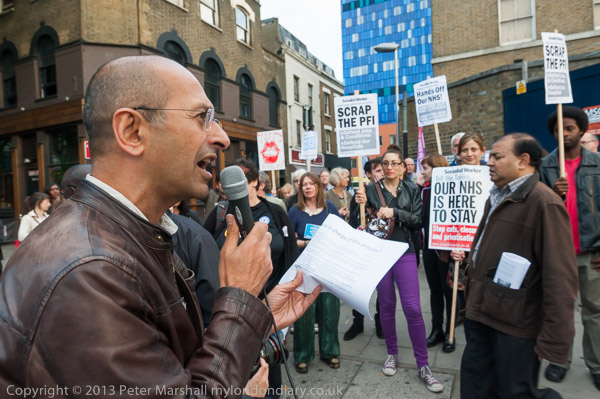
Staff at all the hospitals in the group (and others around the country who are also affected by PFI schemes) are angry at the cuts that are having to be made to pay rich private investors, and are calling for these PFI schemes to be scrapped. The protesters at the Royal London were initially refused permission to protest in front of the hospital, but enough turned up to block the busy pavement opposite Whitechapel Station in the evening rush hour that police moved them there.

I was pleased as a photographer, because the fairly narrow pavement made it difficult to work – the 22mm view above makes it look less crowded than it was, and most of those present are out of picture to the right – and this was also the only position from which the hospital – the blue building in the centre – could be seen.

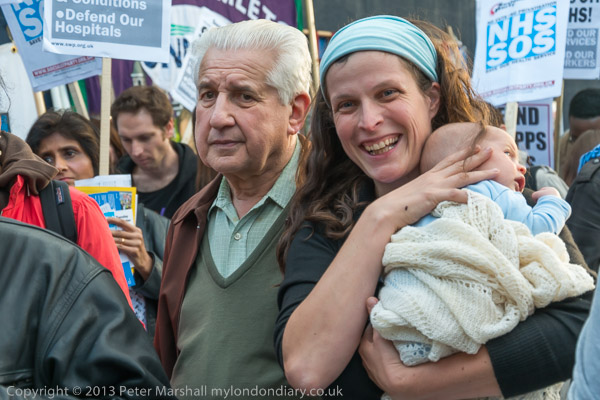
Though working in the crowd there did provide some good opportunities for pictures. I particularly liked this because of the spread of ages and the contrasting expressions of the man listening to the speeches and the woman carrying the child who is laughing because she has seen me taking her picture. This was the second or third frame, and at first she was looking concerned, but I think this makes a better picture. A little later I took another picture of her and behind her a man with a child on his shoulders in which she again looks serious – you can see it in Scrap Royal London NHS PFI Debt – but I think this is a better picture.

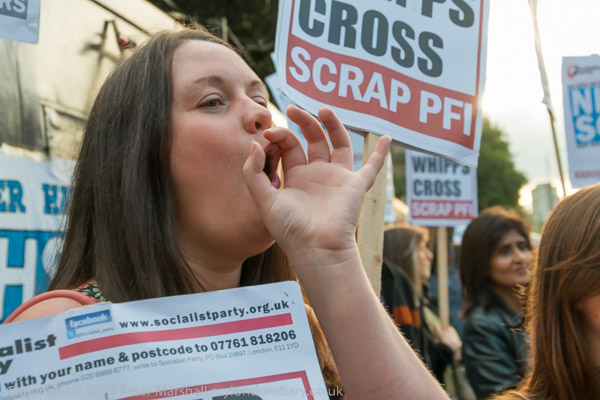
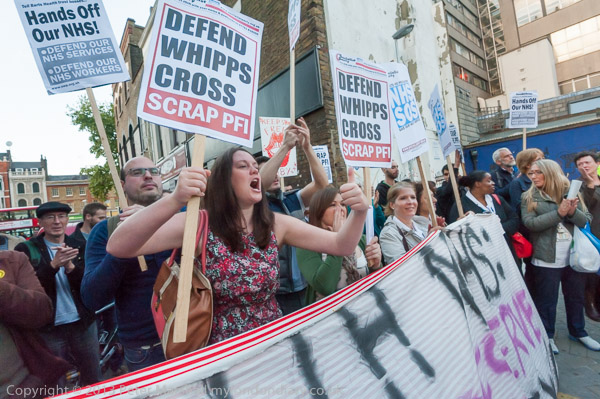
There were also some more active protesters, including this nurse shouting in support of a speaker from the Royal College of Nursing, the largest nurses’ union. Whipp’s Cross, where she works, is another of the Barts Health NHS Trust which is suffering hugely from the Royal London PFI.  I was standing fairly close to her – I couldn’t get any further away in the crowd, and though this is taken with the 28-105mm at 48mm (67mm equiv) it does have just a hint of what is sometimes called wide-angle distortion, which I think makes it a little more dramatic. You can see too the lighting from the low sun,  which also slightly restricted the choice of point of view when working. Here I’ve moved to put it just behind the placard above the woman’s hand – and you can see it has made just a little bite out of the edge of it.

After the police got the protest to move, the speakers were in front of the new hospital buildings, which was better in terms of context, but not necessarily more exciting pictorially, particularly as everything was now in shade. The audience was also more organised, with many behind the large main banner. Of course banners are important, but they do also get rather in the way.

I’d stood for some while trying to photograph again the nurse I’d photographed earlier, who was reacting strongly every time a speaker made a point or called for a response, and was at the front just behind the banner. But when I moved in close she stopped. I tried for a while, then moved a couple of yards back, standing behind a man who was filming in the opposite direction, towards the speaker. As she reacted, I moved in and took pictures including this one above (16mm D700), only to find a woman tugging at my sleeve to try and get me to move.  They now wanted to film in the direction where I was standing.  Well, tough.  I wouldn’t normally deliberately move into someone else’s picture, and hadn’t done so in this case, and I expect a reasonable degree of respect from other photographers and videographers. This was a protest and not a set for TV. Once I’d got the picture I wanted I moved out of the way. They could get their ‘reaction shot’ without me the next time the crowd erupted. But I was shocked by their bad manners.

Continue reading Royal London

Gagging Free Speech

Sometimes its hard to know whether our current government are obtuse or devious. The public are rightly concerned about the activities of lobbyists in Parliament, particularly those pushing particular commercial interests. Part of the reason we’ve yet to get effective environmental policies is undoubtedly the activities of lobbyists on behalf of the big energy companies, though perhaps they really have enough politicians in their pockets to get policies tailored to their needs in any case. And it would be hard to exaggerate the number of them who have direct interests in issues like the privatisation of the NHS which is going on apace while being denied.

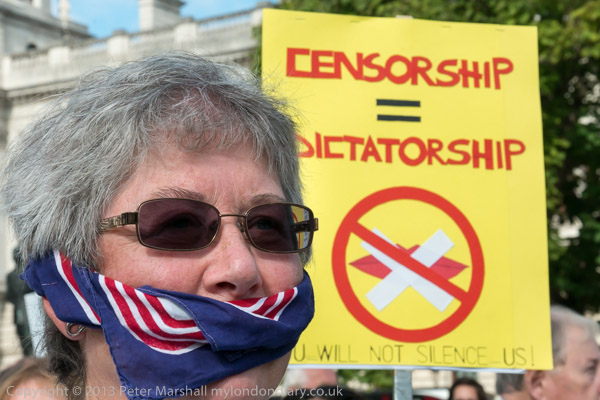
But back to lobbying and the gagging bill. Rather oddly it turns out to be something with very little effect on commercial lobbying, but likely to effect all the charities and other groups which use elections as a legitimate way to put their causes forward, as well as the campaigning activities of trade unions.

My own feeling is that government is in a mess, with little real examination of the affects of policies, and some fairly unscrupulous if not dishonest and misguided individuals in cabinet offices. We have a bunch of crooks who are prepared to tell lies about what is happening, to misrepresent statistics and to flout the law to pursue policies which benefit themselves and their friends. If the courts rule against them, they appeal. If the appeal fails they change the law.  Previous governments often got things wrong, often made a mess of things – both Labour and Conservative – but I think we now have something different, with the deliberate misleading of the people. Its perhaps something that really first became obvious with Tony Blair,  lying to us, spectacularly over Iraq, but which has got far worse, far more endemic.


A photographer in the background I could have done without

But perhaps I’m just getting old and even more cynical. Of course there are still members of parliament in all parties who are there for the best of motives, working hard for the people they represent, plugging away at good causes, rebelling against bad laws, but few are likely to end up as cabinet ministers, and if they do it will mean compromising their beliefs.

I’m not sure there is a solution to this, but if so it would be most unlikely to be palatable to parliament and stand no chance of being enacted. At least not before our civilisation collapses – and with luck it will see me out, though I don’t give it too long.

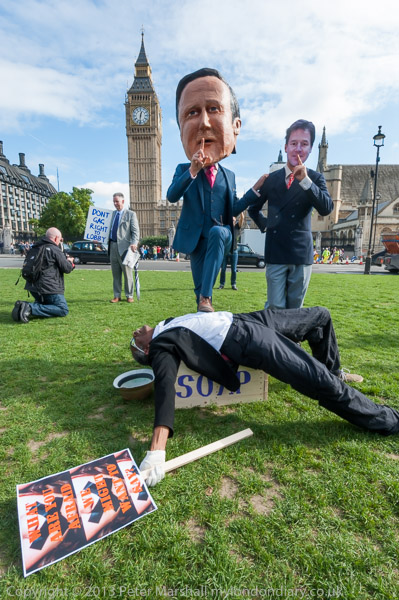
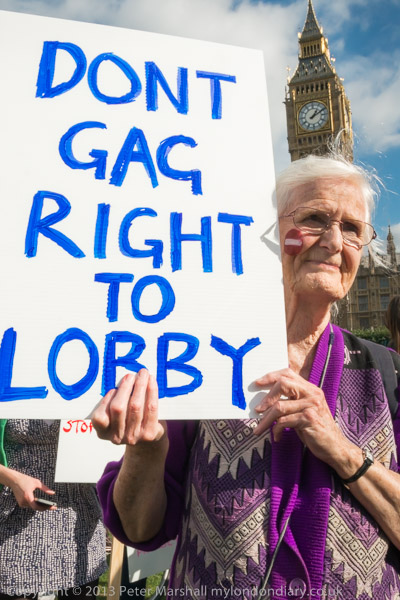
I didn’t sit down to write a political rant, but to write about photographing this and possibly another protest against political madness. In the morning it was the about the misguided gagging bill, or to give it a more official title, the Transparency in Lobbying, Non-Party Campaigning, and Trade Union Administration Bill.  Protests like the one I photographed have actually had some effect, and the government has had to undertake further consultation having realised it had little chance of passing through the House of Lords.  Part 1 of the bill completely fails to tackle corporate lobbying, part 2 would basically suspend democratic debate by non-party advocacy groups for  a year before every general election and part 3 would involve trade unions in unnecessary and restrictive red tape.  I think it unlikely that it can be transformed into a satisfactory piece of legislation in the five weeks proposed.

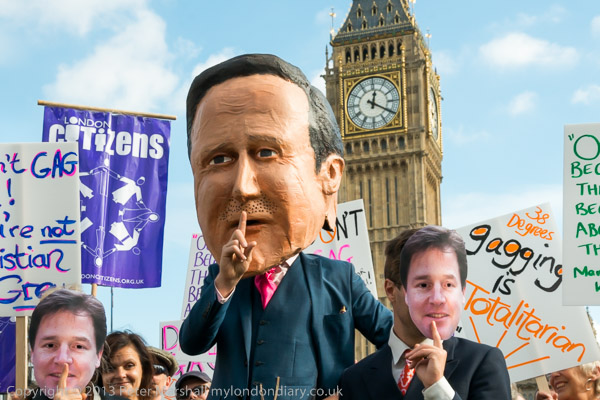
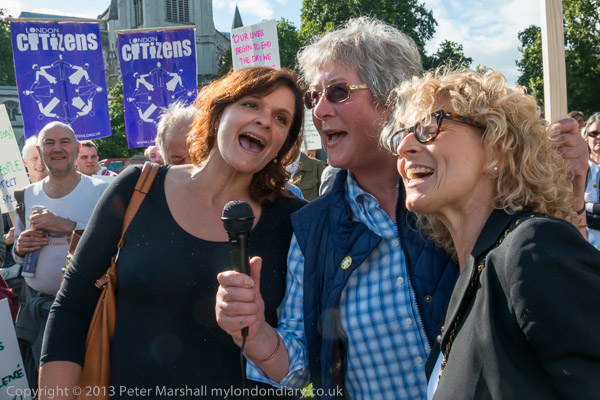
Photographically the main problem was other photographers getting in the way, most notably when the organisers of the protest were setting up some photo opportunities. I don’t always want to take part in these, but I’d try to keep out of the way and out of the picture for those who do, and found myself wishing others did when one walked into the background to take a different picture just as I was taking mine. The top image was taken during the main photo-op, though it is only a detail and not the whole view, which to my mind was very boring. But it was a rather more boring picture than this showing most of the whole  group that a national newspaper chose to use, despite being offered several more interesting pictures.

After I’d been photographing this protest, essentially about freedom of speech, I was flabbergasted when a woman approached me and suggested I should not use some of the images I had taken. I had photographed – mainly at their demand – a group of teenage girls who had been taking part in this public event, and somehow she thought I should not use these. It was hard not to be rude.

More pictures at Don’t Gag Free Speech.

Continue reading Gagging Free Speech

Oh, So Easy to Lose

If I hadn’t come back to review the pictures I made of  protesters opposite the Egyptian embassy in early October for this blog post, there are a dozen or so of my images I might never have seen again. It perhaps would not have been a great loss, because none of them are great images, not even among my own best images, but it reminded me of how easy it is to lose digital images.

They wouldn’t have been entirely lost. At the moment I still keep (and try to back up) all of the raw files I shoot, except for those which are really technically hopeless or terminally unseen. I don’t keep those I take by accident when I grab hold of the camera carelessly and hit the shutter release or stick my elbow on it when I sit down (well, I might if that random process ever produced an interesting image.)  Or where for some reason I completely missed what I was trying to photograph. But I still keep the near misses, the images I make when I’m working my way to what I want and all the rest that are decent. A few years back I was asked for pictures of an incident in connection with a court case, and those that were most relevant were just those kind of images, which had I only kept the most successful would have been deleted.

But that full set is a dead or at least dormant, something I’m unlikely to look through again unless something special like that request for evidence comes up.  Active is the selected work that I put on My London Diary and other web sites and which I keep as full-size jpegs on my internal and external hard disks.  Some of it is also stored externally, in the archives of the several libraries that occasionally sell my work, and a much, much smaller amount in digital or print form in other collections.

I select my work in Lightroom, giving a 2 star rating to those that will end up in that active collection. Some other images – including near duplicates of those images – get a single star. Then the images that I send to Demotix or elsewhere, all of which should be ‘2 star’ images, get an additional colour rating, using a different colour for each story on a particular day. LR has 5 available colour labels, yellow, green, blue and red. And purple, but purple is a pain as there is no hot key for it (Adobe uses 0-5 for stars and 6-9 for colours – and apparently couldn’t think of another hot key – perhaps Ctrl+7 would be useful – and why not let us have 3 more colours on Ctrl+6, 8 and 9.) Fortunately I seldom have more than 4 stories for a single day.

When I want to write out a set of images for My London Diary and for the jpeg collection, I select them by the 2* rating. Which is usually fine, but just occasionally – as for this protest – I’d managed to give the best images a blue rating but to not assign them to 2* (or more likely to somehow remove the 2* rating from them all, though I can’t find any way to do this on a whole batch in LR.) So when I selected the pictures to write, I got only the three that hadn’t been selected to send to the agency rather than the whole 15.

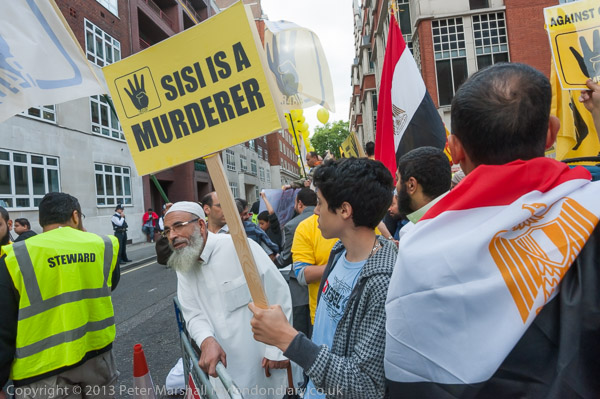
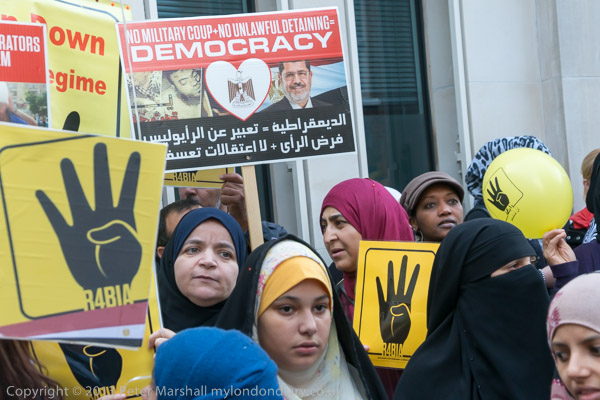
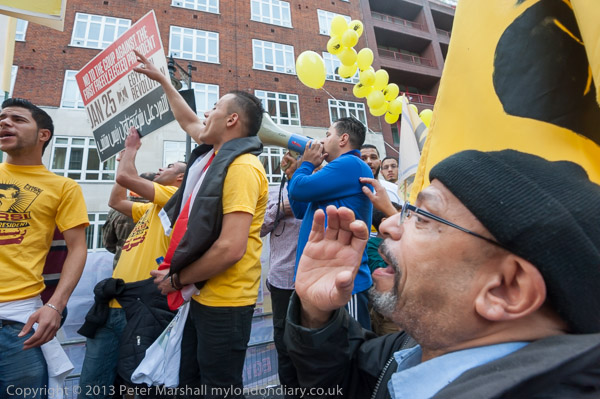
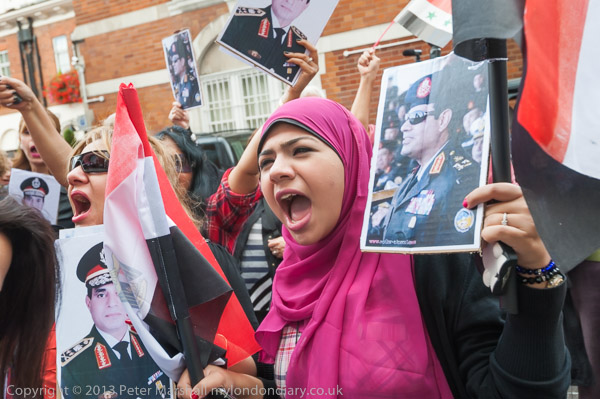
It was a fairly long and slightly confusing day for me, and at the Egyptian embassy I found not one protest but two. Opposite the embassy were the supporters of the deposed President Morsi, and a few yards down the road a smaller group who had come out in support of the army who had deposed him.  So it perhaps isn’t surprising that I didn’t notice a fairly small group of images was missing. But coming back to write about the protest for >Re:PHOTO it was obvious.

There were interesting differences between the two protests, and of course the posters and placards were very different as you can see. I felt rather more welcome at the protest supporting the removal of Morsi. It was a smaller protest and easier to move around and take pictures.

More in Egypt For & Against Muslim Brotherhood which must be one of the longest web pages I’ve written, with the newly added images making a total of 35 on the page, roughly twice the normal number I aim for. Thank goodness for broadband.
Continue reading Oh, So Easy to Lose

Back Morel

All photographers should be backing Daniel Morel in his case against Agence France Presse (AFP) and Getty Images which is scheduled to begin in a Manhattan court today, Nov 12th. (I’m writing this earlier but it is scheduled to be published on the 12th.) It’s hard to imagine why either agency feels the case is worth fighting, or what can occupy the court for the six days the case is expected to last.

One of the photographers who has followed the case since the start is Jeremy Nicholl, and rather than write about it myself, I suggest you read his post from Nov 5th on his ‘Russian Photos Blog‘ with the excessively long title “A Business Model Gone Wild”: Day Of Reckoning Looms For Agence France Presse And Getty Images In Morel Copyright Theft.

As Nicholl says, the two agencies have already been found guilty of infringing copyright. The current case is about whether their clearly wilful disregard of everything we know and understand about copyright is ‘willful’ under US Law. If so, Getty and AFP could face a truly massive bill – over $27m, as well as huge costs.

I find it hard to disagree with Nicholl’s statement:

“But anyone who has followed the case can have no doubt: the behaviour of AFP and Getty has been both willful and reckless, not to mention thuggish and comically incompetent.”

and hope the court comes to that same conclusion. The two agencies – if they had any sense at the time – would have quickly come to an agreement with Morel and made him the substantial payment he deserved for their breach of his copyright, which would  have cost them a lot less than the US court may decide that US copyright law provides.

The hugely punitive amounts that can be awarded under US law are perhaps hard to justify, but they do make a very clear statement about copyright, while UK law is rather weak with its idea of reasonable damages for the loss involved rather than any real disincentive against copyright theft. We may be able to get paid at a higher rate than we would have been willing to negotiate, but we don’t really get compensated for the offence against us.

But copyright remains under attack here and elsewhere, and this case is one that I think we should all back. It has too a certain irony in that Getty who are fighting against paying for their copyright offence are one of the most assiduous companies in tracking down and making often rather large claims when the copyright of their own images is abused.

Legal Aid Road Block


Police talks to a woman they have decided is in charge of the protest

The British legal system isn’t perfect, but in many ways is the best in the world, despite its faults. There are plenty of miscarriages of justice, some of which eventually are recognised, though many of these arise not from the legal system, but from corrupt policing, something that has been getting much public attention recently over a high profile and very minor cases such as ‘Plebgate’, but also over far more serious cases such as the inquests into the killing of Sean Rigg, Ian Tomlinson and Mark Duggan.

Of course many of us have been aware for a long time that our police at times embroidered the truth, planted evidence or simply told lies. It happened to some of my mates when I was still at school, to my friends at university and, years later a pair of officers threatened to fit me up when I argued with them over taking photographs.

One of the cornerstones of our legal system is legal aid. Again it isn’t perfect, but it goes some way to levelling the playing field, making it possible for those without means to fight their case. The law is still unequal, still ‘One law for the rich, and another for the poor‘ or even those on moderate incomes, but Legal Aid at least does something too redress that imbalance.

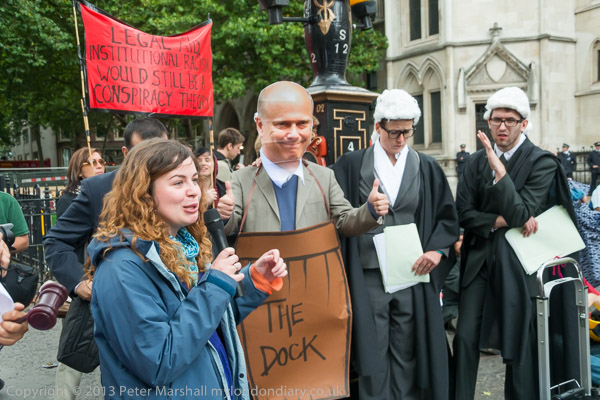
One banner on the protest read ‘Without Legal Aid, Institutional Racism would still be a Conspiracy Theory‘ and it is true that Legal Aid has done much to help challenge various inequalities. Which is perhaps why our current coalition government has set out to largely destroy the current system, wanting to replace it with a cut-price provision which will put many of the current providers out of business. It’s one of a whole batch of measures designed to reduce the possibilities of justice and of opposition to government plans being pushed through.

The details of the protest, organised by DPAC and UK Uncut were not made public in advance, with just a meeting place specified for the protest. That meeting place was the Central Criminal Court, the Old Bailey in the City of London. On a Saturday morning this is a largely deserted area, and it was clear that the protest was not going to take place there where it would affect and be seen by no one.

When I arrived it was also clear to me that few of the DPAC activists who I knew would be involved were present. I decided to look for them and thought of likely places in the vicinity and took a walk around, guessing that little would happen for at least half an hour.

At first I followed a protester in a wheelchair who was heading east, but it turned out they were just lost, and soon turned back towards the Old Bailey. Perhaps because it was fairly early on a Saturday morning I wasn’t thinking too clearly, and I was also misled again when one of the UK Uncut activists I know cycled past heading north.


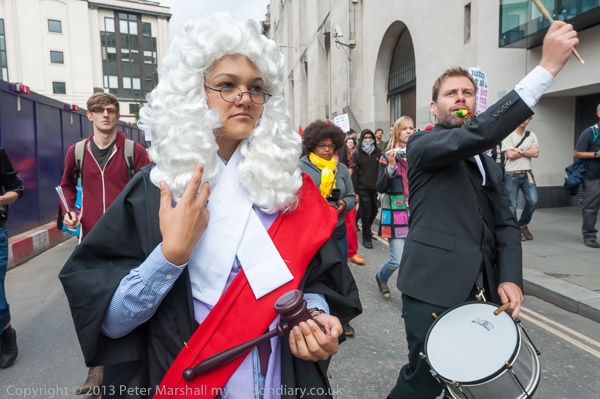
The march from the Old Bailey included a judge and a samba band

So I returned to the Old Bailey and joined the others waiting there, and before long we set off, going south, and then west. I took some pictures and then rushed ahead to the next point where I thought a protest was possible – but again there was no one there.

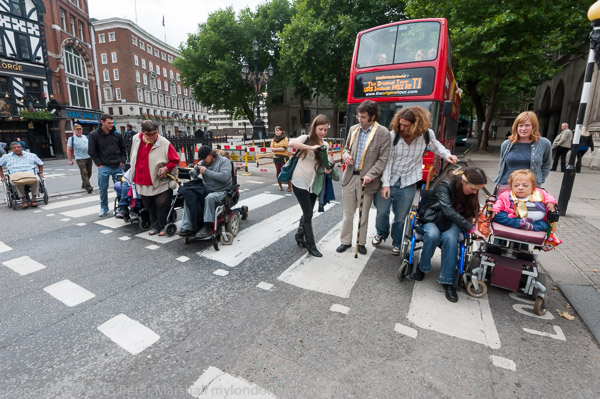
As the march started to go up Fleet St, my mind finally clicked back into gear, and having taken one or two pictures, I started to walk fast. One other photographer who had noticed me looking around earlier was with me, and we arrived just in time (well, 30 seconds earlier would have been a little better, but I didn’t want to run) to photograph the protesters bringing their wheelchairs onto the pedestrian crossing in front of the Royal Courts of Justice.


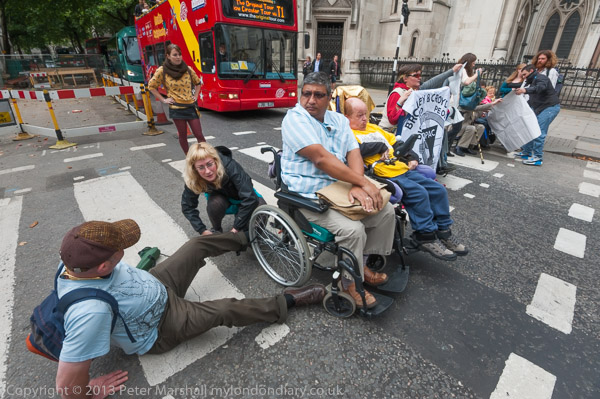
Wheelchairs move to block the road at the Royal Courts of Justice

The Strand isn’t the busiest of roads in London on a Saturday lunchtime, but has a significant amount of traffic both in cars and on foot, so the protest would be noticed, but it was obviously a very significant location for a protest about Legal Aid – and one that I kicked myself for not having realised earlier. But the two of us were still there well over a minute before the other photographers with the march realised what was happening. Thinking ahead really does give you and advantage.


An able-bodied supporter gets locked on to one of the wheelchairs in the road block

I’d met the judge earlier at the Old Bailey, and outside the RCJ the rest of the legal team for the trial of ‘Ian Duncan Smith’ arrived, together with the defendant with the dock tied around his waist. He was duly tried with all those present being invited to be members of the jury. There was a break for a little entertainment before the trial ended with the unsurprising verdict and he was taken away, though only to the pub and not the prison he richly deserves.


A protester replies to police who are trying to bring the protest to an end

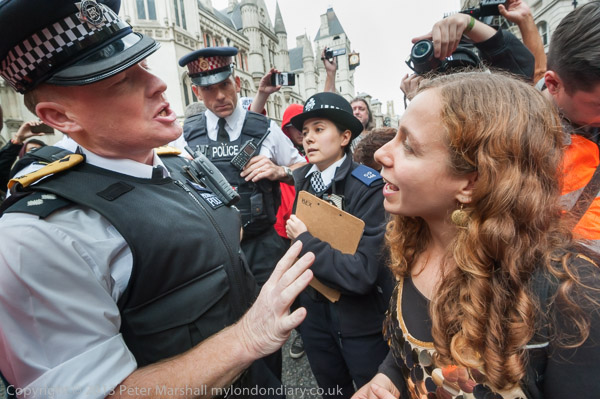
Thinking ahead helped again later, when a police officer came to talk to a woman who he felt was in charge of the protest (though I’m not sure why he thought that, but police seem unable to think in non-heirarchical terms, perhaps because of the nature of their own organisation.)

Though this time it was only a matter of seconds, and as I saw him coming over and knew that something was likely to occur, I moved into the right place for when it did. I was just a little closer than I would have preferred, but in the middle of a crowd like this you don’t have any choice.

I don’t always get things right when I try to think ahead and anticipate what will happen next, but it often works out. It’s all too easy to get completely absorbed in what is happening now, and miss the start of the next phase of an event.


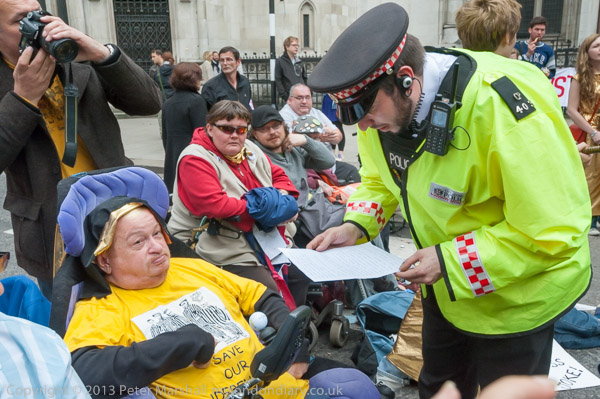
An officer reads his script to the wheelchair protesters

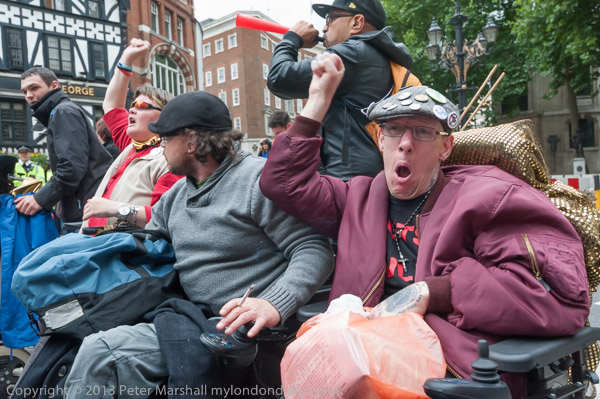
The police had been getting increasingly restive. Disabled protesters present them with something of a challenge, at least while the press are around, getting physical with them would certainly hit the front pages and be very bad publicity. And many police certainly sympathise with protests such as this, and are concerned to uphold the right to protest. They tried hard to persuade people who were sitting on the road to move, telling them they were breaking the law by obstructing the highway, and making threats of arrest. Eventually they came and read the same script to those in wheelchairs, and, after a short further protest and discussion, the disabled protesters came to the decision that they had made their point and it was time to go.


The protesters celebrate their success before leaving the road

After a final short celebration everyone left the road together after just over an hour and a half. You can see the rest of my images from the protest at UK Uncut Road Block for Legal Aid.

Continue reading Legal Aid Road Block

September Complete


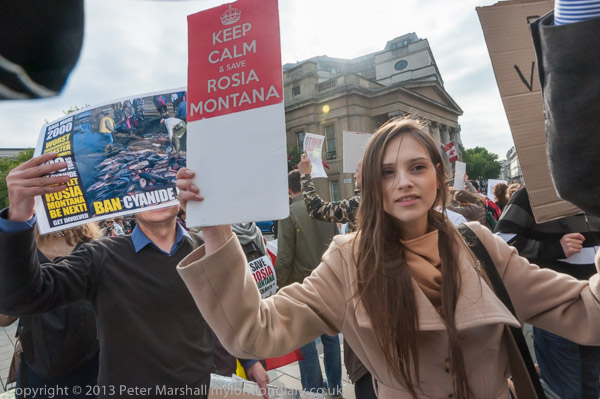
Romanians protest in Trafalgar Square against cyanide mining that would destroy heritage site Rosia Montana and threaten massive cyanide pollution of the Danube and Black Sea.

I seem to be getting further and further behind in posting my work on My London Diary, and further still in posting about it here.  There are various reasons, for this, some personal which I won’t bore you with, but mainly because there have simply been so many events for me to cover in the last couple of months.  The pace of protest seems too have ratcheted up and I’ve had many more messages inviting me to cover events. Of course I can’t be everywhere, but I do my best to cover the things I have a particular interest in,  and the 30 or so events listed here for September kept me busy.

I work differently from the typical press photographer, as readers of some of my posts will know. Often when I’m covering an protest I’ll be there as the protesters arrive and set up, and will stay as long as I can while things are still happening, telling the story of the event through a series of images – which you can see in my edited version (sometimes too loosely edited) on My London Diary. Eventually.

Of course a newspaper or magazine generally only wants a single image, seldom the text about the story and never the story in a set of pictures.  At an event where I spend several hours taking pictures, it isn’t unusual for a press photographer to arrive, spend five minutes arranging a group picture, and leave, or sit down in a corner, get out a notebook and file his or her pictures.  I try to get my pictures to the agency – selected and properly adjusted where necessary, captioned and key-worded – along with the story, by the end of the day. Though sometimes the day ends around 1 or 2am, and the story follows the pictures the following morning.

Their way of working reflects a different kind of interest, and one that is far more closely geared to the market.  I don’t mean it as a criticism when I talk about the difference, and in some respects I admire their professionalism, but we have different motives. At times they take pictures that I look and and think that I wish I had thought to approach the subject in that way, though more often I find them rather formulaic. Some of my pictures are like that too, and I often find that the images in a set that to me are least interesting are those that my editors at Demotix like to promote, and which are used by the press.

I like to write here more about the photography of many of the events, which delays me more.  Some events go entirely smoothly, with no photographic or other issues and unless I have something particular to say about them I don’t write about them on >Re:PHOTO, but quite often there is a story to tell – if only about how I messed things up.

There are other photographic items of photographic news and opinion that I like to share with my friends – around 3000 visitors a day – on this site;  the occasional review, links to photography in the press, in galleries and on the web and my own thoughts and prejudices. Thanks for your interest.

September 2013

Save Rosia Montana – No Cyanide Mining


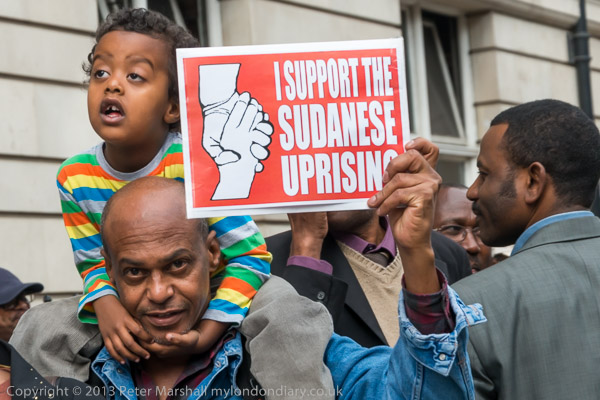
Sudanese Call for Regime Change
10,000 Cuts – Deaths After Atos Tests


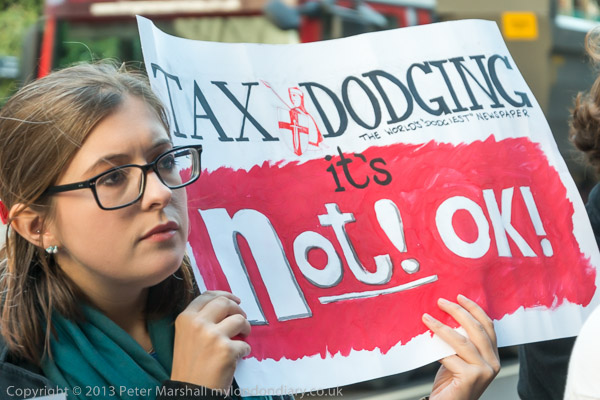
Express Stop Sponging Off Migrants
Hizb ut-Tahrir Women March for Syria
Paddington Basin
Druids Celebrate Autumn Equinox
World Peace Day
Save Whipps Cross Hospital
National Gallery Human Chain over Arts Cuts
Iran ‘Release Sunnis, Don’t Hang Them’
Aurora tells Shell – Stop Arctic Drilling
Malta Day Procession
Secular Europe Protest
Lewisham Hospital Victory Parade
Arms Trade Die-In at Parliament
9/11 Protest at US Embassy


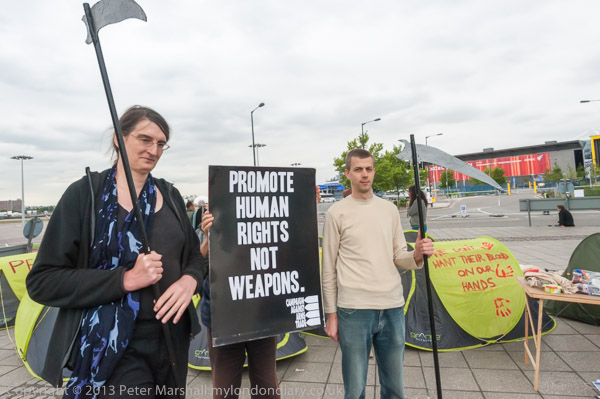
Occupation at DSEi Arms Fair Continues
Wreath for Victims of London Arms Fair
Occupy vs the Arms Fair
Silvertown


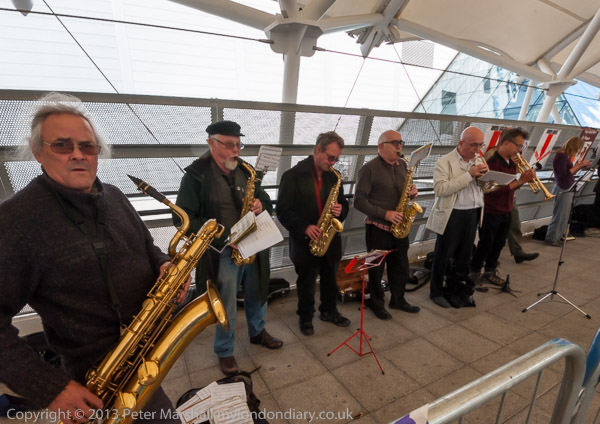
Musical Protest against Arms Fair
Tower Hamlets United Against the EDL


Anti-Fascists Oppose EDL
EDL March returns to Tower Hamlets
DPAC take Pants to IDS
End UK Caste Discrimination Now
DPAC Picket Ministries


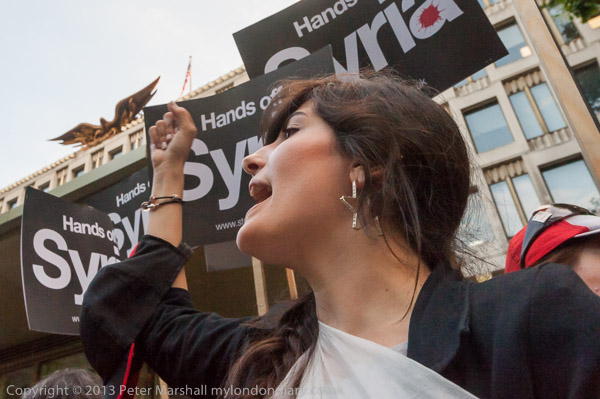
Hands off Syria
Love Russia, Hate Homophobia
DPAC at BBC – Tell The Truth

Continue reading September Complete

Darkroom Nostalgia

Whether you are someone who  has never made a print in a darkroom or one of us who paid our dues in that respect, you will almost certainly find the post Magnum and the Dying Art of Darkroom Printing by Sarah Coleman on her The Literate Lens blog of interest, in showing a little of how a master printer – in this case Pablo Inirio of Magnum in New York – thinks and works. And my thanks to Petapixel for commenting on and linking to her post.

What I find a little disturbing is not the post itself, but some of the comments that it has provoked, although Coleman did perhaps set them up when she wrote:

“Over the last fifteen years, almost every photographer I’ve interviewed has waxed poetic about that “magical” experience of seeing an image develop in chemicals for the first time. You have to wonder whether today’s young photographers will rhapsodize as much about the first time they color-calibrated their monitors.”

Digital has of course removed some of the mystique. No longer do we have the quasi-masonic initiation into the dark arts that used to be necessary, and digital comes without those smells (for which I say thank goodness, as taking some of that toxic chemistry out of our lives must be a good thing.) But I still feel there is something magical about pressing a button and then seeing a miniature image on the back of the camera, and even more being able to show it and zoom into it on a large screen on the computer.  But colour-calibrating your monitor is perhaps equally exciting as measuring out 10ml of Rodinal or learning to keep the developer temperature constant at 20 degrees.

Coleman’s is an entirely false comparison. What was important in photography was the image; what still is important is the image, though now it appears in fractions of a second in an automatic way without all the fuss we used to have.

Digital printers still have to do all the kind of things that we did in the dark to get good prints, just that these are much simpler (and can be reversible) on the computer. In the darkroom Gene Smith used to get through a box of paper and a bottle of Scotch to make the final print, we can do it by viewing on those calibrated screens and save the Scotch for later. Though personally I’d prefer a decent glass of wine – or two.

While we still need to make all the kind of adjustments that Inirio records on his annotated images, in Lightroom the computer remembers them for us, saving us the need to draw the diagrams. We can also do them with ease more precisely than the best master darkroom printers, and once you have made the ‘perfect’ print (or the best you can make) then can repeat it at the click of a mouse.

That doesn’t mean you or I can be a good a printer as Initio. Printing has always been a matter of vision, of being able to see the potential in a negative. Without that you can dodge, burn and use all the other techniques in darkroom or digital and never produce a great print. Many great photographers have never managed to, and have collaborated with others to print their work better than they ever could (and despite what it asserts in the ‘Media Space’ show, Tony Ray-Jones was one of them – see here and here.) Perhaps a true problem of digital is that is has more or less dispensed with the talents of specialist printers – such as Inirio – because everyone thinks they can do it as well as the best.

Of course once you have the vision, it isn’t always easy to transmit that to the material. You have to learn (and make tests, tests, tests) to see how the materials react. In the digital world this is also much simpler, with much of the necessary information being stored in print profiles and curves etc.

The same is true of digital images. Our raw files (or even camera produced jpegs) are only starting points – if you like Ansel Adams’s musical analogy – the scores, and the digital files we send to clients or use on the web or to make prints are performances, some better than others.

Adams is the man I first learnt to print properly from, not in the flesh but in the revised 1968 version of his Basic Photo series, Volume 3 The Print (more recent versions perhaps somewhat dumbed down) and it was a good starting point on which to build. In my darkroom in the old days there were always two developer trays (later vertical ‘trays’ to save space, keep temperature constant and reduce developer oxidation) containing low and high contrast developers and prints were usually transferred from one to the other at an appropriate time for the contrast required – at least until I changed to using Multigrade papers. I had a few little tricks and nudges that I’d learnt talking to other printers or thought of myself, and I enjoyed making good prints, but I don’t regret that I never use the darkroom now. Because I know I can do better on the computer and making inkjet prints on baryta papers, though I could also get a lab to print the digital files on genuine silver halide paper.  I’ll not go back to the ferri, the flashing, the Blu-tak, cut masks and all the rest of the wands that were a part of the magic – when needed.

I certainly have some regrets over cameras and lenses that I no longer use because they take images on film. The panoramic cameras, the Minolta CLE and Leica, the Konica Hexars and the Olympus OM4s were all better tools for what they did than anything digital yet produced. You can do more with the Nikon DSLRs, take pictures in much lower light  and more, but they don’t have the same ease of use or responsiveness, though things are improving (and they will probably get there in a few years, just in time for cameras disappear for good.) But on the very few occasions I take film now, it doesn’t go into an enlarger, but into a scanner. It just wouldn’t occur to me to make darkroom prints.

Back in the days when I taught photography, I used to find the best way to get students to see the possibilities of making good black and white prints in the darkroom was to get them to use Photoshop. They could then quickly (and at zero cost) learn about getting the contrast and exposure correct, and go on to see the effect of dodging and burning. Years earlier, before we had computers in art departments, I’d taught lighting with the aid of video cameras, because you didn’t have to develop film to see the results.

But the idea that printing in black and white is a good way to learn about how to make good images in the digital age which some in education suggest is nonsense.  It is at best a slow and inconvenient method to learn about making images. Digital is a far better medium for both teaching and learning about photography. Using film and darkrooms is essential for teaching about working with film and darkroom printing – full stop.

I’m not against craft skills, but think it is only generally worth teaching those that are relevant now. I think it’s great that a few people like to learn how to use the wet plate process, but despite arguably representing the pinnacle of photographic practice, I certainly wouldn’t want it to be an integral part of normal photographic courses. It’s time to let go of darkroom printing in education, just as we (I hope) no longer teach other outmoded processes. Except as history, and there is nothing wrong with that. We just need to be clear it is history, or that it’s a bit of fun, rather than something that all photographers could benefit from.

But you can see another view on (again a link from Petapixel) Long Live Film, which has a trailer from a film of that name, made by mail-order processor Indie Film Lab and Kodak both with a certain vested interest.

Nostalgia junkies who hanker after those colour and tonal distortions that were a signature of different film stocks will find that there are plenty of ways to reproduce these from your digital images. I’ve not tried any of the products from ‘Totally Rad’, not being a believer that clicking on a pre-set can give your pictures an ‘individual’ look, but they claim to have carried out an impressive amount of research to develop “the most faithful film emulation available” in their Replichrome. Personally I’ll save the $99 and concentrate on trying to get something individual in the viewfinder.

10,000 Cuts & Counting

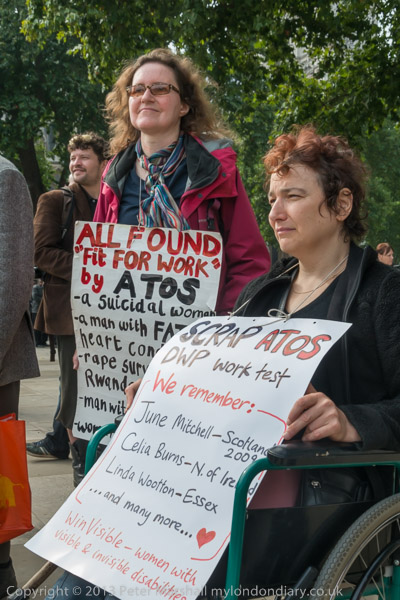
Although it felt rather like a demonstration, ‘10,000 Cuts & Counting‘ was described as ‘a ceremony of remembrance and solidarity’ with the many sick and disabled people who in the last few months of their lives were called in for Work Capability Assessments carried out by Atos on behalf of the Department of Work and Pensions.

Most knew they had only weeks or months to live, and doctors were well aware, but still they were called in for tests to see if they were ‘fit to work.’ Imagine the stress of having to attend the tests – and for many the real physical difficulty too. But even worse, many were judged fit to work on the basis of a computer-based questioning based on capabilities such as being able to sit in a chair, walk a few yards, press a button, lift a book… Those administering the tests for Atos are trained to catch people out and to reach their targets for cutting down the number of people who qualify for benefit. Many of those 10,000 will have lost their benefits – including some who will have lost them at the previous test and successfully appealed against the result. The system is inhumane and administered by a company that gets paid more the more people it fails. Neither the Government nor Atos appear to have any concern about the effect the tests have on those who undergo them.

There were some harrowing stories from many of the speakers about their own experiences and those of other disabled people under the system, but I couldn’t help feeling that it was preaching to the converted. Most of those who attended were already actively involved in campaigning and protesting over the issues involved. On a Saturday morning there were relatively few others in Parliament Square, and the four great institutions surrounding it, to each of which at one point we faced and made a plea – the Houses of Parliament, Westminster Abbey, the Supreme Court and the Treasury – were all largely empty, other than for the tourists queuing for the Abbey.

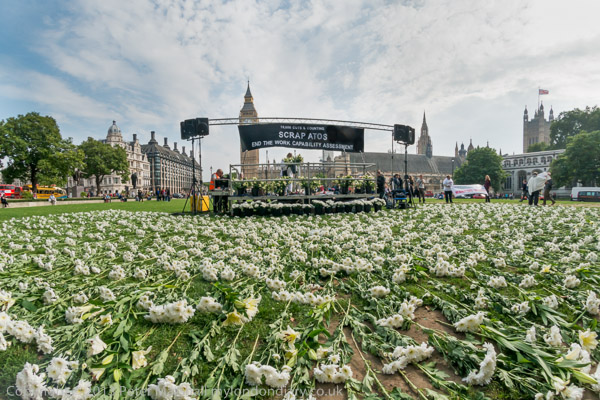
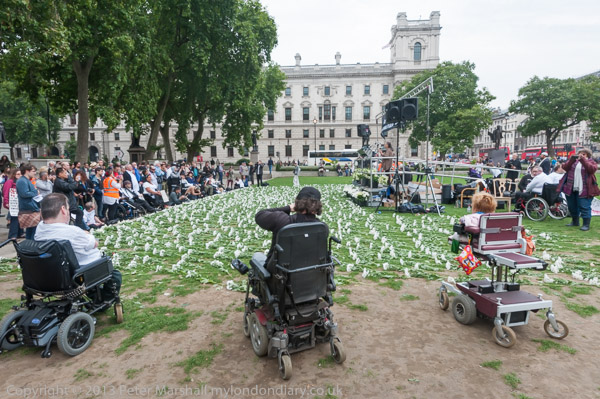
I thought a little about how I could make the most of the carpet of white flowers covering the grass of Parliament Square in front of the platform, and working from close to the front with a wide angle seemed to be the answer. I got down on my knees – you can tell photographers by the worn and dirty patches on their knees – and tried the 16-35mm, but it wasn’t really as wide as I wanted. The answer – yet again – was the 10.5mm fisheye, being very careful to keep the horizon level on the dead centre of the image. And afterwards it is just another plug for that Fisheye Hemi plugin.

The 16mm covers around two thirds of the view of the fisheye, but even if cropped to the same stretch of the buildings on the horizon, there is a subtle difference, and the flowers in the version from the fisheye don’t have the slightly disturbing elliptical aspect that a rectilinear ultra-wide produces at the edges. Despite the curvature of the straight gantry above the platform with the ‘Scrap Atos’ banner, and of the roof of the Houses of Parliament behind, the fisheye view actually appears more natural.

One problem with using the fisheye is flare and ghosts, and with a lens with such an extreme angle of view it isn’t possible to use a lenshood. There is a little lip around the lens, but that serves more to protest the glass than to shade it. Sometimes the effect adds to images, but more often it is a distraction. Probably it would be possible to retouch the lighter area at the upper right of the banner completely, but I simply darkened it a little. The sun was I think just outside the frame at top right, and you can see the effect of flare in the Victoria Tower and the trees at right of picture. The whole area needed darkening and also some increase in contrast.

Otherwise, the flowers made it rather difficult to cover the event, and kept the audience at rather a distance from the speakers, though it was actually much closer than the top image makes it seem. Photographers couldn’t easily photograph them either, as the flowers went right up to the platform.

This isn’t a great picture, taken with the 16-35mm at 22mm, but it perhaps gives a more accurate idea of the area covered by the flowers (though perhaps making it look a little smaller than it was) and clearly shows how they made a ‘no go’ area for photographers at the centre of the event. It accounts for me taking a third of the photographs that morning with the 70-300mm, usually a lens I use rarely if at all.

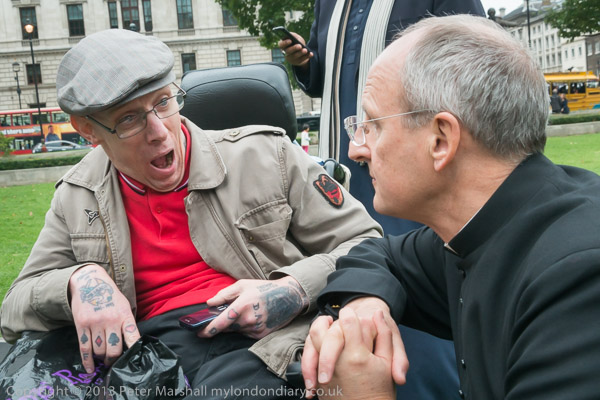
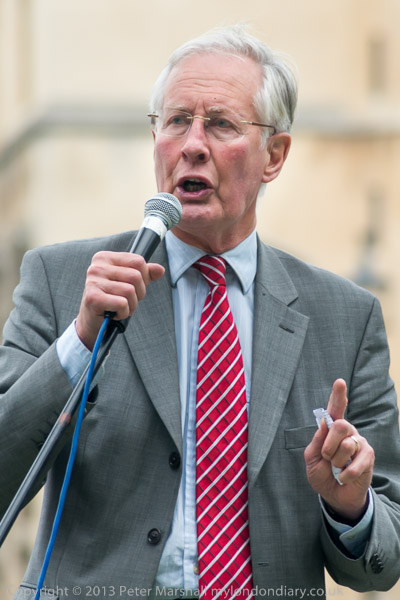
I wouldn’t have chosen to take Michael Meacher MP – one of a small number of MPs who have consistently stood up for disabled rights (two others, Jeremy Corbyn and John McDonnell were also present) – at 300mm (450mm equiv), the kind of focal length best reserved for bird spotters, and it would have been good to have been able to get a tighter image. I was able to photograph him – and the others involved, such as David Ison, the Dean of St Paul’s Cathedral who chaired the event , from a much closer distance talking to people.

Most of the pictures in ‘10,000 Cuts – Deaths After Atos Tests‘ were taken either before the event started, when the audience were spaced out more widely and it was possible to walk up to them, or around and behind the stage.

Continue reading 10,000 Cuts & Counting