Friends & Families

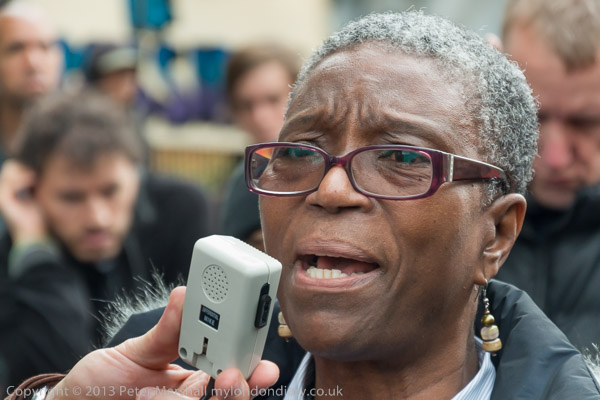
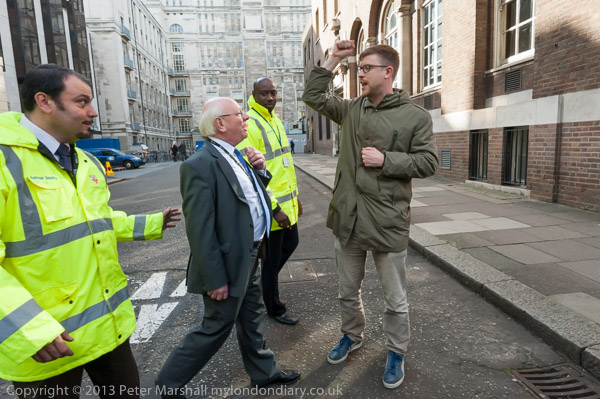
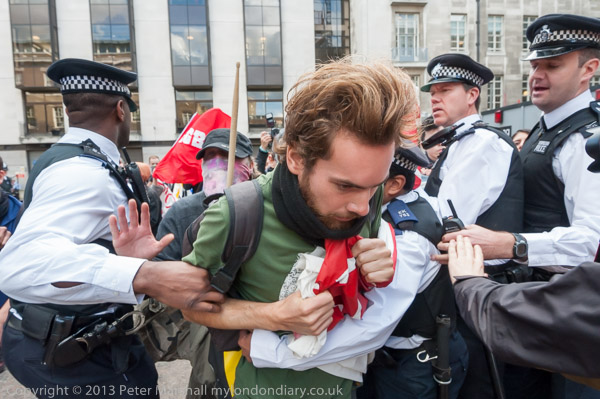
There are some events where I become more emotionally involved than others, and the annual United Families and Friends Campaign procession to remember all those who have died in the custody of police or prison officers, in immigration detention or psychiatric hospitals, held on the last Saturday in October, is one of them.

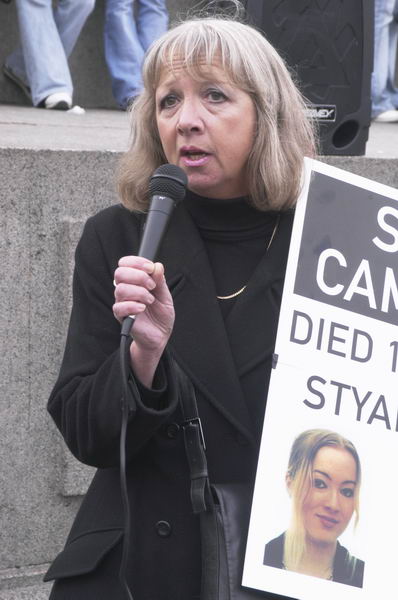
The first of these marches I photographed was in 2000, but it was in 2003 that I remember finding tears streaming down my face as I took pictures as I photographed Pauline Campbell speaking about her daughter Sarah who had died died in Styal prison
because the prison authorities and staff simply would not recognise her condition. It hit me hard partly because she was an impressive speaker, but perhaps more because she came from a not dissimilar background, around my age and working (as I was still part-time) in FE. Her daughter was just a few years younger than my sons.


Pauline Campbell speaking in 2003

She became a full-time campaigner for the cause of women in prison, working with organisations including the Howard League for Penal Reform (she became a trustee) and in 2005 was awarded the individual award of the Emma Humphreys memorial prize organisation, for “highlighting the distressing reality of women’s lives and deaths in prison”. Later I got to know her better, particularly after I photographed her trying to throw herself in front of prison vans at Holloway on a cold winter night, and received many e-mails from her encouraging me in my work. But a few months later she became another victim, found dead beside her daughter’s grave.

I’ve come to know others who have lost sons or brothers or other friends and relatives over the years, and have photographed some of them on many occasions as well as this annual march. It is still a very emotional event for me as well as for them. I’m not sure how this affects my photography, but perhaps it makes me try harder to capture their emotions.


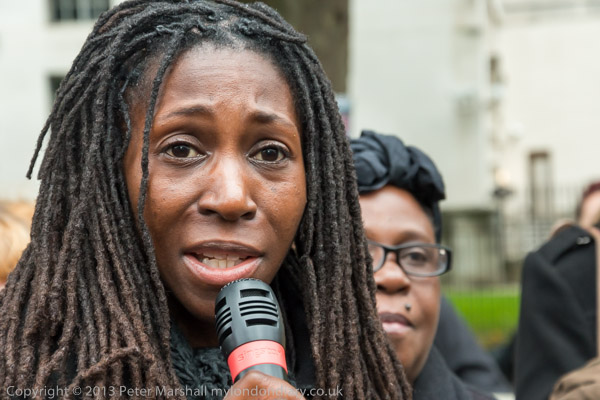
Stephanie Lightfoot-Bennet talks about the killing of her twin brother Leon Patterson by Manchester police in 1992


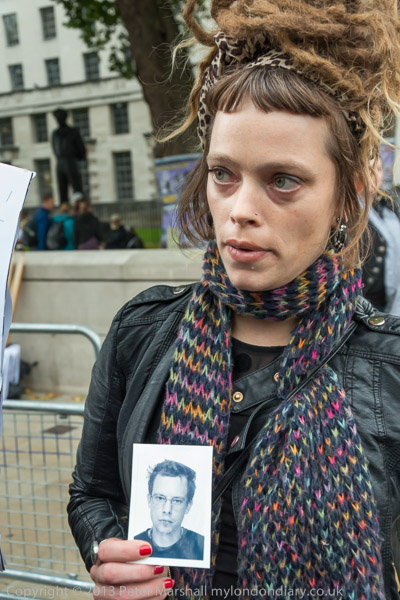
His sister Jo holds a picture of Thomas Orchard, killed by police in Exeter in 2012


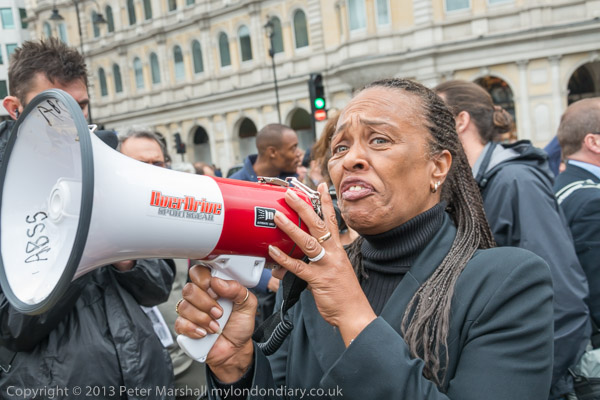
Ricky Bishop was killed in Brixton Police Station in 2001 – his sister speaks about the failure to prosecute the 12 officers involved


Ajibola Lewis, whose son Olaseni Lewis died after being restrained by police at Bethlem Royal Hospital in 2010


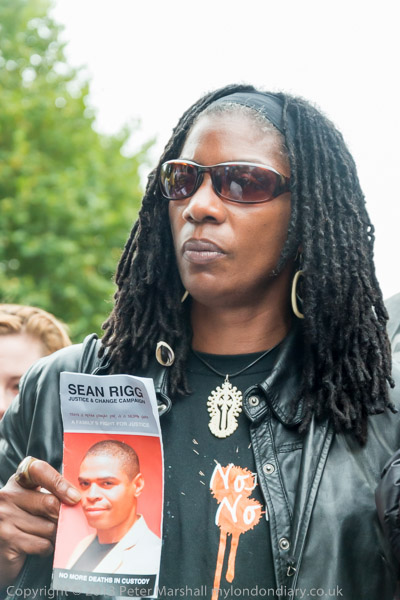
Marcia Rigg holds a leaflet about her brother Sean Rigg, killed by police in Brixton Police Station in 2008


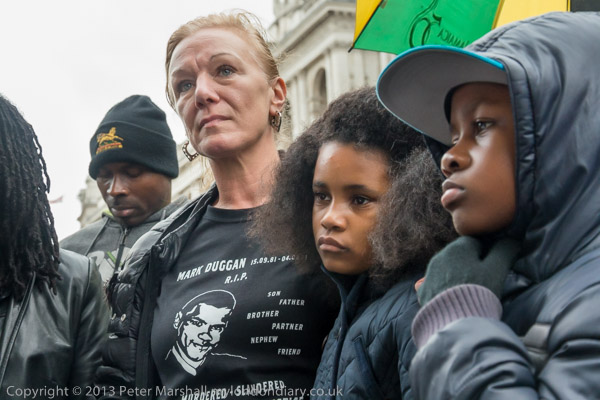
Carole Duggan, Mark Duggan’s aunt with two of his children.

I’ve written in the past about a number of these cases, and you can find more about them on the 4WardEver UK  web site.

Relatively few of these custody deaths are properly investigated, and it was only the consistent and determined campaigning by the Rigg family that led to an inquest jury coming to the conclusion that the police had used “unsuitable and unnecessary force” on him, that officers failed to uphold his basic rights and that the failings of the police “more than minimally” contributed to his death.  The inquest on Mark Duggan currently taking place has already revealed many inconsistencies in the police evidence, which together with that from other eye-witnesses make it hard to avoid the conclusion that his death was the kind of extra-judicial execution that we would condemn if it happened in other countries.

More pictures at United Families & Friends Remember Killed.

Continue reading Friends & Families

Cops Off Campus!


The university moves in to try and stop free speech

You might expect universities to be enlightened employers and to respect freedom of speech, but while that might once have been so, nowadays you – like me – would be disappointed. When workers at London University staged a number of in noisy protests last academic year for a living wage and proper conditions of service, the response of the university management was not to support them but to ban further protests and threaten to call in the police.

The ‘3 Cosas‘ campaign for proper pay and conditions for low paid staff at the university has widespread support from students and academic and other staff employed by the university. Earlier campaigns by the low paid workers have resulted in some of them now getting a living wage, but even for these the conditions of employment – things like sick pay, holidays and pensions – are far less favourable than they would be if the university employed them directly, rather than buying them in as cheap labour from contractors.


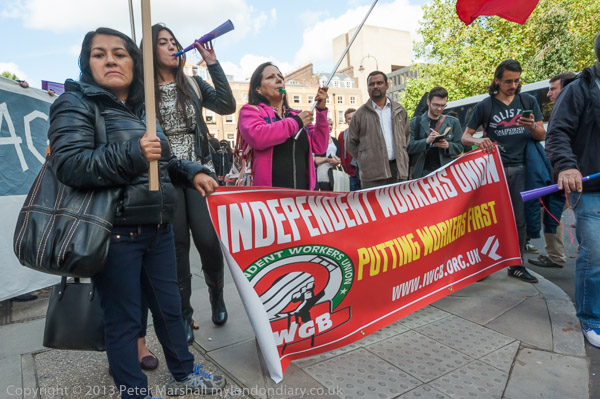
IWGB supports the ‘3 Cosas’ campaign

Its a curious position to work at the university but to be employed by another organisation, as their work is vital to the running of the institution. Even if the university engages another company to manage the cleaners, security and catering staff etc, they are still a part of the institution and it surely has a duty towards them to ensure they get proper pay and conditions. Many other organisations have realised this and made paying the living wage and proper conditions a requirement on companies contracting to run services for them.

But rather than standing up for those who work there, London University has said it is none of their business and objected to protests warning members of the university they may face arrest if they protest on campus.


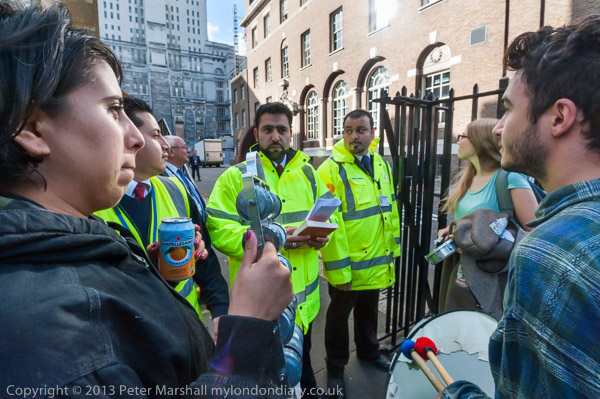
Security on the gate to the Senate House car park

The protest by the ‘3 Cosas’ movement on 24 Oct was in direct defiance of this ban, and resulted in far more disruption than any previous protest – and greater cost to the University. Extra security staff were on duty, with gates around the Senate House locked and checks made on all those entering.  At first this kept the protesters out, but a few students and academic staff made their way inside the closed area and started to protest, resisting arguments by security and managers to leave.

Eventually the bulk of the protesters decided to walk around some of the barriers and make their way to the Senate House, and I followed them. Some had actually climbed the tall fence or gates in front of Senate House, but I was considerably less athletic, simply walking through a gap in a very threadbare hedge and across a lawn.


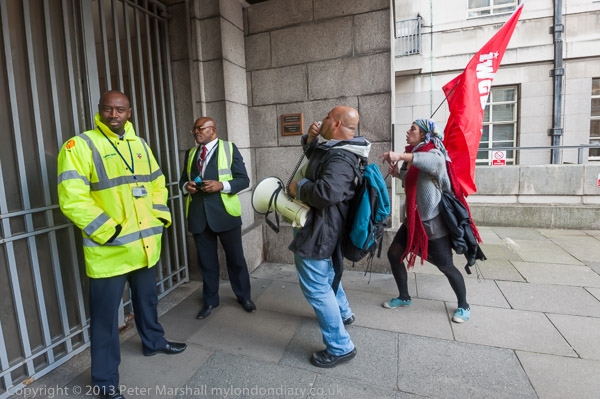
Protesters outside the Senate House, guarded by security

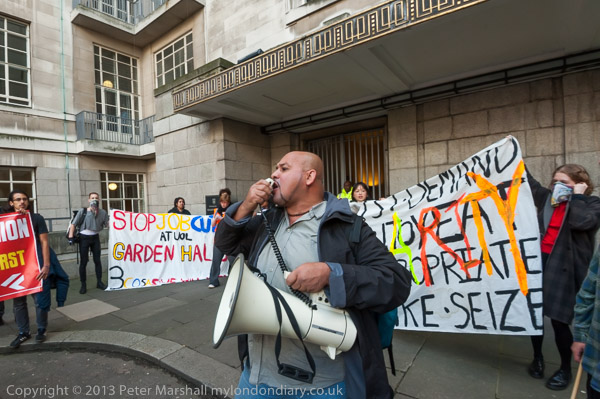
Having defied the ban on one side of Senate House I was a little surprised when it turned out to be equally easy for the protesters to walk round to the other side and do so again. But if the authorities really intend to stop protests they will need to invest heavily in barbed wire! By this time the university management had called in the police, though I don’t think the police were all that pleased or sure what their role should be. It was after all a peaceful protest and causing little or no disruption – and what disruption there was mainly from the action of the university security.


Protest continues on the other side of Senate House

Finally as the protest was almost at its natural end, the police decided to act, moving in and trying to stop the protest ending!  The result was something of a farce, with a handful of police grabbing the odd student while the others simply walked past – as I did.  After a little argy-bargy and some actual barging the police came to their senses and walked away, leaving the protesters to rightly claim a victory. They had stood up to the university authorities and to the police in a protest not just about the ‘3 Cosas’ but about freedom to protest and freedom of speech.


Police try to stop protester leaving while other police are shouting ‘Let them through!’

It may not end there. While the protesters were inside around the Senate House, there was a man on a balcony filming them – to which the protesters took exception. It seemed an unnecessary provocation, and suggests that the authorities might be considering disciplinary or legal action against those taking part.  This would be an extremely inflammatory act, and one that would reflect badly on the university.

More at 3 Cosas Defy London Uni Protest Ban.

Continue reading Cops Off Campus!

Adobe I Think Not

Like quite a few other photographers, I’m wondering whether to jump aboard Adobe’s licensing programme, which, for the next couple of days only – until Dec 2nd – is on offer for photographers at at $9.99 per month to include both Photoshop & Lightroom for those who don’t own a recent copy of Photoshop. Earlier Adobe had made the offer available only to those with Photoshop Creative Suite 3 (CS3) – and that offer continues until the end of 2013.

Given the fairly regular paid updates that both Lightroom and Photoshop have had in the past, this doesn’t seem a bad offer for those who need to keep up to date in both programs, but it does tie you in to a continuing commitment. Once you are on the licence scheme, the newer versions you get will stop working if you stop paying.

For those of us in the UK, Adobe’s offer is not quite as generous. Allowing for VAT, the offer should translate to around £7.50, but Adobe are asking for £8.78 a month, which adds up to £105.36 a year. It still doesn’t seem excessive, but the licensing programme ties you into a scheme in which Adobe have the upper hand and can (and surely will) increase the monthly subscription as they wish. Once you are in you have the choice of paying the increase or going back to the software you had before you joined, which could cause problems.

At the moment it looks as if Lightroom will continue to be made available for the foreseeable future as a paid for program with charges for major upgrades. Unlike Photoshop, which has been around so long that upgrades are seldom of huge significance (and sometimes make annoying minor changes that move or alter the familiar), every major upgrade to Lightroom so far has been worth buying (and the minor ones which come free have also been worth installing.)

Photoshop isn’t of course the only software for photographers, and many make do with alternatives, such as Adobe’s own Photoshop Elements, though its interface always puts me off. But there remain a few things for which Photoshop seems essential, notably for me its ability to produce CMYK files, and it remains an industry standard. For me it is also the easiest software to use for retouching my scans, and a reliable carrier for a number of Photoshop plugins I find useful (though other software would also support these.) Some people find Photoshop buggy, but I’ve seldom had any problems with it.

Were I to need to look for an alternative, perhaps the most suitable software would be Photoline, software which started on the Atari ST in 1996 and first came to Windows the following year in version 2. There is a useful Wikipedia article on it. Version 18 is now available for both Windows and Mac and has full colour management and Lab and CMYK support. I’ve not tried it (you can download a 30 day trial version) but it looks impressive. The full software costs 59€ and a single user licence allows you to install it on several computers (even both Mac and Windows.) Major version upgrades seem to come every year or two but cost only 29€. Currently the euro prices convert to around £49 and £24 respectively. If any readers are using Photoline, comments would be welcome.

Were it important to me to keep up-to-date with Photoshop I’d sign up today, but it isn’t, and I’ll save the money for the moment. If Adobe ever move to put Lightroom on a subscription only basis I’d have to reconsider, though perhaps too I’d look for alternatives. Adobe isn’t the only game around.

Thursday

I don’t often go to Hounslow, although its only a few miles away. I can get on a bus a short walk away and it will take me there, though it’s faster to either take the train to Hounslow or get off a stop before and catch a bus, depending on which part of Hounslow I want to go to. But not a lot happens there. Not a lot happened there in the eighteen or so years I lived there until I left for university. A few years later my family had all moved away, and there didn’t seem a great deal to go back there for.

But on a Thursday morning I found myself standing alone at a bus stop outside Eaton House, the Hounslow Reporting Centre. Most asylum seekers have to report either daily, weekly or monthly at one of these centres – there are around 15 covering the whole country – or sometimes at a police station. They get fingerprinted and their biometric ID cards are reactivated. Or they may be taken from the interview room and put into a holding cell, to be transferred to one of our immigration prisons (officially called detention centres) to await deportation. Eaton House serves those living in much of West London and further afield, and certainly wasn’t chosen as the easiest place to find or travel to, on the western edge of Hounslow. Reporting often seems to be a way to harass asylum seekers rather than anything more.

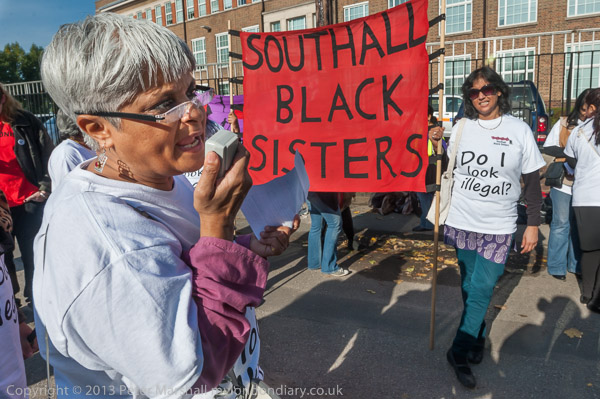
Southall Black Sisters was founded in 1979 to fight for the human rights of Black (Asian and African-Caribbean) women and like many others are appalled at the growing racism of government legislation and activities against asylum seekers and other migrants. I’ve photographed them taking part in many events over the years, but I think this was the first organised by them I’d been to.

I have a suspicion that Eaton House was chosen as a reporting centre (and I think as a base for some of the UKBA officers who go out on immigration raids) because it is rather out of the way. The journey is intended as a disincentive to wanting asylum or a punishment, and to make organising protests more difficult. Although bus services in London have improved since my youth (then the route between Southall and Hounslow was particularly unreliable, and on several evenings I stood for an hour or so waiting for a 120 before giving up and walking home.)

But this time, coming from Feltham, my bus was dead on time and I arrived a few minutes early and I walked up and down, then sat down at the seat inside the bus shelter and waited hopefully. I like to get to protests a few minutes early, but it’s always nice to have a others gathering there so you know something will happen, and as the start time approached I was beginning to wonder if I was wasting my time.

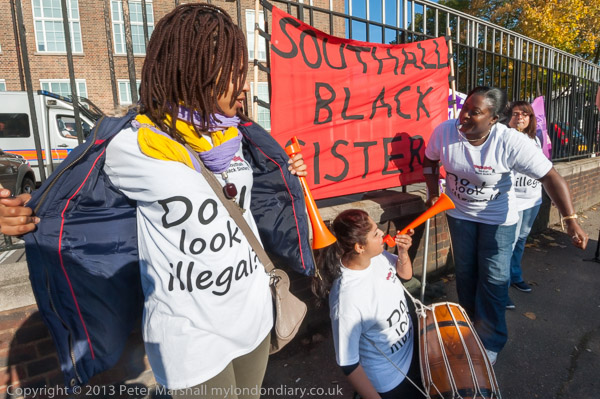
But Southall Black Sisters arrived on the dot, a minute before the advertised time and the protest got underway. Many of those taking part were wearing the group’s white t-shirt with the message ‘Do I look illegal!’ printed very large on its front, and with the protest involving quite a lot of activity it proved surprising difficult to get images in which this was fully legible, as you can see in Southall Black Sisters Protest Racist UKBA.

There were a few interesting moments, particularly when police officers tried to liaise with the women, and when one officer complained about the language one of them had used shouting at a man walking by who had made a racist comment, and was surrounded by the women telling him he should be taking action against racists, not those who stood up to them. The officer claimed to have been unaware of the comment that had been made, and eventually backed away as women shouted at him and blew whistles and vuvuzelas. But although I took pictures, it was perhaps something that would have been rather better recorded on video.  I’d not heard either the racist comment or the response the officer objected to.

My time at the protest was limited as I wanted to be in central London for another event, involving a journey by bus, then a short walk to the underground at Hounslow East from where the Piccadilly line would take me, very slowly, to my destination.

I was beginning to get worried that I hadn’t really managed to take an image that really worked about the protest as a whole, when I made the one at the top of this post, showing the Director of Southall Black Sisters, Pragna Patel speaking. I’d moved around very close behind her using the 16-35mm on the D700.  This was the sixth of seven frames; at first I’d been a little further back, and working at 16mm, and she had been partly obscuring the banner.  I’d been working with the banner and to its right a group of the women with drums and horns in front of the UKBA fence and building, and Pragna Patel was reading from a list of slogans in her hand. As she turned her head around more towards me I zoomed in slightly for a frame and then stepped closer to tighten the framing a little. Even so, the image, taken at 20mm, needed a little cropping mainly at the right of the frame, and this also enabled me to bring the top of the image to the top of the banner.  I’ve retained the 3:2 aspect ratio, though I think it might improve the picture with just a little more off the right hand edge. You can see my shadow in the bottom right by the way, and the t-shirt of the woman holding the banner is nicely legible, with a curve in  her stance that seems to send my eye back into the picture.

I took one more frame immediately after this, almost identical except that the speaker’s mouth had closed and her head moved very slightly forward. As soon as I had taken these two images I thought I had managed what I needed, and, moving back a little, made a quick check on the screen on the back of the camera to confirm this. I don’t often stop to ‘chimp’ when taking pictures (and often get annoyed with photographers who keep standing in the way of others to do so) but wanted to be sure.

As I looked up from the camera, I saw my bus coming down the road, and quickly waved goodbye and jumped on it, on my way to take more pictures elsewhere.

Continue reading Thursday

End UK Caste Discrimination

It was raining fairly heavily as I made my way into Hyde Park for the protest by CasteWatch UK, but I didn’t want to put my umbrella up. It’s days like this that I wish I had an assistant to hold an umbrella over me, as it isn’t really practicable to photograph holding one yourself, though I have sometimes done so. I like to get close to many of my subjects and it just gets in the way, apart from being rather tricky to manage. But at least I have a decent hood on my jacket that keeps me dry without getting too much in the way, though it does make it just a little harder to work, and in particular restricts peripheral vision, making it easier to miss things going on around me.

I’ve also experimented a little with waterproof housings for the two cameras (D700, D800E) I like to use, but have yet to find anything I like though Op-Tech make a cheap one that looks interesting. Perhaps readers have some other suggestions?

So I work with the front of my waterproof jacket partly open, slipping the cameras partly inside when I’m not taking pictures. Two Nikons with large lenses don’t really fit easily inside, especially if one has a flash attached. Though flash is seldom a good idea in the rain unless you want to take pictures of raindrops. I put a large microfibre cloth over them, or spend my time wiping them down to try and keep them dry. The cameras are fairly well sealed against water, but the lenses – even the pro 16-35mm f4 – not so good.

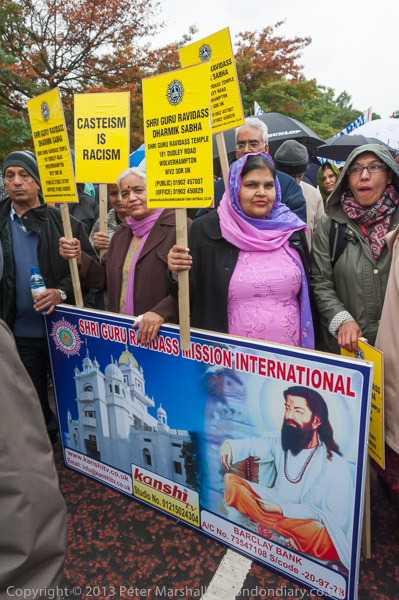
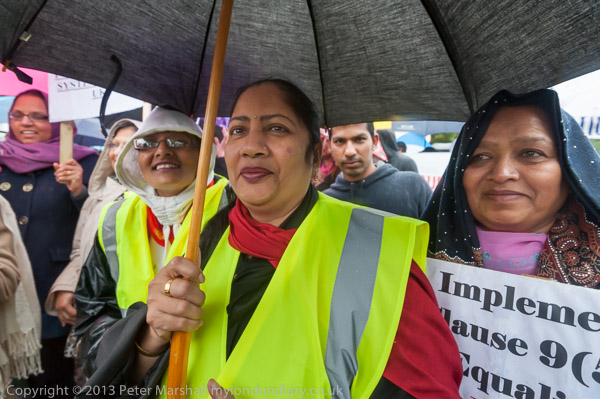
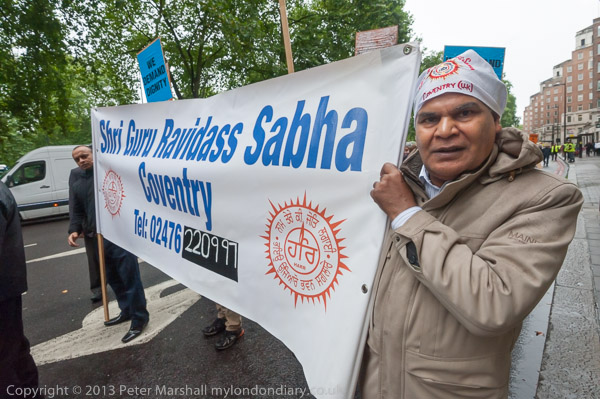
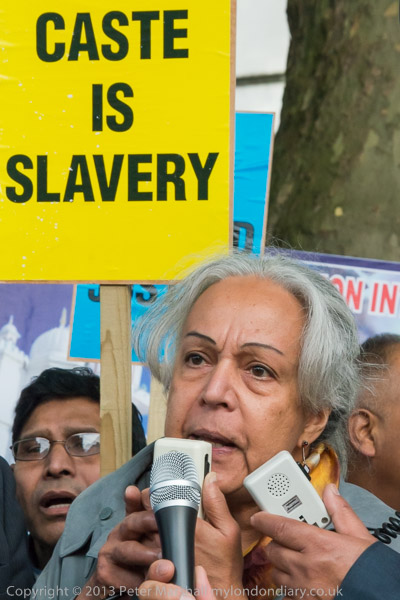
Caste Discrimination is illegal in India, though that hasn’t stopped it remaining to be a real problem there, and one that has now been exported to the UK. It’s a problem that has a religious dimension too, with many of the lower caste Dalits being followers of the 14th century Indian guru Guru Ravidass. He is considered holy (but not a Guru) by Sikhs and  many Ravidassia places of worship are called Gurdwara and until recently many considered themselves as Sikhs (and some others as Hindu.) But in 2009 the murder of a Ravidass leader, Ramanand Dass, by Sikh extremists in the temnple at Vienna led to a decisive split between Ravidass and Sikhs. Ravidass Gurdwaras that had previously flown the Sikh
Nishan Sahib flag with its Khanda symbol now adopted the distinct Ravidass Harr Nishaan, and in place of the Guru Granth Sahib they brought out their own Amritbani Guru Ravidass Ji containing the hymns of Guru Ravidass.

Ravidassia complain they are discriminated against because of their low caste by both Hindus and Sikhs. The government didn’t want to act, but were forced to do so by the House of Lords and MPs, and in April legislation was passed to ban caste discrimination in the country under the Equality Act. Rather than accept this, the government, under pressure from Hindu ad Sikh higher caste groups and individuals, decided to delay implementation by setting up a two year period of consultation with these groups, angering both the Dalits and others opposed to discrimination.

Almost all those on the march were Ravidassia, with just a few Sikhs and others also supporting the demand for speedy implementation of the law. A little under a thousand were standing in the rain when I arrived, many under umbrellas, some listening to speeches and others just standing around waiting for the march to begin, out of earshot of the speakers.

Umbrellas can be a problem, particularly for colour photography. While black umbrellas simply cause shadows, sometimes rather deep, coloured umbrellas can give some very strong colour casts from the light coming through them onto the faces beneath. One solution is to use flash, but unless you are also under the umbrella this can give reflections from rain drops in the air. Instead I relied on being able to use Lightroom’s Adjustment Brush to adjust ‘temperature’ and ‘tint’ on faces where necessary. You can see a blue patch I left on the forehead of the woman in the image below.

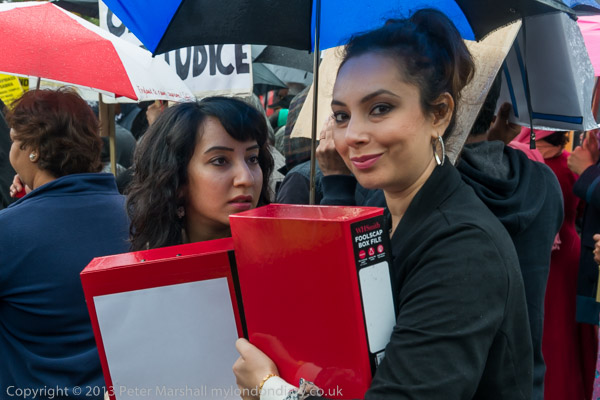
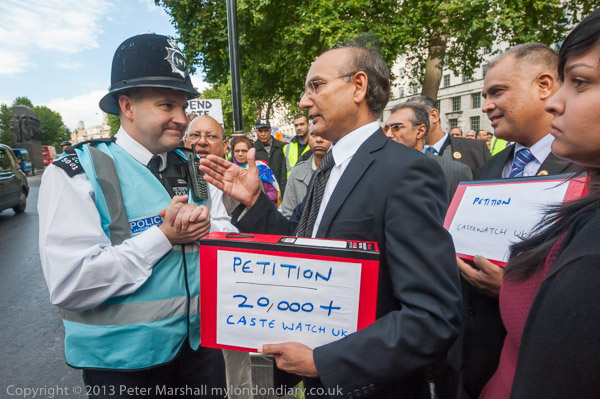
I noticed two young women carrying red boxes, which I guessed contained the petition the march was to present at Downing St, and went over to photograph them and ask about the protest. They took me to photograph the march organiser, and later at the end of the protest I photographed them on their way into Downing St with the petition.

Although it was still raining when the march started, it soon eased off, and I was able to photograph the march as it went down Park Lane to Hyde Park Corner in the dry. Park Lane has many trees along the Hyde Park side, and the lighting varies considerably. Usually I hand around in the lighter areas taking pictures, then after a while hurry on to the next area with decent lighting.

At Hyde Park Corner I decided I’d been on my feet for long enough (walking is fine, but photography usually involves too much standing around, which is bad for more legs) and I took the tube for a couple of stops, meeting up with the protesters as they came along Pall Mall towards Whitehall. I’d not made a note of the exact route and had spent a little time waiting at Piccadilly Circus before I realised they were not taking a rout passed there.

Opposite Downing St there was a rally on the pavement, with a number of speakers, few of whom I recognised. It’s sometimes a problem in captioning, but if I don’t recognise a speaker or remember having heard the name before it probably is not going to be of great interest to likely clients.

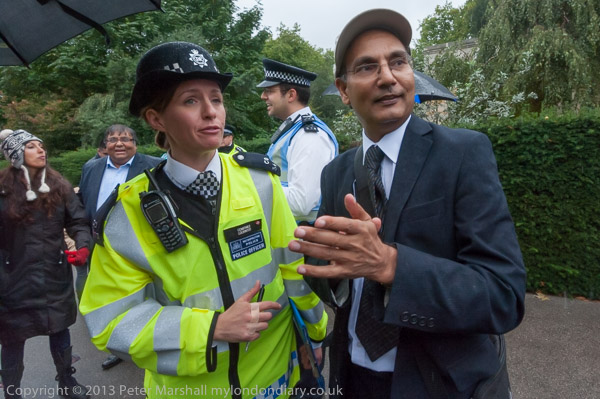
Although it was fairly noisy in the crowd and with the speakers using megaphones I was still listening for other things happening, and something made me move out of the crowd to the side of the road. There I found the event organiser and a few others having an argument with a police officer, who was trying to stop them going across the road to present the petition. Finally he realised that they were telling him that they had arranged to do so with the authorities and agreed to let them do so.

I was pleased with the pictures I’d taken. It was a cause I could wholeheartedly support, and the people were all very warm and friendly and keen to have their pictures taken. You can see more of them at Make Caste Discrimination Illegal Now.
Continue reading End UK Caste Discrimination

Morel Wins Hands Down

I feel good. I hope that never happens again to any of us. This is a victory for all artists, for all copyright holders

Daniel Morel’s verdict, (as reported in the Times of India) after hearing the jury had returned a unanimous verdict that AFP and Getty had willfully violated the Copyright Act expresses what many of us feel, though he has the added bonus of having been awarded $1.2 million – the maximum statutory penalty available – along with an extra $20,000 for their violations of the Digital Millennium Copyright Act.

Reading the day by day account of the trial on Editorial Photographers UK makes it pretty clear why AFP and Getty lost the case, and reinforces what I and many others wrote earlier about the madness of AFP and Getty in fighting it rather than admit their mistake and come to an early settlement as the other offenders did.

It seems to have been a case of the agencies thinking they were so big they could do what they liked, and get away with it despite the law. The attempt by AFP to blame the photographer could hardly have made a positive impression on any sentient jury member, and I suspect that had the jury been able to make a higher award they would have done so.

I’m not generally in favour of the scale of damages that US Law allows, which often seems unreasonably high (while the UK approach lets off deliberate offenders too lightly.)  But this case seems to be  good example of why such high damages should be available.

For more on the background of the case see Jeremy Nicholl’s excellent feature on his Russian Photos blog. I’m sure he and EPUK will have something to say about the verdict.

Education Under Attack

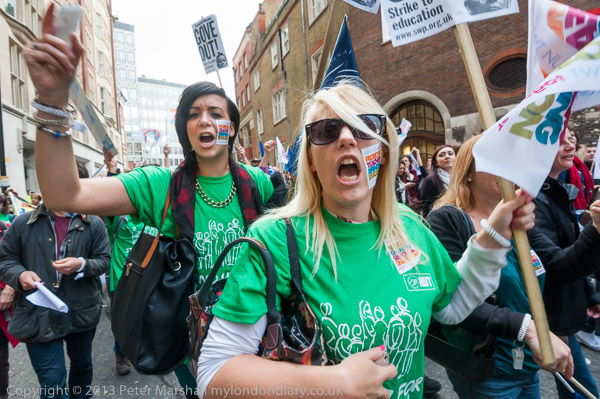
I spent 30 years of my life working full-time in education, teaching a wide range of subjects including science, chemistry, IT, computer networking and, of course, photography. It was hard work during term-time, particularly in the early years when I was a teacher and then a head of department in a very large secondary comprehensive, when 60+ hour weeks were normal for me during term times, with lesson preparation, planning, marking and administration taking up perhaps one and a half times as much time as the actual class contact – then around 24 hours a week. Anyone who thinks teachers have it easy – and who looks on it as a 9 to 4 job has never tried it, or not at this level.

Then – in the 1970s – the workload we had was at the high end for the profession, and others working in primary schools or grammar schools or even some smaller comprehensives did have an easier time, but those days are now long gone, with the National Curriculum and Ofsted making the kind of hours those of us at the sharper end had to put in back then universal.

Like many teachers, I went into the profession for idealistic reasons, though many of these were frustrated by the problems and pressures I met. Now the pressures are much greater, and driven by government interference and a spectacularly vindictive and doctrinaire inspection system that rewards blind compliance and attempts to stamp out initiative and individuality. Things started to get really bad in the 1990s, and I was glad to be able to resign at the end of that decade and take up photography and writing about photography.

Now things are even worse, with an education minister driven by hare-brained ideas from failing systems abroad and deaf to the advice of many educationalists in the UK. Education Minister Michael Gove seems to hate and mistrust teachers, and is setting out to increase workloads and destroy the collective agreements that have governed teachers’ pay and conditions. Add to that the raising of the pension age, with teachers in the future being expected to work until they are 68 and it is hardly surprising that teachers are very angry, both for themselves and over the future of state education. Much of that anger is against Gove, universally loathed across the profession.

I’d put the march through London from Malet St to Westminster into my diary a month or so earlier, and only checked on it again on the morning it was taking place. When I did so I found that the time I’d been given had changed, and that I had no chance of covering the start. I decided that if I caught the next train I could probably meet them in Whitehall, and that proved to be the case, though I had to run a couple of hundred yards to be opposite Downing St as the head of the march reached there.
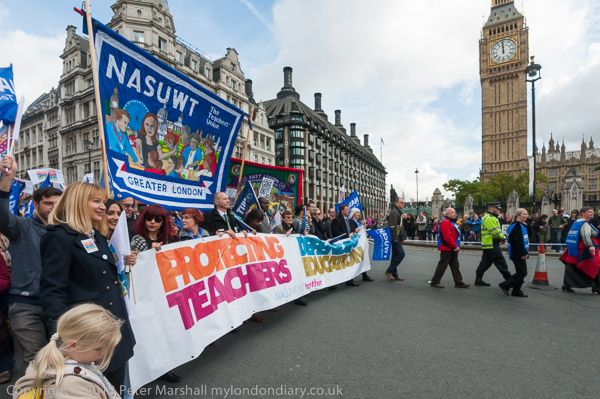

A difficult angle – and rather a mess at right in the middle of the image
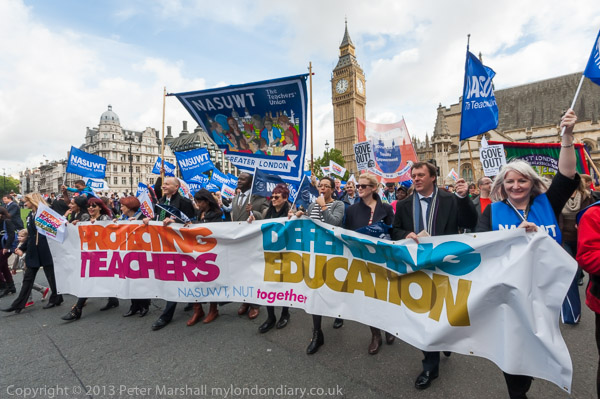

Catching the procession as it swung away from Parliament gets a better angle

As expected, some teachers reacted strongly as they passed the gates to the street, shouting towards the Prime Minister’s residence hidden away behind the gates guarded by armed police, and I took a few pictures, before hurrying along to the head of the march to photograph it going past the Houses of Parliament. It’s always good to get a few images with Big Ben in the background.

It’s tricky to get good images unless marchers stop and pose, as you have to work from a fairly oblique angle to include the protesters and parliament. Often the best opportunity is when marchers are some way along the front of the square, but marches like this that turn up away from parliament give a better opportunity on or just past that corner – as in the image above.
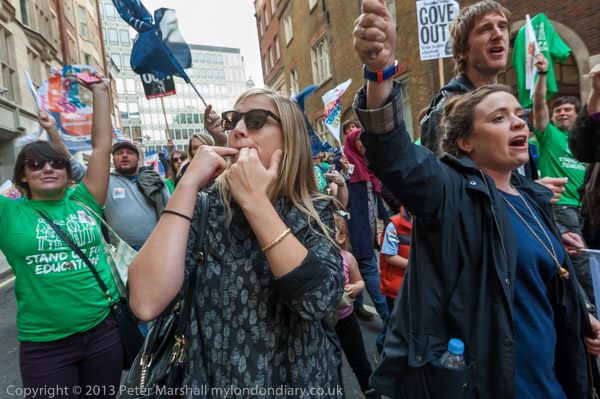
I kept with the head of the march as it came up to the Dept for Education a quarter mile or so further on. It doesn’t really stand out in pictures – and when people are just marching past it’s seldom possible to include it sensibly. But I knew that here was another location where the anger would emerge visibly. I’ve seen a few pictures from the rally published in newspapers and magazines, and I think mine show that anger more clearly.
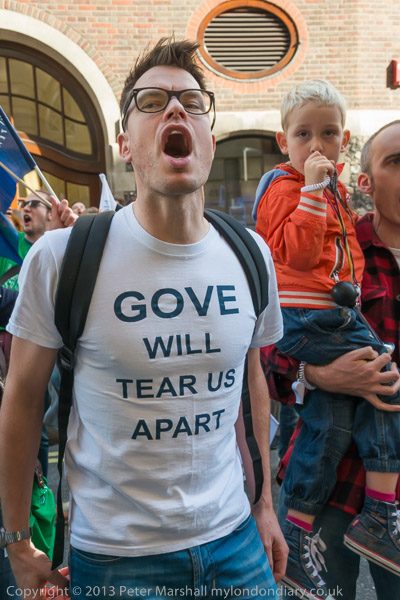
There were far more on the march than the hall a couple of hundred yards further on would accommodate, and as it filled up, the march came to a halt, still stretching back a fairly tightly packed third of a mile by the time I left half an hour later. Estimates put the numbers in London at 15,000 and there were other marches and rallies across the country.

I made the mistake of trying to get to my next appointment by bus, but the teachers’ protest had completely disrupted the bus services and brought traffic in London to a complete standstill. When I finally found a bus that was running, it went a couple of stops before coming to a halt, with the driver advising us that if we could walk it would be faster. And it was, but not fast enough, as by the time I arrived the protest had finished and dispersed.
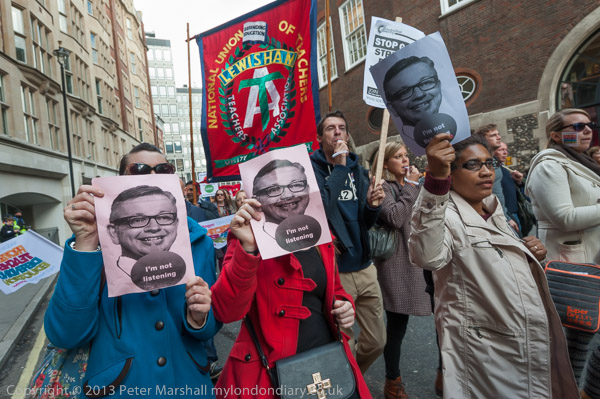
Gove, like many others inside and outside parliament, seems to think that teaching is easy and a cushy number. It probably was at the posh Scottish private school he got a scholarship to, and most of his colleagues in the cabinet went to Eton, where I’m sure the atmosphere is rather different to your average comprehensive. Eton is a very good school and I’m sure its staff are dedicated and talented (I was once urged by the head of department there I worked with as an examiner to apply for a vacant job.) If Gove would fund the state schools at a similar level they could do acheive wonders too. But I can only agree with conservative peer Lord Baker who recently said “Michael Gove had a tough upbringing and he believes if he did it, anybody in the country could do what he did: whether they’re orphans, whether they’re poor, whether they’re impoverished, they can all rise to the top. That is not actually true, and that is dominating the attitude of a key minister in government.

More pictures of the march and angry teachers in Teachers March against Government Plans.

More About My Teaching Career – and how I managed to be a photographer too.

I began my second teaching post (the first had been a couple of terms filling in time before getting my teaching qualification) as a science teacher at one of the country’s largest comprehensives, and stuck it out for almost ten years, considerably longer than average for the school, getting promoted three times over the years.

Most weekdays I’d get up at 7am to get to work for 8.45am, teach until 4pm, with ten minutes for a cup of tea in the morning. If I was on lunch duty I’d eat a free school lunch as a part of the lunch break, otherwise I’d bring sandwiches so I could get on with marking and other jobs. When the ‘students’ left, I’d be clearing up and tidying and perhaps some more marking before leaving for home and dinner. This was the only relaxation during most days, and I’d often manage to listen a little to the radio while eating or washing up after the meal, but then it was time to get back to work again, usually until around midnight.

It was a tiring schedule, but it did make it possible for me to take the occasional day off at the weekend for photography – and of course there were the holidays – but after 10 years it had worn me down, and I took a drop in pay to move to a less demanding teaching post in further education. There with a similar amount of ‘contact hours’ I could put in a 40 hour week and get the job done. And by taking on some evening classes, I managed to arrange myself one or two free afternoons which I could devote to my personal photography through the year as well as during vacations.

But while in 1980 my new job had seemed reasonably relaxed, over the years it changed. The College amalgamated with another and later became a small part of an even larger unit. Paperwork – at first virtually non-existent – became to seem the management’s raison d’etre, and inspections increasingly important. Management which had been aimed at enabling staff changed to be about controlling and supervising them, and bullying bosses proliferated. As a trade union rep my job (unpaid and entirely in my own time) increased too, and where once relations had been amicable they became confrontational. Things improved slightly with the appointment of a new principal (but the golden handshake given to the previous for failure rankled.)

Teachers in the UK I think have to be at school on 195 days a year. With 52 weeks of 5 days the full working year is 260 days, so there are 65 days free – but probably I spent around another 10 on school work, writing new courses, leaving me with around 55. In industry in the UK my friends were getting 30-40 days leave per year (including Bank Holidays) so this was a significant advantage in pursuing my photography – making projects like that I took in Hull over several years possible. Moving to FE freed me up for a half day of work during the week and made a number of major projects in London possible.

In the late 70s and early 80s I did consider leaving teaching and going full-time in photography. But I had a family and needed a regular income to support them. Teaching was a way to do that and to continue with some photography. This was a relaxation from the teaching, and helped me keep at that. I wonder if I had been working all day as a photographer I would have wanted to do the same amount of personal photography as well. Many over the years have asked me how I could do both, and it was simple to answer – I just asked them how many hours they spent watching TV. I last lived in a place with a set in 1968.

Continue reading Education Under Attack
Jon Lewis & the Farmworker Movement

Last week the New York Times Lens Blog published a post A Civil Rights Photographer, and a Struggle, Are Remembered about the work by Jon Lewis with Cesar Chavez and his Farmworker movement in California in the mid 1960s. The text is by writer, professor and curator, Maurice Berger, who has also contributed a number of other posts related the the US Civil Rights movement.

The post comes as the book ‘Jon Lewis: Photographs of the California Grape Strike‘ by Richard Steven Street (ISBN 978-0-8032-3048-4) is published by the University of Nebraska press.

In January 1966, Lewis, a 28 year old former marine with a degree in journalism and photographer from California State University in San Jose, visited Delano in California, the centre of the grape workers strike led by César Chávez of the National Farm Workers Association (NFWA), intending to stay for a week before starting graduate school at California State University in San Francisco.

In the event he stayed for eight months, and also returned later in the summer, sleeping on the floor of the union HQ and living on the $5 a week striker’s wages. He managed to borrow $150 to set up and equip a laundry room as a darkroom with second hand equipment, photographing by day and processing at night, especially as the windowless darkroom got steamy with chemicals in the daytime during the summer, taking over 250 rolls of film. He photographed the picket lines, the confrontations, boycotts and the living conditions and in particular the historic 250 mile march of farm workers from Delano to the State Capitol in Sacramento to meet with the governor. This began with fewer than 75 marchers and a police attempt to stop it, but by the time it reached the capital there were thousands of marchers and supporters. The march brought the farm workers’ struggle on to the national headlines and led to a successful farmworker grape boycott.

Lewis was one of a small team of freelancers who documented the strike, all of whom became dedicated to the cause, and gave much of their work to the union to use for posters and publicity without charge. Unlike the photographers from the newspapers and magazines who came for a few days, they stuck at the job, and produced almost all of the best pictures – and Lewis was probably the best among them. Taking pictures was often dangerous, with police and company thugs often targeting them, but working from the inside they had the opportunity to create a unique record.

Lewis also recognised the input of Jim Holland, the man who made the circular red and black picket signs, as he wrote: ‘As props and framing devices they turned many an ordinary photograph into a stronger image.’ Many of us who photographed the ‘Stop the War’ protests in the UK have a similar reason to be grateful to David Gentleman.

As a part of the campaign, a secret ballot administered by the American Arbitration Association was held among the workers for the major corporation opposed to an agreement with the workers, giving them the choice of the newly united union led by Chavez, the United Farm Workers Organizing Committee AFL-CIO (UFWOC), the Teamsters Union or no union at all. This was won by the UFWOC, with only 12 of the 873 workers voting for no union representation, contradicting the employers claim that the workers did not want a union.

You can read more about the strike and see more of Lewis’s pictures in the Jon Lewis Photo Exhibit “1966: Cesar Chavez and his NFWA” by LeRoy Chatfield, part of a site which is a literary memorial to Don Edwards who was also active in the 1960s civil rights movement.

After taking these pictures and returning to college on the GI Bill, Lewis failed to get employment as a college teacher of photography and graphics and found work for 38 years in the printing industry. After retirement he had time to print some of those old negatives again and he gave many of the pictures to Chatfield (another who worked with the Farmworkers) to use on an extensive archive documenting the Farmworker Movement.

Lewis died in December 2009 and a year later, Chatfield, published his portrait and eight of his photographs in a tribute in his journal Syndic.

On the Farmworker site there is a statement by Lewis about his work (and an oral history interview), which ends with the sentence: It was a great privilege to have been able to photograph strong men and women standing. I’m proud to have stood with them.

Hull – City of Culture 2017

I woke up this morning to hear a couple of interesting snips of R4 Today, amused when their reporter, busily chatting with home base, rather spectacularly missed culture secretary Maria Miller’s announcement of that the 2017 UK City of Culture was to be Hull, coming to her speech just after the announcement as she congratulated the other short-listed cities on the strong cases they had presented which were not as convincing as that of the chosen city.

A few minutes later – or was it earlier? – the programme had a discussion on time travel, with a learned US professor telling us that Einstein’s Special Theory of Relativity had stated that travel into the future was possible, and that had been experimentally proven, and that while his General Theory indicated the possibility of travel into the past, so far this had not been achieved.

I had to disagree, having published on the matter in the 1980s, when I wrote about the experience of my first visit to Hull. I can’t remember the exact words (and am too lazy to look them up since they come from a pre computer age and are hidden in stacks of paper), but it went something like this:

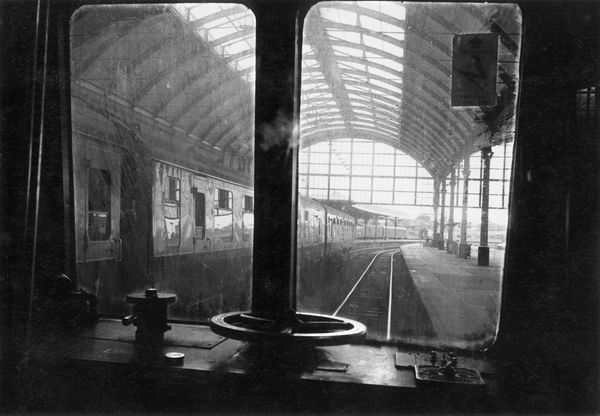
I boarded my train in Manchester in 1965 and emerged an hour and a half later in the 1950s at Hull Paragon.

I didn’t mean it unkindly, but Hull was definitively in a different time zone, and in many ways that endeared the city to me. I kept on going back, and a few years later married into it; we continued to make frequent visits for the next thirty-five years, though never stayed for more than a couple of weeks at a time.

Hull then was in many ways a ‘city of culture’ back then. My parents-in-law to be had met both playing violins in the same orchestra, and there was a fine old ‘New Theatre’ with a wide range of performances (music, opera, ballet, drama, pantomime…) as well as a fine municipal art gallery, the Ferens. Ordinary people still went to concerts, plays and exhibitions as well as themselves taking part in thriving amateur performances. Larkin was by far from being the only poet, and in the Hull Daily Mail the city had one of the better provincial newspapers, if I did spend most of my time reading it laughing at the almost pocket-money house prices in the ads.

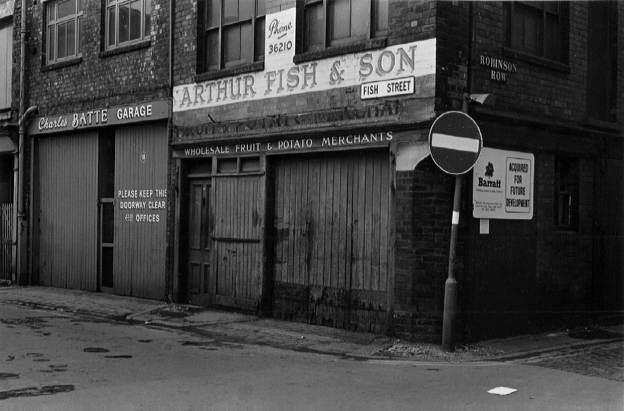
I took some of my earliest photographs in the old town at night, and a few years later found a subject in the widespread changes that were occurring across the city as the Council finished off much of what the Luftwaffe had left with large-scale redevelopment. The ‘Cod Wars’ killed the fishing, and much of the industry was dying, a process greatly accelerated under Thatcher. Barbara Castle gave the city a bridge across the Humber a few miles upstream as an election bribe, but by the time it arrived there seemed little reason to use it, and in 1976 it was made largely redundant with the eventual opening of the M62 to North Cave.

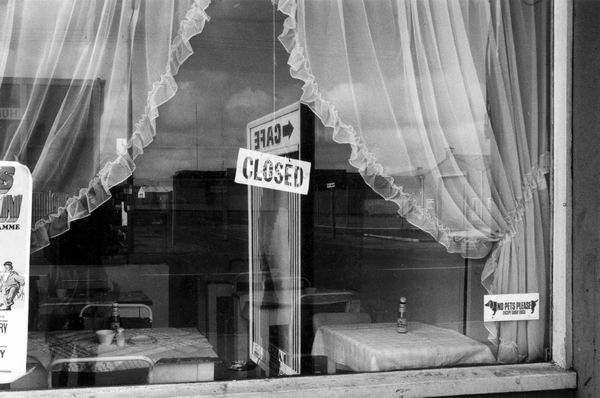
One of the many things I loved about Hull was its openness to the arts – it seemed to have few of the cliques which make – for example – London so unwelcoming to the outsider. I walked into the Ferens Gallery to make an appointment to show someone my work and ten minutes later was talking with the curator. Before long I was offered my first major show (and still my largest), on the top floor of the gallery in 1983, with around 140 prints. Most of them are in my book ‘Still Occupied: A View of Hull‘ (see below), though this also contains some later work and only contains black and white images – the show had around 20 colour images as well.

I continued to photograph Hull on later visits, though these have been much less frequent and shorter in recent years, as our relatives and friends have died. Hull has continued to change, although not always for the better in my view. But some of what I seemed almost alone in admiring back in the 70s has survived and is now promoted with leaflets, interpretation boards and ‘heritage’ signage. There are some splendid new features such as the River Hull Flood Barrier (they forgot to bring it into action at the first high tides after it was finished) and ‘The Deep’, as well as a rather disastrous marina, some rather dreary new housing and some disappointing shopping areas. Hull also got a ‘Fish Trail‘ and a ‘Larkin Trail‘ (I spent some happy times in the later years staying in a fine large ‘Arts and Crafts’ house owned by an old friend a few yards from where he lived.)

The arts as usual have played a part in the regeneration of the city, although not one always understood by the locals. I think I may well have stolen this story from someone, but I remember being in a bar down an alley just off the High St in the Old Town with my brother-in-law, close to the premises of Hull Time Based Arts in the mid 80s, hearing one of the regulars saying he didn’t get what they were doing. “Call themselves ‘Timebase Darts?  I’ve never seen a one of them with a set of arrers!”

Still Occupied by Peter Marshall

There are a few more of my pictures of Hull on the Urban Landscapes web site, and many more in my rather expensive book from Blurb, Still Occupied: A View of Hull 1977-85. Customers at UK addresses only can order direct from me rather more cheaply  for £30 including delivery. But everyone can access the full preview of the book on Blurb for free – click on the full-page button at the bottom of the preview to see the images properly. And you can still download a reasonably priced pdf from the Blurb page.

This was one of the first books I made on Blurb, using their Booksmart software, which mean the layout is not quite up to my later standards. Perhaps I will bring out a second edition for Hull’s year as UK City of Culture, or another book including colour and later work.

______________________________________________________

My London Diary : Buildings of London : River Lea/Lee Valley : London’s Industrial Heritage

All photographs on this and my other sites, unless otherwise stated, are taken by and copyright of Peter Marshall, and are available for reproduction or can be bought as prints.

To order prints or reproduce images

________________________________________________________

Support Rev Billy

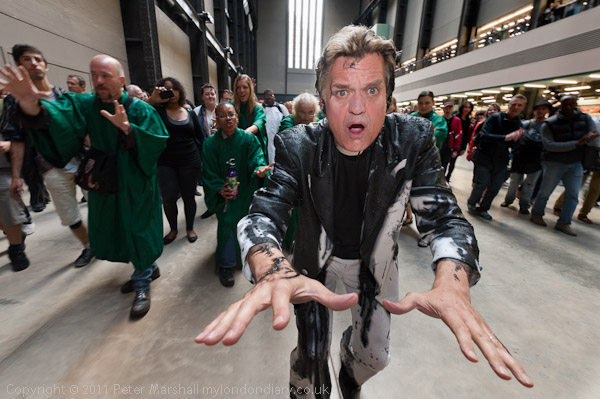
I’ve had the privilege of meeting with the Rev Billy and his associates in The Church of Stop Shopping during I think four events in London, and have been impressed both by their performances and in particular his anti-consumerism preaching. If you’ve not come across him before you can read more about him on My London Diary, and in particular on the two more extended performances I’ve photographed,  Rev Billy’s Tate BP Exorcism in 2011:

The Reverend Billy & the Church of Earthalujah preached a sermon loud and clear in the Turbine Hall of Tate Modern today, an act of exorcism urging an end to extraction of oil for the Tar Sands and of arts sponsorship by BP which gives a company engaged in this most polluting activity a false green image.

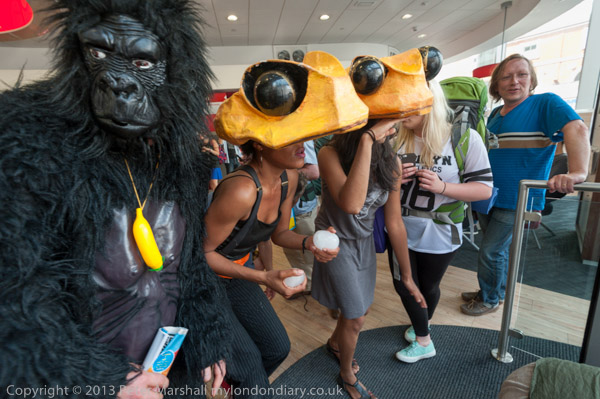
and Rev Billy at HSBC in July this year inside the branch of the bank just opposite Victoria Station in London:

Reverend Billy and the Stop Shopping Choir creatively invaded the HSBC branch at Victoria to perform a “radicalized midsummer cloud forest dream” against the support given to fossil fuels and climate chaos by the banks and the City of London.

Last month they gave a similar performance of this ‘extinction sermon’ in the ‘”wealth management bankof JP Morgan Chase at 56th and 6th in Manhattan. The dancing, singing toads offered bank workers and customers information sheets about the impact of Chase investments on the environment.’ The petition page continues:

Reverend Billy Talen and the music director of the Stop Shopping Choir, Nehemiah Luckett, were arrested minutes later on a subway platform. The two were charged with riot in the second degree, menacing in the third degree, unlawful assembly, and two counts of disorderly conduct. The DA’s office requested one year in prison for “this criminal stunt.

The defence argues that the 15 minute performance was an ‘expressive political activity’ covered by the 1st Amendment of the United States Constitution which guarantees freedom os speech.  Their act was based on research by BankTrack.Org of the Netherlands and the UK World Development Movement which shows that “Chase Bank is a top financier of extractive fossil projects, responsible for more CO2 emissions release than any other institution, with the possible exception of the Chinese Communist Party.”

You can read more about Rev Billy and the collective at The Church of Stop Shopping web site. The case against Rev Billy raises important questions about the right to protest and freedom of speech and seems to be a clear attempt by the establishment and Chase Bank to curb these.

If you care about these issues please sign the petition to District Attorney Cyrus Vance Jr. in support of the Revs Billy and Nehemiah by the Friends of the Church of Stop Shopping.  It will be presented at court on Dec 9th.

Continue reading Support Rev Billy