Germany – More in the Country

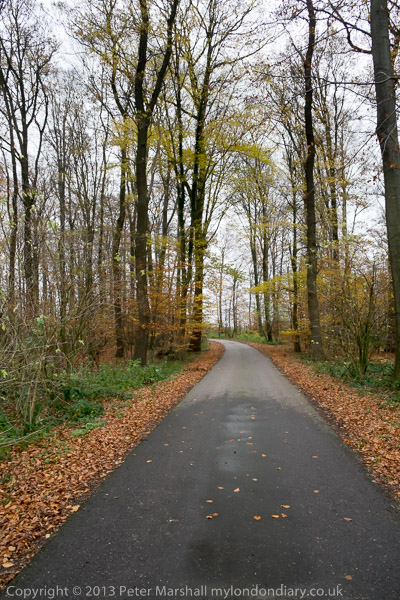
More pictures from the Fuji X-E1 taken in Germany. We cycled along the main road east from Neumunster to the next place of any size – a large village approximately 15 km east of Neumünster called Bornhöved.
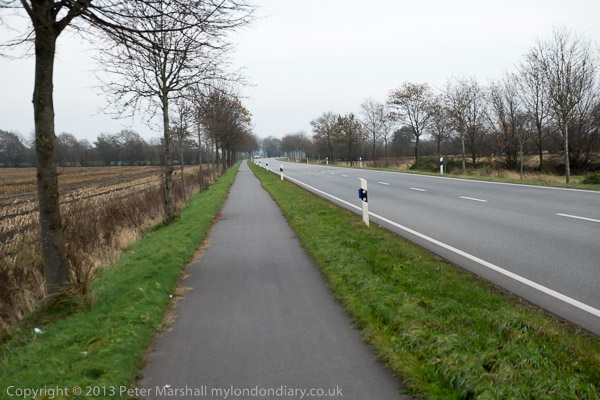
There was a cycle track alongside the road almost all the way. When it disappeared we took an unmarked side road which fortunately led into the village over a motorway. Almost all cyclists use the cycle paths, which most major roads have beside them. Few cyclists seem to wear helmets, except children (for whom I think it may be compulsory, though not all do.)  Outside of the towns we saw very few cyclists.
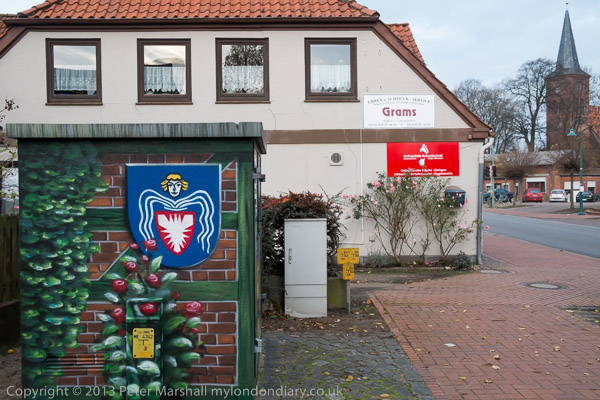

Bornhöved

Bornhöved is a largish village and unusually hilly after the very flat area we had cycled to.  It didn’t seem a place where there was a lot to do, though it had some pretty detailed boards about its history on the edge of the car park. We cycled around it then back to Husberg, where we were staying, making a small detour on the route. It wasn’t the most exciting ride I’ve ever done, and German bikes are not like mine at home.  It did have a lot of gears, but I think I just found the right one and stayed in it almost all of the time.  But the back-pedal braking is extremely annoying, particularly in making it difficult to get a pedal in the right position for a good start. There would have been more pictures, but I’d decided to travel light and forgot to transfer a spare battery from the bag I left in our bedroom to my pocket.

The EX-1 eats batteries fast, especially if you spend much time reviewing pictures, and tend to leave the camera switched on. I had five with me in Germany, and certainly got through three some days despite not taking a huge number of pictures.  The batteries are fairly slow to charge too, I think a couple of hours. The one I’m looking at is 1250 mAH and I think supposed to last around 300 pictures. It’s not a huge problem, as non-Fuji replacements are less than a tenner on e-Bay (and seem every bit as good as the genuine Fuji item which costs a ridiculous £59.99).

The Nikon batteries are a little larger and higher capacity – 1620 mAH – but though I carry a spare in my camera bag, I’ve yet to have to change one when I’m out working. Every day when I get home I do a check, and if they are under 80% they go in the charger and are replaced by the spare from the back. Some of the cheap replacements have higher capacity and can still be at 100% after I’ve taken a few hundred pictures.

It isn’t just the electronic viewfinder that makes the difference. The Fuji X-Pro 1 which I use mainly with the optical viewfinder eats up batters as well, though perhaps not quite as fast.

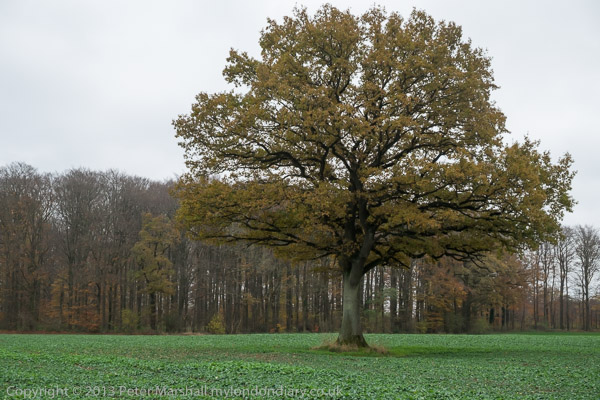
A couple of days later we took a walk closer to where we were staying. Bönebüttel and Husberg are really more or less the same place. But Bönebüttel seems to have more older farms and a lot of agricultural land around it, and we were able to make  nice circular walk that took us two or three hours.  This time I took my bag with the spare batteries and lenses, though I think most if not all of the pictures were made with the 18-55mm zoom, probably because I was feeling lazy!

There were plenty of wide open spaces and somehow out in the country I feel less of a need for an extreme wide-angle than in the town, where the 15mm Voigtlander was often nice to use.
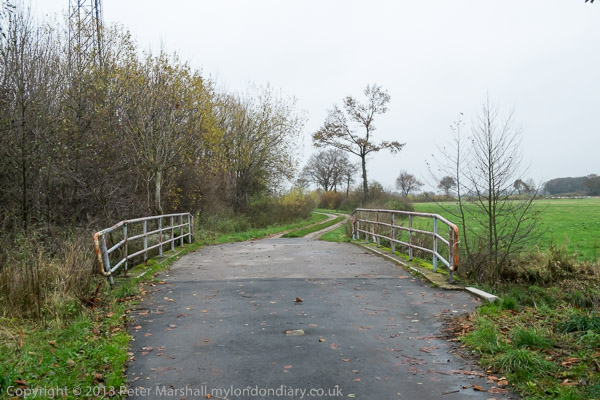

Bönebüttel
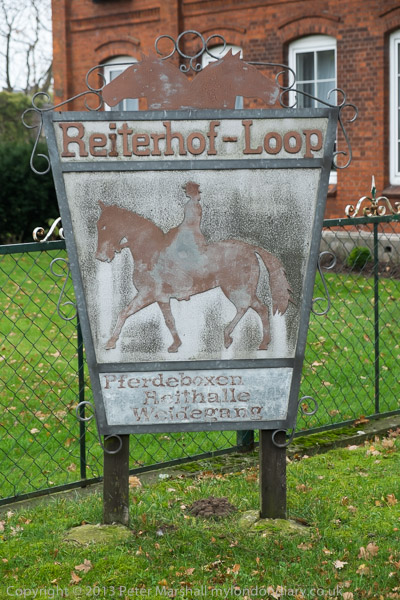

Brammerweg, Bönebüttel

and for something completely different: Designer Outlet
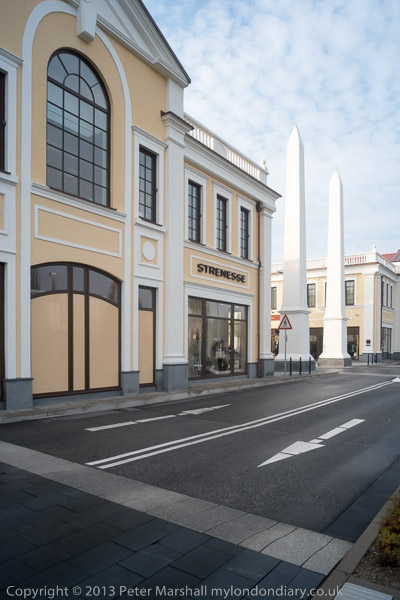

‘Designer Outlet’ in Oderstraße, on the edge of Neumünster “Designed for those who love to shop”
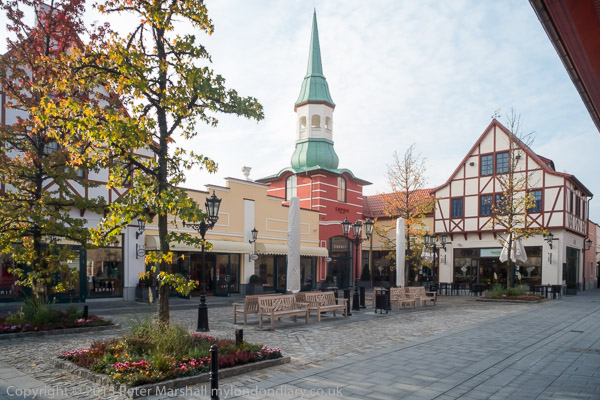
This is a kind of fake-old German town composed entirely of shops. We went in a few of them, but I didn’t see anything I wanted to buy.  All the pictures I took here were with the 15mm Voigtlander (22 mm equiv) and sometimes it wasn’t quite wide enough. But it is a nice lens on the camera, small and light. I don’t have any complaints about its sharpness, nor can I see any trace of distortion. It is a manual only lens, but that isn’t any problem on the Fuji X-E1. There were very few pictures where I needed to focus, having initially set the lens to a sensible setting by scale. Depth of field at f5,6 or f8 is pretty excessive.

Although it was ideal for this location in decent light, the maximum aperture of f4 was a little limiting for interior use, where the f2.8 of the Samyang made a noticeable difference. And it would be nice to have a lens that does autofocus for use at near distances.  So though I was very pleased with how this lens worked, I still ended up wanting the 14mm Fuji, which would have been even better.

The Fuji did a pretty good job in Germany, despite a few problems, mainly caused by the photographer. What I’ve not dwelt on in these posts is its performance shooting movies, where I think it did pretty well. It isn’t a camera of choice for fast-moving action, and it doesn’t have the flash capabilities of the Nikons, but apart from that it could replace them for much of what I do.
Continue reading Germany – More in the Country

Kiel

Kiel is best known for its canal. Which I went to see, though not at Kiel but at Rendsburg. Had a nice day out there, went across the canal on a splendid ‘ferry’, suspended on cables below the high-level mainline rail bridge there,  walked underneath the canal through the newish foot-tunnel with its seriously long escalators, walked though a part of the port and past a site scattered with huge bits of giant wind-turbines, ate currywurst and chips (our German hosts laughed at me) and ice cream, along with a beer. And took not a single photograph, as I’d rushed out without checking that I had a spare battery.

I’d plucked the battery from the charger where I’d left it overnight and put it into the camera as we left in a hurry, assuming we’d be coming back shortly before the main trip out later. We weren’t, and although I’d left the battery in the charger all night, somehow it hadn’t charged. Perhaps I hadn’t plugged the charger in, or hadn’t put the battery in properly. So I had a camera, but without a working battery it was just a dead weight to carry around all day.

Its a while since I’ve been out, at least further than a quick trip to the local shops, without a working camera. I might not always actually take pictures, but the potential is always there. So it did feel odd being without one, as if I was not properly dressed. I enjoyed the day, but think I saw far more opportunities for making pictures than I would have done had I been walking around with a working camera!

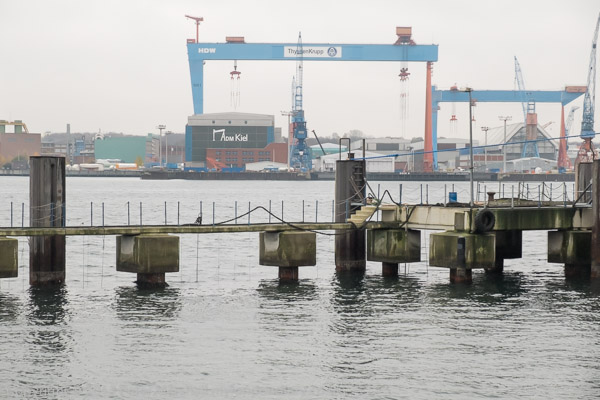
Earlier in the week we had visited Kiel itself – which isn’t really quite on the canal which starts a few kilometres north of the city centre. It was a grey, cold, windy day with occasional rain, and there were few others around as we walked along beside the Kieler Förde.  Unlike most British former ports, it still seems to be keeping busy.

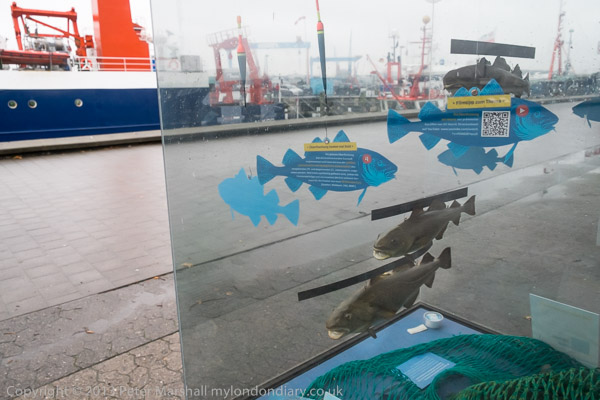
And there were some fish too, along with sea-monsters (you can see them on My London Diary) but it was too cold to hang around and we walked as quickly as possible into the city centre for coffee and cake. Although Kiel was founded in the 13th century, little remains of the old city,  thanks to the visits by the RAF and USAF who between them destroyed over 80% of the old town, and little of the post-war development appears memorable.

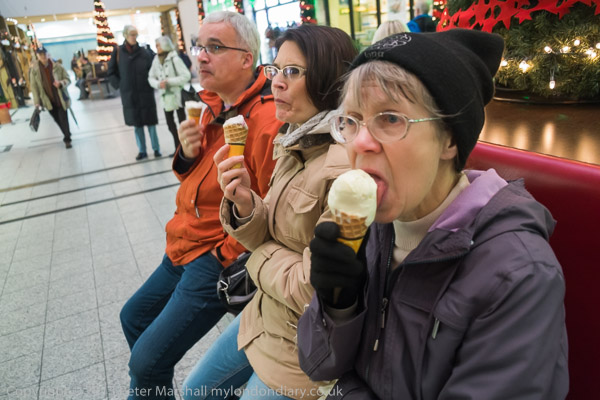
It boasts one of the longest shopping streets in Germany, but given the weather we were glad to get off it and into one of the larger shopping centres, where we soon warmed up enough for some rather delicious ice creams – with a bewildering choice of flavours. Giovanni L has over a 100 flavours and has won various ‘world championship’s as a master ice-cream maker and is now widely franchised across Germany and branches elsewhere, but despite that I can recommend ‘Mozart Praline‘, which comes ‘mit Marzipan‘, though I’m sure many of the others are delicious too. The ‘L’ stands for Lasagna, which seems confusing.


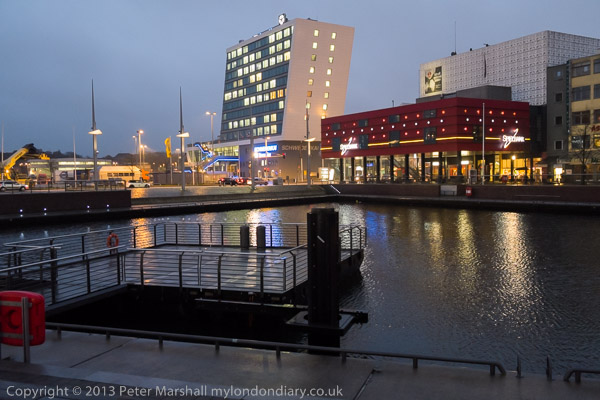
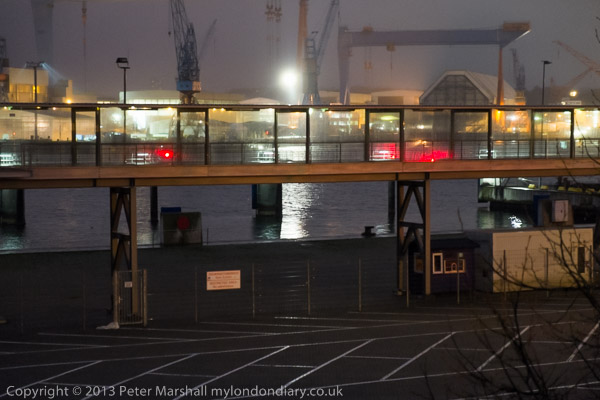
Kiel’s leaning Schwedenkai cruise and ferry terminal – 22mm (33mm eq) 1/30s f 3.2 ISO 2500

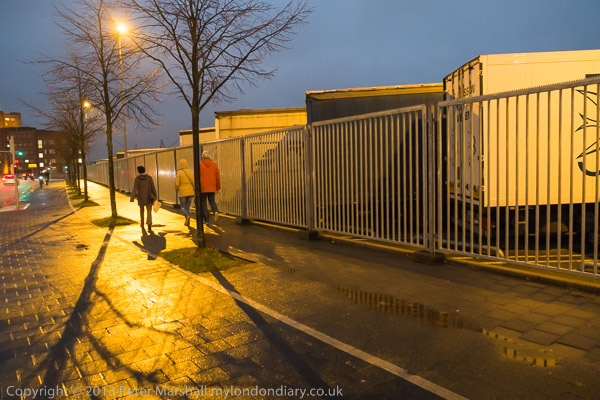
But the more interesting pictures to me were those I took in the dark on the way back to the car park. Of course these were hand-held, although some I was able to rest on a rail. Those here were taken with an exposure bias of -2/3 stop, and all with the 18-55mm zoom on the Fuji X-E1. Its a lens where the maximum aperture changes with focal length, and these were all wide-open. The corners are reasonably sharp despite this. The light sources in the images needed some considerable burning in.


53mm (79mm eq), 1/5 f4 ISO 2500 – and the rain was getting heavier

There are a few more on My London Diary – you can go direct to the Kiel pictures here. It was still raining, and we were hurrying back to the car, so I had to take pictures quickly and then run to catch up with the others.


Continue reading Kiel

Lauren Henkin

David Vestal whose passing I mentioned yesterday, was a man whose work very much reflected the interaction between craft and vision that is at the heart of photography, and the same is certainly true of the landscape photography of Lauren Henkin, as you can see from the interview with her published recently on Petapixel.

This starts by looking at what made her become a photographer, and she picks as a key moment a visit with her parents to a Harry Callahan retrospective at the US National Gallery of Art in 1996, when she was in her early twenties, around the end of her BA in Architecture, where she says “Callahan’s prints (in particular the photographs of Cape Cod), I had a visceral reaction to them.”

She goes on to describe taking a master printing workshop with George Tice, certainly one of the finest printers around both in platinum and silver  I think I probably first registered his name when he was one of the photographers featured in the ground-breaking volume ‘Darkroom‘, published by Lustrum Press in 1977 – on the verso of the title page under the usual details of the colophon the statement ‘PHYSICAL FACT/PSYCHIC EFFECT‘. A series of prints Tice had made from the same negative “opened up the path for me to develop a vocabulary for my prints.”

Henkin goes on to mention two other even more familiar names to me, Tyler Boley and Jon Cone, pioneers in fine art digital printing, whose helpful comments on-line in groups such as Digital Black and White the Print and Piezography 3000 have been a part of my daily life for a dozen or more years. You can read an intersting article written in 2012 by Cone, The State of the State of the Arts in Black & White, which is illustrated by the work of Henkin and Boley among others.

It was Jon Cone who, following on from his experience with Iris printers pioneered high quality black and white printing on Epson desktop inkjet printers.  I started printing with his PiezographyBW Quad ink system in 2000, producing black and white images on matte papers that startled me by their quality, matching or surpassing those I’d made some years earlier with platinum, platinum/palladium and kallitype (albeit with less control over image colour.) I went on to be a beta tester for the next generation of PiezoTone inks.

Cone’s work led printer manufacturers to up their game, and although I’m convinced that Piezography’s latest generation is still the ultimate in black and white printing quality (now on both glossy and matte papers – and yes, capable of more than silver) I no longer use them. Most of my printing is now in colour and I don’t print enough for it to seem worth changing to the cheaper ConeColor system that gives results identical to the Epson inks. If I ever get around to printing serious black and white portfolios I’ll start by investing in a new printer and the latest Cone inks.

But back to Lauren Henkin, who goes on to talk about her inspirations, mentioning photographer Robert Adams as well as painters, sculptors, architects and poets and then moving on to discuss her latest project. The Park, taken in that highly photographed space, Central Park in New York over three years, and her earlier work. Visually, even on screen, it is delightful and her website has an admirable and classical simplicity that complements the fine imagery.

I’ve yet to have the opportunity to see her actual prints as her work hasn’t been exhibited in the UK (she has been in group shows in Arles and Paris, along with a long list since 2007 in the US and Canada.) But its perhaps a reflection on the kind of photography that is promoted by the relatively few spaces that show contemporary work here that London (or some of our other major cities) is not yet on that list.

Henkin is also co-editor of Tilted Arc, a web site with the strap-line ‘Art and argument, fact and fiction. And verse.’ which has recently began a series ‘Women in the Landscape, a new ongoing feature,”conversations between women photographers whose work focuses on the land”. The first conversation is between Henkin and Canadian photographer Jessica Auer, whose work is well worth exploring.

Memory & Photographs

There have been several articles in different papers about some research by Linda Henkel and her team at the Psychology department of Fairfield University in Fairfield Connecticut which shows that people who took photographs of objects remembered less about them the following day than those who simply looked at them.

Her results don’t particularly surprise me, certainly not when I look at how most people take photographs with their phones or see the results on Facebook. It’s usually clear from these images that even if people are pointing a camera in roughly the right direction, they are not thinking about what they are photographing or seeing it clearly. And photographers are not entirely immune; some of the work I see on Demotix or even published in the newspapers gives me the same feeling. Of course we all have off days, and some editors do appear to have an unerring facility for selecting the weakest image of a set (and often then cropping it to destroy whatever visual integrity it might have possessed.)

Her research only tested recall on the following day. My own memory gets regularly tested in various ways about things that happened twenty or thirty or even forty years ago, and if I can look up the photograph the chances of accurate recall without it are remote. Of course that’s a very different thing, but there is a real sense for me that photographs are a large part of my memory.

The feature on her research on Atlantic Cities mentions an important part of her research some other accounts omit. When Henkel asked people to zoom in on and photograph the details of the museum objects that were the subject of the study, this actually aided their recall the following day. In other words if people actually thought about what they were photographing, that act became and aid to recall. Good photography always involves looking and thinking.

Fuji in Germany


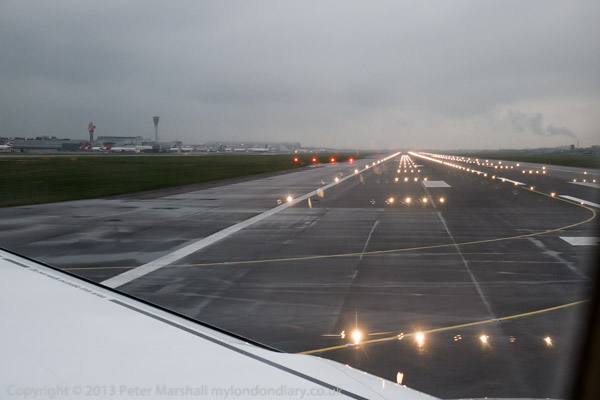
Moving on to the runway at Heathrow Fuji-X 18-55mm

For my trip to Germany last month I took just one camera – the Fuji X-E1 – and three lenses, the Fuji-X 18-55mm (27-83mm equiv), the Voigtlander 15mm (22.5mm eq) and the full-area fisheye Samyang 8mm. Along with a few 16Gb cards and four spare batteries and the charger.

Mostly I wanted to use a camera to photograph some family events, and the X-E1 is not a bad camera for discrete use; fairly small and quiet enough in quiet mode not to be noticeable in a room with a normal level of conversation.

The 8mm and 15mm don’t have image stabilisation, but I didn’t miss it. Possibly camera shake was lessened by the liberal application of the local beer to the photographer, along with the odd glass of Hugo, a drink I find just a little too sweet, combining prosecco, lime, mint and elderflower syrup. And there was also a rather powerful vodka-based concoction containing yoghurt. Together in moderate quantities I think these give about a two-stop advantage! But the 18-55mm has optical image stabilisation, and perhaps a few images at the longer end were sharper for it.


8mm Samyang

The Samyang is a remarkable lens, and the fact that it is a manual lens hardly matters at all on the X-E1, where there is seldom any need to focus. In fact I’d prefer to have a lock that stopped me focussing, as although for nearly everything  you can leave the lens set to infinity it is possible to focus down to 1 ft, at which point things more distant can get slightly unsharp.

One very small problem with the lens is that the camera doesn’t know the aperture in use, though of course it gives the correct exposure despite this. It’s just a little of a shock to look at the EXIF data and find you were apparently taking pictures at f1!

Most of the images with the Samyang – such as that above – were interiors in normal room lighting and I was working at its full aperture of f2.8. Even wide open it is already pretty sharp across the frame. Any lack of sharpness in these images was either from accidental shifting of the focus, subject or camera movement. And with exposures sometimes down to around 1/20s, subject movement was a real problem.

And as you can see the Samyang does give a different view. Although there is some of the normal curvature you expect from a fisheye – perhaps most obvious in the lines between walls and ceiling, the Samyang employs a different mapping to the usual equisolid projection in fisheyes.  This is the stereographic projection, which results in less distortion of objects at the edges and corners of the frame, giving the images a far more natural look. The figure at bottom left would have been noticeable distorted in a normal fisheye image, but looks almost normal here.

With other fisheyes, such as the 10.5 Nikon I’m rather fond of, its often essential to use software such as Fisheye-Hemi to give a more usable result, but correction is far less necessary with the Samyang. So you get the extreme angle without the extreme distortion. A small down-side to this is that if you do want to ‘correct’, Fish-Eye Hemi doesn’t quite get it right, though it does still generally do better than most other software I’ve tried*.


15mm Voigtlander

The Voigtlander 15mm is a great lens, but not great in poor light with its maximum aperture of f4.5 but it is relatively cheap and beautifully small. One problem is that it has a bulging front element that makes fitting a filter for protection impossible. Mine is in the old screw thread Leica mount, but you can now get the same lens in a Leica M mount, and for under £400 if you look around, a real snip compared with Leica prices. I have it fitted with a Leica M adapter and that then goes into a Fuji X adapter.  The 15mm also seldom needs focussing and the scale is generally accurate enough. I used this lens for years on Leica M and compatible bodies and its performance is fine. If there is any distortion it is never noticeable. Again for the EXIF everything appears as f1.

The 18-55mm is an f2.8 lens at the wide end, but by the time you zoom out to 55mm it is only f4, which rather reduces its utility in low light. Otherwise there was really nothing to complain about.


18-55mm Fuji-X and some laser lighting

The camera itself performed pretty adequately, particularly in low light, where most of the time I was working at ISO 3200. Increasing the Luminance noise reduction in Lightroom from my normal 27 to around 50 made the results much smoother (keeping the detail setting around my normal 20 and contrast 2.) There was significantly more colour noise than at ISO 640, but it disappeared with a ‘color’ noise reduction setting of 25.

I had no problems with the digital viewfinder in low light, but in bright conditions it was sometimes impossible to see detail. It was good enough to see which way you were pointing the camera and the limits of the frame, but hardly to see what the pictures would look like.

I really do wish Fuji could find a solution to the deep sleep mode which this camera descends into after switching itself off to save the battery. The quickest way to wake it up seems to be to switch the camera off and on again and wait the second or two for it to come back to life. By which time the picture has often flown.

Battery life is a problem too. The day we went on the most interesting visit I’d rushed out thinking we would be coming back before setting out on the main trip and I would pick up my camera bag before going out for the day. We didn’t and although I’d taken the camera, the battery was dead after the first picture or two. The camera needs a better battery level indicator too, as you only get the warning when it’s already virtually dead. Its generally necessary to take at least 3 batteries to be sure of a day’s work, and four if you are going to be busy. The batteries are supposed to last around 300 pictures, but its easy to run them down faster if you are showing people pictures etc.

Photographing at family parties as I was doing quite a lot of the while, the more interesting moments  are  often when people are moving.  I hadn’t bothered to take a separate flash, and it would have destroyed the mood at times to have used one. I did make a few images with the small unit built into the camera at a more public event when people were dancing, but wasn’t too happy with it. Its really something for emergency use only, though better than many built in flashes. Of course the flash isn’t much use with the fisheye, putting hardly any light into the corners, but it covers the 15mm surprisingly well. There is a brighter central area, but it is relatively easy to even out in Lightroom if you don’t want something of a spotlit effect.

A few minor niggles aside, I was impressed by the quality of the results, and was glad to have only a fairly light weight to carry around. The 18-55 zoom feels a little large on the camera, and for general use I think I might prefer to have perhaps a couple of prime lenses, perhaps the two pancakes (18mm and 27mm ), possibly adding the longer 55-200 zoom when a long lens was essential. Most days I’d prefer a second body too. If you are used to carting Nikons they are pretty light.

In further posts I’ll look more at the other pictures I took in Germany, and perhaps also about making use of the video mode on the Fuji X-E1.


*I think you could possibly use the free Panorama Tools if you could work out how to do it. I’ve got the best results by taking the image into PtGui and converting it to Mercator projection, trimming the output to give a rectangle and then resizing that to 3:2 aspect ratio, but that seems a lot of work and the difference is really quite small.

Continue reading Fuji in Germany

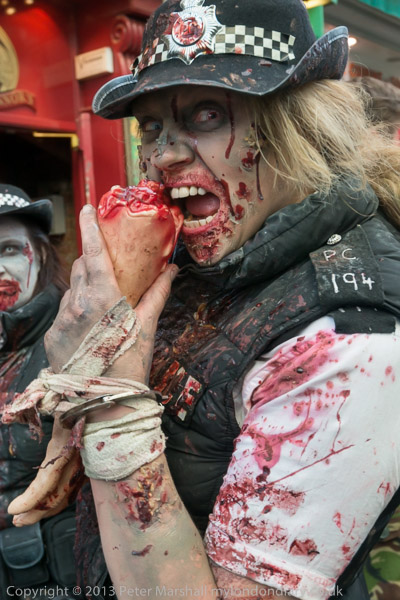
Zombie Time

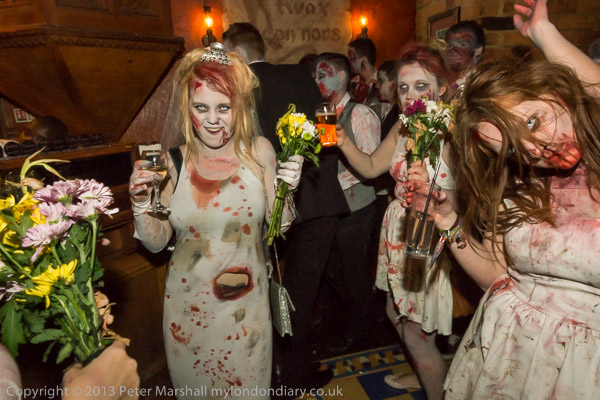
I rather like the zombies. Not that they are cuddly, but there are nice contradictions inherent in the idea and execution and I think it’s a pretty harmless bit of fun that adds colour to the season.

Zombies are of course with us all year, but they come out onto the streets mainly around Halloween, though it has none of the religious significance of the Mexican Day of the Dead celebrations which I’d love to see. If only we had these in London. Well, being the most multicultural city in the world, probably we do, and perhaps writing this will get me an invitation for next year!

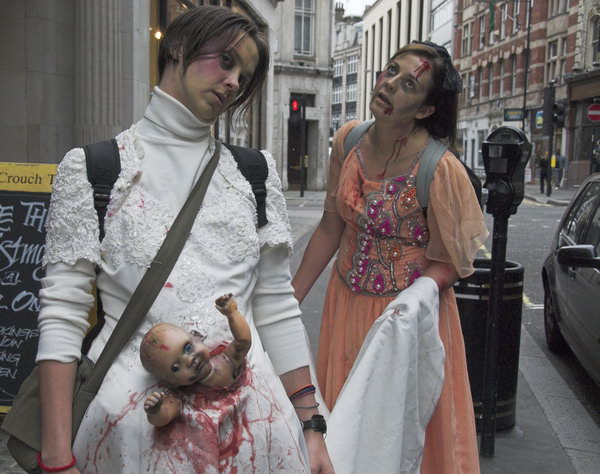
I first met the Zombies in 2006, when their meeting place was the Ben Crouch pub, named and gothically themed after the infamous London bodysnatcher who ran a very effectively enforced monopoly of illegal supply of corpses to the surgeons of Barts and other London hospitals almost 200 years ago. It was a curious place I’d visited a few times before, though best avoided on the 2nd Thursday of each month when it was the haunt of the London Vampire group. Though it looked like a cheap plastic horror-movie set and served cocktails in steaming test-tubes it also had a couple of reasonably priced (for the area) real beers on the hand pumps, and was a handy from the even faker and more hellish commerce of Oxford St.


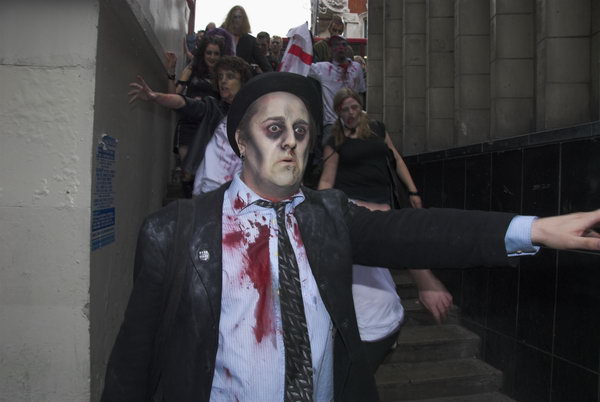
It was here that London’s third annual ‘Crawl Of The Dead’ was due to start, though not before we had time for a little (or in some cases rather a lot) of refreshment. They staggered out and made their way to Oxford St, where the zombies were considerably more lifelike than the shoppers, so intent on consuming that the staggering bloodstained group screaming for brains hardly caused a single head to turn.

In 2009, the Ben Crouch was converted to an entirely unmemorable ‘gastro pub’, and after a single visit I was clear I would never darken its doors again. I doubt the vampires would still be welcome, perhaps preferring the ‘London Stone’ at Cannon St. Though in  2007 the zombies had chosen to start at Ye Olde London, not a place to linger (and not that old as a pub, but until 1867 it was more famous as the ‘London Coffee House’) and wandered across the Millenium Bridge to Southwark, south of the river, and were never heard of again.

In more recent years, the Zombies have returned to the West End, and in 2011 I photographed them close to Piccadilly Circus and in Leicester Square. Last year they started near Waterloo, but soon made for the Jubilee Bridge, and I left them on the Embankment heading towards Trafalgar Square.

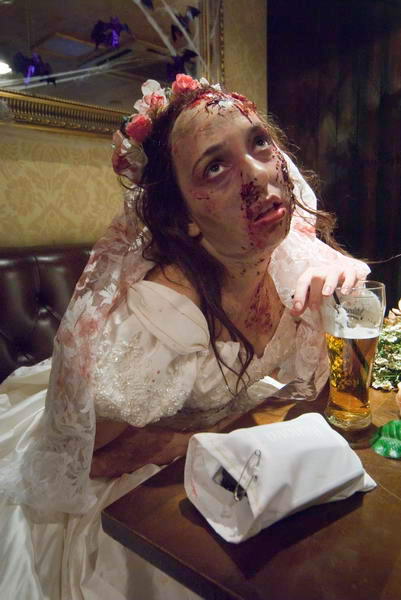
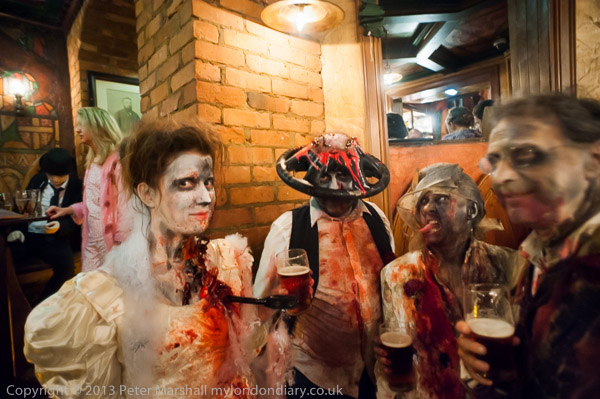
This year they were back in Soho, with the LoNdOn ZoMbIE WaLk VII starting at Waxy O’Connors, another curiously themed pub, though one I’d usually avoid, if only for its confusing layout. This year I’d gone early and had time to take quite a few photos in the pub (and during the zombie fag breaks outside the Wardour St back entrance.)

The pub doesn’t have suitable ceilings for bounce flash, and the lighting varies from dim to non-existent. I did manage a few pictures without flash at ISO 3200, but it was only really viable in a small area lit by a large TV screen, where a few were watching football.

It was so dark that neither the D800E or the D700 would focus reliably without the focus assist light, and for some reason that wasn’t working on either camera. It’s a mystery that is dealt with on page 286 of the D800 manual, which surprisingly I wasn’t carrying at the time and would not have been able to read in the dark could I have found it. Helpfully it is listed in the index not under ‘F’, ‘A’ or ‘L’ but ‘B’.

To get it to work you need to select autofocus mode AF-S, AND either choose the area mode ‘Auto Area AF’ OR select the centre focus point.

Though it isn’t quite as simple as this. You also need to read and digest page 377, which I think tells you it doesn’t work for focal lengths less than 24mm, and at various close distances depending on the lens. When using an ‘optional flash unit’ such as the SB800 I had in the hot shoe, you need also to look at the diagrams and text on page 385, which I’m not sure I entirely understand.

The manual does helpfully tells you that when focus assist is off, ‘The camera may not be able to focus using autofocus when lighting is poor’. Too true, but I didn’t need the manual to tell me that.

I’ve previously ranted about the inscrutable nature of setting the various focus modes of the D800E and won’t repeat that. Working as I had to much of the time on manual focus in near darkness isn’t ideal, though with the flash and working at close distances I could use a small aperture to give me the depth of field I needed – most of the interior pictures were at around f10. I didn’t want to add motion blur, so the shutter speed was 1/60 or 1/80. There was enough light bouncing around together with the ambient to avoid black backgrounds.

Of course outside every pub now you’ll find a small group of smokers, banished from the interior while they soothe their addiction, and zombies are no exception. Here there was a little more light, though it wasn’t a bright day, and I could work happily at ISO 1600. The zombie police arrived too.

By the time the crowd of zombies staggered up the steps and on to the street to make their unsteady way to the next pub on the circuit it was time for me to leave to photograph elsewhere.  But I’d already taken my pictures.

LoNdOn ZoMbIE WaLk VII
Continue reading Zombie Time

L’Oeil de la Photographie

I was very pleased when L’Oeil de la Photographie was announced in October, produced by the former editors of Le Journal de la Photographie, a daily blog of short articles on photographers and photography which was closed by its proprietor a month before, presumably because this free resource wasn’t making enough money.  You can view the site in English or French as you prefer.

I’d looked forward to having a quick look through their free mailing every day, even though there were often days when nothing really caught my interest, and two months ago these postings resumed.

Yesterday’s was one I particularly enjoyed and spent some time looking at the splendid collection of pictures by Anders Petersen, along with some perhaps too brief comments on each of the sections of work, put together for L’Oeil  by Anne Biroleau, the curator of the show of his work at the Site Richelieu of the Bibliothèque Nationale de France in the rue Vivienne in Paris,  Anders Petersen [photographies], which continues until February 2nd 2014.

Other commitments meant I was unable to get to Paris Photo this year, and in the past there has always been less happening in the ‘odd’ years, but for 2013 there does seem to have been rather more than before, and I’m sorry to have missed it.

Also currently on show in Paris at Galerie Vu until January 11 2014 is a more recent project by Petersen, To Belong, made at a village near Modena in Italy called Finale Emilia, in the aftermath of the earthquakes in the region in 2012.

I can’t at the moment find a way to subscribe to the daily e-mails from ‘The Eye of Photography‘, nor can my RSS reader find a feed on the site.


October Buses

My last two stories for October came along together – in best London bus tradition – on a Thursday evening on the last day of the month.

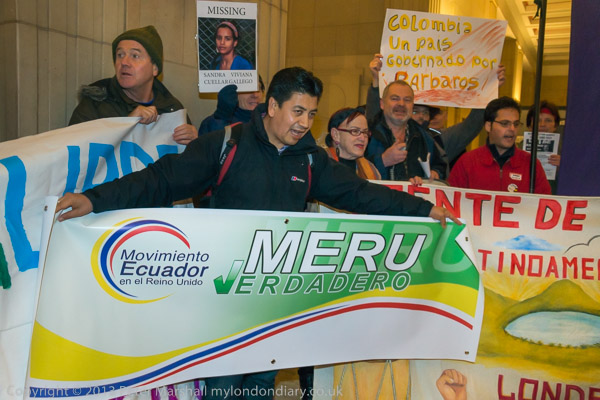
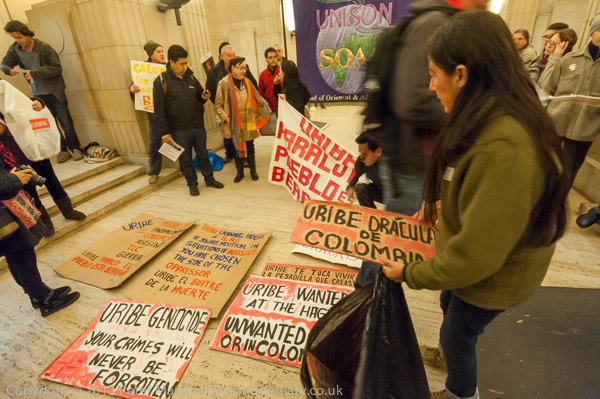
Probably I should have stayed at the first event, where a small crowd was picketing London University’s Senate House against the invitation to speak at a meeting there given to former Colombian president Álvaro Uribe, a man described as a para-military drug gang leader responsible for a ‘dirty war’ against the people of Colombia, responsible for the deaths of thousands and the internal displacement of millions of Colombians. The BBC call him a ‘tough conservative’ whose ‘ political life has been dominated by the desire to rid the country of the rebels who killed his father 20 years ago.’ The opposition in Colombia call Uribe the ‘Vulture of Death‘. He has condemned the efforts by his more reasonable successor to negotiate with the FARC rebels which currently look likely to reach a successful conclusion.

I photographed the protesters moving in to the area in front of the main entrance under Senate House. It’s fairly well lit and for most of the pictures I was able to work at ISO3200 without flash, resorting to flash only when I wanted to be sure of stopping a little action – you can see the pictures at Protest Against Colombian ‘Vulture of Death. Mostly I used aperture priority on the 16-35mm, stopping it down around half a stop from wide open – though that really isn’t necessary with this lens.

But I thought it unlikely that they would actually enter Senate House itself, and that almost certainly Uribe would be brought in, probably with a considerable entourage of bodyguards, by one of several other entrances, and I felt that little more would happen.

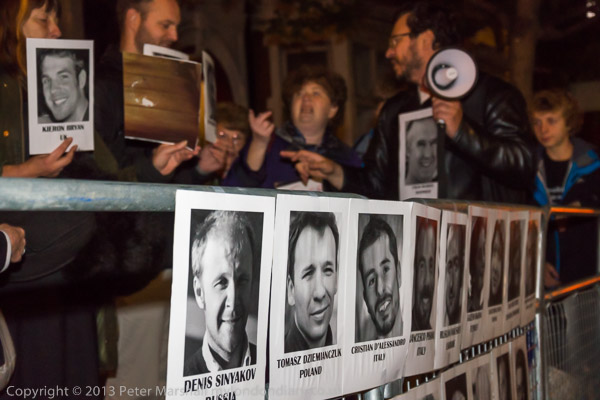
I decided I could leave Senate House and catch a bus to Kensington, where a protest calling for the release of the Greenpeace Arctic 30 was taking place close to the Russian embassy. This is one of several embassies in a private road close to Kensington Palace where protests (and photography) are forbidden, and the protests take place a short distance away across the busy Notting Hill Gate, opposite one of the embassy outposts.

Travelling by bus in London in the rush hour is seldom a good idea. My journey started well as the 390 arrived just as I reached the stop and I jumped on, but it was soon caught in the Oxford St traffic jam, moving in fits and stops at around walking pace. Around Bond St the announcement came that the bus would terminate at Marble Arch, and I jumped up and ran down the stairs to get off at the stop before and wait for the next service in the right direction.

This was a good move, as when my bus got to Marble Arch there was a large crowd waiting for it, and room for only a few. The bus crawled along the Bayswater Road and eventually brought me to the stop opposite the protest. The 3 mile journey had taken roughly the same time as I could have walked it. I should have taken the tube – even with a longer walk to the station at each end I would have saved 20 minutes. But fortunately (as I’d guessed) it didn’t really matter – this was a static protest and still in full swing when I arrived.

The protest pen here is perhaps one of the darkest places on a main road in central London. I took a few pictures without flash at ISO 3200, but it was clear that I was going to need flash.

Again I was working with Aperture priority, setting the aperture at f5.0, though since I’d also set the minimum shutter speed to 1/80 I might just as well have used manual, and I think all the images are at f5.0, 1/80s. At ISO 3200 there was generally just enough ambient to show the background, leaving it looking like it was night and avoiding burn out in a bright doorway and the lighting on a nearby pub. The actual level of the ambient light did change a little with the light from the passing traffic.


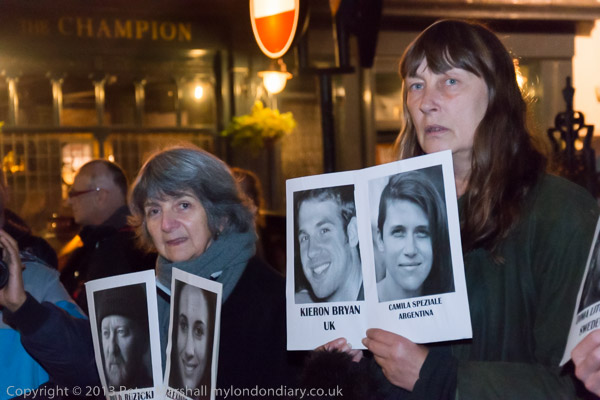
I particularly wanted pictures of the two journalists – Keiron Bryan from the UK

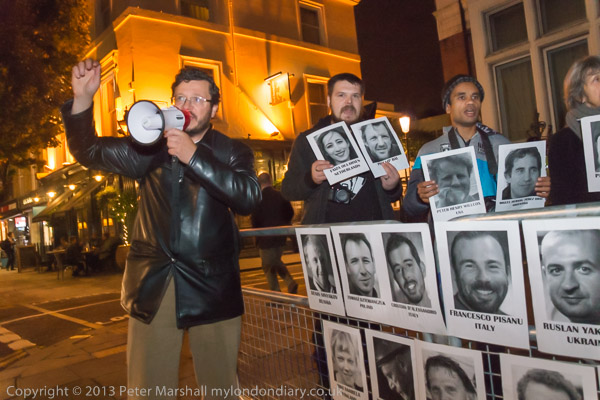
In front of the protest was a display of black and white photographs of around half of the Arctic 30, all with wide black borders, and pictures of the others were held up by the protesters. All that white did upset the metering a little, and I was working with an exposure bias of -1 EV. For the wide-angle you need to use the built-in diffuser to get fairly even coverage, and I often use the small built-in white reflector with the flash head angled up at 45 degrees too.  For those pictures where I was much closer to some of the photographs than the others I tried to even out the lighting a little by twisting the flash head off-centre away from them, making use of the fall-off, though even so some compensation was needed in post-processing.


and Russian freelance photographer Denis Sinyakov, who I’d just written about.

I’ve seen some other pictures taken of the event that show all the things about direct flash that I don’t like, the flatness and black backgrounds. It doesn’t have to be like this, and while I like to keep flash simple – one flash in the hotshoe – it isn’t hard to do considerably better. I’m sure I could improve on what I do by taking flash off the camera, using multiple flashes and so on (like the Strobist) but I’m reasonably happy with these results – more at Russia, Free Greenpeace Arctic 30.

My decision to leave Senate House was probably a bad one. The protesters did manage to get inside, and protested in the lecture theatre where Aribe was speaking. If I’d stayed I might have got some better pictures. But then I wouldn’t have covered the Arctic 30 protest. I’ve not yet worked out how to be in two places at once, or mastered time travel, though I was accused of being ‘Dr Who’ the other day when friends I’d been with earlier turned up at a protest to find I’d beaten them there.

And yes, there were two cows on the top deck of the bus on my way home.

Continue reading October Buses

Koudelka Cop-out?

Can you photograph something as contentious as the Israeli “separation wall” in the West Bank and East Jerusalem and refuse to discuss the politics?  It’s a question that has aroused debate following the publication of a two-part interview with Josef Koudelka on the New York Times Lens blog on the publication of his new book “Wall: Israeli and Palestinian Landscapes“, images made in 2008-2012.

There is a fine introduction to the controversy by Henry Norr on Mondoweiss, which also looks at the slowness of the NY Times to correct an error of fact about the wall which Norr pointed out on pubication, but took much prodding and nine days for the paper to admit and correct. Norr asks why it should take so long and require a  “great deal of consultation” to correct a simple fact. If the NY Times can’t get facts right, who can? And what business does it have publishing a newspaper?

Norr gives the links to the Lens posts, but it is worth reading his piece before you go to them, so I won’t post them here. But the problems in the interview – at least as printed by the NY Times – are discussed in some detail in another post he refers to, The Moral And Intellectual Cowardice Of Josef Koudelka, written by photographer Asim Rafiqui (you can see his Idea of India online.)  He also links to a post by a Nazareth based prize-winning journalist, Jonathan Cook, A photographer who obscures the victims, who takes up Rafiqui’s complaint.

Cook makes the point :

By all accounts the photographs are an unequivocal indictment of Israel’s imprisonment of the Palestinians. If only the same could be said of his interview.

and Norr too makes the point that much of the details of the situation are given in the book (if in very small print) along with the photographs (though he doubts if many will read them.)

Like Rafiqui I’m an admirer of Koudelka’s work (his Magnum portfolio has a good selection up to 2004) and I also find the evasive NY Times interview rather shocking.

Addition:

I wrote this yesterday, here is another post on the issue I’ve just seen:
http://politicstheoryphotography.blogspot.co.uk/2013/12/koudelka-interview-follow-up-2.html

It seems fairly clear to me that the interview reflects a lack of integrity at the New York Times rather than the “cowardice of Josef Koudelka”.  As Jim Johnson writes:

‘Although I would need to inquire further, the problems seem to lie primarily with editorial decisions at The Times rather than with Koudelka.’

I won’t be Xmas Shopping at John Lewis

It was kind of by accident that I found myself photographing a protest by the IWGB cleaners and RMT drivers actually inside John Lewis’s flagship store in London’s Oxford St. I’d had a phone call earlier in the week telling me there was going to be a protest, but there were few details, and I’d expected it to be on the pavement outside.

I wasn’t surprised when I turned up on time and there was no sign of anything happening. Some  protests seldom start on time and I’ve often been the first to arrive, so I hung around on the corner outside the store where I thought I’d be likely to see them and waited, keeping my eyes open.

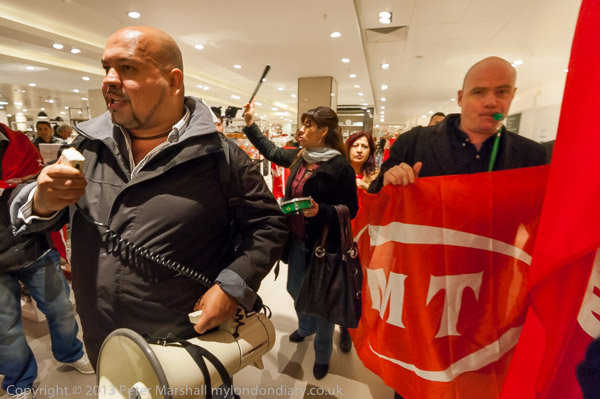
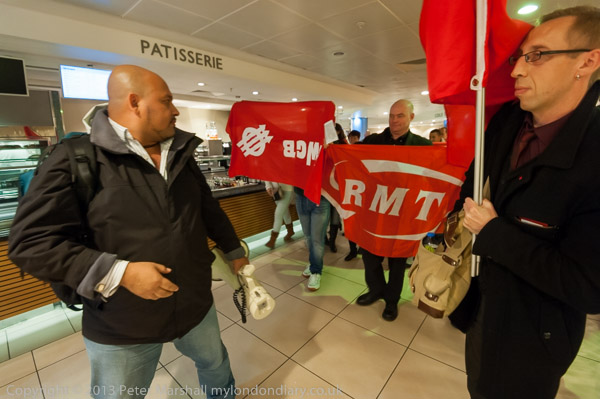
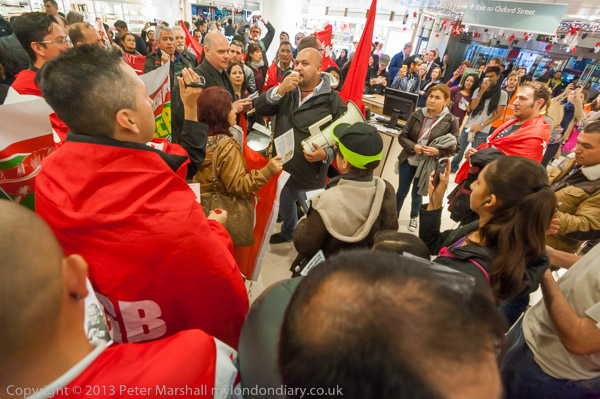
Oxford St is pretty busy on a Saturday afternoon even two months before Christmas (the decorations were up in the shops), and a lot of people walked past, but still no protest. But finally I saw a familiar figure approaching and walked up behind him. “Fifth floor” he told me out of the side of his mouth and I followed, a few paces behind, up the series of elevators, as he made his way to the restaurant area. It did rather feel like something out of a spy movie. I lost him again there, looking away for a couple of seconds as a group of people came between us, and spent a rather frantic half minute or so searching the whole eating area until I came upon him again, now with a group of cleaners, and getting out flags and banners for the protest.

Until now I’d been trying hard to look inconspicuous, as if that large black bag on my shoulder wasn’t a camera bag and I wasn’t a photographer, but now it was time to get out a camera. I decided that working inside the store I would only need the wide-angle 16-35mm on the D700, and set that to ISO 3200. There would be quite a lot of movement and the light levels in parts are quite low – the first pictures I made were around 1/60 f4, but the lighting got better when we moved out into the main part of the store, and there exposures around 1/125 at f5.6 were typical.

Apart from their lack of support for the cleaners and the victimisation of staff who have supported them, the John Lewis Partnership are in many ways an admirable organisation, generally treating their direct employees – or rather ‘partners’ – well, and they get a share of the profits as a considerable annual bonus. But the low paid workers in the store such as the cleaners are not employed by JLP, but come in on a contract from another employer who cuts costs by low pay and poor conditions. Somehow the JLP management think it isn’t appropriate for them to insist that people who work for them in the same shop – or in the lorries that make their deliveries are treated fairly. ‘Never knowingly undersold‘ is the JLP slogan but they can add to that ‘Never caring about how the low paid workers we depend on are treated.’

But JLP staff handled the protest very professionally and simply stood back and let it take its course, applying a little persuasion to the protesters to leave, encouraging them to make their way down the escalators. One person who tried to physically object to the protesters was quickly moved away by security. I wasn’t hassled in any way, and my main problem was avoiding knocking into any of the shop displays as I took pictures. At times I did think of myself as an elephant in a china store.

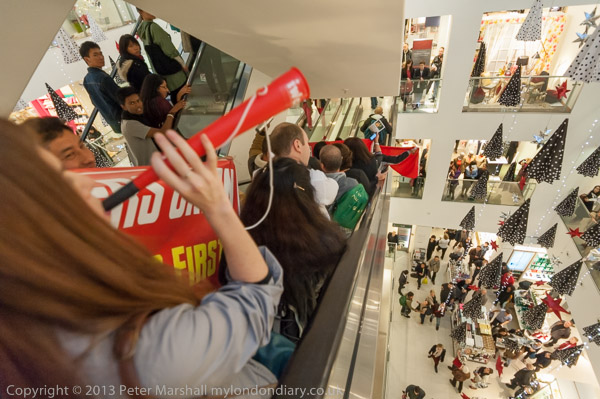
It was on the escalators that I took some of my favourite images, including one of the protesters making their way down and the people looking up at them, in the foreground a woman blowing a red vuvuzela. At first I was a little disappointed that this horn wasn’t in focus, but I don’t think it matters, and may even be preferable – and at 1/100 f4 it wasn’t possible in any case. Even at 16mm focal length depth of field has its limits. The ‘hyperfocal distance’ is around 7 ft, so to get the figures on the ground floor sharp it was impossible to have anything less than 3’6″ sharp too. Of course I didn’t have time to look it up on the spot, things were moving far too fast. That I got it about right can probably be put down to the camera’s autofocus system and a bit of luck. But I was pleased I was using the D700.

Nikon changed the way you control focus between the D700 and the D800, and I think rather for the worse. With the D700 you have a three-position switch at the left of the lens for focus mode – C, S, M (continuous, single and manual) and another 3 position switch on the camera back for autofocus area mode – single point, dynamic area and auto area.

For fast changing situations like this I generally use S mode and auto area. On shutter half-press, this puts little red rectangles briefly on the areas chosen for focus, allowing you to decide if the camera has got it right. If not I try again, possibly with a slight movement of the camera. Usually it works, though it can sometimes get too fixated on near objects in the frame. Its easy and fast then to use to rear of camera switch to change to dynamic area or single point (which both work the same in S mode.) You don’t need to think about it and can do it pretty well without looking. And change back equally easily.

On the D800/D800E, forget about changing focus mode in a hurry. The switch on the front of the camera only switches between auto and manual. There is no switch on the back of the camera. To change from C to S or between area modes you have to press the little button in the centre of the AF/M switch, look at the LCD screen and use the control dials. Probably you will need to read the manual too! Why, Nikon, Why?  I think the change was to enable Nikon to give the user more control over exactly how the autofocus works, but it does so at the expense of usability. Surely the most important thing in a camera. Stick the more fancy focus bits on a menu – we don’t really need them when we are working.

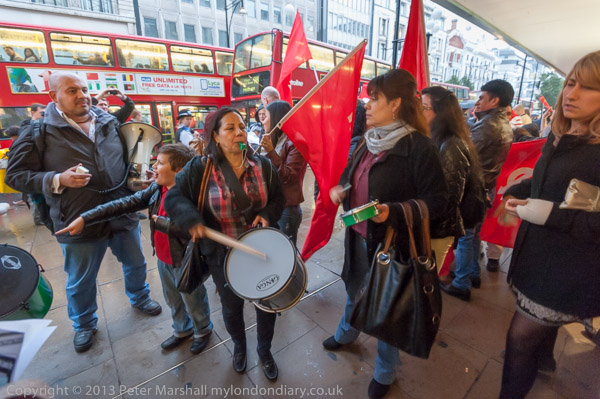
I don’t think the protesters actually intended to go down into the basement, but its always hard to know which floor you have got to.  I think some stores deliberately hide the ground floor to stop shoppers escaping. We wandered around there, eventually finding the up escalator and make our way to the ground floor, where there was time for a short rally before the police arrived around 20 minutes after the protest started and told the protesters that the management had requested them to leave and they would be committing an offence unless they did so. And so, rather slowly, they did, and I photographed them coming out of the store and continuing their protest on the crowded pavement outside.

By now it was around 5.30pm and getting dark, and in most areas darker than inside the store (it looks lighter in the photographs than it actually was.) I took a few pictures using flash, but wasn’t happy with them, and went back to working by available light, still at ISO 3200.

A couple of weeks later I met some of the protesters again, this time in a protest outside John Lewis on Oxford St. One of them had earlier gone inside with a small child, intent on buying a toy for them and had been recognised and asked to leave. It seemed rather petty.

More pictures – and more about the protest – at Cleaners Invade John Lewis Oxford Street.

Continue reading I won’t be Xmas Shopping at John Lewis