End the Zero Hours Scam


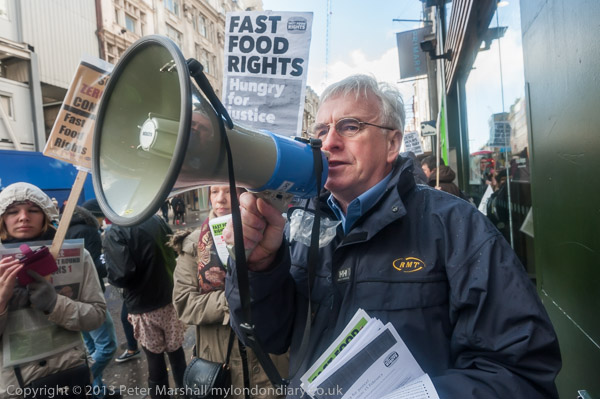
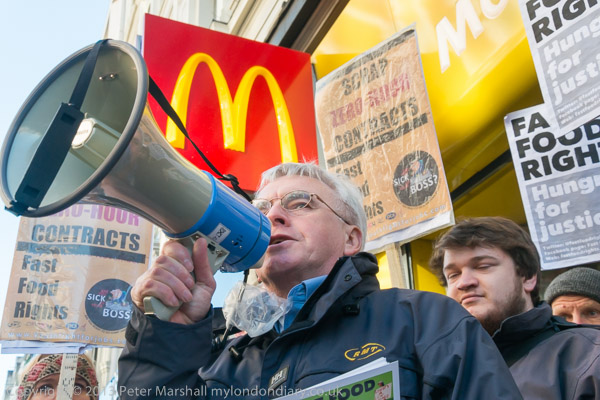
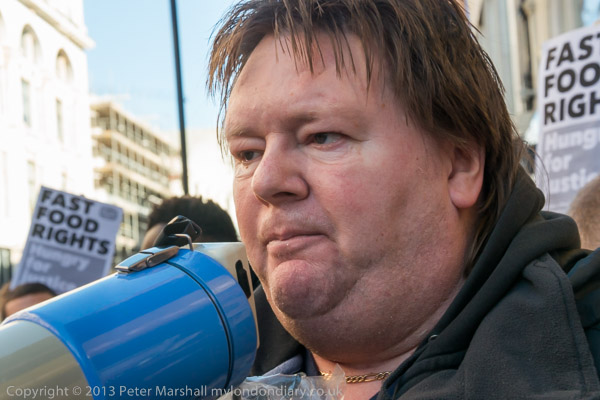
John McDonnell MP speaking outside a McDonald’s in Oxford St

Zero hours contracts are not contracts of employment, but contracts of unemployment. They prevent workers from taking on other work as they have to be available should the employer need them, but without guaranteeing them any employment. It’s perhaps surprising that they are legal, because there is no ‘consideration’ received by the employee. They are essentially unfair, and I hope a future Labour government will have outlawing them high on its list of measures to be enacted. But then I hoped the last Labour government would do quite a few things and ended up very disappointed with both Blair and Brown. More so with Blair, who turned out to be both a liar and a war criminal as well as a Thatcherite, continuing the attacks on trade unions and workers rights that she began.

So I was eager to photograph the launch of the Fast Food Rights Campaign which aims to put an end to zero hours contracts and abysmal pay for workers in fast food outlets. And the way it is trying to do so is by getting them to join a union.

Not any union but the Bakers Food & Allied Workers Union, BFAWU, an old-estabished union founded in 1847 that has retained its independence and unlike some large and bureaucratic unions still fights for its members. And one of those fights is against zero hours contracts, and its strike action at the Hovis factory in Wigan recently gained a victory against the extended use of these contracts there.


Bakers Food & Allied Workers Union National President Ian Hodson

I’d met the BFAWU National President Ian Hodson last August and been impressed by his speech against zero hours contracts at the Counihan family’s anniversary party. He was one of the speakers at this campaign launch, along with a number of others including Labour MP John McDonnell, one of a handful of Labour MPs who I admire for sticking to their principles when so many seem to have sold out.


John McDonnell MP speaking outside a McDonald’s in Oxford St

I’d met with the protesters just around the corner from where I’d expected to see them, holding a brief rally outside a Burger King, but soon they moved off to a McDonald’s at the Tottenham Court Road end of Oxford St.  This is one of their lower key establishments with dark green paint and little to really on the outside to indicate what lies within.


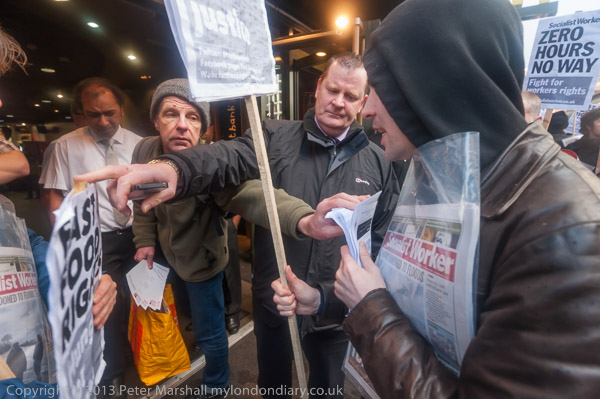
Security stopped people with placards going in to McDonalds, but a man takes more leaflets to give out inside

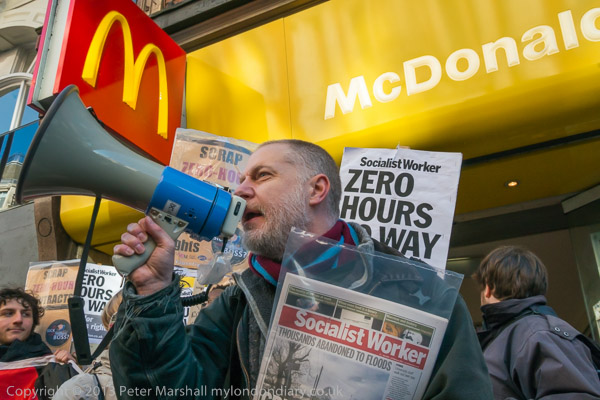
So although I was pleased with some of the pictures, there was little in them to indicate exactly where the protest was taking place. The second McDonald’s we called at, some way along Oxford St had that ugly big M, yellow on red, which made it rather easier to show in photographs.


The brasher McDonald’s look is more obvious
I’d positioned myself here to line up the sign behind the speakers and took some pictures, crouching down a little to get the angle I wanted. Things were going well until I straightened up to my normal height, only to be assaulted by another photographer who had come up behind me and now felt I was getting in the way of his shot. That kind of behaviour just isn’t on. I was there first and if you come up later behind me you’ll have to work over my shoulder; ask me politely and I might crouch for a few seconds, but I certainly don’t expect a colleague to roughly try and push me out of the way. Neither of us got the picture we wanted where with a little sensible cooperation we could both have done.


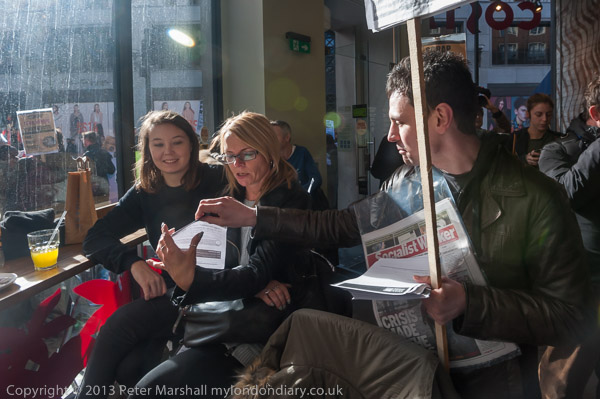
High contrast inside Costa Coffee
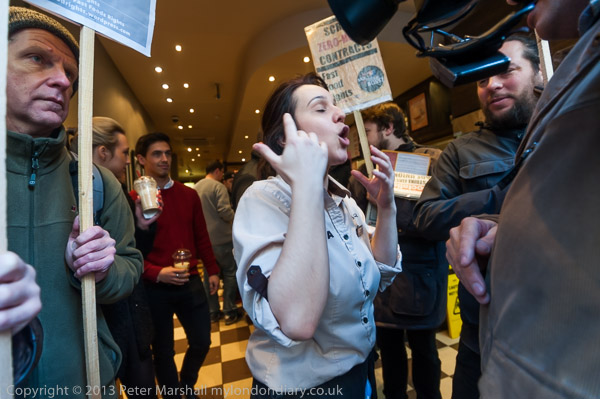
Our next stop was a Costa Coffee just off Oxford St, and while McDonald’s had obviously known we were coming and brought in extra security staff, they seemed to me unaware of what was happening, and the protesters were able to walk inside and hand out leaflets to the workers and customers.

Photographically there was a big problem of contrast, with bright sunlight coming through the large windows. I didn’t want to use flash, at least not when we first went inside as this would have quickly alerted the manager to what was happening and got the protesters asked more quickly to leave, so quite a lot of post-processing was needed to burn down sunlit areas and bring up some of the shadow detail.

Most of the staff and customers seemed interested and not disturbed by the protest, and some were obviously sympathetic, but of course it wasn’t long before the manager asked us all to leave, and we did so, though I had a few seconds to work with flash on my way out. There was a short rally outside before moving off for a repeat performance at a second Costa Coffee on the other side of Oxford St.


The manager argues with a TV cameraman who is just inside the shop doorway
Here again I went inside with the protesters and took some pictures, leaving when asked by the manager. Most of the pictures I took there were with the manager having an argument with a TV reporter who was standing a few inches inside the doorway with a large video camera. By then I was just outside the shop working through the open door, and the argument seemed a little pointless on both sides, other than giving me something to photograph.

After a short rally outside, the protesters decided they had done enough and left very pleased with how the launch of the campaign had gone.

More pictures and text at Hungry for Justice For Fast Food Workers.

Continue reading End the Zero Hours Scam

MI6 Valentine

I’m always a little worried about photographing the MI6 building. Architecturally I think at least in visual terms it’s rather a mess; not quite ‘Legoland’ (apparently one of names its agents use for it, though another, Babylon is in several ways more appropriate), but more one of those silly children’s toys, ‘Transformers’, but unlike the Hasbro/Takara Tomy versions it just sits there and doesn’t change into anything else. But I suppose I’m also worried that someone is going to run out and arrest me for breaking the Official Secrets Act, though I know it isn’t likely to happen. Though I probably would get questioned if I started to photograph people entering and leaving the building.

Of course, if we really wanted to keep the existence and location of MI6 a secret, we wouldn’t have put it in such a distinctive building and location, overlooking the River Thames (it’s also on top of the Effra.) It is a real sore thumb, and London is certainly not short of faceless office buildings that could have housed it equally well (and it does have one such just a few yards away in Kennington Lane.)  Though it is perhaps not co-incidental that the existence of MI6 was only officially acknowledged in 1994, the year before it moved into its flashy new HQ.

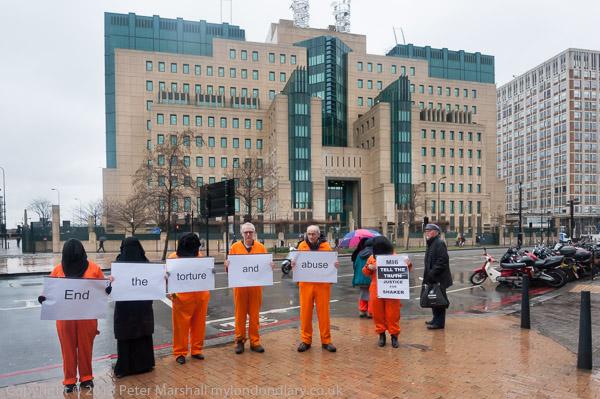
The Free Shaker Aamer Campaign had also been worried that there might be problems with protesting outside the building, but they checked with the police and found them pretty relaxed about it, and this is the second protest the group have staged there.

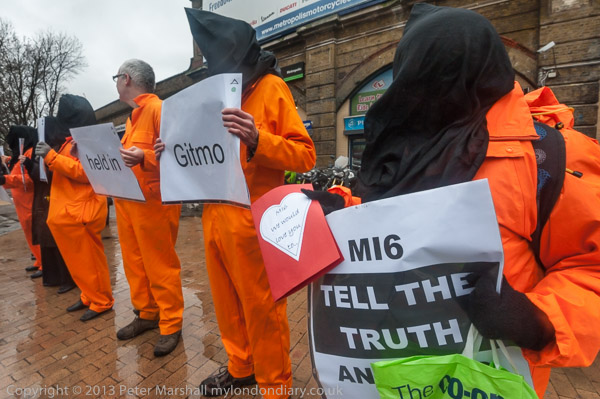
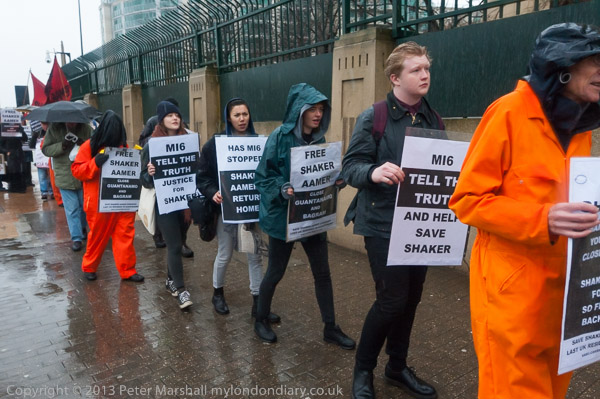
This time it was gloomy and wet, with steady rain as I arrived and the protesters were getting changed into the orange jumpsuits and going out to protest at the roadside. Vauxhall Cross certainly has no shortage of passing traffic, and from that point of view is a very good place to protest. It’s also very convenient to get to, with a large bus station, overground and underground rail stations just across the road.


‘End the torture and abuse’

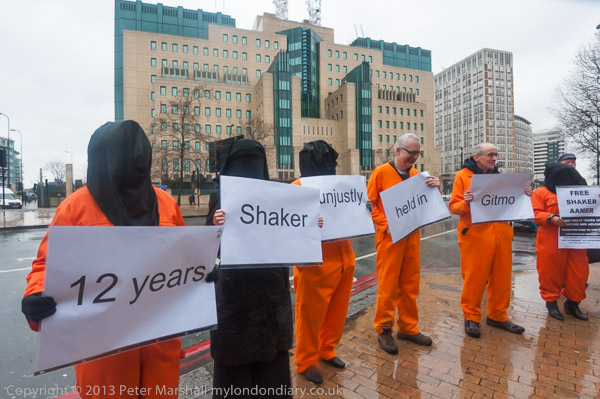
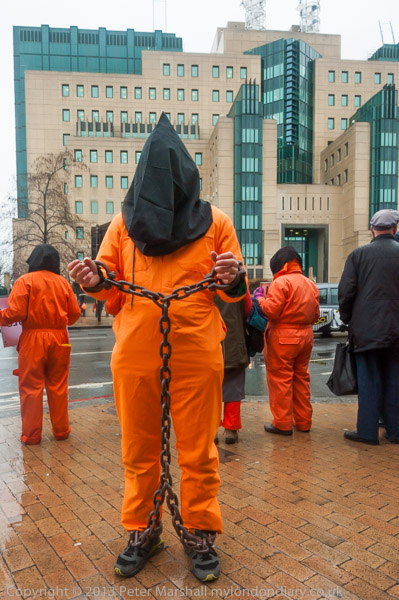
So I went and took the obvious pictures, particularly those with the MI6 (officially called the Secret Intelligence Service) building in the background, with several variations. The protesters had also brought a couple of different sets of slogans


’12 years Shaker unjustly held in Gitmo’ – he was illegally rendered there on 14 Feb 2002

I took these trying to keep the verticals of the building upright in the background, but it’s certainly good to be able to tidy them up a little in Lightroom where necessary, though I hadn’t always quite left enough space around the essential parts of the image to do so. I don’t always try for correct verticals in images, but here I felt that convergence would detract attention from the protesters – the vertical building seems to provide a more neutral background.

I’ve generally also stopped using distortion correction on the images from the 16-35mm, as when you crop precisely in the viewfinder you can find the image correction actually removes whatever you very carefully placed at the extreme edge.  But it sometimes shows at the wide end as here where the building has a distinct curve at the left. But probably you wouldn’t have noticed if I hadn’t told you. Correcting it would lose a little of the figure at the edge who I wanted to keep.

The rain was a problem for me as well as the protesters, and there are a few areas in some of the images where a little post-processing was needed to reduce the effects of rain drops on the filter. But it also meant that I was unable to take as long as I would have liked photographing the Valentine Card for the head of MI6, Sir John Sawer, as it was starting to get wet.

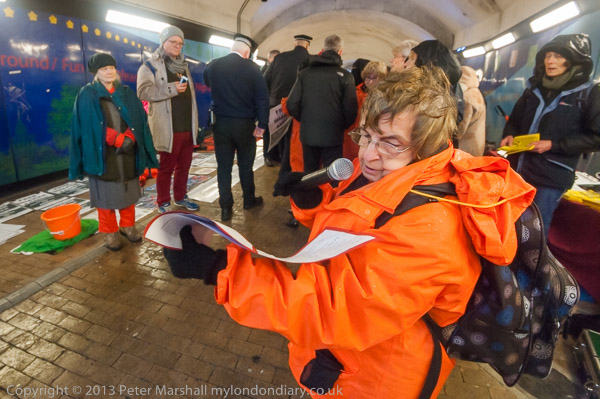
When the rain turned from heavy to torrential, the protesters (and photographers) were able to retreat into one of the long tunnels under the main line to Waterloo, where they had earlier set up their base and there they held a rally. The lighting there was by now almost as bright as outside and working at ISO 3200 wasn’t a problem.

For the first time after over an hour of protest the police turned up and took and interest in what what going on, perhaps because the tunnel was rather congested, especially when some of the walkers and cyclists passing through stopped to find out what the protest was about.

By the time the speeches were over the rain had slackened off just a little, and the protesters came out mainly in single file as the organisers had requested and made their way across the road in a procession to the entrance of the MI6 building to try to deliver the Valentine card. The rain really was too much to work easily, and quite a few images were ruined, but I was able to get some. The man on the gate refused to take the card, citing security reasons, but the protesters persevered, and eventually just pushed it through the wide gap between the gate and the wall before leaving.

While I appreciate the need for security, there is also a good place for common sense, and no real risk would have been involved in taking the card.

By now I – and the protesters – was cold and wet, and I was very pleased to make the short walk to the station for my train home.

The protest was taking place at MI6, because they are thought to have secretly lobbied for Shaker Aamer not to be allowed back into the UK as his evidence about their collusion in torture would be extremely embarrassing. You can read more about this and see the other pictures from the event in ‘Justice Demands the Truth’ Vigil.

Continue reading MI6 Valentine

A Wet Valentine

Feb 14th was a busy day for me, and a very wet one, not good news for those of us in Staines, where the Thames was still running very high, with water flowing slowly across the road in front of our house, and the sewage blocked for five days. Though we were fortunate that the ditch on the edge of the garden was still taking the flood water away. (It’s rising again as I write, almost 3 weeks later, despite a few nice dry days – another 8 inches and we will have significant flooding again in the area.)

It was a relief to get onto a train up to London and get away from it all for a few hours working, but I could have done without the rain reminding me of it and adding to my worries.

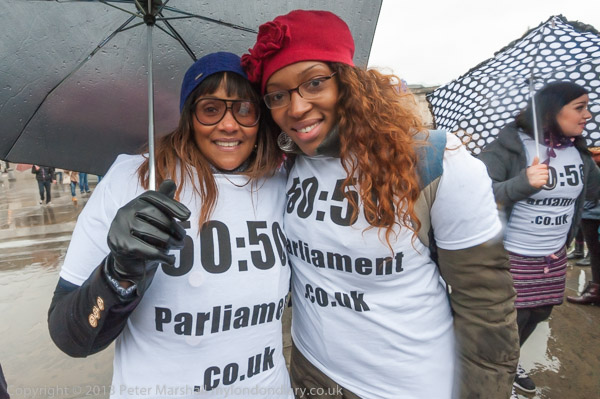
I’d only intended to pay a brief call to ‘One Billion Rising‘ in Trafalgar Square, part of an international day of protest over violence against women. I don’t usually bother with ‘photocalls’, often finding them rather boring, as this one was, but I did enjoy – despite the rain – meeting and photographing some of the women who had come to take part in the event.

It was only raining lightly when I arrived, but was it obvious from the start that umbrellas were going to be a major theme in my images. The only pictures that don’t feature them are a few of the dancers on the stage under cover, though even there, parts of the stage were wet and those dancing in front at ground level were doing so in shallow puddles.

Umbrellas, particularly coloured or patterned ones, do offer some potential to make pictures, but I was concentrating more on the people beneath them.

Also of course concentrating on trying to keep the front filter on my lens free from raindrops. I wasn’t 100% successful, but there were enough pictures were either there were none or they had the impact in the less essential areas of the images. In the top image, there is some slight blur and diffusion in a few areas on the right of the image, still visible at web size, but these don’t detract from the image.

They are less noticeable than when I first saw the image enlarged on my screen in Lightroom thanks to a little post-processing. Using the the local Adjustment Brush tool can reduce the effect. Increasing both the contrast and clarity in the area cuts down the effect of diffusion, and then the highlights and exposure can also be adjusted to bring the diffused area to more closely match its surroundings. The treatment needs a little tweaking for each area you use it on, but it’s convenient to set up a preset as a starting point – and mine has values:

Contrast  +22
Highlights -22
Clarity  +32
with all other settings at zero.

It’s just another reason why I don’t take a notebook computer out with me and send off files from location (or in this case the rather dryer setting of a nearby bar or coffee shop.) I need a good screen and plenty of time to get things at least approximately how they should be.

Of course it would help at least to some extent if I used an umbrella to keep drier while taking pictures. But I just don’t have enough hands and it also restricts mobility – and using a wide angle I just would not have been able to get close enough for some of these pictures holding a brolly. Using a wide angle – especially one with a large glass filter like the 77mm on the Nikon 16-35mm – also greatly increases the rain gathering power, and with wide-angles the lens hoods are of very limited use in protecting them from rain.

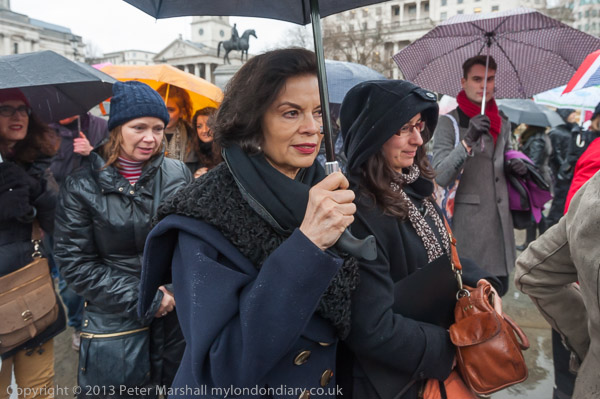
I did deliberately photograph one of the celebrities at the event, Bianca Jagger, of course holding an umbrella, and certainly it is a rather different image of her than some. But there were few others that I recognised (or recognised me.)

Story and more pictures at One Billion Rising – End Violence Against Women.

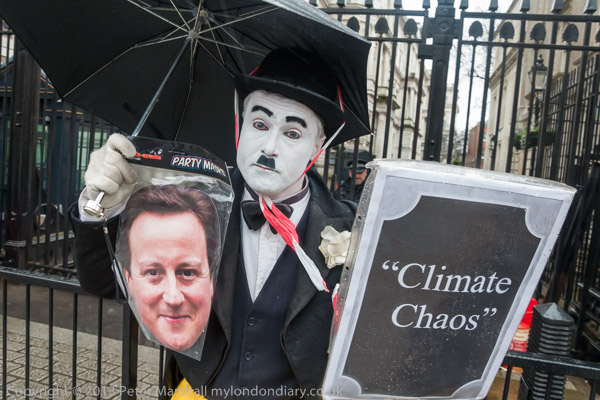
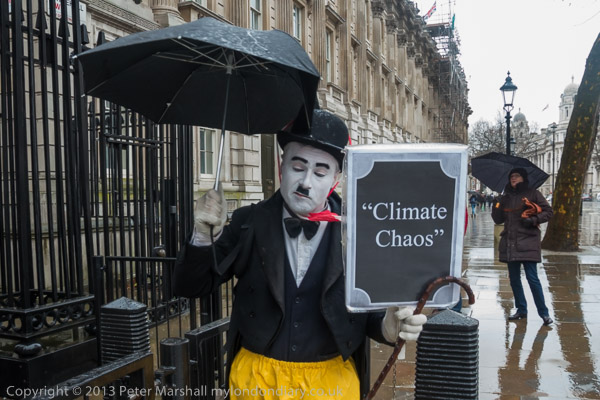
I didn’t really have time to stop and send off pictures in any case, as I needed to be away and doing other things. The first of which was just a few hundred yards down the road at Downing St. I wasn’t there to photography David Cameron, but someone far more famous (or at least Charlie X posing as someone more famous) Charlie Chaplin, who I’ve met and photographed at a few protests.

Charlie Chaplin against Climate Chaos was a one-man performance, and possibly because of the by now heavy rain, I was the only photographer in sight. And it was very much a performance, with Charlie keeping to his character in mime, which made it just a little difficult to communicate with each other.

Of course most photographers also do a little bit of mime, especially useful when abroad when you don’t speak the local language, or when working in noisy situations. I occasionally use gestures to ask if I may photograph someone, but much more often to thank someone whose picture I have taken.

There were really only a couple of pictures that I could think of to take in the situation, and you can see them with a few minor variations on My London Diary.  I would have liked a few more people on the street to use in the background for some images, but apart from the police on the other side of the gates, there were only two other people on the pavement in this part of Whitehall in the five minutes or so I was there (one in red is almost entirely and deliberately behind the Climate Chaos poster) – I’ve never before seen it so empty.

One of these pictures has proved more popular than anything else I too on the day, though I think I was only making the best of a bad job. It certainly was a fine example of Climate Chaos, with a storm lashing London that would normally have hit the north of Scotland, but I don’t think I managed to capture this.

But I was very pleased having taken a few pictures to wave my goodbye and dash across the road for the bus to take me to my next appointment, for which I was already a few minutes late.

Continue reading A Wet Valentine

Heresy?

It knew it was heresy. So I kept it to myself. Drank the white wine and kept quiet.

I was there in the temple of silver, the Print Room of London’s Photographers’ Gallery, in the rather subdued if not hushed darkness of the opening of ‘Eternal London‘, worshipping with others both Giacomo Brunelli‘s undoubted talent (as I said in my initial post – – this is a show to see and, perhaps more importantly, a book to buy.)  And I found myself thinking the unthinkable.

There is a particular mystique about Giacomo’s work, which goes with it’s mysterious quality. He uses the old Miranda SLR and lens given him by his father for all his pictures. It has a removable pentaprism, enabling you to hold the camera close to the ground and see them image on a ground glass screen on the top of the camera body. I thought to myself, just like you can with the tilt-able screens on many digital cameras, or even with a little less elegance using Live View on the back of digital cameras without this feature.

The wall text also had a reference to the printing, comparing it to the wet plate images of the Victorian era in its qualities. I found myself thinking of those fine large, highly detailed prints by Samuel Bourne and others from what is arguably the greatest era of photographic printmaking and finding no similarities. Perhaps there were a few empty skies that were reminiscent of images made when photographic materials were only sensitive to blue light and the ultraviolet, but the wet plate process enabled incredibly detailed images, limited only by the lens as the light-sensitive material was not an emulsion.

Looking at the images on display, I think what they resemble more are prints made from paper negatives, such as those produced in the even earlier calotype process – and also those that I used years ago to make prints by alternative processes, enlarging my images onto resin-coated photographic paper and then contact printing onto another sheet of the same material to give a negative – which was then again contact printed, in my case onto hand coated and sensitised ‘salted paper’ or albumen. Exposures through the paper were much longer than when using sheet film – I put the printing frame in the garden when I went to work and take it in when I came home – and the prints had something of a similar quality to those made by Brunelli in a more conventional manner, though it was more the highlights than the shadows that seemed to diffuse.

And I thought again about what had caused me to lose much of my interest in those alternative processes. In a word, Piezography. Jon Cone‘s four shade black inks and software that I bought into when it first came out, enabling me to make prints on matt papers that had a richness that I’d never managed in the silver darkroom (though it was to be another ten years or so before this became possible on glossy surfaces.)  Now, things are even better with seven shades of grey, though I now make do with Epson’s rather inferior ABW offering (3 greys and the odd spot of colour) as I no longer print enough black and white to keep a dedicated printer running. But even with the Epson inks I can produce prints that are in almost all respects a match for silver.

Soon after I started using the Cone inks (BJP published a review, which half paid for my first set), I had someone visit me who wanted some enlarged negatives using these inks. He’d photographed on 4×5 and printed from this as a platinum print, but wanted to make a larger print – and so needed a larger negative. I scanned his 4×5″ negative, and printed it out as an 8×10″ negative, and before he left I printed out the scanned file as a positive print on a Hahnemühle paper. He looked carefully at it and went rather quiet. It was clearly (at least to me) a rather better print than the platinum, but I made no comment.

Brunelli gets a particular look about his prints that comes from his exposure and work in the darkroom, but it is one that could also be readily applied to a digital file, either by some clever footwork in Photoshop or perhaps even by applying a suitable filter in that or some other software.

Of course it doesn’t really matter whether we work on film or digital or print using silver or carbon pigment inks. I probably wouldn’t have bothered to think about it or to write about it if there didn’t appear, at least from the gallery, some odd kind of mystification over the process. What matters is the end product, the pictures.

And of course these have been printed digitally, and very well indeed, not for the show, but for the book, ‘Eternal London‘ printed by Editoriale Bortolazzi Stei (EBS) in Verona.

Swiss Camera Paris Version

Somewhere hidden at the back of the rack of shelves behind me are a pile of issues of a very special magazine that was published in Lucerne, Switzerland, Camera. I only subscribed to it shortly before it ceased publication in 1981, but bought a number of the back issues that were still available when I signed up. We called it ‘Swiss Camera’ because there were also US magazines that shared the name.

The reputation of this magazine, at least for photographers here, was made only in its last 16 years, when Allan Porter was editor-in-chief from 1965 to 1981.  A new Camera magazine was launched last year in a bilingual English/French version, published in Paris and aiming to take over the mantle of the former publication, and in issue 5, out this week it looks at the work of Allan Porter.

There are a series of articles in L’Oeil de la Photographie related to Allan Porter and the magazine, starting with Camera #5: In search of a mythical magazine, and continuing with Allan Porter: Editor of Camera, Allan Porter: His personal Pictures, Allan Porter: His Photographer Portraits, Allan Porter: His Favorite Covers, perhaps the least interesting for me as his choice of the best 12 from the 162 covers is rather different to mine, and finally, Allan Porter
“I was a go-between”
with a short audio-visual in which he talks about his work and the photographic context of the era, and welcomes the new publication.

At the end of the first article it states: ‘Vintage issues of the magazine are collector’s items today.’ But many can still be picked up cheaply – I found quite a few on offer on the web for $5 an issue, less than half the cost of the new magazine. I haven’t yet looked at the new ‘Camera’ in print, though it is available at half a dozen outlets in London including the Photographers’ Gallery and selected newsagents – details can be found on the website.


Women Are Beautiful

I suspect I would not have bought a copy of Garry Winogrand‘s ‘Women Are Beautiful‘ if it hadn’t been on sale, reduced from £5.95 to £4.50, as the figures still pencilled inside its front cover confirm. Not that I didn’t admire his work, but at the time I was pretty strapped for cash, a father with a wife and young family to support. You can pick up a copy now for around $400 up, more if you want the hardback.

I’ve since bought various other books by and on Winogrand, but this, his second book still remains my favourite, although at the time it was largely dismissed by the critics, savaged by some feminists and bought by very few. Which is why I got it cheap, and why it is rather expensive now.

I’ve almost got around to writing about it a number of times over the last few months, with several exhibitions of Winogrand’s work, and a giant heavyweight volume on him, 465 pages from SFMoMA/Yale, edited by Leo Rubinfien with essays by Sarah Greenough, Susan Kismaric, Erin O’Toole, Tod Papageorge, and Sandra S. Phillips and 460 pictures which I’ve not quite managed to finish reading, though I’ve spent quite a lot of time looking at the pictures. It’s a nice publication and, if you have room on your bookshelves, worth getting, but I think the considerably slimmer ‘Women Are Beautiful’ with its 85 or so plates probably tells you more about the man and his photography.

As well as a book, Winogrand also sold a number of copies a portfolio of the same name, and I think you can see most or all of the pictures (and the cover) from this at the Museum of Contemporary Photography at Columbia College Chicago.

This same portfolio of 30x40cm black and white prints can also be hired as a show from the collection of Lola Garrido through diChroma photography in Madrid. Currently, as
L’Oeil de la Photographie reminds me, this is on show until 23 March in Moscow. Garrido is quoted there as saying “He’s one of the photographers that has done the most for women’s liberation, The first to photograph women as they really are” although whether that view would have gone down well at the UCR discussion Confessions of a male chauvinist pig at the time of the show Rethinking Winogrand’s Women at the California Museum of Photography last year is open to doubt.

Certainly for me one of the attractions of the work was what seemed to be an incredible directness of vision, a spontaneity and an honesty. It wasn’t work that was fitted easily into the times, when any demonstration of male gaze was subject to denunciation as rabid chauvinism. Even now, to judge from the Rubinfien book and show, this work is difficult and under-represented, as commentators including Tyler Green and Nick Shere have noted.

The work from Women Are Beautiful was also shown last year in Worcester, MA, and you can see a viedo of curator Nancy Burns talking about the show at Worcester Art Museum as well as an article in The Daily Beast, which some might find an appropriate title.  The pictures there are reproduced  courtesy of the Fraenkel Gallery, San Francisco, where you can see more of his work from the project.

Most of the text in ‘Women Are Beautiful‘ is by Helen Gary Bishop, with a lengthy essay ‘First Person, Feminine‘, followed by a shorter note about her admiration for ‘Winogrand Women‘ who seem confident, “aware of the place they occupy in space and time.” She sees him as “genuingly attracted by the dynamics of the female being” and having “caught the conflict of the feminine creature: the body as object vying with the self as person.”

Winogrand’s own short contribution is to the point, but I think perhaps has some element of self-deception. He writes:

“By the term ‘attractive woman,’ I mean a woman I react to, positively… I do not mean as a man getting to know a woman, but as a photographer photographing… I suspect I respond to their energies, how they stand and move their bodies and faces.”

His was work that inspired me to go out and photograph on the streets too, with rather mixed results. Many but not all of Winogrand’s women were photographed on the streets of New York where I think street photography was perhaps rather easier and more acceptable. But while I can see why he wrote ‘not as a man getting to know a woman‘ I think it is impossible – and would be unnatural – for men (or at least hetero or bi-sexual men) not to see and react to women in a more visceral way than he suggests. Even the purest photographer can’t deny biology.

Giacomo’s London

Readers who have kept wide-awake though my many posts cannot have failed to register a certain coolness towards the London Photographers’ Gallery, though this hasn’t prevented me from being a member since almost its earliest days (though I think my membership has lapsed a couple of times over the years thanks to their administrative incompetence.) The gallery may not be much, but it is more or less all we have, and I live in hope, though not much, that one day it will start caring about photography rather than seeing its role to try to ingratiate itself to an art establishment that really doesn’t want to know.

But that isn’t really what I sat down to write about today. You can read my other posts, for example and to get some idea of my thinking about the Photographers’ Gallery.

Often on my visits to the gallery, the most interesting work is to be found in the bookshop and the print room, and rather than pay your £4 to confirm your feeling that their might be a very good reason why William Burroughs’ photographic work is so little known, that David Lynch is a considerably better “film director, television director, visual artist, musician and occasional actor” (thanks to Google) than a photographer, and that Andy Warhol was better at almost everything else than taking photographs, I’d suggest you go downstairs to the book shop and print room. Because there you will find some interesting photography, Giacomo Brunelli’s Eternal London, a show which continues until 27 April 2014.


Giacomo Brunelli (left) at the book launch

There are around 30 pictures from the series on Brunelli’s web site, along with his other series, The Animals and Animals II, and Self Portraits.  I wrote about his ‘Animals‘ in 2007, and mentioned them again enthusiastically when they were on show at Photofusion in 2011. I still find them exciting. Self Portraits is a series prompted by Lee Friedlander’s famed 1966 image of the photographer’s shadow on the back of a person on a New York street (you can see more of Friedlanders work on ASX here) but Brunelli works through a whole series of changes, some quite amazing in their effect.

Eternal London certainly has its moments, and comes from two years of early morning walks around central London with the old Miranda camera given him by his father with its 50 mm lens, on a commission from the Photographers Gallery. Perhaps there were just a few I felt were too mannered, but overall I think it’s a fine set of work. My favourite image is a woman walking in the rain holding up her umbrella as she approaches Lambeth bridge. As the gallery text says, the mood is very ‘noir’, stills from some mysterious film of suspense.

I was reminded of possibly Bill Brandt’s most curious picture story, ‘The Day That Never Broke‘ published by Picture Post in 1947, (also called ‘The Man Who Found Himself Alone in London’) (1947), a surrealist fable in which a man wakes up to find himself totally alone in a London enmeshed in fog; he gets on his bicycle and cycles to the river to throw himself in an end it all.  (Incidentally while looking for a link to this image I found a pirated copy on the web of most of my 1999 essay on Brandt in which I mentioned this story.)


Hats are important in Eternal London – in half a dozen of the 31 images

That I also thought of Robert Frank’s pictures from London in 1952-3 has more to do with hats than anything else. By the time I first saw those images around 20 years later thanks to Creative Camera, the hat had largely disappeared from the streets of London. The presence of them in a large proportion of Brunelli’s images is part of what gives his images a period feel, harking back to the black and white films of a previous era.

Frank of course found fog as well, that kind of London peculiar that could be cut with a knife, or rather as the term pea-souper implied, scooped up with a spoon. The near-sihouetted man in a bowler with his umbrella and newspaper behind his back (the third image down on Chasing Light) and shining black shoes seen in rear-view on a mildy foggy street with a Routemaster in the distance is perhaps an archetype of Brunelli’s Eternal London. Though perhaps hard to imagine how the photographer managed to track down so many in streets where the only headgear on normal view apart from policemen’s helmets (perhaps strangely absent) are close-fitting woolly hats.

The book Eternal London, Giacomo Brunelli, published by Dewi Lewis to accompany the show (ISBN 978-1-907893-52-0) is a fine volume, and I think the printing suits the images even better than the handprinted silver gelatin prints available in the Print Room. The images on show (and for sale) are editioned in two sizes, 9.5×12″ and 20×24″ and I think work better on the smaller size. Though around half of the images in the book are printed with a plain verso and would be eminently suitable for framing!

The title ‘Eternal London‘ comes from the Irish poet, author, singer, songwriter, and entertainer Thomas Moore (1779 – 1852) who wrote among many other works the words for the Minstrel Boy, The Last Rose of Summer, The Harp That Once Through Tara’s Halls, Believe Me, if All Those Endearing Young Charms, The Meeting of the Waters and many more. Byron on his deathbed made him his literary executor, trusting him with his memoirs – which he burnt at Byron’s family’s pleading. He published a ridiculous number of works, and though born in Ireland and writing and performing many Irish songs spent much of his life in London where he had come to study law at the age of 20.

This is a small extract from his ‘Rhymes on the Road‘ published in a book dedicated to Byron in 1823, and written after Moore had had to leave England and travel on the continent to get away from the country until he could pay back a debt of £6000 following the loss of a court case (the money had been embezzled by one of his servants.)  It’s not as often seems to be assumed a statement of some nostalgic longing to be back there, but actually a curse, a complaint about how, wherever you went to get away from it, even climbing up mountains in foreign lands, you heard people talking about what was happening in the City!

Fancying we leave this world behind,
Such pleasant sounds salute one’s ear
As — ” Baddish news from ‘Change, my dear — ”
The Funds — (phew, curse this ugly hill) — ”
Are lowering fast — (what, higher still ?) — ”
And — (zooks, we ‘re mounting up to heaven !) — ”
Will soon be down to sixty-seven.”

Go where we may — rest where we will,
Eternal London haunts us still.
The trash of Almack’s or Fleet Ditch —
And scarce a pin’s head difference which —
Mixes, though ev’n to Greece we run,
With every rill from Helicon !

Even before everyone was connected to the Internet and carrying a smartphone you couldn’t get away from it!

Disfarmer – a new biography

I was interested to read a post on Facebook by Pete James, Curator of Photographic Collections at the Library of Birmingham (UK) about a new biography of Mike Disfarmer, self-published on Amazon as an e-book by Kim O. Davis last week. You can read a little of the book ‘Disfarmer: Man Behind the Camera’ free on line and of course purchase the whole. The result of two years of research, the book would appear to tell us all that will ever be known about the photographer, who died in 1959, now 55 years ago.

From the index on-line we can see that most of the details that might be of interest about his photography are still simply suppositions, though it would appear that Davis has a great deal of new material on his background and early life. There appears to be little if any new information not already available in the sample material,and at least one error leapt out at me, when Davis writes that before the early 2000s it had been “erroneously believed that no actual Disfarmer prints had survived.” Of course, as Julia Scully, whose 1976 book with Peter Miller (and show at the ICP) brought his work to the notice of the wider photographic world, had written: “Many of these originals are still to be found in the photo albums of Heber Springs families“.

But it was only when New York photo collector Michael Mattis set in motion an organised search to buy up these images around Heber Springs in 2004 that around 3000 vintage prints were acquired from these families. You can see much of Disfarmer’s work and also read about him in the Disfarmer Project web site, which also has a short biography by Richard B. Woodward from the 2005 book Disfarmer: The Vintage Prints.

Although Disfarmer’s life is intriguing, I wonder if knowing more about it really tells us more about his life’s work. Perhaps it is more worthwhile to examine his photographs rather than his peculiarity and peccadilloes.

Roughly nine months before Mattis set up that project, I’d tidied up my notes about Disfarmer from an earlier talk, and added a few comments to them and published them on line as one of my regular weekly series of features on photography and photographers. I can’t now recall why I did so at this time, but probably Disfarmer was in some way in the air. It was a piece of work that elicited more interest than most – including an appreciative e-mail from Julia Scully making a minor correction to what I had written.  At the time I wrote there was far less material available about the photographer and far fewer pictures on line. I’ve corrected a few typos, but otherwise here is what I published in May 2003.

============================================

Mike Disfarmer – American Portraits

Disfarmer’s Origins

Birth and Family

Mike Meyer‘s parents came to America from Germany some time before his birth in Illinois in 1884. When he was young the family moved to Stuttgart, Arkansas, now apparently widely known the “Duck and Rice Capital of the World” and home of the World’s Championship Duck Calling Contest. Stuttgart had been settled by German Lutheran farmers, many of whose descendants still farm the same lands.

He was the sixth born of seven children, and the only unusual thing his relatives remember about him as a child was his musical ability. He had a fine ear for a tune and played several instruments including violin, piano and accordion.

Work

Meyer’s father died when he was around 14, around the time he went out to work. He continued to live with his mother and worked as a night watchman at the rice mill in Stuttgart.

At some time fairly early in his working life he became interested in photography and bought himself a camera; and taught himself how to use it. We can only speculate what books or magazines on the subject he read – at this date or later.

Move to Heber Springs

In 1914, his mother decided to move to Heber Springs because of its better climate, and he moved with her. There, he set up his first photography studio, in the open at the back of the house. Before long he was in partnership as a photographer with a studio in the main street.

The Cyclone

The climate was not kind to his mother, as a cyclone (probably the great cyclone of Monday, June 5, 1916, which killed 22 Cleburne County residents, although there was another disastrous one on Thanksgiving Day, 25 November 1927) destroyed the house. Meyer was apparently mentally scarred by its effects, although he soon recovered from any minor physical injuries – none of the Meyers are listed among the 1916 casualties. His mother moved out to live with one of her sisters, and he also left home.

Penrose & Meyer

The Penrose & Meyer studio was on Main Street, in the same building as the Jackson Theatre, one of the earliest movie theatres in Heber Springs, built in 1912. Penrose was perhaps an existing local photographer, but nothing seems to be known about him. Unfortunately the block was destroyed in a fire in 1921, and he had to find new premises.

New Studio

The new studio Meyer built was some 20×30 ft, slightly above the typical size for daylight studios and its design was described as modern, perhaps because of its plain backgrounds. It had a wall with large windows fitted with blinds that could be used to control the north light Meyer favoured for his pictures. In the 1930’s it became a popular place to go and have your picture taken in Heber Springs, one of the few attractions in this small town.

Birth Delusions

At some point after the cyclone, Meyer became convinced that the family in which he had grown up was not his own. He got the idea that there had been a cyclone at the time of his birth, and that during this he had been confused with the Meyer child. His own parents had been of a much higher class, more cultured and intelligent than the Meyers.

Such delusions are perhaps not as uncommon as we might think, and pass idly through the minds of many, perhaps especially those whose behaviour suggests mild autism, as some of the descriptions of Meyer might suggest. Meyer took his thoughts further to the point of an obsession, more or less breaking off relations with his real family and changing his name.

Disfarmer

The German name Meyer comes from the Middle High German meier (or meiger) which means superior or higher, and became used for more more important farmers. In modern German, Meier means ‘dairy farmer’. (The name can also be spelt Mayer or Meier, and is found from a different root in Jewish families – the Hebrew ‘meir’ meaning enlightened.)

Meyer was convinced he was not truly of German stock and was not from a family of farmers. He invented a new name for himself to express this: Disfarmer.

Small Town Studio

Heber Springs

Heber Springs was a small town of around 2000 people, although many of the studio clients will have been from the surrounding country of Cleburne County, Arkansas. The town is at the foot hills of the Ozark Mountains, and virtually the only industries at the time were farming and logging. Cotton was the main crop in the southern part of the county, and throughout the area many farmers were living at subsistence level.

Disfarmer’s Assistant

Julia Scully (see below) was able to interview Mike Disfarmer’s assistant, Bessie Utley, who worked for him when the studio was popular in the 1930s and 40s. She not only developed his plates but also often cooked for him.

Utley found him to be a fine man of superior intelligence, with a firm conviction that “he was the only one who could make pictures.” His conviction that he was superior to other people made it hard for them to understand him, and “made the people think he was nutty.”

Studio Sessions

Despite his oddities – or perhaps they increased the attraction – a trip to the photographer’s became one of the attractions on the trips people made into the town. There they stood in front of the plain dark background in the studio while the photographer carefully adjusted the blinds and got the lighting just how he wanted it.
The Sessions

The town’s funeral director recalled a sitting with Disfarmer, and suggested that it sometimes took him an hour to arrange the lighting. Although he may have worked slowly and thoroughly, it seems unlikely that his clients would have had so long a time to wait. However, it is clear that the photographer took his work very seriously and the results he obtained show this.

Over the years, Disfarmer must have taken many thousands of pictures. As well as the studio work with which we are familiar there were probably pictures taken in peoples homes and elsewhere. Images by Disfarmer must be present in many family albums covering a wider range of his work and it would be of interest to discover if these show the same characteristics as the published work.

Equipment

Disfarmer was said to have used a large home-made studio camera. Like many photographers of the time, he stuck with glass plates rather than changing over to film, at least until around 1945. Joe Albright also suggested that the camera back went through a hole in the back wall of the studio, presumably into a dark area, and that Disfarmer looked at his subjects through a window when setting up the images.

Having the camera back in the darkroom area of the studio would give the advantage of a very clear image on the ground glass screen. If the window through which the photographer viewed his subjects was equipped with a lightproof blind, plates could be loaded or unloaded without a darkslide. However, memories of Disfarmer and the way that he had worked were dim, since over 20 years had passed before the interviews.

A Recluse?

Disfarmer, particularly as he grew older, had had less and less contact with other people apart from taking their photographs, but retained his interest in music. The town barber, John Hendricks, an amateur guitarist, remembered evenings when he and Disfarmer sat in the studio playing together, Disfarmer was still a good fiddle player and enjoyed playing the kind of country music popular in the South.

Perhaps because the war had come to an end, but also possibly because of the photographer’s increasingly offhand and eccentric manner, business dropped off. Disfarmer’s studio remained open until he died at the age of 75 in 1959, but we know nothing of his work in these later years.

Posthumous Fame

Death

Disfarmer became more and more a recluse, avoided by most of the townspeople and he had few visitors, and even fewer customers at the studio. He was there on his own when he died in 1959, and it was two days before his body was discovered.

After Disfarmer’s death, the executors wanted the studio cleared, and Joe Albright, a retired army engineer with an interest in photography, was living in Heber Springs and bought the entire contents of his studio for the token amount of 5 dollars.
Saving the Negatives

Although Albright was disappointed to find no photographic equipment worth saving, he did have the foresight to hang on to the boxes of glass negatives that he found, some 3,000 of them, thinking they might be of some interest to local historians.

The latest of these negatives appears to date from around 1945, possibly suggesting that at this date Disfarmer changed over to using film. Albright kept the negatives in store until around 1974.

Miller and Scully

It was then that photographer Peter Miller and his wife Karen moved from New York to join an Arkansas cooperative corporation ‘The Group, Inc’, and found themselves running the weekly Heber Springs newspaper ‘The Arkansas Sun’. They began featuring old photographs supplied by their readers, and Albright got in touch, offering some of Disfarmer’s work.

It was Miller who recognised that these images were possibly of more than local interest. He made some prints from the negatives and sent a few to Julia Scully at ‘Modern Photography‘ magazine. She too was impressed, and set to work with Miller and Herschel and Elizabeth Coley to find out more about the man and his work

Modern Photography

‘Modern Photography’, edited by Scully since she joined in 1966, was a mass circulation photographic magazine that unusually attempted to take the medium seriously, publishing features by critics including Andy Grundberg as well as a regular column ‘Seeing Pictures’ written by Scully herself.

Many photographers both in the USA and abroad looked to it for a wider view of creative developments, until it was finally swallowed up by its rival ‘Popular Photography’. The texts published by Scully form the basis for all other articles on Disfarmer, including this feature.

Publications

Disfarmer’s work began to be published in magazines and a book appeared in 1976, published by Addison House: ‘Disfarmer: The Heber Springs Portraits, 1939-1946‘ with Disfarmer Photographs printed by Peter Miller and text by Julia Scully.

Other publications followed, including a feature by Scully in ‘Aperture‘, certainly one of the highest accolades a photographer can achieve. In issue 78  (Fall 1977) the company was august, including Paul Strand‘s images from his garden at Orgeval, Hilla and Bernd Becher‘s images of preparation plants (“breakers”), colour by Joel Meyorowitz and early pictures by Francis Frith and others from Egypt.

From an unknown and forgotten career in a small town in rural America, Disfarmer had enjoyed a meteoric rise over a couple of years to become regarded by many as a major figure in the photographic pantheon, drawing comparisons to Atget, Arbus and Sander.

Image and Reputation

The Pictures

Disfarmer is said not to have posed his ‘sitters’, and indeed most of them simply stand facing the camera in simple groups. However it is a rare individual who does not look unflinchingly into the eye of the camera, and even rarer one who smiles at at. Whatever he did or did not say to them, Disfarmer clearly imposed a relatively common approach in these matters.

The strength of these images is in part in their simplicity, but their appeal is also very much to do with the character of the people that he photographed. The pictures have a built-in nostalgia, a reference to a time past that for most of us was never present, except in film.

The People

The people here are a past we would perhaps like to think we had, a view of America when the dream was still real, even if those who are shown were not getting much of a share of it.

These are hard-working people, some still in their working clothes, but mainly in their ‘Sunday best’, reserved for going to church or for having your picture taken. Honesty apparently shines through their faces, looking at us from a simpler world where right was right. There is also a fine humanity in them, often most evident in the small imperfections.

Lighting

Disfarmer used soft, overall lighting, probably using reflectors as well as the large north-facing windows which even reduced or eliminated any shadows on the underside of hat brims. Generally the light was slightly directional, coming from the left of camera to produce some slight form shadow which gives the figures their three dimensional quality.

Exposures

His exposures seem to have been quite lengthy – perhaps in seconds – with some faces clearly showing movement blur. The people are clearly concentrating on having their picture taken, staring into the camera with the same kind of intensity that was required for the daguerreotype.

A Collector

I get the feeling that Disfarmer regarded himself more as a scientist than an artist, pinning these people closely against his background and walls almost as if he were making a butterfly collection. But here the subjects respond to his game, some with dour obedience (life was hard and many things just had to be born), some with near terror and others determined to show their individuality through pose or gesture.

For many a trip to the photographers was perhaps similar to a trip to the dentists, something that had to be endured. Young men about to go to war, dragged in by their family to pose with them, and also proud men returning and celebrating.

Although some families will have had their Kodaks, there was still an immense gulf between the kind of small blurred mementos these provided and the carefully composed large format quality of the professional.

Disfarmer and Evans

Although I have no doubt that these are fine portraits of their time, to me the work lacks the complexity of that of Atget and Sander. It is, like its subjects, honest and straightforward.

It has a similar appeal to some of Walker Evans’s work for ‘Fortune’, such as his images of tools, but lacks the complex feelings of those images that he made of share-croppers, articulated both in his photographs and in the text by James Agee that accompanied his work in ‘Let Us Now Praise Famous Men.’

Evans took his pictures as an East coast intellectual coming in to the lives of the share-croppers; while Disfarmer, despite his own certainty that he was an outsider, had known and shared the circumstances of those who entered his studio for all of his life. It is work from a different viewpoint, equally valid but more limited.

Evans – and his colleagues at the FSA – give us a view from the outside, and at times one that was designed to further the aims of the organisation, although Evans himself clearly worked to his own agenda.

In later years, the work of the photographers was more clearly linked to the war effort. Disfarmer had no such pressures, providing a service directly to those he photographed, if one suspects rather on a take it or leave it basis.

Vintage Prints?

I admire Disfarmer’s work, and was pleased to have the opportunity to view some original prints at a recent exhibition. These were prints made from the original negatives, rather than prints made by the photographer himself, and it would be interesting to be able to compare the two.

Those who have edited and published his work appear to have treated it with commendable respect, although it is not possible to know how clearly their selection of his images would reflect what Disfarmer would have considered to be his most important work.

Other Disfarmers?

Disfarmer isn’t a photographer whose work has changed the course of photography, but work that was carried out by someone who remained unknown outside his own small community. It is interesting to speculate on other Disfarmers hidden away in their own small towns around the world, working quietly and diligently cultivating their own gardens.

There have indeed been such claims made for other photographers – including even some from Arkansas – but the evidence that I’ve seen usually fails to support their cases. However, interesting photographers from the past are still being discovered.

It is perhaps less likely in the present that such talent should be overlooked. Had he lived in the present, Disfarmer would probably have been spending a great deal of time on the Internet, creating a web site about his switch at birth and his photographs. Bushels are rarer these days and fewer candles remain hidden.

Louis Clergeau

Of course not all photographers get treated fairly after their death. To judge from John Berger’s review of ‘A Village in France’, Louis Clergeau‘s pictures of life in a small town near Blois in central France from 1902-36, his work has been reduced to an almost meaningless nostalgia.

Rephotography

Photographer Toba Pato Tucker was so impressed when she saw Disfarmer’s work that she went to Heber Springs for two years, photographing some of the same people that he had photographed, as well as their descendants and relatives. The differences her work showed between the 1940s and the later work was the subject of a book by her and Alan Trachtenberg, published by the University of Mexico Press in 1996.

============================================

There are a few things in the piece that we now know more about as a result of further research – and perhaps a few more will arise from the latest publication by Kim O Davis. If I owned a suitable e-reader I might well buy it, but I still prefer to read on paper rather than on screen. But I’m rather more likely to buy a book of Disfarmer’s images.
 

Stereotype?

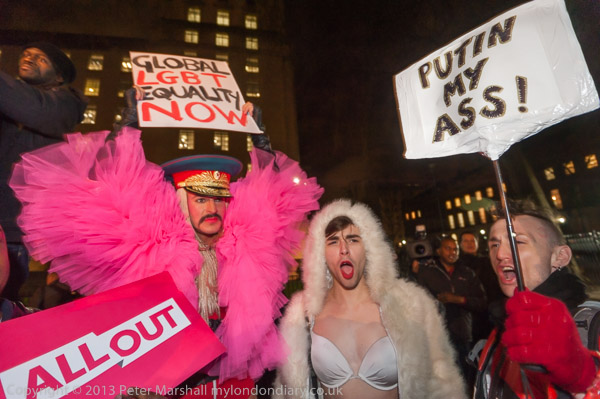
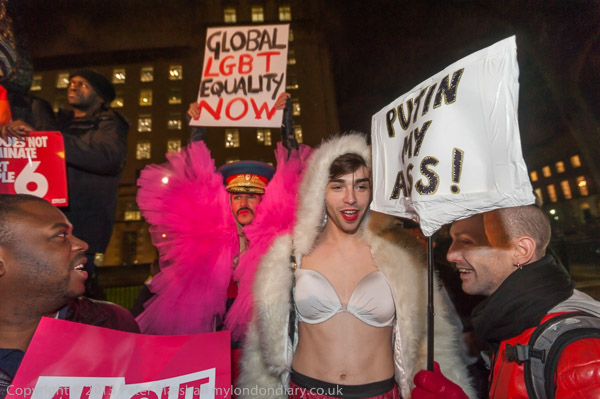
Photographing the protest at Downing St, Uphold LGBT Rights at Sochi, it was easy to concentrate on the more exotic elements of the scene, but it worried me slightly, and in particular I pondered over whether to use the above image with some of those in more unusual dress as the lead image to the story.

Of course the great majority of those at the protest were more normally dressed, though many had followed the ‘wear red’ dress code advised for the protest. And probably if they were holding up a placard or doing anything to distinguish themselves visually, if I noticed them I will have photographed them, and there is a chance their picture will have made the edit.

I wasn’t entirely happy with the picture. I was still working with the scene in my usual non-directive way when another photographer barged in and started getting people to stop acting naturally and look at her camera.  To me this is very much the kind of situation where it pays to let people do their own thing – of course they were very aware I was photographing them as I was using flash (it was in one of London’s darker corners.)

But in the end I chose it because it seemed to neatly present the event. At bottom left the name of the group ‘All Out’ that had organised the event, the guy in the Russian military hat with pink fluffy wings holding up a poster ‘Global LGBT Equality Now!’ A man in a white bikini and fur coat and another holding up an uncompromising anti-Putin placard in his red gloved hand. It has all the elements, though technically it isn’t one of my best flash images. And in some respects I think I had put things together a little better three frames previously, with the image below.
The key factor in my preferring the upper image for the purpose was simply the legibility of the ‘All Out’ and Putin placards.

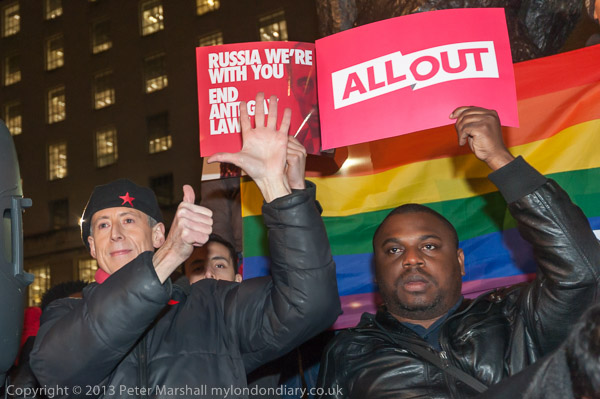
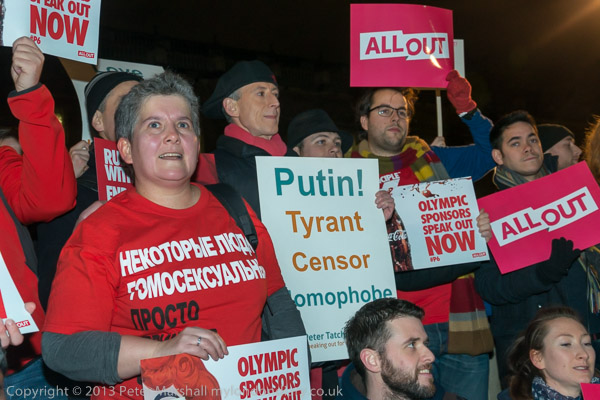
Or perhaps I should have chosen something a little more serious looking, such as Peter Tatchell demonstrating the 6 finger salute – it was a protest involving Principle 6,  the Olympic non-discrimination principle.  He might well have preferred me to use a picture showing a mass of protesters rather than concentrating on him,  and I try not to be too concerned with the ‘celebrities’, although I know that such pictures are more likely to get printed.

Perhaps an image like this one, where he is more in the background. It worries me a little with the text in Russian on the t-shirt of the closest figure, Of course there is a good reason why, but it’s still something of a barrier to non-Russophones (or should that be Russolexes?) and I kick myself slightly for not seeing I’d obscured the ‘H’ of Homophobe.

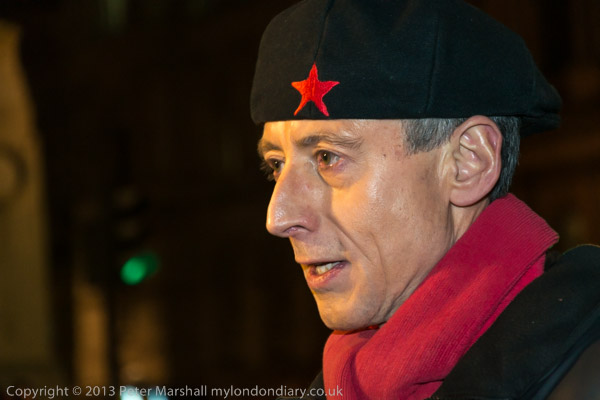
I’ve obviously done some post-processing to even out the illumination across the image, but as almost always with the pictures I put on the web it could have been done a little better. That head at the bottom of the frame just right of centre for example is too bright. And looking at the image now I’m surprised I didn’t make the red star on Peter Tatchell’s cap more visible.

It shows up much better in this image, taken while he was being interviewed. There are three images from a similar viewpoint on the web page in Uphold LGBT Rights at Sochi and the first was without flash, using just the video light on the camera he is looking into. Here I’ve perhaps slightly overdone the flash or could have brought it down a little in post-processing, and perhaps the red star should be a little less bright. I rather like the green circle of a traffic light, but others might not.

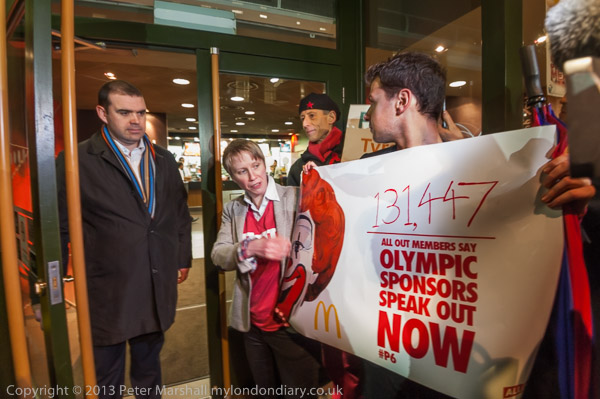
Flash that had been working well earlier in the event rather let me down when I was trying to photograph the handover of the banner with the number of petition signatures on it to the UK Head of Communications for McDonalds, but the real problem was that there was a totally rigid block of photographers around the doorway, wedged shoulder to shoulder. I’d got there a few minutes before while there was still time to get a place, but couldn’t move. At the right you can see the edge of the picture is obscured by part of a TV camera. This was taken at 16mm, and after this people began edging in and I could no longer photograph the whole scene.

Continue reading Stereotype?

Up Willesden Junction


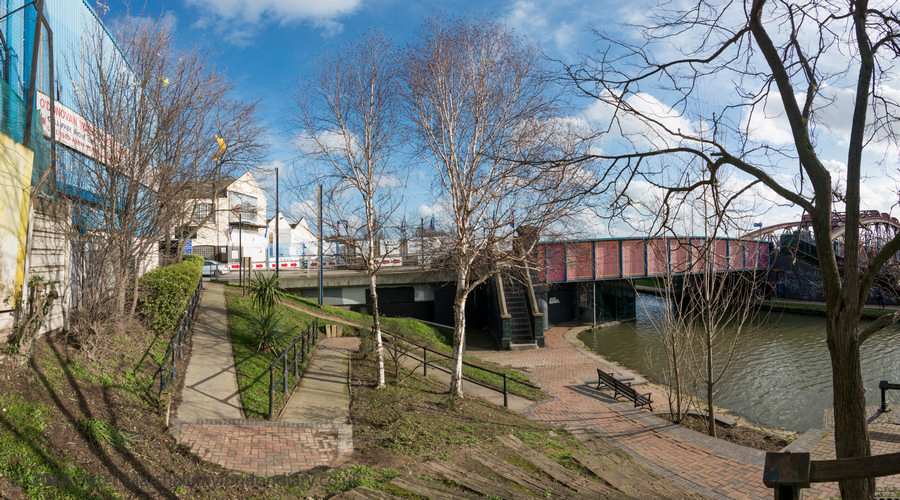
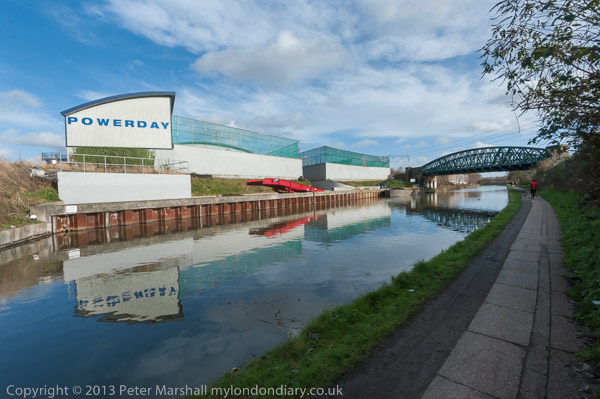
The line from Richmond to Willesden Junction goes over the canal on the bridge at the right.

Trains are my favourite form of travel – if I have to travel. Though I don’t always feel good about them when I need to join the rush hour crush to or from London, especially when SouthWest Trains put on a 4-car unit in place of the normal 8 carriages, as happened at times during the flooding. They’ve also developed a habit of doing the same trick (doubtless simply to save their costs) on some Sunday services which leave many standing, though not quite at the sardine level of rush hours.

But given that the trains are running reasonably to time and have sufficient room, trains are a civilised way to travel. Generally comfortable, seats with enough width and legroom at least for a person of my reasonably average size and smooth and fairly quiet (one of the few ways the railways have improved since my youth, though if they still had windows you could open and stick your head out you would no longer get soot in your eyes.)  You can sit and read a book, or look out of the window at the changing scene.

One of my favourite journeys for looking out of the window always used to be the line around the north of London, which used to run from Richmond to Broad St, right into the City of London. Though in the old days you did need to clean the outside of your window before boarding if you wanted to see out.  The journey perhaps got even more interesting when the service changed to run to North Woolwich via Stratford after the closure of Broad St in the 1980s, though I missed the section between Dalston Junction and the City.

The line is still fascinating, though with the new Overground trains you sit with your backs to the window and get a crick in your neck trying to look out. But the transfer to TfL has certainly resulted in a better service on the line. For much of its route it gives an elevated view of the northern suburbs of London, reaching parts that might otherwise remain unknown except to their residents. I’m one of many photographers of London have used it as a basis for projects, either formally or informally in past years, and Mike Seaborne‘s series very loosely linked to it is one example.

One particular area on the line where I usually put down my book and look out is just before Willesden Junction, where the line crosses the Grand Union Canal before going through an industrial area and reaching the station.  (Like Clapham Junction which isn’t in Clapham, Willesden Junction isn’t in Willesden – railway companies appear to have delighted in confusing travellers from their early days.)  Many years ago I took many pictures around this area, but since then it has changed quite a bit, and every time my train has gone through I’ve thought it would be good to get off and take another look, but have never had the time to do so, always on my way to other places and events.

But on a Sunday morning at the start of February it was a nice day, and I’d decided to go to an event in Willesden. Normally I’d have got off two stations down the line past Willesden Junction – though only a couple of miles away, but I decided to pack some sandwiches and go a couple of hours earlier so I could get off and take some photographs. Afterwards I could take a bus to where the event was starting.

I was a little worried at the weather as I walked to the station – there was a clear blue sky with not even the usual Heathrow vapour trails, something of a killer for the panoramic images that I intended to make. But my luck was in, and after the journey (it took a little longer than usual thanks to engineering works and a bus replacement service) there were some interesting clouds.

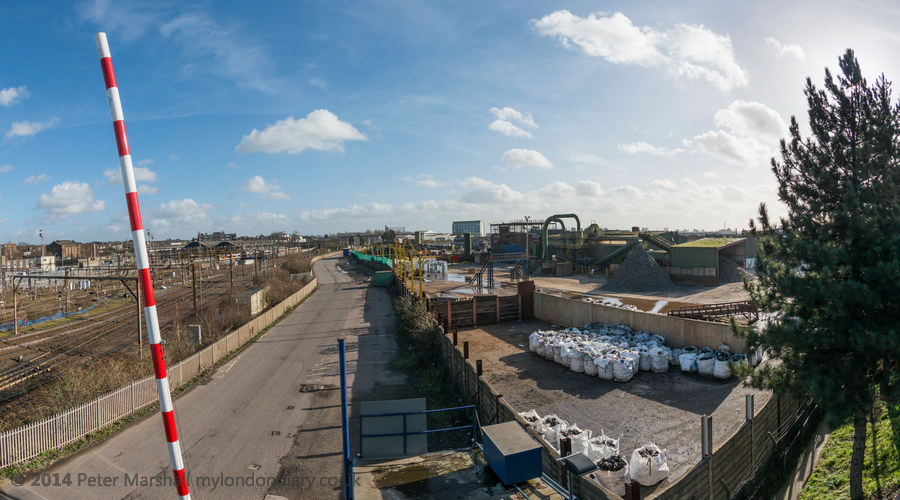
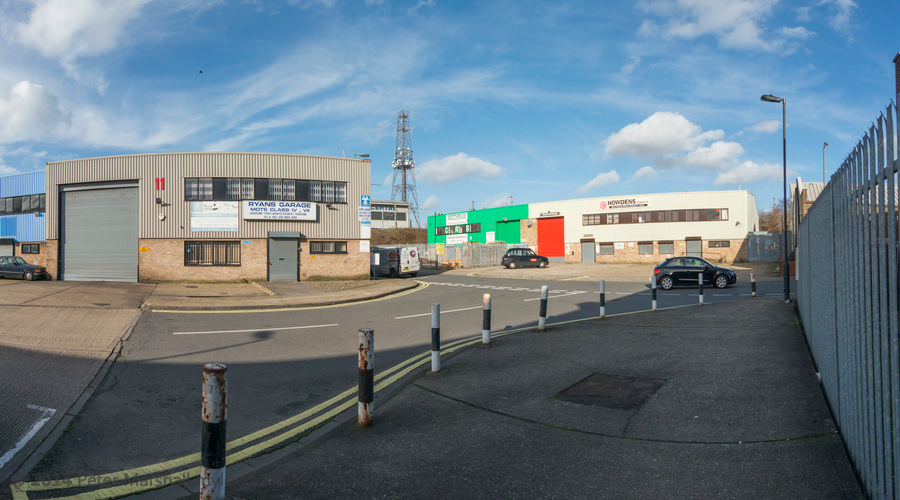
There is a well-hidden but well-used footpath that follows the side of the Willesden Junction to Clapham Junction line as it goes over the many tracks of the main line to Euston, before descending into the industrial estate. It used to overlook a huge metal reclamation site, but this seems to have been very much cleared up now.

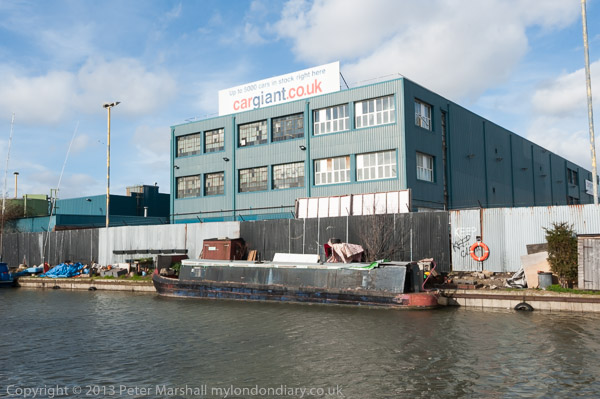
Much of the area north of the canal is now a huge car auction site, but there are also other companies around with warehouses and factories. Another path now leads to a footbridge across to the canal tow path on the opposite bank, but having gone to it to take pictures I returned and made my way to Scrubs Lane (it leads past the North Pole to Wormwood Scrubs, one of London’s larger commons, but I didn’t go that far.)

I sat on a bench to eat my sandwiches in the sun (it was surprisingly mild for London in February) in a small memorial park to Mary Seacole, a remarkable Jamaican woman who used the profits from her general store and boarding house in Jamaica to nurse wounded British soldiers in the Crimean war, as well as medical work in Jamaica, Cuba and Panama. The memorial park was created around the time of the bicentenary of her birth a few years ago here, close to where she was buried in St Mary’s Catholic cemetery in 1881. She has become a controversial figure in the debates over the construction and teaching of British history, with many feeling she was largely sidelined because she was black.

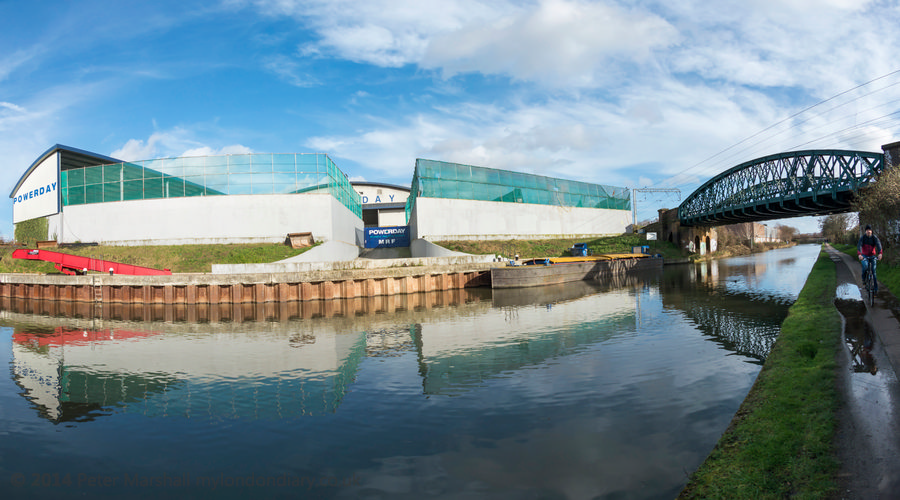
I crossed the canal and walked west along the towpath. Once past the Mary Seacole Garden and Mitre Junction it isn’t the most exciting of walks now. I was annoyed coming down onto the towpath to find a fence on top of the wall which I had photographed over years ago now making this impossible, at least without some way to raise my camera higher than I could reach up. And further on, what had once been a busy railway site at Old Oak Common now just had a few new distant sheds.

The top picture on this post was also something of a disappointment – and it works better on the less wide 16mm rectilinear view above, taken from a more distant viewpoint. But my disappointment was that there was a much better view from the train, a little before it reaches the bridge. The extra height makes a great difference, and there was a fence in the way so I couldn’t climb to get closer to the railway view.

More of the pictures from my walk, which continued with a demolition site, and, at the end of my bus ride to Willesden Green, a splendid 1930s building I photographed before in the 1980s, a Buddhist temple and some fading murals  in Harlesden, Willesden & Mary Seacole

All pictures were taken with either a Nikon D700 with 16-35mm lens or a Nikon D800E with 16mm fisheye. The latter images were converted using PtGUI to equirectangular projection.

Continue reading Up Willesden Junction