Vanessa -no longer invisible

New York Times Lens blog has a nice piece by Rena Silverman, No Longer an Invisible Photographer about Vanessa Winship and her current show at Madrid’s Fundación Mapfre; even if you can’t get to Madrid you can take a ‘virtual tour‘ on their web site from outside the gallery and go in and see the work on the walls. The audio is in Spanish, but the rest of the site is available in English, and there are excellent images of around 25 of her pictures on-line.

I’ve mentioned her work on this blog several times in the past, most recently in Singing about Vanessa and it really deserves the attention it is now eventually beginning to get even in the UK. She was the first woman to receive the Henri Cartier-Bresson award in 2011, and quite possibly the only photographer ever to make a project about Barton-on-Humber, the place she grew up in.

Of course you can also see her work on her own web site, and in the book she dances on Jackson, made with the funding from the Cartier-Bresson award. This was a book I recommended when it came out (actually I think before it came out in the UK) at the time I ordered my copy. I note on Amazon it now says:

Hardcover

  • 2 Used from £670.03          8 New from £130.00

although you can get it for less on Abebooks. Her ‘Sweet Nothings’ is still available at reasonable prices but the exhibition catalogue, as well as looking like a fine book may also be a good investment. You may need to order it from Spain.

No More Austerity

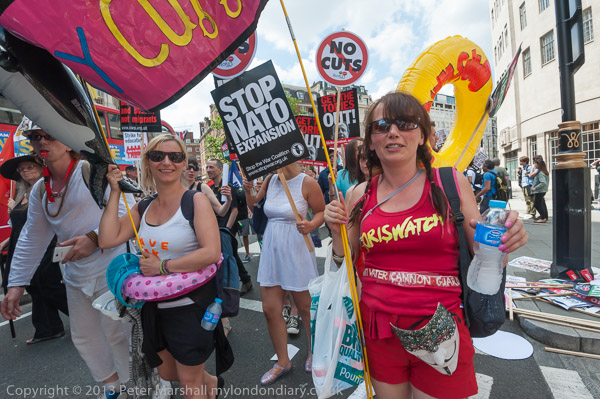
It was one of those days when I spent rather a lot of time running around London looking for things that either didn’t happen or I decided there was nothing much to photograph. On top of which there was also one of London’s largest protests, the No more Austerity march and rally organised by The People’s Assembly, trade unions and campaign groups starting from outside the BBC.

Two groups had promised to hold protests on their way to the big one, and I did manage to find one of these, a protest outside the Regent St Tesco branch where earlier protests and direct action had led to the removal of ‘homeless spikes’, designed to stop rough sleepers resting there. The Call for Nationwide Homeless Spikes Ban was smaller than I had hoped, but there was a story and it’s demand for a nation-wide ban was reinforced by a protester from Cornwall – carrying a Cornish flag – and policed by a Welsh police officer. But of the beach party themed flash mob taking the underground to the more austerity march I saw no sign, though I did I think find them later on the anti-Austerity march.

I’d also planned to cover two unrelated protests, one at Downing St and the other at the US embassy. I went to both shortly after their advertised starting times; opposite Downing St there were a small group of people, but no sign of them beginning a protest. At the US Embassy there was a small protest taking place, but little to photograph. I took a few pictures, talked to the protesters, who told me there were more coming and I promised to return later when they thought there would be more. But when I returned to both groups later, neither were anywhere to be seen, and I didn’t have enough material for either to make a story.

No More Austerity was different. A large protest with perhaps 15-20,000 people marching from outside the BBC, who almost entirely failed to notice it (a short mention appeared belatedly on the local news.) The organisers claimed 100,000 on the march and at the rally, and some papers quoted that unrealistic figure as fact.

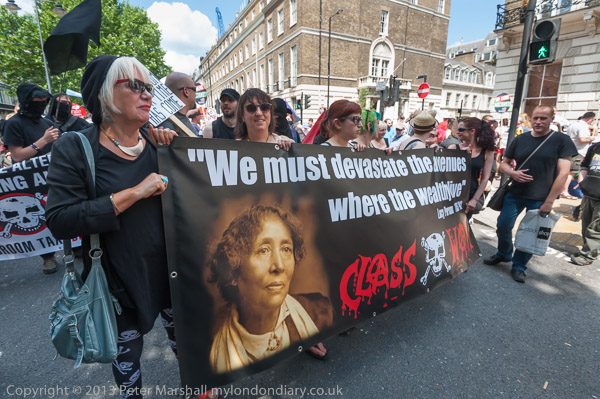
My main problem in covering the event was simply it was too large and too crowded, at least at the start, and there was just too much to photograph. Too many interesting banners – such as that carried by the ‘Class War Womens’ Death Brigade’ with its typically uncompromising quote from US anarchist activist Lucy Parsons (Chicago police called her ‘More dangerous than a thousand rioters!’) “We must devastate the avenues where the wealthy live”  as well as a rather fine crocheted less controversial ‘Tax the Rich’.

It was also rather warm, and I could have done without the extra rushing around central London for the missing protests I tried to find as the end of the march reached Oxford Circus, a quarter mile or so from the start.

When there are large protests in London like this, traffic is hugely disrupted, and the only ways to get around quickly are either on foot (or bike) and the tube. But underground stations are seldom very close to where you want to be, so that too involves a lot of walking or running. Often too, as on this Saturday, key lines or stations are closed for engineering works, and I found I had to do rather more on foot than I liked, particularly when carrying a heavy bag on a hot day. So when I finally arrived at Parliament Square, a short walk from Westminster tube – I was as hot and tired as the protesters who were just arriving having marched the whole distance.

Fortunately the organisers had arranged for a fairly large press area in front of the platform, unlike at some other events, which made it easy for us to work, and particularly to photograph the speakers at the rally. The microphone then became the main problem, with some speakers apparently trying to hide from my camera behind it, along with a metal lectern that almost completely hid some of the less tall.


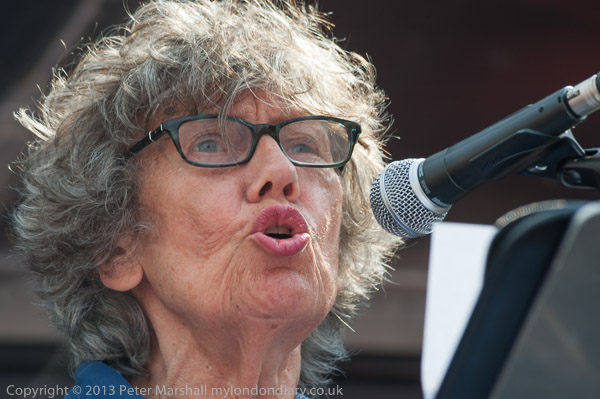
Celia Mitchell reads one of her late husband Adrian Mitchell’s poems

What surprised me greatly about the rally was that there were no speakers from the most active group of anti-austerity protesters, DPAC and other groups of the disabled. I later learnt that this was because the event organisers had refused to provide disabled access to the stage, or rather asked that DPAC should pay for it. It seemed unbelievable that any left group should be so clearly anti-equality; had they known in advance I suspect many of those who did speak would have boycotted the event.


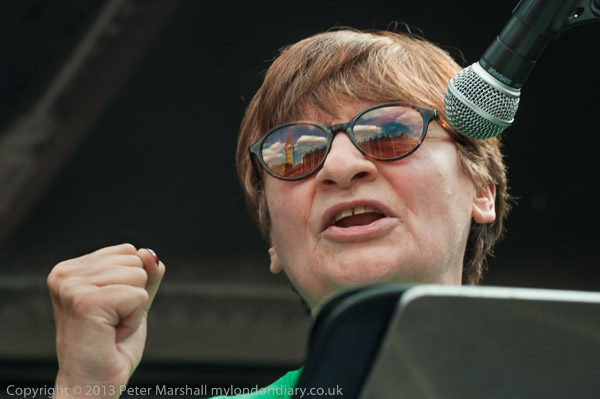
NUT General Secretary Christine Blower with a reflection of Big Ben in her sunglasses

Something I did find annoying were the continual announcements that Russell Brand was on his way to speak at the rally. I expected him on past performance to be the least interesting of the speakers, and while his support brings publicity for the cause I think the whole cult of celebrity is something that the left should try and oppose. When he hadn’t turned up an hour and a half after the rally started I decided it was time to go home. Of course it was pictures of him on stage that dominated the press coverage of the event.

I was quite pleased with some of the pictures I made of the speakers, mainly using the longer end of the 75-300mm zoom, though some were on the 18-105mm. It wasn’t too crowded in front of the stage and I was able to move around quite a bit, which makes a big difference. There were also relatively few large video cameras, which also rather impede movement, particularly as you try to avoid being in shot. And of course there was no sign of the BBC!

Pictures from the day at:
Call for Nationwide Homeless Spikes Ban
No more Austerity – demand the alternative
People’s Assembly Rally
Continue reading No More Austerity

Naked Riders

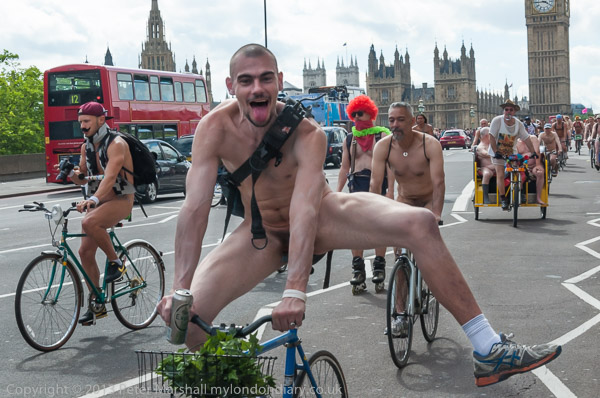
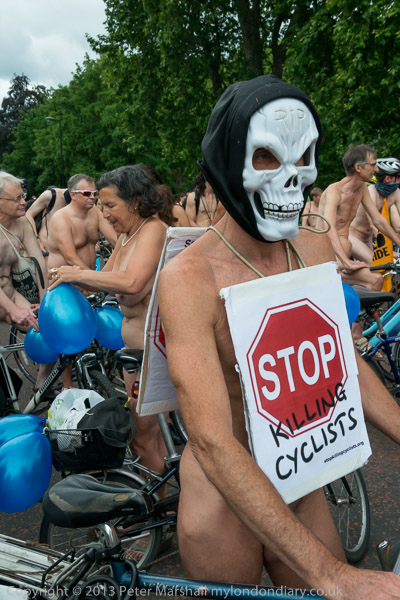
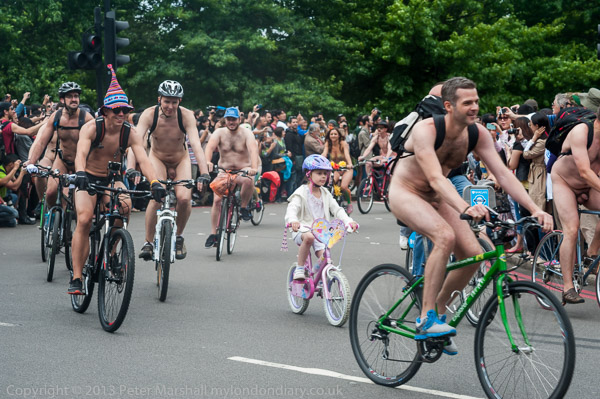
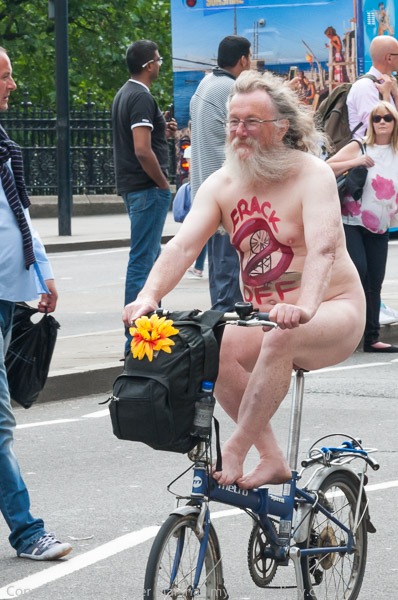
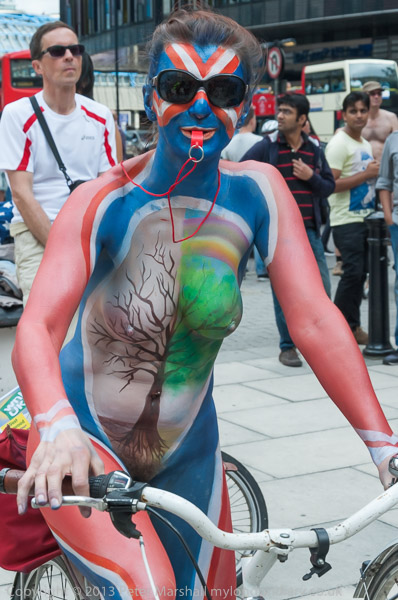
I’m not sure whether I look forward to the annual World Naked Bike Ride in London or not. I’ve nothing against looking at more or less naked people on bicycles, or even photographing them, but it does produce some photographic problems. I’d be a lot happier about it if the ride were rather more obviously a protest, but despite the efforts of a few taking part, things like posters and placards are few. Only a very small minority of riders have flags or posters on on their bikes; slightly more have some slogans painted on their bodies, but it’s still a fairly low percentage.

Of course the ride attracts a lot of onlookers, many with cameras, there for various reasons. But it also seems to attract a number of stewards who like to shout and insult photographers, and I don’t welcome being insulted while trying to do my job. Back in previous years I’ve had some discussion with the organisers about this, and in particular about them trying to impose policies on photography which tried to restrict the rights of photographers, which were silly, unlawful, inappropriate and unenforceable. I think they have moved away from this, but there are still one or two individuals who like to run around shouting at people.

Most of the riders seem happy enough to be photographed, at least by photographers who behave sensibly, and I rather feel that if people don’t want to be photographed without their clothes on they should stay dressed in public. And you don’t have to be nude to ride – the advice is to be “as naked as you dare.”

In photographing the event I try to concentrate on those riders who are clearly trying to make a point – generally about some aspect of ‘car culture’ or bike safety – and also those who have taken a great deal of trouble over their appearance. The set of pictures on My London Diary makes the event look far more focused than it is in reality. My pictures also show a considerably higher percentage of women riders, mainly because more of them appear to have body paint or slogans that make them of interest; the ride itself is far more male.

I’m also aware that while I have no problems with naked bodies, they may offend some people – and some publications. Facebook and other web sites have a great problem with nudity and sometimes ban even the least offensive of images. When thinking of what to post, particularly through agencies, and also when taking pictures, I make sure to take as many as possible that are unlikely to offend. So as well as thinking about framing, I’m also often carefully positioning handlebars and other objects to obscure parts of the anatomy. And just occasionally I have indulged in a little burning in of areas to hide detail that might offend some.

In previous years, many of those who rode in the event have appreciated the images that I took, and have told me so. I’ve yet to have a single complaint (though having said this it will doubtless happen this year) either from those in my pictures or those looking at them. But if you think you may be offended, please don’t look at the images at World Naked Bike Ride London on My London Diary.
Continue reading Naked Riders

Focus E15 and DPAC at UK Uncut Vodafone Protest


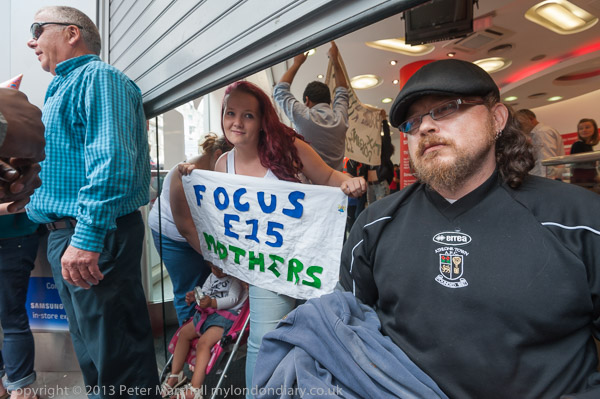
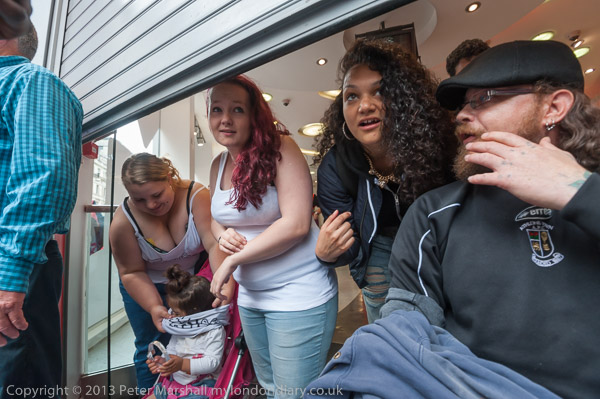
Focus E15 Mothers and Andy Greene of DPAC block the Vodafone doorway

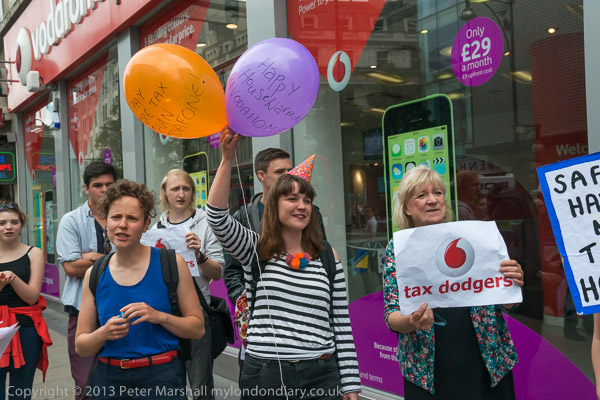
Focus E15 Mums were again to the fore a few of days later, along with a disabled activist from DPAC, Andy Greene, when UK Uncut, a group who seem to have been rather less active recently, renewed their protests against tax dodgers with a party at Vodafone in Oxford St.

The UK Uncut group that met up in Cavendish Square before marching the quarter mile or so to Vodafone were in fact a diversionary tactic, though they actually failed to draw much if any police attention. I’d realised this as we hung around in the square, but hadn’t come to the decision to trust my conclusion and head in advance to Vodafone in Oxford St. I’d checked in advance and we were also within easy walking distance of their Marylebone High St store and I could have missed the action if I’d made the wrong choice.

It was also important not to alert the Vodafone security or the police to what was about to happen. With a largish camera bag and a couple of cameras around my neck I am a little conspicuous.

As we set off and it became obvious where we were heading I did wonder about running ahead – and one of my colleagues did so – but I decided to keep with the leading UK Uncut protesters and to photograph their attempt to get into the store.

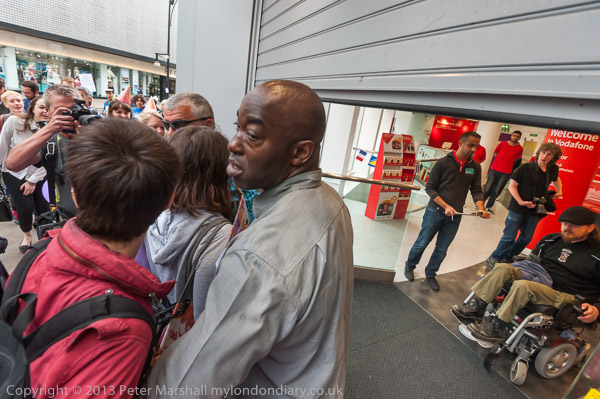
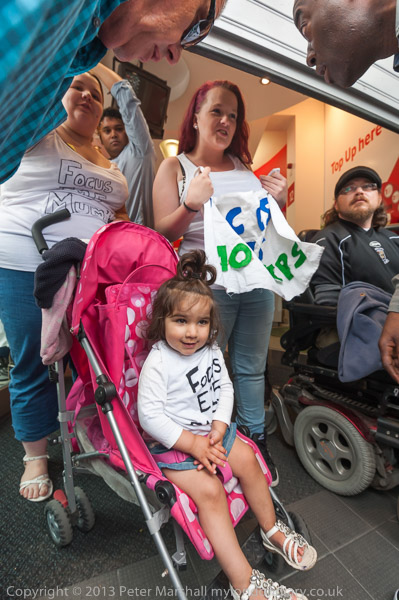
I was just ahead of them as they reached the shop and moved to the right as they were stopped in the doorway so I could take pictures. It turned out to be the right decision as I watched the shutters coming down on the door being stopped as a wheelchair protester moved underneath them. The shutters had to stop, and as they did other protesters from inside the shop, several mothers from Focus E15, one with her daughter, came forward to stand in the doorway facing me.

The situation outside the shop got rather confused, not helped by the security men employed by Vodafone appearing to be rather amateur – and they had no uniforms or ID. When one of them threatened a protester rather graphically I got into an argument with him and he denied having made what was a very clear threat. Fortunately after a few minutes couple of police officers came and quietened things down, though there continued to be some friction between protesters (and photographers) and security over the small area in front of the store doorway which was private property.

I was on the very edge of that private space (and occasionally straying a foot inside it) , close enough to Andy Greene in the wheelchair that I could have reached out and touched him. I would really have preferred to be a little further back – the situation was tight even with the 16-35mm, but if I had moved others – protesters and photographers – would have got in front of me and blocked my view.

After a few minutes of this stand-off, I did move away and photograph the protest party that was taking place on the wide area of pavement outside the store, before going back and taking a few more pictures of those in the doorway. I needed to get down low to get a clear view between two of the security men, which put me at the right kind of level for Safia, Jasmin’s daughter.

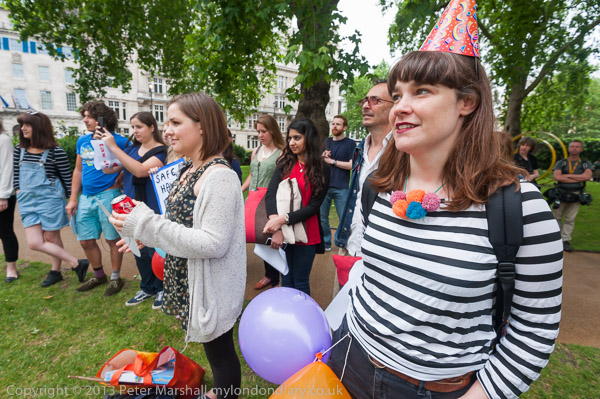
The protesters outside the store continued to have something of a party, passing around non-alcoholic drinks, holding balloons as well as placards and banners, and with the few small children present playing games. There was some music, and people sang a song urging Vodafone to pay the tax it owes, and flyers were handed out on the busy shopping street.

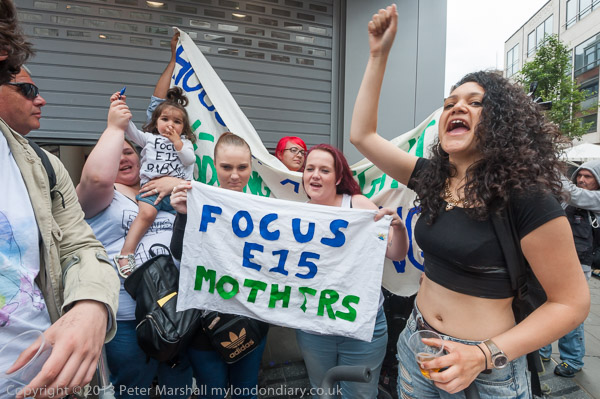
Finally, the protesters inside the store decided it was time for them to come out and join in the party outside and they came out celebrating, with Jasmin coming to the microphone to speak about Focus E15 and  their now much wider protest over housing. Many of the photographers had left by this time, rushing away to file their pictures and missed this part of the protest.

Shortly afterwards it began to rain, bringing the speeches, picnics and childrens’ games to an end as most people found shelter. It soon eased off, but the protesters were beginning to drift away, and I decided it was time to leave too.

More at UK Uncut Party at Vodafone.

Continue reading Focus E15 and DPAC at UK Uncut Vodafone Protest

About Minor and Ray

I’m not sure when I first got to know the work of Minor White. Like many my first introduction to the wide spectrum of photographic history and contemporary practice came through Helmut & Alison Gernsheim‘s ‘A Concise History of Photography‘ from which he is remarkably entirely absent, not fitting the ‘Neue Sachlichkeit’ vision that both focused and constricted their view of the medium.

Probably I had already seen some of White’s work when I got to know Raymond Moore (who got two pictures and an appreciative mention in the Gernsheim’s opus) through a series of workshops with him and Paul Hill at Paul’s Photographers Place in Derbyshire in the late 70s, but it was Ray’s appreciation and understanding of his work that really got me interested. Ten years ago I wrote:

In 1970, Ray read a feature in an American magazine about Minor White. He was already aware of White’s photographs, but the description there of White’s ideas, especially his interest in Zen, excited him as they seemed so similar to his own views. On a sabbatical from Watford, he decided to go to America to visit White, and photographers Aaron Siskind and Harry Callahan, whose work he knew from in books. Ray stayed with White in America and they got on well; Ray saying “It came as something of a relief to find that people felt the same way as I did. I had been interested in Zen for a long time, even while I was a painter, and it was very exciting to see how this had been developed in photography.”

Ray’s work went down very well in America, and he was given solo shows at both the Art Institute of Chicago and George Eastman House in 1970, with a further show at a in Boston gallery in 1971. (Carl Siembab Gallery)

(You can read more of my thoughts and some comments on Ray and the workshops at Remember Ray Moore, posted here in 2010.)

It was perhaps an indication of how little White’s work was known in the UK at the time that I found it very difficult to get hold of a copy of his then out of print major work, Mirrors Messages Manifestations (1969), the only copy that could be located for loan to British Libraries was at the British Library in Boston Spa, which I was required to sign for in blood to be allowed to live with for a month. It certainly changed my photographic thinking at the time.

It was a Facebook post by film-maker and photographer Rina Sherman with a link to Minor Words: Photography and Writing by Michelle Dunn Marsh that sparked off my thoughts about Minor White and led to this post. Marsh’s article, mainly about his sequencing, includes a short sequence of his prints and was written as the first major retrospective of his work since 1987 is on show at the J Paul Getty Museum  until October 19, 2014.

I had been thinking of writing more about White, but a little Googling found to my surprise something I had made earlier,  one of my own articles on White, first published in two parts on another web site in 2001, as  Minor White – Spiritual Journey and Minor White – Equivalents which save me the bother and may still be of some interest. But don’t expect any of the links to work after 13 years – and I gave up maintaining them in 2007.

It is slightly easier to find examples of White’s work on-line than it was when I wrote that piece, but there are still relatively few examples given his importance in photography.

There are some pictures on Luminous Lint, a usefully encyclopaedic site on photography, and also at major museums such as SFMoMA (only 10 of the 26 images in their collection have images on-line) and MoMA, but I was able to find very little at the Princeton University Art Museum which houses the Minor White Archive and has loaned 30 pictures to the retrospective. The largest collection on line is at the Art Institute of Chicago which has around 50 images on line, but on a disappointingly small scale.

There is of course an article about him on Wikipedia, and also some images on the Masters of Photography site as well as scattered images elsewhere across the web. You can also read John Szarkowski’s comments on White from ‘Looking at Photographs‘ where White’s Capital Reef, Utah, 1962 was reproduced, along with some other of his pictures at Atget Photography.

Work by Raymond Moore is harder still to find. His archive, prepared at considerable expense after his death by his young widow, Mary Moore Cooper, failed to find a buyer (another reflection of the lack of interest in the UK cultural establishment in photography) and his negatives, contact sheets made from them, drawings, correspondence, publications and between 700-1000 prints – estimated according to a Guardian article in 1990 to be valued at £440,000 – still so far as I know languishes in store at Sothebys.

Focus E15 Mums at the Carpenters


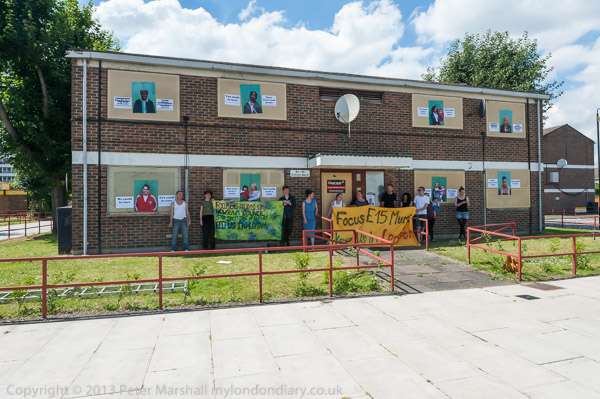
Most of the posters were put up on this one building, though others around were empty too

It’s always interesting when different stories I’ve been following come together. I first got to know the Carpenters Estate when I was photographing around the River Lea and the navigation and back rivers in the 1980s, though I don’t recall actually taking pictures as I walked through. It wasn’t really the kind of subject matter that particularly interested me at the time – a quiet, well planned and solidly built post-war council estate with three point blocks – that just happened to be on my route to and from Stratford station.
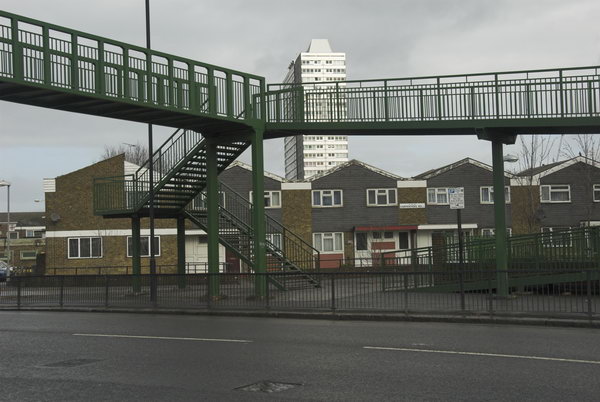
Carpenters Estate, 2007

I photographed a few things around its edges – the footbridge over the railway became a part of my Greenwich Meridian project (along with the then new Stratford Bus station) in the 1990s, along with the deserted rivers and canals and pockets of thriving industry to the north and west.
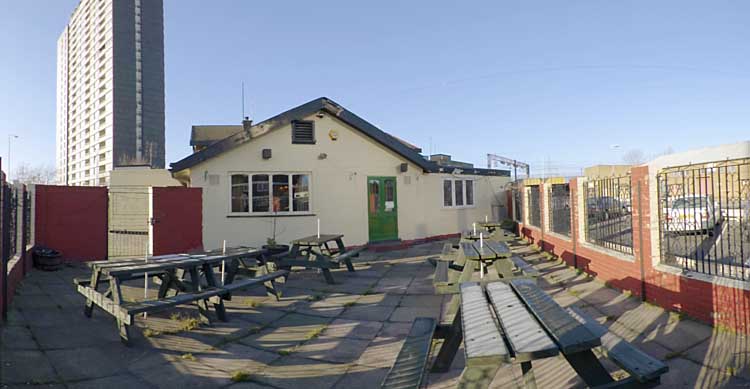
Pub garden on Carpenters Estate, 2005

If one had wanted a textbook example of a council estate that worked and that people were happy to live on, this would have served. But in the early years of this century things changed dramatically. Newham got involved with the London Olympic bid, and suddenly this large area on the Olympic fringe became for the council a very desirable investment opportunity rather than a successful social housing.

Of course they had to find a reason for wanting to close the estate. Like everything else built in the 1960s, the buildings – and particularly the point blocks – contained asbestos. Mostly of course this remains entirely safe unless disturbed (I write looking out over an asbestos roof.) But it was a good enough excuse, and with a report saying it was too expensive to remove it, they started the process of clearing out tenants from the estate.
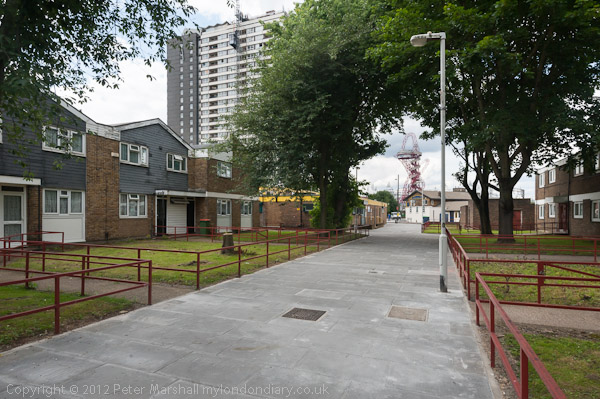

Good solid 1960s housing on a pedestrianised street on this popular estate

Most if not all the tenants were persuaded in various ways to leave, but many of the residents had taken advantage of the ‘right to buy’ and were (and are) keen to stay on. Residents formed an action group and were active in the estate tenants management organisation – until the council rigged the elections to this and disqualified most of them. So the estate has now had perfectly sound, safe properties empty and sealed up, some now empty for eight years, while Newham has one of the largest housing problems in London.

Newham Council’s next plan was to sell the whole area to University College London for a new campus, possibly retaining some of the large buildings for student residences. And somehow, magically, it became possible to clean out that asbestos.
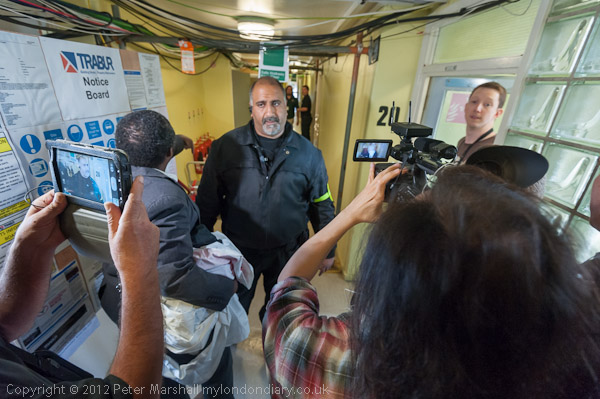

I take pictures of a BBC security man blocking our access from the back of a lift on the 20th floor

I came back to Carpenters just before the Olympics for a tour organised by local residents in Carpenters Against Regeneration Plans (CARP), which ended with a farce as security men employed by the BBC attempted to refuse residents (and their guests including myself) entry to tower block Lund Point where the BBC were using some empty flats for their Olympic coverage. At first police and PCSOs supported the BBC, but later more senior officers told the BBC heavies they had to let us in. We had another fight with them to get to visit a second flat on the 20th floor.

Now, thanks in part to protests by students and academics as well as local opposition, the UCL plan has fallen through, and the council for the moment appears to be allowing some short-term tenancies on the estate, probably before selling parts off for piece-meal private development.
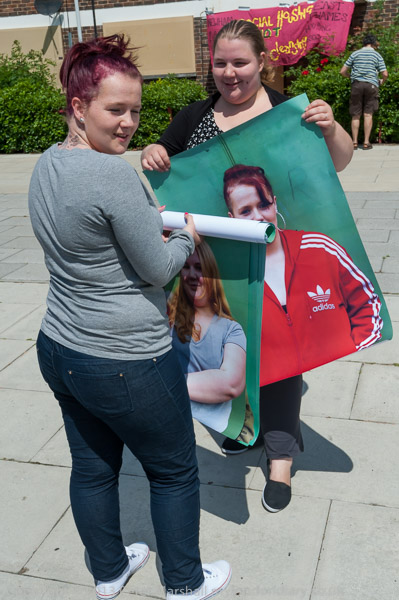

Sam and Jasmine of Focus E15 Mums unroll large posters of Jasmine and Sam

Meanwhile many in Newham are desperate for housing and unable to afford the increasingly stratospheric prices and rents being asked for the new properties being built by private developers, selling mainly to wealthy employees in the City, a short train or bus ride away. Newham residents are being forced out of the area – the poor are no longer welcome in the borough.

Among those the council has tried to force out are a small group of mothers and children who were living in the Focus E15 hostel, who got together after being told they were to be evicted and stood up and fought when they found the council wanted to send them away to Birmingham and elsewhere, away from families, jobs, courses and support.
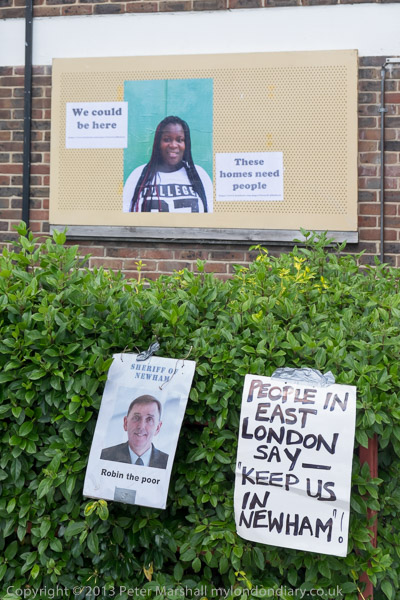

Mayor of Newham Robin Wales on a poster ‘Sheriff of Newham – Robin the poor’.

Their lively campaign has horrified Newham councillors and inspired many others in housing need, and has become a much more general campaign against what they describe as ‘social cleansing’. The E15 mums and others on Newham’s housing lists would love to be rehoused in the empty properties on the Carpenters estate (or other empty council properties in the area) and came to make that point, bringing photographs of themselves and their children along with other posters and paste.
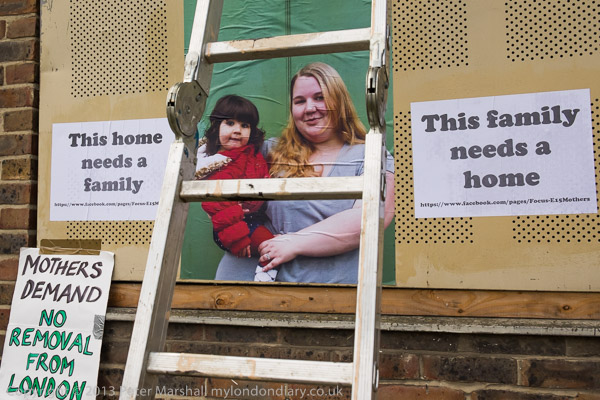
Jasmin and her daughter look out from a poster.

I photographed them putting up the posters on empty properties surrounding a square on the estate, where they were joined by a few residents and former residents. One of them lent them a ladder so they could put up posters on the first floor too. The posters speak for themselves – and it wasn’t very long after the protest before the council, annoyed by the publicity, sent workmen along to take them down.
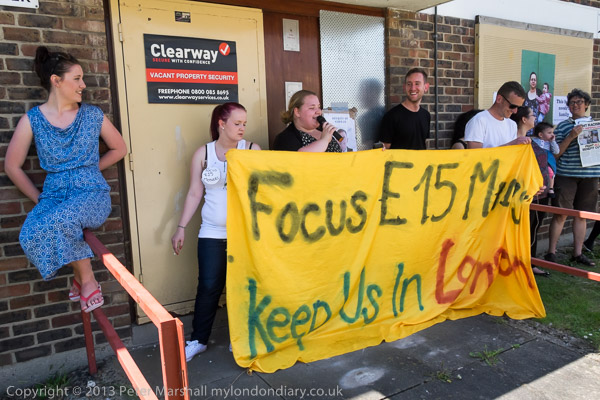
Photographically I had a problem. Overall images – like that at the top of this post – left the posters and banners too small to read in any size likely to be used in a newspaper or magazine, and I found the red railings in front of the block too obtrusive, but I didn’t really manage to find another single image that represented the protest. There were quite a few pictures that I liked, but I did rather feel I had failed to solve the problem. See for yourself at Focus E15 Mums Expose Carpenters Estate.

Continue reading Focus E15 Mums at the Carpenters
Shocking Gaza – Romenzi

The news from Gaza has certainly been shocking, with now well over a thousand Palestinians, mostly innocent civilians, including many children now known to be killed. Of course we should grieve too for the Israelis who have died – mainly soldiers – but the figures point to the disproportionality – this is not a war but an entirely out of proportion one-sided punishment of the population of Gaza. The consequences of the attacks on heavily populated city areas with the weapons being used – even if every one was accurately targeted – are inevitably large numbers of civilian deaths. If you’ve not seen it, watch Jon Snow‘s report which makes this crystal clear – though it does contain some disturbing images. I was pleased I wasn’t watching in HD.

Although I don’t find it easy to look at the pictures and videos which are coming out from Gaza, I think it is important that brave journalists are going there and sending them out.  Today I read that another journalist I admire, Paul Mason, is now in Gaza and reporting for Channel 4.

One of the sets of photographs which brings home what is happening there to me appeared a few days ago in Time Lightbox, Innocents in the Crossfire: Alessio Romenzi’s Shocking Photographs From Gaza, work by a 40 year old Italian photographer who has spent the last five years in Israel and Palestine.  There isn’t a great deal of gore in the images,  though an enormous amount of destruction in the background, but for me they bring me very close to  the people who are suffering in Gaza.

I’ve just spent two days photographing protests in London about what is happening in Gaza, and the realities of the situation seem now to be getting through – even through the media smokescreen that seems to prevent the BBC from hearing what its own reporters are telling it about the situation. One thing that impressed me about yesterdays protest – by around 50,000 people – was the strength of the feeling among many Jews in the protest that Israel – as one speaker put it – “is not behaving as a Jewish state should.”  Over 600,000 people have read Naomi Wolf’s statement on Facebook about why she is “mourning genocide in Gaza.”

As I write this, the latest figures for the Palestinian deaths are 1032,  with the BBC reporting the total number of Israeli deaths as 40 soldiers and two civilians. A Facebook post today pointed up the reason for these very different figures:

Israeli Tanks – 3930 – Palestinian Tanks – 0
Israeli F-16 Fighter Jets – Palestinian F-16 Fighter Jets – 0

By the time you read this, the figures for deaths will doubtless be higher. Surely it must be time for peace.

You can see more of Romenzi’s work from Gaza and elsewhere on his Photoshelter site.

Sikh Freedom

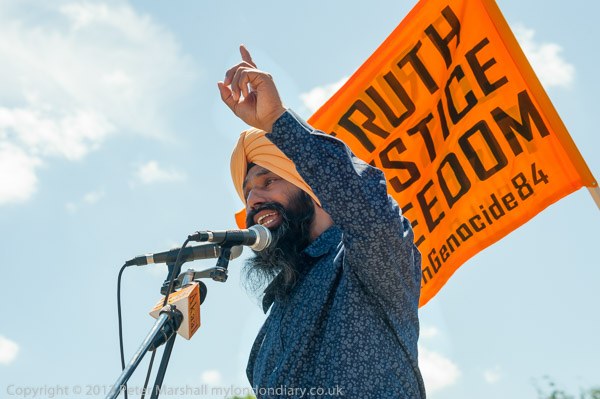
It was I think in 2004, on the 20th anniversary of Operation Bluestar, when Indian troops invaded the Golden Temple as Amritsar, killing several thousand Sikhs that I first attended and photographed the annual Sikh Freedom march in London, and I wrote about the issues for the first time on My London Diary. Then, a number of British politicians came to give their support, but since then it has been an almost entirely Sikh event, which I’ve photographed most years when I’ve been in London at the right time.

The pictures I took then have a rather faded look to them, though that is more a reflection of my own changing tastes and the particular RAW software I was using at the time than their age. Going back to the RAW files now I would certainly get a rather more punchy result.

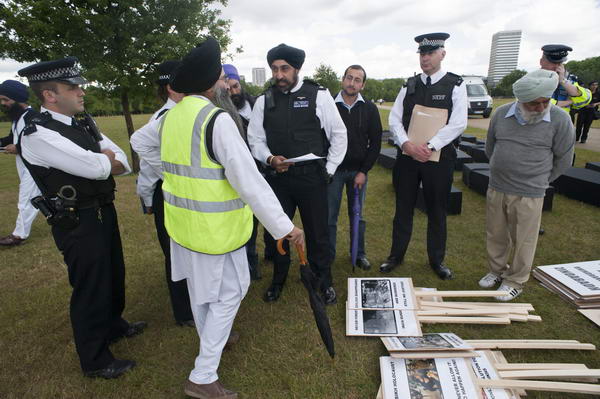
It is an event that has changed just a little over the years, at times becoming more overtly political in its support of Sikh militants fighting for freedom. In 2006 some of the police made quite an effort to harass photographers – including me – who were trying to photograph the event.

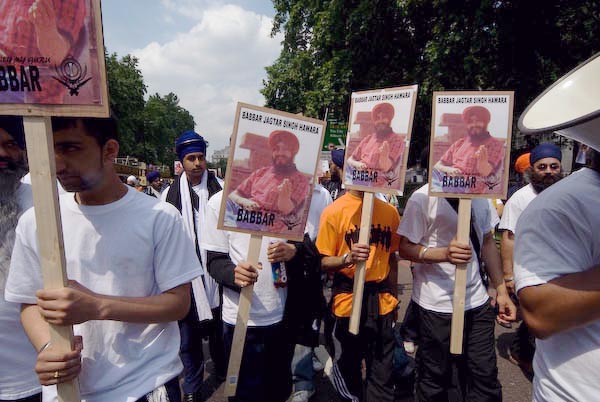
In 2007 there was a large group of supporters of Babbar Khalsa the Khalistani militant armed organization which both India and the UK regard as a terrorist organisation on the march, perhaps why in 2009 the Met brought in a Sikh officer to censor the placards carried on the protest.

The placards since then have been a little less explicit and In 2014 I saw no problems with police.

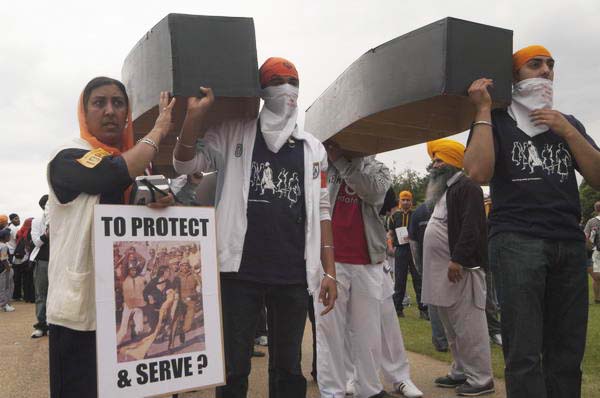
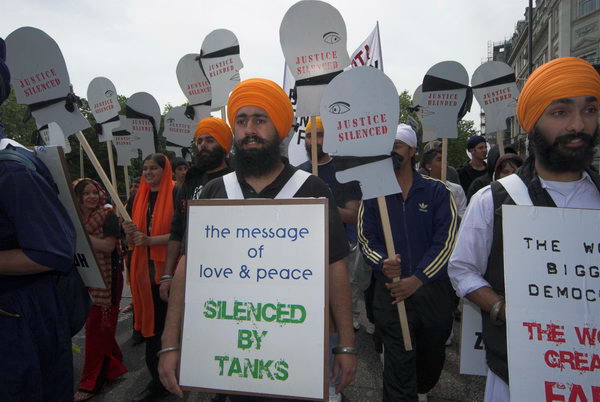
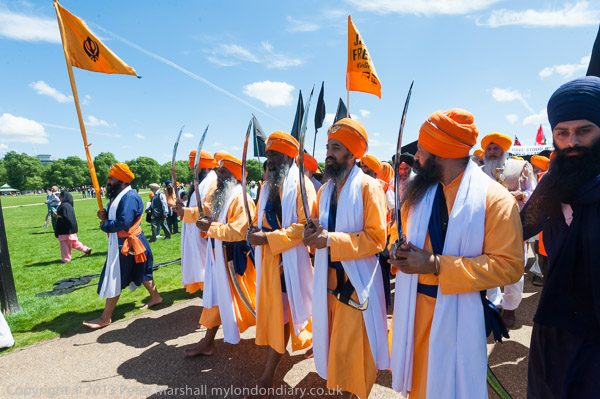
This year’s event followed the same pattern as previous years, with a long rally in a hot and sunny Hyde Park, followed by a march led by five Khalsa in their saffron robes with their ceremonial sword and with black flags and coffins behind them followed by a great mass of protesters.

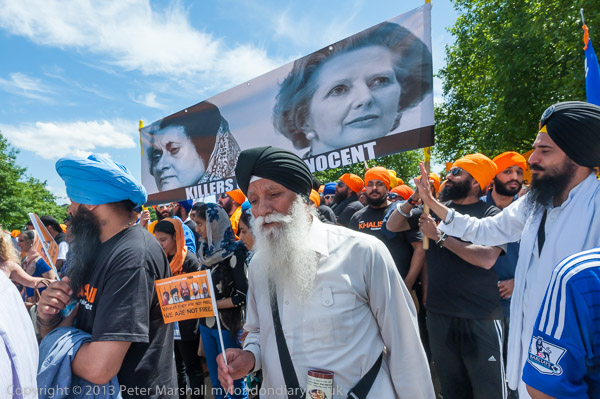
It was perhaps a little larger than in some years, and there did seem to be more large banners calling for freedom and an end to the genocide by India. These included some with the message ‘Thatcher has Sikh Blood on her Hands’ while another showed two huge portraits of the villains, Thatcher and Indira Gandhi with the message ‘Killers of the Innocent’.

More pictures from 2014 at Sikhs march for Truth, Justice & Freedom.

Continue reading Sikh Freedom

Prison Pictures

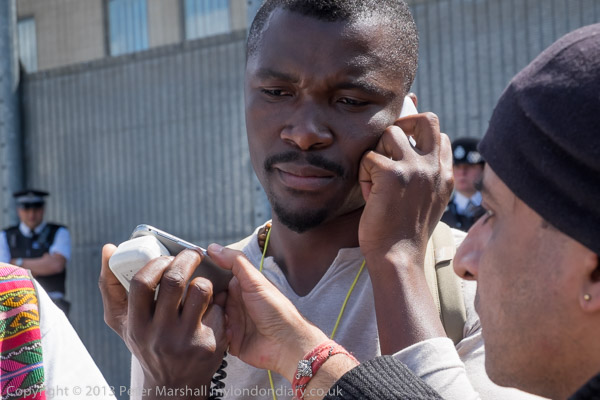
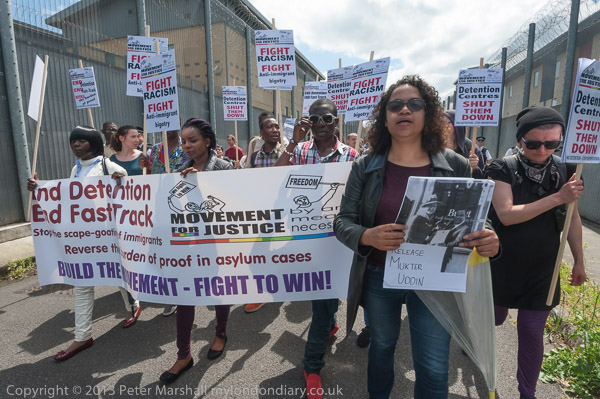
I’ve several times photographed protests outside one of Britain’s immigration prisons – though we don’t officially call them that, and those detained inside have some freedoms denied to prisoners in our other jails. So when the protesters arrived outside the buildings they were able to contact some of the prisoners inside over mobile phones.

In the picture above, two prisoners are speaking to the protesters outside over the phone. One of the protesters holds a mobile phone up to the microphone so that his message is relayed to the protesters, while the man holding the microphone is also on the phone to another man inside the detention centre who will be heard later.

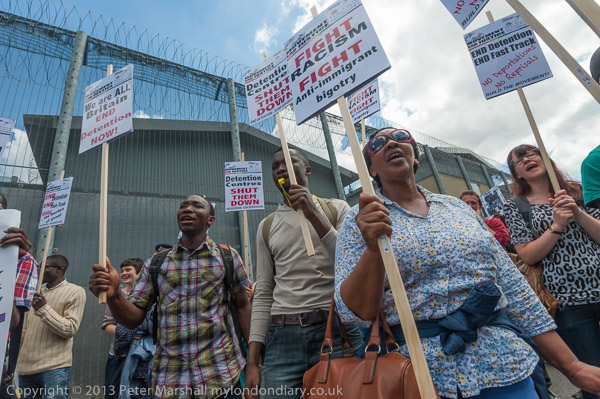
As well as trying to show this, I also wanted to show that the protest was being watched by police, standing back against the tall fence surrounding the prison. Above the 10ft or so of metal sheet is another 10 ft of stout wire mesh, topped by razor wire, ant through this mesh you can see the windows of the detention centre.

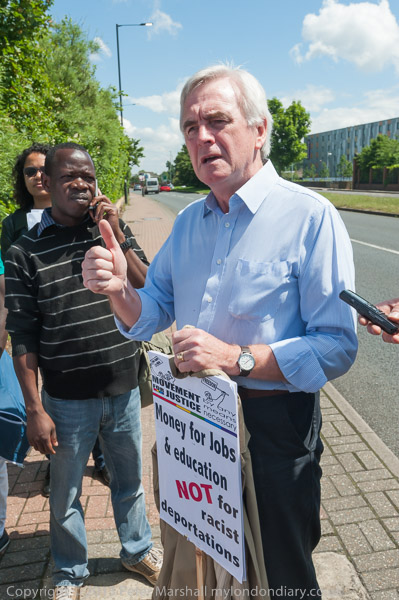
The protest had begun on the main Bath Road – the Harmondsworth and Colnbrook immigration prisons are just on the north edge of Heathrow. The local MP, John McDonnell, had come to express his support for the campaign to end ‘fast-track’ deportations – a method designed solely with the aim of deporting asylum claimants before they have time to put a case together to be allowed to remain – before leaving to speak at an event in central London.

Police had come and asked the protesters what they intended to do, and although there was considerable reluctance to talk to the police – or for anyone to say they were organising the protest – had made it clear that so long as the protesters simply walked around an made a noise they would “facilitate their protest.”  And at least for the hour or so I was there they simply followed, watched and wrote in their notebooks.

And the people – around thirty of them – certainly did make a lot of noise, shouting, whistling, banging pots and pans and using the megaphone – and the response came back from inside, with men in both Colnbrook and Harmondsworth centres (the two are separated only by a roadway the protesters walked down) obviously very pleased that someone in the world outside their prison cared about what was happening to them.


D700, 70-300mm at 190mm (cropped) ISO 800, 1.800 f7.1

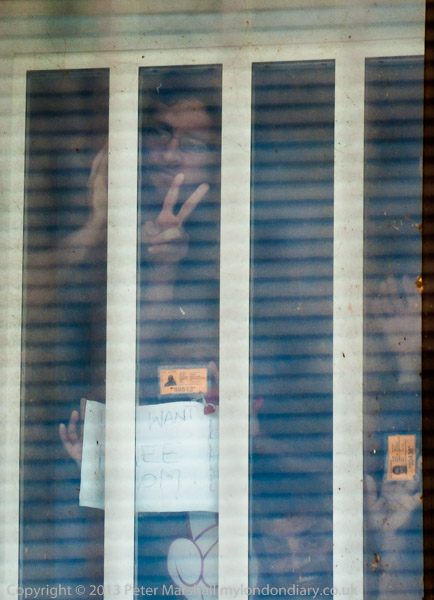
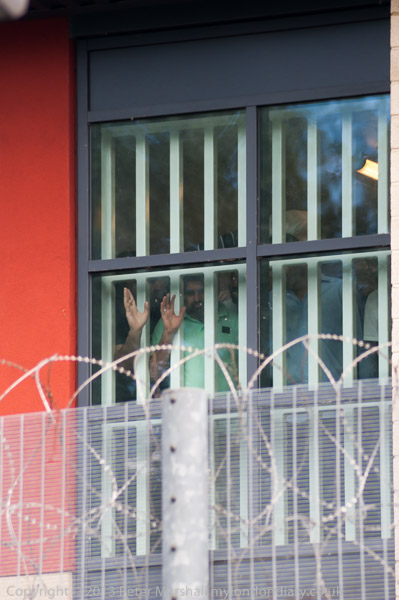
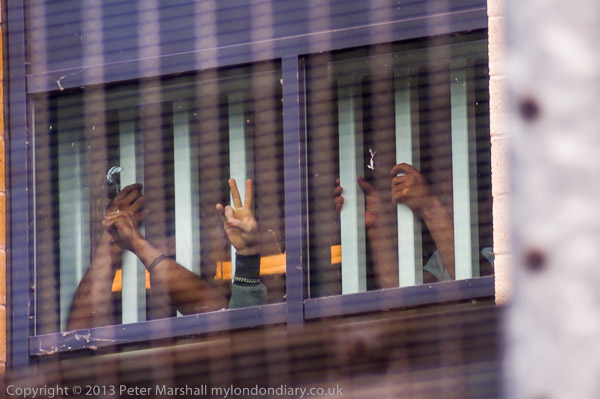
Some were able to come to the upper window and press their faces and hands to them. Some held up their prison ID cards, others wrote messages including their phone numbers so those outside could contact them. The windows were high up and some way away, only visible through the wire mesh, and it was difficult to photograph them.

Autofocus failed dismally, focussing on the mesh fence or simply hunting. I tried the 18-105mm DX on the D800E (27-157mm equiv) and the 70-300mm , mainly on the D700. Working with manual focus isn’t too great on either lens – they and the cameras are designed for autofocus and it was actually very hard to tell the exact point of focus. Most of the pictures I made were at least slightly unsharp, but I’d realised this was likely to be the case and had taken far more frames than I usually would. The images after post-processing are far clearer than when I was taking them.


D700, 70-300mm at 300mm (cropped) ISO800 1/320 f7.1

When the protesters went around to the west side of Harmondsworth things were a little easier, as by moving to the back of the car park I could see the upper windows over the top of the razor wire. But these are from quite a distance, severely cropped from the original images. The strongest images were still I think some I made through the wire, with one of the men inside making a ‘V for Victory’ sign.


D700, 70-300mm at 300mm (cropped) ISO800 1/400 f8

The post-processing needed to get these images was extensive, including a large increase in contrast – not least because the windows are not very clean. Quite a lot of work with Lightroom’s Adjustment Brush was needed. The colour is certainly not very accurate, and in My London Diary you can see some fairly similar images from these window pictures where I’ve done more or less work and ended up with some quite different-looking colour.

I wasn’t entirely clear about my legal position in making these pictures, but I had no doubts about the moral position. These men clearly wanted to be seen and to be recorded, and there is a clear public interest in what is happening inside these centres – which you can read more about in Support Detainees in Harmondsworth.

Continue reading Prison Pictures

Skinningrove

Although I’ve written a few times over the years about the work of Chris Killip, the problem that I’ve always faced is that so little of his work is visible on the web. Most of his books too are out of print*, though I have several on my shelves. Although in the last few years he has become a little more visible (and his show at the Photographers’s Gallery in 2013 was one of their lamentably few highlights in recent years) he remains rather obscure compared to many other photographers. (And no, he didn’t win the prize, which went to a pair of people who had made a book using other people’s images – which wasn’t without interest, but this is supposed to be a photography prize.)

Killip,  a professor of visual and environmental studies at Harvard where he has worked since 1991,  has deliberately chosen to keep his photographs so far as possible away from the web – as his own web site clearly shows. I’m sure too that he could have done far more to make his work available in print. You can see an illustrated review of his Seacoal (apparently still available) on The Photobook,  a three pictures from our ridiculously small Arts Council Collection in the UK National Archives, and rather more in various exhibition listings and reviews.  You could also try a search using his name on Google Images, though as always not all the pictures this returns are by him.

Thanks to PetaPixel, and the short post Chris Killip, (mainly as it makes clear an excerpt from an Aperture interview with him) linking to a note in the NYRB, I’ve just been watching a short film, Skinningrove, with Killip speaking about and showing his work from this small North Yorkshire, fishing village. It’s well worth watching.

One of the pictures shows a secondary teacher with boys sketching on the beach, and Killip says that he is actually a photographer, who has to teach for a living, and names him as Ian Macdonald. You can see some of his work on Amber Online.

______________________________________

*The paperback edition of ‘Isle of Man’ is likely to cost you £250 or more, with the hardback being rather more.  I think ‘In Flagrante’ may cost around the same. There is also a study of ‘In Flagrante’ available from Errata Books rather more cheaply.