A long pink scarf


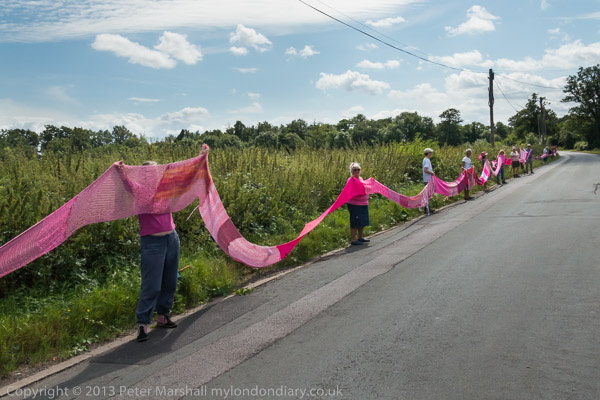
A short section of the seven mile scarf after joining

Seven miles long – and they had a bit left over. CND’s Wool Against Weapons protest on Nagasaki Day, 69 years after the second atomic bomb was dropped on Japan, stretched all the way from the atomic bomb factory in Burghfield to the better-known site at Aldermaston, both in rural Berkshire.  Neither end is particularly easy to get to by public transport, though I have at various times walked most of the way from London to Aldermaston, (including the final Reading to Aldermaston section of the CND Aldermaston March in 2004) it didn’t seem sensible to try to cover a 7 mile long event entirely on foot.
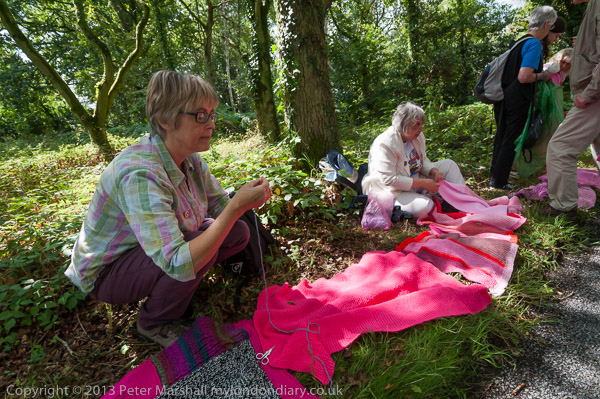

Joining the lengths of scarf at the roadside

Hand-knitting or crocheting a scarf of this length and getting it into place clearly needed a great deal of planning and coordination. If people were knitting a 5 ft scarf you need a thousand of them for each mile and one of the major points about the protest was to get a great many people around the country – including many who for various reasons are unable or unwilling to get out on the streets – to participate. Groups around the country organised the knitting and brought the scarves joined together in rolls of around a hundred foot to centres along the route, from where they were stretched out and joined together.  Along the route there were ‘mile posts’ with small groups coordinating the event and some serving tea and coffee and snacks,  each one allocated to a different region.
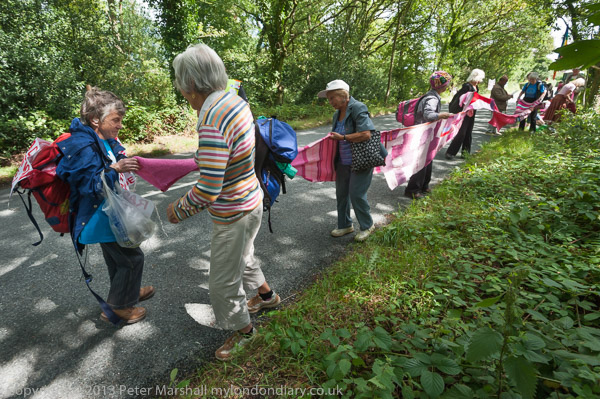

Rolling out a spool of joined scarf lengths along the route

I could have got a lift to the route from the nearest rail station – Mortimer – but decided I needed to be more mobile, and the ideal way for the kind of distance and roads involved was a bicycle.  It would have been a long ride from home, but was easy to take it with me on the train to Reading, with Burghfield, where the London Region of CND was meeting a around half an hour’s ride away.

I’d planned it so I could take a relatively slow ride along the whole route, jumping off my bike wherever I saw an opportunity to take photographs, stopping at all of the mile posts to photograph what was happening there, and also between them where people were rolling out and joining up the scarf.  A bike has the great advantage that you can jump off anywhere, lean the bike against a fence or a tree or on the ground and take pictures. The route was along narrow country roads – some quite busy with traffic – and with relatively few places where it would be easy to park a car, particularly as the police were intent on keep traffic moving along the road as well as avoiding the protesters becoming roadkill.  It took me around 75 minutes to cover the 7 miles to the fence of the site at Aldermaston.
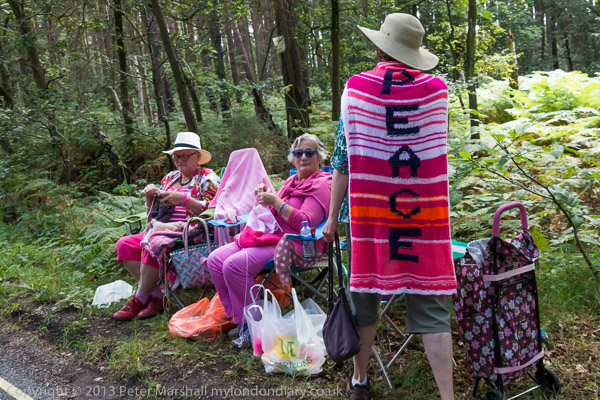

Two women were still knitting away at Aldermaston. Eventually the scarves will be turned into blankets for refugees

I’d wanted to be sure to cover as much as possible of the activities involved in the protest, and arriving at Aldermaston I was pleased to find a couple of women still knitting scarves, as well as a large display of various banners tied to the fence and to roadside trees.
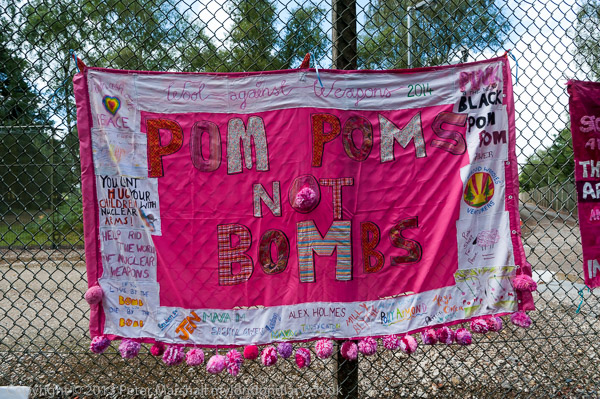

‘Pom Poms not Bombs’ on the fence at Aldermaston AWE

Going back to Burghfield was considerably faster – helped by a little wind and a longish downhill stretch, but mainly by only stopping once to take a few pictures – I made it roughly three times as fast. I even sped past the turning to Burghfield, but quickly realised my mistake as there was no roadside scarf, and had to brake and turn around.
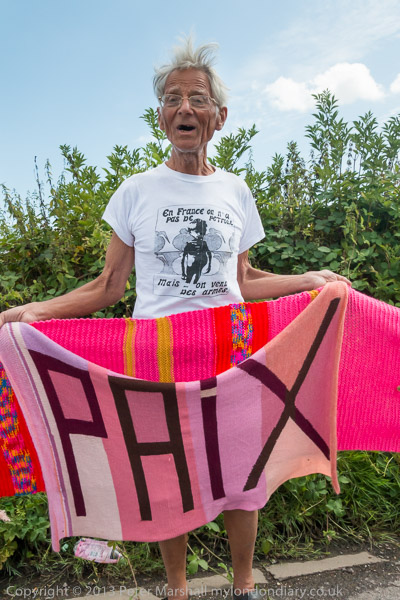

Anti-nuclear protesters from France joined in and had knitted some scarves

The event had been planned to reach its climax at 1pm exactly, and stewards were phoning anxiously to check along the route that the whole length had been joined. They got the message just in time and everyone along the route was lifting up the scarf and making a lot of noise with bells and whistles.  I’d decided to run along and take pictures of as much as I could during the few minutes they would keep this up, keeping on foot as there would be people to photograph every few yards of my way, and this worked well. Stopping to take pictures meant I only covered a little over half a mile, although I got quite exhausted from running with a heavy bag between the frequent stops to take pictures.
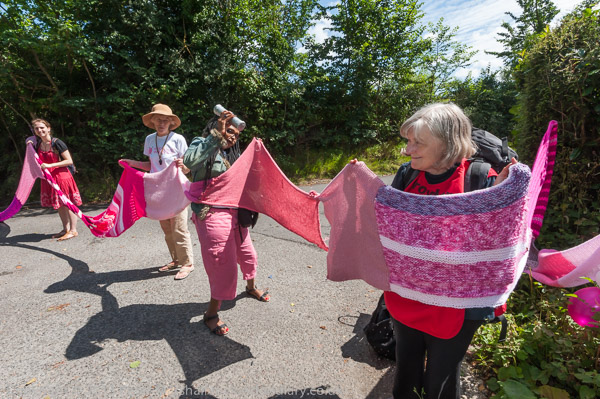

Dancing with the scarf where it crossed a minor side road on the route

I stopped and talked with one group who were holding the scarf at a minor road junction  – lifting it up over a car that wanted to go down the side road, and dancing around the rest of the time.  The sun was coming almost directly from behind them and their shadows were dancing with them on the road.  The strong back-lighting took a little work in Lightroom to get the results that I wanted, but there was no way I could have used flash fill with a group strung out away from the camera.
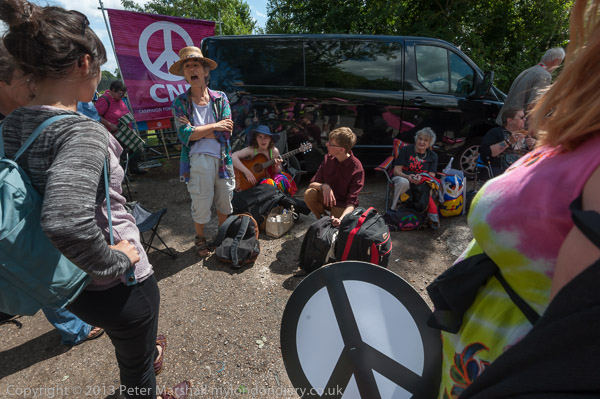

CND symbols and Pete Seeger’s ‘Where have all the flowers gone?’ took me back to the sixties

Back at the Burghfield base things were very much getting back into sixties mode – I’m sure they were singing ‘Where Have All the Flowers Gone?’ when I took the picture above and there were other songs and poetry readings, as well as some political speeches. I sat around for a while to recover from my run up the lane and back and after listening to CND General Secretary Kate Hudson decided I had the energy to cycle back to Reading for the train home and the lengthy editing of my pictures.

I was quite pleased with the set of pictures, taken with my usual Nikon D700 with 16-35mm and D800E with 18-105mm DX, though more for the overall view they gave of the event than for any individual images, though I had a nice set from my run after the joining up had been confirmed.  But there were one or two places where back home looking at the pictures I could clearly see I’d missed an opportunity. The most glaring was at the Aldermaston fence, where I hadn’t recorded the longest and largest banner in a single image.

I’ve got ‘What would you spend‘ in one frame and ‘you spend £100 million on?’ in another, but really getting the whole thing together would have been rather better!  If I’d taken them from the same place with the same focal length I could have joined them up, but rather better would have been to have used the 8mm fisheye to get it all in a single frame.  I was just in too much of a rush, too worried about actually making it back to Burghfield, and not realising quite how much faster my return journey would be.
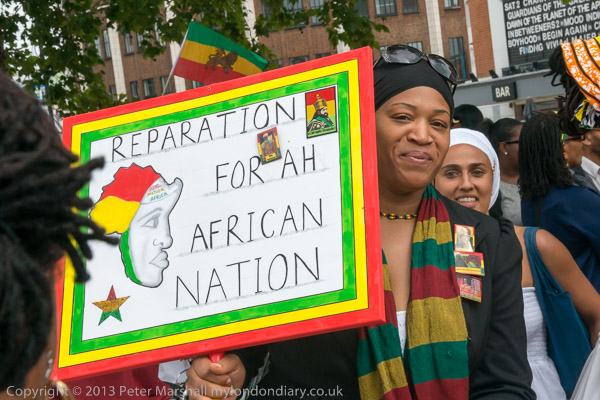
Wool Against Weapons.

Continue reading A long pink scarf

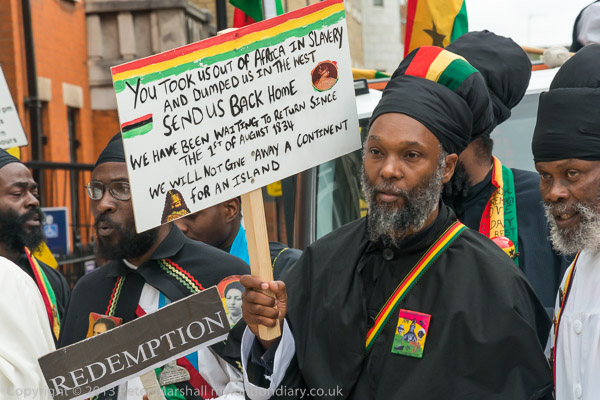
Marcus Garvey Centenary

After working and studying in London, Marcus Garvey returned to his native Jamaica in 1914 and on 1 August founded the Universal Negro Improvement Association (UNIA) to unite all of Africa and its diaspora into “one grand racial hierarchy.”  The movement flourished when he took it to the USA and in 1920 claimed 4 million members.  August 1 had been chosen to found the organisation as it was Emancipation Day, the anniversary of the legal ending of slavery in the British Empire in 1834.

The slave trade had been banned in 1807, and two hundred years later I had photographed events commemorating this in Central London and in Kennington, Brixton and Clapham, which I described as “the spiritual and physical home of the abolition movement.”

As I wrote then, “fortunes made from slavery helped to build many of the institutions from which we still benefit, including our many of our great galleries and museums. Slavery founded many of our banks and breweries and other great industries, and made Britain a wealthy nation.” All of us in the UK – black as well as white – benefit from this legacy, even if, as I also pointed out, “the same wealthy elite that treated Africans so callously exploited the poor in Britain. My ancestors were thrown off their land and probably some were imprisoned for their religious beliefs by these same elites.”


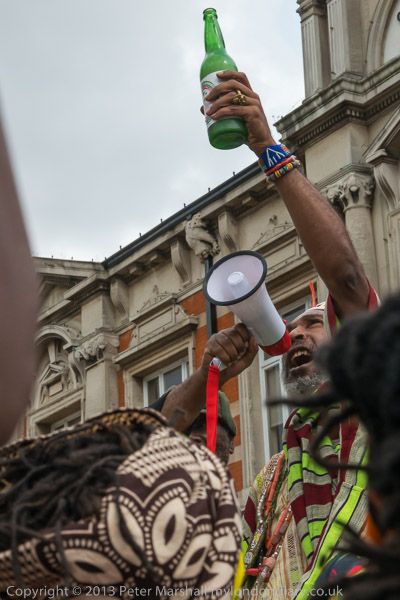
The bottle is of African Palm Juice, traditional for libations in many West African ceremonies

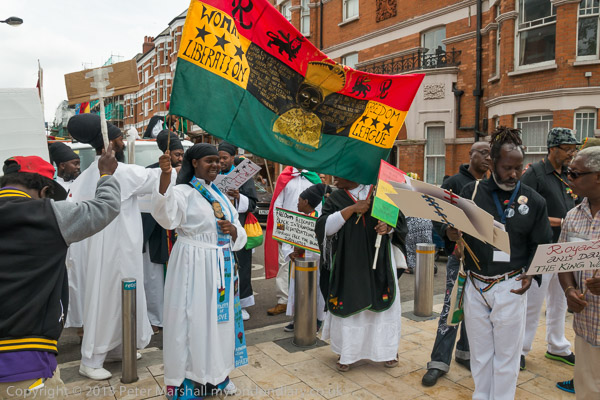
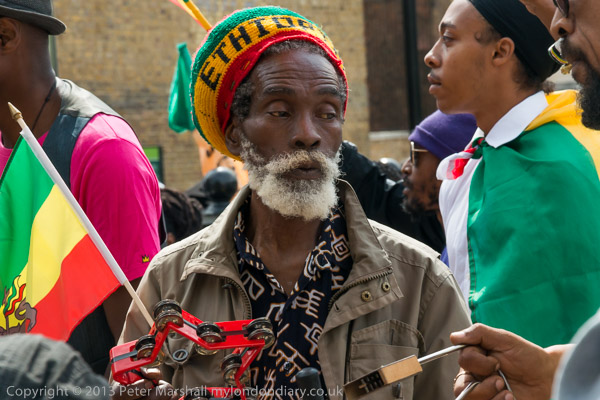
Since at least 1999, some African organisations and countries have been pressing for compensation to the descendants of those who were enslaved by the Atlantic Slave Trade, and the Marcus Garvey anniversary event in Brixton was a gathering before a march to Parliament to present a claim for reparations.

Among those at the event were a number of people who recognised me and greeted me, and a few  who wanted to know why I was taking photographs – who I was working for. As usual I answered them politely, telling them I was a freelance photographer with a particular interest in London and its communities and in protests, and that my work went into agencies and could be used in newspapers, magazines and books, and almost all seemed satisfied. Except one man, in pseudo-military garb, who felt that my presence as a white man at this event wasn’t appropriate, and threatened that some people present might violently object. But others were much more welcoming and clearly happy to be photographed, some asking me to take their pictures.

I’d hoped to photograph the start of the march but things seemed to be running rather late and I had to leave to cover another event while the speeches were continuing.

Pictures and Text: Rastafari demand reparations for slave trade
Continue reading Marcus Garvey Centenary

Stowage Now

I was going to meet a couple of friends for lunch in Greenwich today and stopped off in Deptford to photograph some of the areas I photographed back in the 1980s, including the scenes in yesterdays post Stowage, Deptford.

It was hardly possible to recognise the area which has almost completely changed. Apart from an Electricity sub-station on Stowage itself, about the only buildings left standing are a couple of pubs on Creek Road.

And sadly, one of them, The Hoy, open as a pub for a couple of hundred years,  now appears to be a trendy café, though I had neither time nor inclination to examine it more closely.

To the south of Creek Road there are still just a few of the old industrial properties, but they are now behind hoardings and the yards between them and the river a dense overgrown wilderness, doubtless soon to be replaced by flats.

Mostly the area is tall slabs with a lot of glass, and down the alleyway between them you can just see the Laban building.

Images in this post are panoramic with a roughly 146 degree horizontal angle of view, taken on the Nikon D800E.  They have an aspect ratio of roughly 1.5:1, and normally I make use of this to provide the equivalent of using a rising or falling front by cropping the image to around 1.9:1, but here I’ve used them without cropping.

With such a wide angle of view, on sunny days the sky varies considerably in brightness across the frame, and at times the sun is actually inside the frame.  With the bottom image, I made the exposure as the woman walked into the frame. Afterwards I moved slightly to put the front of the lens in the shade of the lamppost which is on the right edge of the image, but by then the woman had moved out of sight.

Quite a few of the panoramas I make start with a reaction to the scene like this, which I then try and re-make more carefully, particularly getting the camera more accurately level. With the D800E you can display visible markers at the centre of the right hand viewfinder edge and the bottom centre which show lines when the camera is tilted and a small triangle when the camera is level. Getting both to show a triangle can sometimes be difficult, but unless the camera is level both side to side and front to back it’s hard to get a straight and level horizon.

When I catch up with things, my full set of pictures from Deptford and Greenwich today will appear on My London Diary.
Continue reading Stowage Now

40 Years

The first time I wrote about Nicholas Nixon‘s series ‘The Brown Sisters‘ I think was when the project with an annual photograph of the four of them – one the photographer’s wife –  had been going for 25 years. At the start of this month the New York Times published the 40th in the series at the bottom of an article in the magazine, 40 Portraits in 40 Years, written by Susan Minot.  In November 2014, the Museum of Modern Art in New York, MoMA, is holding a show of the 40 images and publishing the book, The Brown Sisters: Forty Years.

It seems to me to be remarkable enough that the five people concerned, Heather, Mimi, Bebe, Laurie (always shown in that order, left to right) and the photographer, have actually managed to get together every year for a photograph since the first in 1975, certainly not something we could have managed in my own family. The photographer was born in 1947 and so is now 66 or 67, and the sisters must be not that different in age. And remarkable too that it should have resulted in a series of such quality (though I find a few a little weak compared to the others.)  There are links to more of the pictures in a recent post here about a series of annual self-portraits by Lucy Hilmer, which she began the year before Nixon’s Brown Sisters.

I first became aware of Nixon’s work when he was included in an exhibition in 1975 at George Eastman House curated by William Jenkins called “New Topographics: Photographs of a Man-Altered Landscape.” I didn’t get to Rochester to see the show, but I read about it and saw pictures from it in magazines and books, as well as a couple of years later attending a workshop with one of the other photographers involved, Lewis Balz, who talked about  and showed work by those in the show and others working in a similar vein. A few years later I bought a small publication, Nicholas Nixon, Photographs From One Year (Untitled 31); the year was in 1981-2, and the book came out in 1983. Some of the pictures from the book are in the MoMA collection (organised by date – start here – but not all images here from 1981-2 are in the book.)  The title and format of the book reflected Nixon’s desire to deliberately set himself different goals for each year of his work.

The 39 plates in that book are finely reproduced more or less actual size from Nixon’s 8×10″ contact prints, and it is a superb set of pictures of people in and around their homes in some of the less affluent districts of American cities, with an introduction written by photographer Robert Adams. Inside my copy are some brief notes made for when I was talking about the work to students, including this about the apparent relation between Nixon and the groups of people he was photographing:

They are not the ‘subject’ but with him part of the act of photographing. And it is an act which does not simply restate the beauty and sensuousness of natural light correctly pictured, but respects and affirms those within its frame.

Copies of this thin book, 48 pages in all, are still available for from around £3 second-hand (a fraction of what it cost me, as the cover price of $16.00 would have meant it was on sale for £16 or more here), and it is well worth buying, even though postage may double the cost.  It may well appreciate shortly, as one dealer is already asking over £50 for a copy.

Bad Advice

F-Stop Lounge isn’t one of the photography sites I read regularly, though it does sometimes have interesting articles. As its name suggests it is somewhat technically oriented and also a slightly clubby kind of place. The aim of its founders was to create “a site that inspires to bring the photographers of the world together” and the site contains “an array of inspirational photographs, insightful real world reviews, detailed tutorials and helpful hints & tips about photography.” I’m not sure why, but there is something about that which makes me want to run a mile.

Having said that, there are some interesting features on the site. I enjoyed reading Mathew Maddock’s Fujifilm X-T1 Real World Review, a totally non-technical account of how he feels about the camera after using it for some months which in large parts reflects my own feeling about the camera which I’ve been using on and off for a while. I’ve just come back from a long weekend where it was the only camera I took, and although I had four lenses with me, the recently acquired (secondhand) 20mm f2.0 was the only one I used, though once or twice I did consider changing to the 14mm.  Quiet, discreet, fast focus, great viewfinder I particularly enjoyed using it in a crowded room after a wedding and in the reception that followed – and using the EVF is even better than using a Leica viewfinder.

Much better too than the fixed lens Fuji X100, nice though that is, but now rather redundant for me, along with the X-Pro1 – really time I got around to selling these. But still not quite a replacement for the Nikons so far as covering action is concerned. And while the X-T1 is great in low light for static subjects, when you need to use flash the Nikon flash system wins convincingly.  It also wins for using flash fill, though those large Nikon lenses mean that the built-in flashes on the D700 and D800 are generally unusable, needing a shoe-mounted flash. I’ve yet to remember to take the small accessory flash for the X-T1 with me to see how well that works in practice, but the low max synch speed of 1/180 would rather limit its usefulness. And given the way the Fujis all eat batteries, running a flash as well from them doesn’t seem a good idea. So for the X-T1 I’ve been adding the fill where needed in Lightroom.

But the article that took me from Petapixel to F-Stop Lounge was Some Of The Worst Photography Advice We’ve Ever Heard, a list of 16 pieces of poor advice often given by people to those starting out in photography. There are two of them that relate to the last paragraph,

  • Your cameras built in flash is perfectly fine, you don’t need an external flash
  • You can just Photoshop it later.

Built-in flash can be very useful, particularly for fill, but of course you can do so much more with a good external flash and the right camera. And while Photoshop (or Lightroom) can often save the day it’s always better if you can get it right in camera.

Mostly they are very bad advice, although there are one or two points that might be worth taking:

  • Always use a filter on the front of your lens.

I’d add to that, make sure it is just a UV filter. And of course there are a few lenses that can’t take a filter. I used a Sigma 12-24mm F5.6 that had a bulbous front element  which prevented filter use – and after a few years cost close to £300 when the front element needed to be replaced. Neither the Nikon 10.5mm or 16mm fisheyes can take a filter either. But whenever a lens that can take one it’s generally a very good idea to use one. While in theory it may marginally take the edge off the lens performance, you are unlikely to notice it, but if you actually use your cameras it probably won’t be long before you will be pleased as you replace a scratched or shattered filter for a few quid rather than face an expensive repair. Nikon make a very nice 14-24mm f/2.8G lens, but two things stopped me buying it. One was simply the weight – almost a kilogram – and the other that you couldn’t put a filter on it.

The list is quite interesting in a way, though some things are just crazy – the kind of rules that will guarantee boring pictures. Perhaps the penultimate on the list, ‘Just point and click’ , isn’t a bad idea for those starting taking photographs, so long as you then look at the results and then learn from them. Probably better than listening to advice from other people, however well-intentioned.

Black Square Portraits

On Wired you can see 23 portraits made by Anastasia Taylor-Lind who spent most of February in Maidan Nezalezhnosti, Kiev. Noting that “There were more photojournalists than protesters on the barricades of Independence Square” she decided whe had to do something different, and eventually decided to make posed portraits of some of those involved in the protest, men in their makeshift armour and women carrying flowers. The Wired page tells the story and also links to the Instagram movies she made of her Hassleblad and Bronica viewfinder images while setting up these portraits, and which gave a more or less instant preview of her work.

It took her a while to get things sorted out, and it was only after a trip back from London that she brought with her a folding frame to hold the black muslin background that works so well in the pictures – a selection from the 96 in her book ‘Maidan—Portraits from the Black Square’ , a limited edition of 750 copies. You can see her at work on a video on the Gost site, and signed copies of the book are available from the photographers own web site. If you are not already familiar with her her work, it is certainly worth visiting the site and looking through the stories on line there, each interesting  in its own way.


End Gaza Invasion


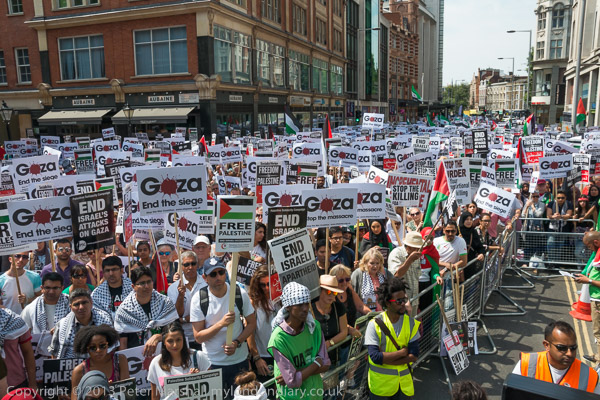
Nikon D800E, 18-105mm DX, 75mm

The last Saturday in July saw London’s largest demonstration for some time, against the Israeli invasion of Gaza. I don’t know how many people there were taking part in it, far too many for me to make a reliable estimate, although I did walk from the front to the back of the march as it was leaving from close to the Israeli embassy.

Following the meeting between photographers from the London Photographers Branch of the NUJ and people at Stop the War, who were the march organisers which I mentioned in Gaza Stop the War, there were considerably better arrangements for the press at the opening rally in Kensington High St, and we were able to work far more sensibly, though outside this press area the crowds obviously made things difficult.


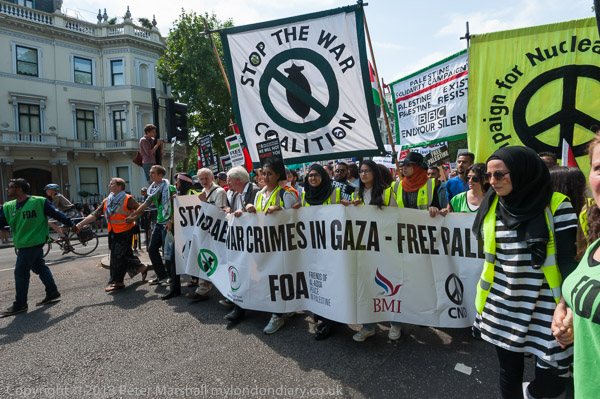
Nikon D800E, 18-105mm DX, 21mm

Things were still just a little tricky with access to the actual platform – which obviously does need proper control – but eventually after waiting five minutes or so I was allowed up to take the couple of pictures of the crowds which I’d decided I wanted. But I resented wasting five minutes of my time for no good reason when I could have done it in ten seconds. Not that I mind waiting, but that five minutes would have been spent getting other pictures than might have been better for me and for the cause.


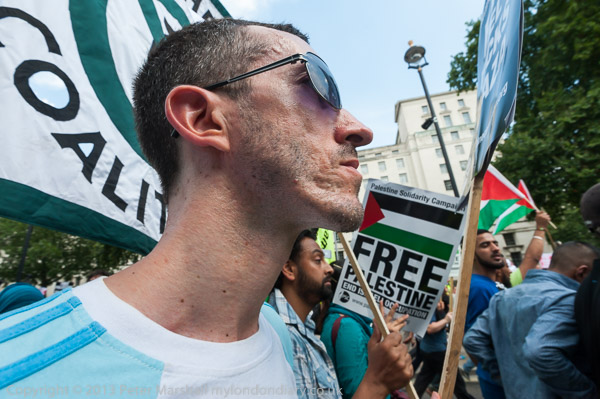
Nikon D700, 16-35mm FX, 16mm

At the head of the march too there were still the usual problems, with photographers having to snatch images from outside a large and heavily stewarded ‘box’ in front of the main banner.  It would be less of a problem if it was half as long, but Stop the War miss out by not allowing photographers proper access for a few minutes at the start of the march, and also at key sites where the march halted – for example outside Downing St.

I walked over half a mile with the front of the march, trying to get decent pictures, but then gave up and worked my way back to the end of the march, sometimes waiting for people to walk past me, sometimes walking backwards inside the march, sometimes going on but slowly making my way back to the start point just over half an hour after the start of the march. By then I’d probably covered about two miles to get nowhere, walking and running backwards and forwards and it was hot and I was tired.  I wanted to be in Whitehall, three miles away when the front of the march arrived there, so I took the Underground to Westminster and walked up Whitehall, stopping for ten minutes or so to photograph a vigil opposite Downing St by ‘Stolen Children of the UK’, families whose children have been taken away from them by the secretive  family courts.


Nikon D700, 16-35mm FX, 16mm

As I was talking, I heard shouting from Trafalgar Square, and rushed to meet the front-runners of the Gaza march – now well ahead of the main banner – just as they turned into Whitehall for the final half mile.  Five minutes later came the ‘box’ of stewards and the main banner, and I took a picture from above the box, standing on the plinth of one of the statues in Whitehall, before infiltrating behind the main banner and photographing inside the march.


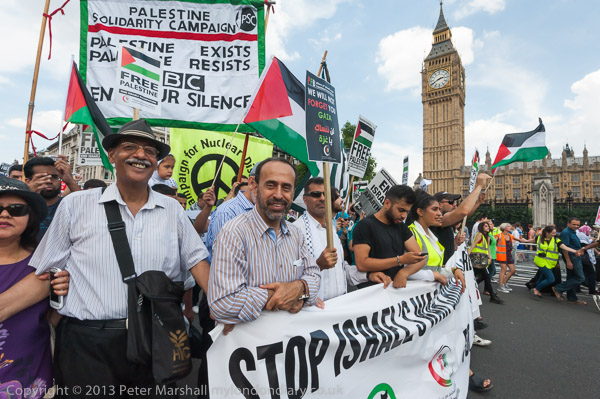
Nikon D700, 16-35mm FX, 16mm

As we came into Parliament Square, one of the stewards whose arm I was leaning against told me to go past her and take pictures and for the last couple of hundred yards I was able to photograph the front of the march with the Houses of Parliament behind them and I was able to work more freely for a minute or so.

During the rally that followed there was also a good area from which the press could work and I photographed  a number of speakers before heat and exhaustion became too much for me and I left for home.

Israeli Embassy rally – End Gaza Invasion
End Gaza Invasion March to Parliament
Stop the Massacre in Gaza Rally

Continue reading End Gaza Invasion

Fushi Kaden – Issei Suda

It was in the late 1970s that I got to know Clare de Rouen, who was then running the bookshop at the Photographers’ Gallery, and we were both members of a loose group who often found ourselves drinking at talking – mainly about photography – in the upper bar of the Porcupine on the corner of Great Newport St and the Charing Cross Road after various events at the Photographers’ Gallery (then in Great Newport St.)  She was a striking figure, truly an Egyptian goddess;  I had come across her a few years earlier at the ICA where I was a very infrequent attender, but it was only later that I came to know her.

At that time the Photographers’ Gallery was still of interest to photographers, and I would go to see all the shows there, as well as many of the meetings, including those of a ‘Young Photographers‘ group that met there, where we would bring work and various well-known names would sometimes drop in and show their work and look at ours. It was a lively group, and often gave the Education Officer whose job it was to look after us something of a hard time, particularly as she was significantly less well informed about photography than most of us.

The group was a part of the educational aspect of the gallery that was important to earn its charity status and Arts Council grant, but was I think rather unpopular with the management – and they jumped at the chance to get rid of it when a small group of largely amateur photographers who had been to workshops at Paul Hill’s Photographers’ Place in Derbyshire went to them with a proposal to form ‘London Independent Photography‘. Though the gallery, having encouraged and backed that group, very quickly withdrew any support after it was set up and it continued on an even more independent basis – as it still does.

Bookshops played an important role in my development as a photographer, and the people who ran them were vital. At first for me it was the Creative Camera Bookroom, but after that closed the Photographers’ Gallery bookshop largely took its place. When you went into either of them, you didn’t just browse the books (though you could if you wanted) but met people who were enthusiastic about the books that they stocked and would talk intelligently with you about them.  There were fewer books published in those days, and whenever I went in Clare would be keen to show me something she thought was good and that I would be interested in. And I was never a great customer in terms of spending – in the early days I couldn’t afford to buy many books – and later much of my collection came as review copies.

Later she moved a little up the Charing Cross road to Zwemmers, where the small photographic book shop she ran there was impossibly crowded with books, many of which were otherwise unobtainable in the UK, including a large selection of Japanese photography, almost all of which was new to me. I spent hours one afternoon going through book after book, at last coming across one that I simply had to buy: Fushi Kaden, photographs by Issei Suda*. I’m not sure why the 100 largly square format images had such a strong resonance, and the short English text at the back of the book told me very little. There is more in Japanese that I can’t read, but the English was of little more use, containing the mysterious sentence “It was not, however, until he produced the photographs using mirrors (appearing in the later section of this present work) that Suda established his own style.’  My only guess is this may be a reference to a change in camera, perhaps from his original Rolleiflex TLR to a simiilarly square format SLR. Next time my son comes to stay I’ll see if he can make sense from the Japanese, though all he normally reads is Manga.

What got me thinking about Issei Suda – and then about Clare de Rouen – was an article in the NY Times Lens blog today, Japanese Swordsman With a Camera, which has 14 of Suda’s pictures along with some text by Rena Silverman. I think all but one of the 14 are in the book that I bought, published in 1978 and are on show at Miyako Yoshinaga in New York until Oct 18, 2014.

The best place to see his work on-line seems to be Charles Hartman Fine Art, but you can also see a good selection of his images on ASX and a video there looks at two books, one by Hiromi Tsuchida and the second by Issei Suda. It’s also worth looking at Only Photography, which has some well reproduced images and also the cover of the book that I bought back in the 1980s. There is also an exhibition of 40 prints and a lengthy text on Facebook from Trans Asia Photography Review but the images there seem just a little lacking in contrast to me.

Later Clare opened her own bookshop further up the Charing Cross Road, upstairs above a sex shop, and showed work mainly of young photographers on the stairs. By then I had no more room at home for books, and seldom bought any. Openings there were impossibly crowded and I think the last time I saw her I greatly embarrassed myself when I dropped a bottle full of beer, handed to me out of a tub of ice and water, the wet neck slipping through my fingers.  She quickly and efficiently cleared up the mess and handed me another bottle.


* I’ve just searched for this on AbeBooks and the only copy listed there is from a Spanish bookseller, for around £300 including shipping, so it was a good investment.


Al Quds march


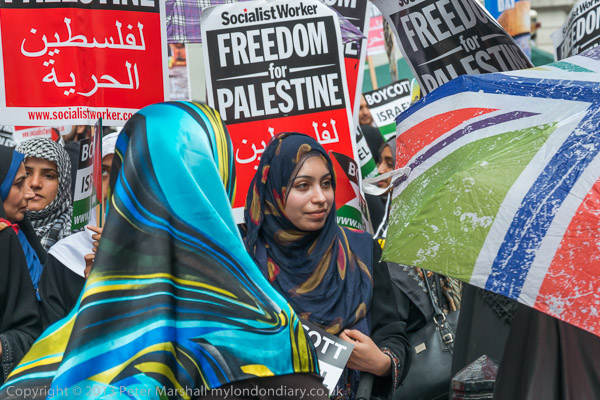
An umbrella adds to the colour

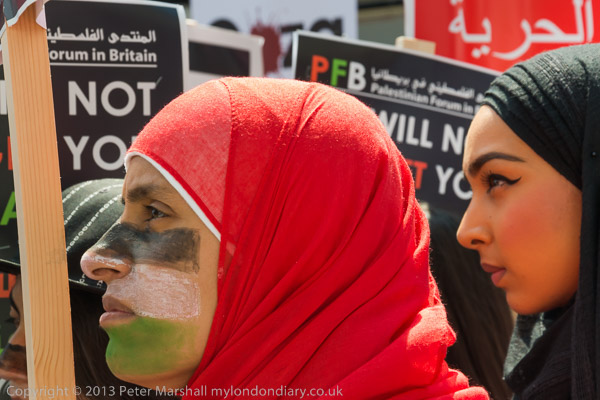
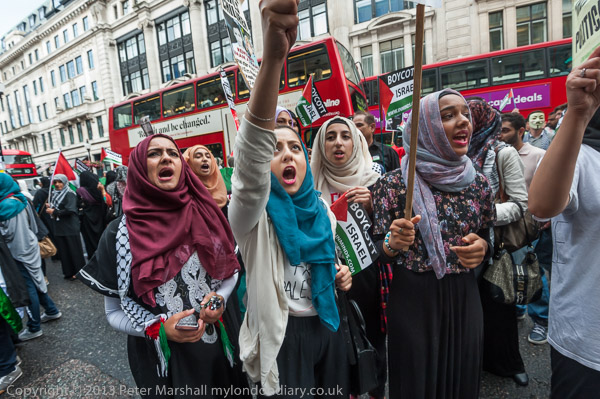
The annual Al Quds (Jerusalem) Day march in London has often aroused controversy, and at times this has made it difficult to cover, with those taking part being very suspicious of photographers. As someone who likes to work close to people with a wide-angle lens, it often meant a considerable amount of argument with stewards to be allowed inside the march. But things have seemed different in the last couple of years, and I had no problems at all this year, with everyone being very open and friendly.


Women shout up at the windows from which vegetables had been thrown at the marchers

The only incident of opposition to the march I was aware of came after the march had gone a few hundred yards south from its starting point at the side of the BBC’s Broadcasting House when a few root vegetables where thrown down at marchers from an upper floor window. I didn’t see them come down, though I was only a few yards away, but I was photographing marchers and not looking up, but I heard the angry response from the crowd, who stopped and shouted up – but whoever had thrown them was no longer visible.

Later I heard that there had also been a small group of far-right protesters who turned up during the rally at the end of the march, outside the US Embassy, but I had left the march well before it reached the embassy.

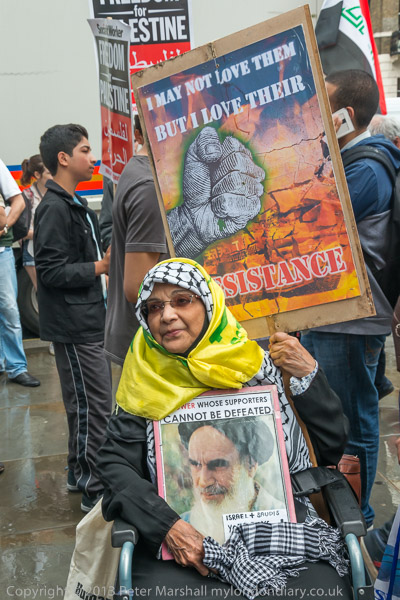
Much of the opposition in past years has concentrated on the backing for the Islamic Human Rights Commission, whose Al Quds Day Committee organises the event, by the Iranian regime, and Al Quds day was introduced by Ayatollah Khomeini. And although the march is supported by a wide range of groups it is still seen by some as being dominated by Iran. Clearly this year the march was almost entirely about Palestine, with the then ongoing attack by Israeli forces on Gaza at the forefront of everyone’s mind.

It’s always difficult to know how to approach things. There were two large banners of the Iranian leaders, and just a few stalwart supporters of Khomeini you can see in my pictures and who I’ve photographed in previous years. They were there, and in their way photogenic, but unrepresentative. I photographed to a handful of Hezbollah flags, but there were very few on show, whereas some years ago there were large groups of them.

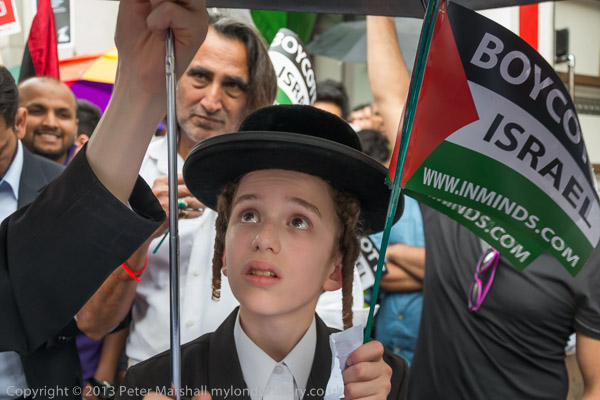
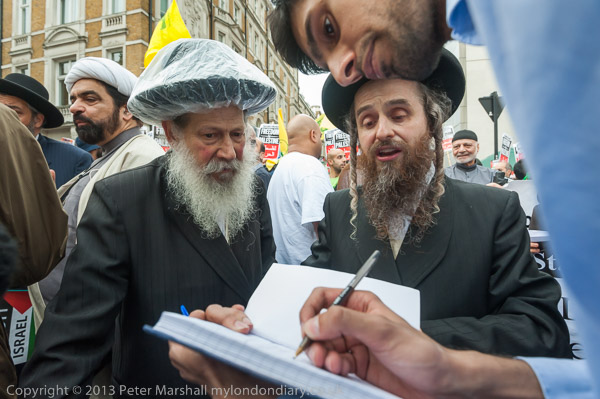
This is also an event that has inevitably been accused of anti-Semitism, and I was looking for anything that would substantiate that. Being against Zionism, or against the use of disproportionate force by the Israeli forces and their killing of children and other civilians is clearly not anti-Semitism. Even the support for groups such as Hezbollah isn’t necessarily anti-Semitic – as the Jews who marched as usual at the front of the Al Quds procession and were greeted as old friends by many of the Muslim leaders make clear, you can be Jewish and opposed to the state of Israel. And as the sheet of slogans held in the hand of the man leading the chanting says ‘Judaism is OK, Judaism Yes, Zionism No‘.

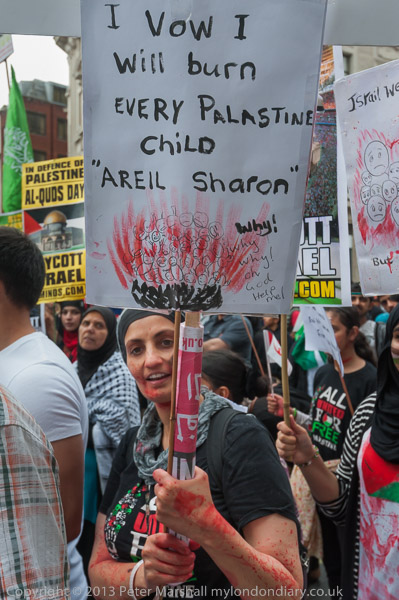
Perhaps the closest I came to any evidence of it was the use by just one of the several thousand protesters on the march of a quotation attributed to former Prime Minister of Israel Ariel Sharon, one of several disputed quotations by him. There seems to be no evidence that he ever made this particular statement about burning Palestinian children which appears to be entirely fabricated. It first appeared on the web around 2002 and in 2003 IHRC published it, while stating they ‘could not independently verify its authenticity‘, which seems irresponsible given its inflammatory nature.

Photographically things were pretty straightforward, with just a little light rain meaning I had to keep vigilant for raindrops on the lens filters, and work with a cloth in my hands to give the occasional wipe. But it wasn’t raining that hard, but the light did go down a little, and most of the pictures on the D700 were taken at ISO 1600. I didn’t get around the changing the ISO on the D800E from my normal ISO 800, but it didn’t seem to cause me any problems. Perhaps for once I had image stabilisation turned on – it often seems to mysteriously get turned off.

As usual I using the D700 with the 16-35mm, switching to the 70-300mm for some more distant views of the march from a higher viewpoint. The 70-300mm is another full-frame lens and I generally prefer to use it on the D700 rather than get the larger file sizes from the D800E.  The 18-105mm was on the D800E all the time, with its DX format giving sensible file sizes (15.4Mp) and an equivalent focal length of 27-158mm.

So there was quite an overlap in the focal lengths covered between the this and the 70-300mm, which I think is useful, as it saves needing to switch between them so much. There is also an overlap between the ranges of the 16-35mm and the 18-105DX that is equally useful, especially when I raise the wrong camera to my eye. I still find it confusing at times that the smaller lens has the greater focal length.

Al Quds Day march for Jerusalem

Continue reading Al Quds march

London Airports

I can’t understand why London has always failed to sort out its problems over airports, although it’s something that has affected me much of my life.  I was born just a mile or two from the site of one of London’s earliest airports, and with another just down the road. As a kid I played in my back garden with the planes streaming into Heathrow sometimes so low overhead that I felt I could reach up and touch them and had nightmares having seen them come over with flames coming from their engines.


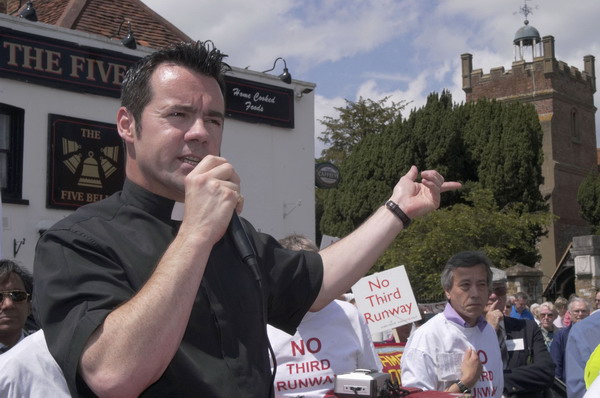
Speeches after protest march at Harmondsworth against proposed Third Runway at Heathrow, 2003

Heathrow was a mistake from the start, pushed through by dressing it up as a military airport (which wasn’t needed)  in WW2 by people who knew it would not get approval as a civilian project. By the 1960s it was glaringly obvious that London needed a new airport, and both the Roskill Commission and the Edwards Report concluded Heathrow was in the wrong place (and was badly designed.)  Roskill called for a new airport, suggesting 3 sites to the north of London and Foulness, eventually making Cublington their preferred choice. PM Edward Heath responded to nimby pressure and rejected this, going instead for Foulness (Maplin Sands),  and things started to get moving, only to be cancelled a couple of years later as too expensive.


Cliffe, 2002

Various studies and proposals followed, with another estuary site, Cliffe, being finally rejected in 2003, and Boris coming up with his island plan in 2008. Another runway for Heathrow – which would have made the problem of it being in the wrong place even more acute – was rejected in 2010, but in 2012 the Davies Commission was set up in a thinly veiled attempt to revive this dead duck.


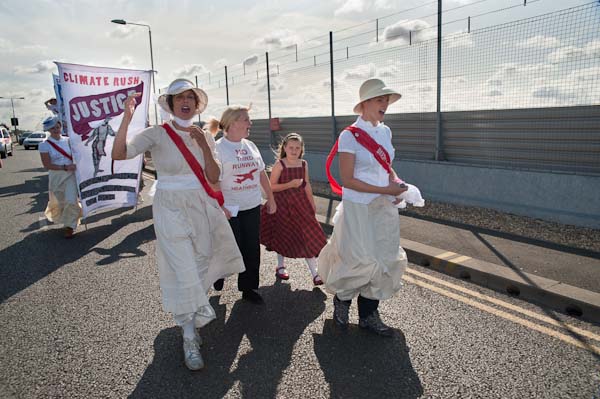
Climate Rush protest against Heathrow Expansion, 2009

Meanwhile, other countries facing similar problems have gone ahead and built their new airports in sensible places. In London we’ve made things worse by developing yet another airport in the wrong place, London City Airport. Roskill I think got it more or less right back in 1971, and we should be considering sites in that general area, around the M1 and the A1.


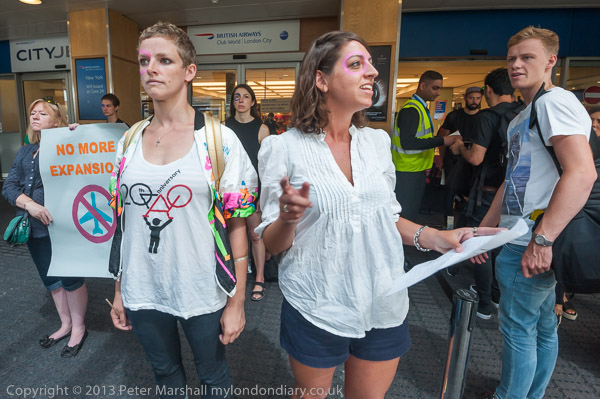
‘The Future’ protest at London City Airport, 2014

So when Tamsin Omond  handed me a flyer and invited me to photograph a protest by a group who call themselves ‘The Future’ at London City Airport, I was keen to do so, even when it did mean travelling across London rather earlier than I like.


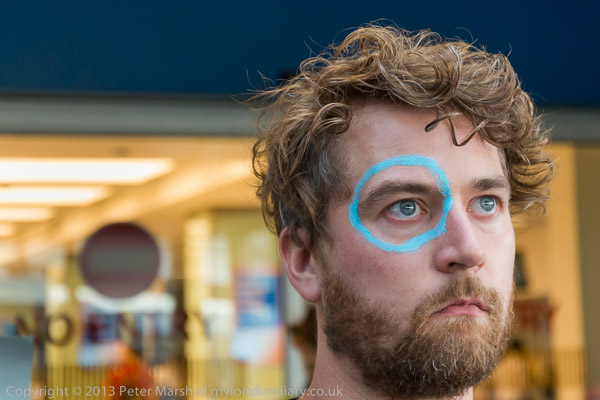
The Eye, The Future. London City Airport, 2014

On their web site they write:

The Eye is The Future’s symbol.  A large circle drawn around the eye to mean:

We are connected:
We unite with a circle drawn around our eye to fight for our future.

We are the watchers:
We judge the powerful when they do not act to protect the future from climate change.

We are the creators:
We refuse to be victims. We create our own world.

Continue reading London Airports