Dartford to Greenhithe (part 2)

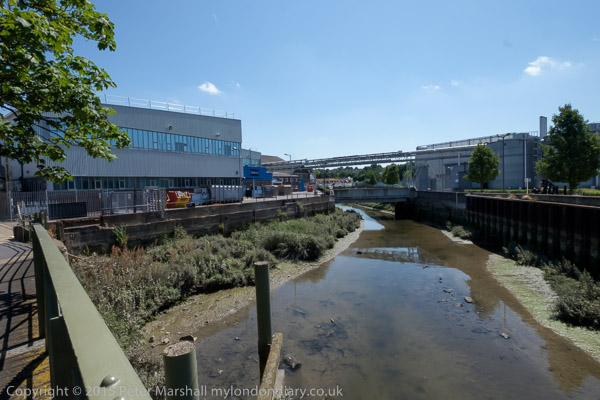
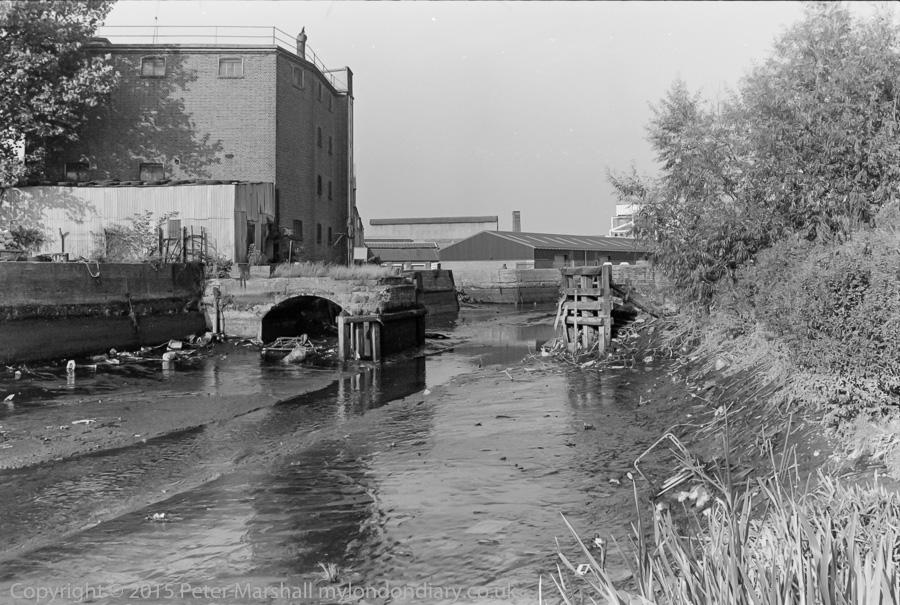
Because Dartford Creek was a navigation (used at least since Roman times, it was improved by an Act of Parliament in 1840, with work completed in 1844) bridges across it had to allow for the passage of the vessels using it, presumably in its heydays Thames sailing barges. At this point there was a lifting bridge, but by 1985 the bridge itself had disappeared.  It doesn’t look a great deal different now, though perhaps a little harder to see as the vegetation on the banks has grown considerably.  The riverside path itself has been considerably upgraded and there are more fences to keep people away from the banks, and the brick building close to the bridge replaced by an undecorated large modern shed.
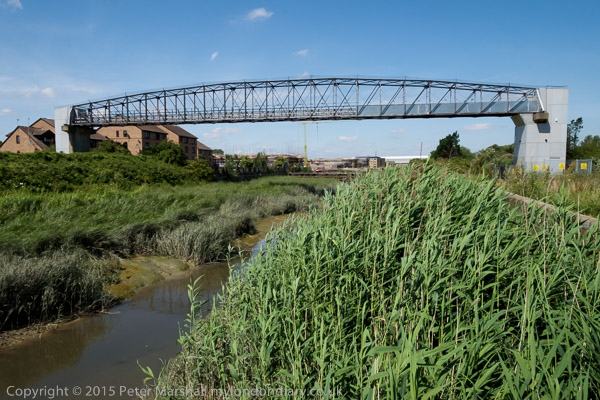
The pipe bridge looks a post-war construction, and once I think linked parts of the pharmaceutical works on both sides of the river; now on the west is a new housing estate, and little sign of anything to the east. But even at the date it was built, a high clearance was deemed essential, though sailing barges had probably given way to diesel.

By the footpath now are signs about the activities of the Friends of Dartford and Crayford Creek, and a little further on at Dartford Lock we came across one of them, working away at the vegetation on the bank. There was a hot sun and he was sweating and happy to stop for a few minutes and tell us about the navigation and the work of the friends – and told us to look out later for a yacht which was to try and enter the river from the Thames in a couple of hours on the rising tide.
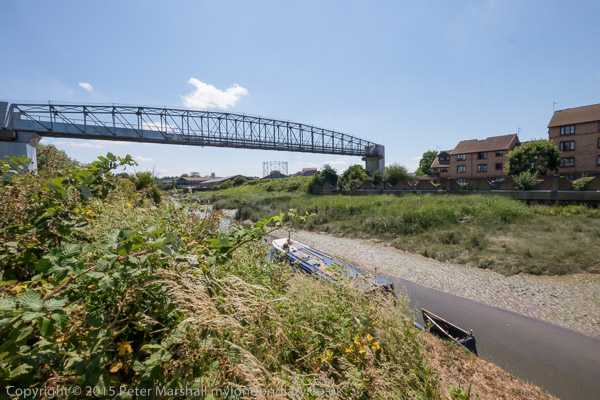
Next to where he was working a narrow boat was moored. This year apparently saw the first boats to come up above the lock since 2006 and the first to be moored overnight for 40 years. Thanks to the ‘Friends’ the lock has been made more usable, with a stretch of over 200 ft of quayside cleared to allow mooring.  The port has silted up considerably over the years, and become covered with grass and weeds in places – according to the link there are now “mud banks over amost 80% of the total port area to heights varying from half a meter to a meter and a half.” and the stream at low tide as little as six inches deep. The port used to handle boats with a draught of one metre, and Dartford lock was a barrier to retain water above it to maintain a minimum depth of around 0.6 metres.
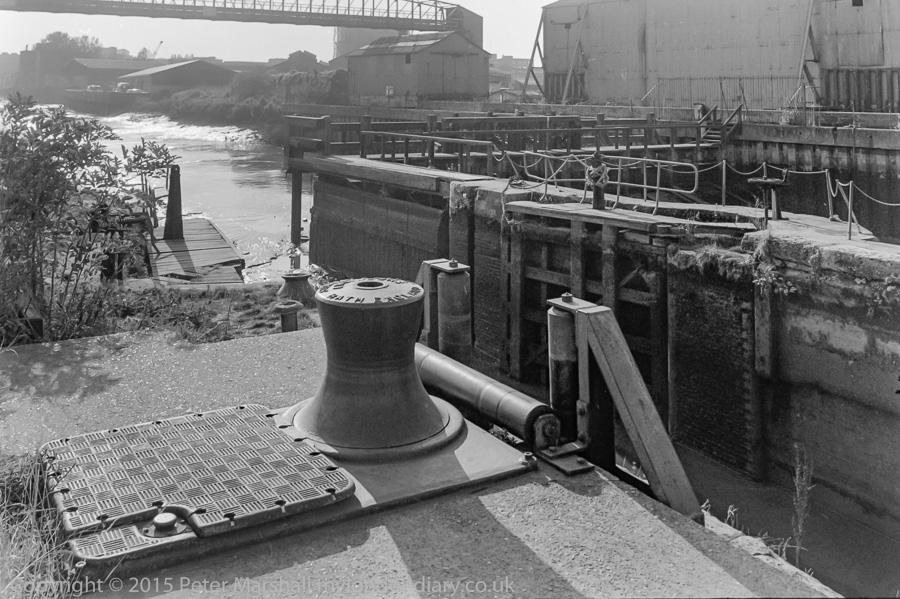
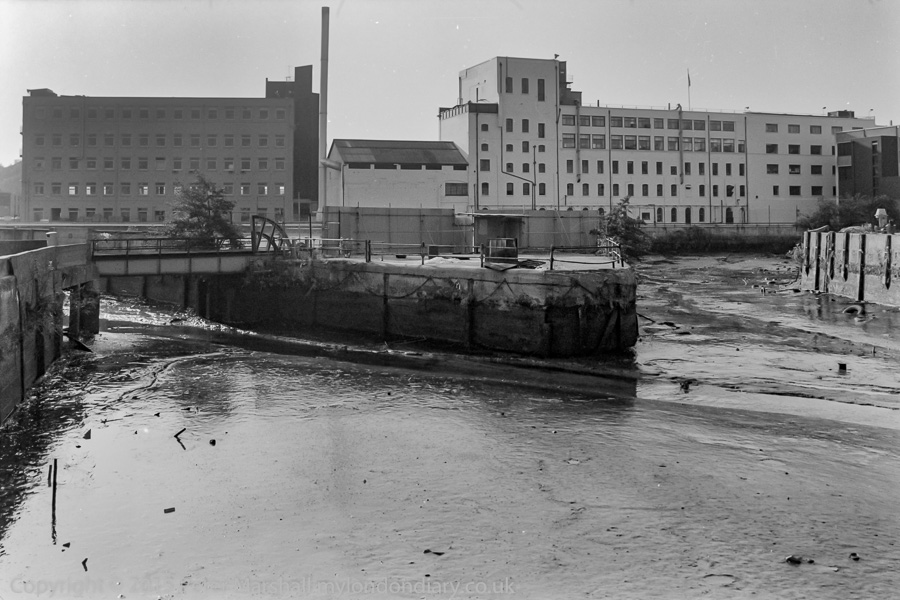
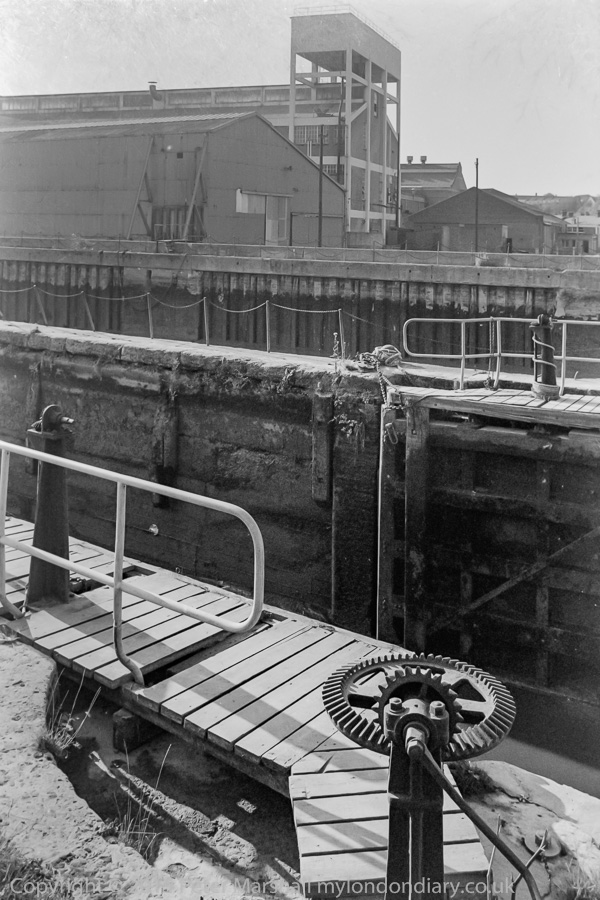
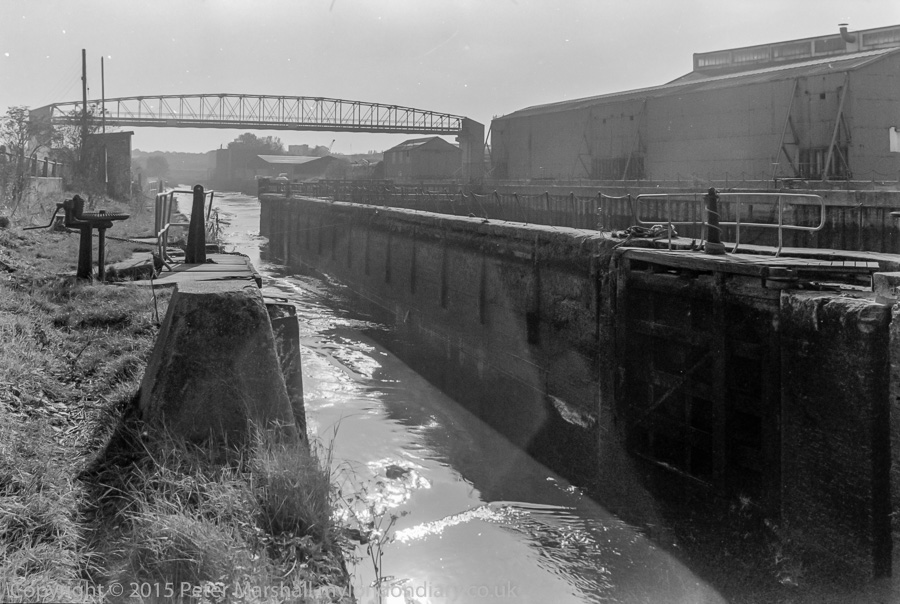
Back in 1985, the lock with its single gate appeared to be still in reasonable condition, possibly even capable of working, though obviously not well kept up, and the landing stage at the left clearly rather dangerous. I didn’t take many pictures – and here I think I was fairly clearly trespassing so perhaps fewer than I might otherwise have done. You can see there is far less mud on the bank at right and considerably less vegetation on both sides, though the older picture was taken in October when some might have died down slightly.
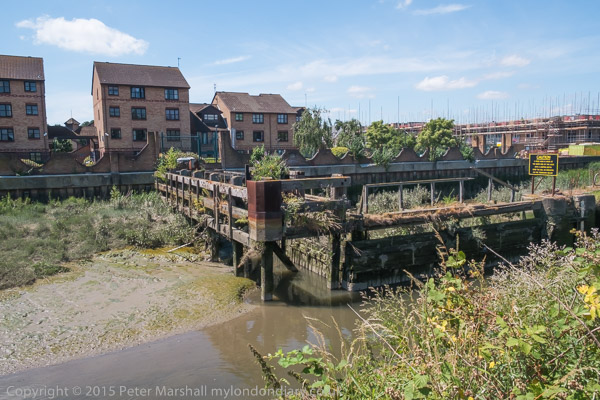
Things have clearly deteriorated since then, although the ‘Friends’ have carried out some work, getting the gate to open more fully and cutting down the flow of water around the lock, which was preventing the cill (or sill) in the lock from carrying out its purpose of maintaining the river level above it.
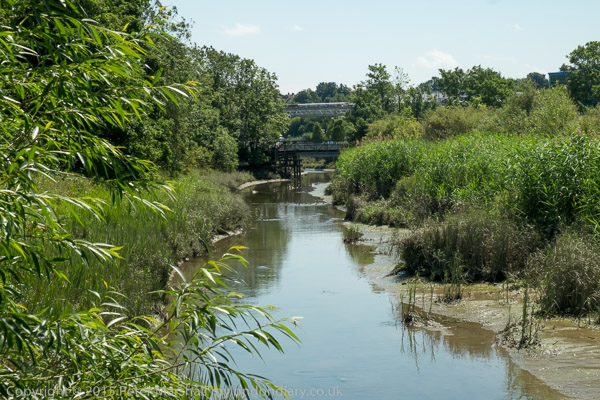
Below the lock the path is perhaps less interesting, following a winding path on an embankment with the river on one side and the long stretch of fairly empty fields and marshland to the east. There used to be a fireworks factory (and some of its isolated buildings remain) and further away an isolation hospital. In the distance you can see the Dartford Bridge and the now disused Littlebrook Power station, and as you get closer the Darent Tidal Flood Barrier and the River Thames. You pass the northern bypass (now renamed Bob Dunn way after the university that University Way was supposedly to lead to changed its mind about coming here) and the mouth of the River Cray (also part of the navigation.) It’s a pleasant enough walk, but one with no shade at all and we were pleased to find a hedge close to the flood barrier where we could sit at least partly in shade to eat our sandwiches.
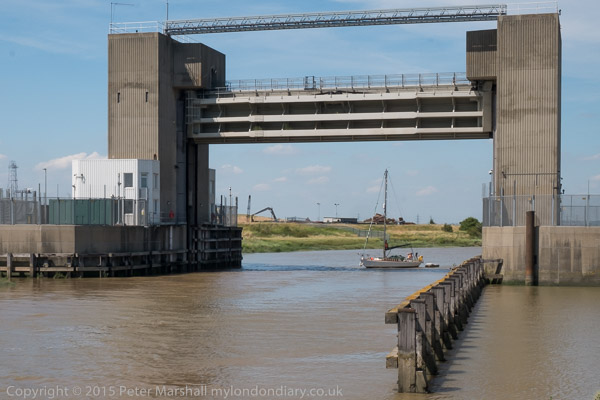
From where we were sitting we could see the mast of a yacht turn into the mouth of the Darent and I jumped up and ran to photograph it as it made its way under the flood barrier – with plenty of clearance – and made its way up river with the incoming tide and under power.  It had hoped to get under the low bridge at Bob Dunn Way (with mast lowered) but I read later from the ‘Friends’ Facebook Page that the tide was too high when it reached there.

Pictures from the whole of this 2015 walk: Darent Valley Path & Thames

Continued at Dartford to Greenhithe Part 3)


For the walk in 2015 I was working with my newly arrived Fuji-X 10-24mm (15-36mm eq) on the X-T1 and the Fuji-X 18-55mm on the X-E1. Both excellent lenses which it is hard to fault in any way. I also carried but didn’t use the Samyang 8mm fisheye, probably because I was walking with two other people, and its a lens that makes me take a long time thinking about composition. The 10mm was wide enough for what I wanted to do, and considerably easier to use.

The only problem I had (apart from the cursed Fuji deep sleep mode – where the quickest way to elicit any response from the camera is to switch it off and then on again – a relatively minor annoyance with landscape, but which essentially makes the cameras hardly usable for covering protests) was that the times on the two cameras were not synchronised. It’s great to have clocks in cameras, time-stamping every image in the EXIF data, and I rely on it to put my images in order. But it would be nice if they kept time better. Though both were set at some point accurate to the nearest second, they were about 45 seconds apart. Yes, I should check and synchronise regularly.

Lightroom does make it very easy to select all the images from one camera and then adjust the time of all of them by the same amount, but I hadn’t done so when I wrote out the images for the web site, so you may notice the odd one out of order.

Back in 1985 we had no such problems. All I had to rely on when taking pictures was a notebook, and I wasn’t too good at making entries in that. But at least images were fixed on the film in the order that they were taken, and looking at the contact sheets I could normally reconstruct walk in my mind.

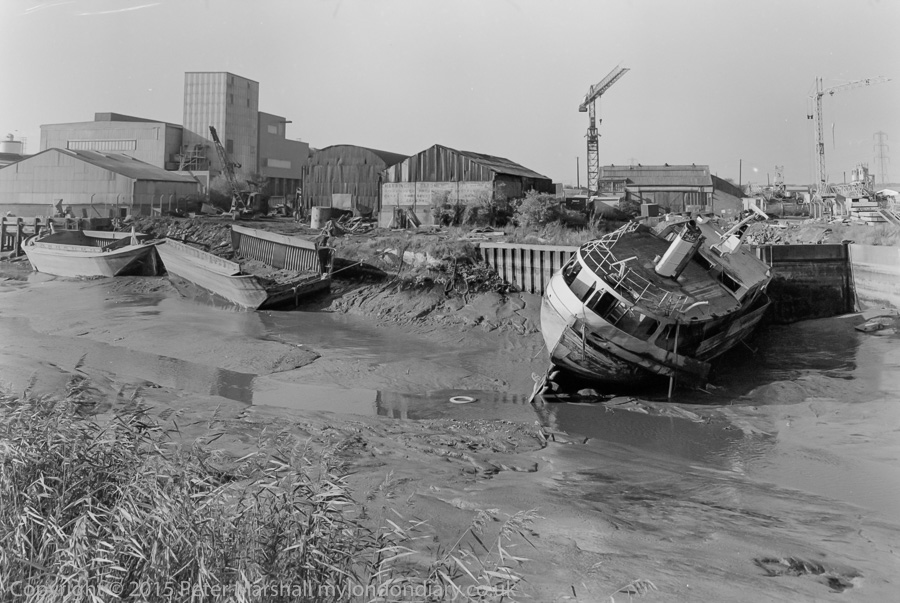
The Olympus 35mm shift lens I took most pictures with at the time was a fairly early version and not multi-coated as later otherwise identical versions were, and was fairly liable to flare and ghosting. You can see a neat but large hexagon in one of the images above. Working with scans does enable at least some recovery of what in the darkroom would have been very difficult negatives.
Continue reading Dartford to Greenhithe (part 2)

Dartford to Greenhithe (part 1)

It was a hot summer day (something I’ve not too often had the chance to write this year) when we took the train to Dartford to complete a walk along the Darent Valley Path to the mouth of the River Darent, and then along by the Thames to Greenhithe.

Dartford has change considerably over the years, and the industries that dominated the north of the town when I first walked this way back in the 1980s have now gone, and most of their buildings too, though as yet little has replaced them.


Welcome Foundation, Dartford 1985

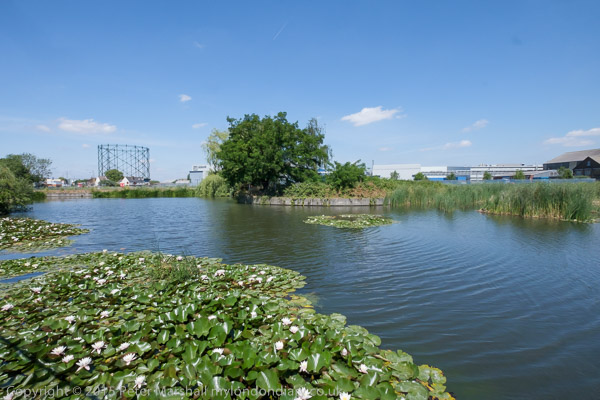
The picture I took back in 1985 was from the railway station, or rather through the open window of a train at Dartford Station, and the building in it has now gone completely. The pond still remains, and I photographed it through the railings on Mill Pond Rd, looking to the left of my older image.  The view straight ahead was rather empty.

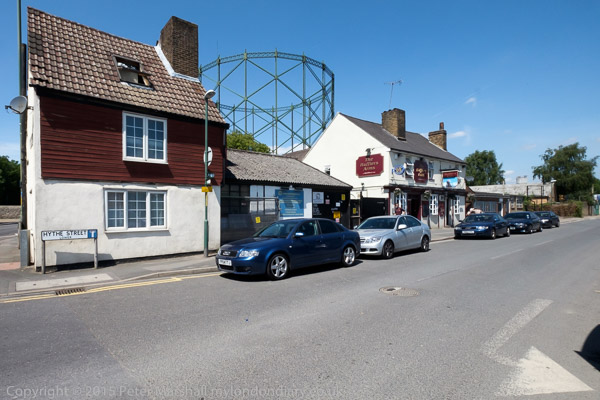
Hythe St and The Huffler’s Arms in the top image didn’t seem to have changed a great deal, though I didn’t have time to stop to admire its interior. But the pub was as reminder that Dartford had been a port, with boats coming up the river from the Thames to wharves here.

You can see the back of the building facing the pond at the right of this picture.  It was quite hard to see exactly where I had taken some of those pictures back then, with little but the river remaining, though some were readily identifiable.

A public slipway next to the bridge taking the footpath across the river here was cleared by the Friends of Dartford and Crayford Creek and the first boat launched here for decades in March 2015.

Although I know I walked along this footpath, before that I think I had gone into the large car park for the pharmaceutical works and perhaps on to a bridge higher upstream, but Glaxo or GSK (as Welcome became) had filled in and built over much of the basin and culverted streams in the years between my visits.  I think I was last around here at the start of 2013, though I’m not sure if I walked this path then.

Back in 1985, there was still considerable evidence of the navigable waterway, but the Dartford & Crayford Navigation (Dartford Creek) was essentially completely abandoned the following year, and the low Dartford northern bypass bridge opened in 1994 makes navigation tricky.  Back in 2006, some intrepid sailors managed to get a narrow boat up to Dartford showing it was still possible – and on their way out they also explored the short arm of the Crayford Navigation.


The creek banks are now overgrown close to the centre of Dartford.

Even back in the old days, navigation was not straightforward, and teams of men were needed to assist the passage of boats, particularly against the tide. Ufflers (or Hufflers) were men with very long poles – perhaps 15 ft – that they could put in the mud to get a purchase as they pulled barges along the creek to the wharves, and were of particular use on those creeks where no suitable towpath for horses existed. Usually they worked in pairs or sometimes three men together.  Probably from Dartford they would be needed to take the barges down against a rising tide to arrive at the mouth of the river near high water so they could enter the Thames.
Continues in Dartford to Greenhithe (part 2)

Pictures from a previous walk from Eynsford to Dartford, mainly along the Darent Valley Path are at Walking the Darent Way  and you can see the pictures from this section (and the continuation to Greenhithe) at Darent Valley Path & Thames.
Black and white pictures in this post were taken in 1985 using an Olympus OM1 and Ilford XP1 film. Most of the pictures I was taking at the time were made the the Olympus Zuiko 35mm f2.8 shift lens, long my favourite lens and still one of the best lenses made for 35mm – it has a 62mm image circle rather larger than the 43mm needed to cover the full frame which gives it an advantage, and easily slides to project any 36×24 rectangle of that larger circle onto the film. After years using it, I still sometimes find myself trying to slide other lenses. Of course we can now correct perspective in Lightroom or Photoshop, but it isn’t quite the same, and I sometimes find myself wishing I still had a lens with movements.
It would of course be easy to fit the OM lens with an adapter to the Fuji-X cameras that I was using for the colour images here (with Fuji 10-24 and 18-55mm lenses) but on the smaller sensor it would be a 53mm equivalent rather than a wide-angle, and the shifts of much less – if not zero- use. But I’ve just found and started to read a test of this and some other ‘PC’ lenses on a Canon full-frame body. Fitting OM lenses to a Nikon is kind of possible, but probably not for the 35mm shift.

I don’t think Fuji will come out with a full-frame X series camera. There would be little in it for them (or for photographers given how well the 1.5x cameras work.) Full-frame is largely a matter of prestige rather than performance, and Nikon were right when they said the APS-C format could deliver the goods – even though they ate those words a few years later. Almost none of us needs full-frame except once in a blue moon. 99% of the images I make with the D810 (and before that with the D800E) I make on the smaller format, despite now having a full frame lens on the camera. If Fuji ever do make the leap, like Nikon it will be for marketing rather than photographic reasons.

Continue reading Dartford to Greenhithe (part 1)

Ahwazi Action


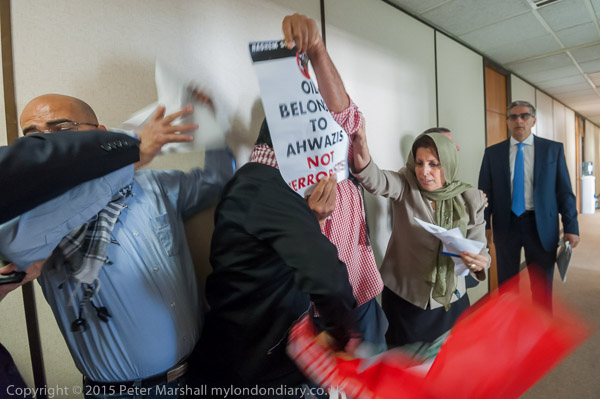
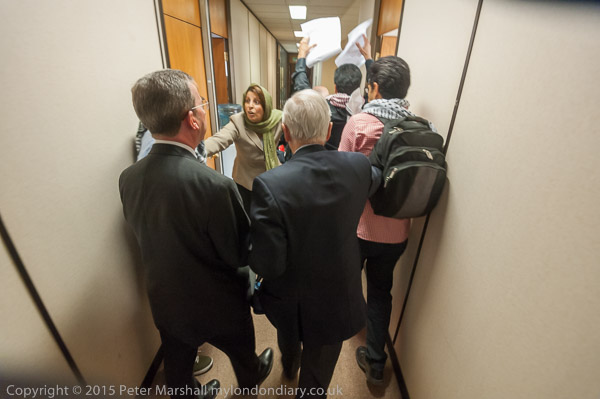
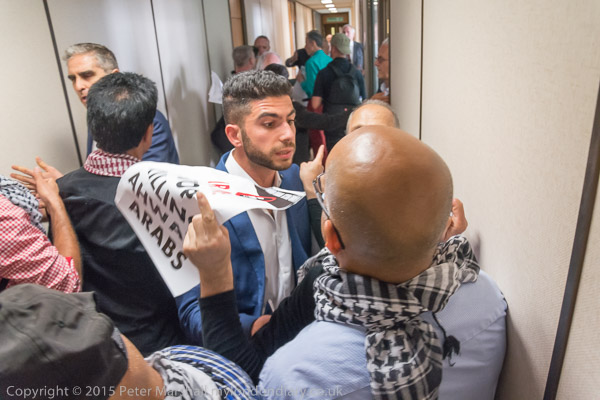
Protesters rush past people in the narrow corridor at the BICC offices

I don’t much like taking photographs inside buildings. So often the light is poor or difficult to work with, and spotlights and windows both tend to mess up autoexposure, even with matrix metering which is supposed to cope with such things. It’s all fine when you have plenty of time to make readings and set settings, but can be tricky when you are working under pressure.

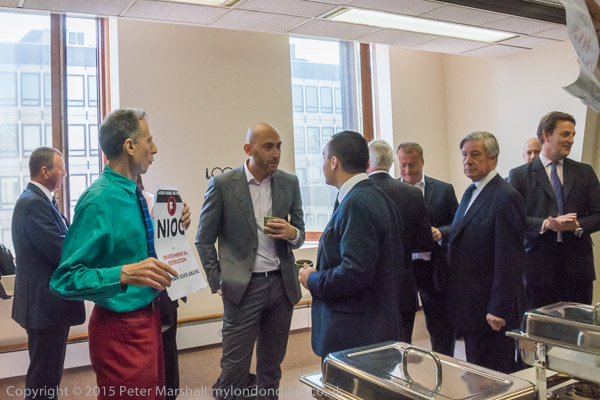
And in NIOC House I was certainly working under some pressure. I wasn’t there by invitation, but had rushed in following some Ahwazi Arab protesters. I’ve mentioned them before, but for anyone who isn’t sure, you’ve probably read about the Ahwazi homeland even if you’ve never heard of it, as it is supposedly the inspiration for Genesis’s garden. The death-knell for the Ahwazi Eden came with the discovery of oil there by the Anglo-Persian oil company in 1908, since when Iran, aided in the years before the Iranian revolution by the UK, has been trying hard to eliminate the Ahwazi people and culture.


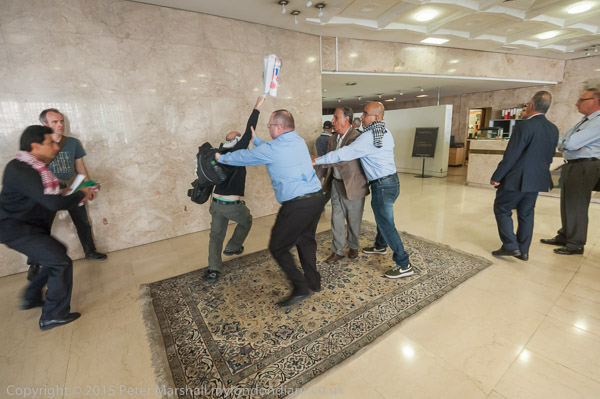
Peter Tatchell’s green shirt disappears around the corner as other protesters face security in the foyer

Even before the recent moves to lift sanctions there have been continued links between the UK and Iran, with NIOC house, less than 5 minutes walk from Parliament, at the centre. Few people walking past would know what goes on in there, or indeed that the initials stand for National Iranian Oil Company. It’s surely significant that although its address is always given as Victoria St, the only entrance normally in use is tucked away at the back on Tothill St.

Back in April I went into the foyer with a small group of Ahwazi protesters (see Ten Days of Rage for Ahwazi Intifada) and at the end of June received an invitation from the Hashem Shabani Action Group to join with them and the Peter Tatchell Foundation in an attempt to gate-crash secret UK-Iran business talks taking place in the offices of the British Iranian Chambers of Commerce (BICC) inside NIOC House.

I met with the group outside Westminster Abbey, were Peter Tatchell gave a short briefing on what they were proposing to do, and in particular on the non-violent nature of the protest. Also present were two other photographers I knew, along with two videographers and an intern.


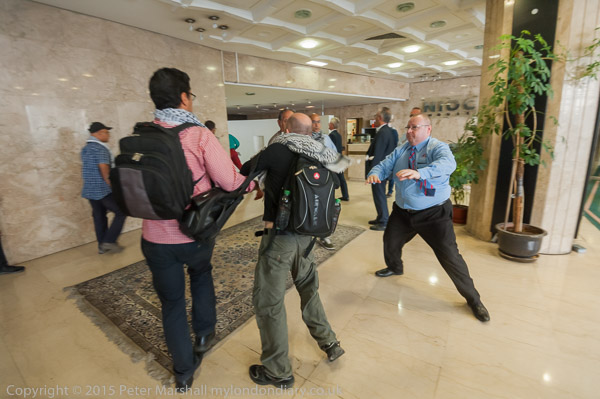
Security fail to stop an Ahwazi protester who runs past them.

I was more surprised not to be stopped by the building security as I followed the protesters who pushed past them and rushed to the stairs, along with the other two photographers; the videographers were a little slower and were apparently stopped in the foyer.

Had I known in advance that the meeting was on the sixth floor I might have declined the offer to attend the protest, and rushing up the stairs I was rather worried that I might not make it without collapsing, though I actually caught up with some of the protesters who were half my age. Despite being pretty totally knackered, put of breath and with a heart thumping at an unhealthy rate I was still able to follow the group as they ran along the corridor to the rooms where the meeting was being held.


More attempts to stop the protesters in the narrow corridor – and a trace of vignetting from my lens hood knocked slightly out of position

There was a certain amount of pushing and shoving in the corridor, and there were people telling me I couldn’t take photographs, but as none of them told me who they were and what authority they had to stop me I proved remarkably deaf. Everyone was a bit confused, but eventually we went into the room where those at the meeting were about to enjoy what looked like a very decent buffet lunch. Things inside the room were a little more civilised, with many seeming to totally ignore the protest and continue with their conversations, but when we got back into the corridor and were on our way out things became more hectic.


Peter Tarchell confronts some of those waiting for lunch who take little interest

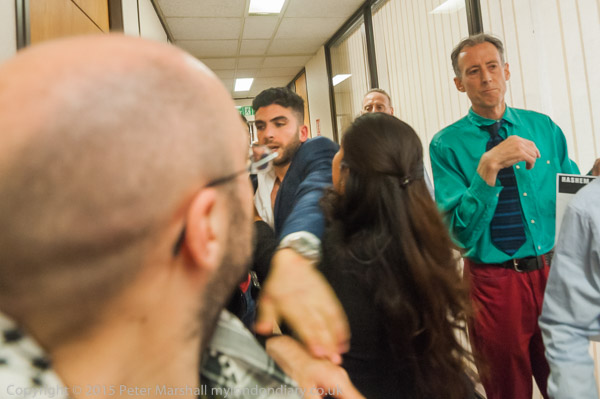
Coming out of the meeting room I took the wrong door and turned left towards the stairs rather than to the right and missed the opportunity to photograph the best known politician attending the event, Lord Lamont. I was at the wrong end of the corridor with people blocking my way when he was confronted by protesters, though both the other photographers were close to him and were able to get pictures. A few of the people who were trying to stop the protest did get rather physical, and one young Iranian, thought by the protesters to be an agent, obviously completely lost his temper, and had to be pulled off by some of the other staff after he assaulted one of the other photographers, knocking him to the ground and causing minor injuries.


A young Iranian man gets angry with the protesters. I can’t get past to the end of the corridor where protesters found Lord Lamont

At least I didn’t get more than a little shoving around, but photographically I was having problems with the D700 which had started to fail to focus and also over-exposing, both extremely annoying. It wasn’t really possible to try another lens on the camera as there was quite a lot of people milling around and I was getting pushed around as I was taking pictures. The light in the corridor was giving me exposures around 1/30 f4 (wide open on the 16-35mm) and with overexposure giving me even slower speeds and considerable subject and camera movement quite a few exposures were unusable. I would have been better to have used the fixed 20mm f2.8, but I hadn’t thought to put that in my bag.


A colleague tries to hold back the young Iranian who has been assaulting protesters

The 16-35mm f4 isn’t really a lens for low-light action, and is also big and heavy, and my lens is beginning to show its age. A year or so ago it needed a very expensive service, almost to the point it wasn’t viable. Now it does seem to be getting a little temperamental, and though it was working properly when I took a few pictures of the group outside NIOC after the event, occasionally since then I’ve had to switch to manual focus.

At fairly close range even at 16mm there isn’t a great deal of depth of field at f4, and manual focus in poor light isn’t too easy with modern cameras and lenses designed for autofocus. Back in the days of film with cameras like the Olympus OM4 and a suitable choice of focussing screen manual focus was much more viable. And with cameras like the Fuji X-T1 that use an EVF, manual focus is again easy, though too slow for rapid moving events like this.

Eventually we left, walking down those six flights of stairs again (I don’t know why they didn’t take the lift down, but I had to stay with them in case anything happened.) In the ground floor lobby we were stopped by police, and told that we were not under arrest but could not leave, even though we photographers showed our press cards.

We sat around in the lobby for three quarters of an hour while the police decided what to do, complicated slightly by the complaint of assault against the young Iranian. Police advised the photographer that his assailant – who they went and found and questioned briefly – probably was protected by diplomatic immunity and he decided not to press charges. The police came round and asked everyone for names and addresses which we gave and then we were allowed to leave. It was good to get outside.


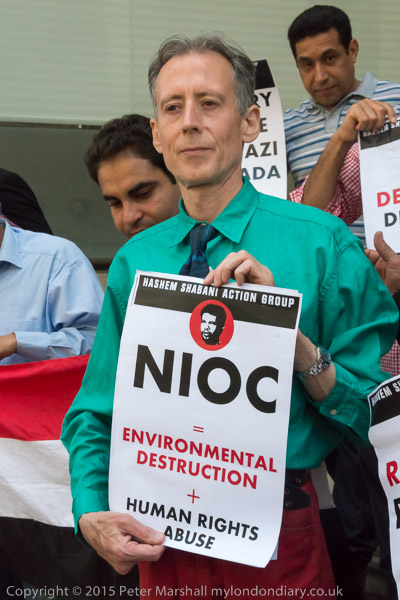
Peter Tatchell poses with the other protesters outside at the end of the protest

Although I don’t think any of the protesters (or photographers) was later arrested, certainly some of the non-violent Hashem Shabani Action Group, named after Arab-Iranian poet and human rights activists Hashem Shabani, executed for peaceful opposition to the Iranian regime in January 2014, have been harassed by police. Some influential UK politicians with busiiness interests in Iran, including some of those at this meeting we visited, have called for the organisation – which says “Our weapons are pens. Our bullets are words” to be banned as a terrorist organisation.

Iran says that Shabani confessed to being a member of the terrorist group “Al-Moqawama al-Shaabiya Al-Tahrir al-Ahwaz” which appears to be a figment of Iranian state imagination. The confessions made by Shabani and others came after extensive torture. Press TV reported the confessions and sentence claiming that the Al-Moqawama al-Shaabiya (People’s Movement) is backed by the US and UK, but there appear to be no reports of the organisation nor its supposed activities except from these Iranian government sources. Unfortunately the UK seem more interested in backing Iranian interests and ignoring  human rights issues in Iran in general and in particular the persecution of the Ahwazi people.

Continue reading Ahwazi Action

Harrodsburg

A remarkable set of pictures by ‘Glasweegee’ Dougie Wallace of the wealthy on the streets around Harrods and other shops selling ridiculously priced bling have apparently caused quite a stir in Qatar (where many of those he photographed have their homes) according the the British Journal of Photography, in an article Qatar responds to Dougie Wallace’s photographs of Britain’s wealth tourism.  The BJP also claim responsibility for having given him the idea, when they erroneously reported last December that he could be found working outside Harrods. It seemed to him to complement work he was doing in  one of the poorest areas of Glasgow, close to where he grew up.

You can see more of his work from ‘Harrodsburg‘ at The Story Institute, which also has some text worth reading on his work and the motives behind it. The area in which he worked – not just around Harrods, but down to Sloane Square and around the Ritz, once the home of many over-wealthy British, is now largely in the hands of “the various tribes of the global super-rich buying up London homes like they are gold bars, as assets to appreciate rather than as homes in which to live.”

More interesting than the BJP story is the article it links to in The Doha News, published in August.  It’s also worth reading the comments. (To save you worrying as I did, the hashtag  #دوغي_والاس  is simply #Doga_walas.)

Wallace’s images remind me of things that I’ve seen walking around some of those same streets, but have never photographed. Perhaps I should say, have never had the bottle to photograph.  Though rather that I’ve never had a very good reason to want to photograph. They are streets too that I dislike, only going through them when I have to, usually on my way to some embassy or other to photograph a protest. But his work is impressive – even if it doesn’t go down too well in Qatar. At the moment we can photograph freely on the street – a liberty I value that we may well lose unless we defend it.

Ooredoo (formerly Qtel Group) which provides most of the internet in Qatar (and probably other internet providers there) was quickly forced by the authorities to block the web site with the images, probably because as well as causing the ultra-rich embarrassment they also show their hypocrisy, particularly in wealthy visitors to London abandoning the strict rules of dress they forcibly impose on others in Qatar.
Pictures from ‘Harrodsburg‘ have been on show in London at the Printspace on Kingsland Rd, but the show, part of the East London Photomonth, was due to close today – or tomorrow or Wednesday – all three dates are in the links.

You can also visit Dougie Wallace’s web site, and buy his books Shoreditch Wildlife and Stags, Hens & Bunnies. The Shoreditch book is I think much better than the presentation on the web, and I hope that Harrodsburg will become available in print before too long.


Staging, Manipulation &Truth

An excellent post on the New York Times Lens blog on a subject I’ve often written about, Staging, Manipulation and Truth in Photography, with comments from some well-known photographers, including Stanley Greene. The post is their response to the survey of photographers who entered for this year’s WPP contest that I wrote about a while back in my post The State of News Photography.

Greene puts some of the blame on digital, reminding us that he put contact sheets into his book ‘The Open Wound’ on Chechnya so that people could see how he was working and thinking and ending with the comment:

There’s a lot of good guys out there, but there’s also a lot of bad guys who are giving us a bad rap. And a lot of bad guys who are getting awards. It’s up to the editors and photo festivals to hold photographers’ feet to the fire.

The problem isn’t so much in staging pictures, but in passing staged pictures off as news. It’s no surprise that Gene Smith gets a mention for his practices, and certainly some of his greatest images would not pass the test for news, but his great photo essays were perhaps never presented as news. We were always aware that ‘Nurse Midwife‘ or ‘Country Doctor‘ were collaborations between the photographer and the subject and a certain amount of staging was probably inevitable.

Bill Brandt too comes to mind, producing some great images, many if not virtually all of them staged. A story I’ve often repeated is of someone commenting to him about an image of an old sea-captain he had been sent from London to Liverpool to photograph, and saying how fortunate that the man had a particular lamp next to him, to which Brandt replied it was not a matter of luck, he had taken it with him to make the photograph. Again there was no pretence that this was news.

Some of the other comments in the Lens post reminded me of my own experiences, and I’ve sometimes been shocked at how some photographers stage news images.  I often think their pictures ought to be accompanied by that short phrase that often was found below images in some magazines, ‘posed by model.’

If you have posed or set up your pictures, then your caption should indicate this. Under some of mine you will sometimes see captions like ‘Jane Smith poses with her ukelele‘ (not that I’ve ever to my knowledge photographed anyone called Jane Smith playing a uke) or ‘the handing over of the keys to the property was re-staged for the press’ to make clear that my photograph was not of the actual event. And if you photograph a ‘photo opportunity‘ you should also – as Santiago Lyon of AP says, make that clear. It isn’t hard to do, though it is perhaps harder to get editors to actually read and take notice of captions.

Michele McNally of The New York Times who headed the jury for the 2015 World Press Photo contest puts it clearly: ‘A staged photo is not acceptable in news pictures that are thought to depict real-world situations and events.’ Photographers need to make sure that they do not mislead in this way.

Greene says in the quote above ‘It’s up to the editors and photo festivals to hold photographers’ feet to the fire.’ Perhaps it’s also up to photographers to name and shame colleagues too where they know that award-winning news images having been staged.

Dignity Under the Hammer

I imagine everyone reading this will have heard of Sotheby’s, one of the leading auction houses in the world, not least for photography. I’ve never actually been to an auction, though I’ve walked past their building in New Bond St often enough, and have been to shows in their S|2 gallery opposite their rear entrance in St George St. But I have often looked through their catalogues of photography sales on-line – and there are some interesting images in their next Paris photography sale in November 2015.

But on July 1st, I wasn’t going to Sotheby’s to make a bid for the hand-painted dollar bill by Andy Warhol that sold that night for £20.9 million, or any of the other high-priced contemporary art works that gave them a record sale of £130.4m. Take the m off the end of those prices and I might have considered them, though I would still find some of the amounts paid rather high. But the art market and the photography part of it in particular is simply crazy, and not about art but about money, a subject I have a relatively small interest in.

The workers I was going to photograph do have concerns about money, though previous actions by their union, the UVW (United Voices of the World) very grudgingly got their employer to pay them the London living wage. Although they work at Sotheby’s, cleaning up the place and carrying around those ridiculously expensive artworks, they are not employed by Sotheby’s.

At the time their union actions won the living wage – and contractual sick pay above the statutory minimum – they were employed to work in Sotheby’s by CCML (Contract Cleaning and Maintenance London Ltd.) But Sotheby’s then ended the contract with CCML and made a new contract with Servest, who presumably were able to offer a lower cost service because they decided to renege on the agreement previously reached with CCML, refusing to pay the backdated payments that had been agreed, refusing to honour the agreement over sick pay, stating they were doubtful that they would pay the increased London Living Wage due in November and taking unfair disciplinary action against one of the union reps.

The union, the UVW, is one of several grass roots trade unions set up by low paid workers who feel the traditional trade unions have – except in a few branches – failed to stick up for the lowest paid in the workplace, particularly where they also represent those on higher pay. Regrettably, some trade unionists have regarded attempts to acheive the living wage as an attack on pay differentials and have even sided with management in keeping some workers on the minimum wage. Many of the lowest paid in London are migrant workers and not native English speakers, and some unions have found this hard to cope with – and trade unions are not immune to racism.

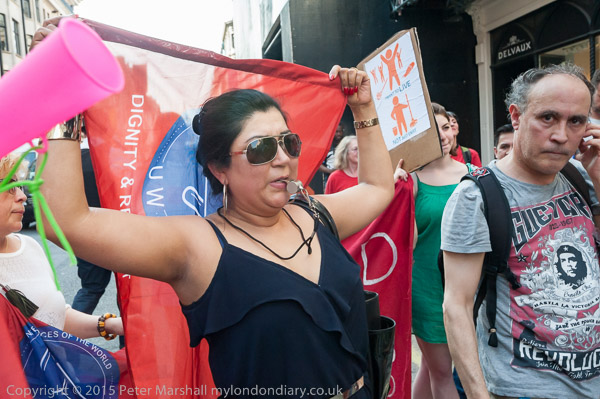
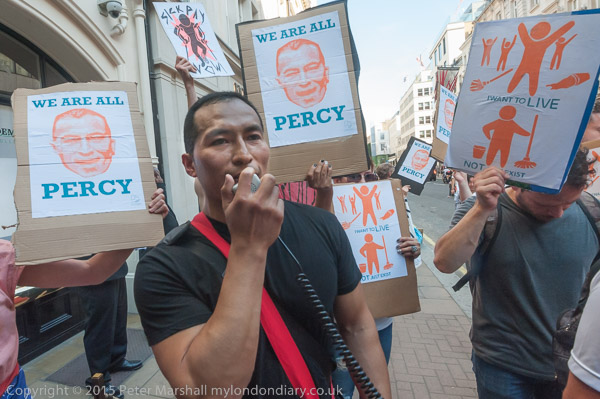
These new unions have brought a liveliness to protests that is seldom seen in the traditional union actions, with noisy protests where people parade and sometimes dance, blowing horns and whistles and banging drums. They want people to notice they are protesting, and it is certainly hard not to, and also they make clear with speeches, placards and banners why they are protesting. Some of the protest at Sotheby’s was in Spanish – the language of most of the cleaners – but it was also in English, and the ‘3Cosas’ that they were calling for were contractual rather than statutory minimum ‘Sick Pay, Holidays, Pensions’ and they wanted them ‘Now!!!’

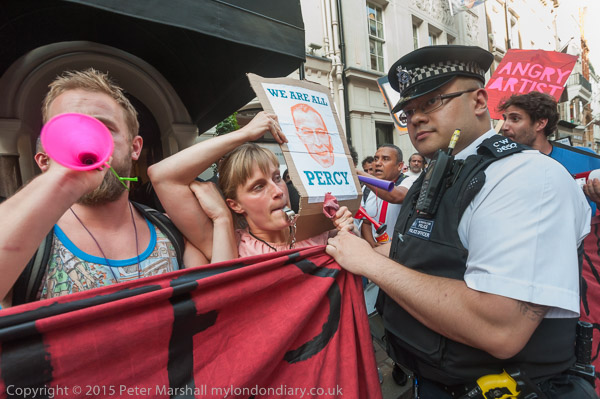
Their chants could certainly be heard by everyone attending the auction at Sotheby’s as well as everyone else in the area. There was considerable tension between police and protesters, with the police trying to move the protest away from the entrance to Sotheby’s and to keep traffic along the street moving.

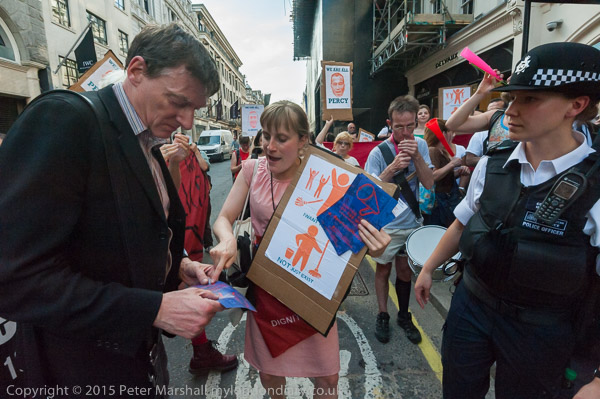
The protesters wanted to make their protest at Sotheby’s and to make those going into the auction aware of their cause and were not attempting to stop people entering or leaving, but the police seemed to the protesters to be siding with Sotheby’s and trying to minimise the impact of the protest. One of the managers did seem to spend a lot of time trying to persuade the police to be more assertive and clear the protesters away, and reinforcements did arrive and made an attempt to do so, pushing some of the protesters aside, but despite threats of arrest the protesters stayed around in front of Sotheby’s, though leaving the entrance slightly clearer.

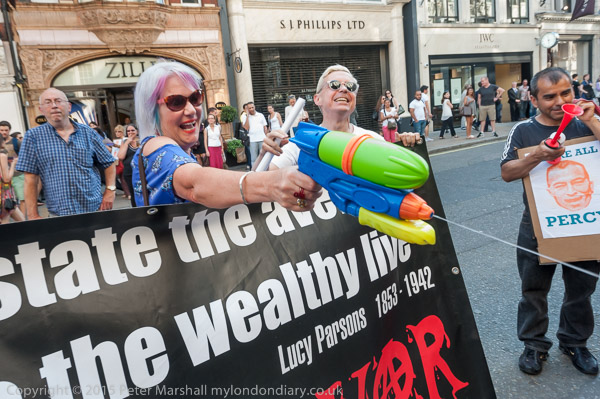
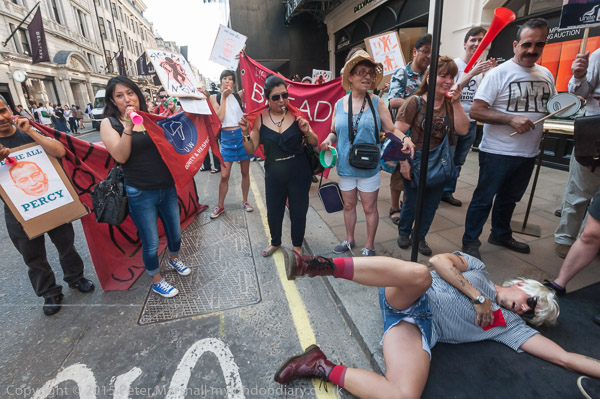
As well as the UVW, the protest was also supported by a number of individuals and other groups, including other low-paid and victimised workers and their union branches and Class War, who injected their usual humour into the event, coming armed with water pistols and staging a mock shooting in front of Sotheby’s, as well as some dancing and mime.

Photographically it was a fairly straightforward event, working mainly at close quarters with the D700 and the 16-35mm (used in all the pictures on this post) with just a few longer shots with the D800E and the 18-105mm. The light was good, though the black carpet and awning over the entrance to Sotheby’s did create some deep shadows in that spot, otherwise the fairly bright but low contrast shade in the streets was easy to work with. There were a few times when police seemed over-officious telling me to get off the road, and a few times I was pushed out of the way, but most of the time things were polite and the atmosphere was reasonably friendly. I had to leave before the protest finished, but there were no arrests while I was there.

The day after this protest, 4 cleaners who had taken part in the protest were stopped going in to work, effectively sacked. Following another protest two were reinstated, but protests have continued to get the two most active union members their jobs back. As I write this, the UVW have called off another protest scehduled during tonight’s auction at Sotheby’s as talks have been agreed which it seems likely will end the dispute. It is a dispute that should never have happened, as Sotheby’s are making record profits and the amounts involved in giving their low paid workers decent pay and conditions are relatively small.

More information and pictures at Sotheby’s ‘Dignity under the Hammer’ protest.

Continue reading Dignity Under the Hammer

Pride Again?


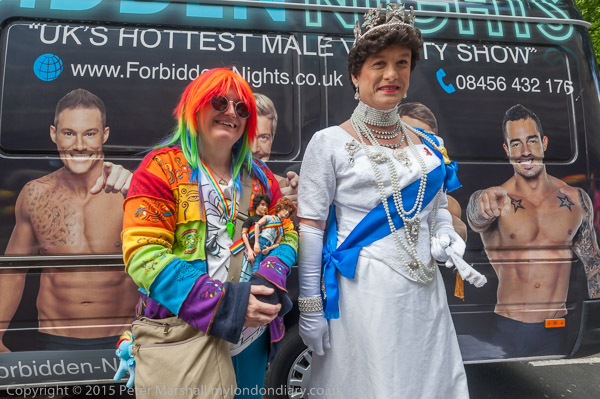
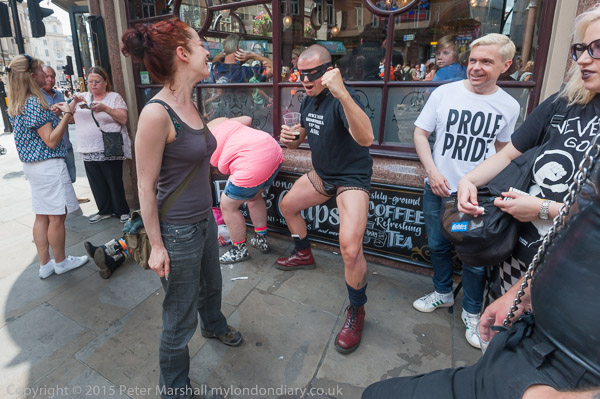
I got the Queen to pose for me with her friend – and found another ten photographers had come to my side

Every year I wonder whether to photograph the annual Pride Parade in London again.  And so far every year with one or two exception I’ve decided to do so, though back in 2007 I wrote here:

Ten years ago, taking part in the Pride march was an important personal and political statement for many, sometimes marking their going public about their sexuality. Now it’s largely a fun event, although a few individuals and groups still attempt to get a more serious message across.

One exception came in 2005, when my younger son inconveniently picked the same day for his wedding and my photographic services were required elsewhere. And in 2003 I was in Edinburgh on the day it happened.  Back in 2006 I had a show Ten Years of Pride at the Museum of London, and I think this year was the 20th London Pride I’ve photographed.

Over the years Pride has become a much bigger and more organised event and it is now one of very few events I bother to get accreditation for because of the size of the crowds that come and watch it, particularly around Piccadilly Circus and Trafalgar Square. But little of what I do really needs it, and certainly until fairly recent years I never bothered.

Pride is so large now that corporate sponsorship is vital, but as always it comes with a cost, changing the nature of the event. But this year there did seem to be a little more getting back to the grass roots and more political engagement and a little less corporate gloss.


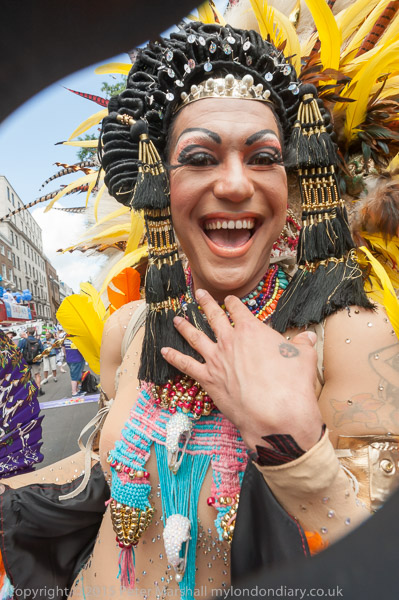
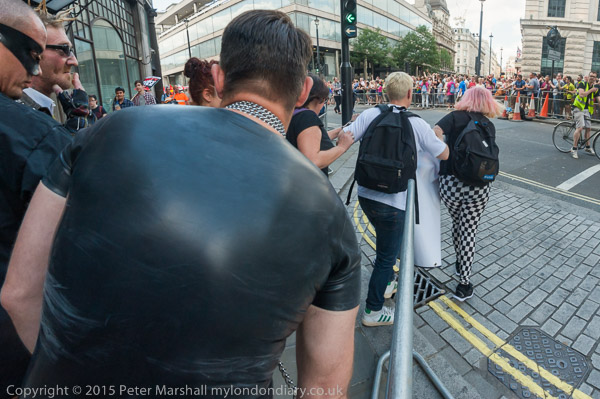
My lens-hood slips around and adds an unwanted frame

Getting accreditation does mean having to arrive early to go to the Press office and pick up stuff, which was a bit of a nuisance, and meant I was at Baker Street where the parade forms up rather earlier than most of the paraders. It was a very slow start to the day and if I’d had any sense I would have found something else to do for an hour or so. But many of the places I might visit don’t open until rather late, and it was in any case a little early for a beer. Sometimes I settle down somewhere and read a book, but often I’m too psyched up to read.


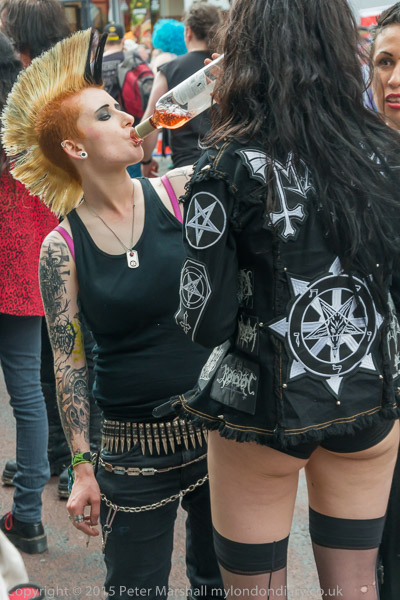
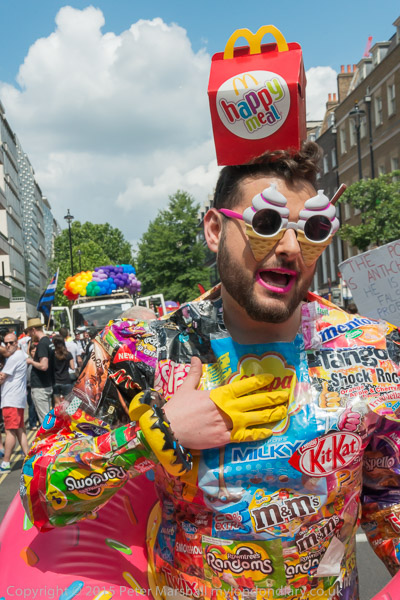
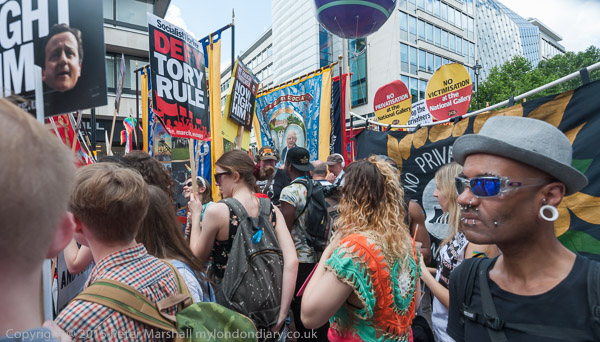
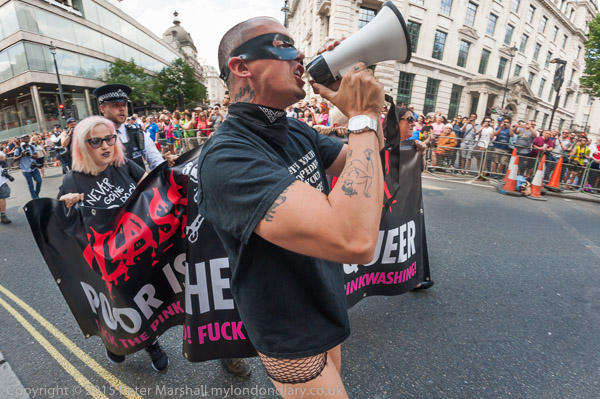
Pride was perhaps a little more political this year than for a while

Eventually things got busier, and by the time the parade was starting at noon things were pretty frenetic.  I went up to the front a quarter of an hour before it began, and then began to work my way slowly towards the back taking pictures. It was well over an hour later that I came to the people still waiting to set off at the back of the march. I should probably have stayed longer and taken some more pictures, but I was already late for a meeting with Class War.

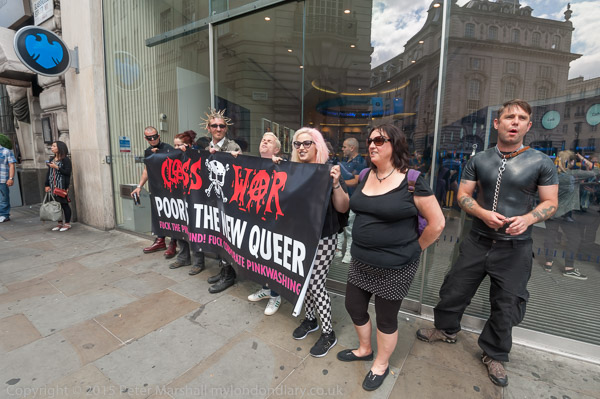
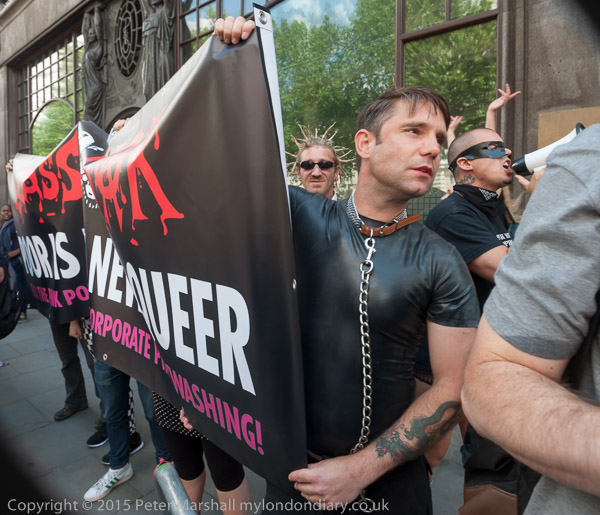
I took the tube from Baker St to Piccadilly Circus and walked into the pub where they were going to be and found no one there.  Eventually I found a small group outside just around the corner and joined them, still waiting for others to arrive. Class War had decided to protest at Pride, and had come with a new banner with the message ‘Poor is the new Queer‘ and ‘F**k the Pink Pound, F**k Corporate Pinkwashing!’  They were not the only protesters, and another group had arranged a funeral procession for Pride, which had attempted to go along a part of the route, but I’d decided that I would be unable to cover that as well as Class War.

The small group of Class War protesters made their way to the parade route through Piccadilly Circus as the parade arrived, but the crowds were too thickly packed behind the barriers for them to get through. They held a short protest in front of the Barclays Bank there, which closed its doors, and then moved off quickly to find a less crowded part of the route on Cockspur St.

As the front of the parade approached, they unrolled the banner, unhitched one of the barriers and ran out in front of it, with a mauve smoke flare attracting attention, and I followed them onto the road to take pictures. They were soon escorted back off the road and I continued to photograph, though rather impeded by an amateur photographer who move in front of their banner, to the consternation of several of the press pack who had now arrived.

I’d thought in advance that I would probably be working at a very close distance and had decided to use the 16mm fisheye on the D700 along with the 18-105mm (27-157 equiv) on the D800E when a longer view was needed. It was a pretty good combination, but once Class War were back behind the barrier and I was still on the other side, after  a few frames I quickly changed back from the 16mm to the rectilinear 16-35mm.


Cropped to remove some of the vignetting by the out of position lens-hood

And there I caused a problem, because I had the lens-hood on that lens, although there was no need for it as that side of the road was in shade. And in my rush to change lenses and the general excitement, I managed to knock the shade out of its proper condition. As often in the heat of the moment, it was some time before I realised this, obvious though it is in the viewfinder, and I took a number of frames with it vignetting at top right and bottom left.  Images seldom work quite as well cropped to remove the vignetting, and sometimes I’ve lived with it there, usually desaturating it to remove a rather noticeable blue edge. The image above is probably better for losing a little at each edge, but there is still some vignetting visible.

Class War soon saw a squad of police heading in their direction and quickly melted away in the crowd. I followed some of them down into the subway from where they emerged without a police escort on the east side of Trafalgar Square and made their way to a nearby pub, where I said goodbye and went to photograph another event.

Many more pictures at Pride Parade (my pictures overstate the political aspects of the event as these interest me more) and Class War protest ‘corporate pinkwashing’.

Continue reading Pride Again?

Light on LIGHT

PetaPixel  has an article about a revolutionary new camera, the LIGHT L16, which looks rather interesting, along with sample images. Its a novel concept and could change the camera market considerably, though perhaps is priced too high to really replace phone and compact cameras, costing more than many DSLRs with their kit lenses.

Apart from PetaPixel, most informative page I’ve so far found on the LIGHT L16 is  Introducing the Light L16 Camera by Rajiv Laroia, Light co-founder and CTO which has a couple of videos and at the bottom of the page the press release, which doubtless you will read recycled as articles on many photography web sites and magazines.

Here are a couple of quotes from it:

Key features of the L16 include:

Integrated 35mm-150mm optical zoom
DSLR-quality high-resolution images
Exceptional low-light performance
Low image noise
Fine depth of field control
Five-inch, easy-to-use touch-screen interface with on-device editing and social network sharing

The L16 will retail for $1,699 and ship in late summer 2016. A limited quantity will be available for pre-order through November 6 at a special price of $1,299 at https://light.co/.

It looks interesting and truly innovative, though only fuller reviews next spring and summer – and user experience – will really tell how well it works.

I don’t see it as a replacement for my own DSLR – it simply doesn’t cover much of the focal length range at which I work – around half my pictures are taken with the 16-35mm lens and mainly in the wider part of its range, while some require a rather longer reach than the 150mm can provide. And although they say its innovative technology gives great low-light results, I think they may be thinking in camera-phone rather than DSLR mode on this.

But there are certainly some very interesting aspects. I remain somewhat sceptical until it actually reaches the point of sale, as we have had a number of innovative products that never quite made it in the past, but this could well be the a great success. And if so, it may be a killer for DSLRs not because it can really replace them, but because it will take away the market for cheaper amateur DLSRs without which the higher end models may not survive.

I’m not sure whether I would want to buy one. It lacks one key feature I’d find it hard to live without, a viewfinder.

Climate Lobby

People going to lobby their MPs at the Houses of Parliament is seldom a good thing to photograph. Mostly the actual meetings take place inside offices either in Parliament itself or in Portcullis House around the corner, and even if you can get in to these meetings there usually is little to photography. The last time I actually lobbied my MP we went in as a small group to the St Stephen’s Tavern, just across the road from Big Ben and I did take one or two pictures, but the lighting was all wrong.

So when groups are taking part in a mass lobby of Parliament, they usually have a photo-call or a rally beforehand, at which there are rather greater opportunities for taking photographs. The Climate Coalition’s mass lobby was a little different to most, partly because of the scale and instead of going into Parliament to see MPs they had arranged for the MPs to come out and meet their constituents.

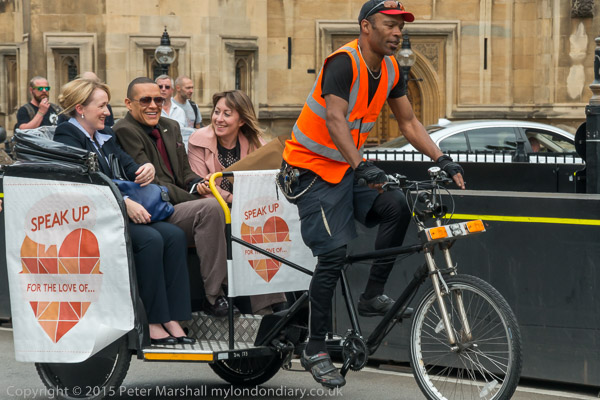
The various constituencies were each allotted a position along a long line stretching through the gardens next to the Houses of Parliament, across Lambeth Bridge and then down the Albert Embankment back towards Westminster Bridge – spread out along about three-quarters of a mile, with a cycle rickshaw service being provided to take the MPs as close as possible to their places.

I’m not sure quite how many MPs made it, but I think it was something like a third of the 650 MPs, but they were spread out not only in distance, but also across a two hour period. I’d started early, when just a few MPs and people come to lobby were around, and after photographing the few groups I could find in Victoria Tower Gardens, went off to cover a couple of other protests – the regular weekly vigil for Guantanamo prisoner Shaker Aamer in Parliament Square, and, a short walk away, a protest opposite Downing St for free speech activist and liberal blogger Raif Badawi, sentenced to 1000 lashes (essentially a slow death sentence) in Saudi Arabia.

Badawi was given the first 50 lashes in January, but the following Friday the second flogging was postponed as he had not recovered sufficiently, and so far it seems the scheduled weekly floggings have not been resumed. The sentence has however been confirmed and now UK government ministers seem to be excusing the Saudi authorities rather than joining in the world-wide condemnation, valuing UK arms sales above human rights.

Today comes the news that Badawi has won the annual Pen Pinter prize established in 2009 in memory of established in 2009 in memory of Nobel winning playwright Harold Pinter for championing free speech.

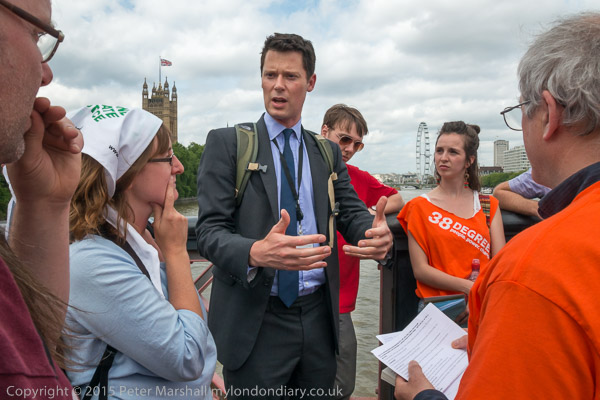
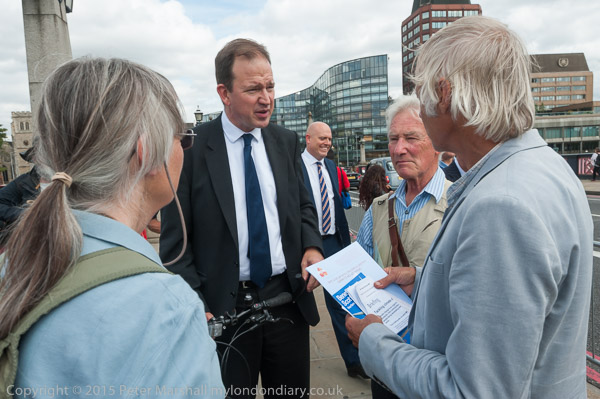
By the time I’d finished photographing this and returning to the Climate Lobby many of the MPs had been and gone, but I was able to run along and find those still talking and take a few pictures. It was hard on Lambeth Bridge because the pavement is so narrow and the groups were very crowded close to the MPs.

MPs are a pretty mixed bunch, and listening to them interacting with their voters I was surprised by a few of them, who seemed to have little understanding of the urgency of climate change, and were lecturing their constituents rather than listening to their views. But most seemed to share their concerns. I’m not sure that lobbies like this have any real effect.

After the lobby there was a rally, with speakers on the top deck of an open-top bus, which made them a little hard to photograph, especially with the sun behind them. A few were too short to be easily seen over the side of the bus, and it would have been good to have had some kind of platform for them to stand on.

As usual, the audience were more interesting than the speakers, as you can see in the pictures at Climate Coalition Rally. Images from the lobby are at Climate Coalition Mass Lobby.

But at least at the rally the names of the speakers went up on a screen, though I missed one or two. Writing the captions for the pictures of the MPs took some time, working out who the MPs in the pictures were from my notes; fortunately some of the constituency labels were visible in the images. MPs often wear their ID cards with their name, but somehow these nearly always seem to be showing the wrong side. I often wish I made clearer notes, but I think you will find all four of the MPs shown above and most of the others have their correct names in My London Diary.
Continue reading Climate Lobby

Cable Street Ripper Horror


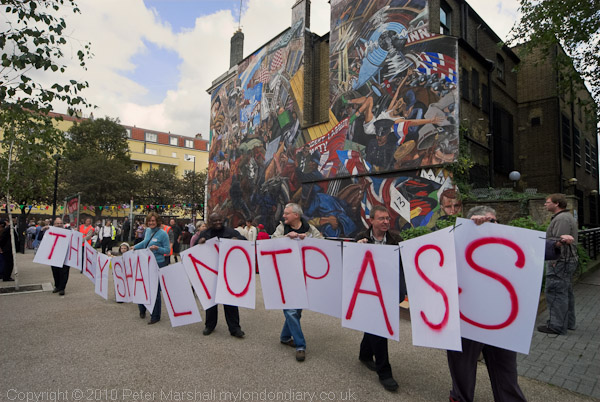
Cable St 70th anniversary, October 2006

I wasn’t at Cable Street in 1936, but was expecting to be there today, 79 years to the day after the ‘battle‘, but yesterday Class War cancelled their planned protest against the Jack the Ripper Museum there. It isn’t really a museum of course, although the owner pretended it would be, getting planning permission to open a museum celebrating the history of women in London’s East End.

That would have made an interesting museum, but would have been unlikely to make the kind of money the owner was obviously after in setting up the tacky tourist attraction that has now opened. Several protests have taken place there, and there is now little doubt what most people in the area think about it – and if anyone still has any doubts about its nature they should read the review by Fern Riddell on Storify or the article based on that in the Independent newspaper.

Fern Riddell is a historian who specialises in the period and in the area, and a consultant on the BBC’s Ripper Street series, so someone whose opinion is of value. Her conclusion: ” it’s not a museum. It’s a poorly executed shock attraction.”

Earlier in their planning, before the change of purpose, the Museum had consulted a friend of mine formerly from the Museum of London who was shocked to hear her name being used to attempt to give the ‘museum’ credibility and made it very clear to the owner that this was entirely unacceptable, getting an undertaking from him not to do so – which he has now broken.

I photographed protests by Class War outside the ‘museum’ on August 5th and 12th, and filed my pictures in the usual way. There was no interest in the protests from the media and none of my pictures were used at the time. Both protests were relatively peaceful, though one small pane of glass was cracked. The protesters held up the traffic on a minor road for some minutes, made a lot of noise, and on the second occasion let off a few flares.


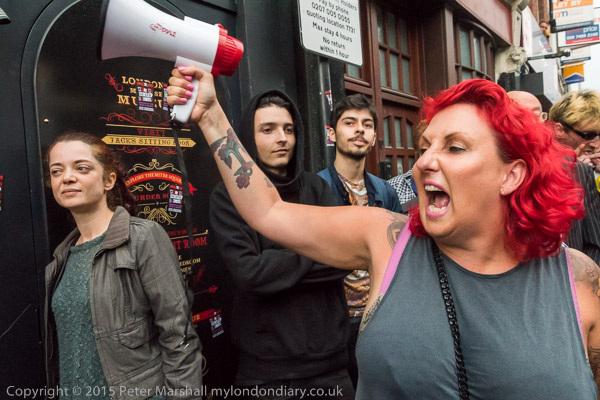
Lisa McKenzie at protest against the Ripper ‘museum’

In the last week, one of my pictures taken at the protest on August 5th has  appeared in several newspapers, some of them more than once. The reason is that some of the same people who organised the ‘Ripper’ protests also organised an anti-gentrification street party in Shoreditch a week ago on Saturday night.

Around a thousand people turned up and took part; I didn’t go although I had been asked to, because I’d had a busy day and its quite a trek from where I live. There was music, masks, dressing up and Class War’s banners; a lot of chanting and shouting, flares, arguments with police who tried to stop it – and some fighting with police when they started pushing people off the road.

I wasn’t there, but many others were with cameras and phones and I’ve seen the videos and heard people’s stories. There were two fairly minor incidents in which two shop fronts were attacked. There was a lot of angry shouting, and the glass of an estate agents window was cracked, and slogans daubed on a hipster-run ‘cereal shop’.

There were a few other nasty incidents recorded on video, including a police attack on a young woman which could have been really serious, and there were a few injuries and some arrests. But it is the cereal shop incident that has apparently enraged the newspapers, causing them to throw as much mud as they can at anyone connected with Class War, whether or not they were around at the time.  Someone even invented a story about the protesters – many of whom also campaign for animal rights – ripping a dog apart with their bare hands for the press. Though there were no real witnesses.

The woman with a megaphone in my picture became one of their chief targets, with some articles that can only be described as vitriolic, although she had left the protest before any trouble occurred. It’s a picture I like because it shows her as a strong and determined woman, and one which I think celebrates her and the working class culture from which she comes.

She left school shortly before she was 16, taking time off school with other women from miner’s families to support their striking men, worked 10 years in a stocking factory, then in shops etc, living in the notorious St Ann’s district of Nottingham. She became a single mother and at 30 took an Access course, going on from there to study at Nottingham University for a first degree and then her Ph.D.

Back in 1970 I bought a book, a Penguin Special, ‘Poverty: The Forgeotten Englishmen‘ by Ken Coates and Richard Silburn, based on their studies in St Ann’s (though the cover photograph by Roger Mayne was I think from North Kensington.) It was this book which inspired Lisa McKenzie to study the area she lived in and knew – and which ended up in her doctorate and the book ‘Getting By‘ that came out earlier this year.*


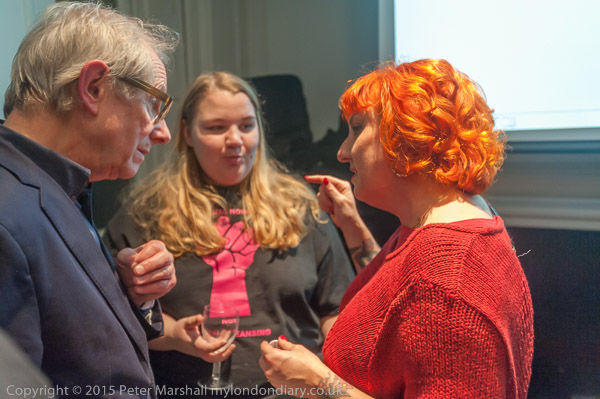
Ken Loach, Jasmine Stone and Lisa McKenzie, author of ‘Getting By’ talk at the book launch

Hers is really a great story of success, a positive story that my picture I think celebrates, but in the media she is portrayed as the devil, an ‘academic‘, someone who obviously doesn’t know anything about the lives of ordinary people. They suggest she is wealthy and privileged and using the lives of the poor for her advantage, but she is in a job that almost certainly pays less than the average wage and her work is all about supporting working class people and their values.

Once you put work into an agency you lose control over it. I’m sure there are uses for which my agency would not supply pictures, publications they would not supply images to, but these were articles in the mainstream press. Companies which almost any agencies would supply images to in good faith. You can’t vet articles when you are supplying pictures, and nor should you be able to or have to. We should demand higher journalistic standards from the press.

But perhaps all is not lost. I cling to the hope that many readers – even of the gutter press (and more seems to be aiming for the gutter at the moment) will see the picture for what it is – an affirmative image of a strong and obviously working-class woman protesting against the horror of a ‘shock attraction’ that glorifies ‘nameless violence inflicted on nameless women’. And perhaps there will be many, particularly working-class women who are less scared of the idea of a strong working-class woman than newspaper editors.


* Any journalist writing about her who had done even a few seconds of research would have found this information about her in an article in The Guardian: The estate we’re in: how working class people became the ‘problem’. It comes up as the second item when I search for her on Google.