Protest Works – at least sometimes

Often people tell me there is no point in protests. They never change things. And of course they are wrong, although of course they don’t always succeed, even when they enjoy massive backing – as our involvement in the Iraq invasion and yesterday’s vote to bomb Syria show.

Two of the protests I covered in the last few days of July have since then resulted in at least a part successful resolution, achieving outcomes that certainly would not have happened without the protest. Both of them were protests about workplace issues, and both involved the unfair dismissal of people for normal trade union activities, and as well as opposing victimisation the protests also resulted in at least some progress on the issues over which they had been taking action. I don’t know the fine detail of the settlements reached, but I do know in both cases protest – and in the case of the PCS at the National Gallery, 100 days of strike – achieved gains which would otherwise not have happened.

The third protest was about Palestine, and in particular about the failure of the BBC to report with the even-handedness it proclaims. Here there has been perhaps little progress, although more has come out – even from within the organisation – confirming its pro-Israel bias, and I think there has been a slight shift, with more attention being paid to the work of some of the BBC’s correspondents in Israel and Palestine rather than the prejudices of those in the studios and back rooms.

The strength of the BBC has always been in the reports of its foreign correspondents, who include some of the best journalists around. Its often at its best in the World Service rather than here in Britain. I remain a firm supporter of the BBC in spite of realising that we have to go elsewhere in search of what is happening in the UK and sensible unbiased opinion on politics in this country. It’s a real shame that it can’t reflect a more independent view here – and particularly in Westminster rather than so often following the promptings of our billionaire-directed press.
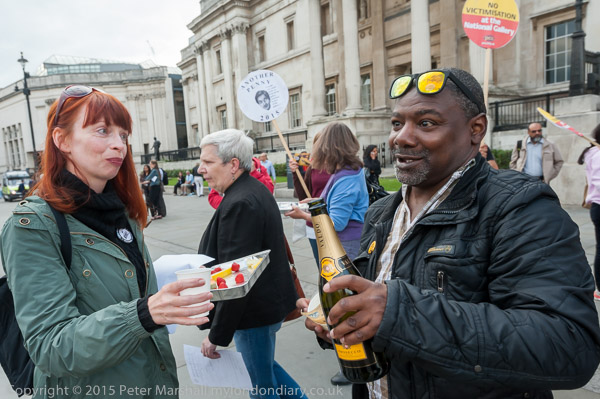
First up was a protest by National Gallery staff outside the leaving party for director Nicholas Penny in Trafalgar Square. I was shocked to find that many of the gallery staff had not even been invited, and they held their own little party outside, against the plans for privatisation and de-skilling that the departing director had signed off, despite giving his opinion that he didn’t feel they were appropriate.

The plans are all a part of the current government’s policy to sell off everything. Partly its a matter of reducing government debts, partly of putting fat profits into the hands of their mates (and themselves) in the private sector. Outsourcing cuts costs by employing less skilled staff on lower wages and inferior conditions and the only thing it ever improves is the bank balances of the out-sourcing company’s shareholders.

Photographically the only problem was in making something of fairly meagre subject matter. The light was fine, there were no problems of access, people were mainly happy to be photographed (though a few a little camera-shy) and there were few other photographers present.
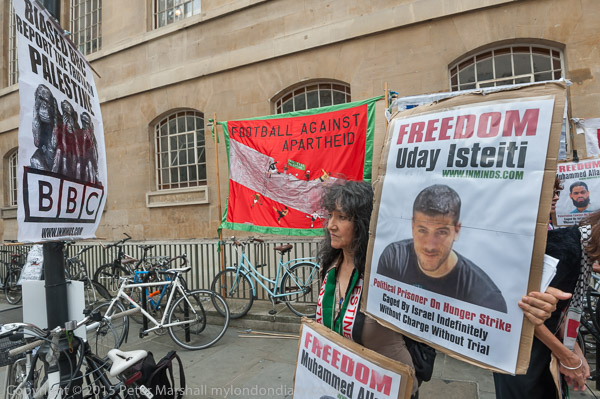
The following day at the BBC there were more posters and banners, but I arrived rather late, and was short of time before the protesters left – and some had done so already.
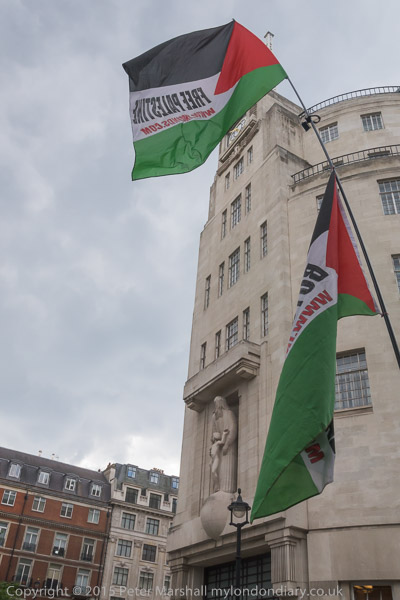
Although the old Broadcasting House is an iconic building and protesters can protest close to it, the entrance to the newer block which identifies it as the BBC is set well back in a private yard, which security keep protesters – or at least organised protests such as this – outside.  It’s a little hard to really visually link the protesters with the BBC. And although I recognise the frontage of Broadcasting House, I’m not sure how many will.
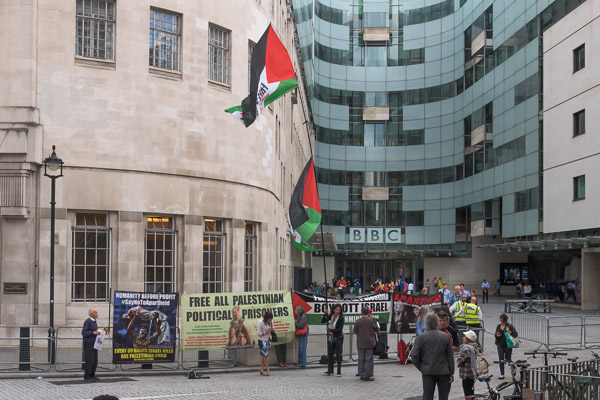
Even using a fairly long lens to compress distances, it’s hard to really link the protesters with their banners on the fence in front to that BBC above the entrance.
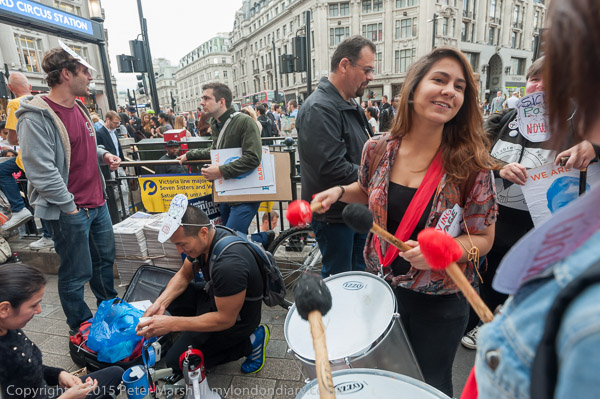
From Broadcasting House it is only a short walk to Oxford Circus where United Voices of the World were meeting to march to Sotheby’s for the start of the protest over the  ‘Sotheby’s 2′, Percy and Barbara, sacked for taking part in a protest outside their workplace for better conditions of employment – sick pay, holidays and pensions.

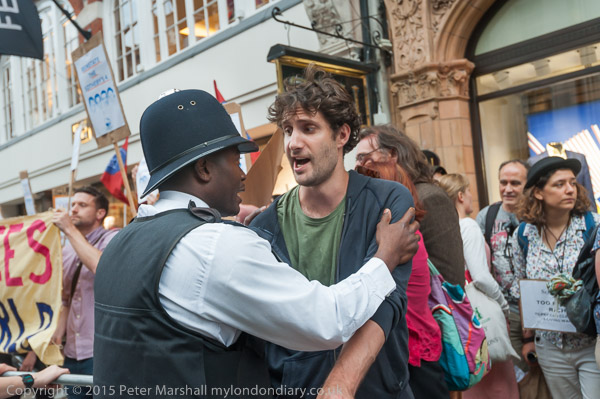
Previous protests had already let to the reinstatement of two sacked workers, and the last one a couple of weeks earlier had been met by a large and heavy-handed police response, trying to restrict the movement of the protest around the streets.  This time their were few police and they simply stood in a line along the pavement in front of the doorway.
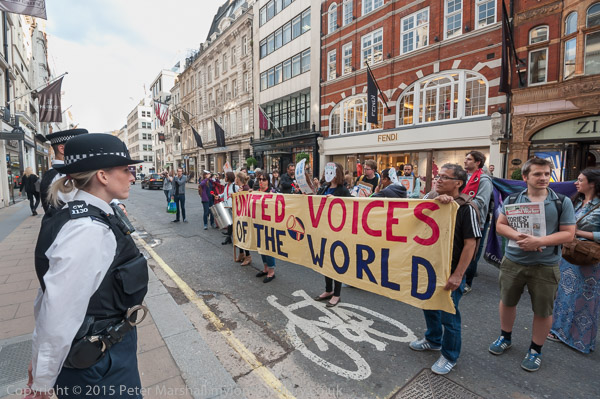
It was curiously low-keyed, but perhaps showed that some officers at least had learnt from the previous  occasion, and this protest cause much less disruption of the area than the previous one. These are protesters who are prepared to make a lot of noise to make sure their protest is noticed, but not people out to cause any serious damage. But none of us likes being pushed around by police, and tempers sometimes flare on both sides if officers try aggressive tactics.
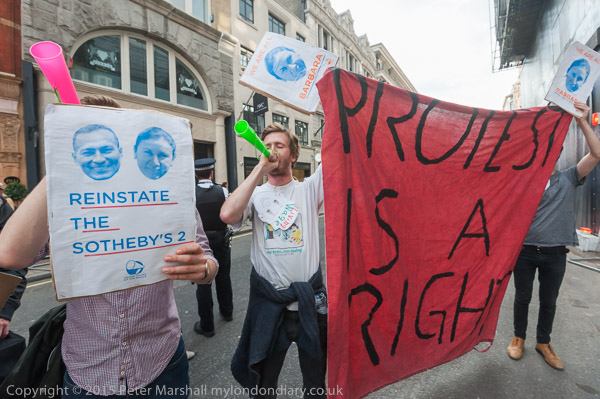
Protest‘, as one of the banners stated, ‘Is A right‘, and the police often claim that they facilitate it, though at times they seem more concerned with its restriction. But on this occasion things went smoothly. It wasn’t boring to photograph, though there were none of the scenes which are likely to make it news in the eyes of the media.

And that’s perhaps something of a dilemma for photographers who cover protests. We know that protests without violence are unlikely to make the news and that our chances of having pictures bought are relatively low.  I happen to think that the victimisation of low-waged workers by a prestigious high-profile employer like Sotheby’s who are making huge profits merits a place in the news. It is a scandal that should not happen in a civilised society.

But the wealthy owners and well-paid editors who control our news regard it as without interest – unless perhaps a ‘celebrity’ takes part or they can condemn those who lack power in our society.

It took another protest or two, but in the end Sotheby’s and the UVW came to some kind of agreement, though I don’t know the details. But here as in a number of other cases, they have managed to protect members and improve conditions by action.
Continue reading Protest Works – at least sometimes
World Press Photo sets Ethics Code

Following controversies in recent years over a number of award-winning images it is good to see that World Press Photo (WPP) has come up with a Photo Contest Code of Ethics for entrants to what is the world’s leading competition for press photography.

I applaud too its firm stand against the staging of images and also its prohibition of  “multiple exposures, polyptychs (diptychs, triptychs, etc.), stitched panoramas (either produced in-camera or with image editing software), and pictures with text added within the frame“.

It’s good too that the rules lay emphasis on accurate captioning, but perhaps the best of all is its guidance on the manipulation of images, making reasonably clear – with the aid of video examples the kind of work on images which is permitted and what isn’t.

I’m also pleased to say that WPP allows the submission of images that were taken digitally or on film, including those taken as RAW files. There is no attempt – unlike Reuters’ recent prohibition – to prevent photographers from using RAW.

Reuter’s present their ban as being based on both ethics and speed, but to me it seems to be a deliberate attempt at de-skilling photographers. We know that although jpegs can do a decent job in some situations, when the lighting gets tough and in particular in low light RAW can enable us to produce images that reflect things more accurately and clearly. Not taking advantage of its potential is working with one hand tied behind your back. Thank goodness I don’t work for Reuters.

The guidelines for WPP entrants are more of less those that I work by for press work, though there are some small differences. In particular I think that the kind of perspective alteration (from spherical to cylindrical) I often use to produce extreme wide-angle views would fail their manipulation tests. For me its a transparent operation which serves to make the image more closely represent the scene as I saw it. Again, although it has very seldom happened, I’d see no problem in stitching together two images of a scene if I felt a wider view was needed than one image could provide. Neither of these practices involves any intention to deceive or mislead in any way.

Last Tuesday I went to view the latest WPP exhibition currently on show at the Royal Festival Hall in London. It continues there until 29 Nov 2015 and is open daily from 10.00 to 23.00 and is certainly worth taking a look, with a number of fine images.  If you can’t get to see it you can still see all the winning images on line.

It’s perhaps a rather wider selection of images than in previous years and one I found more interesting in the different approaches shown.  It’s certainly good news that the WPP are taking firm steps to guarantee the integrity of the photography it selects, and I hope their stand will become a benchmark for photographers around the world.

If you wish to enter the 2016 World Press Photo Contest  you must register for access to the entry site between 2 December 2015 and 7 January 2016, 12.00 CET, and submit your work by  13 January 2016, 12.00 CET.  The rules are clearly set out and entry is open to all professional photographers.

Winnersh Triangle

I’ve never needed to alight from the Reading train at Winnersh Triangle before. When the station – just a few hundred yards down the line from the existing station at Winnersh was added the media was full of stories about strange disappearances in the Bermuda Triangle, and Winnersh Triangle did seem to be a halt where a few left the train but nobody ever got on. And on July 27th we added to that number, the three of us leaving the train there, along with just one other passenger. I don’t know if she returned, but we didn’t.

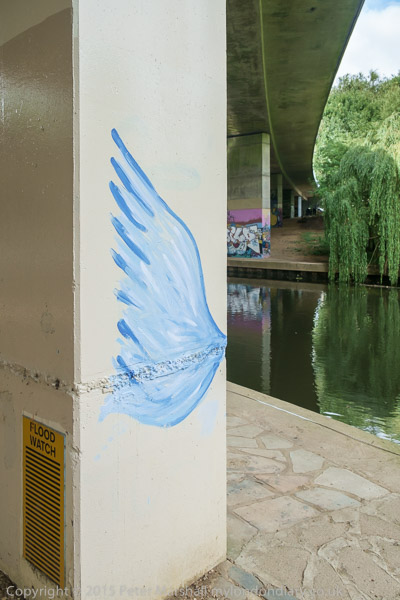
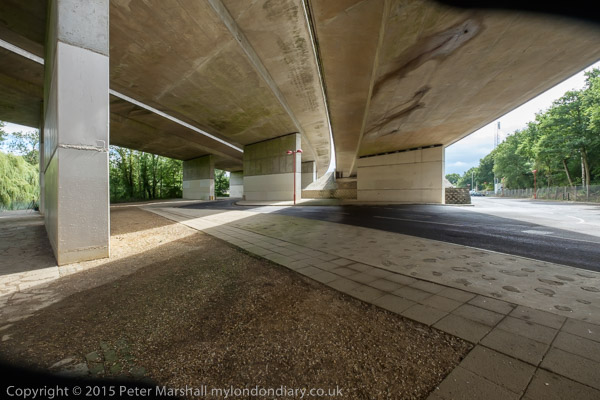
Winnersh Triangle is a business estate on a very vaguely triangular area of land between the A329 Reading Road, the A329(M), a mile or so of feeder motorway to the M4 which begins here, and Winnersh Meadows, a smallish country park. Much of it is in the flood plain of the River Loddon which runs around its west and north sides and regularly floods. Viaducts carry the railway and the lead-up to the motorway across the river.

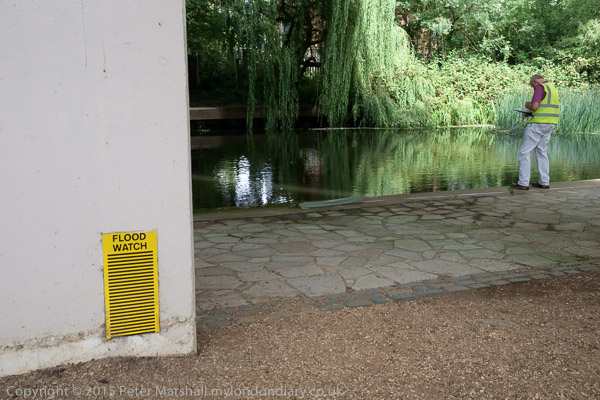
Having something of a penchant for tacky Ballardian developments I would probably have spent some time photographing in Winnersh Triangle itself – and doubtless attracting the attention of its security staff, but my two companions were of a more rural mind, and we set off through the older ribbon of suburbia along the Reading Road to Loddon Bridge before taking a footpath along by the river. Although there had been a little rain recently and we came across a man from the council checking the river – and he was keen to tell us about it. From the sign we could have been walking in a foot or two of water at the wrong time of year.

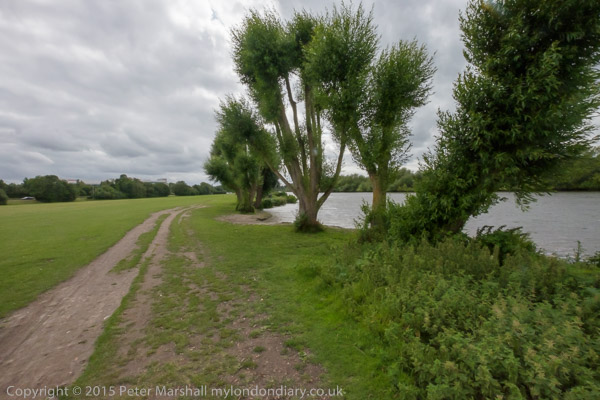
But very soon we were in green rather than concrete country, even if it was more country park than real country, though later stretches of our walk towards the Thames were in surprisingly remote areas despite being not far from the suburbs of Earley and various suburban villages around. There were a few curiosities on the route we took, including The Museum of Berkshire Aviation and a few miles on a rather deep ford across one of the streams of the Loddon, the Old River.

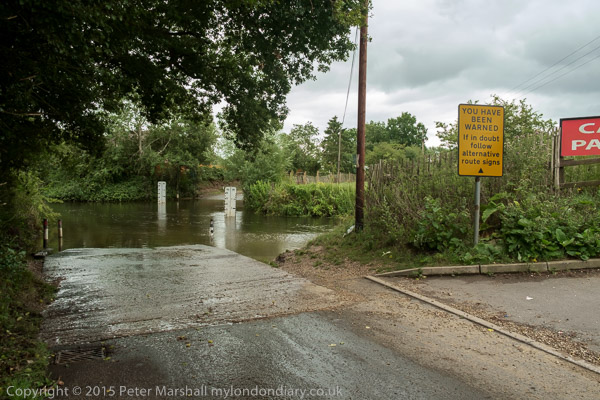
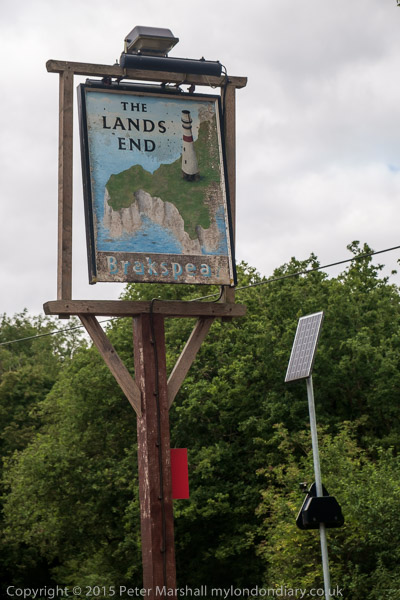
The depth gauge on that day was only reading just under 2 foot, but it goes up to 6 foot. Fortunately for those on foot there is a narrow footbridge a hundred yards or so upstream, and anyone stranded on the west side can take refuge in the Land’s End pub.  The beer was welcome, though at West End prices, with no competition from Wetherspoons here.

We walked on to the Thames, turning left to sit and eat our sandwiches by the river. There were no other walkers on the path on our side of the river – which comes to a dead end where we had joined it – but we could see a steady stream on the Thames Path along the opposite bank – where we had ourselves walked a few years ago.

The path took us to Sonning, past the home of Uri Geller who has I think since moved out, leaving another poor piece of sculpture on the river bank without planning permission to the disgust of the locals. Sonning is a posh village, for those with expensive tastes (or lack of taste) and includes what must be one of the churches with the richest supporters in the land. But we were made welcome as we looked around and presented with a glossy advert-stuffed church magazine. In Anglo-Saxon times there was a cathedral here, and a Bishops Palace until the sixteenth century.

From the churchyard we took the path to join the Thames Path for the few miles into Reading and the train home. It had been a pleasant walk but rather tiring on my old legs.  More pictures at Loddon & Thames.

All of the pictures were taken on two Fuji cameras, the Fuji X-T1 and the Fuji X-E1, with the 10-24mm and 18-55mm zooms respectively.  Weighing in at around half the Nikon equivalents they were rather easier to carry the dozen or so miles I walked. I had a couple of other lenses too, the 8mm fisheye and the 90mm Leitz Elmar, but don’t think I used either – certainly all the images on My London Diary were taken with the two zooms. Again these lenses don’t add a great deal of weight.

The two lenses are a great pair, with the overlap between the two ranges maening rather less need to switch cameras. Just occasionally that 55mm seems a little short and perhaps the 18-135mm would be better. I’m still thinking about it.

Even the four spare batteries don’t add up to a lot (and I think I used all of them.) But battery life is a big problem with all ‘mirrorless’ cameras, even though I work with the EVF on the X-T1 only switching on when I bring the camera to my eye it doesn’t seem to help much.

Many photographers rave about Fuji colours, but I prefer the Nikon version.With the Fujis  on Provia/Standard setting the colours – particularly the greens – are too intense and always need some adjustment in Lightroom. My best results come from working in RAW and importing into Lightroom with a Pro Neg Standard preset setting.

The X-T1 had also developed a strange pink cast, seeing the world through rose-coloured glasses, which takes some correcting. I found that there is a setting on the camera which allows you to mess up the auto white balance, and somehow this had been changed, although setting it back to zero doesn’t entirely solve the problem, but does make the images more neutral. This change in colour appeared to have happened at the time of the latest firmware update – and I hadn’t made any deliberate changes. But I’ve not heard of others having similar issues.

Continue reading Winnersh Triangle

Doves & Fuji Disappoint

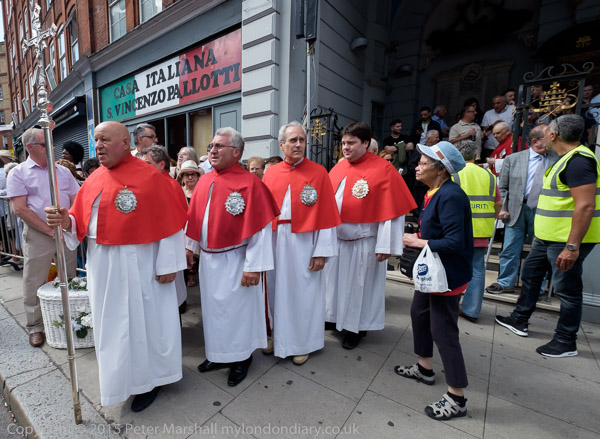
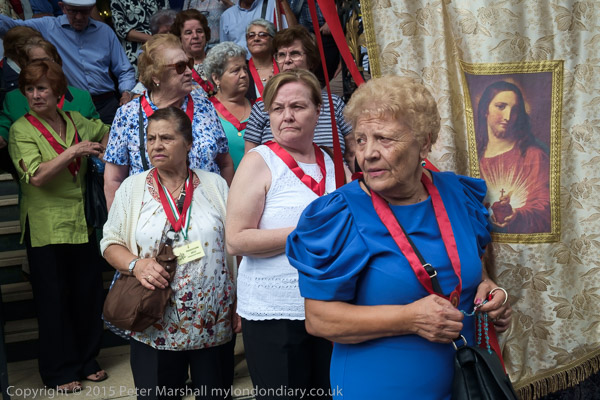
I can’t remember when I first photographed the annual Italian Church festival in London, one of our older traditions, dating back to when the community around the church in Clerkenwell was given special permission to hold a procession around their parish in 1883. Then a Roman Catholic procession was politically still very sensitive.

The Popery Act of 1698 had tightened the very strict limitations on Catholics, putting a bounty 0f £100 on Catholic priests and providing for the  “perpetuall Imprisonment” at the discretion of the King of priests taking Mass or anyone found to have been educating youths as Catholics. When the Papists Act of 1778 attempted to reduce this official discrimination London saw its worst riots ever with around 50,000 people taking part in angry marches to Parliament, with ‘King Mob’ attacking the homes of wealthy Catholics, embassies of Catholic countries and prisons – both Newgate and the Clink were largely  destroyed – and other targets in and around the city.

It was riot on a scale that makes our current protests look small beer indeed – with just the occasional window being broken, the occasional and possibly sacrificial police vehicle torched and where cereal being thrown at a shop window makes vicious headlines. After around 5 days of mob rule the army were brought in, shooting and killing almost 300. Around 450 people were arrested and later around 30 of them were tried and executed.

The legal discrimination against Catholics (and Protestant dissenters) was reduced by Acts in the 1820s but was only finally removed by the Religious Disabilities Act of 1846. But of course we continue to celebrate ‘Bonfire Night’ on November 5th, though perhaps few of us now remember it as an anti-Catholic event dating from 1605, and by  Act of Parliament until 1859.

It was one of my photographer friends whose father was Italian who first told me about the procession of Our Lady of Mount Carmel and I arranged to meet him there perhaps around 20 years ago, and I’ve met him again there most years since then, taking pictures and sharing a few tumblers of Italian wine in the Sangra.


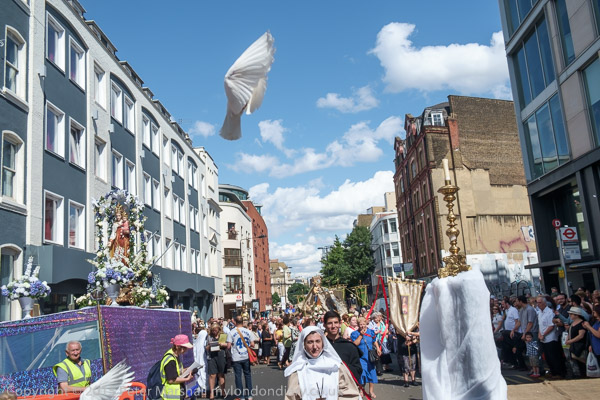
A rather bad picture of the release of the doves

One of the highlights of the event has always been the release of doves, and it’s something I make a point of trying to photograph. It changes a little from year to year and in most recent years I’ve been lucky in getting one decent image of it.

This year I had taken with me two Fuji cameras, the X-E1 and the X-T1, and most of the time I had the Fuji 10-24mm zoom on the X-T1 and the 18-55mm zoom on the X-T1. There were two releases of three doves, and I’d got in a good position for the first one and was waiting with the X-T1, and I set the shutter to continuous high-speed mode – 8 frames a second. As the lid to the first basket was raised, I raised the camera to my eye in readiness and the electronic viewfinder remained blank.  I just had time to grab the X-E1 and raise it to my eye and get a single image as the birds flew away. But they doves were not co-operating – one was flying low and mainly out of frame, a second was nicely in frame but performing a pancake impression, while the third had soared way up and behind me by the time I pressed the shutter.


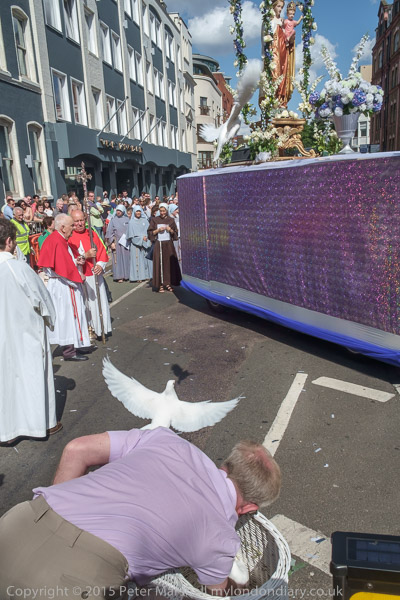
My second attempt was slightly better

I saw a second basket and knew I had another chance later. So I checked the X-T1 again and found that the battery had run out – you get little or no warning. I changed the battery for a fresh one – I’d carefully taken 5 spare batteries with me and had checked before going out that all were fully charged . I tested the high-speed continuous mode with a short burst. Everything was fine. But as the dove man got ready to raise the lid of the basket, I put the camera to my eye and … Nothing. The viewfinder was blank. I tried the usual way to unblock the Fuji sulk, switching the camera off, then on. It still didn’t respond. Fortunately the doves were on a go-slow. They were sitting happily in the basket and having a good time, refusing to leave. I had time to lift the X-E1, adjust the zoom to 18mm and make a picture as the doves were persuaded to leave. You can see all three of them in the image – one still in the basket and two in flight (and a small black shadow dove as a minor bonus.) It certainly wasn’t the best picture I’ve made of the release, but at least I had a picture.

I don’t know why the X-T1 let me down that second time, but it illustrates well the frustration I have with what is in other respects a fine camera – with some really great lenses. It’s the same with other Fuji cameras too, though today for once the X-E1 performed without similar hiccoughs. I keep hoping that Fuji will sort out the problems in the next firmware update, but I suspect they are too basic.

Continue reading Doves & Fuji Disappoint

Sotheby’s Party Protest


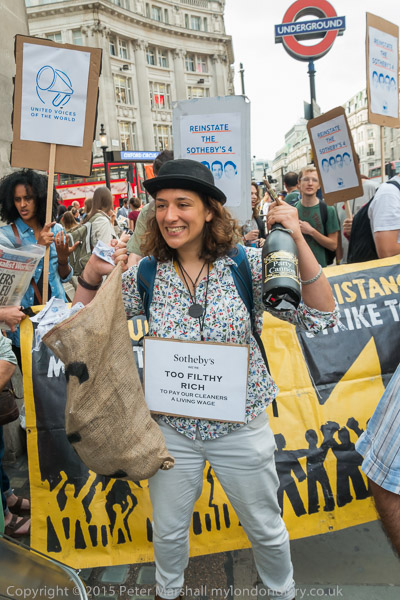
A sack full of money and an equally fake bottle of champagne for a party-themed protest

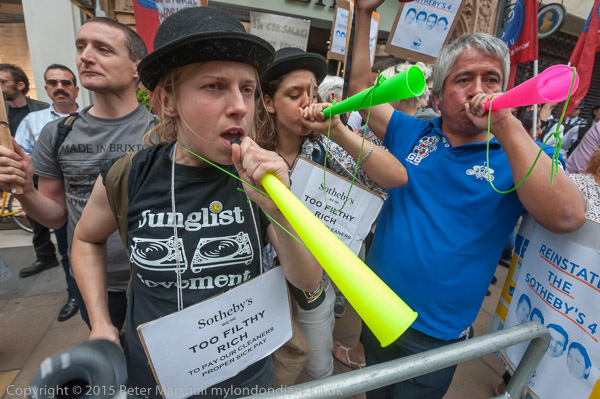
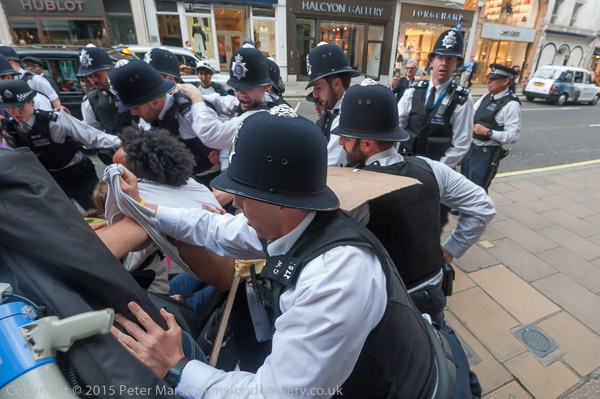
United Voices of the World went back to Sotheby’s intending to have a ‘protest party’ outside while Sotheby’s staff were having their staff party before their summer break inside the building. But the police were not in party mode at all, smarting from being given something of a run-around by the UVW at the previous protest.

Of course the union were there for a serious purpose, calling for the re-instatement of four cleaners who had been sacked for protesting outside their workplace calling for proper sick pay, holiday and pension arrangements.  The UVW want the Sotheby’s 4 to be re-instated.

The cleaners are not actually employed by Sotheby’s – so would not in any case have been inside at the staff party. They are employed by a contractor, Servest, but Sotheby’s had refused to let them come into work in the building, effectively sacking them.

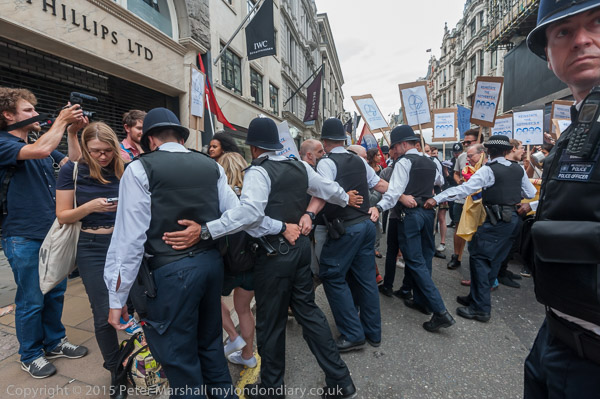
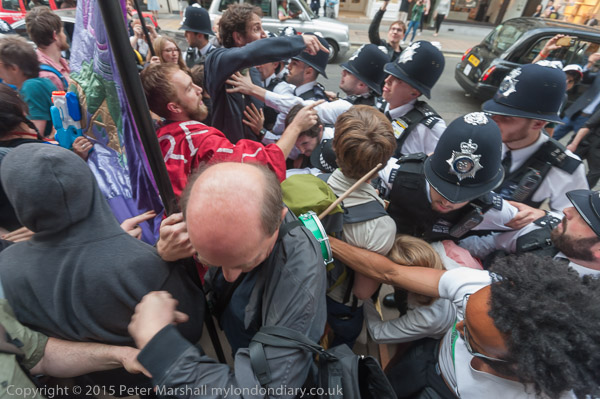
Had the police behaved sensibly there would have been a noisy but essentially good-natured protest outside the closed frontage of Sotheby’s, causing relatively little disruption to traffic in the area. But the police came determined to turn it into a battle and to show the protesters who was boss.  As the protesters came up to Sotheby’s they formed a block across the road, closing it to traffic for far longer than was necessary, eventually pushing the protesters off the road onto the opposite side of the street.

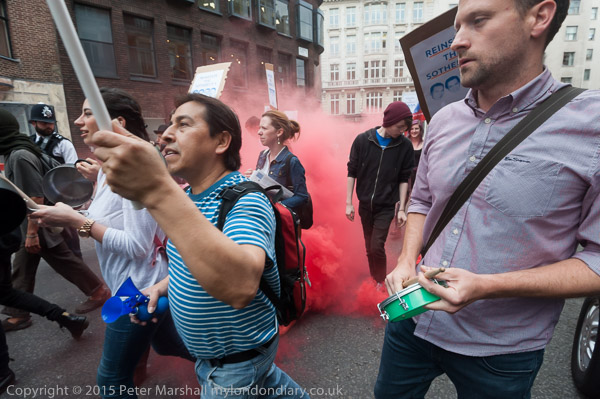
Later they attempted to stop the protesters from marching around the block, and again there was a lot of pushing and shoving by police, but the protesters walked around them and went around the block, letting off a couple of red smoke flares as they did so. When they arrived back at Sotheby’s police again pushed them off the road and behind the barriers which had been set up to contain the protest.

The atmosphere, which had started as good-natured was beginning to turn sour. People don’t like being pushed around by police, and when police again tried to stop them leaving the pen for a second walk around the block things got very heated. The protesters seemed to be pushing their way through when more police joined in, leaving the barriers behind unguarded.

People began unhooking them and moving out onto the street and it took a lot more pushing and manhandling of protesters by police to get them back. The police had really lost control, but the protesters weren’t really out to cause trouble – most just wanted an effective and peaceful protest and people just wandered around on the street shouting slogans.

Eventually police reinforcements arrived and brought the situation under control. It looked for a while as if they intended to arrest some of the protesters, but they thought better of it – and it was perhaps hard to know what the charges might be. Eventually UVW General Secretary Petros Elia spoke to one of the officers, telling him that they wanted to bring the protest to an end, and he went to see the officer in charge and the protesters were allowed to march away.

I made my way home, thinking that an essentially peaceful protest had been policed with unnecessary force, and had cost the public several thousand pounds more than had been needed – all because of a little police dented pride.

Photographing such events I need to keep a certain distance and objectivity, which can often be difficult. I also try hard to avoid getting in the way of the police in the discharge of their duty.  Often police don’t want to be photographed and can be unnecessarily obstructive – and I was asked to move back on a couple of occasions during this protest when I felt it was entirely unnecessary – and also got pushed out of the way rather roughly. Annoyingly police often ask photographers and protesters to move ‘for your own safety’ when its clear we are in no way at risk.

More at Reinstate the Sotheby’s 4.

Continue reading Sotheby’s Party Protest

Immigrants not Criminals


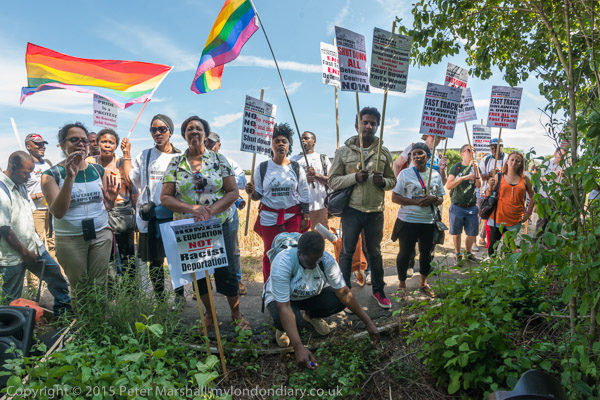
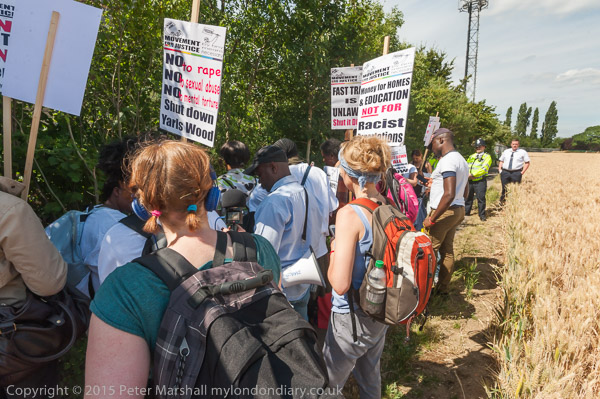
I photographed the protesters from inside the hedge in front of them using the 16mm fisheye

For years our right-wing press (and almost all the UK press is right-wing, owned by a handful of billionaires) have poured hate on immigrants, and successive governments have striven to outdo each other in repressive measures to stop people coming to settle and work in the UK. Unless of course they are extremely wealthy – its only for the rich that we really have freedom of movement around the world any more.

Words such as immigrant, asylum seeker and refugee have become terms of abuse in our racist press – and even in the reporting of more respectable organisations such as the BBC.

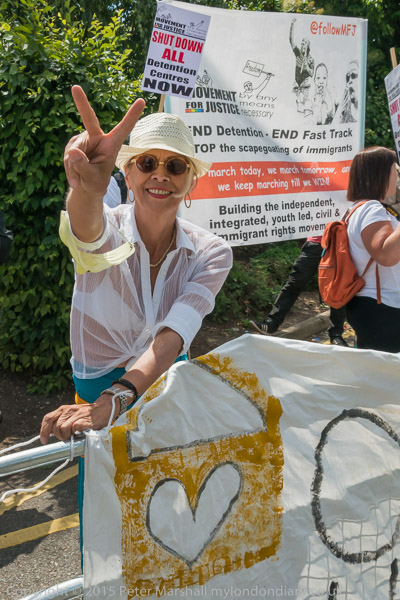
There has been an excessive obsession with numbers, and with terms such as ‘flood’ and ‘storm’ and even people who should know better talk and write about ‘illegal immigrants’ when there is no such thing; people may break the law but they are not illegal, as banners on these protests say – No One is Illegal.

Scare stories are run about huge population increases and the ‘fact’ that the UK is overcrowded. It isn’t, although some parts of London certainly are with tourists, who the government is trying to encourage. There is pressure on services such as schools in some areas – largely because of a failure to direct resources where they are needed in a timely way and the deliberate sabotage of local authority planning with the introduction of ‘free’ schools and academies. The severe housing problem has little or nothing to do with immigrants, but is a long-term problem which has been exacerbated by ‘right to buy’, the end of rent controls and the introduction of housing benefit to subsidise landlords, a failure to implement much-needed land reforms and other government policies. The decimation of our manufacturing industry and the move to a service economy with a proliferation of dead-end low-paid work isn’t a result of migration but deliberate government policies… Immigrants are a simply a convenient scapegoat, without the means to counter their scapegoating.

Except that is through movements such as the Movement for Justice, which continues to fight for them and their rights and occasionally the courts which when people manage to get their cases heard also stand for human rights and the rule of law. That they should have to do so against the Home Office is ridiculous and shameful.

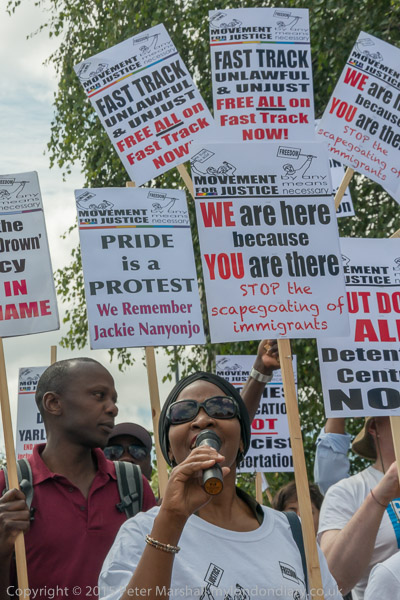
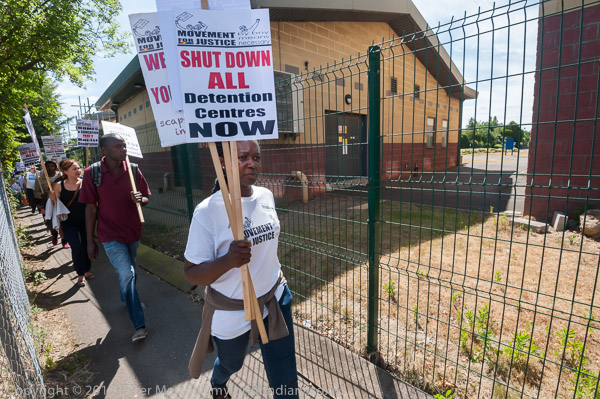
Migrants come here for various reasons, many as some of the placards at the detention prisons at Harmonsdworth & Colnbrook (Now renamed Heathrow Immigration Removal Centre) state ‘We are here because you are there.’ To Britain in particular because of the colonial legacy that built up our great cities – London, Bristol, Liverpool, Glasgow and the rest – and which continues though many international corporations based in London to exploit the labour, raw materials and consumer markets of our former Empire. Asylum seekers come because of wars and conflicts which arise from our invasion of Iraq, our earlier meddling with the politics and boundaries of the Middle East for oil, in Africa for its mineral resources and India for cotton, silk, and other textiles, tea and other goods (not forgetting opium.) And of course there was the trade in slaves, for which Britain perhaps too readily claims kudos for its abolition while refusing to fully acknowledge its involvement.

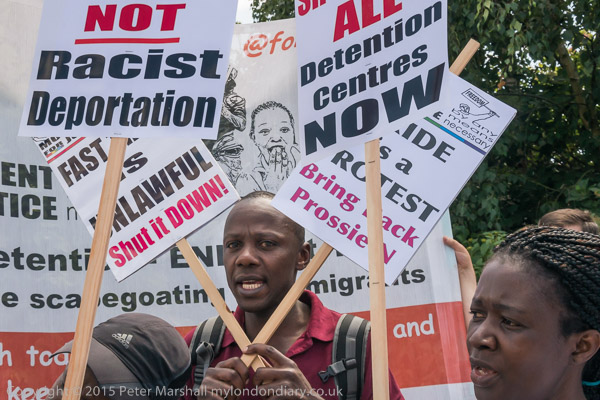
There is a remarkable inhumanity in sending those arriving to seek asylum, often traumatised by war, beatings, torture or rape, to detention centres. Even more inhumane to try and deport them back to the situations that forced them to flee by ‘fast track’ procedures deliberately designed to give them little chance to prove their suffering. The courts agreed, but still people remain at risk. Our Border Agency and immigration system – and the politicians that direct it – are inherently and institutionally racist and while some staff may work with good intentions (and sometimes are able to force sensible decisions) they do so within an overtly racist framework.
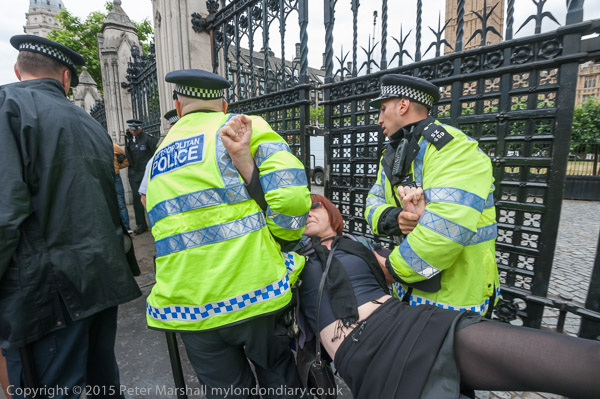
Normally in courts people are innocent until they are proven guilty, but for immigration the reverse applies – their stories are disbelieved and they have to prove they are true. It shouldn’t be like this. People should not be held for long and indefinite periods locked away from friends, and certainly should not be subjected to the rape, sexual abuse and mental torture that goes on in places such as Yarls Wood, private prisons staffed by overworked, underpaid and under-trained security staff.

The protests at Harmondsworth which houses male migrants have been going on for years – I first photographed there back in April 2006. More recently they have been a little overshadowed by MfJ protests at the women’s prison Yarl’s Wood, near Bedford, and by the revelations from inside there with undercover footage shown on TV. With a high profile demonstration due at Yarl’s Wood a few weeks later, there was less promotion of this protest and the numbers were a little lower than at some previous events.

Harmondsworth and Colnbrook prisons are next to each other, set back a hundred yards or so from the Bath Rd (A4) close to the east end of the Colnbrook bypass. A roadway goes down between their high fences to a BT site behind. Since the start of this year the protesters have been stopped from going down this private road and confined to an area in front of the Harmondsworth administration block near the front of the site. It’s hidden from the main road, though there is now in any case relatively little traffic along the A4, with most using the M4. The protests here are not visible to anyone but the prison staff and a few visitors to the prison.

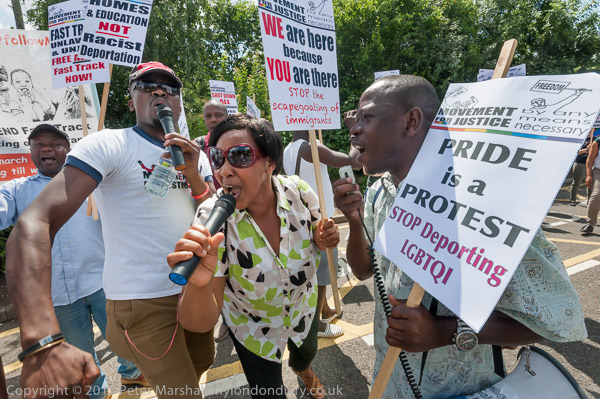
Previously we would see some of the prisoners (our government thinks it makes it sound better to call them detainees) coming to the window and waving, holding up signs and welcoming the the protesters. Now they can’t see the protesters, but they can certainly hear the protest, and outside we can often hear them shouting back. Detainees are allowed mobile phones, and the protesters ring those inside and they can speak to the protest over them, though a mobile on speaker-phone held to a megaphone isn’t always too clear.

Among the protesters are those who have previously been held inside these and other immigration prisons, who also speak against the cruel and racist treatment inside them, the failures to provide proper medical services and the difficulties in trying to put together the case they should not have to make to prove their suffering against a culture of disbelief. While our justice system normally requires people to be proved guilty, under our asylum system they have to prove themselves innocent to avoid being returned to where they fled from oppression. But as the centre’s new name makes clear, this is not about justice, but about removing immigrants.

The protest pen gets fairly crowded, and the security staff and police won’t let me photograph from in front of it, though I do so as a matter of principle for a short while until forced to move inside. Telling police that it is a part of their job to facilitate the work of the press (and showing them the police guidance on this) doesn’t get you very far.

So I find myself working with very wide lenses – the wide end of the 16-35mm and the 16mm fisheye- in the middle of the protesters or sometimes leaning back over the barriers, hoping that being linked together they will not topple. I like working close, particularly with the fisheye, which brings a lot of interaction with the people I’m photographing, but it would be good to have the choice of a slightly longer view. The light’s good and I can use a reasonable shutter speed, needed even with a wide angle when the subjects are close and going across the field of view. It’s good not to use a very fast speed, and to sometimes get a little blurring as people wave their arms and fists, but mostly I’m working in the range 1/250-1/500. Again because I’m often very close I need to stop down for depth of field, and most the pictures are at f8 to f16. I don’t think much about shutter speeds and apertures when working, but set an ISO that gives me roughly what I want – in good light ISO640 or ISO800. Actually in terms of quality working with the D750 and D800E there is relatively little to be gained by any slower speeds, though I do use them for some landscape images.
These are noisy protests so that those inside can hear, with drums and horns, but they are also protests with a lot of dancing and walking around in circles in the limited space available. As the protest was reaching its end, it marched out of the entrance onto the Bath Rd and then down a public footpath on the east edge of the Colnbrook prison, stopping in a field beside one of the blocks near the rear of the site. A large hedge and a tall fence behind it stopped us seeing any of the prisoners inside, but they were close enough to be clearly heard, and to join in with the shouting of slogans such as ‘Detention centre – Close them Down!’ with those outside. Police kept the protesters on the path by the hedge, and again the fisheye enabled me to work from inside the hedge looking towards the line of protesters along the edge of the field.

More pictures from the event on My London Diary at Surround Harmondsworth

Continue reading Immigrants not Criminals

DB Prize goes political

The shortlist for the 2016 Deutsche Börse photography prize is the subject of an article by Sean O’Hagan in The Guardian, Deutsche Börse photography prize shortlist: drones v the women of Tahrir, in which he writes it “is dominated by artists who engage with contemporary politics and social issues, from drone warfare to refugee activists in Africa.”

A small quibble in that, as he goes on to make clear in the next paragraph, Tobias Zielony actually “photographed the everyday life and struggles of African refugee activists in his native Germany for his exhibition The Citizen.” It’s work that seen on the web has only a limited appeal to me, but as well as the “Layout of 22 colour photographs, various sizes, on 11 large-scale pigmented inkjet prints, mounted on Aludibond, framed, 225 x 160 cm each” which you can view on screen the show also include an installation of newspapers, in 12 hanging displays, 130 x 205 cm each together with a 16 pages tabloid format which include the first-hand written accounts and interviews that O’Hagan mentioned. You get some idea of the look of these from the installation views of the show at the 2015 Venice Biennale also on the page.

Eric Kessels project ‘Unfinished Father‘ is more about an exhibition than about photography, and I’m not sure it will translate well to the Photographers’ Gallery. It certainly isn’t a book I would ever think of buying, and I think the photography in itself is of little interest, although the vintage images of the Fiats on the street towards the end of the short video have a certain charm, and incredibly empty streets.

Trevor Paglen‘s The Octopus is another installation which has little to offer me on the web, and from all I can see or read I doubt will engage me more in the gallery. But perhaps a closer investigation will bring out something of photographic interest.

I’ve mentioned Laura El-Tantawy‘s ‘In the Shadow of the Pyramids‘ several times on this blog, though unfortunately I missed the presentation she gave at one of our union meetings in London. But if you took my advice from In the Shadow of the Pyramids you will already have and have been impressed by her self-published book which is the subject of this short listing. And in response to a review of this work I added a little of my own thoughts in 1000 Words. The book as I predicted is sold out (and available on the web at around four times the original cost – but hang on and it will go up more), but the web site gives a great impression of the work and also includes page spreads and embeds a number of reviews.

I don’t much like these large competitions, which I think have a restrictive effect on photography, putting too much power over the future direction of the medium into the hands of a small and largely self-selected elite. It’s perhaps unhealthy too, that it’s banks which are behind a number of them – should we be relying so heavily on them for the future of the medium? And if these four photographers are all judged to be worthy of having their work exhibited at the Photographers’ Gallery I think there is something inherently unfair that just one of them should walk away with the £30,000 prize.  Usually it’s the wrong one.

LIFE Force

I had forgotten about Life Force*, a ‘a free, monthly, on-line, photo-led magazine which celebrates the art-form of the photo-essay‘ which has been available since the January 2011. The back numbers are still available and over the years it has built up a interesting and varied collection of stories, though perhaps not all of them are truly ‘great photography and pushing the boundaries of the medium to explore conciousness and human perception, by harnessing the unique power that photography holds to capture a moment for analysis.‘ But there is plenty worth looking at, including work by a number of photographers I know as well as some I was surprised to find I didn’t.

The November 2015 issue has seventeen stories, some old, some recent. Rather than talk about them all, I’ll perhaps mention just three of more local interest.

Tonight several of my friends will be out photographing in Lewes where the Firework Societies will be celebrating, including burning a giant effigy of David Cameron with a pig on his lap and another of Seb Blatter. Patrick Ward‘s pictures of the Lewes Bonfire Societies which he was able to cover as an insider give a good impression of the activities, though perhaps they lack a little of the excitement I’ve seen in some other images from these events.

I was more than a little envious at seeing Unseen London by Peter Dazeley who has gained access to photograph the ‘hidden interiors of some of London’s most iconic buildings, from Tower Bridge to Battersea Power Station, Big Ben to the Old Bailey‘ and has done so with great care. Although I’ve actually been inside quite a few of the places in this set, either I’ve not had the opportunity to take pictures or have had to make do with hurried snaps, full of other visitors. The only man in Dazeley’s set is a founder at work in the Whitechapel Bell Foundry, an image which for various reasons I feel does not fit well with the rest of the set.


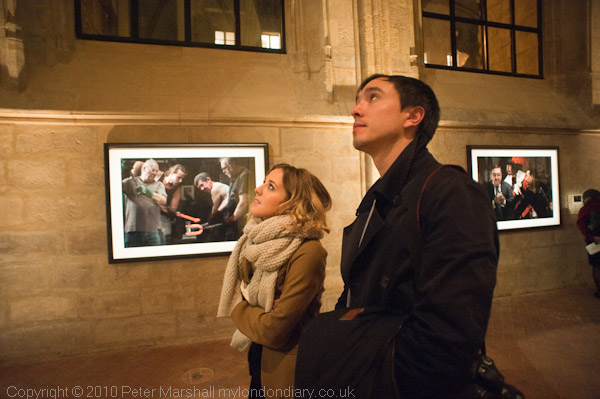
At the Paris opening in 2010 © Peter Marshall

Finally you can see Brian Griffin‘s Black Kingdom, work I have written about before when I attended the opening of his show of in Paris. You can see more pictures from that opening on My London Diary. Good though the work by the others is, his is perhaps the only one of the three I’ve mentioned that I feel is any way ‘pushing the boundaries of the medium to explore conciousness and human perception‘, though there are other essays on the page that could also be considered to have done so.


*I’ve not added links to the individual issue or essays as these are not permalinks and will change presumably when the December 2015 issue is published. To find them after that date you will need to use the ‘Back Issues’ link at the top of the home page and then select the November 2015 issue.
Continue reading LIFE Force

Are photographs ever portraits?


John McDonnell MP, Shadow Chancellor of the Exchequer speaking at yesterday’s ‘Grants Not Debts’ protest

I take a lot of pictures of people, some of which I share here and rather more on My London Diary. I’ve also photographed many others, including members of my own family and friends I know well. Quite a few of those are framed and hanging on people’s walls, while those I’ve taken of public figures have featured in various magazines and newspapers. Some are better than others but most are pretty routine, like yesterday’s picture of Shadow Chancellor John McDonnell, a man I know and have photographed on many occasions over the years.  It’s not a great image, but you can find worse of him every day in the newspapers.

But I’ve never thought of myself as a portrait photographer. And always rather questioned the whole idea of a photographic portrait. I think there are valid examples – for instance Alfred Stieglitz‘s truly intimate work on Georgia O’Keefe springs to mind, but there I’m thinking not of a single image, but of a whole set of images,beautifully presented in the 1978 Metropolitan Museum of Art publication ‘Georgia O’Keefe – A Portrait by Alfred Stieglitz’ which on the front dust-jacket flap states ‘His idea of a portrait was not just one photograph but a series of photographs that would be a portrait of the many aspects of a person.’ (The book is still available from book dealers at a ridiculously cheap price for such a well-produced and important work.)

There are many other pictures of people that I like, many of them good or even great photographs but few which really reach into the depths of a person in they way the best painted portraits do. Though its also very clear if you take a walk around inside – for example – the London National Portrait Gallery that there are many bad painted portraits as well as many poor photographic portraits both in the permanent collection and in their annual prize shows for photography and painting.

But even among photographers whose work I admire greatly, their ‘portraits’ are often the weakest work. Even with a master like Cartier-Bresson there are images which without the name of the famous sitter would probably never have been printed. (Some of his better portraits  along with some images that certainly are not portraits and one or two that perhaps fail to display his master touch and were clichés even before he made them are linked in the Portraits selection on his Magnum page.) And newspapers and magazines are full of poor or indifferent if sometimes technically competent images of people.

What got me thinking about this was a video created by The Lab in conjunction with Canon Australia in which they set up six portrait photographers to photograph the same man, giving each a very different story about him. Looking at what you can see of their results on the video published in the story by Shutterbug, each produced a very proficient image based on the story they were given, particularly as they were given only ten minutes (though often photographers have to do with considerably less, while painters often have months rather than minutes.) But I don’t think any of them was really a portrait of the person, rather an illustration for the story they were told.

Continue reading Are photographs ever portraits?

Budget Balls and More

The trouble with working on a Wednesday“, one military gentleman once remarked, “is that it cuts into two weekends“. I don’t like it either, as usually it’s the day of the week when I catch up with some of the little routine things that need doing regularly, none very important but a nuisance if I don’t do them. When you are a freelance and your work is largely driven by when other people decide to do things that you want to photograph you lose the kind of structure that most employment provides, and I find it good to have one fairly fixed point in the week.

Not that I don’t work on Wednesdays. I’m sitting here on a Wednesday writing this and later – after I’ve been out on a few errands in my local town centre – I’ll be putting in several hours of work on getting my web site closer to date, and perhaps also another few on getting images ready for my next book. But I’ll be ignoring the several possible events in my diary for today, interesting and possibly financially rewarding they might be, largely because it’s a Wednesday. If they had been on yesterday I would have gone.

It has to be something that I’m really interested in to get me out on a Wednesday, and on July 8th there were several such events taming place, some because it was Budget Day. Of course I wasn’t going to get out of bed to take the usual ritual picture of the Chancellor that the papers would almost certainly run (though a large squad of press photographers lined up for the non-event the chances of any particular image being used are fairly low) but quite a few people would be taking the day as an opportunity to protest at the various cuts in welfare spending that were bound to be announced.

Prominent among the protesters were of course DPAC, Disabled People Against Cuts, and I’d received a message from one of the organisers that as well as the widely advertised ‘Balls to the Budget’ protest at Downing St, they were (as usual) planning a little surprise later.

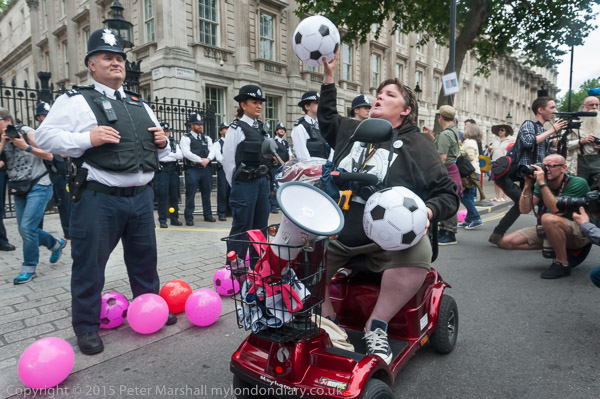
What makes the picture of Paula Peters of DPAC attempting to throw a football with a message into Downing St for me is the policeman standing watching, thumbs tucked behind his waistcoat, standing in a row of pink and orange balloons and balls. Of course her message didn’t reach the gates into Downing St, though a number of others did manage to get kicked or thrown into that high security zone.

It isn’t really a picture that fits the 35mm format frame and would be better cropped a tiny bit at left and quite a lot at the right. Sometimes I do crop images before filing them, but often I’ll leave them un-cropped, knowing that too many editors have an apparently irresistible urge to desecrate images by cropping; if I crop to perfection they will then crop to destruction.


D700, 16-35mm at 16mm, 1/400 f10 ISO 640

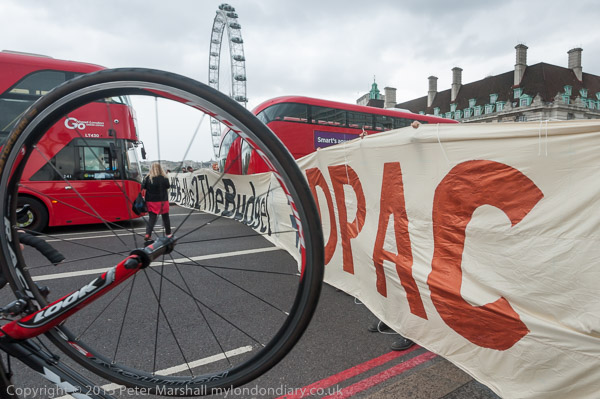
The little surprise turned out to be a 23 metre (75 foot sounds much bigger and better) long banner which they ‘dropped’, hanging on tightly to it over the Albert Embankment wall facing the Houses of Parliament with the message ‘#Balls2TheBudget #DPAC’ before bringing it up to join the other DPAC protesters, some in wheelchairs who had be then marched from Downing St to block Westminster Bridge.

It stretched all the way across the road and it was difficult to get a clear view of it for the buses it blocked and the protesters and other people taking pictures particularly those using their phones. Though I welcomed the cyclist who rode up to it at speed  before jumping off his bike just before it to give me the picture above.

The picture would perhaps have been better with a slower shutter speed to give a little blur as it was still rotating, but was able to nicely frame both it, the larger wheel of the London Eye and the banner. It was nice to have something a little different, and I had very little time to make the image before the cyclist lowered his bike. More pictures at DPAC blocks Westminster Bridge.


Paula Peters and Boadicea

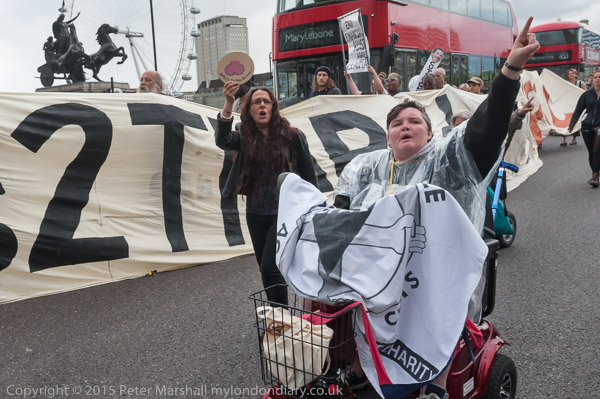
As protesters left Westminster Bridge they were led towards Parliament Square by DPAC’s Paula Peters on her mobility scooter, and as she came up to the statue of Boadicea – also in her chariot – I made a number of attempts to show the two of them together. I think this was the best, with Paula’s gesture echoing that of the statue in the top left. Boadicea probably burnt the town where I now live but was eventually defeated by the Romans. Paula’s chariot as yet lacks the scythes.

As the pictures in DPAC Parliament Square Budget Day protest show, the protest continued, for a while blocking traffic in Parliament Square. The police are faced with something of a dilemma by the protests by people in wheelchairs, realising the terribly bad publicity they would get by using the kind of tactics they use against other protesters. So while they may fairly forcibly drag away ambulant supporters, those in wheelchairs – at least while the press are around – are generally treated with rather more care.

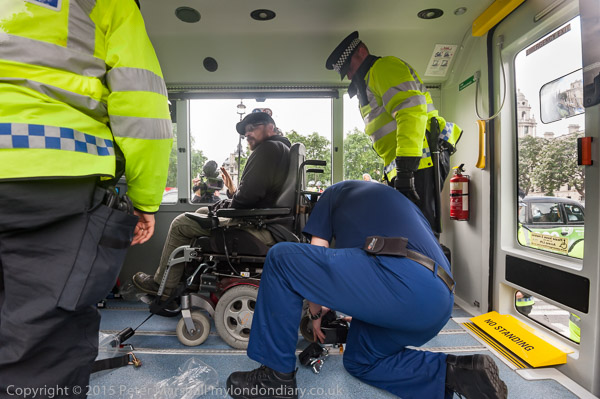
At this protest they had to hire a special vehicle which took quite a while to arrive to transport DPAC’s Andy Greene, locking down his motorised wheelchair with great care. Unlike police vans, it had large windows, and I was able (despite a little harassment by other officers) to photograph through them. They also took away pensioner Terry Hutt in the large and otherwise rather empty van. Two others arrested had left earlier in a more normal van. By the time I arrived at the police station in Savile Row an hour or so later, Andy had already been released, unusually fast as the police usually seem to prefer to hold people for long enough to release them in the early morning after most transport for them to get home has stopped as a little punishment even if they can’t find anything to charge them with.

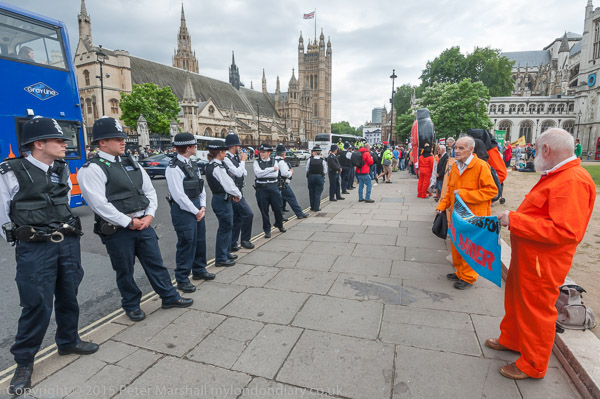
DPAC’s was not the only protest in Parliament Square, with people from several current industrial disputes in London – at the National Gallery and council workers from Barnet and Bromley – coming together for a Joint Strikers Budget Day Rally, and the usual Wednesday lunchtime Save Shaker Aamer weekly vigil who were confronted by an unusually large number of police lines up along the length of the pavement.

Their persistence in calling for the release of Shaker and for him to be returned to be with his family in Battersea seems to have eventually been succesful, though as I write he is still held there. Obama has given the required notice of his release and he could have been on a plane last Sunday, but the authorities at Guanantamo apparently couldn’t handle both that and a visit by three US Congressmen. Quite what has been holding it up since then I don’t know, but I hope it won’t now be long before he is home.

This wasn’t the end of my work on that Wednesday, but I’ve got jobs to do, so I’ll continue another day.
Continue reading Budget Balls and More