Missing Link – Homes for All

I missed one event entirely from the list on last November’s ‘My London Diary‘ page. Homes for All against social cleansing was present in its correct place if you scrolled down the page, but I’d failed to add it to the index at the top of the page.

It’s easy to do. All the code that runs this site is hand-crafted html, though written with the help of  an ancient version of Dreamweaver, which does a nice job of looking after it and making life easier for me. It allows me to look at the site as a whole, and will search and replace across a file or a whole folder of files, and handles some of the actual coding, though I spend quite a lot of time in its ‘Code View’, because it’s easier to do some things that way.

People, particularly some web designers, look at me or sometimes actually tell me I’m mad to do it this way, or show disbelief that a site of this size – now over 150,000 images – can be organised this way. I probably am mad, but it remains the easiest and quickest way to do it.  I started writing html in 1995, and more or less kept up with the changes , including converting my sites to use CSS. Several times I’ve played around with using designs based on data bases but never yet found anything that would give me the speed, flexibility and ease of plain old html.

Partly it is down to site design. I played around with this site for the first few years, and it was only after around 6 years that I finally came up with the current design (though there have been a few minor tweaks since then.)  But the main reason is that what takes the great majority of the time is actually writing the captions and text which I think are essential to accompany the images.
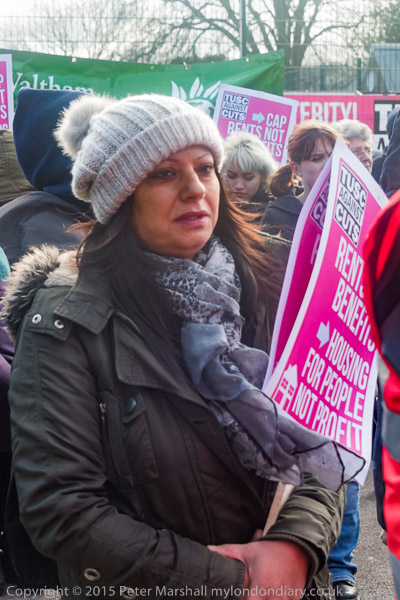
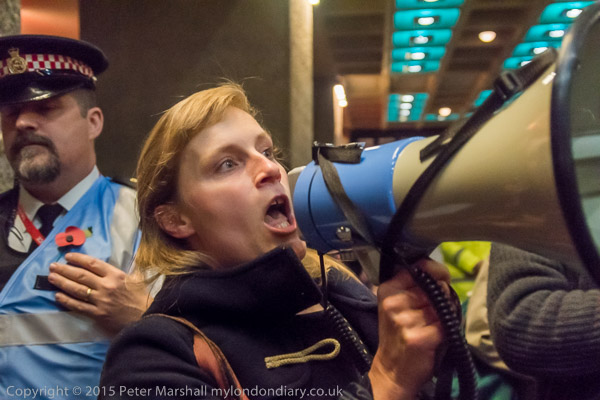
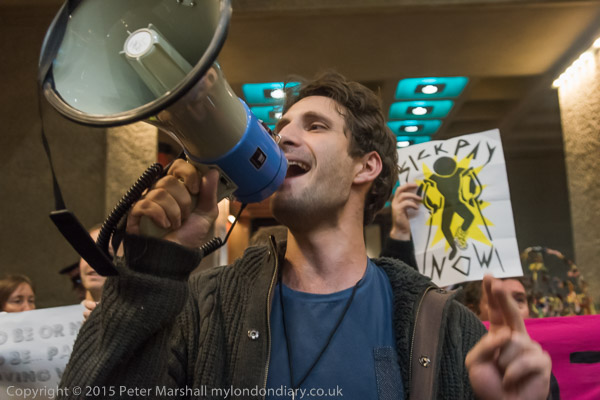
November 21st last year was a cold and windy but sunny morning in London.  Clear air and a low sun gave me some problems with exposure because of the high contrast, and exposing to keep details in the highlights left Lightroom a lot of work to do to bring up details in the shadows. Although I had the ISO set to 800, some of the darker areas show the kind of blotchy colour patches that are more normal at perhaps ISO6400. The images are also rather grainier than normal, though perhaps I could have been more aggressive with the noise reduction. NR is one area of LR which could do with some improvement, and third-party add-ons such as Dfine – now available free as part of the Google Nik collection – can significantly improve images. But using this takes too long (and takes up too much disk space) for it to be a part of my normal workflow.
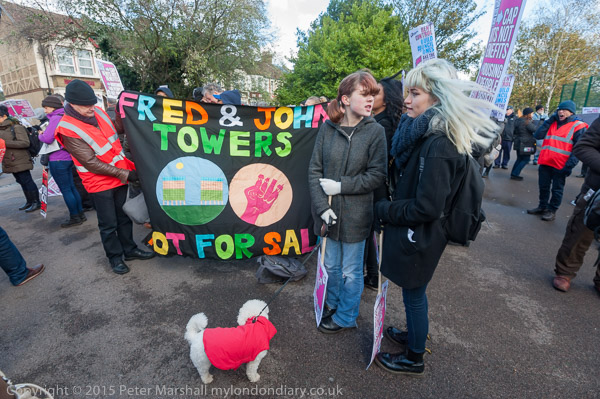
Things like the small dog in a red coat in the picture above help in making pictures that otherwise can too easily look like any other protest rally. Of course the people are different, though there were quite a few present I’d photographed at other protests, and this was a new location. But it wasn’t a very inspiring location, a rather scrappy area of asphalt at the entrance to a small park.
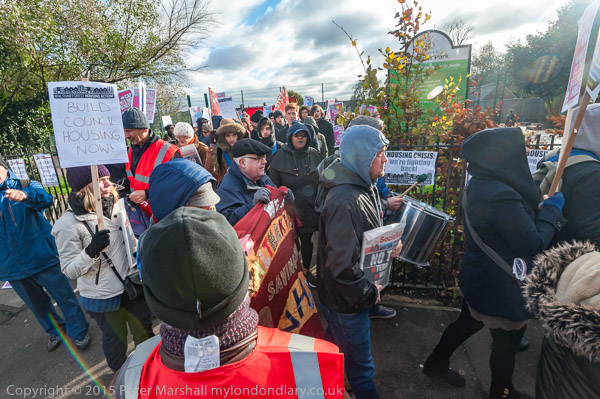
Making images got a little easier once the marchers left the park and came out onto the road, though as you can see above the sun was still causing problems. Lens hoods on wide-angle lenses like the 16-35mm are not really a great deal of use. The sun was only just out of image at top right, and there was considerable flare and ghosting in that corner, as well as across the frame, with a neat rainbow on the roadway at bottom left.

Although sometimes such effects add to an image, I didn’t feel they did in this case. I’ve done a little burning in on local areas, increasing contrast and clarity and reducing the highlights to make the effects less visible. Sometimes cutting down the saturation helps too.  This was an image taken from a high viewpoint, holding the camera well above my head and hoping – and wishing I was using the Fuji X-T1 or some other camera with a tilting screen. I sometimes use the camera’s live view while taking overhead images like this, but it is really difficult to make out anything on the rear screen in bright light.; cupping the left hand around the top of the screen slightly restricts reach but does make the screen a little more visible.
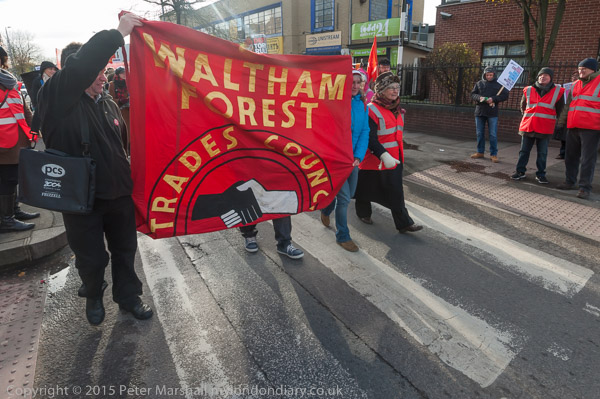
When using the camera at eye level, I usually add my left hand on top of the lens hood when the sun is close to the frame edge – and usually find I have to crop a little of it out at the top of the frame, but at least it does produce a reasonably effective lens hood.
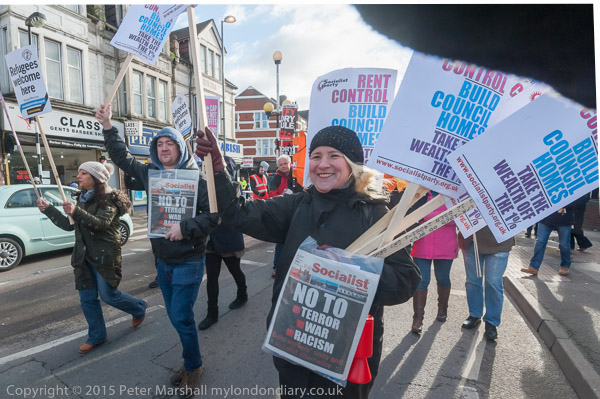
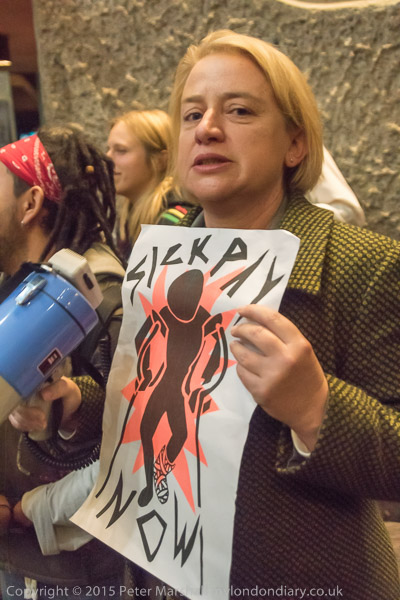
But sometimes my hand – or other objects – can get out of hand, as in what is one of my favourite frames from the event. Whatever it was, it wasn’t meant to be there, but I don’t think it entirely spoils the image. I was walking backwards fairly close to the woman with the placards, with the 16-35mm on the D700 at 16mm and things get just a little tricky to manage. This was the last of several frames I’d taken of her, and the previous few frames I’d been a little further away; while that makes life easier, it also reduces the impact of the image.

Text and more pictures at Homes for All against social cleansing.
Continue reading Missing Link – Homes for All
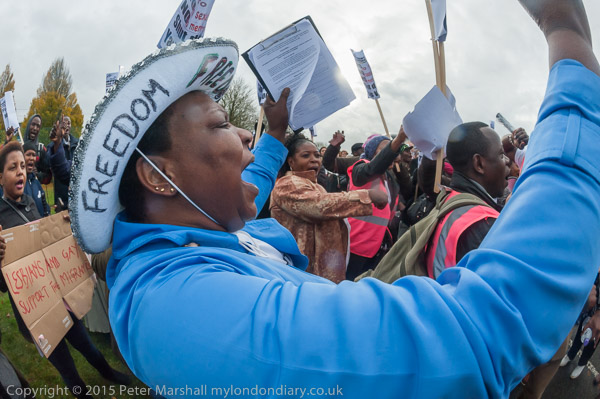
Yarl’s Wood in the mud

I’ve often written about my love for the fisheye lenses, the type that give a 180 degree view across the image diagonal, filling the whole frame with the image, first the Nikon 10.5mm for DX format and latterly the 16mm FX; both light and reasonably fast at f2.8. I use them when I want or need to work really close to the people I’m photographing, particularly in crowds and also for panoramic landscapes, usually with little in the close foreground. Where they seldom if ever work is at moderate subject distances.

Both lenses need a little help from software, and Lightroom (or Bridge or Photoshop) do a great job of removing the colour fringing which is otherwise rather pronounced on large prints. When I first started using the 10.5mm it was sometimes a problem, and reducing its effect in old versions of Photoshop something of a trial, involving careful selection by colour and desaturation. Now it’s automatic and does a much better job.

Also the curvature due to the spherical fisheye perspective is usually a distraction, and software that converts to a cylindrical perspective which gives straight vertical lines is often essential. Photoshop offers to correct it to rectilinear, but that only works if you are willing to accept a narrower horizontal angle of view and a definite softness at the image corners. Rectilinear images are really limited to a horizontal angle of view of around 90 degrees, while the fisheye covers around 147 degrees.

Just occasionally I take an image that – at least for me – works well without that conversion. If you are a photographer you probably noticed that the image above was taken with a fisheye; but to the ordinary viewer it just seems a ‘normal’ image.  And I want people to look at the pictures and not have problems with them seeming unnatural – I try hard to avoid a ‘lensy’ look, whether from ultrawide or extreme telephotos.

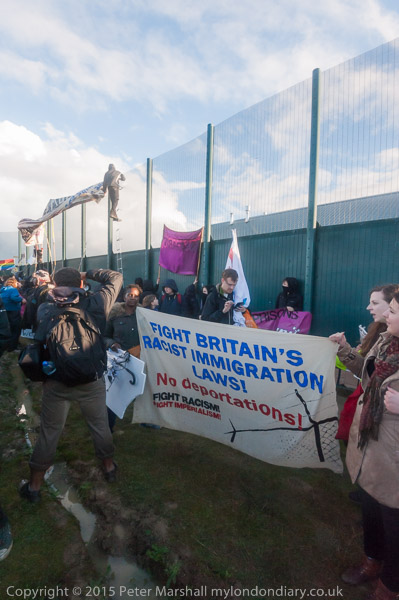
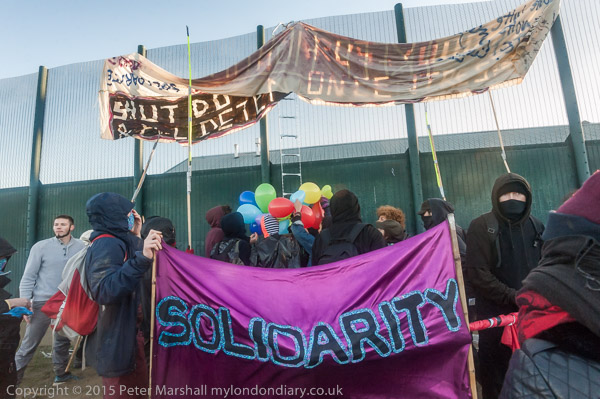
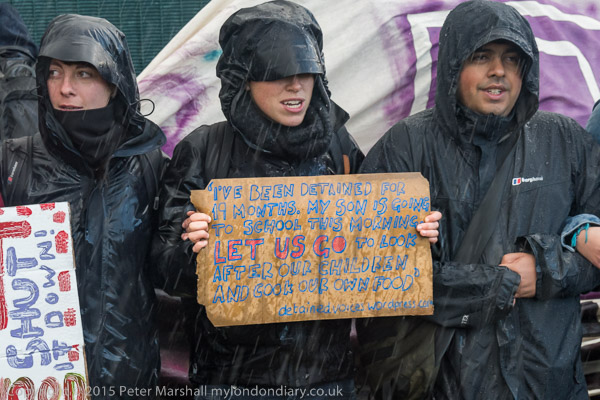
The picture was taken as protesters held a rally on the road close to Yarl’s Wood, one of the UK’s detention centres where we hold people seeking asylum indefinitely, sometimes for 18 months or more, treating them as criminals rather than as refugees. Yarl’s Wood is miles from nowhere, 5 or so miles north of Bedford on the edge of an isolated business park on a former WW2 airfield. The protesters come mainly in coaches and form up by the side of the road to march the three-quarets of a mile or so along a footpath to a field adjoining the prison.

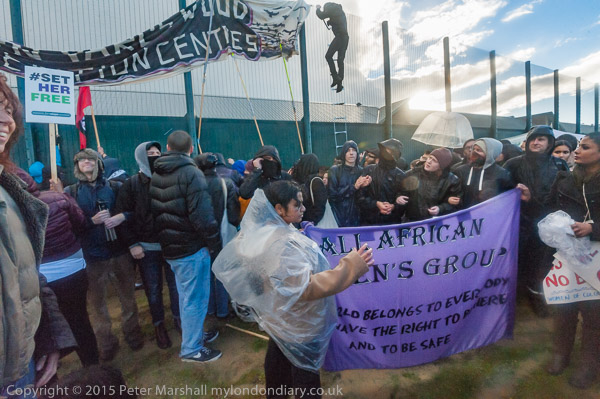
Once we were outside the prison, it rained, or rather poured, as you can see in some of the pictures. I got out my umbrella, which kept the worst of the rain off my cameras but they still got wet. I got wet too, and the ground got wetter still.

Down by the fence, against which much of the action was taking place, the mud got muddier, with water filling furrows running through it. It got hard to move around at any speed, walking on the filthy greasy surface, struggling to keep balance.  Fortunately the rain was a brief shower, or rather a series of brief showers, with the sun coming out between. But I was getting covered with mud just trying to move around, though fortunately kept my balance, though I saw a few others falling over and getting plastered with mud.

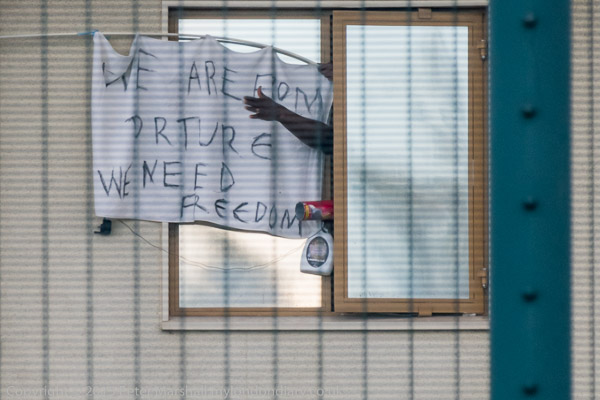
There is a slope in the field going down to the fence, and also a ditch which is just wide and deep enough to be difficult to cross, but not impossible. Hard to jump with camera gear and a muddy landing on the other side, though at one point the protesters  had put down a pallet to act as a bridge.  From higher up in the field we could see and wave to the prisoners inside, many of whom were holding up notices to the windows, clearly delighted to see there were people who knew what was happening to them and cared about it.

Even the sun caused problems for photographers, making it difficult to photograph the people putting banners up on the fence from some angles – except when the clouds came over again.

From higher up the hill, we could see some of the women holding things at and outside the windows, which will only open a couple of inches. One banner read banners ‘We came to seek refuge not to be locked up‘ and another ‘We are from torture we need freedom‘. Others wrote their phone numbers on sheets of paper so that the protesters could contact them and relay their messages over the public address system they had brought.

I didn’t have a very good day there. I was very unsteady on the mud, and had forgotten to bring my 70-300mm lens which would have been rather more useful for photographing people at the windows than the 28-200mm. Photographing through the wire fence is a pain too, with autofocus struggling to get the window frames rather than the wire fence sharp – and modern lenses are not good for using manual focus. And as I walked away I realised that I’d lost my umbrella.

I stayed for a couple of hours and was then pleased to walk away, and find somewhere to scrape the worst of the mud off my boots, which weighed several times as much as usual.  It was several days later that I finally got rid of all the mud. But the feeling of shame that my country could treat people seeking asylum like those locked up at Yarl’s Wood can’t be washed or scraped away.

More pictures at MFJ Meet Outside Yarl’s Wood and MfJ ‘Set Her Free’ protest at Yarl’s Wood.

I’ve been back with the protesters to Yarl’s Wood since Novemeber, and another protest is planned there and at other detention centres around the country on May 7th, 2016. More details of this and other protests from Movement for Justice.
Continue reading Yarl’s Wood in the mud

Artists & Photographers

I don’t know how many art galleries there are in London. Tate Britain, Tate Modern, National Gallery, Courtauld Gallery, Dulwich to name just a few, but there are relatively few photography galleries – and most people might struggle to name even one. Of course there are art galleries that show photography at times, and even places like the V&A that have a tiny bit of space devoted to photography.

And London is of course home to what the Arts Council England have called their flagship photography gallery,the Photographer’s Gallery,and like many photographers I regard its lack of commitment to photography as a scandal; for most of the time it’s just another art gallery, if one that specialises in art related to lens based media.

It wouldn’t matter if England had a plethora of photography galleries, but with so few it seems almost criminal that when so little of the the AC’s money actually goes on photography what little it does provide doesn’t really go on photography rather than on conceptual art.

Of course it isn’t just London. We almost got a national photography gallery up in Bradford – never a good location, Birmingham would have been a far better choice. Or Manchester. Or Leeds. Or Sheffield. But even that promise more or less ended a few years back, with the final stab in the back being the decision to move the RPS collection to the V&A.

And too often that conceptual art which relies so strongly on photography is weakened by doing so. It seldom gives rise to good photography, perhaps because generally the concepts are so simple and so readily grasped that photographs are really superfluous, often little more than rather boring records. There have certainly been exhibitions at the Photographer’s Gallery that would have been preferable visually without the pictures.

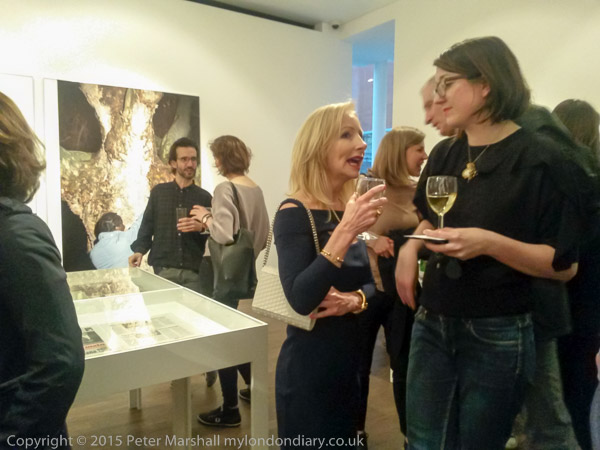
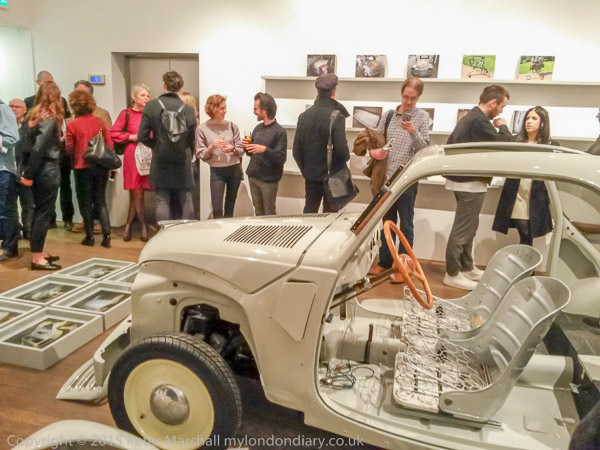
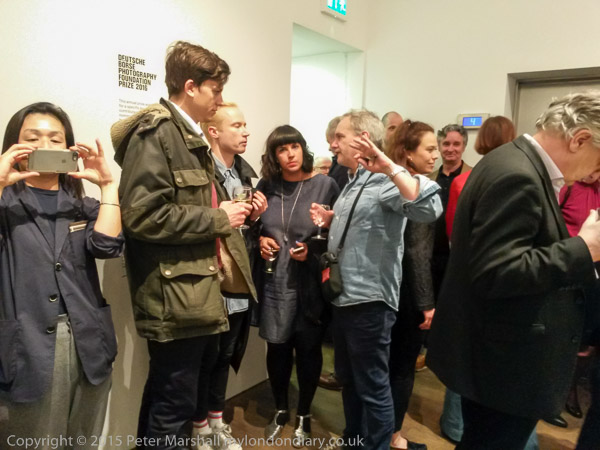
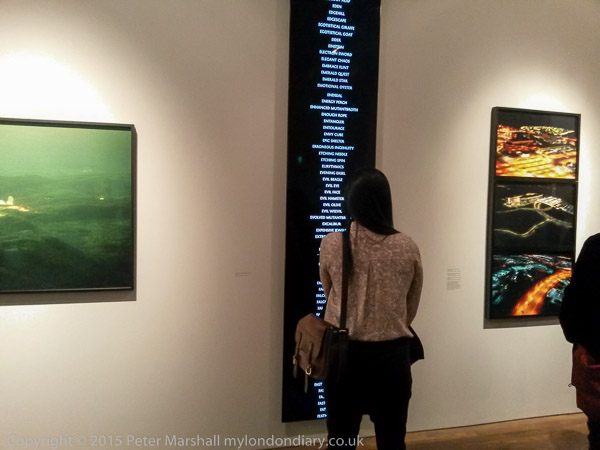
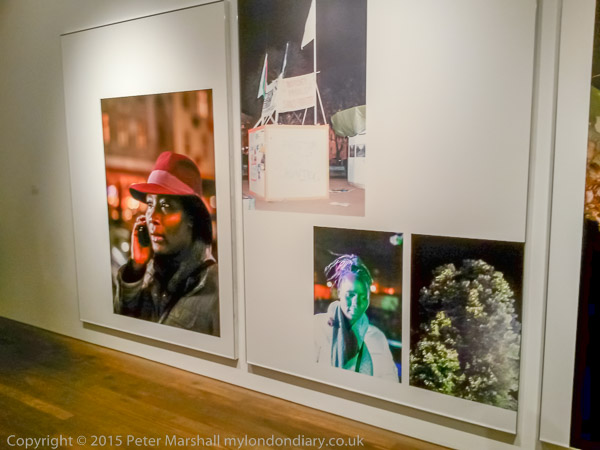
This is something perhaps epitomised by the current Deutsche Börse Photography Foundation Prize, with work by the four shortlisted on show until June 26th 2016. There is relatively little in the show to interest photographers or lovers of the photograph. There are a few fine images by Laura El-Tantawy, and some highly competent but slightly pedestrian images by Erik Kessels, the main feature of whose show is an old Fiat.

Even El-Tantawy’s work is disappointing here, at least for those who know her book* or web site ‘Shadow of the Pyramids‘; the work as seen here seem much like a a pale shadow of the book. Despite this, to my mind it stands fully a head or two above the others, but I suspect she will not be the winner. The DB Prize really isn’t about photography or photographers at all; Ben Luke ended his short review in the London Evening Standard with the phrase “Paglen is the best artist here“. The question isn’t who is the best photographer.

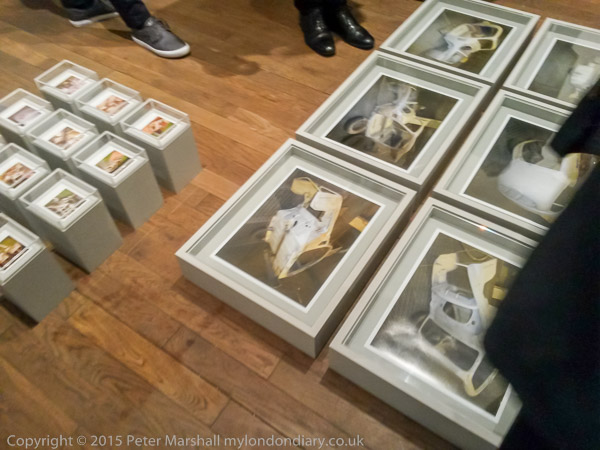
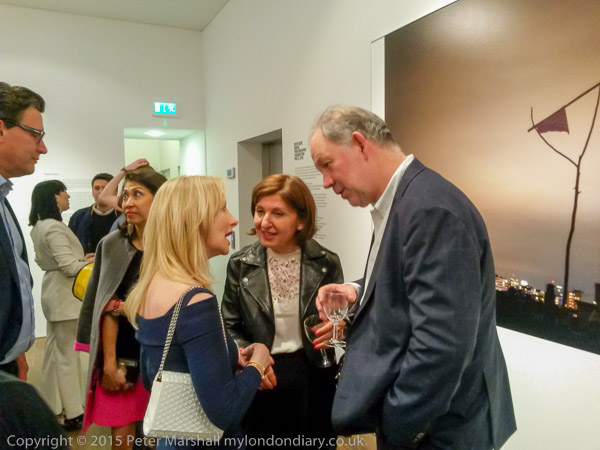
I got out my phone during the opening and took a few snaps in the two galleries containing the work. I still haven’t really worked out how to use it and got quite a few pictures of my feet as well as what I was trying to photograph. The light in the lower of the two gallery floors housing the ‘installations’ was pretty dim and quite a few images were unsharp, but most were OK. 

The camera on the Samsung Galaxy S4 mini isn’t the best around, but does a fairly good job, and with a little help from Lightroom- noise reduction in particular – the results look pretty much OK on the web.  Looking at the EXIF, all seem to have been taken at 1/35s f2.6 with the ISO varying from 320 to 800. For what its worth the focal length was 3.7mm, which appears to give a horizontal angle of view similar to a 30mm lens on a full-frame camera. Although the camera is said to be 8Mp and gives images 3264×2448 pixels, the images are curiously bereft in detail, giving similar image quality to my first digital camera which only had around a 2Mp sensor.


* I bought the book pre-publication at a discount. When I wrote my post about it here recommending you buy it, copies were still available at 88.60 Euros; now you can buy it through dealers for around £300 and you can expect the price to keep rising. I don’t often give good financial advice:-).

Continue reading Artists & Photographers

Language & Education

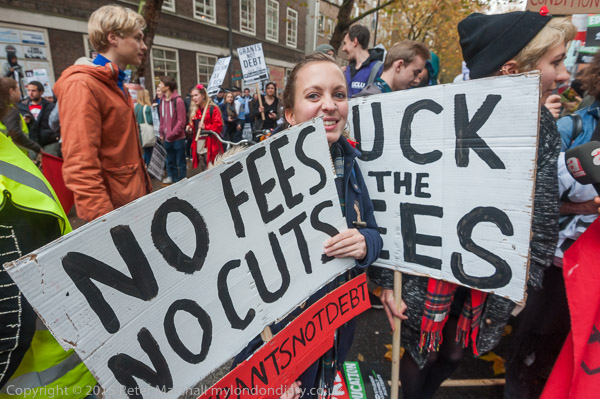
I have a slight problem with language. Or rather I don’t really have a problem with it, but some other people do, and they get offended by seeing some of the slogans on posters and placards. I don’t like to offend people gratuitously, and I was pleased to be able to find a viewpoint when making this photograph which obscured a vital letter ‘F’.

And though it doesn’t worry me, I normally use asterisks in captions and articles to avoid offending others with words such as f**k. Though myself I feel more offended by issues such as poverty and homelessness than in language that is a part of normal speech for many. At heart I think it’s a class issue, and I’m much more upset by class prejudice than by swearing.

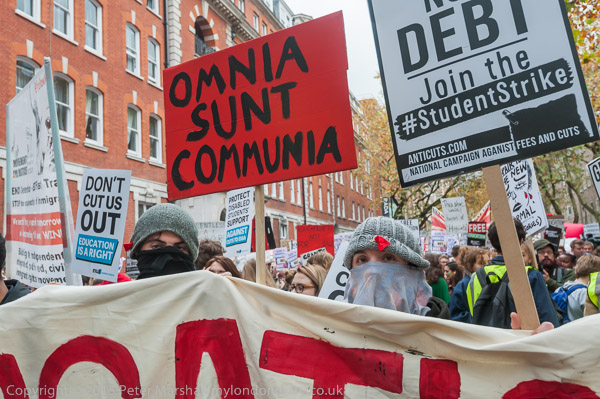
The protest for free education with its slogan ‘No Barriers, No Borders, No Business‘ was certainly a good one for placards, with a wide variety, including at least one in Latin. I was fortunate to have benefited from free education, which did for me include an O Level in that language, but probably even those without that advantage could understand the gist of this one, ‘Omnia Sunt Communia‘.  But I did have to turn to Google to find that it was a phrase pinned by his torturers on reformation theologian Thomas Muntzer who led the German peasants revolt of 1525.

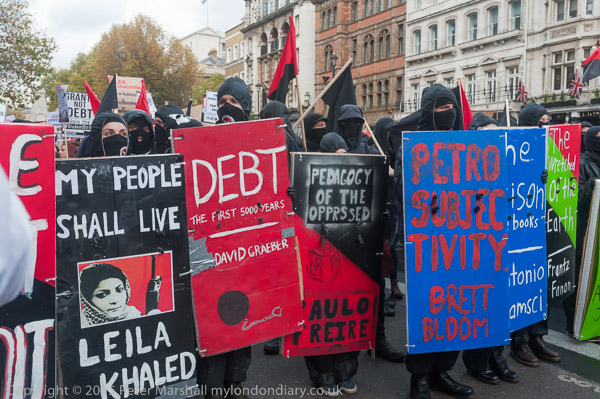
Fittingly for an education protest there was a ‘book bloc’, including here I couple I’ve read and including here two other authors I’ve photographed, though perhaps a shame that one of the volume titles includes a spelling error.

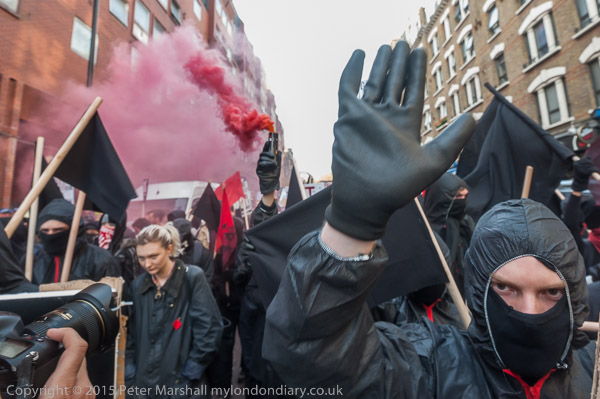
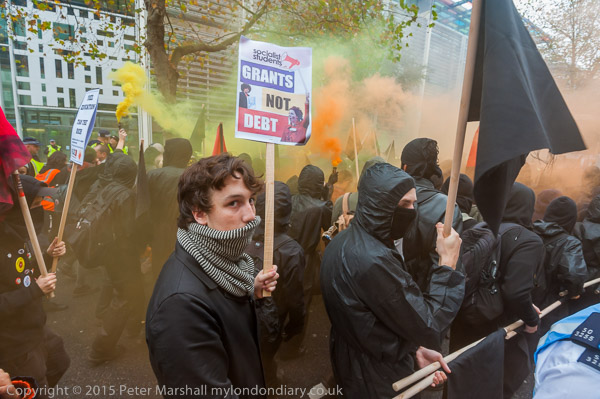
There were a few flares set off during the march, and something of a scramble by photographers to photograph them. I didn’t get any particularly good pictures, though one was enlivened by a masked protester holding up his hand to try and block my lens – which made me widen the view of my zoom to include him. But mostly people were friendly and happy to be photographed.

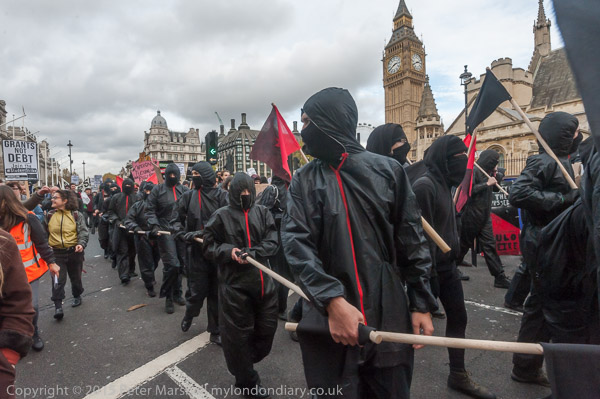
The ‘black bloc’ took on a more uniform appearance for the protest, most wearing identical jackets and trousers to make themselves rather less identifiable. But even so some were unhappy about photography. They were carrying black flags on sturdy poles and at times used them to restrict access to the bloc – as in the picture above.

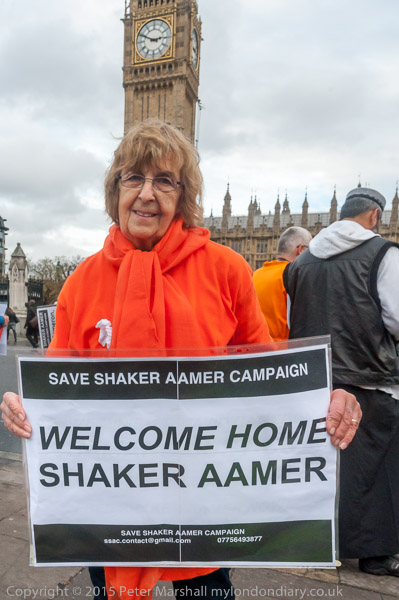
I left the march as it went down Millbank to speak to and photograph a protest that was also taking place along the edge of Parliament Square, where campaigners from the Save Shaker Aamer Campaign who have mounted a weekly vigil for his release opposite Parliament every Wednesday when Parliament was sitting were celebrating to welcome him home. There celebration was a little muted, as although he was the last British resident there, over a hundred men still remained captive.

I shared their rejoicing over his release, and also as I photographer flet glad I would not have to continue photographing – at least occasionally their weekly vigils. With similar protests on a regular basis it does become hard to say anything new, both in the text and the images. Protests against Guantanamo will of course continue, and I’ll still go to photograph them when I can, including the regular monthly event at the US Embassy.

I caught up with the students again outside the Home Office, but arrived a little too late to cover the protest there fully. From there they went to the Dept of Business, Innovation & Skills – which, as I commented ‘is now responsible for the universities which are no longer seen by government as a part of education.’

Here they made a fairly half-heated attempt to push through a police line, but were repulsed. Then a large group of police arrived and mounted a charge against the students, including many of those who had simply been standing and watching. I saw several photographers also being assaulted by police and got pretty roughly pushed to one side myself.

The police regrouped and stood watching the students. More police arrived and formed a tight line across the street, kettling the protest. I decided I’d had enough, but had some difficulty as officers refused to allow me through the line despite showing my press card. I walked along the line and eventually found an officer who let me through, and walked away. I’d gone about a hundred yards down a side street when I heard a lot of noise, and turned around to see a crowd of students running, having broken through the police line.  But I was tired, having been on my feet too long, and couldn’t face running after them – and continued on my way home.

Hidden Faces from Chile

One of the main reasons I began writing a series of articles about World Photography around 15 years ago was the strength and vitality of photography that I had seen coming from Central and Latin America, and I decided that as well as writing about various other countries around the world I would begin to tackle the countries of that continent in alphabetical order. It was a task I never completed, and I think the last country before I was sacked (at least in part because of a determinedly international approach which made it harder for my employers to sell space to US advertisers) was probably Mexico – which actually got several articles.

Other countries were much harder to find out much about, and one of the hardest was Chile, where I was able to find relatively little information then on the web, or in the libraries I had easy access to. It was the web that was vital, as I was writing for the web and needed to link readers to web sites they could visit to see photography.

Probably an important part of the reason for the lack of information was the human rights situation, particularly in the 1970s and 80s which my article mentioned. The show currently at the Maison de l’amérique latine in Paris until the end of April, Faces cachées: Photographie chilienne 1980-2015, is called ‘Hidden Faces’, and none of my research on the web led to any of the photographers represented in it. The article on the site is in French, but Google translate may help if you have problems with that. There is more information about the photographers and more images in the press release.

Lensculture has an illustrated feature on the show Hidden Faces: Chilean Photography, 1980-2015 with 9 pictures and text by Elizabeth Temkin, and also links to a documentary “La Ciudad de los Fotógrafos,” but once I found out how to turn on auto-generated subtitles made a little more sense, though at times they add an element of the surreal and some of the 1hr 20 minutes was lost on me.

Are You an Artist?

You may be a photographer, but are you an artist?” is the question posed by Roger Ballen in a short video in which he gives seven thoughts about this.

They are of interest, even if you are not really concerned about being an artist, certainly thinking about some of them should make you a better photographer.  They may also help you understand Ballen’s work better.

I’ve admired his work since I first saw it, but it has never been something that I wanted to emulate. And I think that those photographers who I’ve really admired most and who have inspired me in my own work are generally people who were more interested in what it meant to be a photographer rather than in being an artist.

Thanks to Peggy Sue Amison for sharing a link to this video on Facebook.

Barbican Revisisted

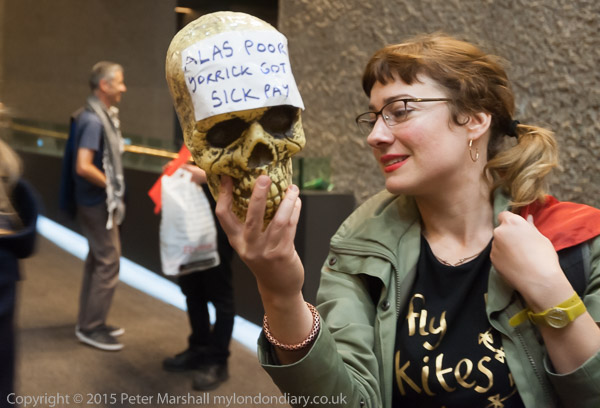
It’s all to easy to miss important details in the heat of the moment. The message on Yorick’s skull read “Alas Poor Yorick got NO sick pay”, but in my picture that all important word ‘NO’ is missing.  If whoever wrote it on the skull had spelt Yorick right perhaps it would have been visible – or if they had put the word on the next line.  What would have worked find on a flat surface was not so good for wrapping around a skull.

Had I noticed at the time I would have requested a slight adjustment of the angle. Although I don’t pose photographs I’m not so much of a purist that I would consider it a sin to do so. The woman holding the skull and gazing into it was doing so without me having asked her, and surely intended that my photograph showed the message in full.

Sometimes protesters hold up a poster upside-down by mistake, or a placard back to front.  Sometimes I’ll photograph it like that, but more often I’ll point out their error.

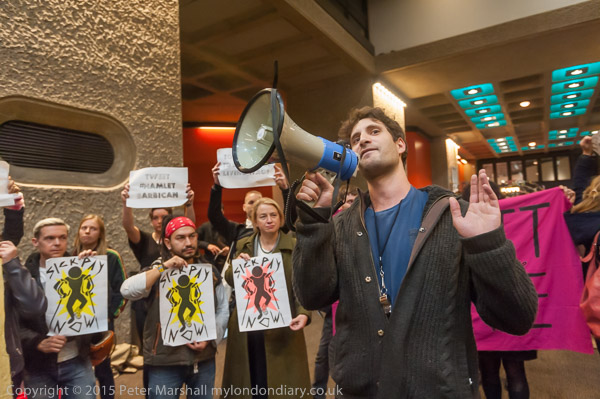
This protest inside the Barbican was organised as a ‘flash-mob’ and I’d been e-mailed the time at which it would happen by the organiser. I was a little worried about going back to the Barbican as I’d rushed in there with the same group of protesters only a couple of weeks earlier and thought I would probably be recognised by the security there and asked to leave, but if they did recognise me they said nothing.

I was there a few minutes early, and sat down close to where I thought the protest would take place in a foyer area and waited. At the appointed time, nothing happened, and I wondered if I had the details right. I recognised one or two other people also hanging around and went to talk to them – and we agreed that it was the correct place and time.

Green Party leader Natalie Bennett walked into the foyer and saw me and came over, telling me she knew she was in the right place when she saw me waiting, but there was still no sign of the protest. In a bar area below us there was a loud drumming and I thought it was perhaps the protest starting, but it turned out just to be a group there starting their performance.

Eventually I lost patience and got out my phone and did what I should have done 15 minutes earlier, and phoned the leader of the group who was coming to protest, who confirmed they had been held up and were still on their way and should be here in about 5 minutes. I passed the message around discretely among those I knew.

There was no mistaking it when the United Voices of the World arrived, as usual making a considerable noise.

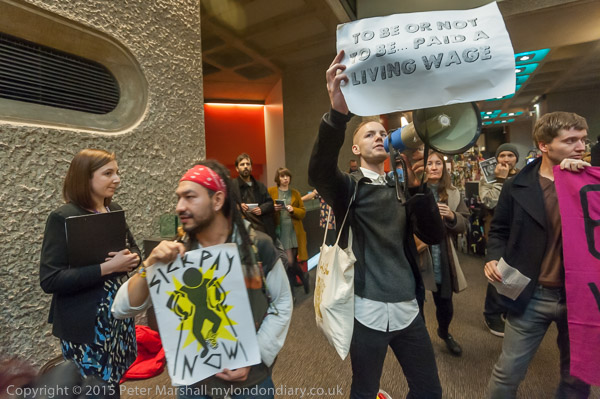
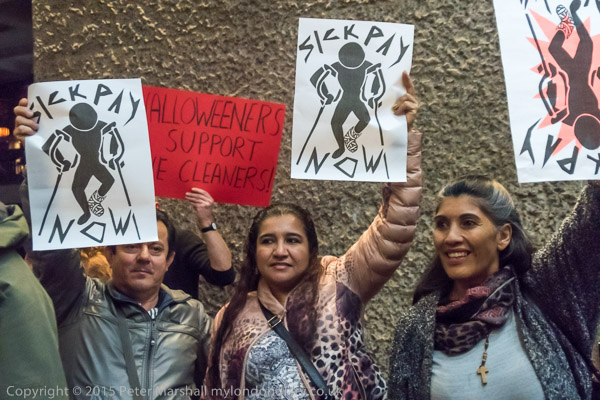
This protest, for full payment of the living wage, sick pay and proper holidays and pensions for the Barbican cleaners and an end to workfare in the centre had, as the first image suggested, a Shakespearian theme, as tonight was the last night of a season of ‘Hamlet’ in the theatre adjoining where it was taking place.

Missing the word ‘No’ wasn’t the only mistake I made during the protest inside. As usual I was working with two cameras, the D700 and D810, and while sitting waiting for the protest to start I’d set both of them to ISO 3200. I’d left the D700 on ‘P’ setting as the light is quite variable inside and using P saves having to think about it, but earlier in the evening had put the D810 on to ‘S’  to use flash.  I left it on that setting and selected a shutter speed or 1/60th which would just about give correct exposure in most parts with the lens wide open.

Unfortunately it’s rather easy to change the shutter speed without noticing it, and it was about two minutes into the event before I realised I was working at 1/250th – at least 2 stops underexposed in most areas.  I don’t like to look at images on the rear screen while I’m taking pictures – it interrupts my thoughts too much – and I was far too involved with what was happening to notice the figures along the bottom of the image in the viewfinder.

Immediately I changed to 1/60th, and rushed around trying to take similar images again – but that’s never possible.  Water, bridge…

But later, Lightroom came to the rescue. On the web the difference in the two images above isn’t clear, though there is a slightly coarser and more saturated look to the upper one, at 1/250th compared to the lower at 1/60th. Working at 1/250th does have the advantage of  being less affected by subject movement, and while the images effectively at around ISO 12,800 have a less smooth tonality and higher noise, they are in general faster.

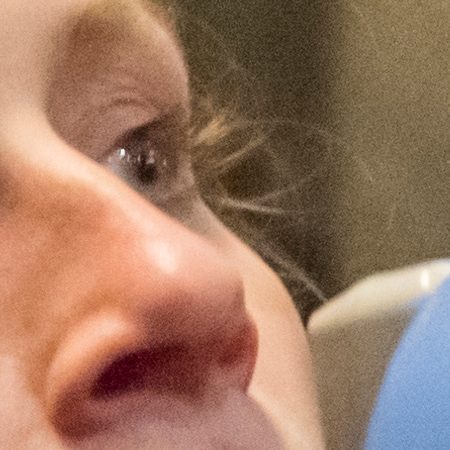
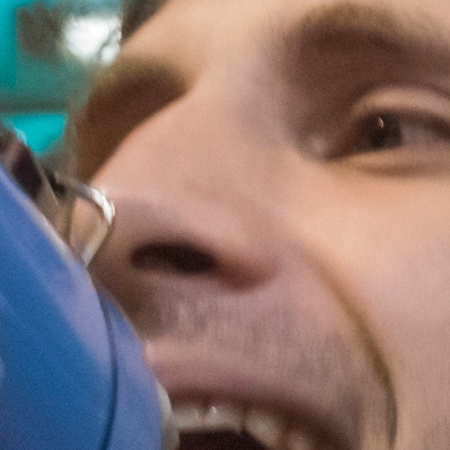
Here are a couple of 1:1 details from the two images which show what pixel peepers will see:

Of course I need not have made the saturation as different as in these two examples. Clearly there is more noise at the higher ISO, but the increased sharpness really is more important.

Looking at the lower image – which seems adequately sharp at normal viewing sizes, I think the lack of critical sharpness is probably due to either subject or camera movement, perhaps both. Both would be ameliorated by using a higher shutter speed.

My conclusion is that my reluctance to raise the ISO beyond 3200 reflects my experiences with older digital cameras (and film). There really isn’t any reason not to work when in low light at ISO 6400 with the D810 (and the same applies to the D700.) When I replace the D700, which is slowly showing its age, probably I can add at least another stop and work at 12,400.

My other conclusion is that a faster lens might help, though anything with a wider aperture than f2.8 might give me depth of field problems. Unfortunately I’d taken the 20mm f2.8 out of my camera bag to lighten my load, but at 296g including lens cap and filter I doubt if I’d really notice the difference.

More pictures at UVW Hamlet-themed Barbican Flash-mob.
Continue reading Barbican Revisisted

Flares

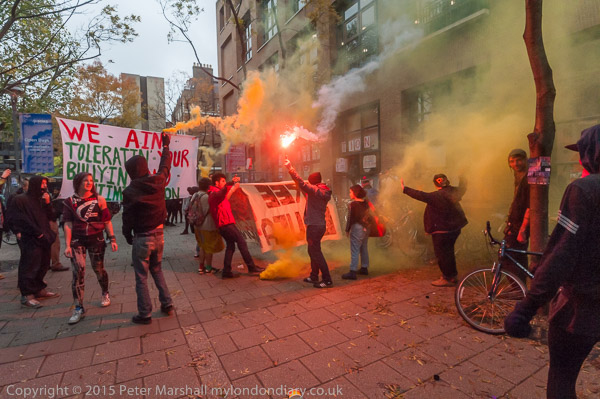
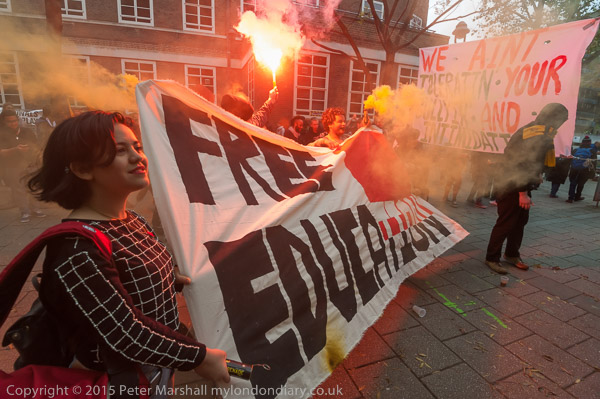
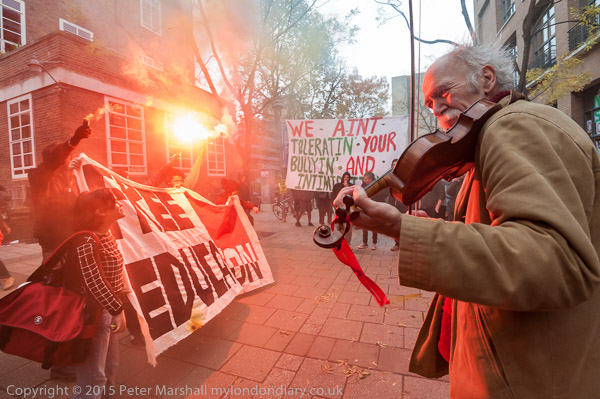
Flares are coming back into fashion. Not the flares I used to wear back in the late 60’s, natty though those were. I had to get rid of mine long ago, as although the legs were still wide enough, it has been some time since I had a 32″ waist.  But flares at protests.

As a photographer I have mixed feelings about them, or indeed flames of any sort. They certainly add a little colour and excitement, but they do create problems with exposure that are sometimes insoluble, and often very easy to get completely wrong. Good though Nikon’s matrix metering is, it usually fails in these situations.

The smoke too restricts visibility, and once you are inside the cloud it can get very difficult to see and photograph. I also worry about the effect of the smoke on my lungs, and it certainly can be very unpleasant.

Lightroom does often need to come to the rescue, and the De-Haze slider introduced not long back can often help. Even better is the more recently addition of De-Haze to the local adjustments brush.

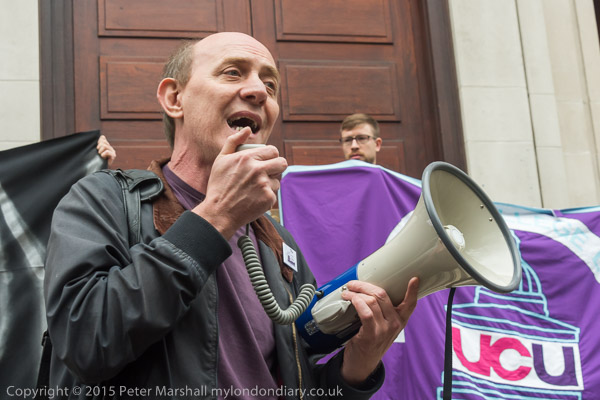
Protests outside SOAS are often visually interesting, and the flares certainly added something. I was also pleased to be able to support Unison Branch Secretary Sandy Nicholl who I’ve photographed at many different protests over the years, and who had been suspended by management for his trade union activities, in particular related to the then current student occupation of part of the university gallery building. You can see and read more at SOAS Shut Down after Sandy suspended. A few days later he was re-instated. Probably the protest helped management see sense.

Dancing has also often been a part of protests here, and on this occasion it was the ‘Strikey-Strikey‘, a version of the hokey-cokey with a mad rush into the centre of the circle at the end of each verse. As someone who photographically likes to be in the middle of things, I was rather in danger of being overrun, particularly as most of the time I was viewing the scene through a 16mm lens (and sometimes, even worse, the 16mm fisheye), which makes anything more than a few feet away seem quite distant.

I almost missed the flares – and I think the few other photographers who had been at the protest mainly did, leaving before the end when they were set off. It’s always hard to know when it is safe to leave an event, and its often a case of what is next in your diary for the day. Fortunately I had a little time spare before an early evening meeting and was in no hurry to leave.

We are also in an age where getting images on-line fast is more important in terms of earning than getting good images. Agencies want them if possible before things happen, and at many events photographers are sitting down and tapping away on their notebooks less than ten minutes after they have started. Apart from missing the development of stories, they are also having to work with jpegs, sending them off with little or no adjustment. While that’s fine for some images – particularly those in relatively flat lighting – it would have been pretty hopeless with the images I took of those flares.
Continue reading Flares

Depardon’s Glasgow

Despite suffering from a terrible amount of that horrible creeping zoom that really does mess up looking at still photographs – which get much of their power from the fact they are still, fixing a moment in a way that video or film doesn’t, Zisis Kardinos‘s Glasgow by Raymond Depardon is worth watching. The powerful atmosphere of his images still comes across, and the musical accompaniment generally goes well with the pictures, apart from one rather embarrassing moment with a “1.2.3” where it persuaded the editor into a very silly visual trick.

If nothing else, it got me looking for the pictures themselves, and you can see 82 of them on the Magnum site, starting here – then click on the first image, then ‘show image only‘. It’s just slightly disappointing that clicking on the ‘View information’ link below the pictures adds nothing, and makes the image smaller again, but good to be able to see them.

I’ve not seen the book, simply titled Glasgow, but you can read about it in ‘The Scotsman‘, and a more perceptive and personal view from someone who was a 13-year-old growing up in Glasgow when Depardon made his two visits to photograph the city.

It might have been a little less dangerous than his work the same year covering the civil war in Beirut, but in the ‘Dailyrecord‘ you can read some of the photographer’s own thoughts – and how despite being “shocked by the destitution” he loved every minute of his time there.

It says a great deal about about the political direction of the British press that the Sunday Times which had commissioned the prize-winning photographer to give his personal view of the city decided when they saw it not to publish it. It wasn’t, as most writing about it now seem to believe that it was shocking, but that it was an unpalatable truth. Then as now there are many stories that don’t get published, stories that the papers and particularly the BBC, never mention or quickly buries to keep on the right side of proprietors and their political allies. Depardon’s work showed the Thatcher era only too clearly.

The bi-lingual book Glasgow (ISBN-10: 202130362) came out at the end of February from Editions du Seuil and has text by William Boyd, who studied in Glasgow in the 1970s. Some of the pictures were shown at the Grand Palais in Paris from Nov 2013 until February 2014 and are perhaps the best reason to go and see Strange and Familiar which is at the Barbican in London until 19 June 2016.

Creative Cloud Woes

There was a great outcry back in 2013, particularly in the photographic world, when Adobe decided that their new software releases would be made on a subscription basis.

I didn’t really go along with this, not least because I think I was the only photographer I knew using a more or less legal version of the software and having over the years turned down offers of ‘cracked’ upgrades from friends.

I’d got copy of Photoshop when I was a teacher at education prices, which seemed to me to be a sensible amount to have to pay for the software, and had upgraded it over the years as far as Photoshop 7. Then I’d given up, as it seemed to do all I wanted, and the upgrades weren’t cheap. Like most photographers, I only use a small subset of Photoshop’s features, and it was priced too high for the market, while Elements seemed clunky and lacked just a few vitals.

I’d also got a legit copy of Lightroom 4. I’d had it from the start, after Adobe had bought up the superior technology of Pixmantec’s Rawshooter in 2006 and closed it down giving registered users a free copy of Lightroom 1.0 in 2007.

It wasn’t really much of a bargain, as Rawshooter was rather better at converting raw files than Lightroom, but I could see the advantages of incorporating image management. And when you bought a new camera – and things were then developing fast on the digital camera front – Rawshooter would no longer handle its files. I looked closely at the alternatives, owning copies of several on my computer and decided for all its current weaknesses that in the longer term Ligthroom was likely to be the best bet.

Though version 1.0 came free, I had to pay to upgrade to v2 in 2008, v3, v4 in 2012 and v5 in 2013 as I upgraded cameras – and also wanted the new features. So when a reasonably priced subscription including both Photoshop and Lightroom became available it seemed a reasonable price to pay, especially as Photoshop now included rather better and much faster retouching tools for working on my scans from negatives, many of which are in poor condition.

And so far, despite the many warnings when the subscription scheme was introduced, Adobe have played fair. Every month I pay them £8.57 (inc vat) and the software is fine – with a recent update to Lightroom CC 2015.5 and the latest Photoshop.

But while I’m happy with these programmes (and an old version of InDesign CS5.5 which I got as a relatively reasonably priced upgrade from Pagemaker), the actual Creative Cloud application is something of a pain, as it seldom works for more than a day or two, giving a message on starting up the computer that it needs the latest version to be installed and refusing to load.

Looking on the web, I seem to be among many others having a similar problem. I’ve tried ignoring it, but that means I don’t get notified of any updates – and eventually the software refuses to work properly.

Adobe does provide some helpful advice on resolving these issues, and if you have a similar problem you might try their suggestion that seems to work for me, deleting the opm.db file and running Creative Cloud again. The file may be hard to find, as the folder containing it is often hidden and you then need to unhide it first. But here’s where it should be:

Windows: C:\Users\<user folder>\AppData\Local\Adobe\OOBE
Mac OS: /Users/<user folder>/Library/Application Support/Adobe/OOBE

If that doesn’t work, you can always log in to Adobe and download and reinstall Creative Cloud. But deleting the file has been a quick and easy fix for me – though of course I disclaim any responsibility for what it might do on your system – it’s Adobe’s suggestion and not mine.

[If you are having problems with Lightroom itself, the obvious place to go for help is of course The Lightroom Queen.]

Given the problems that many of us have, surely Adobe could and should do something to make Creative Cloud more resilient and less liable to sulk in this way? It’s really the only little thing that stops me wholeheartedly recommending their photography plan to all photographers.