Black Magic

I’ve sometimes rather laughed Magnum’s ‘Square Print Sales’, with their postcard-sized signed prints being sold at $100 when you could buy well-printed books with many prints by the same photographers (and sometimes at least as well printed) for rather less. And perhaps been amused by images advertising the sale which showed those same images at 4 times the size. I’ve nothing against people collecting postcards, and I have a few myself, but most cost me 20p or less – and I’ve given hundreds if not thousands of my own work on them away.

Visiting to galleries and auction houses, I’ve often seen prints for sale for thousands of pounds that were inferior in quality to the reproductions of the same images in books. Sometimes it is worth remembering that – with a few rare exceptions – in photography we are always dealing in reproductions, and one of the joys of our medium is its essentially infinite reproducibility.

But of course photographers have to earn a living – and selling prints for thousands or millions is what keeps some art dealers in their lives of luxury.

But Magnum Distribution are now selling Matt Black‘s ‘The Geography of Poverty – Heartland‘, a set of eight 8×10″ prints in an envelope with some documentation for what seems a reasonable price of $249.00 They are in a limited edition, but 100 copies seems a fairly reasonable number, and more than I’ve sold of any unlimited edition print.

The 8 prints are digital C-type on Fuji Crystal Archive Matte paper, which would perhaps not be my choice for black and white prints, and rather more suited to colour images. But certainly you can make good black and white prints this way, though I would generally prefer good inkjet prints (which I imagine is what Magnum’s ‘museum quality’ square images are.)  Perhaps Black prefers the Fuji paper – the cost difference between C-types and inkjet is small – the pro lab I sometimes use charges around 30% more for inkjet.

It’s an great project by Black, who I think is one of the more promising new Magnum photographers for some years, and you can see more at MSNBC, where the presentation and text by Pulitzer Prize-winning journalist Trymaine Lee produce a work of outstanding quality. You can also see more of his work on his own web site and on Magnum, where he became a Magnum nominee in 2015. You can also follow him on Instagram, where he was Time’s Instagram photographer of the year in 2014. There is also a signed Geography of Poverty Newsprint issue for sale which seems to me rather poor value at $45. I have a number of such newpsrint publications now, and they usually end up in the recycling, as they hardly seem worth keeping.

I won’t be buying either that or the set of 8 images. Although I admire the work, I wouldn’t want to hang the 8 images on my wall, nor do I have the space to do so. And I have far too many prints  – my own and others – already hidden away in envelopes, tubes and boxes that never get looked at.
Time’s 100

I may have mentioned Time’s 100 Photos before, their collection of ‘The Most Influential Images of All Time‘, with ‘the stories behind 100 images that changed the world, selected by TIME and an international team of curators‘. If not, it’s an oversight on my part.

It’s certainly a list containing some remarkable images, and a number that it would be hard to criticise their inclusion, though my own personal choices would be mainly different – and with less of an American (that is USA) bias. There are a number of images I simply don’t recognise among the many more familiar, which either says something about me or something about them, and also some pictures where I might have selected another image from the same photographer or event.

There is some interesting text about each of the images, and for some further images or a video. The videos, 20 of them are also listed on a separate page and I have to admit to not watching all of them, and to skipping briefly through some others.

But one I paid more attention to than most is the one that brought me back to this site, from a link on Rob Haggart‘s A Photo Editor blog. Untitled (Cowboy) Photograph by Richard Prince is I think the longest of the Time videos at around 15 minutes. It includes some fairly lengthy scenes of Prince talking about his appropriation of the Marlboro adverts, as well as comments and images showing some of the team of photographers who made the pictures as ‘work for hire‘, and some experts from the art world.

One of the more fascinating aspects is that Prince introduces (at around 9.04) the 1949 Leonard McCombe essay in Life,  Cowboy, which was the inspiration for the Marlboro campaign.

I ended up thinking I would have liked to see more about how the original images were made, and that the actual Marlboro adverts were generally more interesting as cultural artifacts and as images than Prince’s selections from them.

This case differs from some of Prince’s other image thefts in that none of the photographers concerned has any copyright in the images, which are not – as Prince states he thought when he made them, in the public domain, but the intellectual property of Marlboro.

Capa and Margaret Bourke-White both get a couple of images into the collection – and you can probably guess which two. The texts which accompany both the Capa images are severely misleading, as too is the video in which John Morris talks about the D-Day image and his part in it.

The commentary on the ‘Falling Soldier‘ states that in the 1970s:

‘a South African journalist named O.D. Gallagher claimed that Capa had told him the image was staged. But no confirmation was ever presented, and most believe that Capa’s is a genuine candid photograph of a Spanish militiaman being shot.’

It’s a belief that now only those who pride themselves on being ill-informed and dismissing the evidence and research can hold to. If Time’s comment is true then there are plenty of flat-earthers in photography.

Conscientious Picks

The annual Conscientious Portfolio Competition is in some ways an ideal photographic competition, though I’m not generally a great fan of competitions. The annual competition is free to enter (but you will have to wait until late next year – this year’s deadline was 31 October 2016, 11:59pm ET.)

As Conscientious founder and editor Jörg M. Colberg writes:

I don’t believe in “pay to play.” Everybody needs to have the same fair chance. This is why the eventual winners are selected blindly, mimicking blind auditions: the judges get a set of photographs (and nothing else), with the names of the artists encrypted.

As well as being free, its also easy to enter. You simply start by sending an e-mail  with the address of your the web site with the project is on, and which of the projects there you are submitting.

It’s also a very personal view, with no pretention that this is some kind of industry consensus. You go through to the next round if Colberg sees yours as one of the 25 projects he finds of most interest. Then comes the final, where he and two others with experience in working with photographers – for this year Emma Bowkett and Felix Hoffmann, one a director of photography and the other a curator – each make there own personal pick of one project from the 25 in the pool.

There could be one, two or three winners, depending on whether they make the same or different choices. But the contest is run to try and create a level playing field. At this second stage each of those selected sends in 10 jpeg images at the same size which are then presented without the name or CV of the photographer:

Having a second round is based on the idea of making everything as equal as possible. With uniform file sizes, fancy websites won’t be able to beat out simple ones. With a special naming convention for the jpegs (which will hide the full names), the winner(s) will be solely chosen based on the quality of the work.

The prize is simply exposure, with the winners winners each having their work featured on Conscientious, one of the best-regarded photography websites, “in the form of an extended conversation”. This is a contest for ‘emerging photographers‘ and this will certainly be worthwhile and lead to coverage elsewhere. They might even get a mention on >Re:PHOTO :-)

The three winners this year have just been announced, in CPC 2016: The Winners, and I have to say that I find one of them rather more interesting than the other two. Readers will probably be able to guess which. There are links to their web sites on the page, and Colberg also tells us that of the 26 winners selected in 7 years, exactly 13 have been women and 13 men.

It isn’t an ideal competition, but for me beats most others in the way that it is organised. The one big change I’d like would be to have all the selectors being photographers rather than curators or employers of photography or critics. But that’s a view that reflects my strongly held belief that it is our medium and not theirs.


Epic Photobomb?

You probably will have already seen the video, if not, take a look at it on Petapixel: Guy Epically Photobombs Newspaper Photographer Shooting a Demolition.

It’s a good example of the kind of thing that happens with remarkable frequency these days, when it has become very hard to work at many events without someone holding up their phone getting between you and the subject.

In this case it actually makes what would otherwise have been a rather boring movie clip rather more interesting – and the idiot with his phone running across the field of view hardly obscures what is happening.

Without that guy, no-one outside of Reading PA would have watched that demolition video, or known that Reading had a newspaper. Although the factory demolition may have been ‘a momentous occasion, at least regionally, given the history behind this factory, which once built tanks during WWII’ the video would frankly have been rather boring.

The Reading Eagle staff photographer was working from a location where the public had gathered to view the event. But it wasn’t one that gave a particularly good view of the factory and one might have hoped that working for the local rag would give you an idea and get you better access than Joe Public.

And ‘she even set up her gear down low in case debris came flying.’ What? Debris could equally fly low or high, but a higher viewpoint would have helped and avoided the low moving person. The chances of a camera being hit by anything large enough to cause serious damage would seem to be low, and would probably be covered by insurance. If she or the authorities were worried about her own safety then a remote trigger could have been used.

I doubt if we will ever see the phone video, though I expect it will be of little interest with the chimneys hard to make out in a rather blurry and jumpy film. Many of our local papers would now be relying on getting that and others sent to them for free rather than having a staff photographer spending a day on the job.

Berta Cáceres vigil

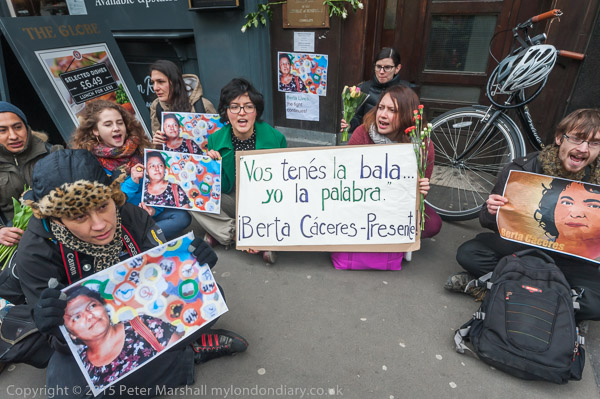
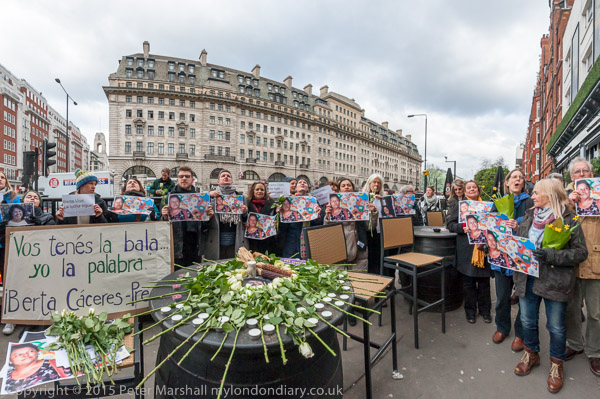
The vigil in remembrance of environmental activist Berta Cáceres, leader of the Civic Council of Popular and Indigenous Organisations of Honduras was a reminder that we are fortunate to live in a country where, at least if you are not a weapons expert with nuclear secrets or a Russian defector, the rule of law usually applies. And while our secretive services may well have been involved in a number of assassinations abroad (including that of Patrice Lumumba, prime minister of the Democratic Republic of the Congo and failed attempts to assassinate Gadafi and Sukarno) as well as some decidly dodgy activities in Northern Ireland that led to the deaths of lawyer Rosemary Nelson and Airey Neave, here things are rather safer.

Of course some protesters here have been subjected to lengthy harassment by police, our legal system and some rather more shadowy figures, and a few years ago we had the entirely ridiculous spectacle of Parliament passing a law aimed (unsuccessfully) at getting rid of Brian Haw who was embarassing them by squatting on the pavement opposite. And police fairly routinely provoke protesters by the use of un-called for force and carry out adminstrative punishment by arresting protesters and either releasing them without charge in the early hours of the following morning or – with the collusion of the CPS – making charges which they know have no basis and are only dropped shortly before they come to  trial.

In Honduras things are rather different and activists who put their heads up are at great risk of their lives. Berta Cáceres is only one of a number who have been assassinated, either by forces of the state or by groups encouraged by the state. Before her murder she had  death threats from the Honduran National Police and judicial harassment.

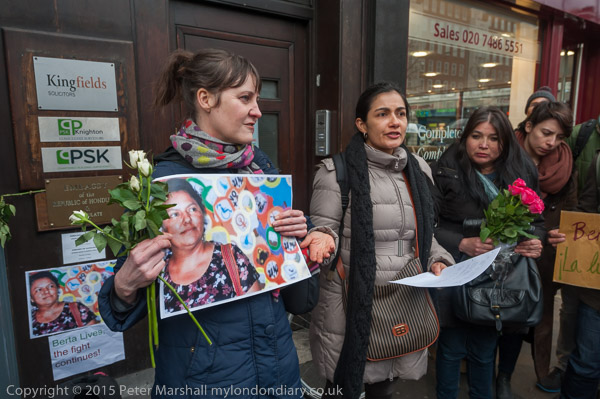
It was quite a difficult event to photograph because of the location, crowded into a relatively narrow pavement between the hard to find door of the embassy and the railings around a subway entrance. I arrived early, and eventually managed to find the embassy door, and was able to show it to the protesters who had been looking for it in Baker St around the corner.

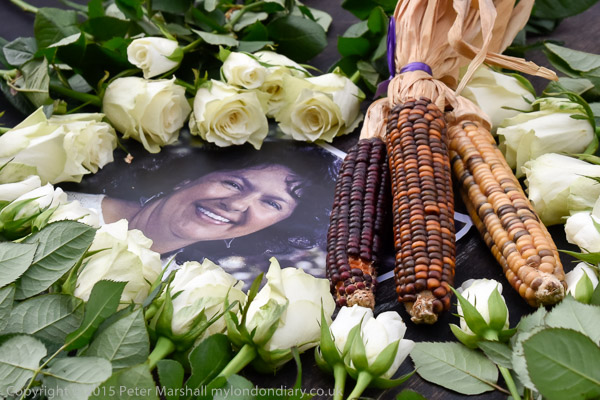
It was difficult for the protesters too, but fortunately the weather was cold and windy which meant that there was nobdoy using the tables and fixed chairs outside the neighbouring pub on which they set up a ring of white flowers and heads of maize around the picture of the murdered activist.

It was hard to avoid rather graphic images advertising the pub food when photographing the protesters with their pictures and posters, and you can see one in the picture above. I’m sure that Reuters wouldn’t approve, but I have darkened and desaturated it slightly to make it less obtrusive.

Usually I’d try to include some sign of the embassy in my pictures of any protest at an embassy, and here you can just see it, behind the white roses at the left of the picture.  There was another clue to its presence in a Honduran flag on the office on one of the upper floors, but it was too high to sensibly include in any image.

A few of the images were made across from the other side of those subway steps, and a few with me clinging to the railings on the small ledge with a large drop behind me down into the stairway. It wasn’t a situation I felt at all happy in, and I soon moved back to safer ground.

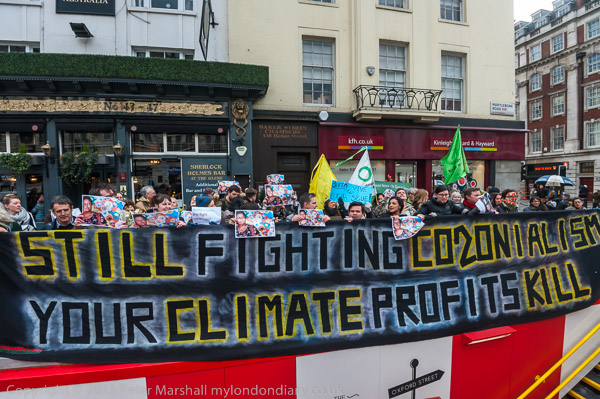
As always in confined spaces the Nikon 16mm fisheye came in useful – with the top picture in this post and two others in Vigil for murdered Berta Cáceres on My London Diary making use of its wide angle of view. As usual I ‘defished’ the images to make the verticals into straight lines and held the camera as close to level as possible to keep them vertical.

Continue reading Berta Cáceres vigil

British Bikers

I’ve seen some rather scary video of UK Bikers and the police harassment of their events which take place on rather out of the way ‘strips’ on the south and eastern edges of London, and although I’ve thought they would make an interesting subject, it’s never been one that I have seriously considered pursuing. And although some of the videos have been interesting, those I’ve watched have been rather amateur, and I’ve seen relatively few good still images. And most of those are by Dan Giannopoulos.

Giannopoulos came across some of them when cycling to work on his mountain bike and went over to talk to them, and Lens (again!) has just published a feature on the eigtheen months of work that followed, illustrated by 17 of his black and white photographs.

I’m not generally a fan of those photographers who work in black and white simply because they feel it gives their work a more documentary look, but Giannopoulos isn’t one of these, and his use of black and white really suits the subject, though there are just one or two pictures among the 17 where I felt colour might have been better. You can see a few more pictures from this project on his own web site, along with a number of other projects both in b/w and colour.

Among the work is another black and white series form 2009-2010 on the UK’s Far Right, which includes some striking images from some events I also photographed. His series was highly commended in the 2015 British Life photo awards, and he was Documentary Series Winner with a series of four images from his project Living with Dementia.

The BLPA isn’t a competition I know anything about, and having taken a brief look at its web site I don’t think I’m a great deal wiser. The entry fees seem relatively reasonable as such things go, but the site currently says:

We are currently in discussion with a major new sponsor regarding opening times and terms and conditions. We hope this will be an exciting new development taking the awards to a new level of awareness and prestige. Please bear with us whilst the negotiations are in progress.”

In the Top 10

I’m not quite sure what it means, but this site, >Re:PHOTO, is now listed as No. 3 in  Vuelio’s  Top 10 UK Photography Blogs.

vueliotop10badge2016

You can see the full list with descriptions and links to the sites on the link above, but here are the top 10 in the rankings updated on 16/11/2016.

1. Sophie in the Sticks
2. Deceptive Media
3. Re: Photo
4. Lawson Photography
5. Girl With a Camera
6. The London Column
7. Allister Freeman
8. The Photographers’ Gallery Blog
9. Thesilenceofthelens
10. Holly McGlynn

And this is the description there for >Re:PHOTO:

“Capturing political movements and protests, Re: Photo takes a slightly different approach. With a more photo-journalist style, the blog focuses on the power of community spirit and people coming together to campaign for social and political change.”

Vuelio has this to say about their rankings:

“Vuelio’s blog ranking methodology takes into consideration social sharing, topic-related content and post frequency. Profiles of these photography blogs and their authors can be found in the Vuelio Media Database.”

The list is certainly a varied one, and most of those included are ones that I would probably never read, but there is room for many different approaches.

Be Creative

As I’ve found in the past, its hard to write about creativity. All to easy to mouth platitudes and end up sounding rather soppy. And at times in his ‘The Creative ManifestoBen Sasso on PetaPixel strays a little into that territory. For me at least the pictures accompanying the piece don’t help in that respect (too sentimental for my taste, though many will react postively), and neither does the fact that he’s American. But the ideas are certainly good advice, and mostly things that I’ve urged on students and those who bother to read my advice over the years.

It’s best you go and read his article. But in precis (and a little of my own spin) his 10 points are:

1. Emotion beats aesthetics
2. Go the other way to the crowd
3. Use you own emotions
4. Be yourself in your work
5. Experiment, try new ideas
6. Don’t get hung up on technical perfection
7. Take time to think when you need to
8. Photograph what you enjoy
9. Know your craft and study your medium
10. Get weird!

I don’t think there is anything new in any of these, and I’ve heard or read them all from many great photographers over the years, from Cartier-Bresson on. But there is also plenty of bad advice out there, confusing means with ends and more. And being a more creative photographer isn’t necessarily going to make you more commercially succesful – which is often rather more about business and people skills than your photography.

Although I came across it through PetaPixel, it’s better to read this on Sasso’s own site, as I couldn’t get some of the links to work from PP, and that ‘weird’ gif is worth seeing.

You can also read the comments, which though I don’t think they add anything in terms of content do show how this piece has been enthusiastically received by other photographers. Most of us at times feel we are in a rut.

There’s also another article on the same subject published on the same day on PP, ‘On Creativity: Seek Failure‘ by UK photographer Jacob James. Again  you can also read it on his own web site.

I’m missing Paris

I went to Paris for several years for what is I think photography’s largest trade fair, Paris Photo, and reading about this years Paris Photo 2016 in several places, including LensCulture and BJP I am rather missing being there this year.


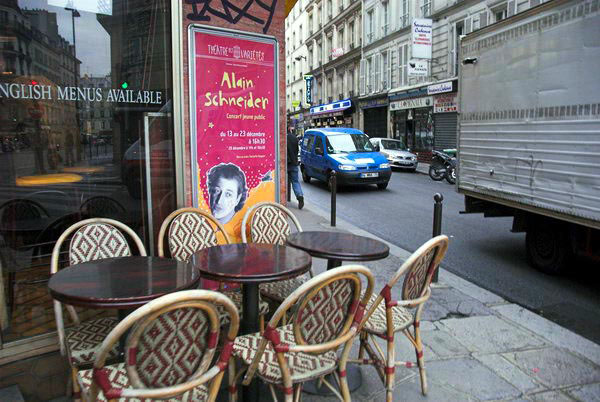
Paris, 2006

One development I welcome is the increasing emphasis on photography books in the show – again read about it on LensCulture – as I’ve long considered the best place for most photography is on the printed page rather than the wall (and have done my little bit towards this – though not of course featured at Paris.)

I’m also pleased to see the increasing emphasis on Japanese photography, something that has interested me for some years, though the book that would certainly be my choice for Photobook of the Year isn’t in the listings.


Paris Photo, 2006

The pictures above are from my first visit to Paris Photo back in 2006, when I visited Paris for a week with Linda. I spent the first evening and a couple of days inside Photo Paris, then in an underground location, going around every stall and looking at all the pictures. It was great, though there were some dealers to whom a journalist for the web was clearly of very little interest and made sure I felt it. But as you can see from the larger album of pictures here, we had an interesting week in the city, and for me the main attraction in this and the following visits were the many shows outside the dealer fair, in the Mois de la Photo and the fringe events of L’Off. I wouldn’t have gone to Paris just for Paris Photo, and  ‘the Month’ was only every two years.  Now it has evolved into ‘Le Mois de la Photo du Grand Paris‘ and won’t be until April 2017 – another reason for not going there now. But perhaps I will visit next April.

Here’s the post I wrote for this site back in 2006:

Paris was full of photographs in November, and there were some great ones at Paris Photo. But there were things that were hard to take too. Large empty wastes of dollar-rich nothingness covering the walls of some galleries. Vintage prints pulled from some photographers waste-bins and awarded stupendous price-tags. I found it hard not to burst out laughing when a dealer came up to the person next to me and told her the price of one rather ordinary ’60s fashion print was 20,000 euros. A couple of years ago we would have though 200 rather steep, and 2000 definitely well over the top.

Still, all good news for investors, and for the minority of photographers who have a place on the gravy train. There were a few other photographers around, trying to talk to dealers, but this wasn’t the place for it. “Best if you e-mail us” they were politely brushed off.

The first day I had a panic attack of sorts as the place got more and more full of people, all there for the free opening party, and had to rush out and up from the bunker into the fresh air above. The next day things were better, less crowded, but still more a place for millionaires than photographers.

But fortunately, there was much more in Paris than Paris Photo.

In 2008 I published a partial diary of my visit as a ‘Paris Supplement‘ on My London Diary and reviewed some of the shows here on >Re:PHOTO, (beginning here) and I had a great time. I only published the series of posts after I got home as I just didn’t have time to write more than notes in Paris, and they are mixed with other posts – the last, on Louise Narbo, only being published on December 5th. YOu can also find more on My London Diary from 2010 and 2012, and also on the November pages of this site.

In 2014  I was just too busy to go, and the attraction of Paris Photo had somewhat waned after seeing many of the same photographs on some dealers stalls again and again.


Paris, 1984

You can see more of my photographs of Paris from 1973-2007 (when I was also there for Photo Paris) on my web site Paris Photos.

There are no adverts on this site and it receives no sponsorship, and I like to keep it that way. But it does take a considerable amount of my time and thought, and if you enjoy reading it, a small donation – perhaps the cost of a beer – would be appreciated.

My London Diary : London Photos : Hull : River Lea/Lee Valley : London’s Industrial Heritage

All photographs on this and my other sites, unless otherwise stated, are taken by and copyright of Peter Marshall, and are available for reproduction or can be bought as prints.

To order prints or reproduce images

________________________________________________________

Photoshop Alternative

A few years ago I would have jumped at the chance to move from Photoshop to an alternative that looks at least equally powerful but at a fraction of the cost. Now, I’m not so sure, as Photoshop has become much more reasonably priced, and there would be quite a long process of learning to move away to Affinity Photo.

That link is for the Mac version, but as I learnt from Peta Pixel, you can now download a free beta of a Windows version which is said to have an identical interface. I don’t think I will, as I haven’t the time to spend evaluating software and changing my old habits, but it does look good and rather than paying a subscription there is a one-off price. The Windows version when launched will cost the same $50 or £40 as the Mac.

It does seem to offer an alternative to everything I need from Photoshop – I took a quick look through the long listing of features – and elsewhere is a list of cameras it supports for RAW, which included all that I own and of course many more. As a British company the price in the UK is perhaps less likely to be affected by any further drop in the pound as we slide into Breixt economic gloom.

But for me, Photoshop comes more or less as a free gift with Lightroom on my subscription, and I’ve come to love and rely on the way that Lightworks with and catalogues my images.  And I still have nagging doubts about Serif, the company that produces Affinity, and  whose PagePlus DTP software I used in the long past; Version 1.0 was cheap and worked farily well, but didn’t quite match up to that available at several times the cost from the big names.  But it does look as if they have made that jump now, and PagePlus X9 looks rather good and if I wanted new web design software I’d certainly look at WebPlus X8. And Affinity seems to offer all that I use from Photoshop – including the ability to use 64-bit Photoshop plugins.

As I said, I don’t have the time to play with betas. But perhaps in a year or so when others have ironed out the worst bugs I’ll consider Affinity again, and decide if I can live without Lightroom. After all its one-off cost is less than 5 months subs to the Adobe Photography Plan – and after that I’d be saving just over £100 a year.  Of course sometime they would bring out a version 2,  and perhaps I might feel a need to upgrade, but it would still work out much cheaper.

As well as Affinity Photo, Affinity Designer is also available as a free beta for Windows.

Incidentally another page at Peta Pixel details how you can save 25 % on your Adobe subscription – but it doesn’t seem to work for me, with the Amazon page this links to listing it at the full dollar price of $119.88 – perhaps the offer is/was only available in the US.