London 1978 – The Crescent Cafe

Since the start of the year I’ve been making the occasional post of my pictures from the 1970s with some comments on my Facebook Page – though not quite as regularly as I did with my Hull photos for Hull2017, where I kept up daily posts for the whole of Hull’s year as UK City of Culture. I’m still posting the occasional set of images and comments to the Hull site, and all of the London pictures are on my more recent London Photographs site, which was put on hold for Hull’s year in the limelight.

A few of the pictures of London I have shared here earlier, but most are new, and where either pictures or comments have a particular photographic interest I’ll share them here too. The photographs will link if clicked to the London site where they appear a little larger. This is today’s image and comment:
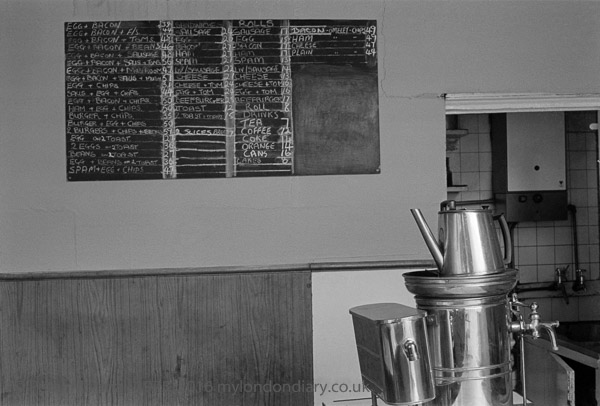

Crescent Cafe, Crouch End Hill, Hornsey, Haringey, 1978
16r26: cafe, Haringey,

I didn’t go in the Crescent Cafe (they spelt it without an accent) but had it been open I might well have been tempted to hand over 7p for a cup of Tea, or even 17p on a Bacon Roll, though its unlikely I would have been hungry enough to deal with Egg + Bacon + Sausage + Toms, nor have been able to spare the 56p to pay for it. It seems nothing now, but money was  very tight for me then though that 7p would only be around 38p allowing for inflation, so still a bargain.

It was however probably the highly detailed menu on the blackboard that attracted my attention, along with the shiny aluminium of the urn and teapot. I’m not sure why it was closed. Perhaps it was a Saturday or Sunday, or, as it was taken in August, perhaps the owners were taking their annual holiday, but the place was clearly still normally in business.

I can’t remember either what had taken me to north London, but I suspect I may have been carrying a large orange box of Agfa Record Rapid, following a visit to “the Brovira Boys of Muswell Hill“, Peter Goldfield and Martin Reed, who imported this holy grail of photographic paper into the UK, and published in 1978 ‘The Goldfinger Craftbook For Creative Photography‘, now rather dated but available on-line. Later I got to know Peter, and wrote a short piece on my >Re:PHOTO blog when he died in 2009. Martin Reed went on to continue the work they started at Silverprint, for many years from 1984 in Southwark and still in business, though without Martin, in Poole and by mail order.

Record Rapid died so far as photographers were concerned around 1988, when Agfa were forced to re-formulate it without cadmium for health and safety reasons. Cadmium compounds are highly poisonous, and are still used in artists’ pigments, but while they are fixed on the surface of paintings, and thus safe unless artists licked their brushes, a considerable proportion ran off into the drains when photographic paper was processed, and their use was banned in most countries. Papers containing cadmium salts continued to be made in other countries for a few years but none achieved the properties of the old Record Rapid, and probably the closest approach to it now involves using some inkjet papers.

Peter Goldfield
The Goldfinger Craftbook For Creative Photography
Silverprint
_____________________________________________________

There are no adverts on this site and it receives no sponsorship, and I like to keep it that way. But it does take a considerable amount of my time and thought, and if you enjoy reading it, a small donation – perhaps the cost of a beer – would be appreciated.

My London Diary : London Photos : Hull : River Lea/Lee Valley : London’s Industrial Heritage

All photographs on this and my other sites, unless otherwise stated, are taken by and copyright of Peter Marshall, and are available for reproduction or can be bought as prints.

To order prints or reproduce images

________________________________________________________
Another Cyclist Dies

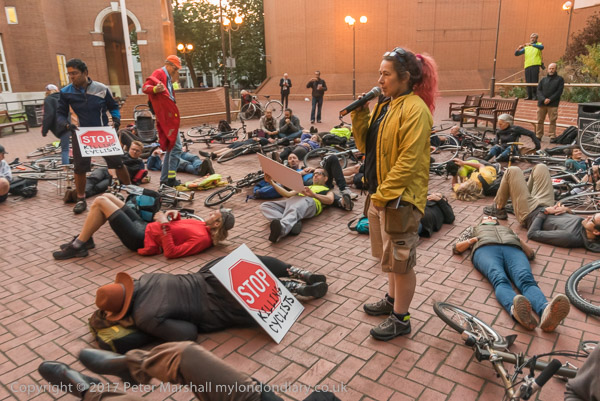
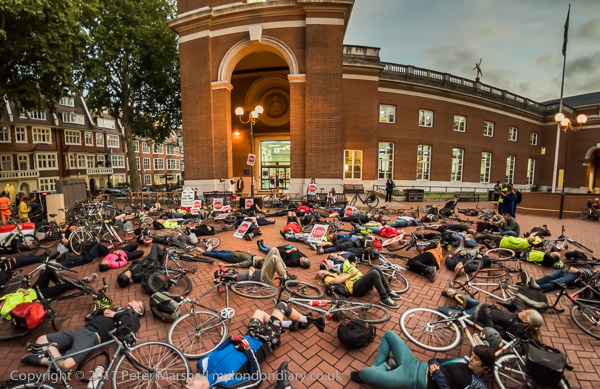
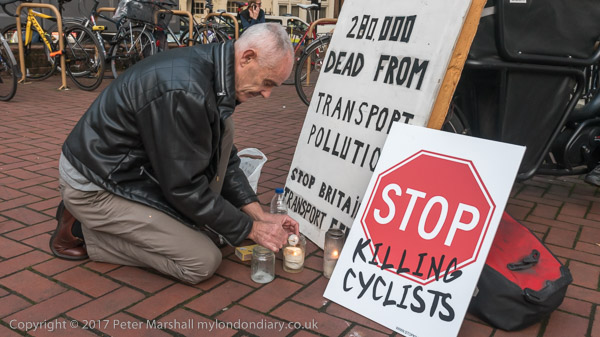
Stop Killing Cyclists were at Kensington & Chelsea Town Hall to hold a vigil and protest for the latest cyclist to be killed by a heavy goods vehicle on London roads. The woman was knocked from her bike at the junction at the north end of Chelsea Bridge, where 36 recorded accidents took place last year, but no improvements have been made.

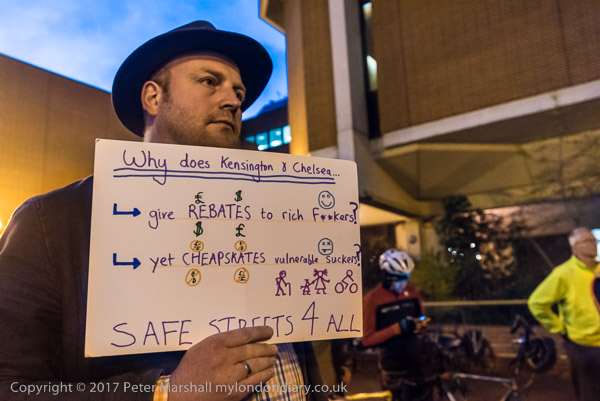
Kensington & Chelsea Council have resolutely opposed schemes for safer cycling in London and have built not a single metre of protected cycle lane in the borough, despite being one of the richest boroughs in London – they even gave wealthier residents some of their council tax back. The 36 year-old woman who was killed at Chelsea Bridge was the second cyclist killed by a HGV in the borough this year.

They are also of course the council responsible for making the Grenfell fire almost inevitable – and ensuring that when it took place so many of those in the tower would die, by cutting costs and deliberately modifying the building and surroundings to increase risk as well as frustrating proper safety inspections. It’s hard not to come to the conclusion that the wealthy councillors consider cyclists – and the residents of social housing – as some kind of inferior beings whose lives don’t much matter.

Usually Stop Killing Cyclists hold their vigils and die-ins on the road where cyclists are killed, blocking traffic for the duration of the die-in. Today was different, perhaps to emphasize that this was an accident largely down to the obstructive policy of Kensington & Chelsea Council towards providing safe cylcing infrastructure. The event took place on the large courtyard of the council offices, which are tucked away out of sight a few yards from the busy Kensington High St.

Fortunately the die-in happened fairly early in the event, while there was still a considerable amount of natural light at the end of a bright day, and my pictures of this are clear and the colour good. As at other die-ins, using the 16mm fish-eye enabled me to get a good overall impression. Even at full aperture the corners are almost pin sharp (they are softened slightly in the conversion to cylindrical perspective) and at f2.8 I was able to expose for 1/125 at ISO 2,200. It is a lens where there is relatively little point in stopping down – though for landscapes in good light I’d perhaps work at f5.6 – and depth of field is pretty incredible wide open.

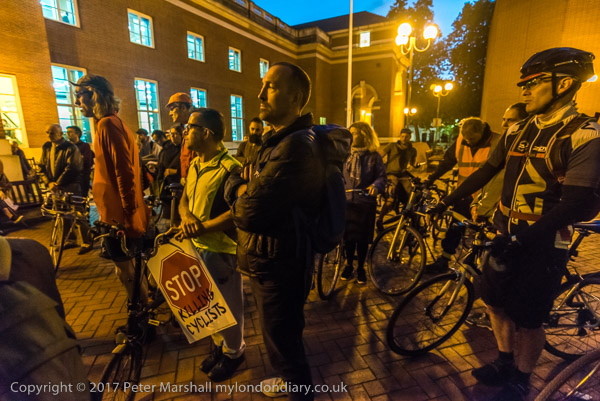
Later it did get very dark in the courtyard, and I was working at ISO 6400 again with lenses at full aperture, though with the 28.0-200.0 mm this is only f3.5-5.6 depending on the focal length. The 18-35mm is only slightly faster at f3.5-4.5.

After the previous week’s problems with wandering fingers I kept a close eye on the aperture and shutter speed. This was a much easier event from that point of view with plenty of time and no rushing. But light was a problem, not mainly because there was so little of it, but because what there was was almost entirely a bright orange. It’s easy enough to vary the colour of the cast (and often hard to avoid) but impossible to remove it.

Cyclists Kensington Vigil & Die In

Continue reading Another Cyclist Dies

Stopping London Traffic Pollution

Every Saturday evening in my youth the BBC Home Service broadcast the radio programme ‘In Town Tonight’, introduced by the music of the Knightsbridge March by Eric Coates and traffic noise, halted by a loud shout ‘Stop!’ and the radio announcer’s voice “Once more we stop the mighty roar of London’s traffic …” It carried on, even becoming a TV show for a few years, an early chat show with celebrities and the odd and occasionally interesting rather random outside broadcast segment, most famously on a night spent in the waxworks Chamber of Horrors by Brian Johnston.

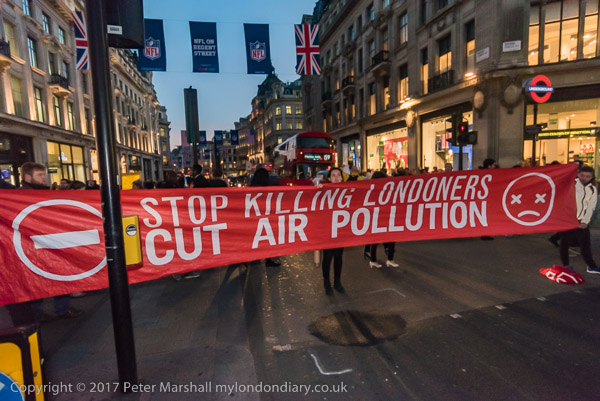
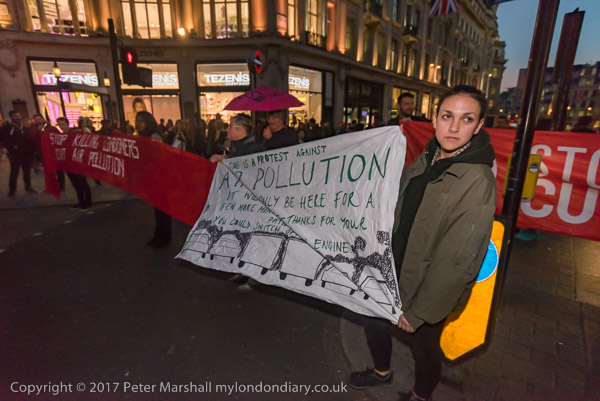
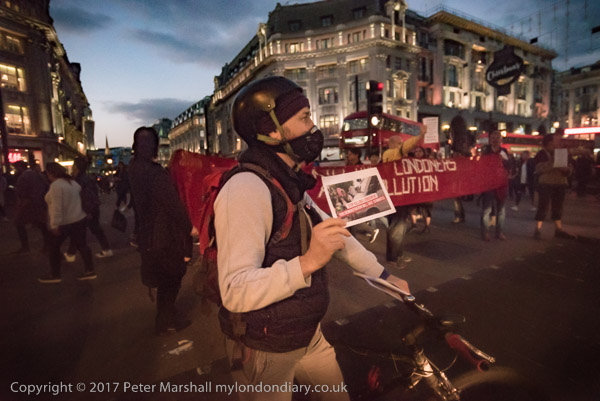
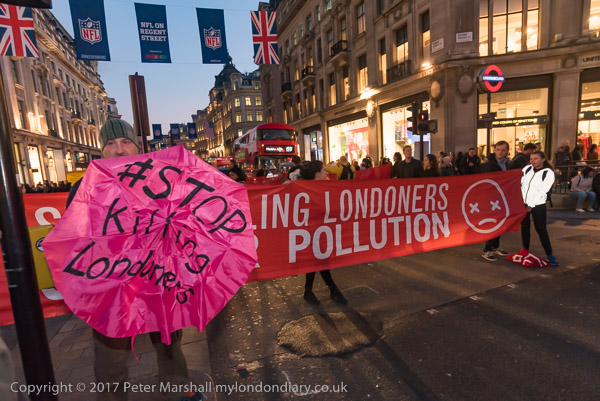
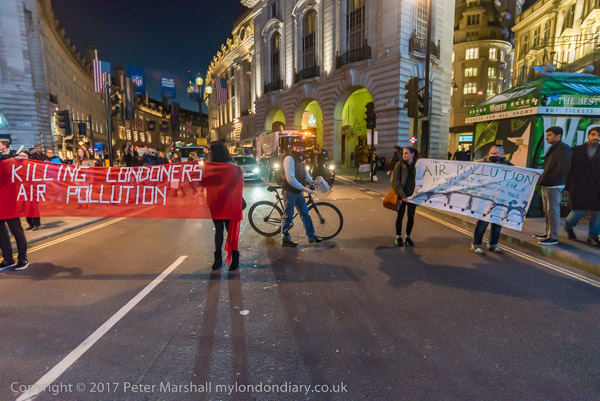
Memories of this and the comfortable fug as our family sat around the radio and a coal fire in our cramped living room came back to me as ‘Stop Killing Londoners‘ again stopped that mighty roar, if a little less dramatically, first at Oxford Circus, by stepping out with banners when the traffic was halted at the lights, in the sixth of their brief protests to highlight the thousands of premature deaths each year caused by air pollution in the city, largely by oxides of nitrogen and minute particulates from traffic. Official figures put the number of such deaths at very close to 10,000 deaths a year, and of course many more suffer greatly from illnesses caused or exacerbated by the polluted air, well above the legal limits for most pollutants.

Actions such as this are intended to force action from London’s Mayor and from TfL, who the protesters see as moving far too slowly and failing to confront those with vested interests, including London’s black cab drivers who are responsible for a surprisingly large amount both of the pollution and also the opposition to measures that tackle it, including the cycle superhighways. And until there is much greater public awareness of the problem, it is hard for the politicians to take more decisive action.

I’d met with the group on Oxford St around 6 pm, and as a photographer it was frustrating to see the light fading rapidly as we approached sunset and we were still waiting for more to arrive and the action to begin. It really was quite dark, and I wasn’t too well prepared for it. I’m always very surprised by the low light levels in parts of busy streets even in the very centre of London.

Flash generally isn’t a good option in wide open spaces for overall lighting, as it falls off with the square of the distance, but it does enable you to pick out people and banners closest to the camera, as in the picture above. But I didn’t want it to remove the shadows from the main lighting which was coming from the headlights of the vehicles stopped well behind those holding the banner.  In some of the other pictures this is a little more obvious.

The effect of the light fall-off with distance from the flash becomes more of a problem when the main  subject is at an angle so that some parts of it are much closer to the camera and flash than others. I often try to lessen the problem by twisting the flash head to the side. The flash doesn’t  really cover the very wide angle of the 18mm used for the above picture, and by angling it away from the centre, in this case towards the left of the picture, puts the closer figure into the area where the light is falling off.  But still considerable burning of the closer part of the image and dodging of the further areas is called for in Lightroom.

It isn’t easy to remember to shift the flash head in the heat of the moment – and with these short protests I’m always very much aware that I do only have a very short time, and often – as on this occasion, rush around taking pictures and getting things wrong.  It’s easy to turn the flash head to the left for one picture and then forget to put it back when it really should be head on.

But my main problem in the heat of the moment was, as usual, my straying fingers.  Quite how I managed to turn the control dial and change the shutter speed from the 1/250th selected to stop motion as the protesters moved into position through 1/500th, 1/1000th, 1/2000th and even to 1/4000th before I finally noticed I had a problem is hard to fathom.  Though the problem was far less noticeable on the camera back then when I was later looking at them larger on the computer.  The above image was made on the D750 at 1/2500s, f/3.5, ISO 6,400 and is at least 4 stops under-exposed, probably rather more.

The grainy image and odd, low saturation colour actually result in a certain gritty attraction, though not one that I was aiming for – and certainly one that required rather more processing in Lightroom than I like or usually allow. At extreme underexposure the darker areas of images acquire an odd purplish colour which needs careful tinting to eliminate. Quite a few images were impossible to salvage from the gloom, and I only had time to take a few pictures as by the time I realised my error the protest was drawing to an end.

The difference in image quality is pretty dramatic, even viewed in these small web images, and I tried to retake a few of the earlier pictures, but time was very short. I did have plenty of time to reflect on my mistakes as I walked down Regent Street with the protesters to Piccadilly Circus, and here I managed to keep my errant fingers a little better under control, at least for the first part of the protest.

Although it was later, it helped too that Piccadilly Circus is generally rather better lit – here the bright lights of London are generally something of a reality. But, as you will see if you look at the images, by the end of the protest there, my fingers had wandered yet again, making me wonder if amputation is the only answer…

Stop Killing Londoners with traffic fumes

Continue reading Stopping London Traffic Pollution

NHS not Border Police

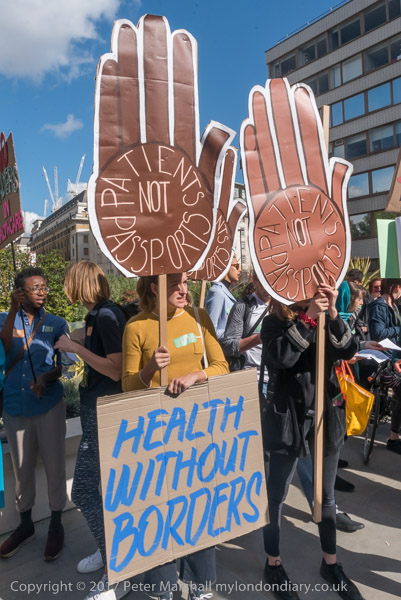
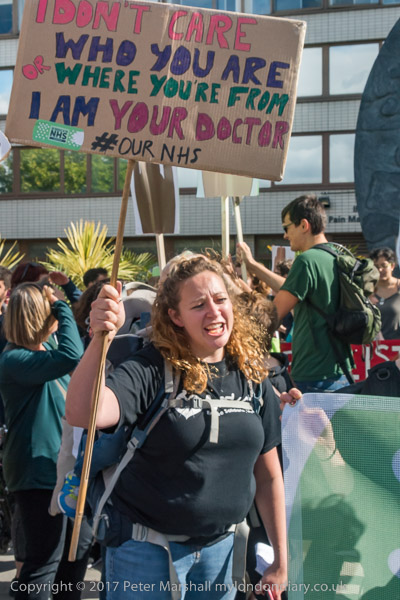
Being foreign isn’t a disease or an injury and to those of us brought up under a universal health system like the NHS, free at the point of use, it just seems wrong that doctors and hospitals should have an obligation to check someone’s immigration status when they come needing assistance. Yet since last October, a few weeks after this protest by medical staff and supporters they have been required to do so for anyone seeking non-emergency care will be required to prove they are entitled to free health service under the NHS and will be asked to pay for their treatment up front if they are not.

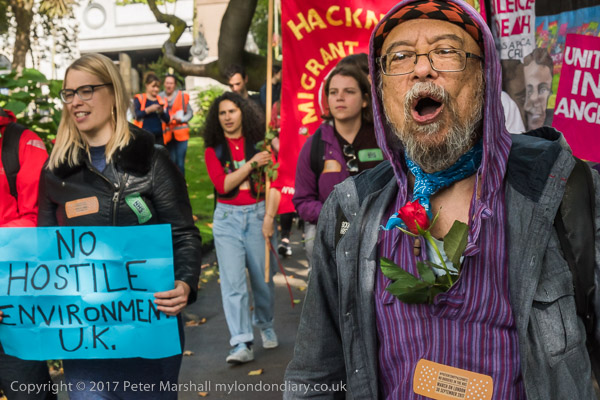
The change is all part of the government’s intention to ensure a ‘hostile environment‘ for anyone not entitled to be in the country, though it won’t of course affect the rich who pay for their private treatment – and they will in any case be welcomed here if they have sufficient funds to invest in the UK. There does seem to me something truly obscene about a system which welcomes the rich but hounds the poor.

The UK too is a country that believes in free trade and promotes it through various organisations. Again there seems to me a contradiction in promoting the free movement of goods but sets up great hurdles to prevent the free movement of people – except for tourism.

Roughly 10% of registered doctors and 4% of registered nurses in the UK are EU immigrants with slightly large proportions from outside the EU. Many who have migrated to work here are now British citizens, and a fairly large proportion of those born in the UK have parents who were migrants. As a frequent patient of the NHS I’m very aware of how dependent it is on migration to the UK, with so many of the staff I meet being from abroad. It seems rather inappropriate to ask these people effectively to police our borders.

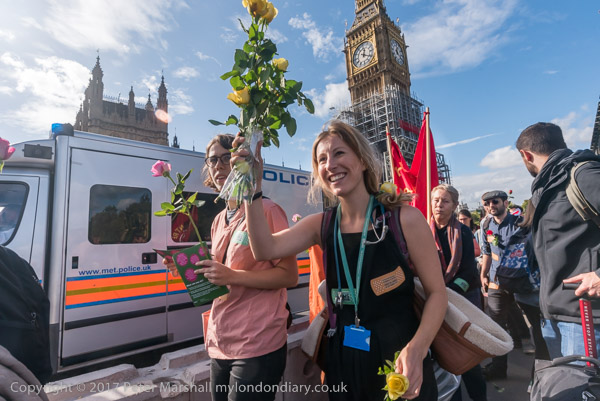
The Patients Not Passports – No Borders in the NHS! protest was a slightly complicated one to photograph, as it had three separate blocs with different starting points, so I had to chose one of them. I met with the Migrants Welcome bloc, partly because I thought it might be more interesting and I knew some of those who would be there, and so was unable to photograph either the Maternity Care bloc or the Sisters bloc (I think Sisters as in Sisters Uncut rather than in the nursing sense) until the three groups came together in an undisclosed location.

Looking at where the three blocs were starting it was relatively straightforward to guess that our common destination might well be somewhere in the area of St Thomas’ Hospital, and we met with them just on the other side of the road, then walking into the garden area above the hospital car park for the joint rally. There were just one or two security staff who attempted to stop the protesters, but clearly stood no chance of doing so; either the hospital authorities (and police) had failed to notice the very public advertisements on social media for the protest or had decided only to offer a very token resistance. I suspect the latter as they will have appreciated the mood of their staff.

The protesters had decided that a very large banner would make a great photo opportunity to get press coverage, but unfortunately it was almost impossible to get the kind of result they had in mind – and at that point there were a number of security officers anxious to prevent us taking it. But the giant ‘Migrants Welcome Here‘ banner is really a difficult format to handle, being over ten times as long as it is high. I did manage to make a usable image, though the banner rather hides the rally behind it, and was rather pleased to catch a pigeon at almost exactly the right place before I was chased off the grass I needed to be on to take it with the 18-35 mm at its widest.

I had one other problem. Apparently there were some people on the protest who because of immigration issues requested that they were not photographed, and some wore small symbols to identify them. It isn’t practicable or even a sensible approach, and there is a very simple alternative if such people wish to take part in public protests (as they have every right to.) Which is to wear a mask or face-paint as a disguise. Police may sometimes ask protesters to remove masks, though not usually if they are clearly decorative, but photographers certainly won’t.

Apparently one such person appeared as a bystander in a couple of my pictures that are on the web site. I don’t know if he was wearing the ‘no photography’ symbol but from where I took the picture there was nothing to indicate he didn’t want to be photographed. It just isn’t possible for photographers to keep track of everyone taking part in a protest in this way.

By the time I had been told of the problem, one of those images had already been distributed around the world and it was too late to take any effective action. Other photographers who were at the event, including some from the major agencies, will also have taken pictures with him in the frame, and their pictures too will have gone out uncensored. But on my web site I have altered his image into a rather blurred generic figure. Like most journalists and photographers I’m opposed to such censorship, but this was a request from a friend and the presence of that person was not important to the picture. I felt unhappy to do so, but angry that I had been put into a position where it was necessary.

No NHS immigration checks

Continue reading NHS not Border Police

Falls and files

Last Thursday I tripped over a cable while taking pictures and fell, landing on my right arm on grass in Russell Square, but wasn’t hurt and my cameras seemed OK. I hadn’t fallen heavily and the cameras seemed OK. But I couldn’t understand why I kept filling up cards using the D810; I was taking quite a lot of pictures, but not that many. Sometime later I remembered I had switched from my now usual 1.2x to full frame earlier in the day as I was using the fisheye and had forgotten to change back, and I switched the image size. Since I was now working on smaller capacity spare storage cards going down to 1.5x.

I still seemed to fill a CF card rather quickly, but thought I’d just got used to having 32Gb cards rather than these older 4Gb and 8Gb ones. But working on the pictures later in Lightroom I found that many of the images were not my normal raw files but TIFs. And a 7360×4912 px TIF is 106Mb, three times as large as my full-frame NEF files. Even switching to 1.5x, the tiffs are still 46.5 Mb. And since a typical 1.2x NEF (6016x4016px) is around 21 Mb, I was still using up space at over twice the normal rate.

Worse still, TIF files produced in camera are only 8 bit files, so image quality is reduced despite the larger file size, and the difference does show. though most of the TIFFs were perfectly acceptable. There were a few where highlight detail was burnt out that I think would have been recoverable on a raw file and I couldn’t quite get the images to match those the colour quality of those from the D750 still working on raw files. I cannot see any reason for having cameras able to produce 8 bit TIF files. I imagine it is a hangover from the early days of digital imaging, and that the marketing department have stopped common sense prevailing to remove this ‘feature’. There might just be a justification if the cameras could produce 16 bit files, but these would be truly huge – and wasteful as the sensor can only produce 12 or 14 bits.

Since they are only 8 bit files, I’m thinking I might convert all those TIFFS to high quality jpegs, just to save space on my computer storage.  There are over 300 of them taking up 21.5 Gb.

I’ve also been trying out working on manual shutter and aperture settings and allowing the cameras to alter ISO to get correct exposure. I’ve come to two conclusions. The first is that its great in normal daylight, usually giving a lower ISO than the standard settings that I would normally choose. But I’m not happy about using it in low light, as if the light falls below that which needs the maximum ISO you have selected for the shutter speed and aperture you have set the camera simply underexposes (and it will also over-exposure in the light is too bright for the minimum ISO and shutter and aperture you have chosen.)

And there is the problem of the main and sub-command dials, both of which can be inadvertently moved by fidgety fingers or with the main command dial possibly simply by knocking against clothing while walking. In normal use of the camera I seem to shift the main control dial most, and so on the D810 have used Custom Setting f9 to change the shutter speed to the sub-command dial, and then have put Custom Setting f7 onto the top of ‘My Menu’ and locked the aperture setting. You don’t seem to be able to lock the setting on the D750, so I have a little bit of black tape over that. It’s ons of several little ways I find the D810 a better camera.

This means I can easily change the shutter speed – when for example I’m photographing a faster moving subject, but cannot change the aperture without accessing the menu. If all my lenses had aperture rings I could use CS f9 to assign aperture to the ring only, but often I’m using lenses without an aperture ring.

It’s a pain having to go into a menu or peel back the tape to change the aperture, but I think I can live with that.  Generally I change aperture only when I’m thinking about depth of field and  for most of what I do there isn’t time for that, especially with no depth of field markers on modern lenses.  In good light I’ll mainly work around f5.6 or f8 and hope. If I forget to lock the aperture it’s too easy to find that I’m working at silly small apertures like f22 and ISO 12,800 when I should be at f5.6 at ISO 800. And at f22 it’s easy to underexpose even at ISO 12,0800.

So there are two advantages to changing to manual auto-iso mode. It beats simple use of auto-ISO settings, which result in too many pictures being taken at the lowest shutter speed you have set, rather than that you would be happier working at. So long as the light keeps in a reasonable range I avoid the occasional descent into huge under or over exposure with missed frames until I get time to review images, and rather than having to choose a relatively high working ISO for a session, when the light is there I’m getting higher quality with many images taken at lower ISOs.

So I’ll keep trying it out, and perhaps find other ways to improve what I’m doing, and to see if I can adapt the method to working in low light with and without flash.

Nine Photos

Nine photojournalists talk us through the story behind their favourite photos in a feature published by XCity+, a site I’d not heard of before which is produced by alumni of London’s City University, which recently had a rather confusing name change to City, University of London. Formerly the Northampton Institute, it has its base in Northampton Square, Clerkenwell, and was one of the CATs which given university status (part of Harold Wilsons “white heat of technology“) in 1966 as The City University, changing its name after becoming a part of the wider University of London (which boasts 18 constituent colleges and nine research institutes) in 2016.

It had always had a close connection with the City of London and the trades of that city, and it is perhaps surprising that it only formed its journalism department in 1976 offering a diploma in Newspaper Journalism, when it is less than a mile for any crow flying from Fleet St.

One of the photographers included is David Hoffman, and his picture from the 1983 Stop the City protest against globalisation, big business and the banks is a stunning image. But it is a little disappointing that the text that accompanies this – and the others is so short. The feature promises us more:

“we rarely have the full story. How were these photos taken, and why?

As the photographers talk us through their most powerful images, we are given a rare opportunity to see these pictures through their eyes.”

Fortunately in David’s case it gives a link to a much more detailed story about the image , both about the situation in which it was taken and how it was the vital evidence in a court case. Its also well worth going to his web site and seeing more of his work.

There are also links in the XCITY+ article to the web sites of the other 8 photographers.

Sex, Lies and Lemmings

Sex, Lies, and Lemmings: Hossein Fatemi and the Toxification of Photojournalism is the provocative title of a detailed article by on PetaPixel by Benjamin Chesterton, known to many of us through his Duckrabbit blog, where this and many other thoughtful and incisive articles first appeared.

In it, Chesterton looks in some detail at the abysmal failure of World Press Photo‘s ‘investigation’ and the equally guilty collaborations by Fatemi’s agency, the generally well-respected Panos, Time, the New York Times and others in dismissing the evidence from fellow Iranian photographers and two Iranian women who worked with him in the making of the pictures (though not in their subsequent misuse), one of whom was falsely labelled in the caption as being a prostitute working to support two young children, a complete fabrication, which could result in severe penalties for the woman in the picture.

Rather than make investigations and take appropriate action, WPP and others appear to have decided on a campaign to discredit fellow Iranian photographer Ramin Talaie who first raised the issues about Fatemi’s work, which has now been shown by WPP around the world. The evidence against Fatemi, as related by Chesterton, much of which comes from investigations by Talaie as neither the WPP, Panos, Time or others has bothered to contact the people in the pictures, seems completely damning.

One of the strengths of Chesterton’s article is that he doesn’t stop there, but goes on to suggest how the matter should have been dealt with – an approach which he says he suspects would have made Fatemi withdraw his work before the issues became public, rather than lead to “the charade on show.” It seems good sense, and an approach that were it taken would lead photographers to think much more carefully about photojournalistic standards rather than, as in the current case, to put forward theatrically staged images with false captions. They may be powerful pictures and I have nothing against the creation of fictional narratives using photography, but it needs to be clearly identified as such and has no place in photojournalism.

You should read Chesterton’s article, and I’ve deliberately not given much of its content here to encourage you to do so. The real scandal is not the photographs themselves, although Fatemi appears to have used them and his subjects irresponsibly, but “the incomprehensible decisions that led to Fatemi’s work being given such a massive platform to deceive.” And as he says in his conclusion:

“World Press Photo set a new standard for photojournalism: NO standard. Basically, you can get away with pretty much anything. Just as long as there are no pixels out of place and you stick to your story, any s**t goes.

You can be certain: lemmings in search of awards will follow.”

‘A Day in the Life’ and Magnum

It’s hard for photographers to view Magnum dispassionately, with the huge amount of myth that surrounds it. It’s members have included some of the greatest legends of photography, and certainly some of its greatest egos. We’ve grown up being fed with the idea of its great crusade for photographers, and it came as something of a shock for me to realise, years ago when I got an application form for some great project, the small print which informed me that Magnum photographers would get paid at twice the rate of the hoi polloi, that it was more a fight for Magnum members than the rest of us, though perhaps some of its benefits have trickled down.

Most of what we know about Magnum is the official story, as told by Magnum and allied organisations including the ICP. And interesting though Russell Miller‘s ‘Magnum: Fifty Years at the Front Line of History’ was, as would be expected from the title (and the sub-title Fifty Years at the Front Line of History – The Story of the Legendary Photo Agency) it too was largely celebratory rather than offering a truly objective story.

Reading Robert Dannin‘s series of posts, The Dannin Papers, on A D Coleman‘s Photocritic International site fills in the story and offers a unique insight, warts and all (perhaps mainly warts.) Dannin was from 1985-90 Editorial Director of Magnum Photos and has a remarkable memory for events and for how Magnum actually worked in those years.

The latest series of posts, which begins with Guest Post 24: Robert Dannin on the “Day in the Life” Projects (a) (January 21, 2018), and is currently on the fifth of seven instalments. Dannin describes the Collins Day in the Life of … series of books which covered 11 countries and two US states as “the first spectacular disruption aimed at transforming professional photographers into undervalued content providers, the unfortunate state of affairs that today confronts those wishing to make a career of making images.

The series, like his earlier series on Magnum which began last October makes interesting reading for anyone involved in photojournalism.

No to Nuclear

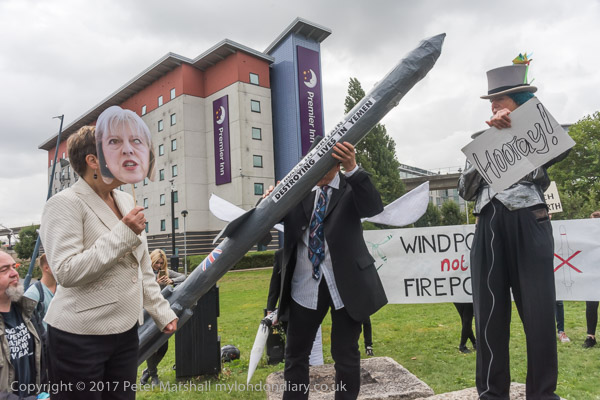
The theme for Wednesday’s protests outside the DSEI arms fair was ‘Arms to Renewables – No to Nuclear’, and as I arrived a street theatre group began their performance of a playlet in which the audience rejected the collusion between Theresa May and an arms dealer to sell missiles for use in Yemen and demanded instead that we promote renewable energy, with two actors tranforming the missile into a wind turbine. It was difficult to photograph as the audience were clustered closely around the performers and so I had to work very close – and for some things even the 18mm of my 18-35 zoom wasn’t wide enough. I would have done better to switch to the 16mm fisheye, but it was so crowded it would have been tricky to get at my bag and change lenses without elbowing peole on both sides.

After that came some poetry, not generally a great subject for still photography, and I wandered around taking pictures of the various banners and posters, including a large Sadiq Khan declaring his opposition as Mayor to an arms fair in London. Then I was told there was a lock-on at the West Gate, and made my way – two stops on the DLR to photograph there.

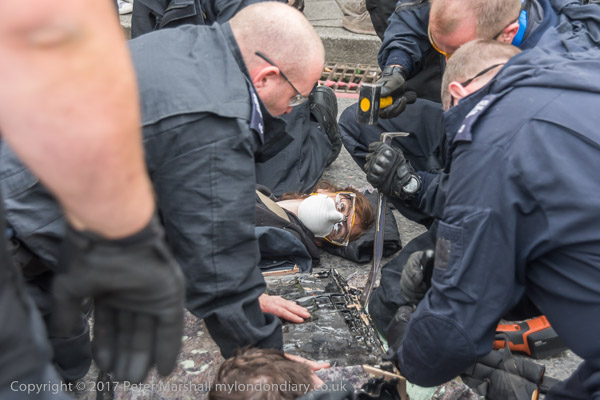
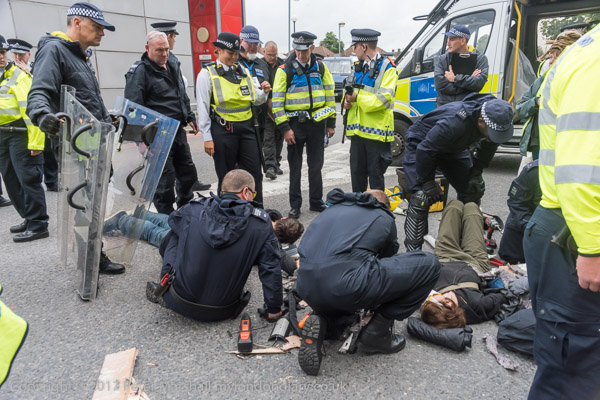
Three people were joined together with their arms linked through two large boxes which seemed to be filled with pitch and metal grids which were taking the police special unit a great deal of effort to remove without injuring those locked together. While a couple of the police worked away, the rest crowded around, mainly it seemed to prevent photographers from getting a clear view – and at times there were certainly some officers who deliberately moved to block my view, though there were moments when most moved away. One or two protesters did rush in to take pictures before police removed them, but I decided I needed to cooperate with the police.

When they had broken up the first of the two boxes and arrested the person who was freed from the lock-on the police took a rest. The special team wanted to leave the remaining two linked together who were now at the side of the road and causing no obstruction, and only began to remove the second box after being told they must by the officer in charge. A crowd of supporters watched and gave encouragement to the two protesters while police struggled to separate them, and cheered them as police carried them away.

As the second of the three was being put into the police van, people started to move towards the Excel gates across the road, as another lock-on was taking place on the road inside the Excel site by two protesters who had made their way through a side pedestrian route. By the time I ran up the gates they were shut and I could only photograph through the mesh of the fencing from perhaps a hundred yards away. I went back to photograph the third protester being taken to the police van and then decided to return to the East Gate to see what was happening there.

The answer was yet another lock-on, and one that was likely to block the road for quite a while, with the special unit still busy at the other gate, and with all vehicle access to ExCeL blocked for several hours, the protesters were having a successful day. They were on the road with banners and singing and chanting and obviously there was no point in the police clearing them as the road was blocked by the lock-on. And as it looked as if little more would happen I decided it was time to leave for home.

Many more pictures at Protesters block DSEI arms fair entrances.


Continue reading No to Nuclear

On Holiday

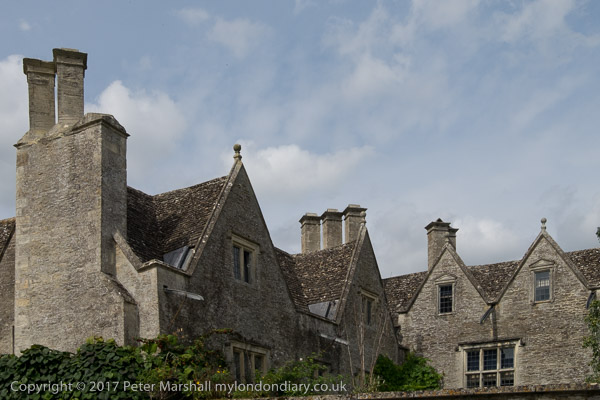
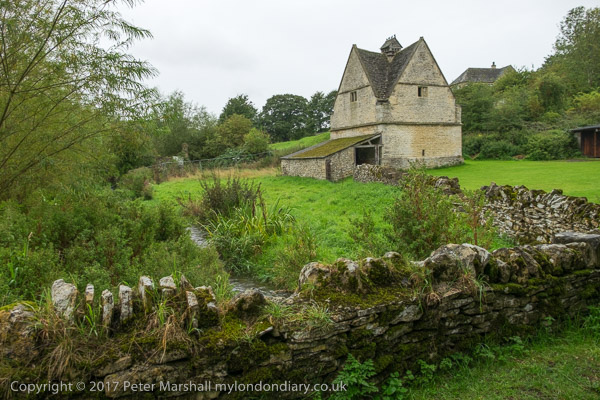
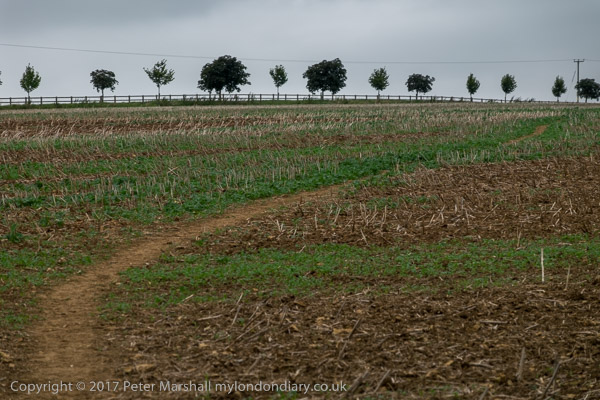
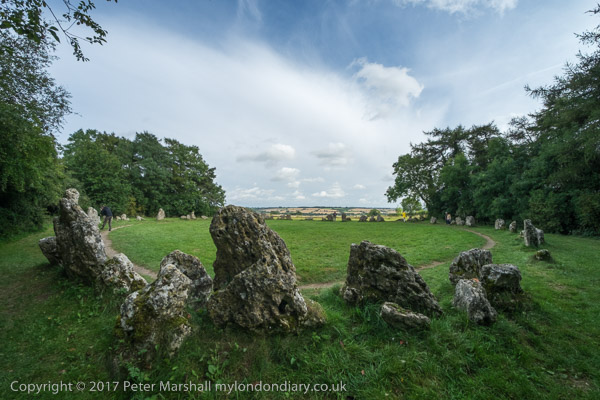
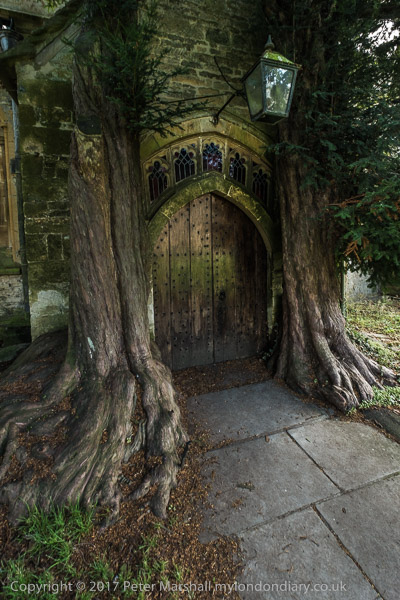
It seems a long time ago that I was on holiday in the Cotswolds at the end of last August. I probably ought to go away somewhere without a camera, but I know if I did I would keep seeing great opportunities for pictures. A few years ago when in Germany I went out for a day and left the spare batteries for my Fuji XT1 back where we were staying as I thought we would be going back to pick up things before leaving on a trip.

It turned out we weren’t, but I could hardly ask my hosts to drive several miles out of their way to pick them up, and the one battery in the camera ran out immediately, so I spent a day seeing so many opportunities in a place I will never visit again. I still sometimes see some of those pictures in my mind and then realise with a start that I didn’t take them. Some of us are severely addicted.

I do travel relatively light on holiday, though most people wouldn’t consider 2 camera bodies and four or five lenses light. But they are Fuji-X and weigh around half of their Nikon equivalents (even if I do need to take five batteries for a day’s pictures.)
I’m not quite sure which lenses I had with me, but I think the 8.5mm Samyang fisheye, the 10-24 and 18-55 zooms and the 18mm. Obviously I didn’t really need the 18mm, but it is so small and light and good for candid images. I’m not sure if I had any other lenses, though it wouldn’t surprise me. I was only going to take the X-T1 body, but it had been playing up a little and the X-E1 hardly weighs anything…

We do a lot of walking on our holidays, and this was no exception. But this lot in a shoulder bag, together with umbrella, water bottle and sandwiches was still light enough to hardly notice, even on the hotter days. Though perhaps my legs would have been a little less tired without. Some of the group we were staying in a holiday cottage came on various of the walks, and we went on car journeys to a number of places but I did spend a little time wandering around on my own, which is perhaps always the best for a photographer.

What was something of a holiday was being largely away from wifi and the internet. It was hard to get a phone signal in the cottage, and each morning I had a short walk after breakfast to get a wifi signal and post that day’s picture to my Hull web site, a project in recognition of Hull being UK City of Culture. And since these pictures were taken for my own enjoyment there was no need to caption and file them, though I think you can find out where they were taken from Cotswold Holiday.
Continue reading On Holiday