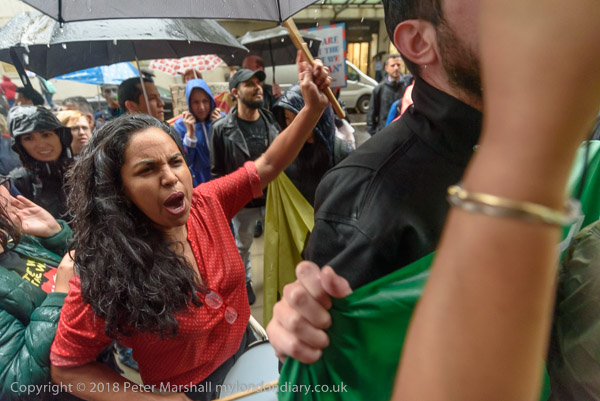
Cleaners Protest in Pouring Rain

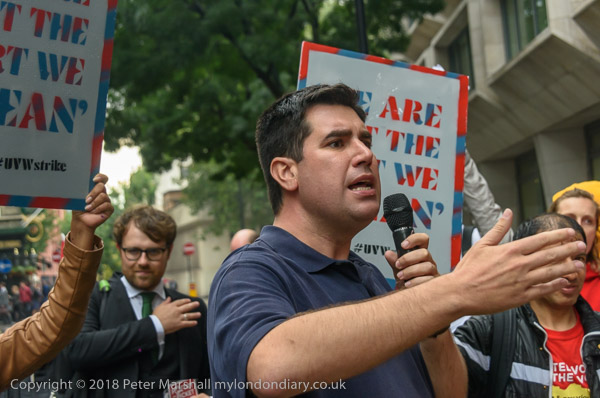
The Ministry of Justice at times appears to be titled in best Orwellian manner, and certainly so far as its low paid staff – such as the cleaners – are concerned it is very much a Ministry of Injustice. It’s  place I’ve attended a number of protests outside, about the treatment of refugees and asylum seekers, about prisons, about privatisation of probation services, aboujt the slashing of legal aid and more. Most recently I’ve been there a few times about the rock-bottom wages and lousy conditions of employment for the people who keep the place clean.

One major reason that our UK benefits system has become so complex, leading to the fiasco over the introduction of Universal Credit, is that we have become very much a low pay economy, at least for those at the lower end of employment. Partly this is because of the huge salaries and other payments given to the people at the top, but more it reflects the contempt the well-off largely feel for those at the bottom.

Universal Credit aims to drive people into work by cutting benefits; its proponents say that aims to make work pay, but unfortunately they have failed to make work pay enough to live on, particularly in London, where costs are high. It seems to me axiomatic that any full time job should pay as a minimum a real living wage. Paying benefits to people because their employer doesn’t pay them enough to live on  – as our system does is a subsidy for inefficient or unscrupulous employers (just as housing benefit is a subsidy for landlords.)  And of course there are many jobs that the state should pay for people to do, either directly or thorugh employers, but it should be deciding what these are and not leaving it to the whims and distortions of private companies.

Cleaners perform a vital role at the offices of the Ministry of Justice, as they do elsewhere, and should be paid at least enough to live on, which is the figure published annually as the London Living Wage. It seems to me a simple matter of justice, but that seems to be in short supply at the ministry.

The campaign here is one of a number being fought for low paid cleaners by the United Voices of the World trade union, which many employers refuse to recognise and try to avoid having to deal with. The large established trade unions – with a few notable local branch exceptions – have not been very succesful in recruiting low paid workers and dealing with their problems, particularly when many of these workers don’t have English as their first language. They often have cosy arrangements with large employers and are ‘recognised’ as representing low paid workers even when they have few if any members among them. Unsurprisingly they haven’t done much for those at the bottom.

Unions such as the UVW are ‘grass roots’ unions with few if any paid staff – and those who work for them generally do so on the London Living Wage they fight for on behalf of their members. They are small enough to have simple democratic structures where every member can have a say – and in their first language. They organise effective protests at workplaces, but also educational classes (particularly language classes) and social events, a few of which I’ve been invited to and have enjoyed.

The main problem in photographing the event was the weather. The  protest began in light rain, but it was soon pouring, and there was only very limited shelter. Some of the protesters were directly against the wall of the building, where an overhang gave some protection, while others stood in the rain under umbrellas.
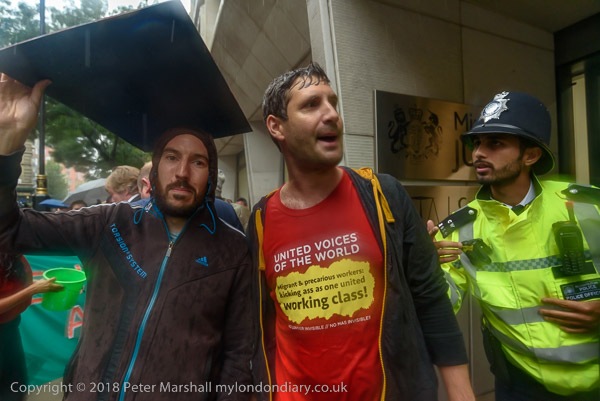
I had an umbrella with me, but it isn’t easy to take pictures holding one – cameras really need both hands to operate. And sometimes I could stand with those under the underhang, but it wasn’t always the right place to be to take pictures.  Occasionally I could stand under one of the umbrellas various people were holding, but more often I was standing a little further away and they poured water down on me.
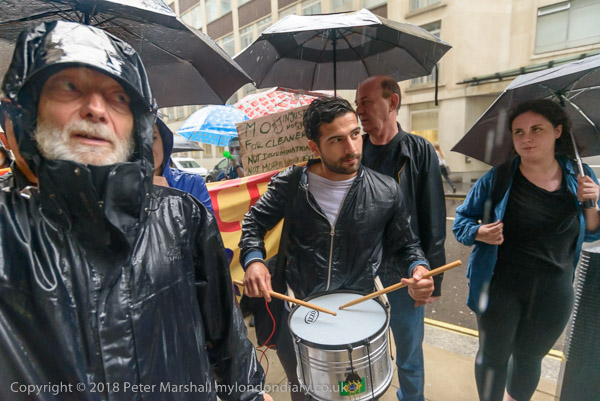
I was getting very wet, and so were the two cameras I was using. Both the Nikon D810 and the D750 have some weather protection, though the lenses are leaky.

I usually keep the D810 on a sling strap at my side, with the lens pointing down, and on the 28-200 I have a screw-in lens hood which offers some limited protection. It isn’t perfect, and vignettes slightly at the wide end when working full-frame, but it’s a great improvement on the plastic Nikon version, which used to fall off at the slightest provovacation. It was an odd size and I think no longer made. I managed to replace the first one I lost after long searching on the web, but it cost £20 and when that one disappeared I decided to go for a generic screw in one.

The D750 with a wide angle uses a more standard lens hood. Still falls off if looked at hard, but when I lose them it’s only a couple of quid for a Chinese replacement (actually slightly better than the genuine thing.) But any lens hood you can use on a 18-35mm isn’t too effective at keeping the rain off.  I have the D750 on a fairly short neck strap, and slip it inside my jacket when it rains, but this means leaving the zip down some way on the jacket – and I get a wet neck and chest.

In my hand when photographing in wet conditions I have a large microfibre cloth, to wipe cameras and lenses. As well as the filter on the front of the lens, its important to keep the tubes of the zoom lenses dry, or else water migrates from them into the lens and condenses as a mist on the elements. And doubtless also on the mechanical bits inside the lens, which I’m sure isn’t good for them.

When I’ve got the camera with the wide-angle in my hand I make a ball of the cloth and hold it in the front of the lens to protect it from rain drops – glass seems to have a strong magnetic effect on them – only removing it briefly to frame and expose each picture.
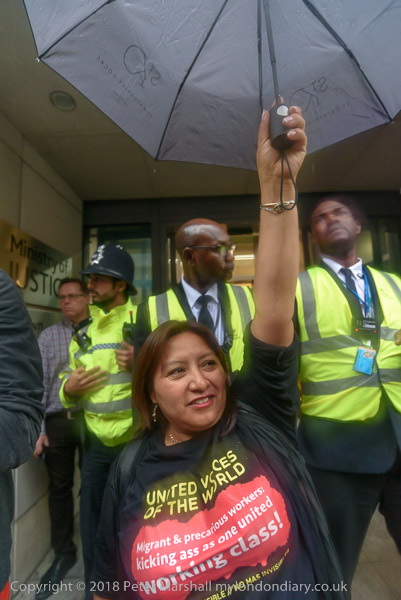
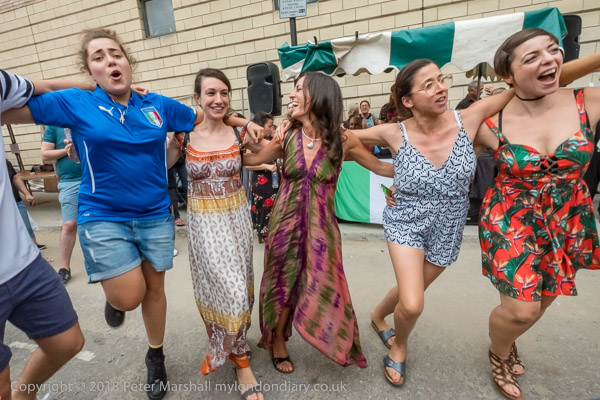
But for part of this event my job was made much easier, as one of the UVW members, seeing me getting rather wet, came and acted as my assistant, holding an umbrella over me and keeping the worst of the rain off. I was extremely grateful to her. Later the rain did stop and it was easier to work, and for Shadow Justice minister Richard Burgon to come and support the workers in his shirtsleeves. And by the end of the protest the cleaners and supporters were dancing in the street outside the ministry.
Three months later, the dispute is still ongoing, with the Minister of Justice refusing to meet with the UVW.  I’m sure there will be more protests soon.
Ministry of Justice cleaners protest

On the street

Although I take almost all of my pictures on the street I’ve never really though of myself as a street photographer, largely because I think of it as a meaningless category. If you disagree I think it is worth going back to what many think of as the ‘bible‘ of the putative genre, Bystander, and read through it carefully and critically looking at the examples. Of course there are plenty of photographs we can say are definitely not street photography, but nothing really emerges which amounts to a clear definition of a genre.

Yesterday I watched a couple of videos about street photography, both of which were mentioned on PetaPixel. For some reason the link to ‘Cheryl Dunn’s highly-regarded 2013 documentary Everybody Street‘ which is now on YouTube refused to display in the PetaPixel page in my browser, but a search on YouTube found it without problems and I was able to watch it full-screen in fairly high quality and I didn’t notice the ads.

It contains a number of photographers who have worked on the streets of New York speaking about their work, and shows them taking pictures and some of the pictures they have taken. Some are very well-known, while others less so, and their work covers a fairly wide range of practices. There is some attempt to give a historical perspective, with Max Kozloff talking about a number of other photographers from Alfred Stieglitz on.

One of the featured photographers, Rebecca Lepkoff, talks a little about the New York Photo League which brought her into photography, though it would have been good to have had a interviewer drawing her out more about this. She was one of the photographers I wrote about years ago in a series on the Photo League, but it would have been good for the film to have looked in a little more detail on some of the others, though few now survive. I think it is impossible to overstate the importance of this organisation in what later became known as ‘street photography.’

Some of the work shown and discussed in the film is quite clearly documentary photography,  and the rest seems to me too varied for the overall category of street photography to have any real use.

I think the film was about 80 minutes long, and it is certainly a very professional film, with some nice footage of New York, making me feel I should have gone there and lived and photographed on its streets, but there were times when I felt it dragged and I did skip forward a little at times. The making of the film was made possible by over $45,000 of crowdfunding but it looks as if it cost considerably more

The second film featured on PetaPixel was the curiously capitalised ‘Why you SHOULDN’T do STREET PHOTOGRAPHY‘ by UK photographer Jamie Windsor, which I have to say I found far more difficult to watch. Not because of what he said, which in part echoes things I’ve said and written in the past, but because of the production and personality of the presenter. He looks at the work of several photographers, particularly the late Hong Kong photographer Fan Ho, Nan Goldin and Martin Parr.

I wasn’t familiar with the work of Fan Ho, but by the time I’d seen a few pictures found it extremely repetitive, and failed to see that it represented in any real way the changing times of the city. If you like pretty, arty photos it may be for you.

Goldin of course did as he suggests live the life of the subjects she photographed, recording moments in the lives of her friends and their particular subculture, with her work something of a ‘family’ album.

I share some of Windsor’s misgivings about Martin Parr and his depictions of working class life. His approach was clearly rather more distant than that of – for example – the Picture Post photographers, and sometimes appears to be very much as he suggests reflecting he prejudices of a middle-class photographer, making judgements about those he photographs.

But not all those Picture Post photographers were Bert Hardy, who grew up a working class kid in the Borough and some who managed a much more empathetic approach came from rather more patrician backgrounds than Parr.

Despite Hardy’s working class background he appears to have had no problems relating to and empathising with people from all walks of life and all levels of society. The nature of Parr’s work came from his intention to be a social commentator rather than to engage with the people he was photographing.

Taking a photograph always implies a point of view. We shouldn’t pretend to “accurately represent a culture” whether or not we are part of it, and I’m not at all sure what that means. For me, empathy with the people I photograph is vital, and to that extent I agree with him.

Much of the uneasy interest I have in, for example, Martin Parr’s New Brighton pictures, comes from knowing that his is a rather snooty middle-class exploitatative view of the working class. It gives them the edge that makes them stand out, just as Bruce Gilden’s photographic street assaults do, though in Gilden’s case I find the approach soon gets to be rather boring, the pictures more about his antics rather than the subjects he photographs. I want photography to be about the world, not about photography.

And it is perhaps empathy that I find absent in Fan H0’s work, which uses people as tokens or ciphers, something which the presentation in this video emphasizes. They remind me of my least favourite of Cartier-Bresson’s work, what another photographer called the ‘waiters’, where the photographer had clearly identified a situation and then waited for a person to put themselves in just the right spot. It’s a side of ‘street photography’, particularly loved by amateurs, that I find just boring. But I wouldn’t want to proscribe it. By all means let a thousand Fan Ho’s bloom, just don’t expect me to spend much time looking at them.

Both for the people who do it and for the audience (if any) for it, photography can be many different things. It’s fine for Windsor to state what he thinks and to ask others also to think about their own practices, but not, as his title says, to try to impose a straitjacket on others.

On the train

I have mixed feelings about taking pictures thorugh the window on train journeys, though I do it quite often. While I enjoy just sitting and looking as the coutnryside flashes past, and we rush through towns and villages, our Intercity trains now go too fast, often passing through stations at speeds too fast to be able to read their names.

We can of course use our smartphones to tell us our location, though even they have problems keeping up, and its just a little disconcerting to often see on the map that we are in the middle of a field distant from any railway line.

Looking out of the window also seems to be a waste of time, when I could be reading a book or writing a post such as this, or even be reading Facebook or other web sites on my phone or notebook. But I do quite a lot of it, just feeling slightly guilty, and sometimes take a few pictures.

The great majority of them get deleted either on the spot or later,  with line-side posts and bushes having appeared in the fraction of a second between the decision to press the shutter and the actual exposure. Others because my split-second decision was simply wrong – you don’t get long to think at 145mph.  And then there are those spoilt by dirt on the window, though I try to find a clear patch. Or by reflections that are hardly noticeable when you make the exposure but glaringly obvious in the result.

It was much easier back in the old days, when trains went slower had windows you could open, and even lean out of (though there were notices to warn you of the danger of doing so.)

When I took pictures through train windows more seriously, I would travel with a cloth and, having picked my seat would often go outside and give the relevant window a much-needed clean.  Of course it was only really possible if you joined the train at the station it started from and sat on the platform side.

Reflections can be minimised too,  first by holding the front of the lens as close to the window as possible, and then by shielding around the lens. A rubber lens hood was useful for this, as it could be pressed up to the glass without transmitting the vibrations of the window to the camera – and if your cleaning cloth was a dark colour it could also be used to help.

I took hundreds of photographs – if not thousands – in this way through windows,though more often shops than trains, and was pleased to see that someone has come up now with ‘The Ultimate Lens Hood‘, a giant version of the rubber lens hood, though it perhaps looks too geeky for me to use it in public.

The journey from Doncaster to Hull flashed past too fast for me to take pictures,, except for one snatched of Alexandra Palace before we really picket up speed, though rather marred by the power lines across it,  but the service from Doncaster to Hull proceeds at a leisurely pace – and I think like my own local services rather slower than under British Rail as train operators have added a spare minute here and there to cut down the fines for late running – in the same way they now annoying quote the time of the train as anything up to 2 minutes after you can actually board it. The 12.00 is now really the 11.58 so far as passengers are concerned.

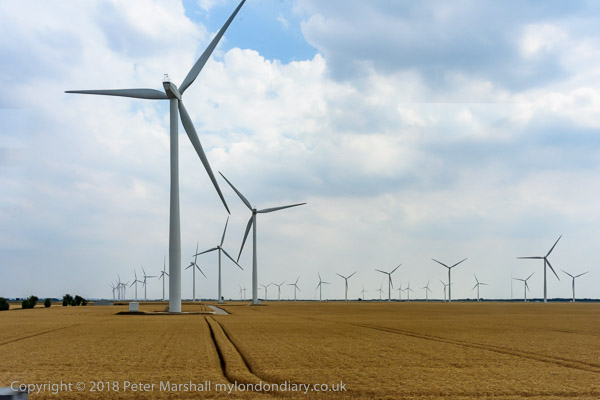
Somewhere in Lincolnshire the line goes along the edge of a large windfarm, and since we were jogging along at perhaps 30 or 40mph I was able to take a whole series of pictures, seven of which I’ve put on-line.  There was even time to think a little about composition, though of course I had no control over the running of the train. But I had time to look at what was coming up and thinking where the train would be, looking out of the window as well as at the camera screen.

Of course I didn’t get everything right. Rather more than I’ve shown were discarded, and even those that are on-line aren’t perfect. They’ve also had some tidying up in Lightroom, including some rotation, perspective correction and cropping, something that would have been tricky to get right in pre-digital days.

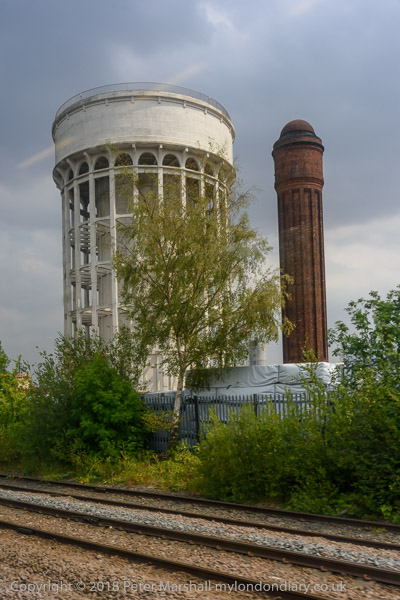
I took a few more at other places on the journey, and also read some of my book. Most of what I took were quickly deleted, but I’ve kept one from Goole and another as we were coming into Hull. I’ve photographed Goole’s famed ‘Salt and Pepper’ water towers before (and better) standing on the ground but the train does give you a different viewpoint.

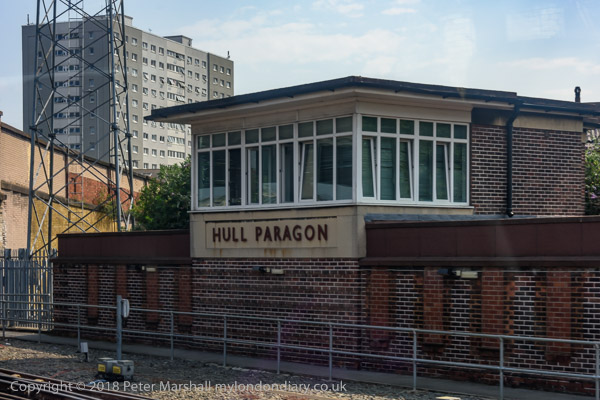
And although the station in Hull is now just Hull, rather than Hull Paragon, the signal box outside carries a reminder of the past, as does the door into what was once the bedroom shared by my two sons next to where I’m typing this, still adorned by its bright orange-red sticker:

HULL

PARAGON


You can see another 6 pictures of the windfarm at On the way to Hull. And should you be sitting on a speeding train frustrated by not being able to read the station names, you can always take a burst of pictures as you go through  – one of the very few uses I’ve ever found for those extremely fast shutter speeds on my mirrorless cameras. When else is 1/4000 (or even faster) useful?

______________________________________________________

There are no adverts on this site and it receives no sponsorship, and I like to keep it that way. But it does take a considerable amount of my time and thought, and if you enjoy reading it, a small donation – perhaps the cost of a beer – would be appreciated.

My London Diary : London Photos : Hull : River Lea/Lee Valley : London’s Industrial Heritage

All photographs on this and my other sites, unless otherwise stated, are taken by and copyright of Peter Marshall, and are available for reproduction or can be bought as prints.

To order prints or reproduce images

________________________________________________________

Italy in London

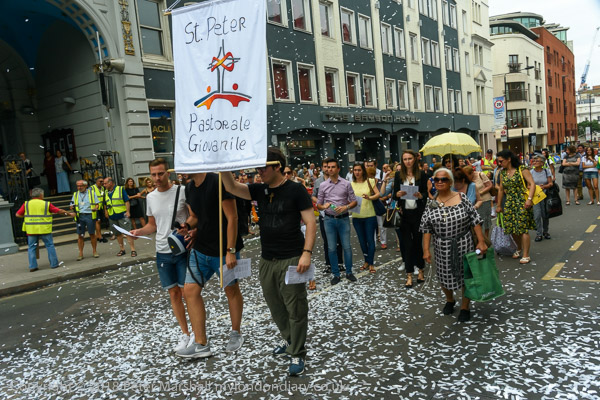
Another July and another Annual Procession in Honour of Our Lady of Mount Carmel from St Peter’s Church in Clerkenwell, an event which has been taking place for around 135 years – every year except during the two world wars.  It’s very much a day out for Italians living in London and further afield, and as well as the procession, which includes Biblical tableaux on lorries, various walking groups, some in costume, others carrying banners or statues etc, and first communicants and clergy, there is also a fair with rows of stalls selling Italian food and drink and other things.

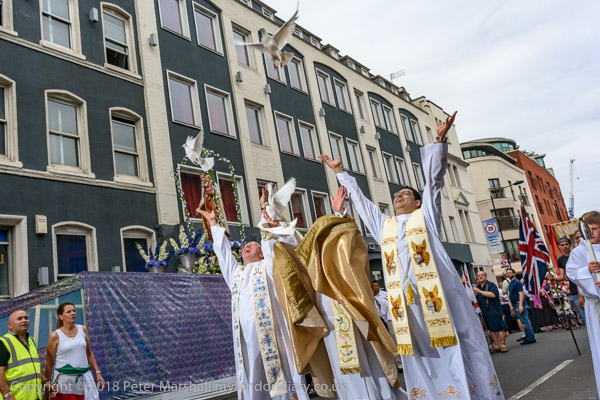
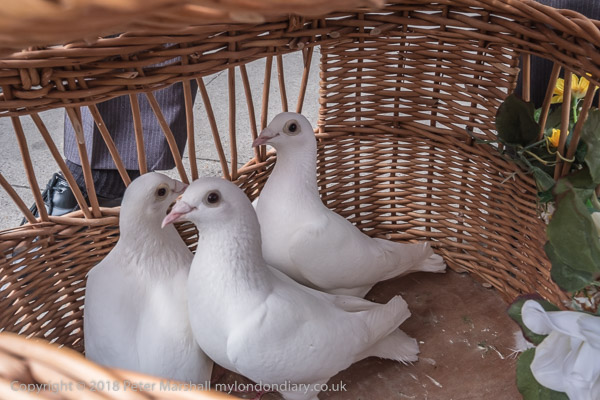
The highlight of the procession – for me at least – is the release of doves by the clergy, and its something I try hard to get a good picture of. But you rely on two unpredictable elements – the clergy and the doves, even when you are in the right place at the right time and ‘f8’ – the correct camera settings.

It isn’t always possible to be exactly in the right place – and in an ideal world I would have preferred a closer and lower viewpoint – and to have the three releasing the doves to have their backs to the church. I had put in a request to the man providing the doves to do his best to get them released together (and I’m sure he tried his best)  the man on the right beat his two colleagues to it, his dove flying high above the other two.

At least this year all three doves were caught in a single frame, though I had to work with a fairly wide angle (28mm) to get them. To freeze motion I was working at 1/500th, and being a bright sunny day this gave me an aperture of f11 for plenty of depth of field at ISO 400.  There are two images with the doves in flight on My London Diary, and they came from a burst of exposures using continous exposure on the Nikon D810, though I’ve cropped the second image.

After a bad experience using two Fuji cameras in an earlier year (one ran out of battery at the critical moment and the other just didn’t want to know when I pressed the shutter – in some Fuji cussedness mode) I’d taken the always reliable Nikon for the event. You don’t get any second chance with this.

As soon as the procession, with the parishoners joining on behind, had moved away from the church I hurried down the hill to the Sagra below where I knew several photographer friends would be waiting for me, with one thrusting a glass of Italian red wine into my hand as I arrived.  One particular stall always has wine cheaper than the rest and we return there every year at the event which has become a social event for us.

By the time we had finished our second glass (or possibly more) the fair was filling up, and I moved through the crowds taking pictures on the rather more discrete Fuji X-E3 and the wider 10-24mm, now my favourite among the Fuji cameras I own, as well as some with the Nikon and 28-200mm. It’s a combination of cameras and lenses I might try to use more, as I sometimes find the 18-35mm Nikon just not quite wide enough – the Fuji lens is a 15-36mm equivalent and extremely sharp.

More pictures and information:
Our Lady of Mount Carmel procession
Sagra – Italian festival

______________________________________________________

There are no adverts on this site and it receives no sponsorship, and I like to keep it that way. But it does take a considerable amount of my time and thought, and if you enjoy reading it, a small donation – perhaps the cost of a beer – would be appreciated.

My London Diary : London Photos : Hull : River Lea/Lee Valley : London’s Industrial Heritage

All photographs on this and my other sites, unless otherwise stated, are taken by and copyright of Peter Marshall, and are available for reproduction or can be bought as prints.

To order prints or reproduce images

________________________________________________________

Yarl’s Wood 14

I’m getting rather used to the ride from Bedford Station to Yarls Wood, going up through Clapham and then a mile or so on a cycle path beside the A6 befgore turning up the hill from Milton Ernest to the meeting point for protesters in front of the Twinwoods gates. That final hill is long and steep, though it’s something of shock to look at the OS map and find I’ve only climbed around 45 metres (around 150 ft) as it feels much more.

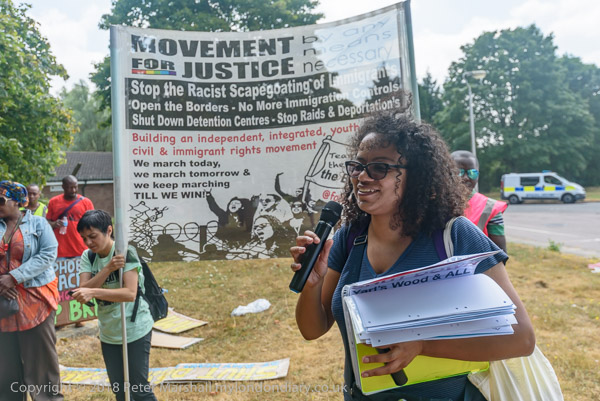
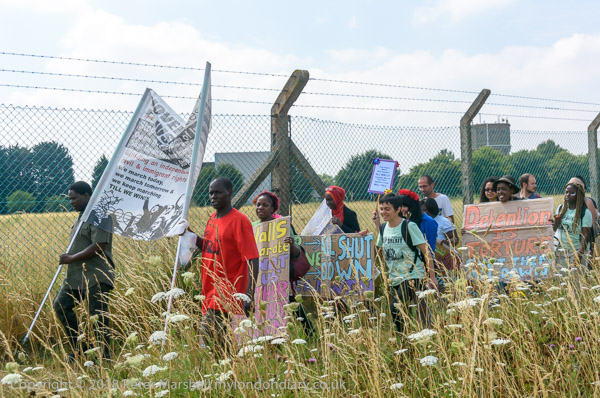
This was the 14th protest that Movement for Justice have organised, bringing many former detainees with them, with coaches from London and elsewhere. I could have joined them in London, but that would add another 3 or 4 hours to what is already a long day for me – and one that leaves me with perhaps another 3 or 4 hours to select, process and caption the pictures I’ve taken. It would be rather quicker if I didn’t keep dozing off at the keyboard while doing it, my finger on a key sending Lightroom into a frenzy of paging through the images which takes minutes to recover. And sometimes the doze is deep enough for my nose to hit the keyboard…

MfJ have come in for considerable criticism following their treatment of one member over a personal issue, which has led to a number of groups refusing to work with them. While some of the criticisms appear to be justified, others suggested a remarkable ignorance about the organisation, which has never hidden its background and organisation. It isn’t something I would join, but I admire and am happy to support the stand they have taken on several issues, and particularly on immigration and immigration detention.

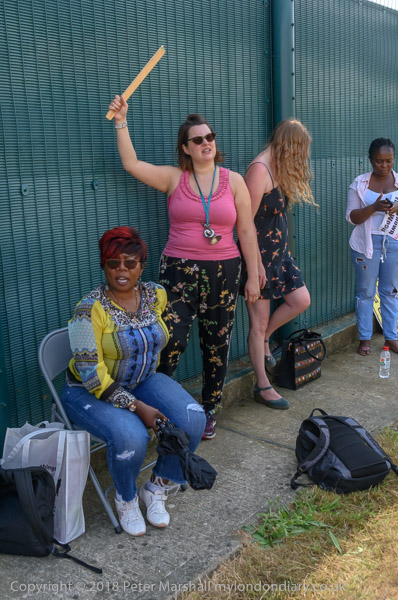
But the controversy has meant smaller protests at Yarls Wood, which is a shame, although there has been a rival protest on another date which perhaps helps to keep up the pressure on the issue. And the absence of some of the other groups has made the evident support that the MfJ gets from former detainees even more obvious. However MfJ decides on and organises the events, it is the former detainees who make the great majority of the speeches and lead most of the chanting and other activities during the protests, and my pictures show this clearly.

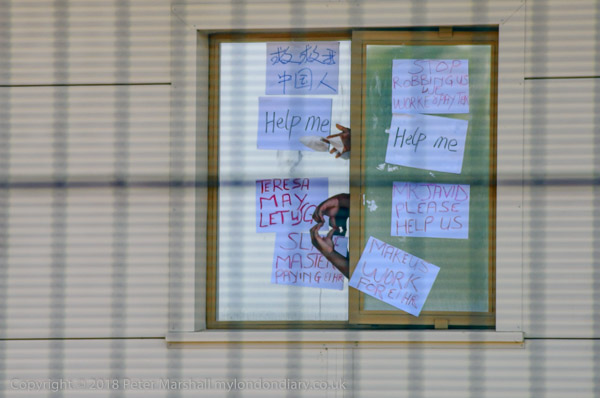
It’s clear too how welcome the protests are to those people, women and families, held inside Yarl’s Wood who are able to get to one of the windows which overlook the protest, or to make contace with the protesters by mobile phone, despite the efforts of the guards inside to keep them away. It’s difficult to photograph the windows through the close grid of the top 10 feet of fence, and the windows have limiters to only allow an inch or two of opening, but one woman has managed to get both hards through the narrow gap and make a heart shape with her fingers, surrounded by messages for help.

It’s something of a trek back from the field where the protest takes place to the road, through several fields and a short stretch of byway, and the fields are heavy going on a bicycle, often easier to get off and walk than to try and ride.  It it’s been wet there is mud which is slippery and soon builds up between wheel and mudguard on the Brompton, stopping the wheels from turning, and when the ground is dry the mud hardens into ridges and furrows which jolt the arms and can even throw you off the bike.

But once back on the road you can relax in the long downhill stretch to the A6,  though it’s annoying to have to brake for a few wiggles as you get near the main road. And when you leave the A6 cycle path to go up to the old road trough Clapham the first quarter mile is a steep climb. I have cycled all the way up, but its taxing, and this time I got off and walked, and even that was exhausting. But then its largely a gentle downhill all the way to the station and I had plenty of time to relax on a slow train to St Pancras.

Shut Down Yarl’s Wood 14

______________________________________________________

There are no adverts on this site and it receives no sponsorship, and I like to keep it that way. But it does take a considerable amount of my time and thought, and if you enjoy reading it, a small donation – perhaps the cost of a beer – would be appreciated.

My London Diary : London Photos : Hull : River Lea/Lee Valley : London’s Industrial Heritage

All photographs on this and my other sites, unless otherwise stated, are taken by and copyright of Peter Marshall, and are available for reproduction or can be bought as prints.

To order prints or reproduce images

________________________________________________________

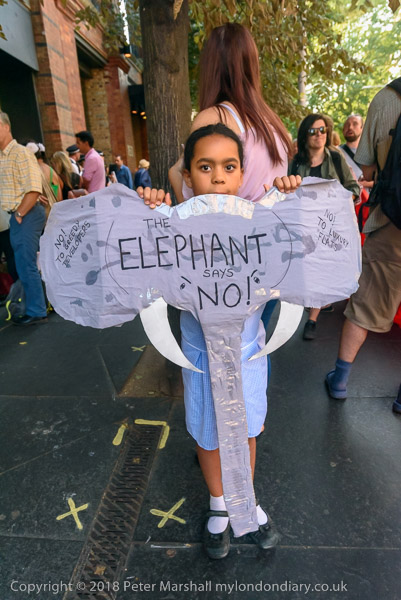
The Elephant still says no, but council says yes

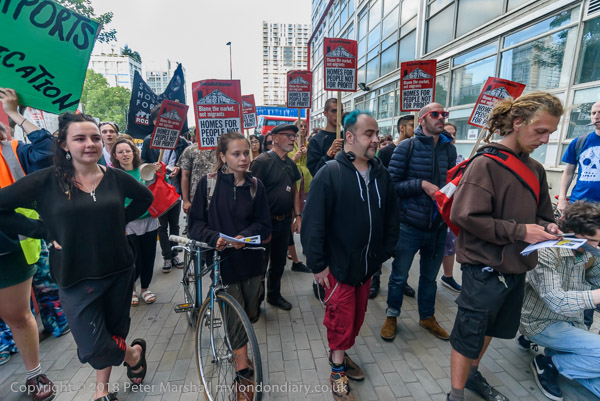
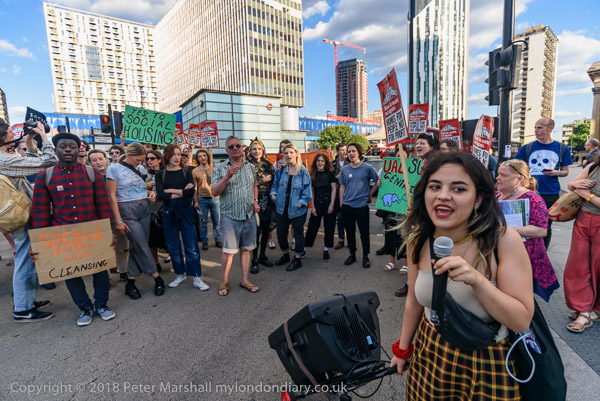
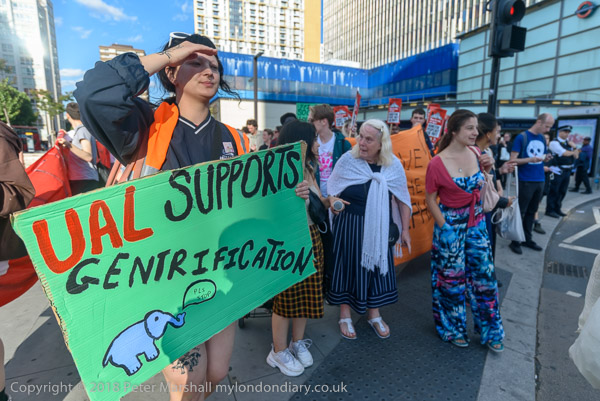
Minor changes to the plans to demolish the Elephant and Castle shopping centre have not changed the opposition to them by local residents and students at the London College of Communication but were enough to convince Southwark’s planning committee to vote narrowly in favour by 4 votes to 3.

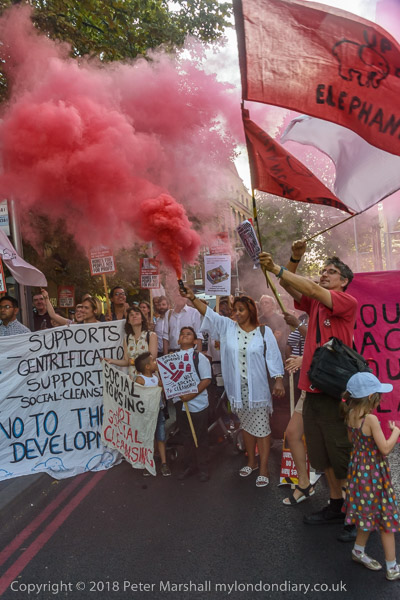
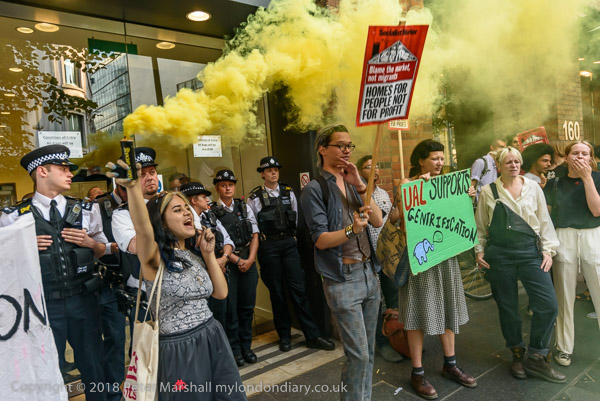
As the committee meeting started there was a loud and well-attended protest outside. The proposals by the developer still involve removing the working class and largely Latin traders and wider local community from the Elephant, in what is clearly social cleansing and further gentrification of Southwark.

The revised plans include only a low percentage of social housing and fail to meet local demands for affordable retail units, compensation for all traders and meaningful involvement and accountability for the people who live, work and study in the Elephant.

Like most such proposals by London’s councils – mainly Labour dominated councils – the development offers rich pickings for the developer, and realises the value of some publicly owned assets, with on the side a number of rather doubtful personal advantages for some councillors and council officials who get lavishly entertained by developers – and some move into lucrative jobs either with quasi-private council arms or working for developers. Local government in the UK has often involved a curious mix of municipal pride and profitable contracts or business advantages, but what was once a largely voluntary system of government has now become a rather well paid career for some of those involved.

While local councils – such as Southwark Council – once used to very clearly see their aim as working to improve the lives of the residents of their boroughs, particularly those in poor housing and low paid jobs, that vision now seems to have been lost. In part it is because of greater pressures and cuts by national governments that have forced many councils to cut services, but I think the major reason is in the rise of political careerists who lack the idealism that was once ingrained in so many. They see themselves as managers of a business rather than as working for the people.

The protest was a lively one, with some good material for photographers. Coloured smoke always helps, though it presents some problems and probably isn’t good for the lungs. It’s something it’s easy to have too much off, with everything seen through a smoky haze, and you often need to move back and photograph from a distance.

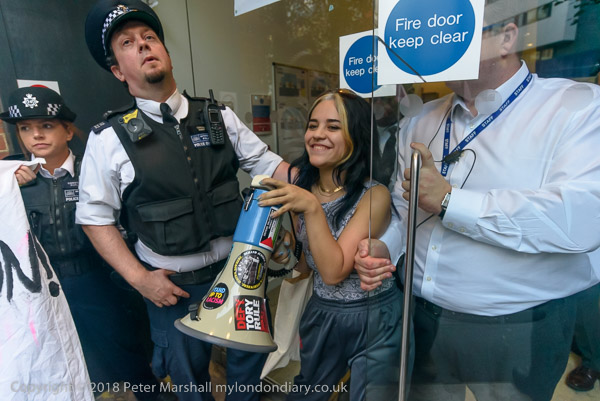
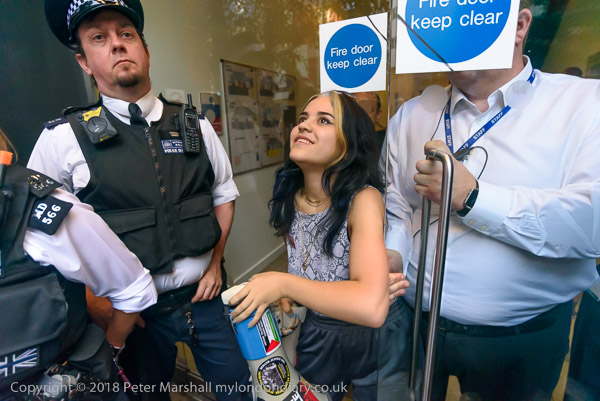
It’s good too when there is a little action, even when only symbolic, as when UAL’s campaigns officer Papaya Guthrie made an attempt to enter the council offices. At times like this it becomes vital to be in the right place at the right moment, and I had fortunately anticipated that something like this might happen. While I usually like to say that I record what people do at events rather than posing or telling them for the photograph, in situations like this the presence of a photographer does have some influence on events, and I’m sure that my presence and that of other photographers did encourage her. I think too that the police officer in this picture has just realised that his actions are being photographed – and this may have had some influence on him releasing his hold and moving back.

Fortunately the light was still good, although its generally a rather dim street, but it was only around 7pm on a July evening, as I was working in manual mode on the Nikon D750, and for some reason (or possibly just my fumble fingers again) had set the camera which was working on auto-ISO to a shutter speed of 1/1000 and the aperture on the 18-35mm lens to wide open. Though I think accidental, it was a fairly good choice for this situation, as the shutter was fast enough to avoid any camera shake (in a crowded situation you usually get jostled) or subject movement, and since I was so close I was working at short focal lengths – 18 and 20mm for these two pictures – and even at f3.5 there is considerable depth of field.

I rarely chimp. Looking down at an image on the rear of the camera loses your contact with the subject and your concentration. And working with Nikon’s auto-ISO it becomes far too easy to either totally under or over expose images when you go out of the ISO range set. But here it worked fine, though at ISO 4,500 these pictures are visibly rather noisy. I could have got smoother images working at a lower ISO but it didn’t matter, though there are some other pictures – both with the D750 and the D810 where I was also using auto-ISO where noise does become an issue. Lightroom can do a decent job in minimising it, but high ISO also reduces detail in images and without some noise can produce rather ‘plastic’ skin tones like make-up applied with a trowel. It’s a look some like but not to my taste. And within limits, like the grain on Tri-X, Nikon noise is not unattrative.

Eventually Ms Guthrie was eased away from the door by a woman police officer and her foot pushed out by security and, surrounded by officers she was moved a yard or two forward. After moving in to photgraph her with the police around, taking my usual care not to get in their way, I moved back, partly to allow other photographers to get pictures too. I’d been the only one in position to get pictures earlier, but by now a couple of others taking pictures had moved around and I wanted to get out of their way. And when she took out a smoke flare from her bag and set it off I was far enough away not be be engulfed by the smoke.

More text and pictures at Refuse plans to destroy the Elephant

______________________________________________________

There are no adverts on this site and it receives no sponsorship, and I like to keep it that way. But it does take a considerable amount of my time and thought, and if you enjoy reading it, a small donation – perhaps the cost of a beer – would be appreciated.

My London Diary : London Photos : Hull : River Lea/Lee Valley : London’s Industrial Heritage

All photographs on this and my other sites, unless otherwise stated, are taken by and copyright of Peter Marshall, and are available for reproduction or can be bought as prints.

To order prints or reproduce images

________________________________________________________

Clocks and Buildings

Two unrelated issues, the first rather brief.

Clocks

Firstly a reminder to those – like me – who have yet to adjust the time settings on your cameras to do so without further delay. On my Nikon cameras it only takes a few seconds to go to the Setup menu, select Time Zone and Date and turn Daylight Saving Time to OFF, but it takes a little longer to find anything on the Fuji menus, once you have made them appear on the rear screen. If you have the Local time set for Daylight Saving you then simply have to select Home.

I got up in the middle of my typing above and made the changes on the four cameras I frequently use. Job done until we get the light back next year.

Buildings

Secondly, photographing buildings, something I was reminded of by an image I shared with the previous post – and here it is again. I’ve just come across a very clear answer to the question of copyright at the IPCopy blog so far as UK law is concerned – with a clear statement that “there is an express exception to copyright infringement under the CDPA 1988 which allows photographs or indeed a film to be made”  and to be published in any way of any building in the UK.

So far, so good. Unfortunately the answer goes on to say that in some cases “in some cases permission may be required to use the photograph” and goes on the mention the Committee of Advertising Practice Code. You can actually find this advice on the ASA web site, where it basically states that buildings and general public locations can be used “without permission so long as they do not denigrate the building or area in question.”  It goes  on to state that recognisable properties owned by “members of the public” require permission.

Perhaps the main area that the IPCopy post does not make clear is the matter of Trademarks, which I’m sure they know far more about than me.  The most interesting discussion I’ve come across of this issue is The London Skyline – an IP view by Leighton Cassidy and Beverley Potts of Fieldfisher LLC written in 2016. In the section on ‘Corporate Branding’ they discuss the use of trademarked buildings suggesting that limitations only apply if the photograph uses the building as a trade mark, or relates to similar goods and services or dilutes or profits from the reputation of the brand.

Although it seems to me that none of these could apply to editorial or most artistic uses of the image, some trademark owners have clearly adopting a bullying approach, threatening any use with expensive litigation. And photo agencies have allowed themselves to be browbeaten into the strictly unnecessary removal of some images.

UK copyright law also has specific exceptions to allow us to photograph and publish pictures of sculptures, models of buildings and works of artistic craftsmanship permanently situated in a public place. I’m not sure what constitutes a ‘work of artistic craftsmanship’, but the legislation makes clear that this does not apply to paintings or literary works, so all those millions of internet posts of graffiti (almost rivalling cats) are at least technically copyright infringements. Though I post some on my own web site, I don’t generally file them with agencies and some at least will not accept them. And I run a cat filter on my Facebook feed.

Unless of course the copyright material is included incidentally, though exactly how that should be interpreted is unclear. Perhaps as a rough rule of thumb you might ask yourself if you would have taken the photograph had that material not been present and if your image focuses (not necessarily literally) on that material. Fortunately also in the UK we have a copyright system where any damages are compensatory rather than punitive, which greatly limits the desire for litigation.

So, aside from a few specific limitations covering military and similar sites you should feel free to photograph any building in the UK (or more or less anything else) and generally to publish those images for non-commercial uses. For commercial use, you and any client need to think more carefully – and I would be very wary about signing any indemnity clauses. But as always with anything involving the law I end with a statement that “I am not a lawyer” (IANAL) and you take my advice and opinions entirely at your own risk.
______________________________________________________

There are no adverts on this site and it receives no sponsorship, and I like to keep it that way. But it does take a considerable amount of my time and thought, and if you enjoy reading it, a small donation – perhaps the cost of a beer – would be appreciated.

My London Diary : London Photos : Hull : River Lea/Lee Valley : London’s Industrial Heritage

All photographs on this and my other sites, unless otherwise stated, are taken by and copyright of Peter Marshall, and are available for reproduction or can be bought as prints.

To order prints or reproduce images

________________________________________________________

Up the Elephant

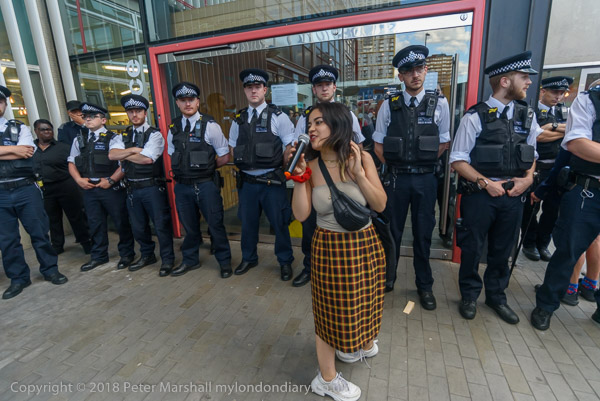
It’s rather a cliche, but I still like it, the one protester and the line of police protecting the status quo, in this case the London College of Communication. But of course it isn’t the whole story and turning my camera around roughly 180 degrees shows a very different picture.

The fight was not so much to save the Elephant & Castle as it currently exists, but to see it developed in the interest of the community who currently live around and use the area, particularly the small market traders, the Latino community and the local residents, rather than a ‘regeneration’ that benefits the developers, the big businesses that will open their shops in the new centre, and the overseas investors who will buy many of the new flats simply as investments rather than for people to live in. And while the University of the Arts will get improved facilities (their current building dates from when the London College of Printing moved here in 1962), the education that working in a vibrant community provides for its students will be lost.

The struggle to improve the plans continues, even though Southwark Council narrowly passed the plans following some minor concessions made by the developers to meet the demands made by the local campaigners. But unfortunately the new shopping centre, though almost certainly more attractive looking than the currently widely despised building, will probably have all of the sterile emptiness of Westfield, though on a smaller scale, attracting people from a wide area rather than serving the locality.

Built in the 1960s, when it opened in March 1965, it was hailed as the first covered shopping mall in Europe and argest and “the most ambitious shopping venture ever to be embarked upon in London”, but was hampered by budget cuts. Although inside it now seems rather small and claustrophobic compared to more recent malls, but is on a more human scale, and has shops that serve local needs, as well as a thriving market that has grown up around it, in particular with over a hundred small Latin-American businesses.

I think everyone agrees that some redevelopment of the centre is necessary, but any local authority that truly represented its residents would have made strenuous attempts to protect the interests of these and other local businesses, insisting that the developer provide a similar amount of low-cost market space in the new development. But all that has been provided, even after the protests are some rather vague promises and a small relocation fund.

The protests have also resulted in a some increase in the number of affordable homes in the development, although only around 12% of the 979 residential units will be at ‘social rents’, and the overall proportion of 35% ‘affordable’ properties is likely to be reduced by fancy accountancy during the construction which will allow the developers to claim this ‘impacts viablity’, reducing their profits below an exorbitant 20%.

Southwark Council has a long history of scandalous so-called ‘regeneration’ projects, selling off the interests of its local population to developers at cut-down prices, including the demolition of the Heygate Estate and the currently continuing demolition of the Aylesbury Estate and other schemes elsewhere in the borough. Unfortunately the Labour dominated council is still dominated by right wing ‘New Labour’.

Protesters Stand Up For The Elephant

______________________________________________________

There are no adverts on this site and it receives no sponsorship, and I like to keep it that way. But it does take a considerable amount of my time and thought, and if you enjoy reading it, a small donation – perhaps the cost of a beer – would be appreciated.

My London Diary : London Photos : Hull : River Lea/Lee Valley : London’s Industrial Heritage

All photographs on this and my other sites, unless otherwise stated, are taken by and copyright of Peter Marshall, and are available for reproduction or can be bought as prints.

To order prints or reproduce images

________________________________________________________

Thieving Artist

I’ve written before about Richard Prince and his appropriation of photographs and only return to the case as I’ve just read a post in The Art NewspaperRichard Prince defends reuse of others’ photographs,  by Laura Gilbert which states the defence he is offering to  a federal court in Manhattan about his use for profit of the works of two photographers, Donald Graham‘s photograph, Rastafarian Smoking a Joint, and Eric McNatt’s photograph of the musician and artist Kim Gordon. It is a rather longer statement, apparently 15 pages, than his original (and soon deleted) tweet: “Phony fraud photographers keep mooching me. Why? I changed the game. &their wizardry professorial boredom keeps coughing up a vick’sVAPOrub.”

Prince argues that by taking the images exactly as they were on Instagram, but enlarging them and adding his comment to put them on the gallery wall and sell them at high prices he was somehow producing a new original work of art, commenting on the process of communication involved in using social media – and Instagram in particular. As Gilbert writes, his approach is supported byome pretty serious names in the art world, with statements from  a museum director, curator and well-known art dealer to the court. All of course people who profit in some way or other from artists like Prince.

Prince of course profits from all the publicity this and other court cases give him, with many articles -including this one – in newspapers, magazines and blogs significantly raising his profile as an artist, and thus the prices and sales of his work.

Perhaps the photographers whose work has been stolen might think about reclaiming it by appropriating Prince’s, producing copies of ‘his’ images, perhaps ‘transforming’ them by the addition of their signatures. I rather suspect Prince and his dealers would call foul and run to the courts in what would be a rather fascinating copyright case.

There is of course absolutely no need for any of this. I’ve had my work used by artists – and they have come to me before doing so, explained what they wanted to do and we have negotiated a licence with an appropriate fee, and appropriate attribution. It’s an established way of working that avoids controversy – without misappropriation. But the very idea of stealing other people’s work seems to me to be the basis of Prince’s artistic practice. He’s famous for it.

I don’t of course know what judgement the court will finally make – and Prince has got away with it in earlier copyright cases, though I hope at last it will be one that fully respects the rights of the photographer – and leads to them getting compensation for the use of their work as well as the legal costs of taking the case. Prince would still be the winner, with all the publicity from the case aiding his status and sales. The only losers – in the longer term – will be those who have paid high prices for what are works which will almost certainly be consigned to the dustbin of art history, lacking any real worth or interest.

Busy Tuesday

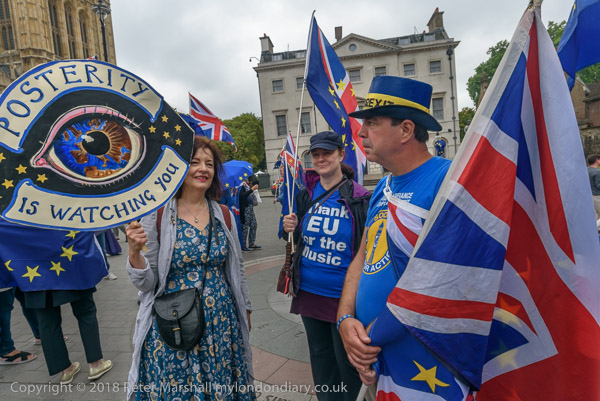
I don’t often photograph three protests on a Tuesday, though one of the three I could have taken pictures of on almost any weekday, and have done a few times before. The anti-Brexit Stand of Defiance European Movement, SODEM, was started by Steven Bray in September 2017 and continue to protest every day that MPs are in session. I went along on this Tuesday as they had announced a a ‘Pies Not Lies’ Remainathon during the parliamentary debate on the European Union (Withdrawal) Bill, and there was a little more interest and activity than usual, as you can see from the ten pictures at Stop Brexit ‘Pies Not Lies’

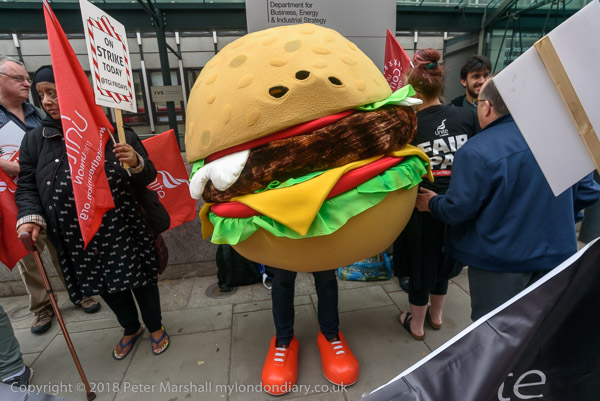
From Old Palace Yard it was a convenient short stroll to the Department of Business, Energy & Industrial Strategy on Victoria St, outside which the Unite Restaurant, Catering and Bar Workers Branch and Unite Community, including staff from TGI Fridays were holding a short protest reminding business secretary Greg Clark of his predecessor in office Sajid Javid’s promise to stop employers stealing the tips paid by credit cards from staff.

Among those protesting was one dressed as a giant burger, though I don’t think either Unite or I really made use of this. I’m there to record events, not to direct them. I won’t tell people how to arrange their protests, and rely on them to decide how they want to do things, but this doesn’t always make for good pictures. Our conventional trade unions are often rather lacking in their ideas about protests and photographs of protests, and trade union magazines and web sites arwe often full of rather boring group photos that I dislike making.

Unite TGI Fridays demand Fair Tips & Fair Pay

From Victoria St I wanted to be at SOAS, a little under two miles away. I should have thought ahead and brought my bike with me to London, as there would have been no problem with having it with me at any of these three small static events. For larger protests and marches, having a bicycle tends to be an encumbrance, and leaving a folding bike like my Brompton locked anywhere in London is a gamble I seldom like to take. A relatively high value machine, easily lifted into a car boot or van and readily sold they are effective magnets for theives.

But at all three of these protests I could have locked it to a lamp post or stand within sight of where I was working, and that mile and and three quarters would have been less than a ten minute ride. Bikes don’t get held up much by traffic, while my buses certainly did. It would actually have been slightly faster to walk the whole way (I’m usually quite a fast walker), but you can’t know that when you start your journey, and my legs would have suffered. The journey took 35 minutes, an average speed of just under 3 miles per hour.

Most journeys in central London are faster by tube – and this is certainly more reliable than buses, but this is one which isn’t. TfL’s journey planner does suggest a combination of two tube journeys and walking would be fastest, but tells me it would have taken me 37 minutes, two minutes more than walking the whole way. Sometimes biking is by far the best solution. Of course for the wealthy there are taxis, but freelance photographers can seldom afford these, and they get held up in the traffic too.

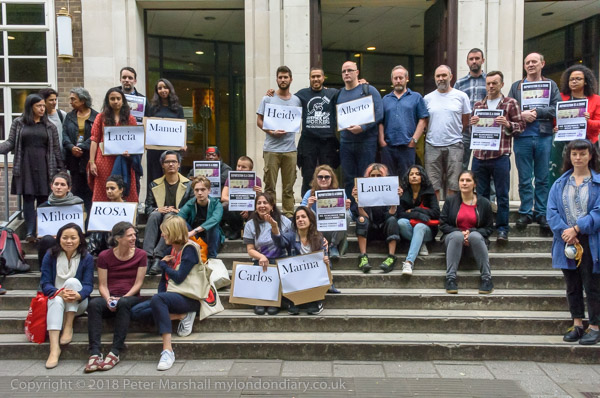
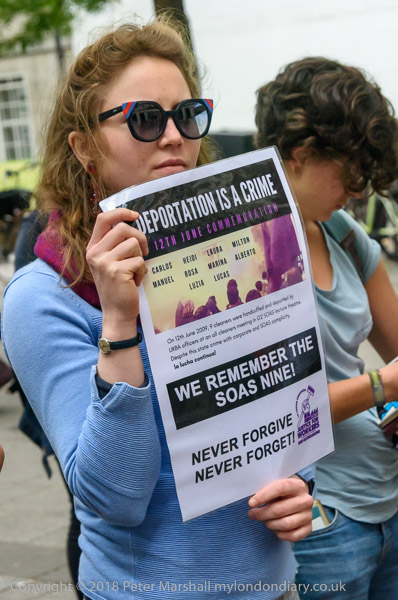
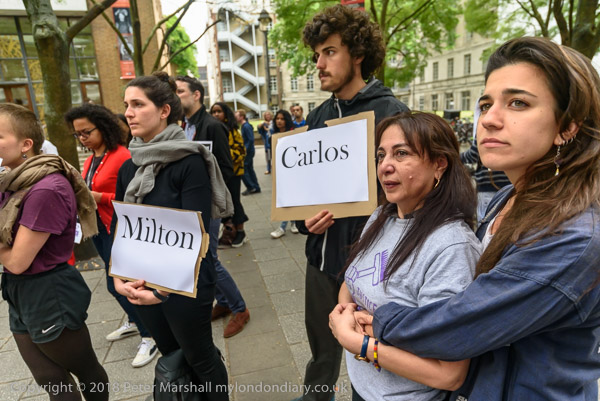
At SOAS, students and staff were remembering the shameful events of nine years earlier, when SOAS management called their cleaners to an early morning ‘meeting’ where agents of the UK Border Agency rushed in, handcuffed all of them and held them for questioning. Nine were then deported. The action was a part of the despicable ‘hostile environment’ for migrant workers, begun by the Labour government, but severely ratcheted up by Theresa May as Home Secretary. People at the protest held posters with the names of the nine who were deported.

SOAS management took the action as retaliation over the trade union activities of their cleaners, members of Unison, who had begun to campaign for a living wage and to be directly employed by the university rather than being employed on terrible conditions and low pay through cowboy cleaning firms. They got the living wage – but then nine were deported.

Eventually, ten years later, after a continuing struggle, the management finally agreed to bring them ‘back in house’, though at the time of these pictures the details had not been finalised. They are now directly employed and both SOAS and the employees are better off.

‘SOAS 9’ deported cleaners remembered
______________________________________________________

There are no adverts on this site and it receives no sponsorship, and I like to keep it that way. But it does take a considerable amount of my time and thought, and if you enjoy reading it, a small donation – perhaps the cost of a beer – would be appreciated.

My London Diary : London Photos : Hull : River Lea/Lee Valley : London’s Industrial Heritage

All photographs on this and my other sites, unless otherwise stated, are taken by and copyright of Peter Marshall, and are available for reproduction or can be bought as prints.

To order prints or reproduce images

________________________________________________________