Medyan Dairieh and Park Royal

I didn’t go out specially to take these pictures in an area of London I’ve hardly visited since I photographed it around twenty years ago and got to know fairly well. One friend who I often meet photographing events in London, Medyan Dairieh, was showing his prize-winning work from Libya. Working for Al-Jazeera, he covered the Libyan revolution very much from the front line, entering Tripoli with the anti-Gaddafi forces and being wounded for a second time in the siege of the final stronghold of Abu Saleem.

Medyan has already talked about his work in Brighton and there are plans for further showings of his photographs and video in other cities. Al-Jazeera has built up a reputation over the year for its reporting of events in the Arab world that has made the BBC and others look hopelessly out of touch and sometimes biased, and Medyan’s photography has played its part in their success.

Unfortunately I couldn’t attend the main event yesterday evening, but took a rather lengthy route home after photographing yesterday’s Climate Justice march to call in, look at the work and meet Medyan again, looking quite different in a smart suit than when we meet on the street, fairly late in the afternoon. It was more or less dark when I arrived at the show, and certainly night as I left at around 4.45pm, almost an hour after sunset.

_____________________________________________________________

The event took place in Park Royal in north-west London, developed as London’s largest industrial estate in the 1930s. I think I first went there when Prime Minister Thatcher had just turned her back on British manufacturing industry in favour of banking, the city and services, photographing a bleak factory for sale on a snowy day as a part of a project on de-industrialisation, returning in later months to photograph some of the more interesting industrial buildings that I thought might soon be demolished.

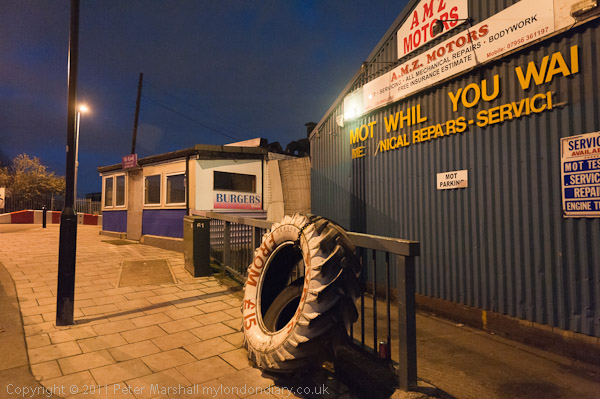
I’d hurried past a small group of buildings as I came to the Islamic centre hosting the event that I had thought might be interesting to photograph, but hadn’t wanted to stop. As I walked from North Acton station I’d been thinking it would be interesting to visit the area again and photograph in better light. But when I came out, the light, mainly from the street lights, with a little still from the dark blue sky wih a few clouds, and also from the passing traffic, was creating a rather interesting and somewhat unearthly effect, so this time I stopped to take a few pictures.
© 2011, Peter Marshall

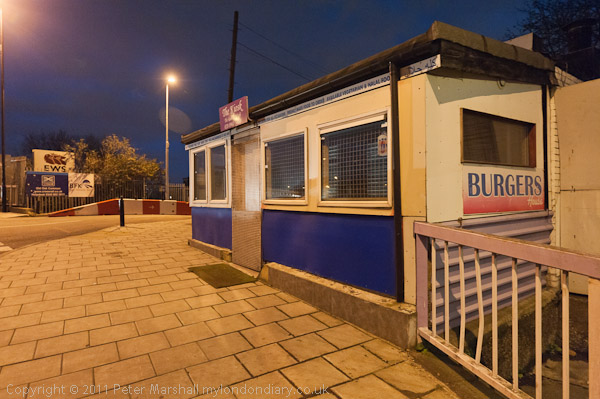
It wasn’t a brightly lit road and I didn’t have a tripod. But nowadays that is seldom a problem. ISO 3200 on the D700 gives a nice quality, with a slight noise which is hardly noticeable at normal scales and quite attractive at 1:1. The 16-35mm lens is only f4, but even at 20mm I would want to stop down to at least that aperture for depth of field in an image like this. Without any exposure compensation set, the shutter speed of 1/30 was hardly a problem, though I made several exposures to be sure to get one that was critically sharp. The Coca-Cola can in the foreground just to the right of the tyre may not be visible on the web, but at 1:1 it is sharp, as is the text across the front of ‘The Kiosk’, though certainly this is easier to read in the second image from closer side.
© 2011, Peter Marshall

To get similar results using film would have been difficult. I would have had to stick to a relatively slow emulsion, perhaps ISO 200, making a tripod essential, made calculations and then bracketed to cope with reciprocity failure, fiddled around with correction filters and then have kept my fingers firmly crossed until the prints came back from the lab, usually requiring a reprint to get the kind of results I wanted. Even then they would have been nothing like as good a colour quality as we routinely get from digital. Though some people like the odd colour that film produced; rather like those people who prefer their oil paintings seen through discoloured ancient varnish than after restoration, or their buildings before rather than after the years of pre-Clean Air Act grime has been removed (and sometimes I do too.)

I could remove the orange cast from the images too, but the orange light was a part of what attracted me to the scene, and removing it produces an unnaturally cold effect. I have reduced it a little from Nikon’s automatic white balance that I used when taking the picture.

Earlier in the day, as I’d been photographing the march looking down on it from Waterloo Bridge, I’d been quite surprised to find a photographer next to me using a tripod. I was getting shutter speeds of around 1/400th and using the 18-105mm felt no need for a tripod, particularly as I was leaning on a very solid railing to take my pictures.

Back in the old days of film, I would only have needed a tripod had I for some reason chosen to photograph the event on a slow film, such as Pan F or Kodachrome 25. Though I can’t ever think why I would have done so when Tri-X or Fuji 400 would have done a better job. But with digital, tripods are needed so rarely that I’ve almost given up on them completely. Tripods still have their uses, but mainly no longer to hold the camera steady (they have never ensured sharpness!*) I think the only use I’ve made of one in the last year has been to mark an exact spot in space to use when rotating a lens around its nodal point to make a panorama – which I was actually taking hand-held. The main rationale of a stand or tripod in a studio is also to precisely locate a camera.

I think there is a stage in photographers’ lives where tripods seem important and seem to them to mark themselves out as a ‘proper photographer’ – and for some years I went nowhere without one. But technology has changed and in practical terms they are now seldom more useful than a dark cloth. And yes, I’ve seen a photographer with an ordinary DSLR using one of those as well. Probably the moth has got mine by now, stashed away in a cupboard with one of my 5x4s. Doubtless there are still photographic courses where students are urged to use tripods, told that you need them to get sharp pictures, just like many are still told nonsense about film being better than digital, that darkroom prints are always better than inkjet prints and doubtless much other nonsense.

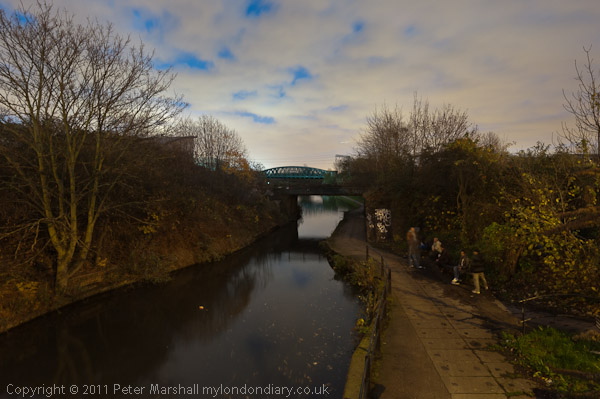
Strolling a few yards further on I came to the bridge across the canal. Park Royal had a great location for industry because of its situation between two of the main rail lines out of London, the Grand Union Canal, and road links including the A40 and the North Circular Road, though now I imagine only the roads are significant. It was really dark as I looked along the canal, hard to make out the two railway bridges. This time there was hardly any light at all, and one solution would certainly have been a tripod. But I held the camera on top of the flat metal of the road bridge and gave a six-second exposure. It was so dark that I didn’t notice the group of people on the canal towpath until after I’d take the first exposure.
© 2011, Peter Marshall

On the back of the camera, the picture looked far too light, so I made a second exposure for half the time. Lightroom’s auto setting produces more or less identical results from the two, simply adjusting the exposure values. Theoretically the longer exposure should be a little less noisy, but I couldn’t actually see a difference, but surprisingly it was just a tad sharper – probably a heavy vehicle had shaken the bridge a little during the shorter exposure (another thing tripods don’t control.) Using the default values actually produces a picture that looks more or less as if it was taken on a sunny evening, the orange street-light becoming warm sun. I’ve tried to get to something a little closer to what I saw and felt as I took it.

__________________________________________________________

* I may sometimes have felt it would be useful to stuff some of my subjects, sometimes not only for photographic purposes, but it has never proved practicable, and a little selective unsharpness often improves images.  The second major cause of unsharpness in my images is incorrect focus. Camera shake comes a poor third except where I’ve forgotten to set an appropriate ISO. Which happens. Too often.
Leveson

The basic problem that the Leveson inquiry seems to be concentrating on in the last few days seems not to be about news and photography but about the non-news aspect of the media and its obsession with so-called celebrities. That photographers seem to be cast as the villains in this piece seems both unfair and also dangerous for our freedom to report the real news.

In my view it isn’t any part of the job of the press as such to report on the inconsequential activities of the various nonentities that occupy much of the tabloid space, along with the various scandal magazines.  It is not what the freedom of the press is about, and the concept of a free press should not be used to defend it. Were it possible I’d personally be very happy to see legislation that put an end both to ‘celebrity culture’ and the reporting of it; both are I think aspects of enslavement rather than freedom.

Over the years we have seen an increasing trivialisation of ‘news’ with an increasing failure to report on the real issues in a cultural devaluation fuelled in particular by television.  It’s a canker that has wormed its way deep into even the most respected of our media – so many of are angered that institutions such as the BBC and newspapers including the Guardian think that stories such as the recent trial of the doctor who let a singer take an overdose deserve to be headline news.

When the colour supplements first came out they often covered real stories; I read the reports by guys like Don McCullin from Biafra and elsewher and many other fine photographers and writers. Now, even from the most serious of newspapers there is seldom much serious journalism or photojournalism, and the magazines are stuffed with silly fashions at silly prices, recipes with 37 ingredients that nobody ever really cooks, reviews of restuarants that only people on bankers bonuses can eat at and all kinds of tat at ridiculous prices, trivia upon trivia upon trivia. Frankly the odd ‘celeb’ getting a bit annoyed at someone poking a lens in their face seems of little consequence when we have a whole culture that is disintegrating and it is just a relatively minor manifestation of this.

Of course the guys who hang around outside homes and pester people on the streets, the ‘paparazzi’, are seldom real photographers, and most of the pictures that they take prove the point. As images they are poorly composed, badly lit and tedious to the extreme, but still the newspapers and magazines fall over themselves to pay big money for them. And it can be really big money, with some photographers making more from a single picture than I make from a year’s work. Take away this financial incentive and there would be no problems.

Unfortunately it is very hard to see how it would be possible to frame laws that would restrict the undesirable activities of the paparazzi without restricting the freedom of the press and of photographers in particular.

The relationship between photographers and celebrities is of course more complex than the media reports of the Leveson hearings suggest – they are after all brought into being by the lens. But I can’t help thinking that Leveson would have been far more likely to reach sensible conclusions if it had concentrated far more on the problems of ‘ordinary’ members of the public who get caught up and trampled by the tabloid circus (some of whom have made the headlines by their testimony too) and much less on giving more publicity to the sometimes relatively minor moans of some celebrities.

There are a couple of things I’ve read about this which started me thinking about the problem. One is a lengthy piece by Edmond Terakopian, I’m A Press Photographer & Very Proud Of It, who describes Leverson rather accurately as ‘turning into a witch-hunt against photographers‘ and the other an open letter by Christopher Pledger that he quotes in full in his piece.   Pledger makes a very good point about the way that TV news disparages photographers in many reports for their intrusive nature, when many photographers would feel that the TV reporters making these reports are part of the same media operation and in my experience usually more intrusive than their still counterparts.

Another issue raised is that of press cards and of ‘fake’ press cards. Although we do have a nationally recognised scheme under the UK Press Card Authority that is recognised by the Association of Chief Police Officers (ACPO), that does not make those issued outside of this scheme ‘fakes’. The UK Press Card is however backed by a verification scheme and is only issued by a limited number of media organisations (the so-called ‘gatekeepers’) and so has a status that other cards do not. But journalism is changing and news and news media is a wider concept than when the Press Card scheme was established; many who are now increasingly contributing to the news media work through organisations that are not part of and don’t fit the recognised scheme.

Nikon Worries

My Nikon D300 gave up on Saturday, while I was photographing a march by Egyptians in London. It happened when the camera got a little knock as I was climbing down from a box on the street. Nothing significant, but it fell around six inches and bumped the side of it.

There was no obvious extra external damage, and I thought if anything I had damaged the lens, as when I tried to focus the 18-105 which was on the camera it hunted around a bit before coming to a halt decidedly out of focus.  I put the camera back in my bag and continued working with the D700 and 16-35mm, and hardly noticed the lack of anything longer the rest of the day. If it had been working there would of course have been pictures I would have made with it, but I’m not sure my photography really suffered. I suppose I could have continued working on it in manual focus, but really the viewfinder just isn’t good enough for that.

The next day I put another lens on the D300 body and found it too failed to focus, while the 18-105 seemed to be working fine on the D700. It was the body and not the lens that had a problem, and it was one that made it more or less unusable.

I spent a couple of days wondering what to do. The D300 has seen better days, and has been knocked around quite a bit. I did a check on the shutter count (on-line by loading one of the .NEF files I did make with it on Saturday to My Shutter Count.com as I automatically strip some less essential Exif data from my jpegs, and the software I have currently installed on my new computer doesn’t read it from raw files) and found it was at around 158500, more than the rated life of 150000. The screen on the top plate has been broken since early summer and much of the rubber on the body is peeling. The top speeds no longer work properly, as I found when photographing swans in July, and I’ve been suffering more recently from the occasional exposure with half the picture covered in nasty coloured lines and the odd image that has an ‘unexpected end of file‘ or gives the annoyling vague Lightroom message ‘there was an error working with this photo.’* All in all it’s in rather a mess, and I shudder to think how much it might cost to get it fixed.

The D300 cost me £969 in April 2008, so it is coming up to 4 years old and it has seen reasonably intense use in that time. That works out at around 0.61p per exposure for the body, which has not been repaired or serviced in that time, so I wouldn’t feel bad about ditching it now. The sensible thing would probably be to get an estimate for repair and then sell it secondhand, but so far I’ve just wasted a lot of time thinking about its replacement.

Everyone on the web seems to have been expecting Nikon to announce a replacement for the D700 for some time – with very strong rumours in recent weeks that the D800 might emerge from under wraps at the end of this month, although these are now being discounted. New products have been held up and the supply of cameras and lenses seriously affected by the flooding at Nikon’s factory in Ayutthaya, Thailand, where all DX SLRs have been made since 2009, along with most of the DX zoom lenses, although the FX D800 will presumably be made elsewhere, probably at the Sendai Japan factory which earlier this year was closed until the end of March following the 11th March earthquake and tsunami.  But in any case it seems likely that it will be very expensive – I’ve seen a figure of $3600 mentioned. And if the strong rumour of it being 36Mp turn out to be true, I’m not sure I need it.

Nikon’s direct replacement of the D300, the D300s, offered few advantages. Better to get my old D300 fixed than go for that. Its replacement is also overdue and was once expected about now. At the moment the most attractive of the available Nikons to me seems to be the D7000, with slightly better image quality in low light than the D300 and some other minor advantages. As usual, the review I found most worth reading comes from Thom Hogan. It’s also just a bit smaller, lighter and cheaper. I came close to spending around £830 on one yesterday.

But today, while thinking about writing this piece, I had another play around with the ailing D300, trying it out on manual focus and in the two autofocus modes, verifying the lens still made the right noises for VR and so on. And suddenly it just started working again, as if something had somehow fallen back into place, and I was looking at a sharp image in the viewfinder (though a rather boring one.) I took a few images with brick walls in them and things seem to be pretty sharp. So perhaps I’ll give the D300 another chance until the next time it falls to pieces. By then Nikon might have their  new models out.

_______________________________________________

© 2011, Peter Marshall
Lightroom refused to work with this D300 raw file, but Irfanview had no problems and Photoshop finished the job.
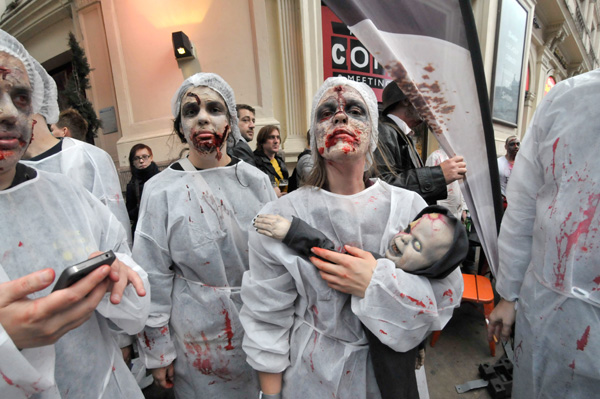
Halloween in London, 2011.

* ‘There was an error working with this file’ and other error messages may simply be Adobe software being very picky about the files that it will open – and perhaps might be replaced at least in some cases by the message ‘Lightroom couldn’t be arsed to open this file.’

You may still be able to get a usable image from the file – as with the picture above – using other software, such as Irfanview, free for non-commercial use to extract to a high quality jpeg and then adjusting that in Photoshop. And even if you can’t extract the image from the RAW data, the included jpeg (used for displaying the image on the camera screen) may still be ok, although these are usually ‘basic’ quality and sometimes smaller than full size. You can download the free IJFR – Instant JPEG From RAW Free Utility from Michael Tapes’s RawWorkflow site – register there to be sent the download link. It’s a handy way to very quickly generate a whole set of jpegs from any set of RAW files.

Not For My Xmas Present!

I won’t be rushing out to buy a copy of  Vivian Maier: Street Photographer which, according to Amazon will be available from 8 Dec, published by Powerhouse Books as a 128 page hardcover (ISBN-10: 1576875776 ISBN-13: 978-1576875773) at the pre-order price of £24.64. It’s cheaper in the US, and the Amazon page includes a one minute video which exposes the book and around twenty of her pictures, and makes very clear why I think the hype around her is unjustified.

Make no mistake, Maier was a good photographer. A very good eye who picked up stuff from all sorts of guys and made her own take of it. You can see in the video and the half a dozen images on the web site that she has learnt well from Walker Evans, from Lisette Model, from Lee Friedlander, from Henri Cartier-Bresson from Harry Callaghan and from others. What you don’t see, despite the several self-portraits, is any clue as to who Maier herself was as an artist.

It says in the text that she took over 100,000 photographs in a period from the 1950s to the 1990s, though overwhelmingly I think her work shows its 1930s roots. 100,000 over 40 years is a relatively modest output and not unusual for the keen amateur that she was, at 2,500 pictures a year, it works out at around 50 a week. It’s hard also to know how much of the back-story is true. Did she show her work to no-one, or was it that the people in Chicago she did show her work to didn’t find it of particular interest.

Mike Johnston on The Online Photographer seems considerably more convinced of the book’s worth than me. It seems a pleasant enough volume, but certainly nothing to get excited about, and I sincerely hope nobody buys me it for Christmas, though I’m sure there will be considerable media hype and many photographers are likely to find a copy jammed in their stocking. Please, please not for me.

There are obviously others who disagree with my verdict on her, and the featured comment by Sherwood McLernon says “I think of it as the book that I had hoped The Americans by Robert Frank would have been, but wasn’t.” which must deserve some kind of award.

I don’t know where McLernon was sitting waiting for the publication of ‘The Americans’ in  1958. Maier had hardly started in photography when Frank took 2 years and around 28,000 images to make the work in 1955-7. Published first in France, where Robert Delpire put his future with the family firm on the line to get it in print, it shocked the photography world, or at least those who saw it, as most of the reviews were extremely negative. Wikipedia quotes Popular Photography as deriding his images as “meaningless blur, grain, muddy exposures, drunken horizons and general sloppiness.

The Americans is in no way a perfect book, but it became a seminal book, although it remains in some respects a difficult book. Maier’s work (both in the show and on the various web sites) is safe and easy to assimilate. If I wanted one word to describe it, I think “anodyne” would do nicely, whereas for Frank it would be “iconoclastic.” The mention of Frank is however interesting, as looking at her work in the gallery this summer, one thought that came to me was that despite her obvious talent and facility, she had never really got to grips with his work.

If you are looking for a present for a photographer with any interest in street photography and you find they haven’t got a copy of ‘The Americans’ then I suggest you buy that rather than this book. Maier’s work is easy listening while Frank’s remains challenging, even after I’ve known it since the 1970s when I was getting into the medium.

If you are looking for a present for a photographer with any interest in street photography and you find they haven’t got a copy of ‘The Americans’ then I suggest you buy that rather than this book. Maier’s work is easy listening while Frank’s is still challenging.

You might also want to look at Martin Parr’s pick of the best books of the decade, made for the PhotoIreland Festival in the Summer. Perhaps among a few of his choices I might endorse is John Gossage’s  Berlin in the Time of the Wall – you can see a selection of the pictures at the Stephen Daiter Gallery, but even at the reduced price of $132 it’s a little expensive for my relatives.

Perhaps at some time I’ll try and write more seriously about my own picks of recent photography books, and I have another of my own Blurb publications arriving shortly.

Ten Years On

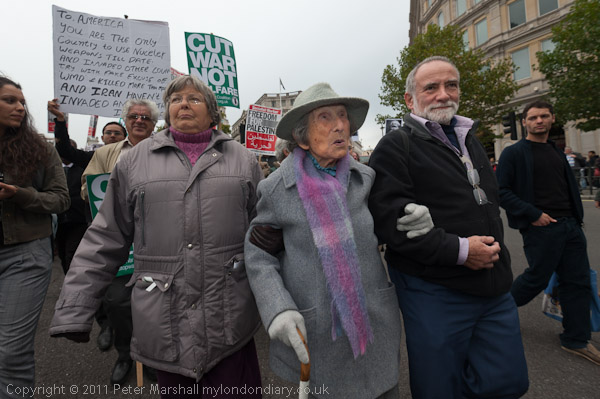
Stop the War, along with CND and MAB marked the 10th anniversary of the Invasion of Afghanistan with a protest in Trafalgar Square followed my a march to Downing Street, which was led by that redoubtable woman whose picture ended my previous post, Hetty Bower.

© 2011, Peter Marshall

I rather like the feeling in this image that the man on her right is not helping her to walk but holding her back.

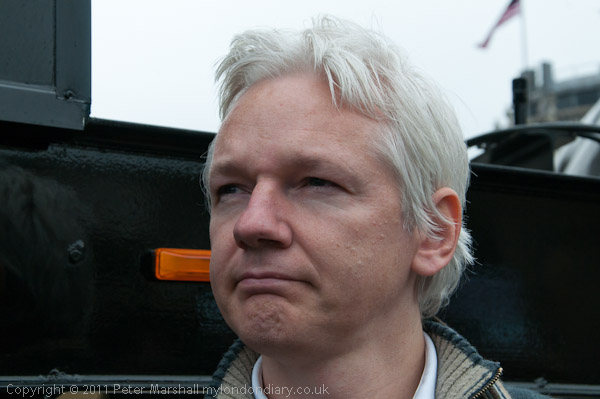
It was, as the picture shows, a rather dull day, but for much of the press the big news was the appearance at the event of Julian Assange. There was a huge scrum when he arrived into the enclosure around the platform in Trafalgar Square, but I decided it wasn’t worth trying to join it as there would be a much better opportunity later.

Fortunately I was right, and  in just about the right place for it, and took far too many pictures of him. This is the one I like best, though perhaps I could improve it a little with some more work in Lightroom, I think it is just a little too dark at the moment.

© 2011, Peter Marshall

I didn’t quite get the picture of him that I wanted, something that had a little more character, but it’s certainly better than many I’ve seen.  There were far too many speakers (and I missed quite a few while away elsewhere) but I did take a few pictures of them that at least I like.

© 2011, Peter Marshall

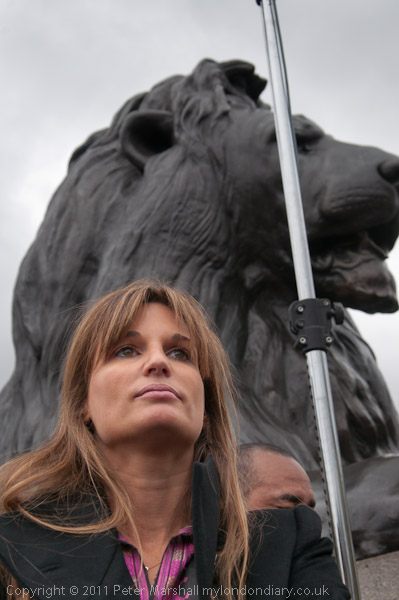
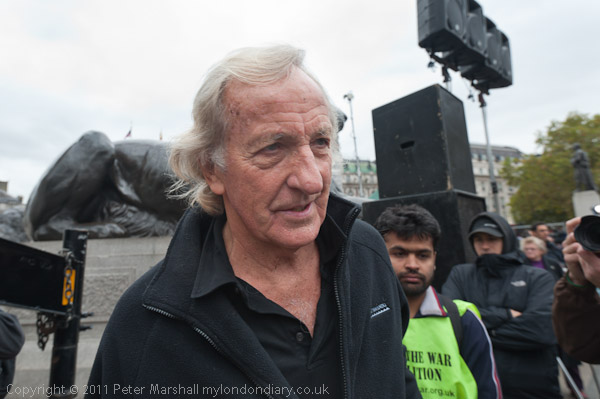
I spent quite a while trying to get exactly what I wanted with Jemima Khan, and I think I came close, but had to work in a split second with John Pilger.

© 2011, Peter Marshall

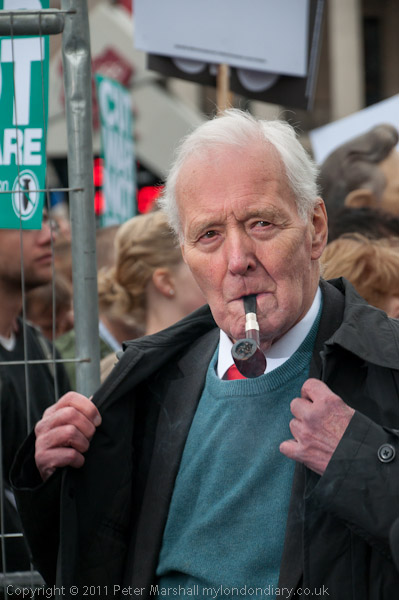
I’ve photographed Tony Benn so many times that I wasn’t going to bother yet again, but then I saw him and thought the lighting wasn’t bad as he took out his pipe to relax for a minute or two before being interviewed for TV.

© 2011, Peter Marshall

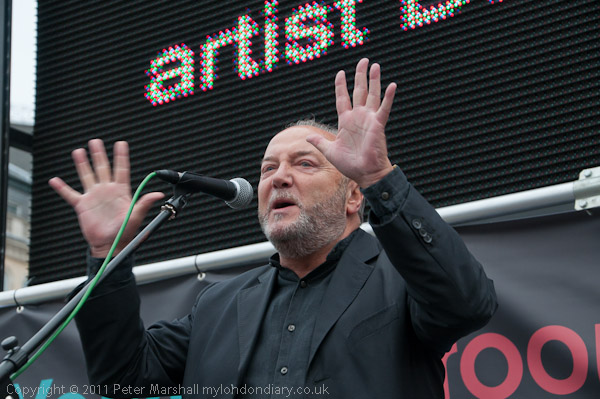
George Galloway always has a good line in theatrical gestures, and I thought this was one of his better attempts, though I’m not sure I would really call him an ‘artist’ as the caption on the screen above him seems to.

© 2011, Peter Marshall

There is something I really like about that little bit of movement in the far hand.

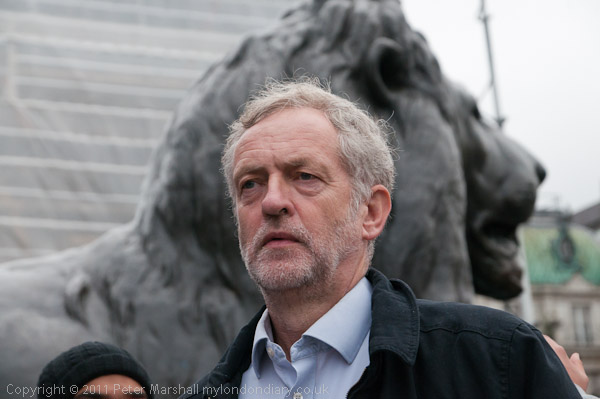
Some people are much more difficult to photograph. Jeremy Corbyn MP, the newly appointed National Chair of Stop the War Coalition, often seems to speak with his eyes closed or near closed and it seldom makes for a good picture.   I photographed him waiting to speak standing in front of the Landseer lions, and can’t decide which of the two frames on My London Diary that I prefer.

© 2011, Peter Marshall

You can see the other one, and my other pictures from the event on My London Diary in  Ten Years On – Stop The War Coalition. Things got a little hectic for a while at Downing St, and there were so many photographers that I kept getting pushed forward, too close to the action. It might have been a good time to use the 10.5mm, but the crush was so tight there was no way I could change a lens.

© 2011, Peter Marshall

I could only work with the 16-35, mainly at the wider end, and do the best I could.

I’ve photographed many Stop The War events over the ten years it has been in existence, and at the moment am eagerly awaiting the launch of a publication celebrating those ten years, which includes quite a few of my pictures. But this event came several months too late to be included.

Cable Street Revisited

Cable Street occupies an important place in British left-wing history, and like all such events is shrouded in myth. I’ve been criticised by some for pointing out some of these, but I think it never belittles our history to get the facts right. Just as last month, when the EDL tried to march into the East End, the people of the East End never got to fight the fascists. The battle in 1936 was with the police, and the people were successful. It was a victory for the people, and one against the fascists even if they didn’t actually come into contact.

This year the police were fighting with the EDL at times, and it was the police who stopped the EDL, as well as succeeding in stopping the people from the East End getting at them, although I saw no real attempt made to breach the police lines. The protesters against the EDL in 2011 remained peaceful, except when a coach full of EDL stopped in the area and started to insult people.

Back in 1936, the East End didn’t stop the fascists, though on that one day they did manage to stop Mosley marching through. But the fascists were busy inside the East End then.  It was also a time when real battles were being fought against them in Spain, and several thousands of brave men, many of them communists or anarchists, including workers from the East End, defied the government and went to fight.

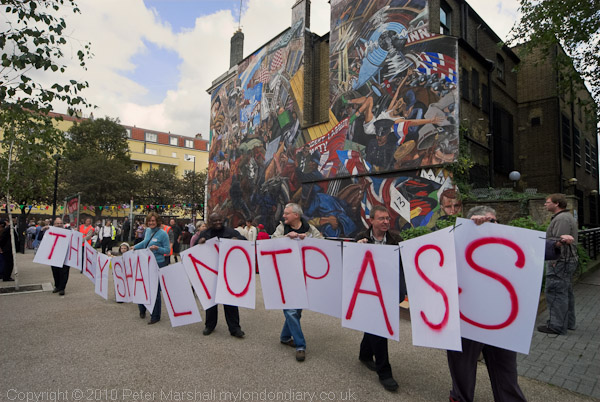
Relatively few of those who went to Spain – or who stopped the police in Cable St – are still alive, but the memory of what they did lives on, not least through the splendid mural in Cable St itself.

© 2009, Peter Marshall6
‘They shall not pass’ in the 70th anniversary celebrations in 2006

The picture taken 5 years ago, when the celebrations were a little smaller and more local makes the connection between Spain and Cable St clear. This year there were people from all over the UK present, including quite a few Indian groups as well as the local Bangladeshi organisations.

© 2011, Peter Marshall
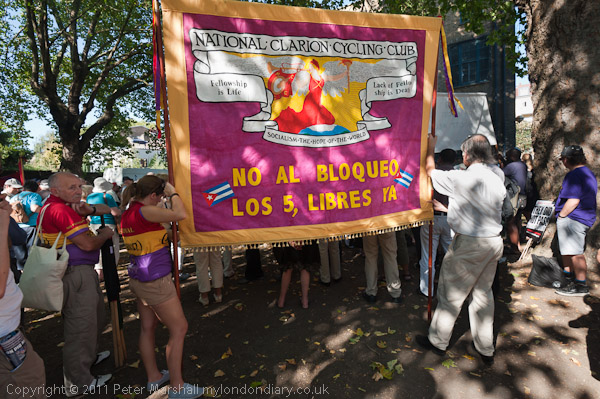
2011: The National Clarion Cycling Club banner also supports the ‘Cuban 5’

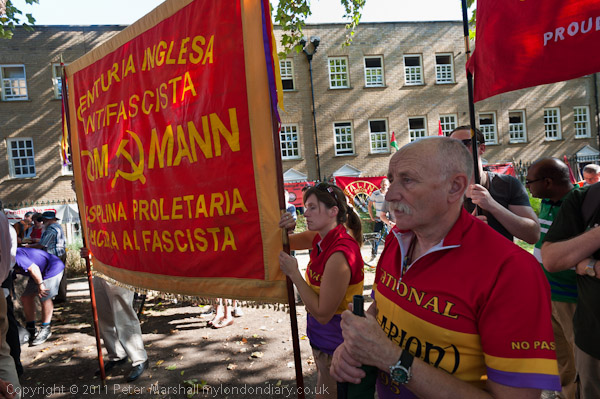
This year’s 75th anniversary also included several groups connected to Spain, including the International Brigade Memorial Trust, the Connelly Association and the National Clarion Cycling Club, who had taken part in an anniversary ride from Scotland.  Their banner was also that of the ‘Centuria Anglesa Tom Mann’

© 2011, Peter Marshall
And on the other side is the Tom Mann brigade banner

More about the 70th anniversary in the second story down this page of My London Diary, and this years event is  Battle of Cable St – 75 Years.

© 2011, Peter Marshall

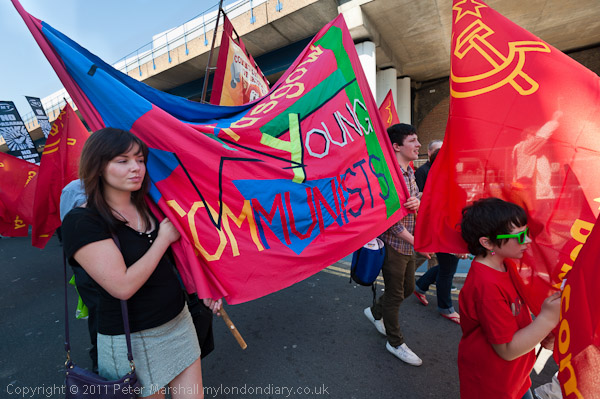
I took two frames with this woman carrying a banner, the second with the red flag hiding the boy in the green glasses, and I’m not sure which of the two I prefer. The main photographic problem was one of contrast, with a huge difference between the shade and sunlit areas.  Even the picture above, where the sunny areas were small required some fairly extreme burning in.

© 2011, Peter Marshall

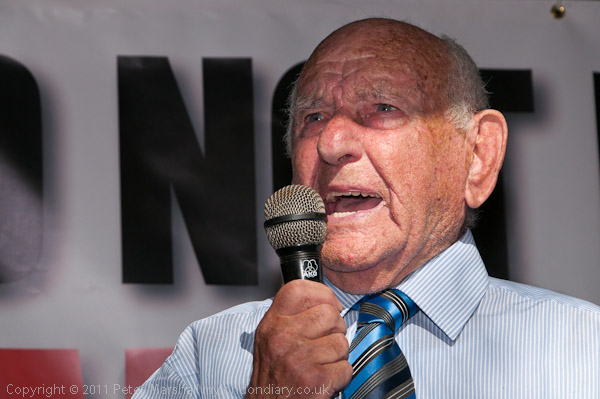
Of course fill-flash becomes very useful in these situations. When Max Levitas was speaking, one of my friends standing next to me was cursing as he didn’t have his flash with him; Max as the image above shows, was standing with his face in the light and forehead in shade, and flash was really essential to cope with this. Usually I have the flash set to -2/3 stop, and I don’t think the exposure can take the flash into account, so I generally use -1/3 stop of exposure compensation with it.

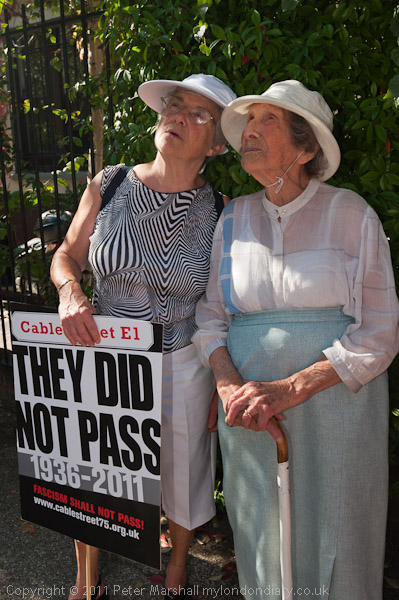
Another image where it was essential was this of 106 year old Hetty Bower, who was 31 at the time of the battle, and certainly the oldest person on the march – she walked the whole way from Aldgate.  She was looking up at the mural when I took this picture of her with a friend.

© 2011, Peter Marshall

Stick at 359 degrees?

If you are in or have ever photographed in Slovenia you need to know it is now illegal to publish 360 degree panoramic images with recognisable faces unless these are pictures of events published as news.

You can read more about this apparently bizarre legal position on Dliberation, which kind of blames the situation on Google Street View’s decision to blur faces in its imagery, although Google wasn’t able to comply with Slovenia’s demand that they carry out the blurring of Slovenian images in Slovenia so Street View does not yet extend there.

Although the decision is bad news for Boštjan Burger, a Slovenian who is one of the pioneers of immersive photography, it actually seems pretty good news for the rest of us, as the deliberation by the Slovenian information commissioner clearly recognises and validates street photography.

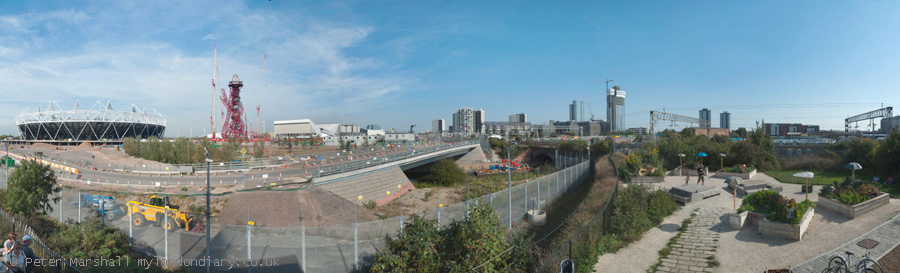
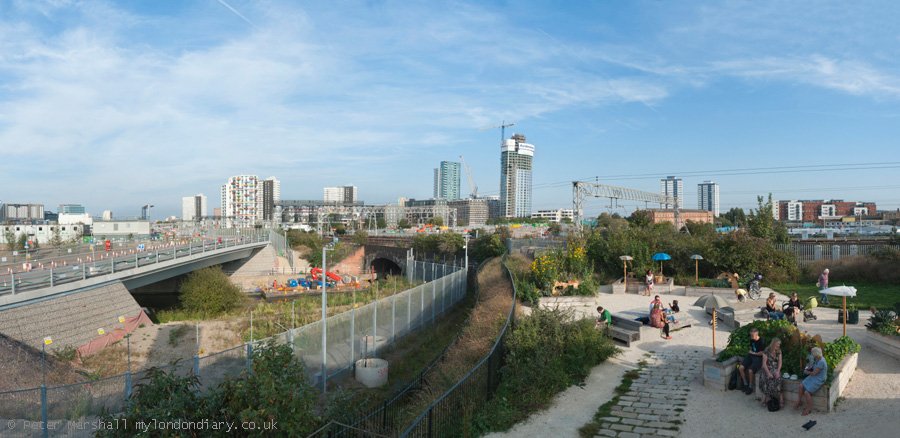
I’m not a great fan on 360 degree panoramas, or really any that you need to use viewer software to see rather than viewing as a flat print (or on a screen) although Street View certainly has its uses. Although I have occasionally made 360 degree views I don’t think I’ve ever shown or published one. As I found a month or so ago photographing the Olympic site from the View Tube and earlier in the year on the gardens project, anything over 180 degrees or so seems to lose interest.

© 2011, Peter Marshall
Roughly 240 degree view
© 2011, Peter Marshall
120 degree view – My London Diary has larger versions of these and others made in the same area on the same day

But for those people who want to go the whole hog in Slovenia, couldn’t they stay inside the law by simply incorporating 1 degree of blank non-photographic space into their images?  Given suitable colour, tone and texture it would hardly be noticeable.

Thanks to a Facebook post by EPUK for bringing this Slovenian story to my notice. Another recent post is to an authoritative and very useful article on their own site, Stolen Photographs: what to do? though I think it is more an answer than a question.

Camera Club

Mention of Clive Landen in the post on one of his former students, Anastasia Taylor-Lind, sent me off to Google to find out more about him, though there was disappointingly little. Almost all that I found were links about his exhibition and book Familiar British Wildlife, pictures of roadkill, which reminded me of the work of a friend of mine, Carol Hudson, and a group show back in 1985 where as well as her fine still life images of dead birds we had a row of prints of her photograph of a dead cat laid out across the gallery floor. Most visitors stepped very carefully over them.

I sent some of Carol’s work to J. David Sapir,  then a Professor (and now Emeritus Professor) in the Department of Anthropology at the University of Virginia, Charlottesville, who had a pioneering web site ‘Fixing Shadows’, founded in May 1995 with a commitment to ‘straight photography’, and it precipitated quite a discussion about exactly what was meant by that term.

Also Google took me to another historic web site which I’ve not visited for perhaps ten years, Camera Club. This was set up by “artist, writer and lecturer Stephen Bull” as a contribution to Photo 98: The Year of Photography and the Electronic Image, and for it he persuaded six “well known gallery artists and photographers” to submit work to be judged as a part of an amateur photographic competition at the Ilkley Camera Club in Yorkshire.

Most of the links away from this site no longer work, and so some of the associated material is no longer available, but you can still see the four pictures from each of the photographers and the brief comment made on them by the judge (who was fully aware of the project) along with his mark out of 20 for each picture.

In my experience, club judges seldom gave any picture less than half marks, so the 10 out of 20 awarded Landen for one  of his pictures was rock bottom, though Martin Parr also achieved this for his cup of tea. Landen’s four images totalled 51 points, making his by 2 marks the lowest score of the six. The club star was  John Kippin with 70, one of his landscape images gaining the full 20, and he was duly awarded the The Stephen Bull Trophy.

It’s a site that still amuses – at least it amuses me – and  also very much shows the passage of time, both in web design and in photography in the choice of photographers and their pictures. Though I’m not sure camera clubs have changed much; certainly in 1998 they were still very similar in their ideas to 20 years earlier.

Anastasia Taylor-Lind

One of the dozen youngish photographers selected for this year’s World Press Photo‘s Joop Swart Masterclass was Anastasia Taylor-Lind, a graduate of the Newport photography course, currently based in Lebanon. She has produced some remarkable photographs of ‘ordinary’ women in conflict zones around the world which you can see on her own web site. There is also a Radio Wales interview with her about her work which is well worth listening to.

There is a story and video about her project ‘The National Womb’ produced for the masterclass which had the theme of ‘Respect’ on the Canon Professional site, and this, the web site and radio interview are the source for almost all I know about her.

I looked at the Taylor-Lind image on the front page of the WPP web site immediately after writing about the $4.3m sale of Andreas Gursky’s ‘Rhein II’ and my immediate thought was how much more her picture was worth than anything from his plastic universe.  Although I’d think the same about the work of many other fine photographers too.

Taylor-Lind also has an unusual story to tell about her home background, which seems to have been in many ways an ideal preparation for her work. Her Swedish mother gave up a career as a ballet dancer to travel the world after meeting her British father, following the hippy trail before returning to the UK, where Anastasia’s early years were spent travelling around in a gypsy wagon. The family settled in Devon when she was nine and she was able to go to school for the first time. Her father often told her that the worst thing you can do is to be ordinary, but at that age she desperately wanted to be like the other people, with a house, car and modern conveniences.

In their home they had no TV and didn’t take newspapers; almost the only early contact she had with the media came from an uncle who every year gave her parents an annual subscription to National Geographic as a Christmas present, and this was perhaps the main place where she saw good photography in her early years. It was a story that struck a chord with me, as when I was small I also grew up among piles of National Geographic magazines, though in my case they were issues from twenty years earlier, again donated to us from a wealthy relative.

She went on to study A level photography at East Devon College, but still didn’t have much idea what photography was about until one day at college she opened a book of Don McCullin’s work and immediately decided that was the kind of thing she wanted to do. Fortunately her tutor had the sense to tell her that if she wanted to take pictures like that she should go and take the course at Newport. There her tutor was Clive Landen, who she says not only taught her the basics about photography but that it would have an effect on her whole life, and this certainly has been true.

In her third year of study Taylor-Lind went to Turkey to photograph Kurdish guerillas, one third of them are women and you can see her pictures of some of them in ‘No Friends But the Mountains’ on her web site.  Her upbringing was certainly a great preparation for the kind of travelling that this involved, and for getting on with the people that she met.

One of the other projects on her web site is on cider makers from Devon. She told her Radio Wales interviewer that she feels more at home in unusual, alternative communities – ” I like crazy people” and that she is the opposite of those photographers who like to disappear into the background as she likes talking too much and “my pictures speak as much about my relationship with the people I’m photographing as anything else.” But really the whole of the interview, video and web site are worth a careful look.

Taylor-Lind’s The National Womb is one of the 12 projects from the Joop Swart Masterclass featured in the book Next #01 published by WPP:

·  Eunice Adorno, Mexico, There Is No Such Place
·  Antonio Bolfo, USA, Survival in Cité Soleil
·  Kitra Cahana, Canada, Nomadia: Young American Nomads
·  Alinka Echeverria, Mexico/UK, Becoming South Sudan
·  Alessandro Imbriaco, Italy, Angela’s Garden
·  Kuba Kaminski, Poland, The Whisperers
·  Sebastian Liste, Spain, On This Side of the Mountain
·  Leo Maguire, UK, Dark Strangers
·  Ivor Prickett, Ireland, Free Libya
·  Mohammed Salem, Palestinian Territories, In Honor of Death
·  Dimitri Stefanov, Bulgaria, Collapse
·  Anastasia Taylor-Lind, Sweden/UK, The National Womb

There are several in the list whose work I’ve seen elsewhere, and doubtless all are worth following up, and there are links to ther web sites on the WPP page.

It’s a volume that seems interesting and at a fairly reasonable price, although unless I get offered a review copy I can’t tell you more.

Arms Unfair 4

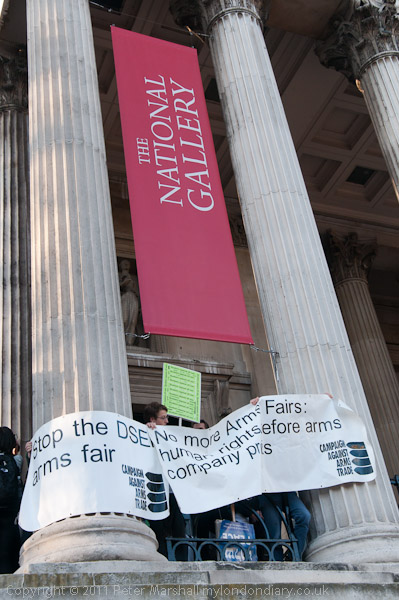
The published timetable for the day of action against the DSEi arms fair had ended with the protest outside BAE Systems, and I’d really spent long enough on my feet and was looking forward to going home and having dinner – as well as working on the many pictures I’d already taken.  So I wasn’t too pleased when I was given the information that there would be another protest outside the National Gallery, and if it hadn’t been on my route home I might have decided enough was enough.

Although we were told to keep it quiet, I got the impression that the police already knew about it, and there were quite a few around as the protesters tried to enter the gallery. I was just behind the first group to go in the main entrance but hesitated about whether to go in.  It is often a tricky decision, and I have no right to enter premises just because I’m carrying a camera and a press card when the staff are clearly trying to keep people out, although some photographers just rush in.

The gallery was just closing to the public, and I would have had to have joined the protesters in trying to push past the security staff to follow them. I think a few may have made it, but were fairly rapidly ejected. I decided instead to try to photograph the larger number of protesters who were still on the steps, ignoring the security men telling them to go down.

© 2011, Peter Marshall

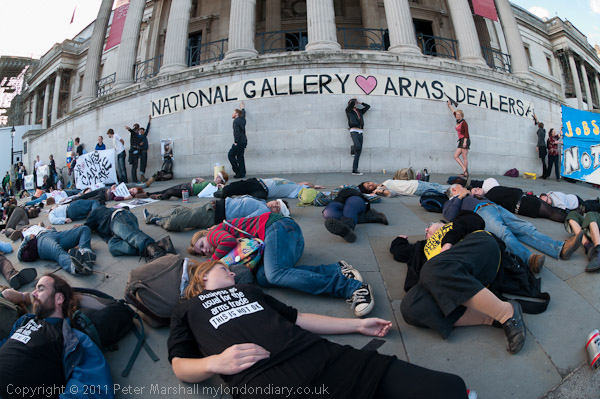
They were trying to put up banners, and so were right against the balustrade at the front, making it difficult to get a suitable angle. I took a few pictures, leaning out and even holding my camera further out, then decided to go down and photograph from in front of the building on the North Terrace of Trafalgar Square.

© 2011, Peter Marshall

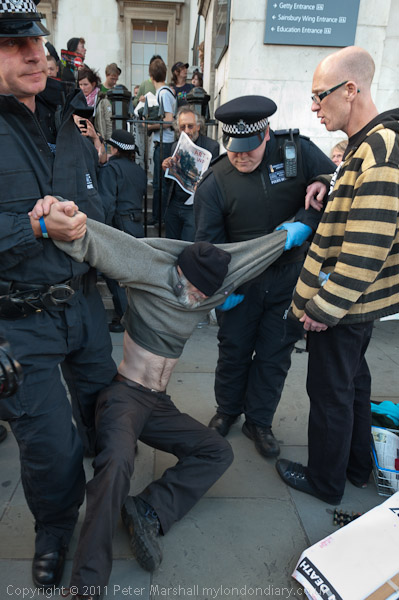
The protest developed, with a struggle going on with police to clear the steps, for some minutes by persuasion and then, after reinforcements had arrived, by force, which was more effective. There were some angry scenes as one or two protesters were dragged away to police vans from the steps, while others staged another die-in on the pavement and I ran back and forth trying to record both.

© 2011, Peter Marshall

© 2011, Peter Marshall

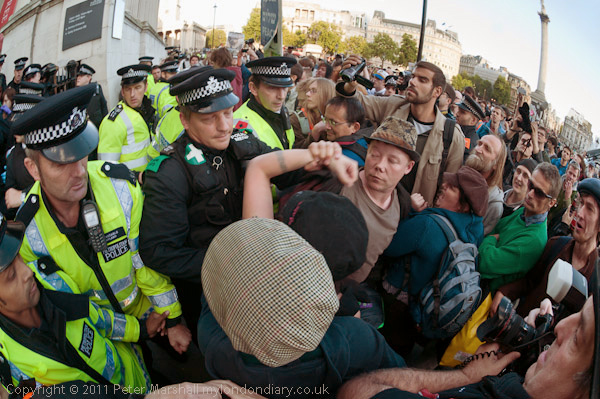
Then more officers still arrived, and one or two of them, including a senior officer, started to get very physical.

© 2011, Peter Marshall

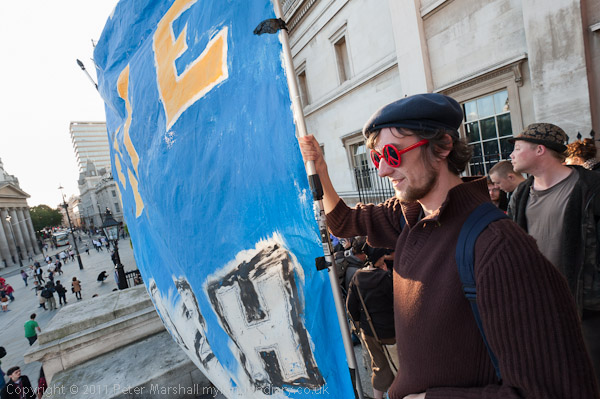
It is the kind of situation where to see anything you have to be very close (or very tall, which I’m not.) And very close in a crowd the 10.5mm can work well. Here I’m holding it up in the air at arms length to get pictures; with experience and checking on the rear screen it is possible to frame things with some accuracy, although there is still an element of chance. I wanted to put Nelson in the top right corner, and in this frame at least I more or less got him there. But the 10.5mm is a rather vulnerable lens, as it cannot take a filter, so does need a little care.

Most of the time I was photographing this fracas I was working with the 16-35mm, a nicely solid (but over-large) professional lens, which can take quite a bit of rough handling (and I’ve been through several filters on it.) It’s main weak point is the lens hood, and frankly the Nikon lens hoods are all pretty useless, flimsily made with an under-engineered bayonet mounting.  One small tap and they either fall off completely or move around, producing vignetting at the corners. So of course it happened in that crowd, and I didn’t notice it until too late, working very much in the heat of the moment. I’ve cropped most of the pictures to remove as much of the vignette as I can, but you can still see it on some of the images.

© 2011, Peter Marshall

If you should lose or break your Nikon lens hood, don’t pay the arm and a leg Nikon ask for these few pence worth of plastic. The cheap replacements available on eBay are in my experience slightly better made and look as good. Of course they still suffer from the same Nikon fixing problem.

More on the event and more pictures at Arms Fair Fracas At National Gallery.