Last Saturday Everything Was Happening

People sometimes think that photography isn’t work. My wife for one, and in some ways I agree with her, and it’s certainly great to do things that I really want to do and sometimes at least get paid because people want to buy the pictures or publish them.  But I actually find it can be pretty exhausting, both physically and mentally.

My camera bag isn’t that heavy, though non-photographers I hand it too usually wince a bit at it’s weight. A couple of camera bodies, three lenses, flash, little oddments like spare batteries, lens cleaning stuff, remote release and then the kind of necessities of life – a bottle of water, umbrella, sandwiches,maps and a paperback to read add up, together with the bag itself to perhaps around 7-8kg  (around 15lb for non-metric readers.)  At the start of the day I can hang it on my left shoulder and hardly notice it. But by the end of the day it does drag a little.  It perhaps doesn’t help that I only have one shoulder, probably a legacy from my rugby-playing youth; not only does my right side just kind of slope down with little on which to keep a bag in place, after a minute or so the pain reminds me that it really isn’t a good idea to try.

Many photographers now use  back-packs. Certainly easier on the shoulders, but they can be a real pain to other photographers if you are working together in tightly packed situations. And though I don’t do a great deal of lens-changing, it is rather easier from a bag than a back-pack, even the kind that swivels around the body.

As usual I digress.  What I wanted to say was that Saturday was rather an exhausting day for me, one that reminded me I’m getting older. But also one that demonstrated again why London is a great place to work, particularly if you want to photograph protests and similar events. Possibly the nine I photographed was something of a personal record for a day (discounting such multi-events as the mass lone demos  orchestrated a few years back by Mark Thomas against the ridiculous limitations on protest imposed under SOCPA.)

And even so, there were other events taking place I was sorry to miss. Some because it really is impossible to be in Downing St and Belgrave Square at the same time  (had I taken my bike with me I might almost have made it, but probably it would have been stolen earlier while I was photographing on Oxford St.) There was an interesting walk in the East End that was truly out of the question. There are also some events where you really have to stick with them as things unfold, and others that are pretty static and at least visually can be summed up in a few minutes.

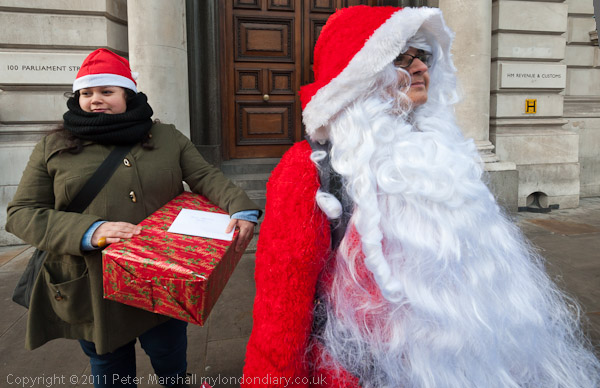
My photographic day started in Parliament St, which as the name suggests is very close to Parliament, and is what most people think of as the bottom end of Whitehall just off Parliament Square. I’d been told that there would be lots of people in Santa costume there at the head office of our tax people (Her Majesty’s Revenue and Customs – HMRC) who’ve lately been letting some big companies get away with not paying billions they owe in taxes, and of course they and the guys across the square in parliament make sure there are plenty of loopholes for them and their rich friends to creep through. If you are poor (or even in that ‘squeezed middle’) you pay taxes; if you are rich you pay accountants.
© 2011, Peter Marshall

I arrived a little late, but just in time, to find one Santa and two helpers approaching the very impressive but firmly closed door.  The protesters were just outnumbered by the four photographers, but more massively by the police, with a FIT team taking pictures and others standing around and sitting in vans, but not interfering with the protest at all.  We took our pictures (there wasn’t really a lot to photograph as you can see) and left.

I had a little time to kill before the next protest, and as usual when I’m in the area I went across to talk with the protesters in Parliament Square, but they were still asleep so I didn’t disturb them, but walked around the square (still fenced off from the public – one of London’s minor scandals – and with a couple of guys paid there to sit inside the fence all day and do nothing) and then back up past Downing St to Trafalgar Square, finding nothing much happening at either location.

The great thing about free entry to museums and galleries is that you can wander in to the National Gallery on the north side of the square (or the National Portrait Gallery just a few yards around the corner) and spend say ten or fifteen minutes looking at a couple of your favourite paintings or perhaps finding something new, and I quite often do when I’ve time to spare.  But time was getting on and I decided to get to the next location, so got on a bus to take me to Oxford Circus.

Another photographer was already there waiting opposite Topshop, and he told me that just a few minutes ago he had seen Bruce Gilden taking pictures at Oxford Circus, followed by a group of people, perhaps some kind of photo workshop. So having mentioned him in a post recently, I took a little walk looking for him (the flashes should have been easy to spot) but didn’t find him, and returned to Topshop.

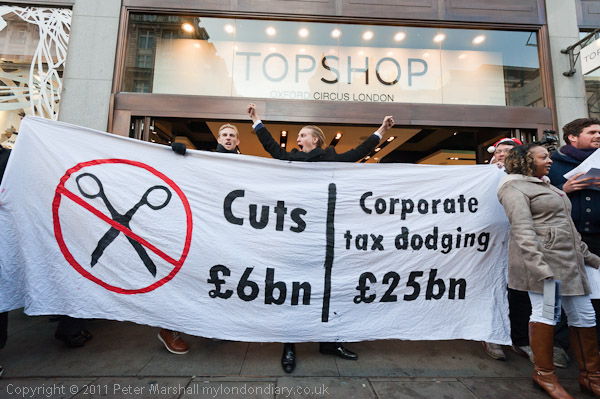
Waiting outside there with another photographer, one of the higher ranking police officers came over to talk to us, telling us we would be allowed inside the store to a designated press area for the protest that was timed for 1pm. Around 15 minutes earlier I decided to go into the store, simply walking past the heavy security there with my two cameras on my chest as usual – and I don’t think they noticed.

But inside the store I decided I was unlikely to get much chance to take photographs – and the police officer had been talking absolute bullshit. So I left the store a couple of minutes before the protest occurred, knowing that there would also  be a protest outside that I could cover. I’m not sure it was the right decision, but it did avoid trouble for me. Some other photographers who had also simply walked in past the security did get some pictures, but they were almost immediately either illegally assaulted and “arrested” for aggravated trespass by security staff or escorted out of the store (as I was three years ago when the Space Hijackers protested there.)  Police did quickly arrive and “de-arrest” the photographers (and arrest the protesters) and they should be able to go to court to get compensation for their treatment.
© 2011, Peter Marshall

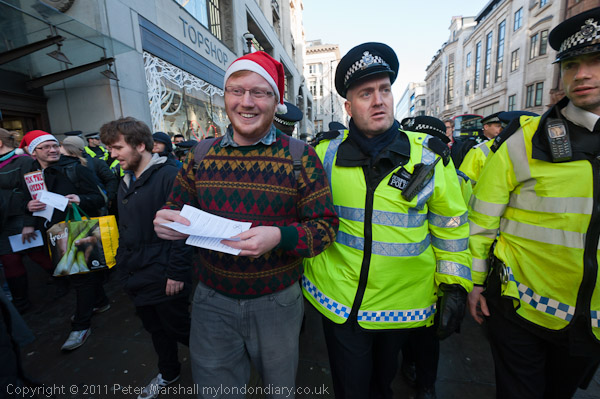
Outside the shop, there were rather more demonstrators (including some who had been inside but left immediately when requested, but later we were told six had been arrested) and the protest continued for a few minutes before police decided to clear the pavement. They told the protesters that they were committing an offence by obstructing the highway, then proceeded to obstruct it even more effectively themselves for rather longer!
© 2011, Peter Marshall
Police were pushing the protesters to clear the pavement – then blocked it themselves

The protest continued for some minutes longer on the road and then on the opposite pavement, and it was a very confused situation, with crowds of shoppers mixing with the protesters, many of whom were taking the opportunity to give out leaflets explaining that the protest was taking place because Topshop avoids paying its proper share of UK tax.

It’s a situation that few people think we should tolerate, and one that the actions by UK Uncut have put firmly on the political agenda. Even the Conservative Party are having to take tax avoidance seriously despite representing so many who profit from the current failures of the system to collect tax fairly. Gradually more and more people are coming to realise that the amounts involved in tax evasion and tax avoidance are truly massive, dwarfing the losses to the country from illegally claimed benefits that get so much publicity in the right-wing press.

Soon it became clear that most of the protesters had melted away, and it was time for me to run along Oxford Street to where I knew their next protest would be.

Continued in another post

Shooting Under Fire

Shooting under fire gives a disturbing picture of the dangers faced by photographers around the world, too many of whom get killed or wounded covering the news.

After you’ve looked at t he pictures, you many also want to look at the web pages of the Committee to Protect Journalists, where on the front page it informs you that 43 journalists have been killed this year so far, and 890 since 1992, 556 “murdered with inpunity” and that 179 are in prison worldwide.

The CPJ, an independent, non-profit organization, was founded in 1981 and promotes press freedom worldwide by defending the rights of journalists to report the news without fear of reprisal. They also have a very useful Journalist Safety Guide on working in hazardous situations, which can also be downloaded as a pdf.

In the UK, events are seldom life-threatening, although photographers do get assaulted, injured and threatened. But the only image in the 39 in Shooting  Under Fire shows a football photographer at Anfield kitted up for working in driving rain. Uncomfortable perhaps, but hardly in the same league.

How To Steal Like an ARTIST

Thanks to duckrabbit for letting me know about How To Steal Like an ARTIST, in which Austin Kleon, a writer and artist from Austin, Texas, and author of the two books, Steal Like An Artist and Newspaper Blackout,  reveals and explains “10 things I wish I’d heard when I was in college.

It’s a useful list and a clear and amusing presentation of some very good advice. But you really need to read it rather than read me writing about it. But I’ll just steal one little bit, where he talks about what you learn from a couple of guys you may have heard of who decided they were going to be artists (and later Patti Smith wrote about it.)

Patti Smith and her friend Robert Maplethorpe dress up in all their gypsy gear and they go to Washington Square, where everybody’s hanging out, and this old couple kind of gawks at them, and the woman says to her husband, “Oh, take their picture. I think they’re artists.” “Oh, go on,” he shrugged. “They’re just kids.”

Of course neither Austin or I suggest you should all dress up in gypsy gear and nip up to Washington Square, but as he says “Fake it ’til you make it.” And read his post to find out more. Mapplethorpe never became one of my favourite photographers, perhaps because I always felt he was faking it, but he certainly made it so far as the art world was concerned.

And when you get to the bottom of the page there are other things to explore, including a page of some great quotes on ‘stealing’, a few of which may be familiar.

Christmas Cards

When I followed a link from EPUK to a page of the worst 53 family Christmas cards (French text), my first thought was of the image selected by David Cameron for his card this year. While I wouldn’t want for a moment to be rude to the photographer, who I’m sure didn’t take it to be used as a card, the image by Stefan Rousseau does seem a little close to those included in that list, most of which came from another site, BuzzFeed, in a feature The Most Awkward Family Holiday Photos,  who credit most to the  awkwardfamilyphotos site, which has quite a range.

Of the three main party leaders, the one who wins my vote for his card is definitely Nick Clegg, who used a drawing by his kids. Miliband’s family snap, again by Rousseau, is a nice happy family snap, though considerably dragged down by a border of Xmas clip art.

It’s a long time since I felt it appropriate to send out a family picture as a Christmas card, and the only time I can recall doing so, it was a very straightforward and old-fashioned group, more or less one that could have been made as a daguerreotype, and its circulation was restricted to other family members who might have had an interest in how the kids were growing up.

Photographer’s Christmas Cards, sent out mainly to other photographers and possibly clients, are a good opportunity to use your own work, though most of mine have not been even remotely Christmassy. I’ve kept quite a few that I’ve been sent over the years, and have often threatened to post a selection of them on the web.

This year I’m sending a postcard with a detail of one of the images in the Secret Gardens of St John’s Wood show which I just happen to have around. The full image would have been better, but has an aspect ratio that doesn’t fit a standard postcard well.  Just so that no one feels left out if they don’t get a print copy, here is the full image now:

© 2011, Peter Marshall
Garden in St John’s Wood, May 2011 (rt click and select ‘view image’ for larger)

Some years I have tried harder and found a suitable Christmas theme in an image. Here are some that I’ve used:

© 2008 Peter Marshall
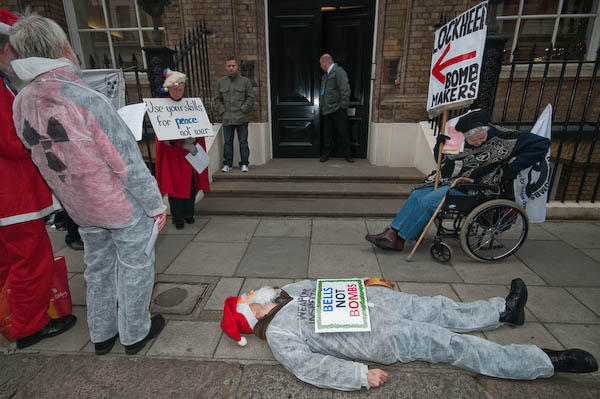
The Muriel Lesters protest at offices of bomb makers Lockheed, Dec 2008

© 2005 Peter Marshall
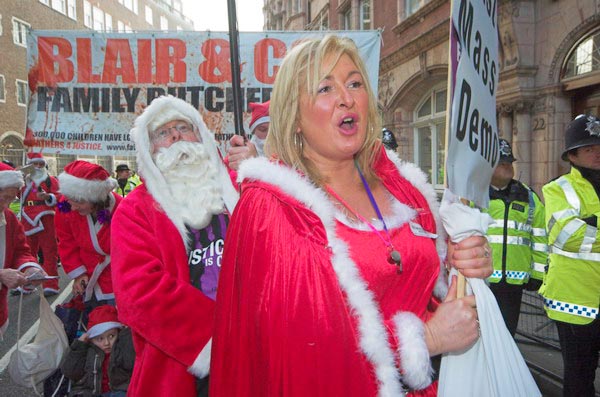
Santas protest at Church of England and Dept of Education & Skills, Westminster, Dec 2005

© 2006 Peter Marshall
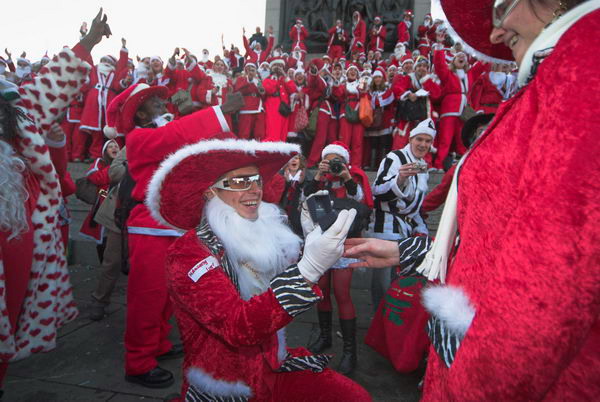
Santa proposes to Santa, Trafalgar Square, Dec 2006

(I can’t remember now which of the dozen or so images I have that I used of the Santas engagement in Trafalgar Square. There is a different one in the 2006 book.)

Press Freedom In Court

This morning, NUJ London Photographers Branch member Jason N Parkinson is in Chelmsford Crown Court along with BBC, ITN and Sky News resisting a production order application by Essex Police to hand over all his footage taken during the Dale Farm eviction on 19 and 20 October this year.

It is a vital case for the freedom of the press, as Jason explains very well in his post on the LPB web site. Jason is there with full backing from the National Union of Journalists (NUJ) and legal support from Bindmans Solicitors. Several fellow branch members are in court to observe the proceedings, and have been allowed to Tweet from the court – and I am following these on #productionorder as I write this. At the moment the court is being shown some of his published footage.

Press freedom is vital for democracy, and under threat from various directions here – including at the Leveson inquiry. The case also demonstrates how vital it is for photographers (including videographers) to belong to a union which will support them personally as well as fight for the principles involved.

Stop The War: 2006-2009

These are the final set of my pictures that went into the final edit for the Stop The War book, several of which were used. There were probably more pictures sent in for these later years, although I think the coverage of them in the book is weaker.

© 2006 Peter Marshall
November 2006, Whitehall

© 2006 Peter Marshall
November 2006, Downing St

© 2006 Peter Marshall
November 2006, Whitehall

There were three pictures from the wreath-laying by military families on Remembrance Day in November 2006, with Rose Gentle and others laying wreaths. They weren’t actually my favourite images from the day, but ones that I thought represented the event better – I think my best work concentrated more on the people involved.  Two of these in particular I think are critically dependent on being in colour, making use of the wreaths of red poppies. Take away that foreground wreath in the lower image and you are left with a very ordinary view of a line of people that would certainly have ended in my reject bin.

© 2007 Peter Marshall
February 2007, Hyde Park

© 2007 Peter Marshall
February 2007, Trafalgar Square

© 2007 Peter Marshall
March 2007, Parliament Square

© 2008 Peter Marshall
March 2008, Hyde Park

© 2008 Peter Marshall
Jan 2009, Kensington

Stop The War – 10 Years‘ is I think an important book about an important subject, and one that is in general terms a very handsome volume, with some superb art work and some pretty decent snaps. One that I’m sure many people will buy and enjoy. It’s a book that I’m pleased to have my work in, although I wish some of the images had been treated with greater respect and sensitivity; a couple in particular were used so badly that on looking through the book I actually failed to recognise them as mine.

In some respects – as might be expected – this is a very political book, one that treats its subject from a particular sectarian viewpoint, and one which is not shared by all who took part in the events it depicts.  As well as the stories it tells there are also people and stories missing from its narrative almost as if by a Soviet ‘airbrush’ ; ‘Stop The War’ was a coalition but one largely dominated and driven from a particular perspective which was only a part of a wider anti-war movement. In some ways my own files over the period tell a fuller story, and perhaps one which may emerge before too long on Blurb.

Many other photographers also produced notable images of some of these events. Some have told me in no uncertain terms that there was no way they would donate their work to ‘Stop The War’, who on at least one occasion generated a photographers’ protest, when along with others I sat down on Park Lane in front of one of the march, disgusted at the treatment of photographers by the march stewards, demanding that we be allowed to work.  Along with other photographers I’ve been pushed, threatened and assaulted on various occasions by ‘Stop The War’ stewards (and often had others apologising to me for the way I was treated) and I once narrowly avoided serious injury when sent flying backwards.

This is also a book that records and celebrates what was a failure. We didn’t stop the war. Despite getting millions out a a march and the support of a majority of the British people. Despite fighting speeches at events by Tony Benn and some others, ‘Stop the War’ failed to think and act in a radical fashion at the critical times and seemed locked into outdated modes of action; ‘Stop The War Dinosaur‘ when we needed ‘Stop The War Uncut‘. It was a battle where we had the support of the people and we could and should have won.

Michelle Sank & Mary Turner

Yesterday evening’s Photo-forum, a monthly meeting “for working photographers across the spectrum to bring images, ideas, photo stories, approaches and work in progress for supportive debate and criticism” was a very special event, although not as well attended as most.

Of course we are coming up to Christmas, and there are many parties and other Christmas events taking place – there seem to be even more than usual this year, perhaps in some kind of reaction against the financial austerity. The weather wasn’t too great either, though London was nothing like Scotland, where people were being advised to stay home. Perhaps if I hadn’t have been coming up to London for a meeting earlier in the day and hadn’t known who was speaking I might have stayed home.  There certainly was a powerful wind, and as I walked past the Occupy London camp at St Paul’s in mid-afternoon some tents were getting blown away and people were struggling to keep some of the structures up. And term had probably ended for some of the students who boost the audience whenever well-known speakers appear.

The format of Photo-forum is a simple one, with two photographers showing their work on the screen and talking about it, one before the interval and one after, often with some interesting questions and debate. It’s also a great opportunity to meet and talk with other photographers, both before the meeting, in the interval and especially afterwards in the pub, where we eat the free food paid for by a raffle drawn at the end of the evening for prints of the speakers’ work.

I’ve long been aware of the work of Michelle Sank, and have written about it here and elsewhere on several occasions, but it was good both to see a wider range of her work, as well as to hear her talking about it and her passion for photography. She also has a very fine web site, which again I’ve mentioned before, on which you can seem almost all of the work she showed last night, and which shows her various projects in depth.  The site is a model of simplicity, clean, elegant and generous in making her work available.

Her practice is perhaps rather different from most of those in the audience, with art institution and gallery commissions enabling her to pursue what remain her very personal projects, but its social documentary aspect certainly makes it far more accessible and worthwhile to most working photographers than some things that appear on photography gallery walls, and I think those who had come to the event with little if any knowledge of her work were very impressed by it.

When I first saw her work around ten years ago, it stood out from what at the time was a host of new portraiture often with similar subject matter, including some by already well-known and much touted art-world photographers, because of the strong empathy between the photographer and the subjects. Clearly these were social documents as well as portraits and were made with a concern for the wider issues involved, and this was something that came out clearly in her comments as she showed the work.

Mary Turner‘s pictures often appear in ‘The Times’, but what she showed at Photo-forum was clearly something in which she had a strong personal involvement and interest. Unlike the typical news photographer (and many of our best press photographers are unlike the typical news photographer) she did not ‘jet in’ to Dale Farm for the highlights, but worked with the people living there from 2009 on, and is still following them now.

Although I only visited Dale Farm briefly on one occasion (and was very aware that I was not covering the story there in any depth), Turner’s pictures of the travellers in their vans reminded me very much of my earlier experiences, before I started taking pictures, of working as a student to defend travellers in Manchester against evictions and harassment by the local council.

Turner got to know some of the travellers extremely well, so that she and her camera became accepted as a part of their normal life, and her pictures display a great intimacy, as well as the lack of illusions about their lifestyle which she also made apparent in her sometimes laconic commentary. Her mainly wide-angle views of them both inside the trailers and outside on the site appealed strongly to me.

As well as the roughly 60 pictures from 2009-2011 which include some from weddings and other events off-site, she was also there for the ‘Last Days at Dale Farm’ shown in another set of images, where again her relationships with the travellers and the access that this gave her to their private lives makes her work stand out from that of other photographers, particularly in showing the reactions of the travellers to the eviction.

Like the others present on the morning of the invasion by riot police, she too has a picture of ‘Minty Challis, an activist and supporter of the Travellers protests against their eviction, October 19th 2011‘  holding up a crucifix in front the the blazing wreckage, and it is one of the better images from this ‘photocall’ for showing more of the scene, although probably much of the tighter cropping in the other images published was made by editors rather than photographers. But it was the next picture in the sequence, a darkened silhouette of people on a roof looking down towards the fire, the sun breaking through under dark cloud and a menacing row of gateposts at the left, like robots advancing inexorably on the site that I found more dramatic.

Turner’s pictures are a fine record of a way of life, and also of the destruction and the lawlessness of Basildon Council, bailiffs and police, ignoring the legal niceties and protections laid down by the courts in carrying out this eviction at huge public expense. They also make clear the nature of the site, laying bare any of the arguments that the long campaign made any sense in terms of planning law.

Although media interest largely disappeared after the dramatic events of October 19, the story is not yet over, and Turner is continuing to visit the travellers and record what is going on, and there are likely to be further developments after Christmas. Perhaps at some point a determined investigative reporter (unless Leveson outlaws them) may uncover the true back-story behind what seems to be Basildon Council’s determined long-term racist vendetta against Dale Farm which would provide an ideal text to accompany a book of these pictures.

If you are a working photographer based around London and don’t know about  Photo-Forum it really is worth finding out more – and you can eamil the address on the web site to be put on the mailing list to be sent a couple of emails every month reminding you of the meetings, which take place on the second Thursday of each month in Jacobs Pro Lounge in New Oxford St.

My only regret about the evening was that I wasn’t one of the winners of the raffle.

Digital Etiquette

Photo-Attorney Carolyn E. Wright is someone whose advice on her blog I’ve often referred to in the past, both here and elsewhere, but I can’t remember hearing her voice before. Recently on her blog she posted a link to Don’t Post Pictures of My Kid on the Internet, Part 2, a programme in the Digital Manners podcast series on Slate, where she tells the two presenters what the legal position is about photographing people – including children – and posting pictures of them on the web.

As she says, there are minor differences in the law from state to state, but the advice that she goes on to give is clear and I think also would apply in this country. The key test is a “reasonable expectation of privacy”, and if this is absent, then you are free to make use of images for ‘editorial purposes’, which would cover posting to Facebook or on your web site etc, in fact more or less anything outside of advertising or product endorsement.

From what she says, I think UK courts have sometimes shown a slightly less wide interpretation of the “reasonable expectation”, but at the moment the position here is similar.

Some of those giving evidence to Leveson or commenting on it have called for the kind of aggressively restrictive privacy laws that would effectively end our right to photograph people without express permission, and there are certainly people who think that is already the case particularly so far as children are concerned, but it isn’t so.

The Slate site also has a poll, and if it is still open you will need to vote to be be shown the results. Although I was pleased to find that my own view was in the majority, the size of those voting ‘No’ to the question “According to the law in most states, anyone is free to photograph you in public and post it online—all without your permission and over your objections. Are these laws correct?” was a little worrying.

This was the programme’s second discussion on the issue, and took place because there were complaints from some listeners about the answers they gave in the first, which was backed up by Wright’s exposition of the law.

Photomonth’s Photo Open

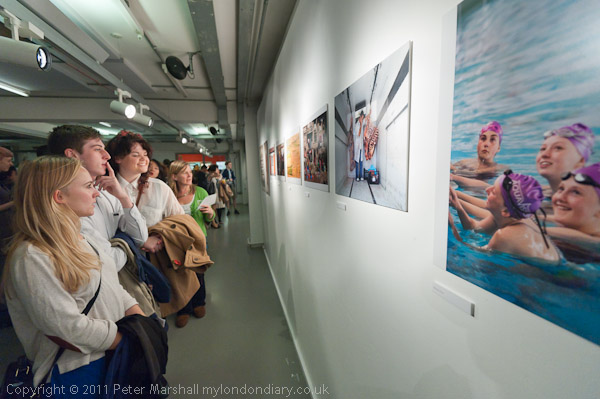
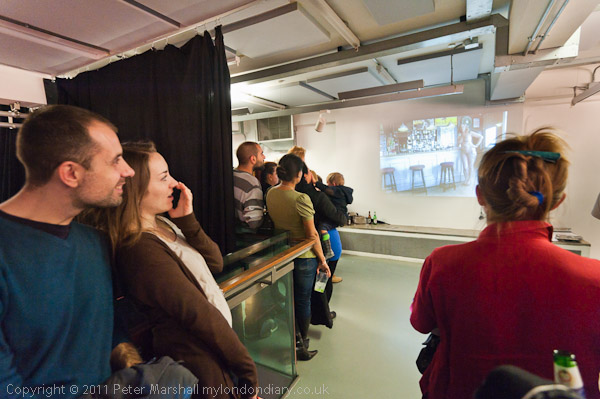
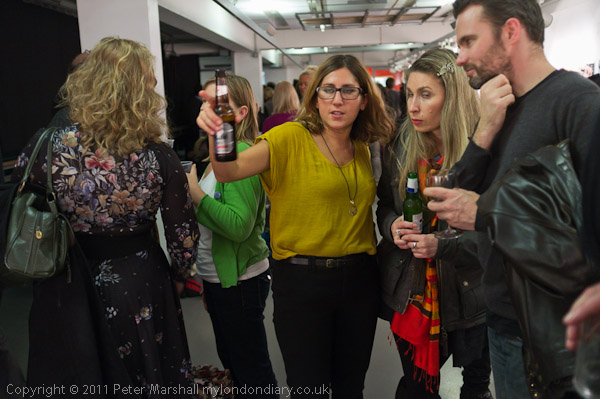
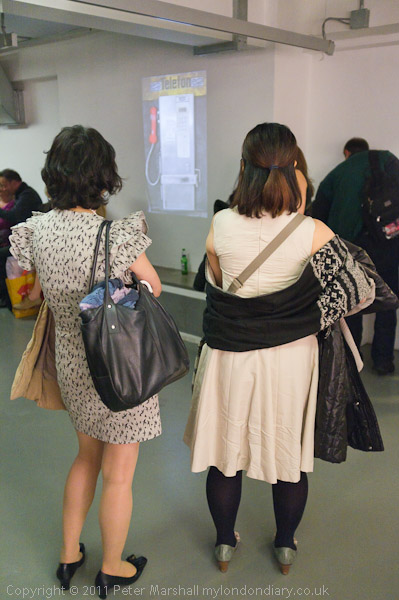
Finally I’ve got around to putting the some of the pictures I took on November 3 at Rich Mix in Bethnal Green, where the East London Photomonth was holding its open exhibition, the Photo Open,  and also having a party, though I left before that got started.

The Photo Open is a completely open show, “open to all kinds of photographers and exhibits a wide range of subjects and approaches” with a small fee (£10 / £5 for concessions) for each image submitted. All of the images sent in are projected as a part of the show, with a relatively small number – around 20 or 30 – selected to be printed and put on the wall. The show is sponsored by theprintspace, who make these prints.

I’d taken both the Fuji X100 and also the D700 with me, as I was calling in at St Paul’s Cathedral to  photograph OccupyLSX there on the way to Bethnal Green. Unfortunately it had started to rain just as I arrived there and I’d only taken a few pictures, not actually getting out the Nikon which I had intended to use while I was there.

I’d thought the Fuji would be ideal if I wanted to take a few pictures at the  opening of the Photo Open, mainly with the idea of posting some here – as I did  here in Photomonth Photo-Open 2011 on November 4th.

At the time my computer was broken and away for repair, and I was relying on a fairly ancient notebook with very limited software, and in particular not enough memory to either run Lightroom or Photoshop. I’d set the Nikon to produce jpegs as well as RAW files, and relied on an ancient copy of ACDSee and image editor FotoCanvas to process the Fuji RAW files.

Now that computer is back, though it’s just died again, but I have a new one, and have just processed the RAW files and put a larger set of the images from the evening on My London Diary.  Its perhaps interesting to compare a few of the images:

© 2011, Peter Marshall

© 2011, Peter Marshall

Of course there are choices that I’ve made to present the images differently, and in particular to make the images rather brighter and cooler, but the upper images of each pair more or less reflect the jpeg that the D700 produced.

© 2011, Peter Marshall

© 2011, Peter Marshall

The last images I’ll post are from the Fuji.

© 2011, Peter Marshall

This is an image processed by Lightroom, and I didn’t use any from the Fuji in my original post here on Re:PHOTO. But what I can show you is the difference between a file saved from the RAW image in Irfanview and below it one processed in Lightroom. The Irfanview file was quite a bit darker, so I’ve adjusted the levels in Photoshop to be similar. By mistake these are adjacent files, but very similar, taken within seconds at the same camera settings.

© 2011, Peter Marshall

© 2011, Peter Marshall

I’m not quite sure what this proves, though perhaps it does show why I like to work with RAW files and use Lightroom.

Stock Gone To Pot

Perhaps time for a little amusement. I find it hard to credit the warped ingenuity shown by some photographers. Imagine the trouble some have gone to setting up some of the most unlikely stock photography imaginable. Or perhaps beyond the imagination.

60 Completely Unusable Stock Photos is a good introduction, and for more there is a site devoted to the genre, AwkwardStockPhotos. But having looked at all 60 I wasn’t sure whether to comment WTF or OMG, though WTF seems the most popular response.

Surely some of the photographers involved must sit around making up silly pictures just to try and get featured there. Surely they cannot be serious! Though if you read some of the comments made in the 8 months or so this page has been around, some of them have actually been used.

Stock is a strange world, and some of the pictures that seem to sell best are truly boring images that no photographer with any sense would dream of making, rather than some of the bizarre concepts here. If you contribute to stock and it doesn’t sell well, I think you can always console yourself as I do with the thought that it’s because your pictures are too good!