RIP Kodak?

Load the BBC World service ‘Newshour‘ for  05/01/2012(2100GMT), click on ‘Listen now‘ to load the player and  then drag the slider to 49.07 and you can hear a short piece with Graham Harrison (look at the 10 pictures on Kodachrome 64 pushed one stop) talking about the history and demise of Kodak.

The gist of what Graham says in this short interview is in his blog post ‘Kodak’s Last Frame?‘ in which he comments on the likely end to the few remaining Kodak films with the Kodak Corporation being expected to file for Chapter 11 bankruptcy protection some time in the next few days. It’s major assets which it is trying hard to sell, are now a number of patents on digital technologies.

Graham’s conclusion in the programme was that “Kodak was too big, not fast enough to adapt to digital” although I think that its problems go back rather further. Having invented photography for the masses and the great slogan “You press the button, we do the rest“, they retained throughout their history the complacent assumption that they really knew how to do the rest better than anyone else. Photography was after all their baby. *

And, as Graham went on to say, they did produce some great films which gave fabulous looks – particularly Tri-X, Kodachrome and, his own particular favourite, Ektachrome 64. On the blog he writes they “gave photographers a wonderful but limited pallet within which to express themselves” which gave me a very strange image involving fork lift trucks – I’m sure it was down to  the spell checker. What he said and meant made more sense, that they had “a limited palette, but within that palette you could be very creative.”

Digital he went on to say is without the limitations of film, but that makes it harder to find ways to be creative with it, and he suggested it hasn’t happened yet.

While I’m very much in agreement with what he says about it being pointless to try and re-create a film look, I’m not sure that I agree with his suggestion that you “have to grasp the new medium and produce something new with it.” To me the great thing about digital is the purity, the naturalness of digital colour, and what really annoys me is when people Photoshop that to absurdity rather than accepting its own neutrality and working with it to make pictures. Colour has become in a way transparent, something we don’t need to worry about in the way we used to with film. It is now after all more or less how we see things. It’s perhaps too why I seldom now feel the urge to work in black and white.

For thirty years I did work mainly in black and white, with colour really being a little extra on the side. In the early years Tri-X was my favourite film, though I also liked the rather smoother look of Ilford’s FP4 and flirted with the almost grain-free detail of slow document films like Kodak Technical Pan, exposed at silly two-figure ISOs and developed in special soups for pictorial contrast.  Then along came chromogenic films, introduced by Ilford, which gave low grain and smooth tones at ISO 400 and made that splendid Tri-X grit a special effect rather than a necessity.

Kodak were slow to respond, though eventually they emulated Ilford’s lead. In printing papers too, Kodak had largely exited the specialist market,  discontinuing all their specialist materials leaving only rather ordinary products for the mass market; those of us interested in fine prints made them on Agfa paper, with Ilford’s Galerie and Multigrade later providing an alternative.

In colour, Kodachrome was king when I started, but in the mid-80s I jumped ship to the much more neutral colours and wider latitude of Fuji’s colour neg films. It wasn’t just the film, but also the Fuji colour paper, again with its cleaner colours and almost zero colour shift on burning or dodging.  Fuji had done its homework on print life too, and produced considerably more permanent prints (as previously had Ilford for printing from transparencies with the very different Cibachrome) than the Kodak papers with their guaranteed fading and browning.

Perhaps it was the efforts that Kodak had to make to catch up with the superior films and papers from other manufacturers – and in the end they more or less did so – that made them take their eye off digital. But I think it was more that they were always essentially a materials company, and with digital the lead went to the camera makers – you didn’t need film any more.

Kodak had got an early start with digital, but really needed to buy in modern camera expertise and that didn’t seem to fit the way the company worked. They ended up making some very good sensors and selling them to people who knew cameras – including Leica, Nikon, Canon, Hasselblad etc. It was a true measure of the company’s desperate state when that successful part of the business was sold to Platinum Equity in November.

There are still people working with film. I’ve got old cameras I still would like to use sometimes – like the Hasselblad Xpan (and its 30mm lens), but somehow I never get round to it. Silverprint still list black and white films from 10 manufacturers, so the loss of one is perhaps not a great problem, but with colour it is now more or less down to Kodak and Fuji. But since Kodachrome ended with Dwayne Steinle processing his pictures of “his house, his family and downtown Parsons” on 29 Dec 2010, Kodak have hardly been a player.

_________________________________________________________

*Perhaps I should declare an interest. Kodak failed to offer me a job when I went to Harrow for an interview in 1966 as a research chemist because they felt I didn’t have a serious interest in photography as I didn’t belong to a camera club.
30 UNDER 30

This is the third year of ‘30 UNDER 30 Women Photographers‘, and as in the previous years it includes some interesting work. For me the highlight was the work by Paula Gortázar*, a Spanish photographer based in London. After taking a law degree and a graduate diploma in business administration in Madrid she completed post-graduate studies at the Central St Martins before going on to an MA at the University of Westminster .

There are others whose work I find of less interest, with rather a lot of work that might be described as ‘art school attractive’ with an almost complete lack of documentary or photo-journalistic content. Although it is pleasant to look through and does include some interesting imagery it does seem a rather one-dimensional selection of work by women, and one that might be seen as reinforcing stereotypes about women’s photography. This is not of course in any way to criticise the work presented, but merely to point out that women photographers cover a much wider range of practice than is displayed here, indeed across the whole of photography.

As well as whole areas of practice, there is also a distinct lack of information on the site, and clicking the INFO link is am almost complete disappointment.  All it tells us is that the site is an ongoing project of the Artbox, “a Design + Communications Studio based in New York + Paris specialising in Interactive Media & Web Site creation” which has worked with “agencies on big brand campaigns as well as with individual artists to create compelling portfolio based web sites” and that its creative director is Mathew Hong, but says nothing about the criteria or selection of the 30 women for the site. Are the photographers simply chosen from those for whom the Artbox has designed web sites or is it a more open event? It would be nice to know, and the absence of any information makes us suspect the worst.

The information about many of the photographers is also very limited in some cases (and non-existent for one of them) and entirely lacks what is surely the essential piece of information – a link to their web sites – a rather surprising lack from a web design studio.

30 UNDER 30 is obviously based on the long established PDN 30, their prestigious annual “Choice of New And Emerging Photographers to Watch” which received nominations from roughly 70 named leading professionals in the business around the world, quite a few of whose opinions on photography even I would respect (though a few I think are firmly in the land of the Emperor’s new clothes.)  I couldn’t download the PDN gallery when I tried this morning, but you may have more luck with PDN’s flash site, which I did look at carefully earlier in the year (and it was working again this afternoon.)

But you can also find a list of all the 30 photographers (including a dozen or so women none of whom I think caught Mr Hong’s eye), with links to their web sites which was posted by A Photo Editor last March when the list was published, and which I mentioned at the time. The comments on that site are also of interest.

___________________________________________

*Some of Paula Gortazar’s work was included in a show by recent alumni of Central St Martins shown at the Protein Gallery as a part of the 2011 Photomonth in East London – her image on the Photomonth Gallery mosaic is from her ‘Common Spaces’ series. You can see more of her work including a documentary section from which a few pictures do appear on ‘30 Under 30‘ at her own web site.

Soth on Adams

One of several posts I’ve been reading that have severely delayed me getting down to my own work this morning was Moving forward, looking back by Alec Soth on his Little Brown Mushroom blog. In it he takes a look at the book which most changed him as an artist in the past year.

His choice is ‘Prairie’ by Robert Adams, a small volume that came out in 1978 and was reissued with a different cover as “a new expanded edition” in 2011, with an essay by Eric Paddock and around a dozen extra pictures. At $35 it perhaps seems expensive for such a slim paperback volume, but it is described as “a future collector’s item.” The tritone reproductions are probably superior to the original clear and precise Rapaport printing, and although I can’t remember how much this cost me in 1978, the cheapest secondhand copy I found in a short online search was now $230.

If you don’t own the original, I’d certainly recommend buying the new, though as a volume that may expand your own horizons rather than an investment opportunity.

Soth homes on on the way that Adams uses repetition – and the three examples he gives are also in the original work, produced in conjunction with an exhibition at Denver Art Museum, although in the third pair the two images have changed places. Soth talks about “use of repetition to quietly investigate time and perception“, though I think in the third it is perhaps more about viewpoint.

‘Prairie’ was I think the third Adams books I bought back in the 70s, after the weightier ‘The New West‘ and ‘Denver‘ and I think in some ways one of my favourites. It’s smaller size and fewer pictures make it easier to get to know. But all were good investments, both in terms of my own work and their current value.

Hetherington’s Last Post

Another superb Duckrabbit post Tim Hetherington’s last photos and their presentation on the Guardian, which together with some interesting and informed comments explores pretty fully the kind of rather unformed misgivings I’ve had about this and several other features on war photography over the past year or so.

It’s worth too taking the time to watch the almost 15 minutes of video on the page, made by Tim Hetherington and Sebastian Junger, where Staff Sergeant Sal Giunta of the 173rd Airborne tells his own story of the events in  Afghanistan’s Korengal Valley which led to him being the first living Medal of Honor recipient since the Vietnam War.  There are also more clips about their movie ‘Restrepo‘ on YouTube.

Restrepo was shot entirely in the Korengal Valley, focussing on a 15-man outpost which gives the film it’s name -and which was named after a medic killed in action there at what was considered one of the most dangerous military postings. Hetherington and Junger’s statement on the front page of the movie site includes this:

Our intention was to capture the experience of combat,  boredom and fear through the eyes of the soldiers themselves… Their experiences are important to understand, regardless of one’s political beliefs. Beliefs are a way to avoid looking at reality. This is reality.”

New Year Honours

Definitively the most heartening list of the year end was described in The Guardian as the “impressive list of the great and the good, packed with scholars and sportsmen, authors and artists” who have for various reasons snubbed our outdated and discredited honours system, long used by both parties when in office to reward nonentities for long service to the party or donations to the cause, along with a smattering of those who deserve public recognition and assorted celebs tagged on in facile attempts to improve the party image.

The list, prepared by civil servants possibly to avoid further embarrassing refusals – although it does contain some serial refusniks – was leaked to the Sunday Times before Christmas and has been published in part in most of the newspapers. The highest accolade must surely go to L S Lowry, who refused on 5 occasions, including when he was offered a knighthood. The list doesn’t give any reasons for the refusals, and most of those on it have not commented on their motives, which in some cases were simply a desire to keep out of the limelight. And certainly a few felt a little insulted at being offered only a minor award when they felt they deserved top honours. Some of them did also accept other honours at a later date.

Among the others in alphabetical order are Frank Auerbach, Francis Bacon, JG Ballard, Honor Blackman, Alan Bennett, David Bowie, Roald Dahl, Albert Finney, Lucian Freud, Michael Frayn, Dawn French, Robert Graves, Graham Greene, David Hockney, Trevor Howard, Aldous Huxley, John le Carré, George Melly, J B Priestley, Vanessa Redgrave, Jennifer Saunders, Alastair Sim, Evelyn Waugh and Benjamin Zephaniah. I’m not sure what lies behind the Times paywall, but possibly the fullest list is on Wikipaedia, which even includes Oliver Cromwell.

Only a very few of them have broken the tradition of silence in refusing awards. Ballard, certainly one of my literary heroes, went public in stating that he turned down the offer of a CBE because of his opposition to the whole “preposterous charade” of the system, and Benjamin Zephaniah also went public, refusing the offered OBE as a protest against the years of slavery and brutality in the British Empire and against the invasion of Iraq.

Perhaps the most upsetting thing is that not a single photographer appears on this list – unless you count Hockney, who I think continually fails to understand what photography is about and what it can do. Although I enjoyed seeing some of his ‘joiners’ I lacked the ignorance that allowed him to convince himself and others that there was anything novel in what he was doing (photographers had indeed started doing it with daguerreotypes.) But if you can draw like him there is perhaps little need to understand photography.

There are of course other awards, and certainly the most entertaining list is The Photo Follies 2011 Awards  from Jeremy Nicholls on his Russian Photos blog. It does include quite a few things I’ve mentioned here over the year, and is certainly a fine compilation of idiocies.


Foto8 Archive

Traditionally at this time of year newspapers and the media go back over the year, printing or reprinting the photographs which they think were the highlights of the year. It’s a practice I’ve seldom found illuminating but I suppose it does take a bit of pressure off and let editors and journalists take a bit of a break at this time of year, though of course events around the world keep on even if they are not reported in depth. And this year perhaps the most important of these events are taking place almost hidden from the press, who largely have to rely on bloggers and those taking part in the uprising in Syria for any information.

© 2010, Peter Marshall
One of my pictures that got into some of the 2010 round-ups

Domestically the two big stories of 2011, so far as the papers etc are concerned, were a wedding and the outbreak of looting and in particular arson in August following the police shooting of Mark Duggan, or more precisely following the police refusal to engage sensibly with the public after that shooting, and the beating of a young woman who questioned them on the street.

There was of course no news about the wedding, an almost entirely predictable circus of little or no consequence. Flames do however make for some dramatic images, and there were many photographers who went to take pictures, often at considerable risk, of the events on our streets. But though I admire them and some of the images that were made, I do perhaps wonder how much these tell us about what was happening and more importantly why it was happening.  Almost certainly there are photographers who have been working on longer-term projects in our inner-cities whose work would cast more light on the issues, but lack the drama and the topicality that would attract the media money.

One publication that since it’s inception has published photo stories that look at issues around the world in greater depth, often printing work that has failed to find other outlets, is Foto8 magazine. I’ve been a subscriber to the magazine since its foundation in 2002, and somewhere around the house have all the 29 issues, which now are published twice a year.  These can now also be read on-line and it is a fine collection.  You can also of course buy the print issues on-line, including the current issue, though at present it does not appear to be possible to become a Foto8 member. Foto8 also has a gallery with regular shows and runs various photography events as well as publishing material on-line.

So if you get bored with looking at similar pictures of the same events in every newspaper and news programme, take a look at the last ten years seen through very different eyes on Foto8, along with some thought-provoking articles about documentary photography.

Scopophilia

I was impressed by Nan Goldin‘s work when her The Ballad of Sexual Dependency was published in book form here around 1989 (the well-thumbed copy is still on my shelf), but it was really seeing the slide show on which the book was based in 2002 that truly made me appreciate her work, and to write about her at some length in Nan Goldin’s Mirror on Life.  (The previous post is a shorter piece, Nan Goldin – Police swoop about one of the sillier reactions to her work which led to me re-writing and posting the earlier piece here.)

I’ve  not seen her most recent show, Scopophilia, (there is an installation video too) which closed in New York just before Christmas, but it was interesting to see some of the reviews of this show which “pairs her own autobiographical images with new photographs of paintings and sculpture from the Louvre’s collection.”

Joerg Colberg noted that this statement from the press release gave him a queasy feeling, and I read it too, thinking things like ‘Oh Dear!’ and ‘pretentious crap’ and there was more to follow.

But then James Danziger on his The Year in Pictures blog praised it as “The one exhibition not to miss before Christmas“though he did go on to say that his favourite part of the exhibit was one of Goldin’s “trademark slide shows.” Certainly for anyone not familiar with these, that would have made a visit worthwhile, and for those of us who have already experienced them (and I watched all at the Whitechapel through at least twice in 2002) a pleasant reminder.

But presumably Colberg took that as read, and his review concentrates on the work photographing the artworks at the Louvre which were shown paired with some of Goldin’s earlier ‘autobiographical’ images. It’s worth reading what he has to say about the exercise, which he concluded made “an incredibly pedestrian exhibition.” I have a strong feeling I would have been in complete agreement.

Truth and Falsity

I’ve written on several occasions, here and elsewhere about the work of Errol Morris and his ideas about truth in photographs, and his contention that “all photography is posed” and that there is “always an elephant just outside the frame”, or that the photograph always de-contextualises its subject.

On The Guardian site you can watch a fairly short video of him talking about his ideas, and you can still read my pieces about his study of Fenton’s two Valley of the Shadow of Death pictures at Cannon Balls to Fenton (2007) and a two part Speculation on Photographs,  (Part 2) where I make some comment and express some reservations about his ideas.

Perhaps his doggedly exhaustive investigation of the Fenton did convincingly tell us something about the leaves, but told us nothing more about the trees, let alone the forest. Of course Fenton’s images need contextualisation, but that isn’t achieved by the study of minutiae.

If Fenton came across a road which had been cleared of cannon balls and decided to return some of them to produce a second picture that perhaps more clearly reflected the ‘reality’ of the situation, does that make his work any more or less important in documenting the war in the Crimea?  Or would we think any less of his work if we found he had cleared the road because he felt the contrast between the empty road and the cannon ball strewn landscape made his a stronger picture of what was surely in either case a death trap?

The Year in Pictures

It’s that time of year when every publication is pushing out it’s version of the year in pictures (and while last year one of my pictures featured in at least one of them, I don’t anticipate it happening again.) But looking at one of the better examples of such reviews my mind went back to a picture taken on 12 May 1937 by Henri Cartier-Bresson.

Judging from the New York Times, the ‘milestone’ of the year in Britain in 2011 was a royal wedding (though they also have a fine picture by Facundo Arrizabalaga of the riot police in Croydon) , and the wedding image, while well-timed and perfectly exposed is frankly rather boring and anodyne – just like almost all the rest that the press used from the event. Cartier-Bresson was photographing a coronation rather than a wedding, but a very similar royal event, and managed to make a picture that has a great deal more to say.

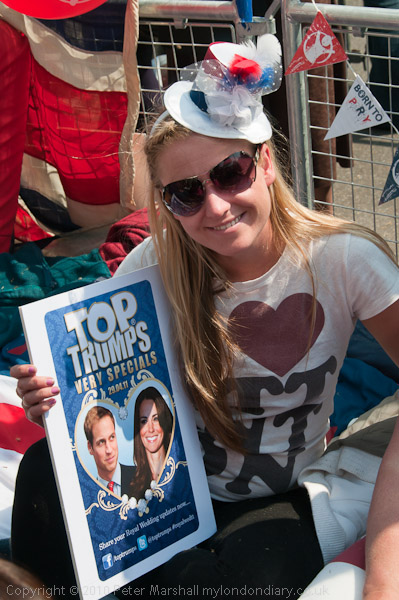
I tried hard not to photograph this year’s wedding, but literally had to step over the people camping out in Westminster as I went to photograph a protest on International Workers Memorial Day, so I did take a few pictures of them which you can see in Waiting For Will & Kate.

© 2011, Peter Marshall

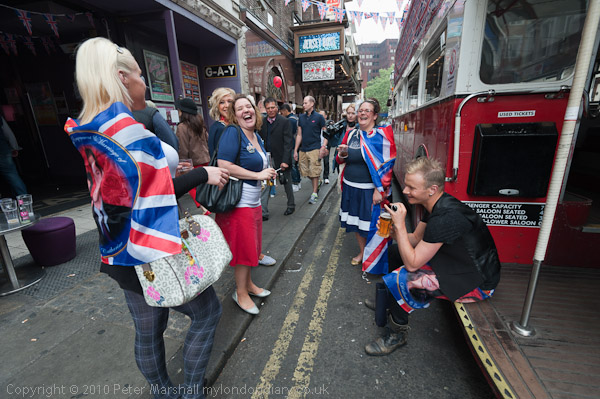
On the day itself I kept well away, though I did take a few pictures at Republic’s Not the Royal Wedding Party and just one or two on my way home through Soho, where the event was certainly seen as a good excuse for a party.

© 2011, Peter Marshall
Of course you can see my own record of the year at great length on My London Diary, although so far it only goes more or less to the end of November (which I’ll say more about when I’ve given it a final check.)

It is of course events in London not shown in the New York Times or My London Diary or elsewhere in photographs that are having a great effect on the world economy, but people clicking mice or working on a keyboard generally make for boring stock rather than news photos. If you want to understand more about how banks and financial organisations working in the City of London, largely unregulated since the Thatcher-inspired Big Bang (and, yes it was them and not Gordon Brown, David Cameron, George Osborne or us spending recklessly on credit cards or even dodgy mortgages) have destroyed the UK economy and threatened the world, there is a graph of G10 Debt Distribution which deserves to be featured in every review of the year, produced by  Morgan Stanley. It shows the UK’s financial sector with a debt of over 600% of our GDP, dwarfing the relatively small government and household debt.

There is a section in the NYT year about the Occupy movement, which has raised many of the issues (or, as the politicians and press like to say, doesn’t seem to know what it wants), but good as some of the photography is, it is also an illustration that it is the moments of conflict and drama that attract us as visual people, while for me the Cartier-Bresson image with which my thoughts started perhaps leads us to think more deeply about the issues. But I doubt if it would make the papers today.

Lacoste Censor Larissa Sansour

I was shocked to read that high-end French clothing chain Lacoste had demanded the removal of Palestinian artist Larissa Sansour from the shortlist for the €25,000 Lacoste Elysée Prize, and even more disgusted that the Swiss Musee de l’Elysée, which I had thought to be an international venue with some integrity had bowed to their demand.

Earlier in the year Sansour had been nominated as one of eight artists short-listed for the 2011 prize, and along with the others received an initial grant – as the Museum page states*

” With the aid of a grant of 4,000 euros, each nominee will be invited to develop a photographic project around the theme “la joie de vivre”. They will be free to interpret this in which ever way they favour – in a direct or indirect manner, with authenticity or irony, based upon their existing work, or as an entirely new creation.”

Sansour submitted three photographs for her project ‘Nation Estate‘ to the museum in November 2011, and according to her press release, they “were accepted, and she was congratulated by the prize administrators on her work and professionalism.”

In what appears to be a simple act of political censorship, Lacoste refused to accept her work, regarding it as “too pro-Palestinian.” You can read more about this on the ‘Electronic Intifada‘ blog, as well as on Sansour’s own site. The museum’s web site removed all mention of Sansour from the material about the Lacoste Prize around a week ago.

Much of the sponsorship money that goes into major museums unfortunately comes from companies wanting to improve their rather unsavoury images – and in the UK we have the example of BP, a major promoter of climate change and environmental catastrophes such as the Canadian tar sands sponsoring our major public galleries – something I’ve covered in such events as Climate Rush’s Tate Britain Oil Spill Picnic and the incredible Rev Billy’s Tate BP Exorcism.

But damaging though this sponsorship is, so far as I am aware it has not been allowed to erode the artistic integrity of the institutions in the same way as this.

Further Developments

Since I posted, Lacoste has now completely withdrawn from this prize. You can read more about it at the British Journal of Photography and also at the Washington Post. *When I checked at the museum site just now the page about the prize it was empty.

I find it hard not to feel that Lacoste and the Elysée museum have both behaved incredibly stupidly in thinking they could get away with this kind of behaviour. It really is shameful that the museum did stand up to Lacoste – even if it would have meant losing the sponsorship, which in the event they have in any case done.

Lacoste’s statement says “Today, Lacoste reputation is at stake for false reasons and wrongful allegations” but I find it hard to take their statement (quoted in its entirety on the Washington Post) seriously.  The reasons and allegations seem all too clear and all too true. Museums and artists would be well advised to avoid crocodiles, and certainly not sell out to them, and the only person to come out of this with any credit is Larissa Sansour.