Marketing Fools Rule

As with so many things these days its the guys in marketing that call the shots, even though they know nothing about things. And this is what seems to have happened with the official promotional video for the new Nikon D800, produced for Nikon Thailand for the launch in Bangkok (a very boring video which shows why such events are best missed.) The people who made the video just went and found some nice footage to use, just unfortunate that at least some of it wasn’t even shot on Nikon, and I doubt in any was actually shot on a D800.

One of the clips used in the video came from Norwegian landscape photographer Terje Sørgjerd, who notes on his Facebook page that he is sponsored by Canon and uses a Canon 5DII. According to the comments there, the promo also contained work taken from a Red Bull snowboarding movie – which again did not use Nikon – as well as some produced on a Samsung NX10.

Nikon have apparently said they will apologise to the photographer and state that the video was not produced by them but made by an external company, though that is hardly an excuse as they used it.  They have also apparently agreed to pay Sørgjerd twice the normal fee for the use, though that seems rather low given what has happened. But on his Facebook page he says that Nikon “have taken every step to have the video removed, and will do everything possible to avoid this from happening again in the future. This matter is now fully resolved between the two of us“.

Of course it has given Sørgjerd a great deal of free publicity – including this mention here, as well as some extra but rather negative publicity for Nikon. The D800 should sell on its merits, and promoting it with images produced on other cameras seems entirely dishonest, though apparently such practices are not unusual in advertising. I remember being told by a photographer many years ago that his pictures that were used in the UK advertising campaign for a new Japanese camera had actually been taken on a Nikon and not on the make being advertised.

Nikon Rumours doesn’t so far as I know have any video shot with the D800, but they do have some genuinely made with other Nikon cameras including the D700,  pretty clever as it doesn’t have a video mode, along with some taken with other Nikons. But I’m still waiting for proper reviews to tell me if the D800 is a body worth considering as a (larger format) replacement for my ailing D300. Perhaps Nikon will come out with the D400 some time this year – it has been rumoured as imminent since mid-2009, though as yet there is not even any agreement between the rumour-mongers as to whether it will be DX or FX!
Film Slides Away

The announcement by Kodak, reported by the BJP,  that they are to discontinue Kodak Professional Ektachrome E100G, Kodak Professional Ektachrome E100VS Film and Kodak Professional Elite Chrome Extra Color 100 means an end to their E6 colour film line, though the production of Portra, Ektar and other colour negative films and their black and white films will continue while demand keeps up.

On the Kodak UK shop site it states : ‘We estimate that, based on current sales pace, supplies … are expected to be available in the market for the next six to nine months; however, inventories may run out before then, depending on demand.‘ If some buy stocks of these materials to put in the fridge for later they may well run out faster, though this may not be a sensible idea. I’ve got stocks of various outdated photographic materials in a large cupboard here that I can’t quite bring myself to throw away, including over a thousand sheets of 8×10 colour and black and white papers. Perhaps one day I’ll feel like going in the darkroom again and it might just be usable, but I think both are unlikely.

Kodak were one of the pioneers of colour photography with their Kodachrome introduced in 1935 and discontinued in 2009. Ektachrome came out in the 1940s, at first with the E1 process. Later versions of the process, E4 and finally E6 became the standard colour negative process for virtually all manufacturers, and Kodak are continuing the production of E6 chemicals, though I always found their products highly over-priced compared with the competition, at least for low volume users.

Of course those who have a particular need for transparency film or are of a peculiarly masochistic bent can still buy and use slide film, something I largely abandoned in the mid-1980s. Fuji have been making better film than Kodak since then, and Kodak have only really been kept in the business by a curious consumer loyalty to the yellow box, perhaps fuelled in America by a kind of jingoistic protectionism that insists that US products are always the best. But then why is anyone still using film?

Doug Menuez tried to give a reason a few years back in a piece called The Zen of Film vs Digital Gratification. If like he apparently does you feel your work in digital somehow lacks lustre you might buy his argument, but I’m of the opinion that my work has improved with digital. But I almost never work in the way that he suggests photographers do with digital:

But while you have your head down checking the LCD guess what? You just missed your pulitzer. That LCD is crack. You just can’t get enough. We all want instant gratification and here you have it. Bliss. Yet the act of constantly checking the back of the camera is taking your head out of the game.”

I get far too involved in taking pictures to do much checking on the LCD while I’m busy taking them. I try to remember to occasionally take a quick peek to check I’m not really messing things up, but the first time I seem most of my pictures on the back of the camera is after I think I’ve finished the job. Often not until I’m sitting on a train on my way home. The main exception is when I’m photographing speakers at events, where  a single button press will zoom in on the eyes I’ve focussed on and let me check the person didn’t blink. There is a point in checking because most speakers are fairly repetitive in their gestures and you can usually re-make the image.

So I don’t share Menuez’s attitude to digital. It isn’t actually about the medium but about how he has chosen to use it. I welcome the new things it makes possible, but haven’t let it change me in the way he suggests.

Photographer Meets Photographed

I used to be a great fan of the BBC, but experience in reporting events over the years as well as some aspects of their output have at least to some extent changed my mind, though they are still obviously rather better than many other broadcasters.I strongly support the idea of broadcasting as a public service and they do produce some very fine programmes in various genres.

But of course they are still over-manned,  still over-complacent, and still deliberately misreporting many events. Still giving far too much air time to bigots, racists and climate change deniers. And still wasting far too much money on rubbish which may be popular but would be done more or less as well by commercial broadcasters.

One of the finest aspects of the BBC’s work has always been the World Service, today celebrating 80 years of existence, though celebrating this by massive cuts, leaving its long-time home in Bush House and insulting its retired employees.

Thanks yet again to Duckrabbit and a post by Ciara LeemingThe face of the Gujarat riots meets his photographer ‘saviour‘ for bringing an interesting piece from BBC News India to my attention.

In 2002, Arko Datta photographed tailor Qutubuddin Ansari praying for help during religious riots in Gujarat during which around a thousand people, mainly Muslims, were killed – the worst riots since Independence. It was a picture that summed up the fear and desperation of many, and was printed on front pages around the world.

A week later, Mr Ansari became aware of the picture for the first time, when a foreign journalist hunted him out in a refugee camp and showed him a newspaper with it across a whole page. It made him notorious and “followed me wherever I went. It haunted me, and drove me out of my job, and my state.”  He lost half a dozen jobs and continued to be hounded by journalists. Ten years on,  BBC Hindi’s Rupa Jha was present when a meeting had been arranged between the two men.

Datta has been in a military vehicle and had taken a few frames of Ansari with a telephoto lens as he had pleaded with the soldiers to rescue him and a few other Muslims from a Hindu mob. Then he told the soldiers to stop and do something, and he and others in the van said they were not leaving until they did something to help the trapped people.

Although Datta’s photograph caused Ansari considerable grief, the journalists’ insistence that the military take action almost certainly saved the lives of the trapped Muslims, as well as bringing what was happening in Gujarat to the attention of the world.

Towards the end of their meeting, Ansari tells the photographer “Nobody is to blame, brother. You did your job. I was doing mine, trying to save my life. Your picture showed the world what was happening here.

Few photographs have the impact that this image does, either as a picture or on the subjects in it, or indeed on the world and on the photographer, but it is a reminder that photography can have consequences we fail to foresee.

This is not the only time Datta has returned to meet the subject of one of his award-winning images. You can watch a video in which he talks about photographing the aftermath of the Asian tsunami and how he retuned to find the Indian woman mourning a dead relative which was the World Press Photo of the Year in 2004.

POYi Flowchart

I’m often surprised and amused by how things link together when I’m looking at pages on the web, often finding things that link to posts I’ve made or thoughts I’ve had but not quite got around to writing about.

One of the latter was about another of those annual awards, POYi, (Pictures of the Year international) which is unusual in conducting its business in public, web-casting the judging with 99 on-line publicly open seats in a chatroom.  The judging is spread out over most of the month, and has now more or less ended – so you will need to wait until next year to take part.

The Photojournalism Contest entry flowchart  on the Shit Photojournalists Like blog has more than an element of truth in it, judging from the various shows and lists of winners I’ve seen over the years. Certainly they lead me to the conclusion I’ve always had about such competitions, “Save your entry fee and buy gear.”  They also link to the POYi Chat Room Heroes blog, though I think you have to have been their to get much out of that.

One photographer who gets a particular mention is Melissa Little, whose work was apparently “pulled in, kicked out, pulled in, then kicked out again.” I don’t know what she had in for POYi, but you can see some interesting work on her own web site, where I find that in 2001 she was a student at the Eddie Adams Workshop and “have been honored to return for the last seven years as staff, where I’ve done everything from mow the grass and rake the leaves to documenting everything in sight as workshop photographer to leading, finding stories and coaching a team of 10 students. ”

I’ve not yet looked at all the awards for POYi, but did enjoy looking through the results for the ‘News Picture Story – Newspaper’ class, where first place went to
Michael Robinson Chavez (Los Angeles Times) for DECONSTRUCTING MUBARAK, second to Mads Nissen (Berlingske / Panos Pictures) for pictures of the LIBYAN REVOLUTION, third to Hiroto Sekiguchi (Yomiuri Shimbun) for TSUNAMI AFTERMATH and the ‘Award of Excellence to Craig Walker (The Denver Post) for his pictures of OCCUPY DENVER. And I mention this not just because there are some fine pictures in these stories (which are always of more interest to me than the single picture awards) but because of the controversy I may have mentioned earlier over World Press Photo, when some judges anounced publicly that they had seen no pictures of the Occupy movement worthy of an award. I don’t know if Walker’s work went to WPP as well, but certainly some other very worthy images did.

Rainy Valentine

 © 2012, Peter Marshall

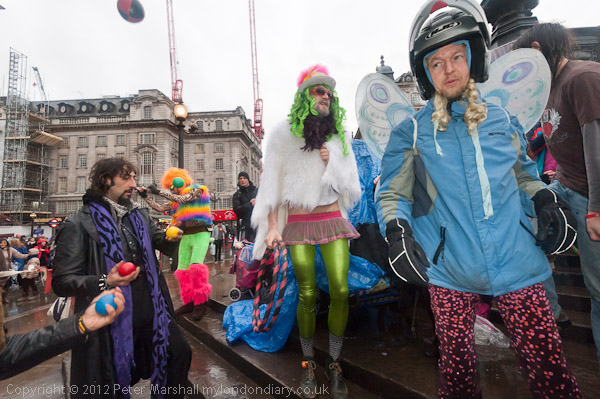
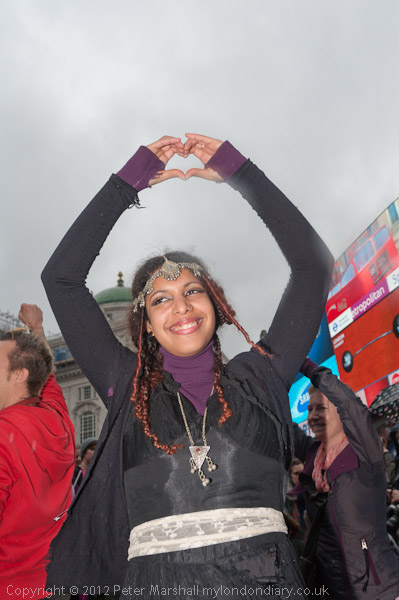
It was a cold, dull, wet and windy afternoon in London, but that didn’t stop everyone at the ‘Reclaim Love‘ Valentine party at Piccadilly Circus having fun, though it did make photography rather tricky at times.  As usual in wet weather I was working holding a lens cloth in my hand and wiping the filter on the front of the 16-35mm before every image, but even so on the picture above you can see several areas of unsharpness caused by raindrops on the front of the lens.

© 2012, Peter Marshall

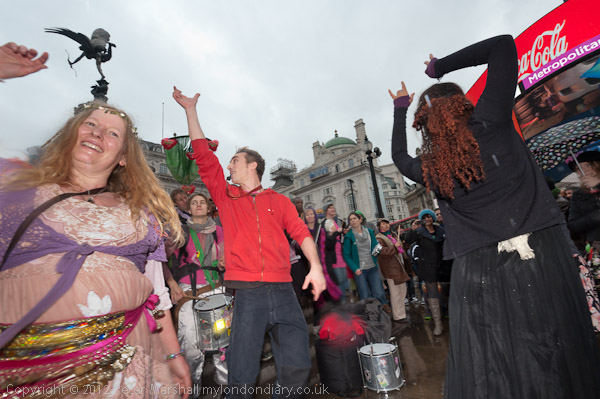
It didn’t worry me when looking at pictures such as these, where what I thought were the key elements of the images were sharp, though I don’t particularly like the water-induced flare visible around the head and arms of the dancer above, it doesn’t spoil the image for me. But there were plenty of images that I had to edit out because of water in the wrong places.

The Nikon 16-35mm is a good lens to use in the rain, for several reasons. Being a professional lens it has better water-sealing than most, and this is greatly helped by internal zooming and focussing – there is no change at all on the outside of the lens other than the rotation of the two rings for zoom and focus. The front of the lens doesn’t move at all, and there is none of the extension of the lens that you get with most zooms. The 18-105DX lens is a typical example, and the zoom action works to pump water and damp air into the lens, where it condenses on the large cold glass elements and pictures soon become completely impossible.

© 2012, Peter Marshall

I took very few pictures with the 18-105mm mainly for this reason,  but also because much of the time I was working in very crowded situations where the 10.5mm DX semi-fisheye was more useful. Being a single focal length with virtually no need to focus avoids much of the problems of water ingress,  but it has a bulbous front element unprotected from the weather – you can’t really have a lens hood on a lens with a 180 degree diagonal field of view. So it suffers even more from raindrops than does the 16-35, although the lens hood on that is pretty vestigial.

© 2012, Peter Marshall

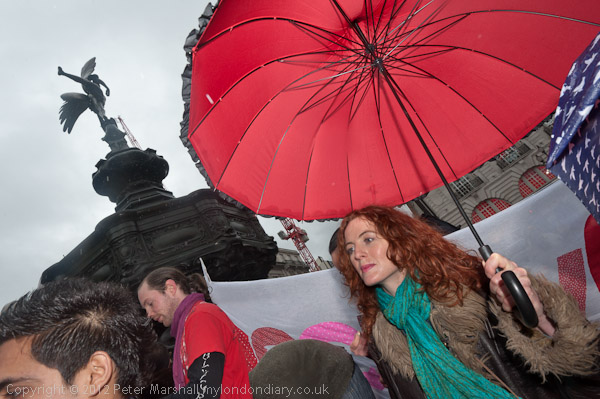
Although some of those taking part had umbrellas, it’s not really an option if you want to move around and take pictures, and of course the drips from these umbrellas are an extra hazard for the photographer.

Using flash in the rain also has its odd problems or opportunities, as you can just see from the red umbrella, where the white streak at its left is a rain drop, illuminated by the flash – and some more can be seen less obviously in front of the dark fountain supporting Eros (though it’s actually his brother.)  But I needed flash, because without it the pictures were too dull and failed to bring out the party atmosphere.

The Nikon SB800 flash is perhaps the least waterproof of all my equipment and most difficult to protect from the rain. As you can see from Reclaim Love – Occupy Your Heart!  I took (and put on My London Diary) too many pictures, and by the time I gave up I was rather damp and the flash was soaked and had stopped working. It did recover after drying out, but has since failed more or less completely.  Hopefully a trip to the repairers will get it working again.

________________________________________________________

My London Diary : Buildings of London : River Lea/Lee Valley : London’s Industrial Heritage

All photographs on this and my other sites, unless otherwise stated are by Peter Marshall and are available for reproduction or can be bought as prints.

To order prints or reproduce images

________________________________________________________

Urban Landscapes – Luca Tommasi

 © Luca Tommasi
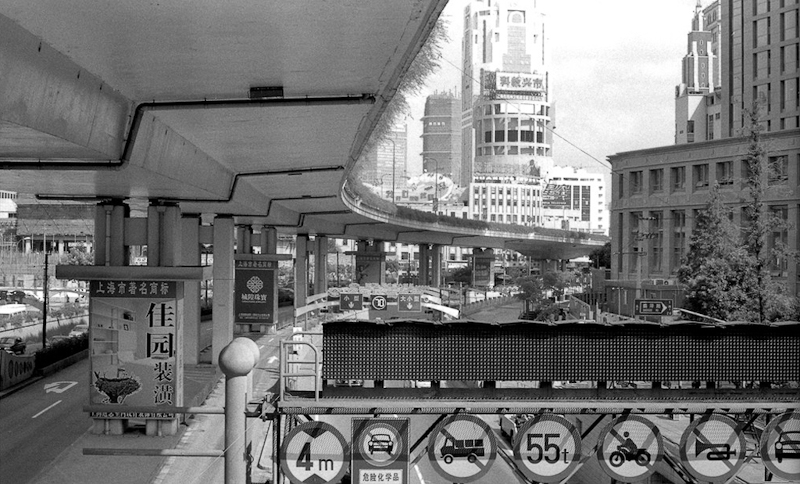
© Luca Tommasi – A changing China

I’ve just updated the pictures in Luca Tommasi’s A changing China on the Urban Landscapes web site that I run with Mike Seaborne.

Although Mike and I are both based on the outskirts of London and much of our own work on the site is from London, we intended this as an international site, and of the eleven photographers whose work is on the site only four are actually from the UK.

We welcome contributions to the site, but insist that these show a serious approach to urban landscape, and on the site I give a brief idea of what this might mean. It isn’t just pretty pictures of a city, and it isn’t just architectural photography. Here is my check list from the site which explains my idea of what we are looking for :

Urban landscape photography

  •  in some way describe a town or city
  •  represents an attempt to understand our experience of the city
  •  shows a dedication to the subject, expressed through a body of work rather than isolated images
  •  concentrates on structures or processes rather than on people
  •  may deal in either details or a broader view

If you have work that you think would fit, you are welcome to submit work and we have a page on the site that tells you more. Now that most web users are on broadband rather than dial-up we normally use slightly larger images, typically 600-800px larger dimension. Projects have to be accompanied by some explanatory text, and we also welcome relevant essays on the subject – up to around 5000 words.

I wrote a little more about this definition and the site as a part of a lecture I gave five years ago, which I presented in a series of posts on this site, including Architecture and Urban Landscape photography.

Like many things on the web, we run the site for love not for money, and there are no prizes or payment for having work on the site, which got a respectable 165,000 hits last year.  Though of course – as with this blog –  it’s the quality not the quantity of our visitors that counts.

Barnstorm – Eddie Adams Workshop

If you are a student or have less than 3 years experience working as a professional photographer (freelance or otherwise) you may like to consider applying for a place on this year’s Eddie Adams Workshop or ‘Barnstorm’, “an intense four-day gathering of the top photography professionals, along with 100 carefully selected students. The photography workshop is tuition-free, and the 100 students are chosen based on the merit of their portfolios.” Unfortunately only 10 of those places are available for non-US students.

It takes place from October 5-8, 2012 in Jeffersonville, New York, and although the tuition is free, those who get a place will need to pay their own fares to the event and also a flat fee for room and board ($375) at the Workshop. It all adds up, but the quality of the free tuition makes this seems a great opportunity.

For more information and to apply, see the Eddie Adams Workshop site.  Described as “the premier tuition-free photography experience” it exists thanks to many volunteers – who over the years have included many well-known names among photographers and editors with Adams “shamelessly exploiting a lifetime of friendships and contacts” who over the years included Gordon Parks, Joe Rosenthal, Alfred Eisenstaedt and editors and picture editors of Time, Newsweek, Life, Fortune, The New York Times Magazine and Parade magazine and is currently sponsored by many of the leading names in photography, including Nikon, Adobe, ASMP, AP, B&H, Getty Images, HP, Manfrotto, PDN, Photoshelter and Sandisk.

Most people know Eddie Adams (1933-2004) for one particular image from Saigon, but he took many fine pictures. He began the workshop in 1988 and this is the 25th Barnstorm.

Wim Wenders on James Nachtwey

Burn Magazine prints a long speech by Wim Wenders on the photography of James Nachtwey, made at the award to Nachtwey of the third Dresden International Peace Prize at the Semper Opera House in Dresden, Germany on 11 Feb 2012 .

It’s an interesting eulogy, and one in which Wenders backs up his arguments with a detailed look at three images by Nachtwey.

Wenders as well as being an internationally renowned director for his films including Paris, Texas (1984) and Buena Vista Social Club (1999) and, nominated for this year’s Oscars, Pina (2010), is also something of a photographer himself, as you can see from his Places, strange and quiet which was shown in London last year. 

Alex Webb’s Chicago

Thanks to Jim Casper’s Lensculture blog for showing me Alex Webb‘s Chicago Street Photography slideshow, made in collaboration with Leica and Magnum. The pictures sometimes disappear a little too fast for my slow-working brain, and although there is nothing wrong with the sounds recorded by Webb and his commentary it perhaps more makes for an easy experience than adding a great deal to the pictures. As to be expected from Webb, there are some interesting images, though in the nature of a presentation like this there are those which are less so, but overall I found it largely held my attention.

The video (which incidentally I couldn’t see using Firefox, but played without problems on Internet  Explorer) is also on the Leica Camera blog, where it appears with a short interview with Webb about the work, along with a half a dozen comments.

One person asks for information about the audio recording and gets a rather poor answer from the Leica Internet team “Some of the information regarding the audio in the piece can be found at the end credits.” If you blink you miss these and certainly it is hardly possible to read past the first few lines crediting Alex Webb, though with a little fiddling around you can stop the video at that point (4m35s) and find that as well as Alex’s own recordings it also credits Freesound.org and ChicagoStreetMusicians.org. There is a kind of odd 14 seconds of blank screen with a couple of bursts of sound after the credits disappear, suggesting some kind of production error, so perhaps the credits were intended to be more readily legible.

In some respects I think that digital works better with Webb’s liking for deep shadows than transparency ever did, and although one of the comments calls for the contrast of these images to be ‘beefed up’, I can’t agree. But when I saw his first book in 1986 I thought it relied too much on the drama of large areas of darkness – to me at the time it seems too easy a way to create drama, and I probably still feel that way.

Nor do I agree with ‘Fred’ who says “Most of these are pretty dull shots.”  But it’s worth spending the 5 minutes to watch this and make up your own mind. You may even want to see it a second time, as I did, with the sound turned off.

Deaths and Injuries in Syria

Probably everyone will have heard the sad news from Baba Amr, where a Syrian Army shell hit a centre being used by the media, killing Sunday Times journalist Marie Colvin and French photographer Remi Ochlik, and wounding others including photographers Paul Conroy and William Daniels, and writer Edith Bouvier.

Ochlik recently was awarded 1st prize in the General News Stories section of World Press Photo for his pictures from Libya – you can see the set of 12 pictures on the WPP site. Daniels too has several fine stories from Libya on his web site.

It’s a reminder of the risks many photographers and journalists take every day to tell the world what is happening in places such as Libya and Syria. You can read more about them and the other around 900 journalists who have been killed over the last 20 years on the Committee to Protect Journalists site.