Carnival of Dirt and Rain

© 2012, Peter Marshall
16-35mm at 31mm

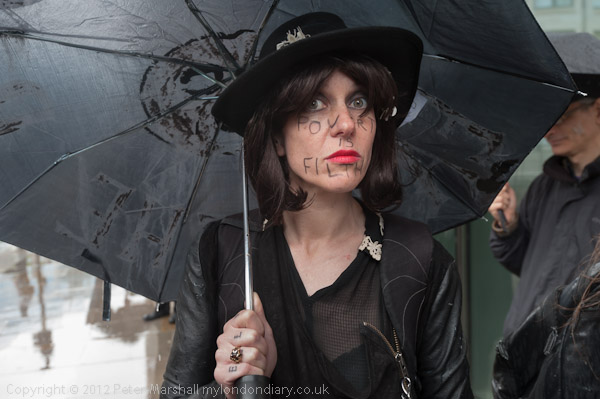
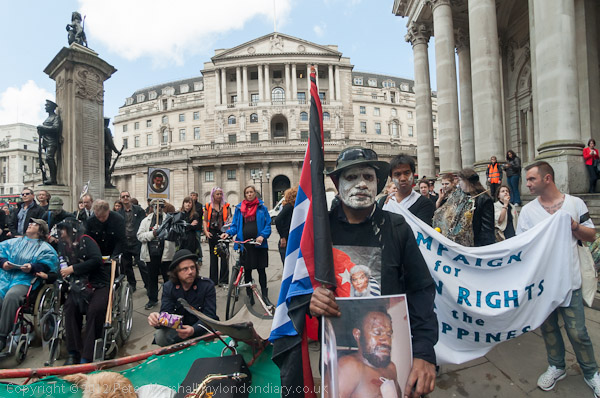
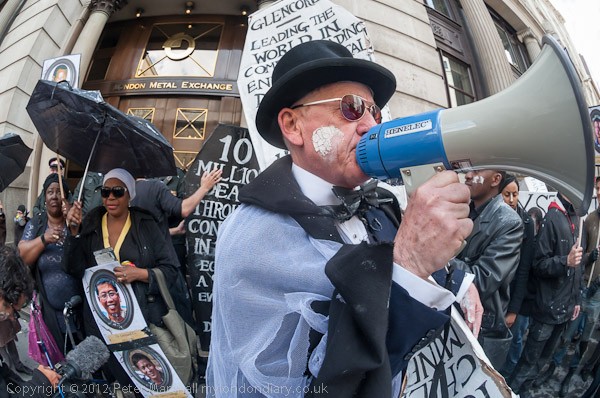
The ‘Carnival of Dirt‘ was an event to point out the environmental damage, destruction of habitat, human rights abuses, deaths and wars around the world caused by the activities of mining companies, many of which are based in London. Much of their activities are financed by the major London financial institutions – the big UK banks, the Stock Exchange, our pension funds and the rest of the City.

One particular London institution, the London Metal Exchange prides itself on being “the world’s premier non-ferrous metals market and offering “futures and options contracts for aluminium, copper, tin, nickel, zinc, lead, aluminium alloy and NASAAC, steel billet, cobalt and molybdenum” and on “setting the global standard.”
© 2012, Peter Marshall
10.5mm, corrected to cylindrical perspective

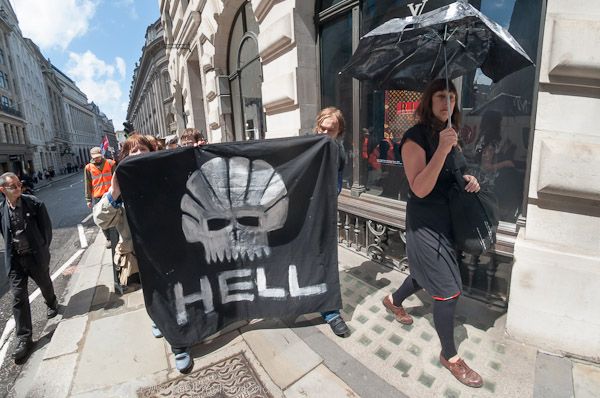
It’s a industry whose standards have corrupted governments around the world, killed millions in countries such as the Congo, and gambles with the future of the planet.  Among the chief villains are Xstrata, Glencore International, Rio Tinto, Vedanta, Anglo American, BHP Billiton, BP and Shell.
© 2012, Peter Marshall
10.5mm, corrected to cylindrical perspective

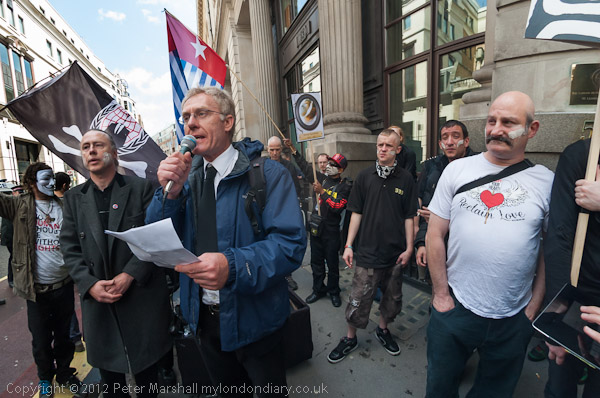
Given that the problems caused by mining are truly global, the opposition to them needs to be global too, and as well as various UK based groups including UK Uncut (the mining companies massively organise to avoid tax) and Occupy, the Carnival brought together  groups campaigning about the Congo, West Papua, the Philippines, Somalia, Latin America, Australia and the Canadian Tar Sands.

The morning’s event that I photographed was a funeral procession to honour the many who have been killed, with the Government of the Dead having some previous experience at such events. But it was a funeral with a New Orleans style carnival atmosphere and a rather good marching band playing.

Planned for a Friday in the middle of June we might have hoped for summer weather, but the day was cool with rather frequent showers, and I had considerable problems with the rain. Sometimes I do wish I had an underwater camera, although on this occasion as often there were more problems with the lenses than the cameras.

Given the price and amateur nature of the Nikon 18-105 mm I can hardly complain that it isn’t a good lens in wet weather. It’s a lens that almost doubles its length on zooming, pumping damp air in and out. Combine that with the temperature drops in heavy showers and the solar heating in the sunny intervals and it is never long before condensation begins to form on the internal lens elements and images degrade to unusable blurs.

Most of the time I would in any case be working with the 16-35mm on an event like this where its normally possible (and often essential)  to work inside the group of protesters. And the Nikon f4 lens is large, well-sealed and entirely professional. Both zoom and focus take place by moving internal elements. But after a couple of hours working, this too, rather to my surprise, started steaming up and also became more or less unusable.
© 2012, Peter Marshall
10.5mm

For around half an hour, the only usable lens in my kit was the 10.5 mm fisheye, and although it is one of my favourite lenses I have to admit it is hardly a general purpose optic. Fortunately there was plenty I could do with it, though I did curse a little later at the extra work it gave me in post-processing, where I needed to convert most of the images from the full-frame fisheye to cylindrical perspective. Later the 16-35 had more or less cleared and I was able to take a few images with that, though some show a little blurring.
© 2012, Peter Marshall
10.5mm, corrected to cylindrical perspective

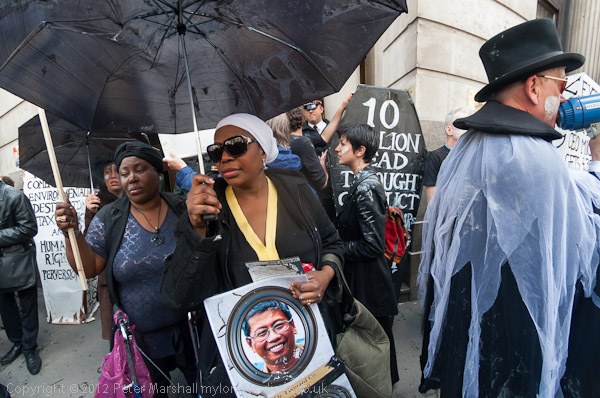
Fortunately by this time the rain had almost stopped, as the exposed front element of the fisheye is great at collecting raindrops and just can’t be protected at all, just wiped immediately before each exposure.  Even doing this you lose a few pictures from drops that land between wipe and shutter press.
© 2012, Peter Marshall
10.5mm, corrected to cylindrical perspective

On the train home I took a more careful look at the 16-35mm, still steamed up, and decided that the problem – or at least most of it – was not in the lens itself but on the rear surface of the filter screwed onto its front. Water must have got in between the glass and the metal body of the filter and at some point condensed there. Had I realised earlier I might have been able to keep working simply by unscrewing the filter and wiping the front element and rear of the filter dry before replacing it – or even working without a filter for a while, though I don’t like doing so.

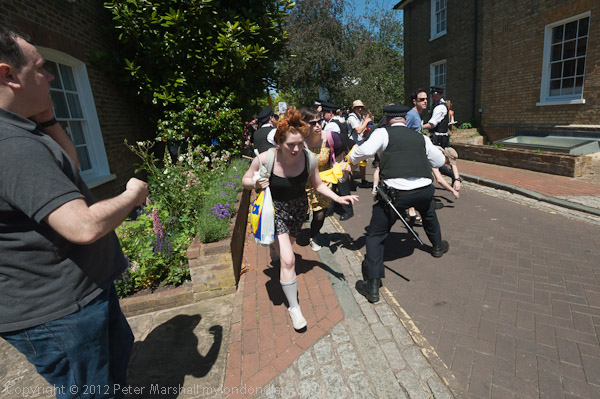
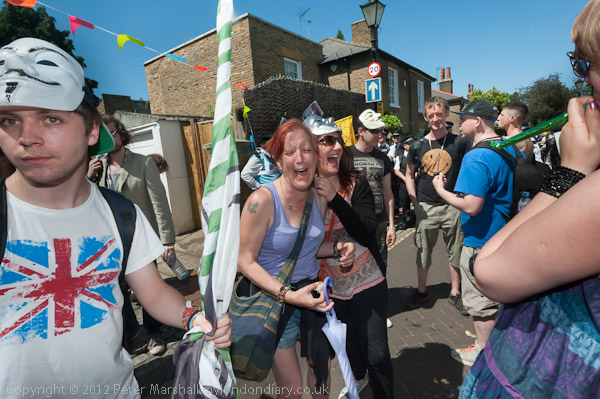
All the images here were taken with the 10.5mm except for the top image, made with the 16-35mm. Of the 10.5mm images, all except one here were corrected to cylindrical perspective in post-processing.

________________________________________________________

My London Diary : Buildings of London : River Lea/Lee Valley : London’s Industrial Heritage

All photographs on this and my other sites, unless otherwise stated are by Peter Marshall and are available for reproduction or can be bought as prints.

To order prints or reproduce images

________________________________________________________
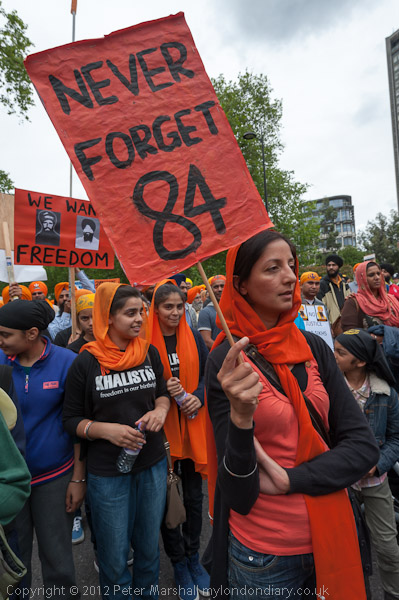
Never Forget Bloody 1984

 © 2012, Peter Marshall

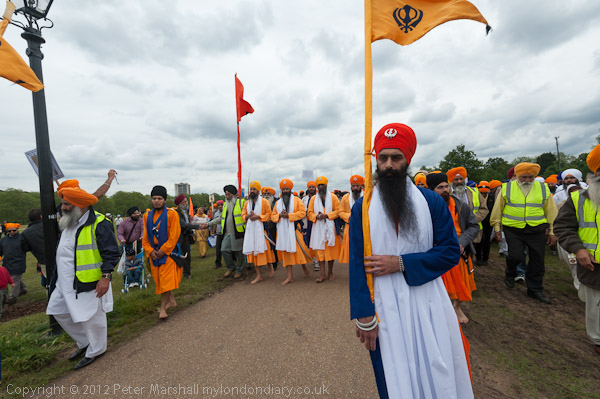
1984 for me always brings to mind George Orwell, but if you are a Sikh it has a different meaning, the year when the Golden Temple was stormed by Indian troops and when so many Sikhs were killed  there and in the massacres carried out by Hindu extremists and apparently encouraged by the Indian authorities, particularly after the killing by her Sikh bodyguards of Indian Prime Minister Indira Ghandi, in which many thousands of Sikhs were killed.

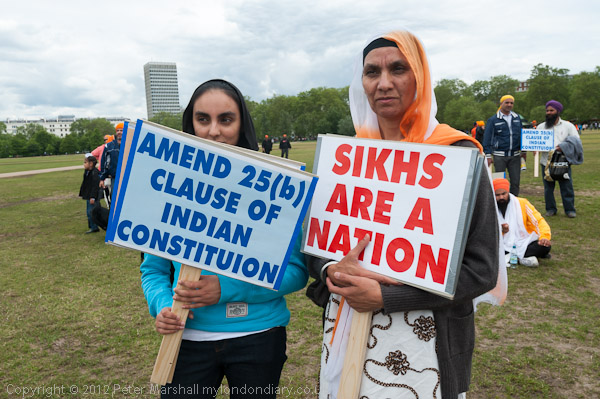
The object of the assault on the temple complex was to clear out Jarnail Singh Bhindranwale and his supporters who were alleged by the Indian government to be terrorists and storing arms there. He led a movement calling for the return of Sikhs to their traditional practices and against Article 25 of the Indian constitution which declared the Sikhs, Jains and Buddhists to be part of the Hindu. He wanted a clear and distinct identity for the Sikh nation. Since his killing and the other events of 1984 many Sikhs have argued this can only be achieved by the formation of a Sikh state, Khalistan.

© 2012, Peter Marshall

Few of the speeches were in English, though there were a few short bilingual contributions, and without knowing some of the background many of the placards would be hard to understand, and the event difficult to photograph intelligently.

© 2012, Peter Marshall

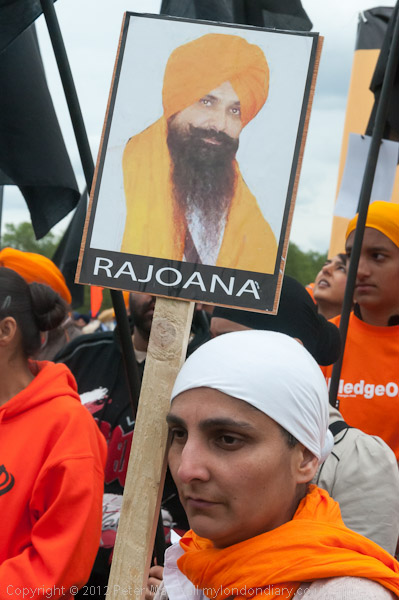
One face on many of the placards was that of Balwant Singh Rajoana, involved in the 1995 plot which killed Beant Singh, Chief Minister of the Punjab who had ordered ruthless suppression of Sikh separatists and was allegedly responsible for the extra-judicial killing of many thousands of Sikhs. Sentenced to death in 2007, his execution fixed for 31 March 2012 was postponed following an appeal for clemency.

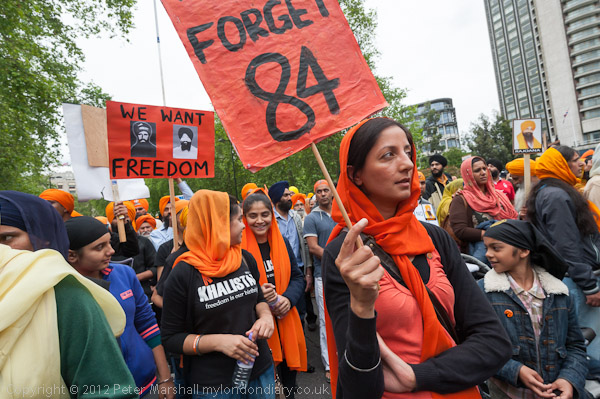
Placards and the messages on them are vital in photographing protests, and it’s sometimes easy to get things wrong. In this picture

© 2012, Peter Marshall

I’ve framed the foreground placard so that it appears to say ‘Forget 84’, while of course the opposite was actually intended, as the image below makes clear.

© 2012, Peter Marshall

Of course the real message of the upper image could be made clear in a caption, but captions and images are often separated. It’s best to make it clear in the image.

More in Sikhs Remember 1984 on My London Diary.

________________________________________________________

My London Diary : Buildings of London : River Lea/Lee Valley : London’s Industrial Heritage

All photographs on this and my other sites, unless otherwise stated are by Peter Marshall and are available for reproduction or can be bought as prints.

To order prints or reproduce images

________________________________________________________
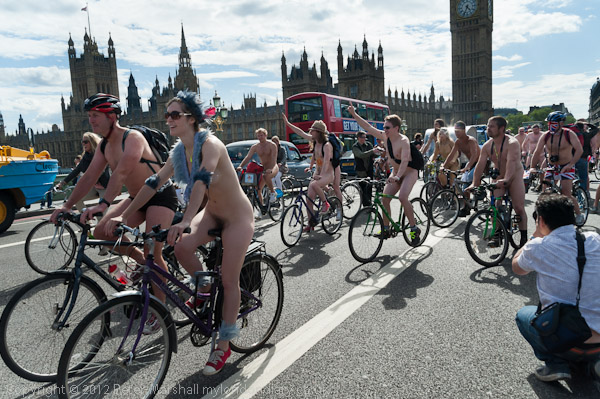
Naked Cyclists

It was quite by coincidence that I returned to London from my holiday in Devon with friends the afternoon before the London World Naked Bike Ride was taking place. But it did give me something to look forward too on my return to work.

© 2012, Peter Marshall

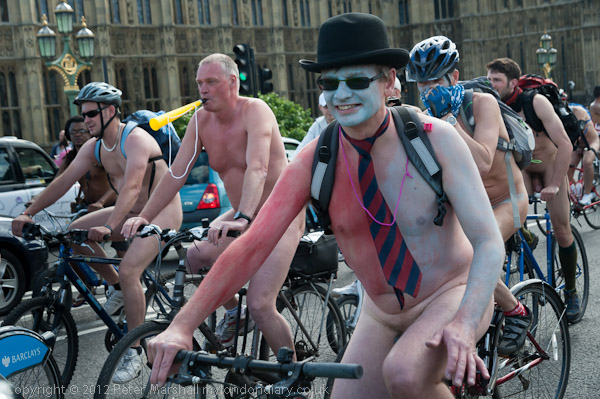
There is something rather entertaining about the sight of hundreds of naked or near naked people on bikes going past the sights of London, and it certainly entertains the thousands of tourists who stop to gaze at them in astonished and bewildered delight.  Of course there are a few people who are upset and perhaps offended or feel somehow threatened by this display of public nudity, though I might be more impressed if more of them turned their faces away rather than continuing to witness the sinful activity.

© 2012, Peter Marshall

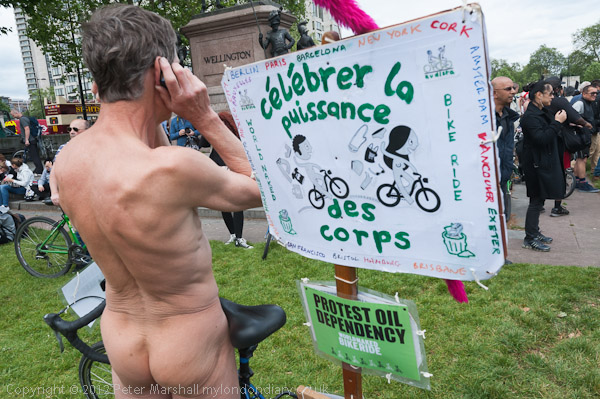
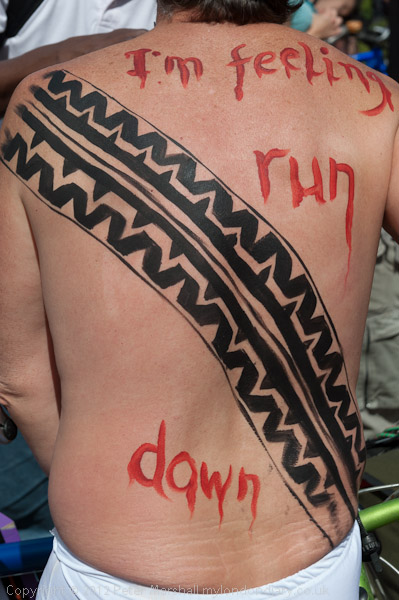
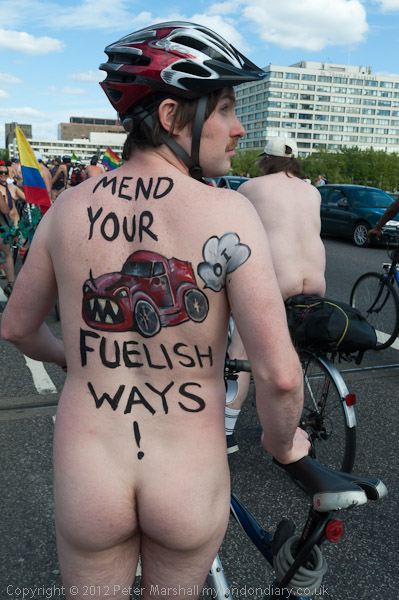
Of course it is a rather unusual event, with people taking part for various reasons, including simply having a little fun as well as those with a strong commitment to environmental issues and others more concerned with naturism (and of course these are in no way exclusive.) But as I’ve commented before, there isn’t a clear message coming across. One of the things I try and do in photographing the event is to concentrate on those riders with messages on their bodies and the few placards or flags.

© 2012, Peter Marshall

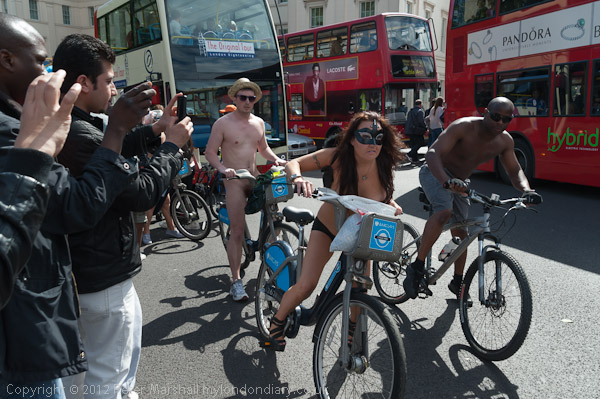
There are always considerably more men than women taking part, and for various reasons most people taking pictures who are mostly men concentrate on the less covered up women riders.  At the start where crowds gather it often got hard to take photographs of the women as there were too many others trying to do so – and pushing in front of others to do so. The crowds made it very difficult to start the event, and those of us who tried to move back when requested by the stewards or police simply found that we were at the back of a crowd.

This year the problems at the start were particularly bad because there was time for the crowd to build  up in a relatively small area, and the start took place into a busy roundabout with traffic flowing normally around it, creating dangerous conditions for the cyclists. Why on earth didn’t the police stop the traffic for a few minutes to allow a safer start? It would have also have got the event started in a fraction of the time and caused far less traffic chaos.

© 2012, Peter Marshall

Female nudity is generally more acceptable for publication than male, and of course ‘topless’ images are a staple of parts of the popular daily press. Photographing men is I think trickier, and for many publications full frontal images present a problem.  Although it doesn’t worry me, I do try to make sure that at least in some images for publication there are carefully positioned handlebars or flags  or legs etc which make the images more widely publishable.

© 2012, Peter Marshall

Most of the rides I’ve photographed in the several years I’ve covered this annual event there have been people that I’ve known taking part, and they have been among the keenest to see my pictures, which have also been commented on favourably by some of those concerned with organising the event.

© 2012, Peter Marshall

Almost all of the pictures were taken with the D700, as I still haven’t repaired or replaced the D300 with the mirror that keeps sticking. Although a few – including the top one here – were with the 16-35mm Nikon, I soon changed to the Sigma 28-300 for the remainder of the event. It isn’t a lens I like much; it could be sharper (particularly at the long end) and focus sometimes seems just a little slow, but is considerably smaller, lighter and cheaper than the Nikon alternative, and it did the job adequately. The Nikon 28-300mm isn’t one of their better performers in any case, and such superzoom lenses are always a compromise.

The 18-105mm Nikkor would possibly have been a better choice (equivalent to 27-155mm) but used  on the FX body the files it gives are only 2784×1848 px, around 5Mp compared to the normal FX size of 4256×2832 px. I’d need to get Lightroom to upsize them a little before filing, but I suspect the quality would be superior even so, as this lens is a much better performer despite being so cheap. I also very much like being able to see outside the red framing rectangle in the viewfinder, rather like you can on a rangefinder camera, which makes covering action so much easier. Exactly why I’m considering buying a D800 (or more likely the 800E) mainly to use as a DX camera.

Don’t visit Naked Cyclists Ride Against Oil on My London Diary if nudity will offend you. Otherwise I hope you enjoy it. For some reason the pages on the World Naked Bike Ride usually seem to be among the most popular on the site!

________________________________________________________

My London Diary : Buildings of London : River Lea/Lee Valley : London’s Industrial Heritage

All photographs on this and my other sites, unless otherwise stated are by Peter Marshall and are available for reproduction or can be bought as prints.

To order prints or reproduce images

________________________________________________________
May Ends at Sainsbury’s

I have to admit that we shop at Sainsbury’s though I can’t remember when I last actually went there. But the stuff we eat that you can’t buy from Tradecraft (my wife sells their stuff on a weekly stall), our superb local butcher (just a shame the fishmonger was forced out of business by our local council) and the local market and a few little things from Waitrose (Sainsbury’s doesn’t have a decent mature cheddar) we get the rest mainly from Sainsbury’s mainly because it is the most convenient local supermarket – ten minutes away on a bike, and Linda fills her panniers there once a week. Though they won’t get that rich on the little we spend.

© 2012, Peter Marshall

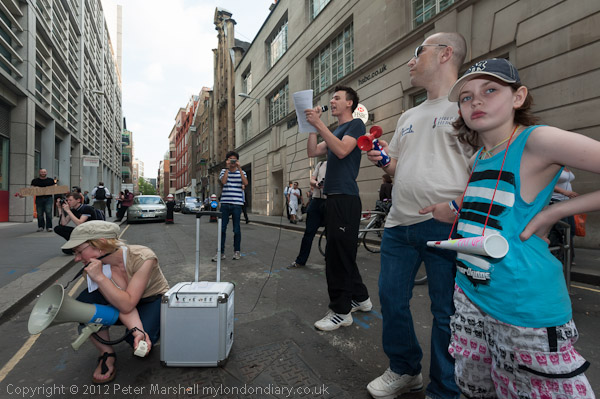
So I was just a little  disturbed to find myself photographing a protest outside a Sainsbury’s Localjust off Holborn Circus as the launch event of a new national campaign, Pay Up!, aimed at making poverty a political issue.  Before I’ve photographed protests at Tescos, at Marks and Spencer’s and even at Waitrose, but this was a first for Sainsbury’s.

But it turns out that they are a low pay employer, actually paying 50p and hour less to its lowest paid staff than Tesco, and certainly not enough to live on in London.

© 2012, Peter Marshall

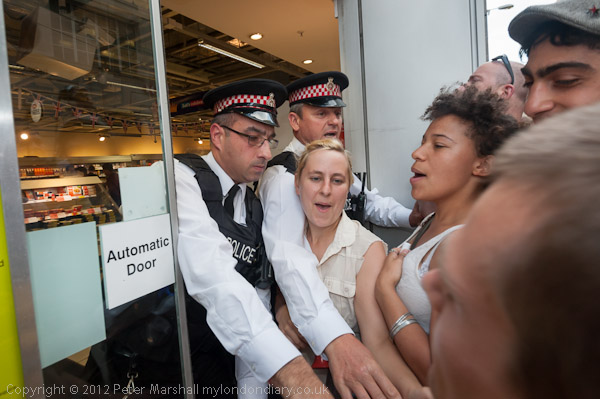
I reached the store with the leading protesters, and wondered whether to follow them in. The police weren’t far behind and I decided to stop and photograph them blocking the entrance to the mass of the protesters instead.

© 2012, Peter Marshall

The pictures – more of course on My London Diary in Pay Up! Launches At Sainsbury’s

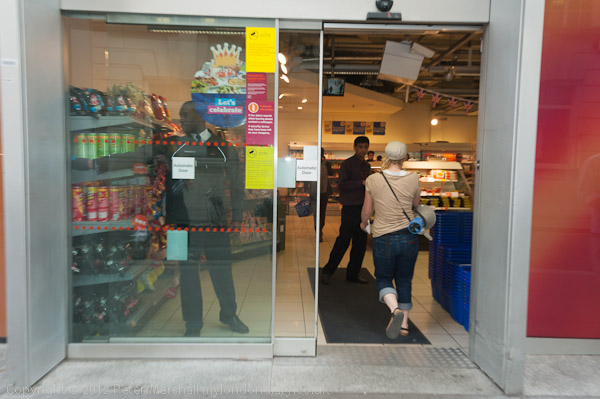
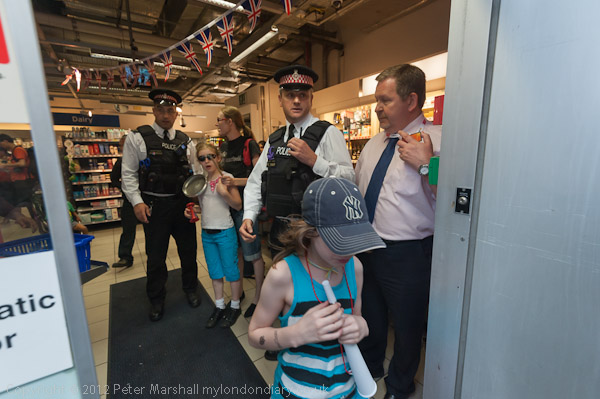
– weren’t great, but probably more interesting than what was happening inside, and I was able to go along the the exit and photograph the half a dozen or so who had got inside as they were fairly politely ushered out by the shop staff and police.

© 2012, Peter Marshall

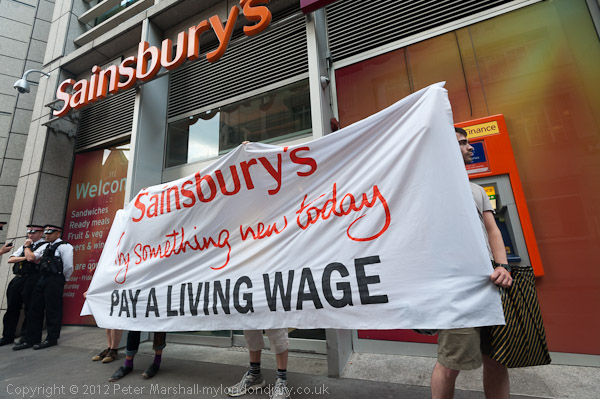
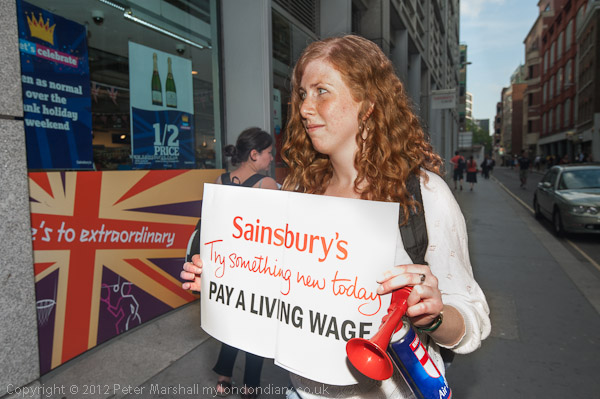
Of course I had to make sure that at least some of the pictures explained what the protest was about, and the banner outside the shop was an easy way to show this, with its use of their advertising slogan ‘Try Something New Today?’ and the protesters’ suggestion ‘Pay A Living Wage.’  You’ll see on My London Diary that I took a few more pictures making use of these slogans.

© 2012, Peter Marshall

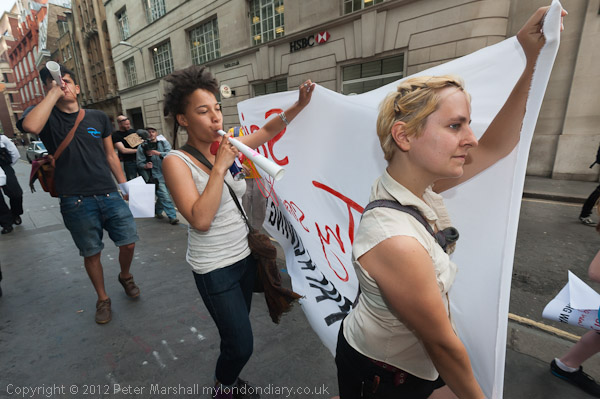
After a while when the protest moved around the corner to the Sainsbury’s offices on Holborn Circus I got another of my favourite images from the day, although this time the banner was held with its message away from me. It was certainly better to work from the side with the bodies of the people holding it visible, and the text would have perhaps taken something from the visual impact of the image.

© 2012, Peter Marshall

The lighting was quite tricky during the protest, with low evening sun and some areas in pretty deep gloom. Much of the time the fill from the SB800 was needed and did a good job, but there were just a couple of pictures where something went wrong.  Here’s one of them, with perhaps a couple of stops more flash than I wanted (I had it set for -2/3 stop.)

© 2012, Peter Marshall

It needed a little flash (I took a couple of frames without) but this was way too much, and the fingers of that hand close to the lens were completely burnt out.  Even with a lot of work in Lightroom I couldn’t quite rescue the image. Of course I am too close to her – the minimum distance shown on the back of the flash is I think 1.2metres, and had I been thinking  I would have tried to cut down the flash in some way, but there wasn’t time to do much. I did see the problem and tried to take a couple of images with the flash off, but it did need some extra light.

1.2 metres (at ISO 1600) does seem rather a long way and the minimum distance increases as you put up the ISO. It’s something that makes flash a lot harder for me to use in low light where I want high ISO to avoid excessively dark backgrounds. Perhaps Nikon could improve the flash circuitry in some way to make life easier?

Partying in Putney

Protests sometimes involve an element of secrecy with their locations being kept secret until the last minute, or being restricted to perhaps a single photographer who is invited to cover them. I’ve had quite a few such invitations, but mostly these have been for events early in the morning so that pictures can reach the newspapers by around 11am, when many of the stories for the next day’s paper – apart from really important breaking news – are finalised.

Living as I do on the fringe of London, covering early morning events in London means getting up very early and paying extortionate fares to travel in. It’s too expensive to do often on spec as a freelance, and actual commissions are rare, so mainly I cover events later in the day.

On Saturday there are cheaper fares all day, and in any case the Great British Street Party at a mystery location organised by UK Uncut and DPAC (Disabled People Against Cuts) was starting from 4 locations in London at the very reasonable time of 11am, and I didn’t even need to rush my breakfast.

© 2012, Peter Marshall
The protest started at Waterloo (and 3 other locations)

Although I couldn’t have know it, I could have enjoyed another hour in bed, because it turned out that Waterloo station was the gathering point on which people from the other three locations would converge, while those of us who had started there were simply waiting for them.

© 2012, Peter Marshall
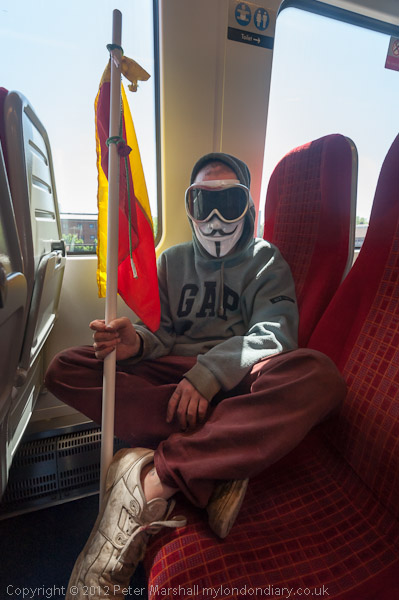
An Anonymous protester on the train to Putney

I think the four groups all finally arrived and we made our way on a train going back in the same direction I had come into Waterloo. As the train pulled into Putney (which I had gone through almost two hours earlier – and I could have saved half my fare) two of the four blocks got the order to alight, while the other two were told to stay on the train.

Should I get off or stay on? Most of the photographers I could see were getting off, so I decided to stay on, hoping to get some different and perhaps better pictures. I still am not sure if it was the better choice and from the pictures I’ve seen both groups actually missed perhaps the most interesting part of the protest as it began in the short street where Deputy PM Nick Clegg lives – though he and his family were known to be away for the weekend.

Had I known in advance where we were going I would have chosen Putney, and then made sure I was on the spot when things started. But had the organisers told me and the other photographers, then the police too would have probably got to know and prevented the protesters reaching there.

© 2012, Peter Marshall

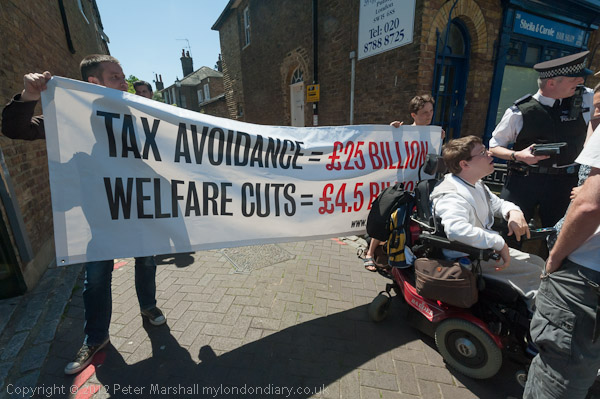
According to the press release after the event, the street was secured at both ends by protesters in wheelchairs chaining themselves across it, but by the time I arrived, the police were holding back the other group of protesters at the far end of the street and at our end there was just one person in a wheelchair and a small handful of people holding a banner waiting for us.  If the wheelchair users did chain themselves across the road I don’t think the press got there in time to take photos.

A few yards up the road were half a dozen police who stopped us as we walked up the road, but not for long. When a couple of protesters tried to push through the police turned to grab them and the rest of us simply ran (or walked, as I did) past their line.And I think we walked straight past Nick Clegg’s house because nobody knew where the party was meant to be, rushing up to join the other half of the protest.

© 2012, Peter Marshall

For a while the police too seemed to have no idea what to do, and the party-goers found themselves in the middle of two disorganised groups of officers, one trying to push them one way and the second pushing them back. Eventually they got themselves sorted out and formed a line  several officers deep blocking off the northern part of the road we had come down – and which presumably included the Deputy PM’s house.

© 2012, Peter Marshall

This left a nice space on the road for the party to take place, and there was truly a party atmosphere, with live music and free food. Some of the press talked about the neighbours being frightened and harassed but there was no cause for it and they would have been welcomed had they come and joined in.

I left early but the party continued for another four or five hours before those remaining left together for Putney station. On there way they were attacked by police, presumably frustrated by standing around doing nothing very much all through a hot Saturday afternoon. It was probably the only time in the day that anyone in Putney should have been much disturbed by what was going on.

More pictures: UK Uncut Great British Street Party

________________________________________________________

My London Diary : Buildings of London : River Lea/Lee Valley : London’s Industrial Heritage

All photographs on this and my other sites, unless otherwise stated are by Peter Marshall and are available for reproduction or can be bought as prints.

To order prints or reproduce images

________________________________________________________
Hospital Visit

© 2012, Peter Marshall

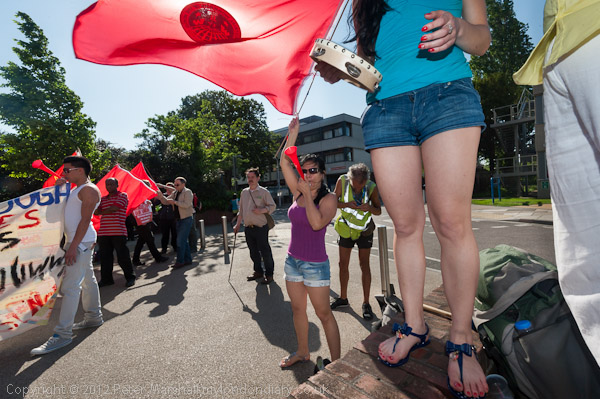
Sometimes there are pictures which appeal to me but which are unlikely to be used and I think the above image is one of them. Although I like it as an image, I think it doesn’t really tell the story. Looking at it there are clues about the event, but nothing that makes it clear.

© 2012, Peter Marshall

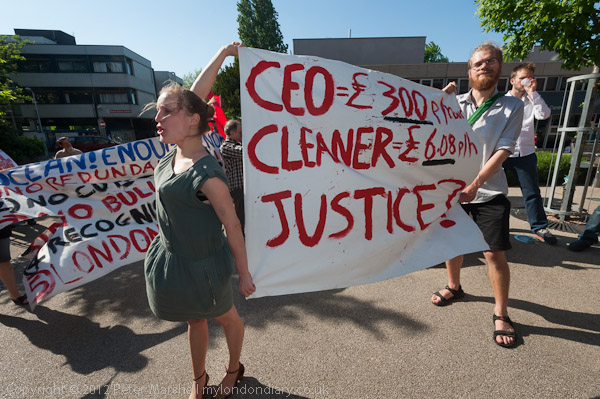
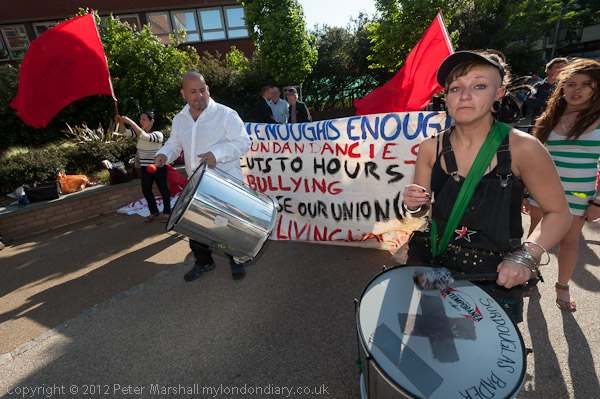
I think this is probably the one I chose as the lead image for the story, because the text on the banner makes it clear what the protest – by cleaners  at one of London’s leading hospitals – was about.  Or perhaps I might have chosen something like this one:

© 2012, Peter Marshall

It felt strange to be back at St George’s Hospital, where nine years ago I spent some time in a bed waiting for an operation which finally put me back on my feet again, although the actual building I was in – typically Victorian with the kind of long wards where Florence Nightingale would not have looked out of place – was due for demolition a few weeks after I left, and not before time.

One thing that impressed me in 2003 about St George’s was the quality of the cleaning. It was the third hospital I’d been in; the first with cleaning out to a contract was largely filthy, and in one of the wards I found discarded needles and dressings under my bed, though the intensive care ward I’d gone in to on entry was well looked after. But basically whenever the nursing staff wanted the place cleaning there were no cleaners to be found. The second hospital was so crowded with beds I don’t think you could see under them.

At St George’s the ward staff made sure the cleaners did a good job, and although the plumbing was falling to bits and parts of the walls were crumbling the floor shone. I don’t know how well the place is cleaned under Ocean who now employ the cleaners, but if as they are trying to they manage to cut the hours the cleaners are given, standards will suffer, both because the staff have less time to clean, but also because of the loss of morale that a cut in their overall pay will undoubtedly bring.

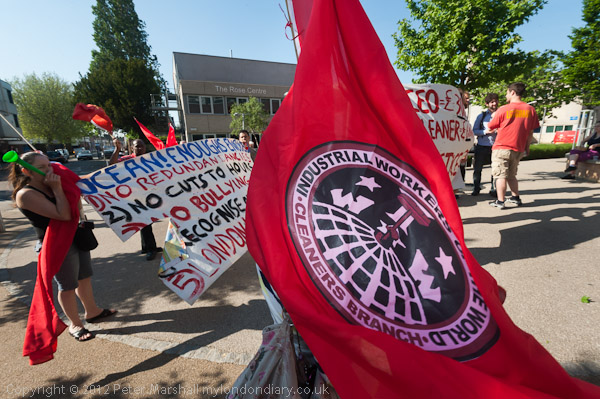
The dispute at St George’s is also about union recognition. The cleaners – all except one – belong to the IWW which now has many of London’s cleaners in its branch here. They have lost faith in unions such as Unite who they feel have failed to press their demands with management, neglecting them in order to get a better deal for more highly paid members. But the management recognise Unite but not the IWW, perhaps because they know they will not be pressed as hard.  There were plenty of opportunities to show the IWW was fighting for the cleaners, and those red flags are IWW flags, but in other pictures I tried hard to make their involvement more obvious.

© 2012, Peter Marshall

Although I think I did a decent job overall – and you can judge for yourselves at Hospital Cleaners Protest on My London Diary – and certainly the cleaners were pleased with the pictures and article published on Demotix, I wasn’t entirely happy, as there was no single picture in which I really managed to put all the elements together. Some days it’s really difficult to find what you want.
________________________________________________________

My London Diary : Buildings of London : River Lea/Lee Valley : London’s Industrial Heritage

All photographs on this and my other sites, unless otherwise stated are by Peter Marshall and are available for reproduction or can be bought as prints.

To order prints or reproduce images

________________________________________________________
Afghan Photographers

Last week I read an interesting Aljazeera feature Afghan photographers shoot to glory, which as well as starting me on a search to see more of the work of the Afghan photographers featured, also sent me looking at the work of Reza who toegether with his brother Manoocher Deghati founded the Aina (mirror in Farsi) media and photography school, where most of these photographers studied, in Kabul in 2001.

Reza is well known for his work around the world for the National Geographic Magazine, which is perhaps why I’ve not really looked much at his work before. There is something about the whole NatGeo look and approach – at least in modern times – that I often find too slick and glossy – and I rather like photographs that are a rather more down and dirty – perhaps rather more like the world itself. NatGeo tends to be a little too American and too coffee-table for my taste, though of course that is being unfair on photographers such as Reza, born in Iran and, like his brother, an Iranian-French photojournalist. He’s won major awards in photography for his work and been honoured by France and UNICEF, and looking at his work you can see why.

After studying film-making in Rome, Manoocher returned to Iran to photograph the revolution and worked for around ten years for the agency SIPA, founded by the legendary Turkish photojournalist Göksin Sipahioglu (one day I must find and resurrect the article I wrote about him) in 1973 in Iran and later in the USA, then mainly for AFP before going to Kabul to found Aina, and is now Middle East Regional Photo Editor for the Associated Press (AP), based in Cairo.

There are some pictures in the Aljazeera feature, but you can find more of their work on the web. The is a portfolio on AFP for Massoud Hossaini as well as his work at World Press PhotoFarzana Wahidy who is his wife and another fine photographer also appears in a feature
Shooting Stars: Reza presents Farzana Wahidy, where his introduction ends with the words “Farzana is telling the story of Afghanistan from the inside.” This is something that is important and true about all these photographers. Fardin Waezi, has his own blog which makes the same point in its title, Though Afghan Eyes. He learnt his photography starting at the age of 7 in his father’s photography studio in Kabul.

Barat Ali Batoor grew up as an Afghan refugee in Pakistan and going to his country for the first time in 2001, he taught himself photography in 2002 to “draw the world’s attention to the plight of the Afghan people the problems facing the country.” You can see his remarkable and controversal images of dancing boy entertainers on his site.

Time Travel…

Thanks to PetaPixel for republishing Time Travel and Ethical Photojournalism by Utah-based photojournalist and chief photographer of the Salt Lake Tribune Trent Nelson, a piece that originally appeared on Nelson’s own web site Trenthead.com on June 15th.

This is a discussion which applies a great deal of common sense to the discussions of the ethics of post-processing of photographs, although I think it says little if anything that I and many others haven’t said before, it does so very clearly.

His final sentence: “Remember, reality is the goal.” is perhaps a good summation of both what is and what is not acceptable in terms of image processing (though perhaps I might sometimes put in a word for clarity too.)  Certainly we should not be bound by the limits of what was possible in the not so good old days, and be ready to take advantage of the powerful corrective tools that are now available in software such as Lightroom 4.

It’s worth taking a look at the rest of Nelson’s Trenthead.com web site too. How many photographer’s web sites have a section on Polygamy? And as it says there are some Amazing Links.

Monet at Giverny

Bernard Plossu is a photographer who perhaps has not been given the appreciation he deserves in the English dominated photographic world (by English I refer of course to the language they speak in America.)  There has always been a philosophical background to his work as with many things French, and doubtless his own minimal almost non-existent website in some way reflects that, though you can see more of his work at Galerie Camera Obscura.

The text on the English version of  La Lettre de la Photographie in the feature Monet at Giverny by Bernard Plossu is not too easy to follow (presumably a machine translation), and if you can read a little French the original makes more sense.

Plossu likes small prints – the colour images are 18x24cm or less and the black and white only 11.4×7.6cm, around 4.5×3 inches, around the size of most people’s family pictures when I was small, representing only roughly a 3x linear enlargement from his 35mm negatives.  There can be a certain exquisite quality to small black and white prints like this but looking at the images in the slide show on screen, I’m not sure that these prints possess it (and looking at the images full-screen I see them rather too large for his aesthetic.) But these are prints by Guillaume Geneste, of La Chambre Noire, one of the best printers in Paris, and not far from my favourite area of the city.

The colour images, printed by the Fresson process I think I like less. It’s a pigment process which uses four exposures with colour separated negatives onto a rather granular pigmented gelatine made light sensitive with a dichromate, with the unhardened material being washed or even abraded off the paper with a sawdust slurry, although the details are a trade secret.

The earliest monochrome prints made in this way used finely divided carbon particles as the pigment, often ‘lamp black’ made by cooling smoke on a cold surface, and were called carbon prints, and the image hardens from the top surface which was exposed to sunlight (or other UV source) down. Because of this the process became known as carbon printing.  In traditional carbon printing the exposed layer is covered by a sticker gelatine coated paper and adhered to this before being washed to remove the original porous paper backing and unhardened gelatin that was left below the hardened image.

The Fresson process was one method that eliminated the need for transfer, enabling the print to be produced directly on the coated material – a direct carbon process. Probably the secret relied on thinner coatings with paper with a good ‘tooth’ and perhaps a certain ‘graininess’ in the coating producing a kind of crude half-tone.

They call the process for colour printing ‘quadrichromie’ and it was developed from the original single colour process first exhibited in 1899 by Théodore-Henri Fresson (which took his name) and marketed by the family. A two year research project by his son and grandson resulted in the first charcoal colour print in 1952, and the process provided by their family firm became popular with advertising and fine art photographers in the 1960s and 70s.

The effect is similar to a tri-colour gum bichromate print, and gives a very painterly effect with the texture of the paper and a usually subdued rather pastel colour. Although some Fresson prints I’ve seen have been very nice as objects, the process with its characteristic palette often seems to overwhelm the subject matter, and I think it may do so here, though it’s obviously unfair to judge from the web images.

Somehow too the Fresson doesn’t quite for me sing the right tune for Monet, and I think it lacks the kind of clarity I see in his works. Though I’ve never been to Giverny I have spent some considerable time with his works in our splendid National Gallery. Often when photographing protests in Whitehall or Trafalgar Square I’ve had a few minutes to spare and have slipped into it to stand in front of works such as his The Waterlily Pond painted in 1899 at Giverny.

I wonder if Plossu might have been better to make use of modern technology to achieve similar but purer effects, processing with Photoshop (I’m not entirely convinced by this example) and printing with pigment inks on suitably textured watercolour paper.  It’s a thought that will be heresy to many.

There are a small number of Plossu’s earlier Fresson images on the  Camera Obscura site, some of which I think are more suited to the process, but it is his black and white work that interests me more.

The show is at the Musée des impressionnismes Giverny across the summer, until 31 October and perhaps this will be the year when I finally get to Giverny. It would certainly be more pleasant than watching the Olympics.

Deadly Coal & Filthy Lies

Last week was apparently “End Mountaintop Removal Week Washington DC,” a piece of news that probably wouldn’t have made our media even in a week without the wall-to-wall royal sycophancy, and to be honest something that I would not normally have been aware of. Although strip mining in the UK is something I’ve written briefly about and photographed protests against in London, the environmental problems it causes in Appalachia are not a major issue here.

What brought them to my attention was a Facebook post from the The Shpilman Institute for Photography referring me to an LPV Digest post about the misuse by ‘Big Coal’ of child pornography allegations to prevent Maria Gunnoe, described by Rolling Stone in their feature about the incident as “one of the most effective and celebrated mountaintop removal activists in Appalachia” to prevent her using a picture by photographer Katie Falkenberg showing a young girl in a bath full of what Aaron Brady in The New Inquiry describes as “brown, poisonous water” caused by the mining. The photographer’s caption which he quotes states that the water has a high level of arsenic which the family say is a result of the blasting used in mining which has disrupted the water table and cracked the casing of the well which is their only normal source of water. Although the mining company haven’t admitted they caused the problem, the caption stated “they do supply the family with bottled water for drinking and cooking.”

Mother Jones gives more details of how Gunnoe, who had gone to Washington to testify to a committee of Congress, was  told before she did so that she must remove the picture from her presentation and that after she had given her presentation was questioned for almost an hour by police over allegations that the image was child pornography.

The image had been taken and used with the permission of the child’s parents and Gunnoe also had their permission to use it, but since the police investigations started it and the caption have been removed from Falkenberg’s web site, replaced by the statement: “The family has declined media request to use this photo; it has therefore been removed from the photo essay to honor their wishes.”

Although some other web sites and blogs have removed the picture at the photographer’s request, it remains fairly widely available on the web. You can find more about the U.S. Representative who appears to have been responsible for the removal of the picture and the porn allegations in the Schmuck of the Week feature Doug Lamborn should be thrown out with the bathwater on Denver Westword, and Gunnoe’s testimony (without the disputed image) is also available online.

The publicity surrounding the case has almost certainly caused problems for the family concerned, and they may well have come under considerable pressure to revoke their permission for the picture to be used.  It would be hard to criticise them, and given their request the photographer, for the decision to withdraw the image, but it really it is hardly possible to remove images from the web once they have been released, and it took less than 10 seconds to find a copy.

This perhaps isn’t always a good thing, but when we are talking about censorship by powerful vested interests who are more than prepared to play dirty I think it must be.