More from the XR Garden Bridge

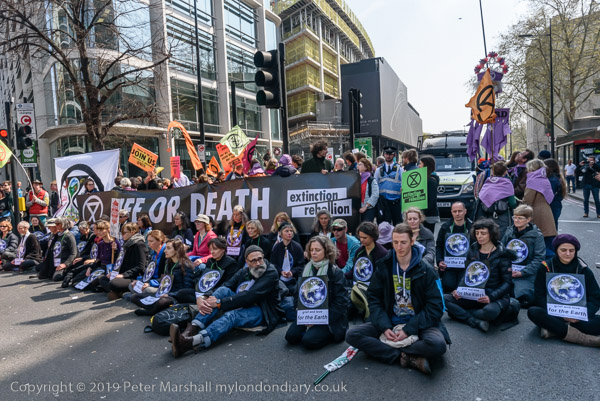
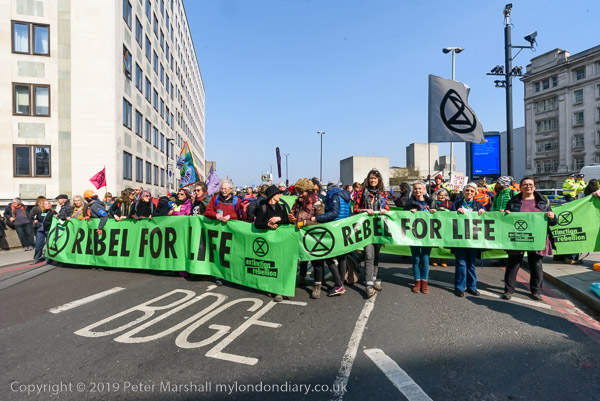
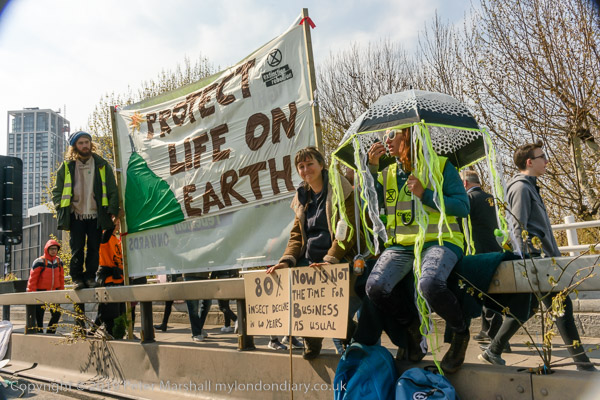
On my next visit to London two days after XR had occupied Waterloo Bridge to make it into a ‘garden bridge’ I found myself needing to cross the Thames to get to an event I wanted to photograph, and the obvious way to get there was to walk through the garden.

There had been reports of arrests by police trying to clear the bridge, but things were still happening there, and for the half hour or so I had given myself to cross it the police were simply standing and watching.

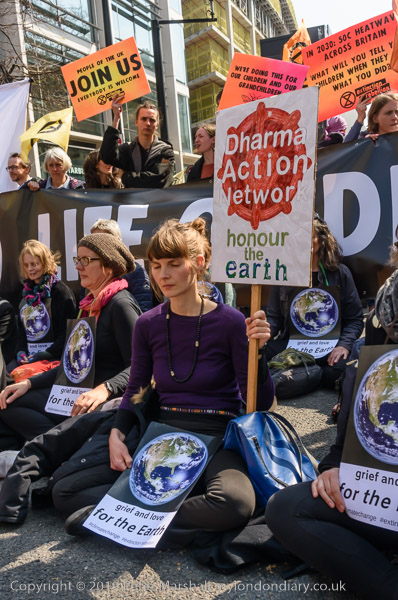
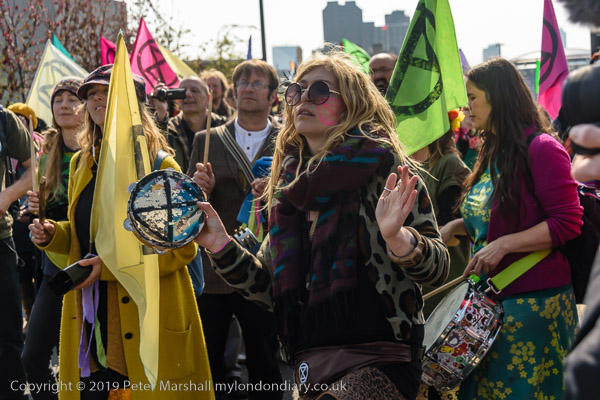
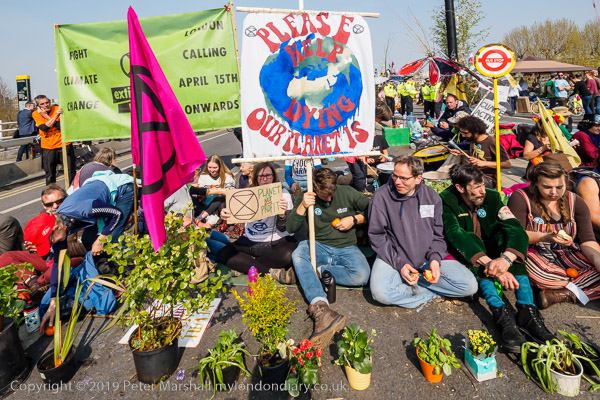
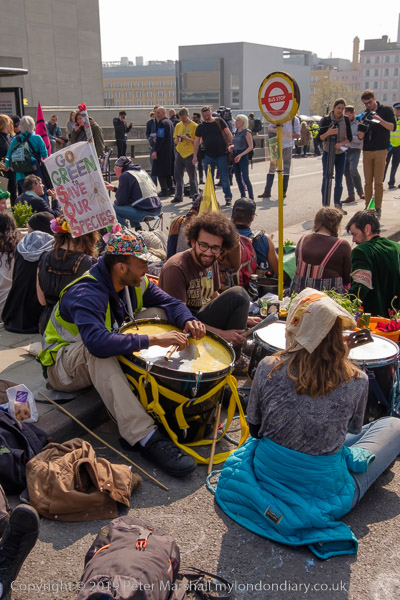
The protesters seemed well settled in, though there were still new people arriving, with an induction session taking place. People were drumming and others simply sitting and chatting around, with a small library being pushed around to offer books to those who wanted to read.

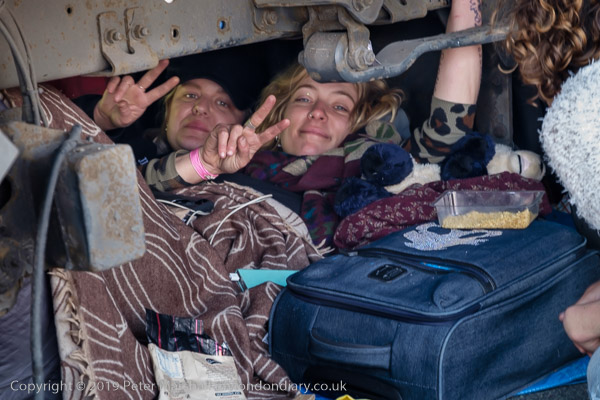
And there was singing, poetry and story-telling on the lorry that was there as a stage, though there were also people locked on underneath it to prevent it being moved, with others sitting on the roof, probably just to get a good view and so that they caught a little more of the breeze coming up the river, as it was a hot morning.

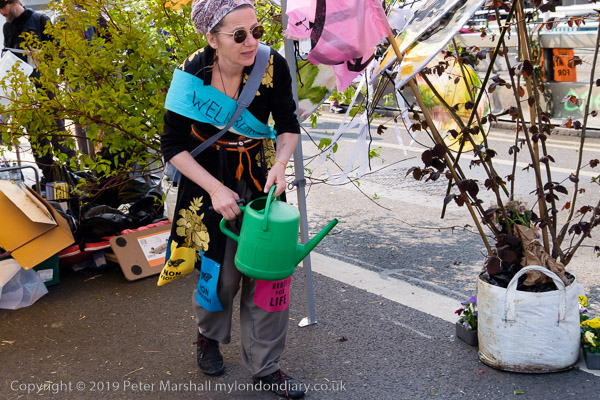
Some people were keeping busy keeping the site running and others were enjoying the sun and a rest. It seemed a very calm place and it was good to be away from traffic and fumes, and I was sorry I had to leave.


All photographs on this and my other sites, unless otherwise stated, are taken by and copyright of Peter Marshall, and are available for reproduction or can be bought as prints.

There are no adverts on this site and it receives no sponsorship, and I like to keep it that way. But it does take a considerable amount of my time and thought, and if you enjoy reading it, please share on social media.
And small donations via Paypal – perhaps the cost of a beer – would be appreciated.
Shell Out

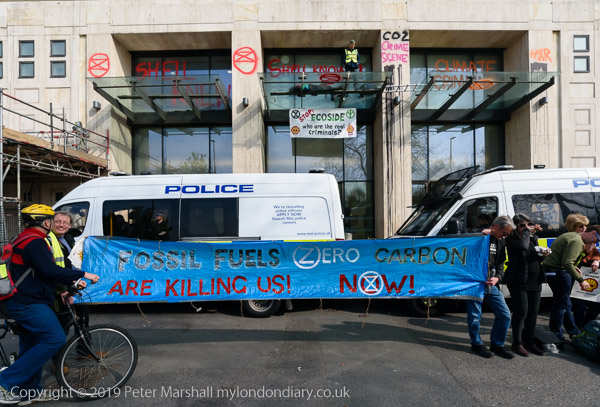
If we are to survive as a species we need to stop the climate destroyers, companies like Shell who are still pushing fossil fuels. So it wasn’t surprising that Extinction Rebellion had planned a protest at the Shell offices in London.

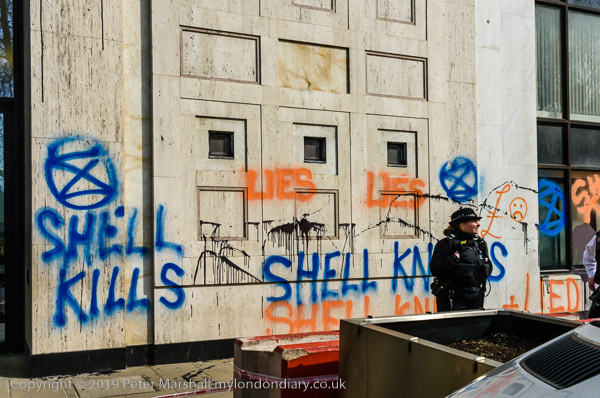
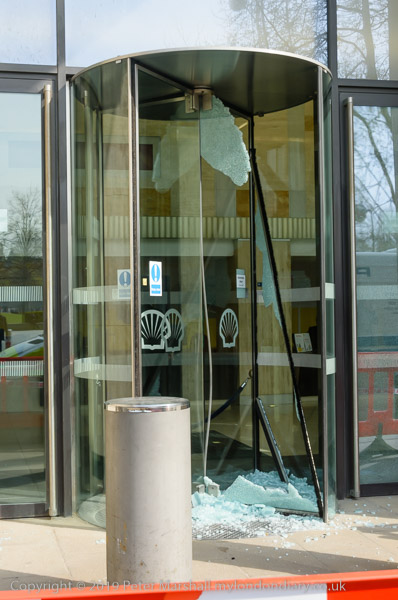
Also not surprising that as those taking part were intending to be arrested for taking illegal action and causing damage to the property that they didn’t advertise their protest beforehand. I only heard about it a short while after it happened, when a colleague who had been filming it told me what had happened and said it might still be worth a visit.

I do sometimes get advance information on illegal actions – and have at times been asked to cover them for the organisations taking them, but I usually pass up the opportunities. Sometimes it’s because they are taking place at inconvenient times, often early in the mornings. I’m afraid I don’t like getting up early and living a short journey outside London makes me reluctant to cover anything that starts before around 10.30am.

I also like to keep a certain distance between myself and groups of protesters. It’s a matter of objectivity and of editorial independence. I may support the aims of a protest, but as a photographer and a journalist I want to see and photograph it from my own viewpoint. So while I’m happy to cover events when I can, I don’t normally want to be a part of them.

Sometimes groups who approach me would be happy to pay for my services, though more often there isn’t any money involved. I’ve long been a supporter of trade unions and the idea that the labourer is worthy of his hire, and am opposed to my work being used without payment by anyone else who is making money out of it. I don’t actually need the money any more but there are plenty of younger photographers out there who struggle to make a living, and I’d rather any paid job went to one of them.

While I understand that many organisations want to improve the chances of hasing their protest or other event features in publications by providing free high-quality images, this is something I don’t like to support. If an event is newsworthy, then the media should be prepared to pay for decent pictures – otherwise no news photographers can make a living.

I have two simple rules when I’m asked for permission to use any of my images without payment:
Firstly – and this applies also when people approach me offering to pay – do I approve of the way they want to use the image. Some organisations get a straight refusal, though agencies with whom I place most images are less discerning.
Secondly if any organisation wants to use my work without payment my second question is to ask if the organisation has paid staff. If it can afford to pay workers it can also afford to pay photographers like me. It’s a simple test.

There are of course exceptions. One long-established is for the occasional exhibitions I take part in, where images are provided for free use in publicising and reviewing the show. And there is one or perhaps two magazines worldwide I would allow to use my work without payment in the unlikely event they would want to do so. And my work is made freely available to you all to view on my various web sites, particularly My London Diary, London Photographs, Hull Photos and the River Lea, links to which appear at the bottom of most posts on this site, a total of around 200,000 pictures and still growing.

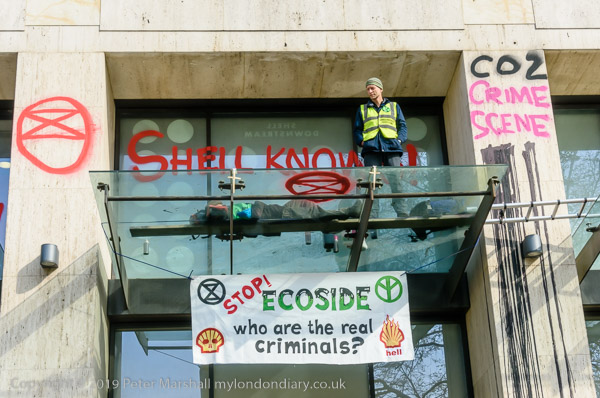
As well as their general role in promoting climate disaster and ecocide, the protest at the London Shell HQ also highlighted their crimes against the people of the countries of the global south in which they operate, particularly in Nigeria where the company has been responsible for the killing of opponents to its activities, including Nigerian writer, television producer and environmental activist Ken Saro-Wiwa, executed by the military government there in 1995. 

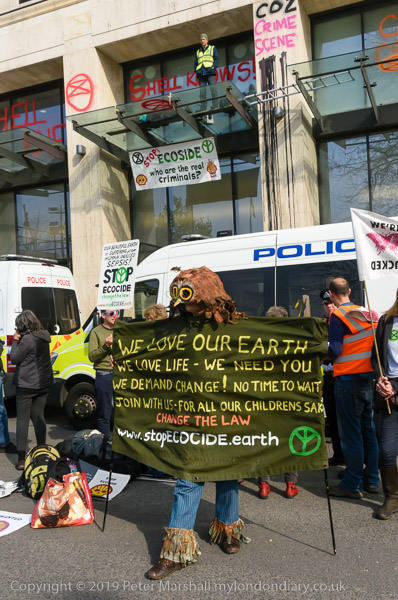
I arrived far too late to see the activists daubing slogans on the Shell building and deliberately causing criminal damage so that they would be able to demand a trial before a jury, enabling them to argue their justification for the action. But there were still two activists occupying the glass porch above the entrance, as well as a group of supporters protesting on the road outside.

You can see a few more pictures at Extinction Rebellion at Shell. I didn’t stay long as I’d missed the main action and little now seemed ot be happening – and I had another protest to visit on my way home.


All photographs on this and my other sites, unless otherwise stated, are taken by and copyright of Peter Marshall, and are available for reproduction or can be bought as prints.

There are no adverts on this site and it receives no sponsorship, and I like to keep it that way. But it does take a considerable amount of my time and thought, and if you enjoy reading it, please share on social media.
And small donations via Paypal – perhaps the cost of a beer – would be appreciated.

Debunking digital myths

You may like to view the 30 minute video in which Tony & Chelsea Northrup discuss what they say are 12 common myths about digital photography, which was recently posted on Petapixel.

But to be frank, I find their presentation pretty nausea-inducing, and even scrolling through on fast-forward with the occasional pause to listen to the answers seemed like 10 minutes of my life wasted. There are some things video is an appropriate format for, but this was just not one of them.

So, what were the myths? I’ll paraphrase, and give my own answers which sometimes differ slightly from Tony Northrup.

Q: Should you fully discharge batteries to avoid a memory effect?
A: Cameras now use lithium batteries and full discharge should be avoided.

Q: Will your memory card be corrupted by deleting pictures in camera?
A: No.

Q: Will using a UV filter improve image quality?
A: No. Adding extra glass may even very slightly degrade IQ, though seldom noticeably. But it can protect the front lens element in tough conditions.

Q: Do higher megapixels sensors have greater noise?
A: Not necessarily, although very high megapixel small sensors on some phones do.

Q: Do medium format lenses give better “compression”?
A: This is just marketing talk. In general larger formats have more limited depth of field which may give a different look to the image, but at apertures that give similar depth of field the pictures will be identical so far as “compression” is concerned. Of course larger sensors generally have more megapixels and lower noise and their larger pixels can give them greater dynamic range. If you want to make giant prints a MF camera will be at an advantage

Q: Does your PC do a better job of Raw processing that your camera?
A: The PC – and viewing your image larger allows you much more control over how Raw processing is carried out. But modern cameras do a very good job in producing jpegs.

Q: Can you edit jpegs?
A: Well, of course you can, and Lightroom in particular seems to do it very well. But avoid repeated saving and later reloading to re-edit them as every jpeg save loses information.

Q: Do you need to turn off Image Stabilisation when using your camera on a tripod?
A: You don’t need IS when your camera is on a tripod, but it may well not make any difference. But it’s probably best to read what the camera manual says and follow its advice.

Q: Are lenses at their sharpest at f8?
A: Probably not. A better rough guide suggests two stops down from wide open, but a stop or two either way is almost never critical. Never be afraid to stop down more if you need greater depth of field or open up if you need a faster shutter speed. Remember many great pictures are not particularly sharp and the great majority of sharp images are not worth a second look.

Q: Is manual focus more accurate than auto-focus?
A: Manual focus is as sharp as you make it, but it is difficult to get focus more accurate than with modern autofocus systems, though you can match this using ‘focus peaking’. Manual focus does have the advantage that the photographer is aware exactly where in the subject focus is – all too easy for autofocus to be somewhere different.

Q: Do Canon cameras give the best colour?
A: Probably only so far as Canon’s marketing guys are concerned. If you shoot RAW, then you (and your raw processing software) make the choices on colour. I’ve used Fuji, Nikon, Olympus and Canon digital cameras. All can produce great colour from RAW files. I usually prefer Nikon, or, if I want a more vibrant look, Olympus, but the others are fine.

The Northrups have carried out some experiments with large groups of people and colour images from various cameras and you can find more details on their site. But for me it’s only my opinion that matters, and I think that which gives the best colour depends on the subject and its colours – it can be Fuji, Olympus or Nikon, but seldom Canon.

Q: What causes memory card faults?
A: A few years ago counterfeit cards were common, and the packaging was good enough at times to fool even reputable suppliers. I was supplied with some and they immediately gave problems. I’ve also bought cards direct from reputable manufacturers which turned out to be not entirely compatable with my camera – and again this showed up fairly quickly. Both times I got replacements without a problem. I think that both these things are now much less common.

Card faults resulting in image loss are now uncommon. But it makes sense to take care never to remove a card while it is being written to and not to get the card contacts get dirty. But as the video says everything does go wrong sometimes – fortunately not very often.

Reading this will have saved around 25 minutes of your life and imparted probably slightly better advice than that in the Tony & Chelsea Northrup video. But I’m sure their many fans will still want to watch it, though I hope if you are reading this you will find better things to do with your time. Why not go out and take some pictures?


All photographs on this and my other sites, unless otherwise stated, are taken by and copyright of Peter Marshall, and are available for reproduction or can be bought as prints.

There are no adverts on this site and it receives no sponsorship, and I like to keep it that way. But it does take a considerable amount of my time and thought, and if you enjoy reading it, please share on social media.
And small donations via Paypal – perhaps the cost of a beer – would be appreciated.

XR Funeral Procession

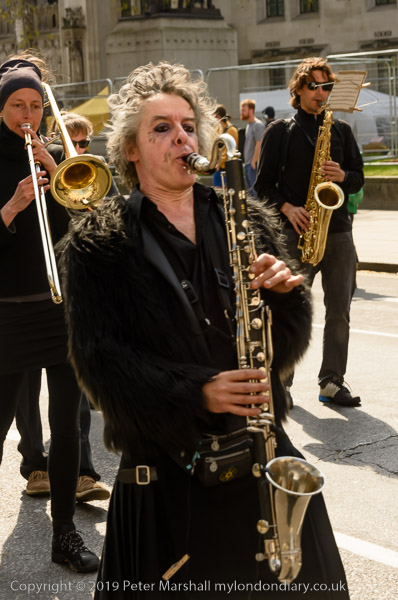
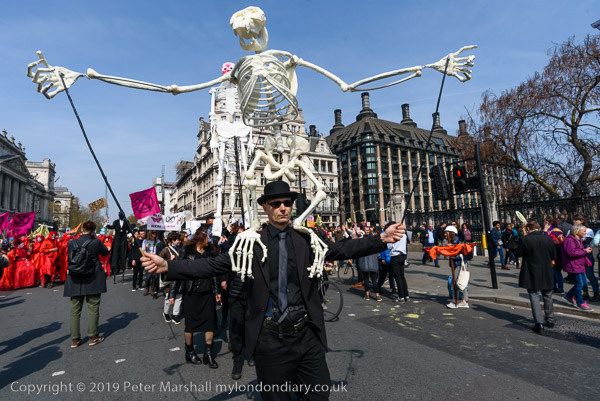
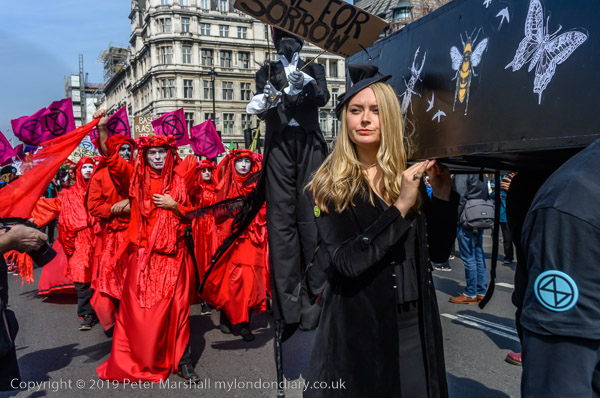
It was perhaps surprising that Extinction Rebellion’s occupation of Parliament Square acheived less publicity in the media than that of the other occupations in April, despite starting with arguably the most colourful (and most musical) of the events of the eleven days, a New Orleans style jazz funeral procession.

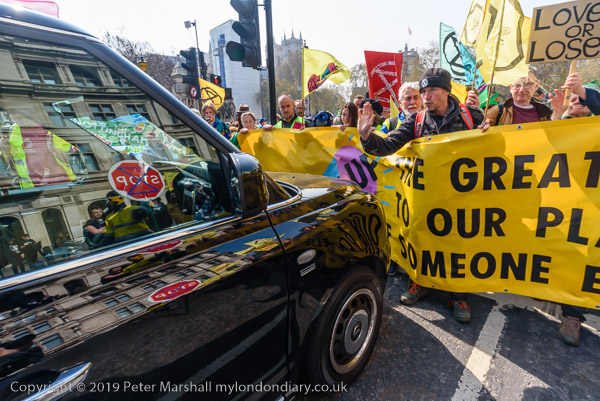
The roads around the square were blocked as I arrived to photograph the procession, much to the annoyance of at least one taxi driver, who made an ill-advised attempt to drive through the protesters before giving up and turning around. But this isn’t a major junction like those at Oxford Circus or Marble Arch, not really even a major route, and one which I’ve long thought should be pedestrianised and permanently closed to all but essential traffic to make London more pleasant for Londoners and tourists.

Again, the protest in Parliament Square didn’t have the kind of permanent focus provided by the Waterloo Garden Bridge, or the pink yacht of the sea at Oxford Circus. And it was hard to see what might have provided that, though a large guillotine might have been popular with some. But what Parliament Square did have was a spectacle, a funeral procession led by a small jazz group in front of the coffin, and behind it giant skeletons and a bright red-clad group apparently representing the blood of extinct species – and of those species including our own soon to become extinct.

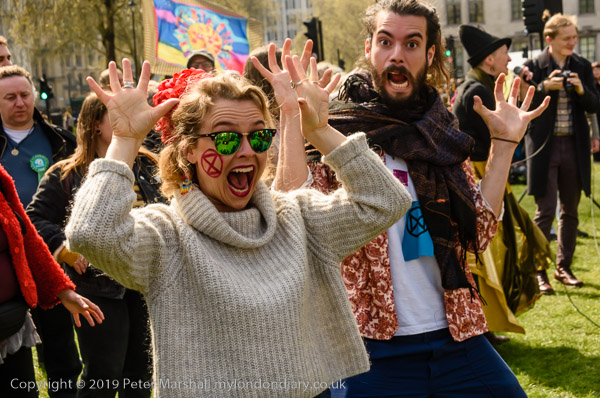
There were other mourners too, people with placards and some giant bees among them as the procession made several slow circuits of the square before moving onto the grass. They didn’t actually bury the coffin (or try to) but there followed a series of workshops and group discussions, and after a while I left to photograph another event that had been taking place at the same time.

The procession perhaps would have made better video that still pictures, both because of the nature of the event but particularly for the music.


More at Extinction Rebellion Funeral Procession

All photographs on this and my other sites, unless otherwise stated, are taken by and copyright of Peter Marshall, and are available for reproduction or can be bought as prints.

There are no adverts on this site and it receives no sponsorship, and I like to keep it that way. But it does take a considerable amount of my time and thought, and if you enjoy reading it, please share on social media.
And small donations via Paypal – perhaps the cost of a beer – would be appreciated.

XR Marble Arch

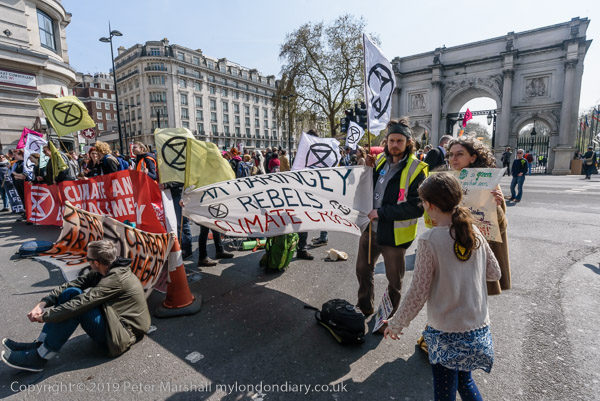
Extinction Rebellion’s largest site during their multiple occupation of London was in the area around Marble Arch. It’s were one of inner London’s busiest north-south routes, Park Lane on the east edge of Hyde Park, crosses the East-West route of Oxford St and the Bayswater Road, with Edgware Road, the A5 starting out its long journey well beyond Edgware to the far Northwest (and there is another similar arch where it ends in Holyhead.).

The Marble Arch itself is on the north edge of the traffic island in the centre of the large gyratory system here. It had been designed in 1827 by John Nash as a ceremonial entrance to Buckingham Palace, but in 1851 it was moved to its present position to serve as an entrance to Hyde Park at the time of the Great Exhibition.

Unfortunately the widening of Park Lane in 1960-64 led to it being cut off from Hyde Park, in isolation on a traffic island. No traffic passes through it now, although you can still walk through its arches. Until the late 1960s three rooms inside the arch were in use as a police station, but are now unused.

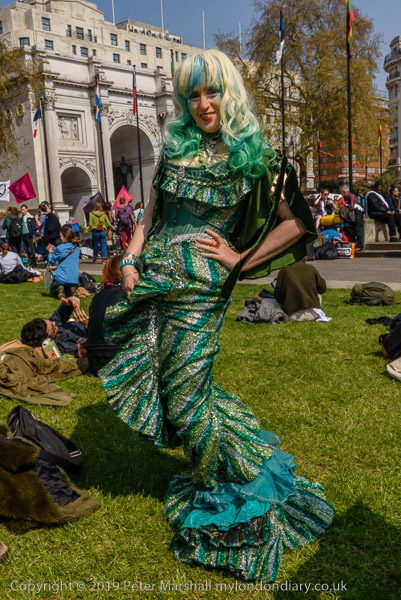
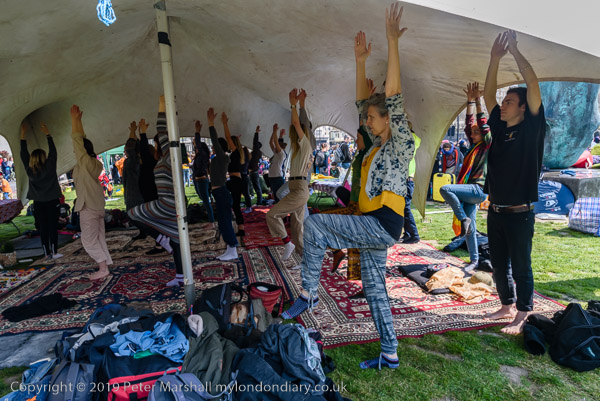
XR blocked traffic on all the roads leading to Marble Arch and tents filled most of the grassed area around, with the hard standing in front of the arch being used for stalls and performances, as well as a lorry equipped as a stage on Cumberland Gate. The area was occupied from the early hours of Monday 15th April. Police got the traffic moving again on Wednesday 24th, and XR finally left after a closing ceremony the following evening.

There wasn’t a great deal happening on either of the occasions I visited Marble Arch, but there were some major events on various of the evenings, with some well-known performers coming to perform and show their support. But I like to go home at night to a comfortable bed (and a good dinner) and left it to those staying in the camp to record.

More at Extinction Rebellion Marble Arch.


All photographs on this and my other sites, unless otherwise stated, are taken by and copyright of Peter Marshall, and are available for reproduction or can be bought as prints.

There are no adverts on this site and it receives no sponsorship, and I like to keep it that way. But it does take a considerable amount of my time and thought, and if you enjoy reading it, please share on social media.
And small donations via Paypal – perhaps the cost of a beer – would be appreciated.

June 2019 – My London Diary

June turned to be a very long month for me. The main event was the second anniversary of the Grenfell disaster, with another silent march, but there were also several other related events. And like many I’m feeling pretty fed up with how things are going politically, particularly over Brexit and despondent about the continuing failure of our politicians to take the climate and ecological catastrophe seriously.

June 2019

Algerians Protest for Freedom

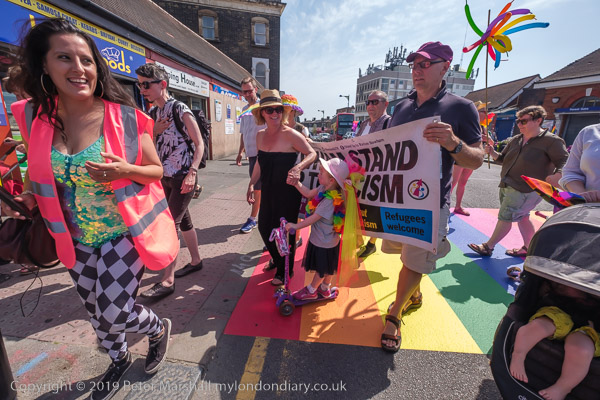
Forest Gayte Pride celebrates Stonewall 50
Remember Cecil the magnificent lion
Global March For Whales

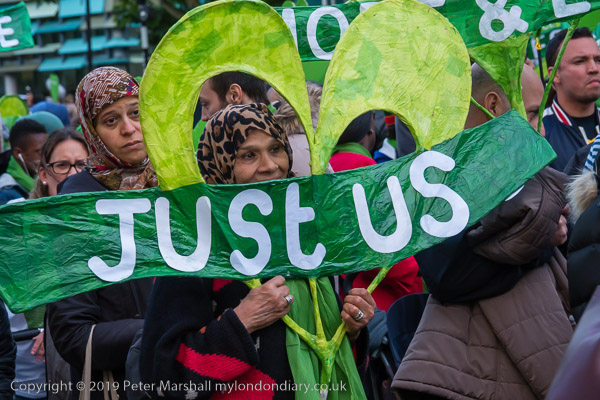
No Justice for Grenfell
Don’t Attack Iran
Viva! protest Coca-Cola Dairy Farm
End torture in Balochistan
Operation Shutdown against Knife Crime
Condoms Cut Carbon
SODEM Steve’s 50th Birthday

Time Is Now Walk of Witness
Against Hindu Fascism in India
Earls Court – Boris’s Biggest Blunder?
Students Friday Climate Strike
Against Farage and Turning Point UK
Extinction Rebellion Dinner of HOPE
City and Temple of Mithras
Free Algerian trade unionist Louisa Hanoune

Hands off Sudan march
‘We are the Love’ for Idlib
Grenfell Solidarity March
Staines, Heathrow, Bedfont
Grenfell Silent Walk – 2 Years on
Rally to end Live Animal Transport
Never Forget Never Forgive SOAS
London World Naked Bike Ride

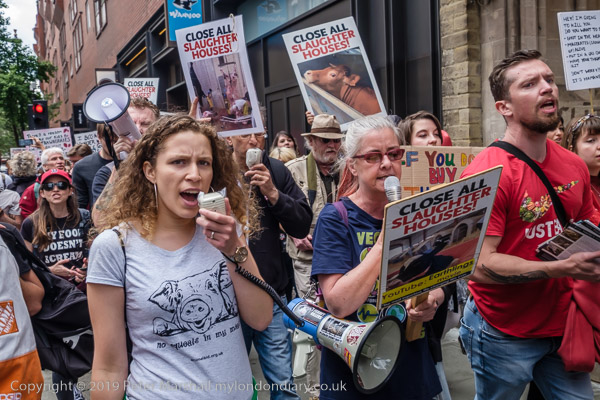
Close all Slaughterhouses
Sodem ‘Stop Brexit’ Protests continue
Parliament Debates Grenfell 2 Years On
Thousands protest against Trump
Osterley Park
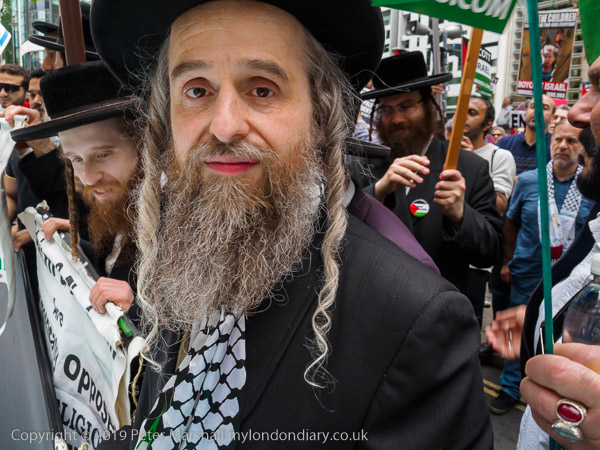
Zionists protest against Al Quds

Al Quds Day march
Cleaners at Hilton Doubletree Hotel
UVW celebrate LLW at Chanel
Canal Panoramas

London Images


All photographs on this and my other sites, unless otherwise stated, are taken by and copyright of Peter Marshall, and are available for reproduction or can be bought as prints.

There are no adverts on this site and it receives no sponsorship, and I like to keep it that way. But it does take a considerable amount of my time and thought, and if you enjoy reading it, please share on social media.
And small donations via Paypal – perhaps the cost of a beer – would be appreciated.
XR Sea of Protest

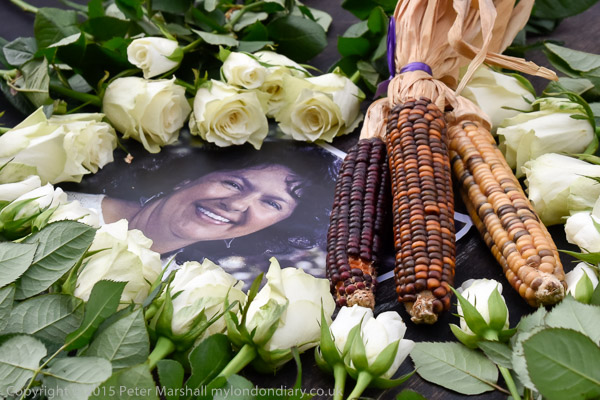
Back in November 2016 I attended a vigil outside the Honduran Embassy in London for  environmental activist and indigenous leader, Berta Cáceres, assassinated either by forces of the state or by groups encouraged by the state. Before her murder she had  death threats from the Honduran National Police and judicial harassment.

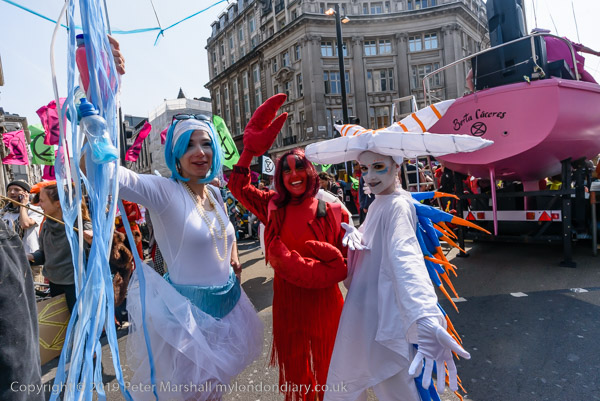
Very much to my surprise, Berta Cáceres returned to London this April in the shape of a large pink yacht named in her memory which Extinction Rebellion (XR) had brought to block Oxford Circus to traffic and create a “sea of protest“.

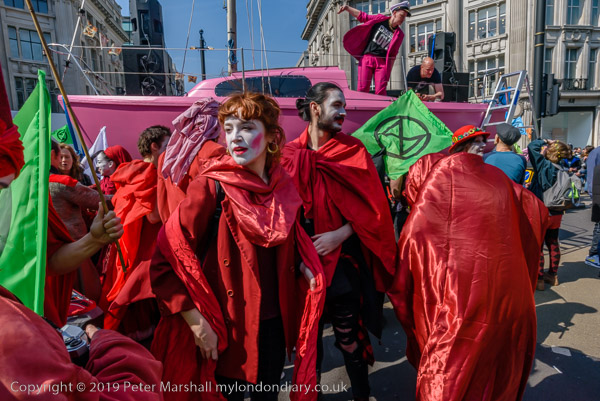
I arrived some hours after the yacht which was by then surrounded by protesters and with various activities taking place, including an induction course for new arrivals and some music. Getting ready to perform were a group of people dressed in red, representing I was told the blood of extinct species and those – like our own – threatened by the Earth’s sixth global extinction event, now getting into full swing thanks to the efforts of the fossil fuel industry and its supporters, particularly President Trump.

I didn’t stay long on this occasion, as other things were happening elsewhere across London. XR intended to keep the roads closed until the government takes necessary action on the global climate and ecological emergency, and this particular action continued from Monday until Friday, when I returned to photograph the police taking action to clear the junction.

More at: Extinction Rebellion Sea at Oxford Circus.


All photographs on this and my other sites, unless otherwise stated, are taken by and copyright of Peter Marshall, and are available for reproduction or can be bought as prints.

There are no adverts on this site and it receives no sponsorship, and I like to keep it that way. But it does take a considerable amount of my time and thought, and if you enjoy reading it, please share on social media.
And small donations via Paypal – perhaps the cost of a beer – would be appreciated.

XR’s Garden Bridge

While Boris Johnson wasted many millions of public money as London Mayor on a crazy project for a garden bridge across the Thames where no-one wanted it and it fortunately came to nothing, Extinction Rebellion provided one for free for a few days .

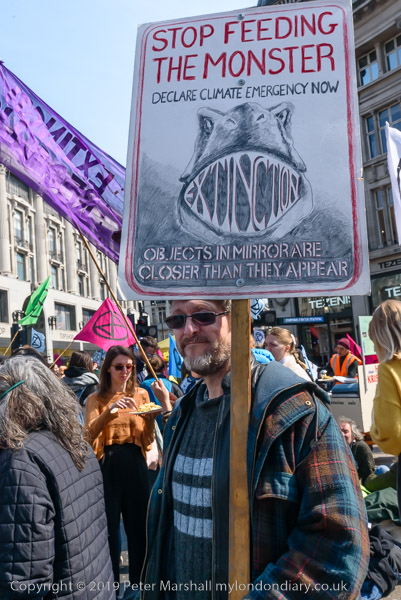
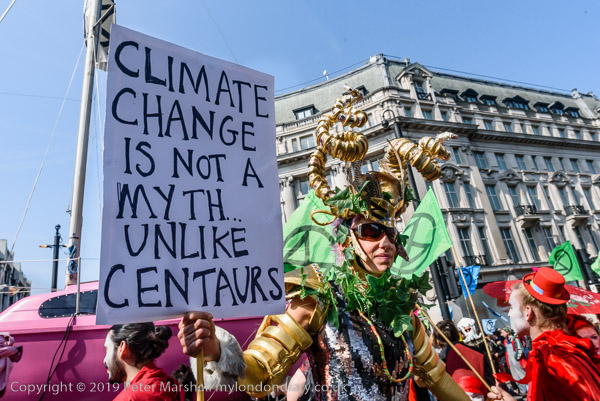
It helped that they didn’t actually have to build a bridge, but just took over an existing one, Waterloo Bridge, closing it to traffic. This did cause a certain amount of disruption, and doubtless inconvenienced some people, but it, together with their other actions around London, did serve to put the issue of climate catastrophe – and the very real threat of human extinction unless people across the world take radical action – into public consciousness.

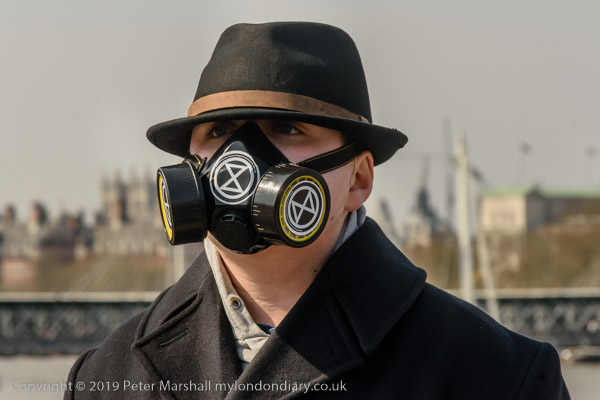
It was a minor inconvenience for me, as found myself having to walk around London rather than sit on a bus rather often during the week, though fortunately the tube was still working. But were I a transport planner for London, I think that at least one of London’s bridges – though probably not this one – would be permanently pedestrianised. We have far too much traffic in central London, causing far too much pollution – and thousands of early deaths – and the congestion charge hasn’t solved the problem.

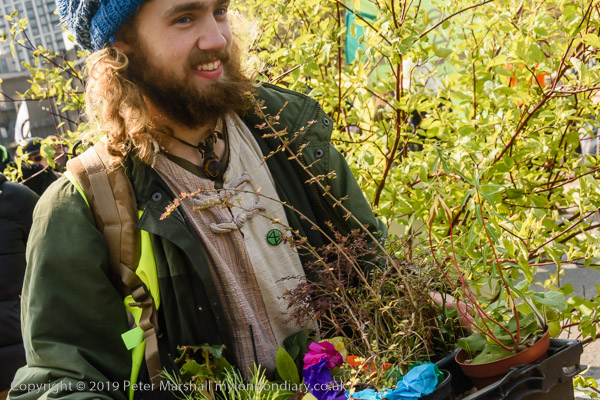
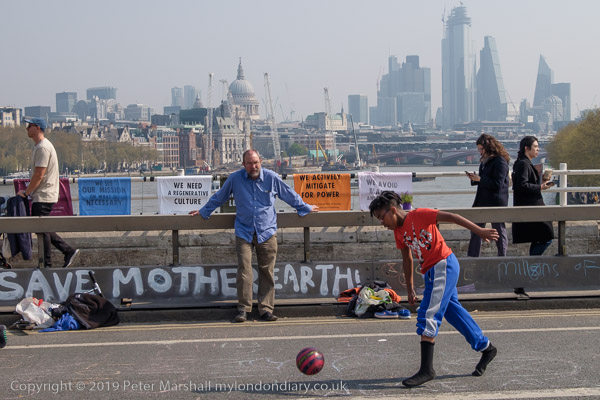
It was very pleasant to be able to walk across the bridge past the trees and plants, or to sit for a few minutes in the sun and listen and watch the activities taking place on the bridge. And the air there certainly felt cleaner, once you were on the bridge and away from the traffic jam south of the river.

Many of those on the bridge had travelled up from the country, and had brought a little of it with them. Some had even walked all the way from Cornwall. Extinction Rebellion has certainly gained a great deal of support, if largely from the kind of people who will go to public meetings and listen to their speakers. Most could be labelled middle class, though not mainly the comfortable and affluent high-consuming middle class, but largely those in low-paid occupations; teachers, social workers, health workers were I’m sure all over-represented.

XR has developed from the activities of groups like ‘Stop Killing Londoners’ whose protests against air pollution in the city I’ve photographed from their start, working on the ideas of Roger Hallam on non-violent protests and people being prepared to be arrested (as I photographed him being arrested at the LSE in a protest for the cleaners there.)

There were arrests at the ‘garden bridge’ but on the couple of occasions I visited police just watched and occasionally took notes. XR’s attitude to the police and their policy of encouraging people to be arrested has been much criticised by others, and they appear to have little regard for the problems it may cause and have under-estimated the support needed. But these are desperate times and rather than carping perhaps the critics should be showing an example by launching their own, more effective actions – but there is little sign of that happening. XR certainly isn’t a perfect game, but it has little competition.

More at Extinction Rebellion Garden Bridge


There are no adverts on this site and it receives no sponsorship, and I like to keep it that way. But it does take a considerable amount of my time and thought, and if you enjoy reading it, please share on social media.
And small donations via Paypal – perhaps the cost of a beer – would be appreciated.
All photographs on this and my other sites, unless otherwise stated, are taken by and copyright of Peter Marshall, and are available for reproduction or can be bought as prints.

Up the Elephant

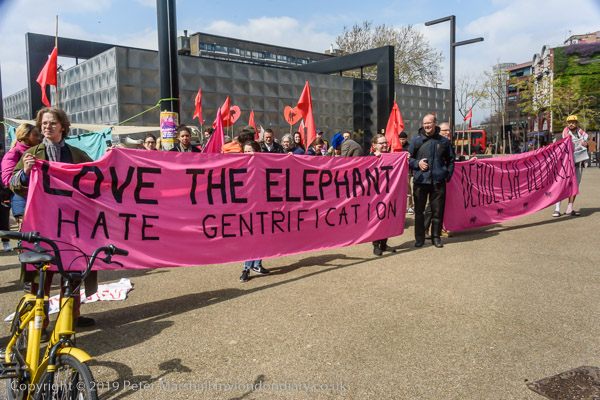
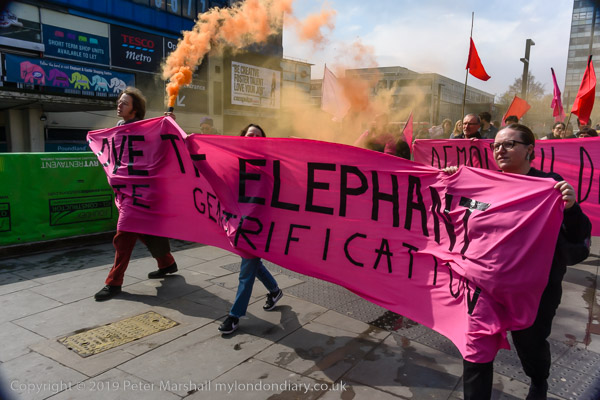
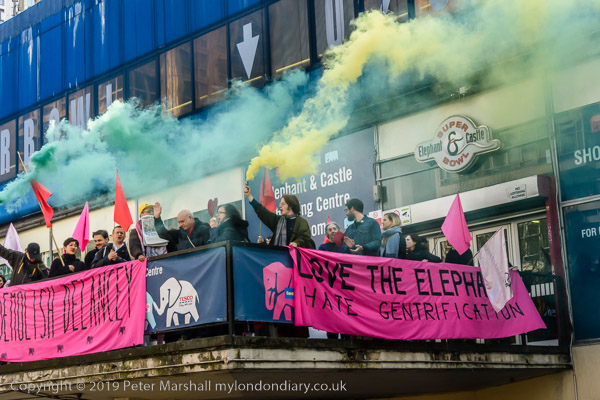
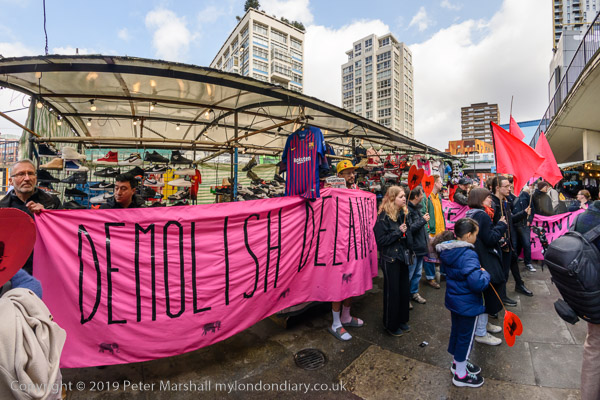
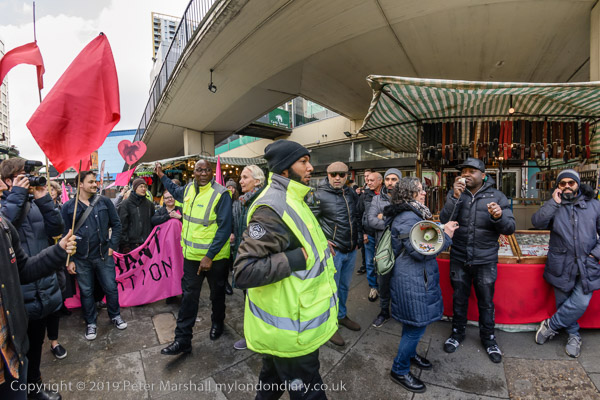
A quick trip on the Bakerloo line took me from elephants in Cavendish Square to the Elephant, where Southwark Notes, Latin Elephant and Up the Elephant were holding their Love the Elephant Street Celebration.

For generations the Elephant & Castle has been a lively South London hub, its nature changing over the years. The country’s first shopping mall was built here in 1955 on the site of a bomb-damaged estate, and while showing its age is still more interesting than most, and one that both reflects and caters for the local community, increasingly Latin-American, as well as largely older bingo-playing local residents.

Shopping malls are generally pretty soulless places, and on going inside you transition from whichever town or city you were into some strange limbo of franchises and chains. The few with a little more character are some of the older ones, usually incorporating market traders and other small local businesses, while the more recent examples have little to offer except the same as every other more recent mall.

Virtually the only reason I ever enter them is to search for the public toilets most offer, which usually involves a long trek following often confusing signage designed to take you past every retail outlet en-route.

Not of course that the Elephant shopping centre is perfect, far from it. It is certainly showing its age and needs improvement, and it has been deliberately run down by its owners to promote the redevelopment.

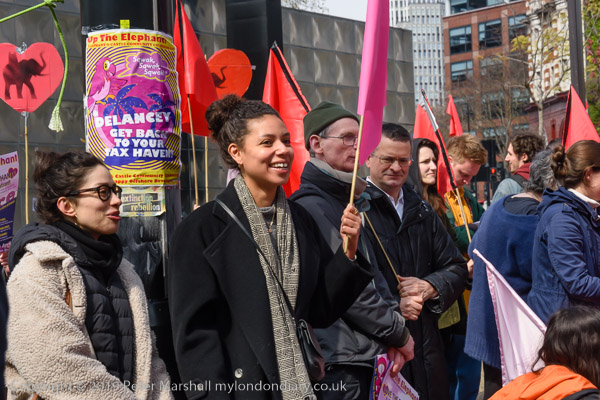
But campaigners say it should be redeveloped with the local community in mind while the developers Delancey working with Southwark Council and the London College of Communications, seem largely concerned with maximising their profits from the scheme.

Years of campaigning by local community groups has resulted in some minor improvements to the proposals – including more social housing, though it remains to be seen if this will actually happen.

Although the plans were finally approved last December, the campaing goes on, to keep the shopping centre alive until it is demolished and to get fairer treatment of the existing traders. Some have been promised space in the new development, but sometimes only a small fraction of their current area, and the campaign want all to be made offers on a ‘like for like’ basis, with an increase in the relocation fund.

More at Love the Elephant.


There are no adverts on this site and it receives no sponsorship, and I like to keep it that way. But it does take a considerable amount of my time and thought, and if you enjoy reading it, please share on social media.
And small donations via Paypal – perhaps the cost of a beer – would be appreciated.
All photographs on this and my other sites, unless otherwise stated, are taken by and copyright of Peter Marshall, and are available for reproduction or can be bought as prints.


Against Extinction

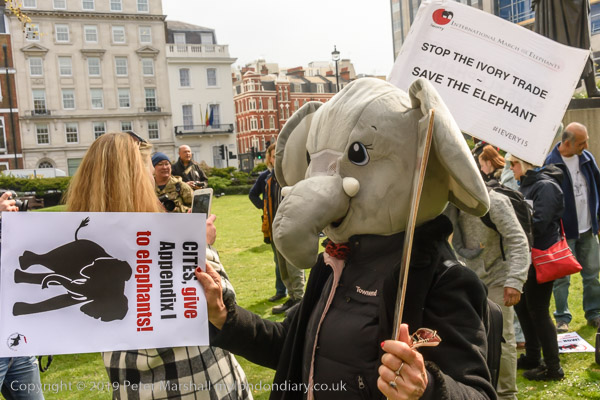
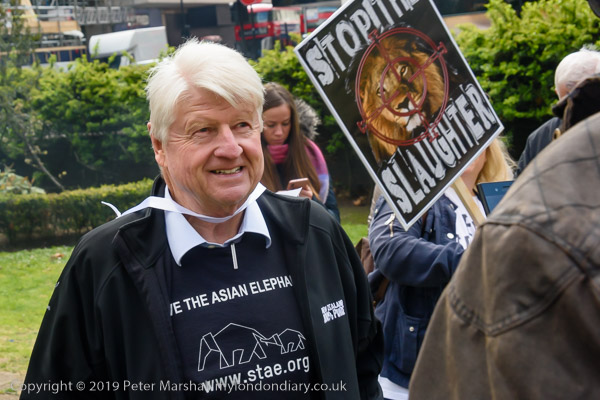
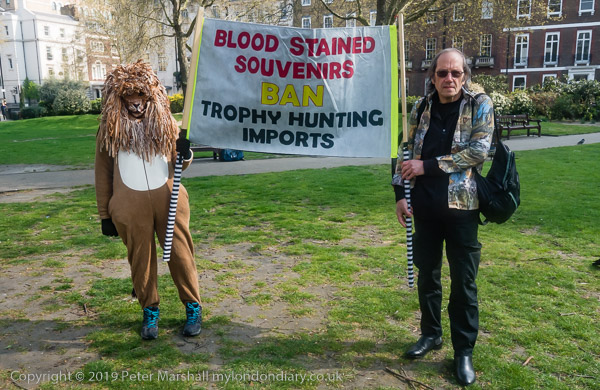
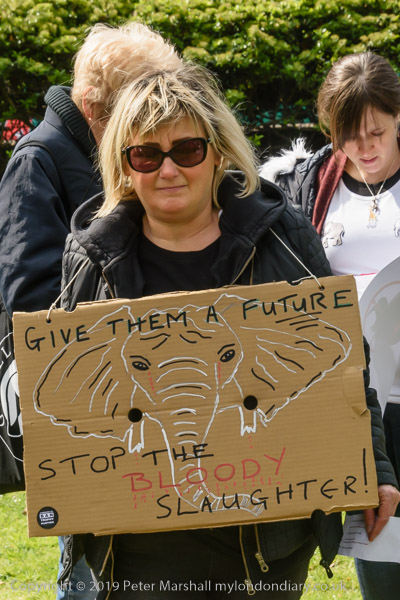
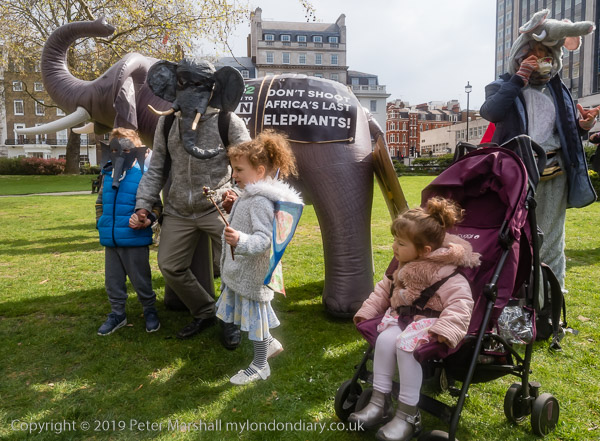
Elephants were in Cavendish Square again today, along with Stanley Johhnson and others mainly from the Tory conservation movement.

Some of the elephants were live, but only in human form, in grey suits with large heads with trunks and tusks, but there were many more on posters . They had come to Cavendish Square as a part of the 2019 Global March for Elephants and Rhinos and were to march to a rally to Downing St.

There were rather few of them, making me think that the Conservative conservation movement is also in danger of extinction, but perhaps more reflecting a wish not to be associated with the much wider and larger animal rights movement whose radicalism I think they find disturbing.

Of course it is a good thing to work through official bodies such as CITES, where some of them are fighting to get greater protection for elephants and to prevent attempts to downgrade protection of endangered species or reopen trade in ivory and other body parts. But it would be good to have a protest that represented the support of a much wider movement for this – even if some of them are also against fox hunting and the badger cull and other activities some Tories hold dear.

There is very wide support for animal welfare and animal rights across the virtually the whole of the UK population (sadly rather more than for human rights) and this protest seemed absurdly sectional. There could have been thousands out on the streets calling for  a ban on the import of hunting trophies of endangered species to the UK and not just a small and slightly sad group creeping along the pavement.

Fortunately the atmosphere was calmer than at a similar protest a few months previously when the papparazzi turned up to photograph Boris Johnson’s girl-friend. She wasn’t there, so nor where they and there was no mad ruch pushing people and other photographers out of the way. But of course this also meant that there was none of the full-page coverage that the earlier protest got. Probably just a bored editor spiking the story as not being news.

More at Against extinction and trophy hunting.


There are no adverts on this site and it receives no sponsorship, and I like to keep it that way. But it does take a considerable amount of my time and thought, and if you enjoy reading it, please share on social media.
And small donations via Paypal – perhaps the cost of a beer – would be appreciated.
All photographs on this and my other sites, unless otherwise stated, are taken by and copyright of Peter Marshall, and are available for reproduction or can be bought as prints.
To order prints or reproduce images