Scanning Negs

I’ve just been reminded by a posting on the ‘Multipro’ list (for users of the now-discontinued Minolta Dimage Scan Multi Pro’) about some of the problems and solutions for scanning film negatives and transparencies. Although I’m using very little film now, I still have a few hundred thousand old images, and if I need to print any of these, I now turn to scanner rather than darkroom. Sometimes I have little choice; thanks to years of storage without any control of temperature, humidity or atmosphere, many now need considerable digital retouching to get an acceptable print. Of course in my early years, my processing might not always have been entirely archival, although some of the worst problems I have are with trade-processed materials.

Oil or Plastic? 

One technique sometimes used to improve scan quality is oil immersion of the film to be scanned, and apparently there is a feature in the current (Nov-Dec 2007) issue of Photo Techniques by Ctein in which he shows how to do this simply (but messily) using cheap mineral oil with the Minolta. Fortunately if you have a Multipro, you don’t need to get your fingers and film in a mess, as thanks to the work of Dutch photographer and filmmaker Erik de Goederen, you can use a Scanhancer, a simple plastic sheet that – at least in the tests I’ve seen – gives slightly better results than oil immersion.

If you use a different scanner, there is a page on the Scanhancer site that discusses other Minolta scanners, as well as those from Polaroid, Microtek, Canon and Nikon. Minolta themselves appeared to have learnt from the Scanhancer research, building in a similar device to their Minolta Dimage Scan Elite 5400 (and a slightly different, but no quite so effective method with the Mark II version) before their unfortunate absorbtion/demise at the hands of Sony.

Third-party Software 

Whatever scanner you own, its performance is likely to be limited by its software. I’ve owned half a dozen over the years, and for several of them crippled would be a more appropriate term. Getting good scans has meant using third-party software, and I’ve used (and reviewed) both SilverFast and Vuescan. Vuescan is the product of one man, Ed Hamrick, and has worked with every scanner I’ve owned and the pro version still offers unlimited free updates (I’ve been getting them for around ten years.) It’s good to know that when I have to buy a new scanner, Vuescan will almost certainly still work with it, while copies of SilverFast I’ve used were specific to a particular model. A single Vuescan licence also allows use by one person on up to 4 computers – and will work with several scanners on a computer.

Both programs can give good scans, though I’ve generally preferred the results from Vuescan, especially when scanning negs. For some jobs Silverfast was faster, and it often gives scans that need no adjustment in Photoshop, whereas those from Vuescan are always improved. But almost all the scans I make need considerable work on them, both to eliminate blemishes (infrared cleaning can do a little on most colour and chromogenic negs, but heavy use does destroy detail) but also to ‘dodge’ and ‘burn’ as I would in the darkroom.

I also scan at 16 bits per channel to enable me to manipulate the files in Photoshop without loss, usually reducing there to 8 bit per channel as few output devices will handle greater bit depth, and I’m generally rather short of storage space (even with more than a terabyte of hard disk in this computer I’m running out of space.)

Combining Vuescan with the ‘Scanhancer’ and ‘Multipro’ can give results that of comparable quality with those from high-end equipment (drum or those hugely expensive flatbeds) – at least from normal 35mm and 120 negatives. I suspect if you have very dense overexposed negatives the expensive gear may cope better.

At some point I hope to replace my old Epson flatbed by one of their more recent models such as the V750 Pro (or possibly whatever replaces this.) When I do it will be interesting to see whether Vuescan will get more out of it than the software supplied.
A Busy Weekend

I’m about to set off for another busy day on the streets of London, although this one is a little different, as this afternoon I’m in Bethnal Green not to take photographs but to lead a tour with the author of ‘The Romance of Bethnal Green‘ (ISBN 9781901992748), Cathy Ross. Its a book I’m proud to have my name on the cover too, “with photographs by Peter Marshall“, and as well as providing 16 of my own images, I also worked on the pictures from local history and other sources, several of which were terribly printed and required considerable rescue in Photoshop.

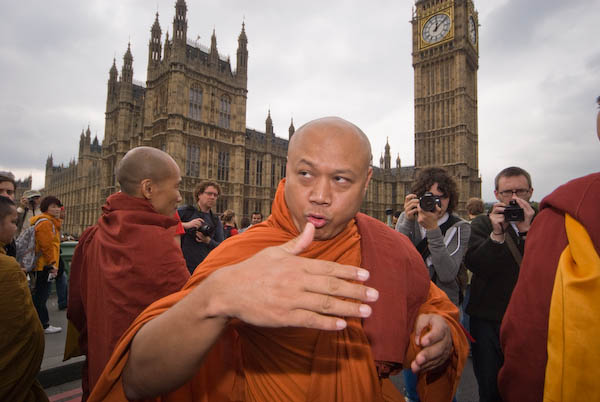
Of course I do hope to take a few pictures here and there, and more tomorrow – as usual. But last weekend, as you can see in My London Diary, was a particularly busy one. Last Saturday I took part in the London march, part of the Global Day of Action on Burma, and was particularly pleased to get pictures of some of the monks in front of the Houses of Parliament.

I left the monks after they had tied ribbons to the gates of Downing St, to photograph a walk organised by Yaa Asantewaa and Carnival Village to commemorate 200 years since the abolition of the slave trade – and illustrate some of our history since then, a part of this year’s Black History Festival, before returning to Trafalgar Square for the end of the Burma rally.

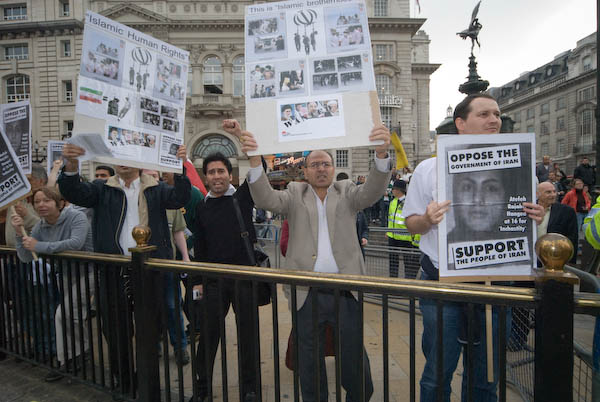
Sunday saw me photographing both the annual Al Quds (Jerusalem) Day march, and also a counter-demonstration by those who see it as an event entirely designed to bolster the cruelty of the hard-line Islamic regime in Iran. I think the truth is a little more complex, and various groups participate in the event for different motives, although of course the event was founded by the Ayotollah and is supported financially by Iranian government-backed agencies.

That there are sickening abuses of human rights in Iran under the name of Islamic law is too beyond doubt.

And then on Monday I was back in London taking pictures again of the ‘banned’ ‘Stop the War’ demonstration. But more about that when I get back from today’s work.

Urban Mutations

Listening to Sam Appleby talking about his series of night images of Crawley, one of the post-war war new towns, brought many resonances.

The presentation was the initial meeting of ‘Urban Mutations‘, a group initiated by Appleby and 3 others who have just completed an urban studies course. It took place in the Angel pub in Rotherhithe, a stone’s throw from the genesis of another gang of four (in Limehouse), but perhaps significantly south of the river. The first floor room, close to Cherry Gardens pier, looks out over the Thames, with views of Tower Bridge, the City and, in the other direction, the towers of Canary Wharf.

One image I couldn’t resist on my way to the Angel (its roof is visible at centre right.) Cherry Gardens pier, Rotherhithe and Canary Wharf; the figure caught in the centre appears caged in the centre of the gate.

My urban studies were of a more guerilla nature, starting on the streets of Manchester, walking through the cramped Victorian terraces of Hulme, learning to drive around their flattened acres of rubble, interviewing in the instant system-built slums (now in turn demolished.) Neighbourhood politics in Moss Side, including what I think was the first real exercise in public participation in the UK, “planning for real” with people modelling their own future (years later when the council knocked down what they went ahead with at the time, the next generation replacement bore an uncanny resemblance.)

From their I went to Leicester, sitting at the feet (literally, as there were usually more students than chairs) of Jim Halloran, one of the pioneers of Media Studies, as well as learning photography, and filming and editing hour after hour of live closed circuit TV.

My first job after Leicester was in a new town, Bracknell. The Development Corporation provided a large new flat at a decent rent – including enough space to set up my first darkroom, as well as an empty shop in the local shopping centre a few yards away dedicated to community purposes, where a few of us met regularly as a community photography group. I started to take photographs for the theatre group based in the local arts centre, and help in the hire darkrooms there, as well as setting up a photography course in the local comprehensive where I was teaching.

In many ways, Bracknell wasn’t a bad place to live, and much of the criticism of new towns in general is unfair and ill-informed – and is usually made from the perspective of Hampstead rather than Dagenham or the St Helier Estate or North Peckham.

Although Bracknell seldom inspired me, since then I’ve taken many urban landscape images, with shows on Hull, London and Paris. Some of these – together with work by a number of other photographers – appear on the urban landscape web site I run with Mike Seaborne.

Appleby’s view of Crawley was shown in print form at the Photographers’ Gallery in 1990 (it had started life as a tape-slide presentation.) At the time I found it an interesting set of pictures accompanied by the kind of theoretical baggage that fortunately seemed to bear little relation to what the photographer was actually doing.

It came at a time when theory had become all in many photographic courses, and it was de rigeur for gallery respectability to have a jargon-infested statement and presentation. As many shows were almost entirely composed of this, often with minimal, tedious, bland or even incomptent photographic content, Appleby’s work stood out.

There is a long history of night photography, stemming from the early days of the dry plate, with photographers such as Paul Martin in London and Jessie Tarbox Beals and Alfred Stieglitz in America, and continuing – for example in London in the 1930s – with books such as John Morrison & Howard Burdekin’s ‘London Night‘ (1934) and Francis Sandwith’s ‘London By Night‘ (ca 1935). One of the more influential books of the 1980s was ‘Summer Nights‘ by Robert Adams (1985) – this year at Rhubarb Rhubarb in Birmingham at least 3 of the roughly 30 portfolios I reviewed were clearly influenced by it.

Of course these photographers had worked in black and white, but in the 1970s we had started to see colour becoming respectable – even trendy – in fine art photography. Guys like Shore, Eggleston, Meyerowitz and the rest were shooting day and night and (among other concerns) exploring the peculiar colour response of films under different lighting conditions. Often the kind of peculiar effects of mixed lighting, of neon, tungsten and dusk skyglow.

Appleby’s images from Crawley very much explore the kind of alienating effect of typcial colour-deficient street lighting, notably the almost monochromatic sodium yellow (shifted more towards red in some images, either by dye characteristics or differential reciprocity of particular emulsions) and also the ghastly green peak of mercury vapour.

The images broke the photographic taboos of the amateur hobby press in this respect, as well as in their deliberate use of the tilted frame, a sometimes over-mannered bow in the direction of Rodchenko’s soviet modernism. Winogrand was of course at the time upsetting some by his tilted viewpoint, but in his images the framing follows a certain compositional logic based on the subject. In Appleby’s pictures it sometimes works in a similar way, but in others seems a deliberately upsetting device which didn’t always seem to suceed.

I was sorry to have to leave in the middle of the evening, and miss the further discussion by the group about urban issues. I look forward to further events.

Exciting Times for Black and White

It must be well over 18 months since I last went into the darkroom to make a black and white print. Until recently it wasn’t something I’d ruled out, just that I hadn’t had a need to do so.

I’ve now printed several shows in black and white using ink jet, including some quite important events – such as my exhibition for the 2005 FotoArtFestival in Beilsko-Biala, Poland, where I was chosen as the photographer to represent the United Kingdom. It can’t have been too disastrous, as I’m back there again in around ten days time, although this time giving a presentation rather than as an exhibitor (Mitri Tabrizian is batting for us this time.)

The work that I showed in Poland was from my London’s Industrial Heritage web site, taken in the late 1970’s and early 1980s, a kind of post-industrial landscape of London, largely based around the River Thames (but later extended to cover a wider area.)

Then I was printing using one of Jon Cone’s great Piezotone inksets, perhaps the first to really give great prints on fine-art matte papers, such as Hahnemuhle’s Photorag and German Etching. Few photographers really mastered printing on matte silver papers – George Krause is one of the few whose work has impressed me, although rather more have made fine matte prints using platinum – including the great masters of the medium, Frederick Evans and Dr Peter H Emerson. But using the Cone Piezography inksets (including the more recent K7 inks) makes it easy to acheive similar results.

A few years back, I had a platinum printer of some note come round to investigate making digital negatives for use in platinum printing. While he was here, I scanned one of his 4×5 negatives and made a Piezo print as well as the enlarged negative he wanted. It gave our meeting an uncomfortable end, as the print seemed to me considerably superior to the platinum he had previously made from an enlarge film negative.

Until around 18 months ago it was still clear that if you wanted really high quality glossy prints, the only way to produce them was in the darkroom. Then came the first generation of improved ‘fibre-base’ glossy inkjet materials, including Crane Museo Silver Rag, Innova F-Type FibaPrint and Hahnemuhle Fine Art Pearl, (and also their re-packaged equivalents, DaVinci Fibre Gloss Classic and Permajet Classic Fine Art Fibre Base Gloss.) These gave colour prints that more than matched those on the plastic RA4 colour papers, and black and whites that were hard to distinguish at least from run of the mill silver prints, although still perhaps a little lacking when compared to the best the current darkroom has to offer – and certainly inferior to the Holy Grail of the old formula Cadmium ridden and highly environmentally friendly Agfa Record Rapid of blessed memory.

Now we have a second generation of fibre-base inkjet papers, so far including Harmon’s Gloss FB Al, Hahnemuhle’s Fine Art Baryt and, perhaps most interesting, the first such paper from an inkjet printer manufacturer, Epson’s Exhibition Fiber, available from next month. So far all I’ve been able to do is read the reviews, such as this on Luminous Light.

I’m already thinking what I can do with my darkroom. At the moment the most likely use is storage for all those Terabyte disk arrays I’m going to need for the incredible amount of digital files I’m currently shooting on the D200 for ‘My London Diary.’

Alexandra Boulat dies

Today I heard the sad news that Alexandra Boulat has died, aged 45. I wrote about her here in June after her hospitalization following a ruptured brain aneurysm while she was working in Israel. Doctors induced a coma to give her the best chance of recovery, but unfortunately she failed to recover, dying peacefully in Paris on October 5, as reported on the VII site.

You can see her portfolio and read a brief biography on the VII site, and there is also a tribute on ABC News.

Hers was a striking talent, and her death is a sad loss for photography as well as a great loss for all her friends and family. As it says on VII, “Her friendship, courage, spirit and creativity touched all of our lives and will remain dear memories always.”

Here is the main part of what I wrote about her earlier:

Alex was born in 1962 in Paris, and her parents were both connected to photography. Pierre Boulat (1924-98) was a Life staff photographer in the 1950s and 60s and Annie Boulat founded and still owns the Paris-based Cosmos agency (its photographers include Bruno Stevens.)

Pierre began working for Samedi Soir in Paris in 1945, and photographed both in Paris and overseas for the magazine. His pictures appeared in Life from 1953 to 1976, and he photographed many leading celebrities, including Aristotle Onassis, Federico Fellini and Duke Ellington. From 1973 on he became a freelance again.

Not suprisingly Alex started taking pictures when she was 12 and became a photographer in 1989 after training in graphic art and art history. She became well-known for her work covering the wars in the former Yugoslavia, and in particular for her fine work on Kosovo, which showed the efect of the violence on the every-day lives of the people there, and gained her the Golden Visa Award at the Perpignan Visa pour l’image, in 1998, and both an ICP Infinity Award and an Alfred Eisenstadt Award from Columbia University Graduate School of Journalism in 1999. Other awards came from the NPPA, World Press Photo, Overseas Press Club etc.

Alex worked for the SIPA agency founded by Göksin Sipahioglu in Paris for 10 years until 2000. In September 2001, together with Ron Haviv, Gary Knight, Antonin Kratochvil, Christopher Morris, James Nachtwey and John Stanmeyer she founded Agence VII. Her work appeared in leading magazines around the world, particularly in the National Geographic Magazine, Time and Paris Match.

You can see her photography on the VII site, and also at War Photo Ltd and the Hasted Hunt Gallery.

Unfortunately my two articles linked to in my previous piece on Bruno Stevens and Göksin Sipahioglu are currently not available on line – even on the Wayback Machine, although you can find many of my older features there.

Facebook

My London Diary now has a Facebook group. Some of you reading this will know a lot better than me what this means. Having held out for some time, I’ve now set up a Facebook account, and any readers of this Blog who are also on Facebook are invited to become one of my ‘Friend’s.’

I don’t have many friends on the site at the moment. Most of those who I’m friends with in real life don’t seem to have ‘Facebook’ accounts. But if you read this blog, you might find it easier to comment or talk about the work here or on My London Diary on Facebook – so become a friend and join the My London Diary group.

Peter Marshall

petermarshall@cix.co.uk

Muslims remember Ali in London

Shia Muslims regard Ali (Ali Ibn Abi Talib) as second in importance only to Muhammad in their faith, as the first Imam. He grew up in the prophet’s household and when the prophet made public his divine inspiration, the nine-year old Ali was the first male to express his belief and become a Muslim. Later he married Muhammad’s daughter, Fatima.

On the death of Muhammad, Muslims disagreed about who should succeed him. Some believed that his successor should only be chosen by God, whose will was made known through his prophet, Muhammad, who they felt had made clear that Ali should be his successor. Others felt that the decision should come from the Muslim community, and they chose Muhammad’s second in command, Abu Bakr to be the first Caliph.
Ali later became fourth Caliph, after Abu Bakr and his two successors had died, but the arguments continued (and many of the facts are still disputed.) Muslims were split over his succession, and this led to the first Islamic civil war and formed the basis of the split between Shia and Sunni. After 4 years as Caliph, he was assassinated, struck on the head with a poisoned sword while at prayer, and dying several days later.

All Muslims venerate him as a great religious thinker, and his wisdom has also impressed many non-Muslims. His rule as Caliph has often been cited as an example of a model Islamic ruler.

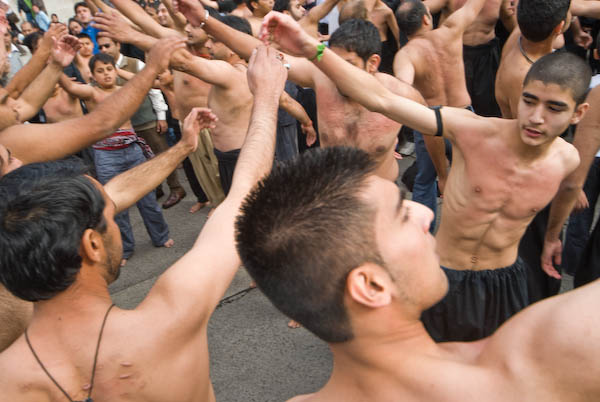
The annual public remembrance of his martyrdom in London is highly intense and emotional, including considerable wailing and beating of breasts. Before this was a long session of reading, of prayers and and increasing The men stand in rows and throw their arms into the air together, bringing them down with considerable force, sometimes producing bleeding. It’s an impressive spectacle of religious devotion, but tricky to capture in a still image.

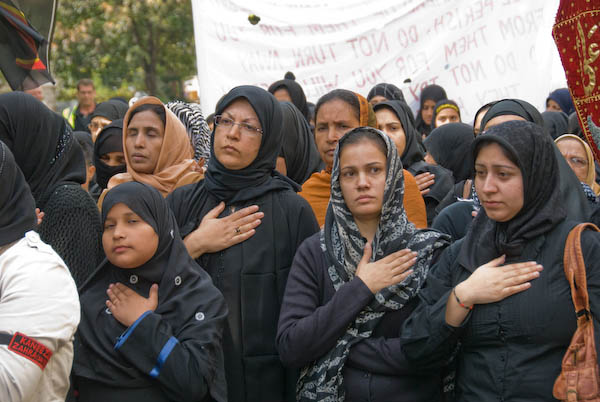
The women mourn in a separate block, and their observance is considerably more restrained, although the devotion still shows in their faces as they move their hands in time with the men.

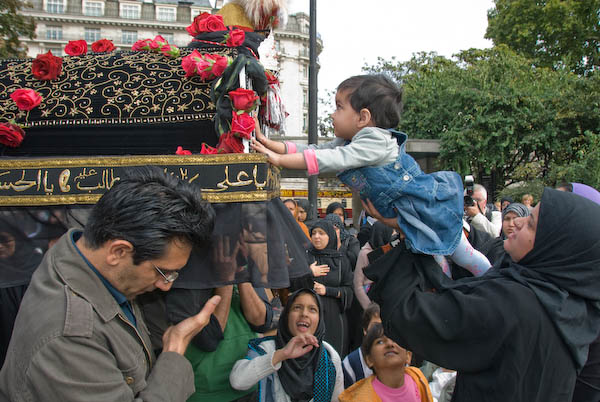
The image I liked most came earlier in the proceedings, when the coffin was brought out and everyone rushed to touch it – at first the men, then the women came as well.

But it was the delight on the face of this young girl, lifted up high in the air, that moved me most.

More pictures on My London Diary.

City People

If you are at a loose end in London tomorrow night (Thursday October 4) why not come along to The Juggler in Hoxton Market, where the London Arts Cafe show ‘City People‘ has its opening (it continues until October 26.) Curating a show is one way to make sure you get your pictures included, and four of mine are on the wall.

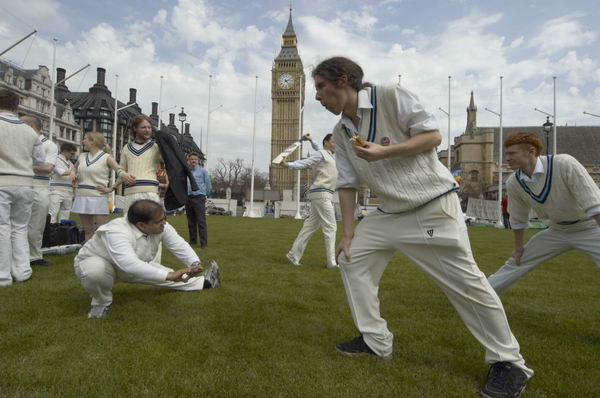
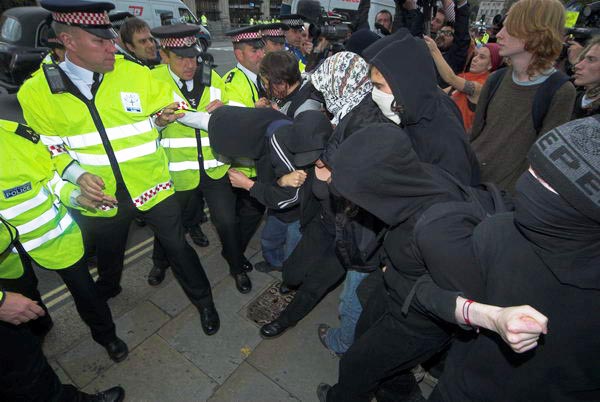
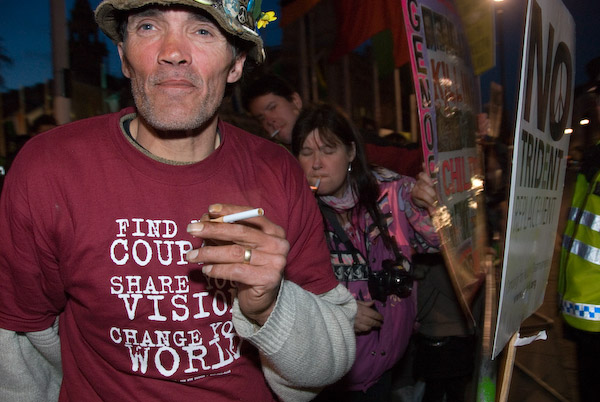
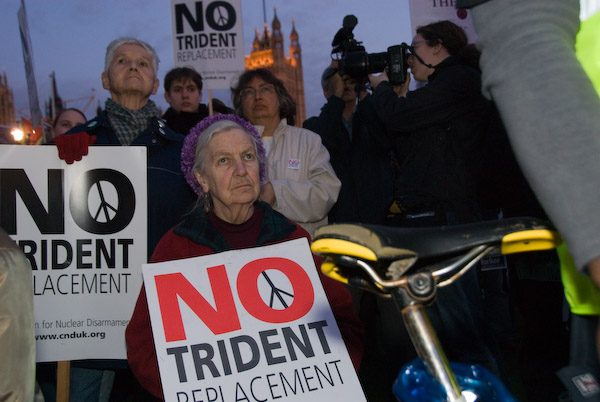
I decided to show four pictures taken in the same place, Parliament Square. In 2005, our New Labour government decided that Brian Haw’s ongoing demonstration looked rather untidy and embarassing in Parliament Square, it was a continual and unwelcome reminder of the great blunders they had made over the Iraq invasion. So they decided to add a bit to the ‘Serious Organised Crime and Police‘ bill that was going through at the time. But rather than a clause that directly said “Sod off, Brian” they brought in a blanket need for demonstrations in a wide area around Parliament needed to give 7 days notice and get permission from the police.

Unfortunately, the 2005 SOCPA act ended up causing rather more trouble than it was worth. It didn’t shift Brian, at first because careless drafting meant it didn’t apply to him, and then, even when a judge was found to say it did (because they had meant it to), the police found that his protest was still allowed, as the law made an exception for individual demonstrators (although the police could impose some conditions to restrict them.) Then comedian Mark Thomas came up with the brilliant idea of mass lone demonstrations (and one day there were over 2000 such events in the area.) Perhaps his best one was a demonstration against the wasting of police time.

So Parliament Square has ended up being a much more important focus of dissent, including at times – usually in the middle of the night – some rather nasty attacks by police (and off-duty police in plain clothes) on Brian Haw and others. Unfortunately I’ve not been around to record these, but I have photographed many other events there in recent years, including these 4 in the show:


The Space Hijackers challenge MPs to a cricket match (May 1. 2005)


Police v Anarchists, Sack Parliament, Oct 10, 2006

Brian Haw
Brian Haw: “Find Your Courage; Share Your Vision; Change Your World” (Dan Wilkins)


No Trident Replacement. March 14, 2007

There is one other photographer in the show, Paul Baldesare, along with various paintings and drawings, providing an interesting mixture of methods and viewpoints.


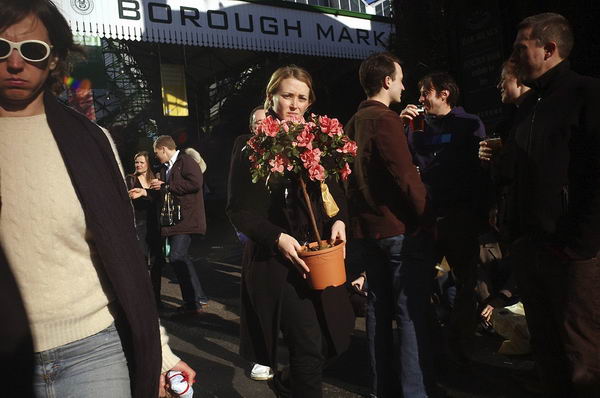
Borough Market, Paul Baldsare.

My pictures have ended up being rather more topical than I expected. Tony Benn, President of ‘Stop the War’ wrote to the Home Secretary on Monday following the announcement of a ban on the proposed march from a rally in Trafalgar Square to the Houses of Parliament on Monday October 8 under the 1839 Sessional Orders legislation. Benn states that he and others intend to defy the order by marching along Whitehall to lobby members of Parliament and call for an immediate withdrawal from Iraq. I hope to be there again taking pictures.

Peter Marshall

Hereford Photofestival

Well, living in London, its as easy and fast for me to get to Paris as Hereford. Of course some people will live nearer. So I need to have a really good reason to go to Hereford, and this year’s festival probably doesn’t provide it.

Unlike Photomonth, I did get a mailing about Hereford. But not to me either for >Re:PHOTO or even for About Photography (where I had one of the largest worldwide audiences for any photography web site) but for a long defunct photographic group I helped to run in the 1980s.

Photography has a lot of catching up to do. Too many people still sticking their heads in the sand about the web! The information on the 2007 Hereford festival site is a one page PDF and if you happen to have an A2 printer handy you can print out the 23.62 x 16.54 inch document and read it.

I don’t, and fortunately I don’t have to, since on a screen it is tricky to read and navigate, and I soon gave up. But, as I said earlier, my 1985 persona got a mailing through the letterbox, which turns out to be exactly this document, but folded to make it considerably more legible. It’s hard to do this with a screen, and perhaps someone should point this out to the designer concerned.

Presenting the whole thing as a single A2 page has to get some kind of medal for the least web friendly way to present information. Even as two A3 pages – as printed – would be better. Another few minutes work could have turned it into something far more useful – although even a multi-page PDF is still nothing like as good as a decently designed web site.

The print version has also to deserve come kind of award for making South African photography seem so boring (Paul Wombell, the festival director, previously managed to more or less kill off the Photographers’ Gallery so far as I was concerned, so perhaps that isn’t surprising.) The front of the leaflet has one of the least inspiring pictures of a dog you can imagine – but this may be thanks to the design, which may cover or crop significant elements. It’s hard to imagine any photographer actually producing an image like this.

Despite this, I’m sure the work of photographers like David Lurie, Andrew Tshabangu (and 12×12), Rene-Paul Savignan and Peter Hugo is worth going to see. And for May 2008 we are promised David Goldblatt and Guy Tillim.

And guess what. Like every festival these days (including the East London Photomonth) it has one of these get-a-snap things where your picture becomes a part of the show. Just say no!

East London Photography Festival: Photomonth

I’ve often written about the lack of photographic festivals in England, and so it is hardly surprising to find that now two come along together.

Photomonth, the East London Photography Festival is now I think in its fourth year, but this year it does seem to have taken off into something rather more significant. I’m not sure how many of the events I’ll get too, but one certainly not to mix is the show at Rich Mix on the Bethnal Green Road, where ‘East End Street‘ includes the work of Paul Trevor.

I first got to know Paul’s work through the magazine ‘Camerawork‘ produced by the ‘Half Moon Photography Workshop‘ set up by Wendy Ewald and based around the Half Moon Theatre in Alie St, just off Aldgate. (Later it morphed into Camerawork.) Indeed it was an exhibition in the theatre foyer there that first really took me into London, and started me photographing there. So you can really blame ‘My London Diary‘ on him!

Paul’s project with the ‘Exit Photography Group‘, ‘Down Wapping’ prompted me to visit Wapping and the group’s ‘Survival Programmes‘, looking at Britain’s inner cities in the late 1970s, is surely the most significant documentary project of the era in any country. Although all three photographers made significant contributions, it is pictures by Paul – such as the opening image of Mozart Street in Liverpool – that provide most of the real excitement in this great body of work.

This is the first show for which Paul has opened up his ‘Eastender Archive‘ although some images are already familiar. I’ve long regarded him as one of the best and most influential photographers in Britain at the time, and one whose work has never really received the attention it deserves from the public, although well-known by other photographers. Unlike some others of the time he hasn’t chosen to seek publicity and ride with the various trends to become the darling of the galleries and curators. But it does look as if, at long last, his work is beginning to get the attention it deserves.

Showing along with Paul is work by Stephen McLaren, who was one of the curators of the rather disappointing show of Contemporary British Street Photography at Photofusion last Summer (his own work was some of the more interesting in the show.) I was one of several photographers who told him that Britain had a great (and continuing) tradition in street photography – including the work of people such as Paul Trevor, of which he seemed at the time (and in the exhibition text) to be blissfully unaware. And when I’d told him, John Benton-Harris, who I think has personally contributed much to the street tradition here since he arrived from the South Bronx, took over and told him too!


London 1975, (C) Paul Trevor, from ‘Cities of Walls, Cities of People’

I showed a half a dozen pictures by Paul some years ago in Clerkenwell in the London Arts Cafe show Cities of Walls, Cities of People, which also included street photography by two old friends, Jim Barron (who sadly died not long after) and Paul Baldesare, although for that show I included some of my own urban landscape rather than street work.

Another familiar name to me is Anna Fox, who is giving the Photomonth lecture, talking on 8 November about her new publication, Anna Fox Photographs 1983–2006 (Photoworks/Impressions
Gallery), coming out in late 2007.

Altogether there are around 50 venues taking part in Photomonth, including Magnum, Host and others around Shoreditch as well as some further east. I have to say much of what is on offer doesn’t particularly excite me, but at least it does seem to be a proper festival in London, even if much of what is in it simply reflects the recent upsurge in photographic spaces in the area covered.

I hope to cover a few of the events in Photomonth over the next few weeks (some don’t start until November), though despite asking to be put on the press list and being promised information, somehow nothing has arrived.

One day, the photography establishment will realise that the web exists and is worth using. Just not yet. Even when I wrote for a site with hits per month in 7 figures it was often hard to get treated seriously as press.

Hereford? Another, rather shorter feature to follow in a few minutes.

Peter Marshall