A Ramble in Olmstead Parks

When Frederick Law Olmsted (1822-1903) visited England as a journalist in 1850, he was greatly impressed by Birkenhead Park, the first publicly funded British park, designed by Joseph Paxton, who had been made head gardener at Chatsworth when only 23 in 1826, and is probably best-known as the architect of the great Crystal Palace.

This park marked the start of a movement to create public parks, and Olmstead was its great pioneer in the USA, working with English architect Calvert Vaux. Their first design was for a competition to build a Central Park in New York, which they won and started work on in 1858, and thus it celebrates its 150th anniversary this year.

They went on to design parks in virtually every city in the country, setting up the first landscape architecture firm, which continued to operate after his death in 1903, and designed more than 350 academic campuses as well as parks.  Olmstead set down detailed principles of design which underlie the apparently natural vistas of all his creations.

As a part the celebration of 150 years of Central Park, The Metropolitan Museum of Art in New York is putting on a show of images by Lee Friedlander, one of my favourite photographers and a key figure in medium in the second half of the 20th century, taken in this and Olmstead’s many other parks across America.

Friedlander started shooting in Central Park in the mid-1980’s, and in 1988 gained a commission from the Canadian Center for Architecture in Montreal (where Olmstead’s Mount Royal Park opened in 1876) to photograph in other Olmstead parks. He worked on this over the next six years, but continued to photograph the parks for around 20 years in all.

The exhibition continues until May 11, and you can read more about it in a feature in the New York Times, which also has a set of 10 pictures on line. They include images in square, 3:2 and panoramic formats, from an interesting period in the photographer’s work.  Although the museum promises to have more information on its web site, currently there is little more than the title and dates and a press release. The show will have around 40 pictures, many never previously exhibited, and is accompanied by a book, Lee Friedlander Photographs: Frederick Law Olmstead Landscapes, with 89 images and an introduction by Friedlander.

Herbert Keppler

I never knew or met Herbert Keppler, (Burt to his friends) who died on Friday aged 82, but his work did affect my life. Born in 1925 he had a long career in writing about photography, and was editor and publisher of Modern Photography which was an important magazine for photographers in the UK as well as America. It was his love and knowledge of photography that led to that magazine publishing portfolios and features of many important photographers, both historical and contemporary, in the 1970s and 80s, including some finely printed examples, at least one of which still hangs in a frame on one of my walls.

Keppler also set up what was probably the first real test laboratory for camera and lenses to back up Modern’s reviews, which were so much more comprehensive and technically authoritative than any others, particularly than those we could read in the UK, where lab testing generally meant poking the lens out of the window and photographing a ship across the Thames.

Keppler was a man with high standards, and he set up a program for vetting mail order ads for Pop Photo, which led to the magazine turning away over $2 million in advertising, according to the obituary by Mason Resnick on the Adorama site.

Later, after 37 years at ‘Modern’ (he joined as Associate Editor when it started in 1950) he was persuaded to move to the more popular ‘Popular Photography’, where he put in another 20 years service, continuing to work more or less until his death. Many of us deeply regretted when ‘Modern’ was bought and closed down by ‘Pop Photo’ , but at least Keppler ensured that its technical content aspired to the standards set by that title, as well as continuing to promote high standards in mail order.

As you would expect, there is an extensive obituary on the Pop Photo site, with more material promised later.

Hanging Out in Brasilia

When I got back to ECCO after helping to hang my show, I was told I had an hour to spare before lunch, and I decided to take a short walk. ECCO is in the SCN or Northern Commercial Sector on the edge of the central axis of the city (Eixo Monumental) around which all of the major public and commercial buildings are grouped.

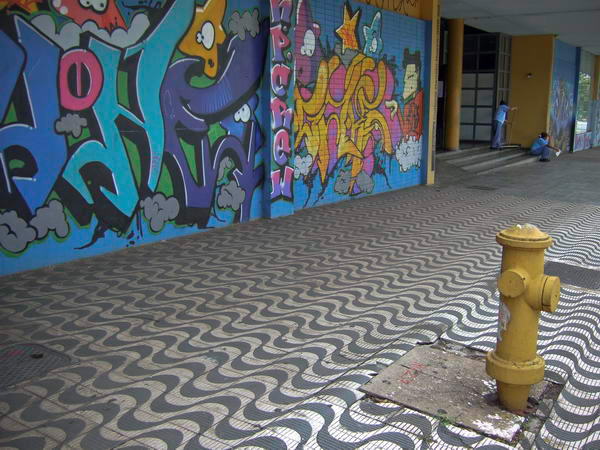
Brasilia is Car City. Planned almost entirely around the idea of movement by car, with streets seen simply as routes. The guide books say it is too large to walk, which isn’t true. They say people don’t walk, ditto. Few people may stroll for pleasure as I was doing, but many were hurrying from A to B, usually taking the most direct route, often in the absence of paved routes cutting a path through grassed wastes, exposing the deep red soil as a violent gash in the city fabric.

I wish I’d had more time to explore and photograph. It was hot to walk in the sun (and I’d forgotten I’d need a hat, so my forehead was peeling a few days later) and it seemed very odd to be celebrating Christmas in mid-Summer weather. Though they have that all the year round in Brasilia.

I took a few pictures around the outside of two large shopping centres, and a few around the offices and waste areas between, then returned to the gallery.

Later, on the way to lunch, we stopped at a large and empty building in the SCS and while Karla was trying to sort things out I took some pictures from its balcony. One shows the Bank of Brazil and the other is looking roughly north, with a row of ministries at the right hand side. On the full size image there are roughly 20 people visible, either walking or standing around under the trees.


There are almost 20 people walking, standing under the trees and waiting for a bus.

I’ve chosen these images partly to be different to those I’ve already put on line on the pages of my pictures from Brasilia.

Hanging in Brasilia

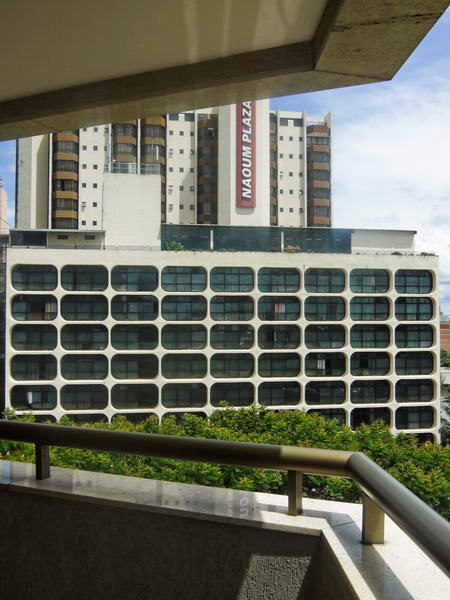
I certainly wasn’t the right kind of person for my hotel in Brasilia last month. I never even got to see the sauna, gym and swimming pool, there just wasn’t time, and I really made very little use of the two balconies my suite was provided with – one on the bedroom and the other on the living room, nor did I get time to even sit in all the chairs or watch the two TVs.


From the living room balcony


From the bedroom balcony

Other than the bed and bathroom (or rather shower room) about the only other facility I got to use was breakfast. Included in the room price, if bought separately it would have cost about what I normally think of paying for a hotel room. It was a buffet and I made the most of it, eating fully if not particularly well, although the scrambled eggs were good.

After a leisurely breakfast I walked back to my room and got a phone call to be in the foyer in ten minutes where I’d be picked up to go and help hang the show. Two guys arrived in a car and we left for the Espaco Cultural Renato Russo.

Brasilia is both simple and confusing. The afternoon I’d arrived I had been taken to see where my show was to be hung, but had no idea of where it was in the city. The normal rule seems to be that to get anywhere you start by driving in exactly the opposite direction. But by now I was beginning to the hang of things, and was not at all surprised when we drove past the Espaco and some way on before turning back and through the superquadra (neighbourhood block) to park at the back of it. Neither of my companions spoke or understood more than the odd word of English, but I watched as they brought out a large brown-paper parcel and started to unwrap it.

These were my prints, made at the best lab in Brazil, in Sao Paulo, and they were superb. A perfect match for the files I had viewed on my screen over 5,000 miles away (just slightly larger than my widescreen monitor) before e-mailing them for printing.

Which shows that colour management can really work. A monitor with a good profile and an Adobe RGB file should translate through a properly profiled printer to a close to perfect result, but it so seldom seems to. It isn’t long since I phoned one well-known lab to ask about profiles and how to send my files to be told “we don’t take much notice of that sort of thing.” My work went elsewhere.

I had six panels in a rough hexagon on which to organise the 24 prints. The panels did have two sides, but because of their position not all could sensibly be used on both. My show was in two parts; six prints on the Manor Gardens allotments, and the rest. There was also a panel of text.

I decided it would work well with most of the work inside the hexagon, but it needed a couple of prints on the outside in the main passageway as well as the text to draw people’s attention to the show. That left me with an almost perfect fit. Two panels with 3 prints each for the Manor Gardens work, which was a nicely loose spacing, then the remaining 16 prints on the other 4 inside panels in a fairly tight single row or 4 to a panel. These were in chronological order, with the two most recent works saved for the outside panel.


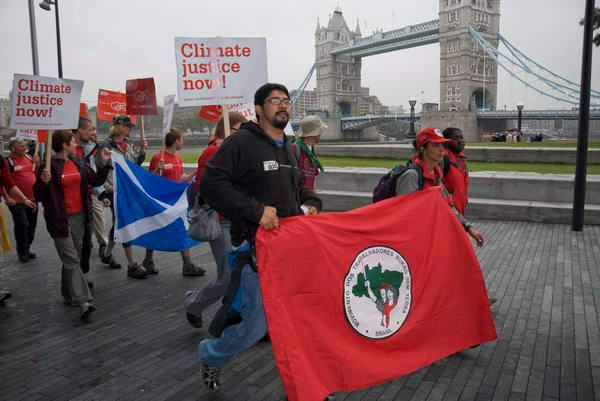
Brazilians lead on the last mile of a 1000 mile ‘Cut the Carbon’ march in the UK

I’d actually chosen these works specially to illustrate the international nature of the work. Although both were taken in London, one showed Brazilians leading a Christian Aid ‘Cut the Carbon’ march, and the other was from a protest against logging in the Tasmanian forest.

Having explained (with much gesture) how I wanted the work hung I got out of the way, looking at the other shows on in the centre – including some interesting black and white student work, as well as the show by Susana Dobal, and colourful pictures from India by Gisa Müller, before sitting down on the steps leading to the main street to make some last minute corrections to my lecture for the evening.

Before I had finished the show was hung and we were in the car heading back to ECCO, where I was to meet festival director Karla Osorio and lunch with her and the British ambassador.

More of my pictures from Brasilia.

Susana Dobal: Minding Language

One of the things I like to say is that if your work isn’t personal it isn’t worth doing. However my navel – and probably yours – is not of a great deal of interest to the rest of the world (I don’t even have any diamonds in mine, and generally prefer to keep it out of sight.) Our work also has to have something to say to other people, in some way reflecting our ideas, the issues that concern us. It has to be about something.

In photography we share a more or less common visual language across cultures. I can look at and respond (and have written about) work from China or Mexico or Mali or Albania, and although I may perhaps miss some of the more local cultural references, feel that I can appreciate (and criticise) the work.

But once we enter the Tower of Babel and bring written (or spoken) language into our work things can become more difficult. I probably am not the right person to review the work of Susan Dobal, whose Alem-Mar (Beyond the Sea) was showing at the Espaco Cultural Renato Russo in Brasilia last month, though I spent some time looking at it and thinking about it while my own work was being hung in the adjoining space. Dobal teaches photography at the University of Brasilia and has a PhD in the history of art from the City University of New York (2003) ws as as a masters in phtoography from New York University. She is one of four members of the Brazilian photo group ‘Ladrões of Alma‘ (The soul-stealers) along with Rinaldo Morelli, Usha Velasco and Marcelo Feijó.
For Dobal’s images of Portugal have added text in Portuguese. A woman totally in black, including a black hood, perhaps a religious or a widow in mourning, stands with her back to us on a stone floor in front of the massive warm orange pillars and arched doorway of a cathedral or something similar. She is small, seen from a middle distance, just right of the centre of the image.


From ‘
Alem-Mar’, (C) Susana Dobal (image Foto Arte2007)

It was an interesting image with some nice use of colour and a contrast between the light and warmth and power of the strong erect verticals and the deep sinister blackness of the crow-like figure.

But there was more to it. As if projected onto the floor was a short text in Portuguese, intended to contrast and illuminate the work. I think it says

sob sol escaldante
passeia a dor secular e ambulante”

which appears to mean

under the burning sun
strolls a pain secular and walking

Either I am missing something in my translation, or the text seems to add little or nothing to my reading of the image.

This was disappointing, as her earlier work on Zone Zero uses text in a far more interesting manner. In World, the images are largely of trees in urban settings shot in the ‘Superquadras‘ of Brasilia, but are combined with captions giving snippets of world news. These contrast with the seeming calm and isolation of these residential building blocks of the city, in which, if present, people are shown as isolated individuals.


From ‘Alem-Mar’, (C) Susana Dobal
(My apologies for the shadow at the top due to gallery lighting – and for generally poor reproduction.)

There were two pictures that attracted me very much as images in ‘Alem Mar’, Solar de Mateus I and II – presumably taken in the grounds of the famous Portuguese ‘stately home’ or manor house which is open to the public. One was of a many-trunked tree in a garden with some purple flowers, words added on its trunks and branches, in a very organic fashion. Again I’m not sure what they add to a picture that again shows Dobal as an excellent colorist.

A final image that caught my imagination is also on the Foto Arte site:

and here it was the flow of the text and the flow or the girl’s hair. Barroco means weird or freaky (or baroque) but my dictionary doesn’t include ‘alumbramento‘, although it sounds like some musical term and is certainly the title of a song.

2008 To Do List

I’m not a great believer in New Year resolutions, which tend to get broken in the first week or two anyway. But it’s often useful to make lists so here’s a quick one, some of which I hope will be of some interest to others. I’ll start with the one that has always been by aim.

1. Make better pictures
Pictures that matter more to me, that say what I think is worth saying. Thirty years ago I decided to take the pictures I wanted to take rather than try and make a living from photography. It led to years of hard graft teaching and doing photography in the gaps, low earnings, and not a great deal of recognition. Of course I don’t regret it. And it’s great to find other people who understand and care too, whether they write to me about my work on the web or see my work in the occasional show – such as that at Foto Arte 2007 in Brasilia, on until Jan 20.

2. get out more and take more pictures.
I got off to a good start on this one, at the New Year Parade in Westminster (which is why this blog appears on Jan 2.) More pictures from this on My London Diary. Events force you to get off your backside or you miss them. What is harder to keep doing are the longer-term projects, where its always too easy to look out of the window and decide the weather isn’t quite right, or find other reasons not to work on them today. Experience of course tells me that the best pictures often come in bad weather and the time is never perfect.

3. check my camera settings more often when taking pictures
So yesterday I decide one picture needs -1.33 stop, and find half an hour later that I’ve shot another hundred or so that didn’t want it at the same setting… Or that the whole set of pictures I shot in one very dark street all show unwanted motion blur because I didn’t increase the ISO… It’s so easy to get absorbed in the visual side of image-making and forget the technical (though many more photographs are failures for the opposite reason – technically perfect nothings.)

4. always check for dirt on the lens
Check and keep checking. Become paranoid about it. One of the best set of pictures I almost took in 2007 was ruined by a little bit of greasy dirt. It had been a huge rush and I hadn’t had time for my normal careful checks as I packed my camera bag.

5. edit my work more stringently
I’m writing this as Lightroom churns out 244 jpegs from the 800 or so pictures I took yesterday. I need to work that down into a much more sensible number for the web and libraries etc.

6. sort out a proper back-up system
After I lost a couple of days work when I first started using digital I’ve been careful to always make sure the first thing I do is to make TWO copies of every file I shoot as soon as I get back to base. But in the longer term that doesn’t really address the needs, as the volume of data is too large, and the media used have limited lifetimes.

For the longer term I need to sort out a carefully edited core of work for extended storage in some form or other. Or rather at least two forms, one preferably off-site.

7. make proper to-do lists
My preferred format for these at the moment is backs of envelopes. That may be ok for developing Government policies, but this is far more serious! I could do it on computer, (and I’ve tried it in the past) but I think it will work best as a large list on the wall of my work room.

8. really sort out my old ‘street photography’
‘Street’ is more a way of thinking and working, and I think most of what I do is street, though there are some purists who have some very funny ideas about it. But it would be nice to put some of my old work, scattered through perhaps 25 years of negatives, together.

9. publish, at least on the Internet, my Docklands work from the 1980s
Pictures of the empty and abandoned docks before the redevelopment really got going that I’ve hardly shown or printed for 20 years. This is stuff that people thought I was mad to bother with then, but I think will be of interest now.

10. get back to scanning my old work which is on deteriorating film negatives
Much of my older work can now only be printed by scanning, restoration work on the scans and then digital output. Film that has been processed and stored under ideal conditions has a decent life-time, but in the real world things are different for many of us.

11. rewrite as many as possible of my features and put them back on line
Few of the several thousand articles I wrote from 1999-2007 are still available on line. For legal and financial reasons I can’t simply republish them, but I would like to write about some of the same photographers and themes again. The problem is finding some way to generate an income that would make devoting the time to this possible.

12. make more money by selling photographs
I wish I knew how!

So my best wishes for a happy and successful 2008 for us all,

Peter

Nick Ut – Now and Then

If you haven’t yet read it, take a look at Nick Ut: Double Negative, an interesting article in a paper I seldom read, the Daily Telegraph. Nick Ut is the guy who took the iconic Vietnam image of a nine-year-old girl running along the road towards him, screaming, naked because she had torn off her napalm covered burning clothes, strips of burnt skin hanging from her shoulders. It was a picture that changed the attitudes of many towards the war, and won Ut a Pulitzer prize.

As John Preston says, he took the shot, but then saved Kim Phuc’s life, cleaning off the napalm, wrapping her in a jacket and driving her to hospital. The two are still in contact, still friends – almost family – 35 years later.

Last year, he took another picture that made the news worldwide, catching Paris Hilton crying in a car after she had been told she would serve her jail sentence. Ut was one of a pack of several hundred photographers outside her house, and with his camera on high speed, just happened to get one ‘lucky’ shot in which her face is clear – and clearly crying.

It isn’t a good picture. It’s about an event of infinitesimal significance to anyone except the one spoilt woman in the car, but it made front pages and TV news around the world. It makes me sick that so many photographers are wasting so much time on such trivia – and that it is more or less all that pays. Ut says he doesn’t mind, was “grateful to have the work.” To me it is just a total waste of time and talent.

More at ECCO: Claudia Jaguaribe, Raquel Kogan, Ludovic Caréme

Cláudia Jaguaribe: ‘Quando eu Vi‘ (When I saw)

Cláudia Jaguaribe was born in Rio de Janeiro in 1955, but she has lived and worked in Sao Paulo as a freelance in advertising, fashion and magazine and newspaper photography since 1989. She studied Art History and Photography in Boston, USA. Her work has included photographic essays on cities (Cidades, (1993) and recently, Rio de Janeiro, text by Luiz Alfredo Garcia-Roza and photographs by Claudia Jaguaribe, 2006) and Athletes from Brazil” (Sextans, 1995) as well as on airports. She works with video as well as photography.

Her web site is another of those I have problems viewing, even when I follow the extensive instructions on the initial page, using Firefox 2.0. You may have better luck (or lower security settings) than me. Wouldn’t the web be much better if web designers could be persuaded that simple sites are fast and responsive and with CSS can do some pretty clever things too. You can also see some of her commercial work at Samba Photo.

However, unless I missed it, the work on show in the main gallery space of ECCO, ‘When I saw‘ is not on her web site. It seemed very much to relate the the Foto Arte 2007 theme of ‘Nature, the Environment and Sustainability‘ being, I think, all about Nature and the way we see it.

Most of the work was in colour, but the piece I warmed to most was (I think) a diptych of two images in sepia.


(C) Cláudia Jaguaribe

I think this is saying that ‘landscape’ is a human creation that we impose on nature. Well, of course. Ideas are human creations – but so is to a greater or lesser extent the so-called natural environment. I come from a country which has been so intensively altered by human activities – hunting, agriculture, industrialisation, landscape gardening (one of my in-laws ancestors was a landscape gardener of some note) and more, such that little or nothing remains unchanged, in which the idea of a ‘natural’ landscape seems laughable. Even the most remote areas of Brazil will have been altered – if only by the increase over the years in carbon dioxide levels.

But what appealed to me was I think mainly the shapes of the leaves, with which I’ve always had a fascination. As you can see in a number of the pictures I took in Brasilia including this one at the Foto Arte offices.


Brasilia, (C) Peter Marshall, 2007

Raquel Kogan: ‘Bewohner’

The occupants or inhabitants referred to by the German title of Raquel Kogan‘s series of colour pictures, ‘Bewohner’, made in Germany and Austria, of soft toys found in cars. (It was subject matter familiar to me, as one of my colleagues in London, Paul Baldesare, has been making a similar collection of pictures for some years, although his concentrate more on the kitsch aspect, and, as might be expected, the English examples are funnier.)

Kogan’s images show these trapped ‘beings’ in a curiously fragmented space, with the angled glass adding reflections of the surrounding street and city.

Ludovic Caréme: ‘Retratos'(Portraits)

The square format colour portraits by French photographer Ludovic Caréme are impressive, and show him as a very successful magazine photographer. The 40 pictures were from 10 years of his work, which you can also see on his web site. He has lived for some time in Sao Paulo, and there were a number of pictures of Brazilian celebrities, including a portrait of the architect of Brasilia, Oscar Niemeyer, taken this year.


(C) Ludovic Caréme, 2007

In it, Niemeyer’s head dominates the near-symmetrical image, above his white coat and clothing, somehow looking too large for his body, which somehow fails to be at ease for the image. It shows him approaching his hundredth birthday still entirely alert and in command and is a powerful image, but my choice of a portrait of the man would be the very different picture by Luiz Garrido also on show at ECCO.

Heroes: Luiz Garrido

Strictly in the interests of research, I spent some minutes this morning on coming out of the shower posing naked, establishing that by crossing my thighs it was indeed possible to tuck my tackle away out of sight, leaving just a triangle of hair visible at the meeting of legs and stomach. Fortunately I was the only photographer present and I certainly wasn’t using a camera.


Brasilia – Congress buildings (C) Peter Marshall, 2007

The show Heróis (Heroes) by Luiz Garrido opened in the Black Hall of the Chamber of Deputies of the Brazilian Government at the centre of Brasilia in November with considerable controversy.

What caused the fuss was an image of the famous Brazilian transsexual actress, Rogéria, in a pose similar to my bathroom experiment (though let’s be clear, I omitted the blonde wig, lipstick, nail varnish, loose shirt, tie, trainers and white socks.)

Rogéria,
(C) Luiz Garrido

Apparently this image was not among those that had been shown when the exhibition was arranged, and the director of Public Relations at the parliament building took exception to it, arguing it was not appropriate to be shown in a space visited by so many children. The same argument was also put forward by my very courteous guide on my visit to the chamber when I asked him about it.


Brasilia – The view from the Black Hall of Congress (C) Peter Marshall, 2007

So for the opening night, the image was on show behind a screen, while negotiations went on about how it might be presented, involving the Festival Organiser and photographer and the management of the chamber. A notice that was put up, announcing (in Portuguese) that “By a decision of the Chamber of Deputies, this cubicle contains a photograph of Rogéria whose open exhibition to the public was not permitted” and this apparently so upset the chamber that they took down the whole show overnight without further discussion.

I find it hard to image how anyone could seriously think that this image would in any way offend against the Brazilian law relating to children and adolescents, which apparently protects them from displays that are inhuman, violent, terrifying, vexing or embarrassing. Young children would walk by unconcerned, while it is hard to see it causing more than a shrug with teenagers exposed to everything the Brazilian media deem fit to publish. This was certainly not – as one bloggers suggests – an erotic image.

You can read more details on the story – and the responses to it by various bloggers – on ‘Global Voices‘ which also has more pictures from the show.

Luiz Garrido‘s show was at ECCO when I was in Brasilia, and looking at the whole show as an outsider, this picture actually struck me as the least interesting of his images on display. The kind of image that gets chosen not because of the photograph but simply because of the discordant views about LGBT rights that it embodies. I’m very much against censorship, but would personally as a curator not have chosen to show this picture.

But there is no doubt that Garrido is an interesting portraitist. I visited his show at ECCO after hours, following a very satisfying rump steak at ‘Oliver’, the contemporary restaurant that is a part of the gallery complex, together with my companions for the evening, Robson and Chris, and I think we were all impressed by his portrait of President Lula, swathed in cigar smoke (and more than a hint of the revolutionary Cubans.)


Lula, (C) Luiz Garrido

Next to him was another fine portrait, of Lucio Costa (1902-98), whose master plan created Brasilia, and next to that, the architect who designed its famous buildings,
Oscar Niemeyer, 100 on Dec 15, and still working. Costa, taken in a study after my own heart, the shelves behind him separated by bricks, slumps to one side, one eye bright and alert, the other side of his face resigned, reflective.


Lucio Costa, (C) Luiz Garrido


Oscar Niemeyer, (C) Luiz Garrido

Niemeyer is placed centrally in the frame, but cropped along the line of his upper lip, taken in front of a white board with some lines and writing, dominated by the two words “mundo injusto” (unjust world.) It is a powerful image, and one that concentrates on the eyes and intellect of the sitter, his balding dome against the world, as well as reflecting the architect’s own use of geometry and curved shapes – as for example in the National Museum at Brasilia.


Brasilia – National Musuem, (C) Peter Marshall, 2007

Under the Car

In my talk in Brasilia I looked at the photography of the urban environment and some of the changing ideas in planning, and how the invention of the car had completely altered our cities. Ideas about Garden Cities at the end of the nineteenth century had been overtaken by urban sprawl.


A12 Eastern Avenue at Gants Hill, London 1995

One of Britain’s greatest writers, J G Ballard and I live on the same ‘terroir‘, the gravel-rich fertile flood plain of south-west Middlesex, now pock-marked by gravel extraction, scarred by acre after acre of water-filled pits. More water towers over us behind the grassy high wall slopes of reservoirs containing west London’s water supply. The sand and gravel has been transformed into roads and houses; the orchard and plots of my grandfather now a housing estate, some of our most fertile land now under the concrete and grass waste of Heathrow.

Round here Mr Cox discovered the sublime king of apples, but crops now are contaminated by unburnt hydrocarbons and heavy metals. Cars and lorries speed along roads grimy with greasy grey dusts, planes thunder low overhead and levels of air pollution go off-scale. Once broad and proud Roman roads long unable to cope, their 1930s arterial replacements fare little better, the ‘Great West Road’ at Brentford now a dark and dimly lit racetrack under an elevated motorway.


Under the Car (C) Peter Marshall

I’m not sure if I saw the TV film starring Ballard in 1970, called ‘Crash!’ or simply read about it. A couple of years later his ideas about the 20th century’s love affair with the car re-appeared, worked into a more dramatic format in his novel ‘Crash’, set in our shared locale (but many years later shifted to Toronto for its remaking as a feature film.)


Under the Car (C) Peter Marshall

My own series on car culture, ‘Under the Car‘, started in the 70s and continued for around ten years, although never finished.


Under the Car (C) Peter Marshall

Under the Car (C) Peter Marshall

Under the Car (C) Peter Marshall

Without Ballard my ‘Under the Car’ essay would have been rather different. His more recent books, particularly Kingdom Come (2006) are a chilling view of an England only too clearly close to the present.