Good Friday

Last year I photographed four rather different events of Christian witness on Good Friday in different parts of London – including council estates, a main railway terminus, a shopping centre and a traditional ceremony at one of the oldest Anglican churches in London.

Butterworth Charity
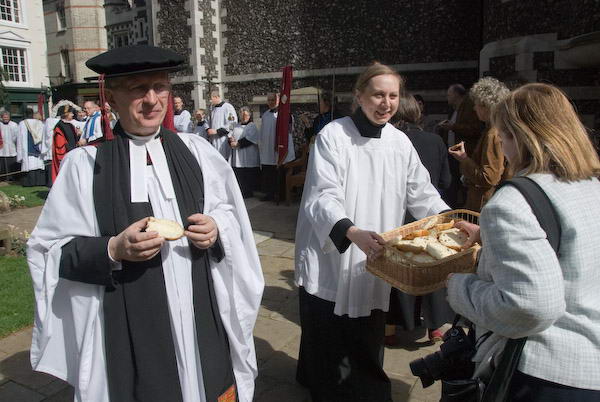
Good Friday: Distribution of the Butterworth Charity, St Bartholemew the Great, Smithfield, London. April 6, 2007

This year I managed only one, the other half of the North Lambeth and District Good Friday Walk of Witness, which made its way around the area by Waterloo Road and The Cut to meet up with those coming from the Imperial War Museum to the service in Waterloo station.

St John's Waterloo
St John’s, Waterloo
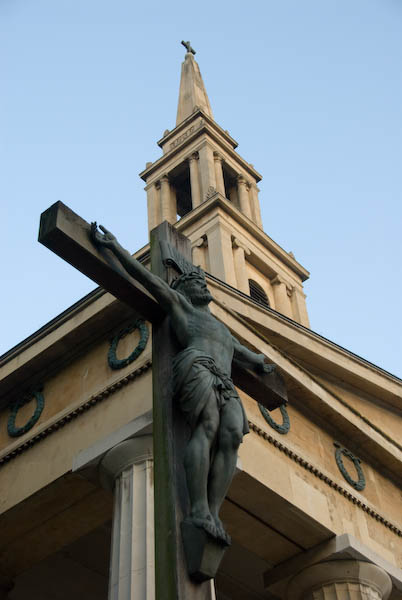
We started at St John’s Church on the Waterloo Road, a fine Greek Revival building, leaving by the gate at the back of the churchyard and walking to the modern St Andrew’s in Short Street and on to the square opposite the Old Vic theatre. After a short service there the procession led on to Waterloo Station and a longer service with the other group in the middle of the forecourt.

Druid Spring

Tower Hill

Easter weekend has been long and busy for me and I’m only now beginning to catch up. Thursday was the start of Spring, marked this year with biting northerly winds, threats of snow and some bouts of cold driving rain.

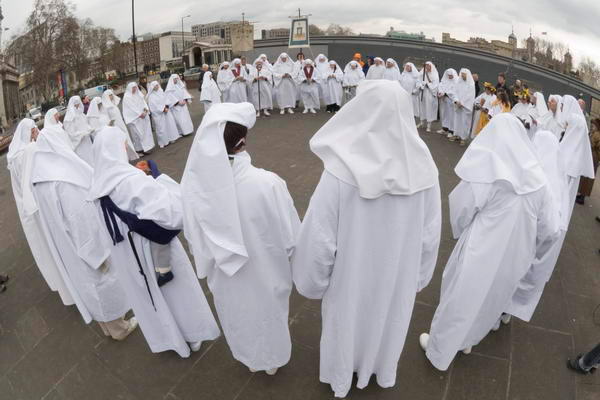
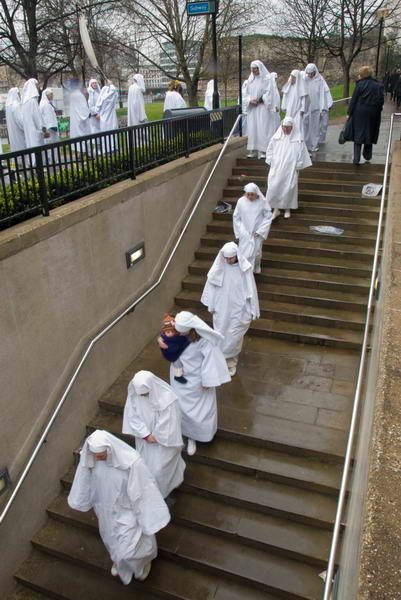
The Order of Druids were lucky that the rain held off until the end of their Spring Equinox celebration at Tower Hill, but their long file back to their starting place was through the rain.

Through the subway

As always when photographing in rain, it was hard to avoid the odd drop on the front of the lens, giving some diffusion – as you can see in a couple of areas of this picture. With a wide-angle lens, you can’t use a lens hood that will effectively protect against rain, and when the wind is sweeping the rain fairly close to horizontal umbrellas are tricky to hold and rather ineffectual. Working without an assistant they get rather in the way in any case.

Like most photojournalists in similar conditions I work with a microfibre cloth or chamois leather, wiping the front of the lens at frequent intervals and keeping the cloth balled in front of the lens with my hand in front of it when not taking pictures. But there is still the second or so when you actually frame the image for the rain to descend.

At such times I always think of the Martin Parr book, Bad Weather, in which he sought out the effects of water drops on the lens, flash bounce from rain and snow and more, often working with an underwater camera for the purpose. Interesting though the pictures are, I think few editors would have the vision to see it in his way. But perhaps the main thing that makes the pictures I took of the Spring Equinox this year differ from those I made last year is the weather. There is after all something timeless about the Druids, whose origins stretch back into the deepest ancient history even if the particular order I was photographing was only inaugurated for the Autumn Equinox at Primrose Hill in 1717!

Phillip Jones Griffiths 1936-2008

Phillip Jones Griffiths died yesterday at his home in London, aged 72. 

You can read more about him on the Magnum Blog, in a short tribute by Stuart Franklin, which links to a number of his Magnum features, as well as to an obituary in the New York Times by Randy Kennedy. Franklyn quotes his former Magnum colleague of many years, Henri Cartier-Bresson, who was also one of his great photographic inspirations, as writing what is perhaps the best epitaph for him some years ago:

“not since Goya has anyone portrayed war like Philip Jones Griffiths”

Jones Griffiths had been suffering from cancer for some time, but had continued to organise his work and to lecture until very recently – including a talk in London a couple of months ago.

I posted only this morning about the new Magnum WARS set of four features inspired by his work and including him with four of Magnum’s best war photographers of the current generation, and a couple of weeks ago about an interview with him, and I’d previously written several times about his work, including a fairly lengthy section in a short online history of war photography.

He was a man whose photography – and life – always asked questions, didn’t accept the accepted wisdom, the status quo, but as Kennedy’s obit ends, always wanted his photography “to say to say ‘Why?’”

More Camera Porn

One of the problems I seem to be getting more and more is a failure of autofocus on my Nikon D200. In the old days of course we all focussed manually, but this is actually a lot harder with modern cameras and lenses. We used to shoot mainly with fast (or fast-ish) primes – my standard SLR kit included a 28mm f2.8, 50mm f1.8, 105mm f2.8 and 200mm f4, but nowadays that whole set is usually replaced by a 18-200mm f/3.5-5.6 which goes a bit further as well as filling all the gaps (and weighs about the same.) Larger apertures means brighter focussing screen images – and a more decisive ‘snap’ in and out of focus. And of course the smaller sensor – and thus smaller focussing screen also dims the image.

Factor in too my age and dimming eyesight, along with rather poor manual focus rings on modern autofocus lenses and manual focus for me now tends to be for emergencies only when I’m working with a DSLR. Generally I rely on autofocus, but one of my problems is perhaps that the D200 seems to have so many options. I have to admit that I’ve only intentionally used a few of them – perhaps some of the others would be more suitable.

There is a nice switch on the front left of the camera, at the bottom of the lens box, which has 3 nice, straightforward settings, labelled C, S, and M for continuous, single and manual. The only problem I have with this is that it’s too easy for us compulsive button-fiddlers to move it to the wrong setting – particularly manual, and its then possible, especially in poor light, to take lots of out-of-focus pictures before you notice.

Then on the back is another less scrutable 4 position lever, with icons that could mean anything. The only one I really understand is square braces inside square braces, which stands for ‘Single Area AF’ and means the camera focusses using the focus area you tell it to (and is indicated in the viewfinder.) It was perhaps not the best choice for the chaos outside the Chinese embassy, as the manual indicates it best suits static compositions where the subject stays in the selected focus area.

Perhaps I would have been better off with ‘Dynamic Area AF’ which can use focus information from other focus areas, but doesn’t indicate it is doing so, or with ‘Group Dynamic AF’ or even ‘Dynamic Area AF with closest subject priority’, but unfortunately I didn’t have the manual with me to weigh up the options (page 54) though it would certainly have let me identify the icons (I’d find say S, D, G, C much easier to remember.)

Of course, once you’ve assimilated all that there are a number of custom functions related to all this – a1 to a10 – and given a few hours I might sort out the best combination taking everything into account. It would actually have been a lot easier just to get out the Leica and get on with the job, perhaps with that nice fast 35mm f1.4!

Actually I’m beginning to think that perhaps the D200 (or lens) may be in need of some kind of service, as well as casting my eyes more and more over the reviews of the D300. There’s a good one fairly recently appeared by Thom Hogan , one of the few reviewers on the web whose opinions I take seriously (one of the best-known others is really just a clown and believes that there isn’t a lot of point in shooting RAW – well perhaps there isn’t for the sort of pictures he likes to post.) Of course Digital Photography Review is pretty hot for the technical kind of stuff (so far as they go) and they’ve also recently reviewed the D300, but Hogan is a photographer who takes reviewing very seriously – even to the extent of taking cameras to bits. (One other guy worth reading is Sean Reid, but his site is a subscription site, and costs $32.95 per year – and well worth it if you have an interest in the gear he reviews.)

Hogan also writes extensive e-books on cameras, though I can’t tell you what they are like – when I was writing for what was then one of the most popular photography sites on the web I did write asking for a review copy of one, but never even got a reply! So I reviewed a couple of those from another author instead. But I suspect Hogan’s might be better.

One of the other things I didn’t write about when I was the guide to ‘About Photography‘ was so-called ‘glamour photography‘, although the reasons there were different, and one thing I don’t miss are the regular and frequent e-mails I used to get from several people in that sordid business telling me they were God’s greatest gift to photography and that I should be featuring them on my site. Frankly, it’s boring formulaic crap, and the slicker it is, the more boring.

Today I was reminded just how sordid it can be by a mention on ‘Conscientious‘ of a blog with a posting entitled How To Photograph Nude Women, For Free. I won’t give the link given there on this site, as I can’t think of any reason to recommend this to any photographer, but if you know any young women who might be thinking of becoming a model, I’d suggest they read it and beware. It really is the kind of thing that gives photography a bad name, and even makes the actual porno industry look respectable.

St Patrick comes to London

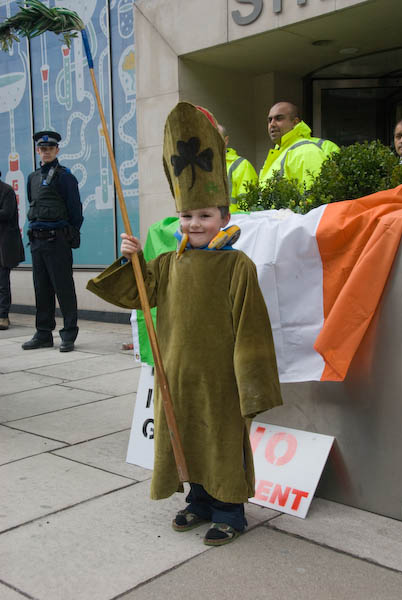
St Patrick outside Shell HQ

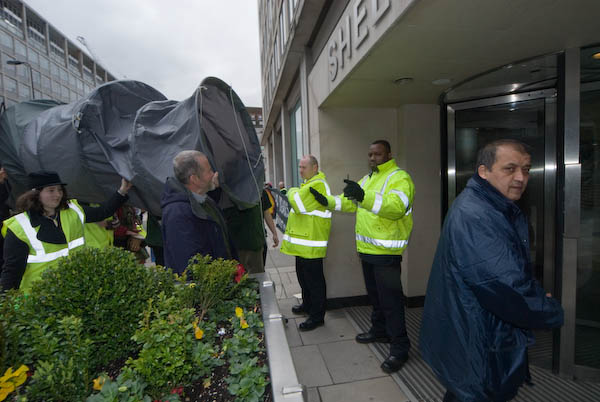
St Patrick came to London, bringing with him a rather large pipeline, which his friends from environmental and social justice movement Gluaiseacht tried to take into the Shell HQ near Waterloo.

Pipeline at Shell HQ

Shell have the major share in the Corrib Gas Project in Mayo, Ireland, given away at a bargain price by the Irish government, and the associated high pressure pipeline and refinery will pollute the local countryside. Around half the Irish protesters were from Mayo, and they brought the pipeline to Shell’s HQ to remind them, in the words of one of the many songs sung during the protest, ‘Shell Sells Suicide’, that “they forgot about the will of the people, and the people of Mayo say “No, no, no, no, no, no, no… ” There was music and dancing too, and despite a chill wind around those drearily Soviet-style blocks of the Waterloo steppes it felt good, as you can I think see from the pictures.

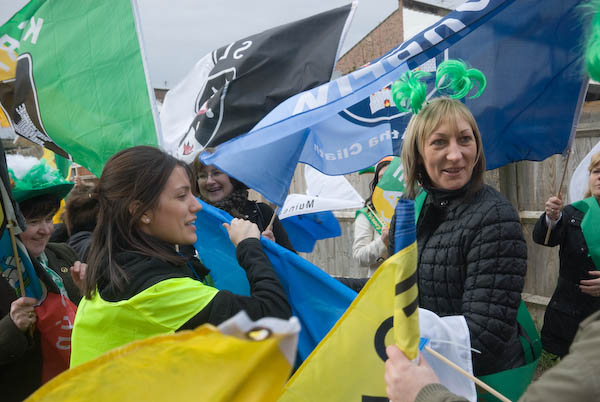
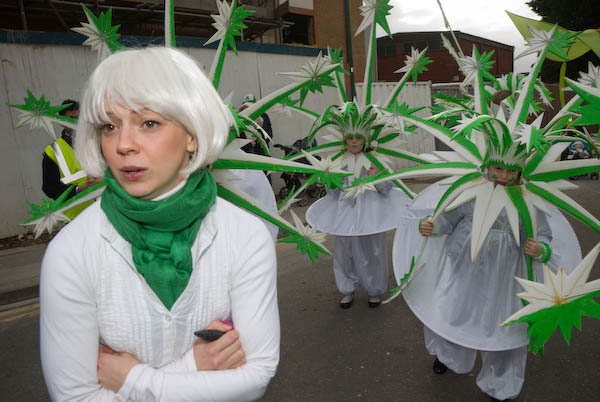
Brent St Patrick’s Day Parade

Another St Patrick, slightly older, was at Willesden Green for the Brent St Patrick’s Day Parade later in the day, and you can see his picture on My London Diary along with others from the event. I have to admit I enjoyed photographing the women at the event more than the saint, and here are a few of them – more of course on MLD.

Brent St Pat's Day Parade
Sorting out the Irish county flags
Brent St Pat's Parade
Waiting for the start of the parade
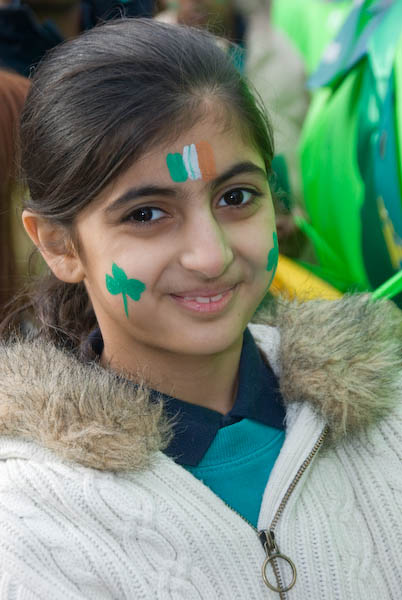
Brent - Celebrating difference

I think this last image says something about one of London’s most culturally diverse Boroughs, which celebrates Diwali, Eid and other festivals as well as St Patrick’s Day.

Tibetans protest in London

Looking at the work by some of the great Magnum war photographers makes me realise more strongly than ever that I’m not cut out to be a war photographer. Cowardice is one reason, though anyone who doesn’t have a healthy dose of this in their make-up is perhaps unlikely to survive long. But I think that perhaps I’m rather to timid a guy for the job, and, as I got a reminder on Monday, too ready to panic under pressure.

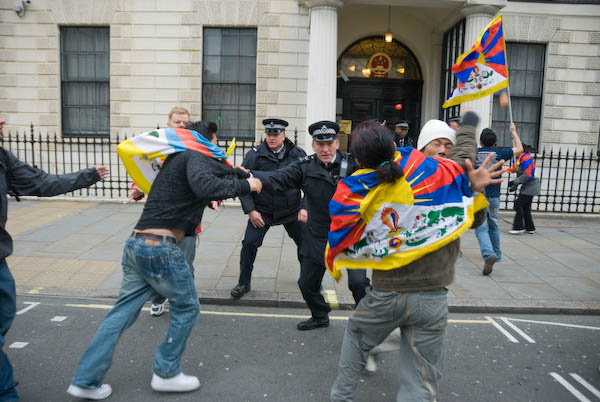
I was photographing the Tibetan protest opposite the Chinese Embassy, timed to coincide with the Chinese government ultimatum to Lhasa protesters to give themselves up or face serious reprisals (whereas one suspects that anyone who did give themselves up would simply be beaten up, tortured, imprisoned and quite likely shot.)

I’d arrived rather late, having been taking pictures at Willesden Green and suffering a slight delay on the underground, so had missed the silence at 4pm but it probably wouldn’t have made a good photograph. It was certainly a very noisy even by the time I arrived, and I spent quite a while mingling with the demonstrators shouting at the embassy across the road, photographing with both a semi-fisheye and the ultra-wide end of the 12-24mm.

Where I wanted to be – and along with other photographers really needed to be was in the empty area just in front of the line of barriers in front of the protest. But that nice empty traffic-free area was being guarded by 3 policemen with orders not to let the press in, though I did sneak a couple of images from close to both ends.

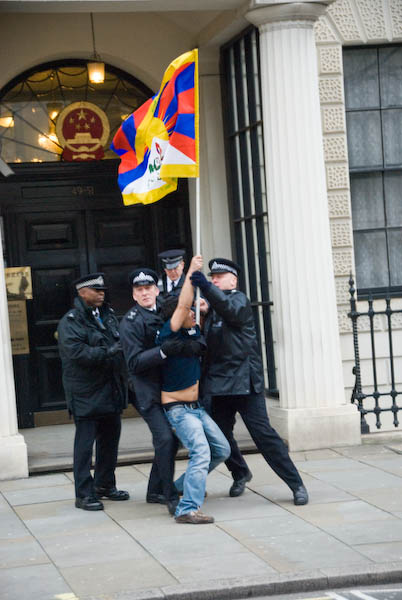
Police like to keep things simple. Nice neat lines, two sides – cops and robbers , or in this case, cops and protesters. Despite those nice “agreed guidelines”, photographers are just a nuisance. I was just wondering whether to make a complaint to the officer in charge or just go home (it was around 5pm, the light was beginning to fail, and I’d had a long day, so the latter seemed preferable as although I think we should complain on principle, in practice it never gets you anywhere) when a Tibetan guy with a flag rushed across the road in front of me and made across the road for the door of the Chinese Embassy.

Tibetan Flag at Chinese Embassy

So of course I rushed after him, and got a shot – if from a little too far away – of him waving the flag as he was stopped by the four officers on duty. ISO 800, 1/125 at f4.8 – wide open – at 60mm (90mm equiv) on the 18-200. Almost sharp too.

Behind me I were other Tibetan youths who had knocked down the barriers and followed him, and I was able to get into better position as police and stewards tried to stop them.

Tibetans rush towards the Embassy

This is wide open at 18mm (27mm equiv), and 1/125 again, and sharp enough to read both officers’ shoulder numbers, and the little motion blur probably improves it.

There were a few decent frames in the chaos that followed, but looking back though the whole shoot I seem to have made too many exposures at the wrong time, got far too much camera shake (though of course some caused by being pushed in the crowd) and taken far too little thought. In a word, panic.

Fortunately there was enough left to make a decent story, or at least I think so – you can see it in My London Diary.

Of course other photographers also panic and get things wrong, though they may have considerably better reason to do so. Robert Capa on that D-Day beach had an incredible hail of unfriendly kinetic activity inches above his head, and its hardly surprising he didn’t raise it too much. I often wonder quite how much of the distress that lifts those images out of the norms of photojournalistic syntax into their powerful expressionism was the result of a quaking photographer rather than of the melting admiration of the unfortunate darkroom technician. When ‘LIFE‘ ran them in 1944 with a caption about the ‘immense excitement‘ of the moment making ‘photographer Capa move his camera and blur‘ it quite likely told a little of the story, although ‘excitement’ was probably not the most appropriate word. Capa after all was human, and like most of the rest of us would have been shit scared.

WARS from Magnum

There are an awful lot of photo-blogs around. I don’t have many links on the ‘blogroll’ of this site, mainly because I wanted to keep it simple and only link to sites where I often find interesting features. One of those carefully selected links just has to be Magnum‘s blog, and yesterday this announced a new set of four essays on its companion site, Magnum in Motion,”WARS – A series of four essays revolving around a common topic,” also to be published on ‘Slate.’

In 2006 Magnum in Motion interviewed Philip Jones Griffiths, almost beyond argument the greatest photographer of the Vietnam War, and at the start of his piece he makes the comment “Photographers are either mud people or sand people. I’m a mud person.” This was his response to people who asked him why he hadn’t covered the desert wars of recent years. More seriously he feels that photographers need to get the kind of perspective that comes from a detailed knowledge of the country and what was happening – as he set out to do in Vietnam. In his piece he gives an insight into what he set out do in his coverage of the war there, and his pictures give a real feeling about the country and the war, including the Americans fighting there, who he sees also as victims of the war.

[In Jones Griffith’s Magnum in Motion podcast, “Point and Shoot“, he talks about guns and his experiences, and attitudes to war, and it’s also worth listening to – you’ll find it – along with 35 others of interest on their podcast page. But the images are shown much more strongly in the ‘War’ presentation.]

Jones Griffith’s flip response on sand and mug acts as the starting point for presentations by three of the leading younger photographers who have covered recent conflicts. As Christopher Anderson points out, the younger generation of war photographers got sand wars rather than mud, whether they liked it or not. Paolo Pellegrin ‘s stark black and white images from Lebanon are perhaps more often from a ruined cityscape of rubble than either sand or mud.

Thomas Dworzak in Chechyna and Iraq has seen both, but the difference is more in the situation than the geology. In Chechnya he could usually go along with the rebels whatever they were doing – if he was brave enough , and he obviously was – but in Iraq “as a Westerner, there is no more access to the insurgent’s side” and he can only work with the Americans, photographing what they do in the country. He comments on the freedom he is given to take pictures – and that those things ‘off-limits’ are largely the kind of boring ‘high security’ places and briefings he has no interest in photographing. He became a photographer to show the injustice and inhumanity of war, and his pictures continue to do so, even if he may sometimes feel that what he is doing is in some sense “a middle-class, Western, boy’s game” as he can leave the war and go home to enjoy a very different world.

Stop the Wars

Saturday’s anti-war demonstration in London was a large one, with estimates of 50,000 by the organisers. It took roughly 40 minutes to pass me going over Westminster Bridge, and by the time I’d photographed the final protesters opposite Westminster station I had to run the hundred yards or so to catch up with the head of the event going round Parliament Square. They had arrived there by walking a roughly 2km circuit, coming back across the Thames over Lambeth Bridge and up Millbank.

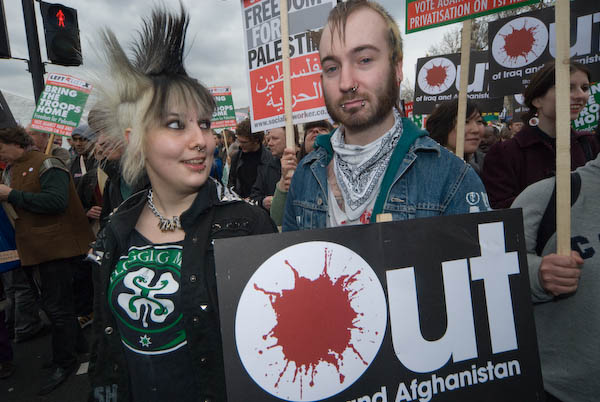
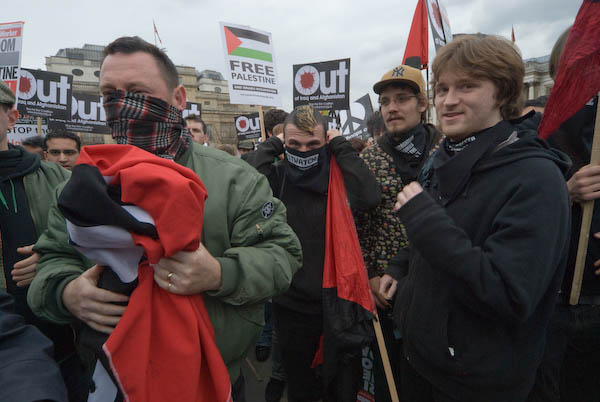
It was remarkable too for the range of different people and groups supporting it, many adding their own causes to the general aims of getting our troops back from wars in Afghanistan and Iraq, not going to war with Iran and ending the Israeli seige of Gaza.

I tried to reflect the whole range in my pictures, though I’m sure I missed some. And although thankfully the police did largely leave the conduct of the demonstration to the march organisers, the event did show the continuing fascination of FIT teams with the anarchist fringe, which only serves to encourage them. The only real clash, when four were arrested on what seems a very dubious pretext, predictably came when I was taking a break from the event as little seemed to be happening.

Although I’ve written a little on My London Diary about the event, mostly I’ve just put up pictures, roughly in chronological order, that cover the event. It was a big event, so I took a lot of pictures and there are rather a lot on line, perhaps about one in ten of what I took.

Thinking again about Winogrand, he liked to keep his work for a couple of years before he looked at it and selected the pictures that worked. Although nothing on My London Diary is in the same league, my serious edit will also be in a few years time. For the moment the site is really more like my digital version of contact sheets, as the name suggests a diary of how I saw things in London.

Narrative and Photography

ere’s another quote from the Garry Winogrand TV programme I mentioned recently (and if you haven’t watched it yet, I’m sure you will find it of interest.)

There isn’t a photograph in the world that has any narrative ability, any of them, they do not tell stories; they show you what something looks like… to a camera.”

Garry was of course right, but also wrong. Right from the point of view of making a photograph (almost certainly all he was interested in.) As he goes on to say “the thing has to be complete in the frame … it’s a picture problem, it’s part of what makes things interesting. A piece of time and space is well described, but not what is happening.”

But when we view all or most photographs we see them in a narrative manner. We supply a narrative context. And although that narrative may not be true to the time and space from which the photographer wrenched his moment, it does bear some relation to it. Although the photograph doesn’t determine the narrative, there has to be some kind of consonance between the image and it.

One of photography’s most famous images is of a man leaping from a plank in the Place de l’Europe in Paris, behind The Gare St Lazare in 1932. It’s ‘decisive moment‘ is because of our narrative completion with the splash of failed pride, although the picture itself is complete in a Winograndian sense in its frame (one of Henri Cartier-Bresson‘s few cropped frames.)

The set of pictures I took outside Holloway prison on Jan 16 have no claims to photographic fame, though they are perhaps a good illustration of being in the right place at the right time (and almost getting the exposure right.) Taken individually they could be anchored to a narrative in various ways, but as a sequence they tell more of a story.

Pauline Campbell’s daughter died in Styal prison in 2003. Sarah’s death led to her campaigning around the country on behalf of women who have died in prison – now more than 40 deaths since Sarah. After nearly four years of her campaigning the Home Office “finally admitted responsibility for the death of my daughter Sarah Campbell, including liability for breach of Sarah’s human rights under the European Convention on Human Rights.”

In January Pauline organised a protest to mark the death the previous month in Holloway of Jamie Pearce (later she found the prison authorities had spelt her name incorrectly – she was Jaime Pearce.) As a part of this she attempted to stop vans arriving at the prison with prisoners and talk to the drivers, and police were determined to prevent this picketing.

I took 6 frames of one incident as it happened and several afterwards which were related. Because of the sunlight coming more or less directly toward the camera (giving flare in some images) I was shooting using flash, and there was a variable delay between shots as the flash recharged. (Longer than usual as my SB800 had died and I was using the SB80DX, which is slower to recycle and less smart with the D200.) One of the minor advantages of digital is that is does record timings of pictures in the EXIF data, particularly pertinent in this case as I rename images on import to Lightroom including a sequential number – and in this case these are not in the correct order.

On Indymedia I published six, and they were also used in a centre page spread in ‘The News Line’, together with another picture from the event and my ‘Indymedia’ report. ‘The Big Issue (North)’ used a single image. Here they all are, although the times are all an hour out, as my camera was set incorrectly – it actually happened at around 15.34:
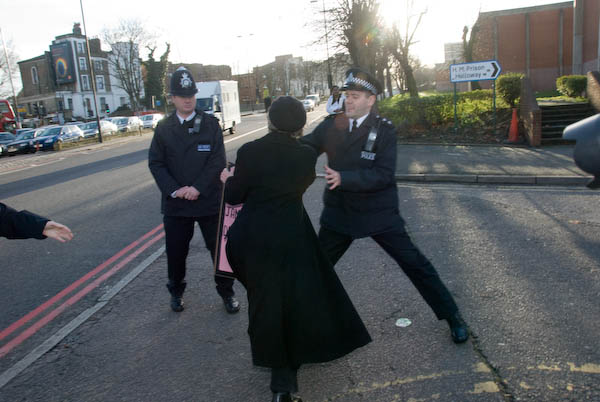
Image 1
Frame 1. 14.34.28 Pauline sees the van approaching and tries to run through the police line…
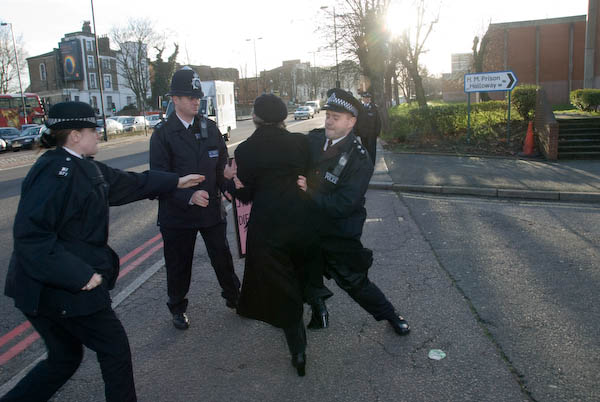
Image 2
Frame 2. 14.34.28 … but is intercepted by the senior officer…
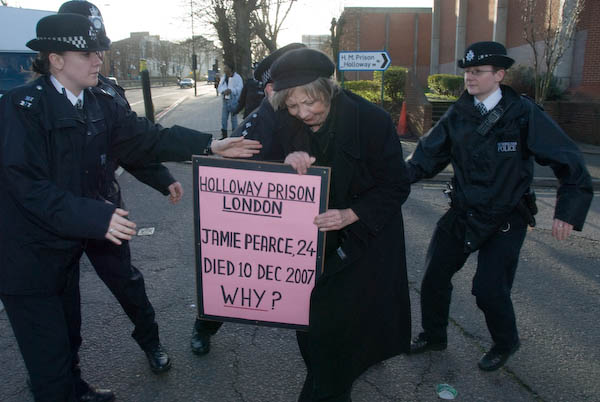
Image 3
Frame 3. 14.34.30 … who starts to push her back, while a woman officer holds out a hand in front of her.
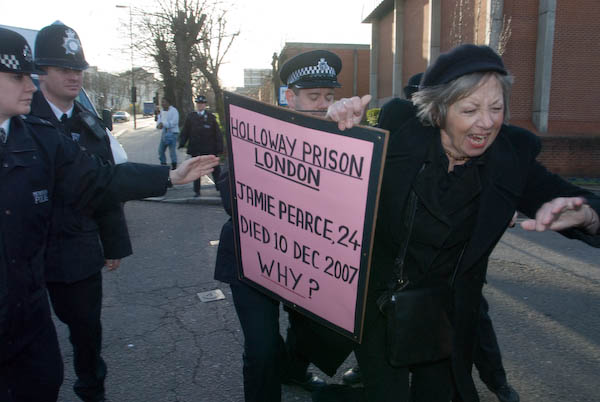
Image 4
Frame 4. 14.24.31 Pauline falls towards my right
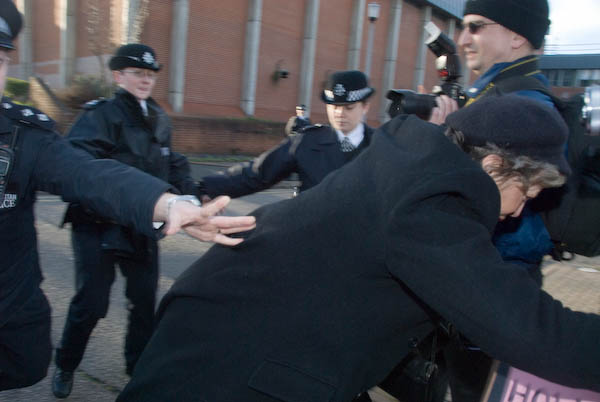
Image 5
Frame 5. 14.34.31 … while I move round to show the hand pushing her…
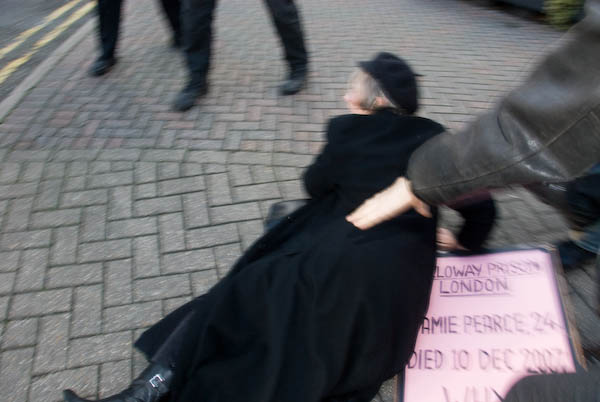
Image 6
Frame 6. 14.34.33 … and she has landed on the pavement.

There should have been more than six images, but I was pushed me out of the way by police between the 5th and 6th images. I took a frame of her being helped on the ground, but wasn’t allowed tot really get where I needed to be, then I saw the officer who had pushed here, apparently reacting to what he had done, taking two pictures before he noticed and turned away.

Image 8
Frame 8. 14.34.42

Image 9
Frame 9: 14.34.42

No one picture really tells the story, though some suggest more than others. Taken together they are fairly convincing, in particular I think Frame 3, which shows that only one officer was pushing her – and another holds out her hand to try to stop her falling, and Frame 5 where I’ve moved round pretty fast to show the hand in the middle of her back.

The best picture – the most dramatic frame – is 4, shows Pauline from the front falling towards the camera, but clearly it doesn’t tell the whole story.
Close Down Yarl’s Wood

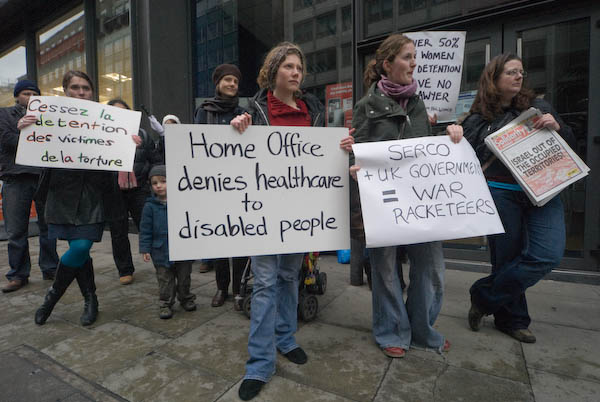
The last of three events linked to International Women’s Day I attended was a picket close to the offices of SERCO, organised by Feminist Fightback, All African Women’s Group and Black Women’s Rape Action Project. Unlike the Million Women Rise march, but as also the Dignity! Period rally, this involved both women and men.

Few people recognise the name SERCO, though increasingly around the world it is running their lives. Around the world, governments are turning to SERCO to run what used to be public services – hospitals, prisons, schools and even military services. Increasingly what used to be public is being sold off and run for profit. When they think of a way to charge for the air that you breathe, it will be SERCO – or another company like it – collecting the cash.

In the UK, if you go to prison it may be run by SERCO, and you will be taken there in a SERCO van. SERCO also own and run Yarl’s Wood Immigration Removal Centre, where around 400 women and children seeking asylum are imprisoned.

Around 70% of the women at Yarl’s Wood at any time claim they are survivors of rape. Conditions are appalling, with inadequate food, racist and sexist abuse, and profiteering from the sale of essential items. Apparently SERCO were forced to investigate claims that women there weren’t getting the miniscule government allowance of 71p a day passed on to them, and according to the women they have at times been prevented from contacting their lawyers.

Women there have responded with hunger strikes as well as letters and petitions to Gordon Brown and others demanding investigation of their treatment.

SERCO London picket

SERCO have a Research Institute in London in a court off High Holborn, and a picket there after the Million Women Rise event on Saturday March 8.

Around 40 people turned up to demand the immediate closure of Yarl’s Wood and an end to the criminalisation of rape and torture survivors. They also called for an end to SERCO and other private companies profiting from the oppression and misery of others.

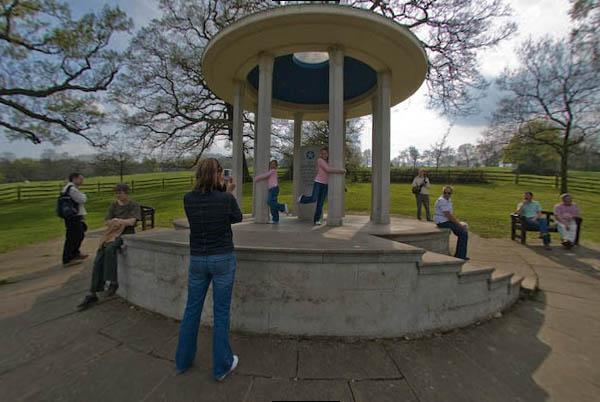
Detention centres such as Yarl’s Wood are in any case a nasty stain on British justice, going against all our long-held principles of fair trial and the opposition to arbitrary detention dating back at least to the time of Magna Carta, signed a short distance from where I live.

American Bar Memorial to Magna Carta, Runnemede
American Bar Memorial to Magna Carta, Runnemede (more pictures)

That such centres should so badly treat those held inside them for the profit of their shareholders is reminiscent of the worst days of the slave trade – the abolition of which we celebrated last year.