Frank Herzog & Early Colour

I don’t often mention Amateur Photographer here, though it’s a magazine that I used to read many years ago as a schoolboy – well before I started taking pictures – probably mainly attracted by pictures of scantily-clad women which occasionally appeared in its pages, or even those carefully posed nudes with strategically placed accessories or gauzy fabrics that amateur photographers were wont to produce in the 1950s and 60s (and they still dominated many club contests when I was on the edge of that world in the 1970s.)

Later, before the web, it became the magazine to go to in the UK when you were searching for cheap materials or equipment, or wanting to sell cameras, with pages of secondhand listings and adverts from Marston & Heard and others, as well as the first camera discounters. There seemed to be several times the pages of adverts as editorials, and much of the editorial was hardly worth reading. Compared to the US magazines such as Modern Photography and Popular Photography, their reviews were decidedly amateur. AP’s idea of a lens test was to open a window, take a few snaps of a ship at anchor on the opposite bank of the Thames and blow up the results.

There were the occasional articles that were worth reading. Once in a while there would be an interesting historical article or series by one or other of the few British photo-historians, or perhaps an extended review of a new book or exhibition which enabled the magazine to print some pictures without having to pay reproduction fees.

I even wrote a few articles for the mag, illustrated by my own photographs, including one with some of the Hull pictures I’m currently putting on my Hull Photos site, as well as several, intended to be amusing, on the outings and exhibitions of a small and atypical group of club photographers that got me more or less thrown out of the camera club, whose august members became aghast and I was summoned to appear before the committee. Some people had no sense of humour.

I’ve not looked at a print copy of the magazine (you can also subscribe to a digital version) since my local library stopped having magazines in some earlier round of cuts, but I do occasionally glance at its news feed online, and sometimes find something of interest. And a couple of days ago my attention was caught by a review of a book, Modern Color by Fred Herzog, written by Oliver Atwell, illustrated by several of Herzog’s pictures. The book was published last year by Hatje Cantz in Berlin.

I wrote about Herzog back in 2013, having seen some of his work in a lazy show at Somerset House, in which his work had stood out, along with some pictures by other photographers whose work I knew well, and I’ve seen more since. You can view many of his images online at the Equinox Gallery which brought his work to a wider audience with two shows in 2007. Before then he had previously had one-person shows also in Vancouver in 1994 and 1972 and had work in a few group exhibitions.

Herzog, who worked as a medical photographer at the University of Columbia and also as a Fine Arts Instructor, apparently took to working with colour because he didn’t have the time to make black and white prints, though his work suggests that he had a strong feeling for colour. It wasn’t unusual for photographers to work in colour at the time he started back around 1960 – and I took my first colour film – before I was a photographer – a year or two later. It’s the quality and intention of his work that were different, at a time when colour photography was largely the province of commercial photographers and amateurs like myself photographing their holidays or their girlfriends sitting in cherry blossom as I did.

Herzog chose to use Kodachrome, an excellent choice in terms of longevity, and a film with an attractive and distinctive pallette, if not the most accurate colour. It was also a film with high contrast, rather restricting the subject matter and lighting if you wanted to avoid large areas of empty shadow. Over many years of working he produced an extensive archive and you can look through 162 of the 100,000 or so at Equinox. They were taken from around 1958 to 2009, but it is work from the first 10 or 15 years that I find more appealing.


When I began working as a photographer in colour, Kodachrome was a rather expensive option, and I generally used less expensive alternatives, either process paid, or films which I could buy in bulk and process myself in E4 (later E6) chemicals. To cut costs I kept away from expensive Kodak chemicals too, making use of alternative and cheaper brews. Usually these produced good results, but keeping the solutions at the correct temperature and accurate timing was difficult.

Although producing transparencies was in some respects an easy option, it created a problem if prints were needed for exhibition. There were reversal papers available – and I used an Agfa version for the colour prints in my show German Indications – they were fiddly and it was hard to get good prints. More expensive were colour prints made from inter-negatives, which could be good, especially when paying for professionally made 4×5″ negatives from 35mm, and For those on very large budgets it was possible to get excellent dye transfer prints, but a single print would have cost around half my monthly salary.

Things changed a little with the introduction of Cibachrome-A by Ilford in 1975, making it possible to produce prints from slides in amateur darkrooms. The prints were brighter and bolder than those produced on conventional colour papers, and more long-lasting, but it was difficult to tame the contrast. Good for many commercial uses, Cibachromes were death to more sensitive images.

The chemicals used for the Cibachome dye bleach process were also pretty nostril-searing and disposal required some care. They were never very suitable for those of us with small and not too well-ventilated darkrooms, probably shortening the lives of many of us.

I abandoned colour transparency and moved to colour negative film for my own work in 1985, either processing the film myself or using cheap amateur film processing services, which also provided enprints as proofs. The change for me made sense because of new and better colour negative films and paper from Fuji becoming available. Until I moved over to digital almost of my colour work was made on Fuji materials, though I did try out some of the newer Kodak films that emerged after Fuji had disturbed their complacency.

But the advent of high quality negative scanners and archival inkjet printing have opened up new possibilities for all of use, and particularly those who worked with transparencies, giving a degree of control over contrast and colour that was simply impossible in the past. And it meant a new lease of life for Herzog’s Kodachromes.
Anthony Hernandez

It was now over 35 years ago that I first became aware of the work of Anthony Hernandez. I’d become interested in the work of the ‘New Topographics’ which in some respects seemed similar to my own urban landscape work at the time, and booked to go on a workshop with Lewis Balz, whose work in his New Industrial Parks Near Irvine, California had greatly impressed me. So much that I wasted much time in making similar pictures rather than following my own ideas.

I didn’t entirely see eye to eye with Balz at that workshop at Paul Hill’s ‘The Photographer’s Place‘ in Derbyshire. I wasn’t impressed by him as a workshop leader, having experienced some of the best with Ray Moore and rather felt Baltz was too much plugging his own work and worth rather than in any way looking at the work we students had brought and trying to give us new ideas and motivation. As a teacher myself I didn’t much go for his teacher knows best attitude and a certain unresponsiveness.

I didn’t endear myself to him either, not just because I asked difficult questions (something every teacher should welcome) but because I wasn’t afraid to express my opinions on his work. Although I appreciated the fine grain and resolution he got from the films he used, I felt there were problems with the tonality in using films that were not designed for pictorial use and expressed my misgivings. It was actually an experience that led me to years of frustration and occasional joy in trying to tame Kodak’s Technical Pan film, “a black-and-white panchromatic negative film with extended red sensitivity” on an Estar baseintended for Microfilm use which Kodak stopped producing in 2004, though some sites continued to offer it for a while. Eventually they gave up telling photographers it wasn’t intended for pictorial use and brought out their own developer, Technidol, which did a decent job in restraining its contrast without reducing the ASA speed to single figures.

Kodak had actually stopped producing the film several years previously as the materials needed were no longer available but had found a large stock in their deep freeze so they could continue to sell it for a while. They also revealed that the film had been designed and produced for military purposes, its extended red sensitivity presumably designed to be particularly revealing in some aerial reconnaissance work.

Balz and I had a particularly testy exchange when the proofs of his new book ‘Park City‘ arrived and he showed them to us, along with some of his original prints. It was perhaps unwise for me to point out that the book proofs actually handled the highlights rather better than his silver gelatine prints!

But the most interesting aspect of the workshop was the work by other photographers who I had not perviously been aware of, including Chauncey Hare who I wrote briefly about a few days ago and Antony Hernandez. I can’t remember exactly which images Balz showed, but the work was probably from his pictures of Los Angeles (may present a problem with some modern browsers as the site requires flash.) Certainly the images were black and white.

Hernandez recently had a show at SFMoma, apparently the first retrospective of his 45 year career. You can see more about it at American Suburb X, Los Angeles Plays Itself: Anthony Hernandez at SFMOMA.

Cyclists Die

As I’ve mentioned here before I’m a cyclist, though not a very active one at the moment, just jumping on a bike to go down our local shops or post a letter etc, and the very occasional longer ride. When I taught at a local college, I cycled to work and back every day, perhaps around five miles in all, except on half a dozen days in many years when thick snow halted traffic and I made it in on foot – to find none of the students had made it. Cycling was a little exercise that helped keep me healthy, but also the fastest, most reliable and certainly the cheapest way to get there.

In the suburbs where I live, the main danger for cyclists is fast-moving traffic, and drivers who fail to see cyclists. There are also those drivers who believe that cyclists have no place on the roads – and recently the UK’s Transport Secretary Chris Grayling has suggested cyclists are not road users, just a few weeks after he knocked one off his bike opening his car door.

Central London’s slower moving traffic can actually make cycling there safer, and the danger in London is mainly from lorries and other large vehicles with restricted views turning left over cyclists. But there is another hidden danger which kills many cyclists and pedestrians – air pollution from traffic fumes.

Research by scientists at Kings College for the Greater London Authority and Transport for London published in 2015 established that 9,5000 people per year die early in London due to high levels of nitrogen dioxide (NO2) and fine particulate matter (PM2.5s). Over 60% of these were attributed to NO2, and Oxford Street has the worst NO2 levels in the world, mainly because of diesel vehicles, particularly the large number of buses. But all internal combustion engines – diesel or petrol – produce NO2.

It isn’t just deaths. Many of those who die early have suffered for years from lung diseases, heart problems, cancers, asthma, emphysema and lung infections. And along with Birmingham and Leeds, NO2 levels in London have been well above EU safety limits for more than 5 years.

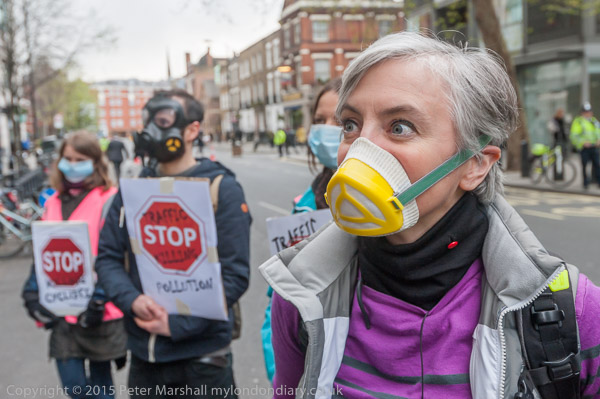
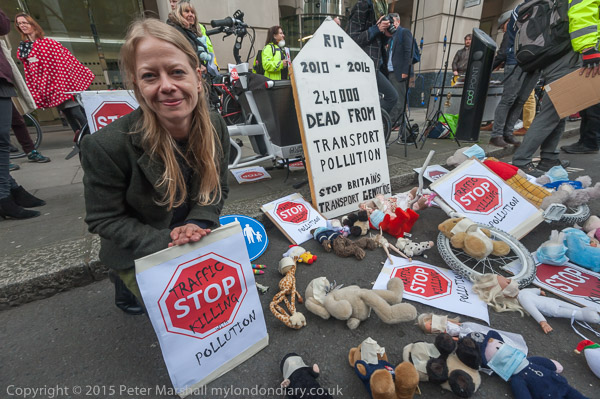
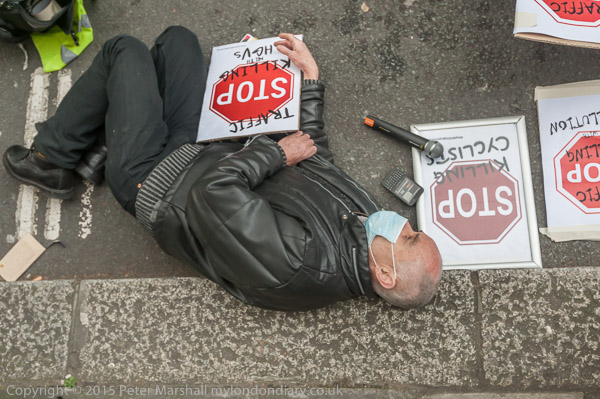
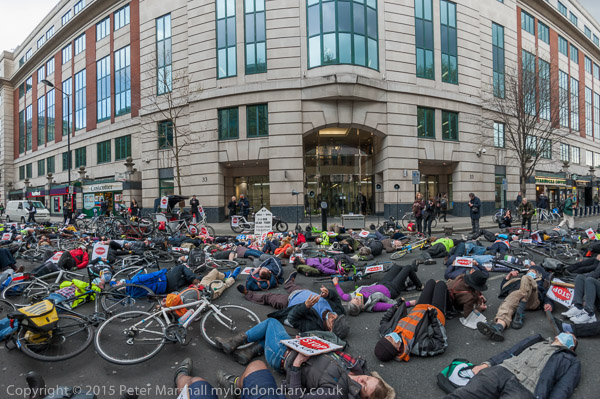
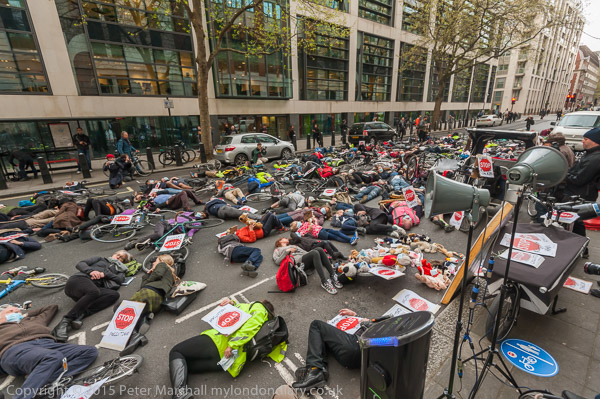
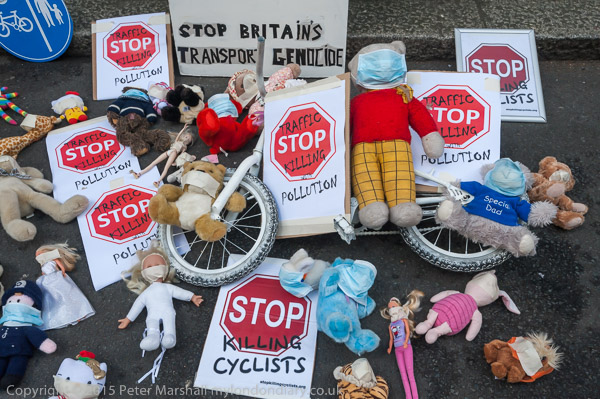
Cyclists are particularly effected by air quality because they are more active than the average street user and closer to vehicle exhausts. So Stop Killing Cyclists called a die-in outside the Department of Transport to demand the government take urgent actions to address the problem, with 8 demands which I list at Stop Air Pollution Killing Cyclists.


Sian Berry

The protest took place ahead of the London Mayoral elections, and all of the candidates were London asked to respond to this list of demands, and their answers were commented on at the event. Those from the two main candidates, Sadiq Khan, who became Mayor and Zac Goldsmith were disappointing. Despite his claims to be an environmentalist, Goldsmith showed an almost complete lack of concern, and Khan was little better. One candidate – Sian Berry for the Green Party – both accepted the full list and came to take part in the protest, though we all knew she sadly had little chance of winning the election.


Donnachadh McCarthy, Co-founder Stop Killing Cyclists, taking part in the die-in

The publication of the report has so far led to a few minor changes or promises of future change. Two bus routes have become zero-emission, and others are to follow, and the High Court in November ruled that the government really had to take some effective measures over diesel vehicles – and revealed that the Treasury had previously prevented them doing so.  Mayor Sadiq Khan has stated the intention to bring in pollution charging this year and to bring forward establishing the Ultra-Low Emission Zone to 2019.


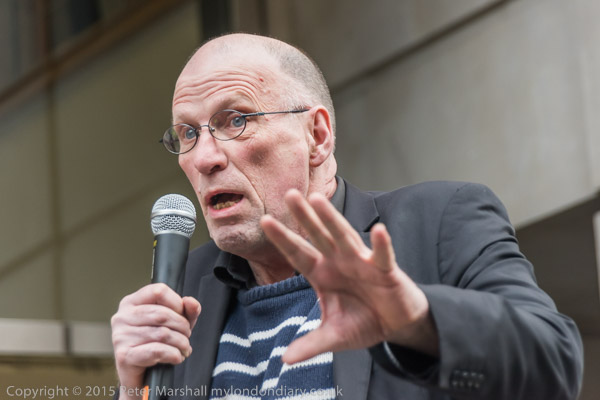
Environmental campaigner John Stewart, best known for his campaigning against Heathrow expansion

But at the same time, the government has announced its intention to back a new runway at Heathrow, which will seriously increase pollution in London, both from aircraft and from the extra traffic the runway will generate.  There is simply no way that pollution targets can be met if Heathrow is allowed to expand.

As usual, to capture overall images of the die-in the 16mm full-frame fisheye was useful, though the image at the tops of the post was made with the rectilinear 16-35mm lens.

Stop Air Pollution Killing Cyclists.

Continue reading Cyclists Die

Laughlin’s Third World

One of the books I’ve had on my shelves for a very long time – since soon after it was published in 1973 – is is ‘Clarence John Laughlin: The Personal Eye‘, a catalogue for the Philadelphia Museum of Art exhibition and a double issue of Aperture, Volume 17, Numbers 3 & 4, also published ‘as a book for general distribution’.

I don’t think its distribution in the UK would have been very wide, but like many US photographic publications of the time it would have been available at the Creative Camera bookshop in Doughty St and doubtless advertised in the magazine.

For those without a copy on their bookshelves, you can get a good idea of Lauglin’s thinking from ‘First Principles of the Third World of Photography – THE WORLD BEYOND DOCUMENTATION AND PURISM ONE – TEXT AND IMAGES BY CLARENCE JOHN LAUGHLIN’ on Carnival of Dogs. His 12 point manifesto there begins “In Photography, as in all arts, the quality of the human imagination is the only thing that counts – technique, and technical proficiency, mean nothing in themselves” and ends “The limitations of photography are nothing more than the limitations of photographers themselves.”

Much of Laughlin’s work is now in the Historic New Orleans Collection, where you can view and zoom into many of his pictures, so many indeed that it is hard to know where to start. But it is worth paging through the many pages of thumbnails and picking some to look at.

Although in the end I learnt that my own creative interests were in purism and documentation, in my early years in photography work such as Laughlin’s made a strong impression on me, and I’m rather surprised that although I wrote about him and other photographers who might be considered to follow in his footsteps such as Arthur Tress in another place, this is the first time in several thousand posts I appear to have mentioned him here.

Laughlin’s work was brought to my mind by two posts Clarence John Laughlin: In Memoriam on Photocritic International by A D Coleman, who wrote about Laughlin in his 1977 critical survey The Grotesque in Photography.

The first piece takes its sub-title Prophet without Honor from the subtitle of the Laughlin biography, Clarence John Laughlin: Prophet without Honor by A. J. Meek, professor emeritus of art at Louisiana State University (University Press of Mississippi, 2007), and one of two stories in it recounts Coleman’s meeting with Laughlin around 1975 when the photographer showed his of work to collector Sam Wagstaff. He set out a strict set of conditions about what he expected anyone who bought his pictures must do – and after looking through the work, Wagstaff rejected the idea that a photographer should have any rights over their pictures after they had been sold.

Over the ages, artists have almost always had an uneasy relationship with those who have provided them with a living, but it is only in relatively recent times that photography has succumbed so entirely to patronage by individuals and corporations. Most of the early photographers were themselves wealthy and others have maintained some sort of independence based on various commercial practices and around the reproducibility of the medium.

The second piece, subtitled Lament for the Walking Wounded, is an article published by Coleman in his “Light Readings” column in the December 1977 issue of the magazine Camera 35, together with a postscript.

Published at the time without names, it recounted the speech by Hilton Kramer, then chief art critic for The New York Times, at a New York City national meeting of the Society for Photographic Education, in which Kramer held Laughlin up to ridicule not for his photography, but making tasteless jokes about his eccentric nature. Coleman himself felt ashamed after the event at having joined in the whole-heated laughter at a man he describes as on of “the walking wounded of photography” who have suffered from their dedication to the medium and “never got their due and are beginning to realize that they may never get it.”

Though relating events now around 40 years in the past, these are stories which are still relevant, perhaps even more relevant, today.

On this day…

Once upon a time I had to write a daily post on photography for several years as a part of my job. Of course I still write here most days, but then I wasn’t really allowed to write about my own work, which made things a lot harder, and I couldn’t take a day off whenever I felt like it.

Of course you don’t actually have to sit down and write a piece every day. You can write stuff when you have time or the mood takes you amd schedule it to appear later. I’m actually typing this at 10.25 on Wednesday but it will most likely appear on Saturday – unless something more urgent to publish means I will put it back a day or two or even longer. Just occasionally I get things wrong – as I did this week, when the post intended for Friday accidentally got published on Thursday afternoon when I pressed the wrong button.

Sometimes when I had to write those daily pieces there were plenty of things happening that I could write about – exhibition openings, books, new web sites, and inevitably obituaries etc. But there were days when I was stumped and would turn to various ‘On this day…’ sites for inspiration. The Library of Congress has its Today in History page which often features some interesting photographs from its extensive collection that might prompt a thought.

Those daily blog posts were a relatively small part of the job I was employed to do, and some were fairly short, though one of the reasons I eventually got sacked was for writing too much and writing for photographers rather than people who’d just bought a camera and had no idea what to do with it.

When I read a post by James McArdle on the Photohistory blog about his project On This Date In Photography I was interested but perhaps a little sceptical about his intention to present “an event that happened, or is happening, on the date of posting. Journalistic, not necessarily academic, it aims to broaden the interests of devotees of photography, with some posts specifically on British photo history, others more wide ranging.”

He goes on to state that the site is “a ‘labour of love’ I am undertaking for one calendar year to revive my research and writing in preparation for penning a book on an aspect of photography next year.”

I have to say that I’m very impressed by what I’ve seen so far, and suggest that his is a site you should all add to your bookmarks/favourites.  I haven’t read all the entries which he began in October, but enough to make me want to go back and read more. One almost at random, for December 27th, with the title Dream, looks at the photography of  Latvian photographer Gunar̄s Binde, born 27/12/1933  who I was pleased to meet and see his work in Poland in 2005.


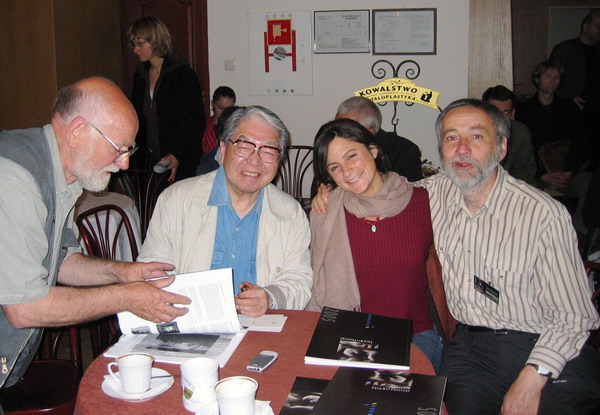
Gunars Binde looks through the catalogue as Eikoe Hosoe, Ami Vitale and I  for a photograph at the first international FotoArtFestival in Bielsko-Biala, Poland, where I represented the UK with pictures from London. You can read the more about the festival in my Polish Diary. Picture by Jutka Kovacs.

Doctors & Teachers

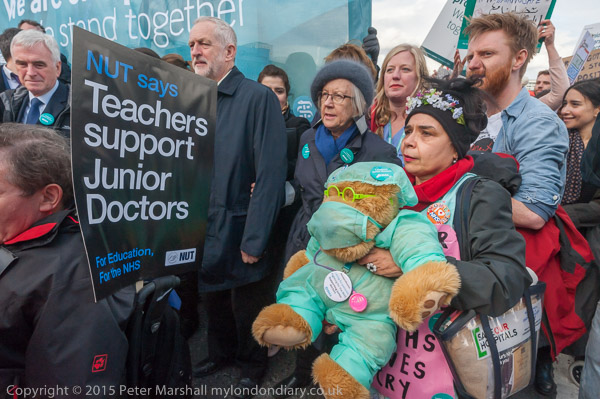
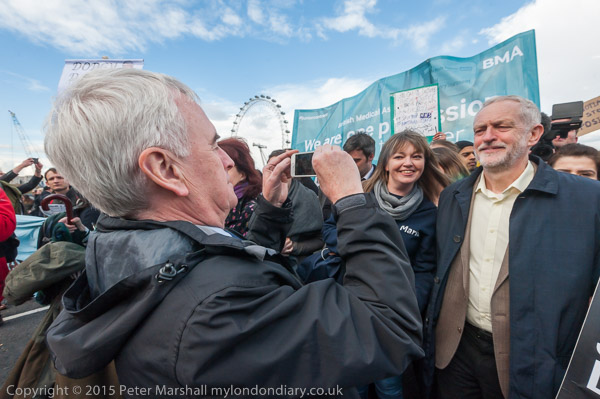
This was a photo that I felt more or less summed up the march by doctors and teachers on the first day of the two-day strike by Junior Doctors’ last April.

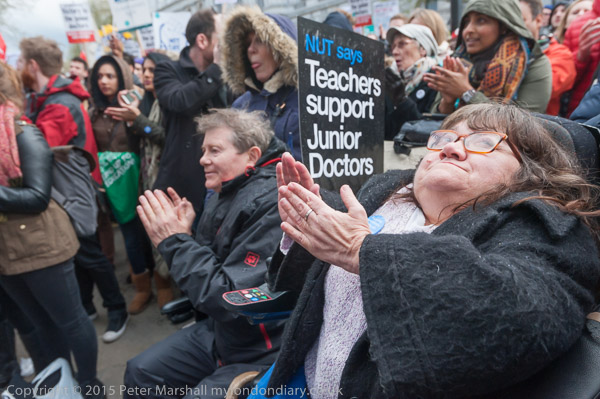
From the banner at top left with its message ‘stand together‘, Shadow Chancellor John McDonnell, the poster ‘NUT says Teachers Support Junior Doctors’, Labour Party leader Jeremy Corbyn and supporters including a ‘Save Our Hospitals’ camapaigner carrying a large teddy dressed in surgical gear.

It perhaps could have been clearer in showing that the NUT poster was on the back of a wheelchair – and my framing at left has cut off the face of a well-known disabled activist and speaker, World of Inclusion and Coordinator UK Disability History Month Richard Rieser – but his presence would have drawn attention away from the rest of the image. You can see him in a lower image on this page.

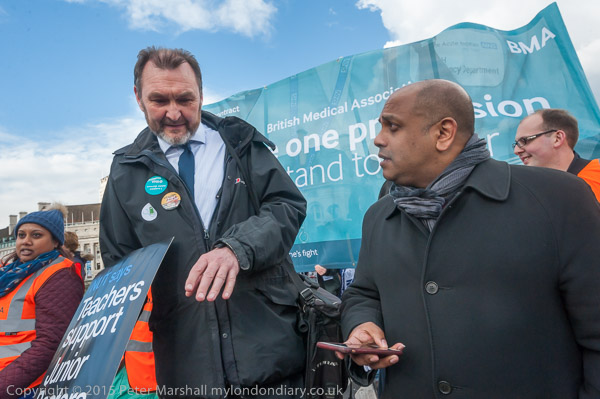
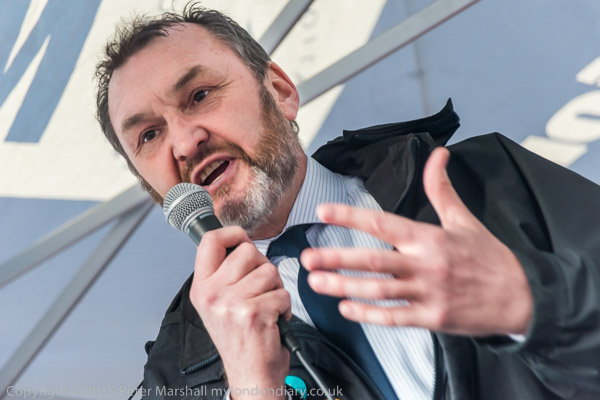
Missing from it were NUT deputy general secretary Kevin Courtney and Johann Malawana chair of the Junior Doctors Committee, shown in the second image, but you can’t have everything.

What isn’t clear in these pictures is the pushing and shoving from a few misguided stewards and other photographers that made getting some of these pictures at the front of the march difficult.

But there was one photographer who didn’t get hassled by stewards – John McDonnell taking a picture of one the marchers with Jeremy Corbyn.

The pavement opposite Downing St where there was a rally was also very crowded,  and it was difficult to move around. There were plenty of good speeches and I was able to get some reasonable pictures of most of the speakers, but photographing people in the crowd was more difficult.

It was quite an interesting list of speakers, including both Jeremy Corbyn and John McDonnell as well as Green Party MP Caroline Lucas, PCS General Secretary Mark Serwotka, Vivienne Westwood, Vanessa Redgrave, several junior doctors and others, as well as NUT Deputy General Secretary Kevin Courtney (above) who later used one of my pictures of him in his election campaign to become NUT General Secretary. I was pleased that he won, though I can’t really take much credit for the victory.

More at:

Downing St rally for Junior Doctors
Doctors & Teachers march together

Continue reading Doctors & Teachers

Hull Photos 12/1/2017-18/1/2017

12 January 2017

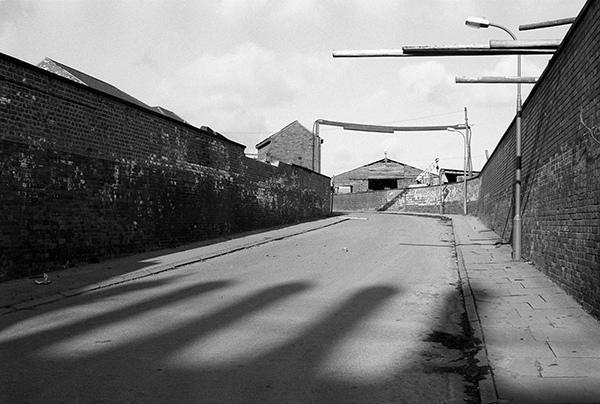
Subway St was the main route in and out of the Fish Dock for men and lorries and the subway led under the main railway line – and after this picture was taken, the A63 main route into Hull, Clive Sullivan Way. The shadows at the bottom of the image are from the chimneys of one of a number of fish smoking houses in the area, I think now all demolished.


27p44: Subway St leading to St Andrew’s Dock, 1981 – Docks

13 January 2017

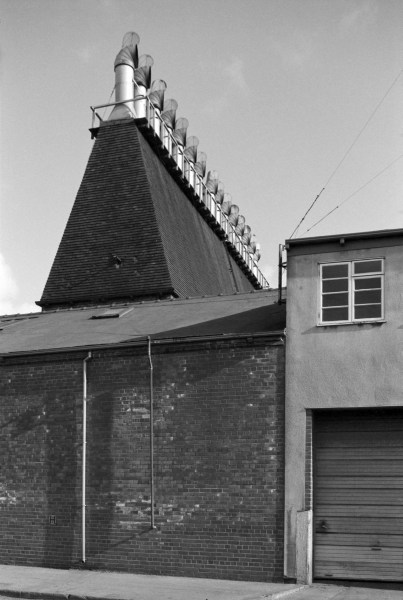
This fish smoke house was one of a number in the area close to where Subway St led into the Fish Dock – and probably this picture was taken either on West Dock Ave or Subway St close to their junction with Goulton St. Rows of chimneys like this on top of a steeply sloping roof were a familiar sight in the area between Hessle Rd and the Fish Dock.


27p45: Fish Smoke House, Goulton St, 1981 – North & West Hull – Hessle Rd

14 January 2017

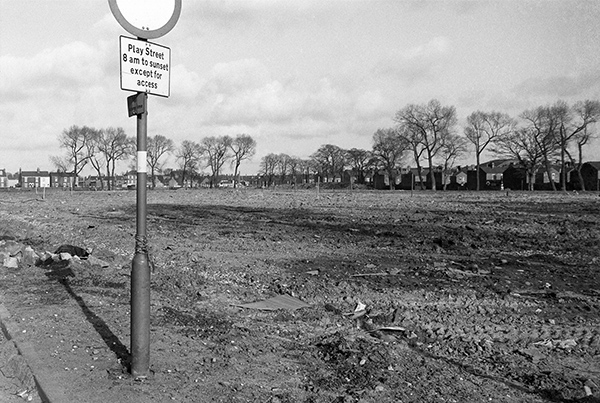
This is the image I chose for the cover of my book ‘Still Occupied’ and from my contact sheet it appears to have been taken in the Goulton St/Subway St area, although when I showed it in 1983 it was titled ‘Clearance area near Woodcock St‘, around 600m to the north-east. I’m afraid the exact location of some of my pictures is something of a mystery as I did an awful lot of wandering around while taking pictures.

Those more familiar than me with Hull may be able to identify the large curved roof in the right background, and below it, just in front of the houses a small obelisk on a plinth, though these details are probably too small to be seen clearly on the web image, and there are more monuments on a low mound in the centre of the picture, so this is definitely a burial ground. Just to the left of the post, partly obscured is a building which could be a pub.

Today, writing this, I spent a little more time researching this (thanks to Google Streetview), and the street at the left is definitely what is now called Conway Close, though when I took the picture it was Division Road. The mound and monuments are the Division Road burial ground – an overspill from Holy Trinity – and the houses at right are terraces from Tyne St. The buildings close to the post have I think all been demolished. The ‘Play Street’ I was on the edge of was I think Beecroft St or Massey St. The latter is still there with a ‘Play Street’ sign and the muddy area is now a grassed open space.


27p46: Play street and cleared site, 1981 – North & West Hull – Hessle Rd

15 January 2017

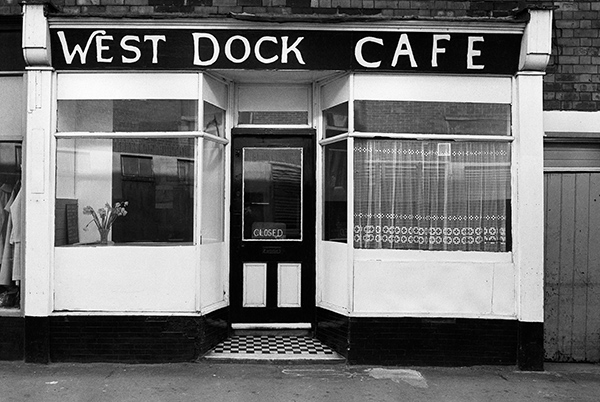
One of my favourite images from Hull, with its lively lettering and rather erratics letter heights in the sign-writing, the vase of daffs, one with a broken stem, and the patterning of the net curtain, the step and the frontage as a whole, which together I find rather satisfying. It was probably taken on a Sunday as there is a closed sign on the door.

I never went inside; like many working in Hull around noon I would rush back for dinner at ‘home’ before returning to work for the afternoon. My mother-in-law would put it on the table at 12.15 precisely. A friend who worked on Sculcoates Lane used to rush down to Paragon Station, jump on the train to Hessle for his home dinner his mother had waiting for him as he arrived, ate up and then rushed for the train back to Hull and a rather speedy return to the office.

It was about two and three-quarter miles from here to Loveridge Ave, and if I was lucky I might get the Fish Dock bus I think a 27. But otherwise I was then fairly young and fit, and at ‘scouts pace’ I might make it in 25 minutes. I daren’t be late.


27p53: West Dock Cafe, West Dock Ave, 1981 – North & West Hull – Hessle Rd

16 January 2017

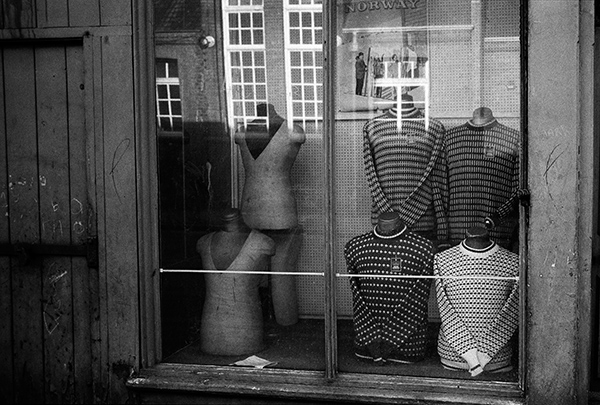
Another picture from West Dock Ave, a shop selling Norwegian jumpers for fishermen. There is a very straightforward and workmanlike look to the shop, with its boarding and simply set out display of four wooden forms showing off different jumper patterns. Presumably the others are in there bare as they only currently have four patterns.

You can still buy genuine Norwegian Merino wool jumpers, though probably not in West Dock Ave and the genuine article will cost you £150 or more. They use ‘raw’ wool which retains its natural lanolin and the fibres are spun along the fibre in a worsted weave rather than the normal wool weave across it. They are noted for warmth and breathability and have a natural water repellence due to a thick weave and the natural oil.

One of my brothers made several visits to Norway before his death when I was 20, and brought me back not a jumper, but thick woollen knitted socks. These were of oiled wool and came with the strict instruction – DO NOT WASH. But eventually they did need washing, or keeping in a different room.

Apparently you can then wash them with a little baby oil in the water to replace the natural oils. But I didn’t bother, and later relegated them to serve as bed socks, keeping my feet warm in winter and meaning I didn’t need to put on slippers when I got up in the middle of the night. I think they lasted well over 30 years.


27p55: Norwegian jumpers, West Dock Ave, 1981 – North & West Hull – Hessle Rd

17 January 2017

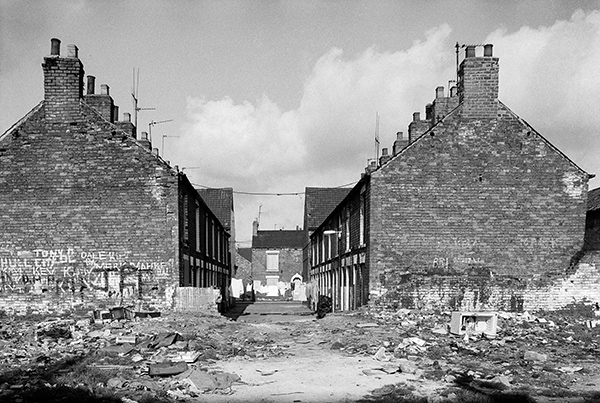
It’s easy to place the picture of the shop window and the jumpers with some precision, as the reflection in the window shows it was taken opposite the school in West Dock Ave. This terrace is the next frame on the film, and I think was probably taken as I walked further south down West Dock Ave, and perhaps shows one of the terraces leading off east from Subway St – which would be the road behind the line of washing. But I could have wandered further, perhaps towards any of the three streets named after leading public schools, Rugby, Eton and Harrow presumably by some Victorian developer with a warped sense of humour.

Probably there are people in Hull who could remember having written their names on these walls, Tony, Kev, Mark, Dale and the others. Back in the days before spray cans graffiti was considerably more basic. And some years earlier another Tom, Sir Tom Courtenay, born in Subway St, lived at 29 Harrow St from the age of 4 in 1941 until 1959.


27p56: West Dock Avenue area, 1981 – North & West Hull – Hessle Rd

18 January 2017

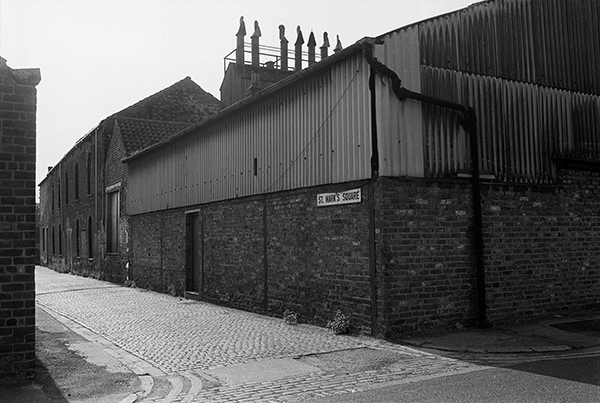
Four months after taking the picture above I was back in Hull and went back to roughly the same area. St Mark’s Square is not the only thing that Hull has in common with Venice – it also has the parish and church of St Charles Borromeo, a sixteenth century Cardinal and administrator of the archdiocese of Milan which stretched from Geneva to Venice, and it used to have a great deal of water in the centre of the city, though rather less since Queens Dock was filled in as public gardens in the 1930s and a disturbing shopping centre plonked down on stilts in Princes Dock in 1990-1.

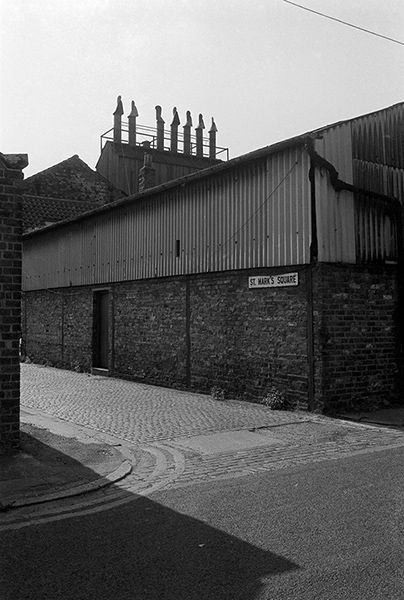
Hull’s St Mark’s Square is perhaps a little less imposing than its Venetian counterpart, but was at the centre of Hull’s first out of town suburban development by Thomas English, a wealthy local shipbuilder in the first decade of the nineteenth century  known as the Pottery Ground. Edgar was one of his sons, and there is also an Alfred St, named after the other, as well or course as English St.  Where St Mark came in I don’t know – there wasn’t a church there, though it did have a Wesleyan Chapel in the early years. St Mark’s Square was an open square for some years at the centre of the new development. All that remains from around 1802-3 appears to be the street pattern.


28h15: St Mark’s Square from Edgar St, 1981 – North & West Hull – Hessle Rd

And I turned my camera to portrait orientation for a second picture.

28h21: St Mark’s Square from Edgar St, 1981 – North & West Hull – Hessle Rd


You can see the new pictures added each day at Hull Photos, and I post them with the short comments above on Facebook.
Comments and corrections to captions are welcome here or on Facebook.
Continue reading Hull Photos 12/1/2017-18/1/2017

Charmes de Londres

I have quite a collection of books of photographs of London (as well as probably a few hundred thousand of my own pictures) but one of my favourites is ‘Charmes de Londres‘, credited to Jacques Prevert with photographs by D’Iziz-Bidermanas. Although most of the texts are poems by Prevert, it also has some quotations by others including William Blake and a Picasso drawing.

I didn’t buy this when it first came out in 1952, as I was then only seven and penniless – and it wasn’t in any case for sale, but came across it in an Oxfam shop perhaps 15 years ago, paying £19.50 for a copy in good condition. Perhaps remarkably you can still find copies of the original edition, published ‘hors commerce‘ for members of La Guilde Du Livre in Lausanne and printed by heliogravure (photogravure) on wood pulp free paper, for only a pound or two more. The previous year’s collaboration, published in the same way,  Grand Bal du Printemps, will set you back around 25 times as much.

Part of the reason you can still find copies of that original version (there are also later editions) is that it was a relatively large print run, with 10,300 numbered copies (mine is No. 4871) as well as 30 labelled I to XXX for the organisers of the guild. Although photographers often complain about getting second billing to writers when then works are published, Prevert had a much larger fan base!

The book is a reminder of the fine printing that could be achieved with photogravure, and it matches the mood of Iziz’s images perfectly. A recent post on Spitalfields Life,  Israel Bidermanas’ London, reproduces a fine selection of over 20 images from the book, without Prevert’s poems (which are of course in French) and gives a good impression of the subjects, but shows them in a more modern tonal interpretation, more contrasty and with intense blacks, which perhaps loses something of the gloomy charm of the original publication. This was a post-war London still under a gloomy miasma, though probably the real pea-soupers defeated the photographer few if any images have a clear distance.

The best way to see more of his pictures on-line seems to be to search on Google Images or Pinterest for ‘Izis Bidermanas‘.

Iziz was one of many fine photographers of Paris, and another was Willy Ronis (1910-2009). In 2004, French editor Alain Dhouailly published a limited edition of 130 copies of a set of 12 or his images printed by heliogravure which gives some background on the process. Ronis’s work is fairly widely avaialable and on galleries on the web, for example at Hacklebury Fine Art.

Do we need artybollocks?

Photography Critics, Theorists and Academic Writing: Does Photography Need Them? is the question asked and answered by Grant Scott on his ‘The United Nations of Photography‘ blog.

It’s an article which makes a great deal of sense, although I come at photography from a rather different angle. Most commercial photography just fails to interest me, and I take it as seriously as I do the text that goes with it on the magazine pages or billboards. I may sometimes, often, admire the craft, but I’m far more interested in reading a novel or a poem.

A good photograph strikes me as being something like a haiku and some can perhaps tell a short story, while a set of photographs can certainly be an essay and a good book at least a novella. Some photography (and even some commercial photography, though precious little) is more profound than other, and it isn’t elitist to say so.

I think also that in writing that art theory based criticism “exists within a niche created for a specific reason. Just as ‘commercial photography’ is created to meet a need and provide an income this academic approach to photography provides a career for those involved with it” Scott is confused. Commercial photography is created to meet a need and does thus provide some with an income, but its justification is that need, not that it provides a career for some photographers. And it can be no justification for the academic activity unless it too has some utility. Perhaps their shouldn’t be people getting paid for doing it.

Where I’m 100% behind him is when he then goes on to comment on “impenetrable academic text, agenda heavy theory and ill-informed criticism”. It’s only purpose is just that rather incestuous career-building which he has previously said he has no issue with.

I’m happy too in agreeing with him and Einstein, who apparently actually said “It can scarcely be denied that the supreme goal of all theory is to make the irreducible basic elements as simple and as few as possible without having to surrender the adequate representation of a single datum of experience” though “Everything should be made as simple as possible, but not simpler” is certainly pithier.

But I think the growth of theory-based criticism in the 1970s actually led to an impoverishment of our medium, and certainly to an impoverishment of many photographers, and to the growth of a new and largely unnecessary stratum of paid curators and other professionals who took funding away from the artists, along with a huge cohorts of photographers who could talk the talk but had little to say with their pictures.

I’m not actually against critics or curators. I’ve played a little on both sides over the years, and even achieved a little appreciation from fellow photographers on occasion. But good curation and criticism has to be built on an informed appreciation of the work and not on arcane theory.

And of course we don’t really need any of these guys. The  Artybollocks generator can create it all for us, with its ‘instant artist statement generator coming up with such gems as:

My work explores the relationship between Critical theory and copycat violence.
With influences as diverse as Derrida and L Ron Hubbard, new tensions are distilled from both constructed and discovered dialogues.

Ever since I was a teenager I have been fascinated by the unrelenting divergence of the mind. What starts out as vision soon becomes manipulated into a cacophony of lust, leaving only a sense of unreality and the chance of a new synthesis.

As spatial phenomena become distorted through studious and repetitive practice, the viewer is left with an insight into the darkness of our condition.

Artybollocks also offers you a printable certificate to show you are an artist (“Please keep this certificate in a safe place. Nobody else will ever ask to see it but you may feel better if you behave as if it is important.”) as well as a generator for tweets. And so I leave you with 144 characters:

What starts out as triumph soon becomes finessed into a manifesto of lust, leaving only a sense of chaos and the possibility of a new beginning

Grossman & the Photo League

Around 15 years ago, I wrote a series of articles and short notes about what was still then a very much overlooked part of American photographic history, but which is now referred to as ‘New York’s famed Photo League‘. An organisation that was destroyed by McCarthyism as ‘anti-American’ it remained largely outside the pale until this century, and I was pleased to be able write about it and to mention some of the photographers still alive and working who learned and developed their craft there, largely under the critical eye of Sid Grossman (1913-1955). I’ve mentioned it before on this site, including two posts with the same title, The New York Photo League where I quote from my 2001 article, and a longer version here.

You can get some idea of the critical blind-spot by reading the lengthy introductory essay by Gerry Badger to the 1985 Barbican show ‘American Images: Photography 1945-80’ which relegates Grossman and others to what is essentially a footnote to the later work of Robert Frank and the Photo League to an introductory sentence to the work of Aaron Siskind which makes clear that his importance as a photographer was due to breaking away from his early work with the League on Harlem Document.

Although none of Grossman’s work appeared in the Barbican show, that the work of several others involved in the Photo League does probably owes itself – as did much of the show – to the ideas and graft of John Benton-Harris, a native New Yorker who studied with Alexey Brodovitch, and who grew up with the work of the Photo League photographers and their successors and their views of his city.

As his artist page at the Howard Greenberg Gallery states, Grossman, who had founded the Photo League with Sol Libsohn in 1936, “had a tremendous influence on a large number of students who studied with him including Weegee, Lisette Model, Leon Levinstein, Ruth Orkin, Arthur Leipzig, Rebecca Lepkoff and numerous others.”

The main show at the Howard Greenberg Gallery in New York until Feb 11, 2017 is the “first solo exhibition in 30 years to explore the legacy of Sid Grossman” and the exhibition also includes “a small selection of work by some of Sid Grossman’s students including Rebecca Lepkoff, Leon Levinstein, Marvin Newman and Ruth Orkin.” Also showing at the gallery is a “companion exhibition with work by Sy Kattelson, a student and close friend of Sid Grossman.

Last September, Steidl co-published with Howard Greenberg Gallery ‘The Life and Work of Sid Grossman ISBN, 9783958291256′ with a biographical and critical essay by Keith F Davis, the first comprehensive survey of Sid Grossman’s life and work, with over 150 photographs “from his early social documentary work of the late 1930s to the more personal and dynamic street photography of the late 1940s, as well as late experiments with abstraction in both black and white and color.”