Walking Backwards

One of the skills that every photographer who covers protests has to master is walking backwards, or rather more importantly, taking photographs while walking backwards.

Back when I learnt photography – and when I taught it – there was a considerable emphasis on avoiding camera shake when taking pictures.

We learnt and taught to stand  still, feet a foot or eighteen inches apart to make a solid platform (of course if you could lean against a post or wall, kneel or lie prone it was even better.) The camera should be held firmly in both hands, the left cradled under the lens, the right holding the body firmly with the first finger resting gently on the shutter release. Elbows should press in against the side of your chest, and it was vital to hold your breath and squeeze rather than jab at the button.

Of course, even this was only second-best, and ideally photographs should be made with the camera on a truly solid and weighty tripod. Of course in part this was a hangover from the days of large cameras and slow emulsions. Back in the 1890s when people started to make pictures without a tripod, exposures were often well under the 1/30th which makes hand-holding relatively easy with standard lenses.

I still sometimes see photographers trying to work this way – and some even at protests, but I’ve come to hate tripods (except for those few very special projects for which they are essential) and many, if not the majority of my pictures are taken while I’m walking, and often when I’m walking backwards, though sometimes I walk in the same direction as the people I”m photographing and twist around to work at an angle over my shoulder. It works for me better over the left than the right shoulder.

Walking backwards when taking pictures does need a little practice, but if you match your speed precisely and keep in step with those you are photographing you can get surprisingly sharp results at shutter speeds slow enough to give an attractive blurring to the background.

Though more normally I play safe by using ISOs that were unthinkable in the past. With both the D810 and D750 I’m now using there seems to be very little advantage in working below around ISO800, and results at much higher ISOs are still usable. In general I set the D750 with the wide-angle lens to ISO640, and the D810 with the 28-200mm at ISO800 and ISO auto allowing it to rise to ISO6400.

Nearly all the wide-angle pictures are sharp, and those with the longer lens usually suffer from focus problems rather than those caused by camera or subject movement.

One slightly limiting human design specification is the lack of eyes in the back of the head, and when walking backwards it is essential to take the occaisonal glimpse behing to check for curbs, lamposts and other obstacles. Falling over backwards is something of an occupational hazard, and could be dangerous, though the worst I’ve suffered has been the odd bruise.

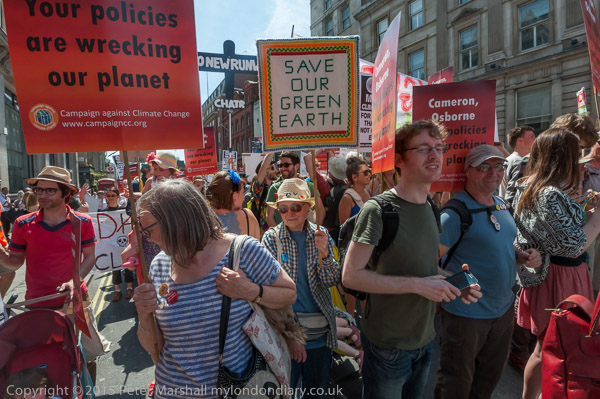
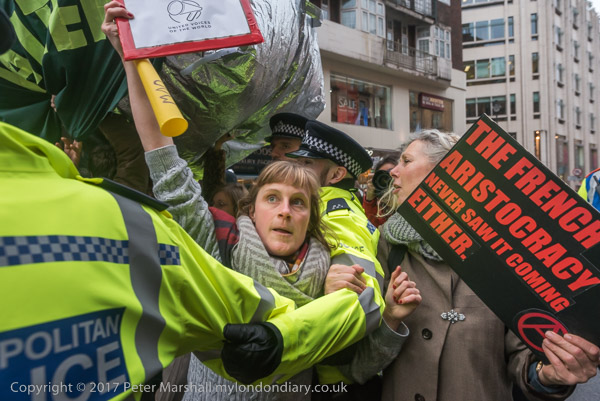
But the march I covered on the 8th May was a break from all this, as the marchers were marching backwards from Trafalgar Square down Whitehall, though in easy stages with several  stops for speeches on the way.   And they really weren’t very good at it, proceeding very slowly and cautiously.

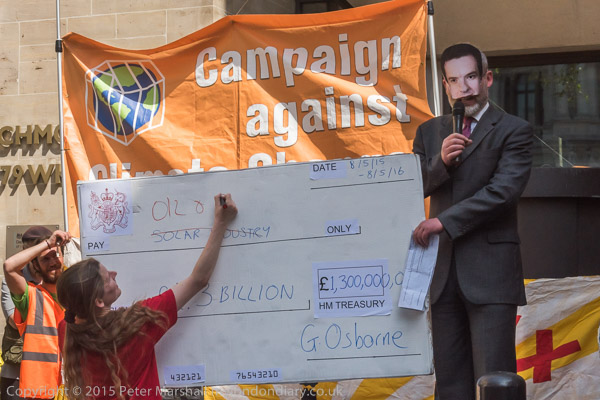
This march in reverse gear was to highlight the governments back-tracking over clean energy, with insulation grants being dropped and clean energy programmes being crippled while they back technololgies such as fracking and burning biomass which contribute to climate change as well as proposing massively polluting and unnecessary road and runway projects.

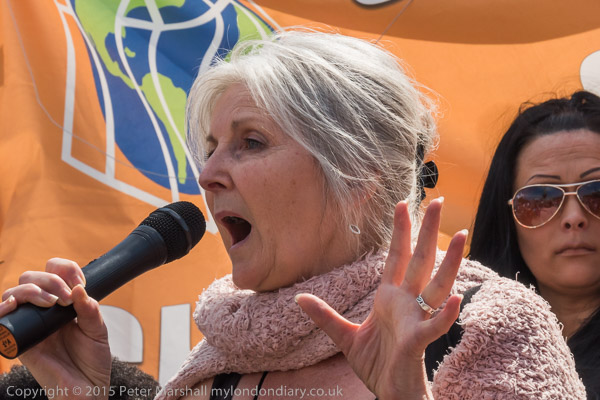
The event had started with some speeches including one from a woman whose house had been flooded. It brought back memories for me of watching the water come up to my own house a year or so earlier – though fortunately in our case it had stopped an inch or so short.

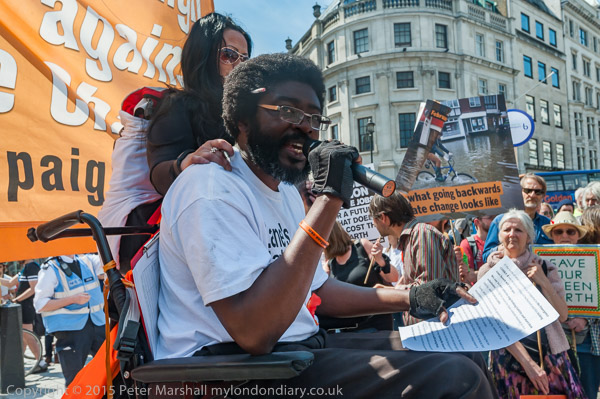
One of the others who spoke was Kye Gbangbola, whose son Zane had died in those same floods in February 2014 and had been left part paralysed. Despite a lengthy inquest since then it still seems not entirely proven that this was the effect of carbon monoxide rather than deadly hydrogen cyanide released by flooding from landfill.

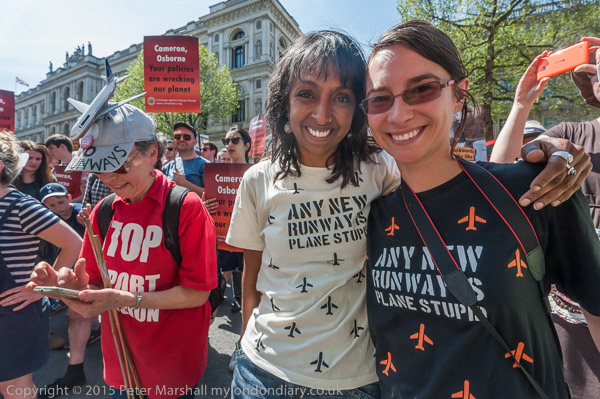
Later there were speeches from others as the march halted first at the Old War Office, where speakers included Dame Vivienne Westwood, and opposite Downing St, where Sheila Menon of Plane Stupid talked about the lack of any real need or public good of airport expansion and the catastrophic effect it would have on climate change, as well as the increased deaths through air pollution, and called for the huge subsidies that aviation enjoys to be removed.

Finally outside the Dept of Health there were speechs and street theatre, which again looked at the huge subsidies the governemnt gives to the oil industry while at the same time it is cutting green initiatives. The protest had been intended to end in Parliament Square, but time had run out, probably because non-photographers are so slow at walking backwards.

More pictures at Going Backwards on Climate Change
Continue reading Walking Backwards

UVW at Barbican


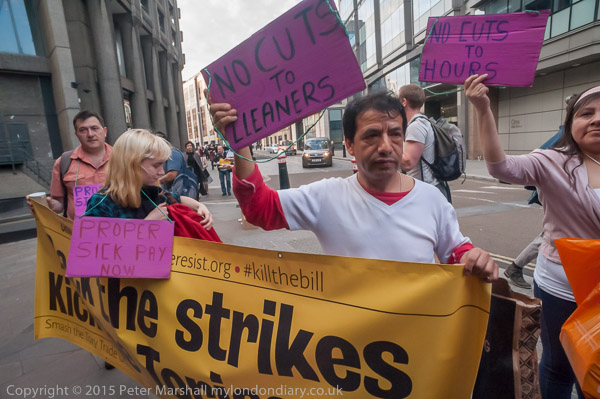
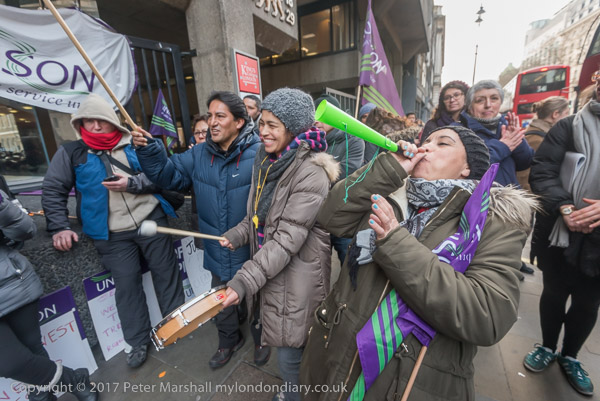
Saturday Evening, May 7th, I went to one of London’s best-known arts venues, the Barbican Centre, in the City of London and owned by the City, not to listen to a concert or view and exhibition, but for yet another protest in a long-running fight to get the prestige venue to treat its cleaners with proper respect and dignity and give them decent pay and conditions.

It wasn’t the first protest by cleaners that I’ve photographed there, and over the years the cleaners have made some progress, achieving, more or less, the London Living Wage through previous protests. But one of the problems with outsourcing of cleaning contracts (and other outsourcing) is that at the end of the contract period, new contracting companies come and put in lower bids – and the only way they can achieve these is by screwing the workers harder. Since the hourly rate is now more or less protected, that means increasing workloads, getting the cleaners to clean more and more, so they can cut hours and make staff redundant. And when Servest took over the contract that is exactly what they tried to do.

The Barbican managers try to claim they have no responsibility for the pay and working conditions of people Servest get to work to keep their centre running, a ridiculous and totally untenable position. And while Servest aren’t quite employing slave labour and whipping them to work harder it should be a condition of any contract that the Barbican make that workers are treated fairly and reasonably – and the Barbican should insist that this is so.

There are workers at the Barbican who are little different from slaves. Certainly under the previous contractor there had been workers on ‘Workfare’, under which those who had been unemployed for over three months were given the choice of working unpaid for companies or organisations or being “sanctioned” – losing their benefits. There are no whips involved, just the threat of destitution.

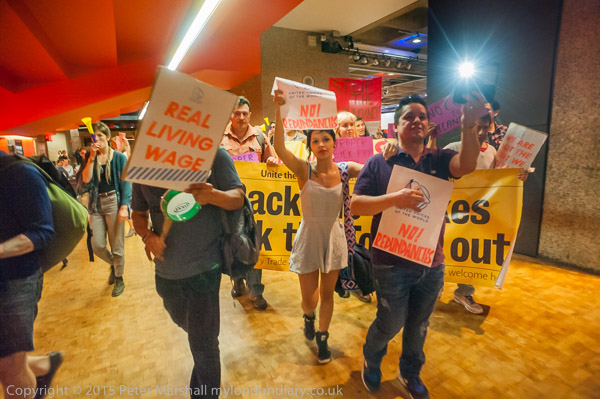
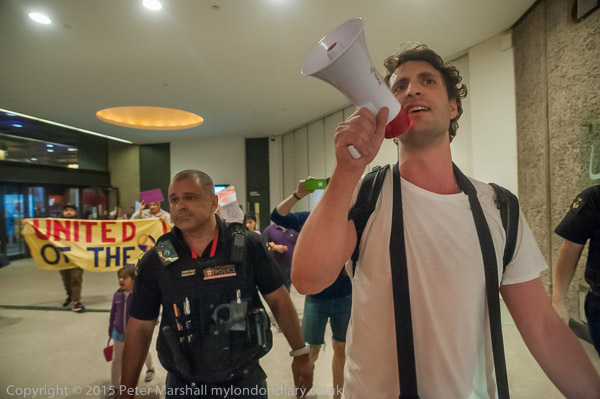
I’d got the message from the cleaners’ union , the United Voices of the World (UVW) that the cleaners, who had kept their protest secret except for trusted supporters from the Bakers Union, Class War, SOAS Unison, Unite Hotel workers branch and IWGB Couriers branch, would be meeting a short distance away and then walking together into the Barbican, hoping to rush past security.

When we met up it was still pretty light on the street, but I changed the D700 to ISO 2000 to be ready for going inside, and changed from my normal 16-35 f4 zoom to the one stop faster 20mm f2.8. As the group neared the entrance they broke into a run, and we all made it inside, except for a small group including the workers at the Barbican who stayed to protest outside the main entrance – going in could have resulted in disciplinary action – and Servest were already singling out union members for redundancies.

Inside the lighting was even lower than I remembered and I took the ISO up another stop to ISO 4000 on the D700, while relying on auto-ISO on the D810, where I had the 28.0-200.0 mm f/3.5-5.6 in place, as usual working in DX mode. The 18-105mm would have been more useful, though it is no faster, as there is rather a large gap between the 20mm and the 42mm equivalent of the 28-200, but I only thought about that after I’d left home. Generally the auto-ISO chose ISO in the range ISO 4000-10,000, and the results, though noisy were usable after some fairly aggressive noise reduction in Lightroom.

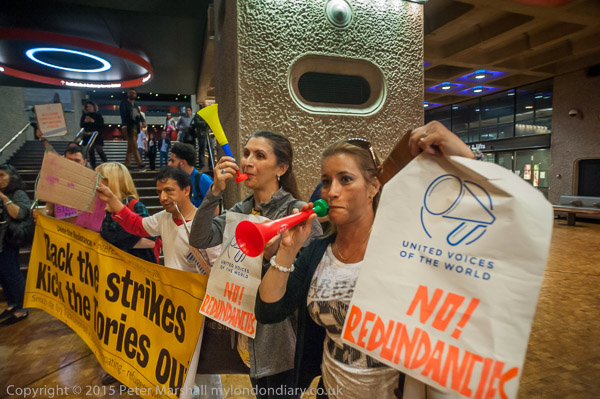
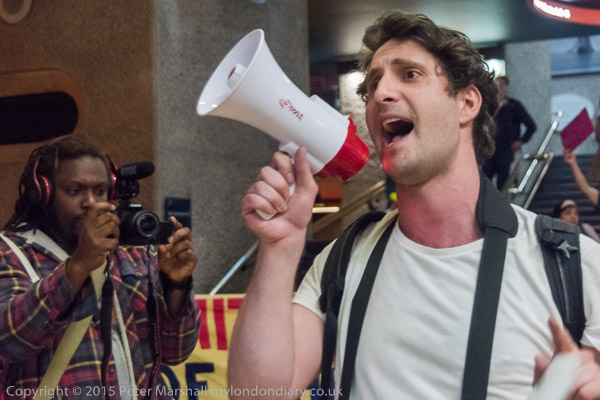
After around 15 minutes of noisy protest, stating the cleaner’s case to people waiting to go into events and in the foyer areas, the police arrived, and after a little argument the protesters agreed to go out by the way they had come in, keeping up their noisy protest as they slowly made their way out through the busy areas to where the others were protesting in front of the main entrance. The protest had made quite a stir and despite their disclaimer I think it certain that the Barbican would be putting pressure on Servest to try to avoid further happenings like this.

Cleaners invade Barbican Centre

Continue reading UVW at Barbican

Hull Photos: 26/1/17-1/2/17

Images posted daily on the Hull Photos web site. Comments are welcome here or on Facebook.

26 January 2017

The Alexandra Hotel in Hessle Rd on the corner of Ropery St remains a splendid example of a Victorian pub, built at some time between 1870 and 1890 and was Grade II listed in 1994. My picture shows the side in Ropery Rd, but the Hessle Road side is in the same style. Both the oval fanlight above the corner door and the circular one at right have a six-pointed ‘Star of David’ glazing, and it is perhaps not coincidental that there was a large Jewish population in the area around the time it was built.

The pub now looks much the same as when I took this picture, though it was damaged and closed for repairs for six months after the floods in December 2013. Unlike many pubs built as ‘hotels’ it still offers bed and breakfast, and at prices that I’m told are worth it just for the English breakfast, though the rooms are rather basic and the noise from the drinkers and traffic might make sleep difficult.
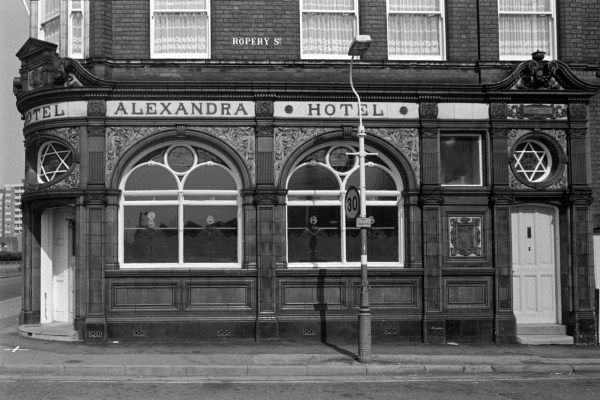

28h53: Alexandra Hotel, Hessle Rd / Ropery St, 1981 – North & West Hull – Hessle Rd

27 January 2017

There were several fish smokehouses around Ropery St in 1981, and the two shown in this pictures are still I think present if looking somewhat different. At the left of centre is one I think at the rear of 54 Alfred St and that to the right of centre at the rear of 140-142 English St. This seems now to be built into a recent shed which is part of Happy Hutch Co., and the empty space in the front of the buildings is now occuped by the premises of parts distributor Andrew Page Ltd.

It is hard to see the first smokehouse from Ropery St now because of more recent buildings. The area has changed with the builidng of CLive Sullivan Way and the expansion of Smith & Nephew, but I also photographed a third smokehouse, possibly one of the two still present between Tadman St and Daltry St. One of the pictures shows a sign for ‘Kingston Fish Foods’ who are no longer in the area, and nothing else seems to resemble the buildings in these pictures.
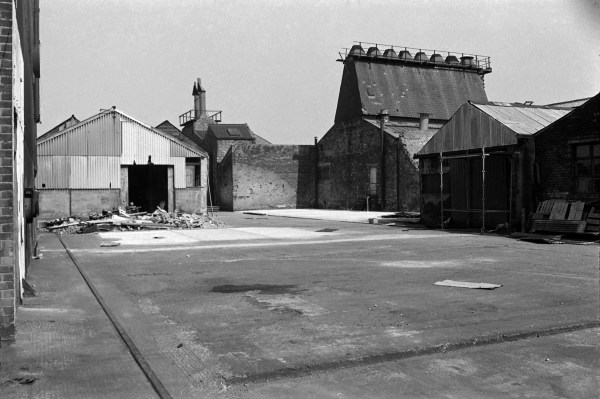

28h56: Yard and fish smokehouses, Ropery St, 1981 – North & West Hull – Hessle Rd

28 January 2017

There were several buildings in Linnaeus St, not far south of Anlaby Rd which were associated with the Hull Western Synagogue which opened there in 1902 and closed in 1994 some years after I took this picture. There are some impressive gates which according to the 2008 Grade II listing (and the text on them in English and Hebrew) were dedicated to the memory of the late Edward Gosschalk and presented to the Hull Western Synagogue By his widow and sons June 1926. Gosschalks are still a leading Hull solicitors in Queens Gardens.

I didn’t photograph the main gates, but a simpler part of the iron railings around one of the buildings, which was then boarded up, and where the shadows seemed to add an air of mystery, and I very carefully and reasonably precisely lined up the ironwork with the edges of the door surround, taking several frames to ensure I got it right, working with the 35mm shift lens.

I think this was a part of the Jewish School on the site which has now been extensively restored. The synagogue (also listed) is at the back of the site on Convent Lane, but I didn’t photograph it.

Linnaeus St was originally called Botanic Lane and at its south end were Hull’s first Botanic Gardens. It was renamed after the famous Swedish botanist Carl Linnaeus (1707-1778), the inventor of the binominal naming system for organisms still in use, in 1823, and kept the name after the Botanic Gardens were moved to a site off Spring Bank West around 1880. The buildings from the synagogue complex are I think the only pre-war buildings remaining in the street.
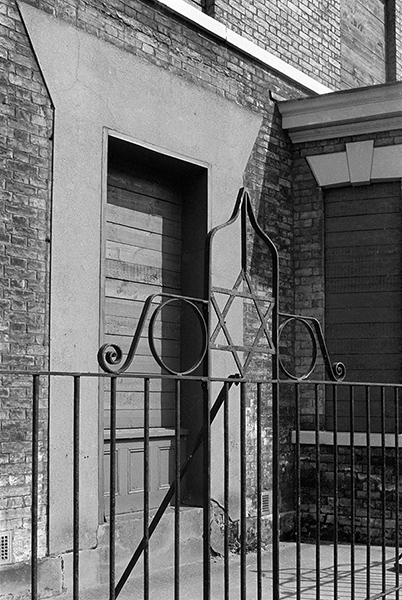

28h53: Star of David railings, Linnaeus St, 1981 – North & West Hull – Hessle Rd

29 January 2017

The area around Abbey St has changed since I took these pictures and I cannot always identify the exact locations. A B Rooms, Lock and Safe Engineers (see previous picture in this section) had premises in Field St, but later moved to new buildings in Abbey St close by. Their building in Field St has been considerably altered since I took that picture.

I can find no information about ‘Reynard Building…’ in Hull. If Carl Sharp reads this he many well know more! I think it was probably in Abbey St (as I recorded on the contact sheet a month or two after taking it.)

This is perhaps another picture that is more about the formal qualities, and in particular three rectangles, and the contrast between a black aperture and the white painted area on the wall. There is a kind of reprise at the left of the image with three vertical rectangles of doorways. I don’t think I would have made an exposure without the tree or the name ‘Carl Sharp’ written so confidently. But it’s a view of a derelict corner of a city whose changes I was recording and made at a time when I was striving to put form to work in the pursuit of content.

Working with the shift lens (or a view camera with movements) as I did on most of the Hull pictures is a rather different exercise to taking pictures with normal positionally fixed lenses. It enables the photographer to establish a point of view and then to precisely place the edges of the frame, moving the whole frame left, right, up or down a considerable amount. I’ve chosen to keep the verticals upright, chosen to stand on a particular line that places the distant pale door next to the larger gate on the corner, and to stand at a distance so that the frame cuts the doorway at left and also fills the right of the frame with a wall which actually on close inspection curves away at the extreme edge.

What I couldn’t control is the actual aspect ratio of the frame, and like all of the pictures from Hull this is presented without cropping. But I am tempted to remove that last brick or two at the right. The Olympus had a good viewfinder which showed almost all of the image, and a tiny bit also gets removed in the scanning and squaring for printing, but we may be seeing just a tad more than appeared in the viewfinder when I was making the image.
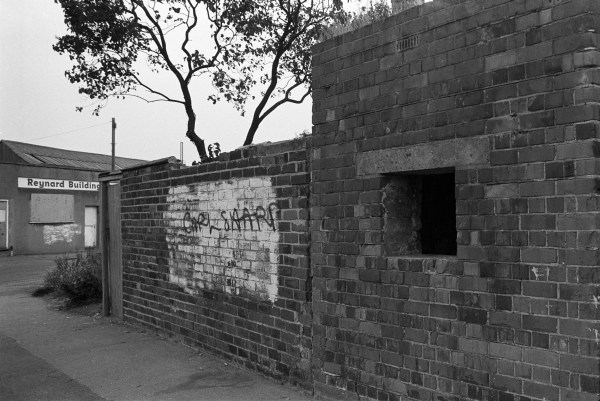

28i13: Abbey St area, 1981 – East Hull

30 January 2017

A game of cricket in the street – again according to my contact sheet, Abbey St – in front of a rather forbidding factory building which I’m pretty sure is no longer there. The G5 is perhaps for Gate 5, suggesting this was a fairly large undertaking. The ball, a tennis ball, is just visible to the left of the batter, a girl who has taken a pretty hefty swing which failed to make contact. Perhaps having an audience put her off her stroke.

I think this was a family game, with an older man at the left who could be a brother or father. I stood and watched for a few seconds, taking 2 pictures – this was the second. The 35mm shift was a manual lens, not ideally suited to action, but I had learnt to squeeze the button on the lens to stop down the aperture and press the shutter release as a single action – and still find myself sometimes doing so while taking pictures – just as I sometimes still try to push the lens body to one side or another to adjust the framing, but realise what I’m doing when it doesn’t move.

The 35mm shift was a kind of gift from Hull, something I’d long coveted but not been able to afford. One day I got off the train in Paragon Station and walked across Ferensway to look in the window of the photography dealer a few yards up the road, Hilton Photography (they moved to Paragon St years ago) and there was the lens in the window. It wasn’t cheap, but it was in pristine condition and considerably less than the new price. These were rare items, I’d not seen one secondhand before and nor I imagine had the dealers, and I suspect they didn’t really know what it was or what it was worth. I really couldn’t afford it, but I bought it on the spot.
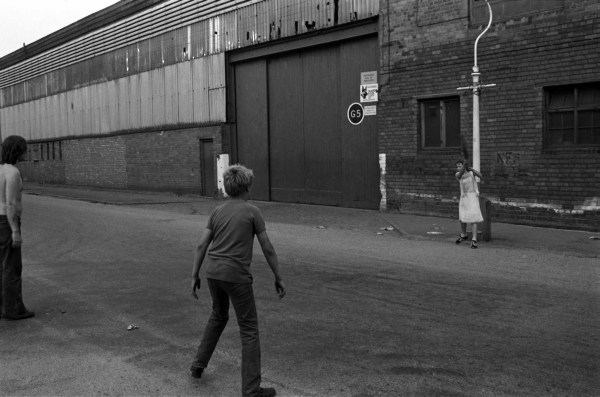

28i15: Abbey St area, 1981 – East Hull

31 January

The curved cafe window on the corner of Dansom Lane and Holderness Rd has been replaced, but there is still a cafe there, and the buildings across the Holderness Rd look much the same although now selling scooters and bikes. Witham ends across the road to my right on the other side of Dansom Lane South as I took this picture with the Holderness Hotel at 55 Witham, so my caption ‘Witham’ in the book ‘Still Occupied’ is just a few yards out.
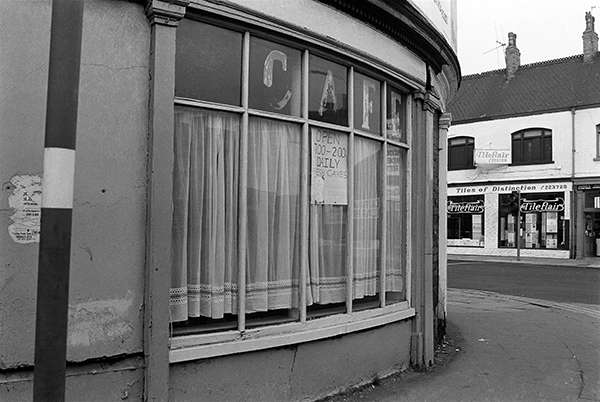

28i24: Cafe, corner of Dansom Lane and Holderness Rd, 1981 – East Hull

1st February 2017

Much of Hull’s industry grew up alongside the River Hull, and one of my favourite streets in the city was Wincolmlee, at the back of warehouses and wharfs along the west bank of the river. Among the early industries along the Hull were shipbuilding, and the first steam packet in England is said to have been built on the River Hull, in a Wincolmlee yard, in 1796, under the direction of Furness, from Beverley, and Ashton, a Hull physician, some years before Fulton’s better-known invention.

But the main businesses in Wilcomlmlee and the Sculcoates area around it were oil mils, milling a wide variety of seeds and nuts brought in by boat, producing oils including linseed oil, used in cloth, linoleum and paint, palm and other oils for soap, rape, flax, barzil and other oils, as well as large quantities of the oil cake which remained being used to produce cattle feed. Paint factories based on the oil production included those for Sissons and Blundells, both of which became well-known. White lead factories supplied the paint industry, engineering firms produced the presses needed to crush the oil.

Other factories processed the sugar that came into the port, the whale oil, produced glues and soap. There were large cotton and flax mills, corn mills and more. Much of this industry had ceased by the time I was photographing, but some remained, along with many of the buildings that had housed it.

Cooper St is a short street off from Green Lane, which used to end at the bank of the Cottingham Drain, now just a narrow strip of wasteland, less than a hundred yards form the junction of Green Lane with Wincolmlee. Victoria House, built around 1840 but with late 20th century alterations was Grade II listed as at 2 Green Lane in 1994 and until recently was the site of a printing business, CTP Plates, liquidated in October 2016.
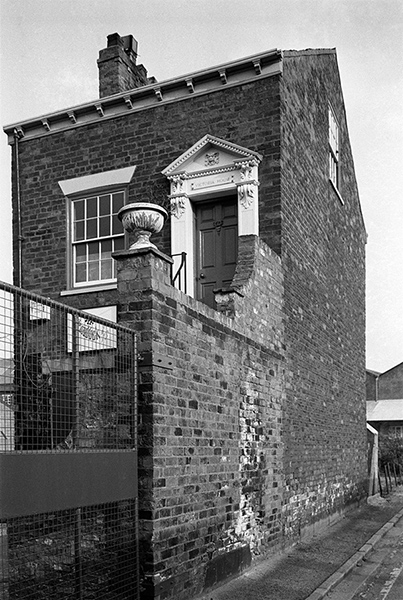

28i31: Victoria House, Cooper St, 1981 – River Hull


You can see the new pictures added each day at Hull Photos, and I post them with the short comments above on Facebook.
Comments and corrections to captions are welcome here or on Facebook.

Continue reading Hull Photos: 26/1/17-1/2/17
Jan 2017

A combination of minor ailments, bad weather and other commitments meant that I was able to complete uploading January’s stories and pictures to My London Diary earlier today, 1 February, something of a record. I’d hoped to get it finished yesterday, but had to work on other things. Until the last few days, January had been a relatively quiet month, and I’ve not been able to cover the recent anti-Trump protests for various reasons. My work hasn’t been helped by a hike in rail fares to get to London, some of my journeys now costing around 30% more than they did in 2016.

I’ve written before that I’ve been trying to cut down the work I’m doing on My London Diary and spend more time on other things, one of which is Hull, currently enjoying its year in the spotlight as 2017 UK Culture. As well as publishing work from the 1910s and 80s over the year on my new Hull Photos web site, I’m also hoping to carry out a new project in Hull, as well as visiting for talks and possibly workshops etc. Meanwhile I’m also working on a new website on my old work in London, hoping to launch something on the first 10 years later in the year.

The biggest event of the month for me was the protest by the UVW and friends at Harrods. People often tell me that it isn’t worth protesting, but this tells a very different story, with the protest hitting the national news before it even happened and Harrods being shamed into giving the staff the money their customers assumed the staff would get. It’s only one of many protests I’ve photographed that have had a successful conclusion, and many others have succeeded in getting attention to issues that otherwise would never have been covered by the national media or discussed in homes, workplaces and parliament, putting issues on our national agenda. Protests don’t always work, but they often do – and not protesting never has any chance of effecting change.

Jan 2017

End Japanese dolphin slaughter


Save our NHS from STP Cuts
Ban HP from BETT show


King’s College cleaners strike
Nelson Walk
Justice for international students
March against closing community centres
Oh! Mother march against knife crime


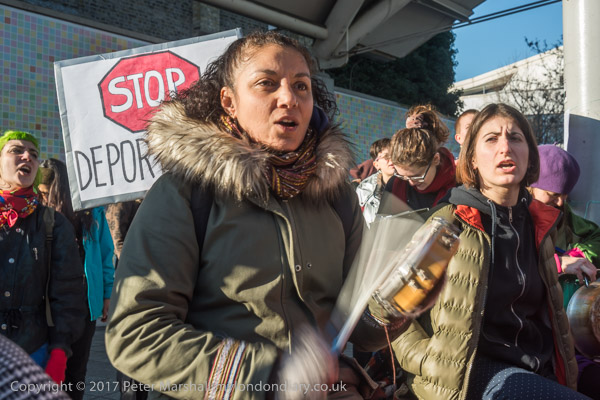
Peckham march against deportations
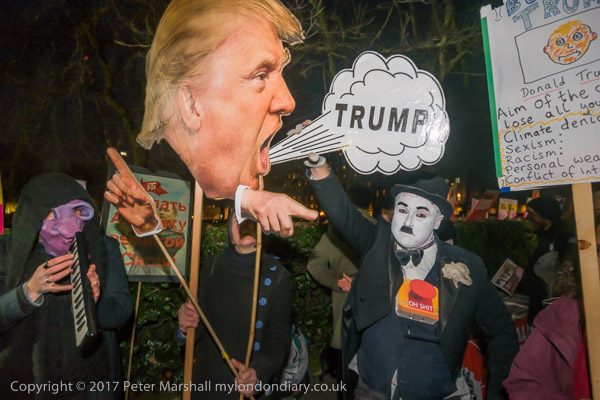
F**k Trump


Crowds protest Trump’s Inauguration


Brixton march against mass deportations
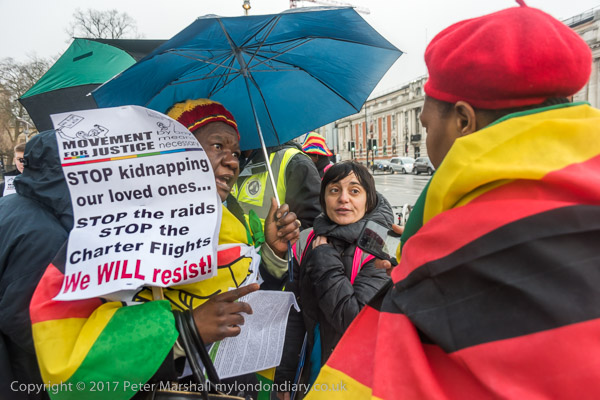
End Deportation Charter Flights to Nigeria
15 Years of Guantanamo – No Joke!
Alarm Bells for the Housing Crisis


Harrods stop stealing waiters’ tips
Save the Sunderbans Global Protest

London Images

Continue reading Jan 2017

Yet more May Day!

And then I changed my mind” was the sentence I left off my previous piece on May Day 2016 (and have now added). It was May Day, and though I was tired and hungry I knew that things were going to get interesting.

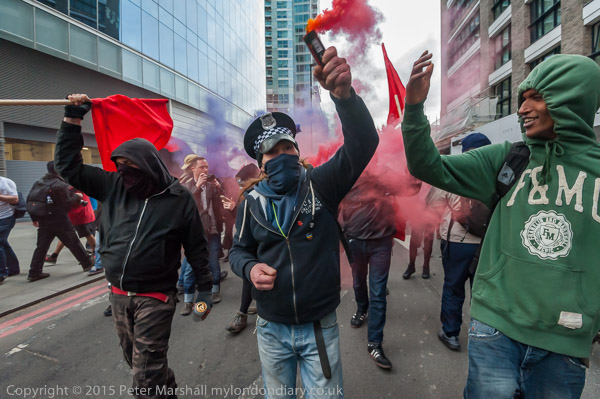
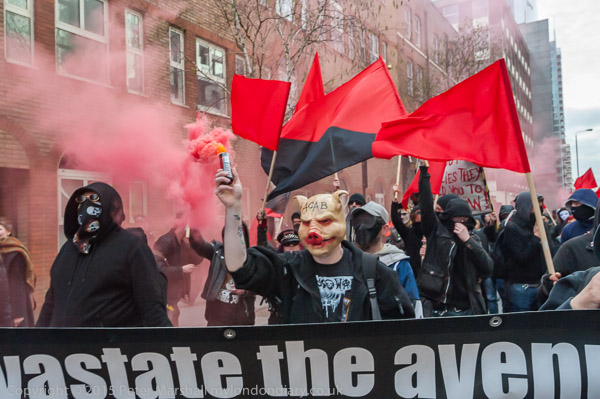
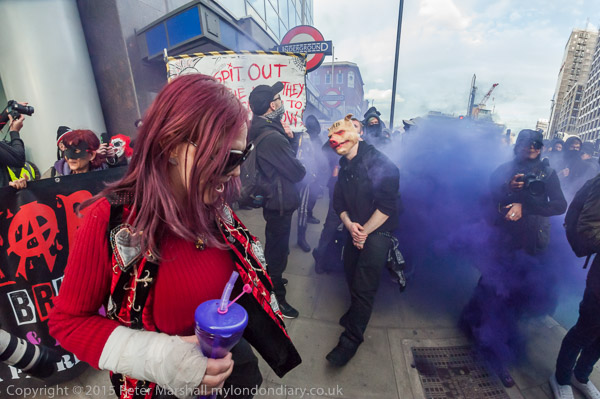
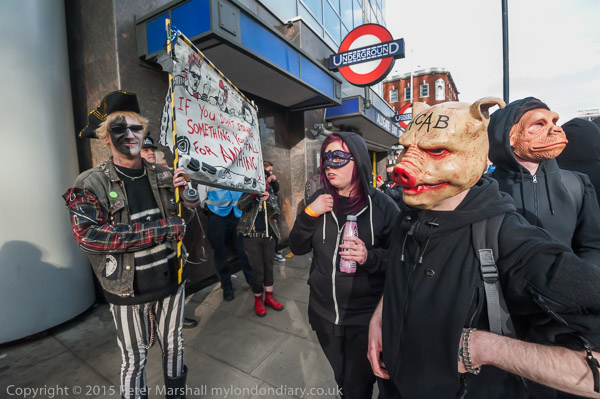
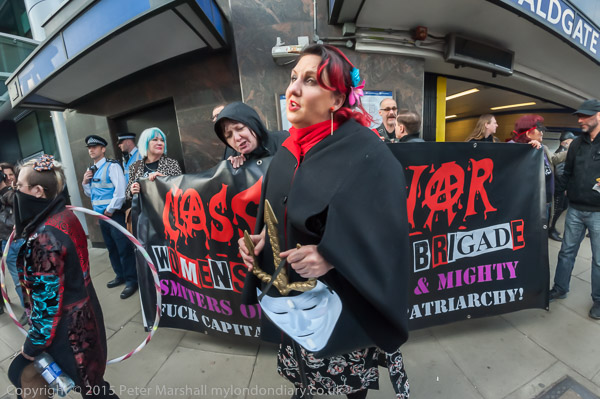
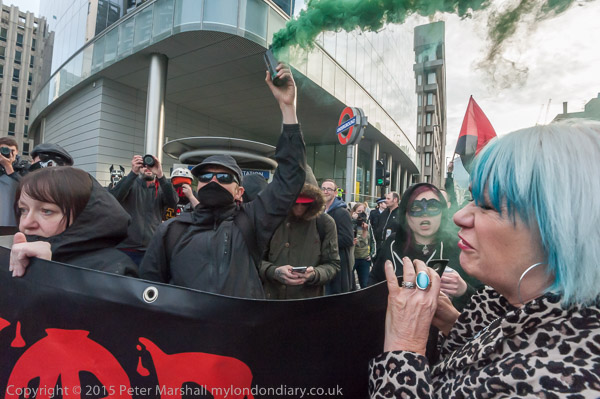
The party, F**k Parade 4, sound system at eleven and coloured smoke flaring, set off down Leman St, led by the Class War banner with a man wearing a pigs head and with me hurrying backwards in front.

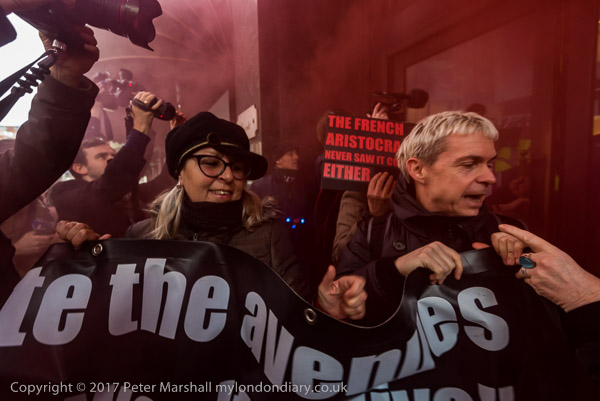
After going under the railway bridge they turned left into Cable St and massed outside the Jack the Ripper premises, perhaps London’s sleaziest tourist attraction, where I’d previously photographed Class War and feminist groups at several protests and vigils. A line of police guarding its front looked quite worried as Class War brought their banner to stand in front of them, but soon the air was too full of red smoke to see much, and I was finding breathing unpleasant.

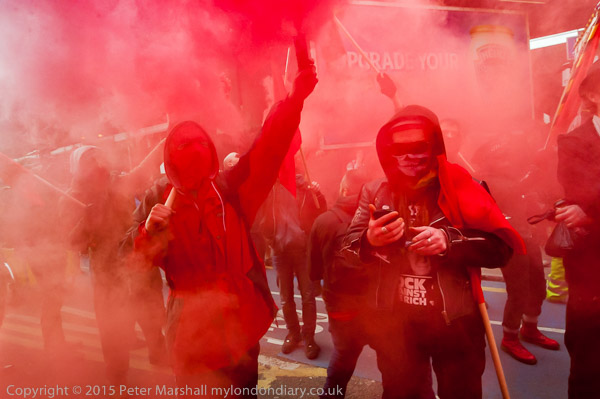
You need to be a little distance away from the smoke both to breathe well and to get good images. When you are actually in it things get difficult to see and the camera metering becomes unreliable. Fortunately the marchers soon moved off, and it became clear they were heading for Tower Bridge.

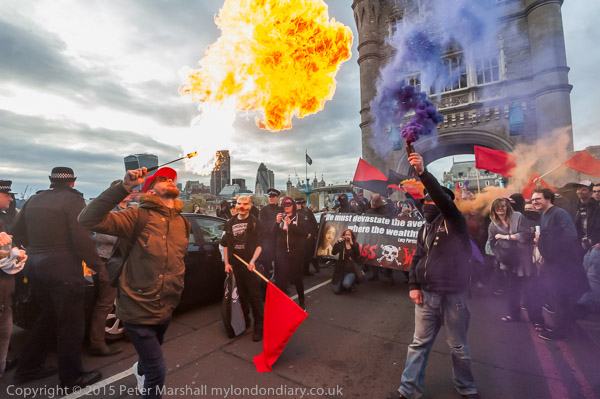
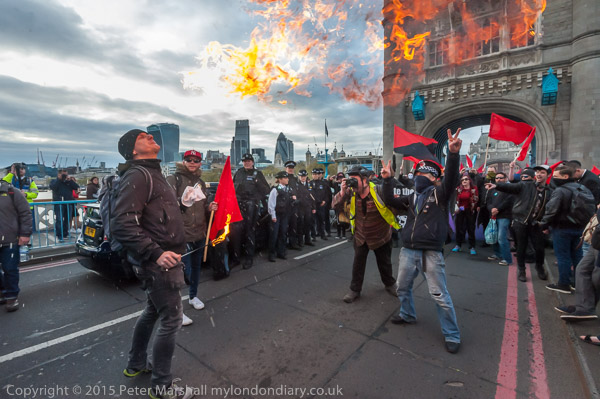
And I wasn’t disappointed as having blocked the bridge there were then more flares and also fire-breathing.

It’s technically pretty impossible to get good pictures when a huge cloud of fire explodes into the air, the extreme brightness of the flame compared with the ambient light is beyond the capabilities of film or sensor. And it certainly is more than the automatic exposure can do to get the best balance. Parts of the flame are white, burnt out where the light intensity has overexposed the sensor, with no detail that can be recovered in post-processing.

I think I should have taken the pictures here using manual exposure, but I actually made them using ‘P’ setting, as things were just happening too fast to think much about the technical stuff.  The camera – D700 – has underexposed by around a stop so far as the general scene is concerned, plus the 0.3 stops under I normally have set. Working around dusk at ISO 3200 this gave an exposure of 1/500th f11, enough to more or less stop action and give plenty of depth of field. Ideally I think I should have underexposed perhaps another stop or two, perhaps using the same aperture and speed but working at a lower ISO. This would have given me a little more highlight detail and made post-processing easier – considerable work was needed on these pictures.

I don’t think the metering really reacted much to the fire, as the exposure remained pretty much the same across a series of frames with different amounts of flame. In the second image you can see (at least on a larger image) the rain of drops of unburnt paraffin which was falling on me.

After the marchers left the bridge I followed them on to Tooley St before deciding the time had come when I could no longer ignore the messages of my body, and I left to go home. I was sorry to do so, as I guessed from previous conversations that they would be heading towards the long tunnel that takes Bermondsey St under the railway lines from London Bridge, where both the sound and the visual effect would be great.

F**k Parade 4: Ripper & Tower Bridge

Continue reading Yet more May Day!

Fuji blues – and greens

I’ve been using Fuji-X cameras for some years when I want something a little lighter and more compact than the Nikon DSLRs. They are usually the cameras I turn to when I’m not photographing events and don’t need the file size of the D810. The cameras I take on holiday.

But though I like some things about them, and have got some decent results, I also have some reservations. They are just too complicated and the controls and menu system lacks the simple and logical pattern of the Nikons. And there are too many ways in which they are just not so responsive and so reliable.

I can leave a Nikon switched on all day, safe knowing that the battery won’t run down and the camera will respond at the slightest touch of the shutter release. With all the Fujis, even if you switch off the rear screen and digital viewfinder, and don’t make any exposures, the battery still runs down. It’s kind of the worst of both worlds in that it Fuji cameras have an auto switch off that you can set, which does switch the battery off after the set time, but fails to stop the battery running down. When you want to take the next picture, even if the battery is still in juice, you have to wait a second or two while the camera starts up – and while you miss the pictures.

With the first Fuji I bought, the fixed lens X100,  things sometimes got even worse and the camera refused to switch on, either until you took the battery out and back again or pressed the shutter for ages, turned around three times widdershins and said the magic word. At least later models more or less fixed that, but still too often meant that when you pressed the release nothing at all happened.

Then there is the colour. Most digital cameras I think have problems with intense reds, losing the highlights, but Fuji has its problems with greens as well – unless you like your grass super-emerald rather than au naturel. And my XT1 has another problem – which needs extra work on the raw files – in that some Fuji lenses give results that are far too magenta, typically needed a correction of perhaps -35M in Lightroom. It doesn’t seem to be something that every XT1 suffers from, though I have found fellow sufferers, and possibly it could be solved by sending the camera back to Fuji for repair, but it only came to my notice after the guarantee period (when the camera went back to Fuji twice for other issues) was up when I bought another lens.

Then there are the mickey-mouse modes. I’d like to ignore them, but the combined ISO and mode knobs on the XT-1 are tricky to use, and changing ISO all to often puts you into what Fuji laughably call the Advanced Filter mode. The two dials are supposed to move independently – and sometimes they do, but other times both turn together. The resulting images are not nice. Jpegs rather than RAW and with impossible to correct contrast or colour or both. You can’t convert from ‘Dynamic Color’ or any of the others back to sensible colour, though you can just about get a half decent black and white.

It’s a shame because all of the Fuji cameras I’ve bought – X-Pro1, X-E1 as well as those already mentioned  have been almost there. Delightful in many ways, which is perhaps why I’ve several time bought another, but…. I’m even hoping that Fuji have at last got it right in the X-T20, and mug that I am, I’ll probably buy it.

And then there are those X-Trans sensors. It seemed a good idea to get away from the Bayer pattern, but I’ve never been convinced that they really improve things, though Lightroom at least seems now to have learnt how to get usable results after a really shaky start. But if  you still feel they are definitely an improvement (and Fuji cameras seem to have a unique facility to produce fanboys) you should read an article by Jonathan Moore Liles, which I first saw in PetaPixel, but is a little better read on medium com, where the pictures are larger.

Its an article which I think more or less destroys the claims of superiority of the X-trans sensor, which can perhaps at worst be seen as a marketing gimmick and at best simply a different balance between colour and luminance, and one which has some unfortunate side effects. In practical terms these are seldom if ever particularly important, and are often mitigated or eliminated by suitable corrective processing which I tend to apply fairly routinely in Lightroom. There is a tendency in portraits – whether on Nikon or Fuji – for faces to look a little flat that a little brushing with a positive value of ‘Clarity’ can improve, and the whites of the eyes (sclera to use the technical term preferred by Liles) usually benefit from a little more brightness and contrast which I think reduces the colour bleed into them.

Then there is the question of the Raw processing software preferred by Liles:

The RAW file was processed using Darktable’s Markesteijn demosaicking algorithm (3-pass mode) with a single iteration 9×9 chroma median filter followed by application of a bilateral filter on the chroma channel and light sharpening. The color profile is my own, generated from shots of a Wolf Faust IT8 chart and should accurately represent the colors in front of the camera.

Most of us just rely on Lightroom, though Fuji purists stick with the free Silkypix converter that Fuji provides, insisting on its superiority. Like me, unless you are a Linux user you have probably never heard of darktable, but Googling takes me to the site which tells me “darktable is an open source photography workflow application and raw developer. “  There is a MacOS version but not one for Windows, though I wouldn’t be rushing to try it out if there was, and there is a page about its X-Trans support which gives you some idea about that Markesteijn thingy, but includes the statement  “Though darktable now can read and process X-Trans files, there are plenty of opportunities to improve camera support. In particular, as mentioned in “What’s involved with adding support for new cameras“, each camera model could benefit from its own basecurve, white balance presets, lens correction, and noise profile.”

Although I have nothing against open-source software – and there are several programs I use or have used (including before Lightroom got better another RAW converter) – I think the use of it here is a serious weakness in the argument. First it entirely locates the article in the high geek rather than photographic sphere, and secondly it raises doubts about whether this particular software is as effective as that recommended by the manufacturer (and privy to their unreleased data), or to the commercial software such as Lightroom (and Adobe have enjoyed some cooperation from Fuji) and Phase One.

Of course, the debates about X-Trans and Bayer are marginal. Both can produce decent images and the differences between the two will seldom be apparent or important. Photography really isn’t about the minutiae of technical differences, but about what your images speak.

More May Day


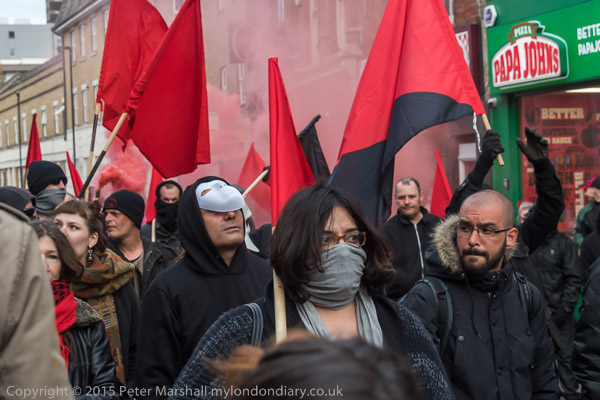
May Day partying outside the ‘Rich Door’ at One Commercial St – F**k Parade 4

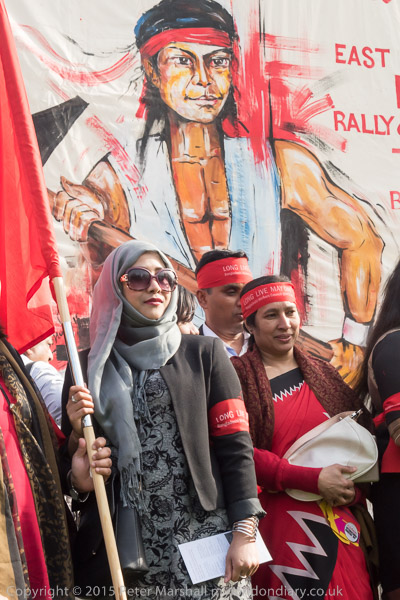
I left while the talking was still going on in Trafalgar Square and the audience was getting thinner and thinner to make my way to the East End. The first event there was a May Day Rally & Gonosangeet organised by the Bangladeshi Workers Council together with Red London, trade unionists, labour movement, political and community activists. I had to leave early while the speeches were still taking place, but I understand there was to be music later.

They did have a rather nice banner, and among the speeches was an interesting historical one by East End activist and historian David Rosenberg of the Jewish Socialist Group, and I think there was to be music later.

But a rather more active event was due to start, with F**k Parade 4, the fourth in a series of anti-capitalist street parties organised by anarchists in East London returning to its origin at One Commercial St, the venue for over 30 protests by Class War against social apartheid in housing, and where last year’s May Day event was the first of this series of roving music and dancing protests.

I met up with a few of them sitting outside a nearby pub, wiaing for the cycle-hauled sound system to arrive, and then walked down with them to ‘Poor Doors’, where the party was already starting to become lively.

Everyone was in party mood, and even the large number of police who were standing around seemed to be enjoying themselves.

Soon the party-goers decided to move off, and with a few smoke flares and lost of red flags the went south.

But I’d been on my feet and taking pictures for too long, and decided it was time to go home. There were plenty of other photographers on hand to take pictures. But then I changed my mind….

Continue reading More May Day

May Day


Media present in force this year as Jeremy Corbyn was speaking at Clerkenwell Green

One of quite a few things that I’ve long held against the Labour Party (despite voting for them in many elections) is their failure when in power to make May Day a public holiday. Instead we have an ‘Early May bank holiday’, which in 2017 will happen to be on May 1st. In 2016 it was on a Sunday, so at least most workers could celebrate it, though the great majority probably followed their usual Sunday routines, more likely to involve collapsing on a sofa with the Sunday papers than going on a political march.


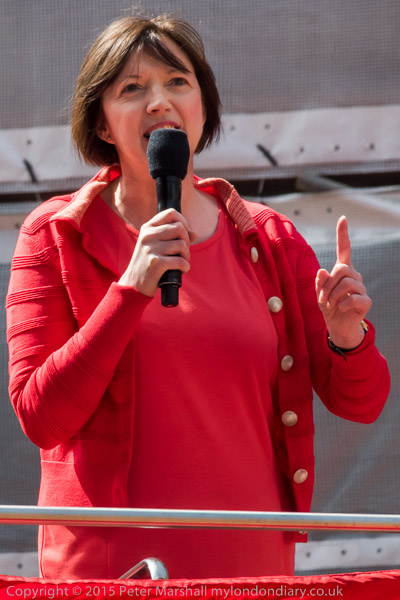
TUC General Secretary Frances O’Grady speaking

The May Day tradition as International Workers’ Day, according to Wikipedia dates from a Second International resolution of 1891 and was strengthened in 1904 by a resolution calling for energetic demonstrations for the eight hour day, class demands and universal peace, with workers stopping work wherever it was possible without injury to them. Unfortunately when I was still in full-time paid employment, work continued except on those days when May Day fell at a weekend. According to the organisers of the London march, it has been celebrated in London since the 1880s.


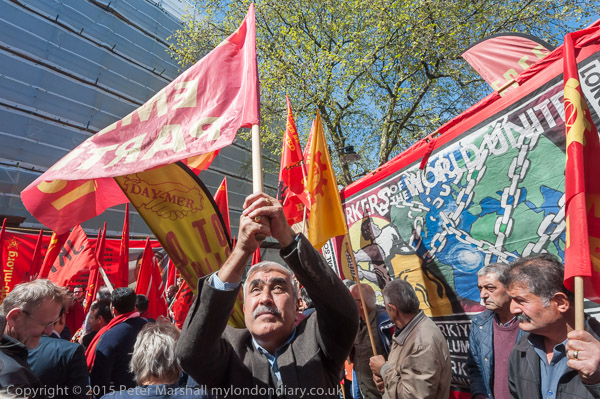
Daymer Turkish and Kurdish Community Assocation

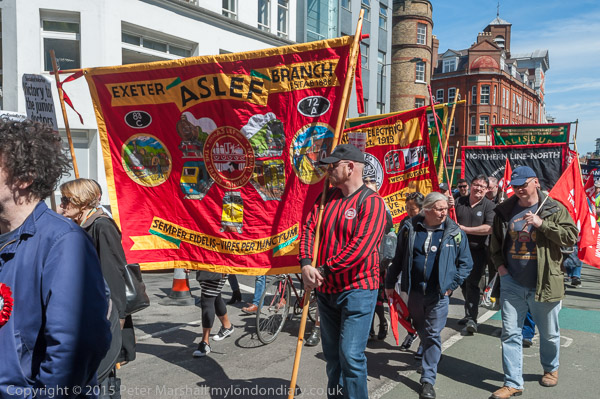
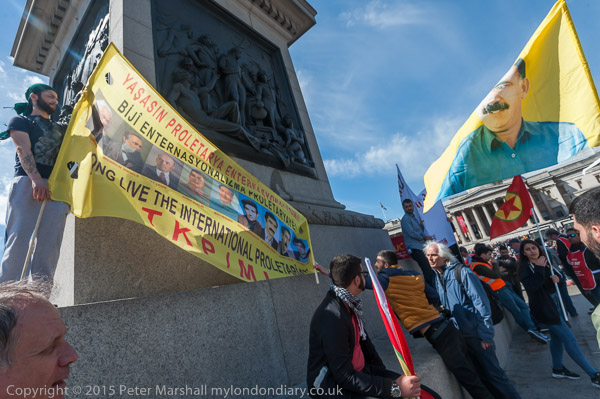
May Day in London, though supported by the trade unions, has been largely kept alive by organisations of immigrant workers, particularly from London’s Turkish and Kurdish communities along more recently with the more sporadic activities of various anti-capitalist groups.

If I could be bothered I would try to correct the Wikipedia article which states “May Day activities (from 1978) are on the first Monday of the month.” In general nothing much happens then – and the May Day events in London that it mentions took place on 1 May 2000 – which happened to be a Monday so was also a bank holiday, and I was there when the windows were smashed at McDonald’s, leaving as I saw the riot police rushing in. Now I would stay to take more pictures, but then for various reasons I was less willing to take risks and left as I saw the glass being broken and riot police rushing in.

The march from Clerkenwell Green, organised by the London May Day Organising Committee, is officially supported by a wide range of organisations – listed in 2010 as :

GLATUC, S&ERTUC, UNITE London & Eastern Region, CWU London Region, PCS London & South East Region, ASLEF, RMT, MU London, FBU London & Southern Regions, GMB London & Southern Regions, UNISON Greater London Region, Globalise Resistance, Pensioners organisations and organisations representing Turkish, Kurdish, Chilean, Colombian, Peruvian, West Indian, Sri Lankan, Cypriot, Tamil, Iraqi, Iranian, Irish and Nigerian migrant workers & communities, plus many other trade union & community organisations.


More people climb on to the plinth with their banners. They think the steward is unhinged and unfraternal and tell him so in several languages

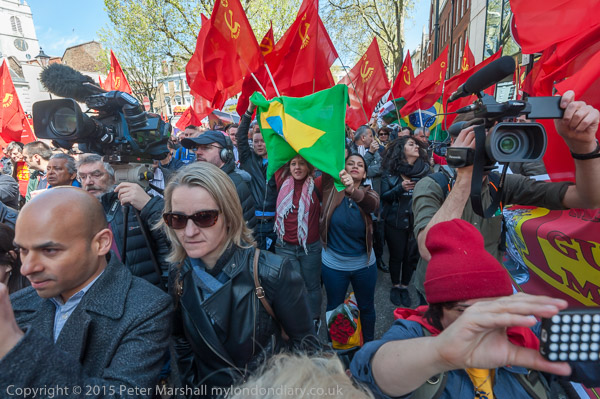
The arrival of the march in Trafalgar Square led to a fight between stewards, photographers and the more militant marchers to try and keep the plinth around Nelson’s column clear. I wasn’t happy about being told I couldn’t photograph from there and by the total lack of fraternal solidarity shown by the stewards to their fellow trade unionists trying to do their job.

The march is followed by a rally in Trafalgar Square, which those various trade union organisations seem determined to keep as dull as possible. Most of the community groups soon drift away, and are followed by most trade unionists who are feeling thirsty after the march.

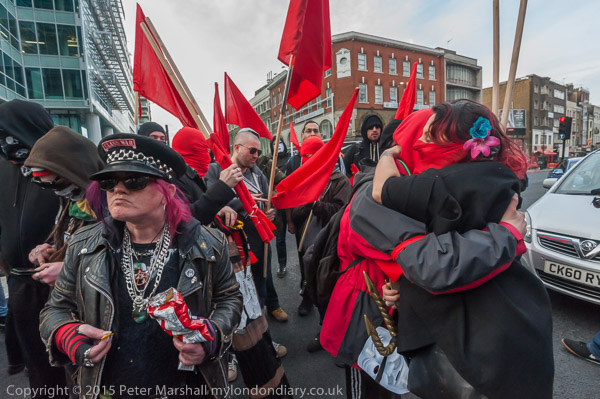
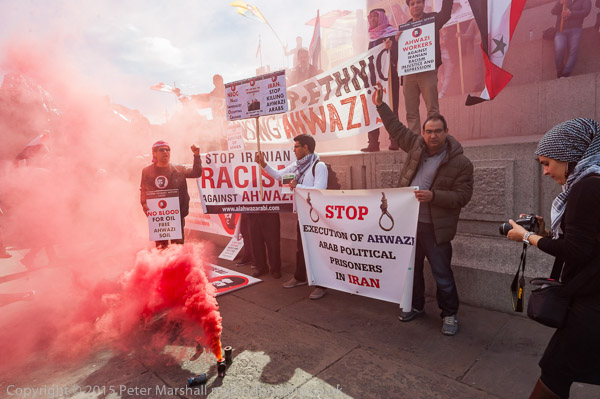
Fortunately the start of the event was enlivened a little by members of various communities taking little notice of the stewards, and in particular by the arrival of Ahwazi protesters who set off a number of smoke flares, as had some of the Turkish protesters when they entered the square.

Many more pictures and some text at:

May Day at Clerkenwell Green
May Day March
May Day Rally
Ahwazi Protest at May Day Rally

Continue reading May Day

Grove Hardy

I’ve just come across an article about what used to be one of the leading professional darkrooms in London, and one where one of my friends, the late Townly Cooke, once worked as a printer. One of the more interesting exhibition visits I made was to a Magnum show, I think on the South Bank, some years ago with Townly, where he talked about some of the images which he had worked with, although I think the prints in the show were not up to his and Grove-Hardy’s standards.

Grove Hardy ~ Requiem for a Lab is on the unattributed Darkside blog – I’m unsure whether the author wishes to remain anonymous or has simply forgotten to add his name, so I won’t name him either. After Bert Hardy, who had set up the lab with printer Gerry Grove in the 50’s, died in 1995, his wife Sheila continued to run it, renaming it ‘The Bert Hardy Darkroom’, and it finally closed in 2007 after the retirement of the last remaining printer – there simply was not enough work to keep it running.

The darkroom perhaps doesn’t live up to what many might expect of a professional darkroom, and certainly not like some of those that have appeared in books which have looked at photographers and their darkrooms, though it is in most respects a little more well equipped than my own black hole. But its enlargers are a little more primitive than mine, and unable to make sensible use of Multigrade papers, so all its prints were to the end made on graded papers. The writer comments that by “the 2000’s Grove Hardy were probably the only lab in London still using graded paper, and Ilford were making it primarily for them and a handful of other labs worldwide.”

The darkroom was just off the Blackfriars Rd in Southwark, a short walk from where Bert Hardy grew up, and close to another site many photographers knew well some years ago, the Valentine Place premises where Martin Reed set up photographic suppliers Silverprint. Reed sold the company a few years ago, and Silverprint has now moved out of London, but still supplies hard to find photographic materials (like film and silver-based papers) and equipment at new address in Poole, Dorset or by mail order.

Hull Photos: 19/1/17-25/1/17
19 January 2017
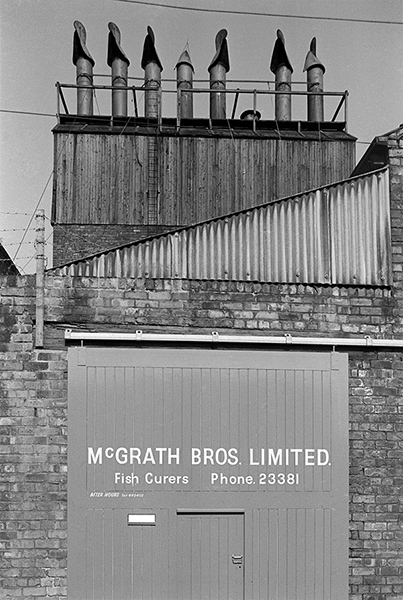
Although Hull’s fishing industry had been reduced greatly with the cod wars, in the 1990s Hull remained an important fish marketing centre with two thirds of UK imports of fresh Icelandic fish being handled by the daily fish auction at Albert Dock. In the mid-1990s the Hull Fish Merchants Protection Association stated that “over half the capacity of the UK (fish) processing industry is sited on the banks of the Humber Estuary. Over 80% of all imported supplies of fish comes into the Humber ports.” In 2011 the Hull Daily Mail reported the end of fish auctions in Hull as main Icelandic supplier Atlantic Fresh Ltd switched to Grimsby.


28h24: McGrath Bros, Fish Curers, St Mark’s Sq, St James Street, 1981 – North & West Hull – Hessle Rd

20 January 2017
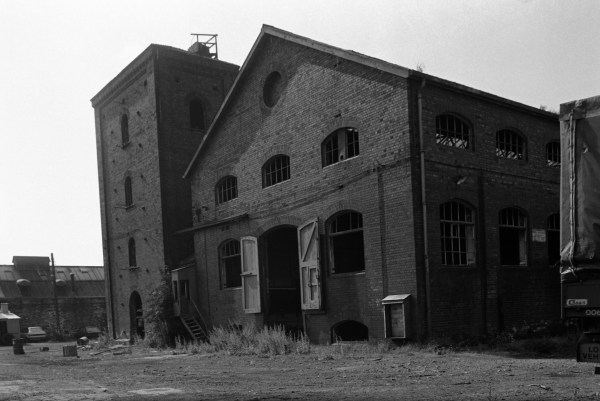
This was taken between two frames, one showing a view south on Alfred St around a hundred yards south of its junction with English St and the next a development site on the north-east corner of the Alfred St / English St crossroads. The sun was coming from the southwest, so this building was facing roughly south. But I m not sure of the exact location.

It is quite a distinctive building with its four storey tower, and doubtless some people in Hull will recognise it, but this is the first time I have shown this picture. The parked cars and lorry at right suggest the site was still in use. I’m not sure why I took the image slightly tilted, but it must have been intentional, perhaps intended to add to the feeling of dereliction and I haven’t corrected it.


28h32: Derelict building, Alfred St or English St, 1981 – North & West Hull – Hessle Rd

21 January 2017

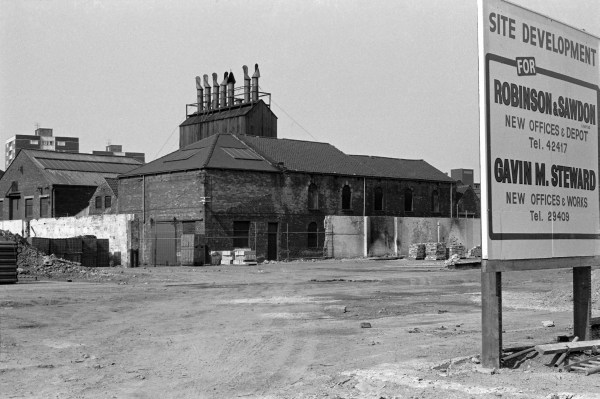
A site on the the north-east corner of the Alfred St / English St crossroads, cleared for the building of Alexandra House, offices for Hull Building firm Robinson & Sawdon (now occupied by The Water Hydraulics Co.)

The buildings behind are around At Mark’s Square and include the distinctive chimneys of McGrath Bros’ fish smoke house, and further distant, council flats on Porter St, across Hessle Rd.


28h32: Building site, Alfred St / English St, 1981 – North & West Hull – Hessle Rd

22 January 2017

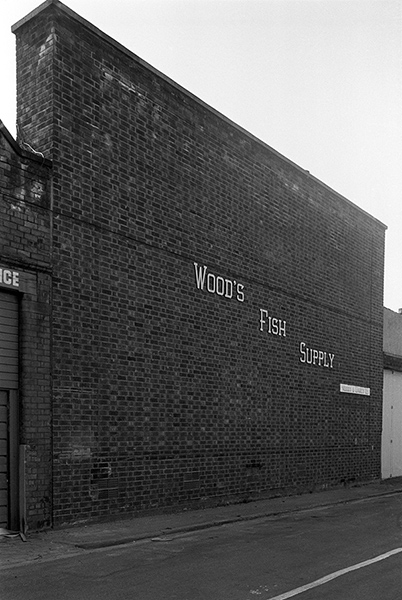
Local fresh fish merchant Wood’s Fish Supply was one of many companies buying fish from the Hull Fish Market. The wall is still there, though with a small window in its impressive mass and the site is occupied by UK Auto Service. The wall is almost ten feet taller than the building behind it and is a couple of feet thick – though perhaps hollow.

A comment on Facebook suggests it may have been built this thick to support large steel beams spanning a large hall behind – but the only rational explanation for its excessive height seems to be that the building was expected to have another floor. The premises were also home to a second wholesale fish company, Moody & D’Arcy Ltd, whose name is on the board at the right of picture. This company, formed in 1948, was dissolved in 2002.


28h35: Wood’s Fish Supply, 54 Alfred St, 1981 – North & West Hull – Hessle Rd

23 January 2017

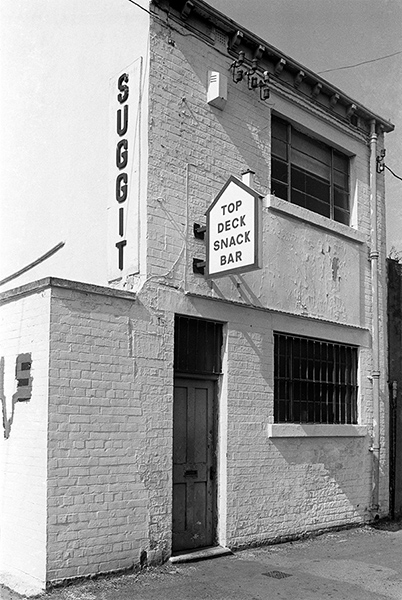
The Top Deck Snack Bar, now renamed the Top Deck Cafe is still there at 140 or 142 English St, on the north side between ALfred St and Ropery St, looking overall very similar now to 1981, with the addition of metal blinds over the door and ground floor window, the replacement of the door and its 1930s style glazed windows and different signage. It looks rather more open and welcoming now, whereas before it had the air of a place where only regulars would venture. The side wall now has its brickwork exposed and has lost the sign for ‘Suggit’ – (H V Suggit, Poultry Packers and Frozen Foods) – and also lower down the rather crudely painted logo for HVS only part visible in this frame.) But without the snack bar sign, a house with a chimney, I would almost certainly not have stopped to take the picture.

Suggit’s site is now a car repair business, the Engine and Gearbox Centre.


28h44: Top Deck Snack Bar, English St, 1981 – North & West Hull – Hessle Rd

24 January 2017

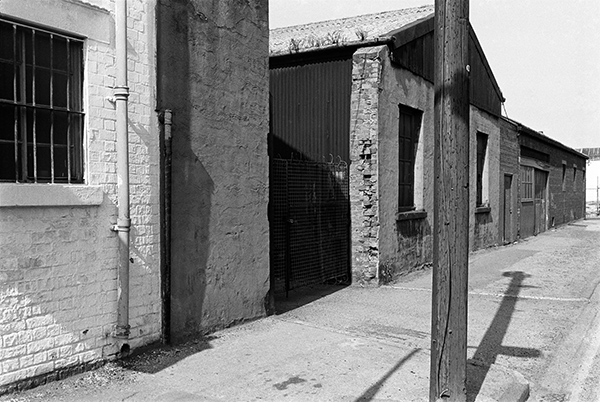
This is the image that we chose for the poster of my 1983 show at the Ferens Art Gallery, ‘Still Occupied – A view of Hull‘ though I’m not entirely sure why. Certainly it was a more ‘arty’ image than many in the show, playing a little with formal qualities, rhythm, punctuation and texture, and I wanted an image that was clearly ‘vernacular’ and not pictureque, classical rather than romantic.

The scene is still readily identifiable on Street View. The window at left is in the Top Deck Snack Bar featured in yesterday’s image and there is still a wooden pole (though probably a replacement) in the same place on the pavement. Most of the next section of wall has gone, replaced by a wider blue painted metal gate, and those two window recesses I carefully placed on either side of the post have been filled in, their positions still marked by a groove or crack around them. The roof has been renewed and its front replaced; Google, not always reliable in such things, tells me this is the Tom Thumb Industrial Estate. The next section of buildings has also had its frontage rebuilt, but the final group of three window recesses remains.

Street View doesn’t let me manoeuvre myself into quite the position I stood in the road to produce this image, and certainly doesn’t let me reproduce the glancing lighting that produced the textures and shadows from 1981, and the tension and atmosphere I felt then have disappeared completely.


28h46: English St, 1981 – North & West Hull – Hessle Rd

25 January 2017

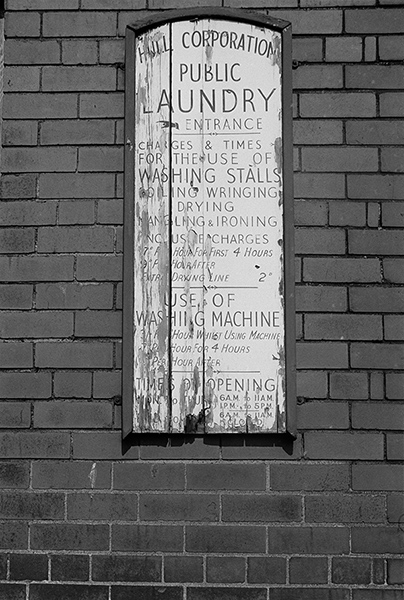
Hessle Rd Public Wash House was opened in 1885, though rebuilt and added to at later dates. It was part of a public baths complex between Madeley St and Daltry Street, where Clive Sullivan Way now turns off from Hessle Rd. As well as swimming baths and slipper baths there were laundry facilities and I photographed the notice on the outside of the Public Wash House, by then closed and boarded up.


28h52: Hessle Rd Public Wash House, 1981 – North & West Hull – Hessle Rd


You can see the new pictures added each day at Hull Photos, and I post them with the short comments above on Facebook.
Comments and corrections to captions are welcome here or on Facebook.
Continue reading Hull Photos: 19/1/17-25/1/17