Hull at Night

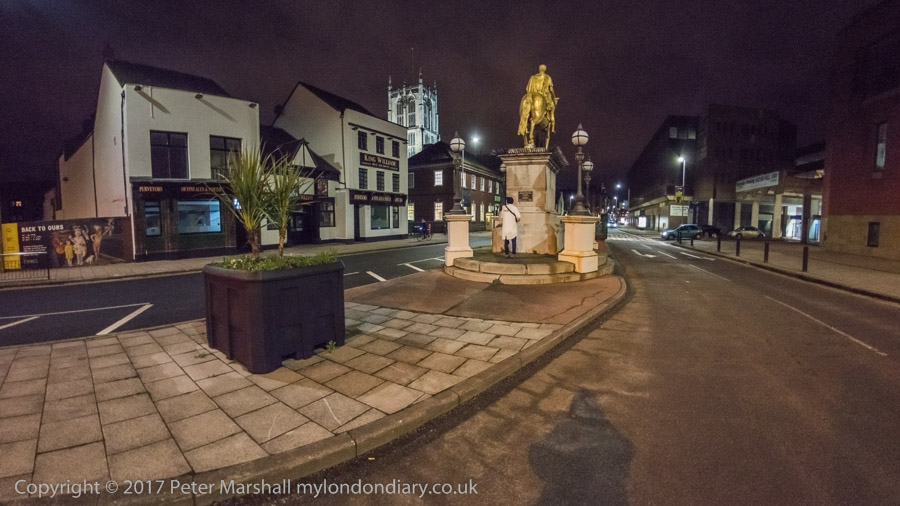
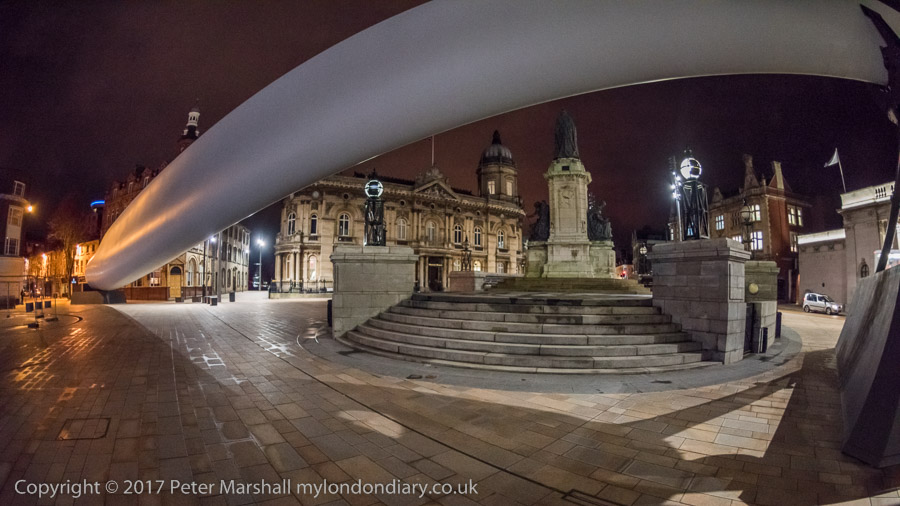
Most nights Hull goes home early, and much of the centre seems deserted. Presumably at closing time people stagger out of the pubs, but until then the streets are eerily empty. Certainly on a Thursday evening when I was taking these pictures, though things liven up a little at the weekend.

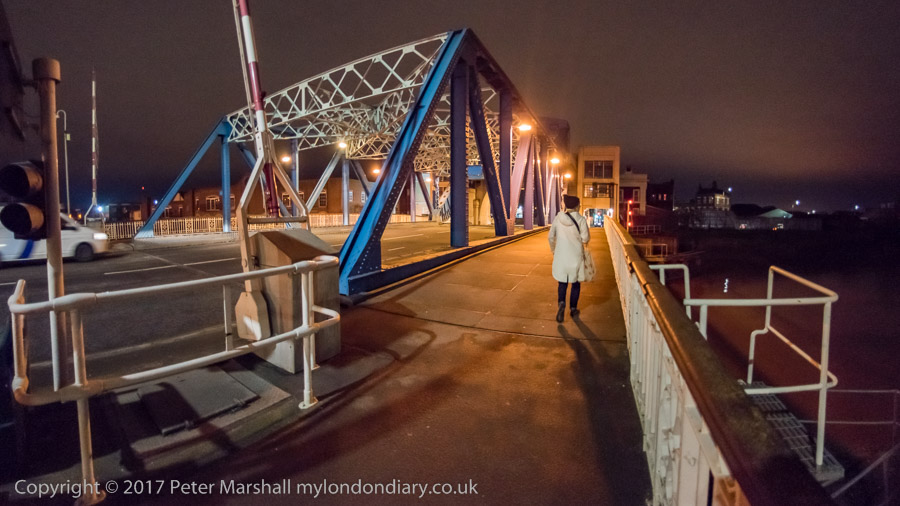
There is one car in my picture of North Bridge, though I think about the only one we saw as we crossed it, and that solitary figure appears in several of my pictures as she was walking around with me.

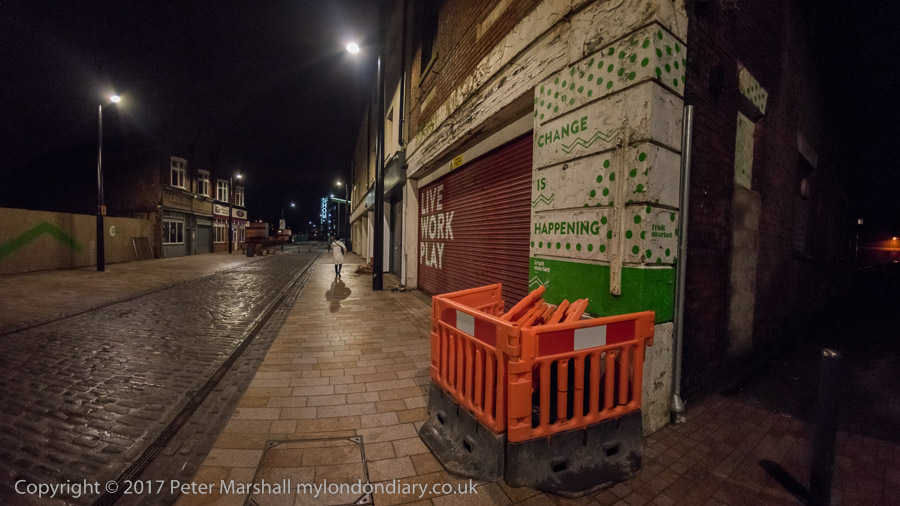
You can see her again in Humber St, the centre of Hull’s ‘Fruitmarket’ area, which no longer sells fruit but is touted as “Hull’s modern, vibrant & unique cultural quarter, open all day every day“. It may be open all day, but it was pretty deserted at night in February.

You can see her too reading the plaque under King Billy. And in the background there is a single cyclist and just a few distant cars. The square in front of Holy Trinity was deserted (though there was a regiment of orange barriers) as was Prince St and Posterngate, and it was only as we came to Trinity House Lane that we saw the first pedestrian, scurrying quickly away.

Whitefriargate was empty too, with just one or two people around Monument Bridge, and I didn’t have to wait to get pictures of Queen Victoria Square without people – I didn’t particularly want to have the square empty, but it was, apart from some large object that had been left across it.

This wasn’t taken in the early hours of the morning – when I was fast asleep in bed. This was early evening, around 7pm. Where was everybody? You can see a few more pictures from this walk, and see these larger – at Night in the Old Town, though you won’t find many more people.

Obviously, these are panoramic images, though the format isn’t extreme, quite a good fit to my wide-screen monitor with just a small empty strip at top and bottom. I don’t much like extreme panoramic formats, though I do like panoramic images. These use the same cylindrical perspective that I’ve used since I bought my first swing-lens camera in 1990 – an expensive Japanese model.  And although I’ve admired some of the more extreme angles of view used in some images, I’ve seldom wanted to use them myself. These pictures have a horizontal angle of view of around 145 degrees, a little greater than my old Widelux.

Despite being taken at night, I didn’t use a tripod – all are handheld. Tripods are quite useful with panoramas; you need them not to hold the camera steady, but to hold it absolutely level. Even small deviations can make some images unusable. But I’m an impatient man and like to keep things as simple as possible, concentrating on the image rather than technicalities. So though I own several tripods of widely varying size and utility I seldom disturb the dust on them; worthwhile tripods are always too heavy to carry.

A tripod would have enabled me to use a lower ISO and reduce the noise in the images, but I quite like a bit of noise in night pictures, it adds to the mood.

Continue reading Hull at Night

Hull Photos: 1/9/17 – 7/9/17

Pictures added to my Hull Photos site from 1st -7th September as a part of my ‘picture a day’ project for #Hull2017, Hull’s year as UK City of Culture. Clicking on any image will open the page on Hull Photos where the picture is shown larger. You can follow my daily image posts on Facebook or on Hull Photos. Comments are welcome here or on Facebook.

1st September 2017

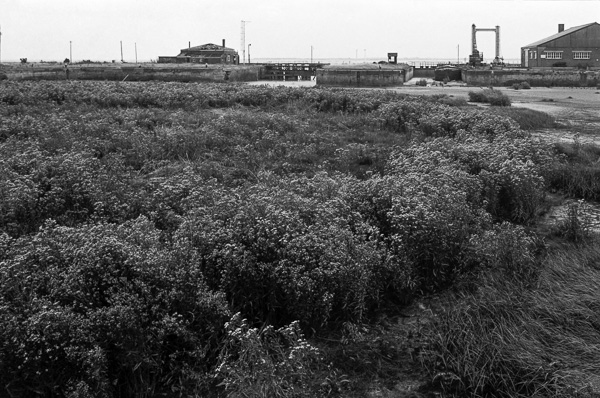
It’s hard to see now exactly the location of this picture, which on my contact sheet it labelled Foredyke Path, thought it should be simple given that there are three bridges shown.

I think the framing arch is a bridge under the disused Hull to Hornsea line, the distant bridge and embankment are the Hull Docks line, still in use, but can’t work out why there is a footbridge, apparently on the line of the path, which I think followed the Foredyke Stream drainage ditch, culverted a few years earlier and now part of the Hornsea Cycle Route which forks off around here. Other rail lines in the area were the branch to Withernsea and some sidings to mills which ended close to Cleveland St.
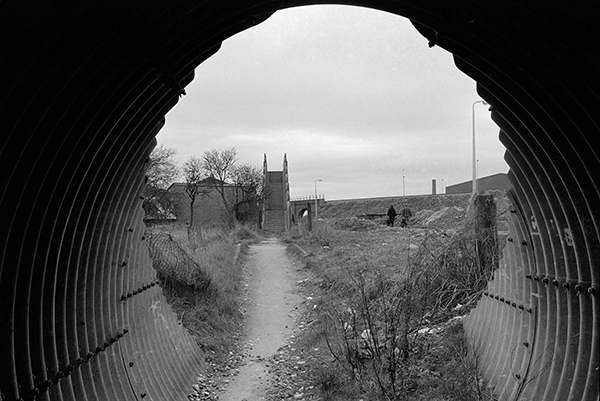

84-4d-12: Foredyke Path and railway bridges, 1984 – East Hull

2nd September 2017

Another visit to Queen’s Terrace in 1984. Number 1 and 3 Queen’s terrace still appear possibly to be occupied, though the off-licence had I think closed for good, and the sheet of ply lying across the doorway at right suggests this was no longer in use.

This was one of many small shops which had served what had been a densely occupied area of working class housing. Some of the area had been cleared following war-time bombing but much still remained until the council demolitions. There are still some shops on the opposite side of Sculcoates Lane, but others have been converted to private houses.
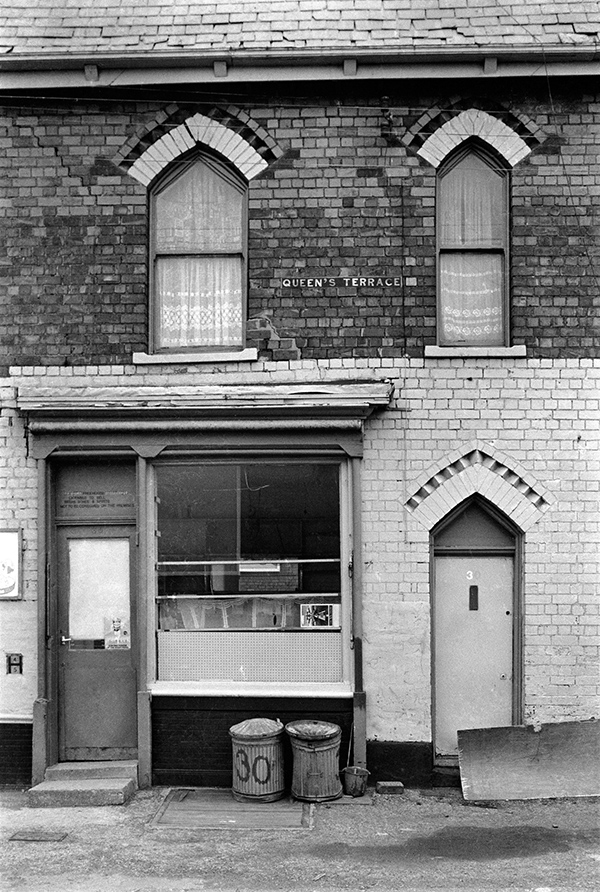

84-4d-65: Queen’s Terrace, Sculcoates Lane, 1984 – Beverley Rd

3rd September 2017

Another view of what I think from the brickwork is probably again Queen’s Terrace, but possibly another street in the same area, awaiting demolition in April 1984. One house appears still occupied, with net curtains at its windows while the rest of the terrace has doors and windows blocked with corrugated iron to prevent squatting. The one remaining door has the number 1 on it, but may have lost another digit.

Looking at existing terrace rows in the area and elsewhere in Hull you can see the various different treatments of the brickwork which mark the different streets or parts of streets. The arch above each of these doors and windows required ore than 20 bricks to be cut to shape and the windows needed specially shaped glass panes, all of which must have added considerably to the labour of construction. This part of the street appears to have been re-roofed and I suspect would originally have been slate.
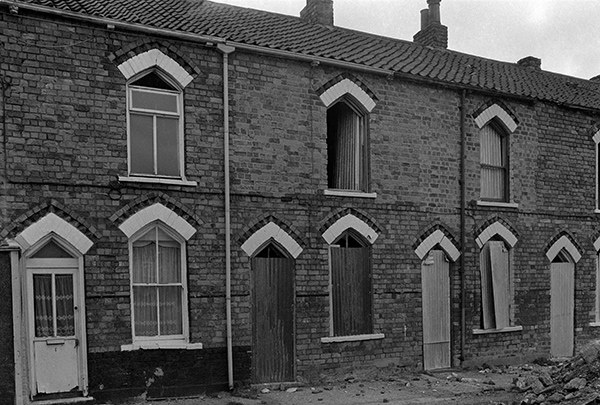

84-4d-63: Queen’s Terrace, Sculcoates Lane, 1984 – Beverley Rd

4th September 2017

There are still some pipes which cross Wincolmlee a few yards north of where I took this picture but this section of the wall and the bridge across from Holmes Halls Tanners to their wharf, as well as their buildings on the right have gone, replaced by some parking space and featureless modern sheds or cladding on older buildings and a used car sales yard. But the building with the chimney and much of its wall is still there, as this is the former Sculcoates Goods Station, also Grade II listed.

Further in the distance the listed Wilmington Swing Railway bridge survives, and now in rather better condition. Rix’s oil tanks have grown and what was then Pauls Agricultural Products silo – now Maizecor – on Wincolmlee is still visible.
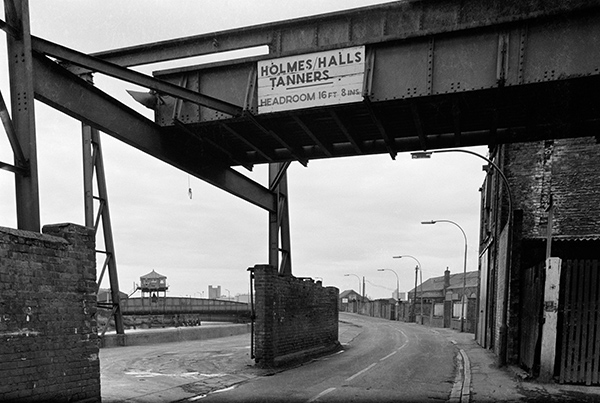

84-4d-66: Holmes Halls Tanners and River Hull, Wincolmlee, 1984 – River Hull

5th September 2017

In my book ‘Still Occupied’ this was wrongly identified as Morley St, but it is actually Glass House Row, further south off Cleveland St. The buildings on the right side of the street can still be identified, and closer inspection shows that some of the windows have been altered from their position when I took the picture. The industrial structure and the large building at the end of the street are now longer there, but the more distant buildings are still recognisable, as the large block next to the Bankside Cafe at 330-338 Wincolmlee.

According to the informative Wikipedia article on Wilmington, Glass House Row was named for the short-lived Hull Glass Company, set up in 1846 but which had failed by 1850. Later on the street were the Anglo-American mill (1879-80) and the Bon Accord Mill (1895), both apparently oil mills set up by brothers John and James Stephenson which later become part of BOCMM, who stopped milling at both in 1929-30, though Bon Accord went back into service for a couple of wartime years, ending in 1942.
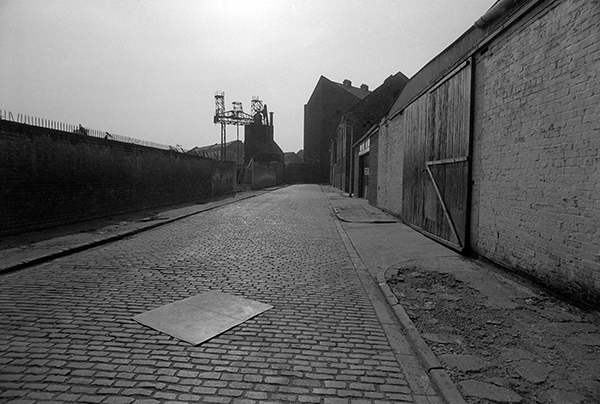

84-4e-03: Glass House Row, 1984 – River Hull

6th September 2017

Teal & Mackrill Ltd are still in business on Lockwood Street, famed for their specialist marine grade varnishes, topcoats, undercoats, primers, anti-fouling and bilge paint. The company was established by Arthur Teal and Mr Harold Mackrill in 1908 and became a limited company in 1913. Still an independent family run company it has around 75 employees and makes around 1.5 million litres of paint a year, mainly for marine and agricultural use, including many specialist paints.

Paint manufacture was a major industry in Hull, with some major brands having factories close to the River Hull, though I think all have now moved away or gone out of business, while this specialist firm remains.

Both the paint on the nameboard and on the side of the building at right seems not to be the best advertisement for their products. Only the taller building at extreme left remains, the rest of the building having been replaced with a doubtless more practical but rather blank metal-clad large shed, its blue paintwork in excellent condition.

Somewhere on the buildings – I’ve only seen pictures – is a large mural originally commissioned for the 1949 Hull Industrial and Trades Exhibition by Patricia Mackrill who had just graduated from Manchester Art School, which was displayed in Hull City Hall.
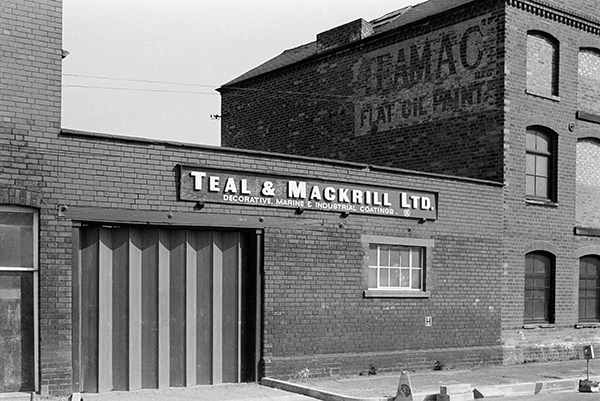

84-4e-13: Teal & Mackrill Ltd, Lockwood St, 1984 – River Hull
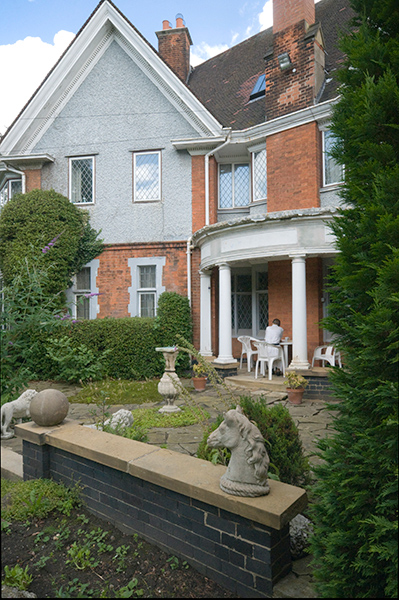

The loggia at the rear of West Garth, Newland Park, Hull

One of my late friends in Hull was a member of the Mackrill family, though I think with no involvement in the paint business. I knew Ian first in London, where after a legal career he became a psychotherapist but late in his life he bought another home in Newland Park, Hull and after a few years moved back into a large house there, West Garth, where he had lived for some years as a child. One of the finer examples of Arts & Crafts houses in Hull, he was unfortunately unsuccessful in getting it listed despite carrying out considerable work to restore it to its original state. It does get a brief mention in Pevsner’s volume on Hull. I and more often my wife stayed with him there on a number of visits to Hull in the 2000s.

7th September 2017

Extensive drainage is needed of land all over the catchment of the River Hull, much of which is close or below the level of the river at high tides, full of carrs, waterlogged areas often covered with trees such as alder and willow, and ings or water meadows and marshes. An extensive system of drainage developed over hundreds of years with the first recorded dyke being the Eschedike linking the Abbey at Meaux to the River Hull, built both for drainage and navigation in 1160-82. Later more drains were built discharging excess water into the River Hull or Humber at low tides, and one of the larger of these was the ‘Barmy’ drain, built following the passage of the Beverlev and Barmston Drainage Act in 1798.

Despite all the work done over the centuries – including building the tidal barrier to stop tidal flooding, Hull is still prey to flooding, and large areas suffered in the 2007 floods caused by torrential rain which led to 17,000 homes being affected, with 10,000 people having to be evacuated.

For many years the drain was a water playground for the children of Sculcoates, many of whom learnt to swim in it, though I think this is very much discouraged now, perhaps because over a hundred people are said to have drowned in it, some committing suicide. It is supposedly home to the mythical ‘Beast of Barmston’, half man and half dog.

I don’t know anything about this mural, which includes Mr Winn’s Post Office & General Stores and the Outreach Arms, but it was at the rear of buildings on Northumberland Ave, and the pitched gable end and roof at right is I think the rear of Trafalgar Motors, while the larger roof in front is the back of what is now Ralph’s Autos. The picture is taken from the footpath beside the drain which runs along what used to be the Hull & Barnsley line into its Cannon St terminus.

The town shown on the mural looks nothing like any part of Hull I know, and unlike Hull is overlooked by distant hills. The canal scene is also rather inappropriate for what is a drainage ditch and was never I think used for navigation.
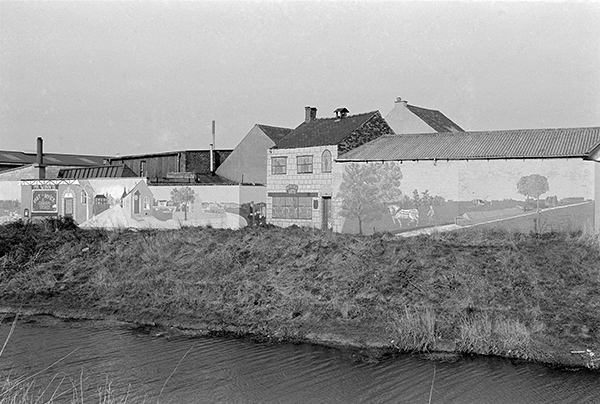

84-4e-16: Beverley & Barmston Drain, 1984 – Beverley Rd


You can see the new pictures added each day at Hull Photos, and I post them with the short comments above on Facebook.
Comments and corrections to captions are welcome here or on Facebook.
Continue reading Hull Photos: 1/9/17 – 7/9/17
Hull Promenade

If you read my posts here or on Facebook regularly you will certainly be aware that 2017 is Hull’s year as UK City of Culture. And that as my personal contribution to the year that I’ve been posting another picture every day to my newest web site, Hull Photos, also known as ‘Still Occupied – A View of Hull‘, the title of a show I had in the city in 1983 in which around 148 of the pictures appeared.

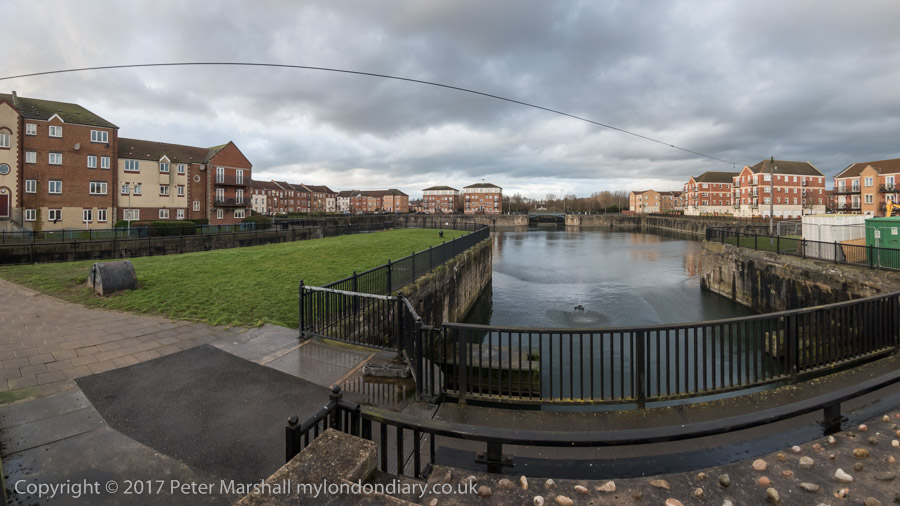
Half Tide Basin and entrance locks, Victoria Dock, 1982

So far I’ve added 406 pictures to the site, rather more than the days of the year so far, as I put pm quite a few pictures before the start of 2017. But every day, usually more or less straight after breakfast, I sit down at my computer, write the code (I have to alter 4 files) and then FTP the day’s new image into place. It’s become a daily ritual, sometimes something of a challenge, especially when I’m away from home, but a little bit of structure I’m sure I will miss when we get to 2018. The latest picture is always shown on this page, as well as on its final resting place in the site, but it’s best to follow the year on Facebook as I usually post some text about it there – and you can comment.


Half Tide Basin form the entrance locks, Victoria Dock, 2017

But of course I had to visit Hull during this special year, and although I’d hoped to find time to go several times, so far I’ve only managed 5 days in February. We had an eventful journey to Hull, parts of which I’m probably not allowed to tell you much about, which involved me traveling alone from Kings Cross to Hull with an empty reserved seat next to me, with my wife taking a later train which was diverted via Selby while the train I was on was kept standing at Kirk Sandall while several rail staff on board argued with a young man who had run across the track to board the service and appeared not to have a ticket. Finally we moved on to Hatfield & Stainforth where a police officer was waiting on the platform, and, over an hour late we finally arrived at Hull, around 20 minutes after Linda got there.

We’d sold Linda’s parental home to pay for her mother’s upkeep in an old people’s home back around 2000, and our old friend with a stately home in the north of the city we were always welcome at died a few years ago, so this year we were staying in digs in the Victoria Dock estate, comfortable enough and only a very short walk from the Old Town thanks to the recent Scale Lane footbridge. We got there, dumped our cases and went out for a walk.

I’d not been to Victoria Dock for over 25 years and it was something of a shock to se what had been a largely open and derelict area turned into a suburban estate, if one with some reminders of its previous life, with the dock entrance and Half Tide Basin retained as a feature.

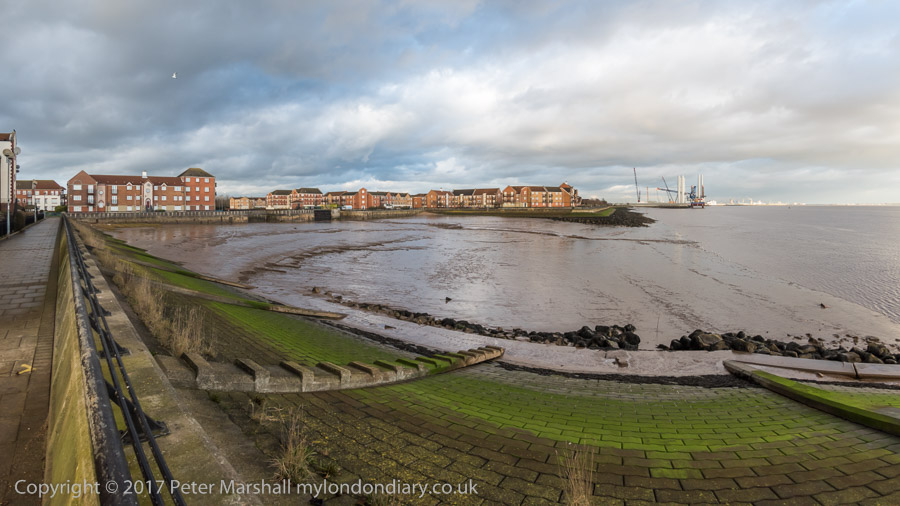
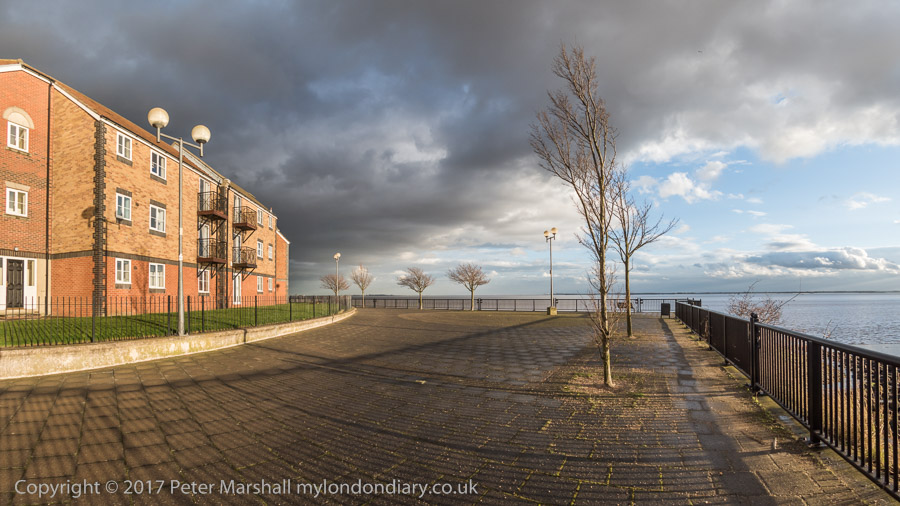
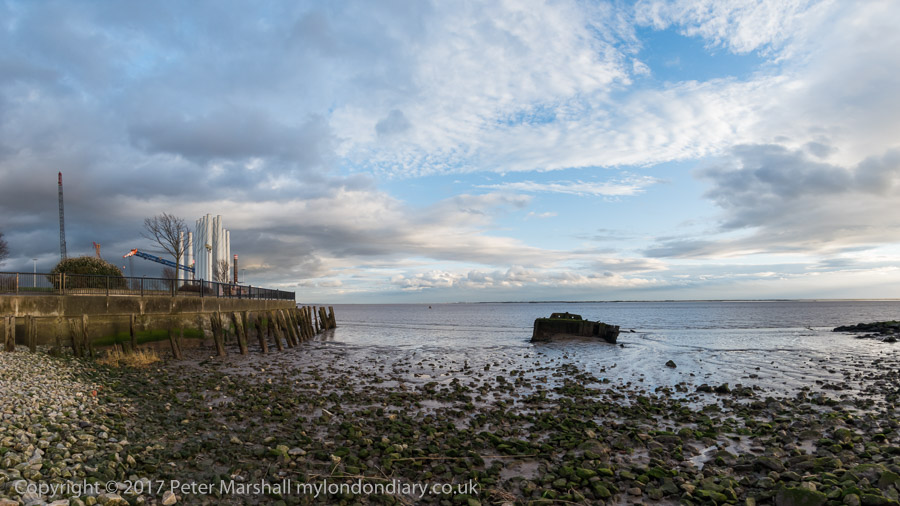
And while the old Hull had a number of piers, it now has a Promendade, and it was one we had virtually to ourselves on a glorious dramatic winter afternoon.

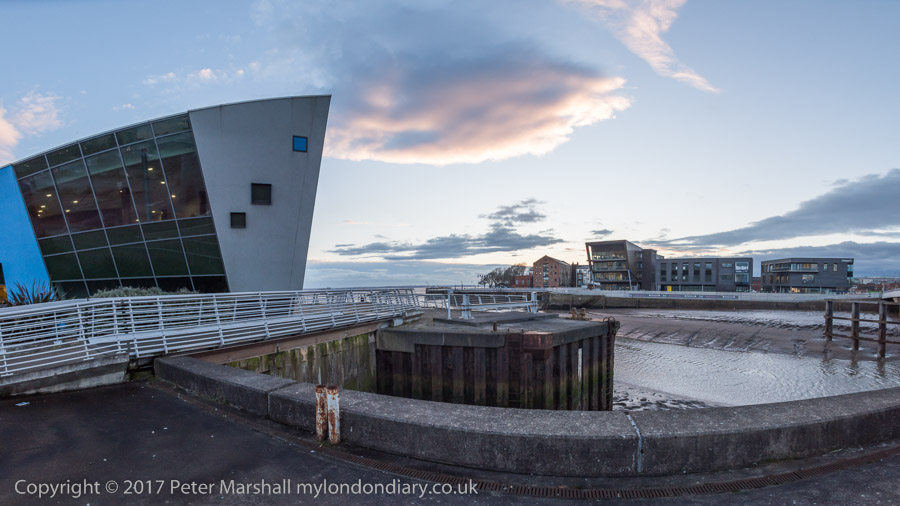
Siemens, whose ‘blade’ was then dominating Queen Victoria Square in the city cwntre have taken over Alexandra Dock, providing welcome employment, and I suppose the loss of the public footpath on the edge of the Humber there is a small price to pay, but it was a disappointment to find our path blocked there, with a long diversion. Instead we turned back towards the city centre. past The Deep and across the footbridge there to the Minerva for a pub meal.

More pictures: Victoria Dock Promenade
Continue reading Hull Promenade

Culture Calls

Looking back at around 15 years of My London Diary I’m very much aware that the main focus of my photographic work has shifted from a broader cultural perspective towards the more narrowly political. In part the reasons for this have to do with changes in society and the outside pressures and the great increase in grass roots political activity over those years, and in part they reflect changes in my own political perceptions.

First there was the increasing frustration with the failure of a Labour government to put forward Labour policies, continuing basically Thatcherite policies under Blair and then Brown. Then we had the remorseless austerity of the coalition and and Cameron years, before the national interest was sacrificed to Tory in-fighting with the Brexit referendum. Now we see a weak and failing adminstration dedicated to following not the will but the whim of the British people who voted on the promise of the unobtainable .

Of course it isn’t only British issues. The UK and London in particular has always provide a stage for protests for and by the world, in part because of the involvement of this country around the world, probably greater than ever in these post-Empire and post-Colonial days thanks to the devious antics of the City and companies based here.

And thinking about some of the events I used to photograph I perhaps feel I’ve said all I have to say about them. Delightful though it is to photograph – for example – Vaisakhi, I rather feel I’ve taken enough pictures and covered enough of what is essentially the same festival every year. But whatever the reasons, these days I seldom cover the religious and other cultural events which once took up much of my time.

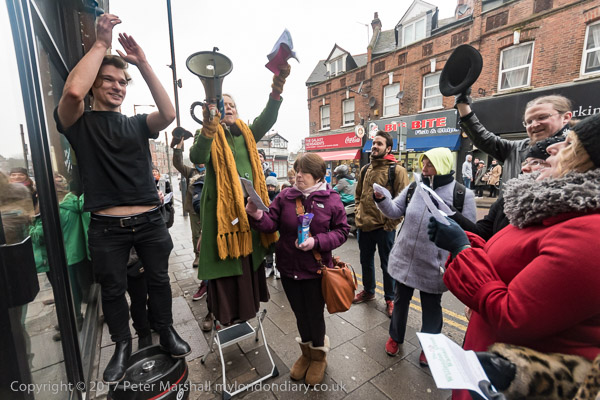
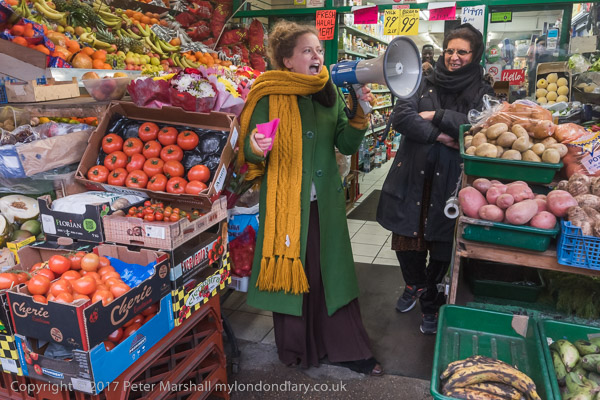
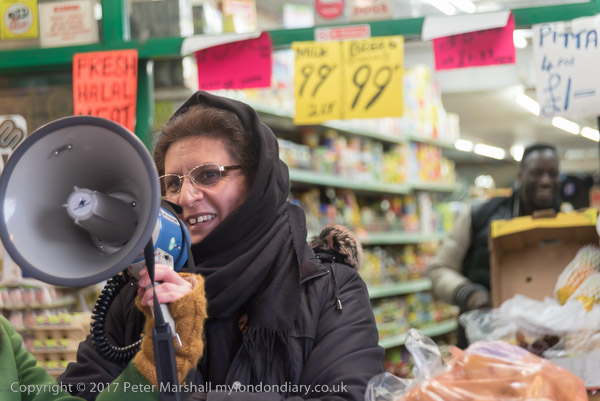
I wouldn’t have bothered to cover the Willesden Green Wassail if I hadn’t had a message from the organiser inviting me to do so.  I’d enjoyed photographing it back in 2014,  and had nothing essential in my diary for that day, so decided to make the journey to photograph it another time. And I enjoyed it again.

Willesden is an interesting area, a part of London that seems very happy with being multicultural, with a borough, Brent, which until hit by the cuts was very intent on celebrating the various festivals of its different groups.

It’s also an area served by a great number of small shops, helped by lower rents than in many areas of London – though this is beginning to change as gentrification creeps in, if more slowly here than in much of London.

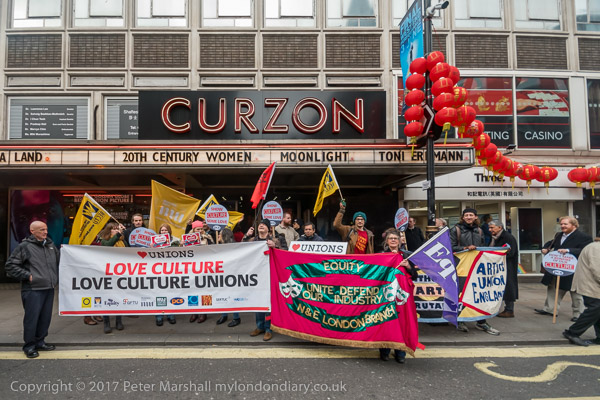
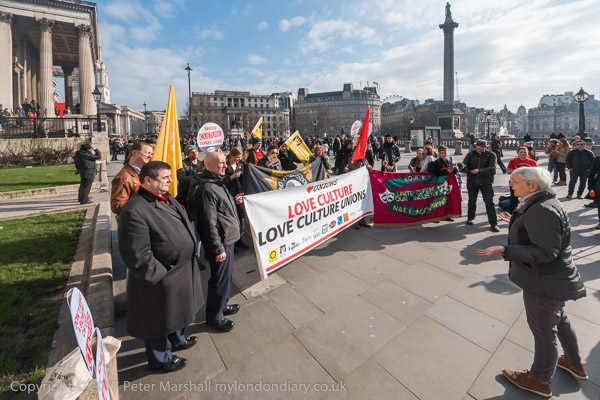
A couple of days later came a more political event around culture, organised as a part of a week of actions by trade unions and celebrating some of our cultural institutions and those union members who work in them.

Although our culture celebrates the stars – and rewards them with often astronomical salaries for doing usually what they love to do – and a few months later the BBC was forced to reveal how much it pays its highly paid staff, some of whom clearly don’t deserve it – these stars depend on many others who work in the industry, including some on or close to the minimum wage, and in London in particular below the living wage.

Our tour reminded us of some of these, particularly the workers for Picturehouse, and the continuing fight by those at the Ritzy, in Hackney and elsewhere who are still fighting for a living wage in an industry that makes billions and rewards the stars extravagantly. And in our great public galleries staff are increasingly being replaced by out-sourced workers on low pay, minimal conditions of service and little or no job security. Management are pinching pennies from those who can least afford them, while those at the top get fat salaries – and yachts as leaving presents.

Show Culture some Love
Willesden Green Wassail

Continue reading Culture Calls

Death on the Roads


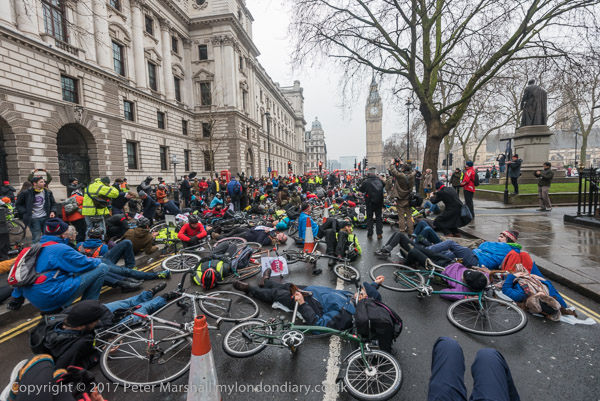
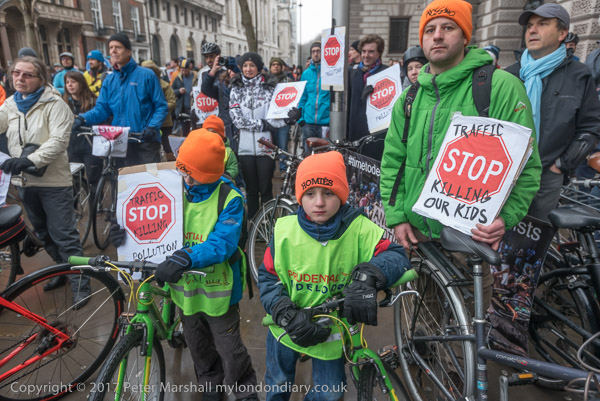
Die-in remembers 3 cyclists and 2 pedestrians killed on London roads in the previous week

Cyclists arouse deep and entirely irrational prejudice among many vocal members of the British public, and I’ve spent some time trying to understand why, though with no great success. And here some of my somewhat random thoughts possibly related to the subject.


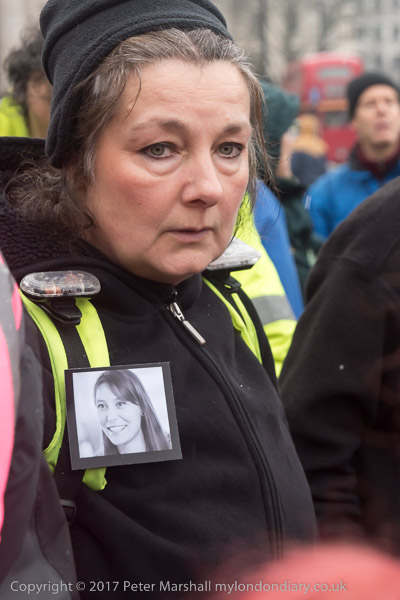
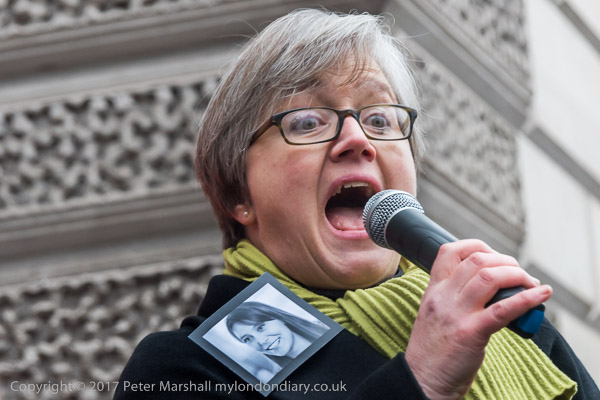
Many at the protest wore phoographs of one of the cyclists killed that week

Back in the 1890s there was a bicycling craze here and in the US in particular; the introduction of the ‘safety bicycle’ with its smaller wheels and chain drive and its widespread availability changed the way people lived.

In particular it led to much greater freedom for women, changing the way they dressed and how they behaved – so much so that Susan B Anthony in 1896 said, “the bicycle has done more for the emancipation of women than anything else in the world.” The popularity of bicycles also provided a need for smoother, pothole free roads, and the roads that we now use were largely made for the use of bicycles.

Back in the 1940s and early 1950s, pretty well everyone except the rich rode bicycles. They were (and are) a cheap and reliable form of transport and schools and factories would have large cycle sheds. But times were changing, and as Harold Macmillan said in 1957 “most of our people have never had it so good”; the post-war boom meant the working class was getting more money and it became a part of everyone’s aspiration to get a car. Back at school in the early 1960’s we all envied one of my friend who had a part-time job and could afford to own and run a Morris Minor, not least for its potential in attracting members of the opposite sex.

Bicycle clips became an emblem of failure. Or of extreme crankiness (rather appropriate for cyclists although of course it derives from the Dutch or German for sick.) People on bikes began to be seen inferior beings who should always give way to their motorised superiors. Planners and road engineers (with a few exceptions, particularly in the new towns) almost entirely disregarded the needs of cyclists in the interest of making the movement of motorists faster and reducing congestion.

Attitudes and behaviour towards children have also changed. When I was primary school age my parents were happy for me to go and play with friends out on the streets, to ride around the area on my bike. By the time I was in long trousers – at 11 – I was cycling all over a wide range of outer London, making my way to Box Hill, Virginia Water, Windsor, the Devil’s Punchbowl and more, sometimes with friends, but often on my own.

When those of my generation went to youth clubs or activities we weren’t taken by car (my father didn’t own one, though he had possibly driven when in the RAF and had certainly ridden a motorbike in his younger days, but when I knew him he rode an ancient bike, or when he had heavy loads used a push-cart) but used bike or occasionally bus.

Roads then were even more dangerous than now. In 1960 almost 7,000 people were killed on UK roads; by 2015 that had dropped to 1700, and injuries, particularly serious injuries, were also greatly reduced. Though the kind of side streets that I lived and played on are perhaps more dangerous, partly because there are many more parked cars which obscure vision, but mainly because people drive much faster down them – why more areas are now getting 20mph limits – though nothing is done to enforce them.

The change isn’t driven by safety but by perceptions of danger, and particularly perceptions of ‘stranger danger’ driven by some rather hysterical campaigning. Children have always been at risk from some adults, largely from family members, but also from a few strangers, and I don’t think those risks have increased. We were given simple and straightforward advice. But we were also given a freedom which no longer exists. Parents who behaved like almost all parents did then would now find themselves threatened by social workers – as happened to a family we knew in our area a few years ago.

Owning a car if you live in a city like London isn’t an entirely rational act, but one that the car makers have had to encourage and promote though millions spent on advertising. For longer journeys, except in the outer suburbs where public transport is often poor it’s a slow and generally inconvenient way to get to places, and for shorter journeys a bike is generally much faster. At least some of that motorist hate comes from seeing people on bikes moving much faster than them through traffic queues – and sometimes doing so in slightly unconventional ways.


Green Party London Assembly member Caroline Russell

Perhaps the greatest boost to cycling in London came from the 2005 terrorist attack, making some reluctant to use tube or bus to get to work. Another factor has certainly been the rise of the Brompton folding bicycle, which many can take on the train and into their workplace to cut the risk of theft. Brompton’s aren’t cheap, though there are also cheaper folders on the streets. And thanks to Ken Livingstone we also have ‘Boris Bikes’.

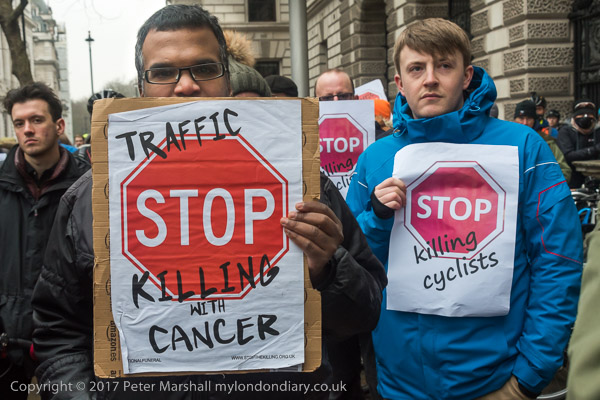
With more people cycling we have more deaths of cyclists and the protest and die-in outside the Treasury in Parliament Square came at the end of a disastrous week in which 3 cyclists and 2 pedestrians were killed by drivers in London. Most deaths of cyclists come from them being hit by lorries and other large vehicles which have large areas of restricted visibility due to their design – something which has to change.

Serious accidents involving cyclists and pedestrians are rare – the energy involved in such collisions is so much lower. Probably rather more injuries are caused by accidents involving other pedestrians which are common and usually unrecorded. Probably pedestrian hate is more a matter of the visibility of cyclists – and the way some mainly young cyclists ride fast on pavements past people. Usually their fast reactions and control of their bikes avoids collisions but can frighten some. While cyclists and pedestrians can mix safely – as they do on many miles of officially shared pavements – cyclists should certainly do so with appropriate caution, as the movements of pedestrians are often unpredictable.

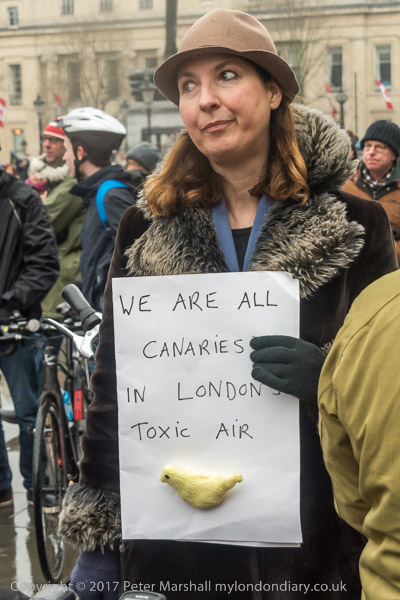
Cycling has much to contribute to the city, cutting down congestion and pollution, and to our health as a nation suffering from over-consumption and obesity. It should be encouraged by making it easier and making it safer. London needs a giant leap in spending to cut deaths from traffic pollution and poor health, as well as policies that increase public transport and cuts the use of cars and other motor vehicles, both petrol and diesel, moving all those buses, taxis and other necessary vehicles to electric over a relatively short time-frame.

Continue reading Death on the Roads

Shame on May

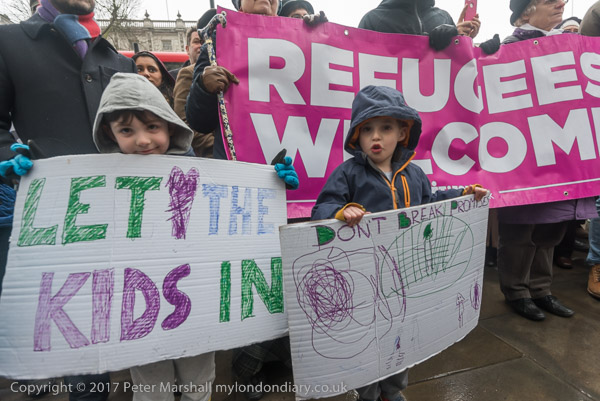
One area that has shown the real inhumane and nasty nature of our current government most clearly has been its treatment of refugees, particularly those fleeing Syria. Theresa May’s response stands in such incredible contrast with that of Angela Merkel. Merkel isn’t a person whose politics generally I have much sympathy with, and certainly not someone I would have regarded as a person of great warmth. But faced with the huge flow of people in distress she made a courageous decision – and one which she will have known was politically dangerous – to help the refugees.

Theresa May in complete contrast has been consistently inhumane – both as Home Secretary and Prime Minister over this and related issues. It isn’t just that she lacks any empathy for her fellow human beings, but it is also cowardice, running scared of the right-wing bigots of her own party.

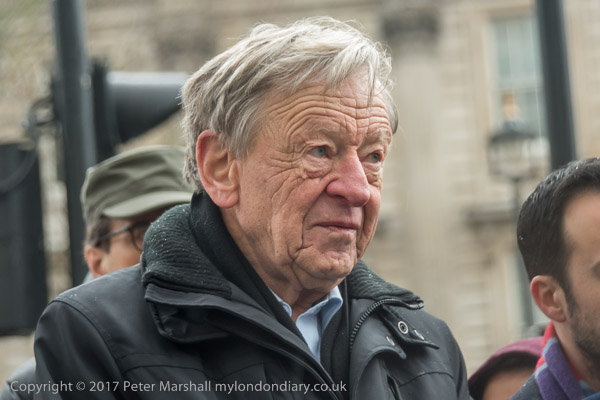
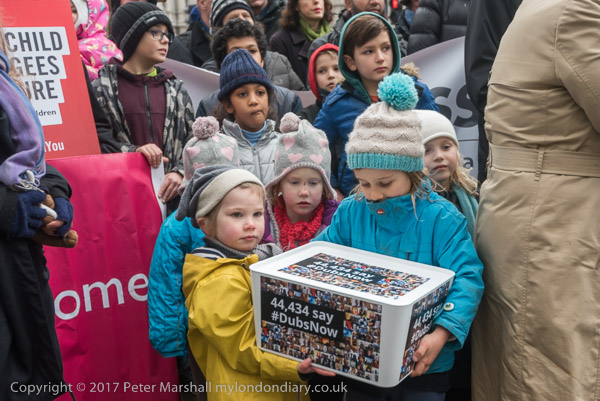
The Lord Dubs, formerly for some years Alf Dubs, Labour MP in Battersea, gained widespread support in both houses of Parliament for his amendment to the Immigration Act 2016 which offered unaccompanied refugee children safe passage to Britain and the Tory government was forced to accept it. But they did so grudgingly, and acted in a desultory manner, inventing excuses to avoid implementing it to any great extent, pretending there were no places for the children to go even when many local authorities had offered them, and eventually abandoning the program in February 2017 after only 300 of the 3000 children should have been brought here.

I’m pleased that my own signature was one of the 44,434 on the petition that was taken to 10 Downing St, but angry that this failed to get a response. Though not surprised, as this is only one of a number of occasions on which the Tory government have ignored or flouted the law.

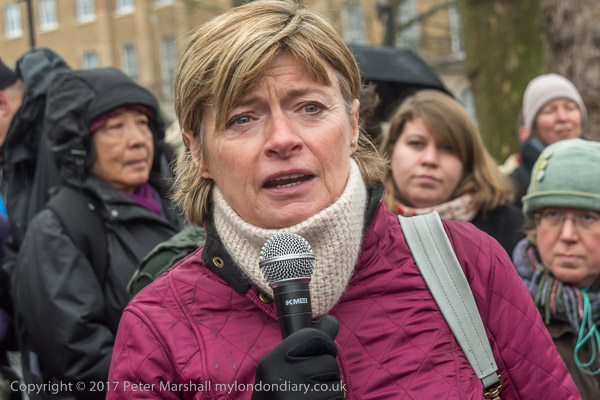
Lord Dubs has of course a particular personal involvement in the issue. Born in Czechoslovakia in 1932, he was one of the almost 700 children saved from the Nazis by the English stockbroker Nicholas Winton and his team of helpers, though it was only in later life that Dubs learnt the details. Among those who spoke at the event was a woman who had been a friend of Winton (who was knighted in 2002, thanks in part to campaigning by Dubs) who reminded us of his motto, ‘If it’s not impossible, there must be a way to do it.‘ Unfortunately, despite wide political support for bringing the children here, May remained unmoved.

More at Dubs Now – Shame on May.
Continue reading Shame on May

Derek Ridgers 80’s book launch

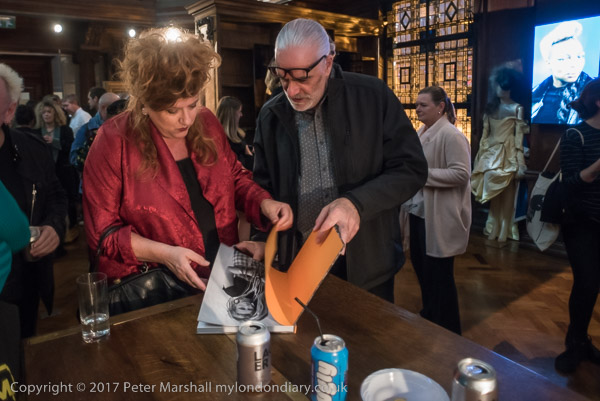
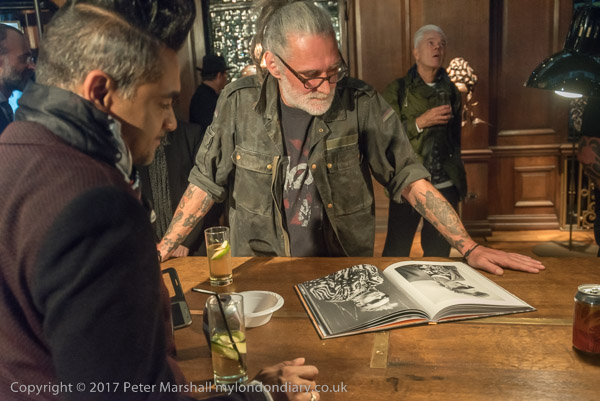
I hadn’t gone to the launch of ‘In The Eighties, the ninth or tenth book by Derek Ridgers intending to take pictures, but to celebrate the occasion and meet up with him again. But I had my camera bag with me, as I’d been in Brixton photographing a protest there against London’s excessive air pollution – it took only 5 days to exceed the annual pollution limit on the Brixton Rd.

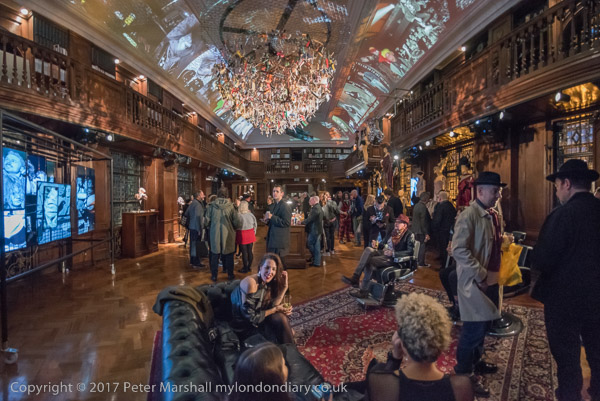
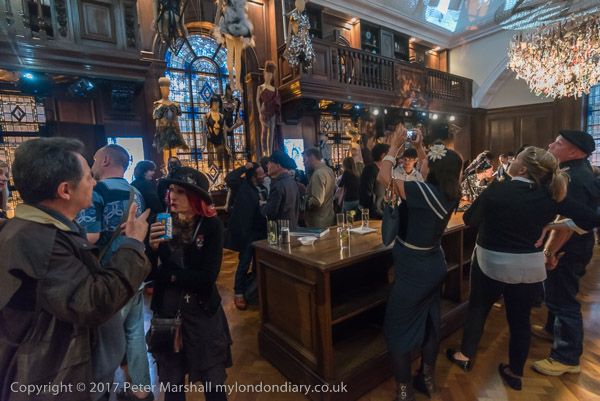
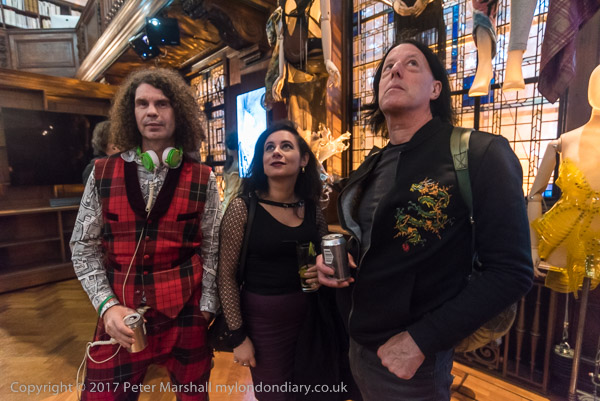
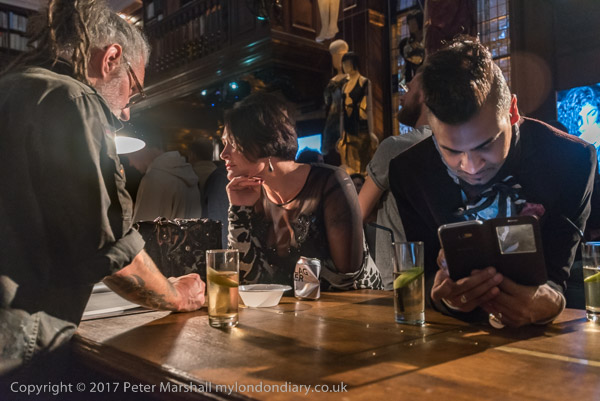
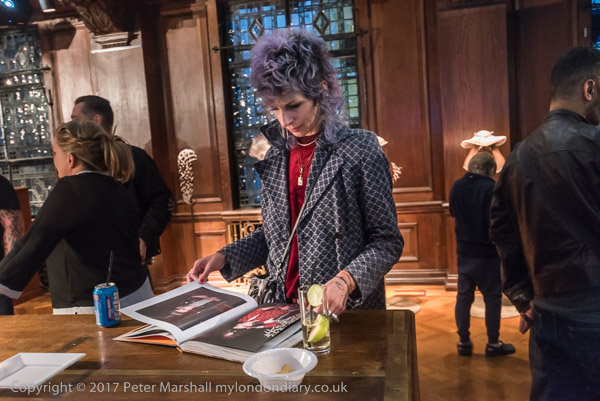
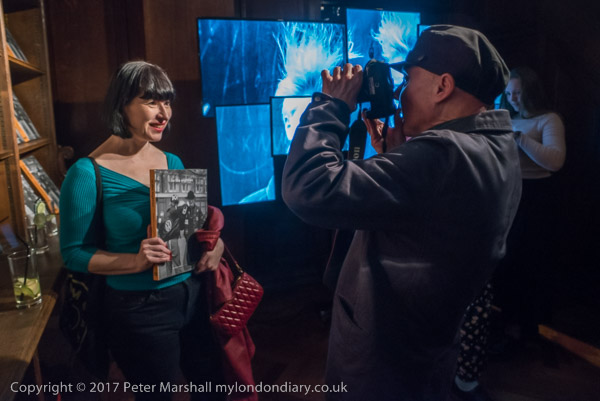
But on entering the The Library Space (built in 1910 as the Edwin Tate Library, Grade II listed and now a cultural space hosting workshops, exhibitions etc) I just had to take some pictures of the place and the event – as too did many others of those present.

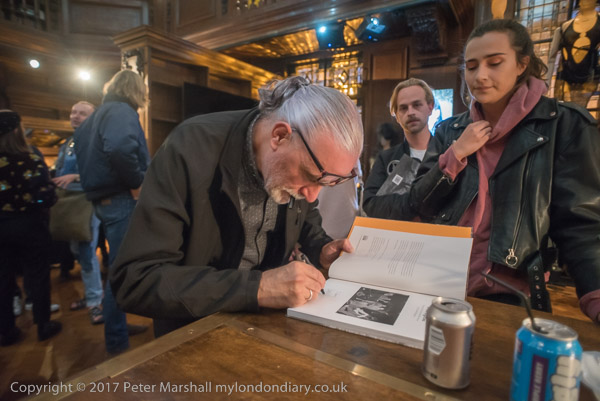
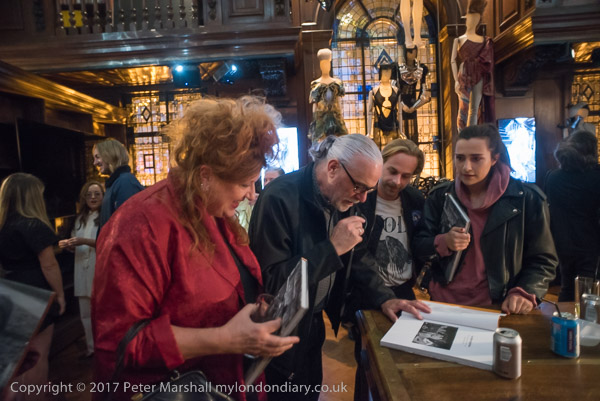
And I also bought the book – and of course got Derek to sign it – and I photographed him signing for several others.

It’s a book packed with portraits, and with a few pages of introduction, concentrating on the developments in club and youth culture which Derek’s work concentrates on. Although central to much of his work, its an approach that I think rather minimises the value of his work. Yes, he documented the London scene, in the clubs and on the streets, but the strength of his work is not really what he did but the way that he did it, the reflection of his personality and his intent vision.


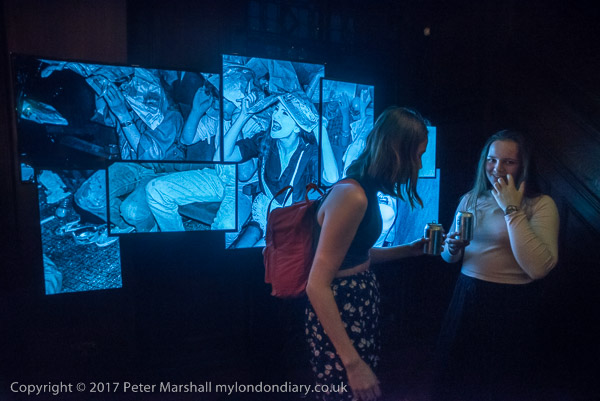
People look up at Derek’s pictures going around on a strip around the ceiling


And study the book

Of course there is interest in the people he photographed, their clothes, their hair styles, their make-up and their behaviour. But that isn’t what makes this work stand out above much other photography of the era dealing with similar subjects.

In The Eighties by Derek Ridgers, published by Carpet Bombing Culture, ISBN 978-1908211569

In The Eighties

In The Eighties‘ is the title of a new book by Derek Ridgers, an old friend of mine, being launched tonight (14 Sept 2017) at The Library Space in Battersea Park Road, London.

You can see a preview of the book and read some of Derek’s views in the feature ‘Documentary Photography: A Masterclass from Derek Ridgers‘ on ‘Another Man’.

Derek gives a straightforward account of how he took these sometimes remarkable portraits in the article: “I just walk straight up to people and say ‘Do you mind if I take your picture?’”. The people he chose were those who caught his attention, particularly as he walked along the King’s Road, then the epicentre of young London’s trend-setting young fashions. Since most – but certainly not all – of those he chose were very deliberately presenting their image to the public I imagine most were more than pleased to be asked to pose for a photograph, and cooperated with him as he moved them into a suitable place nearby to find the kind of background he liked, “something that’s very plain, without anything to detract the eye, and yet something that still possesses an element of time and place.”

The quote about backgrounds comes from one of five tips for aspiring documentary photographers in the article – you’ll have to read it to find the others.

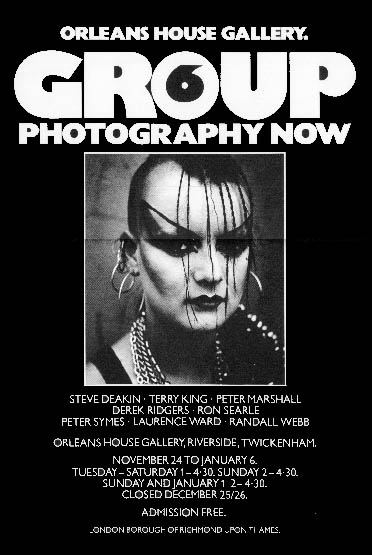
Derek and I were for some years a part of a small group of photographers who came together monthly to bring our latest pictures and discuss them. We all I think benefited from the sometimes frank appraisals, and Derek’s were usually franker than most, often saying bluntly what others of us were thinking but trying to find more delicate ways to express. ‘Framework‘, as the group became known as, was something of a hard school, and one that some could not take. Elsewhere I’ve described it as “a pionering UK group of independent photographers until its demise in 1993; together we organised around 20 group exhibitions almost all of which included some of my work. (Among many UK photographers to exhibit with Framework were Terry King, Carol Hudson, John RT Davies, Derek Ridgers and Jo Spence“), though Jo was never a member, but one of a number of others we invited to take part in our shows.

Framework had started life as a group inside a photographic club, but became a separate organisation after than club appropriated a gallery space and exhibition opportunity we had arranged for wider club use, changing its name from ‘Group Six‘ to ‘Framework‘. Derek had designed the orginal logo for Group 6, and it was one of his pictures on the poster for our first exhibition in 1984.

You can read more about Framework on an unfinished web site I began about it some years ago. Since I wrote this, at least two of the members, its main organiser Terry King and Randall Webb have died. Framework itself came to an end with the formation of London Independent Photography in 1993, which most of us joined. It was the experience of Framework that led me when a LIP committee member a year or two later to argue for the setting up of the local groups which now form a vital part of that organisation.

Flares at King’s

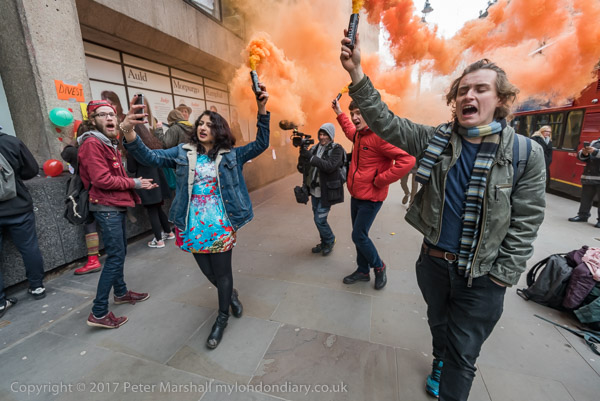
Photographing people holding flares is something of a hit or miss thing, with rather a lot of unpredictable behaviour. There are the people holding the flares, and protesters movements are often fairly unpredictable, but smoke is also peculiarly so. And if you actually get in the smoke, camera exposure metering gets pretty unhinged too and it can also be difficult to focus.

Though I usually like to get as close as possible for most of my pictures (though I know it often pays to stand back a little for a wider view) it seldom works to get too close to people holding smoke flares – and can be quite uncomfortable too. The smoke isn’t good for the lungs or the eyes and has an unpleasant smell, and very close contract can result in burns and stains on clothing that are hard to remove.

It isn’t I think illegal to set off smoke flares, although police and government web sites state it is. The relevant law is clear that it is only an offence “if in consequence a user of the highway is injured, interrupted or endangered” and I think that would be hard to show in this case. But of course, I’m not a lawyer.

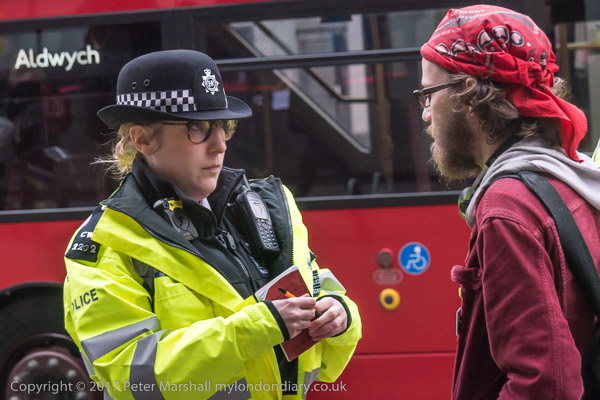
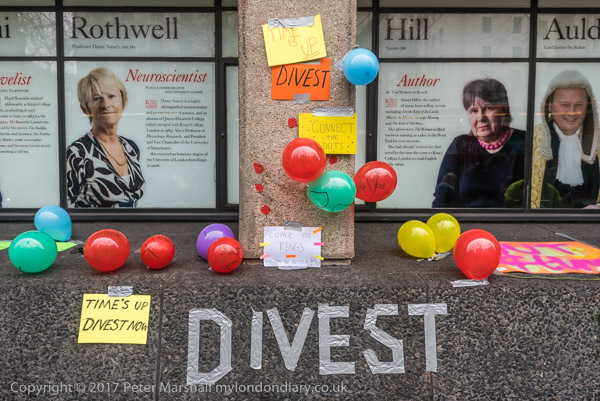
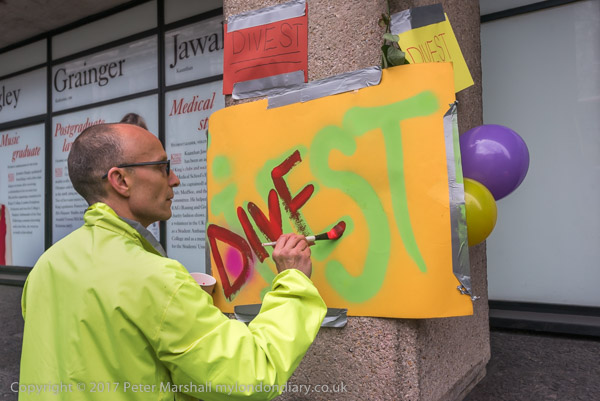
Another case where laws are often invoked against protesters is for the use of chalk and other easily removed markings on roadways, pavements and walls. Police during this protest talked with and asked for names and addresses of some of those who painted with chalk on the wall of King’s College. It’s had to prove ‘criminal damage’ when a simple wipe of a damp sponge – or even the rain – will remove it, though at least one protester was convicted for this a year or two back at the University of London Senate House – and a specialist cleaning company apparently got paid hundreds of pounds for a few seconds wielding a damp rag.
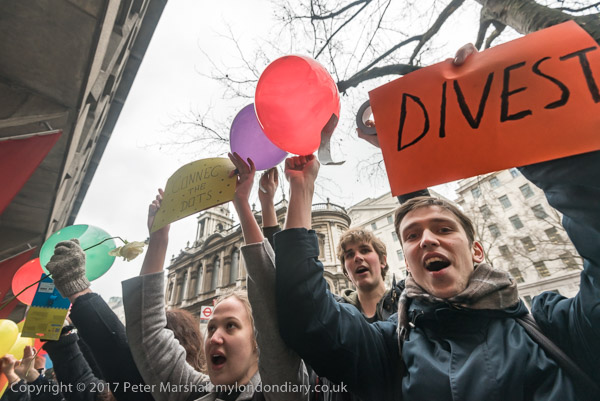
The organiser of this protest, PhD student Roger Hallam had been suspended for writing “Divest From Oil and Gas Now. Out of Time!” in spray chalk at an earlier protest, and in response at this event there was a great deal of displaying messages by other non-permanent methods, as well as a few who chose to deliberately paint washable coloured dots.

There is so far as I’m aware no law relating to the use of balloons on the public highway, and the protesters took full advantage of this. It was just a little difficult to photograph the long line, and space was limited between the wall and he protesters as they moved to tape them onto it.

The aim of the protest was to persuade King’s College to end its investments in fossil fuels and switch to investments in renewable energy,  part of a London-wide divestment  campaign.

More at King’s College Divest Oil & Gas Now!

Continue reading Flares at King’s

Trump & May

Mobile phones are a mixed blessing. I don’t like the thought that your every movement can be tracked whenever you carry one, though it was very useful when I left mine on a bus earlier this year – and was able to watch it slowly moving along the map towards the depot, from where a couple of days later I collected it. But as a journalist I don’t like the idea that the police can now track my movements – and would like it even less if I was working in some foreign countries.

And on my recent holiday it was great to be able to see my own position on the OS map I’d bought and downloaded to the phone, something I used far more than the paper copy. This year, rather unusually I didn’t get lost at all.

But being available for people who know your phone number to contact you at any time – or at least when your phone is switched on and has battery – is not always a good thing. Though much of the time when I’m actually working there is too much noise for me to hear (or notice a vibration) from the phone in my pocket.


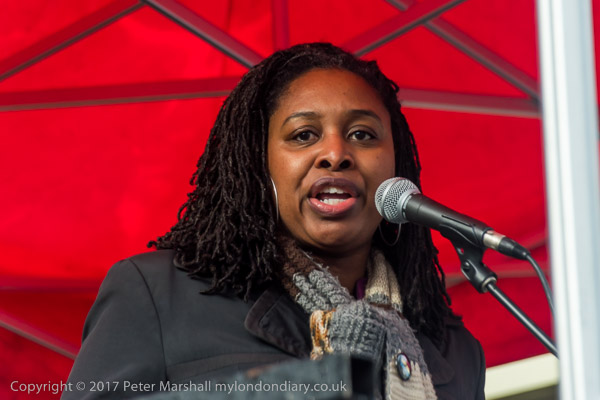
Dawn Butler MP

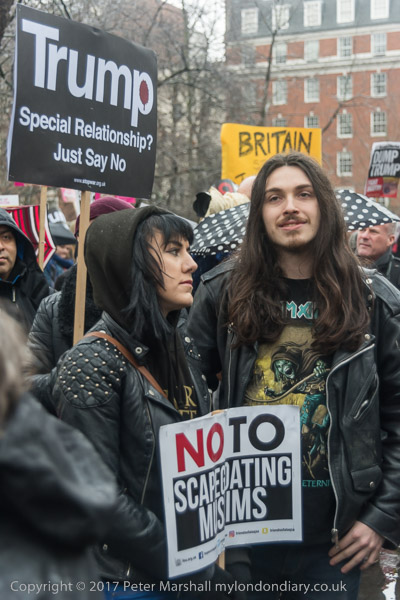
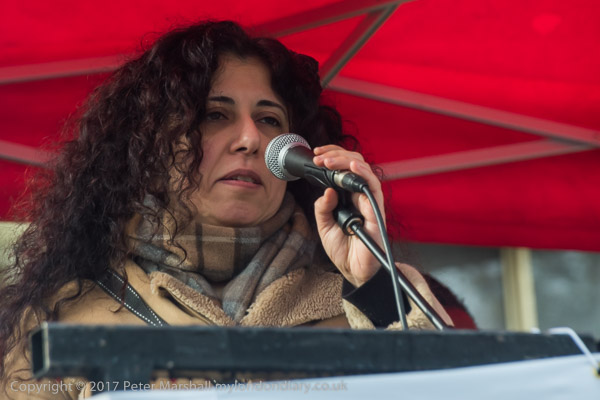
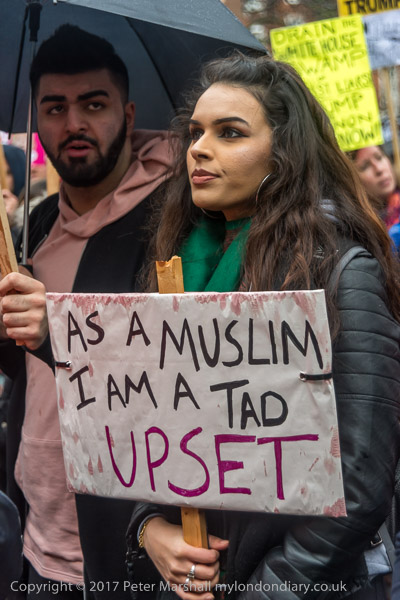
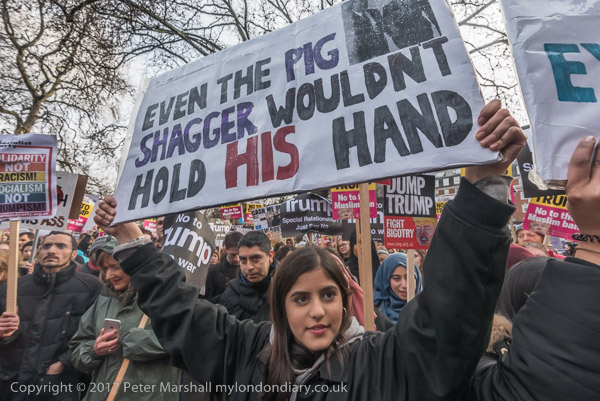
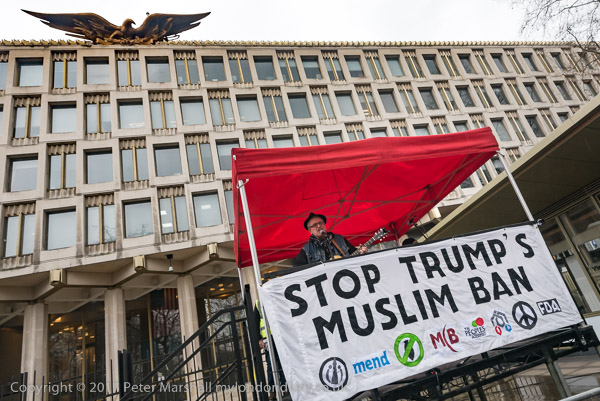
At lunchtime on 4th Feb I was more or less at the front of a densely-packed crowd in front of the US embassy, in a good position to photograph the speakers at a rally calling for Trump to end his Muslim ban and for May to withdraw the invitation to a State Visit here. It was at a quiet moment in the proceedings when a refugee poet was reading one of her works that I heard a faint ringing and answered the call.

It was my wife, and she was locked out as the lock on our back door would not open with her key. And she wasn’t well, or I might have stayed to finish the job before making the fairly long trip home, but I began walking to the bus stop as I talked to her, abandoning the protest. An hour and a quarter later I found my key didn’t work either, but fortunately I had the keys to the front entrance which did. More bad news was that we needed a locksmith who came, couldn’t open the lock and had to use a jemmy and then an angle grinder to cut through the lock and fit a new one. It wasn’t cheap.

Fortunately I’d already taken enough pictures to file a decent story, including probably the two most important speakers, Brent Labour MP Dawn Butler, shadow minister for diverse communities before she resigned to vote against the Brexit Bill and NUT General Secretary Kevin Courtney, and plenty of the protesters and their placards – it was a protest that brought out wit and obscenities – so I was able to file a decent story, though I had to miss the march to Whitehall and the further rally there.

It’s often the case with marches than the best opportunities for pictures are before they start, when people are often more closely packed and a little less organised. Back when I photographed some carnival processions with a few of my photographer friends we would usually pack up and go the the pub as the procession began. And for many of the longer political marches in London don’t walk the whole way.

Taking photographs means a lot of walking backwards as well forwards, going too and fro, and is considerably more tiring than simply marching. And as I usually want to cover marchers at the back as well as at the front (and those in-between) with large marches I try to find a convenient point to take the tube to the destination.

I often see other photographers standing around talking with each other before a protest starts, and while I like to be sociable (and often we have useful information to exchange) I sometimes feel they are missing opportunities and will leave them and get on with the job. And at some marches there are some photographers who only photograph the people carrying the banner at the front and just walk ahead of this all the way. It’s seldom a place to get the most interesting pictures.

And a small note to event organisers. A red roof to the stage is not a good idea. It really doesn’t provide a good background and it bathes the speakers in red light which isn’t flattering. Please chose a fairly neutral colour, perhaps a light or mid grey.  18% would help with our exposures!

More pictures at: No Muslim Ban, No State Visit.

Continue reading Trump & May