Against Trump and Robinson

It was a day of strong emotions in Westminster, with rival rallies. Having been attacked by right-wing protesters at the previous ‘Free Tommy’ rally in Whitehall I had decided to leave the reporting of the far right protest at Downing St to my less recognisable colleagues. Although I’ve covered many events on the right, and tried to do so without distortion – and been commended by some on the right for my objective reporting – I’ve also been featured in photographs and named on right-wing hate web sites, with their suggestions that photographers like me are an enemy that should be roughed up or worse.
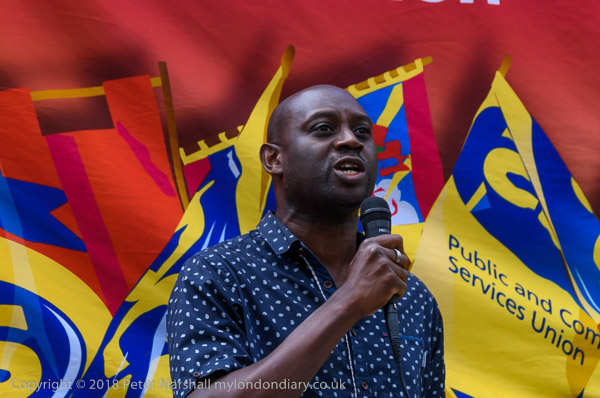
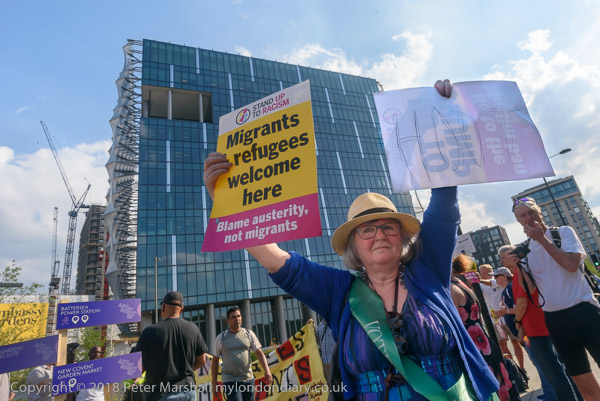
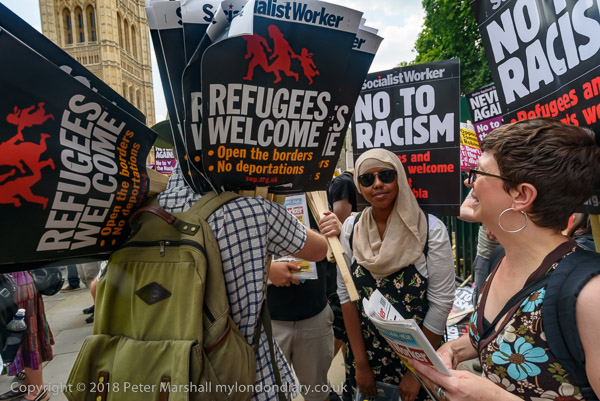
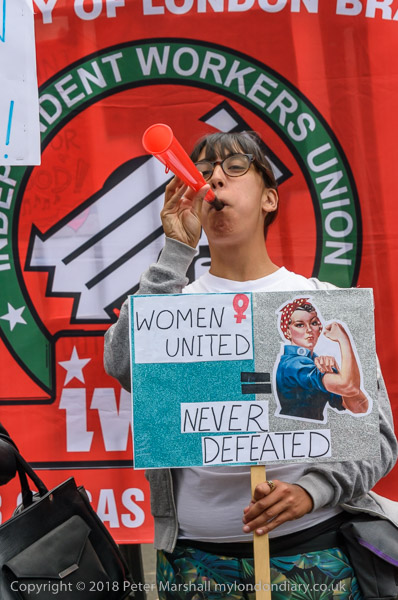
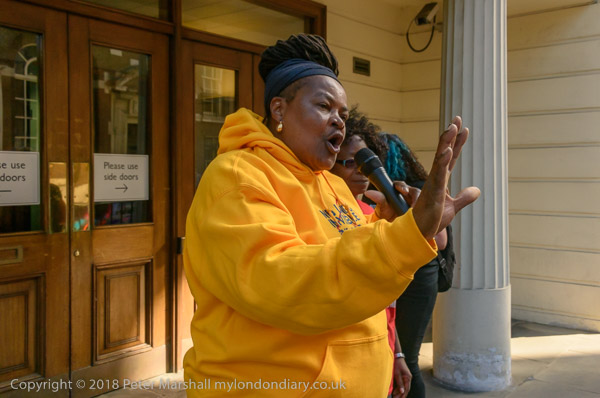
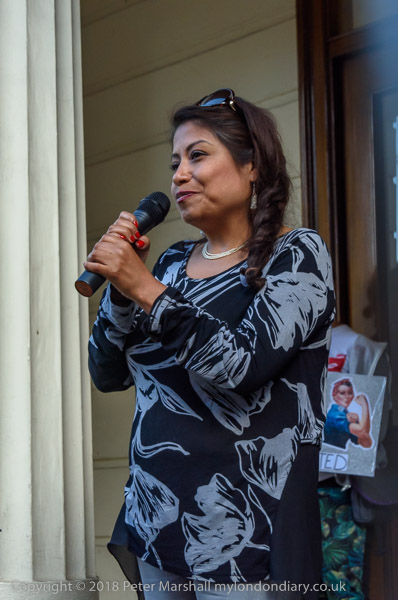
So I began taking pictures at the Stand Up To Racism and Unite Against Fascism rally in Old Palace Yard opposite the House of Lords, where speakers included a number of trade unionists – such as the PCS speaker above –  as well as Green Party MEP for London  Jean Lambert  and Weyman Bennett from Stand Up to Racism. I arrived after the event started, having rushed there from Croydon Pride, so I may have missed some, but I was suprised not to see or hear any Labour MPs.

The plan had been for those at the rally to march behind a lorry carrying their sound system to Parliament St and continue the rally closer to the extreme right protest, with police keeping a couple of hundred yards between the two events. But police refused to allow the lorry to move from where it was parked on Abingdon St. There was a bitter argument between the organisers and police who gave no coherent reason for the decision, which appeared to many to be politically motivated, but eventually the march which had been kept waiting for a long time proceeded without the powerful sound system.
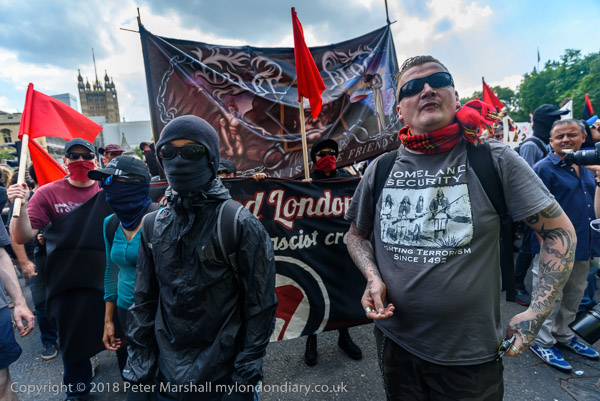
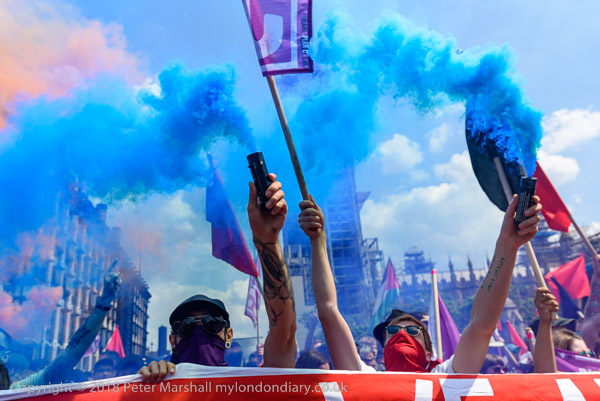
Where Bridge Street runs in to Parliament Square, the Stand Up to Racism march was greeted  by a large group of anti-fascists who had met south of the river and come across Westminster Bridge, and a number of smoke flares were set off. Also on the corner were some small groups of right-wingers who were abusing the anti-fascists, with police trying to keep the two groups apart.
The Stand Up to Racism march continued up Parliament St to the police barrier across the bottom of Whitehall and held a further rally there, although without the lorry they could only use a smaller amplification system, and the speeches were inaudible for much of the crowd.
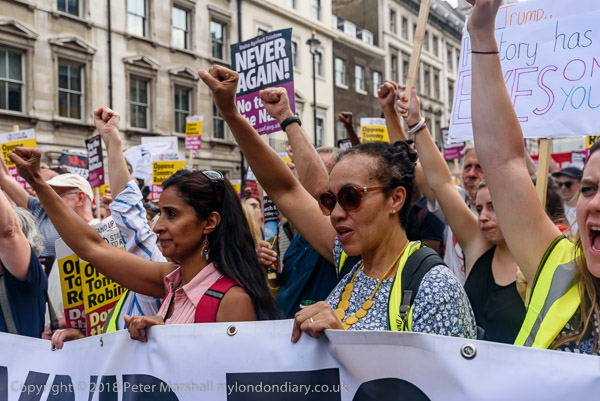
After having taken a few pictures of the speakers and the front of the crowd where they could be heard, I wandered back down towards Parliament Square, where the anti-fascist crowd was forming a barrier across the end of Parliament St, with police present in front of them.
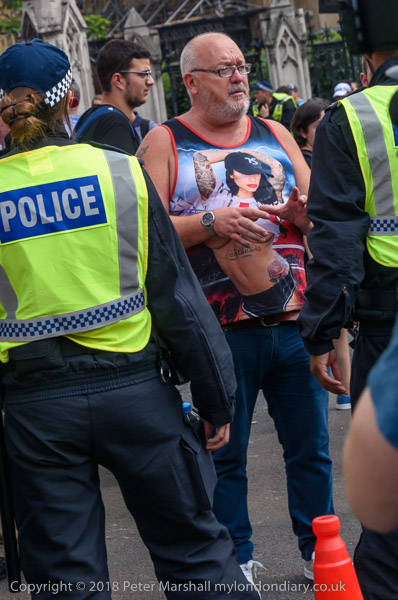
There was a further police line across Bridge St, and beyond it I could see a larger group of right-wing football fans, being stopped by police from moving towards Parliament Square. There were a few of them roaming around the square, with police talking to them and trying to persuade them to leave. One of those, in front of Parliament was wearing a lurid t-shirt showing a young woman posing provocatively with various tattoos including a red rose and across her stomach below her half-exposed breasts in flowing script was ‘England’.

See more at:

Against Tommy Robinson & Trump
Whitehall rally against extreme-right
Anti-Fascists & Police harassed by hooligans

______________________________________________________

There are no adverts on this site and it receives no sponsorship, and I like to keep it that way. But it does take a considerable amount of my time and thought, and if you enjoy reading it, a small donation – perhaps the cost of a beer – would be appreciated.

My London Diary : London Photos : Hull : River Lea/Lee Valley : London’s Industrial Heritage

All photographs on this and my other sites, unless otherwise stated, are taken by and copyright of Peter Marshall, and are available for reproduction or can be bought as prints.

To order prints or reproduce images

________________________________________________________
Croydon Pride

01p60213
Croydon, 2001

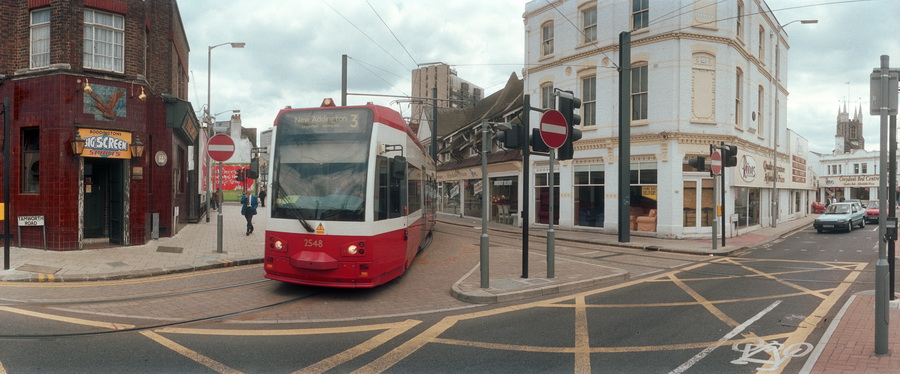
I have mixed feelings about Croydon, another place in London where I have shown work in group shows in the past, and which I have photographed, particularly for its tram system, taken in 2001. You can see my pictures along ‘Line 1’ in Croydon Tramlink. It was an unusual project for me in that the pictures on-line were taken on 6×7 rather than 35mm film; as well as these medium format images I also worked with a panoramic camera as you can see above, though I’ve yet to get around to adding these pictures to the web site as promised.

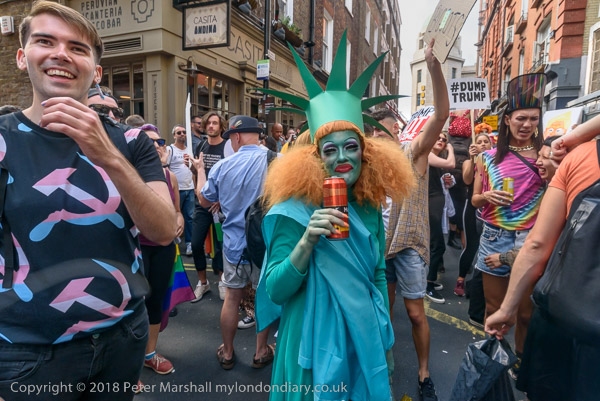
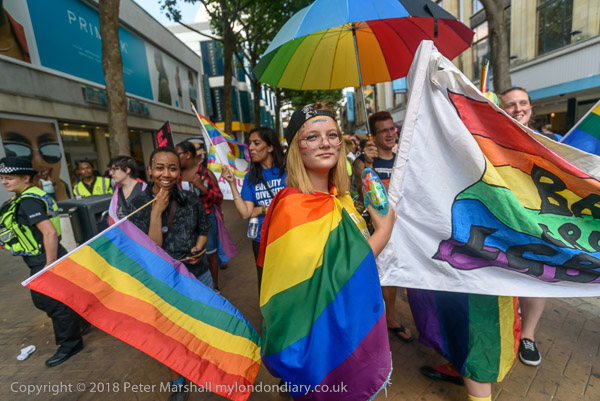
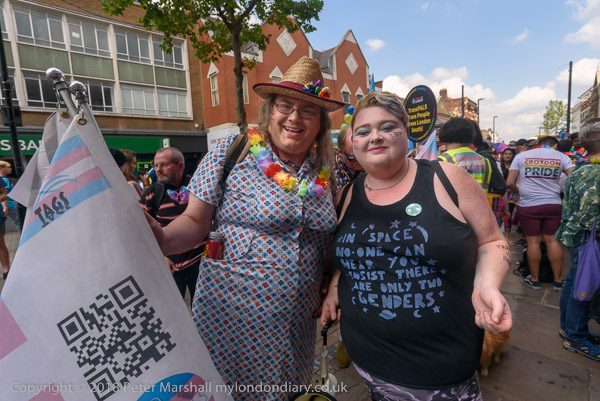
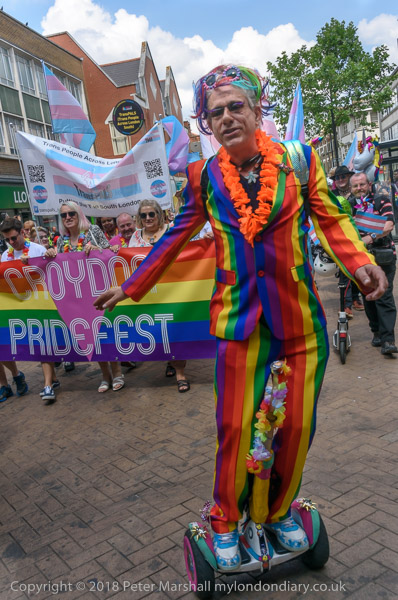
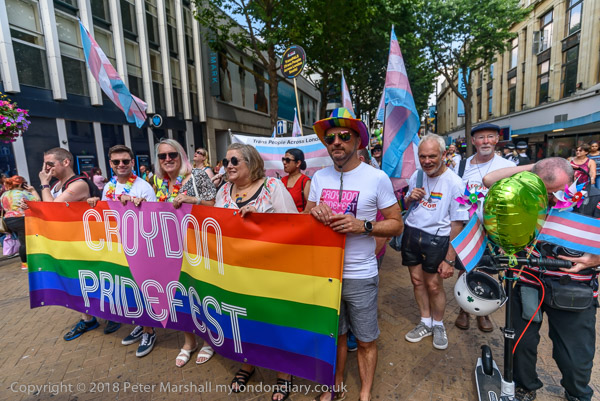
I still visit Croydon reasonably frequently, either to visit or meet friends, and for the occasional protest, particularly those about immigration issues at Lunar House. But on Saturday 14th July I was there for ‘Croydon Pride’, photographing the procession through the centre of the town to the third annual Croydon Pridefest in Wandle Park, sponsored by Croydon Council and said to be the second largest Pride Festival in the capital. I’d given the main London Pride a miss this year, but thought it would be good to cover a much smaller and less corporate event.

It was a much smaller and more intimate event than London Pride, and I enjoyed meeting some of those taking part and photographing them. There had been fears that anti-trans activists would try to disrupt the event, but fortunately they did not materialise, and the march was a show of support for trans people, with a large banner for TransPALS, (Trans People Across London South) and others carrying flgs and placards in support.

I was sorry to have to leave the march soon after the start to make my way back to central London from East Croydon station, but other things were happening there I didn’t want to miss.

More pictures at Croydon Pride Procession

______________________________________________________

There are no adverts on this site and it receives no sponsorship, and I like to keep it that way. But it does take a considerable amount of my time and thought, and if you enjoy reading it, a small donation – perhaps the cost of a beer – would be appreciated.

My London Diary : London Photos : Hull : River Lea/Lee Valley : London’s Industrial Heritage

All photographs on this and my other sites, unless otherwise stated, are taken by and copyright of Peter Marshall, and are available for reproduction or can be bought as prints.

To order prints or reproduce images

________________________________________________________
Workers protest Univ of London hypocrisy

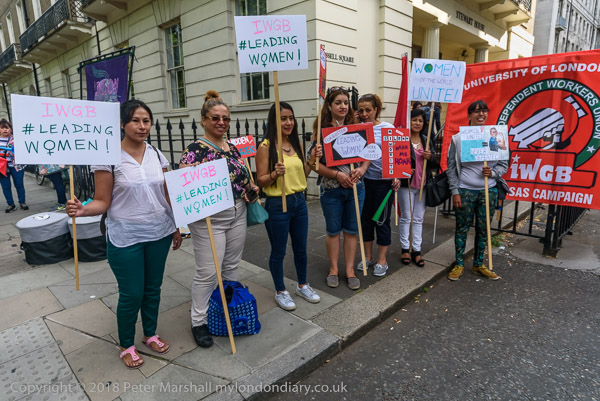
While the University of London holds events in favour of women’s rights in its #LeadingWomen season which aims ‘to break down the barriers women still face in education and the workplace today’, it is still denying decent terms & conditions to migrant and BAME women who work there, by using outsourcing companies which offer minimal rights, often with bullying management and zero hours contracts.

The IWGB union which represents low paid workers in the University’s central administration decided to hold a protest on the night one of these events was taking place, and contacted the two women who had agreed to speak, explaining the situation to them. Ayesha Hazarika and Catherine Mayer cancelled their appearances at the #leadingwomen event and instead came to speak at the protest. The university had to call off its event.

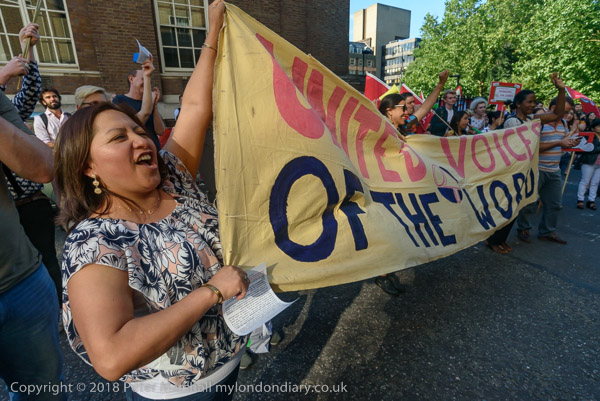
Other ‘Leading Women’ who spoke at the meeting included Mildred Simpson, who led the succesful LSE campaign by the United Voices of the World union to be brought in-house, and Newham Cllr Belgica Guania, the first Ecuadorian councillor in the UK.

The university fails to recognise the IWGB which a majority of the low-paid workers belong to, but has been forced to respond to their demands by a series of high-profile protests and strikes. It has now agreed in principle to bring these employees, currently employed by cost-cutting cleaning contracting firms back into direct employment by the university, but is refusing to engage with them on when and how this might happen.

The dispute is not only about conditions of service – sick pay, holiday pay, pensions, maternity pay – but also about having a management which respects the dignity of the workers and is also concerned with getting a good quality of service rather than cutting corners and overworking staff to cut costs. Often workers have to accept bullying and unsafe working practices and a failure to provide proper equipment by contractors to keep their jobs.

UoL #LeadingWomen protest hypocrisy

______________________________________________________

There are no adverts on this site and it receives no sponsorship, and I like to keep it that way. But it does take a considerable amount of my time and thought, and if you enjoy reading it, a small donation – perhaps the cost of a beer – would be appreciated.

My London Diary : London Photos : Hull : River Lea/Lee Valley : London’s Industrial Heritage

All photographs on this and my other sites, unless otherwise stated, are taken by and copyright of Peter Marshall, and are available for reproduction or can be bought as prints.

To order prints or reproduce images

________________________________________________________
Trump, Trump, Trump…

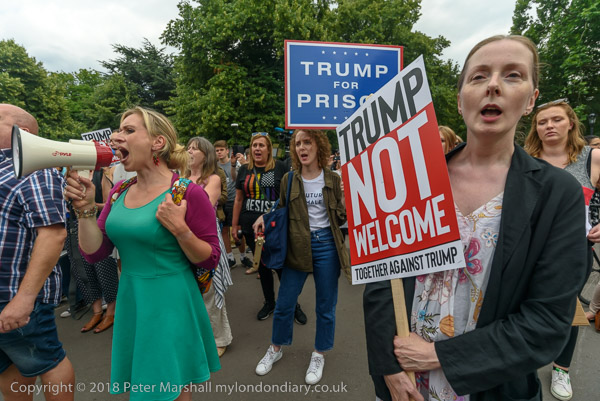
It was a week of protests against Trump, certainly making very clear the point that Trump is not welcome here. And of course he isn’t – there must be very few outside a few Conservative MPs who really think it was a good idea to invite him, and their number must have dwindled at seeing the farce of a visit that public opinion forced on the government.

Trump’s only contact with London was to walk a few yards to and from a helicopter to the house of the US Ambassador where he spent a night in the large estate in Regent’s Park, surrounded by a huge security operation behind a tall fence. I suspect police had advised that it would not be possible to ensure he would be able to travel on London’s roads to either Buckingham Palace or the US Embassy at Nine Elms. It had been thought that the visit had been arranged for the President to officially open the embassy, but he described it as as ‘lousy’ and ‘horrible’, and refused to go there.

The week started with a protest there, organised by Momentum Wandsworth. Sensibly the protest was held on the main road in front of the entrance to the embassy garden, where workers in the embassy come out on foot, and also the protest could be seen by those going along the fairly busy road.

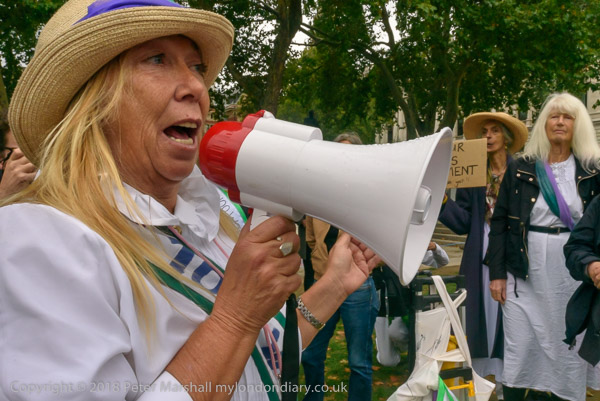
The embassy is built on a site with a radical tradition, as one of the protesters reminded us, wearing a suffragette sash in memory of one of the leading suffragettes, Charlotte Despard who lived and worked there.

There was a large and noisy protest in Regent’s Park when his helicopter arrived, and the protesters intended to keep up the noise all night until he flew off to a military base to be safe from protesters. Being Trump he will have boasted they were there to welcome him as he walked from the helicopter to the house, where I suspect effective double glazing will have kept out the sound. We did see the helicopter fly in, but the landing site was out of view.

Later that evening, protesters dropped a giant banner with the message ‘TRUMP: CLIMATE GENOCIDE’ over the river wall opposite the Houses of Parliament. The protesters say that by wilfully ignoring the clear science on climate change he is threatening the existence of human life on earth. It seemed a very good and clear reason to protest against him.

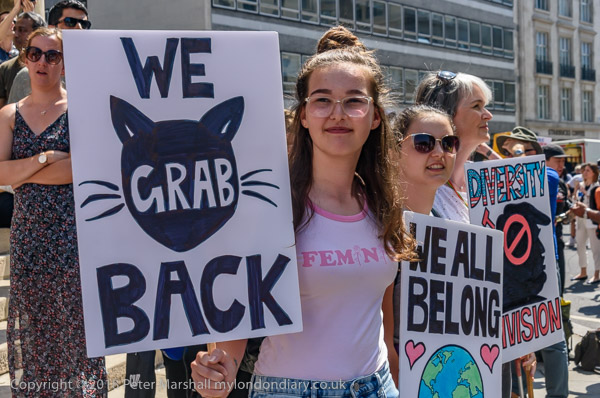
I didn’t get to Chequers or Windsor Castle, but there were protests at both. In London on Friday there were several protests, two on a large scale. The first, organised by women and supported by a wide range of women’s groups, highlighted his misogyny, but also protested more generally with what was described as as a day of joy, love, solidarity and resistance celebrating the diverse communities which make up our great city of London, standing together for Justice, Equality and Peace. It was against Trump and others whose agendas driven by desire for profit, greed, power & domination are ‘wreaking havoc – fuelling conflict; displacing vast numbers from their homes; waging war on our rights; destroying our planet.’

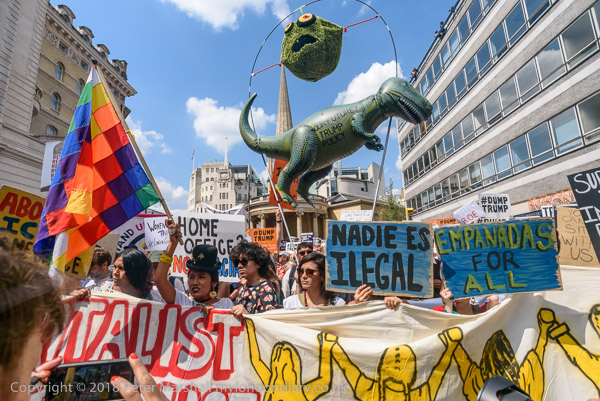
This march with tens of thousands was still making its way through London’s streets when a second and much larger march, estimated at a quarter of a million people, organised by ‘Together Against Trump’ began, on its way to a rally in Traflagar Square, though by the time I arrived there, the square was already full to capacity. Owen Jones had begun the Stop Trump Coalition in February with grassroots campaigners, trade unions, NGOs and politicians and others, including SWP members, had formed ‘Stand Up to Trump’, which also took part in the march.

I walked through Soho, which had people on almost every street with posters and placards, most intending to join one or other of the two big marches. There was a TV crew touring the area with two actors impersonating Trump and First Lady Melania, though not particularly well, but I had come for the marathon ‘Revolution Day’ street protest party against Trump’s visit organised by Soho Radio, which was meant to start at mid-day and continue at least until midnight. It wasn’t really happening on my first visit, so I returned later to take more pictures, and then again after photographing the main march, by which time things had really got going, though I think it would have got even more interesting in another hour or two, by which time I was having dinner elsewhere.

US Embassy protest says NO to Trump
Noise protest against Trump
‘Trump: Climate Genocide’ Giant banner
‘Bring The Noise’ Women march against Trump
Massive protest against Trump’s Visit
Soho parties to protest Trump’s visit
______________________________________________________

There are no adverts on this site and it receives no sponsorship, and I like to keep it that way. But it does take a considerable amount of my time and thought, and if you enjoy reading it, a small donation – perhaps the cost of a beer – would be appreciated.

My London Diary : London Photos : Hull : River Lea/Lee Valley : London’s Industrial Heritage

All photographs on this and my other sites, unless otherwise stated, are taken by and copyright of Peter Marshall, and are available for reproduction or can be bought as prints.

To order prints or reproduce images

________________________________________________________
Sutton KOSHH March


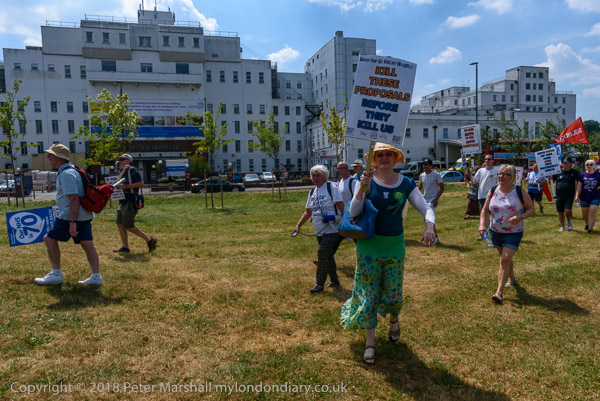
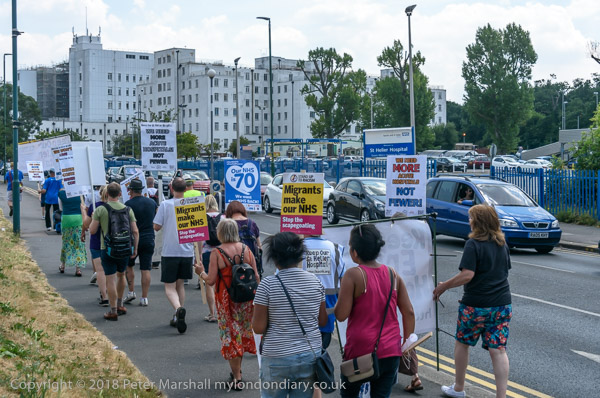
The protest march reaches the St Helier open space in front of the hospital

I don’t often go to Sutton, a town in South London, part of Surrey that was absorbed into Greater London in the local government reforms of 1965.  It really isn’t a place there is much to go there for, unless you need to shop, and there are plenty of other places for that.  I did spend a little time in the area in 1997  when I was photographing London and its buildings, though I think I found relatively little to interest me in Sutton itself. Since then then only time I can remember returning is when with seven friends we put on a photography show in the library there in 2007.

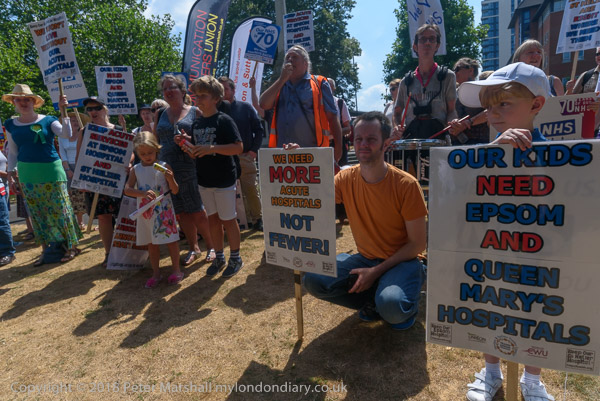
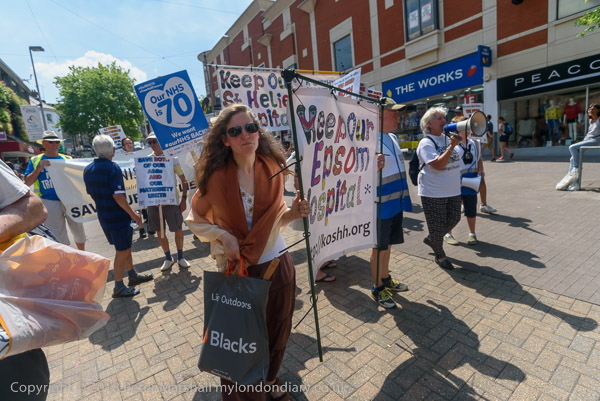
One of the campaigns that I’ve come across regularly taking part in various protests about the NHS, against cuts in services, creeping privatisation and hospital closures has been KOSSH, a slightly sinister sounding name standing for ‘Keep our St Helier Hospital ‘, and when I got an email telling me about their planned march celebrating the 70th anniversary of the NHS and against the plans of the Epsom and St Helier trust to close A&E, Maternity, Paediatrics, Emergency Medicine and Surgery, Intensive Care, Coronary Care and the Cancer Centre at one or both hospitals and sell off the sites, I was interested to join them and photograph the event.

Of course, as so often it wasn’t the only event I would like to have covered. Also taking place in Central London was the annual Pride march, which I’ve photographed most years since the early 1990s, as well as several other local events. But Pride isn’t what it was, and the march in particular has become such a corporate event that I’ve rather lost interest in photographing it. Last year’s event had been enlivened by the Anti-Racist & Migrant Rights Pride march, which had managed to take pride of place at the front of the main event (though only because they were not allowed to join the main march) but there appeared to be nothing like that planned this year, though later I heard that a group of anti-trans feminists had put in an appearance.

So my plan for the day had been to go to Sutton and photograph the march, then go into Soho and photograph on the streets there after the official march. But it was a very hot day, and by the time I had marched all the way to St Helier Hospital and photographed the short rally there,  I was exhausted, and caught the two trains to take me home for a cool drink and a rest.

St Helier Hospital (the site includes the Queen Mary children’s hospital) is one of the few buildings in the area that had attracted my attention back in the 1997, on high ground a mile or two north of the centre of Sutton, in one of the largest council-built estates in London. The St Helier Estate was a ‘garden city’ cottage  overspill estate built by the London County Council between 1928 and 1936 outside of London,  and with over 9000 homes was the largest such development by the LCC other than Becontree, and the hospital there, in a modern style, was opened in 1938.

Closing either of the hospitals would lead to longer emergency journeys in what is often a very congested part of London.  The full range of services would only be available at St Georges in Tooting. Back in 2003 I sat in an ambulance for around an hour stuck in traffic on my way there – until one of the medics accompanying me suggested I might have an emergency – and even then with blue lights flashing our progress was slow. The proposed cuts would reduce services at a time when needs are increasing and are proposed only to save money to meet government cuts which call for huge savings by the trust.

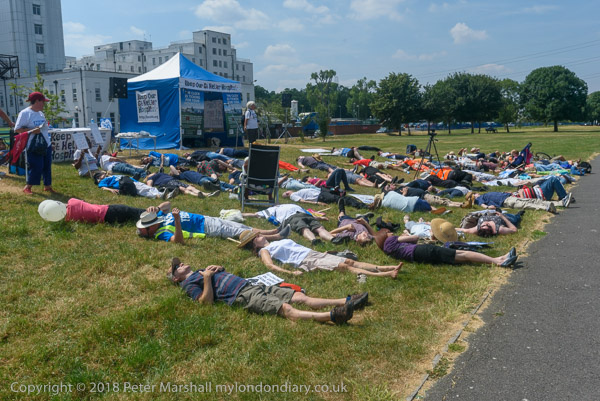
The die-in at the end of the march wasn’t huge, and quite a few of those who started the march, including several in poor health, didn’t manage to complete it in the summer heat, though I’m sure none actually died. But it made the point that hospital closures will lead to people dying, particularly those needing emergency treatment.

More at NHS at 70 – Save St Helier Hospital

______________________________________________________

There are no adverts on this site and it receives no sponsorship, and I like to keep it that way. But it does take a considerable amount of my time and thought, and if you enjoy reading it, a small donation – perhaps the cost of a beer – would be appreciated.

My London Diary : London Photos : Hull : River Lea/Lee Valley : London’s Industrial Heritage

All photographs on this and my other sites, unless otherwise stated, are taken by and copyright of Peter Marshall, and are available for reproduction or can be bought as prints.

To order prints or reproduce images

________________________________________________________
September 2018 complete


Class War visit the Rees-Moggs

September was an unusual month for me, partly because I spent quite a lot of it outside London, with a week in the western Lake District, then a family event that took me for another weekend up to Belper in Derbyshire.  I’ve included some pictures from both these in ‘My London Diary‘ because it’s convenient for me to have them here and also because I know some people who read the site would lke to see them.

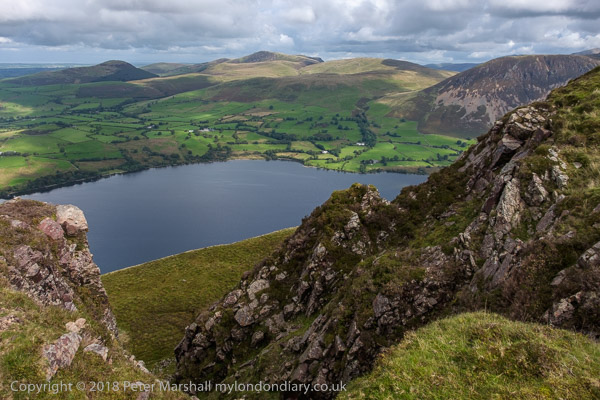
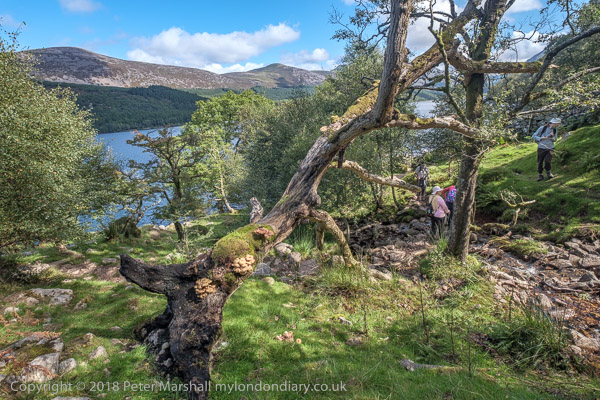
Ennerdale was interesting in several ways. I’ve been to the Lake District before quite a few times (starting with a day coach trip from Manchester during our honeymoon – and we were celebrating our 50th anniversary this year) but I’ve never really come to love it as I know many do, largely I think because much of it is infested with tourists. Of course I was one of them, but I do like to get away from the herd, and even some of the mountain tops there get crowded at times.

Ennerdale is still out of the way, and the plan is to keep it like that, with the area deliberately being allowed to go wild. You can’t drive though it, and the road that goes along much of its length has a gate so that only those with a key can take a vehicle along it. If you want to travel you have to walk, though I suppose you could also ride a bike. The landscape certainly isn’t on an Alpine scale and rather tamer than parts of Scotland, but wild enough.

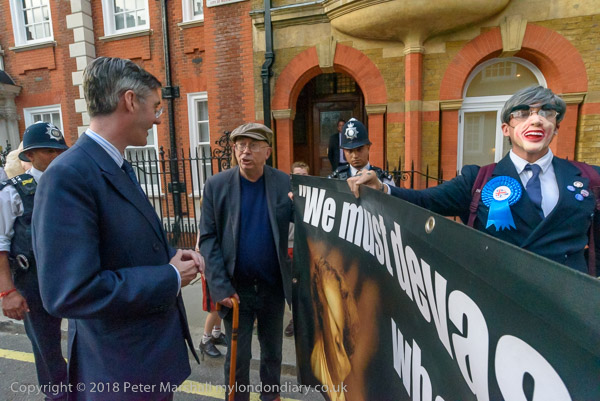
The story which attracted most attention was of course the visit of Class War to the Westminster home of the Rees-Moggs. It showed the media at their worst, failing to check the facts and bursting with ridiculous and unwarranted indignation based on a lack of understanding about what actually took place. And of course both Rees-Mogg and Class War revelled in the publicity. You can read the real and more amusing story on My London Diary.

my london diary

Sep 2018

Carter’s Steam Fair


Deptford Panoramas
Deptford Art & Gentrification Walk
Deptford Walk
Bethnal Green
Hands Off Amadiba


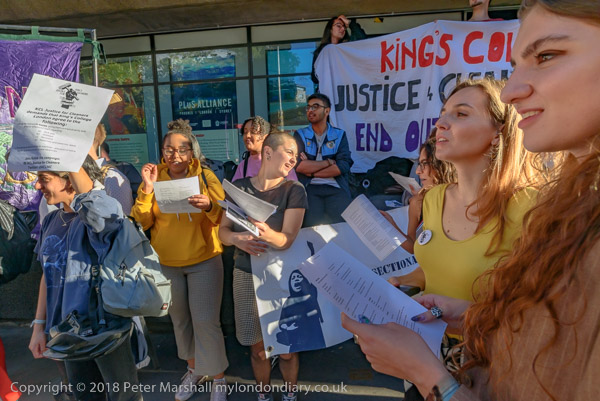
Kings College workers await council decision
End executions in Iran


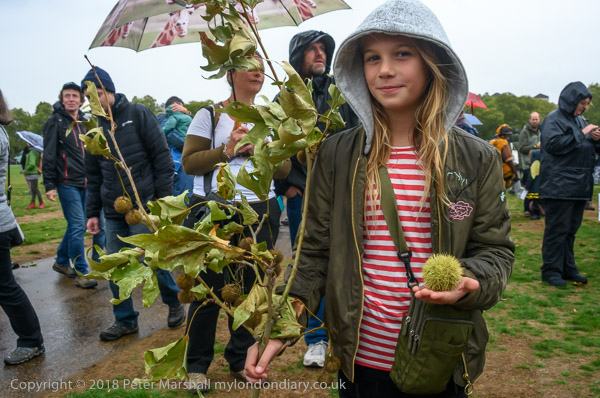
People’s Walk for Wildlife
Please feed the lions
Belper (& Birmingham)
100Women protest at BEIS


100Women against fracking
Trump told to close Guantanamo
Class War visit the Rees-Moggs


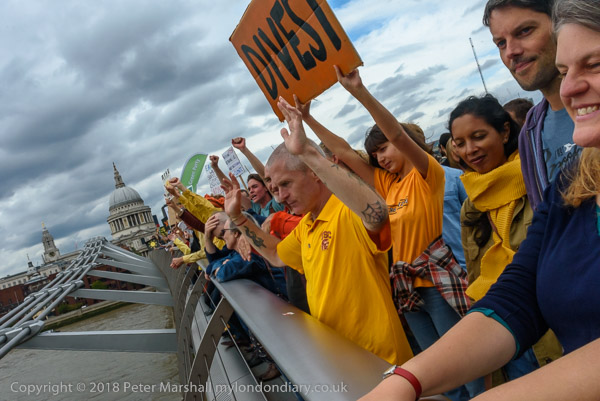
Worldwide Rise For Climate
Justice for Windrush descendants

Ennerdale Holiday
Penrith Castle


Crag Fell
A Lakeland Drive


Walking round Ennerdale Water
Whitehaven
Loweswater
Cleator Moor
Ennerdale Bridge
Ennerdale arrival

London Images

______________________________________________________

There are no adverts on this site and it receives no sponsorship, and I like to keep it that way. But it does take a considerable amount of my time and thought, and if you enjoy reading it, a small donation – perhaps the cost of a beer – would be appreciated.

My London Diary : London Photos : Hull : River Lea/Lee Valley : London’s Industrial Heritage

All photographs on this and my other sites, unless otherwise stated, are taken by and copyright of Peter Marshall, and are available for reproduction or can be bought as prints.

To order prints or reproduce images

________________________________________________________
The Elephant still says no, but council says yes

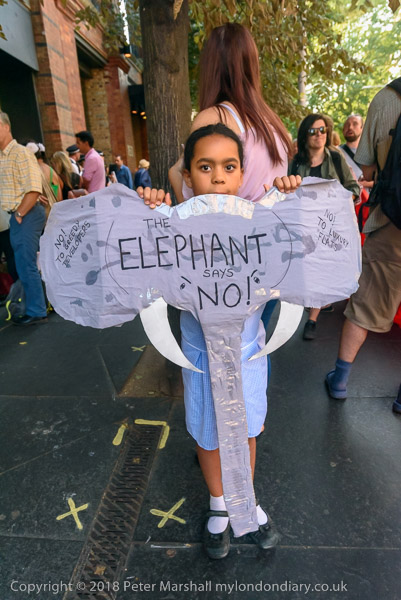
Minor changes to the plans to demolish the Elephant and Castle shopping centre have not changed the opposition to them by local residents and students at the London College of Communication but were enough to convince Southwark’s planning committee to vote narrowly in favour by 4 votes to 3.

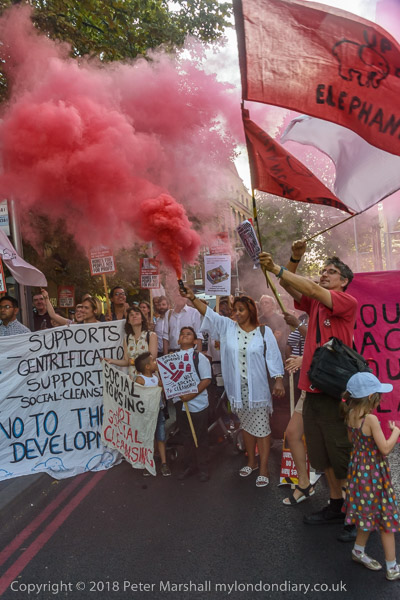
As the committee meeting started there was a loud and well-attended protest outside. The proposals by the developer still involve removing the working class and largely Latin traders and wider local community from the Elephant, in what is clearly social cleansing and further gentrification of Southwark.

The revised plans include only a low percentage of social housing and fail to meet local demands for affordable retail units, compensation for all traders and meaningful involvement and accountability for the people who live, work and study in the Elephant.

Like most such proposals by London’s councils – mainly Labour dominated councils – the development offers rich pickings for the developer, and realises the value of some publicly owned assets, with on the side a number of rather doubtful personal advantages for some councillors and council officials who get lavishly entertained by developers – and some move into lucrative jobs either with quasi-private council arms or working for developers. Local government in the UK has often involved a curious mix of municipal pride and profitable contracts or business advantages, but what was once a largely voluntary system of government has now become a rather well paid career for some of those involved.

While local councils – such as Southwark Council – once used to very clearly see their aim as working to improve the lives of the residents of their boroughs, particularly those in poor housing and low paid jobs, that vision now seems to have been lost. In part it is because of greater pressures and cuts by national governments that have forced many councils to cut services, but I think the major reason is in the rise of political careerists who lack the idealism that was once ingrained in so many. They see themselves as managers of a business rather than as working for the people.

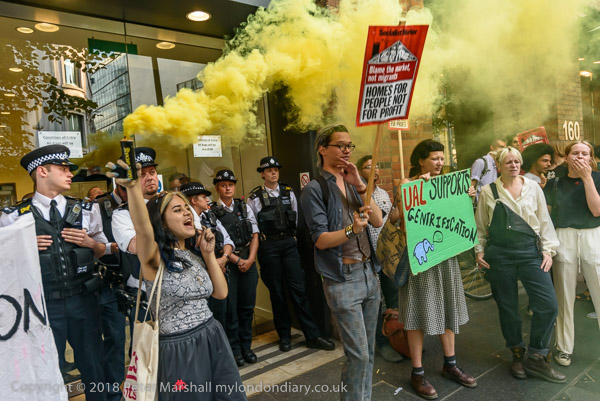
The protest was a lively one, with some good material for photographers. Coloured smoke always helps, though it presents some problems and probably isn’t good for the lungs. It’s something it’s easy to have too much off, with everything seen through a smoky haze, and you often need to move back and photograph from a distance.

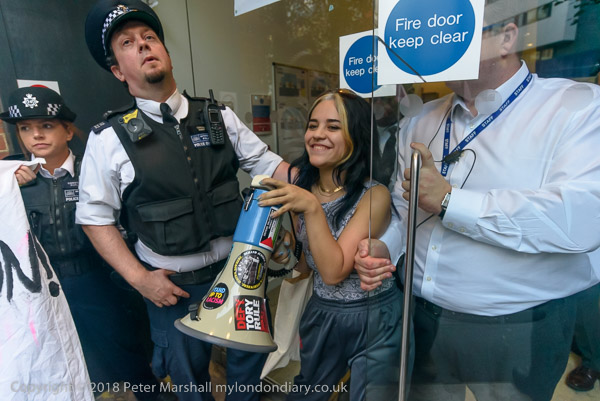
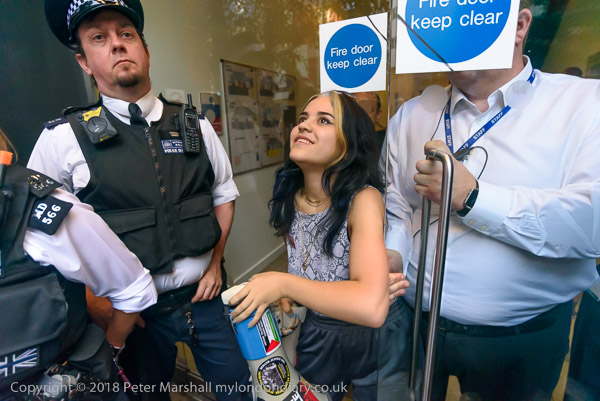
It’s good too when there is a little action, even when only symbolic, as when UAL’s campaigns officer Papaya Guthrie made an attempt to enter the council offices. At times like this it becomes vital to be in the right place at the right moment, and I had fortunately anticipated that something like this might happen. While I usually like to say that I record what people do at events rather than posing or telling them for the photograph, in situations like this the presence of a photographer does have some influence on events, and I’m sure that my presence and that of other photographers did encourage her. I think too that the police officer in this picture has just realised that his actions are being photographed – and this may have had some influence on him releasing his hold and moving back.

Fortunately the light was still good, although its generally a rather dim street, but it was only around 7pm on a July evening, as I was working in manual mode on the Nikon D750, and for some reason (or possibly just my fumble fingers again) had set the camera which was working on auto-ISO to a shutter speed of 1/1000 and the aperture on the 18-35mm lens to wide open. Though I think accidental, it was a fairly good choice for this situation, as the shutter was fast enough to avoid any camera shake (in a crowded situation you usually get jostled) or subject movement, and since I was so close I was working at short focal lengths – 18 and 20mm for these two pictures – and even at f3.5 there is considerable depth of field.

I rarely chimp. Looking down at an image on the rear of the camera loses your contact with the subject and your concentration. And working with Nikon’s auto-ISO it becomes far too easy to either totally under or over expose images when you go out of the ISO range set. But here it worked fine, though at ISO 4,500 these pictures are visibly rather noisy. I could have got smoother images working at a lower ISO but it didn’t matter, though there are some other pictures – both with the D750 and the D810 where I was also using auto-ISO where noise does become an issue. Lightroom can do a decent job in minimising it, but high ISO also reduces detail in images and without some noise can produce rather ‘plastic’ skin tones like make-up applied with a trowel. It’s a look some like but not to my taste. And within limits, like the grain on Tri-X, Nikon noise is not unattrative.

Eventually Ms Guthrie was eased away from the door by a woman police officer and her foot pushed out by security and, surrounded by officers she was moved a yard or two forward. After moving in to photgraph her with the police around, taking my usual care not to get in their way, I moved back, partly to allow other photographers to get pictures too. I’d been the only one in position to get pictures earlier, but by now a couple of others taking pictures had moved around and I wanted to get out of their way. And when she took out a smoke flare from her bag and set it off I was far enough away not be be engulfed by the smoke.

More text and pictures at Refuse plans to destroy the Elephant

______________________________________________________

There are no adverts on this site and it receives no sponsorship, and I like to keep it that way. But it does take a considerable amount of my time and thought, and if you enjoy reading it, a small donation – perhaps the cost of a beer – would be appreciated.

My London Diary : London Photos : Hull : River Lea/Lee Valley : London’s Industrial Heritage

All photographs on this and my other sites, unless otherwise stated, are taken by and copyright of Peter Marshall, and are available for reproduction or can be bought as prints.

To order prints or reproduce images

________________________________________________________
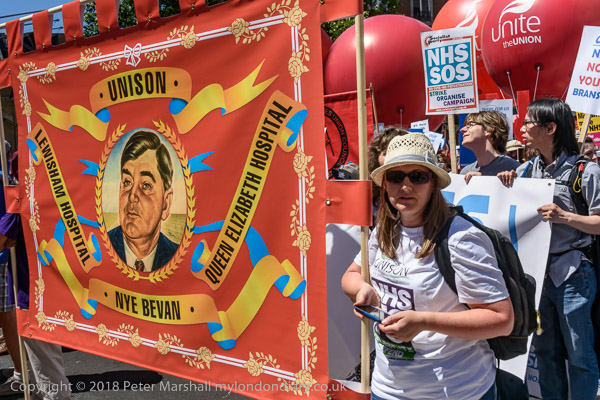
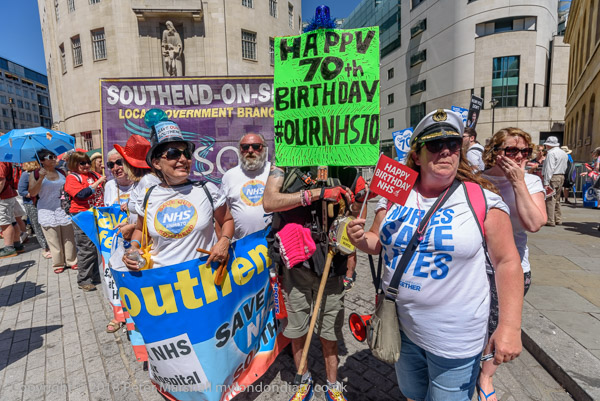
NHS 70

I was born before the start of the NHS but it has been there for almost all of my life, there when I’ve needed it. Some of my earliest memories are of going to the clinic where my mother was given free orange juice, which I loved, though I remember it as being rather viscous and sweet compared to the orange juice I now drink every morning at breakfast. And they also gave her cod liver oil, which was rather difficult to get me to take, though I’m now sure it did me good.

Of course the NHS wasn’t then welcomed by everyone, and was brought in against considerable opposition, both from doctors and from inside the Conservative Party. And it has never been perfect; in particular dentistry has never really been properly brought within the ambit of a health service to meet the three core needs set out by Aneurin Bevan:

  • that it meet the needs of everyone
  • that it be free at the point of delivery
  • that it be based on clinical need, not ability to pay

and there were years when I couldn’t afford NHS treatment that have left a legacy in my current lack of real bite (though I get by.)

But even with this, we have moved far beyond the days of my parents, when the extraction of all of a person’s teeth and their replacement by a “full set” was a popular (and quite expensive) coming of age or wedding present. They woke every morning to see their teeth grinning at them on the bedside table in a glass tooth-mug, soaking in some tooth wash and part of the routine of rising was to put their teeth in.

There have of course been many medical advances since July 5th 1948, and treatment under the NHS has improved greatly. When I think of the many treatments I’ve received over the past fifteen years that have kept me alive and more or less fit to work, about the only ones that would have been available back in 1948 were aspirin and the concerned care of doctors and nurses.

There have been some set-backs too. Many were appalled at the introduction of prescription charges by the Conservative government in 1952 (the 1949 Act by a Labour government had made this possible – and led to Bevan’s resignation.) They were free again for three years in the 1960s and are now £8.80 per item, 176 times the 1952 rate, though actually rather greater than this as the initial charge was ‘per form’ and since 1955 it has been ‘per item’. The amount these charges raise is relatively small in terms of the NHS budget, perhaps around £400m, mainly because almost 90% of prescribed items go to those of us who qualify for free prescriptions.

While prescriptions are now free for people living in Wales, Scotland and Northern Ireland, our current government has announced a crackdown on faudulent claims for free prescriptions in England, an expensive sledge-hammer to crack an insignificant nut. Many of those currently accused of having falsely claimed to be eligible are found to actually qualify for exemption, but have simply not applied or not kept their paperwork up to date.

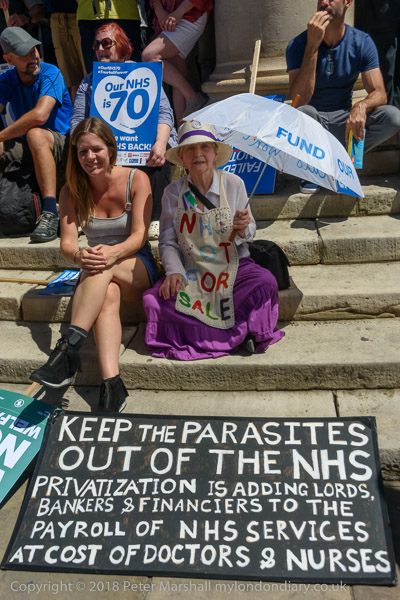
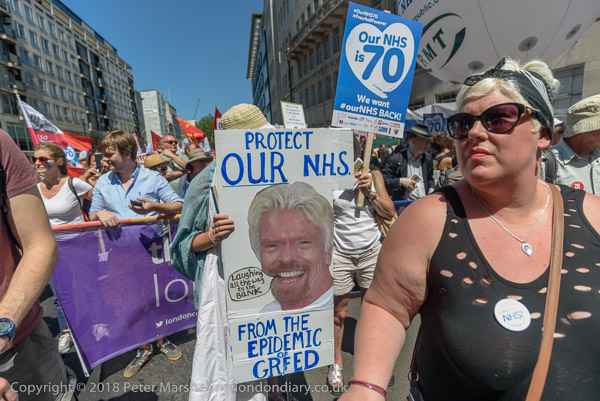
The prescription crack-down is perhaps simply and example of the general Conservative apoplexy at the idea of people getting something for free that they or their friends could be profiting from. More and more aspects of our NHS treatment are now being handed over to private companies to deliver, and the NHS is continually being weakened by this back-door privatisation, sliding slowly into the hands of healthcare businesses. And once this process is more or less complete – unless we get a government that reverses it – those companies will be keen to go further, to move to a US-style insurance-based system with exorbitant medical costs and people being turned away because they have conditions their insurance does not cover or because they have been unable to afford the insurance payments.

And, as I point out on My London Diary, those in government who legislate the future of our NHS have considerable legal and declared financial interests (as well as others with interests that for legal reasons they are not obliged to declare) :

“A report by Social Investigations in 2014 found 65 Conservative peers, 12 Lib-Dem peers, 37 Labour peers and 33 Crossbenchers with interests in private healthcare companies, as well as 63 Tory MPs, 3 Lib-Dems, 14 Labour members and one other. Some held directorships, others were shareholders or had received payments from companies for various services etc.”

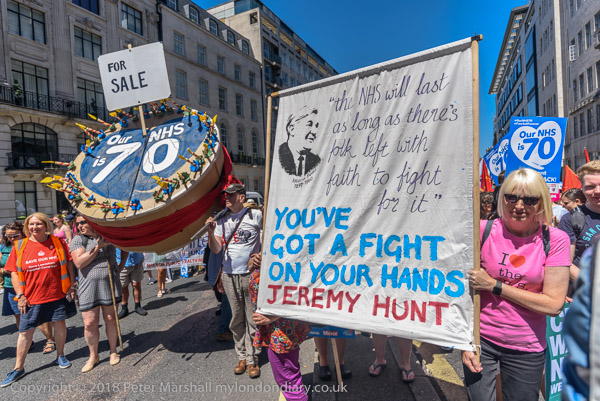
Aneurin Bevan never actually said “The NHS will last as long as there’s folk with faith left to fight for it” though he certainly did say that people would have to fight to keep it and its principles alive. At no time in its history has it been so much under threat as now, and this march showed that there were still people prepared to fight for it, though it is hard to be confident that we will win. I’m hopeful that it will see me out, but fearful that its demise might see the death of me.

More text and far too many pictures including those of the speakers and politicians supporting the event at NHS at 70 – Free, for all, forever

______________________________________________________

There are no adverts on this site and it receives no sponsorship, and I like to keep it that way. But it does take a considerable amount of my time and thought, and if you enjoy reading it, a small donation – perhaps the cost of a beer – would be appreciated.

My London Diary : London Photos : Hull : River Lea/Lee Valley : London’s Industrial Heritage

All photographs on this and my other sites, unless otherwise stated, are taken by and copyright of Peter Marshall, and are available for reproduction or can be bought as prints.

To order prints or reproduce images

________________________________________________________
Clocks and Buildings

Two unrelated issues, the first rather brief.

Clocks

Firstly a reminder to those – like me – who have yet to adjust the time settings on your cameras to do so without further delay. On my Nikon cameras it only takes a few seconds to go to the Setup menu, select Time Zone and Date and turn Daylight Saving Time to OFF, but it takes a little longer to find anything on the Fuji menus, once you have made them appear on the rear screen. If you have the Local time set for Daylight Saving you then simply have to select Home.

I got up in the middle of my typing above and made the changes on the four cameras I frequently use. Job done until we get the light back next year.

Buildings

Secondly, photographing buildings, something I was reminded of by an image I shared with the previous post – and here it is again. I’ve just come across a very clear answer to the question of copyright at the IPCopy blog so far as UK law is concerned – with a clear statement that “there is an express exception to copyright infringement under the CDPA 1988 which allows photographs or indeed a film to be made”  and to be published in any way of any building in the UK.

So far, so good. Unfortunately the answer goes on to say that in some cases “in some cases permission may be required to use the photograph” and goes on the mention the Committee of Advertising Practice Code. You can actually find this advice on the ASA web site, where it basically states that buildings and general public locations can be used “without permission so long as they do not denigrate the building or area in question.”  It goes  on to state that recognisable properties owned by “members of the public” require permission.

Perhaps the main area that the IPCopy post does not make clear is the matter of Trademarks, which I’m sure they know far more about than me.  The most interesting discussion I’ve come across of this issue is The London Skyline – an IP view by Leighton Cassidy and Beverley Potts of Fieldfisher LLC written in 2016. In the section on ‘Corporate Branding’ they discuss the use of trademarked buildings suggesting that limitations only apply if the photograph uses the building as a trade mark, or relates to similar goods and services or dilutes or profits from the reputation of the brand.

Although it seems to me that none of these could apply to editorial or most artistic uses of the image, some trademark owners have clearly adopting a bullying approach, threatening any use with expensive litigation. And photo agencies have allowed themselves to be browbeaten into the strictly unnecessary removal of some images.

UK copyright law also has specific exceptions to allow us to photograph and publish pictures of sculptures, models of buildings and works of artistic craftsmanship permanently situated in a public place. I’m not sure what constitutes a ‘work of artistic craftsmanship’, but the legislation makes clear that this does not apply to paintings or literary works, so all those millions of internet posts of graffiti (almost rivalling cats) are at least technically copyright infringements. Though I post some on my own web site, I don’t generally file them with agencies and some at least will not accept them. And I run a cat filter on my Facebook feed.

Unless of course the copyright material is included incidentally, though exactly how that should be interpreted is unclear. Perhaps as a rough rule of thumb you might ask yourself if you would have taken the photograph had that material not been present and if your image focuses (not necessarily literally) on that material. Fortunately also in the UK we have a copyright system where any damages are compensatory rather than punitive, which greatly limits the desire for litigation.

So, aside from a few specific limitations covering military and similar sites you should feel free to photograph any building in the UK (or more or less anything else) and generally to publish those images for non-commercial uses. For commercial use, you and any client need to think more carefully – and I would be very wary about signing any indemnity clauses. But as always with anything involving the law I end with a statement that “I am not a lawyer” (IANAL) and you take my advice and opinions entirely at your own risk.
______________________________________________________

There are no adverts on this site and it receives no sponsorship, and I like to keep it that way. But it does take a considerable amount of my time and thought, and if you enjoy reading it, a small donation – perhaps the cost of a beer – would be appreciated.

My London Diary : London Photos : Hull : River Lea/Lee Valley : London’s Industrial Heritage

All photographs on this and my other sites, unless otherwise stated, are taken by and copyright of Peter Marshall, and are available for reproduction or can be bought as prints.

To order prints or reproduce images

________________________________________________________
US Torture protest

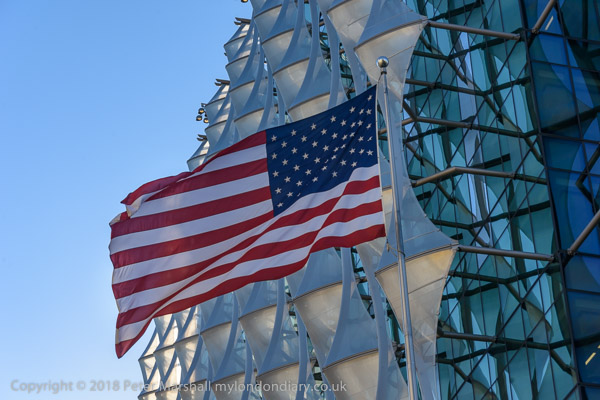
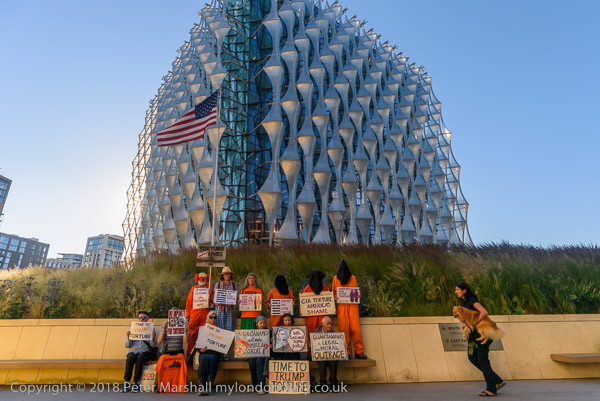
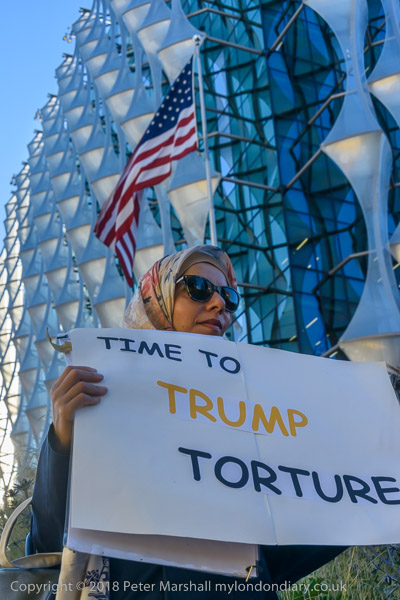
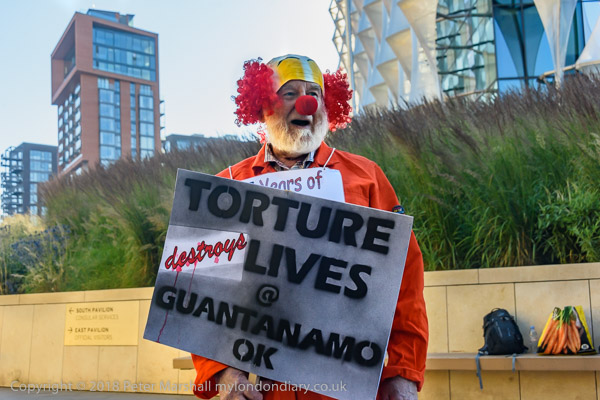
The trouble with protesting outside the new US Embassy in London is that almost nobody sees the protest. The area around is still something of a building site, and even when the tall blocks of flats around are completed and sold, relatively few of them will be inhabited, with many going as investments to overseas investors, few if any of whom will actually ever live there and many will never even visit.

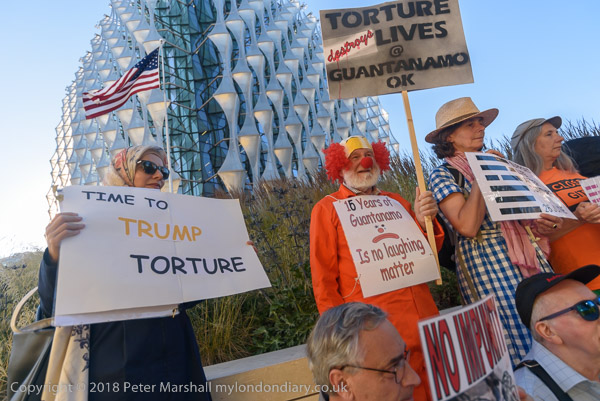
The path around the embassy leads nowhere; only those going to the embassy on business will use it, and the protest I was going to photograph was timed for after the embassy was closed. The only people who came to see what was happening were the police and security on duty, as well as one embassy employee in a suit who came briefly and took a few photographs.

So my photographs – and those taken by some of the protesters – are the only public face of the protest, and while mine have appeared on Facebook and on my own web site, as well as on the site of the agency I sent them to, they have not yet been sold for any use. Guantanamo is no longer considered news by the media, and there are no longer any detainees with a UK connection that might make them so for the UK press.

It would be slightly more public to hold this and other protests on the main road in front of the embassy, but it is set back well from the road, and some of the connection would be lost. But at least the protest would be seen by those going along the road, which at the rush hour does have a number of pedestrians, cyclists, cars, buses and other vehicles passing – rather busier in total than the old venue in Grosvenor Square. Or perhaps there is somewhere ele in London sufficiently connected with the US as to be a suitable site for protest?

So while the protesters put in time to make their way to this rather out of the way place, and I worked hard to exploit the visual possibilities of the situation – in some ways rather more exciting than Grosvenor Square, if nobody actually sees the protest itself or the photographs, our time and effort is rather wasted. Torture continues at Guantanamo and I fear this and similar protests will have little effect in stopping it.

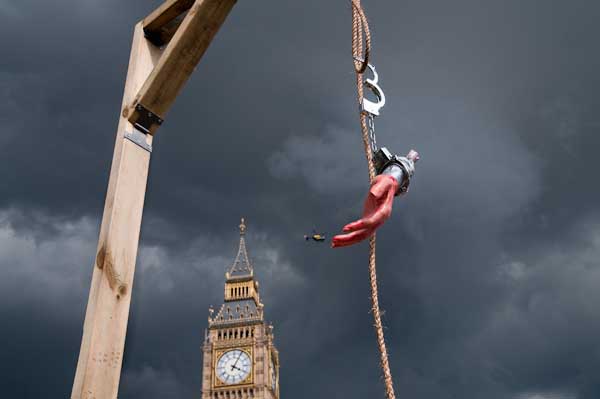
You can see more pictures from the protest at Torture protest at US Embassy and please feel free to share the pictures and this post. The images (except for the top one, which I didn’t send as it wasn’t a part of the protest) are available for editorial use from Alamy though almost impossible to find through their rather opaque search system.

______________________________________________________
There are no adverts on this site and it receives no sponsorship, and I like to keep it that way. But it does take a considerable amount of my time and thought, and if you enjoy reading it, a small donation – perhaps the cost of a beer – would be appreciated.

My London Diary : London Photos : Hull : River Lea/Lee Valley : London’s Industrial Heritage

All photographs on this and my other sites, unless otherwise stated, are taken by and copyright of Peter Marshall, and are available for reproduction or can be bought as prints.

To order prints or reproduce images

________________________________________________________