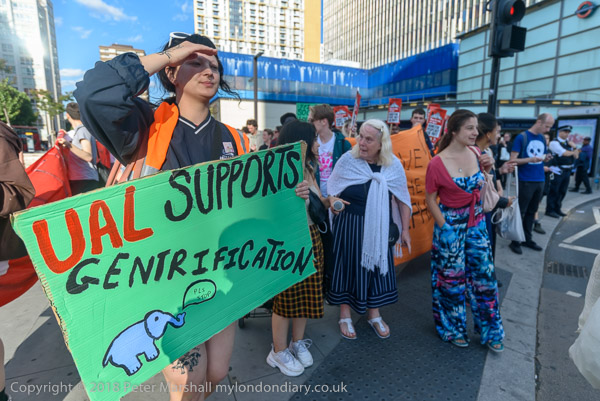
March for a People’s Vote

So much about Brexit and the way we are moving away from Europe makes no sense. Referendums don’t really fit into our constitution, but they are clearly not binding, but Prime Minister Cameron staked the future of the country on one and clearly lost. Since that decision, Theresa May spent most of her time digging a deeper hole to appease the Conservative right, only too late to come to the realisation that negotiations mean you have to negotiate, too little and far too late with her Chequers proposals.
It seems most likely that no deal will be made, and that if one is it would not be able to get a majority in Parliament. So the government is trying hard to find procedural ways to avoid giving MPs the meaningful vote they were promised. Whatever happens then is anyone’s guess, but it seems likely that the government will fall, and my only hope is that a new government will come in which will go back to Europe and make a sensible deal, probably involving us remaining inside the customs union.

We are clearly however in a situation where almost nothing is impossible, but in the short term for most of us things are going to be tough, while a few of the most prominent advocates of leaving the EU will literally be laughing all the way to the bank, having made a financial killing at the country’s expense.
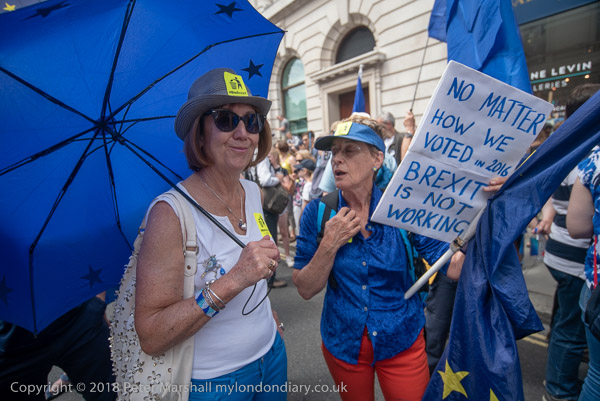
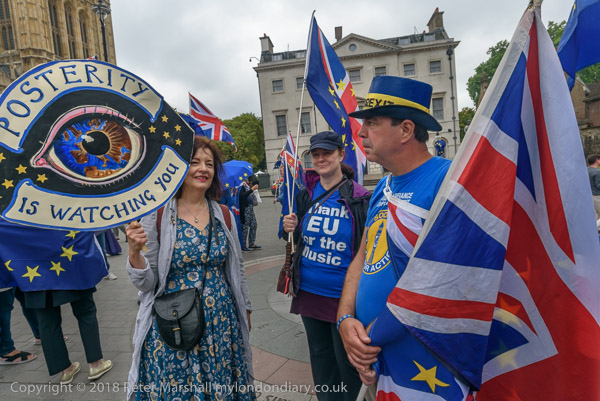
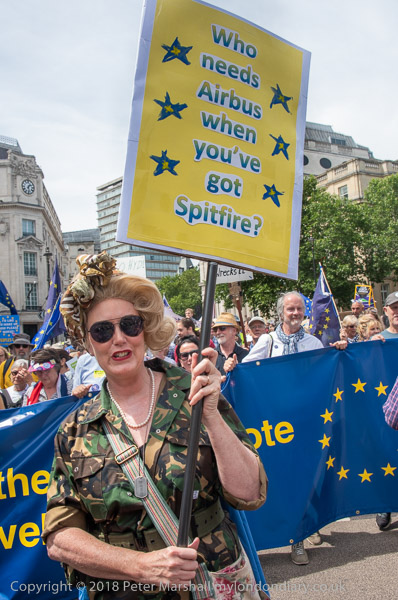
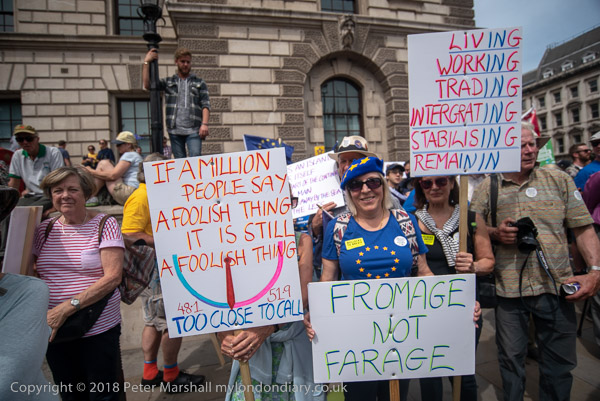
Quite where a ‘People’s Vote‘ would fit in I’m not sure. Nor I think are all those running the campaign, which for some at least is simply another way to attack Jeremy Corbyn. But for most I think it was something much more positive, and expression of their wish to remain closely tied to the rest of Europe and continue the kind of free movement we have enjoyed.
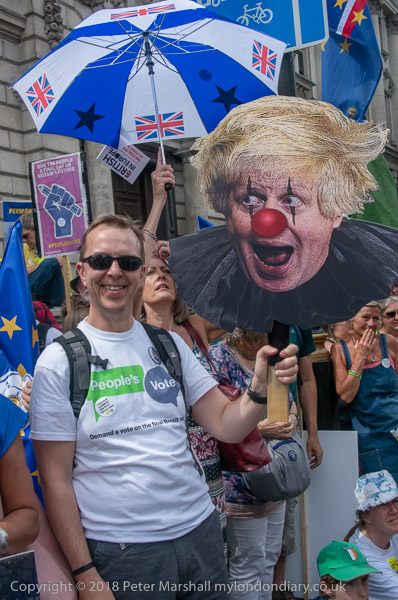
What is beyond question is that the British public were lied to at the time of the referendum – and that the huge majority of the lies came from those promoting Brexit. There was also considerable breaking of the rules on election spending, again mostly from the same side. Most of those who voted to remain feel cheated, as do a significant number who voted leave, some of whom have expressed their feelings strongly on the matter.
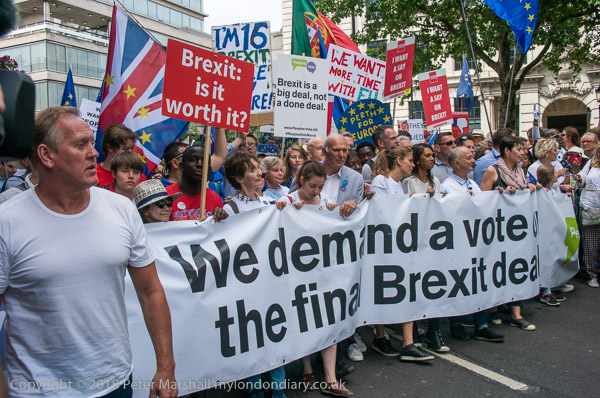
Although opinion polls now show a good majority would vote to stay in Europe, a second referendum would involve a second campaign when dedicated Brexiteers would be strengthened by calling ‘Foul!’ and those running a second Brexit campaign indulging in the same lying and cheating that won the first. Hopefully the lies would be less convincing second time round, and enough of the older voters who gave Brexit their small majority will have died and been replaced by young voters who see their future in Europe to reverse the first vote, but I’m not entirely convinced the result would be different.

Many more pictures at Many Thousands March for a People’s Vote

______________________________________________________

There are no adverts on this site and it receives no sponsorship, and I like to keep it that way. But it does take a considerable amount of my time and thought, and if you enjoy reading it, a small donation – perhaps the cost of a beer – would be appreciated.

My London Diary : London Photos : Hull : River Lea/Lee Valley : London’s Industrial Heritage

All photographs on this and my other sites, unless otherwise stated, are taken by and copyright of Peter Marshall, and are available for reproduction or can be bought as prints.

To order prints or reproduce images

________________________________________________________
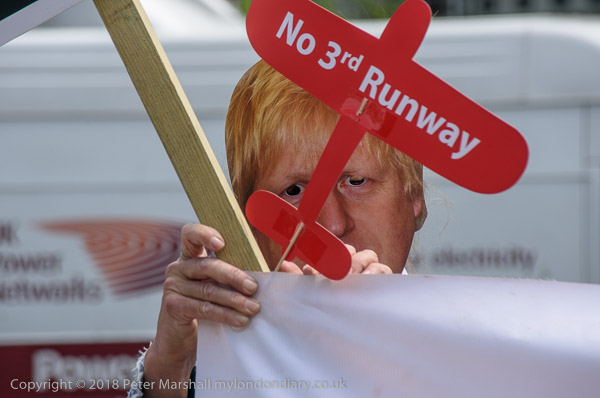
No Third Runway

Although the arguments for building an extra runway at Heathrow seem now to be even weaker than when it was ruled out back in 2009 and those of us who live near the airport celebrated, and the arguments against far clearer, well-funded lobbyists have managed to put it back on the political agenda, reviving what seems clearly a corpse. Politically it is quite a curious mixture, with some trade unions supporting airport expansion, along with aviation industry figures.

Brexit has also played a part, with prominent Brexiteers supporting expansion as necessary to increase our trade with the rest of the world after we leave Europe, though Boris Johnson who opposed the third runway when Mayor of London, and is now MP for Uxbridge, which would be adversely effected has promised if necessary to lie down in front of the bulldozers. Of course, as he was then Foreign Secretary and thus a part of the cabinet he would have been obliged either to vote for the Government motion or resign when the vote came on the Monday after these protests – and he conveniently found some mythical Foreign Office business to take himself out of the country.

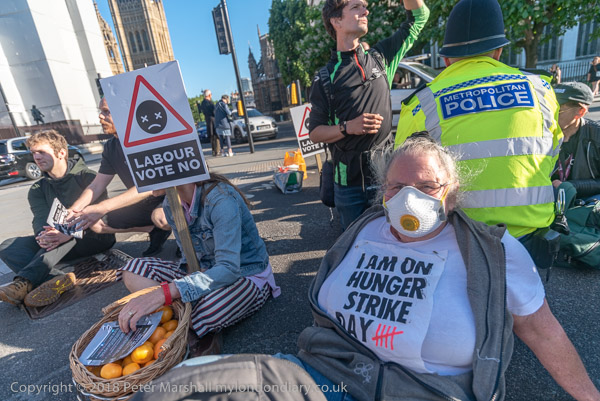
A small group of people had been protesting with a two week hunger strike outside the Labour Party HQ (though they had been elsewhere when I went to try and photograph them) and most of them came to take part in both the Friday evening protest and on Saturday.

As I wrote in My London Diary in June:

“Heathrow expansion would be a disaster not just for those who lose their homes or would suffer increased pollution under the flight path in a city with already dangerous and often illegal levels of pollution thought to result in around 10,000 premature deaths in London each year, but will add the the already growing threat of irreversible climate breakdown that could threaten the future of human life on the earth.”

The recent report by the Intergovernmental Panel on Climate Change will I think change the game so far as aviation is concerned – as well as on many other issues, forcing even our current government to take more environmental issues far more seriously. Aviation is of course a global issue, and there will be considerable pressures from many other countries which are likely to make the growth forecasts on which the Heathrow decision was based totally absurd.

Despite the vote which came on the Monday following these protests it is very unlikely the third runway will ever be built.  Brexit and the economic crisis that will precipitate will almost certainly lead to its cancellation on cost grounds, and the disruption the building would cause to traffic around London is unthinkable. Politically also any attempt to go ahead with the project on the ground is likely to be impossible, and it seems almost certain that the next government – of whichever party or coalition –  will reverse the decision.

More at:
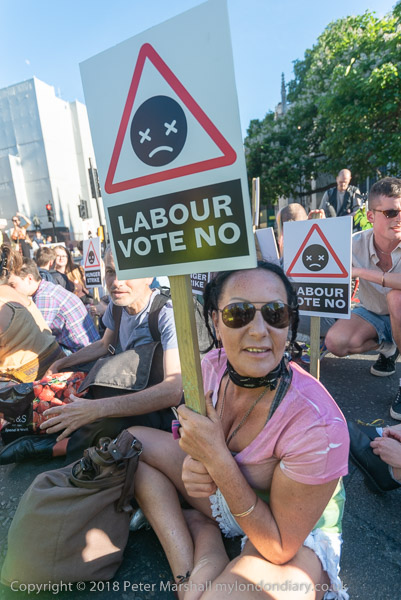
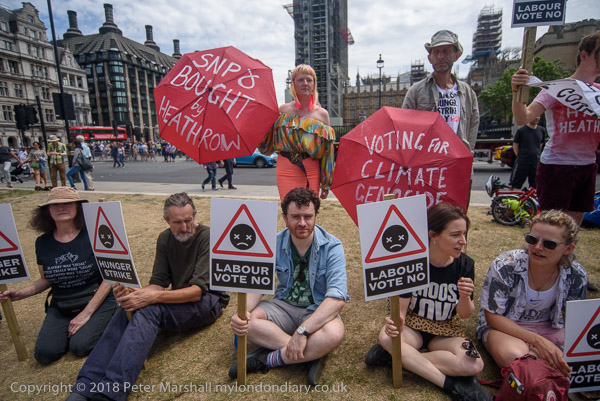
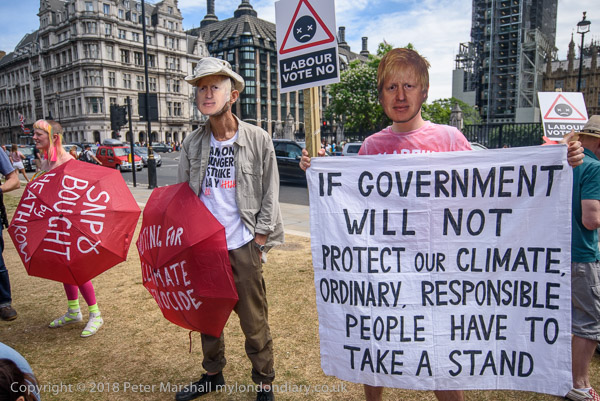
No Heathrow block Parliament Square
Vote No to Disastrous Heathrow Expansion
______________________________________________________

There are no adverts on this site and it receives no sponsorship, and I like to keep it that way. But it does take a considerable amount of my time and thought, and if you enjoy reading it, a small donation – perhaps the cost of a beer – would be appreciated.

My London Diary : London Photos : Hull : River Lea/Lee Valley : London’s Industrial Heritage

All photographs on this and my other sites, unless otherwise stated, are taken by and copyright of Peter Marshall, and are available for reproduction or can be bought as prints.

To order prints or reproduce images

________________________________________________________
Up the Elephant

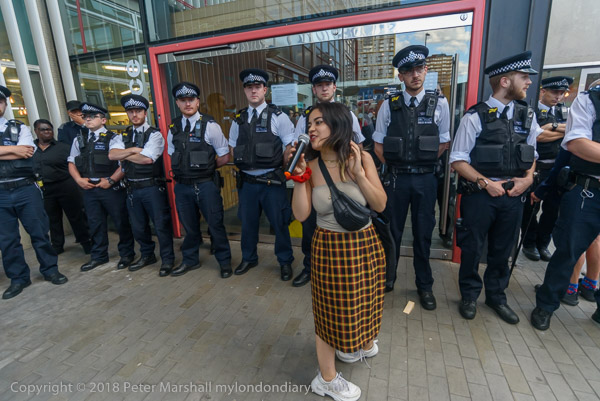
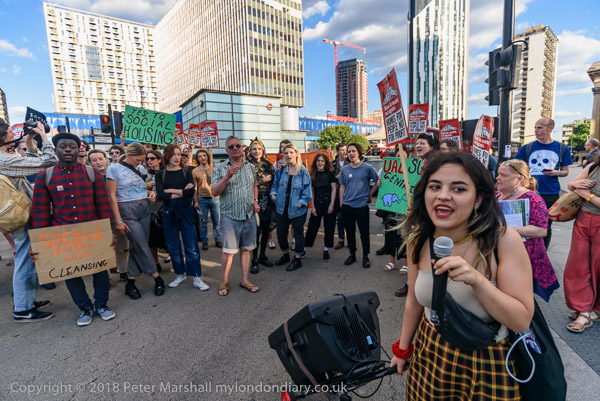
It’s rather a cliche, but I still like it, the one protester and the line of police protecting the status quo, in this case the London College of Communication. But of course it isn’t the whole story and turning my camera around roughly 180 degrees shows a very different picture.

The fight was not so much to save the Elephant & Castle as it currently exists, but to see it developed in the interest of the community who currently live around and use the area, particularly the small market traders, the Latino community and the local residents, rather than a ‘regeneration’ that benefits the developers, the big businesses that will open their shops in the new centre, and the overseas investors who will buy many of the new flats simply as investments rather than for people to live in. And while the University of the Arts will get improved facilities (their current building dates from when the London College of Printing moved here in 1962), the education that working in a vibrant community provides for its students will be lost.

The struggle to improve the plans continues, even though Southwark Council narrowly passed the plans following some minor concessions made by the developers to meet the demands made by the local campaigners. But unfortunately the new shopping centre, though almost certainly more attractive looking than the currently widely despised building, will probably have all of the sterile emptiness of Westfield, though on a smaller scale, attracting people from a wide area rather than serving the locality.

Built in the 1960s, when it opened in March 1965, it was hailed as the first covered shopping mall in Europe and argest and “the most ambitious shopping venture ever to be embarked upon in London”, but was hampered by budget cuts. Although inside it now seems rather small and claustrophobic compared to more recent malls, but is on a more human scale, and has shops that serve local needs, as well as a thriving market that has grown up around it, in particular with over a hundred small Latin-American businesses.

I think everyone agrees that some redevelopment of the centre is necessary, but any local authority that truly represented its residents would have made strenuous attempts to protect the interests of these and other local businesses, insisting that the developer provide a similar amount of low-cost market space in the new development. But all that has been provided, even after the protests are some rather vague promises and a small relocation fund.

The protests have also resulted in a some increase in the number of affordable homes in the development, although only around 12% of the 979 residential units will be at ‘social rents’, and the overall proportion of 35% ‘affordable’ properties is likely to be reduced by fancy accountancy during the construction which will allow the developers to claim this ‘impacts viablity’, reducing their profits below an exorbitant 20%.

Southwark Council has a long history of scandalous so-called ‘regeneration’ projects, selling off the interests of its local population to developers at cut-down prices, including the demolition of the Heygate Estate and the currently continuing demolition of the Aylesbury Estate and other schemes elsewhere in the borough. Unfortunately the Labour dominated council is still dominated by right wing ‘New Labour’.

Protesters Stand Up For The Elephant

______________________________________________________

There are no adverts on this site and it receives no sponsorship, and I like to keep it that way. But it does take a considerable amount of my time and thought, and if you enjoy reading it, a small donation – perhaps the cost of a beer – would be appreciated.

My London Diary : London Photos : Hull : River Lea/Lee Valley : London’s Industrial Heritage

All photographs on this and my other sites, unless otherwise stated, are taken by and copyright of Peter Marshall, and are available for reproduction or can be bought as prints.

To order prints or reproduce images

________________________________________________________
The Isle of Dogs…

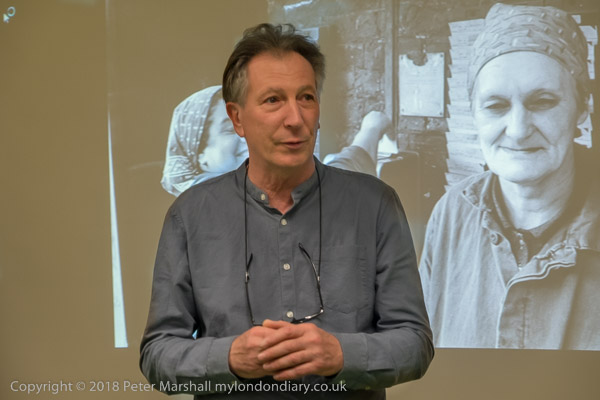
Thursday night last week I went to the launch of Mike Seaborne‘s book, ‘The Isle of Dogs: Before the big money‘ appropriately held on the Isle of Dogs in Cafe Vert at George Green’s School, a few yards from Island Gardens DLR station.

Mike is an old friend who I met not long after he was taking the pictures in this book, and we then found that we had both been photographing the area at the same time. But while I was just an occasional visitor to the area with a general interest in what was happening across London (and in across Docklands in particular), he became very much more involved in the community of this particular area, as this work shows. Of course, as you can see from his web site, he has also photographed widely across London and elsewhere.

MikeSeaborneCover
Image Copyright Mike Seaborne

It was good to see this work published by Hoxton Mini Press, who I think have done a fine job with this volume which is a part of their series ‘Vintage Britain‘. You can judge for yourself on their web site, which shows the cover and ten double-page spreads from the work, and says:

“Now home to Canary Wharf and global finance, the Isle of Dogs was once the beating heart of industrial East London. These photographs, taken between 1982 and 1987, show the island just before the big money moved in and the area was forever transformed.”

and of course you can buy a copy on-line.

Mike began to photograph London in 1979 and until 2011 was Senior Curator of Photographs at the Museum of London.  A group of photographers including Mike and myself have also organised a number of shows over the years, and you can still see work from several of these, including ‘Another London‘, on the web, and much more of Mike’s work on his own web site. Back in 2002 we set up a site together to celebrate Urban Landscape photography, featuring our own work and that of other photographers from the UK and around the world.

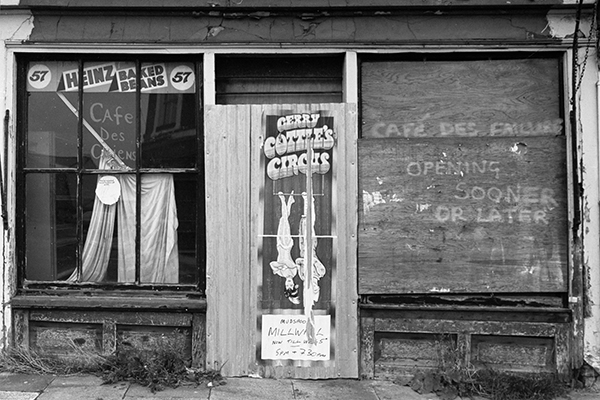
A few of my own pictures from the Isle of Dogs can be seen in the preview of my City to Blackwell on Blurb, the first of five books in my Docklands series. With both of us wandering around the area at about the same time, there are a few similar images. What photographer could resist this shop-front? Here is one of several pictures I took:


you can see Mike’s in his book, and also on his 80sIslandPhotos.

Mike has continued to be involved with the community he photographed back in the 80’s and this was evident at the opening, from which I’ll perhaps post a few more pictures later.

______________________________________________________

There are no adverts on this site and it receives no sponsorship, and I like to keep it that way. But it does take a considerable amount of my time and thought, and if you enjoy reading it, a small donation – perhaps the cost of a beer – would be appreciated.

My London Diary : London Photos : Hull : River Lea/Lee Valley : London’s Industrial Heritage

All photographs on this and my other sites, unless otherwise stated, are taken by and copyright of Peter Marshall, and are available for reproduction or can be bought as prints.

To order prints or reproduce images

________________________________________________________
Assange – Six Years

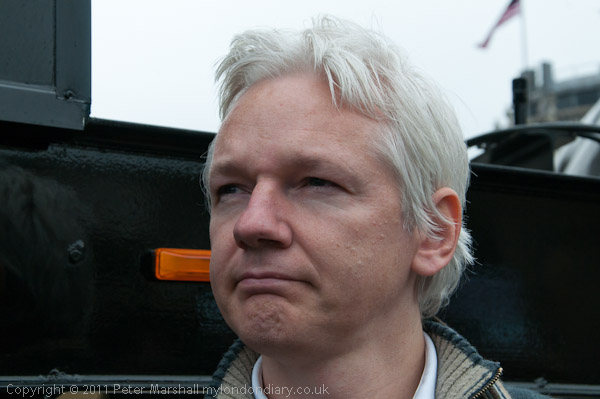
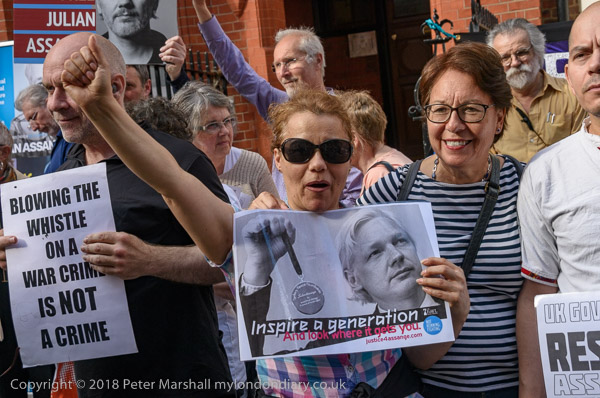
I didn’t warm to Julian Assange as a person when I briefly met him in 2011, but I guess he had other things on his mind.  But when various allegations were made about his conduct with women in Sweden it did seem that a case was being constructed on rather flimsy ground  – and later dropped – to try to enable the US authorities to get their hands on him. They wanted to lock him up in isolation for life for revealing illegal and immoral activities by the US military and security services to the world.

I’m a supporter of freedom of information, and think that Wikileaks is carrying out a great service in releasing information which the US and other governments were keeping hidden; Wikipedia comments:  “Supporters of WikiLeaks in the media and academia have commended it for exposing state and corporate secrets, increasing transparency, supporting freedom of the press, and enhancing democratic discourse while challenging powerful institutions.”

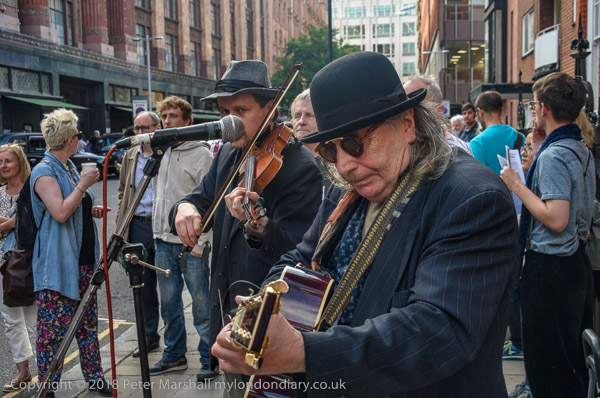
It came as a surprise to realise that Assange had been inside the Ecuadorian embassy in London for 6 years on 19th June 2018, though I have been there a number of times and photographed his supporters on the pavement opposite. Our government is too scared of upsetting the USA to allow Ecaudor some way to fly him to their country and has spent huge sums on security to prevent this happening. Ecuador has come under increasing pressure from the US to hand him over, and have for some months been refusing access to him and have taken away his internet connection – though recently announcing some limited access  following a visit to the country by the UN Special Rapportuers for Freedom of Expression & Refugees, this does not yet appear to have been implemented.


Ciaron O’Reilly

The BBC has been accused of publishing fake material and misleading statements in many of its reports on Assange – and certainly along with most other UK media has adopted a very negative attitude towards him. A recent article on the BBC website about the lengthy Special Protocol recently imposed by Ecuador on him quoted a statement clearly from a parody account as being by him. The new protocol appears to many to be designed to provide Ecuador with a pretext to withdraw diplomatic immunity in the event of some minor transgression of its draconian terms.


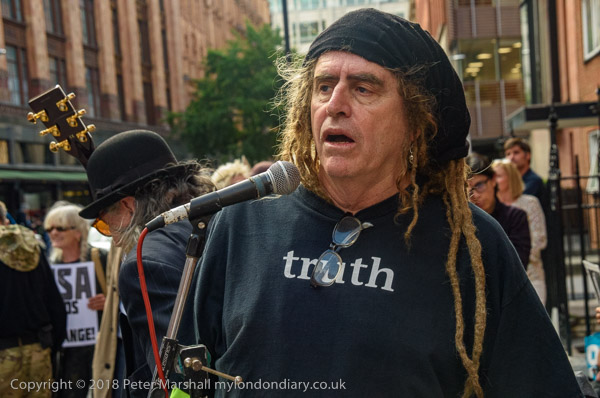
Joe Black

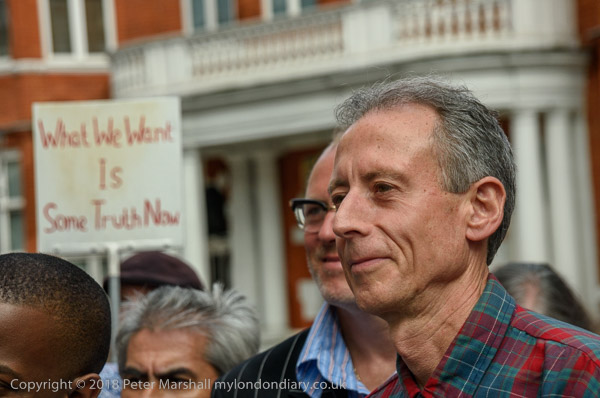
There was of course no sign of Julian Assange today, though Horvat Srecko, one of his friends and close associates did come to speak, and there were others there including well known peace and human rights campaigners, including Peter Tatchell  and Ciaron O’Reilly.


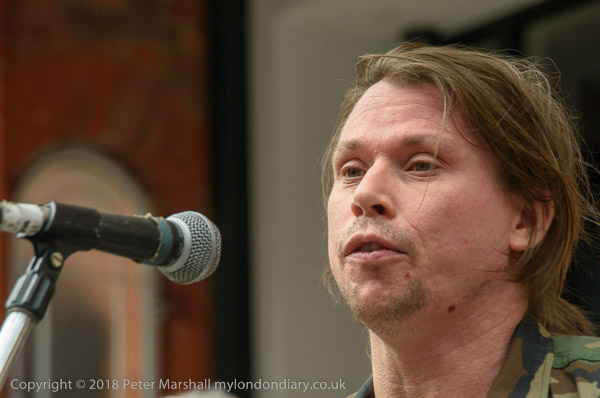
Lauri Love

Also speaking at the event was Lauri Love who fought a long and succesful battle against extradition the the USA on hacking charges  – and had he lost would now be sitting in isolation in a small cell for the rest of his life.


Peter Tatchell

The even attracted a small crowd, including many who have regularly come to show solidarity with Assange outside the embassy. Among them were a number of Ecuadorians who urge their government to continue to protect Assange.

Assange in Embassy for Six Years

______________________________________________________

There are no adverts on this site and it receives no sponsorship, and I like to keep it that way. But it does take a considerable amount of my time and thought, and if you enjoy reading it, a small donation – perhaps the cost of a beer – would be appreciated.

My London Diary : London Photos : Hull : River Lea/Lee Valley : London’s Industrial Heritage

All photographs on this and my other sites, unless otherwise stated, are taken by and copyright of Peter Marshall, and are available for reproduction or can be bought as prints.

To order prints or reproduce images

________________________________________________________
Thieving Artist

I’ve written before about Richard Prince and his appropriation of photographs and only return to the case as I’ve just read a post in The Art NewspaperRichard Prince defends reuse of others’ photographs,  by Laura Gilbert which states the defence he is offering to  a federal court in Manhattan about his use for profit of the works of two photographers, Donald Graham‘s photograph, Rastafarian Smoking a Joint, and Eric McNatt’s photograph of the musician and artist Kim Gordon. It is a rather longer statement, apparently 15 pages, than his original (and soon deleted) tweet: “Phony fraud photographers keep mooching me. Why? I changed the game. &their wizardry professorial boredom keeps coughing up a vick’sVAPOrub.”

Prince argues that by taking the images exactly as they were on Instagram, but enlarging them and adding his comment to put them on the gallery wall and sell them at high prices he was somehow producing a new original work of art, commenting on the process of communication involved in using social media – and Instagram in particular. As Gilbert writes, his approach is supported byome pretty serious names in the art world, with statements from  a museum director, curator and well-known art dealer to the court. All of course people who profit in some way or other from artists like Prince.

Prince of course profits from all the publicity this and other court cases give him, with many articles -including this one – in newspapers, magazines and blogs significantly raising his profile as an artist, and thus the prices and sales of his work.

Perhaps the photographers whose work has been stolen might think about reclaiming it by appropriating Prince’s, producing copies of ‘his’ images, perhaps ‘transforming’ them by the addition of their signatures. I rather suspect Prince and his dealers would call foul and run to the courts in what would be a rather fascinating copyright case.

There is of course absolutely no need for any of this. I’ve had my work used by artists – and they have come to me before doing so, explained what they wanted to do and we have negotiated a licence with an appropriate fee, and appropriate attribution. It’s an established way of working that avoids controversy – without misappropriation. But the very idea of stealing other people’s work seems to me to be the basis of Prince’s artistic practice. He’s famous for it.

I don’t of course know what judgement the court will finally make – and Prince has got away with it in earlier copyright cases, though I hope at last it will be one that fully respects the rights of the photographer – and leads to them getting compensation for the use of their work as well as the legal costs of taking the case. Prince would still be the winner, with all the publicity from the case aiding his status and sales. The only losers – in the longer term – will be those who have paid high prices for what are works which will almost certainly be consigned to the dustbin of art history, lacking any real worth or interest.

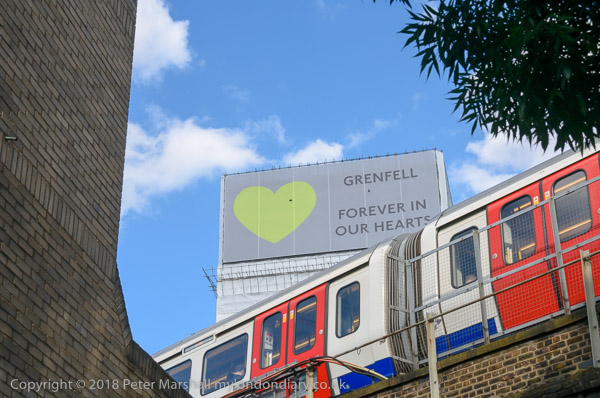
Grenfell Anniversary

It was hard to believe it was a year ago that we all woke to the terrible news about the fire at Grenfell Tower – though those in the area had been up all night since it started early in the morning.

Hard to believe too how little has so far been done, at least by Kensington & Chelsea Council, the governemnt and official bodies either for the victims who survived the disaster or to seek out those responsible and to make sure that such a tragedy will never happen again. Clearly the authorities are hoping that the grass will grow long enough in time to hide the crimes that made Grenfell not just possible, but virtually inevitable.

While it is right that the inquiry which finally started should look in depth at what happened, there are so many things that were obvious virtually from the day of the fire, and which we should not be waiting for years for action to be taken. There are things that could have been done virtually immediately. Promises that were made of urgent action – by the Prime Minister and others – which have simply not been kept. There should by now be people in prison, companies paying fines, councillors being banned from public office and more. The system has found it possible to try and jail a few people who tried to make false claims following the disaster, but somehow has not managed to take action against those responsible for it.

Grenfell is not the only block that was waiting for disaster to strike. There are others with the same flammable cladding, others with inadequate fire doors, others with dangerous gas supplies, others without proper water supplies to fight fires, other fire authorities that cuts have lefte without the equipment to properly tackle high rise fires, without the manning levels to tackle major blazes. Others where councils and landlords have been able to avoid adequate safety inspections. Probably Grenfell was an extreme example where a callous council and its TMO managed to bring all of these things together and to hide much of it from public scrutiny, but we should none of us be surprised to wake up to another dreadful news bulletin tomorrow or the next day. Grenfell was a warning that urgent action is needed; 14months on it is still needed.

The community response to the tragedy was immediate and enormous and such a contrast to the authorities who should have done so much more. And more is even now coming out about the poisonous fumes and particles spread about the whole neighbourhood by the fire, which will have affected many more than those who escaped the tower and had to leave the adjoining blocks. Then mental trauma many suffered – including many of the community volunteers – is also becoming more apparent, as is the continuing failure of the local council to respond adequately to the needs of those who suffered.

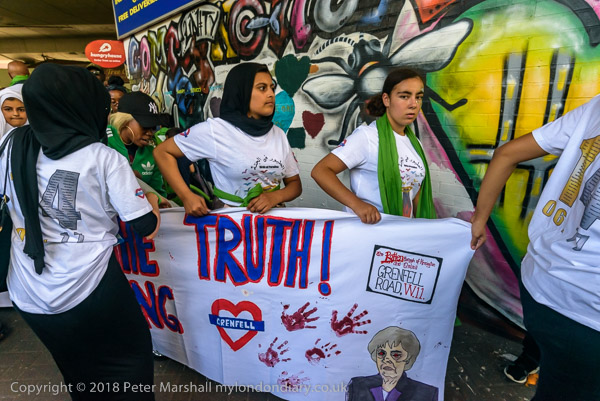
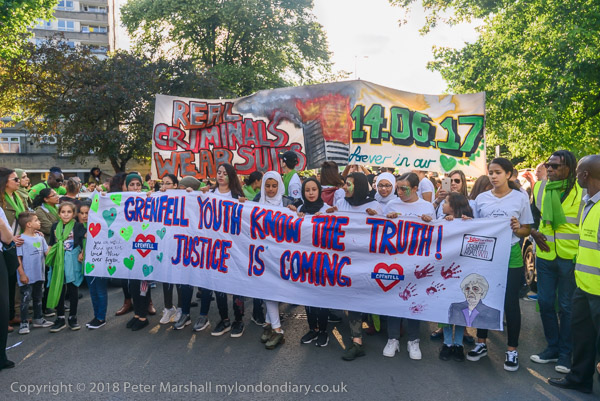
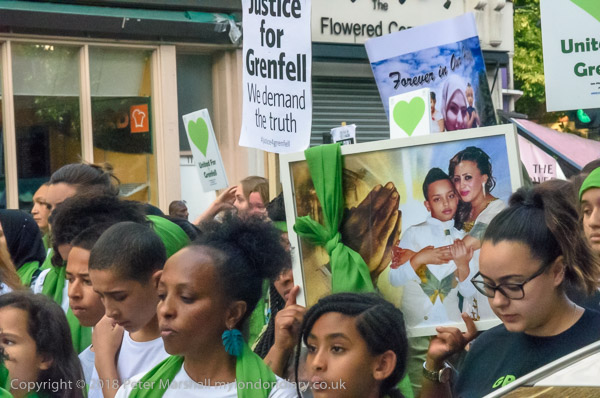
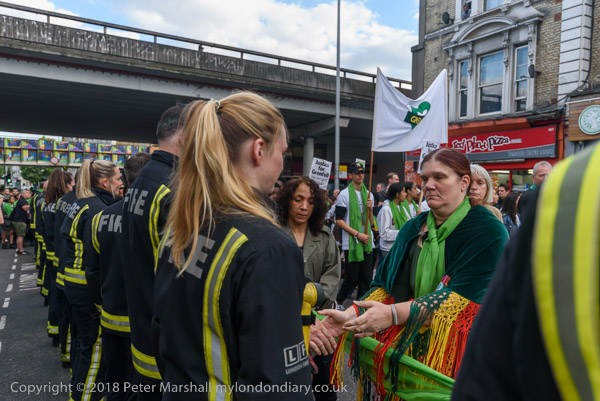
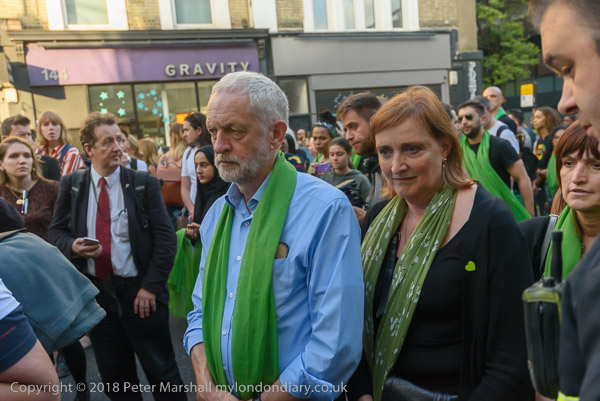
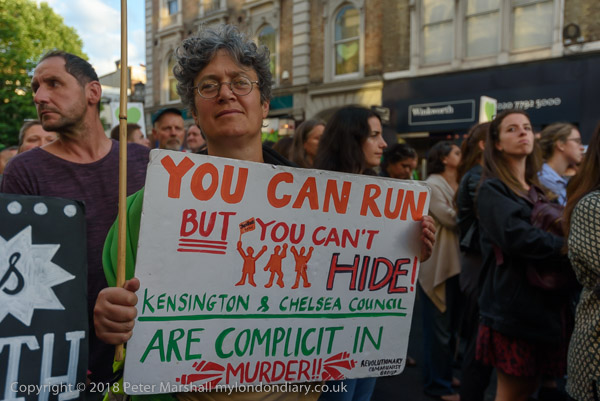
And the community is still keeping the issues alive by its monthly silent walks, every 14th of the month. The June march was special, marking a year since the disaster, and an estimated 12,000 of us crowded there to make our feelings felt, wearing green fabric to show our solidarity with the victims. It was a moving event and one that was difficult to photograph, not just because of the crowds.

I took so many pictures it’s hard to decide which to put in this post. And I was there not just as a reporter but to show my own support, wearing a green scarf like the others, and for various reasons rather more emotional than usual. Together I think the pictures make a good account of the event, and the captions, some rather longer than usual, add to it.

I left the march at Ladbroke Grove, as the organisers had made clear that the press were not welcome in the park where the march was ending, and walked slowly back to Shepherds Bush, though some of the wealthier parts of the area, feeling there should be millions not just thousands marching, and that we should all be angrier and more determined to see changes. To borrow a slogan we do need a society that works ‘for the many, not for the few’ and one where people’s lives really matter, even if they aren’t among the wealthy elite.

Massive Silent Walk for Grenfell Anniversary

______________________________________________________

There are no adverts on this site and it receives no sponsorship, and I like to keep it that way. But it does take a considerable amount of my time and thought, and if you enjoy reading it, a small donation – perhaps the cost of a beer – would be appreciated.

My London Diary : London Photos : Hull : River Lea/Lee Valley : London’s Industrial Heritage

All photographs on this and my other sites, unless otherwise stated, are taken by and copyright of Peter Marshall, and are available for reproduction or can be bought as prints.

To order prints or reproduce images

________________________________________________________
Busy Tuesday

I don’t often photograph three protests on a Tuesday, though one of the three I could have taken pictures of on almost any weekday, and have done a few times before. The anti-Brexit Stand of Defiance European Movement, SODEM, was started by Steven Bray in September 2017 and continue to protest every day that MPs are in session. I went along on this Tuesday as they had announced a a ‘Pies Not Lies’ Remainathon during the parliamentary debate on the European Union (Withdrawal) Bill, and there was a little more interest and activity than usual, as you can see from the ten pictures at Stop Brexit ‘Pies Not Lies’

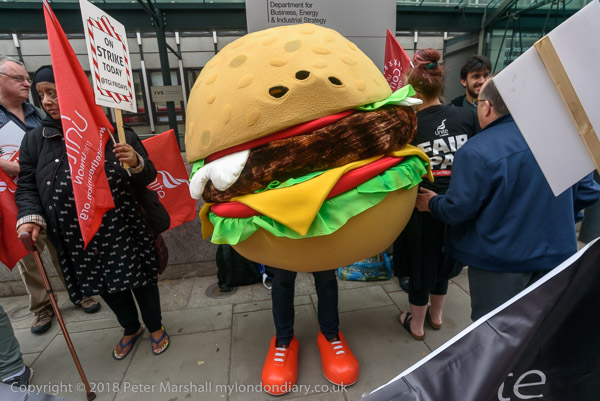
From Old Palace Yard it was a convenient short stroll to the Department of Business, Energy & Industrial Strategy on Victoria St, outside which the Unite Restaurant, Catering and Bar Workers Branch and Unite Community, including staff from TGI Fridays were holding a short protest reminding business secretary Greg Clark of his predecessor in office Sajid Javid’s promise to stop employers stealing the tips paid by credit cards from staff.

Among those protesting was one dressed as a giant burger, though I don’t think either Unite or I really made use of this. I’m there to record events, not to direct them. I won’t tell people how to arrange their protests, and rely on them to decide how they want to do things, but this doesn’t always make for good pictures. Our conventional trade unions are often rather lacking in their ideas about protests and photographs of protests, and trade union magazines and web sites arwe often full of rather boring group photos that I dislike making.

Unite TGI Fridays demand Fair Tips & Fair Pay

From Victoria St I wanted to be at SOAS, a little under two miles away. I should have thought ahead and brought my bike with me to London, as there would have been no problem with having it with me at any of these three small static events. For larger protests and marches, having a bicycle tends to be an encumbrance, and leaving a folding bike like my Brompton locked anywhere in London is a gamble I seldom like to take. A relatively high value machine, easily lifted into a car boot or van and readily sold they are effective magnets for theives.

But at all three of these protests I could have locked it to a lamp post or stand within sight of where I was working, and that mile and and three quarters would have been less than a ten minute ride. Bikes don’t get held up much by traffic, while my buses certainly did. It would actually have been slightly faster to walk the whole way (I’m usually quite a fast walker), but you can’t know that when you start your journey, and my legs would have suffered. The journey took 35 minutes, an average speed of just under 3 miles per hour.

Most journeys in central London are faster by tube – and this is certainly more reliable than buses, but this is one which isn’t. TfL’s journey planner does suggest a combination of two tube journeys and walking would be fastest, but tells me it would have taken me 37 minutes, two minutes more than walking the whole way. Sometimes biking is by far the best solution. Of course for the wealthy there are taxis, but freelance photographers can seldom afford these, and they get held up in the traffic too.

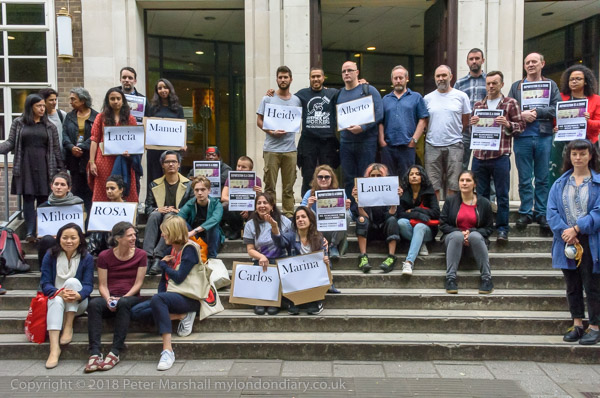
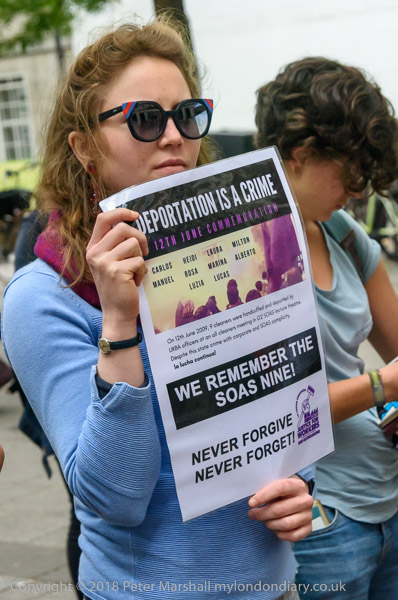
At SOAS, students and staff were remembering the shameful events of nine years earlier, when SOAS management called their cleaners to an early morning ‘meeting’ where agents of the UK Border Agency rushed in, handcuffed all of them and held them for questioning. Nine were then deported. The action was a part of the despicable ‘hostile environment’ for migrant workers, begun by the Labour government, but severely ratcheted up by Theresa May as Home Secretary. People at the protest held posters with the names of the nine who were deported.

SOAS management took the action as retaliation over the trade union activities of their cleaners, members of Unison, who had begun to campaign for a living wage and to be directly employed by the university rather than being employed on terrible conditions and low pay through cowboy cleaning firms. They got the living wage – but then nine were deported.

Eventually, ten years later, after a continuing struggle, the management finally agreed to bring them ‘back in house’, though at the time of these pictures the details had not been finalised. They are now directly employed and both SOAS and the employees are better off.

‘SOAS 9’ deported cleaners remembered
______________________________________________________

There are no adverts on this site and it receives no sponsorship, and I like to keep it that way. But it does take a considerable amount of my time and thought, and if you enjoy reading it, a small donation – perhaps the cost of a beer – would be appreciated.

My London Diary : London Photos : Hull : River Lea/Lee Valley : London’s Industrial Heritage

All photographs on this and my other sites, unless otherwise stated, are taken by and copyright of Peter Marshall, and are available for reproduction or can be bought as prints.

To order prints or reproduce images

________________________________________________________
Al Quds Day 2018

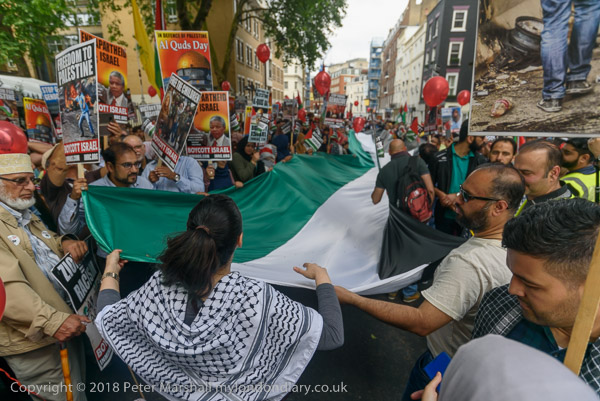
Al Quds Day in London has long aroused opposition. Al Quds (Jerusalem) Day was inaugurated by the leader of the 1979 Iranian Revolution and founder of its Islamic republic Ayatollah Khomeini. The Shia religious leader and his successors have many opponents, and the Iranian regime has brutally oppressed all opposition, imprisoning, torturing and hanging many over the years. Allegations have been made that this event in London and some groups supporting it are funded by Iran. Organisations supporting it include 5Pillars, Ahl-al-Bait Society, Ahlulbayt Islamic Mission, Balfour Declaration Centenary Campaign, Campaign Against Criminalising Communities, Football Against Apartheid, Hastings PSC, InMinds, Jews for Boycotting Israeli Goods, Lebanese Community in Scotland, Neturei Karta UK, Palestine Democratic Forum, Scottish Forum for Middle East and North Africa and the Scottish Palestine Solidarity Campaign, as well as a number of mosques throughout the UK.

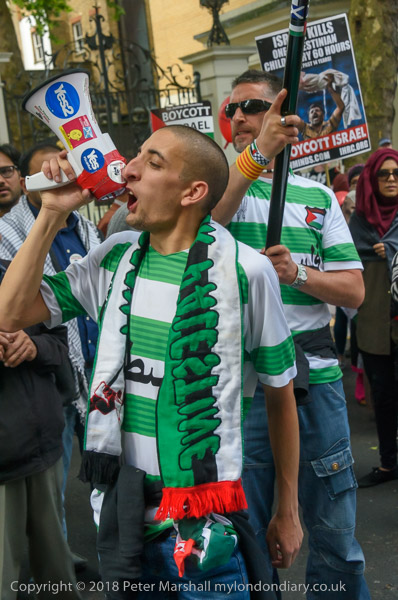
Al Quds Day calls for the freedom of the oppressed everywhere (except in Iran) but particularly in Jerusalem and Palestine, and the most numerous and persistent of those who oppose the march are Zionists and other supporters of Israel, who include some right-wing Christian groups. Some just hold counter-protests, while others try to physically attack the march, standing or sitting on the road to prevent its movement and insulting those taking part. Sometimes things are thrown at the marchers who include many with young children.

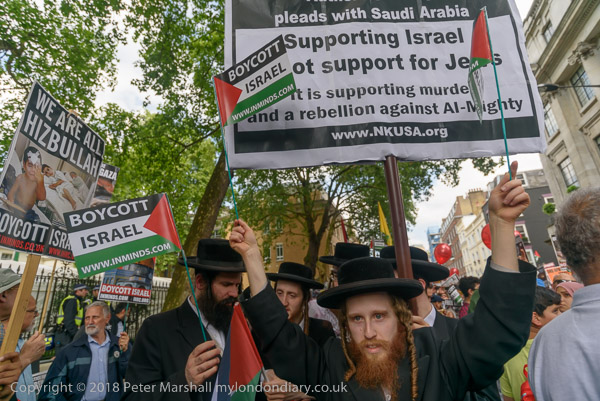
Those who oppose it call it anti-semitic, though the organisers go to  great lengths to explain they are not against Jews, but against Israeli government and the occupation of Palestine. Though the marchers are predominantly Muslim, they always include a significant number of Jews opposed to the occupation of Palestine, and at the front of the march alongside the Imams are a group of ultra-orthodox Jews who support the Palestinian cause, arguing that the idea of a Jewish state goes against their religion.

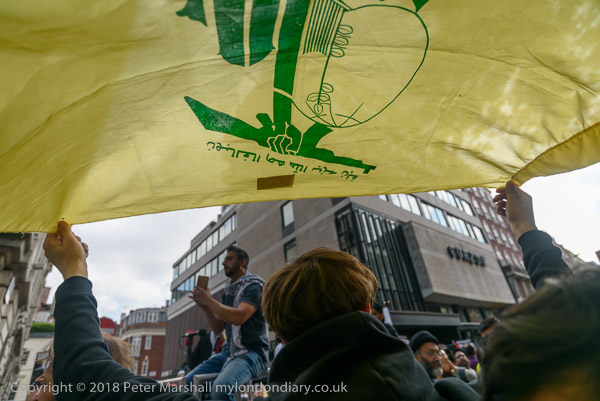
At least in recent years when I have photographed the event, the march organisers have been careful to ensure there are no anti-Semitic posters or placards on the march, and that any Hezbollah flags which may be present are in support of the political party which is a part of the Lebanese parliament, and not of the banned military wing. There were relatively few of them, a handful in a march of well over a thousand, and few pictures of the Ayatollah.

The event does call for freedom for Palestine, and condemns violence against Palestinians by the Israeli state and the increasing takeover of Palestinian land by Israel. It points out the different treatment of Palestinians, calling Israel an Apartheid state because of the different laws and their application, different roads etc., a charge made even more clear by the recent Jewish nationality law, and it supports the Boycott, Divestment, Sanctions (BDS) movement which works to end international support for Israel’s oppression of Palestinians and pressure Israel to comply with international law.

The event started with a static protest at the rear of the Saudi Arabian embassy in Mayfair, and was against the demonisation campaign led by the Israeli government and the ongoing murders by Israeli troops of innocent Palestinian protestors in the Gaza Strip commemorating 70 years since Israel was formed on expropriated Palestinian land.

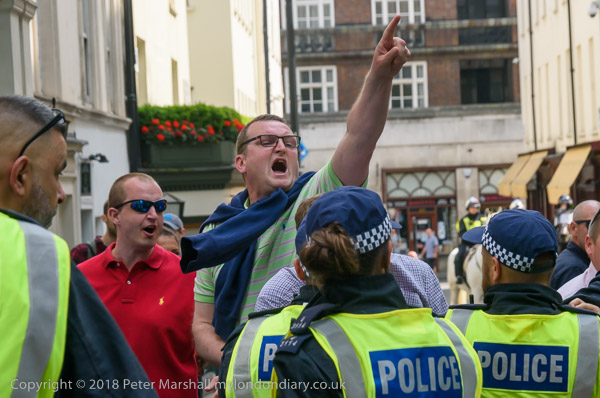
The usual Zionists who attack the procession were joined by football hooligans who had been at the ‘Free Tommy’ rally the previous day, but a huge police operation kept most of the far away from the rally. A short distance along the street was a more orderly protest by the Zionist Federation, staying behind its barriers and watched by police between the two groups.

I had to leave after a couple of hours and before the rally ended with a march to Westminster, which apparently saw further attempts at disruption by Zionists and football hooligans which were quickly stopped by police. The Al Quds day event itself is attended by many families and resists provocations.

Al Quds (Jerusalem) Day
Zionists protest against AlQuds Day

______________________________________________________

There are no adverts on this site and it receives no sponsorship, and I like to keep it that way. But it does take a considerable amount of my time and thought, and if you enjoy reading it, a small donation – perhaps the cost of a beer – would be appreciated.

My London Diary : London Photos : Hull : River Lea/Lee Valley : London’s Industrial Heritage

All photographs on this and my other sites, unless otherwise stated, are taken by and copyright of Peter Marshall, and are available for reproduction or can be bought as prints.

To order prints or reproduce images

________________________________________________________
A Forgotten Street Photographer?

While it’s great to see a film being made about Garry Winogrand which shows some insight into the man and his work, the description of him as a “forgotten street photographer” seems rather lacking in credibility.

Of course most people who think of themselves as “street photographers” nowadays are woefully ignorant of the history of photography including that of so-called street photography, and most people outside the photographic world would be hard put to name any photographer, certainly anyone who has been dead for over 30 years. Perhaps soon we will see a film about another of these “forgetten street photographers” like Henri Cartier-Bresson?

I’ve not seen the film, currently enjoying an extended run in New York, but I have watched the trailer and another introduction to it with more of WInogrand’s voice, as well as the preview – and many other videos about WInogrand, some of which I used in my teaching over 20 years ago. And I think the film will be something photographers should not miss. It will apparently be available later as a part of the ‘American Masters‘ series on PBS.

Vice has an interview This Forgotten Street Photographer Shot Some of Our Most Iconic Images with film director Sasha Waters Freyer which I think makes interesting reading and shows some fresh insight into the man and his work.

I’ve written about him and his work at some length, and have copies of most of his books as well as the most important works on him published since his death, and have been able to talk with one or two people who knew him working on the streets of New York. As well as this article, he gets a mention in 45 other posts I’ve written for this blog (and one other draft, about his work in Picture Post, that somehow never got finished.)

One of the problems with Winogrand is that he took so many pictures – including the many thousands on the undeveloped cassettes found after his death. Many of them didn’t really work as pictures, though without the openness they represent he would not have made those that, sometimes spectacularly, do. I feel sure that there are many images that have been published since his death (and a few during his lifetime) that do nothing to enhance his reputation, and the last show of his work I saw in London had far too many of them. Part of the reason for this lies with the art market, where anything attributed to him sells.

It’s interesting to look at his ‘Women Are Beautiful’ which Sasha Waters Freyer says “really hurt his reputation”. It obviously drew some attacks, but I don’t think he really had a reputation to destroy, and most of the attacks were based on the idea of a man publishing a book of that title rather than the work in it. As she goes on to say, “there are a lot of ways in which it is a celebration of women. It is a really important document of this period when women are entering the workforce and making themselves visible in a way that was completely new in American society.”

Winogrand thought it would sell, calling it in private “The Observations of a Male Chauvinist Pig” and hoping it might appeal to a different market, but it alienated too many and was too highbrow and insufficiently raunchy to attract the ‘Pigs’ he had anticipated. But it remains one of his best books, perhaps because of the focus given it by the problems in his personal life and the film sets out to examine him as a male artist and to understand how his “relationship to marriage and children and family … impacts (his) artistic output.”

Of course there are many other articles and reviews of the film (which has a Facebook page) you can find on-line. One from IndieWire by David Erlich caught my attention for this paragraph:

“Street photographer?” What a sterile way to describe someone who just captured what he wanted — who didn’t wait for permission to take pictures, or require an assignment.