Six years ago: 30 May 2015

May 30th, 2015 was one of those days where I travelled around London stopping off for various reasons en-route. As always on such occasions I give thanks to the GLC for their efforts which resulted in the London-wide travel card before they were sadly eliminated by Mrs Thatcher, leaving the city largely rudderless for a crucial 15 years when it fell behind other cities in the world – except of course for the financial City of London which further cemented its reputation as the corruption capital of the world.
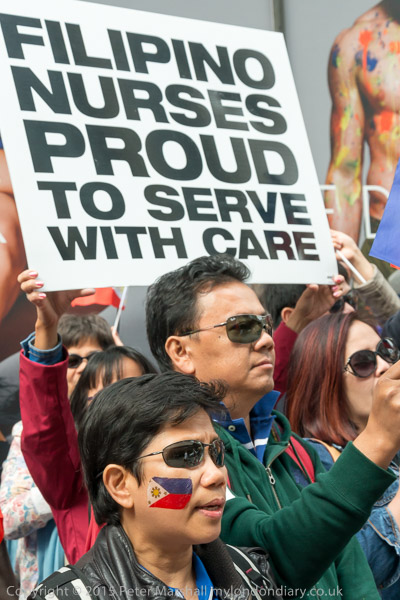
London is very much a world city, and my first event, outside the Daily Mail offices in Kensington reflected this, with protest by Filipino health workers over their coverage of the case of Victorino Chua, a nurse found guilty of murdering two patients and injuring others. The newspaper used the case to insult Filipino NHS workers who have for years formed a vital part of the NHS. When I came round in intensive care in 2003 it was to see a Filipino nurse who greatly impressed me with his care and attentiveness over the next few days.
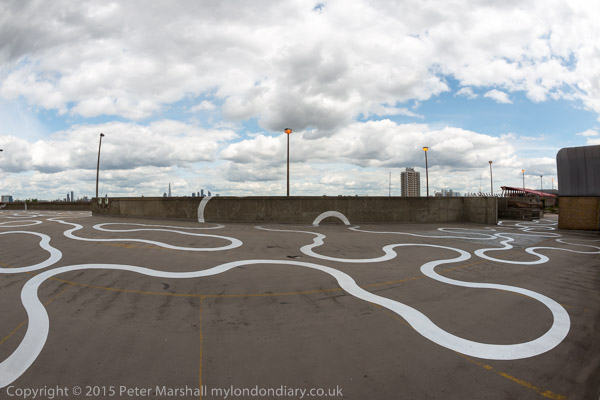
It had taken around an hour for me to get to Kensington, and the journey across London to Peckham Rye was around another 50 minutes. I was there not for a protest but for the proposed Peckham Coal Line, an elevated linear urban park whose proponents compared in extremely misleading publicity to New York’s ‘High Line’ walk. And while the public were invited to walk the Coal Line, we were largely unable to do so as it is still an active part of the railway network – and one I took a train along after following around its length and back on existing local roads and paths.
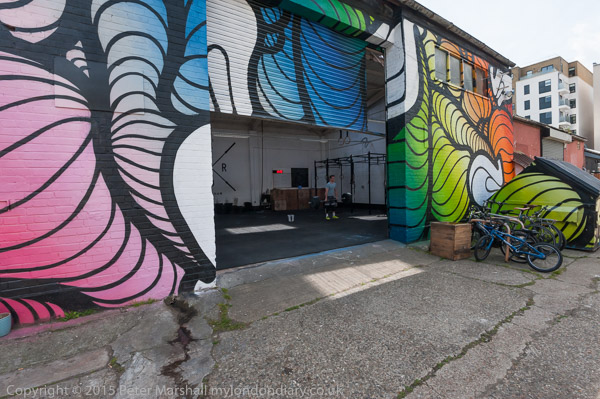
Despite that it was an interesting walk, including a visit to the roof of the multi-storey car park and the Derek Jarman memorial garden. Part of the proposed walk is already open to the public as a small nature reserve, cleared beside the railway line for a massive inner-ring road – part of the proposed London Ringways motorway scheme which was fortunately abandoned after the terrible impact of building its earliest sections including the A40(M) Westway in Notting Hill became clear.
A train from Peckham Rye station took me along the route of the Coal Line to Queen’s Road Peckham and then on to London Bridge, and the Underground to Waterloo where I met with UK Uncut who were to go to an undisclosed location for some direct action. This turned out to be Westminster Bridge, where the protesters blocked the road.
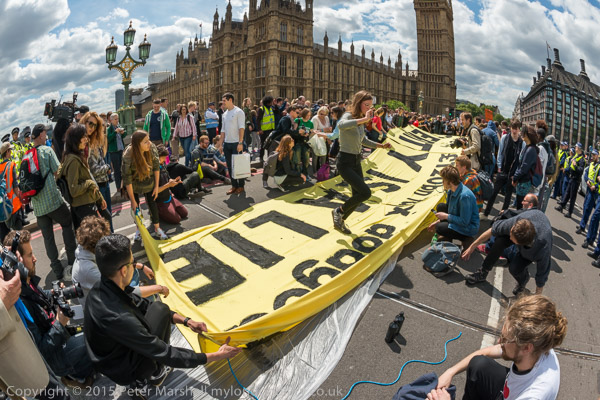
The then unrolled a large yellow banner and began to fill in the slogan that had been marked out on it with black paint. After some parading around on the bridge with it, they then lowered it over the upstream side of the bridge and lit a couple of smoke flares. I’d run down across the bridge and a little along the embankment in front of St Thomas’s Hospital to take pictures of the banner drop.
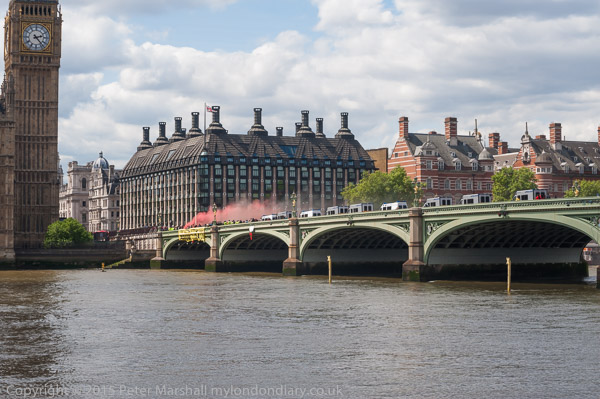
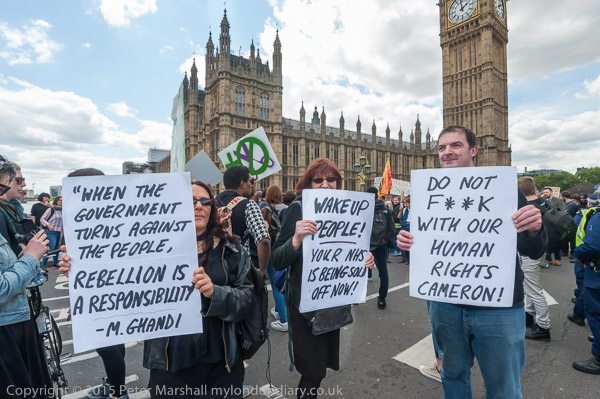
The banner drop was really on the wrong side of the bridge for photographs and it seemed something of an anti-climax. It was hard to read the banner and its message ‘£12 bn more cuts £120 bn tax dodged – Austerity is a lie’ ” was perhaps a little understated. I think may of those present had expected something rather more direct, both in message and action. I went on with many of them to join another protest in Parliament Square which was just coming to an end, against government plans to get rid of the Human Rights Act.

It was then a short walk to Trafalgar Square, where on the anniversary of the 1967 declaration of Biafran independence, Biafrans were calling on the UK government for support in getting back the country which they claim was taken away from them by the Berlin Conference in 1884 and incorporated into Southern Nigeria. They say Biafra was successor of the Kingdom of Nri of the Igbo people, which lasted from the 10th century to 1911 and was one of Africa’s great civilisations before the European colonisation. As well as backing the call for independence the protest also remembered those who died in the Nigerian-Biafran War.
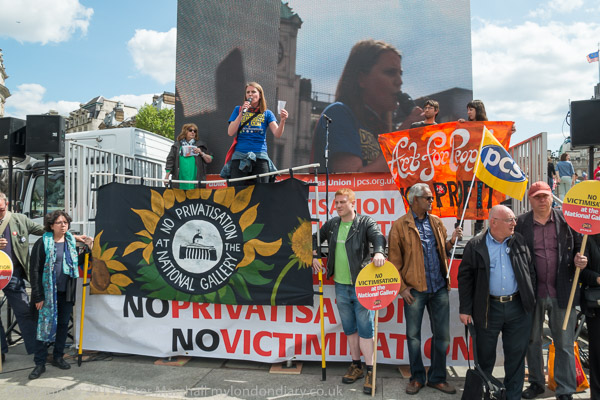
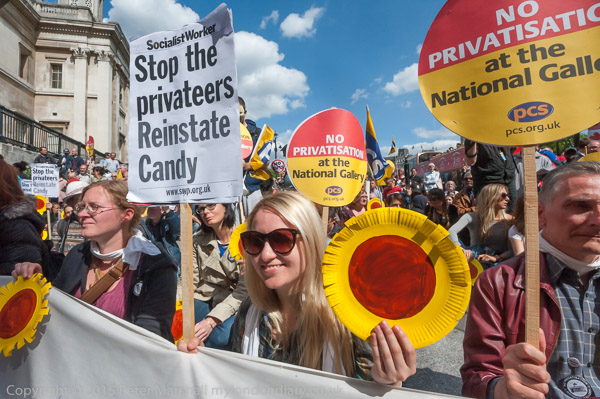
In the main body of the square, striking National Gallery staff and supporters were holding a rally after PCS rep Candy Udwin was sacked for her trade union activities against the plans to privatise gallery staff.
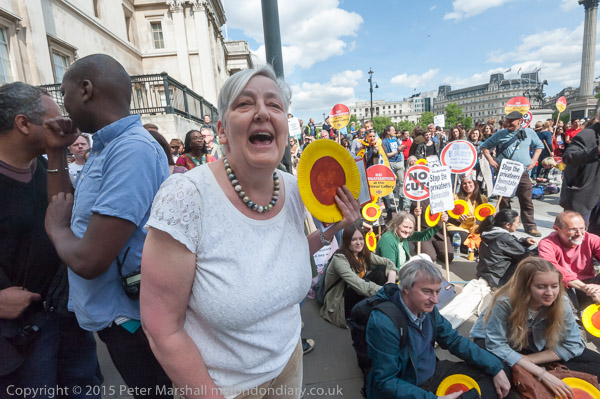
At the end of the rally, people moved towards the Sainsbury Wing, where security is already run by a private company and exhibitions guarded by outsourced staff. Police blocked the doors to stop them entering, and they sat down to hold a further rally blocking the gallery.

Mass rally Supports National Gallery strikers
Biafrans demand independence
UK Uncut Art Protest
Walking the Coal Line
Filipino Nurses tell Daily Mail apologise

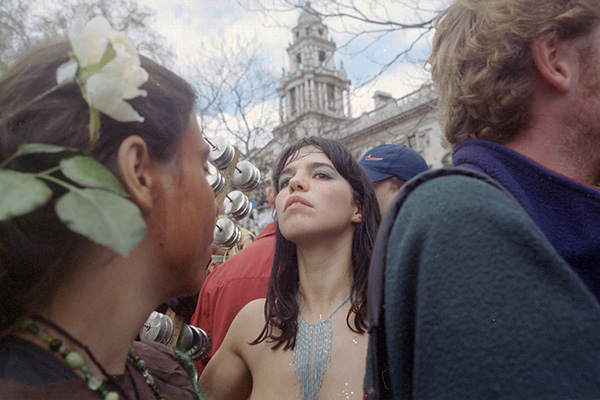
May Day #KillTheBill

May Day 2000

Unfortunately May Day is not a public holiday in the UK, and when I was in full time teaching it was usually just a normal working day for me and I was unable to celebrate it except in those years where it fell at a weekend. Even when I cut my teaching to 30% for a few years, that 30% seemed always to include May Day, and it was only from 2003 that I began to attend May Day in London every year – until 2020, when it went online.

This year, when May Day is on a Saturday, the official May Day celebrations are also taking place online, but May 1st is now a nationwide day of action against the Police, Crime, Sentencing and Courts Bill 2021 with which the government is attempting to severely limit the right to protest and in particular to criminalise “noisy” protests and prosecute people in the Gypsy and Roma communities. Noisy protests shaming businesses have been vital in recent years in gaining better wages and conditions for low paid workers particularly in the City of London.

The Bill will give the police much greater powers to place conditions on protest – and to make it a crime to break these conditions if they “ought to have known” they were in place but didn’t. They introduce a new offence of “intentionally or recklessly causing public nuisance” which can lead to a sentence of up to ten years.

Police also gain greater powers to stop and search on the streets under a new Serious Violence Reduction Order, an arbitrary power that removes even the need for any suspicion and will doubtless lead to an even more racist implementation of stop and search, worse than the old ‘Sus’ law that led to the Brixton riots 40 years ago.

As a knee-jerk reaction to Black Lives Matter protests there is a new offence of causing damage to statues and memorials which could also lead to sentences of ten years, twice the maximum sentence for assault causing actual bodily harm.

The bill also seeks to create a wide “controlled area” around parliament where protests would not be allowed – and so MPs and ministers would no longer be made aware of any public opposition to their actions. Many see the bill as denying our right to freedom of assembly and association under Article 11 of the European Convention on Human Rights .

A long list of organisations are coming to Trafalgar Square at noon today for a MayDay #KillTheBill protest (and to similar protests in Sheffield, Leeds and Manchester.) They include Sisters Uncut, Women’s Strike Assembly, Black Lives Matter UK, Disabled People Against Cuts, the Independent Workers Union of Great Britain, Lesbians and Gays Support the Migrants and Docs not Cops. With the current large Tory majority in the House of Commons the bill is likely to pass with only minor amendments, and the fight will move to the streets where with strong opposition much of the new law will be unenforceable.

Seconds later an officer knocked this man offering plants flying

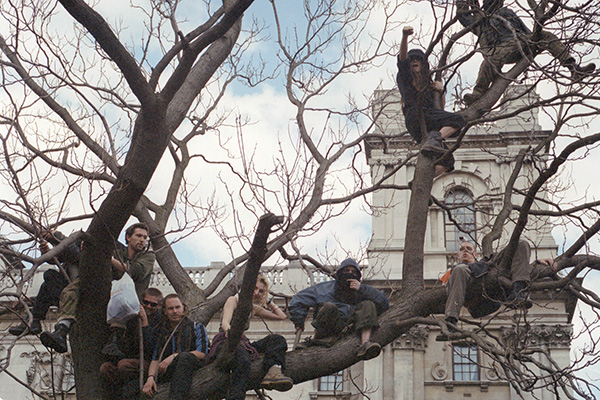
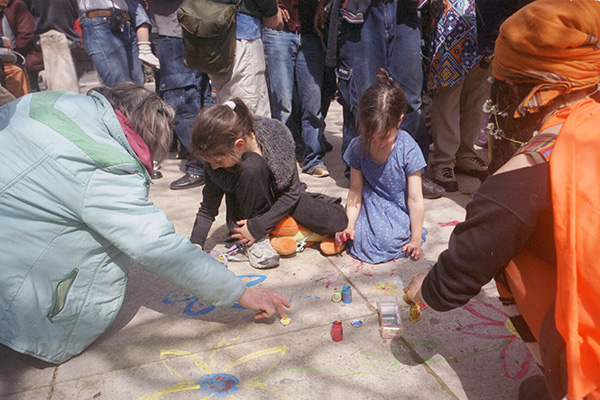
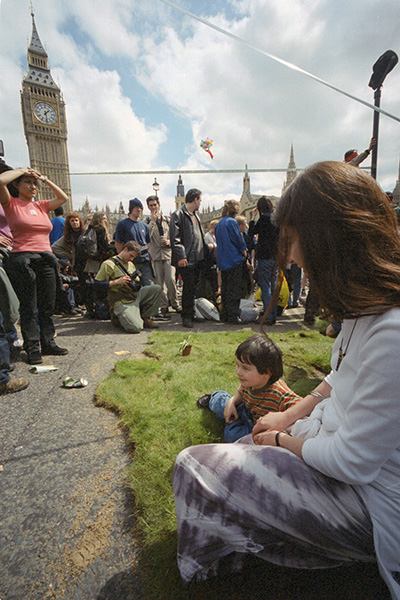
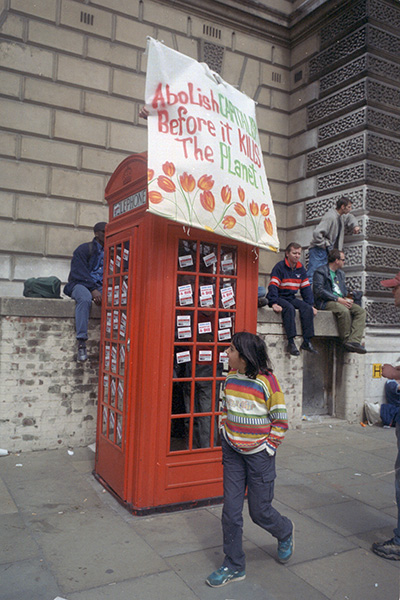
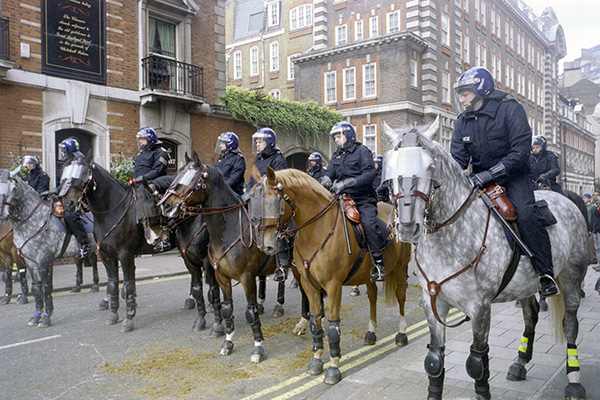
Pictures are from 21 years ago, May Day 2000. There are some black and white pictures from the same day on My London Diary.


All photographs on this and my other sites, unless otherwise stated, are taken by and copyright of Peter Marshall, and are available for reproduction or can be bought as prints.


Hackney Housing

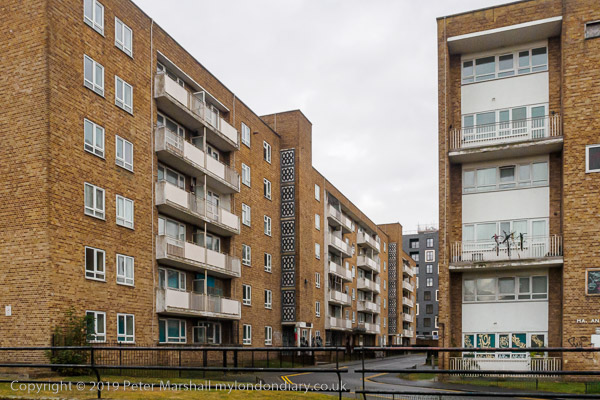
I took a short walk in Hackney before the protest outside the town hall to remind me exactly where Marian Court was, just behind the rather empty ‘fashion village’, an implant into the area with government money, £1.5m of Boris Johnson’s regeneration funding after the 2011 riots. It seems if anything to have been an expensive way to prove that gentrification isn’t an effective way to combat racist policing with a shoot to kill policy, and has failed to generate the promised jobs.

Marian Court appears to have been a well-designed small estate built for the Metropolitan Borough of Hackney in the late 1950s. It was built to the standards of the time and was in need of modernisation, and had been allowed to deteroriate. But as on many other council estates, rather than investing in the relatively modest cost of the necessary refurbishment, the council decided on an expensive scheme involving total demolition and the building of roughly twice as many housing units on the site by private developers, with a large proportion for sale at high market prices and others also at high prices as ‘affordable’ or shared ownership properties. Reports say that despite the roughly doubling of the number of units there will be 40% less social housing than at present.

The replacement flats in such schemes are almost always built to lower space standards than the existing properties, and demolition and rebuild involves an enormous environmental impact. Given our current problems with global warming and the impending threat of human extinction unless we take urgent actions to avoid this, demolition of existing buildings such as this should now be a rare last resort.

The human impact is of course also huge, with the estate being emptied. Those in social housing will have been offered rehousing, but usually in far less convenient places than this, targeted in part because of its central location and close transport links, and also probably with less security of tenure and higher rents. Leaseholders typically get compensation at far less than the cost of a similar property in the same area – or the new properties.

Schemes such as this effectively lead to social cleansing, despite the promises often made (but seldom kept) by local councils about residents being able to stay in the area or move back into the redeveloped properties. Those on low incomes are forced to move to the peripheries of the borough, to outlying borough or sometimes well outside London, away from jobs, schools, friends and other links in the community.

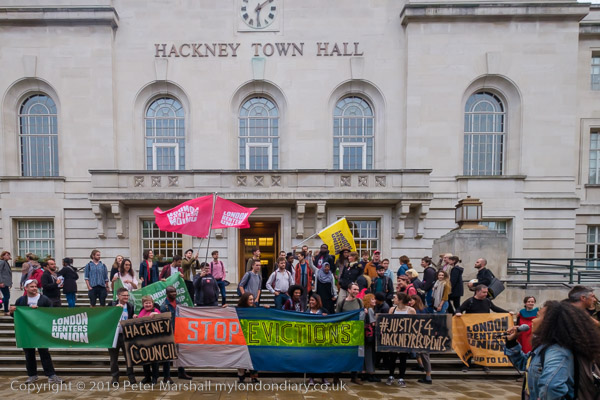
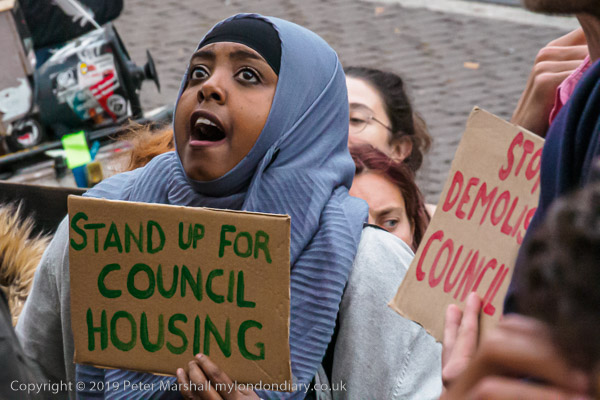
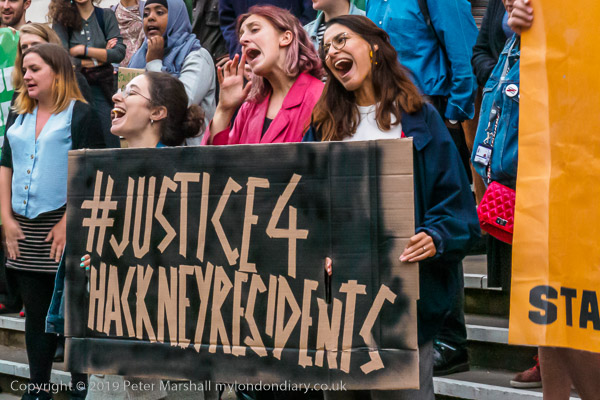
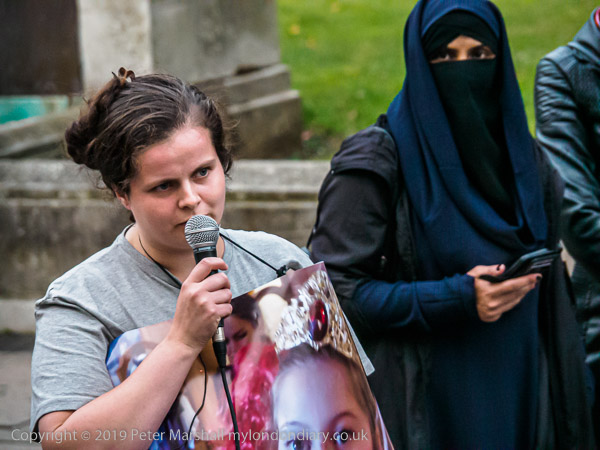
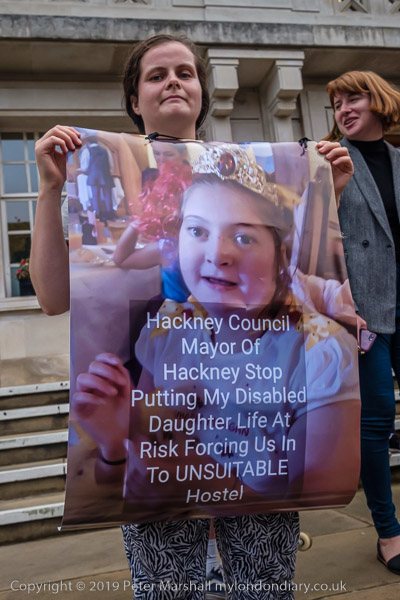
The protest at Hackney Town Hall, organised by East End Sisters Uncut and London Renters Union was over the failure by Hackney Council to provide suitable rehousing for two families remaining in Marian Court, both of whom attended and spoke at the event, and who seem to have been victimised because they particular housing needs and have stood up for their rights. You can see more about both of them and their issues with the council at Hackney don’t victimise housing activists.

And a few pictures of the area including Marian Court in Hackney


There are no adverts on this site and it receives no sponsorship, and I like to keep it that way. But it does take a considerable amount of my time and thought, and if you enjoy reading it, please share on social media.
And small donations via Paypal – perhaps the cost of a beer – would be appreciated.

All photographs on this and my other sites, unless otherwise stated, are taken by and copyright of Peter Marshall, and are available for reproduction or can be bought as prints.