Firefighters and Nurses – 2015

Key Workers were protesting in London on Wednesday 2nd December 2015, but their protests were ignored by government and then Tory Mayor of London Boris Johnson. Since then we have seen that the warnings of the protesters were real and the consequences of Tory policies have led to disaster. It’s a failure of our system of government that allows dogmatism and class interests to pursue such irresponsible policies at both local and national level, and one hugely facilitated by a media largely controlled by a handful of billionaires.


Firefighters say cuts endanger London – City Hall, Wednesday 2nd December 2015
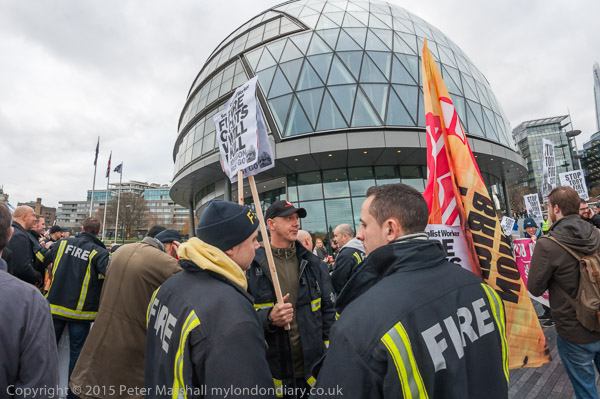
Firefighters and Nurses

Firefighters and supporters protested at City Hall against plans to get rid of 13 fire engines and slash 184 firefighters in the London Fire Brigade. These came on top of previous cuts and station closures which have already led to increases in the time taken for firefighters to arrive at fires which have lead to people who would otherwise have been rescued dying in fires.
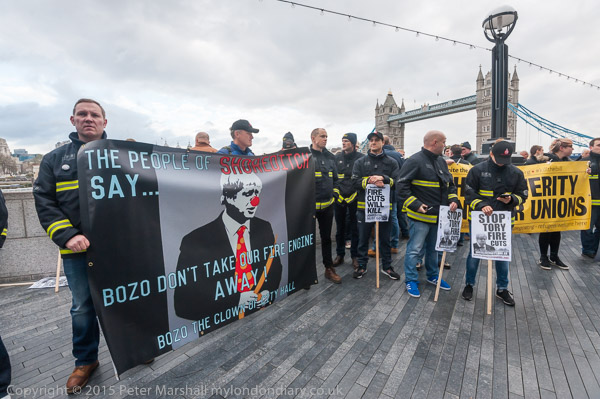
Firefighters and Nurses
The People of Shoreditch Say… Bozo Don’t take or Fire Engine Away! – Bozo the Clown of County Hall’

Trade unionists and others came to support the firefighters and some spoke at the rally along with speakers from the FBU. It took only a little persuasion to get George Galloway to speak. Members of the London Assembly had put forward an alternative plan to make savings and avoid the loss of the fire engines but these were dismissed by London Mayor Boris Johnson.
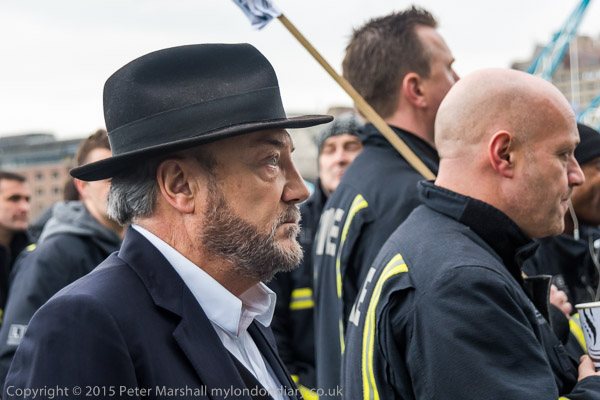
Firefighters and Nurses
George Galloway came to show support

One of the consequences of the cuts to London’s fire services came sadly and disastrously with the loss of 72 lives at Grenfell Tower on 14 June 2017. We found then that London simply didn’t have a single fire engine capable of dealing with a fire in the upper floors of the building. Fortunately Surrey, although it has far fewer high rise buildings had kept one which could be called in to help, or the death toll would have been even higher.
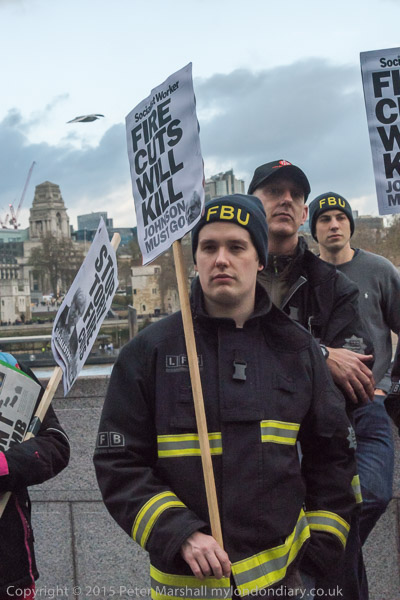
Firefighters say cuts endanger London


Save NHS Student Bursaries – Dept of Health, Whitehall, Wednesday 2nd December 2015
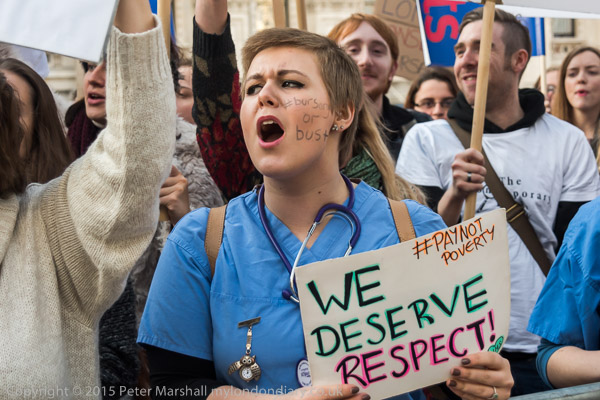
George Osborne had decided to scrap NHS student bursaries from 2017. Nurses and other healthcare students have to spend around 50% or their time working in hospitals for the NHS during training and so are largely unable to take on part-time work as many other students do. They only payment they get for this work is through the bursaries.
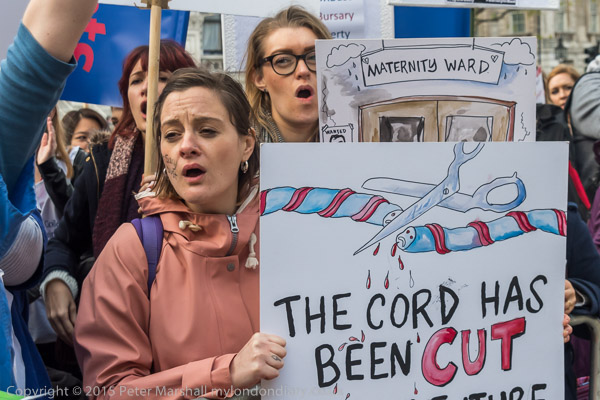
It seems totally unfair to ask them to take out student loans and work for the NHS for nothing as well. And since many of the jobs they go into are not particularly well-paid, it makes little financial sense as many would probably never fully repay their loans.
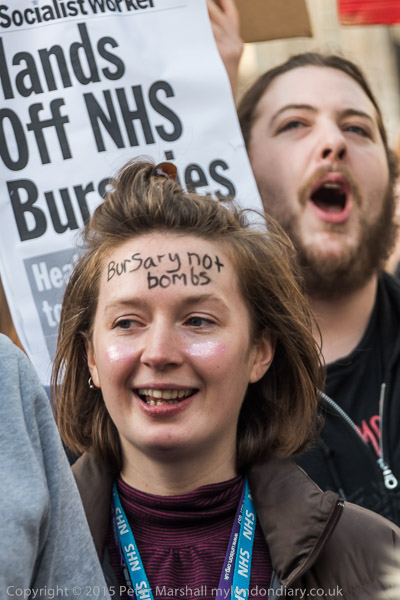
Always plenty of money for our arms manufacturers

But what nurses said it would do was to lead to a reduction of students applying for healthcare courses, particularly the many single mothers and more matures students who are enabled to take the courses by the bursaries. And to take this action at a time when there was a critical shortage of medical staff was sheer lunacy.
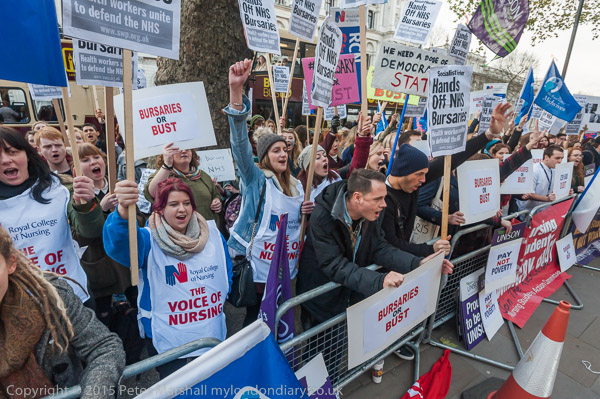
Of course they were right. The situation in the NHS is even worse now partly due to this axing of bursaries. Of course there are other factors too – including a racist immigration policy which has been made much worse with Brexit. And the continually increasing privatisation taking place.
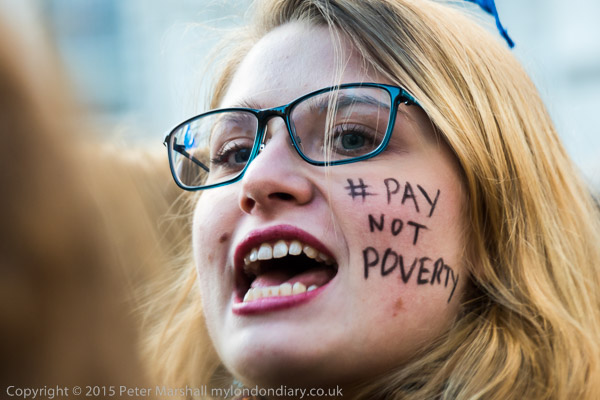
The NHS has so far suffered various areas of breakdown caused of exacerbated by various government policies – including some under New Labour who promoted disastrous PFI schemes that have brought some hospital trusts to financial ruin. Covid was another savage test and things look set to get far worse in the coming winter months. And given the years of below inflation pay offers its hardly suprising that nurses are now about to strike.
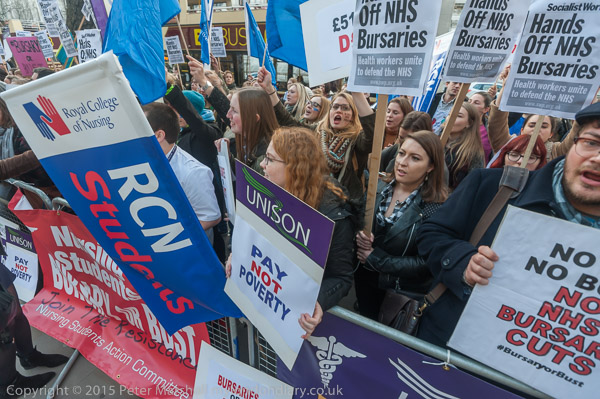
The problems with scrapping the student bursary were so intense that the government was forced to set up a new bursary scheme in 2020. But while the previous scheme had a maximum of £16,454 a year, with a minimum of £10,000, the new scheme was considerably less generous, at a standard £5000, with additions for shortage areas and childcare giving a maximum of £8000.
Save NHS Student Bursaries


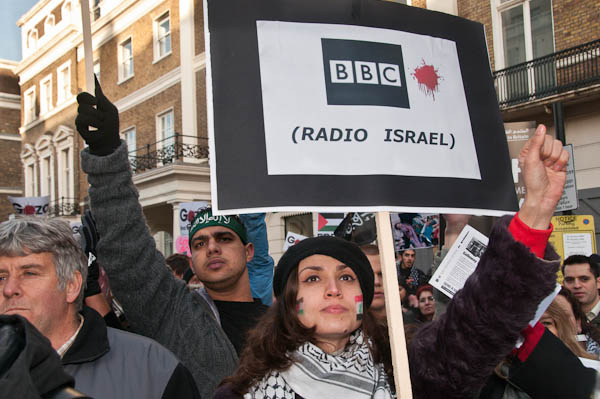
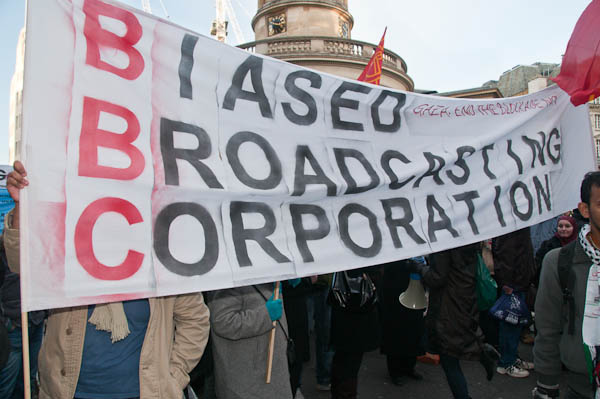
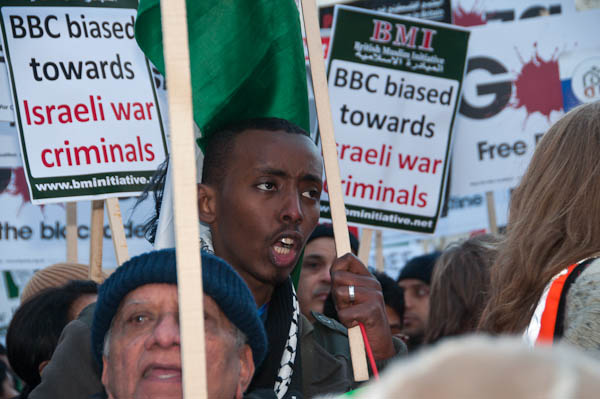
BBC Ban Gaza Appeal 2009

BBC Ban Gaza Appeal 2009

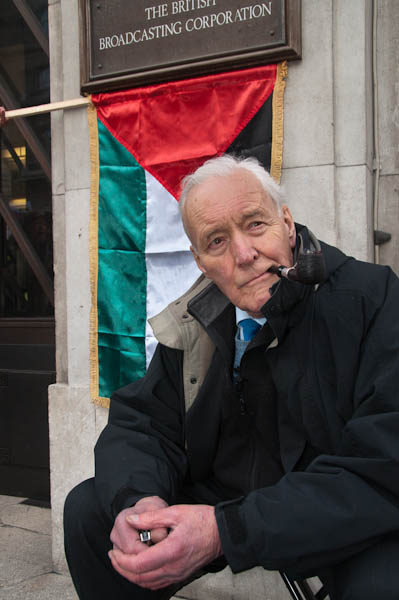
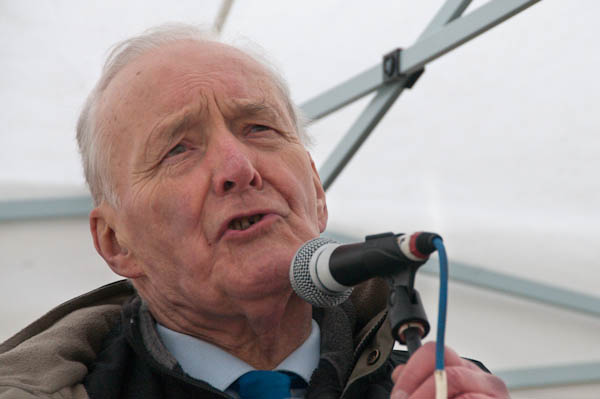
Tony Benn speaking

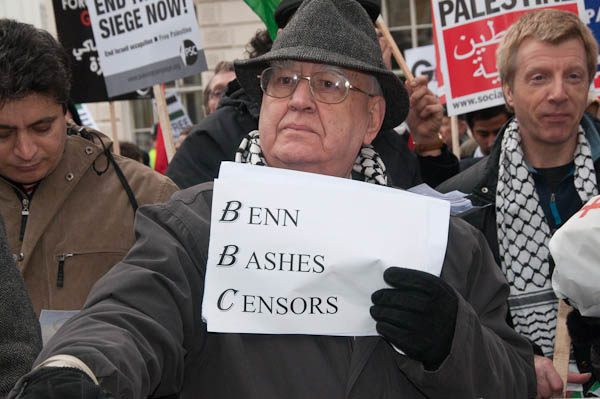
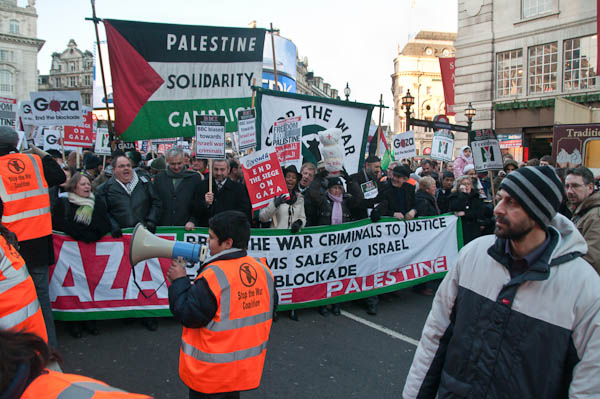
Listening to the controversy in the last few days over the BBC licence fee, frozen for the next two years by Nadine Dorries, who has also threatened that the fee will be abolished after the corporation’s current royal charter expires in 2927, my mind went back to January 24th 2009, when I photographed a protest which began at the BBC against their biased reporting of the Israeli attack on Gaza, and calling for an end to the blockade and of arms sales to Israel, for a free Palestine and for Israli war criminals to be brought to justice.

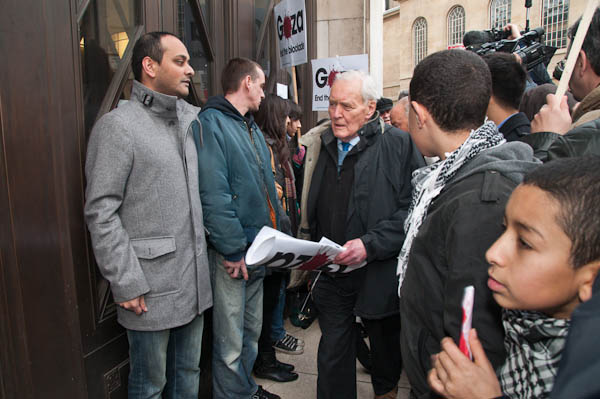
Tony Benn leads a delegation into the BBC to deliver a letter

Earlier that morning, for the first time ever, the BBC bosses had refused to run the Disasters Emergency Committee appeal for humanitarian relief for Gaza. I’d listened with incredulity to their explanation that they had done so to uphold their reputation for impartiality – as if their were sides to be taken on delivering much needed humanitarian support.

Listening to the Radio 4 Today programme as I ate my breakfast I rose to applaud Tony Benn who in a live interview condemned the BBC for their ban and proceeded to make the DEC appeal on the programme for them. Quite clearly the Today presenters and editors were also appalled by the one-sided stance taken by their bosses, and though they felt unable to defy the management had created the opportunity for Benn to do so.

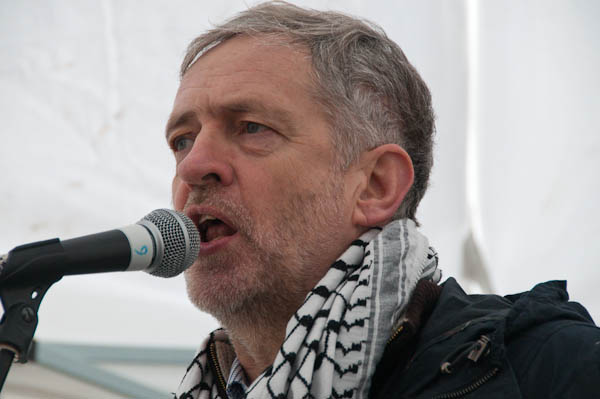
I was pleased later that morning to be able to congratulate Benn in person for his action, and to hear him speaking about the ban both before going in to deliver a letter of protest to the BBC and a few minutes later at a rally a short distance down the road. Unfortunately police prevented me from going in with him to the BBC to photograph him handing over the letter, but I was able to photograph him outside with others including Jeremy Corbyn, MP, Lindsey German and George Galloway, MP.

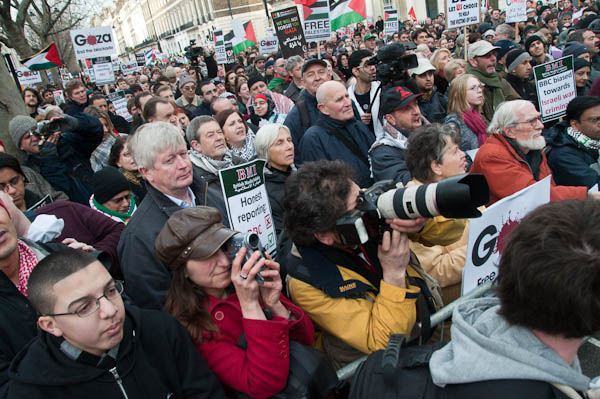
A huge crowd at the rally before the march

I don’t remember any report of the protest appearing on the BBC, who generally fail to report protests in London unless they involve violence, criminal damage or major celebrities, though it probably got a small mention. The Press Association also got things a little wrong, reporting the smaller press conference with its roughly 400 attendees while not noticing the 10,000 protesters a hundred yards or so down the road.

People often blame journalists for the failure to report protests and similar events, but this is seldom the case. Journalists report but editors fail to publish. This is even more true when it comes to protests in London about events in overseas countries, which some editors have been known to dismiss as “tribal matters”.

I was pleased at the rally to hear a message from the then General Secretary of my Union, the NUJ, condemning the BBC ban – along with many others. The problem with the press in the UK is not down to journalists, but to the ownership of the mass media, with 90% of the UK-wide print media is owned and controlled by just three companies, Reach plc (formerly Trinity Mirror), Murdoch’s News UK and DMG Media, publishers of the Daily Mail. Six billionaires own or have a majority shareholding in most of our national newspapers.

The BBC should be both independent and impartial, and the licence fee was seen as a way of giving it an income independent of government control. But in recent years this has seemed to be less and less effective. It operates under an agreement with the secretary of state for digital, culture, media and sport, and is overseen by the BBC Board, with day-to-day operations being overseen by an executive committee of senior BBC managers.

Appointments to the Board (and its predecessor the BBC Trust, earlier the Board of Governors) and some BBC jobs have often been politically motivated. Its current chair is a former banker who was an adviser to Boris Johnson when he was Mayor of London. We need a new model which guarantees independence from government while continuing to finance the BBC as a public service broadcaster.

The BBC in deciding on what is and what isn’t news has generally a conservative approach, not in a party sense, but in supporting the status quo and establishment views. It also generally follows the lines established by the billionaire-owned print media. It should be something that challenges their assumptions and reports fairly and independently, but while it retains an excellent reputation around the world for its World Service, confidence in its national news services has dropped considerably.

Now many feel that to get the kind of impartiality it should be delivering you have to treat it as just one source of broadcast news – along with ITV news, Sky and other questionable sources such at the Russian-owned RT and Qatari-owned Al Jazeera.

You will have to look hard to find much real investigative reporting now in the British media, either broadcast or print, though occasional examples appear. But the only place it appears with any consistency is now Private Eye, which publishes a great deal of serious reporting along with its often rather schoolboy humour.

More on the protest at the BBC and the march to Trafalgar Square on My London Diary. I didn’t stay for the final rally as I had already heard many of those speaking earlier.
Gaza: Protest March from the BBC.