Earth Now

Earth Now‘ opened at the New Mexico Museum of Art on April 8 and remains on show until October 9, 2011. Looking at the response of American (US) photographers to the environment, it starts with the classic work of Ansel Adams and Eliot Porter and goes on to look mainly at work created since 2000 by around 30 other US photographers. As well as familiar names including Robert Adams, Mark Klett and Bill Owens, there are many new to me and the show includes a wide range of approaches.

One that interested me more than most was the work by Chicago-based photographer Brad Temkin who has made series on residential backyards and gardens, including one on rooftop gardens. My particular interest comes because I’ve spent several days recently photographing gardens for a project in London, including one on a rooftop with a spectacular view.

I was reminded of the show by a post  by Paul Raphaelson in his ‘Contemporary Landscape‘ group on Yahoo,  who thanks Kirk Gittings for pointing the show out to him. Raphaelson is one of the photographers whose work is on the Urban Landscapes site, which has a number of his pictures from his Wilderness project.

It’s some time since Mike Seaborne and myself had time to update the Urban Landscapes site, and we often get requests from photographers wanting to add their work, although relatively few of them present suitable projects.  But perhaps before long we will get down to running it more actively.

Burke and Norfolk

Last night at a small meeting of photographers, one of my friends came with a copy of the recent book, Burke + Norfolk (published by Dewi Lewis Publishing) and I was greatly impressed by it, truly a handsome volume, and some stories to tell about an event he had attended with Norfolk at Tate Modern where work from it is currently on show in the Level 2 gallery until 10 July 2011. A second show of the work opens at the Michael Hoppen gallery in Chelsea tomorrow (May 13) until 11 July 2011.

Much though I like Norfolk’s work, to me the major figure in the book is John Burke, whose life and work  I wrote about at some length in a feature ‘Baker & Burke: Photographers of India‘ in 2004,  the eighth of a series of features on 19th century photography in India unfortunately no longer on line, linking to work by Burke in the British Library collection and elsewhere, and as I made clear, very much dependent on the researches of Omar Khan published  in History of Photography in Autumn 1997 as John Burke, Photo-Artist of the Raj and his 2002 book From Kashmir to Kabul, a generous amount of which is available on line in a Google preview, which unfortunately does not include what Khan describes as the only known photo of Burke himself.

I don’t own the book, but it would be interesting to see, if only because Norfolk on the Hoppen site is quoted as saying “There are no photographs of him. In a couple of sketches we see him from behind, but never his face; that has to be more than just reticence, surely?” There are two sketches in the preview pages, but I think the answer to the question is in any case not really. Many photographers dislike being on the “wrong” end of a camera, and of course photography was not the ubiquitous medium it is now. I have very few pictures of my own ancestors of that period, and unless people took care to caption and conserve them most images of the time are now anonymous. Of course, Burke’s son Willie was also a photographer – having started as his father’s assistant, and might perhaps have photographed his father, but the only images of his I know about are a few in the India Office collection and they would be unlikely to include the family snaps.

You can of course see more of Norfolk’s (and Burke’s) work from this project on Norfolk’s own web site, which also has a transcript of a conversation between him and Paul Lowe about the project, and you can see him at work (not with a wood and mahogany camera that he mentions in that piece but with something more modern and possibly digital) in Afghanistan in a Tate video on YouTube. Also worth listening to is a series of 5 short audio clips of him talking to Jim Casper on Lensculture, along with 30 of his pictures from his series Forensic Traces of War.

The book is also I think a good example of the kind of production values that “proper publishing” can achieve, the kind of volume that makes me think there is still something that they can do that Blurb and other publishing on demand can’t, or can’t yet, match.

April 1 Winogrand

On Joerg Colberg‘s Conscientious web site you can read all about the forthcoming publication of ‘The Complete Winogrand‘. Perhaps what really made me sure I was reading it on April 1 was the suggestion that he only took 300,000 pictures!

But elsewhere  on the web – or if you take a trip to the Quad Gallery at Derby before May 8 – you can really see some of Winogrand’s colour street photography. I first came across these on Facebook, but I think it’s better to look at them on Nick Turpin’s sevensevennine blog,  where they are accompanied by the answer given to Turpin by Joel Meyerowitz about Winogrand’s attitude to colour (the pictures are from Meyorwitz’s personal collection.) In essence I think Meyerowitz suggests that it was the problems at the time over colour printing that led to him not making a great deal of this work, although he happily showed slide presentations of it.

It is an interesting set of 20 images that clearly relate to the concerns of his black and white work, and I think – though I’ve not tried it – that several of them would probably be better pictures in black and white, while others clearly need and use colour.  There are two of his colour images, dated ca 1963, in Bystander, but I think neither is a particularly good example of his work.

Looking at his newly published colour pictures, perhaps the first thing that hits me is how poor the colour is, that faded filmic look (which I know some love.) For me it is a barrier that I have to get over to see some of these pictures, though there are one or two it suits rather well. I’m not sure why they are like this, but if it reflects the prints that he had made back then I think he was generally right to stick to black and white.

The Cruel Radiance

I haven’t yet read Susie Linfield’s The Cruel Radiance, Photography and Political Violence but I must, and the short excerpt available on American Suburb X makes me think I must find the time to do so.

I’ve long  said that the problem with most of the criticism of photography is that the people who write it don’t really look at the pictures and don’t have a real understanding of the medium – perhaps because relatively few of them have ever really become or tried to be photographers. In the excerpt, Linfield starts by reminding us that the great critics of other artistic media were truly in love with it and then writes “The great exception to this approach is photography criticism.” The paragraph ends ” It’s hard to resist the thought that a very large number of photography critics—including the most influential ones—don’t really like photographs, or the act of looking at them, at all.”

She then goes on to suggest why this is and how it exhibits itself in the work of Susan SontagRoland Barthes, John Berger (who she describes as “the most morally cogent and emotionally perceptive critic that photography has produced“), and several others who feature highly on photography course reading lists.

The excerpt ends with her comparing the work of movie critic Pauline Kael, truly smitten with her medium and producing great insights with “the postmoderns’ obsession with victimization, their refusal of freedom, their congenital crabbiness” and asks  why photography critics have rejected the “quest for the synthesis of thought and feeling—and the essentially comradely, or at least open, approach to art that it suggests” which “was the central project for generations of critics, especially American critics in the twentieth century.”

It is a good question and exceptionally well put, and I look forward to reading her answer to it and her thoughts about photojournalism and particularly the photography of violent events that this work addresses. The publisher’s text on their web site end:

A bracing and unsettling book, The Cruel Radiance convincingly demonstrates that if we hope to alleviate political violence, we must first truly understand it—and to do that, we must begin to look.

Looking, and looking critically,  at the images should surely be the start of all photographic criticism and should be at the basis of all photographic courses. And perhaps we should all ritually burn those scrawled-over copies of ‘On Photography.’

Street Photographs

Yesterday The Observer added a great set of 12 pictures by Picture Post photographer Kurt Hutton* to its web site. In November 1939, shortly after the start of the Second World War, he was sent to Wigan along with two other photographers to photograph George Orwell’s Wigan. (Thanks to EPUK for the link to this in their weekly newsletter.)

It is perhaps surprising that Hutton doesn’t feature in the London Street Photography show, but it does contain some fine work by his fellow PP contributors Humphrey Spender and Bert Hardy, along with an unusually slack image by Felix Man. Also notably absent are Thurston Hopkins and John Chillingworth, and given that this is not really a ‘street photography’ show, perhaps Bill Brandt might have been there too. But of course there wasn’t space to include everyone.

But these Wigan pictures strike me as remarkable for several reasons. Not least that although there was a war on, the original PP caption to one of them included “The authorities asked to have all pictures left with them to be checked up. When the batch was forwarded on to us, this and other pictures on these pages were missing. They were considered unsuitable. We made new prints of some of those missing pictures.”

These pictures evoke their time very powerfully, and remind me of my own childhood. A dozen years later I might have been one of those urchins sitting on the street, although the street on which I grew up was a little more suburban and slightly less bleak. But we played on it much as they did. Two things have changed – there was little traffic and no parked cars, and parents who give their children the kind of freedom that we enjoyed would now be prosecuted for neglect.

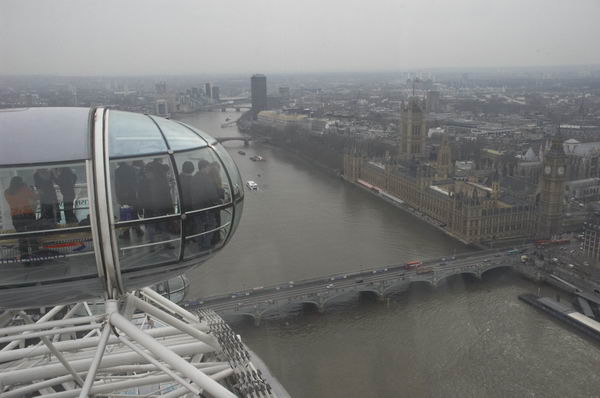
But would a photographer dare to take similar images now, when photographing children has become such a suspect activity?  And certainly any photographer taking pictures of the ‘Air Raid Precautions’  would expect to attract the attentions of the law. One unfortunate amateur photographer, physics teacher Rik Rutter, even got stopped by police for photographing a tourist attraction, the London Eye, in January, although now, as the Amateur Photographer report states he has received an apology from Commander David Zinzan of the Met police who confirms he should not have been stopped.

© 2005 Peter Marshall
© Peter Marshall, 2005
London Eye and Houses of Parliament on a typically gloomy London day

=============================================

*You can see a wider range of Hutton’s work on the Getty Images site which includes the Hulton Picture Library containing work by all the Picture Post photographers, and a search brings up over 3000 pictures. There is also a smaller selection, concentrating on celebrities and a few of his best-known images, available on the GettyImages Gallery site – search for ‘Hutton’.

London Street Photography

© 2011, Peter Marshall
Wolf Suschitzky with the red jumper

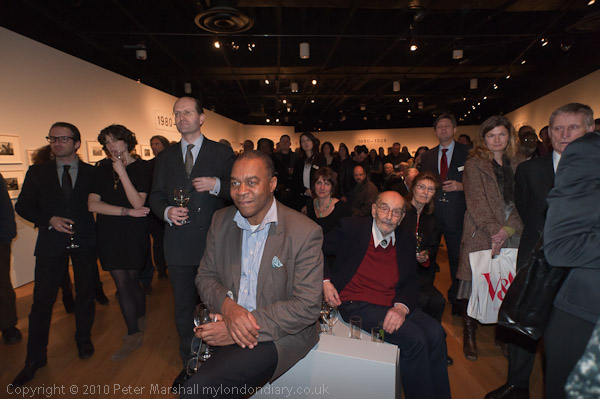
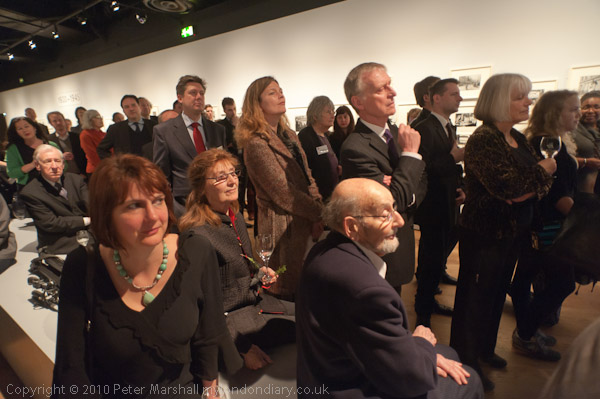
Last night’s opening at the Museum of London of the show London Street Photography 1860-2010 was a great occasion for London’s photographers, with many of the photographers featured present, although of course those from the earlier sections are long dead. But of more than 70 photographers featured, I was told that 47 are still alive, and quite a high proportion of them were among the guests last night.

© 2011, Peter Marshall

© 2011, Peter Marshall
Mike Seaborne, Jack Lomond and  Wolf Suschitzky in a weird purple glow

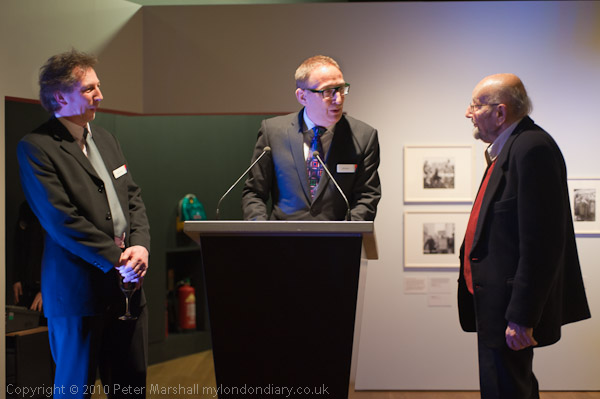
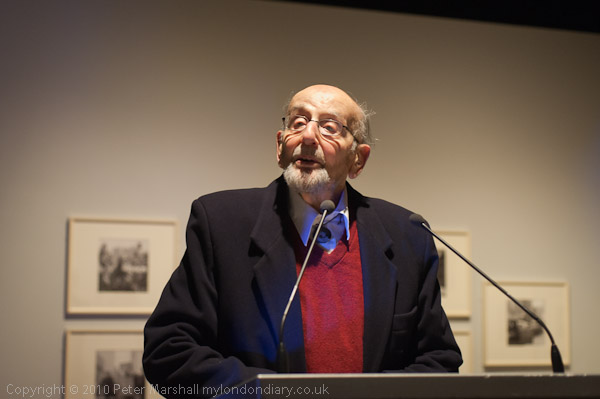
Certainly the oldest among us was Wolf Suschitzky, born in 1912 and still looking well who formally opened the exhibition after a speech by the Museum’s director Professor Jack Lohman in which Mike Seaborne, Senior Curator of Photographs, who together with Curator of Images Anna Sparham put the show together, appeared as Exhibit A. The majority of images in it are from the Museum’s own collection, which Mike has built up tremendously in his years there.

© 2011, Peter Marshall
Suschitzky declares the show open

Although Suschitzky was the sole living among the pre-war photographers featured,  most of those in the next period, 1946-79 are still living and still working, and among those at the opening was Roger Mayne, born in 1929 and best known for his pictures of North Kensington in 2004. During our conversation he mentioned the much wider range of his work that many are unaware of, and you can see some of that on his own web site.

1946-79 covers a long period, and some fairly diverse approaches and style, from photographers such as Henry Grant (1907-2004) to Paul Trevor (b1947) and including among others, Tony Ray-Jones, John Benton-Harris and Charlie Phillips.  Grant’s work stylistically would certainly fit him better in an earlier section – and perhaps seems most similar to that of photographers from the early years of the century, while that of some of the others in this section still seems strikingly contemporary. Perhaps the only thing that the work in this era of the show has in common is that the pictures were all black and white, and around the end of the 70s is perhaps the latest date it seemed possible to ignore work in colour.

One section of this is a group of anonymous images from a project carried out by the Richmond and Twickenham Photographic Society around 1962. It is perhaps surprising that none of the authors are known, and the pictures too are rather surprising for a camera club, even (or perhaps especially) one as prestigious as the R&TPS, which has produced at least five presidents of the RPS. Early in my photographic oddysey – around the latter half of the 1970s – I belonged to it myself (and almost got thrown out on sartorial grounds), but with some notable exceptions, the work that appeared regularly in the club was considerably less interesting than this.

The earliest colour image in the show is by Bob Tapper, from 1986, followed by one of mine from 1991, and the most recent black and white in the book (and I think the show) is from 1999, by John Chase, with all of the images from this century in colour, in part a reflection of the switch to digital, but also of the changing nature of the marketplace for photography.

I’ll write more about the show and my thoughts on street photography later – openings, especially ones like this with so many people to talk to (and I didn’t manage to get to talk to everyone I would have liked) are not the greatest times to actually look at the pictures, and the size of this show made it quite impossible for me to properly see it all. But I saw enough to say that this is a show well worth seeing, even if some of the pictures are not street photography (and unfortunately perhaps much current street photography isn’t really street photography any more.)

© 2011, Peter Marshall
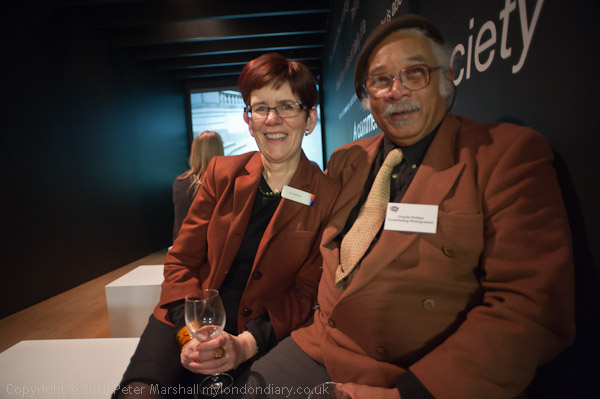
Charlie Phillips talking with Cathy Ross from the Museum of London

The show is open to the public from 18 February to 4 September 2011 and entry is free. The book, London Street Photography, published by Dewi Lewis Publishing, ISBN 978-1-907893-09-4, costs £14.99 ($25.00) and contains many of the best images from the show and is due for general publication in March.

The largest selection of pictures from the show I’ve found on line is at The Independent, and includes some of the best (and a few rather less interesting) images.  The Telegraph has a longer piece on the show with 4 images, but manages to say very little, and unfortunately the Museum’s own web site gives it depressingly limited coverage; perhaps the budget ran out?

It was late when I finally left the bar next to the museum to make my way home through the streets of London, but I thought I would take a picture or two on my way to the station.

© 2011, Peter Marshall

A Trip to Kingston: Muybridge Misappropriated?

I think I first became aware of the work of Eadweard Muybridge while I was  in short trousers, on one of the visits we were treated to by two of our maiden aunts to London’s Museums. The Science Museum was only a short trip on the District line away from where I grew up, but London was another world, and one to which my own parents seldom if ever ventured. Back in the 1950s I’m not sure what kind of display the Science Museum in South Kensington had, and my memory of seeing the images of a jerkily flapping bird in flight may well be a later back-projection.

But when I read what is apparently the first published book on him, Kevin MacDonnell‘s ‘Eadweard Muybridge – The Man Who Invented the Moving Picture’ (ISBN: 0 297 99538 3) in 1972, a book whose photographic enthusiasm made up for its many errors,  much of what it contained on his pictures of movement was already known to me from the history books, but the book did fill in many details on his photography as well as more about his extraordinary life. But the real revelation was to see his photographs of Yosemite, Alaska and Central America and to realise what a fine photographer he was.

It was perhaps shortly after that I first visited the display of his work in his home town of Kingston, a few miles from where I live on the edge of London, and was rather disappointed. Some years later we took students to see it at the Kingston Museum and it had I think improved, and as a part of the current interest in his work aroused by the Corcoran Museum show which closed recently at Tate Britain and will be on show again in San Francisco from 26 February to 7 June 2011, Kingston Museum has benefited from a Heritage Lottery grant of almost £50,000 for its own Muybridge exhibition.

Web sites worth looking at  on Muybridge include Stephen Herbert’s encyclopaedic The Compleat Muybridge and the Muybridge Collection on the Royal Borough of Kingston upon Thames web site. But unfortunately although this latter contains much important material, particularly related to his movement work, there is little about his other photography. Their current exhibition (until 19 March 2011) concentrates on his hand-painted glass Zoöpraxiscope discs used in his lecture presentations. Based on his photographs, these are certainly unique artefacts but seem very much a sideshow compared to the actual images published in Animal Locomotion and the Human Figure in Motion (and now animated on screen by almost everyone, including in the past a number of my students.)

You can however view some of the photographically more interesting aspects of his photography from the Kingston collection in the ‘Image and Context‘ section of the Eadweard Muybridge: Defining Modernities site.
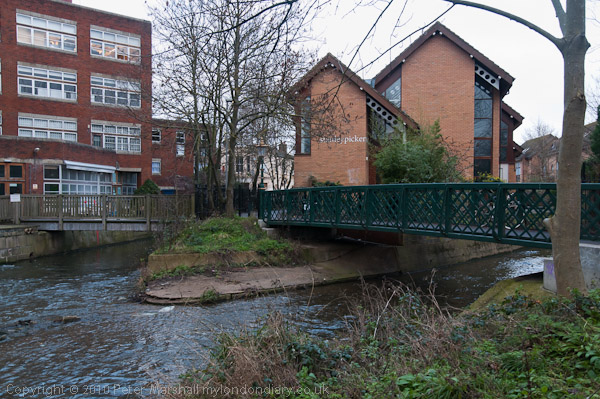
© 2011, Peter Marshall
The Stanley Picker Gallery at the University of Kingston

Also taking part in the Kingston celebrations is the Stanley Picker Gallery at the University of Kingston. I have to say that the most interesting part of my visit there was the walk to and from the site, through the streets of Kingston and then back along by the Hogsmill River, one of London’s lesser known streams.
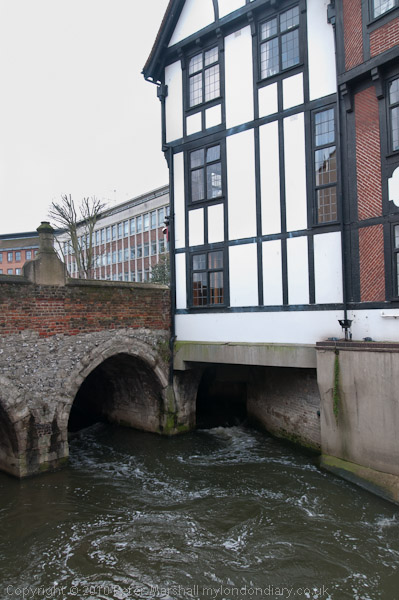
© 2011, Peter Marshall
Hogsmill River in Kingston – perhaps London’s oldest bridge, though much widened
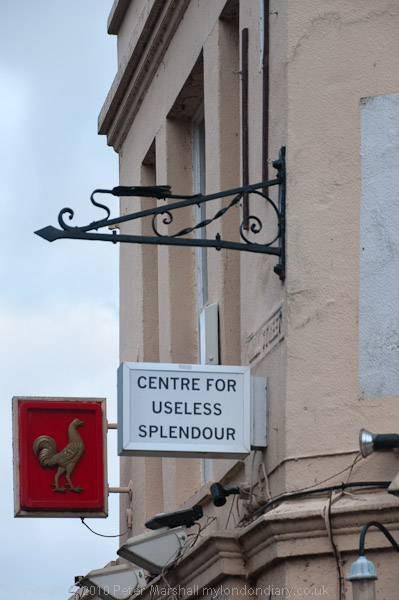
© 2011, Peter Marshall
Visitors to the Swan pub on the Hogsmill Walk may be disappointed

The gallery currently contains two works by an artist which are based loosely on Muybridge’s work. One references his 1877 panorama of San Francisco – which can be viewed online in some detail elsewhere (and on the same site there is also an 1851 daguerreotype panorama of the Bay.) Muybridge’s work is remarkable for it’s detail and clarity, thanks in part to the large (indeed ‘mammoth’) plates on which he photographed it, but also to his careful choice of the day when the air was particularly clear. Perhaps too he had learnt something from his previous attempts the preceding year on a smaller – which had been destroyed in a fire. The 13 plates together produce a 17 foot long image covering a full 360 degrees and showing a remarkable precision in alignment.

It did occur to me that a more fitting tribute to Muybridge would have been to host a show of rather more interesting panoramic photography than the two works on show in postcard racks here, which were I think taken in the garden of 2 Liverpool Road, the house where he spent his final years in Kingston, though I think it has changed rather since he was there.
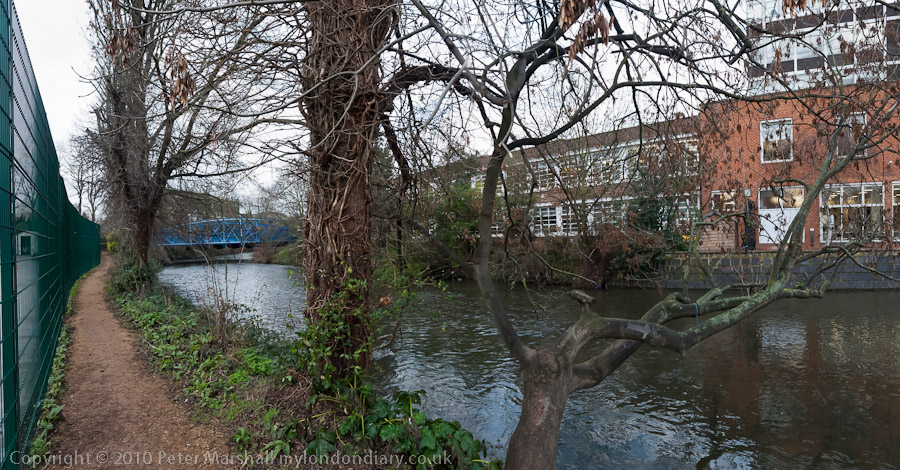
© 2011, Peter Marshall
Hogsmill River at Kingston University – right click and select ‘View Image’  to see larger

The single thing I found most interesting about the work on show in the gallery was the letter reproduced on the final page of the leaflet from David Leigh in California to Borough Librarian Mr Cross on Jan 24th 1949, sending him some information about Muybridge and which in a postscript says “I have read, somewhere, that he was drawing to scale, a replica of our Great Lakes, at the time of his passing.”  This was presumably the inspiration for the work based on the Great Lakes which apparently made use of linoleum, which I also found of little interest.

I can’t however let pass the following error in the introduction to this work:

LINOLEUM Linoleum was invented by Frederick Walton in Staines, England in 1855.

Much though as a resident of Staines I might want to claim any honour it deserves, unfortunately this is just factually incorrect. Staines did have a long connection with lino, and in my youth this was certainly clear to one’s nostrils as you drew near the town, perpetually reeking of linseed oil. But Walton himself wrote to the Technical Director of the first Austrian linoleum company Felix Fritz, the author of ‘Das Linoleum und Seine Fabrikation‘ that he invented linoleum in 1861 (and it is described but not given that name in a British patent of the same year.) At that time Walton was still working in Chiswick, and had no connection with Staines;  it was only in 1864 that together with some new partners he purchased the land on the banks of the Colne there to set up a larger factory to manufacture lino.

Should you wish to read Fritz’s extremely turgid tome there is a copy in the library of the Royal Society of Chemistry at Burlington House, but one of the two existing copies of an edited English edition is on a shelf downstairs, severely abridged and translated pro bono for Staines Musuem by Linda Marshall with considerable (uncredited) technical assistance from myself.

The lino in Staines, long the town’s major employer, celebrated its centenary by closing down around 1964. When we moved to Staines ten years later you could still sometimes smell the linseed oil around the old buildings, then a thriving nest of small workshops and warehouses. Now virtually no trace remains and all we have is a large car park and a bleak boring shopping centre.

This error may not be of great importance, but for me it was symptomatic of a lack of rigour in the work – and was just one of a number of statments that made me think “that’s not quite so.” And a quick check in Google or reference to Wikipedia would have corrected this particular error.

Kington Museum curator Peta Cook told the BBC that she was keen to change the fact that Muybridge although well known in America is not more widely recognised in Britain. They quote her as saying:

“He is London born, and he came back and died here, and this is an amazing collection in Kingston. I would like London to have as much pride in Muybridge as the Americans seem to have.”

I can only agree.

The BBC article suggests the reason for our relative neglect of him is “perhaps because he did the bulk of his work in America.” I have a rather different view. He is neglected here because he was a photographer. And I left Kingston feeling that this very British cultural refusal to acknowledge photography in its own right is very much reflected in the way this current opportunity has been at least in part wasted. Muybridge was a photographer, and a part of a photographic tradition; it’s a pity we can’t celebrate him as such.
Penny Tweedie (1940-2011)

News of the death of Penny Tweedie came as a shock to me, when I read her Guardian obituary which reports that she died on January 14 at the age of 70. I didn’t know her well, but he seemed in rude good health when I last talked to her when she gave a presentation at the  NUJ Photographers Conference in May 2009, and was still very much taking an interest in photography and still taking pictures.  She didn’t at all seem an old woman, but a very lively person of my own generation, still young in spirit. We looked together at a few of the pictures in the NUJ exhibition, and she complimented me on my work in it.

Tweedie came into the profession from Guildford School of Art at a time when women were widely patronised and discriminated against. She had to fight against prejudice – even from the NUJ, and succeeded because  of her determination and talent – she showed she could cover all aspects of the job at least as well as the men.

You can see much of her work on her web site, including some of her better known portraits and some fairly recent pictures, such as those she supplied for the ‘Hospice in the Weald: Celebrating 30 Years Cookbook’ published last November. But her best work was made in the era when magazines published real photography and she worked for some of the best – National Geographic, Sunday Times, Observer, Independent and Telegraph magazines, using the money she made from them to finance less lucrative work, particularly for aid agencies including Oxfam. As  for the Hospice book, she often gave her work for good causes unpaid.

In 1975 the BBC sent her to Australia where she photographed a series they were making about Explorers, but it was the Australian Aborigines she met there that became her great preoccupation, and produced some of her best work and her books This, My Country  and Spirit of Arnhem Land as well as earning her a Walkley Award, Australia’s leading photographic award.

The Guardian article gives more details of her life and career, and includes near the end the chilling statement:  “it seems despair at the world’s lack of use for her craft finally induced her to take her own life.”

Leave Counting Teaspoons to the Academics

It’s a while since I mentioned the online magazine Visura, which is now at issue 11. The highlight for me is a portfolio of the work of Elinor Carucci, pictures of her and her family. At the age of 21 she decided to “shoot things as they were happening. I returned to color film which is, for me, warmer, more vivid.”

The result over the years is a very intimate body of work, with pictures of her mother, self-portraits related to her own marriage and its problems, her back pain and her work for 10 years as a “professional Middle Eastern dancer, or as it is called in the West, a belly dancer.”

The work is very much a collaboration between her and her family, but particularly with her husband Eran: “Some of the photographs in this collection are a collaboration between us, a few of them are Eran’s own take on the situation, his own work.”

Other portfolios in the issue also have a very personal, intimate theme, and although I find some of them of interest they move me less, and at times some I think go over a difficult to define line of using people and some simply fail to engage me.

Stephen Crowley‘s images of men and boys from Afghanistan were made using the cameras and equipment of street photographers still working in old-fashioned ways there. It isn’t of course the calotype process as he states, but uses commercially produced photographic paper. There are some interesting images by Yannis Kontos (Kabul Photographers, under Features) of these photographers at work and some are also in Issue #8 of Daylight Magazine (it costs $5 to download) with a rather longer text. As one of them, Mia Mohammed, bemoans in a short article on CBSNews, his business is about to come to an end because his supplier no longer stocks the kind of photographic paper he needs. Despite the competition from digital there is still demand for these services which can be carried on in the absence of any electrical supply.

Looking at the pictures and text by Stephen Crowley, I can’t help thinking that this is a piece of work more about the story than about the pictures and that I would very much have preferred him to have made his pictures on large format film – still essentially nineteenth century technology. Or even on digital.

The teaspoons come in Visura columnist Charles Harbutt‘s account of how he became a photographer (Harbutt is one of several distinguished columnists and his Reflections on Kertesz appear in the current issue.)  When around 18 and taking pictures for a college newspaper Harbutt managed to attend a workshop run by two major figures in documentary photography, Roy Stryker and photographer Russell Lee.  Stryker picked on one of Harbutt’s pictures, a back view of a girl working in her family kitchen, and told him he should have used flash “so that future researchers could count the silverware and identify the dress pattern and get other significant facts about the family“.  Lee disagreed, as using flash would have lost the mood and made it impossible to take more than a single image of the situation. He said that “preserving the actual experience was what photography could do best. Leave counting teaspoons to the academics.”

Milton Rogovin Dies – His Work Endures

I was saddened to hear of the death of Milton Rogovin, although since he was 101 it was hardly a great surprise to hear the news that he died on Tuesday (18 Jan 2011.) The NY Times Lens blog has an illustrated feature with links to various aspects of his work (and to his obit in the paper), though perhaps his own web site is the best place to see his work. And he was perhaps the first centenarian photographer to start blogging. There are also some good links in the comments on the Lens blog.

I’ve written several times about Rogovin, and the most recent was on this site in August 2009. I think his work is important in particular for his recognition and celebration of the ‘ordinary’ working man, and occupies as important a place in the history of photography as other fine documentary photographers such as Jacob Riis and Lewis Hine.

One small but important technical point I picked up on from his work was about shutter speeds. When photographing people he liked to work on the edge where some slight movement might occur rather than us a fast speed that would be guaranteed to freeze any movement. For him and later for me it was something about showing living breathing people in his pictures, rather than butterfly specimens pinned to the board.