Sapology

© 2010, Peter Marshall
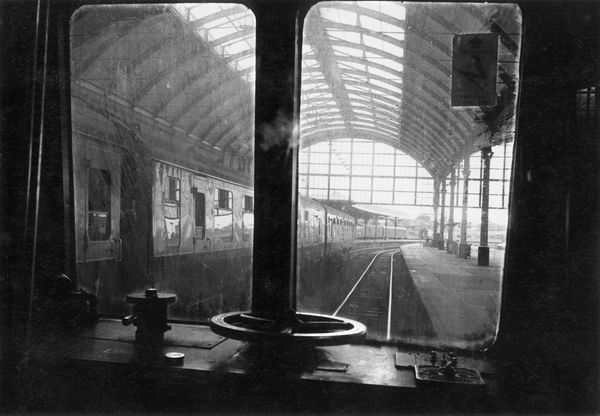
The Thames from the top deck of a bus on Battersea Bridge on my way home

Chelsea isn’t my favourite part of London, always a slow bus ride for me, either from Victoria or Clapham Junction, although yesterday I enjoyed the journey back as the evening lighting was beginning to work its magic as the bus made its way over Battersea Bridge, and I was feeling rather pleased after a pleasant hour or so at Michael Hoppen Contemporary with the aid of some interesting company, a couple of beers and some good photography.

The current show, until 5 June is one of the most interesting I’ve seen in that space which so often seems to be given over to mildly pornographic visions that doubtless sell well. But this show was different. Daniele Tamagni‘s “Gentlemen of Bacongo” is a fascinating study of a genuinely interesting phenomenon.

Les Sapeurs get their name from ‘Societe des Ambianceurs et des Personnes Elegantes‘ – or alternatively from the English version, ‘Society for the Advancement of People of Elegance‘, and sapology is more than a look, it is (as one might expect in a Francophone society) a philosophy espoused by its exponents.  Despite the poverty in the society in Brazzaville, Congo (or perhaps as a reaction to it) they aim for an elegance and style that is based on an idealised tradition of the English dandy, although sometimes allied with a flamboyant use of colour that would seldom be imaginable in our duller clime.

Many of the finely tailored suits are – at great expense, sometimes involving years of saving – from Saville Row and leading French and Italian designers  – and are complemented by hats, shoes, ties, carefully folded and displayed handkerchiefs and gloves, along with cigars (seldom actually smoked) and pipes.

Le Sape has its own highly formalised aesthetic, at its base a ‘trilogy of colour‘, aiming for a perfection of effect within a particular choice of three colours. It even has a written set of ‘10 commandments‘ (actually only eight as numbers 9 and 10 are “Still to be written”) of which number 2 is “You will not sit down“. Clothes are for posing in, for appearing in on the street or at the bars at which the Sapeurs meet, for putting on a show.

Most of what I know about them comes not from the images on the wall but on the book of Tamagni’s work (Gentlemen of Bacongo, Trolley Books, 2009, ISBN: 978-1-904563-83-9 – and the site has a good slide show of ten images) which is more impressive that the show, enabling Tamagni to portray a much wider and more rounded view of his subjects. On the gallery wall they perhaps become a little too much like exotic specimens. It is hard to photograph people like this who are so conscious of their own appearance and image and are almost always posing, but he manages both to project them as they would like to be seen and also at times to get beyond that.

I first met Tamagni in Peckham in 2007, and I wrote about his contribution to a show there and, something I found rather more interesting, his work on black churches there, from which perhaps the most striking image in that show came. In the same year he won the best portfolio in the Canon Young Photographer award for Italy for his pictures of dandies from the Congo, and  in 2010 he gained the ICP award for Applied Fashion photography.

© 2010, Peter Marshall
A sapeur poses in front of Daniele Tamagni’s pictures at Michael Hoppen
© 2010, Peter Marshall

Sapology has spread from the Congo as Sapeurs have gone abroad to live and work, and the opening night was made more memorable by the attendance of one of them from London, who had also brought along a collection of his shoes. As usual I couldn’t resist taking a few pictures, two of which you see above.

© 2010, Peter Marshall
AramintaDe Clermont and Daniele Tamagni

Also showing in the gallery are a series of portraits by Araminta De Clermont of young South African girls from the Cape Flats dressed up for their end of school ‘Matric Dances‘. For many of  these young women it is the night of their lives and their families have planned and saved over the year to create a night of fantasy. She has photographed them very much as fashion models in the style of fashion magazines. Born in the Isle of Man she graduated in architecture before going on to study photography in London and South Africa. She now lives and works in Cape Town, where these pictures were shown in 2009.

Her first solo exhibition “Life After” at Joao Ferreira Gallery in 2006 looked at South African ex-prisoners and their tattoos. You can see six pictures with her comments in a Guardian slide show, Prison Ink.
Crow Country

The British Journal of Photography has a rather low opinion of it’s readers when it states “Few readers will have heard of – let along seen – Masahisha Fukase’s 1986 book, Karasu (Ravens), first printed by Sokyu-sha, a Japanese publisher based in Tokyo.”

Do I feel insulted or give myself a pat on the back as one of the chosen few?  No, but I do feel it rather more reflects the ignorance of the writers of the BJP about the wider aspects of photography which are too often demonstrated on its pages than anything about its readership, and for a publication hoping to establish itself as a monthly devoted to the medium is disappointing. Guys you need to up your game. In many respects the latest May issue is an improvement (and I’m pleased to see that it has lost the typographic fancies that made it literally hard for me to read.)

Although I don’t own ‘Karasu‘ I was among the thousands of us in London who flocked to the Serpentine Gallery in 1985-6 (and it was also shown in Oxford) for the show ‘Black Sun‘ which featured Fukase’s work along with that of three other great Japanese masters, Eokoh Hosoe, Shomei Tomatsu and Daido Moriyama and have the Aperture issue of the same name by Mark Holborn which served as a fine catalogue. It has 16 pages devoted to Fukase’s work, and in particular to the crows. Much more recently I remember seeing a whole wall of this work, I think at the V&A, and the former director there, Mark Haworth-Booth is among those listed in the acknoledgements to ‘Black Sun’.

More recently in 2008, Paris Photo had its thematic show on Japanese photography from 1848 to the present day and on this site I wrote “Of course there will be plenty of familiar work, including people such as Shoji Ueda, Ihei Kimura, Masahisa Fukase, Eikoh Hosoe, Shomei Tomastu, Hiroshi Sugimoto, Nobuyoshi Araki and Daido Moriyama” and there was.

Japanese photography, despite my particular interest in the work of people such as Eikoh Hosoe (who I was really delighted to meet in Poland in 2005) and Issei Suda, one of whose books I bought many years ago was an area I had only really just started to work seriously on in the ‘World Photography’ section of my ‘About Photography’ site when my contract was terminated.  A couple of years earlier I had published a piece ‘Early Photography in Japan’ which had dealt largely with the nineteenth century and was hoping to write more on the twentieth century, although I had written short notes about Fukase and the others.

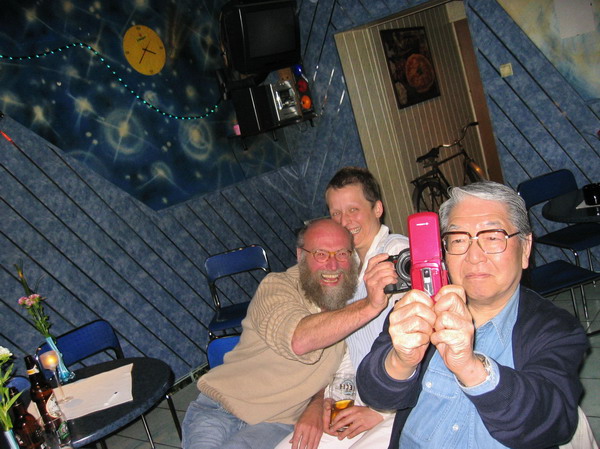
© 2005 Peter Marshall
Eikoh Hosoe photograhs me with a pink phone in Alacatraz

The BJP calls Karasu an obscure masterpiece” and expresses surprise it was chosen as the best photobook of the past 25 years in their critic’s poll and you may like see the list of the other works that these “five experts” (themselves somewhat randomly chosen) have selected.  Perhaps surprisingly, the one Japanese among them, Yoko Sawada, who was responsible for many of the issues of the influential Japanese photographic magazine déjà-vu in the first half of the 1990s, does not mention the book, picking works by five other Japanese photographers starting with Nobuyoshi Araki to whom 4 of the magazine’s 20 issues (including its last produced by Akihito Yasumi) were entirely devoted.

There are rather few books on the list I would have chosen, although I’m familiar with many of them. Those I own are Nan Goldin’s ‘Ballad of Sexual Dependency‘, Chris Killip’s In Flagrante and What We Bought: The New World by Robert Adams, although I do have other works by several of the photographers named.

I don’t really subscribe to the idea of “the best photobook“. Books to me are working tools, things I use, and if you have a job that needs a screwdriver even the best spanner is likely to be pretty useless. I’ve never felt a need – nor do I expect to –  for quite a few of the volumes listed by this very small selection of critics.

What I have read recently is ‘Crow Country‘ by Mark Crocker, described in the Independent as “A thoughtful and brilliantly executed celebration of countryside and the importance of nature in human affairs.” It contains no photographs, but is superb evocation of one man’s obsession with the the corvid family of birds – crows, rooks, jackdaws, ravens and more – and his attempts to find what lies behind their migrations, roosting and massing. It’s a work that perhaps might well be read alongside Fukase’s work.

Visura 9

Issue 9 of Visura magazine is, as its predecessors, full of delights, and doubtless you will find your own and different highlights from mine. Cheryl Karaliks‘s five deaf boys raising their hands in the air in Bobo Dioulasso, Burkina Faso in 1991 certainly lifted my heart and there are many other fine images in her ‘Notes from Africa.’ Alex and Rebecca Webb’s ‘Violet Isle‘ includes many amazing colour images by both, and it was a joy to view the work again.

The work in this issue is extremely varied, and living up to the magazine’s policy which is to feature “personal projects chosen by the contributing artists themselves” with “texts that accompany projects … edited through a collaborative process with the artists” with the goal “to be true to their voice“. Although it is an ‘invitation only’ publication, photographers are invited to include a link to a series of their personal work on the ‘Your View’ page.

I still have some problems with the web design – or perhaps with my connection to the site. I don’t know if I saw all the pictures in some of the essays, as on the final image I reached there was still a button for the next image – but clicking it failed to load more. The initial image for each feature also came equipped with a ‘previous’ button that did nothing on my browser. For some features – including my two favourites mentioned above – I could find no accompanying text other than the image captions, and where the text was on the other features there was a large area of empty space.  I was left wondering whether the photographers had wanted their images shown without text, or whether the text had for some reason failed to load.  It remains the kind of site where I sometimes am left wondering whether I’d using the right browser or have the right plugins loaded.

For some time I’ve been convinced that the future of photography magazines is on the web, and Visura I think is in most ways a good example of how that future will be. Visura has great content and it looks good on my screen (and after all photographers need to have good screens, accurately calibrated to process their own work – so what could be better to view the work of others?)

Previous issues are still available in the archive section of the site and there are many fine features there to discover if you haven’t been a regular reader.

Photojournalist Arrested At Protest

On dvaphoto you can read the full story of the arrest of photographer Ethan Welty in Colorado following his coverage of an environmental protest at the Valmont Power Plant near Boulder on Tuesday April 27th. He was photographing from outside the plant where 4 environmental activists were arrested for 2nd Degree Criminal trespass.

Police named him as one of the arrested activists, and the press, including AP ran the story without checking the facts, and much of the media are still ignoring Welty’s attempt to point out to them that he was acting as a journalist and did not take part in the protest, staying outside the plant.

You can see Welty’s pictures from the event on Photoshelter, and his web site is also worth a look for his other work.  As Matt Lutton says in his post, “This is an issue not just of press freedom for an independent photographer covering an event but of Ethan Welty’s ability to fight false accusations and bad reporting which have brought his name into media reports of the event.

Shoot 36

For those of us who want to remember the old times, or for those who never experienced them, professional photographers are invited to take part in Shoot 36, which invites them to shoot a 36 exposure film using a single body and one fixed focal length lens, pick the best 6 images, scan them full frame and upload them to the site.

You can see the full rules on the site if you want to take part in what I think is an interesting bit of fun. So far the one set of six images that stands out for me is from Sang Tan – some nice pictures even if not entirely sticking to the rules!

As it says on the site:

  • It’s a challenge.
  • It’s a bit of fun for the professional photographer.
  • It’s about enjoying past techniques.
  • It’s about hand processing film.
  • It’s about the anticipation of discovery.
  • It’s a test of our skills as photographers.
  • It’s about the smell of the chemicals.
  • It’s about loading a spool.
  • It’s about a fridge full of film!.
  • It’s about taking pictures not because we are paid to but because we want to.

One day I might even try it myself – I’ve got plenty of outdated film to use!

The London International Documentary Festival

The LIDF starts more or less now, with the premiere of Abel Ferara’s innovative docu-film Napoli, Napoli, Napoli at the Barbican this evening  (I’m sorry I’ll miss that and the party afterwards) and it goes on until 8 May featuring more than 130 films from 36 countries, bringing the world’s stories to the capital.

One of the reasons I’ve not been posting much this week is that I’ve been busy putting together a small presentation for The Invisible City tomorrow. The event starts at 10.30 am and goes on until 4.30pm, though my contribution is mercifully shorter.

I’m actually taking two pieces to the event. One is a rather higher resolution printed version of a kind of psycho-geographic spoof I wrote for a web site that folded soon afterwards (I think co-incidentally.)  I’m told that Hub Kings Cross where the event is being held would like to keep it up on the wall for a while after Saturday, but I don’t know any details. I’m please to be going back to King’s Cross too, as its an area I was involved a little with around the start of the Kings Cross Railway Lands Group, helping in a very small way in the planning exercises they organised to find what residents of the area really wanted.

Apart from a few minor corrections, slightly better image quality and a slightly different layout with each page on the web site being replaced by an A4 sheet, ‘1989‘ remains more or less as it is on the web.

© 1989, 2006, Peter Marshall

From ‘1989

There are some small compromises in design, partly because I had to do it a a hurry, but also because although the images are large enough, I think ideally I would have liked them just a little bigger and with more white space.  What I’m putting on display is more like a print or magazine version of the work (I put it together and printed it using Desk Top Publishing software.)  Years ago I used to occasionally teach a little using Pagemaker and it still does a neat job without fuss.

Printing was very easy after a first ruined sheet when I forgot what I was doing. Using the Epson ABW method they provide on the R2400 (and other printers) it was simply a matter of choosing my own preferences for the colour of the black and white images and reducing the ink by around 10% which I find gives better prints on the Epson Archival Matte paper.  It is normally only a material I use for proof prints, as it can give a rather nasty yellowing with age, but so long as these prints last on a wall for a few weeks they will have done their job.

The other thing I’ve been working on for LIDF is a 20 minute presentation on  30 years of my work in the Lea Valley.  The finished presentation includes work from 1982 to 2010 and concentrates on the Olympic area and south from there, although there are some pictures from further north – including the source.

Many of the pictures I’ll be showing are on my River Lea – Lea Valley web site, but there are quite a few that have yet to make their way there, including some I’d forgotten about myself. If I’d had another month to prepare I would have included more of my colour work, including more panoramics as there are still some parts of my archive which are pretty unexplored.

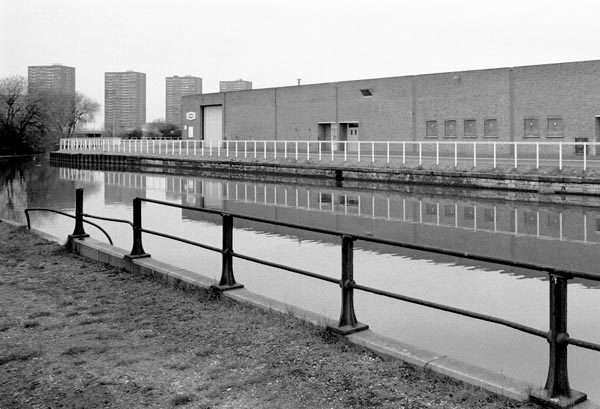
© 1983, Peter Marshall
Behind these warehouses on the Lea Navigation, in Duck Lees Lane, Ponders End was the works where one of the key inventions of the 20th century was made, the foundation of the whole electronics industry. But I may well forget to mention that tomorrow! Putting the presentation together has been a major effort, first of all finding and scanning images and then hours of swearing at Microsoft Power Point. In the end I ended up finishing it in Open Office’s equivalent, Impress, where I found ways to do things rather faster. It also enabled me to export a high resolution version as a PDF which might be useful.

Other photographers taking part include Tom Hunter with his Swan Songs and Life and Death in Hackney; Ruth Baily with pictures of the Midland Hotel and Alexander Brattell’s exploration of Victoria Park. Mike Seaborne, who runs the Urban Landscape web site with me is also talking there.

Tomasz Gudzowaty

Thanks to Verve Photo for reminding me of the work of Tomasz Gudzowaty, a very fine Polish photojournalist (b 1971)  who has won too many awards over the years to mention.   In the past few years he has concentrated on photographing sports, but bringing to the area the kind of humanistic eye of a great photojournalist.

His interests are away from the big events, the big money and the champions (though he does have a very nice set of portraits of ‘The Olympians‘, sporting champions from the past on his web site) , looking very much at minority sports and people at all levels in them, managing to get published the kind of stories that don’t usually make the sports pages and magazines.

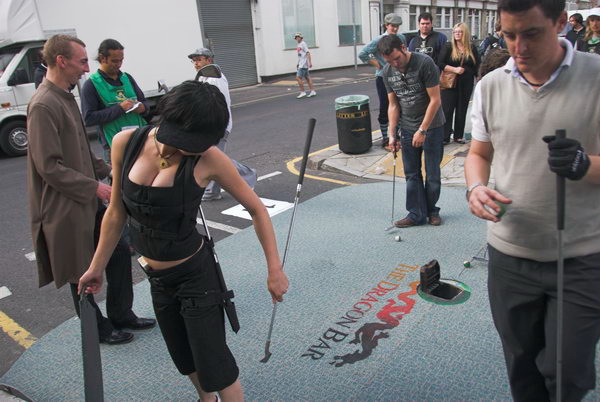
One of his more recent essays that has won awards is on urban golf in India,  a game invented and played by slum kids – and not the kind of event I photographed a few years ago in Shoreditch, though it has some similarities, but unlike me he makes some stunning black and white images from it.

© 2006 Peter Marshall
Urban Golf in Shoreditch was sponsored by a drinks company

VII – The Magazine

If you’ve not yet seen VII – The Magazine, launched a couple of weeks ago, it’s well worth a look. As you might expect from one of the world’s leading photo agencies, there are some fine photo stories from some of its 29 photographers posted already, and obviously many more to follow.

But perhaps the most interesting piece so far is an interview with Ashley Gilbertson who worked largely on assignment for The New York Times in Iraq from 2002 until 2008 and was in 2004 awarded the  Robert Capa Gold Medal for his work in Falluja by  the Overseas Press Club.

If you click on the image of his mobile, a popup window will open  with a warning that the story contains graphic imagery and language. It does. He talks candidly about the death of Billy Miller, the marine assigned to protect him was killed while he was photographing in Falluja and the affect it had on him. Since then he has looked at the emotional impact war has on the soldiers and their families and the problems faced by those who do come back.

I had some problems with the player software on my system using Firefox but it worked fine when I made the player full-screen. I found the series of black and white panoramic images of the rooms at home of soldiers who had been killed particularly moving, along with a couple of the portraits of those who had returned and were obviously very much affected by what they had seen and done.

Paris on Sepia Town

Sepia Town is a great site that I’ve mentioned before that maps historical images, mainly photographs, from cities around the world on to Google maps so you can see from Street View what the places in the pictures look like now.  Hidden away in its view of London are a couple of my pictures, taken before 1980 which I think is Sepia Town’s  definition of a historical image.

The latest news on the Sepia Town blog is that they now have added some of Atget’s images of Paris to the site for us to enjoy.

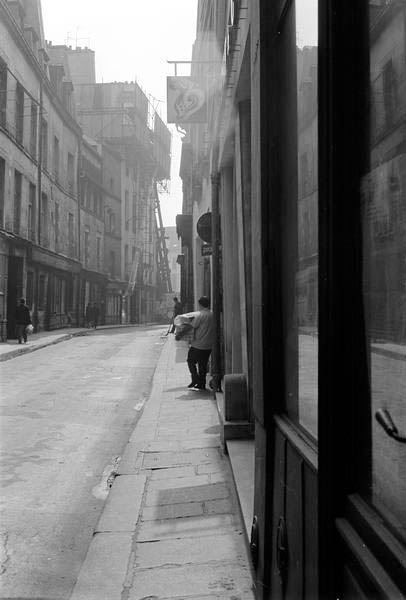
There are a few of my own pictures of that city which I might add, when I have the time, but you can already see a selection of the images that I made there in Paris 1973 ,

© 1973, Peter Marshall

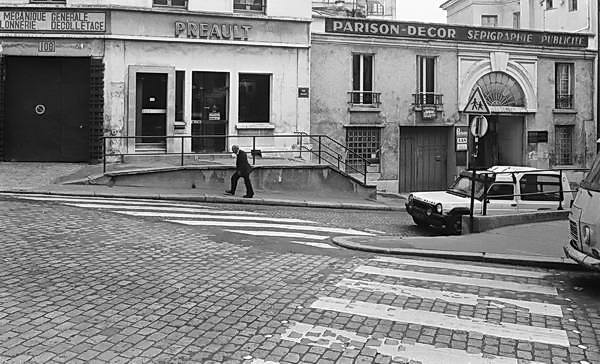
although the work that I took more consciously based on Atget came a few years later, in Paris Revisited, taken in 1984, which I put on line earlier this year.

© 1984, Peter Marshall
Quai de Jemappes / Rue Bichat, 10e, Paris, 1984

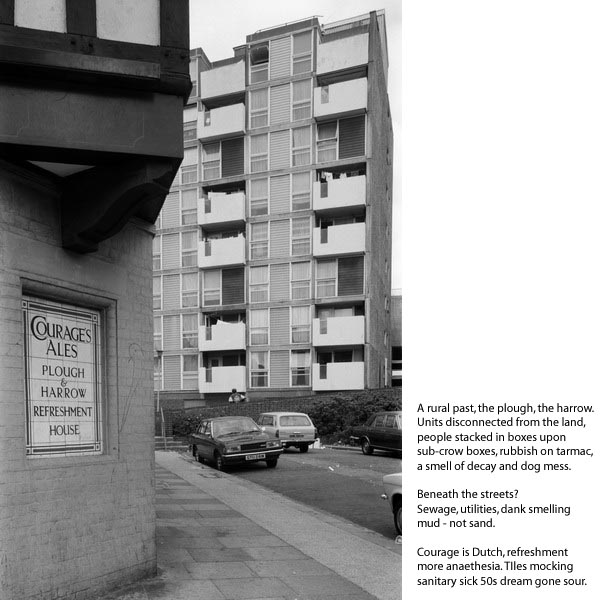
The other work from the 1970s that I intend to put on Sepia Town is from Hull  (sometimes known as Kingston upon Hull) where at the moment there are no pictures at all. A few of mine are on the Urban Landscapes web site.

© 1975-83, Peter Marshall
Hull Paragon Station

Chocolate Box?

I was surprised to see on the cover of April’s British Journal of Photography (not yet updated on line) the text “Forget the chocolate box aesthetic and tune in to the new landscape photography with a message to tell“, because I thought that anyone with a serious interest in photography (rather than producing coffee table landscape books that sell rather well) had abandoned that kind of thing a few generations back. And in any case those few well-known guys who make a good living from schmaltz are hardly likely to throw their meal ticket away.

Is this I mused, a sign that BJP are now marketing themselves at the hopeless and helpless amateurs who are still immersed in the kind of pictorialism that went out of style with the rise of modernism now almost a hundred years ago? (Something I date in photography from the publication of Paul Strand’s work in the two final issues of Camera Work in 1916-7, though it took a while to spread from that point.)  Even Ansel Adams, arch-priest of large-format mountain worship, was seldom choc-box though perhaps more often pop-corn. And some of those later Edward Weston landscape’s were almost chillingly classical.

But turning to the article, it seems the “new landscape photography” they were referring to was really something very old by now, brought to public attention in 1975 by the ‘New Topographics‘ show and widely discussed here at the time by photographers with articles appearing in the US magazines that many of us read as well as ‘Creative Camera‘ and doubtless even the BJP.

I don’t find Eugenie Shinkle‘s article reflects the situation and the thinking among photographers, at least not those I knew at the time. The British landscape photographers most admired were people including P H Emerson, Paul Nash, John Piper, Edwin Smith and – rather different in his style – Bill Brandt, none of whom was in any way affected by Minor White and at least two who were certainly in part under the spell of Eugene Atget, perhaps a forerunner of the “neutral stance” of the New Topographics. To suggest that this was in any way “a moribund European landscape tradition” seems ridiculous.

Minor White was not particularly well-known at the time in the UK, and although parts of the USA were full to the gunwales of his disciples, I think had relatively little impact here. One reflection of this was the problem that I had in getting to see a copy of his “Mirrors, Manifestations and Messages“. The only copy that could be located in a library in the UK was in the British Library Lending collection itself and I had to sign away my soul to the devil before being allowed to take it home.

Raymond Moore certainly appreciated White’s work, along with that of others such as Callahan and Siskind, and made the pilgrimage their with his work – which was recognised, seized upon and shown in the USA.  I think he had a more profound and open vision than the better known Americans, particularly in his late work, and had he moved to the States would by now be considerably better known and respected.

I had the pleasure of going in a group with Moore and other photographers to the show ‘23 Photographers / 23 Directions’ at the Walker Art Gallery in 1978. The work which interested us all – Moore included – was largely that by Lee Friedlander, Lewis Baltz, William Eggleston, Steven Shore and Robert Adams (3 of them in the New Topographics show and the other two sharing some of what was described as their neutral stance) and we had very little time for some of the others (the Bechers were also in both shows, but perhaps we found their work less interesting.)  We had all seen the work of all these photographers in reproduction, but for some of us it was the first chance to see the actual prints.

A year or two later I had the experience of sitting at the feet of Lewis Baltz (absolutely literally if not entirely metaphorically) as he looked through the page proofs of his Park City. Along again with a group of photographers. Most interesting to me was the work he showed us by other contemporary American photographers working in both black and white and colour, most now well-known. Several were later in Sally Eauclaire’s New Color Photography (1981) and other books.

The New Topographics are now part of the tradition rather than news.  It’s still an interesting show, and one of several in that era that changed the face of photography.  But perhaps the article and the cover tease might more accurately have said “Show that shook up British photography thirty years ago.”