2010 Deutsche Börse Photography Prize

This evening I went to the opening of the showing fo the four photographers short-listed for this year’s Deutsche Börse Prize at the Photographer’s Gallery in London and was disappointed. Although in previous years I’ve usually disagreed with the decision of the judges in making the award, I think this year is the first in which I’ve found little or nothing among the work displayed really worth looking at.

I’m particularly disappointed because one of those short-listed was a photographer who I knew years ago in the 1980s and whose work I then admired. Back then I was involved with a small group of photographers who called themselves Framework and met monthly to look at each other’s current work, and occasionally organised group shows. The core of the group apart from myself was Terry King, who did most of the organising, and others involved included Carol Hudson, Derek Ridgers and Jim Barron. (You can read more about this group in an old and outdated but never finished web site.) We had our first exhibition as Framework in 1986 and the last in 1992, and the full list of those who showed with us included some well-known names in UK photography, including Jo Spence.
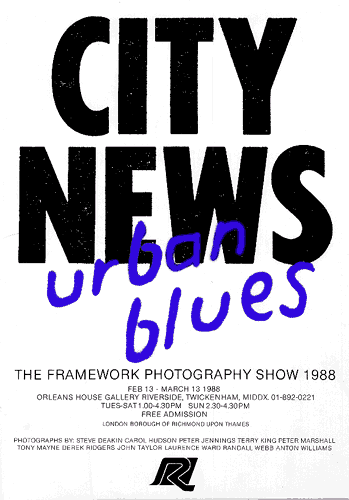
© 1988 Peter Marshall

One of the photographers who brought her work to several of our meetings in Kew was Anna Fox, and I was greatly impressed by her pictures of office workers in London, later published as ‘Workstations‘ (1988). When she came to Framework she had I think just finished her degree studies at Farnham, where she is now Professor of Photography at University for the Creative Arts. I think she was also the only photographer we invited to show with Framework who declined to do so!

So I went to the gallery tonight rather rooting for Anna (though we’ve not kept in touch) but found myself rather disappointed by what I saw on the wall. You can see quite a lot of it on her web site. The series I found most interesting was her 1999 miniature bookwork ‘My Mother’s Cupboards‘, but it was simply too small and in a way too limited. The selection from ‘Back to the Village‘ was also rather disappointing, and in general I felt that what we were seeing in the gallery was too many little bits and nothing really substantial. And looking through her web site, I still find the work from her early projects – particularly ‘Workstations’ – rather more exciting than anything she has since produced. You can read about her work ( and the other three) in The Telegraph.

I can’t even bring myself to write anything about the actual work by Sophie Ristelhueber which is on the ground floor of the gallery. Other than that the prints are quite large. But on my last visit to Paris I saw shows by twenty or more French photographers who I find of more interest, and I find it hard to see why her work made it here. There is a gallery of her work from her Jeu de Paume show on The Guardian web site which I find rather better than looking at the gallery wall, but still fails to convince me the hype is really more than hype. And I’m not sure why the Photographers Gallery should be showing the work of someone who saysNowadays I am not even a photographer because I am a conceptual artist.’

Zoe Leonard is a photographer whose work I’ve known for a long time and probably first saw in the American photography magazines, perhaps Modern Photo. I’ve always thought of her as a pretty good photographer, but nothing really special, and the work on show confirms this.  Analogue 1998-2007, on show at the gallery, isn’t a bad piece of work, but I think there is very little to distinguish it above the work of the many other photographers who have also photographed “tacky shop windows, quaint signage and mundane commercial products“. I can’t really say anything against it. There are quite a few images I’d have been happy to take myself when I worked extensively with similar subject matter in London twenty years ago. But I didn’t take them on square format and print the film borders.

Duncan Wylie’s work on the Maze prison after closure I’ve always found rather boring, and this show did nothing to change my mind. The article in The Telegraph is considerably more interesting – and the smaller selection of images helps greatly in this.

But the prize winner in this show must surely be the original producer of the scrapbook which fills one wall, I think Wylie’s uncle, although it was published by Wylie and Timothy Prus. The selection of spreads on the Steidl page is misleading, because the major interest lies not in the photographs but in drawings and the text of the articles, from magazines and newspapers – and also a typed ‘recipe’ for the troubles.

It’s these articles and  (and that the wine ran out almost before the opening started) that stick in my memory and created the greatest impact –  not the photographs, and that seems to be a fairly damning indictment of what was meant to be a photography show.
Bow Creek By Bike

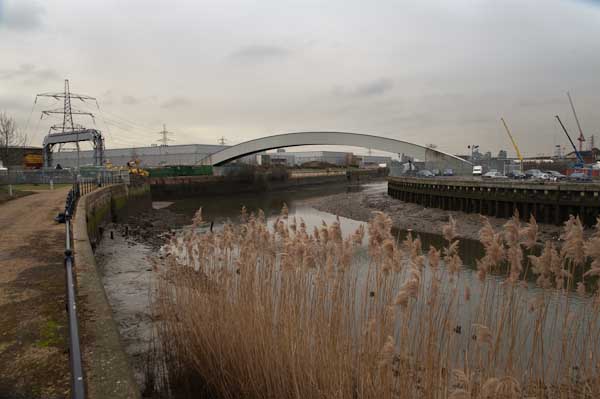
I was on my way to Stratford to be interviewed and decided on the way to visit the section of path by Bow Creek to the south of Bromley by Bow. This is an isolated section of path tidied up and opened some time ago that somehow I’ve never quite managed to go along before. If you are on foot it’s a bit of a pain, because having walked around 2/3 of a mile you come to a dead end and all you can do is turn round and walk back.

But it was a decent enough day for a bike ride, so I took the Brompton up to Waterloo on the train and down the escalator then hopped on it on Waterloo Rd. Cycling in central London is really rather easy compared to the suburbs where I live, because there the traffic tends to be moving around 30mph faster than me, whereas most of the time in London it’s going at the same speed or slower.

© 2010, Peter Marshall

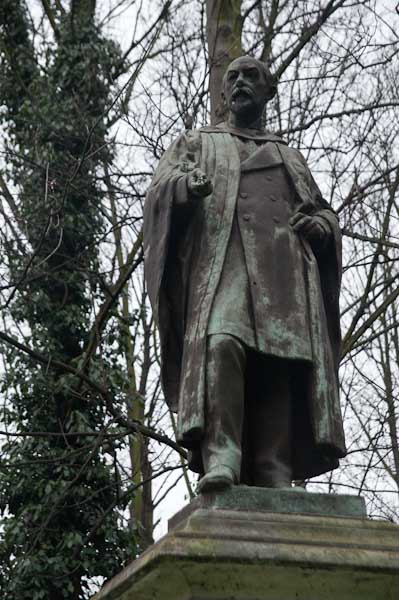
First I revisited The Gas Light and Coke Company’s War Memorial, which is close to the start of the footpath. I photographed it a few years ago, but since I was there thought I’d do so again. I rather admire the statue of the boss, Sir Corbet Woodall, one of the great figures in the gas industry whose attitude to his workers – who he made partners – was remarkably enlightened by today’s often primitive standards. He looks the part too, standing there with his spectacles in his hands. Although he died during the ‘Great War’ he was 75, so I don’t think his death was attributable to enemy action, but many of his employees did die fighting for their country, and their names are listed on the panels in the memorial.

The footpath is wide and has a good surface for cycling, and in the hour or so I was there taking pictures I saw only two people who had come down it for a walk. But it’s a pleasant detour if you are in the area.

© 2010, Peter Marshall
Near the end of the footpath

I was using the Sigma 24-70 and working mainly on manual settings with the lens well stopped down – mainly around f8, as I wanted to make some panoramas by stitching images. Since almost all the interest is along a fairly narrow strip there doesn’t seem to be much point in producing the kind of all-round views that would have acres of sky (and a lot of path) in them so I was making single-row panoramas, which it is fairly easy to do hand-held.  Thought it would have been slightly better to have used a good tripod – there were a couple of pans I tried that won’t stitch well enough for me.

I tried a few 360 degree panoramas, but apart from getting very long and thin, I usually find I lose interest somewhere. Probably the best pictures come from around the 100-120 degrees that I used to get in a single exposure on film with swing lens cameras like the Horizon.

You can see more pictures from the Gas War Memorial and the path on My London Diary – where I give some more information about the walk. I’ve also posted 3 of the panoramas I made on a special page. The top one is a bit less than 180 degrees and almost fits my screen if I browse maximised. The second is less ambitious and around the aspect ratio I normally prefer, though I don’t find this particular picture as interesting as the other two. And the third is a full 360 degrees. To see all of that at one time I need to press Ctrl and – together a couple of times to zoom out in Firefox. And contrary to the end, this is the picture I like best.

Prescott Folly?

This is not yet another underhand knocking piece about our former Deputy Prime Minister who I think has been so unfairly pilloried by the press, largely because of his adherence to his working class origins and some habits which are rather too easy to make fun of, not least a complete inability to construct a coherent sentence, always jumping off to another thought before reaching a conclusion. But I really think Prescott deserves praise as the first UK politician in power to take environmental issues at all seriously.

© 2010, Peter Marshall

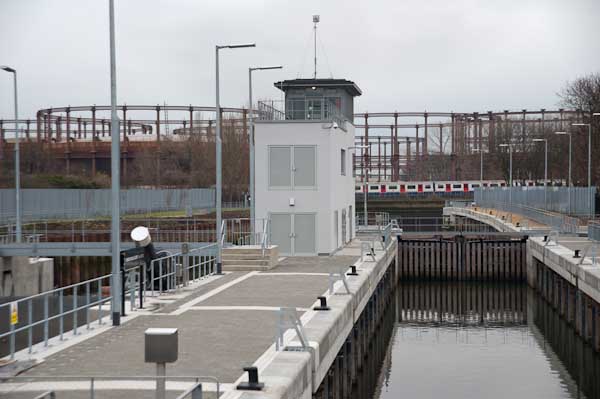
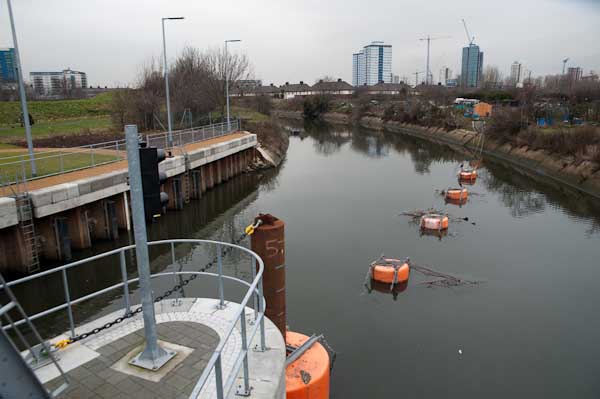
But so far as I know he played no part in the creation of the Prescott Folly, officially known as ‘The Three Mills Lock‘ and a part of the “greenwash” around our 2012 Olympic Games bid. The lock was to enable huge amounts of building materials and waste to be transferred in and out of the Stratford site over the river/canal system already existing there, but previously only navigable by small craft around high tide. Actually even although the new lock will keep up water levels above it, there isn’t a great deal downstream at low tide, so I’m not sure what a great difference there will be.

The Prescott Channel, named after a long-forgotten chair of the Lee Conservancy Board, was constructed in the 1930s as a part of a flood prevention scheme, which also involved the construction of several new locks designed for navigation but which were seldom if ever used.

2010 sees history repeating, as although a barge was loaded with waste in June to take to Rainham for disposal I suspect this was a photo-op rather than the start of real operations and there seems to be little use currently being made of this £19 million lock.  The barge for those pictures on the Waterworks River is the 250 tonne Ursula Katherine from Bennett’s Barges. The only pictures of a barge I’ve found elsewhere on the system, apart from a few narrow boats (and they used to occasionally make it before the lock was built) are all of the single barge from the opening event – and I’ve even searched Flickr.

© 2010, Peter Marshall

The Olympic Development Authority already claims to be more than meeting its target for movement by rail and water using rail alone. So they don’t need the barges. But it would be nice to see one going through now and then.

But even though it is perhaps unlikely to have much of a role in the concretisation of the area taking place for the Olympics, the lock does have two roles which will be critically important in the aftermath, when property developers will be scrabbling for easy profits.  It will enable the flows of sewage that occur into the Lower Lea during storms to be prevented from flowing upstream on the tide into the Olympic area, and will also prevent the flooding that can currently occur on much riverside land.

Which is of course good news for British Waterways as it converts considerable areas of riverside land that they own from open wasteland into highly desirable development opportunities. But had they proposed the plan for this reason it seems unlikely it would ever have been started.  Folly is hardly the word to describe it; deception would be more accurate.

I had been hoping to cycle on the footpath along the side of the river along the ‘Long Wall’ from Three Mills to the new lock, and then to continue over the bridge at the lock and on to the Northern Outfall Sewer. Both paths were closed, supposedly for six months, for the construction of the lock. The lock was completed months ago, but the paths remain closed.

You can see more pictures of the lock and the area around on My London Diary.

The Sincerest Form of Flattery

I’ve been thinking for a few days about the complaint made by New York City-based photographer Alex Brown aginst the Glasgow artists, Littlewhitehead (Craig Little and Blake Whitehead) who had based an installation on an image by him of a young boy in a Darth Vader mask sitting in a cheap restuarant.

You can see the photograph and a picture of the installation on PDNPulse, which also gives details of the story, though I think I first saw it somewhere else.

My immediate question are where do we stop? And frankly is it a good idea for photographers to raise such questions?

In this particular case much of the impact of both works relies on a heavily trade-marked and copyrighted plastic head dress warn by the child in the picture.  So perhaps Lucasfilm Ltd have a pretty good case for suing the arse off both of these guys?  Then for Alex Brown, perhaps we might ask whether he has a property release for the diner, and there looks like another copyright issue involved in that red shirt, which even has some photographic imagery…

Every time we take a picture, we are copying everything within the frame of our camera. And of course using our skills to organise it into some kind of statement – I don’t in any sense want to belittle the activity of photographers in general or Brown in particular by using the word copying. It’s at the basis of our medium.

And of course the installation is not just a simple transformation into 3D of Brown’s 2D work. There are obvious significant differences, but of course his work acted as an inspiration for the sculptors (though I think it an abuse of language to call it plagiarism.) Perhaps too we need to remember the dictum that is still at the base of our copyright laws “there is no copyright in ideas, only in their creative expression” even if some court decisions appear to contradict this.

It’s an area where photographers very much live in glasshouses, and if every artist or photographer who had inspired some of my pictures were to form a line outside my house it would stretch a very long way. And near the head of the queue would be guys like the two Henris (Matisse & Cartier-Bresson) and Walker Evans.

But back to the Darth Vader image; since Littlewhitehead were deliberately making use of a particular image, I would have assumed that they would have acknowledged it when exhibiting their work and in their documentation. And that they would have carried out sufficient research to include the name of the photographer (it wouldn’t have taken much at all.)

But really that’s all.  If I put an image of – for example – the Lloyd’s of London building on line, I don’t inform Richard Rogers, ask his permission or expect him to demand payment. Though I rather hope if he happens to see it he will like it. And if someone ever goes to the trouble of creating an installation based on one of my images, I’d feel flattered.

And my thanks to Charles Caleb Colton for the title to this piece!

Wonderland

Yesterday I was out taking pictures and I met a photographer I know, Brian David Stevens, who a couple of weeks ago at the photographers protest in Trafalgar Square had come and asked me if I thought he should buy a Leica M8, knowing that I owned one.

Well of course I told him not to be silly, and if he really wanted a digital Leica to start saving for the M9. So I wasn’t at all surprised to see him with a new M8 around his neck, and he is very pleased with it, and you can see some of his early results from it already in the last four posts on his Drifting Camera blog. Of course it’s no coincidence that the best work with the new camera – from the event we were both at, the London Arbaeen Procession, is in black and white, where the problems of using the M8 as a colour camera don’t arise. You can see a few of my pictures already on Demotix, but I’ll post again about it here later

But he also told me about a couple of books he thought I’d like, and later posted the details to me on Facebook. One of them was Wonderland, and today – another co-incidence – James Pomerantz published a lengthy illustrated Conversation With Jason Eskenazi who is the photographer concerned. On Eskenazi’s own web site the only pictures from the book appear to be thumbnail-size page spreads. You can see a dozen of the images from his book on NPR and also read about it and listen to a short program from the link on that page. The title does come from Lewis Carroll if you were wondering. As well as writing the Alice books and his day job in maths he was also a photographer, some of whose work has aroused controversy.

You can order the book direct from Eskenazi’s site, although orders sent now will not be processed until he comes back from his travels around the beginning of March. It’s a book that I think is worth getting.

Kew Bridge Eco Village 8 Months Old

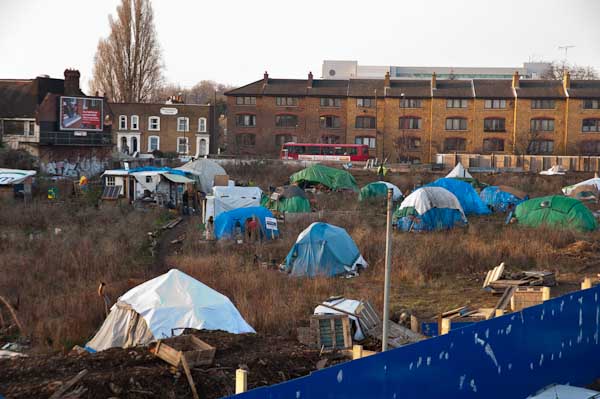
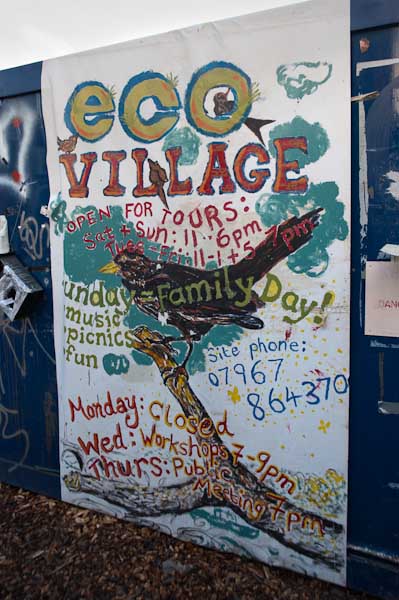
Kew Bridge Eco Village was occupied on the 6 June 2009, and 8 months later it is still there and has expanded considerably since I visited it in the summer (see here and here.)

The occupation was inspired by other similar protests, particularly the 1996 ‘Pure Genius‘ occupation of the Guinness site next to Wandsworth bridge by The Land is Ours, and aims to demonstrate how people can live in harmony with nature, cultivating food and recycling waste. You can see a few of my pictures from ‘Pure Genius’ on My London Diary and I wrote about it her on >Re:PHOTO last year.  One of the earliest protests I posted about on the web was the first anniversary of this occupation which I put online in 1997. Both the page design and scan quality of Pure Genius – One Year On leave much to be desired, and are a reminder of how much the web has developed since then. File sizes had to be small when the fastest modems ran at 56 kbps and many of us were on considerably slower lines.

© 2010, Peter Marshall

The Kew Bridge site had been empty since the demolition of the Scottish Widows insurance offices in 1992, and has been owned by property developers St George since 2003. In September 2009 their latest plan for the site including 164 flats, offices and a piazza with a riverside pub was attacked by various local community groups and failed to gain any support from councillors, despite being recommended by the council officers, and a decision on it was deferred, at least until March 2010 and quite probably until June. Given the cool reception the plans received it may be that the developers will need to submit revised plans, which could hold up the development for even longer.

There are now around thirty permanent residents, roughly as many as the site will accommodate, along with occasional visitors. While I was there a small group was clearing a largish area for planting as a vegetable garden along the side of the site next to Kew Bridge, and there were various cold frames and a polythene growing tunnel elsewhere on the site.

© 2010, Peter Marshall

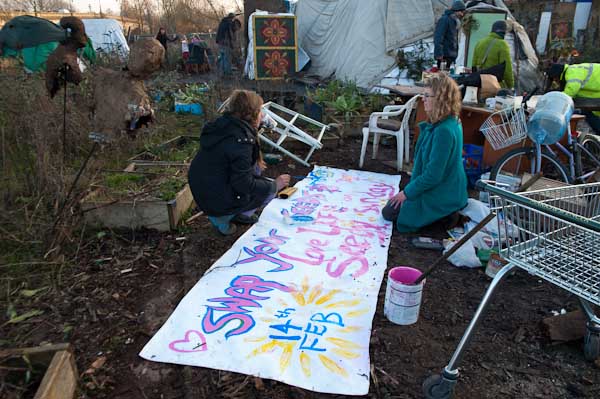
Others were painting posters in preparation for the Kew Bridge Eco Village’s ‘Seedy Sunday‘, Brentford’s First Annual Seed Swap next week, on St Valentine’s Day, Sunday 14 Feb, from 11am to 3pm. If you haven’t any flower or vegetable seeds of your own to swap, seeds will be available for a small donation, and there will also be information, gardening related stalls, refreshments and, from 12.30-1.00pm, storytelling for children.

The seed swap is one of a number of similar events taking place at various locations around the UK mainly during February and early March, the largest of which is held in Brighton and Hove.  ‘Seedy Sunday’ is also “a campaign to a campaign to protect biodiversity and protest against the increasing control of the seed supply by a handful of large companies.

© 2010, Peter Marshall

There are a few more pictures from my short visit on My London Diary.

Giacomo Brunelli at Photofusion

© 2010, Peter Marshall

I was very pleased to meet with Giacomo Brunelli again at the opening of his show ‘The Animals’ at Photofusion in Brixton this evening. The show continues until 26 March 2010, and if you are in London it is one you should not miss.

© 2010, Peter Marshall

© 2010, Peter Marshall

There are few photographers who have produced such an individual and intense vision as this, one which reflects a peculiar and single-minded devotion it its subject. Frankly I find most animal pictures boring and would run a mile to avoid any ‘Wildlife Photographer of the Year’ exhibition (and frankly who gives a toss whether that wolf was wild tame or even stuffed.) But these small dark and glowing images are something else completely, a different and highly personal way of seeing the world.

© 2010, Peter Marshall

I first saw this work when Brunelli brought it to Rhubarb-Rhubarb in Birmingham in 2007 and was knocked out then. These are small but dramatic images, printed by the photographer himself (in his bathroom when his wife lets him take it over for the purpose), with dark edges and rounded corners and just so different from anything else.

© 2010, Peter Marshall

I wrote about it on this blog then and included a couple of examples, so I won’t repeat myself. It still has that same freshness and impact. Don’t miss it.

Waitangi Day On Foot

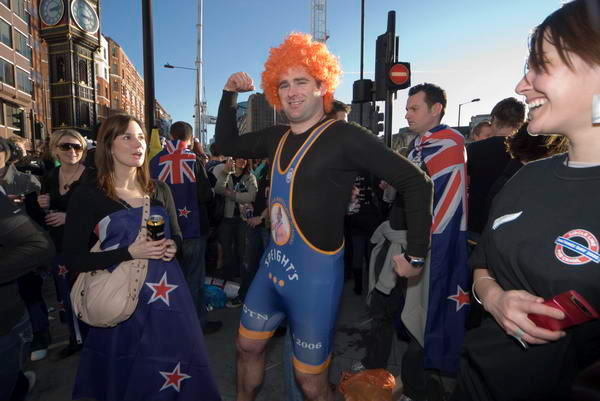
This Saturday is Waitangi Day, and unless you happen to be a Kiwi, you probably will not have the slightest idea what I’m talking about. It’s a national holiday in New Zealand, commemorating the Treaty of Waitangi, signed in 1840 between Britain colonists and the Maori chiefs, which made New Zealand a part of the British Empire.

Its hard to avoid the suspicion that we were not being entirely above board. The text of the treaty was different in the two languages, and the colonial courts later ruled it had no legal standing. So perhaps the Maoris really have little to celebrate, though there were a few of them taking part when I photographed the event in 2008.

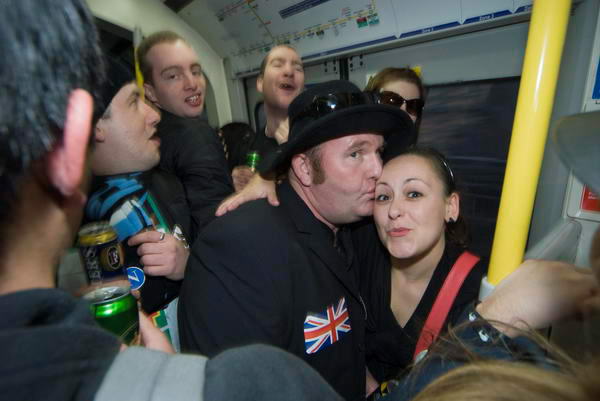
London seems to have almost as many New Zealanders as there are left back home, and traditionally they have celebrated the event here – for reasons that remain obscure to me – with a Circle Line pub crawl. This has been an all day event, starting with beer for breakfast in Paddington and then working station by station around the circle line via Earls Court, getting off at each station and making for nearby pubs before rejoining the Underground.

© 2008 Peter Marshall

There are a number of rules that have been set down, the chief among which appears to be that those taking part can only travel on Circle Line trains – and not the District Line which also runs on part of the route. And also drinking rather a lot of beer!

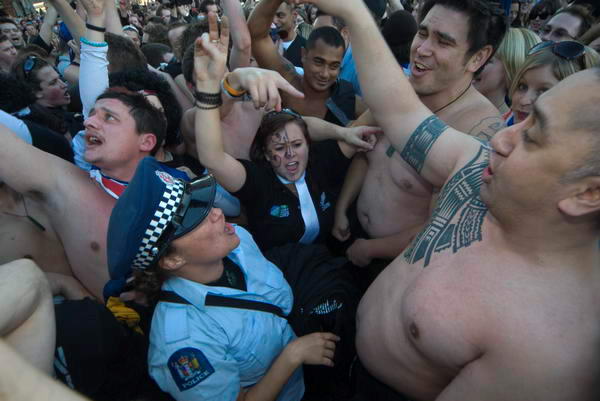
They aim  to arrive at Parliament Square for tea-time, 4pm, when they indulge in the Maori haka, a kind of war dance which is normally performed at the start of rugby matches by the All Blacks, on the stroke of Big Ben, before continuing on to the final two stops to the finish at Temple – making 12 stations in all. I made a slightly shorter pilgrimage – from Gloucester Road to Westminster, and not coming from New Zealand didn’t feel bound to have a drink at every stop, or the pictures might have been even less sharp than usual.

© 2008 Peter Marshall

This year, whether by accident or by cunning plan, the Circle Line is closed on Saturday for engineering works. This isn’t an unusual event as those who travel in London will know, for the past few years large parts of the Underground network close down at weekends. But this year the celebrants will have to walk rather than take a train.

© 2008 Peter Marshall

I photographed the event in 2008 and there was a certain amount of friction between police, underground staff and the Kiwis, with various stations being closed. Boris Johnson then got elected and announced a ban on drinking alcohol on public transport, which perhaps had a certain dampening effect on the celebrations, though I suspect it was widely ignored during this event. The year I took these pictures there was already a ban in place on drinking in Parliament Square but there was no attempt to enforce this on those taking part in the Waitangi Day celebrations.

© 2008 Peter Marshall

Although I had great fun taking the pictures I won’t be doing it again this year. It just doesn’t seem the same without the Circle Line.

Magic Realism

I first came across the work of Stephen Ferry (he describes it as ‘Non-Fiction Photography‘) when I was sent a copy of his 1999 book ‘I Am Rich Potosi’ to review (as usual, my review is no longer on line.) I found it to be not just striking images but also a fascinating story of a city which was once the fabulously wealthy centre of the Spanish empire which ran on the vast quantities of silver from this ‘Rich Mountain.’ The pictures present the remarkable story of the present day Quechua miners and their culture. I wrote a lengthy review, looking in detail at some of the images, and was surprised and gratified to get a very appreciative and detailed response from the photographer.

You can also see work from this book as well as his other projects on Ferry’s own web site, which unfortunately is another of those that opens in a new browser window that fills your screen (and on my screen that means is twice the area it needs to be to show the work.)

More recently Ferry went on a trip to the area of  Colombia where Gabriel García Márquez grew up and inspired the ‘magic realism’ of novels such as ‘One Hundred Years of Solitude‘ and ‘Chronicle of a Death Foretold‘. Márquez has described himself as just a journalist, reporting the events of the world that he knew in what most people think of as fantasies. And in the pictures that Ferry brought back from the fictional ‘Macondo‘ (and the real town of Sucre, Sucre in which he spent three weeks) at times support this thesis, as you can see in the presentation on ‘Lens.’

Don’t miss the other work on Ferry’s site either, particularly The Sinister Hand on the Civil War in Colombia. On a slightly lighter note you can also see pictures of Cholita wrestling featuring Aymara women petticoats in Marisol Khali.

Right Up My Street but

Unfortunately I’m more than unlikely to be in Milwaukee in the next couple of months (I’m not sure they’d let me in to the USA, and with the current fuss over “security” I think all those of us who need to travel with syringes are likely to have a hard time of it.)   But for those that are, the show Street Seen: The Psychological Gesture in AmericanPhotography, 1940–1959, which features the work of Lisette Model, Louis Faurer, Ted Croner, Saul Leiter, William Klein, and Robert Frank, continues at the Milwaukee Art Museum until April 25, 2010.

You can read a little more about the show (including that it also has work by Robert Capa, Henri Cartier-Bresson, Walker Evans, W. Eugene Smith, Helen Levitt and Weegee, among others) and that it claims to be the first major examination of street photography of the 1940s and ‘50s in nearly 20 years on Art Knowledge News.

While its hard to disagree with the statement that the six featured photographers “embraced photography as an ‘act of living‘”, it is perhaps harder to accept the opposition between this and telling a story, particularly with the work of photographers such as Cartier-Bresson and particularly Smith in mind who did pretty well at both.  But like many shows it sounds as if it would be good to view whatever caveats you might have about some of the curatorial texts.

There is a short review of the catalogue on the NY Times and a little more about the show here.