Freedom to Film – Worldwrite in Hackney

Last October I went to Hackney to join education charity WorldWrite in their protest against the interference with the right to film in public places that they have faced, mainly by officials working for Hackney council. I wrote about it in Worldbytes Defend the Freedom to Film, which included a few pictures I took in Ridley Road market, one of the places where they had been told they could not film.

© 2009 Peter Marshall.
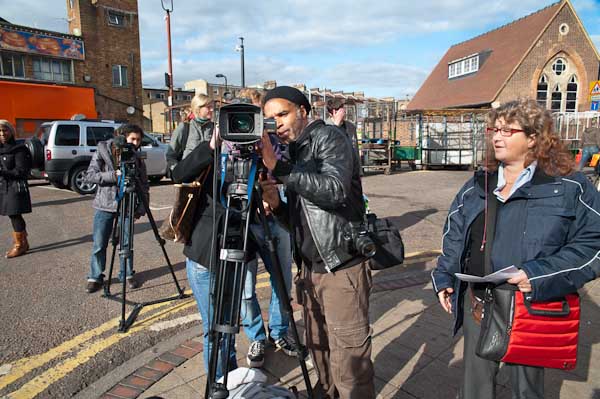
I’m filmed by the Worldwrite crew in Ridley Market.

You can now see the film ‘Freedom to Film‘ they made on that day, and – health warning – one of the people they interviewed is a rather maniacal looking photographer called Peter Marshall. Apart from that it’s a well made film that states many of the issues clearly.

© 2009 Peter Marshall

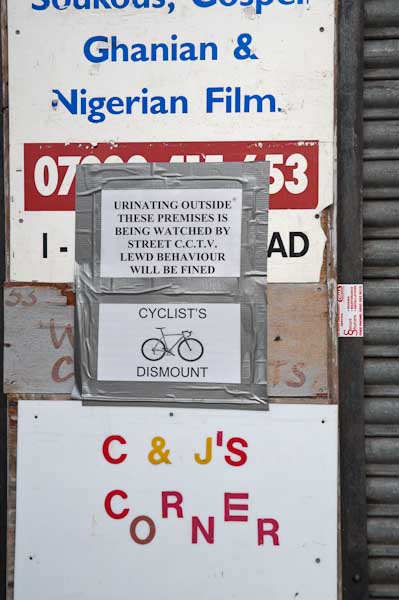
One of the points made on the film is that we are all being watched all the time by CCTV – as the notice above makes clear, though I couldn’t quite follow its logic. Though I do seem to remember someone being convicted of a lewd act with a bicycle last year.

But seriously I’m pleased that WorldWrite are making a stand and promising to record and make public every interference with their filming in public places. The flier they were handing out during the filming gave a clear statement of the law:

There is in fact NO LAW against filming or taking photographs in public places and permission or a licence is NOT required for gathering news for news programmes in public spaces.

I hope Hackney Council are listening and ensure their employees get the message.

© 2009 Peter Marshall
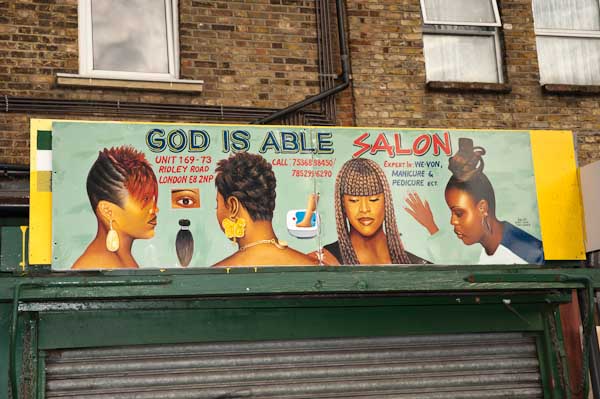
God is Able Salon

Just a few yards away is God First Hair Do and you can see a picture and a few more pictures from Ridley Road on My London Diary.

New Documentary- Jon Lowenstein

Thanks to DVAphoto for Worth a Look: Jon Lowenstein in Haiti which as well as pointing to the pictures also raises some points about them. It mentions Jon’s comment about one image:

Haitian National Police gather a group of ‘looters’ or ‘salvagers’ and confront them. In some of these instances the looters are shot, but in many cases they are let go, especially when Western media are present.

The presence of the media clearly does have an influence on events and surely there can be few photographers who cover them who haven’t realised this. We’ve all watched how demonstrators react to a TV crew, becoming noisier and more active for the camera, and it happens if to a lesser extent for still photographers, however discrete we try to be.  But in Haiti things are more extreme and many people have very little to lose and no way to exist or for their families to exist except by taking advantage of whatever they find. ‘Looting’ certainly isn’t a term I’m happy with in this situation.

You can see the set of images on the NOOR web site and also on Lowenstein’s own site, although I couldn’t get the captions to display there, and they help to understand more about these images. But there are a number of other projects also worth a look; in general I find his black and white work considerably stronger than the colour.

Lowenstein is a fine example of what some call the new documentary photography, and not surprisingly he put in an appearance on Verve Photo, Geoffrey Hiller’s site devoted to “The New Breed of Documentary Photographers” and well worth browsing through when  you have time to spare – as it will certainly detain you for some time.

Also on NOOR you can view Jan Grarup‘s fine colour images from Haiti – he arrived there 4 days after the quake and provides some vivid images of life there.

Copying, Co-incidence or Cliché?

I’ve written on this site before about allegations of plagiarism in Copycat Images? which included an example from my own work which I know to be simply a coincidence, but a couple of posts on PDNPulse  send me back to the subject.

Copycat or Not? posted Feb 16 looked at the similarity between landscape images by David Burdeny, a Vancouver-based photographer and earlier work by photographers Sze Tsung Leong and Elger Esser. Leong and his New York gallery owner, Yossi Milo have objected and got their lawyer on the case.

I’m very unsure about this on several grounds. Perhaps most importantly that one of the basics of copyright is that it is not concerned with ideas but with their execution, which I think are, in the examples given on PDNPulse, significantly different (and generally I prefer Burdeny’s; he does seem to be a rather better photographer – which just could be why Leong and Milo are so worried!)

This is a feeling that is reinforced by the follow-up post,  Copycat or Not, Part II: A Case of Nothing New Under the Sun? where – at least at the small scale we see it on the web, Leong’s four pictures seem to me rather like any tourist snaps (though doubtless on the gallery wall they are considerably larger) while some of Burdeneys have a little more presence.

Both photographers work with large format, but to me that doesn’t in itself make their work any more interesting. And, as one of the comments on PDN points out, both have similar backgrounds, having trained in architecture, so perhaps similarities in their work are not surprising.

But frankly I don’t find either of their work of particular interest, and when Burdeny is reported by PDN as saying that “the similarities arose because he happened to shoot from some of the same tourist spots” I think it is only too true – and about both their work. I’ve almost certainly got images in my archive rather similar to the two pairs of images of Paris included in the posts, though I doubt if I’d ever want to show either of them, even on the web. There are images you take just because you are there with a camera, and images you take because you have something to say, and on the evidence neither of these guys have grasped this. One of the comments on the second feature points out that you can find very similar pictures to these on a popular stock web site.

Burdeney also provides a number of other examples of pairs of very similar works, in some of which I think there is a far clearer case of copying involved, while others are simply coincidental.

Whether the actual concept of the show involves copying is also not entirely clear, and in a kind of vague way there would seem little doubt that the Vancouver gallery has tried to produce something in a similar vein to the Milo gallery show. But it would be hard for anyone to claim a copyright on a show of large format somewhat boring images of well known tourist sites around the world – there is far too much prior art. What neither piece tells us is how many works each photographer had in their exhibit and how many of those were of the same places. A pair of photographs is used to suggest a great similarity, but to me fails to do so, as it only includes two pictures from Burdeny’s exhibit which are not particularly similar to those from Leong’s. It does show that both galleries framed the work in white frames and – surprise, surprise – both hung them in straight lines on a white wall. But the two photographers print to different formats and Leongs prints have white borders while Burdeny’s fill the frames. The images seem evidence of a different presentation rather than a copycat show.

Another comment points out the similarity of the two artist’s statements, but my problem here is that neither seems to show much originality. However each does includes the identical phrase “each image offers a finely grained density of visual information, rendered in the broad range of tonality made possible by“and while the content is pretty much a cliché of any show of large format work, it seems likely that this exact expression may well have originated with Leong or Yossi Milo. But although I’ve not been able to locate a prior source there may well be one.

I find it hard to see that Leong has a case so far as the photographs are concerned. Most of the commenters agree with me, although Leong does have his champions, one of whom writes “his work is not merely about landscape, but has greater conceptual goals. His locations, and the use of very precise form and dimensions, are done with great thought, reason and research.” In which case I have to say he has fooled me completely – or perhaps his conceptual goals have little to do with the actual photographs?

It’s also worth looking at the set of pictures, Sacred and Secular on Burdeny’s own website, where you will find that the contested images are probably the least interesting among those shown.  Comparing this to the ‘Horizons‘ series on the Yossi Milo site you see a very different show. The case I think is closed.

Chatsworth Lion

More on my own example:

© 1984, Peter Marshall

taken by me in 1984 and click on this link to see  Fay Godwin’s taken completely independently three years later. More tightly cropped to a square format but otherwise pretty well identical.

In fact my own picture was a copy, of this image:

© 1980, Peter Marshall

which I made in 1980 in a way that is perhaps even a little closer to Fay’s picture, taken like hers later in the year so the ferns have grown. And if Edwin Smith or any other photographer walked past there a few years earlier than both of us I’m sure he would have taken a very similar picture.

I’m fairly sure that when I took the lion again in 1984 I remembered my earlier photograph and was trying to improve on it (though I don’t think I did – the earlier image is perhaps clearer as a few small images in the interior of the building weaken the later image. I also prefer it to Fay’s as the addition of the male head at the left is I think significant, but others may well prefer hers.) But quite often I have looked at pictures taken elsewhere when I’ve visited the same area after a longer gap of time and have been surprised to see almost identical images.

There are some places where there really is little choice of the best viewpoint.
Chinatown Celebrations

I’m not sure when I first went to Soho to celebrate the Chinese New Year, but the first pictures I’ve been able to find are from 1998, when I took pictures in both black and white and colour.

© 1998, Peter Marshall
China Girl, Chinese New Year in Chinatown, Soho, London, Feb 1 1998

It’s quite likely to have been my first visit there, as for the previous ten years or so I was spending most of my time photographing the buildings of London, and the relatively rare days of good light during the winter were especially important in visiting some of the more suburban and leafier areas of the capital, which in spring and summer get hidden by a screen of green leaves.

In summer too the sun is higher in the sky and often the lighting is less interesting for these pictures – although I tried to avoid pictures that were just about lighting.

So in those years my photographs of events were largely around those in the summer and  the warmer weather does seem to make people more outgoing.

Not that I gave up my pictures of London buildings for summer, but tended to work more in the central areas where trees were less of a problem. And there were more days where the weather was favourable.

If you want to see what the web looked like in 1996, the site I built then with some of these London Photos is still on line (I added some pictures the following year and sorted out the code a little later when HTML and browser changes made it necessary, but essentially it remains a vintage 1996 web site.)

© 1995, Peter Marshall
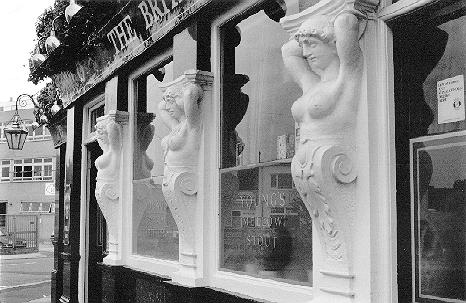
This Victorian pub in Barking with a splendid frontage  closed on 11 Oct 2009
when landlords Rita & John retired and Youngs sold it. Photo  August 1995.
© 2006 Peter Marshall
And the pub much the same in 2006 – though the area around it had changed.
More pictures from Barking and the River Roding in 2006

The scans I made then sometimes look rather poor now – they include some excellent examples of moire and have a rather ‘dotty’ effect. Scanners have improved and software too, but the big difference is in download speeds. The 466px by 303px jpeg above was trimmed down in size to 34Kb but still took a few seconds to load. Nowadays I’d happily make it 80Kb and it would load in a fraction of the time.

Most years since 1998 I’ve gone back to photograph Chinese New Year and the celebrations had a considerable growth when Ken Livingstone was Mayor. Chinatown was crowded in 1998, but now an even larger area of central London heaves with people making movement difficult.

But my main reason for not going today isn’t the crowds but that the pictures that I’ve taken more recently seem just to repeat those I’ve taken in earlier years. As I wrote last year (and illustrated with a few pictures)

It’s certainly a spectacle worth seeing, but I’ve seen it before and photographed it many times and don’t feel a need to repeat the experience.

So I’ll spend the day at home, making some new black and white prints of old work and perhaps on the several web sites I’ve been promising to update for some years.

Street Party

I often think London serves its tourists rather badly so far as it’s well-known landmarks are concerned, and as it happens I was taking pictures in three of them on the same day, Trafalgar Square, Parliament Square and Piccadilly Circus.

Trafalgar Square was improved greatly when the north side of it was closed to traffic, and at least makes a try with the column, lions and fountains, and the National Gallery along the whole of its north side is an impressive building (though its new block is uninspiring – thanks to Prince Charles we didn’t get a “monstrous carbuncle” that by now we would admire and love, but instead later got the unusually timid and rather bland post-modern Sainsbury Wing by Robert Venturi and Denise Scott Brown. The square’s south end is still a traffic scheme, with poor old Charles isolated on his horse, and again St Martins to the east is on the other side of a busy road. It’s an area that cries out for a more radical approach, particularly to traffic movement.

Parliament Square is frankly ridiculous. Traffic flows around all four sides and there is not even a crossing for pedestrians to get to the central area – you need to study the traffic lights and take your chances when they stop the cars.  Understandably one of the constraints on the area is the need for security, but rather than ugly tank defences above ground we could have some nice landscaping – perhaps even a moat…  And of course redirect traffic around the east and north side only, with proper pedestrian crossings.

© 2010, Peter Marshall
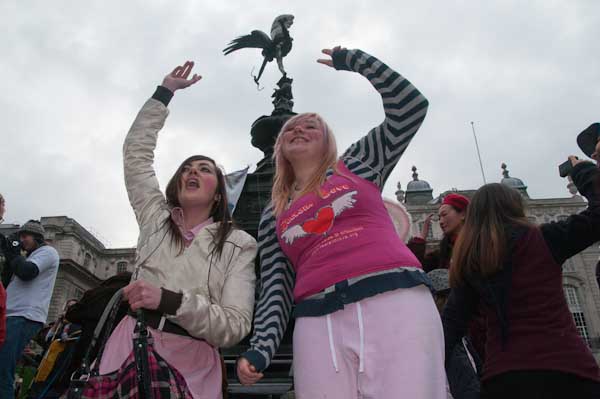
A ‘Reclaim Love’ t-shirt, dancers and Eros. It wasn’t posed

But Piccadilly Circus is just a mess. A rather shabby pedestrian area around Eros, and its main feature a wall of advertising, but again traffic is the real problem, and the congestion charge doesn’t seem to have helped much. Perhaps one problem is that it is a flat rate charge, and that once you’ve paid it for the day it acts as an incentive to drive around more. Perhaps road pricing that charged for the actual time spent on the road  would be more efficient – and have a built in incentive to avoid congested areas.

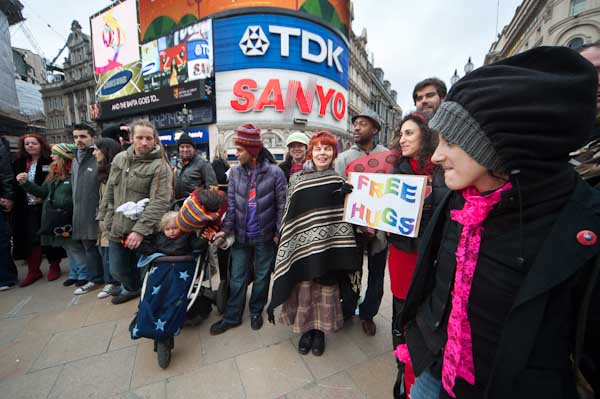
I don’t have a lot to write about last week’s Valentine Party at Piccadilly Circus. Of course as well as photographing the people involved I wanted to show where it was happening, and make use of that aluminium statue  (after all Eros was particularly relevant to an event about love) and also all that neon – as it was an event opposing commercialisation.

© 2010, Peter Marshall
Historic Annual Earth Healing Circle at Piccadilly Circus
This year’s party was perhaps too popular, making it too crowded for there to be a great deal of dancing, and also often too crowded to take pictures.  The 12-24mm did come in handy, though as usual it was often just a bit too wide. But I enjoyed taking pictures and meeting people. More about the event and a ridiculous number of pictures on My London Diary.

© 2010, Peter Marshall
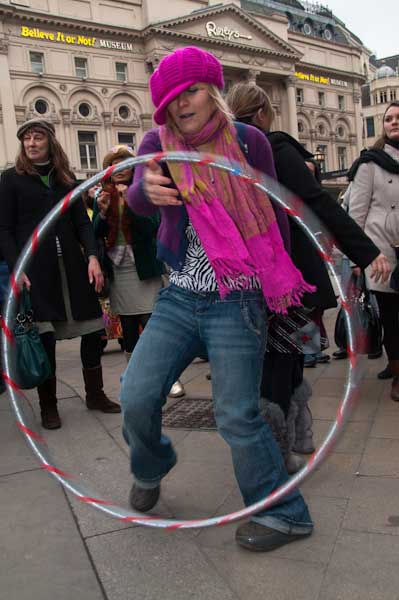
Getting the right speed (1/125) for a hula hoop was a matter of luck

Iran Opposition

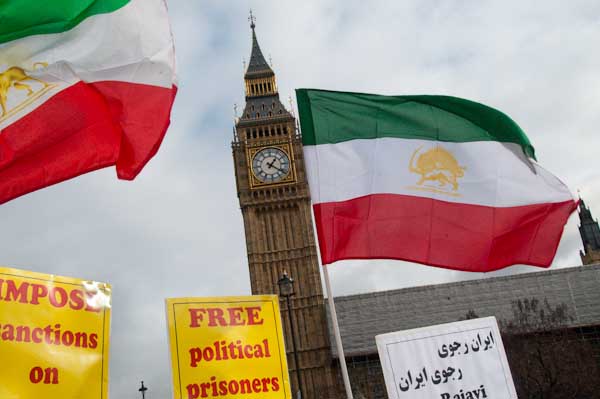
Last Saturday’s Iranian demonstration in Parliament Square was in several ways an easy event to photograph, not least since the organisers were very keen to have the press take pictures and had organised the event in a way that made it easy for us to work.

© 2010, Peter Marshall

Working in Parliament Square gives you a very obvious way of showing where you are in your pictures, with the gothic clock-tower of Big Ben instantly recognisable around the world. I’ve taken many images with it in over the years, sometimes having to perform some fairly extreme contortions to do so, but  here it was easy to satisfy my desire to include it in some images.

Most of the pictures were taken on a Nikon D300 with the Nikon 18-200mm lens, (27-300 equivalent) and it was a pleasure to be working with this again and not to have to change lenses to zoom in to a tight head shot. I really do prefer the D700, but lenses for that are rather more conservative in zoom range (and considerably more expensive.)  I was using the D700 for the more extreme wide-angle view, with the Sigma 12-24mm. Its a nice lens, and still going strong after six years of my normal abuse; though it did need a facelift when the front element got a few small craters in it – the element is too bulbous to allow you to protect it with a filter.

The 12-24 is a very useful lens on DX format – where it becomes equivalent to 18-36mm, but on full frame it is just a bit too extreme at the wide end. The distortion at 12mm is almost always a noticeable problem, and I really need to avoid the last few mm of focal length. So it’s useful zoom range is really only something like 16-24mm. I hope soon to replace this by Nikon’s latest 16-35/4 VR zoom – supposedly available here from Feb 19, though I don’t know yet when my dealer will get supplies.

Given the 1.5x factor with the DX format it really makes more sense to use this with longer lenses. If Sigma manage to sort out my 24-70mm that would become a 36-105 equivalent on the DX body, useful whenever I need it’s f2.8 aperture, but otherwise the 18-200 is just so versatile.

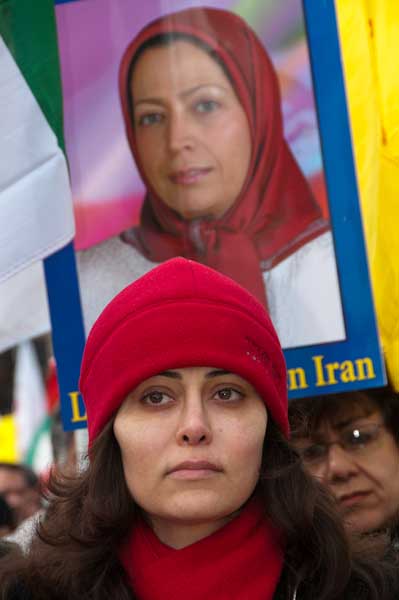
Back to the demo – as usual more about it and more pictures on My London Diary – in the end it’s people that make pictures interesting for me, and sometimes it’s just a matter of expression and fitting them in to the overall picture. But who could fail with this face?

© 2010, Peter Marshall

Although getting the right combination with the placard of Maryam Radjavi did take a little bit of doing – and this was probably about my twentieth attempt.

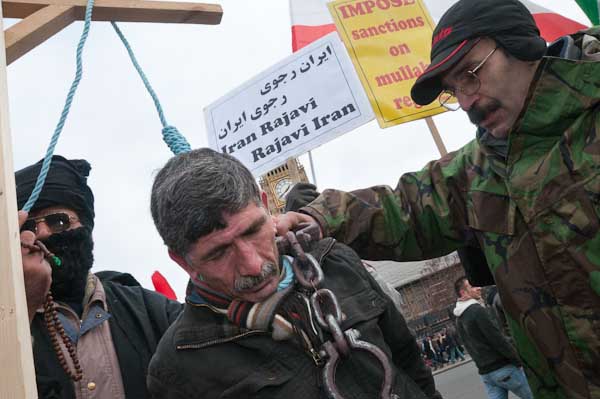
Here’s a slightly less obvious picture of Big Ben, along with some street theatre the protest organisers had laid on for the press.

© 2010, Peter Marshall

This was quite tricky to photograph, mainly because a dozen or more photographers and a couple of guys with video cameras were also trying to get the same picture. You have to learn to pick the right place, get there before the rest and stay there until you are sure you have your picture. Sometimes in situations like this the very wide angle of the 12-24 does come in handy, because if you move back with a longer lens someone is almost bound to jump in front of you.

Oily Olympics

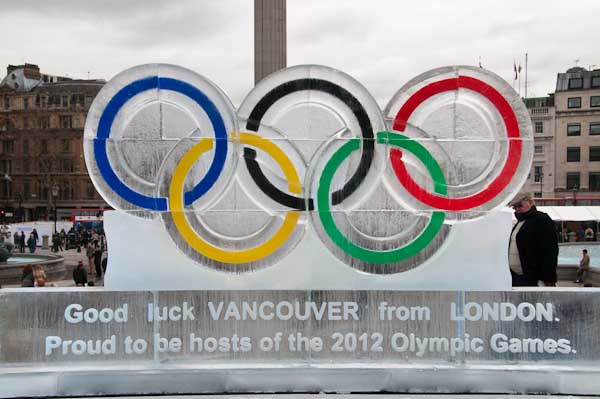
The start of the Vancouver 2010 Winter Olympics provided a great opportunity for protesters against the Canadian Tar Sands and they took it. Trafalgar Square was celebrating the event with a giant screen and an ice sculpture and I think they had hoped this would attract the crowds. Unfortunately it didn’t.

© 2010, Peter Marshall
It will soon all melt, just leaving a mess

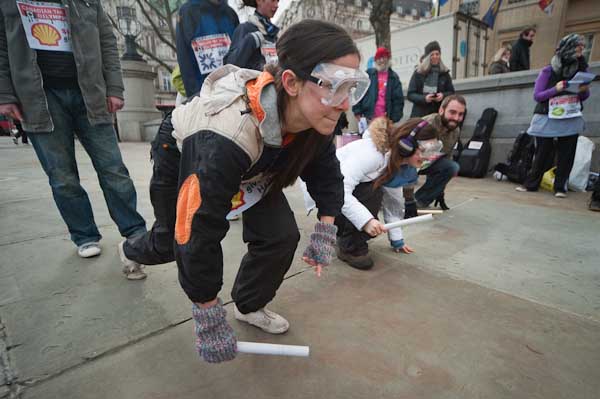
But at least the Canadian Tar Sands Oil-ympics provided an hour or so of interest, next to Canada House – and you can see the pictures I took of the events and the medal ceremony on My London Diary, along with a little more about why people are protesting against the tar sands – and the companies who hope to profit from this environmentally disastrous project.

 © 2010, Peter Marshall
‘Shell’ get off to a good start in the relay

Perhaps it was rather better as an idea than in the actual execution and I found it hard to produce pictures that really satisfied me. Perhaps it didn’t help that the 24-70mm I’ve mainly been working with recently was in for repair (again after a couple of weeks.)

One of the first things I photographed seriously was sports, though I soon got bored with it.

© Peter Marshall 1974

A couple of the canoeing images I took around 35 years ago now did quite well at the time. The only reason I took them was really that I’d just bought a new lens, one of the first of a new generation of zoom lenses, a Tamron 70-220mm Adaptall, introduced in 1973.

As well as the novelty of the zoom (really only common on movie and TV cameras before – I’d used one working in the educational TV studio where I really started learning practically about photography a few years earlier – these lenses also incorporated a rather clever idea that in theory enabled you to use the same lens on cameras with different mounts. The lens came with its own mount, and you then bayoneted a slim adaptor on to that suit the camera you were using. Lenses were rather simpler things then, and apart from actually holding the lens in place, the only other linkage that cameras provided was a mechanical one, indicating the lens maximum aperture and stopping it down to the taking aperture when you pressed the shutter release.

© Peter Marshall 1974

It wasn’t a really bad lens, but unlike now, there was still a considerable gap in optical quality between prime lenses and zooms such as this, and after a year or two I sold this lens second-hand and bought a couple of superb primes (a 105mm and 200mm) that actually together weighed slightly less than the zoom.  I think it was almost 20 years before I bought another zoom lens. Now I take perhaps 95% of my pictures on zooms.

More on Copyright

I’ve long been a fan of the Photo Attorney blog by US attorney Carolyn E. Wright, which recently celebrated five years on line – though if you have an old bookmark you should to update as it is now at a new address. (I think all the links I made to the old site still work.) She gives some great advice on legal matters for photographers, much of which is relevant to those of us outside the USA too.  Occasionally her site has been the first place where I’ve read about some of the problems photographers have had here in the UK too.

A week ago Wright made a great post on another blog I look at regularly, A Photo Editor, in an article Photographers- How To Deal With Infringements and one of the benefits of not mentioning it here immediately is that this has now attracted quite a number of interesting and informed comments.  Her piece has some useful advice on making use of the DMCA (the U.S. Digital Millennium Copyright Act, 1998) as well as the advice “If you created the photo in a country that is a signatory to the Berne Convention, you do not have to register in the U.S. to protect your copyright or to file an infringement lawsuit in the U.S. However, if you do, then you may be entitled to statutory damages and attorneys’ fees” which perhaps makes the situation clearer than some other sources (Though one of the comments asks the very good question why, since the US is a signatory, you need to register photos taken there. There’s signing and there’s signing!)

But her piece very clearly lays out a series of steps photographers can consider and take to try and recover fees for the use of their work. However much of this may soon be history so far as UK photographers are concerned, with the Digital Economy Bill now making its way through Parliament. As mentioned here before, this law is Mandelson’s baby part dictated to him in a Corfu villa by David Geffen and is expected to be passed within the next month or two and, as the Copyright Action web site puts it:

“It introduces orphan works usage rights, which – unless amended, which HMG says it will not – will allow the commercial use of any photograph whose author cannot be identified through a suitably negligent search. That is potentially about 90% of the photos on the internet.

“Copyright in photos is essentially going to cease to exist…”

On that site you can read and download a letter to post to your MP, preferably with your own comments, but otherwise as it stands (download links are in 3 formats at the bottom of the letter.) If you are a photographer or a lover of photography and a UK voter please consider doing so – and don’t leave it, do it now. I’m getting mine ready to send now.

Private in Public

Last Friday lunchtime I was photographing a demonstration in the City of London, in front of a large modern office building close to Liverpool St station.  The building houses UBS, a Swiss-based company formed by the 1998  merger of the Union Bank of Switzerland and the Swiss Bank Corporation, the second-largest manager of private wealth assets in the world and the second largest bank in Europe according to Wikipedia.

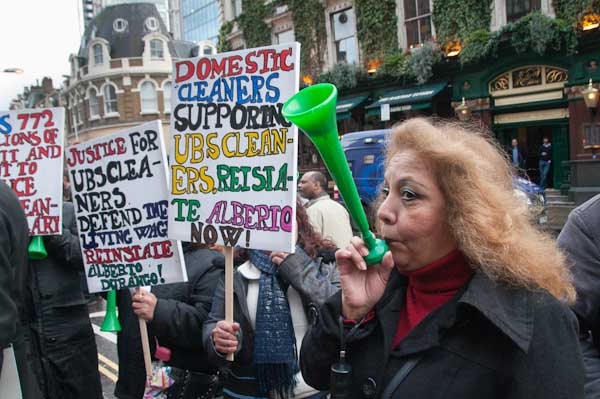
It’s also a company that is trying to bolster its reputation following a continuing investigation into dodgy off-shore accounts designed to fool the US tax authorities, and last month it issued a new code of conduct and business ethics which all employees are required to sign. Apparently the new interest in ethical conduct doesn’t apply to its own relations with cleaners, and it handed over the cleaning contract to a new company, Lancaster, on Feb 1. They immediately cut the cleaners hours – and thus their pay – and sacked the union shop steward, Alberto Durango.

The UBS offices have a wide pavement area in front of them, generally walked across by the public but actually owned by UBS – the kind of privately owned public space that makes up large areas of our cities now. UBS is on the southern edge of the large Broadgate estate which is one such area, developed on the former site of Broad St station (which was of course part of the publicly owned British Rail before it was sold off.) The public are freely allowed onto such areas as consumers to visit and consume the services of the various companies that occupy them, but we are not allowed the freedoms that we normally enjoy on the public highway – such as free speech and taking photographs.

To me this is reflects a deficiency in our planning processes – which should insist on such pavements being a part of the public highway as a condition of planning consent and also possibly of our laws about what is and is not public space. Photographers recently demonstrated at Canary Wharf against the restrictions on photographing there – another large private estate on formerly public owned land.

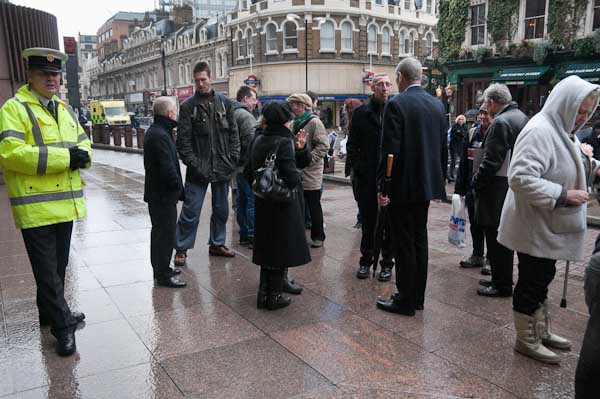
So I wasn’t at all surprised after I took this picture

© 2010, Peter Marshall

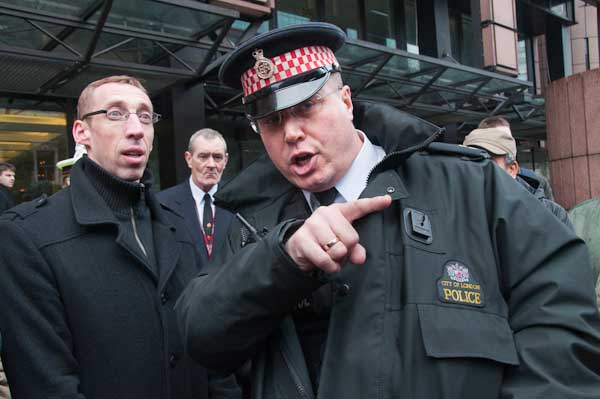
that the security guard at the left – his boss is the guy with the umbrella talking to some of the demonstrators telling them they can’t demonstrate there – came up and told me I was not allowed to take photographs.  And of course when I asked him why this was, his reply was totally predictable. “Security, this is a bank” he told me. “But I’m pointing my camera away from the bank” I replied, “so how is security involved?”  His answer was to tell me that if I continued to take pictures there he would call the police and ask them to remove me, although he did also tell me that I could photograph from the pavement by the side of the road – which would of course mean that I was actually photographing the bank. Somehow that wasn’t a problem.

Of course it isn’t really about security at all. It’s about asserting the rights of the property owner, and also on this occasion about the embarrassment of the company at having a demonstration about the truly abysmal way they are treating their cleaning staff.

© 2010, Peter Marshall

What I think is more serious about this is that within a few minutes the police did arrive, not to deal with me, though several times officers did politely tell me to move back onto the public pavement when I strayed on to the private forecourt, but to force the protesters to move off of private land.  I fail to see that a peaceful protest on private land that is causing no damage, is of limited duration and no threat to public order should be of any concern to the police. It seems to me to be essentially a civil matter rather than a criminal one, and that the police force have rather more important things that should occupy them.

© 2010, Peter Marshall

I’d  be very much happier with a police force that acted to protect the rights of workers.

More pictures from the event on My London Diary.

World Press Photo

I can’t understand why so many blogs publish a small selection of the winning images from World Press Photo and don’t write anything about the images they use. Just what is the point, when at the click of a mouse you can go and see the whole of the work of the winners? Online at World Press Photo.

I’ve only had a quick glance through the whole lot of them – there are quite a few – and don’t really want to say anything about them yet, other than an overall impression, which is that I think they show that 2010 was a disappointing year for photography. Of course there are exceptions – and the set of pictures by Eugene Richards is one.

Of course, as two well-regarded photographers were saying to me today, World Press Photo is very much a lottery (and one went on to suggest perhaps even more so because the judging is held in Amsterdam, and at the end of a day looking at far too many pictures the judges may well indulge in recreational activities that could well cloud their judgement.)

Among the outstanding work there do seem to me to be some rather pedestrian images, and while in recent years there have been some surprisingly interesting pictures or sets in some of the generally more tedious categories such as sport, arts and entertainment and nature, this trend seems to have reversed somewhat. Perhaps too the portraits fail to excite me this time.

I’m not a great believer in contests and competitions. I seldom enter them and am unconvinced they generally improve the general standard of photography not least because I suspect the best work very seldom wins. Partly because selection is often a matter of political trading between the various judges (as we occasionally hear when judges spill the beans after the event) but also because at least in some competitions the judges often include people in whose judgement I have little or no faith.  Not purely out of prejudice, though probably I’ve plenty of that, but because of the visual quality of magazines they edit or exhibitions they have curated etc.

Certainly the most interesting comment on last year’s World Press Photo was UNCONCERNED BUT NOT INDIFFERENT by Adam Broomberg and Oliver Chanarin who were among the judges. I first read this in Foto8, but it seems no longer to be available on their site but can be downloaded from the authors’ Chopped Liver web site – listed under Information / Selected Articles. Worth reading after you’ve looked at the pictures.