Swan Up

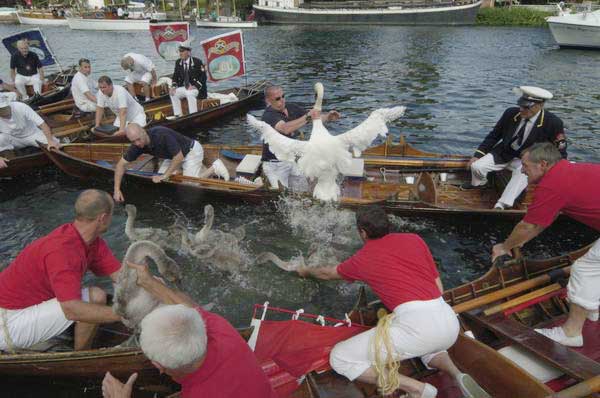
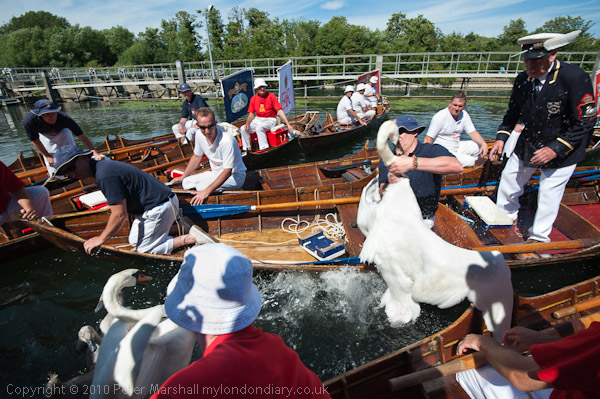
I was in two minds over whether to go and photograph the Swan Uppers again this year. It’s a subject where I think I’ve probably more or less done all I can do over the last ten years, and which in some respects doesn’t change a great deal year to year. But it was a nice day and the river is only a five minute walk away, so I went along again – as you can see below and in many more pictures on My London Diary.
© 2010, Peter Marshall
Swan upping 2010 – Nikon D700

© 2004 Peter Marshall.
Swan upping 2004 – taken on a Nikon D100

Photographically it’s very hard not to repeat – with small variations – what I’ve done before. And since I think I’ve had some good luck in the past those variations generally result in pictures that are not quite as good as some I’ve taken before – as you can see above.

It’s also an event which is getting just a little harder to photograph, not because of any real changes in the event but simply because interest in the event, and in particular press interest has increased.  I think the first year I photographed it there were probably only around three or four other photographers present. Now it becomes virtually impossible to move at the times when you really need to be in exactly the right spot, and it isn’t quite predictable where the peak of the action will occur.

A couple of years ago there was some extra interest as it seemed likely that the Labour government would be tidying up some  of our ancient laws and this might remove the rationale behind the upping – basically an annual census of swans born each year on the non-tidal River Thames between Sunbury and Abingdon, in which the year’s cygnets are shared between the sovereign and two City of London livery companies, the Dyers and the Vintners.

In the old days swans were a feature of royal banquets – and also until around 25 years ago those of the two companies (and by a special royal dispensation, at St John’s College Cambridge); it was a privilege rigorously protected against more plebeian tastes and catching one of these royal birds could get you sent to the Tower or transported; now you only risk a fine of up to £5000 and/or six months in jail under the Wildlife and Countryside Act, 1981. I’m told that properly cooked they can be delicious, though others are less keen (and the description that they are like a ‘fishy goose’ certainly doesn’t attract me.) Certainly it doesn’t seem worth the risk.

Perhaps the best coverage I’ve made of the event was on film, using a Leica M fitting Konica Hexar RF and the Hassleblad Xpan panoramic camera (made by Fuji) , which produces a 58x24mm negative on 35mm film.  Although it was a camera I lusted after when it came out, I soon found using it with the normal 40mm lens a little disappointing.

With the 40mm you get roughly the same horizontal coverage as with a 28mm on the standard 35mm format, but of course a greatly reduced vertical coverage.  You could get the same picture simply by cropping a 28mm image, although the area of the negative would then be  less than 4/10 that of the XPan. To get the same quality you would need to shoot on 6×6 and crop, so the XPan did give you the advantage of using medium format but with handling (and choice of films and costs) of 35mm.
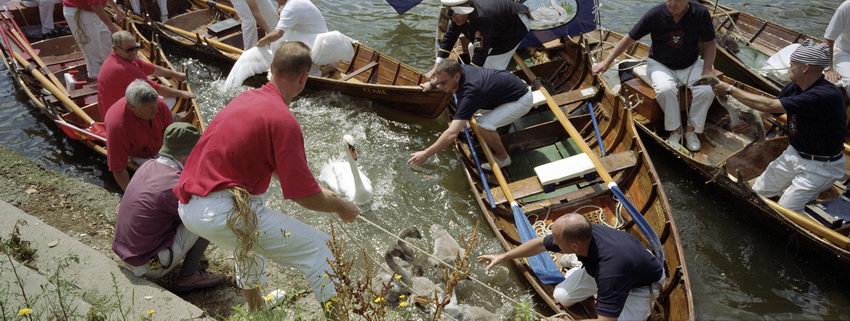
© 2001, Peter Marshall
Swan Upping 2001 – Hasselblad XPan and 40mm lens

But what really transformed this camera for me was the 30mm lens, equivalent to around a 20mm across the image. It comes with its own accessory viewfinder giving a beautifully large and bright view- and with a visible spirit level – and needs a special filter to combat the vignetting which is inevitable with ultra-wide rectilinear lenses. It was wider than anything available for medium format and a superb quality lens that could normally be left wide-open.

It would I think be too expensive to produce a digital version of the Xpan, and the film version is only available second-hand,  production having to be abandoned because of environmental legislation that banned the method used to make its circuit boards. The camera sold better in the UK than in other countries, but sales were not high enough to justify redesigning board to get round this.

At least one reviewer has stated that with the 30mm lens it is essential to use the camera on a tripod. I don’t think I ever tried that, but it certainly wasn’t a lens for low light work, with the maximum aperture of  f5.6 reduced by a stop and a half by the filter. But in good light it was easy enough to use hand-held, and given the focal length and aperture you seldom needed to use the normal range-finder window to focus. The automatic exposure was generally pretty accurate and in good light it was really a point and shoot camera, but as the auto-wind had to cope with almost twice the normal movement it was just a little slow to wind on for rapid action – so then I switched to the Hexar RF (the first modern ‘Leica’) which gave 2.5 fps.
BJP Looks Up

Its the time of the month for a new issue of BJP, and having sat down to read the August issue with my lunch a few days ago, for the first time I was really quite impressed by it as a monthly magazine. While some previous issues have been dealt with and discarded before I reached the cake stage, not only was I still reading this, but there were several features that I’d skimmed briefly and then thought I must read later.

I won’t bother you with the details, as they are on the BJP web site, or rather will be when they’ve got around to updating it for the current issue. One of the many things that caught my interest was a report by the editor on the festivals at Arles and Madrid, the latter of which looked considerably more interesting. His comments on Arles did solve the problem of why I’d found the festival (though I only visited it on line) so uninspiring – and frankly the first hand reports and others that I read made me glad I hadn’t made the effort to get there. It does seem to have become more and more a networking thing rather than showing new photography of any interest.

Simon Bainbridge reveals something of the art-word connections that gave this year’s festival its ‘conceptual’ bias – almost always a bad thing in photography – and unfortunately seems likely to prevent it ever being a real photography event in the future (although he puts a very different spin on it, rating this year as the best since Martin Parr’s in 2004.)

I always find it hard to understand why vacuous images around a trivial and so soon digested conceptual core are put on a pedestal and admired as great art, while truly conceptual photography – and Walker Evans exemplifies this for me – is somehow regarded as old hat and dismissed.  Perhaps because the art world has still not managed to understand photography?

The magazine still badly needs a redesign, particularly the cover, which really doesn’t make the most of Lee Friedlander‘s image from ‘America By Car’ (yet another of the features I said I wasn’t going to tell you about) and there is a slightly more proper review of the Hassleblad H4D than I wrote a few days ago (and a perhaps rather less informative piece than I’ve written though not yet posted on Lightroom 3, though some bits from it have leaked out in other posts.)

This is certainly the first issue since the BJP has gone monthly which has made me at least think that I might renew my subscription once it runs out.  Though I think it still hasn’t quite found a position in the market, and I’m still not convinced there is a place for it in print. One thing that I really miss is the old exhibitions listing, they now only seem to have the bigger shows that every other listings site will also have.

But perhaps like so many things now (including perhaps this blog) what the BJP really needs, rather than trying to sell a print magazine,  is some kind of micro-financing model for viewing web pages which would make a good web-only presence possible.  While few of us are willing to cough up the kind of subscription now needed to view newspapers such as The Times on line, some minute fractional payment to view web pages, financed by a levy on our contributions to ISPs,  rather along the line of DACS payment for photocopying of copyright materials might provide a viable source of income that would guarantee the future of diverse and useful content on the web. If every time someone read this and my other web pages I received just 0.5p it would actually make me enough to live on.

One way I might consider trying to get income is a donate button, allowing people to make the occasional contribution to me via PayPal. I’m still thinking about it.

Threat By English National Alliance

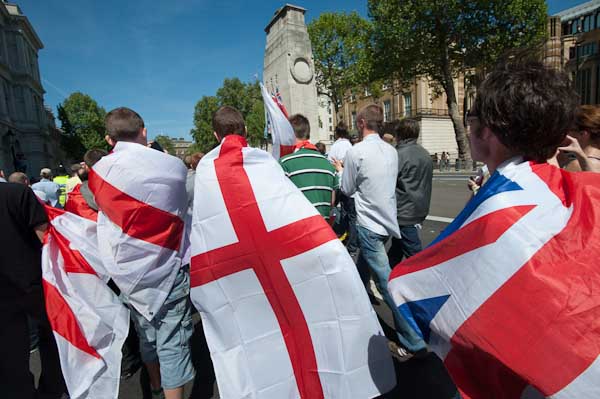
© 2010, Peter MarshallThe march came up Whitehall in silence and then burst into applause at the Cenotaph
I was surprised this morning to receive an e-mail informing me about a page attacking journalists on a web site which calls itself the English National Alliance, and even more surprised to find my picture at the bottom of the page with the caption;

Peter Marshall.
Socialist

Anti English Journalist

and Photogpraher

Well, at least there they had spelt socialist correctly, as in the title and address of the page it was “socilaist”. And of course I’ve no objection to being called either a Journalist or a Photographer, but I’m certainly not anti-English.

The complaint against me was that I had written about a ‘Patriot’ demonstration in May, and had:

lied to try and create interest more in himself as a journalist than the event, by stating that the patriots were involved in a scuffle at 10 Downing street, which was a total fabrication on his part…”

Unfortunately the writer had simply got it wrong, and has mixed me up with another photographer who had written about the event.

What I actually wrote in the only part of my article which mentioned Downing St was this:

“The march set off noisily, but as it turned into Whitehall and approached the Cenotaph it became a silent tribute to British troops, which was followed by applause, with the chanting resuming as they came past Downing St and on to Trafalgar Square.”

No mention of any scuffle, and several people on the left have criticised me for being too kind to the marchers for writing what I thought was a truthful account.

As usual I set out to describe the event as clearly and objectively as I could and give reader a fairly good idea of what happened, of why people were marching and the ideas they were putting forward. I did also describe the behaviour of some of the marchers towards the journalists present, particularly at the end of the event and the chanting of racist slogans by some. And as well as my description of the event I also made my own point of view clear – something which I think is also vital for journalists to do.

Interestingly when I met some of the march stewards earlier this month they thanked me for the fairness of my account of the event, and also told me that they had too been appalled by some of the behaviour I’d commented on.

The story about “a scuffle at Downing St” did not come from me, but was written by another photographer at the event in a completely separate story.  I saw nothing of the incident he describes,  where marchers were held back by police as they surged towards a woman who had shouted “racist scum” at them. I have no reason to doubt his account, but I didn’t see it, so I didn’t report it.

My story, headlined Peaceful March by EDL in London, includes this paragraph:

Many of us who are not members of the EDL would like to see a proper celebration of traditional British culture and would certainly support the wider use of the English and other British flags and the proper celebration of our national Saints Days. And while parts of our history have involved the exploitation of other cultures, there are also many aspects of which we can justly be proud, particularly for example in the areas of science and technology.

Which I think is hardly anti-English.

But more importantly than a misplaced attack on me, the ENA article is an attack on all journalists and on the freedom of the press.  It’s a call for censorship and control of the media:

On all future demonstrations and protests Journalists must be challenged and sent packing if they are NUJ members and also start gathering photographic evidence against them as well where possible so we can identify them constantly and banish them from our events.

…..

By creating ‘welcome cards’ we can ensure that unbiased Journalists are allowed into the ranks of Nationalist protesters with us so that they can tell the truth of the protests and demonstrations and start getting the message out that we are growing in stature, strength and support and will no longer tolerate a socialist minority dictating to us or spreading lies about the patriotic cause through their media access.

It clearly is a call for the kind of controlled press that is a feature of totalitarian societies both of the right and the left, and a complete denial of the freedoms which are one of our proudest English traditions. And it is a call we need to fight against – and this is a fight in which anyone concerned with upholding English traditions and freedom will join with us.

Lost Ansel Adams?

The claim by Richard Norsigian that the 60 glass negatives he bought at a garage sale nearly ten years ago from a man in Fresno are lost images by Ansel Adams is attracting a lot of attention in the press.  The negatives, which Norsigan bought for $45, having haggled with the seller who wanted $60 are said to be worth $2 million. Experts are said to have identified the handwriting on the negative envelopes as that of Ansel’s wife Virginia, and the evidence of a meteorological expert and others is said to confirm they are by Adams.

You can see some of these pictures for sale on the Lost Negatives web site, yours for $1500 for a 24×30″ digital print. Looking at them I’m not convinced that they show the same interest as the known work of Adams; if they are by him they were surely in the main his rejects, and it is hard to believe that he would not have destroyed at least some of them.

But truly the last thing we need is more Ansel Adams pictures. Not only did he take rather a large number – of which a small few are works of considerable power and majesty and most are frankly rather on the boring side, but thousands of other photographers have gone out and taken Ansel Adams pictures too. Sometimes I have this image of queues of photographers lining up with their 10×8 view cameras to try to faithfully replicate his once unique vision of the Californian landscape.

So I’d really like to see some kind of mechanism for losing much of Mr Adams’s work rather than anyone coming up with more. The true finds of his work that are interesting are those that show a different side of his photographic mind, such as the many pictures by him in the Los Angeles Public Library, pointed out by Gerard Van der Leun on American Digest in 2006 (and reposted in 2009) which you can find by putting the photographer’s name in either the photographer or keyword fields in the LAPL search page.

Back to those Norsigan images. The grandson of Ansel Adams believes the claim that they were by Adams to be false and has given some reasons. Although Norsigan may genuinely believe they are by Adams it seems to me that he may not be entitled to market them as such without the permission of the Ansel Adams estate, who may have some title to the use of the photographer’s name.  And if they are genuinely the work of Adams, surely the copyright would still lie with the Ansel Adams estate except in the case of images taken before 1923, although the Digital Millennium Copyright Act 0f 1998 is not entirely clear on the status of unpublished images.

I Really Don’t Need a Hasselblad

A week or two ago I went to a members evening at Photofusion in Brixton, where one of the events on the programme was a demonstration of one of the latest Hasselblad digital models,  the H4D with a 50Mp back. It’s basically a 645 format camera although the sensor is  rather smaller at 36.8 × 49.1mm, twice the area of that in my Nikon D700.

The camera we were shown by a guy from Calumet came with a fairly hefty 80mm macro and I certainly wouldn’t have wanted to carry that combination too far, but with the normal 80mm standard lens it weighs 2290g, not a huge amount more than the Nikon D700 with the 16-35mm which adds up to around 1800g. Definitely portable if not lightweight.

But of course I wouldn’t be happy for long with only a standard lens, and a couple of lenses would probably double the weight, with the smallish wide-angles weighing in around 900g each and a moderate telephoto at around 1300g.

But I’d miss would be the ability to take several images in rapid succession. The H4D is a little slower than I could wind on with a film camera at 1.1s per image, while the Nikon manages around 5 fps (and 8 fps with a battery pack.)

Of course I wouldn’t want to make many pictures, as 50Mp images take up rather a lot of disk space, and realistically I’d need a faster computer to handle them too. It’s undeniable that if I want to make really big prints the extra pixels would help and there are roughly twice the number of pixels across the frame comparing 50Mp with 12MP, but even at A2 the D700 can do a pretty decent job.

Obviously the H4D-50 isn’t the camera for me, which is just as well considering the price, around £18,000 in the sales, saving about £3000 on the RRP, with another couple of grand for a lens.  I can’t even see myself getting the cheaper H4D-40 which you can pick up with lens for a mere £13,000 or so if you shop around, or even a cheaper medium format competitor but I did listen carefully to see what I might be missing.

True Focus and Absolute Position Lock

One thing – and a major USP in both their literature and the talk we got – is True Focus and Absolute Position Lock.  The H4D only has a central focus point for autofocus, so you need to focus and then tilt the camera to get an image focussed away from the centre.  When you focus, assuming the lens has a flat field of focus, this plane is actually at different distances from the camera, increasing as you move from the centre of the image. So when you tilt the camera to alter the composition you are moving the focus behind the part of the subject on which you focussed. The H4D True Focus detects the tilt and alters the focus to compensate. Clever or not?

Let’s do a little maths. Thankfully we have our friend Pythagoras, who can enable us to avoid trigonometry. Imagine you are taking a full length portrait from about 8 feet away.  You tilt your camera up slightly to focus on the eyes, setting the focus distance at 8 ft, then you tilt the camera down, having locked the focus. But the tilt has meant that camera to subject distance is now less than 8 ft, as the distance from the camera to the point in the centre of your image, perhaps now 2 ft lower than where you focussed, is less than 8 ft. How much less? Going to that Greek we find that instead of 8 ft the distance is the square root of (8×8-2×2)  which works out as 7.745 ft, a full 3 inches less.

Will it matter? To find out we need to think about depth of field and the sensor/lens and aperture we will be using and decide on an acceptable circle of confusion.  It all gets too complicated, so lets just try a simple example and assume we are using a standard 50mm lens on a Nikon D700, and to avoid more maths I’m going to feed those figures into an on-line Depth of Field Calculator. Assume I’ve got a 50mm f1.4 (I don’t) and have decided to use it wide open. DOFMaster tells me if I’ve focussed at 8 ft, the near limit will be 7.69 ft, so those eyes will still be sharp.  I don’t think I need a Hasselblad H4D.

Wider Dynamic Range?

The other big point is quality, and as well as superb lenses that also comes down to the large sensor.  But it isn’t really the fact that the cells on the sensor are larger and perhaps surprisingly the H4D doesn’t offer the kind of high ISO performance we get on FX format cameras. The big difference, according to the sales talk, is that the sensor is 16 bit rather than 14 bit, and that gives you better tonality and a wider dynamic range.

Well I think, is that so? Certainly for their digital back they claim a dynamic range of 12 stops, which is pretty good. But using the D700 with RAW files and processing with ACR the guys at Digital Photography Review got a best result of 11.6EV which is pretty similar. I think they might squeeze out a little more now with LR3.  Perhaps those 2 extra bits don’t offer quite as much as they guy said.

I found it hard not to laugh when he said that shooting a Canon or Nikon DSLR is like working on transparency film. Not if you know what you are doing, and its perhaps significant that DPR note that their best result was almost 5 stops more than the default jpeg dynamic range.

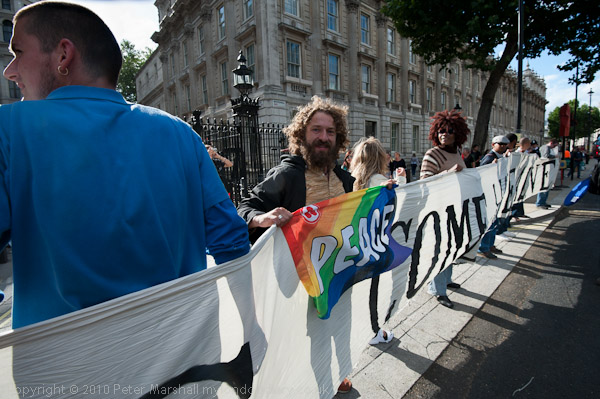
In practice digital has proved itself able to handle almost anything I’ve thrown at it – so long as I’ve got the exposure right (and when working fast that’s often a problem.) Here’s an image I took last Friday at Downing St:

© 2010, Peter Marshall

The sun is strong and low, just out of frame. You can just see some detail in the sky at left (the line at the top is actually the edge of my digital portable light shield – my left hand.)  I don’t know what the subject dynamic range was, but I do know that I had to do a terrific amount of burning in Lightroom to get that detail to show. Getting the tone I wanted in that blue shirt, the Peace flag and the face of the guy holding it needed a bit of added brightness too.

Getting however many stops of the subject into an 8 bit RGB range is going to be a tricky business with any camera and high contrast scenes will almost always look too flat if this is done without a certain amount of dodging and burning as well as using a curve that flattens unimportant parts of the tonal range. Using a back with inherently greater dynamic range may make the job easier, but in the end – like darkroom printing – it comes down to the skill in interpretation of the negative or RAW file.

It’s a picture I wouldn’t have tried on tranny and would have been tricky on black and white, and which I don’t think my older digital cameras would have managed well.   When Digital Photography Review tested the D300 they could only manage just under ten stops, though I think they (and Lightroom) may have improved enough to squeeze out a little more. But certainly the D700’s 11.6 seems good enough. So yet again I don’t really need the H4D!

Making an impression

© 2010, Peter Marshall
Under the dark cloth – a DSLR. And why not?

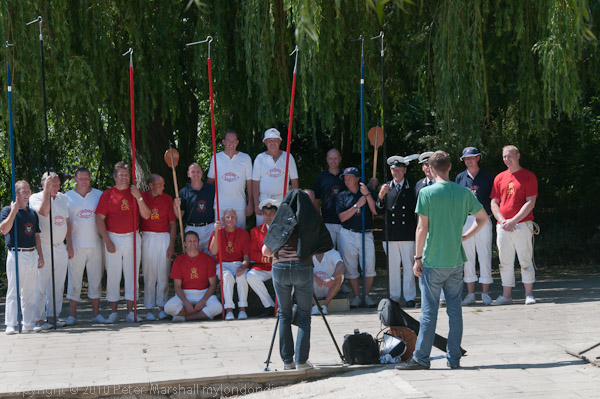
Then on Monday last week I watched a photographer taking a group photograph of the swan uppers and there was the camera all set up on a tripod and covered with a large black dark cloth.  I was surprised to think that someone was still using a large format camera but had to laugh when the assistant briefly lifted the cloth to reveal a rather ordinary looking DSLR (it could have been a 25Mp Canon, though I couldn’t from a distance identify it) but I thought that the D700 would probably have done the job adequately. That photographer didn’t need an H4D and nor do I.

Of course back in the old days of film, there were many photographers who used medium or large format for jobs that could readily have been done on 35mm. The larger negs were more forgiving in some respects, particularly over sloppy processing and handling (and some repro guys really were sloppy) and I think the same is true with larger digital files.  And many clients, especially those paying big advertising money, were considerably happier to see photographers using large and expensive equipment. Some would specify 4×5″ and never knew when they were given Kodachrome duped up to that size. Perhaps the main selling point of medium format digital is keeping clients happy in much the same way.

Big Lunch Street Party

© 2010, Peter Marshall

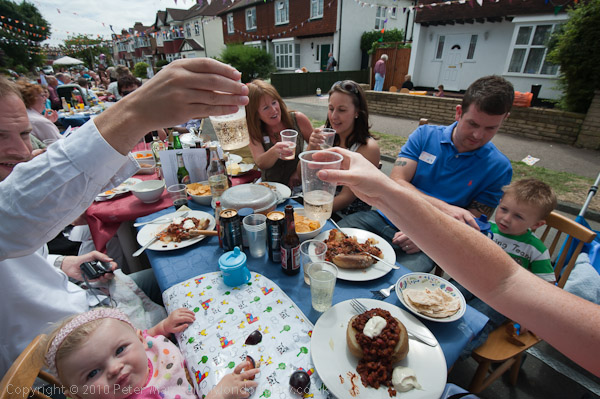
The Nikon 16-35mm on the FX format D700 was pretty well an ideal lens for photographing this suburban street party, part of a nationwide neighbourhood building exercise ‘The Big Lunch’. You can see more of the pictures mainly taken with this combination on My London Diary, which also tells you more about the street and the event.

There were a few occasions when I wanted a longer lens, and the 18-105 Nikon on the DX format D300 (27-157 equiv) provided what I needed. I did find myself being slightly confused on occasion and forgetting that the physically longer lens (the 16-35mm) was actually the wide angle, and grabbing the wrong camera, although the overlap in focal lengths between the two sometimes meant it didn’t matter.

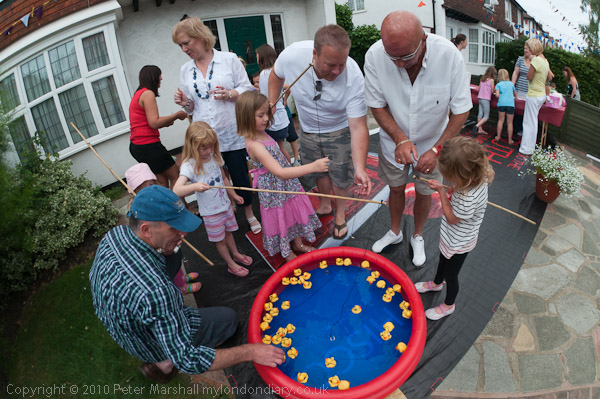
The D300 also came in useful for a few images with the 10.5mm fisheye where I thought that the red circle of the pool would really make an overhead view with the fisheye work. I had to take several images to get the framing I wanted as I was shooting with the camera held up well above my head, but this frame was just about perfect.

Framing with the fisheye is always a rather different exercise to framing with rectilinear lenses, and it is seldom really possible to locate the corners of the image with any precision – you get a 180 degree view across the image diagonal. So while normally framing is very much about where edges and corners fall, with the 10.5 its much more about placing the centres of the edges (and in this example particularly the centre top to give just a little space above the heads and the centre bottom around the edge of the pool.)

© 2010, Peter Marshall
LR3, Distortion correction at 30

Previously I’ve often made use of the  Fisheye Hemi plugin which retains these edge centres while losing some of the extended corners, and its a very useful tool. Here is the result it gives with this image, similar but with some lines noticeably straighter, and just a little more content at the two edges.

© 2010, Peter Marshall
FishEye Hemi Distortion correction

Lightroom 3 comes with a lens profile for the Nikon 10.5mm which will actually convert to rectilinear when set to 100, its default, which I think is totally useless.

© 2010, Peter Marshall
LR3 Distortion correction at 100 – Rectilinear.

© 2010, Peter Marshall
Uncorrected image

Which of these images best represents my intentions when photographing the scene is an interesting question, and for me either of the upper two versions is more acceptable. The rectilinear result clearly distorts the scene in a way that misrepresents what I saw, and the uncorrected image gives far more prominence to the corners than I intended. Technically, Lightroom’s rectilinear version produces an unusable result, having to stretch out some of the pixels unacceptably and losing sharpness in some areas.

In a week that has seen yet another highly publicised case of digital manipulation, with a caddy being removed from a golfing shot and Getty firing the photographer concerned, Mark Feldman, who claims he took out the caddy while showing him and the golfer the picture when it the caddy suggested his presence ruined the picture, and that sending this version as well as the uncorrected original to Getty was simply an unintended “fatal mistake.”

Given the poor quality of the Photoshop job and that he sent both corrected and uncorrected versions I’m convinced his story – and his own comments  on the article are a true explanation of what happened.

But if he had done it deliberately and suppressed the original it would clearly have been digital manipulation. However the kind of perspective alteration shown in the above examples is an example of the kind of digital manipulation that is fully acceptable.  It’s a subject I discussed at some length a couple of months ago in Ethics and Images.

Two Years to London 2012

 © 2010, Peter Marshall
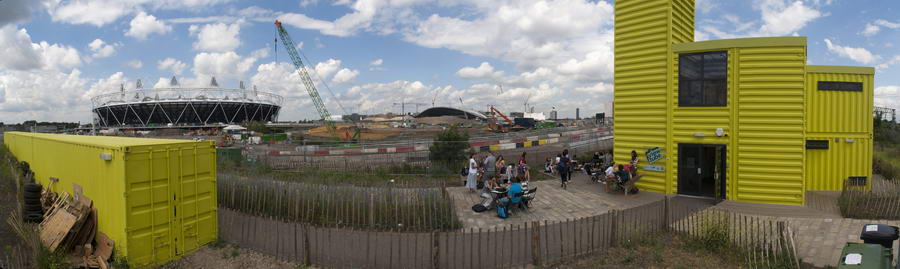
The Olympic site in June 2010 – more (and larger) pictures

Today is exactly two years to the start of the London 2012 Olympics, and various events are taking place to mark this. The man in charge, Lord Coe of Ranmore (still better known as Seb) was interviewed on the BBC this morning and talked to the presenter about how just five years ago, the Olympic site was an undeveloped wasteland.

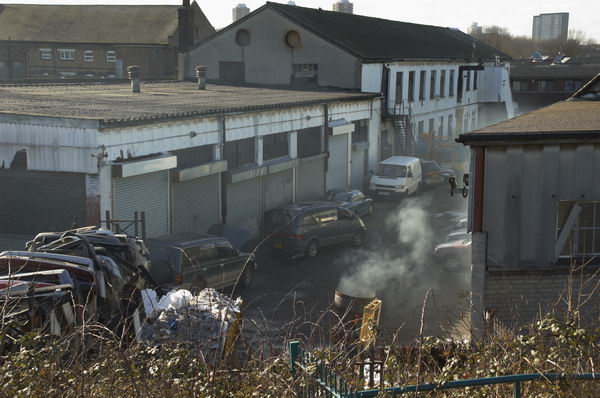
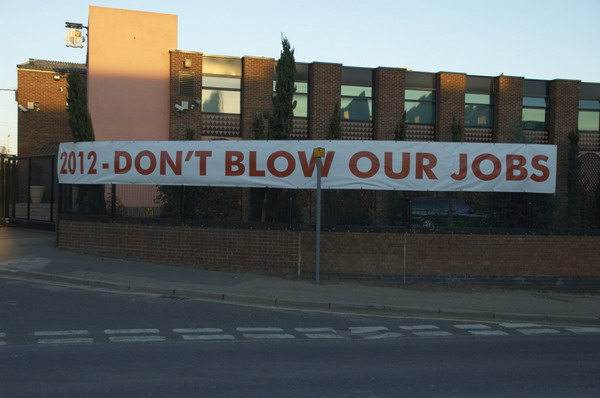
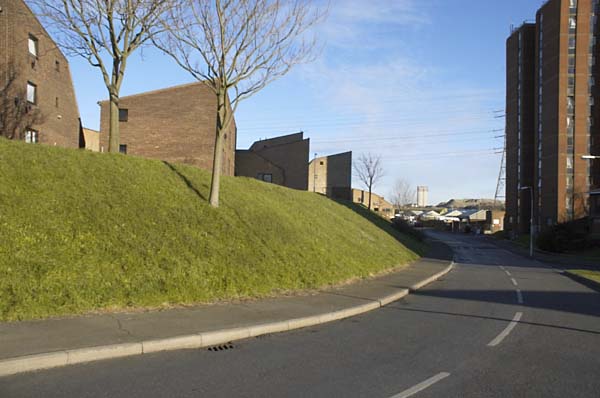
It’s a lie, and one that Lord Coe knows is so, all part of a deliberate attempt to justify the Olympics as bringing some great redevelopment opportunity to the area (which might just be true.) These are some pictures from around the site before the Olympic redevelopment, which led to the closing down of many small local employers, along with a few larger companies, some of which did rather better from the forced removal.

© 2005 Peter Marshall
The stadium was built at the left of this picture. Nothing remains.

© 2005 Peter Marshall
This industrial area on Marshgate Lane has been completely cleared

© 2005 Peter Marshall
The stadium is more or less where this building was

© 2005 Peter Marshall
This housing estate and tower block was demolished for the Olympic Village
Of course there are many more pictures from the area here on My London Diary (the index page only covers work up to 2007 – see entries under Newham) and rather more on my River Lea site, with pictures from 2000-2005 starting here.

Before the Olympics

More convenient for some is my recently published ‘Before the Olympics‘, still available on Blurb which packs 240 pictures into its pages, including a significant selection from the Olympic area, particularly from the 1980s before the London Olympics was even a gleam in Seb Coe’s eye. Had he really wanted them on a “undeveloped wasteland” he could of course have chose Ranmore.

BP Plugs Leak

If you’ve not already seen it there is a great piece on The Russian Photos Blog today, BP Plugs Leak, Photoshops Entire Gulf Coast.

Of course much of the anti-BP US hysteria is no more than an attempt to deflect attention from the US government’s responsibility for encouraging unsafe oil exploration in the gulf and elsewhere, which has backfired spectacularly, exposing the almost total lack of proper regulation of the oil companies activities.

And it would be hard to find anyone with any understanding of the matter who has any sympathy for the attacks on BP and the Scottish government over the release of the the Libyan who was convicted on very doubtful evidence of planting the bomb on an airline. Perhaps the remaining documents that the US government and the UK government will not allow the Scots to release could make their way to Wiki-leaks and might then help convince those US politicians that there is no case for the Scots to answer.

© 2010, Peter Marshall
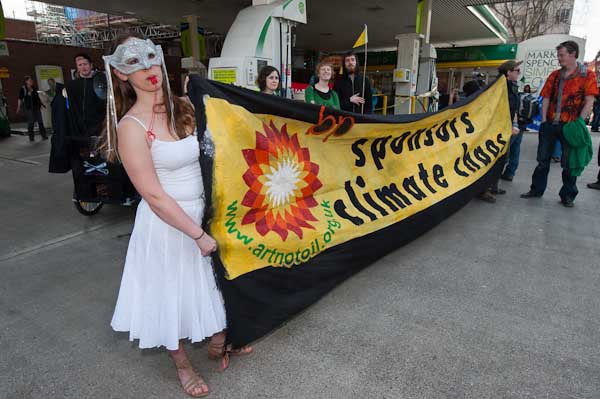
Party at the Pumps exposed BP’s exploitation of Canadian Tar Sands

BP of course do have plenty of things to answer for, not least their intention to exploit the Alberta tar sands

© 2010, Peter Marshall
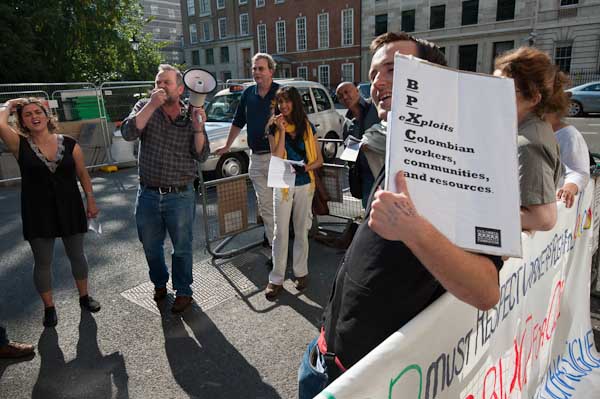
Picket at BP in solidarity with Colombian Oil Workers
and their lack of care and respect for the dignity of their workers in Colombia.

Democracy Camp Stops Traffic

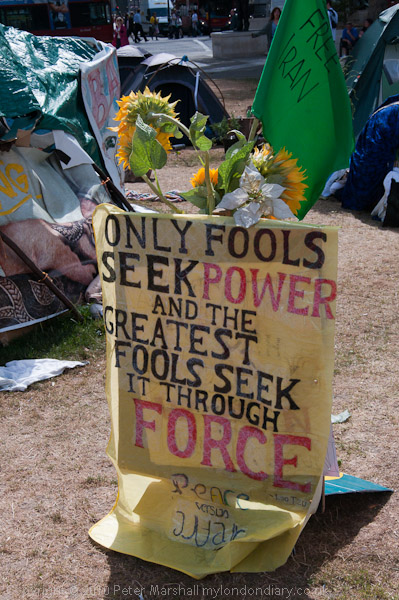
The Democracy Camp which set up in Parliament Square on May 1 was cleared by bailiffs and police early on Tuesday morning after two and a half months there. I wasn’t there to see it go, but I did visit last Friday after the court had announced its decision that they had to leave.

© 2010, Peter Marshall
Dry grass – just add water & leave it to grow – but made to look like bare earth in the Standard

For the moment Brian Haw and his Parliament Square Peace Campaign is still there, and in its tenth year, but very much under threat.  He’s become something of a national institution and I hope he manages to keep there until he feels it is time to leave.

It seemed to me that the Democracy had perhaps in several ways outstayed its welcome, although certainly its presence had livened up what is normally one of London’s dullest areas, and one that the city has always completely failed to make sensible of proper use of.  It did at least provide a little entertainment and amusement for tourists. It also gave a temporary home and some hope to a number of London’s homeless – including some ex-soldiers – at minimal cost to the tax payer. But perhaps like the Climate Camp it should have cleaned up, packed its bags and left of its own accord after a decent period of occupation.

Of course there were down sides, though the councils and the press seemed to make rather too much of these. Clearing the rubbish was only a matter of a lorry coming occasionally to pick up the neatly piled black sacks as the campers did the rest of the work and it’s hard to see how Westminster Council can work out the rather large amounts it has quoted.  The site too was largely self-policing and there was certainly no point in the presence of ‘heritage wardens’ who simply stood around doing nothing there (I did see one taking a few photographs.)   The grass about which so much fuss has been made was not in much worse state than my own lawn, and I confidently expect that to recover given a few decent falls of rain and a few of months of my usual neglect rather than the unnecessary turfing and reseeding the Mayor will spend Londoners money on.

© 2010, Peter Marshall

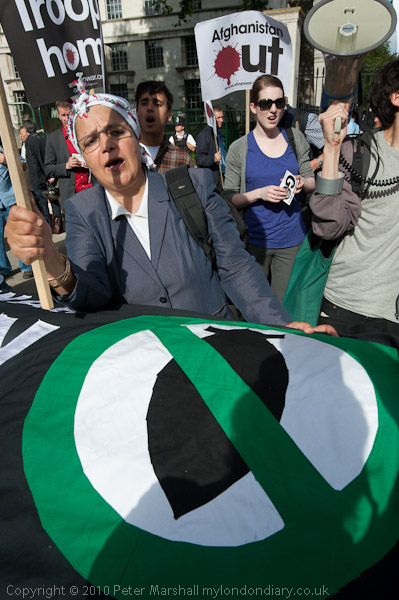
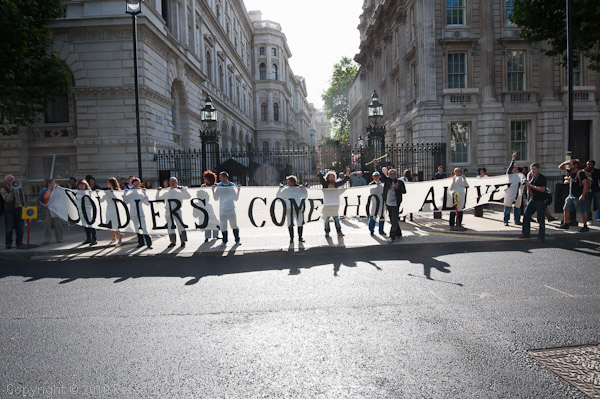
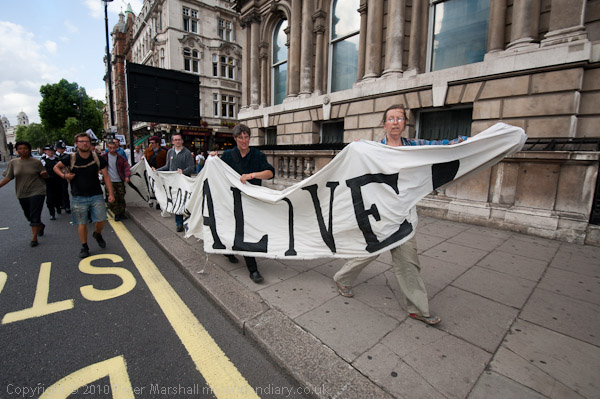
One of the causes which the camp has brought some attention to through its protests is the war in Afghanistan, and the longest banner on its site read ‘SOLDIERS COME HOME ALIVE!’ On Friday evening Stop The War were holding a demonstration opposite Downing St against the war, so I wasn’t surprised to see the campers coming up Whitehall carrying the banner.

© 2010, Peter Marshall

Nor was I surprised that rather going across the road to the area on the opposite side of Whitehall where demonstrations are permitted they instead stood on the pavement to block the gates to Downing St. Like them I’m not happy with the restrictions including this on the right to demonstrate that were made by the Labour government in SOCPA  (Serious Organised Crime and Police Act 2005) which were a serious assault on our democratic freedoms.

The police at least responded fairly reasonably and after a few minutes told them they would have to move, and they did, but only to the centre of the road so as not to obstruct the gates.  It was difficult there for both police and photographers who were in danger from the traffic that was still being allowed to move along the road, and police politely explained this to some of the leading campers and requested that they move across to the pavement where they were allowed to demonstrate.

Instead some of the other protesters from the camp decided on a different logic of solution. If traffic created a hazard, stop the traffic – and so they did. Police made some attempt to get them to move, but there were simply not enough present to actually force them. After around ten minutes I saw one of the officers talking to one of the leading protesters and they shook hands, I think having come to an agreement. She organised the protesters to stand with their banner for a few minutes across the road, then led them back towards the camp.

© 2010, Peter Marshall

It was a protest without violence from protesters or police. The protesters had been allowed to make their point clearly but the police had also minimised the disruption caused by the protest, although it had held up traffic for almost 20 minutes by the time it ended. Perhaps it was a little bit of democracy in action.

Pictures from Parliament Square, the Stop the War demonstration and the Democracy Camp’s contribution to this on My London Diary, along with more about the event. A few thoughts on the photographic problems in another post here.

Waterloo Carnival

© 2010, Peter Marshall

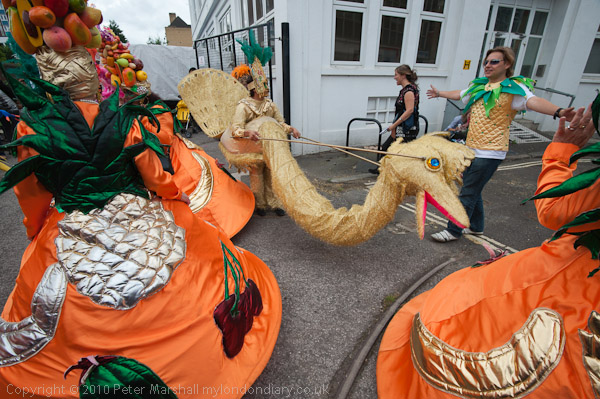
There is a certain chaos and madness about this picture that I like and is perhaps why I like to photograph the event it comes from, a relatively recent annual carnival held close to Waterloo station, in an area centred about a street called Lower Marsh.

© 2010, Peter Marshall

The carnival itself is a symbol of a changing area, not long ago a down at heel and solidly working class area which came to life a little on weekday mornings with a street market, but after than packed up in the early afternoon was pretty dead.

Lower Marsh is the remnant of a much larger market through the centre of Lambeth from Vauxhall to Blackfrars which was notorious in the nineteenth century for the depravity of those who traded there and frequented it. Building Waterloo Station cut it off from the area to the north in 1848, and in the 2oth century road building, wartime bomb damage and slum clearance continued its decline. The end of the GLC came as a blow too, as workers there would come through Leake St under the station to shop and eat.  Also in the 1980s property developers brought up much of the area hoping for a windfall from redevelopment around the Paris-London Eurostar train service to Waterloo but it didn’t happen and many buildings were more or less left to rot.

But over the last ten or so years it has begun to pick up, with new offices around and it’s become a much trendier area, with various specialist shops, cafés that have moved beyond the full English breakfast (though I love a good ‘greasy spoon’ even though my diet forbids it) and a pub called the Camel And Artichoke which despite the name serves a decent pint.

© 2010, Peter Marshall
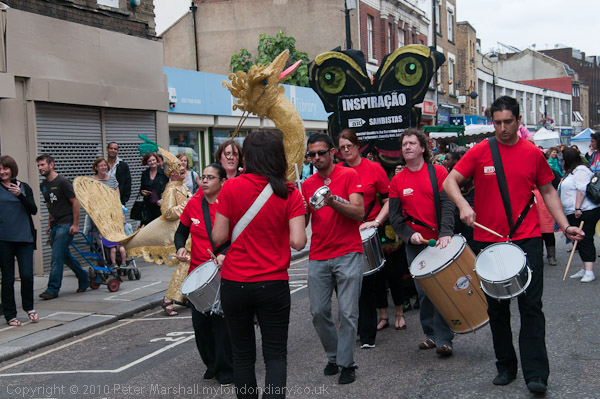
The samba group from Christian Aid whose offices are in the street

The population is also considerably more mixed with the selling off of both council housing and formerly cheap private rented accommodation to people who see the advantage of living within walking distance of Westminster and central London.

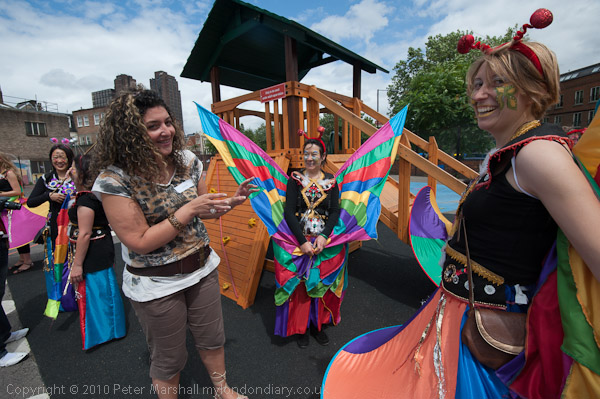
As usual at the moment I was working with the D700 with the 16-35mm f4 Nikon lens and the D300 mainly with the Nikon 18-105mm, with just a few pictures on the 10.5mm fisheye. And for once everything worked as it should.

More pictures on My London Diary.