I’ve been putting in a lot of time over recent months sorting out my own work from the 1970s and early 80s, and have just decided that Lightroom can help me organise this stuff in a similar way to my current digital work. I’ve set up a new catalogue ‘London1’ and have imported several hundreds of scanned images – 16 bit tiff files – into it.
The raw scans need quite a lot of work doing on them – and some things are much quicker in Lightroom, for example rotating and cropping – and it is also probably an advantage that the edits leave the original file untouched. There are some things – like retouching – where at least most of the work needs to be done in Photoshop, and it is easy to use Ctrl+E and open and edit the original and then save it to return to Lightroom. But with so many pictures to work with, I’ve decided only to retouch the scans when I actually need to make a print. Too much of a job to retouch everything.
In Lightroom it’s easy to tag, keyword, select and sort files into collections, and then to output an individual image or a whole set with a preset for a particular purpose – for web, or book pages etc. And at least one of my next set of books will be from my early pictures of London.
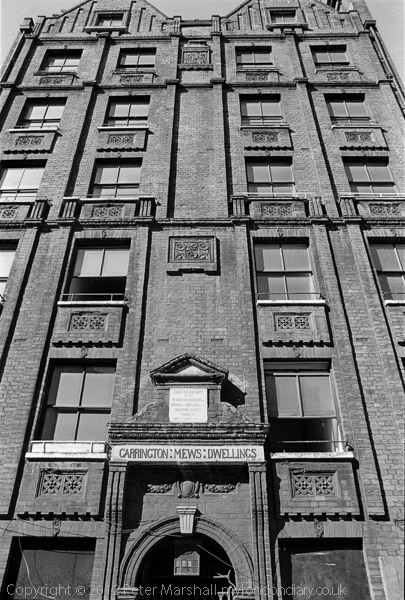
Or at least it’s fairly easy to keyword and caption pictures – it sometimes would have helped if I had bothered to make notes, which I wasn’t too good at back in the 1970s. It should still be easy when, as in the case of ‘Carrington Mews Dwellings’ the pictures come with their own label, along with another, too small to read on the web but easily legible on the original that tells you they were ‘Erected A.D. 1877 by the Metropolitan Association for Improving the Dwellings of the Industrious Classes’. There is a Carrington St in Mayfair – but Streetview shows it has nothing to match and Google can’t help for Carrington Mews either – and it isn’t listed in Wikipedia among the existing buildings erected by the MAIDIC. Pevsner of course wouldn’t have thought it worth mentioning, nor does it appear in the Survey of London. It is – or rather was, the bottom windows are boarded in my picture – somewhere close to Carrington St, as the adjoining image on the contact sheet is Whitbread’s ‘The Grapes’, still in Shepherd Market although now with décor rather less to my taste a free house ‘Ye Grapes.’
Of course they are not very early pictures of London, and people were photographing the city from the 1840s, when certainly a Mr Talbot made a calotype negative of Nelson’s Column under construction in April 1844.
One site that regularly published old pictures of London is Spitalfields Life, and a couple of days ago it had a feature The Forgotten Corners of Old London with images from the extensive collection of the Bishopsgate Institute – which is the source for many of its features on old London. This particular set of pictures appealed to me as in some ways being like much of my own work, often recording things that seem peripheral or inconsequential but which have a certain resonance.
Another recent feature which particularly appeals to me is Dark City: London in the 30s on the ‘Library Time Machine‘ of the Royal Borough of Kensington & Chelsea, which republishes well 15 of the evocative night photographs from from London Night John Morrison and Harold Burdekin published in 1934. The book has a total of 50 photogravures in dark blue by Burdekin with assistance from Morrison who also wrote an introduction. I could reproduce some of these pictures here, but its better if you go and look at them all on the Time Machine site (if you haven’t got a copy of the book.) I added it to my collection ten years or so ago when I was researching a piece on the photographers of London. It came from an era when night photography was becoming much easier, and was perhaps prompted by Brassai’s night images of Paris. Today night photography is easier still, but it remains a good idea to take a companion in many places, even in parts of London. Burdekin made a deliberate decision not to include people in his pictures and the streets are eerily empty of traffic, but London then mainly went to bed well before midnight and it would probably have been hard to have found any to include in many of the places he photographed. London is much more of a 24 hour city now and you might find yourself waiting for a long time for some streets to be empty. Then you took your friends and relatives along if you wanted people in your pictures.