Cleaners at the Barbican

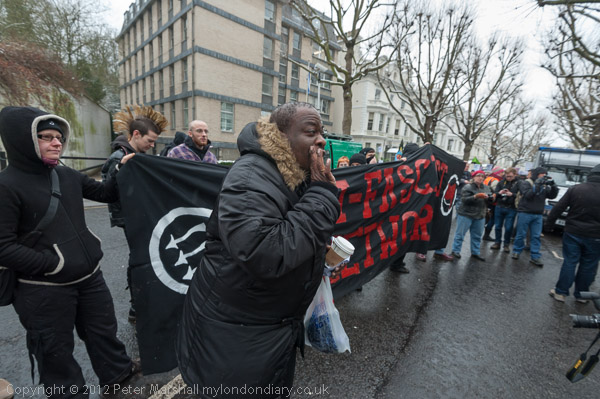
I couldn’t stay in Enfield with the Chase Farm protest because I wanted to cover the Cleaners Protest at Barbican. At least it was an easy journey, as trains from Enfield Chase run into Kings Cross, and though the Circle Line was suffering its New Zealand inspired closure so I couldn’t get the underground to Barbican, I could still jump onto the Northern line to take me to Moorgate, from where it was just quarter mile or so walk to the main entrance of the Barbican Arts Centre, a prestige arts centre owned by the City Corporation of one of the richest cities in the world, where the cleaners are paid less than the living wage.

So I was easily there at the time advertised for the protest. But there was nobody else there. I wasn’t all that surprised. Most of the cleaners are from Latin America. When I was in Brasilia, people told me that if they wanted people to actually arrive on time for an event they said “3pm English Time“.

So I didn’t assume that the protest had been cancelled and go home, but told myself I’d give it a half hour. It was too cold to stand waiting, so I went for a walk to look at an area nearby where I’d photographed some buildings and see if anything had happened to them. It was now an empty block. There were a few pubs I could have gone in, but none looked very inviting and I walked a bit more mainly to keep warm before making my way back to the Barbican. Twenty minutes after the advertised start there were now three people waiting to take part but soon a few more arrived, and 40 minutes late the organisers of the protest turned up. So perhaps I could have marched to the hospital in Enfield after all and not missed the cleaners.
© 2013, Peter Marshall

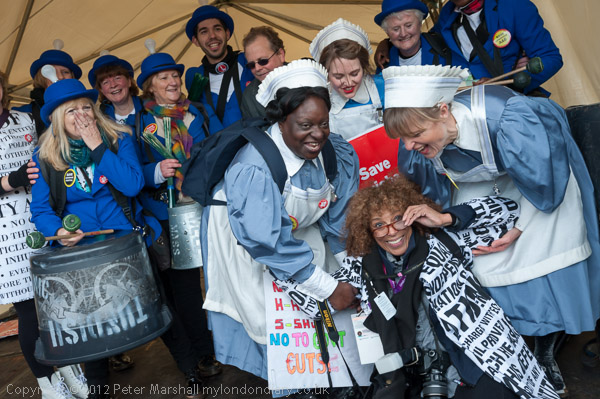
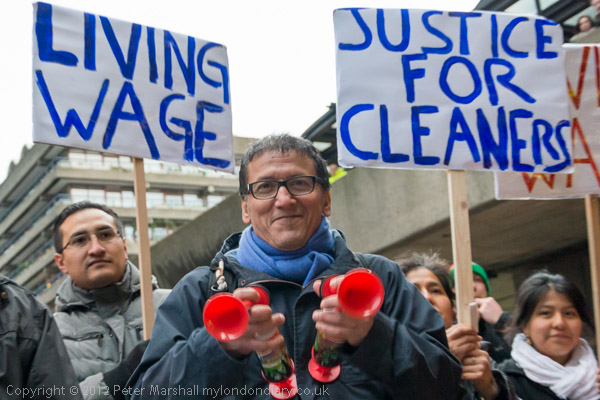
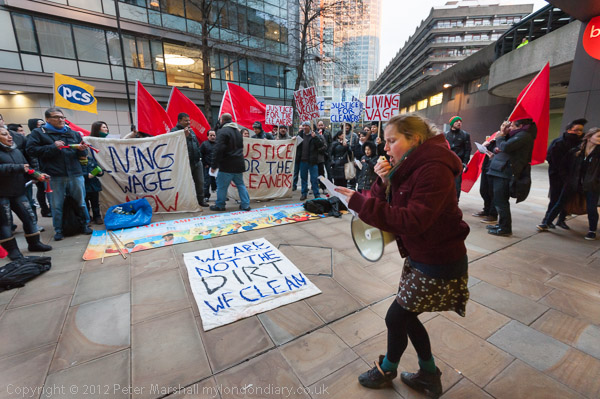
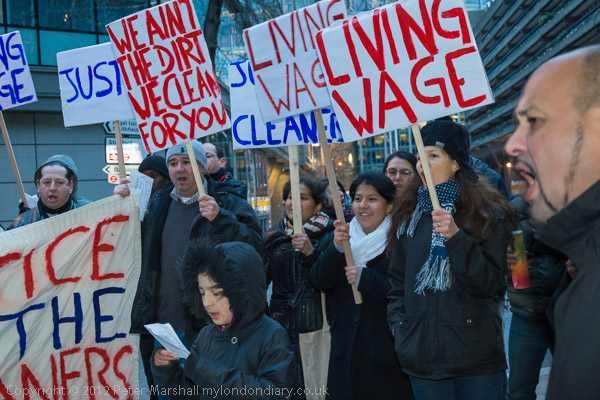
Once they had arrived things got pretty animated, with lots of banners, placards and noise, including some new air-horns with pumps attached, along with a few whistles and some seriously large and loud drums. And of course a megaphone so that people going into the Barbican Arts Centre could be told why there was a loud protest taking place.

The sun we had seen in Enfield had long been replaced by thick cloud, and as the protest got under way around 4.15pm it was beginning to get pretty dark. I turned the ISO up to 1600, and working with the 16-35mm was able to work at around 1/50 f4 in the dimmer areas, going up to around 1/80 at f4.5 further away from the buildings. But people were generally pretty active although this was a static protest there was a lot of movement, and I should have used a higher ISO to get a faster shutter speed, as quite a pictures were not usuable as some of the people were blurred. The cleaners and their supporters generally protest in a very active way, with a lot of waving and shouting, and today probably jumping up and down to keep warm. The 16-35mm isn’t a very fast lens at f4, but it is usable wide open, and usually I need the depth of field that f4 gives.
© 2013, Peter Marshall

With the longer 18-105mm on the D800 I was struggling even at ISO3200; I don’t like to go higher than this as the results can get noticeable noisy, but it might have been better to have done so. Both lenses do have VR, but it doesn’t seem to be as effective as it should be, and can’t deal with subject movement. Both lenses also seemed to be having occasional focus problems in the low light.

I’m still not used to the focus settings on the D800, which only has a 2-position focus switch at the left of the lens for AF-M, rather than the 3 position C-S-M of the D700, which seems much better. It’s far more difficult to change from single focus to continuous focus, and much harder to tell which of the two you are using. I can’t understand why Nikon made this change. And the three-position switch on the back of the camera was also much easier than pushing in the AF-M button and twiddling the front command dial, though this does give more options, even if I don’t know what they mean. I need to find time to study the manual again.
© 2013, Peter Marshall

Eventually as it got darker still I finally had to get out my flash – still the Nissin. The results just aren’t as good, even though I was still working at high ISO to pick up as much ambient light as possible and avoid the worst effects of flash. I decided I’d done all I could and in any case it was time for me to leave and send in my stories for the day.

I’m still not sure if I prefer the Nissin to Nikon flash units. At the price it certainly does a pretty good job most of the time, and as with the Nikons I also occasionally get pictures that are ridiculously over-exposed. None of them work too well at close quarters.

I took in three Nikon flash units into Nikon for servicing thirteen days ago (I was sure I had a fourth somewhere but couldn’t find it.) The two SB800s are now repaired and I’m awaiting their return. The SB700 which I thought only needed a new flash shoe fitting –  I’ve just told them to re-cycle as the estimate was close to what I originally paid for it, and slightly more than I could get a new one for on eBay. I should have tried Araldite!
Haka or Hospital Closure?

I seldom travel outside of London to cover events, partly because there is so much to do inside. Greater London covers quite a large area, a little over 600 square miles and has a population of over 8 million, so there is no shortage of stories, and my own definition of London is a little wider than the official designation. I still consider myself a Londoner although because of a little gerrymandering in the 1960s the town where I live found itself left out in the cold, attached to an alien Surrey with which it felt little in common (and indeed an ancient rivalry, still fought keenly at Lords and the Oval.)

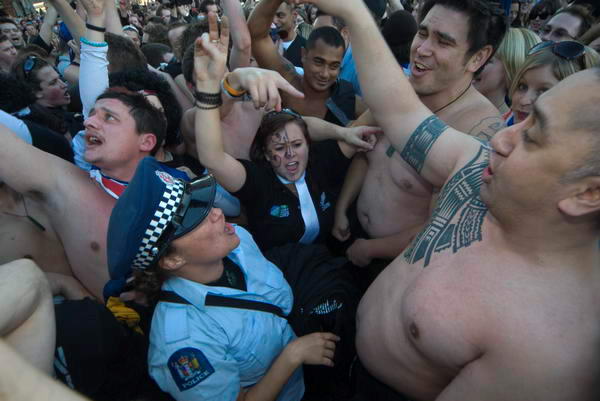
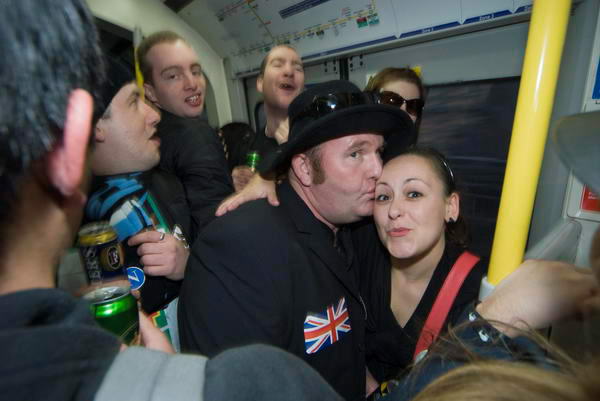
But London is one of the most cosmopolitan of cities, with a population including people from every country in the world, and – according to the 2011 census – populations of over 20,000 for some 27 of them, and pretty large numbers from quite a few more. One group that doesn’t make it into that top 27 are New Zealanders, but there are still quite a few of them, and on one day a year Kiwis come out on mass to celebrate Waitangi Day with a Circle Line pub crawl which culminates in a haka opposite the Houses of Parliament.

© 2008, Peter Marshall

I didn’t photograph them this year, partly because this year Transport for London had the neat idea of putting a damper on the occasion by closing down both the Circle Line and also that part of the District Line that which uses the same tracks. Undaunted the Kiwis (who’ve suffered from some part closures in previous years) would be following the same route on foot, staggering between the various pubs that mark out the route. But it wouldn’t be quite the same. Back in 2008 an alcohol ban came into force on the tube, which also must have had a slightly sobering effect on the event, although perhaps largely unenforceable for such a mass event. But I was pleased I had photographed the event a few months earlier.

© 2008, Peter Marshall

So I got as far as putting the list of pubs into my diary and working out some rough times and places to photograph, but in the end decided it wasn’t worth trying to cover, as I was unlikely to get anything as good as I did in 2008.

But the main reason I didn’t get to see the haka again was that there were other events I decided to cover and the times and places just didn’t seem to work out. I could just have caught the start of the event on my way to Enfield, but decided it wasn’t worth the detour.

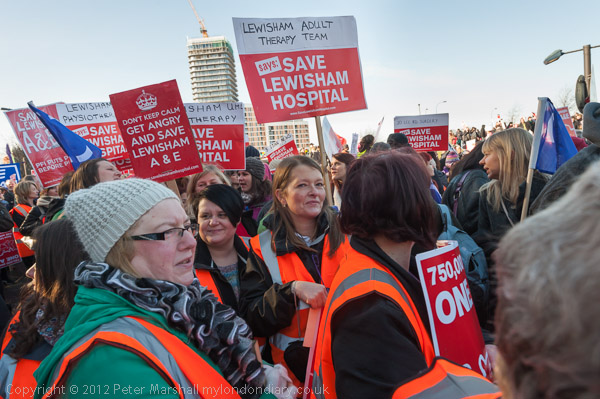
Hospital closures are arousing a great deal of anger at the moment, and mass protests like that at Lewisham a week ago – though even 25,000 on the street for a local protest and the almost unanimous opposition on medical grounds as well as those who can add up pointing out the financial unreason of the proposals hasn’t yet managed to open the closed mind of the minister. But the fight continues, there and elsewhere, and another hospital affected by similar plans for downgrading is Enfield Chase, more or less at London’s northern extremity.

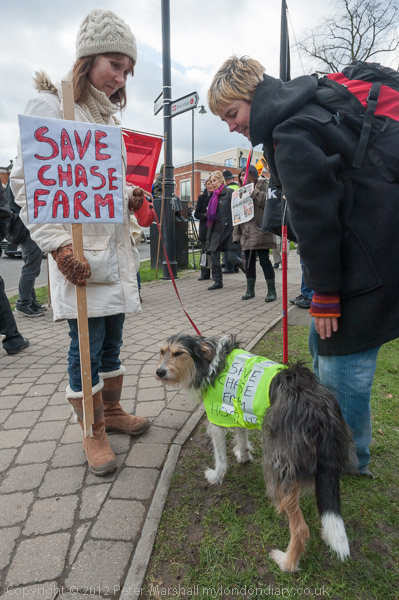
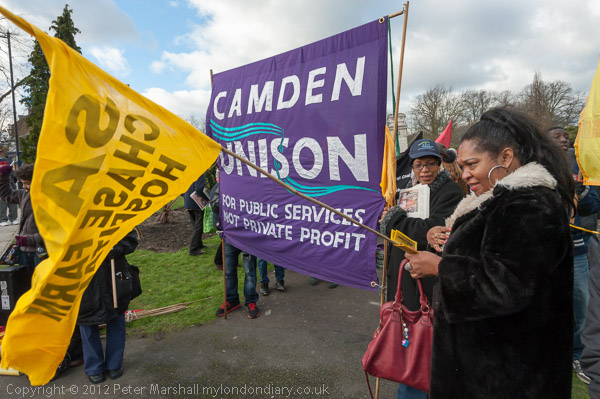
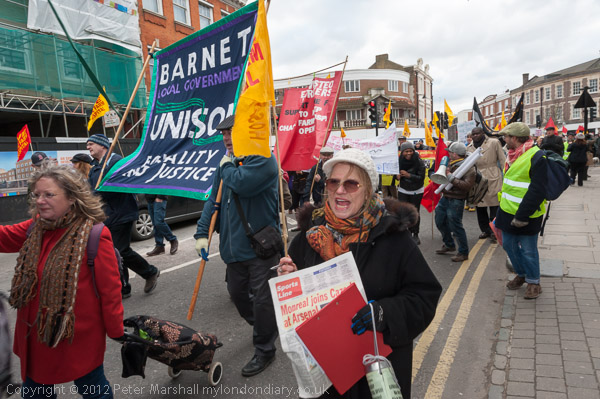
I knew the protest there would be much smaller than at Lewisham, and wasn’t disappointed to find a couple of hundred local people waiting for the start of the protest on a cold and windy area of grass in front of the war memorial with banners saying Save Chase Farm Hospital.

© 2013, Peter Marshall

I’d been given a time for the event but hadn’t realised that the march would not start until an hour later – and that there would really be nothing happening in that hour. It seemed rather a waste of time for the protesters, standing around and getting cold in a rather out of the way location, and it seemed a bit of a waste of my time too – and had I known I’d probably have gone and had a drink with the Kiwis in Notting Hill en route to Enfield.
© 2013, Peter Marshall

There always is something to photograph, but perhaps not a great deal. And I also had a decision to make, when I was told by one of the organisers that if I stayed with the marchers until they reached the hospital there might be a scoop for me. It wasn’t hard to work out what was likely to happen and there was a banner which read ‘Enfield Young Socialists Occupy Chase Farm‘ to help me if I had any doubts, but although it would have added to the story, a look around at those present told me that any occupation was likely to be a token one, a few hours before they were ejected by police.

© 2013, Peter Marshall

In the end I decided to stick to my plans for the day, which were to follow the march until it was time to take a train to another event I had said I would probably cover.

________________________________________________________

My London Diary : Buildings of London : River Lea/Lee Valley : London’s Industrial Heritage

All photographs on this and my other sites, unless otherwise stated are by Peter Marshall and are available for reproduction or can be bought as prints.

To order prints or reproduce images

________________________________________________________

London Dérives

Just published today, after much gnashing of my few remaining teeth, is a book of pictures taken on my rather aimless wanderings around London in the late 1970s and early 1980s. Well, not exactly aimless, but mainly walked with no particular destination in mind.

In those days, before the Travelcard, most of my walks were circular in nature, starting and finishing at the same station, and these starting points were also largely determined by those places to which it was possible to book a ticket from my closest station. When I did venture further it was a matter of buying two or three  or more separate tickets in the course of the journey.

London Dérives (or as Blurb will have it, being a US based company ‘London Derives’) ISBN 978-1-909363-08-3 contains 73 of my black and white pictures and the best way to buy it is to download the PDF version which is currently only £4.00, less than my usual price. You can of course see the preview and at the moment a full preview is on-line, though I may cut down the number  of pages visible in a few days. Viewed full-screen it is almost as good as the PDF, although I hope some readers will download this as it does make a donation to keeping this site running as well as to Blurb – and they take Paypal as well as plastic.

For most of the 1960s I was a student, and very much involved in the events of 1968, although things were a little quieter in Manchester than in Paris. But among our bedside reading at that time was ‘The Society of the Spectacle‘, a translation of Guy Debord’s 1967 La Société du spectacle.  When a few years later I had the time and money to start taking photographs, this was one of my text books for how to approach contemporary life with a camera. Twelve years earlier Debord had written ‘Introduction a une critique de la geographie urbaine‘ and in the main text of London Dérives I quote from this and his Theory of the Dérive.

One problem with Debord is that his thought was very French, and translations into English often lose the struggle, ending up with something that is in English but make little sense. London Dérives has a new translation of one often quoted key passage from his ‘urban geography’ that talks about his idea of the dérive (it’s sometimes useful being married to a linguist, though any mistakes are almost certainly mine.)  Like the published works of the Situationists, this short translation (but certainly not the rest of the book) is issued with an ‘anti-copyright’ message – it can be shared freely and without any need to attribute. Here it is:

The sudden change of mood in a street over only a few metres;
the obvious division of a city into clear-cut areas of mental
climate; the steepest slope – in no way connected to the
contours – down which aimless strolling will be led; the
captivating or repellent nature of certain places, all this seems
to be neglected. Or at any rate never considered as depending
on reasons that can be brought to light by a thorough analysis
and turned to advantage. People are aware that there are
gloomy districts and others that are pleasant. But they usually
convince themselves that the elegant streets give a sense of
satisfaction and that the poor ones depress, hardly any more
nuanced than that. In fact, the variety of possible combinations
of moods, just like the solution of chemical substances
into an infinite number of mixtures, leads to feelings as diverse
and as complex as those brought on by any other type of
spectacle. And even the most basic objective scrutiny shows
the impossibility of formulating a qualitative or quantitative
distinction between the influences of the diverse built
environments in a city based solely on the period or style of
architecture, much less on the living conditions.

Introduction à une critique de la géographie urbaine
Guy Debord, 1955

It took many hours of work to get the pictures ready, with some images needing around an hour and a half of detailed retouching, thanks to my negative files having been infested by tiny insects some years ago. Too small to see clearly with the naked eye, the remains of these insects and  the tracks they left chewing up the gelatin are only too obvious in enlargements. Fortunately after retouching they are generally not visible in the images in the book. It was also an opportunity to remove some of the other oddities we often got with film, and in most cases the images in the book are the best I have ever made from these negatives.

In the period covered by this book I made approximately 30,000 negatives, mainly in London. Some of these were on projects which are the subject of other books – such as ‘Before the Olympics’ on the Lea Valley and forthcoming volumes on Docklands, the River Thames, post-industrial London etc, and I have not included pictures from these areas in this work. As well as the 73 images that made it to the book, there are roughly twice as many that I scanned but were not selected. I’m thinking about making a set of the best of these these available to purchasers of the book (print or PDF) as a low cost supplement.

Continue reading London Dérives

Short Stories…

 © 2013, Peter Marshall

The February show in the 2013 Photographic Residency Project, SHORT STORIES FROM AN AUTONOMOUS SPACE,  curated by David Boulogne of 2012PICS and featuring contributors to that site is a set of ten black and white photographs with short texts featuring images from my ‘Before the Olympics’ project and book based on my Lea Valley web site.

The 10 pictures went up on the wall at Workshop Coffee Marylebone (75 Wigmore Street London W1U 1QD) and will be there for the rest of the month. I’m told the coffee there is the best in West London, and I’m sure unlike those shops selling second-rate coffee they pay their taxes.

David describes Short stories from an autonomous space as

“a unique partnership presenting monthly a rare photographic survey produced by artist photographers gathered under the 2012pics project. The mission of the collective is to create archives related to the change of the urban landscape in the East-End with the 2012 Olympic Games.
It is also a platform for contemporary documentary photography that reveals individual initiatives undertook in the last 30 years in a progressive fashion.”

In my statement about the work I wrote:

PETER MARSHALL
Before the Olympics

In 1981 I began a long-term photographic project in the Lea Valley from the source of the river to the Thames at Limehouse and Bow Creek, concentrating on the urban changes which were taking place and have continued. As a part of this project I photographed the busy industrial area of Stratford Marsh and around the Bow Back Rivers, returning in the 1990s and the early 2000s and again after the Olympic bid was announced and then won, recording as far as I could it’s transformation from a productive area to the urban wasteland with scattered monumental structures it is today. I hope to continue the project to record the legacy of the Olympics when the area will be hopefully be returned from behind its high security fences to more productive use as a part of a wider project on urban development in East London. A selection of work from this project was published as Before the Olympics: The Lea Valley 1981-2010; second edition 2011: ISBN 978-1-909363-00-7.

© 2013, Peter Marshall

The shows through the year will all use the same set of frames, with an image size of 23cms square, and all of my images were made on 35mm film with an aspect ratio of 1.5:1, leaving plenty of space for texts to accompany them. These tell something of the history of the area which counters the deliberately misleading statements about the area put out by the Olympic developers.

Of course the Olympics has come and very much left its giant footprint on the area, changing it almost beyond recognition. I hope something to benefit East London can be salvaged from its legacy and also that I will be able to continue to record the area as it is, at least in part, reopened to the public. You can see some of my latest pictures from the area in Olympic Area Slightly Open from a visit in December 2012.

________________________________________________________

My London Diary : Buildings of London : River Lea/Lee Valley : London’s Industrial Heritage

All photographs on this and my other sites, unless otherwise stated are by Peter Marshall and are available for reproduction or can be bought as prints.

To order prints or reproduce images

________________________________________________________

Paris 1914

The Autochrome process was patented by the Lumière brothers in France in 1903 and sold from 1907. It was an ‘additive’ colour process, mixing light of the three primary colours like the image on a computer screen, rather than the later subtractive processes developed in the 1930s, including Kodachrome and Agfacolor. A tri-colour screen was incorporated onto the glass plate by squashing a single layer of a random mixture of dyed potato starch grains onto an adhesive coating, the gaps between the grains were blocked with lampblack and the screen varnished to preserve it, before being coated with a panchromatic black and white emulsion.

Public Domain image
Public domain image of a highly magnified autochrome screen – Wikimedia Commons

For practical reasons, probably due to the limitations of available dyes, the Lumières used orange-red, blue violet and green dyes rather than the conventional red, blue, green (RGB) set. As gaps between the starch grains were blocked by black lampblack, and the coloured starch grains also absorbed light, far less light reached the film than when making a black and white image. A strongly coloured orange filter was needed on the lens, partly to cut out all the UV, but also to correct for the higher sensitivity of the emulsion to the blue end of the spectrum – as panchromatic films of the era were still not very sensitive to red. They were also slow by modern standards, so exposures were length, made with the camera on a tripod – and avoiding subject movement.

The plate was developed in a normal developer to give a negative silver image. This was then chemically removed leaving the unexposed silver halide on the plate which could then be exposed overall to light and the plate developed a second time to give a positive image. These images were very dark but the colour could be extremely good. Particularly when enlarged, the results show a brightly ‘pointillist’ effect which can sometimes be annoying but often adds to their attraction.

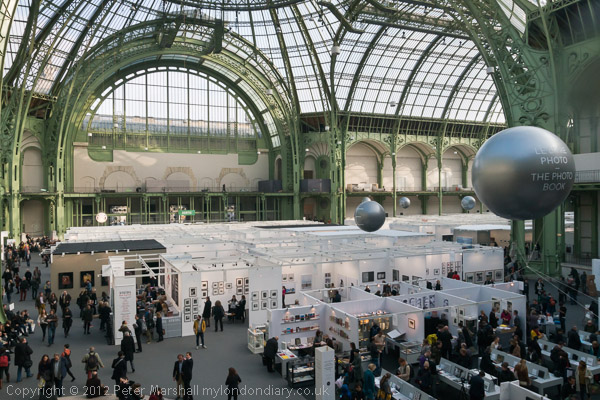
On the Paris1914 site there are a good selection of coloured images of Paris taken between the introduction of the process and 1939, including some taken by  Léon Gimpel (1878-1948),  a well-known amateur photographer of the era whose work was celebrated in a show at the Musée d’Orsay in 2008. One of his pictures is of an exhibition in the Grand Palais in 1909, which perhaps looks a little more interesting than Paris Photo at the same location 103 years later.

© 2012, Peter Marshall
The Grand Palais in 2012 – with smaller balloons

The quality of the results is quite variable – one of my favourite images, ‘Une famille, rue du Pot-de-Fer, Paris, 24 juin 1914′ by Stéphane Passet, could almost have been taken using modern materials, while some of the others are extremely crude.

You can see more about the Albert Kahn collection – which included these among around 70,000 autochromes – in a presentation about La Mongolie, entre deux ères, 1912-1913, about the current show (until 31 march 2013) at the musée Albert-Kahn in Boulogne-Billancourt on the edge of Paris.

You can also see a more varied selection of work on an official French government site, Autochromes Lumière, a superbly detailed site full of historical information and of course images. I really can’t imagine anything similar being produced here. There is also more about Gimpel and other photographers who used the process on this site.

Perhaps if the UK had a real Arts Council rather than a Opera Council with crumbs for the rest we might get sites like this dealing with aspects of photography?

Murder & Masterclass

I’m sometimes a little sceptical about ‘masterclasses’ and workshops, not least because I’ve myself taught a few over the years. While many seem worthwhile and some seem to offer very good value for money, others seem to be merely money-making exercises, charging high fees for the privilege of being taught by someone who has little idea how to teach and only a fairly basic grasp of the subject in which they are supposedly a master.

I’ve attended a few over the years too and they have varied immensely in quality, from disappointing to highly inspiring. I’m sure I wouldn’t be writing this now if in the 1970s I hadn’t made a trip to Derbyshire for a workshop with Paul Hill and Raymond Moore, something I’ve written about on various occasions, including in Darbis Murmury. It was so good I went back several times for more.

One that I’m sure was very worthwhile – and you can read about it from the point of view of a blogger who attended it – was last weekend’s Guardian Masterclass run by Antonio Olmos. At the bottom of sarasiobhan’s short piece is a list of ten ‘top things she learnt‘ at the class, which she is very complimentary about.  Apart from the ‘(use a 50mm fixed lens)’ they are all good sense – really a 50mm makes it hard to get in close enough, and a 28mm or a 35mm is better. Since sarasiobhan already uses a Leica X1 – with a fixed 35mm equivalent lens – it seems in any case redundant advice so far as she is concerned.

I wrote about Olmos before when he gave a talk to Photo-Forum in 2010, and he has produced some great work you can see on his web site, as well as regularly in  The Guardian where you can also read his advice on street photography.

I’ve been meaning for some time to mention his ongoing series The Landscape of Murder and the features on his blog (subtitled with typical self-depreciation ‘Ramblings of a mad visual mind’) are always worth reading. He has a separate blog devoted to his Landscape of Murder project which is perhaps the best way to approach this work.

In my post on his 2010 talk I wrote:

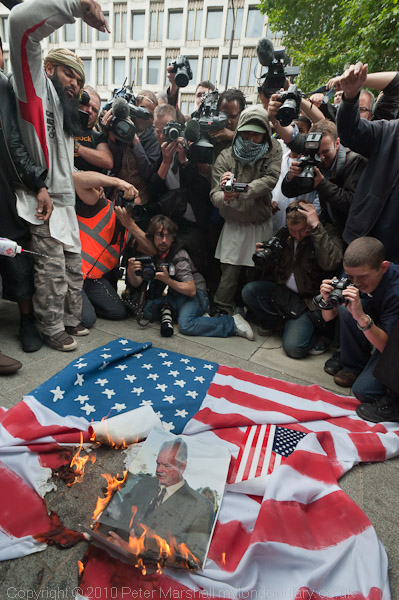
Olmos also passed on a great bit of advice he himself received, that if you find yourself surrounded by photographers when taking pictures, you are almost certainly in the wrong place.

and a week or so later I thought of his comment again when I was taking this picture:

© 2010, Peter Marshall
US Flag, photo of pastor Terry Jones, lighter fuel, US Embassy & Press, Peter Marshall

and wrote about it in another post, Flag Burning, Photography & Politics. It’s something we very much agree on (and readers may notice that I have often passed on this advice), and his work is distinguished by his thinking about his subjects and finding different ways to approach them.

Should We Ask?

The NPR ‘the picture show’ has an interesting story What It Feels Like To Be Photographed In A Moment Of Grief about a photograph of a woman praying in front of a candle and statue of the Virgin Mary outside the St. Rose of Lima church in Newtown, Conn., on the day of the school shootings there, taken by AFP photographer Emmanuel Dunand.

The woman contacted NPR after they ran the picture, identified herself and wrote that although it was a beautiful image and she wasn’t asking for it to be taken down, she “would like to make a point about responsible journalism, it would have been nice if someone could have asked my permission.”

The photographer’s response was that he thought that in the situation, leaving her alone was the most respectful thing to do. I’m fairly convinced that in the circumstances I would have come to the same decision.

There are I think several things that are not really brought out in the short feature or really in the 140 comments people had made on it by the time I read it, and also it connects with something I was thinking about writing about a small incident when I was taking pictures last Saturday.

There is a sense that the picture in question is not really a picture of a particular woman, who is hardly recognisable in the image, her face largely covered by hair and her hands far more important in the image. This is a picture which gains from being generic, from expressing the feelings of many rather than being an image of a particular person.

The NPR talked to Kenny Irby of The Poynter Institute, who gave what I think was a very confusing answer about the two benefits of photographers introducing themselves and interacting with their subjects. It showed a complete failure to understand the difference between news and features, perhaps surprising coming from a leading journalism school. It isn’t as Kenny Irby says ‘unfortunate‘ that the AFP does not have a policy requiring photographers to ask for subject’s names when they are photographed in public places, it is very much at the foundation of news photography.

The woman in the picture is quoted as saying “all of a sudden I hear ‘clickclickclickclickclick’ all over the place. And there are people in the bushes, all around me, and they are photographing me, and now I’m pissed. I felt like a zoo animal.” I don’t know how accurate a description that was, but it shows that there were many other photographers as well as Dunand involved, and it obviously can be very disturbing and intimidating to be surrounded in this way. But this was a very public event, in a place ‘packed with local residents and the media’ and the attention she got was inevitable. Hers was a private grief but she was expressing it in a very public place and in a way that was certain to attract attention.

Her final sentence in the quote was perhaps unfortunate. Zoo animals often come to welcome visitors and generally don’t have strong feelings against being photographed, often playing up for the camera. It’s one reason why I don’t much like zoos and have seldom photographed in them. And though I don’t mean to suggest that she was acting for the camera, many people – even in distressing situations – do so.  As of course many people including Susan Sontag have pointed out.

News photography is sometimes tough. I’ve at times photographed through tears and I think all good photographers ever who photograph difficult events will have too. But like Dunand who commented “all you want to do is put down flowers, you don’t want to take photos” we have a job to do. He is also reported as saying that ‘if he sensed that someone was bothered by the camera, he simply put it down’ and I think most professionals would do the same. But of course it may well not have been the click of his camera that disturbed.

There are many times when I start taking a picture on my own and find myself surrounded by a crowd.  I don’t like working with a pack of other journalists, and when I feel the shoulders pressing against mine I always know I’m in the wrong place – and after I’ve taken my picture try to move away. Many events now we have far too many people with cameras trying to photograph, and those who generally behave the worst towards both the subjects and other photographers are generally not the professional photographers present.

© 2013, Peter Marshall
A photocall -which I often avoid – but people often want

But there are times when I think it is right to ask and I do. One happened last Saturday, when I was photographing the start of the large march to save the hospital in Lewisham, one of the most successful, well-run and needed in the country, threatened simply because other hospitals have huge debts arising from the policy of a former government – the private finance initiative. Closing Lewisham wouldn’t even do much – if anything – to solve the financial problem and it is more of a human sacrifice demanded by the current government -both metaphorically and literally, as its closure would lead to excess deaths among the sick and injured in the area.

© 2013, Peter Marshall
People waiting for the march to start – of course I didn’t ask

I was photographing one of the local MPs and some of the senior hospital staff at the front of the march when one of the march stewards asked me if I had seen a family taking part with a young child in a pram who was on a drip. It would he said, make a good picture. The family were on the pavement only a couple of yards from the head of the protest in a very public place, and it would have been possible to photograph them without asking, but I felt that it would be unduly intrusive to do so – I needed to get very close. I went up to them and asked. They said no. I didn’t take the picture, though I think it might have been an image that would have dramatised the protest and perhaps made some front pages.

© 2013, Peter Marshall
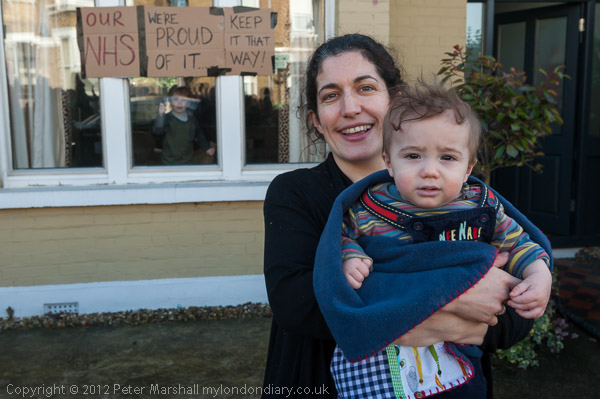
This woman and children were watching the protest – and I asked permission

Of course I did take many other pictures. There were only two others where I felt I needed to ask permission, both involving people not actually taking part in the protest. One had no problems, and in the other one of the two people ran away while the other was happy to be photographed. Of course I did talk to many other people while I was taking their pictures – particularly to the parents of the children I photographed, but it wasn’t a matter of asking permission – this was a situation where permission could be assumed and almost everyone was pleased to be photographed (and some demanded it!)

© 2013, Peter Marshall
I talked to the people while taking pictures – but permission was implied.

More of my pictures and story at Save Lewisham Hospital.

________________________________________________________

My London Diary : Buildings of London : River Lea/Lee Valley : London’s Industrial Heritage

All photographs on this and my other sites, unless otherwise stated are by Peter Marshall and are available for reproduction or can be bought as prints.

To order prints or reproduce images

________________________________________________________

Tony Ray-Jones – Pepys

Until I read a three part article on the Pepys Estate at Deptford published in ‘The London Column‘ I wasn’t aware that the work which Tony Ray-Jones took for the Architectural review was now in the RIBA photographic library.

© 2013, Peter Marshall
Pepys Estate, 1982. Peter Marshall

The first of three posts on the Pepys Estate, Deptford links to BBC archive footage of a remarkable programme first broadcast in 1969, Bird’s Eye View – The Englishman’s Home – shot mainly from a helicopter with commentary by John Betjeman who refused to fly, but worked with the footage as it was edited. Rather slow-moving by modern standards, though Betjeman is always a pleasure to listen to, unless you have a strong stomach for the sentimental and picturesque you might like to skip the first thirty-something minutes where inevitably it lingers far too long over many stately homes, and omits the true history of misery, repression and exploitation behind their architectural splendour.  Ground-breaking it claims to be for its aerial perspective, but the approach is comfortable and conservative in its politics.

© 2013, Peter Marshall
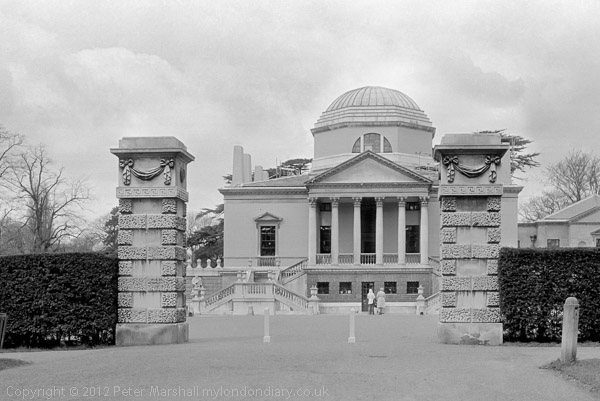
Chiswick House, 1977. Peter Marshall

After a brief trip to fairy-tale Wales at around 30 minutes the programme shifts first to Chiswick House in Betjemans beloved Middlesex, before moving to truly urban housing in Bath “in the crater of an extinct volcano” and then Clifton in Bristol, built when it was the second city of England (built on the unmentioned slave trade) then on to Brighton, our best-looking seaside town. The helicopter (and commentary) concentrate on the Georgian terraces of the 1830s before zooming down to the Pavillion.

Next come a couple of ‘model’ villages built on some of the huge estates – including the single house left in the old village at Chatsworth that had spoiled his Lordships view and Edensor built up the hill for his tenants: “I can’t see why this sort of thing is any more inhuman than what a council does today“. I can.

Then its comfortable North Oxford and swimming pool suburbs, “the sort of house that everybody wants, an acre and a garden and no cow“. Finally at 39 minutes we get to Port Sunlight “a protest against northern back to backs” (which don’t get shown), and on to Peacehaven. Betjeman comments on the snootiness about this cliff-top development, but his defence of it seems to be based more on a wish to stand out from the architectural crowd than any real knowledge of the place – to which two of my aunts moved to die around the time the programme was made.

At 42 minutes comes Harlow New Town (“do you think this is the way we ought to live and do as we are told)” and on to a new Lyons estate at New Ash Green in greenfield Kent, then at 44 minutes, Docklands and high rise, with brief glimpses of the Royal Docks and Roehampton. The programme ends with the Pepys estate: “But where can be the heart that sends a family to the 20th floor of such a slab as this … .caged halfway up the sky… what is housing if it’s not a home” and the wide cleared site for Thamesmead with a its early blocks under contsctuction – “how human will it be?” asks Betjeman.

The image by Tony Ray-Jones, ‘Pepys Estate, Deptford, 1970‘ brings us back very much into the real world of a group of young kids playing on the estate, as does the text by Owen Hatherley and the further picture by Ray-Jones on part two of the series. In part three. Robert Elwall writes about the work commissioned by Hubert de Cronin Hastings, owner of the Architectural Press and editor of its leading journal, the Architectural Review from Ray-Jones and some other leading photographers in a series entitled ‘Manplan‘ which ran 8 themed monthly issues from September 1969 to September 1970 and its place in the history of architectural photography. Ray-Jones’ contribution was in the last of these,  ‘Manplan 8: Housing‘ and perhaps the final straw; it was an experiment too much for many of the magazine’s subscribers and had to be abandoned.

© 2013, Peter Marshall
Waterloo, 1980. Peter Marshall

Searching in the RIBA Photo Library using the term ‘Ray-Jones’ returns 167 images by him (rather more than the 138 mentioned on The London Column), from the Pepys Estate, from Lillington Gardens in Pimlico, from Haringey, Thamesmead, the Old Kent Rd, Blackheath, Battersea, Southwark, Crawley and New Ash Green and elsewhere and includes architect designed small houses as well as council estates.

The most interesting pictures to me are those of children playing around the estates at Thamesmead and Hammersmith and particularly in the Pepys Estate at Deptford, which appears to have occupied him more than the other sites. Some of the work seems straightforward architectural work – and at times similar to images I and many others have taken of similar subjects (and frankly there are a few that are a little boring), but the work comes alive once he found people to include in the picture – and there are a few where there is no visible architecture.

© 2013, Peter Marshall
Violet Villa 1896, Putney, 1982. Peter Marshall

But his purely architectural work – like much of that genre – often leaves me cold. Too often the pictures are of idealised structures, everything clean and tidy, with the emphasis on new buildings, pristine and unlived in. I suspect like me, Ray-Jones was truly more interested in the lived in, buildings that have developed a character through use – and abuse. Too often architectural photographs look like pictures of models rather than the real world, and although I’ve spent a lot of time photographing buildings, I’ve never called myself an architectural photographer.

I’ve written here before on some of the issues over housing, and in particular the privatisation of estates such as the Pepys Estate, and it was good to read Owen Hatherly’s piece. You can read some of my own thoughts in Views of Deptford and on posts about the Carpenters Estate (Around the Olympics) in Stratford and the Heygate Estate (Southwark’s Shame) at the Elephant.

The three pictures illustrating this piece are from my own archive, and include some which will appear in the books I’m currently working on from my pictures of London in 1970-85.

________________________________________________________

My London Diary : Buildings of London : River Lea/Lee Valley : London’s Industrial Heritage

All photographs on this and my other sites, unless otherwise stated are by Peter Marshall and are available for reproduction or can be bought as prints.

To order prints or reproduce images

________________________________________________________

Grey Day, Golden Dawn


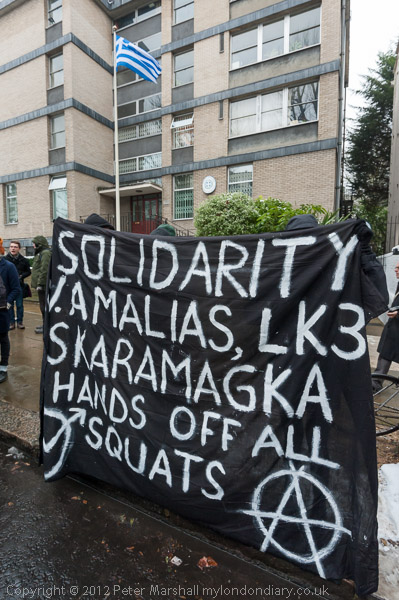
It’s hard to know why the Greeks should have such an ugly embassy in London, backing on to Holland Park, and in a street (also called Holland Park) otherwise full of rather nice Victorian detached villas from the 1860s. I wonder if embassies are somehow exempt from planning laws, not that these generally concern themselves much with aesthetics.

I’d come to photograph the five hundred or so who had answered the call from Unite Against Fascism (UAF) to show their solidarity with the people of Athens, several thousands of whom were marching in their city at the same time in a protest against racist violence, with the fascist Golden Dawn (GD)  party being implicated in many of the attacks. Although GD claims not to be fascist, many of its members have been shown giving Nazi salutes and it has published materials praising Hitler, Hess and others and one of its MPs has a ‘Sieg Heil’ tattoo. In earlier years the party made no pretences and decorated its party congress with swastikas and other Nazi symbols. More recently, its party magazine praised Hitler as a “great social reformer and military genius”  and it ran in the elections with the anti-immigrant slogan “So we can rid this land of filth“.

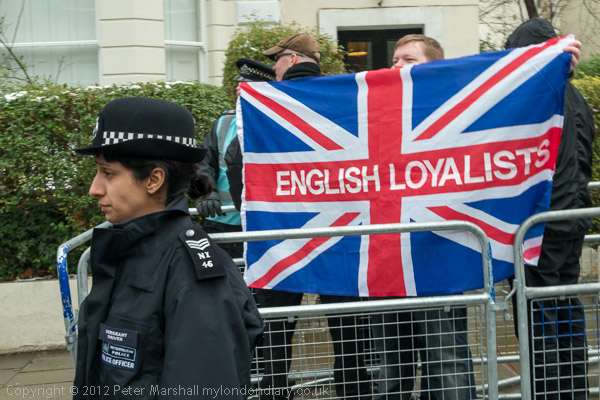
What I hadn’t expected was that police would allow a small counter-protest organised by a group calling itself the ‘British Friends of Golden Dawn’ just a few yards from the main protest at the embassy. They looked just like the EDL – and several of them recognised me from when I’ve photographed their protests.

© 2013, Peter Marshall

It is hard to to understand the thinking of protesting in support of a pro-Hitler group like Golden Dawn while holding up the Union Flag, the flag of a country which was one of the leaders in the fight against Hitler. You can’t really be an ‘English Loyalist’ and support the fascists.

I’d dressed up well but it still felt cold, round about freezing. Before the protest I’d walked through the snow-covered Holland Park, dotted with large snowmen. I didn’t stop to photograph them, I’d already seen far too many snow pictures.

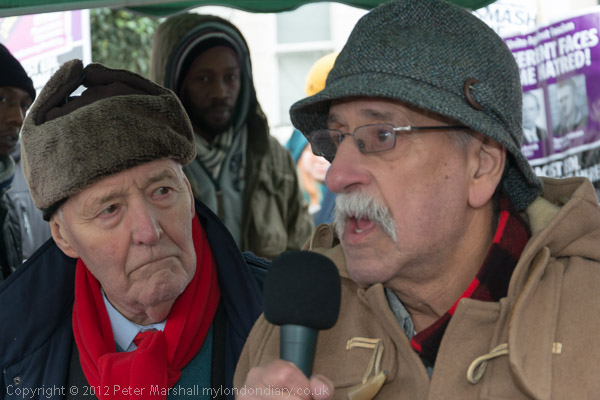
The UAF protest attracted many leading figures on the left, including Tony Benn, who looked well but spoke only briefly, leaving others to make the real speeches. One of the others was Gerry Gable, editor of Searchlight, who I don’t recall ever having met before, though the EDL have accused me of working for him. I’ve never given Searchlight pictures and so far as I’m aware they have never used anything of mine, so I was surprised when one of the Golden Dawn supporters shouted out at me for being a “Searchlight photographer.” I’ve nothing against Searchlight, but it has never happened. It is just a part of a right-wing myth that sees all journalists as in the pay (some hope) of sinister left-wing conspiracies, when in fact most of us are struggling to make a living from a largely right-wing press.

© 2013, Peter Marshall

Weyman Bennett of UAF came to look at the counter-protest and shouted back rather jovially at their insults, doubtless heartened at their pathetic performance. Soon the police appeared to tell them it was time to leave, and having arranged transport to the protest for them led them away to the nearby underground station, along with a few anarchists shouting insults. I took a few pictures with the 70-300mm as they walked away, but couldn’t be bothered to run to get closer.

© 2013, Peter Marshall

There really was very little light all day, with heavily overcast skies. I’d been using flash to photograph the speakers, who were under a gazebo, and had set ISO800 for that, wanting a fairly wide aperture with theD800E on ‘S’ and working at around 1/60s, using the 18-105mm, a decent portrait lens at its longer settings. But when I switched to the longer zoom without flash I forgot to increase the ISO, and few of the pictures are really sharp. Working without flash on the D700 I was using a higher ISO and had no problems.

More pictures at Anti-fascist Solidarity Against Golden Dawn.

________________________________________________________

My London Diary : Buildings of London : River Lea/Lee Valley : London’s Industrial Heritage

All photographs on this and my other sites, unless otherwise stated are by Peter Marshall and are available for reproduction or can be bought as prints.

To order prints or reproduce images

________________________________________________________

Richmond in the 70s

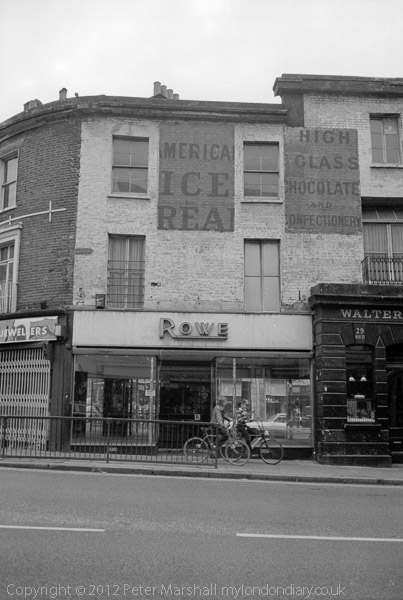
Sorting out the hundreds of my images from the 1970s that I’ve thought worth scanning I came across this one, not a great picture – which is perhaps why I couldn’t remember where I had taken it. I looked out the contact sheet to find little help. There were a series of half a dozen frames of this and adjoining scenes, but nothing obviously to indicate where I had been when I took them. The frames to one side were recognisably from the Shell Centre at Waterloo, and those after this were from close to my home, but there were no clues as to this location.

© 2013, Peter Marshall

The pictures seemed fairly carelessly framed (this may have been deliberate) and the only information I’d written on the contract was that they had been made with one of the several little Minox 35mm cameras I used to carry in a pocket all the time (I punched the filing hole through the model letters.) Hardly large enough to fit in a 35mm cassette, with a lens that folded into the body when not in use, these had a 35mm f2.8 lens that was every bit as good as the best SLR lenses. Or at least could be, as the first one I bought I had to fight with Leitz, the importers, to get changed as it was decidedly unsharp – at first I got back a rather sniffy letter from them pointing out that there were no performance standards for Minox products, but after I insisted they did replace it. It was a tough plastic clamshell design, but did break when it went flying out of my pocket as I ran down the street one day – and my insurance company perhaps surprisingly paid for the replacement. When that eventually broke down, Leitz apologised that they could no longer repair that model and offered me the latest version at around half price. So altogether I owned at least four of them over the years.

As well as being compact, it was also virtually silent, and great for photographing inconspicuously, although its automatic exposure was not always too reliable, and as with other very small cameras it was easy to get your fingers in front of the sensor – or the camera lens – when cradling the camera in you hand. The manual film wind also sometimes took rather a hefty effort with my thumb, which occasionally became rather painful.

Small cameras then didn’t necessarily mean worse results – those with good lenses could do just as well as larger beasts that took the same 35mm film and made images the same size – unlike with small sensor digital compacts.

I tried a few searches on Google using the shop names I could read on this and the other thumbnails I was looking at with some likely places and drew a blank, but once I looked at the scan at more or less full size I found the picture had a vital clue. Under the large 29 above one window the tiny bit of text I had thought to be decoration was actually the rest of its very short address, Hill St. Googling that suggested Mayfair, which it clearly wasn’t, but a quick search on my on-line A-Z found just two more Hill Streets in the Greater London area, in Richmond or St Albans.

I’d not visited St Albans in 1979 when the picture was taken, so it had to be Richmond, and it was good to be able to confirm this at the web site of the LB of Richmond and Twickenham, which has online a detailed  walk down Hill St, and I was soon looking at a picture of 29 Hill St taken in 1900, then the premises of Mr J.H. Jarvis, but clearly the same place at that on the right of my image.

© 2013, Peter Marshall

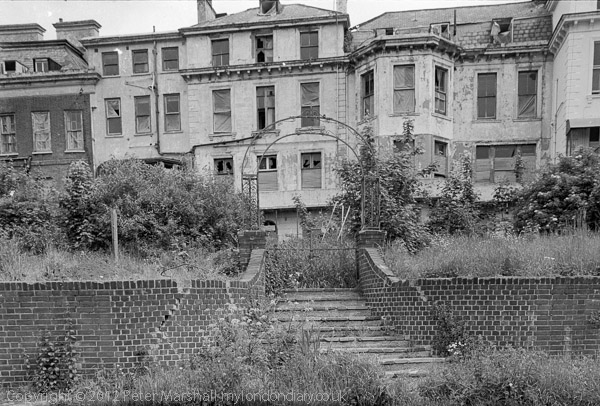
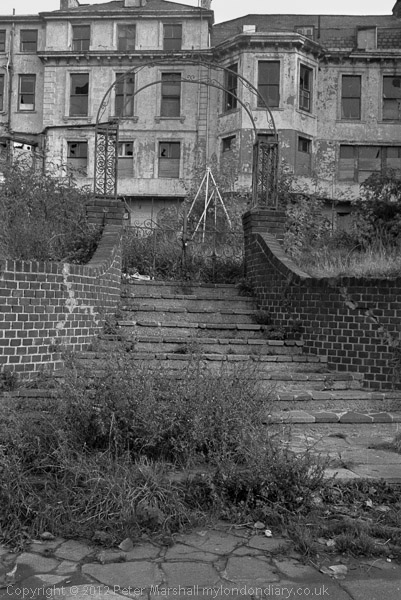
Around the corner are some much more recognisable properties next to the bridge which I’ve photographed on several occasions, and facing the river were the backs of some properties including a couple of listed buildings. I used to visit the area quite often at night some years earlier than my photograph, nursing a pint of bitter for an evening in my student years as I listened to the likes of Bobby Wellins playing in the old Palm Court Hotel. I wasn’t taking pictures then – I couldn’t afford to, as photography then was an expensive business – but later I took a few pictures of the exterior before the controversial redevelopment by Quinlan Terry in 1984 which rebuilt the Grade II listed façade but lost the atmosphere.

© 2013, Peter Marshall

The vertical image was taken in autumn 1979, probably with a Leica and the horizontal in May 1981, on an Olympus OM1. Little had changed though perhaps the weeds had grown a little.