Ridgers on Slate

It’s great to see an old friend of mine getting some of the recognition he deserves and the article on the US Slate magazine Portraits of the London Punk Movement of the 1970s and ’80s by Sophie Butcher, published yesterday when Derek Ridgers was signing copies of his latest book at a New York book shop, has some large images of his work.

In the piece Derek says “I’ve documented clubs for five decades. I’ve got a 240-page book in the making (about that period titled The Dark Carnival). You could say I don’t need any more photos, so I’ll stop when I get a publisher for the next book”. Though I’m not sure I believe him about stopping.

He has amassed a huge body of work over the years – and as he says the two books so far cover less than 2% of what he took in that period. In a Facebook comment he says “I’m still scanning stuff from that time and, who knows, there may be more books.”

Picket Line Dance

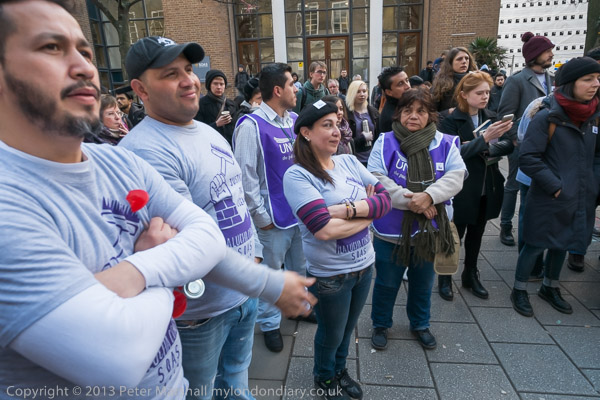
I’d really gone up to London not just to photograph the City pancake event and meet up with a couple of other photographers but to visit SOAS where the cleaners were on the first day of a two day strike to gain equal treatment to other staff working there.  The picket line had formed at 4 am and apparently by 6 am, the normal shift start time, almost the full normal morning shift were there taking part.

It’s too far from where I live to get there for the early morning – I’d have to stay up in London overnight to cover events that early, so instead I went to the lunchtime rally that they were organising.

I left the pancake race  early, arranged to meet my friends in a couple of hours time in a pub in Holborn and got to SOAS just as the rally was about to start.  The cleaners at SOAS belong to Unison, and the SOAS branch has there has actively pursued their fight first for a living wage and now to be brought back in-house and to get decent pensions, holidays and sick pay – with the slogan ‘One Workplace, One Workforce’.

The cleaners at many other places have not  been supported by the traditional unions and have chosen to leave these and form their own union, the IWGB, and some IWGB members were there in support of the SOAS campaign. The two groups have have worked together with others in the ‘3Cosas’ campaign in the University of London for proper conditions of employment (a campaign which the Senate House Unison branch seem to have worked with the management to try and subvert, as well as apparently fiddling branch elections to prevent cleaners being elected.)

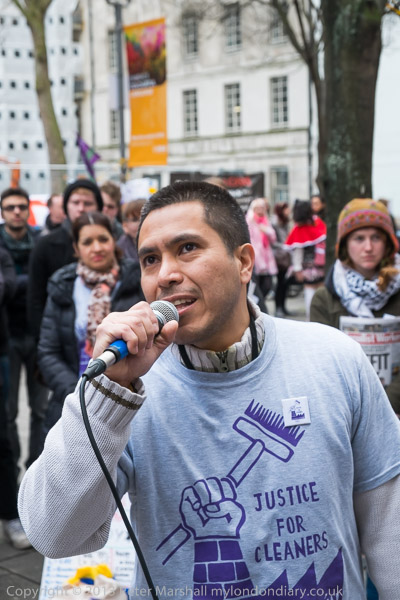
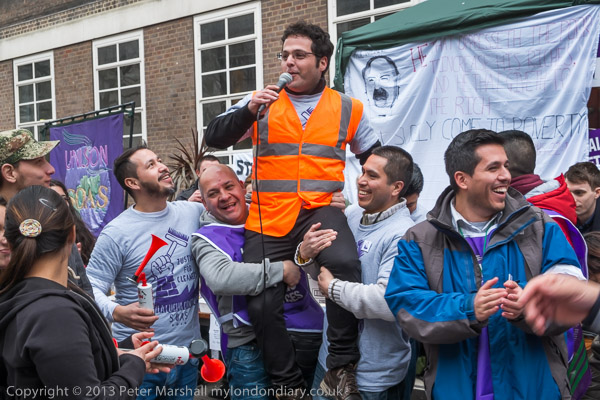
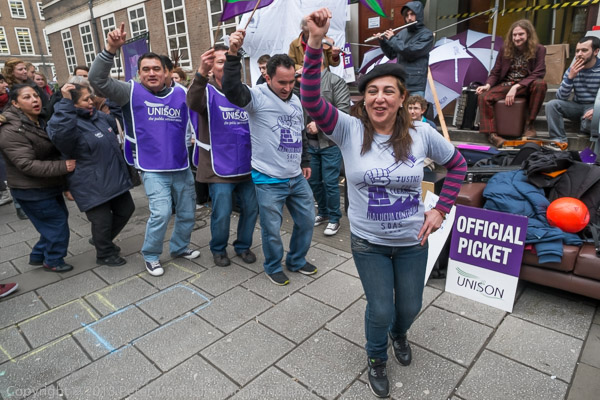
Of course at a rally you photograph the speakers and the people listening, looking for ways to connect both with the event – easy in this case because so many were wearing ‘Justice for Cleaners’ t-shirts or Unison tabards or holding posters. There were some large banners too, though not always easy to photograph – it was quite hard to see the red text on the one in the picture below, and harder still in photographs.

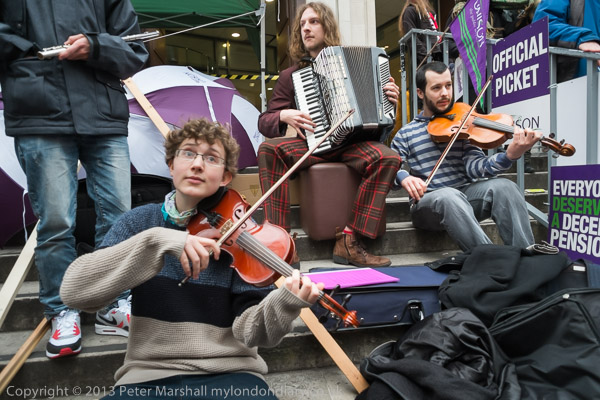
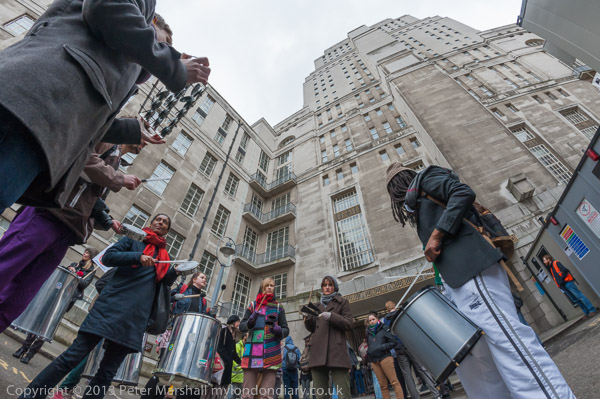
But perhaps what you don’t expect to find on a picket line is a band (or perhaps I should call it an orchestra) playing Latin American music and people dancing.

And it was the people dancing who created problems for the Fuji X-Pro1, with well over half the images showing them slightly out of focus. The 14mm focuses pretty rapidly most of the time – fast enough for the delay to be hardly noticeable for static subjects – but was totally unable to keep up with dancers at close distances.

The really stupid thing was that I did not need to focus at all. Back in the old days working with the equivalent 21mm on a range-finder body, I’d simply have set the focus at my usual 1.8 metres and with a aperture of say f8 and everything would have been sharp. We called it zone focus – depth of field on 35mm meant anything more that around 3 ft away was sharp (they ‘hyperfocal’ distance was around 1.8 metres at f8, and could easily be set from the nice depth of field scales all decent lenses had.)

It’s a habit I’ve got out of using cameras with fast autofocus, and also slightly less useful. Using manual focus on the Nikons isn’t always easy, as the viewing screen isn’t really designed to make it easy to judge sharpness, and with zoom lenses the depth of field scales if present are only rudimentary.  Lenses too are designed with a different ‘feel’ to the distance ring; in the old days although they moved smoothly a little more effort was required to start them, while with most modern lenses the slightest accidental touch may shift focus. When I set the lens at 1.8m in the old days, it would still be at 1.8m until I deliberately moved it to a different distance, but most lenses just work like this now.

With the 14mm at f8, the hyperfocal distance is  1.24 m, and setting the lens around that distance would have meant everything from 0.62m (2 feet) to infinity would be acceptably sharp.  I’d probably have chosen to focus a just little closer as I didn’t need the background sharp. Adjust the ISO to give a sensible shutter speed and everything would have been fine. I felt very stupid when I saw the images on the computer (most looked sharp enough on the back of the camera while I was making them.)

The 14mm is a very nicely built lens, and it does have a depth of field scale, although it is rather more conservative than the figures I give above (the actual figures depend on an assumption about how sharp things need to be to seem sharp – the value of the ‘circle of confusion’.)  Optically too, it is virtually perfect. But I’d like just a bit more feel on the focus ring.

All equipment has its limitations, and automation isn’t always the best answer.  I got enough pictures with the Fujis, but its always annoying to lose things, and as usual it was some of the best that were not usable.

On the plus side, I really appreciated having a much lighter bag –  with the much of the weight being essentials like a book to read on the train and a bottle of water. Two Fuji bodies and three lenses – including the Samyang 8mm which I used in the pub later – hardly seemed to weigh anything. Even with neck straps and the several spare batteries you need to carry the whole kit weighed only just over 4lbs.

More pictures at SOAS Cleaners Picket Line.

Continue reading Picket Line Dance

City Pancakes

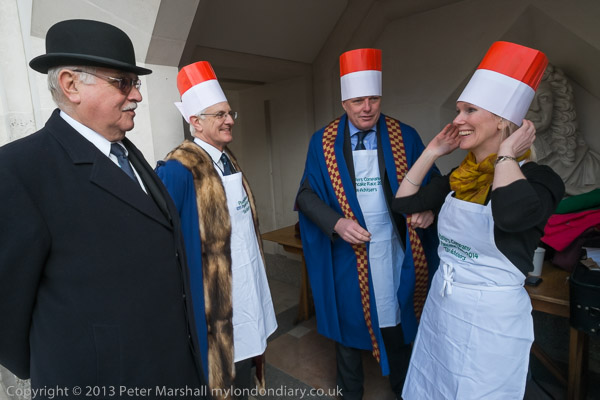
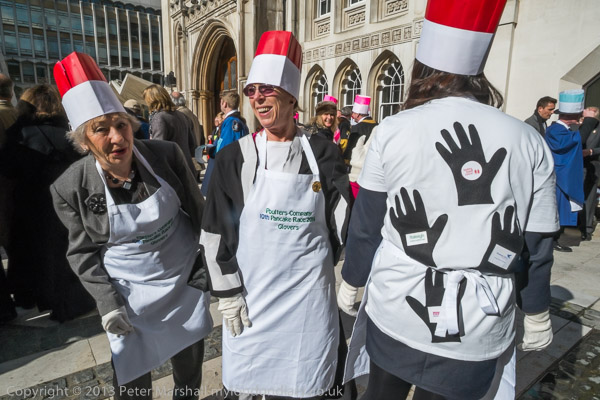
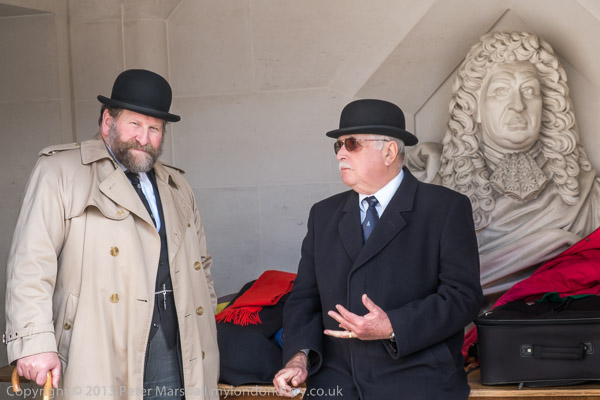
I only really went to the City of London Pancake Races this year to meet up with other photographers. It’s an event I’ve photographed a number of times in previous years and I don’t really feel I had anything new to say about it.  It does have a certain surreal quality that I find amusing, and those taking part also obviously find it a day to at least metaphorically let down their hair a little, though this doesn’t stop the competition being rather cut-throat – as one might expect from the City.

It is of course all in a good cause, or rather good causes, with monies raised going to the four charities chosen by this years Lord Mayor – who this year was for the second time in the City’s history a woman, Fiona Woolf, a lawyer specialising in electricity industry reforms.  Beating Bowel Cancer, the Princess Alice Hospice, Raleigh International and Working Chance perhaps were rather harder to interpret for the fancy dress competition than some in previous years.

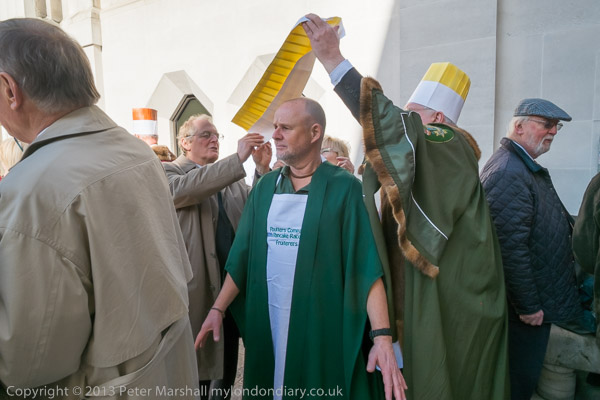
There was a small series of images of one of those taking part having his hat put on that had the quality of some ancient crowning ritual that rather amused me – this is the first of four on the web page. It’s partly those hands stretched down, but the robes give it something of a masonic or even druidic feel.

One of the photographers I had gone there to meet was John Benton-Harris, and it was an event that reminded me of his work from his early years in this country in the late 60s and 70s, a series of ‘Mad Hatters’ which forms a part of his commentary on the English class system.

Also present and taking pictures was another well-known photographer, Martin Parr, currently working on a project in the City of London. I’d not expected to see him, and found on talking to him that this was the first time he had photographed the event. I’ll be interested to see what he made of it – and the rest of the City.

It was one of the first events I’d deliberately decided to photograph using Fuji X cameras, with the 14mm f2.8 Fuji lens on the X-Pro1 doing most of the work but with the 18-55mm on the EX1 body.

I didn’t attempt to photograph the actual races and the rest of the event is relatively static, and the 14mm (21mm equivalent) was great working in the sometimes quite restricted places in the crowd.  Although it is a relatively large lens, the camera is still pretty unobtrusive compared to the Nikon – especially with the huge 16-35mm f4 wide-angle. Had I brought the Nikon I might well have chosen to work with the 20mm f2.8 Nikon lens rather than the zoom on this occasion.

But the really important difference is in the noise. Working at close range in a generally fairly quiet event (except for the starter’s cannon and the shouts of support during the actual races) the Nikon’s shutter is unmissable, while the Fuji was a whisper by comparison – even I could hardly hear it. Far less obtrusive than a Leica!

City of London Pancake Races

Continue reading City Pancakes

Against Corrupt Government


In front of the Ecuadorian Embassy

It was a protest against “the corrupt systems governing the world, bankers and the military-industrial complex” in the tradition established by the Occupy Movement, and it was hard not to sympathise which much of what people at it said. I used to think that although our government was corrupt it was at least less corrupt that most of the rest, but under the present coalition I’m rather less sure of that.

I remember back on the morning when the story about UK Members of Parliament expenses broke in May 2009 with the leak being published in the Daily Telegraph that really this was an unimportant story.  And although it seemed to occupy most of the papers for the next year or two it still seems to me pretty trivial compared to the other scandals the press should be investigating and reporting. But it’s easier to write about duck houses than dig the real dirt.  And today some of the papers are wasting space about claims for spectacles for staff who use computer screens, and suggesting that £354 is a ridiculous amount of money for the taxpayer to fork out.

A little research would have told the reporters concerned that if – like my wife – you have a complex prescription, the lenses are expensive and need special frames. The amount they were getting worked up about it is about what her last pair cost. Mine cost about half that, but still rather more than the papers seem think a pair of glasses should cost, though I usually choose around the cheapest frames my optician has on offer.


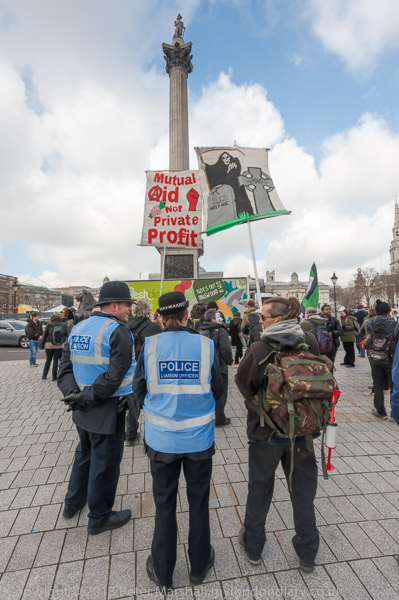
‘Mutual Aid not Private Profit’ and ‘RIP Welfare’ banners on poles

But given that Parliament is spending (and at times wasting due to incompetence) billions of pounds getting worked up about a few hundred pounds makes no sense. The fuss about expenses is all simply a distraction from the real corruption and scandals in the system. Which occasionally we get to know a little about, generally not from the work of mainstream journalists but from leaks by whistle-blowers like Edward Snowden, from bloggers and particularly from Wikileaks.  The Occupy movement has done much to make clear the links between government and big business at all levels, and to at least sketch out that other ways of doing things are possible.

As you can see from the picture above, the event started at Trafalgar Square, with Nelson above and police below keeping an eye on events. Though I don’t think the police liaison officers were actually spying on the protesters who will almost certainly have  included at least a couple of plain clothes police whose job it is to keep in touch with such things, if not the odd undercover officer.

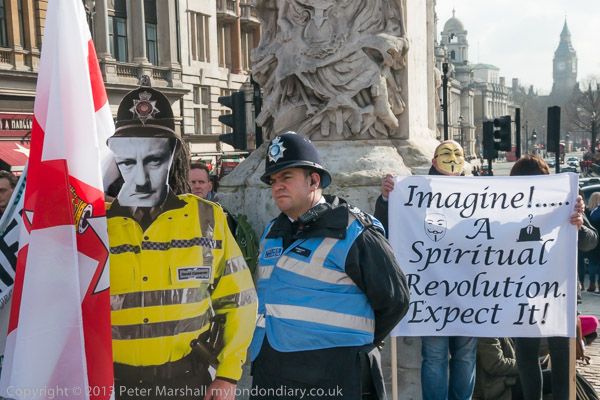
One protester actually came with a copper on his back (the face was rather familiar) and was carrying an Ulster flag. I talked to him after his conversation with one of the police and found he had come over from Northern Ireland to London for the protest.

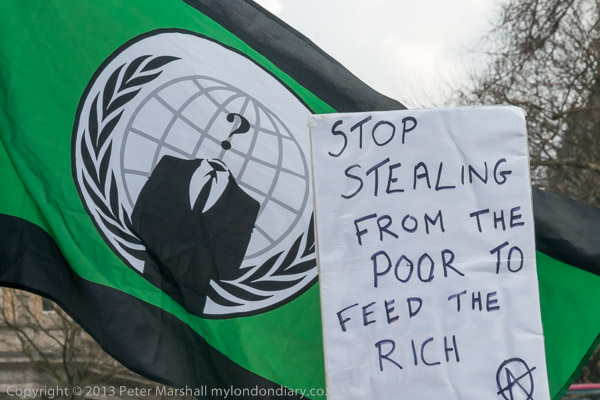
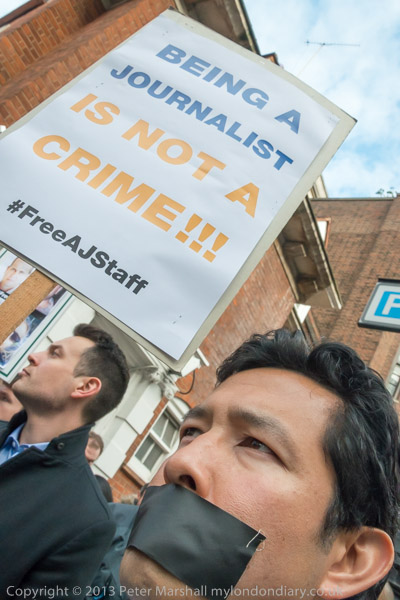
Taking pictures at an event like this isn’t just about making pictures, but also about conveying the message and of showing what the event was like. The two things don’t always go together and it annoys me to see the newspapers use images that make striking pictures but are superficial or only trivially about the event they were made at.  Of course the simplest way to connect images with the message is through words on placards or obvious symbols such as the Anonymous flag or mask.


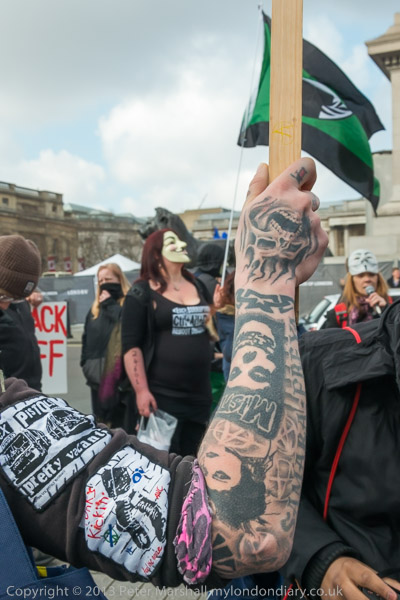
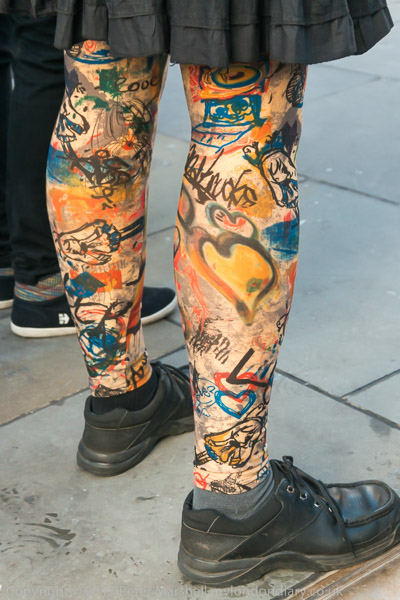
Misfit’ tattoo and Sex Pistols patch

In Against Worldwide Government Corruption you can see a series of pictures in which I am working hard to try to make a picture using the rather fine tattoo above. It proved to be difficult, as it was a moving subject, and the other elements I was working with were moving too – including a flag blowing in the wind which always tends to be frustrating. The main problem I had was with other people walking into the area in front of me to take pictures.

It would be so much easier to set things up, to direct a scene rather than photograph actual events, but this would be falsifying things. And it would not leave room for the magic of the unexpected which can be so much more exciting than a preconceived idea. But though I tried hard I don’t think it quite came off. Quite a few pictures that almost work, but I never got to one that really sprang out at me when I saw the result on screen.

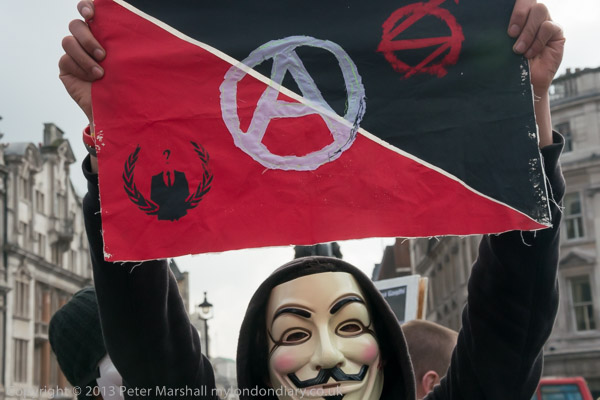
There was something of a happy accident about the image of an Anon holding an Anarchist Anon flag above his head. I took it with the 18-105mm on the D800E, where the DX lens gives a dark line frame to show the actual image area. Its something I rather like, though it makes the viewfinder image just a little small, but it is great when you want to frame precisely, giving the DSLR a similar (but much more accurate) facility to a Leica.

But here I was too hurried (perhaps because I was standing in a busy road in the way of traffic about at any moment to be given the green light to drive at me) and as I pressed the shutter realised I had framed using the whole visible image rather than the DX frameline.  I’d seen the top of the flag and the chin of the mask in the viewfinder but immediately realised they would not be in the picture. I took a second exposure putting these elements inside the frame as I’d meant to, but on seeing the two images decided it was better with them cut off.

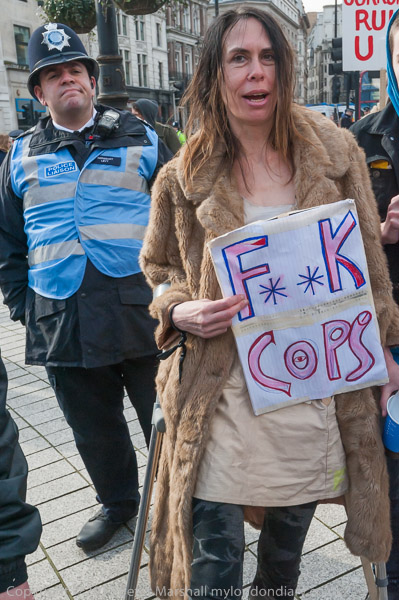
Another picture I took a couple of variations of – and they are both in My London Diary – was of a woman holding a poster with the message ‘F**k Cops’, with a police officer standing behind her.  It’s the contrast between the two figures, their expressions, body language and clothing – as well as the poster – that make this image work for me.

Taking pictures of some of the people and events I photograph, it is impossible sometimes to avoid bad language in pictures. Sometimes there are things that might offend people, although standards have rather changed. But I think few people now would object to seeing ‘F**k’ in an image, though they might find ‘F**k   Cops’ less acceptable. While 20 years ago I might have thought twice about sending the picture to an agency now it wouldn’t occur to me it might be a problem.

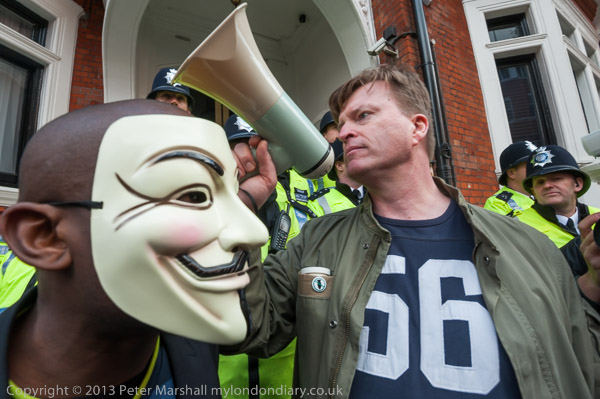
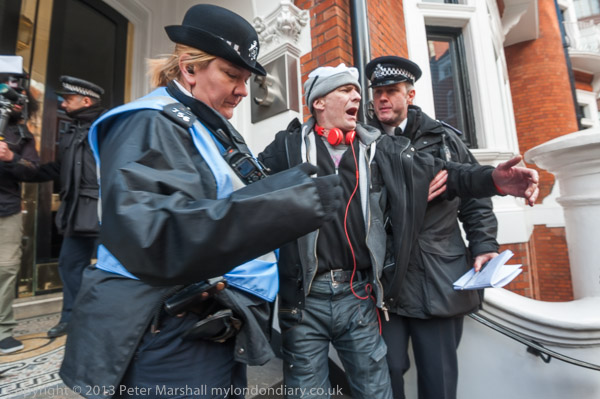
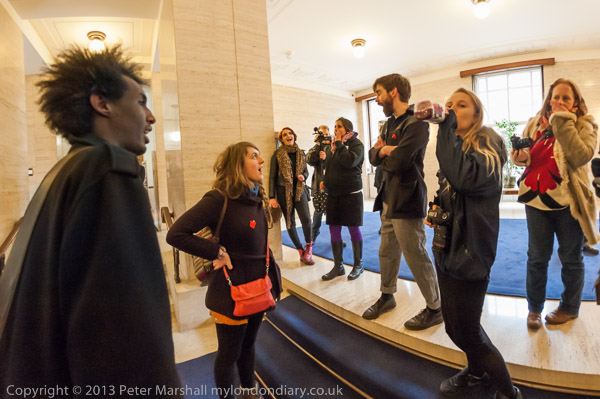
From Trafalgar Square the protesters moved on to the Ecuadorian Embassy, where Julian Assange has been holed up since June 2012. It was entirely predictable that they would make an attempt to enter the building, though the police and most other photographers were slow to realise this. So I was in a good position when it happened, though soon with photographers shoulder to shoulder on both sides, and unable to move or even change a lens. But I was in the right place and prepared for the picture at the top of this post, unexpected though it was.

More at Against Worldwide Government Corruption.

Continue reading Against Corrupt Government

Feb 2014 Complete

Well, I almost kept that resolution to keep things on My London Diary more or less up to date, but then really messed things up by forgetting about the last day of the month for a couple of weeks. In mitigation it has been a rather busy time for me, with a real ferment of protest as well as a few other things, and February itself was rather a mess.

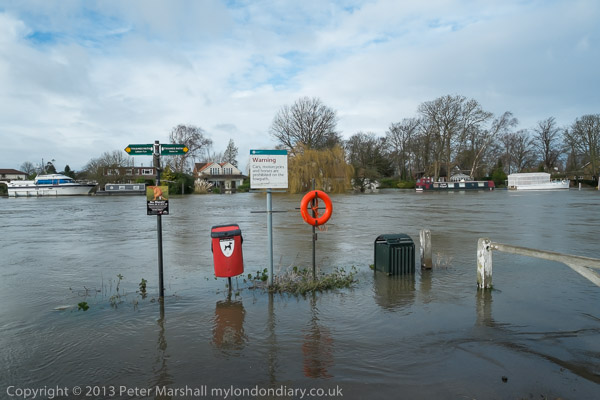
Not least that for 13 days we lived without any mains drainage in the house which caused a few problems and certainly made us appreciate how much we rely on such services. But we were lucky to avoid actual flooding and the water in our street didn’t come into our house. The river level here now is 1.91 metres – 6ft 3 and a bit inches – lower than at its peak. There are still places around where you can see the mud it has left behind – and clearing up is still going on and will be for months in homes that were flooded and at least one local basement is still having to be pumped out. February isn’t a month we will forget quickly around here, though I failed to take any memorable images of the floods.

Most of my work was as usual in the centre of London, still protected for the moment by the Thames Barrier from tidal flooding, and possibly by the lack of dredging in upstream areas like ours from flooding by the Thames. Getting on the train to London seemed often to be going to a different world where roads were not blocked and toilets still flushed.  Anyway, here is the complete list.

Feb 2014


G4S & Israeli Prison Torture

Students tell Vice Chancellor to Resign


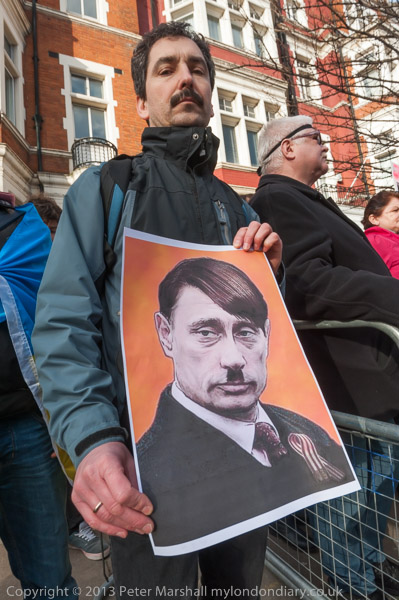
Ukrainians Protest, Celebrate and Mourn
Syrian Peace Protest at Russian Embassy
Focus E15 Mums at City Hall


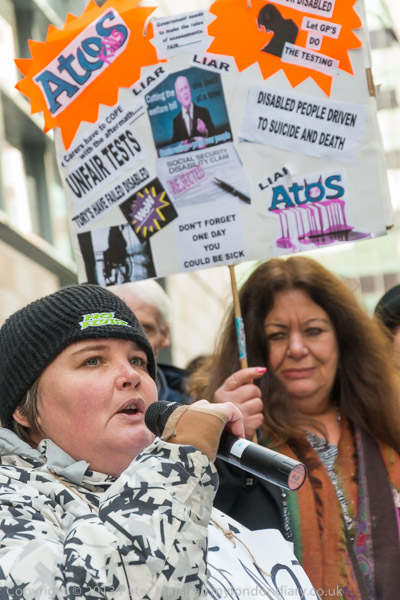
Atos National Day of Action


NUJ demands Egypt release jailed journalists
Free Margaretta D’Arcy picket
Solidarity vigil for Shawki Ahmed Omar


Reclaim Love Valentine Party
Anons 6th Anniversary at Scientology
Hungry for Justice For Fast Food Workers
‘Justice Demands the Truth’ Vigil
Charlie Chaplin Climate Chaos
One Billion Rising – End Violence Against Women
Central Staines Flooding
River Ash Floods
Flooding Hits Staines Again
Bellyhangers to keep Abortion Legal


Students protest Loans sell-off
Uphold LGBT Rights at Sochi
Willesden Wassail
Harlesden, Willesden & Mary Seacole


EDL supporters object to being photographed
EDL Saved by Police in Slough

Continue reading Feb 2014 Complete

Chalk and Protest

I was sure I’d finished posting my work for February on My London Dairy a couple of weeks ago, and was congratulating myself on being almost up to date. Then, a few days ago I found that although I’d published a few things from March, there were still a couple of things from the last day of the month, Feb 28, that I’d somehow neglected.


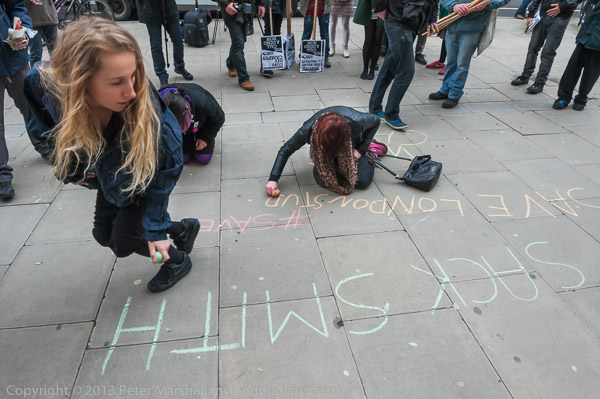
Students chalk on the pavement at the start of the student protest

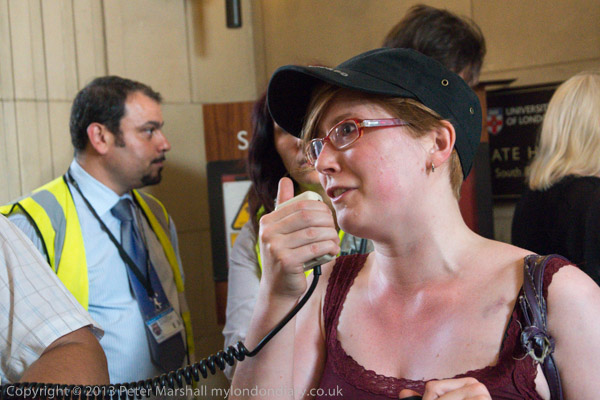
One has come back into the news – and even at last made the mainstream – in the past few days. Last July the woman speaking in the picture below was arrested for chalking slogans about the 3Cosas campaign cleaners’ struggle for decent pay and conditions across a foundation stone at the Senate House. I wasn’t there when Konstancja (Koshka) Duff did this, nor when she was arrested with unnecessary force later, and charged, following pressure from the University for her to be charged. In the picture I took the following day when she spoke at the 3Cosas protest at Senate House, signs of her beating by the police were clearly visible.


A bruised Koshka Duff speaks at the 3 Cosas protest she was promoting a day after her arrest

The caption I wrote in July was “They claimed chalk caused damage and was expensive to remove. I find a damp cloth works well“.

A couple of days before the protest at the end of February her case finally came to court. The police, having mistreated her on arrest adopted what appears to be their normal tactic of charging her with assaulting the police officer and special constable involved, but fortunately for her video and photographic evidence showed that the police accounts were not not consistent with events. The judge said that one had “exaggerated her evidence” and the other had clearly not been in a position to see what he had described in court, having been behind the van door, and dismissed that charge.

Of course there is no chance that the officer who assaulted her will ever be charged with that crime, despite many witnesses and video evidence, nor that either will be charged with perjury for lying under oath in court.

Although the university authorities now deny it, there can also be no doubt that the arrest and prosecution only occurred because of pressure from the University of London’s deputy director of property, Paul Nicholson-Lewis, who, according to police evidence at the trial was “very keen to press charges”.

Although the major charge of assaulting a police officer was thrown out, Koshka Duff was still treated very harshly by the court, with the judge in a highly curious ruling reported in London Student, rejecting Duff’s claim that she had chalked on the stone to advertise the following day’s 3 Cosas protest and finding her guilty of criminal damage, ordering that she pay £810 to cover the cost of repairs to the stone and £200 towards prosecution costs. You can donate to the Chalk Fund to help her pay the fine.

The case made the news again after an open letter signed by 49 academics mainly from London University colleges to the university gave advice that a damp cloth could be used to remove chalk and helpfully enclosed several cloths for future use. The high cost of cleaning – the £810 charged to the student – appears largely to be because the unnecessary use of high pressure hydrocleaning damaged the gold lettering which had to be replaced.

So the protest against the University Vice-Chancellor began with some highly symbolic chalking on the pavement, demanding that he resign.  Not just over the chalking affair, but because of the increasing bringing in of police onto the campus, over his decision to close the student union, his failure ensure that outsourced staff working on the site are given decent conditions and more.

It took place very quickly and it wasn’t easy to find a good angle to photograph. I also wanted to make what they were writing visible in the images, which meant photographing as they finished it.


Students protest outside the Senate House

Students protested outside Senate House, and the gates at its base were locked. Someone opened a fire exist and they went inside to protest, hoping to find the meeting of Vice-Chancellors, but it appeared to have been moved elsewhere.


Students protest inside the Senate House

They were careful not to cause damage and clearly were not intending to occupy which would have been in defiance of a High Court injunction obtained by the University management against its own students.  I went outside as some students climbed out onto a balcony and watched from outside as they went through an open window into the Vice Chancellor’s offices, where they apparently went through some of the files. But by this time I was elsewhere.

More pictures and about what happened at Students tell Vice Chancellor to Resign.

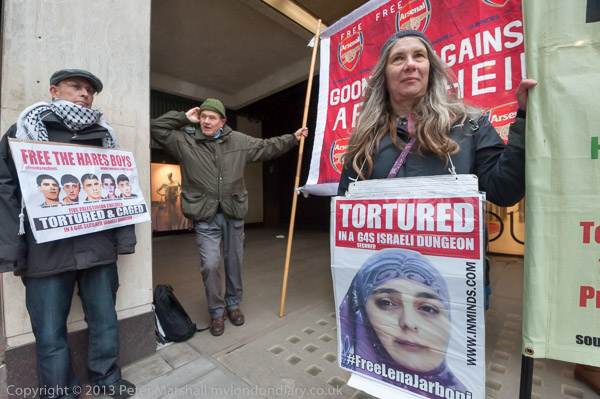
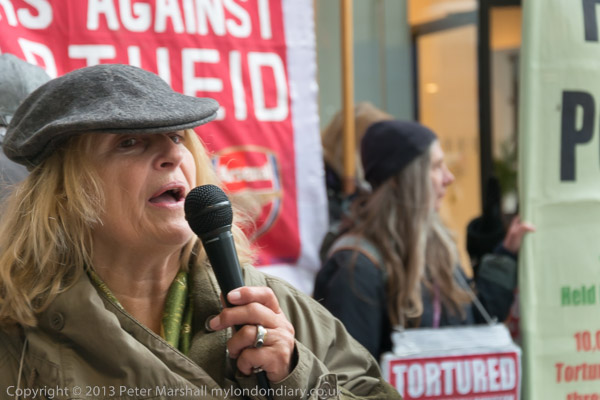
Elsewhere was a protest against security company G4S outside their offices in Victoria Street, one of a number of protests for International Israeli Apartheid Week. G4S runs a number of prisons in Israel and you can read more at G4S & Israeli Prison Torture.

Continue reading Chalk and Protest

Before the Garden City


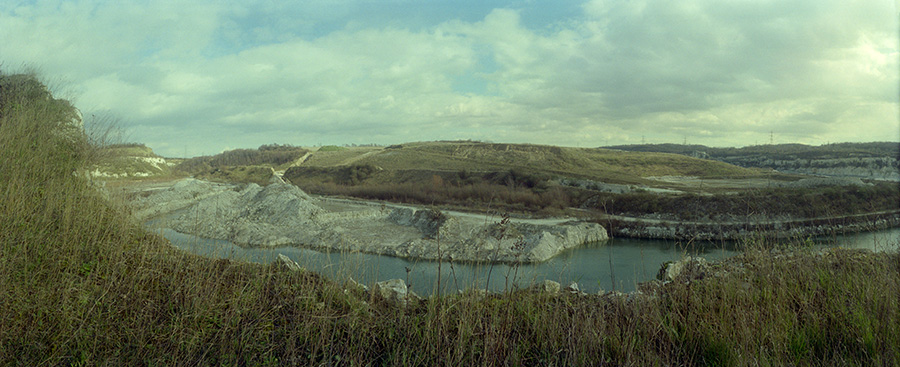
Western Cross Pit, 2000

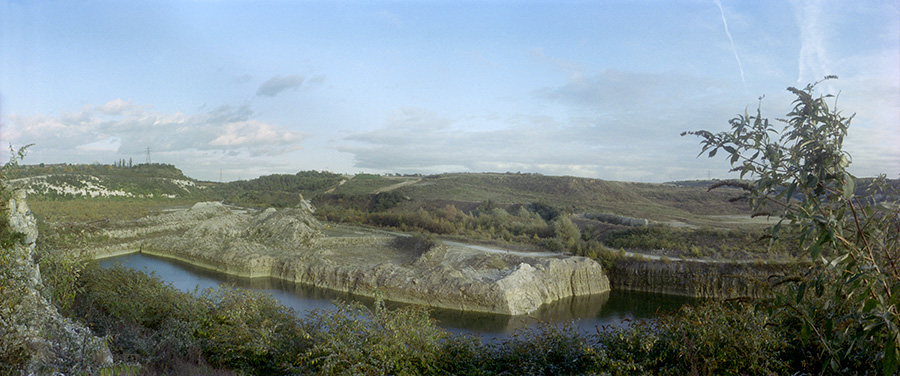
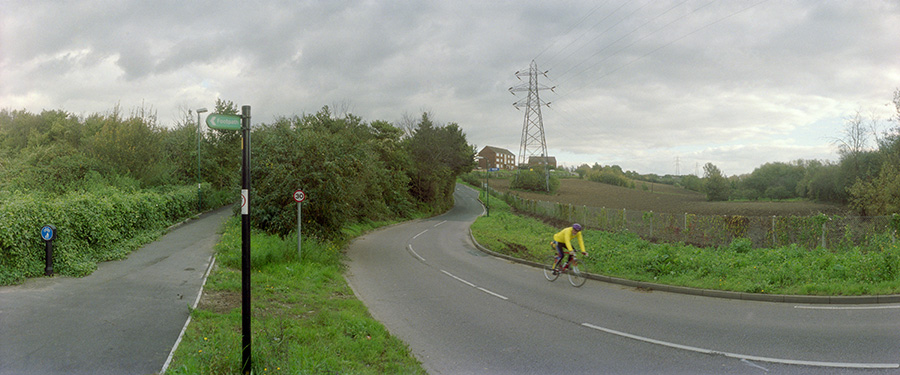
One of the latest UK Coalition government pseudo-announcements which caught my attention was of a new ‘garden city’ to be built at Ebbsfleet in North Kent. It’s hardly new, since development in the huge former chalk quarry south of Swanscombe has been talked about at least since 2002, with the main planning application submitted in 2003 for around 6000 homes and related facilities. And it will be hardly a city – perhaps more like several villages. But there were certainly plenty of trees on parts of the site back in 2000-1.


View from Alkerden Lane, 2000

In 2000 I went to photograph Bluewater in the former quarry immediately to the west across the B255. As an afterthought I walked across the road to see what was on the other side, and found I could see a view across and extremely large quarry.  Much of it was hidden by bushes, and in previous years when I’d tried to photograph this chalk pit from the north side, I’d given up as the area around it was too overgrown to get a proper view. Although parts of the fence were rusty and would have been easy to go through, there was a very large drop and it was clearly not safe to trespass.  But a month or so earlier I’d managed to get the view above.


Alkerden Lane, 2000

This ‘Eastern Quarry’, covering much of the area between Alkerden Lane and the A2 was impressively large. Most of the chalk from this site – the Western Cross Pit – was taken to the Swanscombe works by rail, but there was also a conveyor belt taking it to the Northfleet works. I was around the area again a few months later and made another photograph from a very similar viewpoint – there was a fairly limited area where you could see over the fence and the lip of the pit.


Western Cross Pit, 2001

Working on the pit seems to have started some time in the 1930s when the earlier quarries closer to Swanscombe were largely worked out. It certainly continued into the 1970s a perhaps later. The chalk here was around 50 foot below the surface and considerable overburden had to be removed, much of it being used to fill some of the earlier workings. There was then almost a hundred foot of pure chalk to be removed – leaving a very large hole.

A little further east in the same redevelopment site, close to the A2 there were also clay pits, providing another vital material for cement manufacture, though this was worked out before the Second World War, Clay was also brought in from Cliffe marshes and across the Thames from Essex in barges. The river also allowed the shipping in of coal, initially from the Durham coalfields, to fuel the process. Later this was replace by oil, also coming by river. The river was also used to ship out cement. The works at Northfleet were close to the deepwater channel and could handle sizeable ships, while those further upstream were more restricted. Cement production was later consolidated there, and it was the only cement works still in production I photographed in 1985.


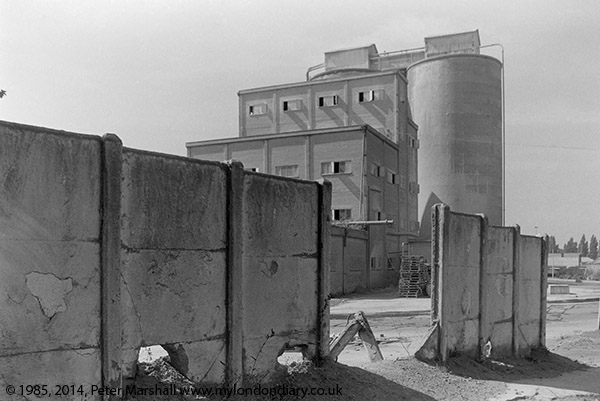
Derelict cement works at Swanscombe, 1985

When I first photographed the area around the mid 1980s, the cement industry was still going strong at Northfleet. I went back in 2003, mainly to photograph around the Channel Tunnel Rail Link, which passes just to the East of the ‘Garden City’ with a Ebbsfleet International station close by, but also the new housing that was by then being built in various places around the area. My last visit was a little over a year ago, and things have changed even more, with the hug factory at Northfleet entirely disappeared.

When cement was at its height, this was one of the most polluted areas of the country, and even ten years ago there was still plenty of dust in evidence. Although signs of the industry remain – and there are industries in some of the former quarries as well as housing estates, it is a much cleaner place now.

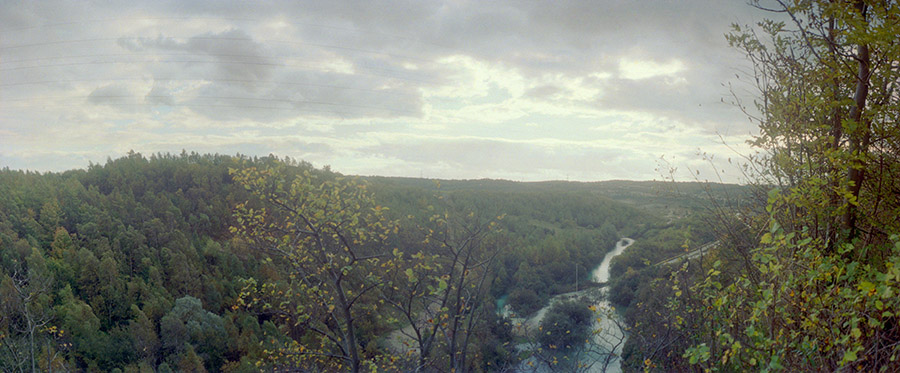
You can see these images at twice the size by right-clicking and choosing ‘View image’. The panoramas were taken on 35mm Fuji film using a Horizon 220 camera which has a lens that swings through an arc to take a picture with a horizontal angle of view of around 120 degrees. The camera gives negatives approximately 56x24mm, and although a cheap camera, gives excellent results.  The negatives are the same width as 6×6 medium format negatives, while the height is that of 35mm. The black and white image was taken on an Olympus OM camera, almost certainly with a 35mm shift lens to keep the verticals upright.

Continue reading Before the Garden City

Ukrainians

Although I’ve not been to the Ukraine, I did photograph Ukrainians in London holding a protest and a remembrance service for those killed in the protests.

I’d been told that they would be marching from a cultural centre in Notting Hill a few hundred yards from the Russian Embassy, but when I approached at the time for the protest, the street was empty. I thought that perhaps I had missed them, and a man came up to me, obviously going to the protest asked for directions to the Russian embassy. He spoke very little English, (and I zero Ukrainian) but I gathered – wrongly as it turned out – that the march had already left, so I hurried towards the embassy too.

Not that you can actually protest at the embassy, which is at the other end of the still guarded private street which also houses the Israeli embassy. As there, protests are on the other side of the main road close to the street opening. Though at least here there is a building with a Russian flag – the consulate – actually opposite behind a tall fence.
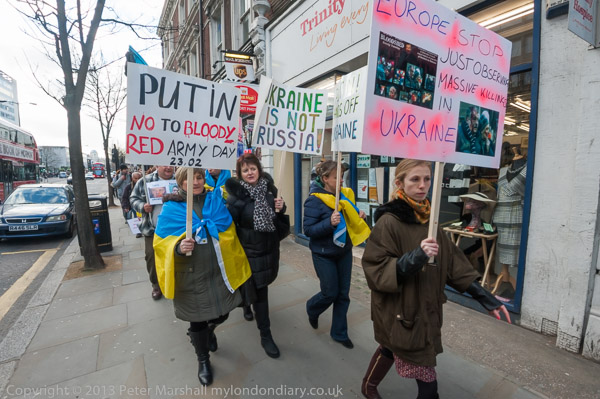
There were a few Ukrainians already there, along with another small group of Syrians and Syrian Peace Protest supporters, several of whom I recognised. Having greeted them, I went to talk to the Ukrainians, and found that the march had not arrived. I took a few pictures and then decided to go and look for it, meeting it a couple of hundred yards down the street. I think there had been a last-minute change of plan, and they had started from elsewhere.
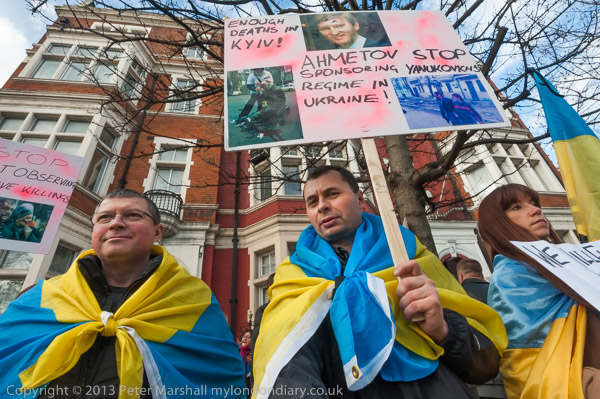
There were still nothing like as many as I had been told to expect, but slowly more arrived and the protest grew. Many wore or carried Ukrainian flags and there were enough placards to make it clear what the protest was about, although not all were in English. A few protesters carried flowers, and some came with candles. Fortunately they got on well with the Syrians, joining together as both protested against Russian interference in their countries.
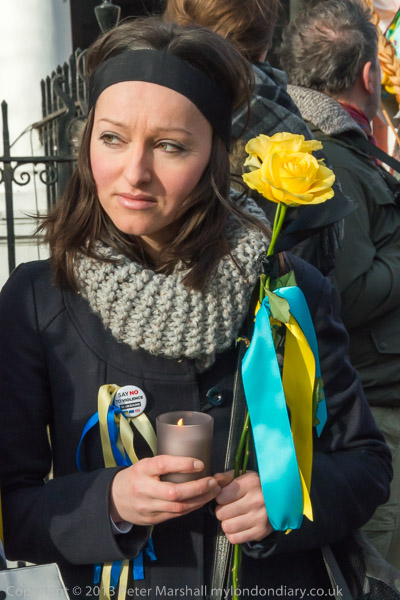
One image I saw in my viewfinder did give me something of a shock. It wasn’t quite the picture below, but a slightly wider view of the same person.
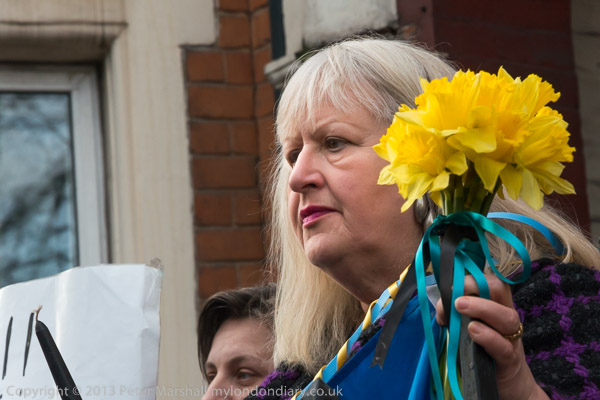
The woman was holding a bunch of daffodils with a blue ribbon tied around them in her left hand, which also held one corner of a Ukrainian flag. With her right she grasped another corner of the flag, and what seemed be a large knife. It was only on looking more closely I realised it was in fact only an unlit black candle, outlined against the white of a placard behind. Framing more tightly as above made the wick more visible, and moving it away from the text on the placard cuts down the illusion a little too, but there is still something slightly chilling, at least for me. The angle of the candle (or blade) and the intense expression remain powerful.
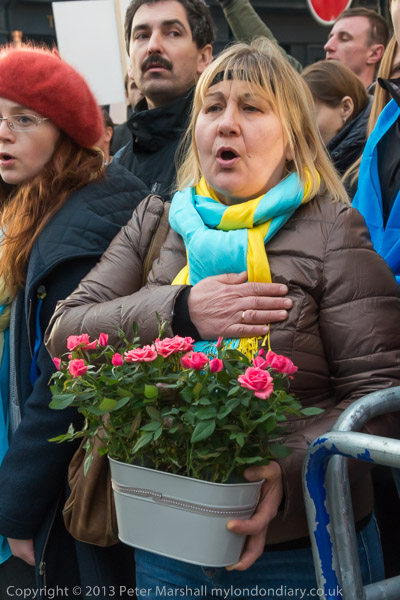
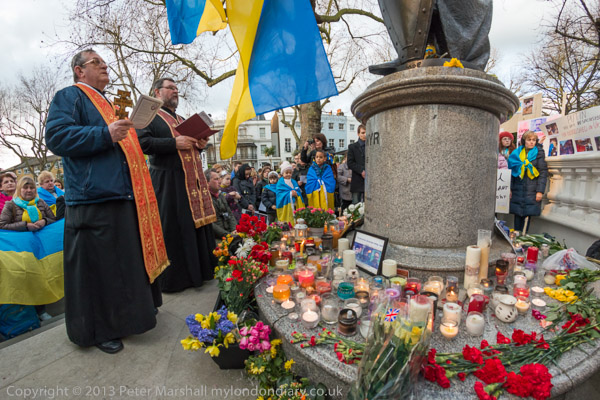
The plans changed again. It had been intended to march to the Ukrainian embassy a short distance away, and then on to the statue of St Volodomyr a short distance away on Holland Park Avenue. I’d called in there on my way to the protest and took a few pictures as it was surrounded by candles and a few photographs of those killed in the protests. But they had decided there wasn’t time for the embassy visit, and, after singing their national anthem, hands held on hearts, they set off for there.

At St Volodymyr, things were pretty crowded, with Ukrainians adding and lighting candles and adding more photographs of the dead to the display. Many of the candles in the jars had gone out and needed re-lighting. It was a pretty cramped area, and with quite a few photographers trying to get pictures, things were a little difficult. As usual I was working mainly with wide-angles, both the wide end of the 16-35mm and the wider still 16mm full-frame fisheye. Inevitably along with the Ukrainians and the candles there were also other photographers in the image. It’s something I usually try to avoid unless I want to make a point of it; usually photographers are there to record the event not to be it.

I make a point of dressing in fairly dull clothes when covering events. Dark blues, dull russets, greys, blacks. I don’t have a great deal of bright saturated colour clothing in any case, but I don’t wear it when I go out to take pictures. There are times and places where high-viz is essential, but this certainly wasn’t one of them, and I found myself cursing a photographer who had chosen to wear a bright red wool hat, though not to his face.
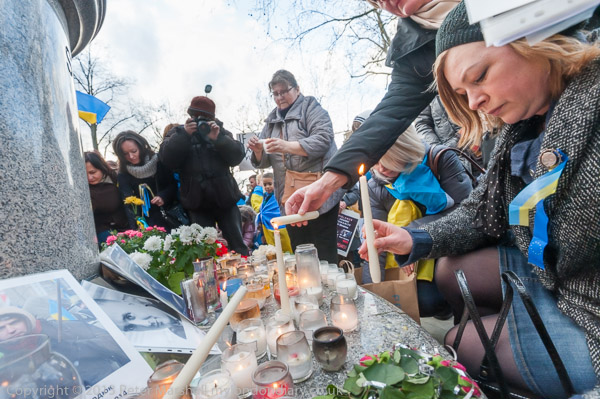
But it did really spoil a number of my pictures. And it led me commit at least a minor photographic sin. That hat the photographer close to the centre of the image was wearing was really about the same colour but rather brighter than the one the woman on the left below was wearing. I’ve not removed anything, but I think applied excessive burning in and a little desaturation, probably beyond what Reuters would approve of. I shouldn’t have done it, but it really was a sore thumb, and I succumbed to temptation on this one frame.
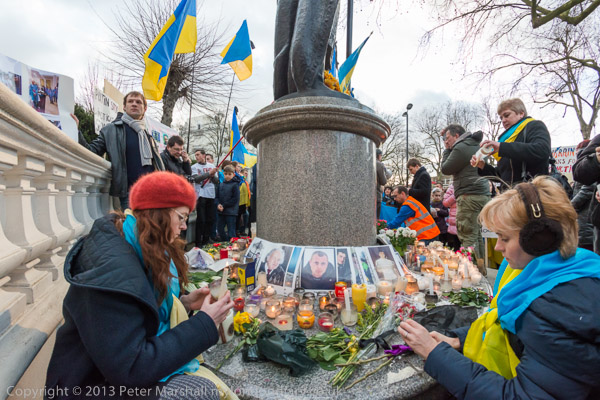
I’d actually taken off my hat in any case. It was decidedly warm for February but it was also something of a religious reflex. In the tradition in which I was raised, at a time when men almost all wore hats or more often caps, but always removed them when entering church – or indeed for open air services such as was being prepared for here.

I don’t know whether this is a part of Ukrainian Orthodoxy as well, but I did notice that all of the men in the large congregation gathered around the statue were bare-headed. But perhaps our English winters are too mild to merit any head-covering.
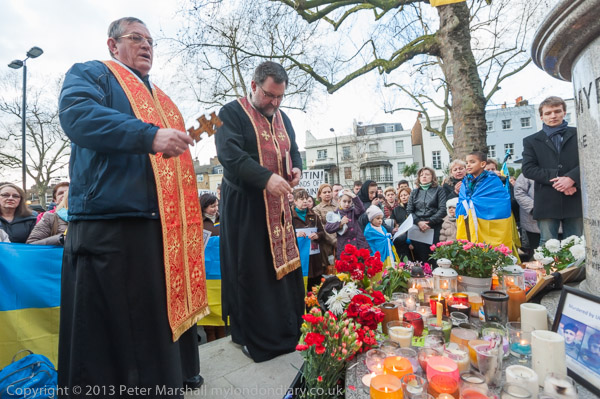
But during the ceremony itself there were another couple of photographers whose behaviour was I felt unsuitable, really intruding on what was happening, moving around and rather getting in the way.  I felt a more reverent attitude was appropriate. I feel it is a privilege to be allowed to photograph events such as these, and holding a camera isn’t a licence for bad behaviour.

Story and more pictures: Ukrainians Protest, Celebrate and Mourn

Continue reading Ukrainians
Ukraine Images

As I sit at home writing this post, people are going to the poll or not in the Crimea, voting on whether to go for greater autonomy inside Ukraine or to return to Russia, which they were part of before Kruschev gave them away in 1954. Or not, because some people are said to be boycotting the vote as neither of the two alternatives represents their wish to remain in the present arrangement.

There seem to me to be only very limited situations where boycotting a vote can be an effective tactic, though I wouldn’t presume to give the guys in the Crimea any specific advice. Here in the UK, most people don’t bother to vote in most elections, though its rather apathy than boycott that gets the greatest support in almost every poll. But I do think this would be at least a slightly healthier democracy if on every voting paper there was the option ‘none of the above.’

I’ve been glad these last few weeks that I’m not one of those photojournalists who flies out to trouble spots to report on them, though I have been impressed by the work of those who do.  Paris-based photojournalist, Alfred Yaghobzadeh, was on the ground in Kiev documenting the events from the day after things kicked off, and on LensCulture you can see an in-depth showing of his work, with 87 colour images and 105 black and white pictures.

It’s interesting to see the work like this, and there are some fine images. Kiev seems to have brought out a huge number of memorable and spectacular images from a great many photographers, but looking at the work of just one person is in some ways more revealing and gives a greater insight into what things were really like. The same is also true for videos such as Vice New’s Ukraine Burning with camera work mainly by Phil Caller (along with three others who from their names are probably Ukrainian.) Once you have got over the rather annoying interviewer (Vice Magazine seems to revel in the annoying, perhaps it worries it might have to change its name otherwise) it’s an interesting film – and again makes me feel glad not to have been there.

Caller is someone I used to find myself often covering events in London with a few years ago, when he was still working mainly with still images, but starting also to take video. Had I then been at a similar stage in my career to him it is a decision I would quite likely have felt I had to make also, if only to earn a living. Keeping on taking only still pictures – and keeping on putting my stories on Demotix are luxuries I’m in a position to afford after over 40 years of work.

There are things the still image does better, preserving a moment and bringing it to our attention in a way that doesn’t happen in a movie – unless perhaps you introduce a still frame. But that becomes an ‘effect’ in the way that a still image isn’t, and one that alters the nature of a film.

Looking at Yaghobzadeh’s work I found myself wondering why he had chosen to take some of the images as black and white. The square format is great for most of the portraits, but in some of the other images I found myself thinking that they would almost certainly have been better in colour. There are some exceptions, mainly those images with a strong element of design.

Of course many photographers now who present their work as black and white have actually taken these as colour, but I think that Yaghobzadeh was working with film, and from the format of the images, with medium format.  One of the things that attracts me, at least in principle, to working with cameras with an electronic viewfinder – such as the Fuji x-E1 – is that you can work with an monochrome image in the finder, while still if you are saving images in AW, have all the colour information still present should you later decide you would prefer to have a colour picture. But I say in principle, because although I’ve taken a few thousands of images on the camera I’ve yet  to take a single one as monochrome. I’ve still too got a cupboard with a shelf full of black and white film (now all rather outdated) but somehow I feel that photography and I have moved on.

Suffering And Photography

Although I feel there are relatively few occasions on which we should “look to Susan Sontag for advice“, Lorena O’Neil’s short piece When Suffering And Photography Collide on Ozy – short of Ozymandias.

In case you’ve forgotten, the inscription:

My name is Ozymandias, king of kings:
Look on my works, ye Mighty, and despair
!

from the plinth of a statue for a long-dead Egyptian tyrant was the inspiration for one of Shelley’s best-known works, a 15 minute sonnet penned in a poetry speed-writing contes that produced certainly one of his best-known works.  Great and all-powerful Osymandias may have been, but all that remained was the shattered ruins of this boastful great work, “two vast and trunkless legs of stone” and “near them, on the sand, Half sunk a shattered visage” alone in an empty desert. Or possibly in fact rather less than this.

I’m not any wiser as to why a web site which seems to think of itself as a kind of cultural trendsetter, bringing you “the new and the next“, putting you ahead of the stream, giving you in on the “new people, places, trends, ideas and opinions months before you’re going to hear about it in the mainstream press.”  Perhaps the name just means they are huge braggarts too?
Of course I’m not one of the “Change generation” and so perhaps shouldn’t be reading the site. But enough mocking the meaningless. O’Neil’s piece starts off with a question:

As cell phone cameras proliferate, so do multiple images of violence from around the globe – but is it morally corrupt to look at these pictures and videos?

A good question (though I’m not sure about that ‘morally corrupt’.) But perhaps she passes over to Sontag and her book, Regarding the Pain of Others (which I’ve not read) a little too quickly. I’d want to start by asking why people are recording the kind of videos and take the kind of photographs she is talking about, and perhaps not want to treat them as a homogeneous group. And then to go on to ask why we should want to look at them (and I think generally we should, at least for those made with a serious purpose, though I know we don’t always do so for the best of reasons.)

But where I have a problem is with the Sontag’s conclusion “”If we could do something about what the images show, we might not care as much about these issues,” because now there is almost always something we can do, even if it may not be a huge contribution.  We can make others aware, sign petitions, donate money, lobby our representatives, write letters, tweet, post on Facebook, join organisations, write articles, protest…

O’Neil writes:

“Sontag wants us to engage in a thoughtful debate, be it with others or just ourselves, about pain and violence and war, and our inability to understand something we have not experienced.”

Thoughtful debate seems a good starting point, but unless thought leads to action it is empty.

Sontag’s ‘On Photography’ (which is recommended reading at the bottom of the article) is perhaps one of the most infuriating books on photography I’ve ever read, full of insights mixed with half truths and misunderstandings. My copy ended up with more underlining and marginal scribbles than any other work I’ve ever read, and my notes on some chapters became longer than her contribution and ended up in little magazines. But my review was rather short:

‘Sontag’s ‘On Photography’ is great television.’

A related article you may also like to read, published last December on The Weeklings is On the Blindness of “WAR/PHOTOGRAPHY” by Chloe Pantazi, which discusses Brooklyn Museum’s exhibition, WAR/PHOTOGRAPHY: Images of Armed Conflict and Its Aftermath, which ended in February.