Universal Discredit

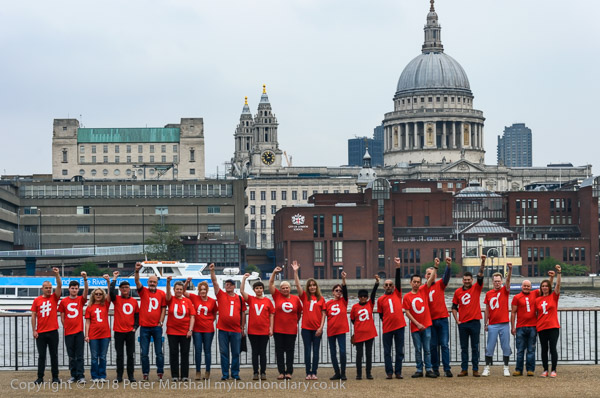
T-shirts spell out StopUniversalCredit’ in Tate Modern Turbine Hall on the Unite Day of Action against Universal Credit, 24 May 2018

There were some positive ideas behind the introduction of Universal Credit, a new social security payment system first announced by the then Work and Pensions Secretary, Iain Duncan Smith, in 2010, claiming it would make the social security system fairer to claimants and taxpayers. It aimed to simplify the system by replacing six existing benefits for working-age people who have a low household income: income-based Employment and Support Allowance, income-based Jobseeker’s Allowance, Income Support, Child Tax Credit, Working Tax Credit and Housing Benefit. It would also taper off gradually as people moved into employment, removing the ‘cliff edge’ of losing benefits when going back into work.
But both Duncan Smith and Welfare Reform Minister David Freud, had failed to grasp the complexity of the varied and often varying circumstances of those in low paid and often insecure employment, particularly those on zero hours contracts or other sporadic or seasonal work, or with fluid family arrangements. Nor did they make clear that the main driver behind their changes was to simply cut the cost of benefits. And it now seems likely it will end up being more expensive than the benefits it replaced.
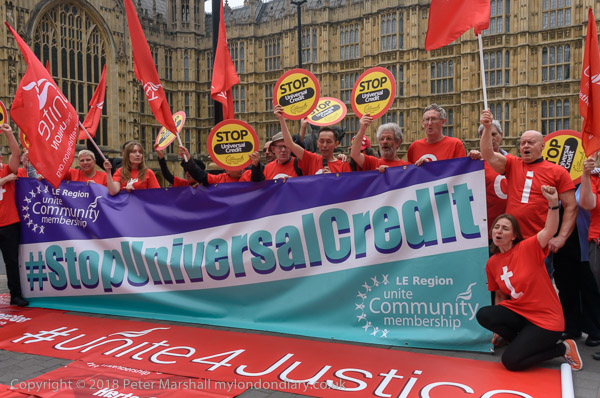
Outside Parliament

Following the Welfare Reform Act 2012, UC roll-out began to selected claimants at pilot job centres in 2013, and problems rapidly became apparent. There were entirely predictable problems with the IT system and the implementation costs were six times the initial forecast at £12 billion. The roll-out was intended to be more or less complete by 2017, but is now expected to take until 2024. Cuts were made to the initial system by George Osborne in 2015, making the transition to work less generous and removing some of the payments for child support, though these were partly restored in 2018 by Philip Hammond. And in 2020 there was a temporary £20 increase as a response to Covid.
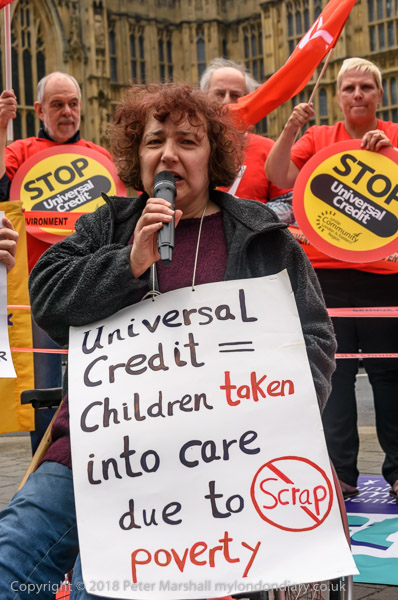
What is clear is that the introduction of UC has caused a great deal of hardship to claimants, some temporary, some permanent. It has led to many being unable to keep up rent payments with a great increase in evictions and homelessness. UC has been the main driver of the huge increase in the need for foodbanks. It has forced some women into prostitution and made some claimants turn to crime to keep alive – while some have starved to death.
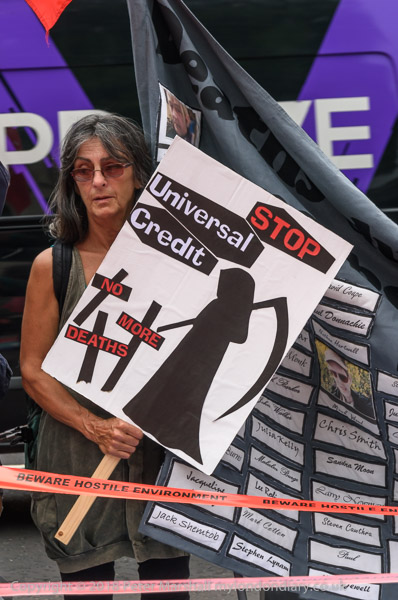
UC has had a particularly hard effect on families with children, particularly those with more than two children since 2017, and also on self-employed claimants and others with fluctuating incomes. Overall there have been both winners and losers, with around half losing out and a little over a third gaining compared to the replaced benefits.
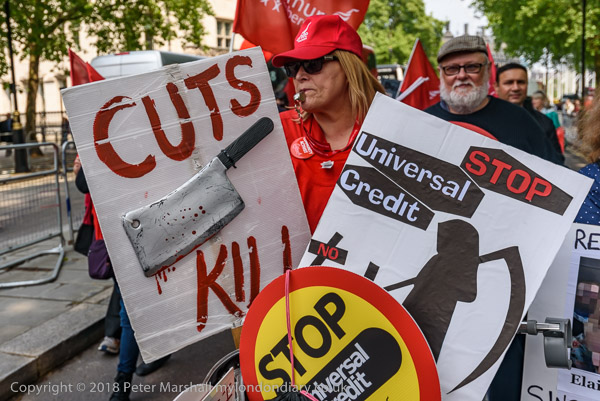
Marching to the DWP

One of the major problems for everyone has been the long wait before any UC is paid, partly because of the change from a weekly to a monthly benefit. Even where the process works smoothly, the delay between making the claim and receiving money is six weeks, and around a fifth of claimants have had to wait around 5 months or more. There are now emergency loans available – but these mean that when people do get their payments they are reduced to repay these advances. There are also many whose benefit has been cut or stopped for largely trivial reasons through a savage system of benefit sanctions imposed by job centres.
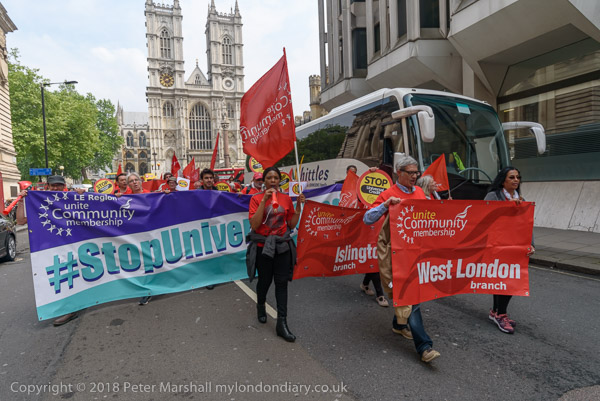
Many other problems have also been caused by UC – you can read a long list of criticisms in the Wikipedia article. As well as evictions and homelessness it has resulted in an increase in domestic violence and a steep rise in mental-health problems. And, as the National Audit Office reported, there is no evidence Universal Credit has met its aim of helping people into work and they say it is in many ways unwieldy and inefficient and is unlikely to provide value for money.
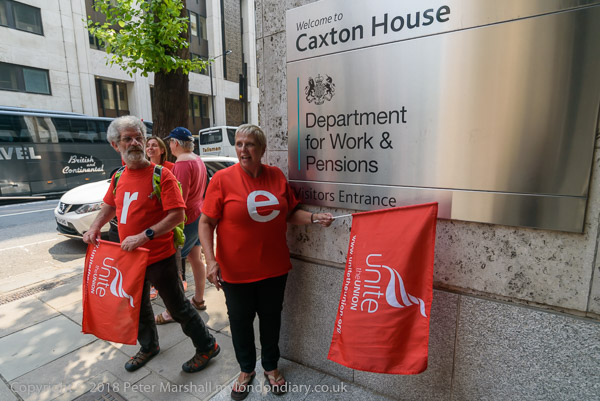
It is clear that UC is in need of a complete replacement, and that it’s monumental failure should have led to the resignation of Iain Duncan Smith in 2015 after the DWP admitted publishing fake testimonies of claimants enjoying their benefits cuts and statistics showed 2,380 people died in a 3-year period shortly after a work capability assessment declared them fit for work, but instead he was knighted in 2020. Under the present government we are unlikely to get more than very minor tinkering that will quite likely create more problems that it solves. One of the proposals under debate is that of a Universal Basic Income, along with targeted welfare payments (some of which are still in existence) to cover those with additional needs. Earlier this month the Welsh First Minister Mark Drakeford announced that this would be trialled in a pilot scheme in Wales.

Universal Credit rally & march
Universal Credit protest at Tate Modern
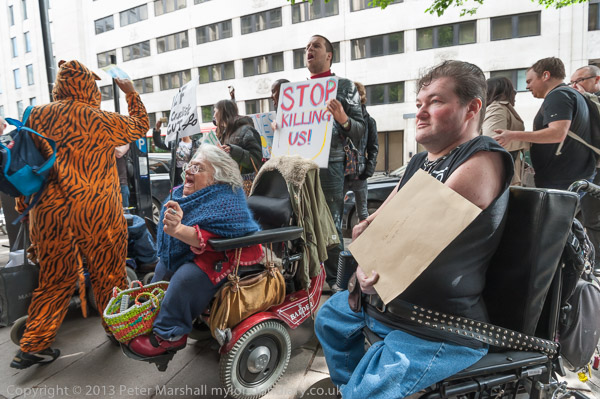

Fuel Poverty and Independent Living 2014

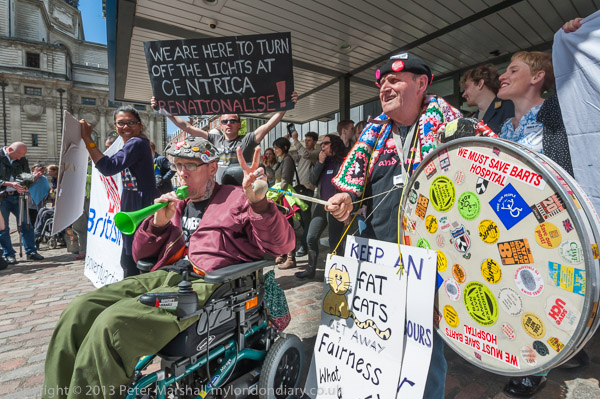
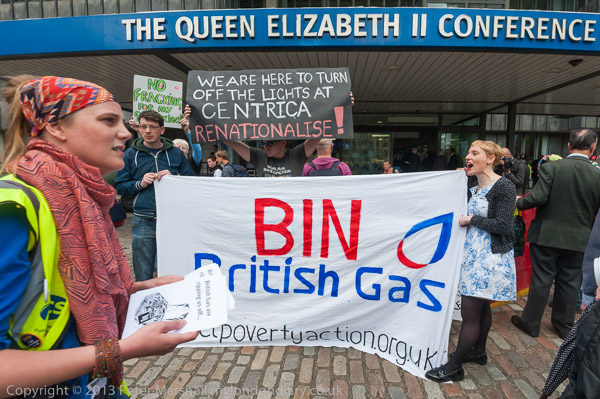
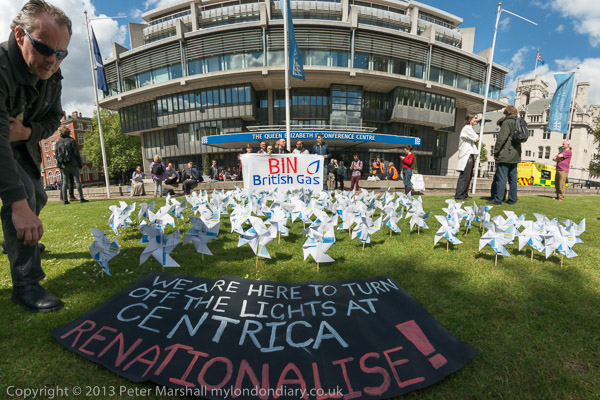
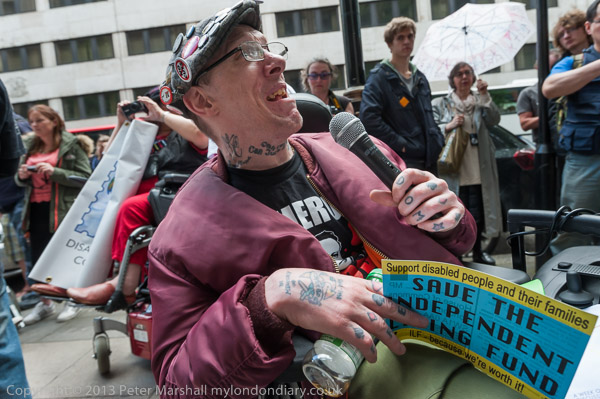
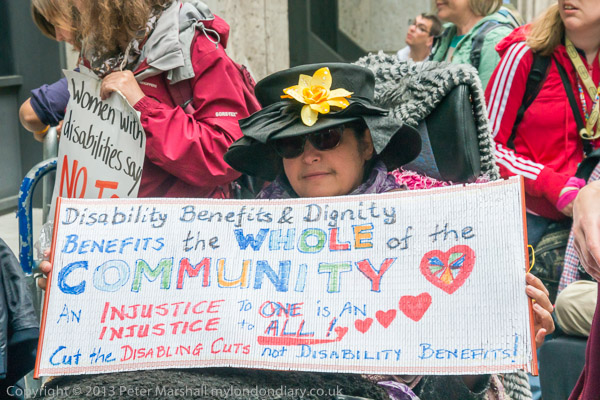
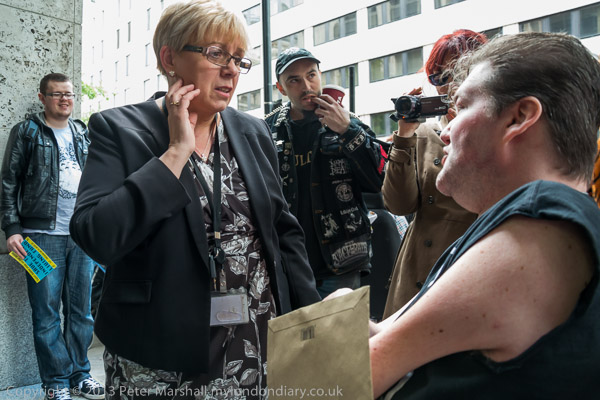
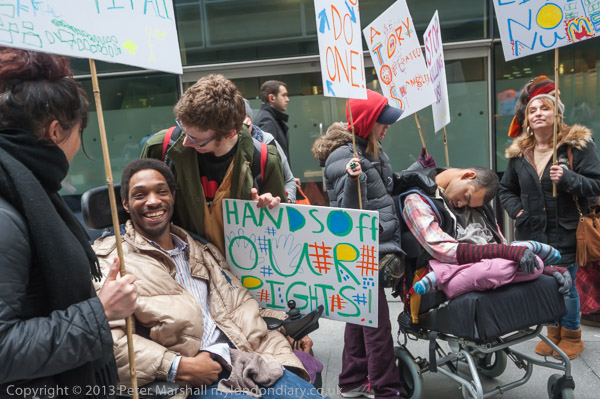
Disabled activists were prominent, along with pensioners at the Fuel Poverty Action FPA) protest outside the British Gas AGM taking place at the Queen Elizabeth II conference centre in Westminster. And when that protest ended they made their way to the Dept of Work & Pensions protest against plans to end the Independent Living Fund.

There were over 10,000 excess deaths in Winter 2013-4 because people could not afford to heat their homes, the situation exacerbated after British Gas raised its prices in November, gas by 10.4 %, electricity by 8.4 %. Centrica, the parent company of British Gas, made £2.5 billion in 2013.

FPA call for an increased investment in renewable energy, which in the long term will result in cheaper energy and will help us tackle climate change. But this isn’t popular with the big six energy companies (and the government which is led by their lobbyists) as it enables greater local generation and control of energy, threatening their monopoly of energy production and profits.

They say “Our energy system & economy are run to make private profit at all costs – our rights to warm home and a safe climate are sidelined. We’re being ripped off and left to freeze. We say: things have to change. We need and affordable. sustainable energy system owned by us, not big business.”

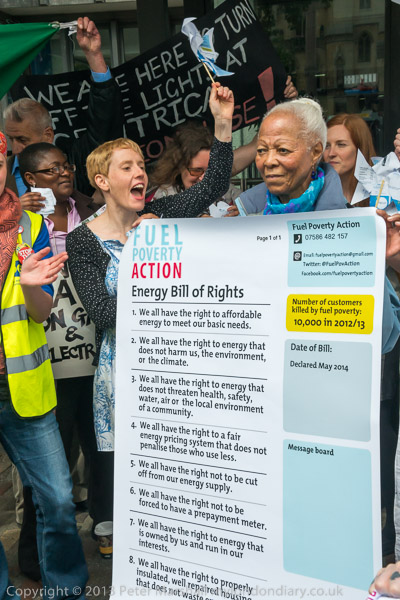
At the protest they launched their ‘Energy Bill of Rights’ with the following statements:

  • We all have the right to affordable energy to meet our basic needs.
  • We all have the right to energy that does not harm us, the environment, or the climate.
  • We all have the right to energy that does not threaten health, safety, water, air, or the local environment of a community.
  • We all have the right to a fair energy pricing that does not penalise those who use less.
  • We all have the right not to be cut off from energy supply.
  • We all have the right not to be forced to have a prepayment meter.
  • We all have the right to energy that is owned by us and run in our interests.
  • We all have the right to properly insulated, well repaired housing that does not waste energy.

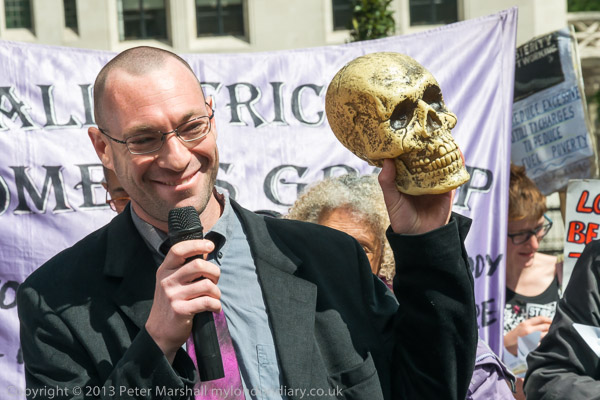
They were joined by an actor carrying a skull, one of a group which had entered the Centrica AGM and performed Hamlet’s iconic monologue ‘To Heat or Eat, that is the question’ and repeated this for the protesters.

For a final photo opportunity, the protesters planted 100 small windmills made of British Gas bills in the grass outside the centre.

The Independent Living Fund (ILF) helps over 18,000 disabled people who have high support needs to live an independent life in the community rather than live in residential care. The funding is ring-fenced and is highly cost-effective compared with the costs of residential care, the care package costing on average £300 per person per week.

Despite this and a Court of Appeal ruling that the minister had not specifically considered the duties imposed by the Equality Act, and that the proposals were unlawful, the DWP announced in March 2014 that the scheme will end in June 2015. Responsibility for care will pass to the local authorities, and provision will be subject to the usual constraints and cuts of local authority expenditure.

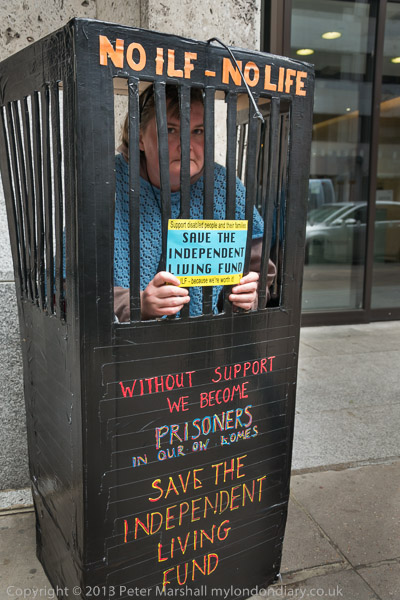
At the centre of the protest was a small cage, with the message ‘NO ILF – NO LIFE’ across its top, and below the barred window ‘Without Support We Become Prisoners In Our Own Homes – Save the Independent Living Fund’. Squeezed into this was Paula Peters of DPAC, Disabled People Against Cuts, the group who had organised the protest.

Many at the protest were going on to lobby their MPs, and one who had travelled from Newcastle had phoned Mary Glindon, the Labour MP for North Tyneside, who came down the the protest. She tried to deliver a letter from the protesters to the DWP but was at first refused entry by the DWP security, though eventually they allowed her to do so through a side entrance away from the protest.


All photographs on this and my other sites, unless otherwise stated, are taken by and copyright of Peter Marshall, and are available for reproduction or can be bought as prints.


UK Uncut Party against Freud

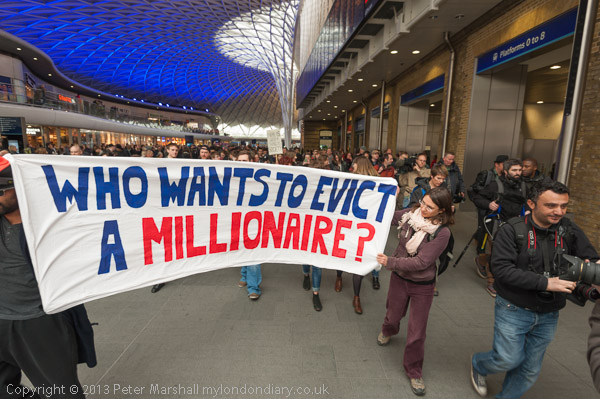
Protesters meet at Kings Cross Station

Not Sigmund, but his great-grandson, a millionaire merchant banker responsible for government welfare reforms. The ideas behind many of the changes in the benefits systems which are having such disastrous effects on the lives of many and particularly those with disabilities, impoverishing many, driving some to suicide and driving the enormous growth in the need for food banks come largely from the work of one man, David Freud, now Lord Freud. A modern-day Scrooge promoting Victorian ideas, the man who launched a thousand foodbanks. Rather more, over 2000 by 2021.

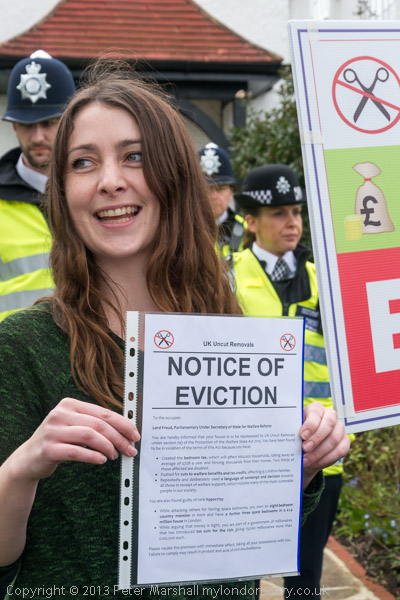
They came with a notice of eviction for Lord Freud

Freud went into journalism after his PPE degree at Oxford, working for 8 years at the Financial Times before becoming a merchant banker. It was Tony Blair who, impressed by his work raising finance for Eurotunnel and EuroDisney brought him into politics in 2006, asking him to produced a report on the UK’s welfare-to-work system. His 2007 report called for the involvement of private companies paid by results to get people, particularly single parents and those suffering from long-term illness and disabilities back into work and for a single benefit to replace the various benefits for working age people, combining Housing Benefit, Job Seekers allowance etc.

UK Uncut had brought a removal van and cardboard boxes, but…

His ideas were taken up enthusiastically by New Labour and incorporated into a White Paper in 2008, by which time Freud was an adviser to Gordon Brown’s government, but in 2009 he became a member of the Conservative Party, who made him a Lord and a shadow minister under David Cameron, becoming in the 2010 Coalition government Parliamentary Under Secretary of State for Welfare Reform at the Department for Work and Pensions (DWP).

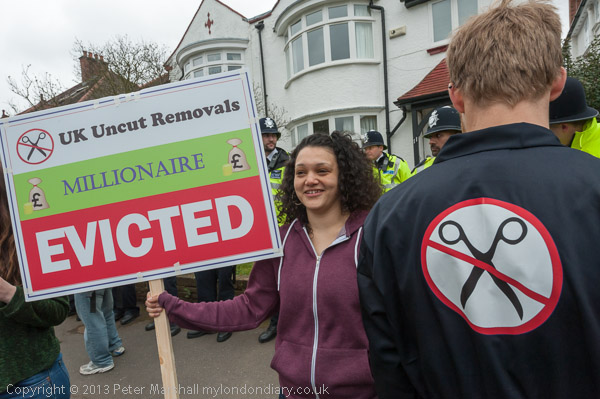
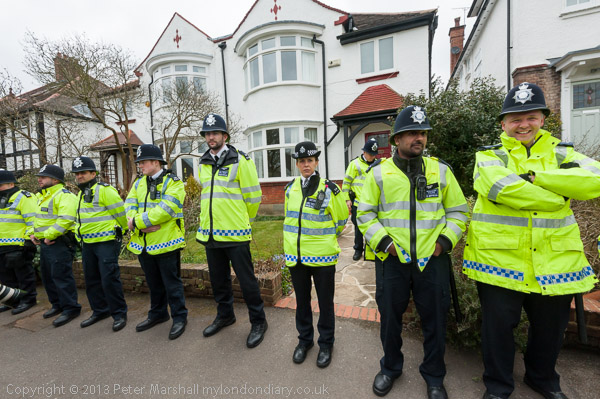
Police prevented the protesters reaching the house

There he began a programme against people on incapacity benefits, lone parents and the self-employed whose earnings were low, who he said were enjoying a lifestyle of living off benefits. After the 2015 election he was promoted to Minister of State at the DWP and given the job of expanding the Universal Credit scheme, retiring at the end of 2016.

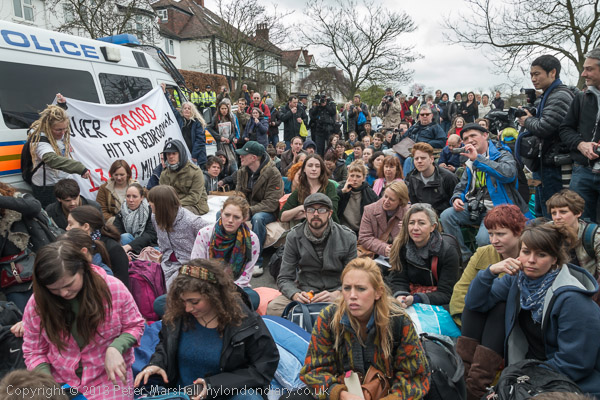
Listening to songs and speeches on the road outside the house

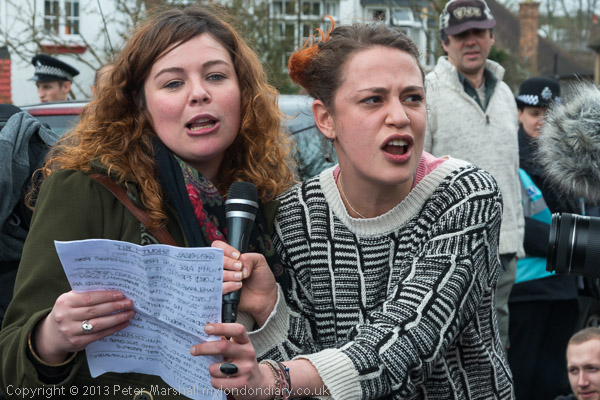
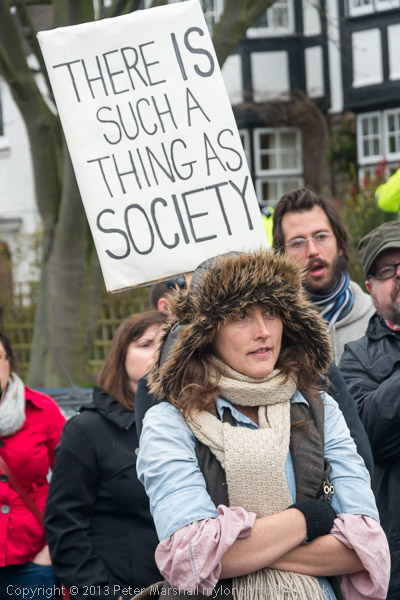
On Saturday 13th April 2013 I went with UK Uncut supporters who travelled from Kings Cross to hold a lively but peaceful protest in the road outside Lord Freud’s home in Darmouth Park, Highgate against the bedroom tax, another of his ideas to disadvantage the poor. At the same time protesters from DPAC (Disabled Persons Against Cuts) visited the home of Ian Duncan Smith and delivered an eviction notice there.

At the party there was street theatre, games, a quiz and speeches about the bedroom tax and other measures against those on low incomes and benefits that Freud was bringing in. The bedroom tax hits particular groups such as foster carers, disabled people and single parents many of whom will be unable to meet the extra rent and will face eviction, including many now in homes with special adaptions for their disabilities. In social housing there simply are not the smaller properties available that the act is designed to force people to move into.

People are also hard hit – particularly in London where rents are high – by the strict limit of the benefits cap. Other measures, including cuts in legal aid and council tax benefits and the end to disability living allowances will also cause real distress, and those benefits that remain are getting a real terms cut by below-inflation increases. Among those speaking at the event were Green Party leader Natalie Bennett and journalist Owen Jones.

Who wants to evict a Millionaire?


All photographs on this and my other sites, unless otherwise stated, are taken by and copyright of Peter Marshall, and are available for reproduction or can be bought as prints.


April Fools Day

The idea of a day – or rather a morning – for largely harmless pranks to be played on others on April 1st seems to have been fairly widespread around many countries, but the seems to be no real explanation of its origin, but it seems to date back as least into the middle ages. The choice of date is suggested by some to have marked the end of the week of celebrations for the New Year, which was traditionally celebrated across Europe on March 25 until the sixteenth century.

There have been some celebrated hoaxes over the years – and those of us who were around in 1957 still remember the spaghetti harvest on the BBC with its narration by Richard Dimbleby, which fooled much of the nation and amused the rest of us. But so many of today’s news stories and government pronouncements throughout the year now seem so bizarre and unbelievable that I now am disappointed when no-one comes on afterwards to shout ‘April Fool!’

On several occasions in recent years I’ve found myself covering protests outside our Atomic Weapons factory at Aldermaston on April 1st and it’s long seemed to me that our government’s policy on nuclear deterrence is at best a complete hoax – but so far no government has stood up to admit this.

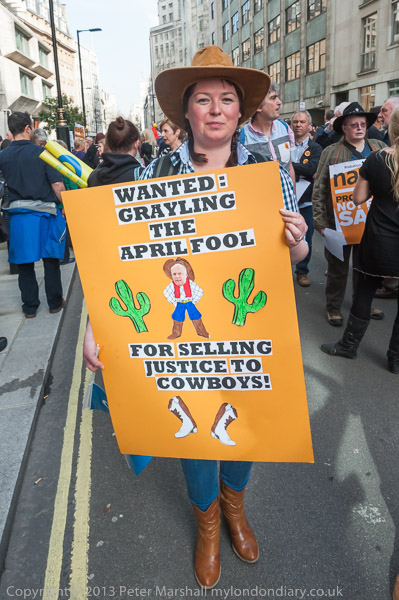
But I wrote about Aldermaston a few days ago, so today I’ll look elsewhere and to April 1st 2014, where I photographed three events in central London, one of which was by probation officers, naming then Justice Minister Chris Grayling whose birthday it was an ‘April Fool’, a judgement adequately confirmed by the failure of his reforms of probation and legal aid, and by his performance in later Government Ministries. Who can forget his no-deal Brexit ferry fiasco which resulted in us taxpayers forking out an extra £50 million on termination bonuses including to the firm with no ferries? ‘Failing Grayling’ is a truly well earned epithet.

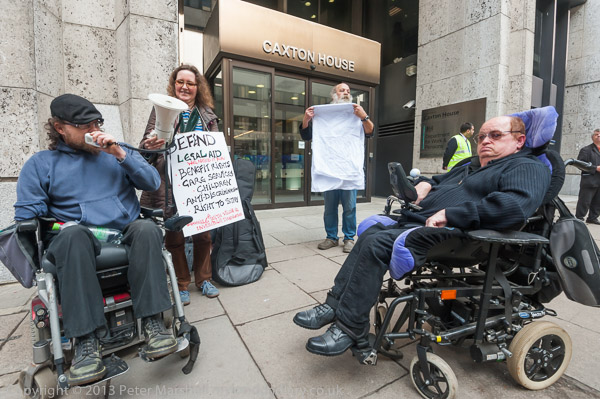
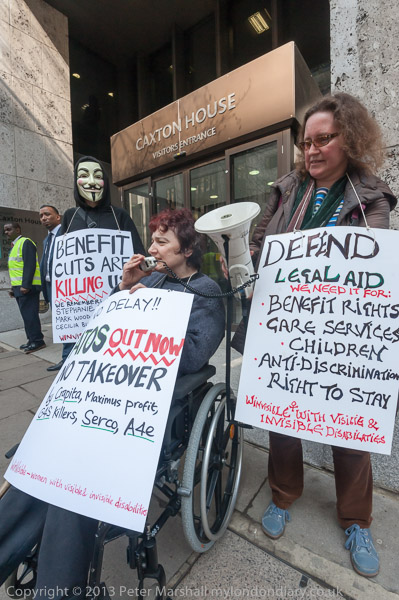
But the first event on that day was a picket by disablement activists at the Department of Work and Pensions HQ in Westminster, then run by Iain Duncan Smith, another Tory with a rather too consistent record of failure. Among the groups protesting were the Mental Health Resistance Network who successfully took the DWP to court over the discrimination against people with mental health conditions built in to the Work Capability Assessment (WCA). The DWP lost their appeal against the judgement but had defied the court in failing to address the issue.

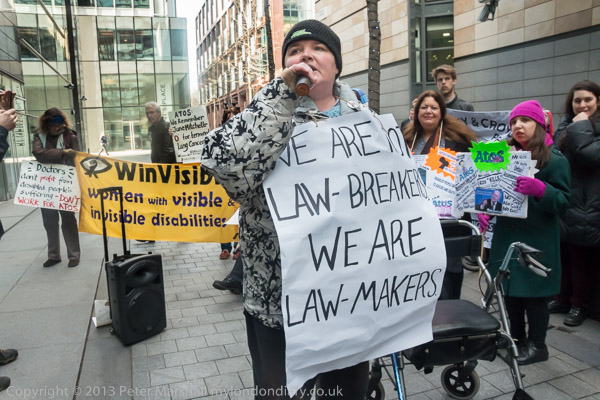
Along with the MHRN were campaigners from DPAC and Winvisible and the picket was one of a number around the country demanding that assessments of work capability and personal independence payments be carried out by local GPs rather than the discredited tests by IT companies such as ATOS, which are inadequate by design and deliberately administered to disadvantage claimants, with trick questions and falsification of responses to meet targets set by the companies for the largely unsuitably qualified staff who administer them.

From the DWP in Caxton St it was a short walk to Parliament Square, where Kurds and Alevi were protesting against the attacks on the Kurdish areas in Northern Syria by forces supported by Turkey.
Kurds want justice and autonomy for northern Syria, where the area known as Rojava has a constitution that supports the rights of women and of all its population groups based on widespread community involvement. Many at the protest had flags for the PJAK (Party of Free Life of Kurdistan) which, like the Kurdistan Workers Party (PKK) calls for the release of Kurdish leader Abdullah Öcalan, held in a Turkish jail since 1999. The PKK was made a proscribed organisation in the UK in 2001 probably at the request of the Turkey, one of our NATO allies, who have a long record of discrimination and attempts to eliminate Kurdish culture and invaded and occupied Kurdish areas of Syria in 2016, implementing a policy of ethnic cleansing of the Kurds.
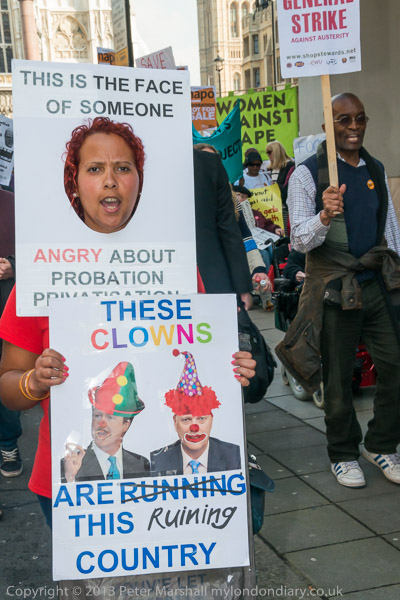
The largest of the protests on 1st April 2014 was by probation officers and lawyers from the London Criminal Courts Solicitors Association and other supporters of the Justice Alliance against the moves to privatise probation and cut legal aid.

Among the speakers at the event were two shadow ministers of justice and other MPs including Jeremy Corbyn, as well as Green Party Leader Natalie Bennett, trade unionists, and solicitors as well as several probabtion officers.

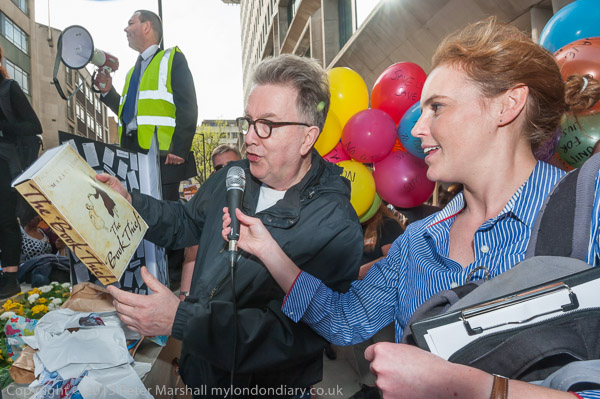
Following the rally in Parliament Square, the campaigners marched the short distance to the Ministry of Justice, where Tom Robinson led the singing of “the alternative ‘Happy Birthday’ and unwrapped a couple of presents for InJustice Minister Chris Grayling, a packet of Skittles (as bought by Travon Martin) and a copy of ‘The Book Thief’. Grayling had just announced that he was to stop books being sent to prisoners in UK jails.” A small group then delivered a birthday cake with a tombstone with the message ‘RIP Justice’ to the ministry.

More at:
Probation Officers Strike for Justice
Kurds protest at Rojava attacks
DWP & Atos Work Assessments

Atos & more – 19 Feb 2014

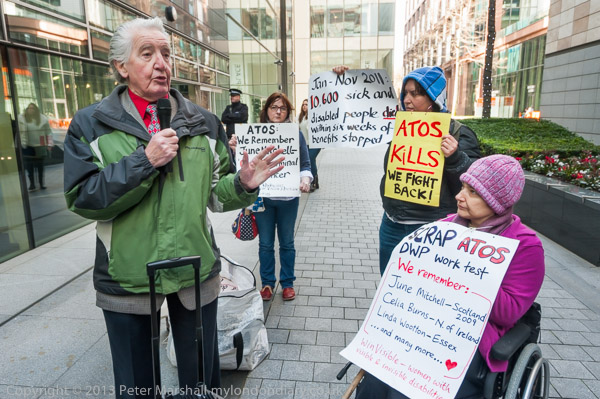
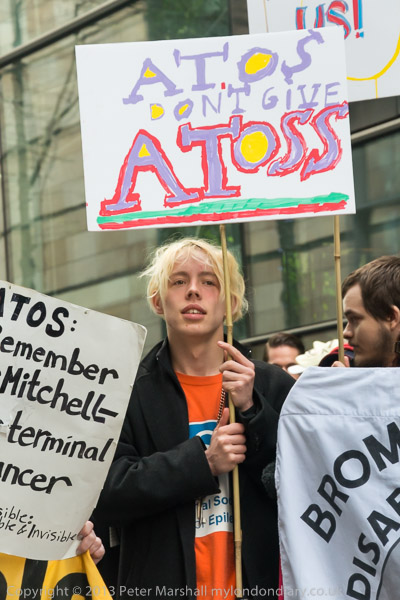
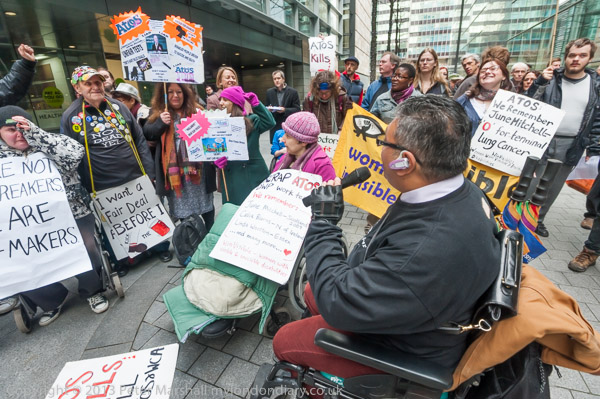
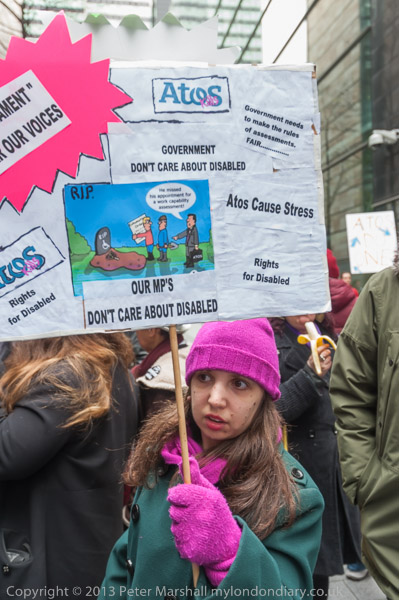
Seven years ago, 19 Feb 2014 was a big day for protests, particularly as campaign groups Disabled people Against Cuts (DPAC), Black Triangle, Atos Miracles, the Green Party, NUS, Occupy New Network, PCS, Unite and many others were taking part in a National Day of Action against Atos for its institutionally incompetent Work Capability Assessment testing of disabled people which has resulted in many disabled people being unfairly refused benefits.

There were protests at each of the 144 Atos testing centres around the country, including those at Wimbledon, Neasden, Marylebone, Highgate, Ealing, Balham and Croydon in London, but I only photographed them at the Atos offices in Triton Square, just north of the Euston Rd.

Even a report commissioned for the government pointed out serious flaws, and over 40% of appeals after people have had their benefits cut by Atos assessments have been allowed a figure rising to over 70% where the appellants have been assisted in their appeals by benefits experts. These appeals take months, during which people are thrown into abject poverty, and often having won on appeal claimants are within a few weeks again penalised by a new Atos assessment.

Atos apparently get paid more for finding people fit to work, and use simplistic tests and often tricks to do so, with no quality control or penalty for those tests which are overturned on appeal. The protesters called for the company to lose its contracts and be prosecuted for its mishandling of the tests, and for these tests to be abandoned and the Minister responsible, Ian Duncan Smith to be sacked.

Many disabled people have been driven to suicide by these failed tests and the stressful appeals procedures. The government figures for January to November 2011 showed that 10,600 people, an average of 223 a week, died withing six weeks of having been found fit for work by ATOS. The Department of Work and Pensions scandalous response to the public outcry when these figures were released was not to take action to make the improvements that were clearly needed, but simply to refuse to respond to requests for similar information for later years. The campaigners say that assessments of fitness to work should be made by qualified medical doctors, ideally by “the GP who regularly sees and treats the sick or disabled individual in question” who they say “is the only person able to decide if an individual is fit for work.”

Among those I heard speaking outside Atos HQ were MP Dennis Skinner, Paula Peters of DPAC, Among those I heard speaking outside Atos HQ were MP Dennis Skinner, Paula Peters of DPAC, Green Party leader Natalie Bennett, journalist Sonia Poulton and the Rev Paul Nicolson of Taxpayers Against Poverty. You can read more about the protest and see more pictures at Atos National Day of Action.


I left the Atos protest briefly to cover three further events. The first at the Iraqi consultate in Kensington was a solidarity vigil by the wife and daughter of Shawki Ahmed Omar, an American citizen held and tortured in Iraq by US and Iraqis since his arrest in 2004, and now in Abu Ghraib. They were accompanied by two supporters at one of their regular vigils calling for his release. You can read more about the vigil and the case at Solidarity vigil for Shawki Ahmed Omar.


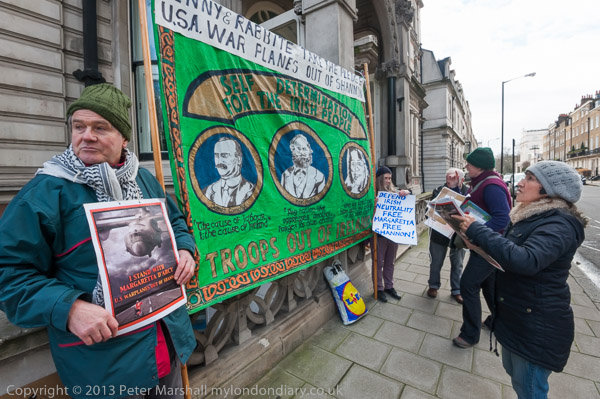
Next was a picket at the Irish Embassy close to Marble Arch to demand the immediate release of Margaretta D’Arcy, imprisoned for protesting against illegal US flights from Shannon Airport, and now in Mountjoy Women’s Prison, Dublin. More about this at Free Margaretta D’Arcy picket.


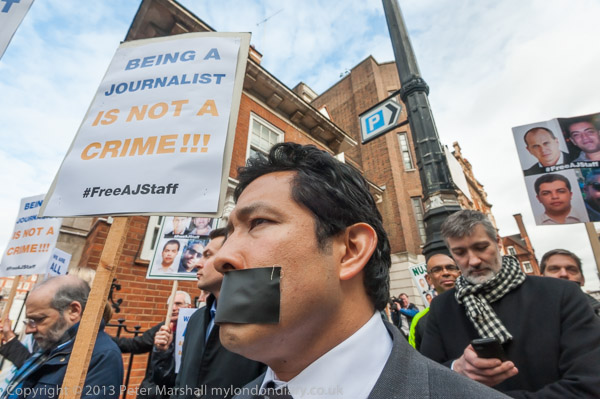
Third was a protest called by my own union the NUJ at the Egyptian Embassy in Mayfair, for press freedom in the country and calling for the release of all jailed journalists, including the four Al Jazeera journalists. More at NUJ demands Egypt release jailed journalists.


All photographs on this and my other sites, unless otherwise stated, are taken by and copyright of Peter Marshall, and are available for reproduction or can be bought as prints.


Tottenham

Since I was going to photograph a protest in Tottenham, a part of north London I don’t often get to, I thought I’d take a look at the new stadium there. I’m not a Spurs fan, nor of any other team, though I do still occasionally read the reports on Brentford’s matches in one of our free local papers with a little amusement. Although I was keen on sports when young and played in my areas leading under-11 football team – two of whose members went on to play for Brentford and one for Chelsea – and continued to compete for my school and several teams at football and rugby while a student, I’ve always considered watching sport – either live or on TV – a waste of time.

The new stadium looks fine, though I didn’t have time to investigate it beyond a few quick snaps. But what really gets me annoyed is that the club want to change the name of nearby White Hart Lane station (in White Hart Lane) to Tottenham Hotspur, and that TfL are more than happy to oblige in this annoying piece of corporate branding and pocket £14.7m for doing so. TfL’s job is to run a transport system, not to provide publicity. I will also feel rather disappointed if Spurs fans accept the name change for the ground and stop calling it White Hart Lane.

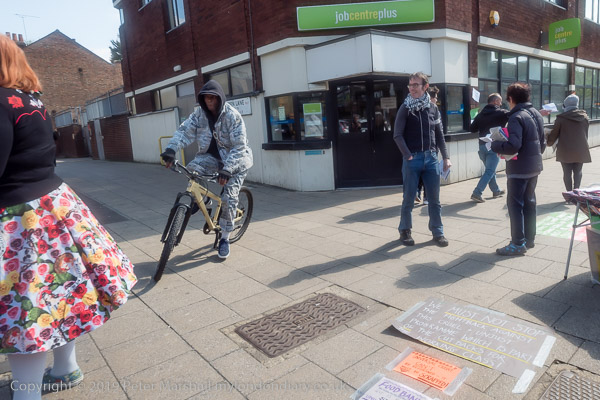
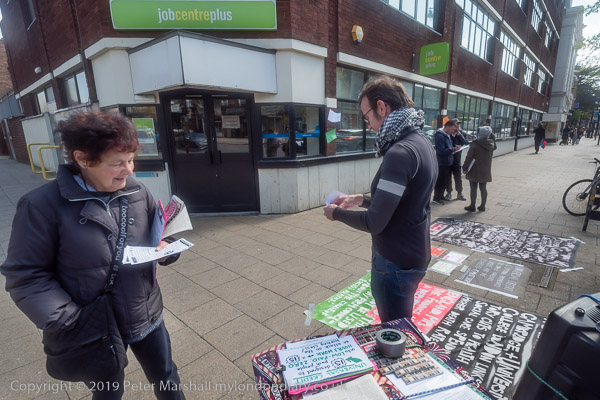
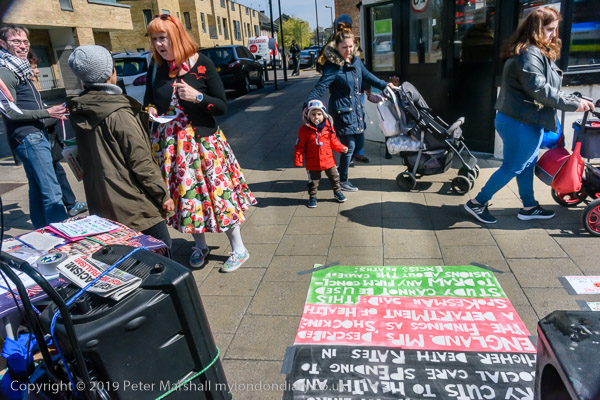
The protest outside the Tottenham Job CentrePlus was a small one, taking place on a Thursday lunchtime, and organised by the Revolutionary Communist Group, a relatively small left-wing organisation, but about a major issue, Universal Credit. Although some of its aims to simplify the benefits system are laudable it has been clear from the start that there were huge problems in the implementation, and that the whole scheme has simply not been properly designed. Add to that some political interference to cut costs and the whole thing is a disaster.

Much of the problem is I think that the scheme was designed by well-off and well-connected people who have little or no appreciation of how those affected live. The kind of people who, if they are a little short of cash at some point can sell a few things (perhaps some of their investments or the second or third house), get a loan at a relatively low interest rate from a bank or ask friends or family to tide them over.

Waiting a five weeks (or rather longer) for their money would not be a problem for them, but for those who are dependent on benefits it can be a disaster. It is a public disgrace that we need food banks, but UC has been a major factor driving the huge increase in people who have to use them – or starve. The other major factor driving people to them has been benefit sanctions, with people losing benefits often for trivial or even made-up reasons so that DWP staff can meet the targets set for them, leaving people with no resources on which to survive for months or even years.

Many too have become homeless for the same reasons, evicted because they cannot pay the rent. And far too many have died. It’s a scandal and one that attempts to draw public attention to and organise opposition I think deserve support, whoever organises them. It’s a pity that the sectional nature of left-wing politics means that the RCG seldom gets much support from people outside its own group for protests such as these.

As a photographer, small protests such as these present something of a challenge to make them newsworthy. As much as possible I try to cover them in a way that brings out the issues, perhaps as reflected in posters and banners, and also to produce images with some visual interest.

Scrap Universal Credit Jobcentre protest
Tottenham and Spurs


There are no adverts on this site and it receives no sponsorship, and I like to keep it that way. But it does take a considerable amount of my time and thought, and if you enjoy reading it, please share on social media.
And small donations via Paypal – perhaps the cost of a beer – would be appreciated.

All photographs on this and my other sites, unless otherwise stated, are taken by and copyright of Peter Marshall, and are available for reproduction or can be bought as prints.

To order prints or reproduce images