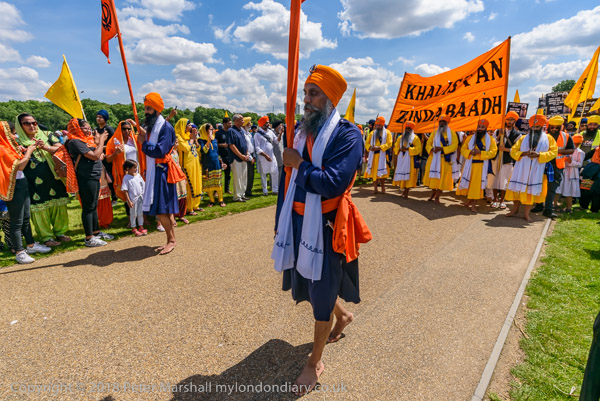
Scrap Universal Credit

Although it was a good idea to try and simplify the benefits system, Universal Credit has proved to be a costly failure, which has created a great deal of hardship for many of the claimants who have been transferred on to it.

Those who have been putting the system into effect – particularly the truly evil IDS (Iain Duncan Smith) have simply failed to understand how most people on low incomes or on benefits actually live. They inhabit a world where people have bank accounts which are seldom empty at the end of the month, who never have to think whether they can afford to buy food or pay the electricity bill or rent. People who if they find themselves a bit short – perhaps because they have just bought some luxury item or had an expensive holiday – have relatives or friends who can lend them the odd thou or can get a bank overdraft which they can pay off after the next pay cheque or two, or when the next deal comes through. People who probably own several houses, and are profiting from the rental on some of them.
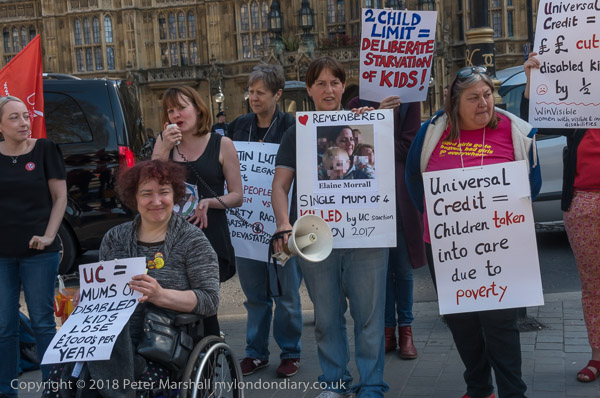
I’m fortunate now not to have to worry about money. Not particularly rich, but enough to meet my needs – and have the occasional small treat. I’ve lived on relatively little (by the standards of the wealthy) all my life, but grew up in poverty. My mother wrote down every penny she spent in a small red notebook, added it up at the end of every week. Usually there was enough to pay the baker, the butcher, the grocer (in those days they delivered and called for their money later) but sometimes she had to borrow a few pennies from a neighbour (or one of us children’s money boxes we saved the odd penny in) and pay them back with a little scrimping the next week.

People on low wages or relying on benefits don’t generally have the kind of back up that the middle classes take for granted. If they have to wait weeks without money (and most of those transferred to universal credit it is a minimum of 5 weeks, often much longer) they get behind with rent, often get threatened with eviction. They have to rely on food banks to eat.

Those most affected by the changes in the benefits system have been the disabled. Not just by changing to Universal Credit, but by other changes in benefits that have led to many losing the support that enabled them to live decent and productive lives. They have been targeted by deliberately poorly designed assessments of ability to work, administered to them by largely unqualified people who have targets to fail as many as possible. Its a system which has been clearly found to be unfit for purpose and where many are subjected to a repeated series of failed assessments followed – months later – by successful appeals.
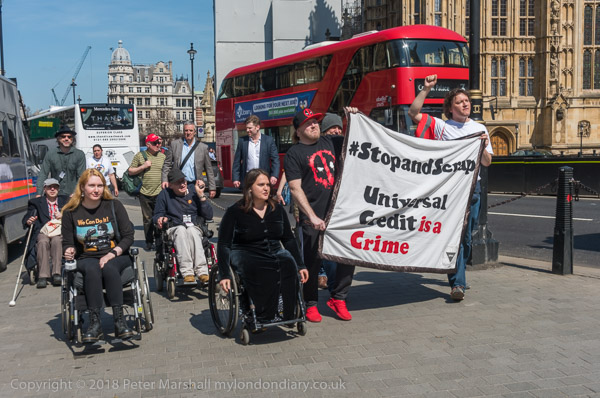
Its a system that has rightly been called Kafkaesque, and is probably beyond saving. The effects of all the cuts are even worse, a national scandal in which thousands have died. But the government still claim that despite the problems it is a success and in any case there is no simple way to stop it and go back to a system that, however complex, actually more or less worked.

Some of the problems of Universal Credit are down to the failure to get a working IT system that could not only deal with the many differing circumstances of those claiming benefits, but even more more importantly give the kind of instant communication of personal details between the DWP and the HM Customs & Revenue. It seems unlikely that this will ever be got to work, with truly huge sums being wasted on yet another failed IT project.
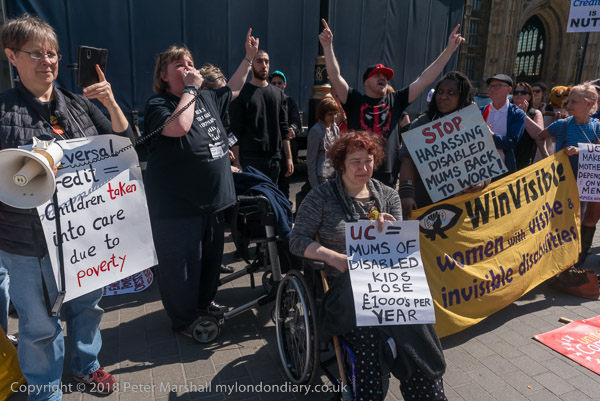
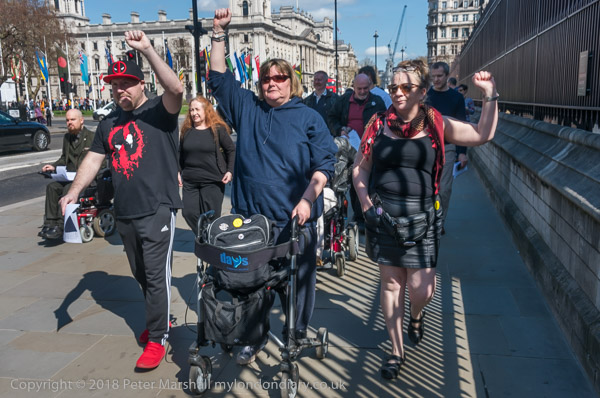
The Conservatives when elected as a part of the coalition in 2010 picked on the disabled because they thought they would be an easy target. But the activities of DPAC (Disabled People Against Cuts) have proved them wrong, producing some of the most determined of protesters, and a group the police find difficult to deal with, not wanting to invite public outrage.

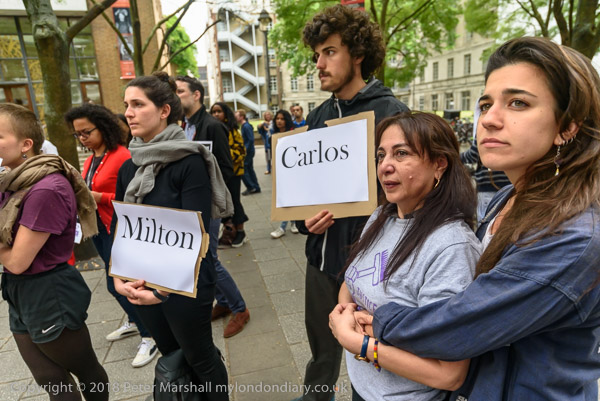
I met with the group outside Parliament, where some were intending to go inside and hold a protest there. I didn’t go with them as I was fairly sure I would not be able to take pictures, but instead went with others who were holding a rally in front of Parliament.
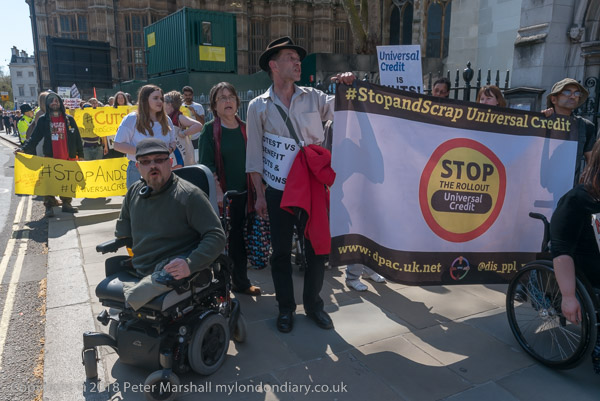
When the protesters came out after a noisy protest inside, the rally continued for a while and then Paula Peters told us more about what had gone on inside. She then asked those present if they were ready for some DPAC action, getting a resounding positive response.
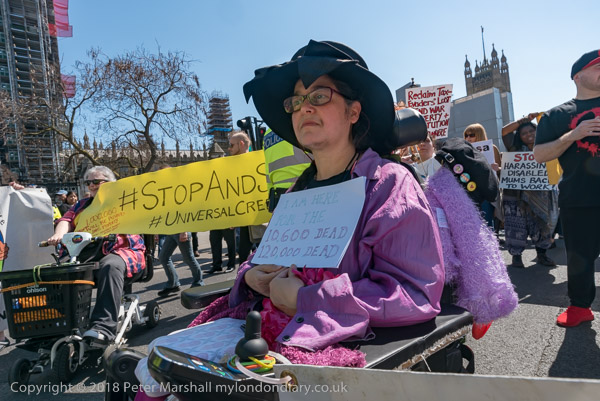
The group then moved off towards Parliament Square, where, as expected, they blocked the road, holding up all traffic wanting to go to Millbank or Victoria St. Police came to talk to them, telling them they were committing an offence and might be arrested, but most protesters ignored the warnings. A little over half an hour later, the protesters decided the road block had gone on for long enough, and made their way to the side of the road.

More on My London Diary: Stop & Scrap Universal Credit say DPAC

______________________________________________________

There are no adverts on this site and it receives no sponsorship, and I like to keep it that way. But it does take a considerable amount of my time and thought, and if you enjoy reading it, a small donation – perhaps the cost of a beer – would be appreciated.

My London Diary : London Photos : Hull : River Lea/Lee Valley : London’s Industrial Heritage

All photographs on this and my other sites, unless otherwise stated, are taken by and copyright of Peter Marshall, and are available for reproduction or can be bought as prints.

To order prints or reproduce images

________________________________________________________
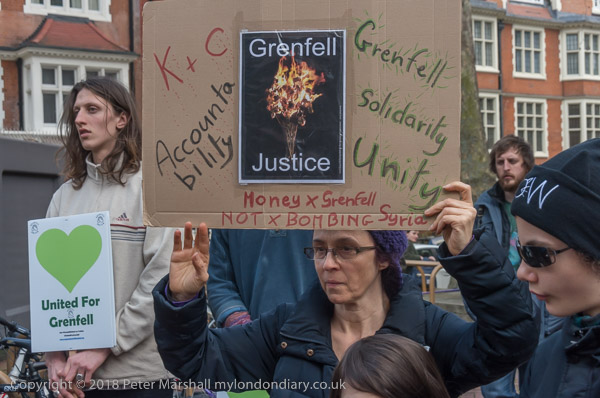
Grenfell – another month

Very little progress appears to have been made in finding homes for those displaced by the terrible fire at Grenfell Tower, and in April little or no progress appeared to have been made in the official investigations, either by police or others. There seems to have been a great deal of deliberate delay, one of the usual tactics of the establishment under threat, giving time for that grass to grow long.

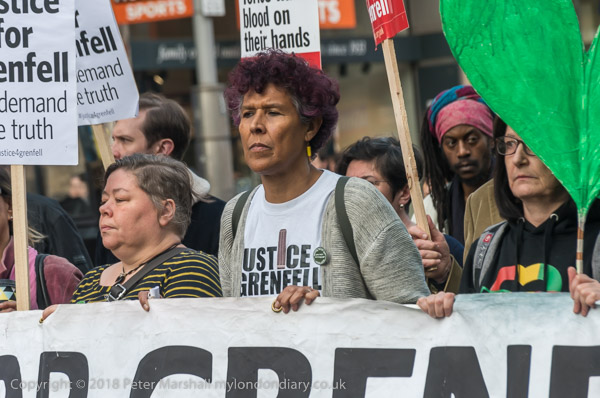
But I think it is clear that the Grenfell community will not give up its demands for Justice, with these monthly marches keeping up the pressure for action, even if so far little has resulted. One thing that many were discussing before the silent march began was whether something more active was needed.

Moving the march to start at Kensington & Chelsea Council’s offices just off Kensington High Street certainly make it more visible, with the march holding up traffic on one of London’s busiest streets, still full of shoppers and normally busy with traffic in the rush hour. Marching around Ladbroke Grove close to Grenfell Tower obviously was significant but could go almost unnoticed in the rest of London and the country.

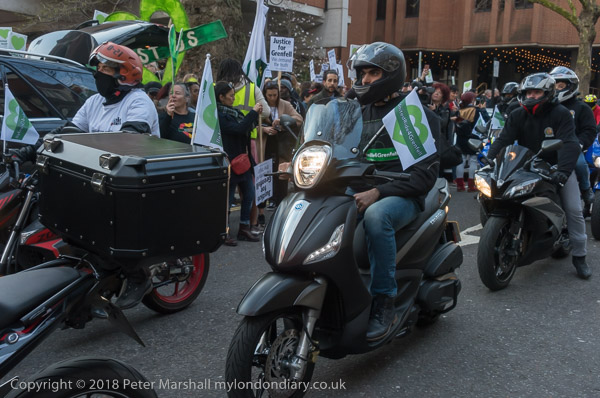
Not only was the march more visible, the event was more audible too. The march remains silent but the United Ride 4 Grenfell by bikers from the Ace Cafe on the North Circular Rd, which included Muslim bikers Deen Riders, riding to Parliament and then coming to Kensington Town Hall was definitely very noisy. The silent marchers waited by the side of the road at the Town Hall as they went passed, then moved onto the road to start the silent march.

I didn’t find it easy to photograph the bikers. The glare from their powerful front lights as the came down the slope towards the town hall was overpowering, and the first of them were past fairly quickly. Fortunately they had to wait for some of the group to catch up, and then for the traffic lights at Kensington High St, so I was able to take a little more time. There wasn’t a great deal on many of the riders or their machines to show their support; a few had flags on their machines or labels on their clothing, one or two with Grenfell t-shirts visible. I took most of the pictures opposite the marchers waiting to leave so their banners and hearts appeared in the background.


Grenfell silent walk – 10 months on
Bikers for Grenfell

______________________________________________________

There are no adverts on this site and it receives no sponsorship, and I like to keep it that way. But it does take a considerable amount of my time and thought, and if you enjoy reading it, a small donation – perhaps the cost of a beer – would be appreciated.

My London Diary : London Photos : Hull : River Lea/Lee Valley : London’s Industrial Heritage

All photographs on this and my other sites, unless otherwise stated, are taken by and copyright of Peter Marshall, and are available for reproduction or can be bought as prints.

To order prints or reproduce images

________________________________________________________
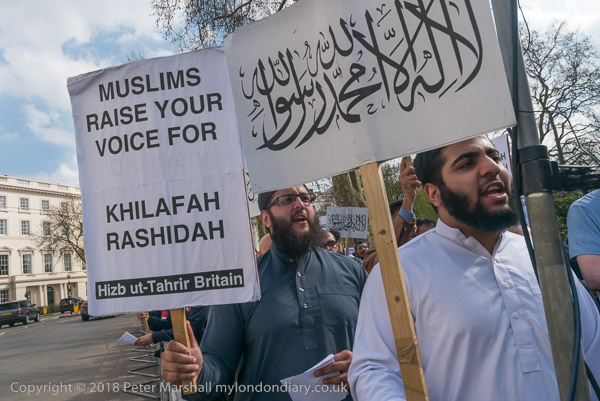
Hizb Ut-Tahrir at Turkish Embassy

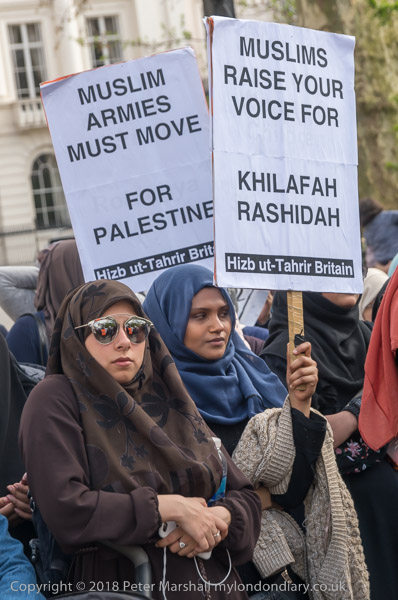
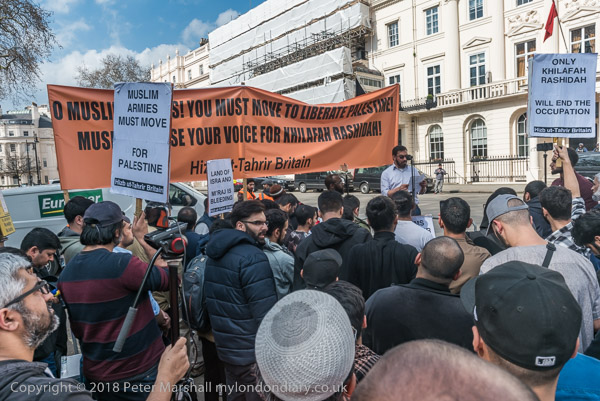
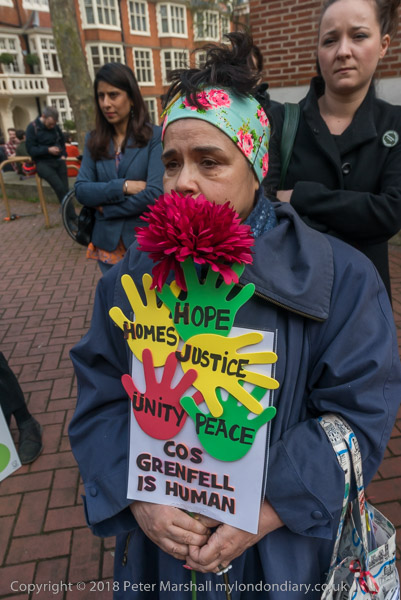
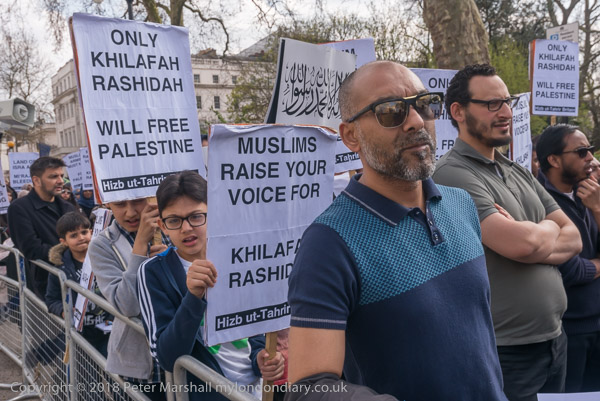
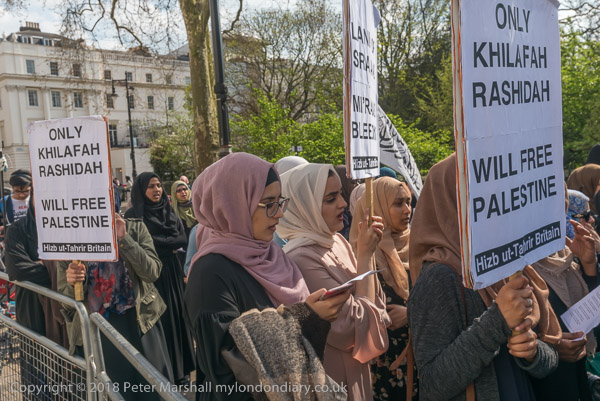
I first met Hizb Ut-Tahrir in 2004 and have photographed a number of their protests since then. There are often some at them who are not very happy about being photographed, though mainly it is a few men who are unhappy about the women on their protests being photographed. Of course they have staged women’s protests – such as one at the French embassy in 2010, but at most the women are relegated to an area well away from the speakers. At least at this one there were powerful speakers so they could hear what was going on, but at least while I was there, no women spoke.

The organisation was started in 1953 in Jerusalem by a Sunni Muslim scholar and aims to restore the Khilafah Rashidah, the “Rightly Guided” rule of the four caliphs who succeeded the Prophet in a 30 year reign when Muslim armies conquered much of the Middle East. They would sweep away the more recently created states such as Turkey which they accuse of complicity in handing Syria back to Assad in accordance with colonial interests.

While many Turks and Kurds condemn Erdogan as a dictator who is increasingly moving the country toward an Islamic regime, they condemn him as a secular leader, and in particular for his strengthening Turkish military and economic ties with Israel – which they do not recognise. The protest called on all Muslims to support the brave people of Palestine who “are raising their voices to speak out and protest against the illegal occupation, as they are mercilessly killed by the Zionist regime.”

Hizb Ut-Tahrir is banned in many countries, including, according to Wikipedeia, “Germany, Russia, China, Egypt, Turkey, and all Arab countries except in Lebanon, Yemen, and UAE.”
There were moves to ban it in the UK after the London bombings and again around the 2010 election but it remains legal here as there is little if any evidence of them being actively involved in any terrorist activities here. The organisation was given a huge boost by the invasion of Iraq in 2003 but numbers of supporters have declined in recent years.

More at Hizb Ut-Tahrir protest against Turkey.

______________________________________________________

There are no adverts on this site and it receives no sponsorship, and I like to keep it that way. But it does take a considerable amount of my time and thought, and if you enjoy reading it, a small donation – perhaps the cost of a beer – would be appreciated.

My London Diary : London Photos : Hull : River Lea/Lee Valley : London’s Industrial Heritage

All photographs on this and my other sites, unless otherwise stated, are taken by and copyright of Peter Marshall, and are available for reproduction or can be bought as prints.

To order prints or reproduce images

________________________________________________________
Mayfair Monopoly

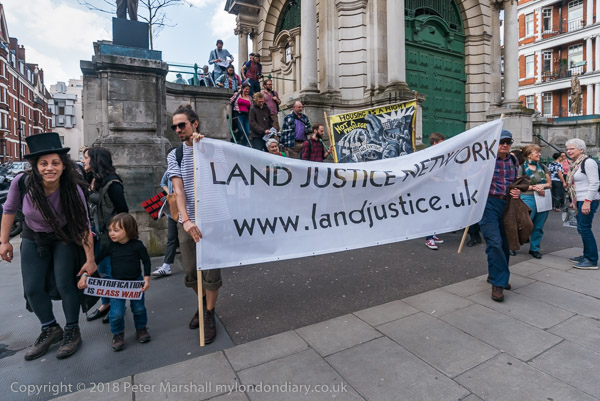
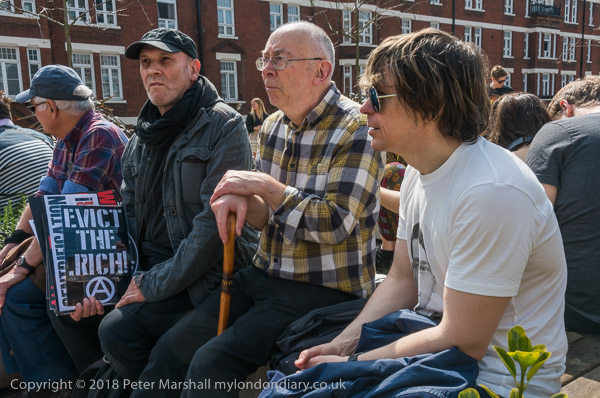
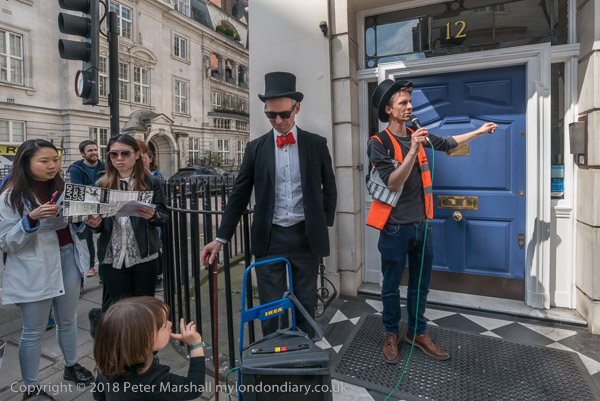
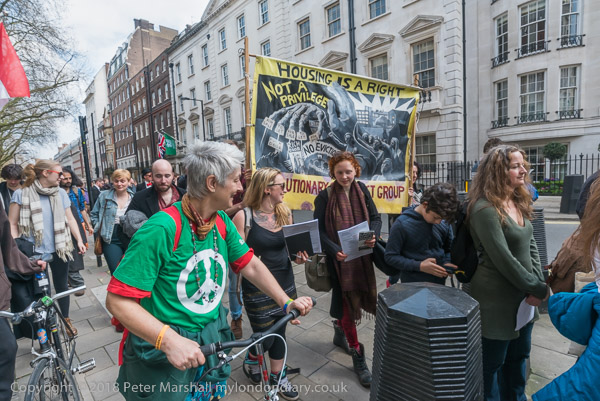
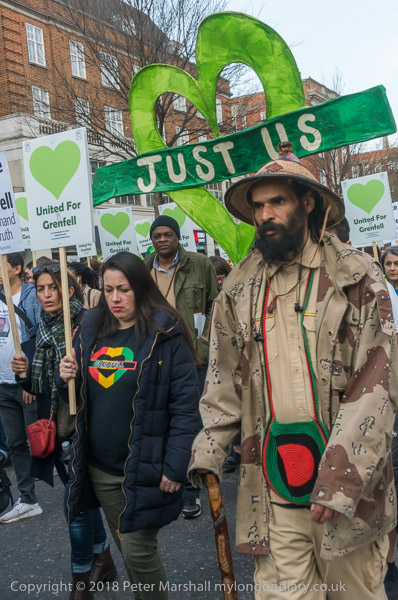
We had come to Brown Hart Gardens in Mayfair for the start of a Land Justice Network event, loosely based on the board game ‘Monopoly’, The Landlords’ Game, an illustrated tour of London’s wealthiest areas reminding us that land ownership in Britain is one of the most unequal in the world, both in rural areas and in cities.

The unequal ownership of land, much deriving back to the Norman conquest and its aftermath is the basis of our class system and the inequalities which still persist which arise from it.

There is an excellent report of the event on the Land Justice Network web site (including one of my pictures) which also has links to the great map and guide for the walk by Nick Hayes which people at the left of the picture above are looking at, and those of you who missed the event can repeat it on your own if you wish.

Much of Westminster is owned by the Duke of Westminster, since 1677 when an area of swamp on the outskirts of the city came into the possession of the 21 year old Sir Thomas Grosvenor by his arranged marriage to the 12 year old Mary Davies (arranged marriages at an early age were not unusual then), who had inherited the land from her father. At the time it was hardly worth much, but eventually it became Mayfair, Park Lane and Belgravia, and the backbone of the enormously wealthy Grosvenor Estates.

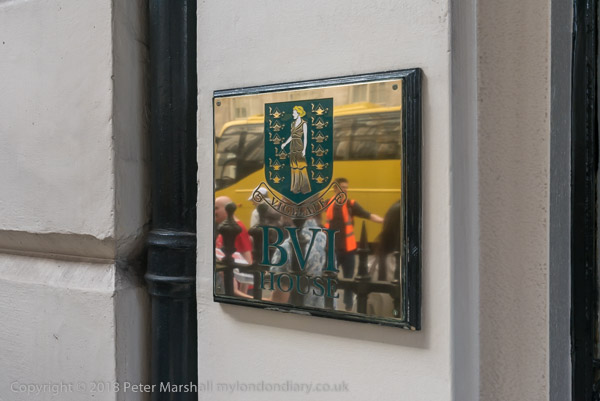
Although the land belongs to the Grosvenor estate, many of the buildings are owned by overseas companies, particularly those in tax havens – such as the British Virgin Island – outside whose offices we stopped for several speakers, including Christian Eriksson talked about his investigations for Private Eye tracking the massive increase in tax haven ownership of UK property by various dubious characters.

The tour included stops outside one large house empty for around 15 years, the London offices -‘Grouse House’- of Odey Asset management whose owner Crispin Odey formed ‘You Forgot the Birds’ to oppose the RSPB who want to stop the killing of birds.

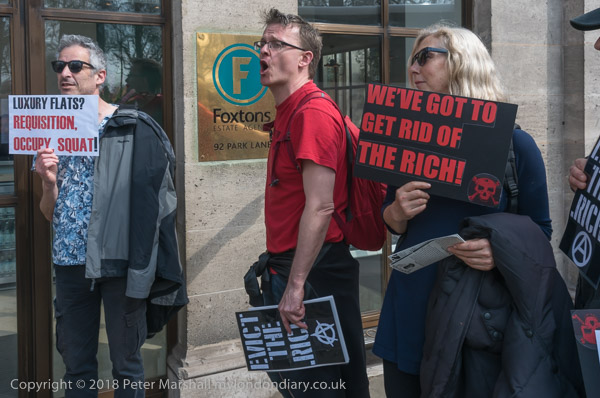
Then there was Foxtons, and along Park Lane to the Grosvenor Hotel, which hosts many of London’s most dubious events including awards for property developers, and into Hyde Park, the scene of many former battles over the public right of access, before walking along what was called London’s most expensive street, Grosvenor Crescent, where there is a statue of the first Marquis of Westminster (the family continued climbing, from Baronet to Baron to Earl to Marquis and finally Duke in 1874.)

I left the tour briefly to photograph another event, catching up with it again at the final rally in Cadogan Square, part of the second largest of the surviving aristocratic freehold estates in central London, owned by the Cadogan family, one of the richest families in the United Kingdom. The Cadogan estate began with another marriage, that of the second Baron Cadogan to Elizabeth Sloane, the daughter of Sir Hans Sloane, who had purchased the Manor of Chelsea in 1712.

More pictures at: The Landlords’ Game

______________________________________________________

There are no adverts on this site and it receives no sponsorship, and I like to keep it that way. But it does take a considerable amount of my time and thought, and if you enjoy reading it, a small donation – perhaps the cost of a beer – would be appreciated.

My London Diary : London Photos : Hull : River Lea/Lee Valley : London’s Industrial Heritage

All photographs on this and my other sites, unless otherwise stated, are taken by and copyright of Peter Marshall, and are available for reproduction or can be bought as prints.

To order prints or reproduce images

________________________________________________________
Friday the 13th

I suppose on average the 13th of the month falls on a Friday once in seven months, and there is no real significance in this. This year, 2018, we had one in July (for Trump’s visit) but also there was one earlier in April, and slightly unusually for a Friday I photographed three events.

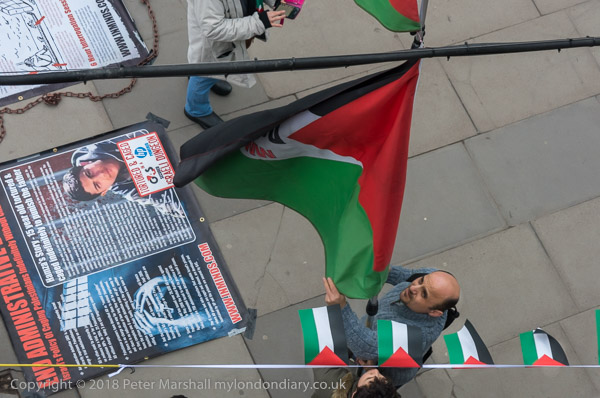
Inminds human rights group hold regular protests every couple of weeks, usually on a Friday against various aspects of the Israeli state’s treatment of Palestinians. They are at various locations, often outside companies who support the Israeli military or prison system in various ways, which provides some variety in the pictures on those occasions I go to photograph them. A constant feature is of course the Palestinian flag, rather a lot of them, including some on some very tall poles, which look good from a distance but are often difficult to photograph. Flags are often a problem too in seldom flying as the photographer would want, sometimes hanging limp, sometimes spelling out their message back to front.

As well as the flags, there is also some great Palestinian music which I never tire of hearing, extremely evocative. The speech about the reason for the protest of course differs depending on the location and the particular event, but many of the large banners they erect are the same, and it is sometimes difficult to produce different pictures.

Today it was Palestinian Prisoners Day and the protest highlighted the plight of the roughly 6,500 Palestinians currently in Israeli jails, around 350 of them children, and the protest was on the South Bank embankment in front of the Royal Festival Hall. And it was next to the downstream footbridge attached to the rail bridge into Charing Cross, which gave me a different perspective to play with.

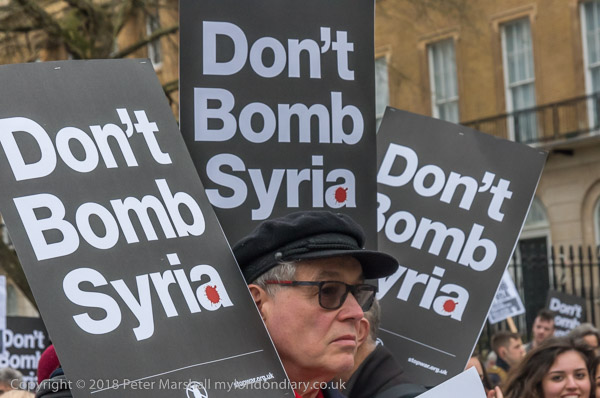
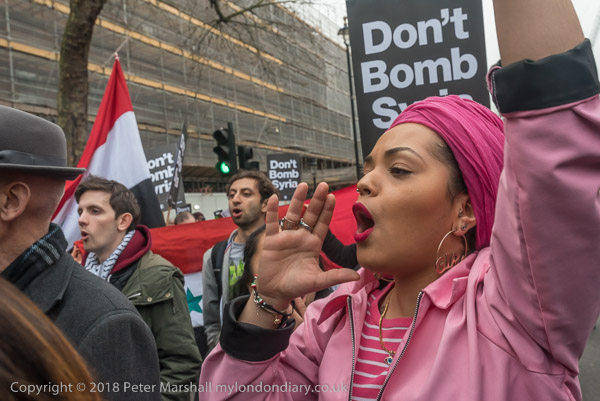
It was also conveniently on my way across the bridge for the short walk to Downing St, where Stop the War had called a protest calling for Theresa May to stop her plans to take part in bombing Syria, together with French and US forces, following a possibly unreliable report of a chemical attack by Assad’s forces.

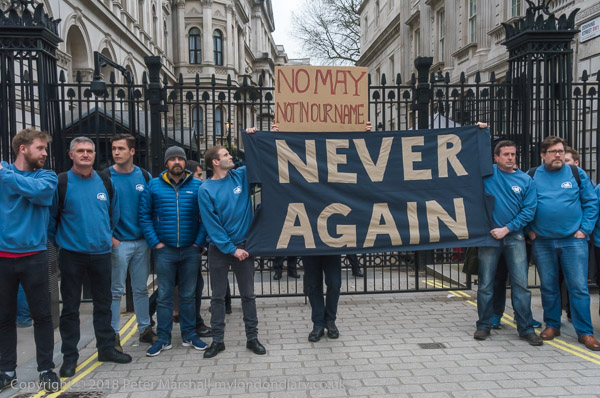
They were not the only groups there to protest, with a number of Syrian Assad Supporters, Veterans for Peace, and others who continued the protest after Stop The War, having had a few speeches from their members and taken a letter to Downing St (fortunately they went with an MP who was allowed in to deliver it, though they were not) in their highly controlled protest packed up and left. Things then got a little more interesting with people going on to Whitehall and blocking traffic, eventually being removed by police.

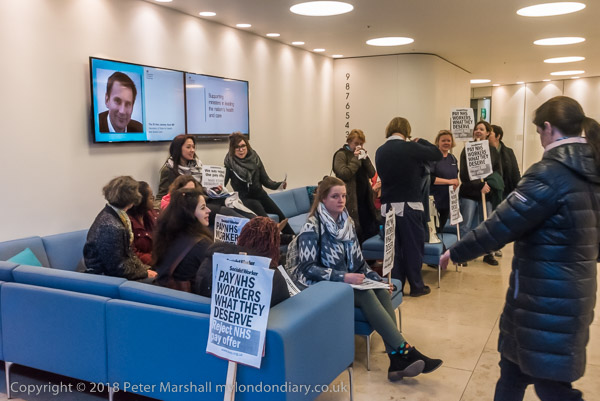
Though better to photograph, this also threatened my schedule, as I was hoping to cover a small protest at the Ministry of Health by NHS staff from hospitals across London opposed to the proposed pay deal for all NHS staff other than doctors, dentists and very senior managers.

It would have been easy if the Dept of Health was still in Whitehall, in Richmond House where it had been since this was built in 1987, just a few yards from Downing St. But unfortunately it recently moved out to new offices in Victoria St around half a mile away, rather a long way to run carrying cameras and bag. I saw the protesters outside in the distance as I trotted down the street, but then looked again when closer and they had disappeared, having occupied the foyer.

Fortunately security had not locked the door, and I was able to follow them in to take a few pictures, but was rather out of breath and perhaps not at my best. After a few minutes they went outside and posed for some group photographs.

More on all three protests:

Palestinian Prisoners Day protest
Don’t Bomb Syria protests
Ditch the Deal say NHS Staff

______________________________________________________

There are no adverts on this site and it receives no sponsorship, and I like to keep it that way. But it does take a considerable amount of my time and thought, and if you enjoy reading it, a small donation – perhaps the cost of a beer – would be appreciated.

My London Diary : London Photos : Hull : River Lea/Lee Valley : London’s Industrial Heritage

All photographs on this and my other sites, unless otherwise stated, are taken by and copyright of Peter Marshall, and are available for reproduction or can be bought as prints.

To order prints or reproduce images

________________________________________________________
Not Quite Déjà-vu

This morning I took a look at the front page of Café Royal Books, a small independent publishing house based in Southport, England originally set up in 2005 by Craig Atkinson as a “way to disseminate drawings and photographs, in multiple, affordably, quickly, and internationally without relying on ‘the gallery’“.

Since 2012, Café Royal Books has published at least weekly an ongoing series of publications presenting mainly ‘British Documentary Photography since 1960’. As he says on the site:

“This type of work has historically been neglected, in the UK and overseas by major institutions. It is often neglected by the photographer too, possibly because there has been no outlet, as such, for it.”

The publications usually present a series of images by a single photographer on a single project. It may be the work from a single event or representing a much longer project.  CRB has produced some larger works, but these weekly publications are generally between 24 and 40 pages, more a zine than a book, with the aim of building up a comprehensive survey of the area of work. Some photographers are represented by quite a few such volumes, in some cases more than 20, while others have preferred to stop at a single issue.

Atkinson keeps down costs, wanting to keep the issues affordable – currently £6 each for most.  You can get every title (except the special editions etc) with a 60 issue subscription – roughly the annual output – and there are also limited editions in a boxed set of 100 books every 100th title aimed “at public collections, so the books remain accessible.”

Among the photographers who have already had issues published are some very well-known names – including Martin Parr, Jo Spence, Daniel Meadows, Brian Griffin, David Hurn, Victor Sloan, Chris Killp, Paul Trevor and others, but some of the best books are by people you may well never have heard of.

The three most recent titles are Diane Bush — The Brits, England in the 1970s,
Ian MacDonald — Greatham Creek 1969–1974 and Janine Wiedel — Chainmaking: The Black Country West Midlands 1977, each worth a look, and you can page through them on the web site. Another recent title is John Benton-Harris — The English, where I have to declare an interest, as I helped John translate his ideas into digital form. It’s a great introduction to the work of this photographer who came to London to photograph Churchill’s funeral and stayed here as one of our most perceptive observers – and was also largely responsible for the seminal 1985 Barbican show ‘American Images 1945-80‘, providing most of the ideas and contacts and doing much of the legwork for which others were rather better at taking most of the credit.

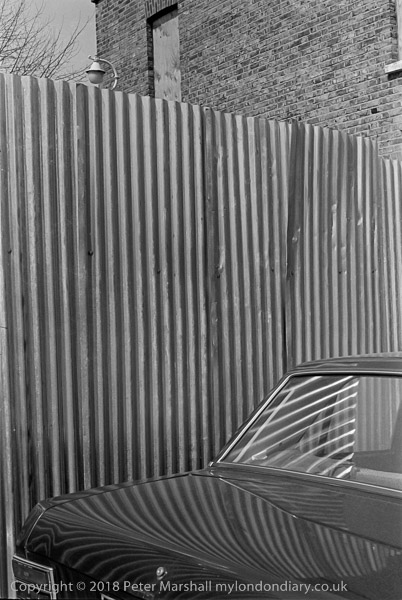
But the déjà-vu? It came on the back cover of a book by another US visitor to this country, Diane Bush, who was here from 1969 for ten years, becoming a part of the Exit Photography Group with Paul Trevor and Nicholas Battye which produced ‘Down Wapping‘. On the back cover of her ‘The Brits, England in the 1970s’ was a picture of a car parked in front of a fence, using the reflections of that fence. It isn’t the same car nor I think the same fence, nor quite the same treatment, but I immediately thought of my picture when I saw hers.


Parked car, Vauxhall, Lambeth, 1978 – Peter Marshall

I don’t think there is much possibility that I had seen her picture when I took mine, but have a nagging suspicion that somewhere, by some photographer, is a similar image that we both had seen before making our pictures.
______________________________________________________

There are no adverts on this site and it receives no sponsorship, and I like to keep it that way. But it does take a considerable amount of my time and thought, and if you enjoy reading it, a small donation – perhaps the cost of a beer – would be appreciated.

My London Diary : London Photos : Hull : River Lea/Lee Valley : London’s Industrial Heritage

All photographs on this and my other sites, unless otherwise stated, are taken by and copyright of Peter Marshall, and are available for reproduction or can be bought as prints.

To order prints or reproduce images

________________________________________________________
Photojournalism’s sexual harassment problem

Some of the best photographers I know are women, and there are many women in photography whose work I admire. Probably a rather higher proportion than among male photographers, because in general it is tougher for women to have successful careers in photography. And when I had a job writing about photography and photographers I tried hard to give women their due, though in the past history of photography they are greatly outnumbered by men. But there are of course many worthy of mention, and I wrote at some length about as many as I could.

When I was teaching photography, almost all my best students were female, and I realised then the importance of female role models, making sure to include the work of women photographers in my teaching and to buy books featuring them for the college library – including Naomi Rosenblums 1994 ‘A History of Women Photographers’. Of course many I would have included in any case – such as Julia Margaret Cameron, Cindy Sherman, Nan Goldin, Dorothea Lange, Jo Spence – but there were other less well known names.

A few years ago my union branch produced a t-shirt based on the experience of women photographers with the message “Yes I’m a woman – Yes it’s a big lens – Any other stupid comments?” but it was the public rather than photographers this was aimed at.

I’ve never been aware of sexual harassment of women photographers by other photographers and found the examples given in the CJR Special Report: Photojournalism’s moment of reckoning deeply disturbing. While it is no surprise that such people exist (and I’ve come across them elsewhere) what is shocking is the way that their behaviour has been tolerated and even excused by some of the best-known organisations in the business. As the report says “women photojournalists say publications, institutions, agencies, and industry leaders have turned a blind eye.” It’s disgusting to see the hypocrisy of “a field that claims to shine a light on abuses or wrongdoing in the world, while protecting predators in their own industry.”

While we all knew before the #MeToo movement that such practices were prevalent in the movie industry, where the casting couch was the route to many successes, some of us were naive enough to assume that photojournalism had higher standards. Apparently not. It seems our industry has to say #UsToo.

June 2018 – At last


Huddersfield Royal Infirmary campaigners at the BBC – NHS at 70 – Free, for all, forever

I have at last finished updating My London Diary for June 2018. It’s been hard work for various reasons. Thirty three stories and around 1800 pictures represents quite a lot of time, travelling to and from events as well as being there to take the pictures. And on average it probably takes me another couple of hours to process and caption the images to upload to one of my agencies. Some stories require quite a bit of extra research, as well as more general research to keep up with events.

After I’ve sent off the pictures there are other things to do. Most I make available on Facebook for my friends and the public, particularly for those who took part in any events. Usually having created a Facebook album I then post links to the pictures on the event pages or other relevant places, as well as putting them on Twitter.

For the posts on My London Diary I then go through the pictures again, picking out more pictures that fill gaps in the story, showing different aspects or different people taking part and ‘develop’ those to add to the set I’s selected to go to an agency. Typically I’ll put a little over twice as many on my web site as I file, and these often include a number of the more interesting pictures which I’ve decided for various reasons aren’t suitable for the agency.

The text that was filed with the pictures is a starting point for My London Diary, but often needs extra information. And since it is my own web site and meant to be a personal one, often it gives rather more of my opinions. Finally, although I designed the web site to be easy to update, adding the information also takes time, most of it in adding captions which as well as telling readers what the pictures are about are also vital in making them accessible through on-line searches.

June 2018

NHS at 70 – Free, for all, forever
Torture protest at US Embassy
Vauxhall & Nine Elms
Peckham & Deptford
Many Thousands March for a People’s Vote


Vote No to Disastrous Heathrow Expansion

White Pendragon letters refused
No Heathrow block Parliament Square
Stop Arming Saudi to bomb Yemen
Protesters Stand Up For The Elephant
Assange in Embassy for Six Years
Staines Walk
Justice for Grenfell Solidarity March
Massive Silent Walk for Grenfell Anniversary


‘SOAS 9’ deported cleaners remembered

TGI Fridays demand Fair Tips & Fair Pay
Stop Brexit ‘Pies Not Lies’


Al Quds (Jerusalem) Day

Zionists protest against AlQuds Day
100 years of Votes for Women
End government killings in Nicaragua
Anti-fascists oppose Free Tommy protest


Free Tommy Robinson

Close all Slaughterhouses
Flypast for Queen’s Official Birthday
Colombian Carnival for Water, Life & Land
Die-in against Greenwich cycle deaths
University of London staff in-House now
Zionists defend Israel shooting protesters


Free Palestine, Stop Arming Israel

Abortion Rights in Northern Ireland Now


Sikhs remember the 1984 genocide

Anti-Knife UK protest

At the bottom of the page is a link to the pictures I occasionally take travelling around London, mainly from bus or train windows, and a few when I’m walking. I like to travel on the top deck of buses which gives a different angle from Google’s Streetview, and trains often provide a quite different view of the city.

London Images

As usual, comments are welcome here on any of these pictures and stories.

______________________________________________________

There are no adverts on this site and it receives no sponsorship, and I like to keep it that way. But it does take a considerable amount of my time and thought, and if you enjoy reading it, a small donation – perhaps the cost of a beer – would be appreciated.

My London Diary : London Photos : Hull : River Lea/Lee Valley : London’s Industrial Heritage

All photographs on this and my other sites, unless otherwise stated, are taken by and copyright of Peter Marshall, and are available for reproduction or can be bought as prints.

To order prints or reproduce images

________________________________________________________
Stop the Killing

I spend a lot of time at events wondering what I should photograph. Of course there are people and situations that are visually attractive and it would generally not be sensible to miss these opportunities, but that isn’t enough. It can often even be quite misleading and unrepresentative of the event, though it’s often such images that get published, and what I think many photographers aim for to sell to newspapers.

Another type of image that seems often to get published are group photos, with large numbers of people holding a banner, taken frontally in the manner of team photographs – I often joke about putting someone in the middle holding the ball, though few find them funny. I suppose for small events these at least let you see how many were taking part, and local newspapers used to feel that showing more faces boosted sales, but when there is often a large group of photographers crowding to get around the centre spot I usually avoid it.

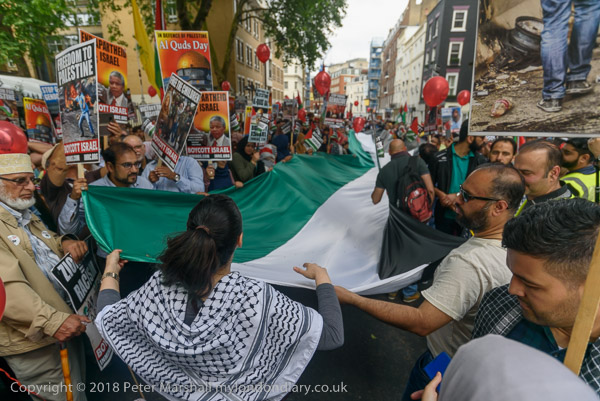
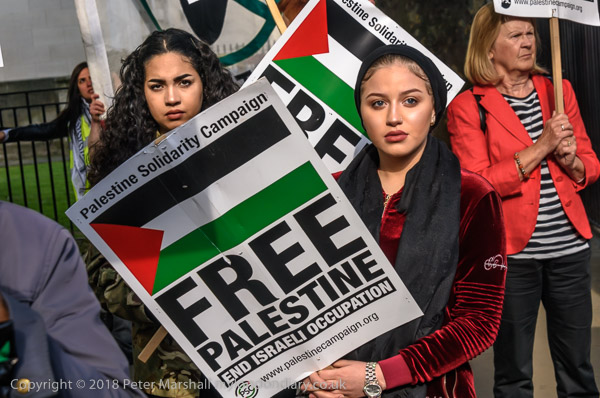
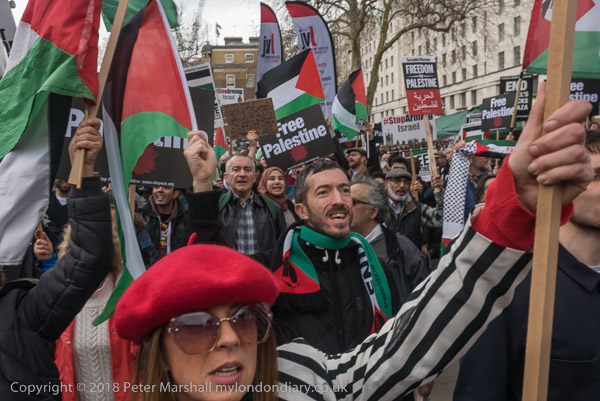
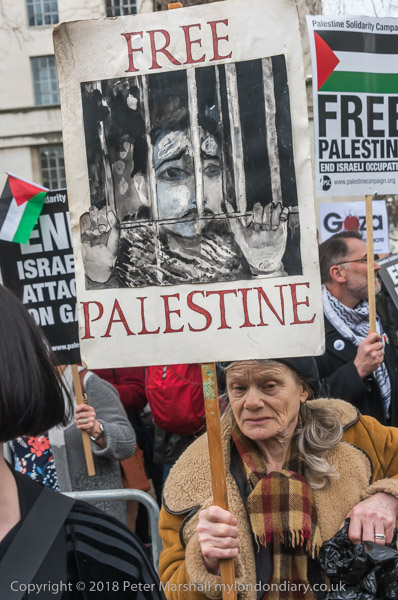
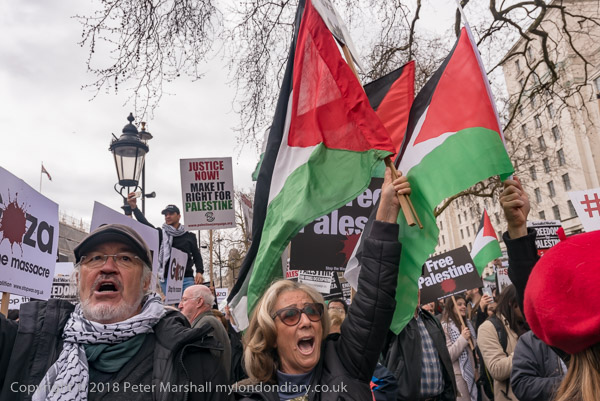
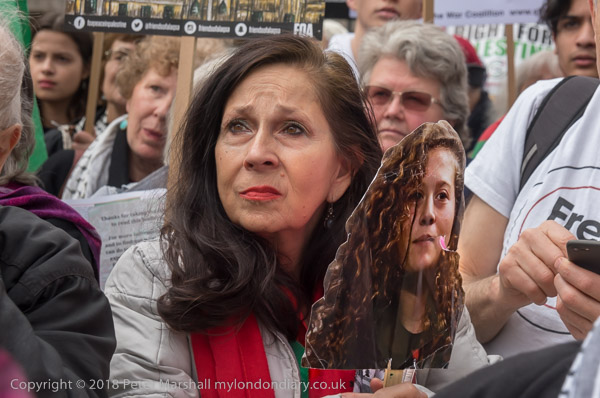
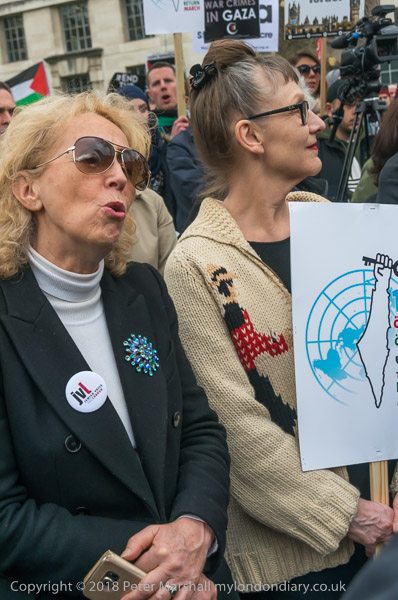
My motivation for photographing events is to tell the story. And for me that very seldom can be done in a single image but requires a series of images. Placards and banners are often very important in this, as to are gestures and expressions. At this protest, I tried to show something of the anger that people felt at the cold-blooded shooting of Palestinian protesters by Israeli snipers.

Things that are worth photographing aren’t always particularly photogenic, and it is often something of a challenge to make pictures that are visually attractive, clear and precise. I took a great many pictures, probably over a thousand, though at times there were very many of the same subject as I tried hard to ensure I had something close to what I wanted.

Photographing an event like this involves a huge number of decisions about where to be when and what to photograph – and on more technical matters such as focus, focal length and framing. I try to concentrate on these and take advantage of the automatic features of the camera to deal with as much as it can; though usually I like to chose where the focus is, I’m happy to let the camera actually auto-focus there, and to let auto-exposure get the exposure more or less correct.

This was a large protest, with several thousand packing mainly in to a fairly small space, making movement through the crowd a little difficult. There was a small press area in front of the stage, but I chose not to use it for photographing the speakers as it was too close to them looking up from below. But the crowd perhaps meant I stood in that one place rather longer than I would have liked.

I wondered briefly whether or not to photograph the counter-protest by half a dozen Zionists a few yards away, and decided to do so – and you can see a few at the link below. There were many, many more Jews in the protest ashamed of the actions of the Israeli snipers following their orders to kill and maim unarmed protesters at a distance, shooting many in the back as they ran away, using bullets designed to expand and inflict maximum damage to those they did not kill.

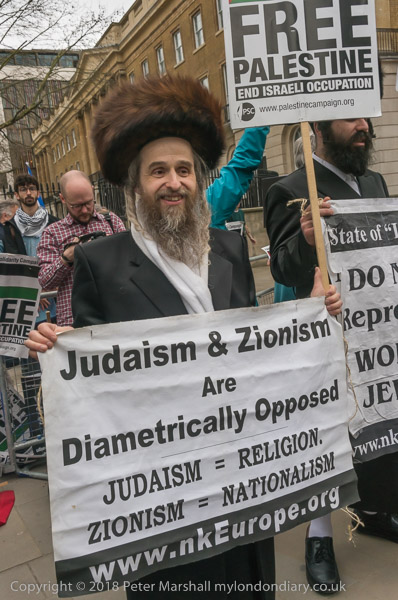
And as usual at such protests there were the anti-Zionist Jews with their message “Judaism Demands FREEDOM for GAZA and ALL PALESTINE & forbids any Jewish State” .

Here I’ve only posted a small and fairly random selection of the images that I took – and written very little about the actual protest. You can read more and see an unusually large number – around a hundred – of the pictures I made (edited down from perhaps a thousand) on My London Diary at Great March of Return – Stop the Killing

______________________________________________________

There are no adverts on this site and it receives no sponsorship, and I like to keep it that way. But it does take a considerable amount of my time and thought, and if you enjoy reading it, a small donation – perhaps the cost of a beer – would be appreciated.

My London Diary : London Photos : Hull : River Lea/Lee Valley : London’s Industrial Heritage

All photographs on this and my other sites, unless otherwise stated, are taken by and copyright of Peter Marshall, and are available for reproduction or can be bought as prints.

To order prints or reproduce images

________________________________________________________
Pennies for the guy…

Pennies for the guy who took the picture is the offer to photographers from  National Geographic Fine Art Galleries (NGFA) revealed in the article  Is National Geographic Fine Art a Ripoff for Photographers?  published on PetaPixel. In it Ken Bower writes of how his initial reaction to having one of his landscape images selected to be sold by the NGFA turned sour when he found out more about how the NGFA sales programme works.

The NGFA explained it to him, and you can read their explanation in the Petapixel post. If NGFA sell the print for $1800, 10% of that amount goes to the National Geographic Creative agency – so in this case a miserly $180. That agency then gives half of their cut to the photographer, who ends up with $90 – just 5% of the price the buyer has paid.

Simple maths shows us that the NGFA itself takes 90% of the purchase price – in this case $1620. That’s 18 times as much as the photographer. And although NGFA increases the price of the prints as the edition – of 200 prints – sells, that ratio remains the same. If they sell the whole edition of 200, those pennies for the photographer would however add up to a substantial amount – if nothing like as substantial as that made by the NGFA.

Now I appreciate galleries have costs. In this case they are making the prints, running a web site, conducting the sales etc. I’ve sold a few prints through galleries, and their commissions have ranged from 20% to 35%, and a 50:50 split is not unusual. Some I’m told even take a little more – but even the worst deals I’ve heard of leave the photographer with 40%, eight times what NGFA are offering.

As Bower points out, the NGFA seems to be “targeting photographers who have placed well in Nat Geo photo competitions or who are popular on the Your Shot community” for their sales, rather than the extremely professional and talented professionals whose work is published by National Geographic – who would have a much better idea of the worth of their images.

I’m not a great fan of commercial photo galleries, as regular readers will have noticed. With few exceptions I don’t feel they have the best interests of photographers or photography at the base of their activities. I still think and have often argued that the concept of limited editions is inimical to our medium and am unhappy at the fetishisation of the photographic print and in particular of the ‘original print’ that they foster. Overall I think they are parasitical on photographers and photography, though there are a few I respect for how they have genuinely contributed to our knowledge and understanding of the medium’s history.

But while buying prints from a commercial gallery, or better, from a photographer may at least sometimes be a sound investment as well as a pleasure to be enjoyed, it seems to me that the NGFA is essentially selling high price decor. I’m not dismissing Bower and those who have signed up with them as photographers – his is certainly a decent landscape image – but those with cash to spare will buy it or images like it because it goes with their colour scheme – and the next time they have new interior decorators in, that picture will go out with the trash – or if they try to sell it they will almost certainly find its resale value is far less than they paid, possibly little if any more than the worth of the frame.

As Bower hints, essentially what is being sold are high-price posters. Not printed by the photographer, the printing not overseen by the photographer, decisions about paper etc. not made by the photographer. An edition of 200 might almost as well be labelled unlimited, and the prints are not signed by the photograph but machine-signed with a ‘digital signature’.

There is a poll at the bottom of the Petapixel page asking for readers to rate the deal. When I looked at it, to my astonishment there were 15 people out of a little over a thousand who thought NGFA were offering a great or good deal. It made me wonder if they worked for the company, though on any poll you can get a few random drunken clicks. At the other end of the scale almost 96% thought it a bad or horrible deal. I think you can guess how I voted.