Birth of the Fake News Photo

Another splendid piece by Kenneth Jarecke on Medium, Birth of the Fake News Photo takes a look at the principles that grew up (if unevenly) to produce the ethical basis of photojournalism and their more recent undermining, in particular by World Press Photo.

Jarecke writes with beautiful clarity, and is (as Wikipedia states) an American photojournalist, author, editor, and war correspondent. He has covered “everything, from wars to Olympic Games, in all corners of the world”.

You can see some of his fine photographs on his own web site, and at Contact Press Photos – of which he was one of the founding photographers.

His web site also contains a age worth reading in which he outlines his philosophy, which is also worth reading.

More on Windrush

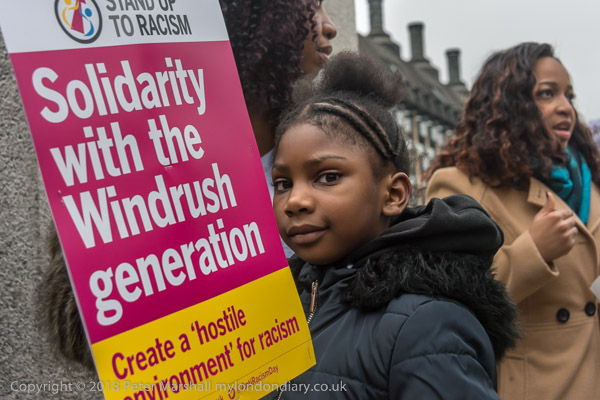
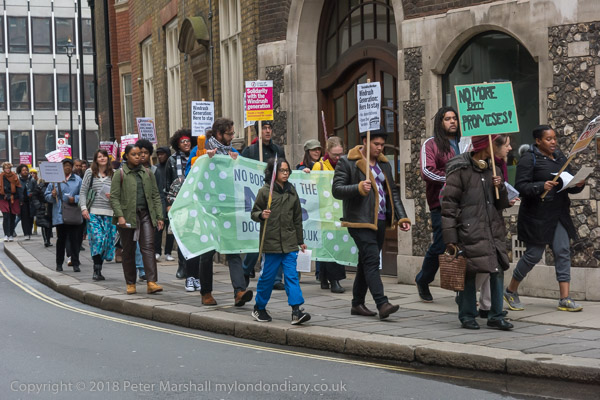
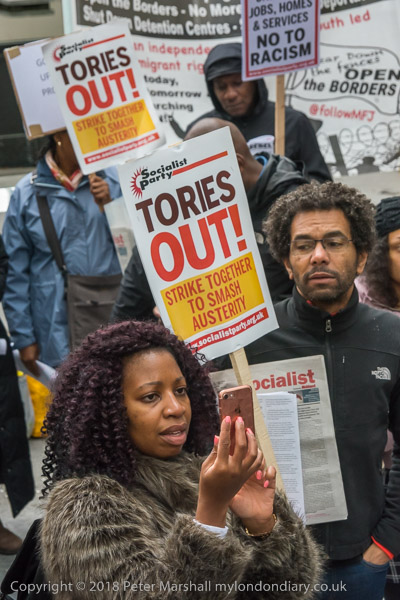
The march from Parliament Square to the Home Office was unusual in that it was called and organised not by a group, but by one incensed individual, Sara Burke who wrote that “the government’s abhorrent treatment of those from the Windrush generation is a national embarrassment”. Other groups including Docs Not Cops, Stand Up to Racism, Movement for Justice and the Socialist Party joined in to support her initiative, but it did give the event a slightly different feel.

The event began with people gathering in Parliament Square, where there was some organised chanting mainly led by people from Stand Up to Racism and the Socialist Party, but Sara Burke declined to speak there and led a rather quiet march through Parliament Square and on to the Home Office, insisting that the marchers kept to the pavement.

Sara Burke did give a carefully prepared speech outside the Home Office, and there were other speakers including from all of the supporting groups.

A few of the same people were back on Monday afternoon for a protest during the parliamentary debate on a petition with 170,000 signatures calling for an amnesty for all the ‘Windrush reneration’ who arrived here up to 1971, calling for a change in the burden of proof  – instead of individuals being assumed illegal unless than can prove their right to remain, it should be up to the authorities to prove that they arrived after 1971 or are otherwise not entitled to stay, and calling on the Home Office to provide compensation for any loss and hurt they have caused.

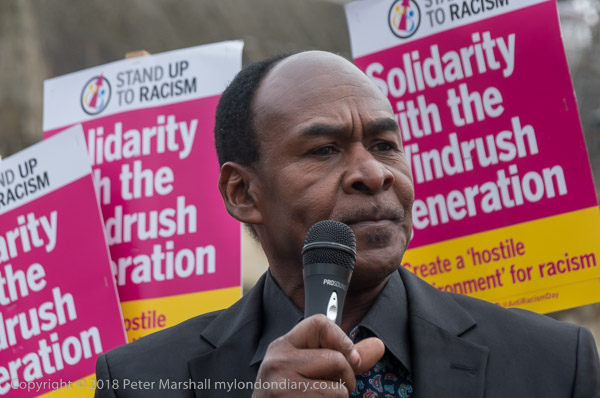
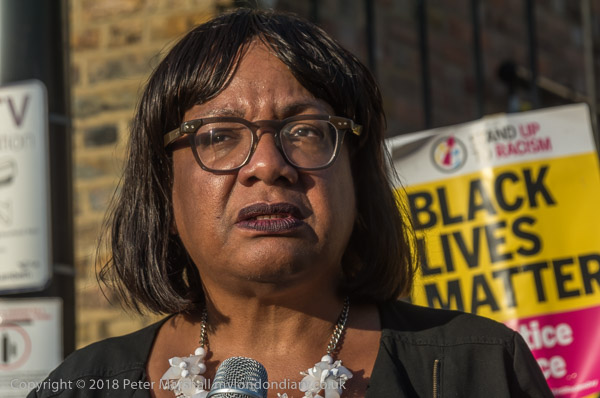
Among those who spoke was Harold, above, who came to this country legally in the 1950s and and has worked here since, but  who the Home Office has been refusing a passport and was threatening with deportation, others whose parents and grandparents are from ‘Windrush’ families, and anti-racism campaigners including NEU General Secretary Kevin Courtney and Shadow Home Secretary Diane Abbott.

Windrush march to Home Office
Protest supports Windrush amnesty debate

______________________________________________________

There are no adverts on this site and it receives no sponsorship, and I like to keep it that way. But it does take a considerable amount of my time and thought, and if you enjoy reading it, a small donation – perhaps the cost of a beer – would be appreciated.

My London Diary : London Photos : Hull : River Lea/Lee Valley : London’s Industrial Heritage

All photographs on this and my other sites, unless otherwise stated, are taken by and copyright of Peter Marshall, and are available for reproduction or can be bought as prints.

To order prints or reproduce images

________________________________________________________

Fuji Freeze

I like Fuji cameras and have quite a set of them, along with the lenses, but can’t bring myself to rely on them. With Nikon I seldom get let down; sometimes I may have a problem getting focus (I think my telephoto zoom needs a little attention) but generally they do what I tell them to when I want them to.

The Fuji’s have great image quality – nice lenses and are around half the size and weight. I’d love to use them all the time, but they make me miss too many pictures. With the kind of work I do, every fraction of a second sometimes counts, and they are often just too slow.

I was sitting drinking a coffee with a photographer friend outside a cafe next to a demonstration a couple of months ago, and he asks me whether I thought it would be a good idea for him to get a Fuji XT1 or XT2. I had to say no, and to show him why I picked up the Nikon D810 from the cafe table, brought it to my eye and pressed the shutter. It took a picture immediately.

Do the same with my XT1 and what would happen? Probably nothing, or at least nothing for a second or so, perhaps even longer, by which time the picture might well have disappeared.

I did it for real  couple of weeks ago, with my Fuji XE3, in many ways the nicest of the Fuji’s I’ve owned.  After which I made this post on a Fuji facebook site:

Fuji Freeze hits again.

I saw what I thought would be a great picture yesterday, moved into position, raised the Fuji X-E3 camera to my eye, framed and pressed the button.

Nothing happened. Nothing at all. Pressed again, ditto. Several times before it eventually realised it was a camera and took a picture. But by then it was too late.The woman had turned away, the inflatable dog she was holding fallen to the ground, the kid who was staring at me had decided his feet were more interesting… No picture.

The ‘Fuji Freeze’ had hit again. I’ve seldom noticed it with the X-E3 before now, though with the XT1 I’d got into the habit of turning the camera off and on again before trying to take a picture if I’d left the camera without using it for more than a few seconds.

With the Nikons I can pick up the camera, press the button and it just works. Why can’t Fuji be like that?

As you might expect, there was a range of responses, some more rational than others. Some people had obviously had similar experiences to me, while others were clearly in denial.

Reading the comments, I thought a little more about the problem went back to the manual, and found there at least a partial explanation. Fuji mirrorless cameras (and this may apply to other marques)  do not really have a ‘sleep’ mode. The manual, under ‘Auto Power Off’ states that that the camera turns off automatically after the selected time – unless you choose OFF.

Of course not quite everything is off, as the camera has to check now and then for a shutter press or half-press, so some circuitry is active, just not that connected with taking pictures. I suspect the circuit that keeps going to do this only checks perhaps every second or two. Which would account for the sometimes very annoying wait before the camera starts up – and why it can be noticeably slower than turning the camera off and on again. Coming up from off takes under a second on the XT3.

The manual says if you select ‘OFF’ for this, you have to turn the camera off manually.And it also says ‘shorter times increase battery life’. I find I had ‘1 minute’ selected, which clearly isn’t long enough for the way I want to work.The longest time setting is 5 minutes which might be enough for this not to be a real nuisance. Changing the setting to OFF ought to be better, but I already often get through 3 batteries in a session and the camera back seems to get very hot after a few minutes if you leave it on.

If I’m correct, Fuji could solve the problem by simply decreasing the time interval between the checks for the button press to a small fraction of a second. Only Fuji would know if this is a matter of hardware or firmware in their cameras.

However, the problem that I had was a longer delay than I can reproduce through testing with different settings of ‘Auto Power Off’. So I think it is some intermittent fault – and one that some others also seem to suffer from.

DSLRs generally have a fast enough time from power off to first picture that is too short to notice, and approaches zero if the camera is left turned on. The battery drain on leaving the camera turned on is small.

The Fuji X-E3 does pretty well from power off to first picture, at around 0.7s, apparently significantly better than most mirrorless cameras. But if you want truly instant response every time you need a DSLR.

Leaving a mirrorless camera switched on rapidly depletes the battery, and the best way to work with the X-E3 and other Fuji cameras is to turn them off manually after each series of exposures, and get into the habit of turning the camera on every time you want to take a picture.  That way you are less likely to be disappointed.

Workers’ Memorial Day

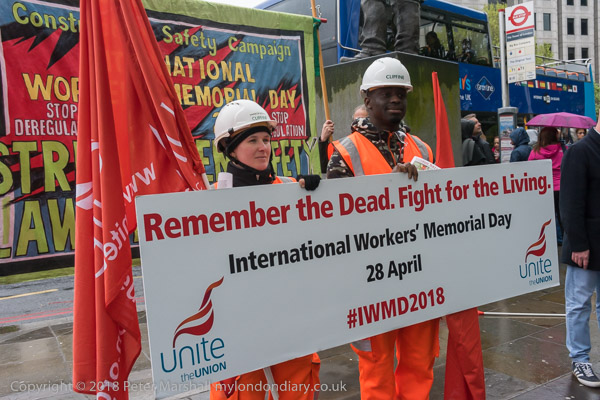
International Workers’ Memorial Day is observed on April 28th. It is also called International Commemoration Day (ICD) for Dead and Injured or sometimes just Worker’s Memorial Day, though the acronym for this, WMD, has other connotations.

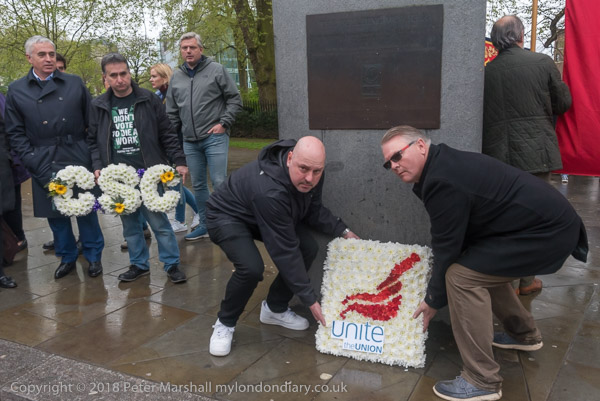
IWMD is an international day of remembrance and action for workers killed, disabled, injured or made unwell by their work, and highlights the fact that most workplace incidents are not ‘accidents’ but the largely predictable result of failures by organisation to have proper safety procedures and training. It promotes campaigns and organisation to fight for improvements in workplace safety under the general slogan for the day ‘Remember the dead – Fight for the living.’

The day was inaugurated by the US AFL-CIO in 1970, and was later taken up elsewhere. In Canada parliament made  April 28 an official Workers’ Mourning Day in 1991. Since 1989 it has been celebrated in North America, Asia, Europe and Africa and it came to the UK in 1992, being adopted by the Scottish TUC in 1993, the TUC in 1999 and the Health and Safety Commission and Health and Safety Executive in 2000. The ILO, part of the United Nations, recognised Workers’ Memorial Day and declared it World Day for Safety and Health at Work in 2001.

Since 2010, Health and Safety standards in the UK have dropped and the system of safety inspections greatly weakened as a part of a government drive against what they call ‘red tape’. This means workers’ lives are now at greater risk than for many years.

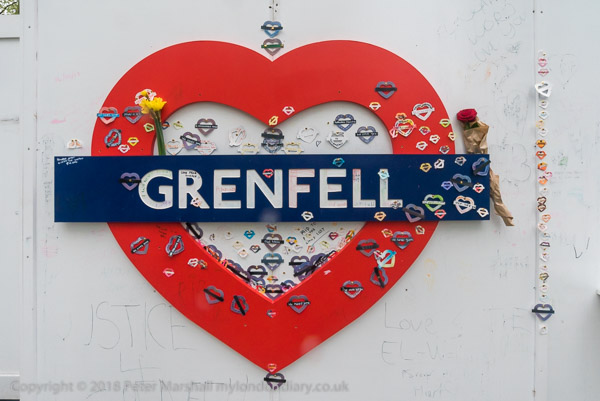
This slackening of regulations appears to have been an important factor in allowing the Grenfell Tower disaster to take place. Rather than face tough fire inspections and have to make improvements they paid a contractor to make less strict inspections that would allow highly dangerous situations pass without comment.

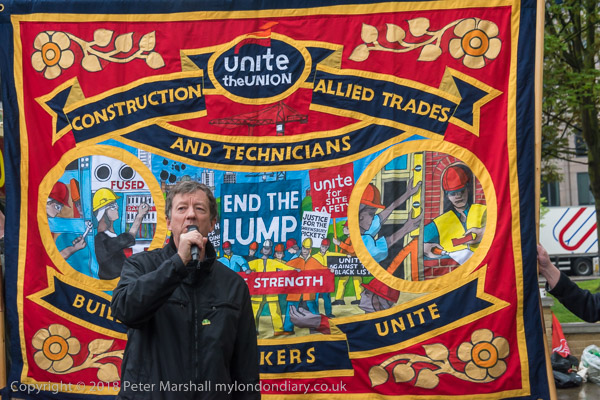
Among the speakers at the main London remembrance at the statue of a building worker on Tower Hill was Moyra Samuels of the Justice4 Grenfell campaign, and after wreaths were laid and the event ended, some of us travelled to Notting Hill for another brief ceremony close to Grenfell Tower.

Most of those who take part in this event are building workers, as the building industry is one of the most dangerous in the country. Because of the way that statistics on work-related deaths are compiled, most are not recorded as such. In particular many thousands of work-related deaths occur annually from cancer following exposure to materials such as asbestos and other carcinogens. There is typically a 20 year or so period between exposure and death, and it is usually hard to show a definite causal link in an individual case, though overall figures may be clear.

International Workers’ Memorial Day
Workers’ Memorial Day Grenfell vigil
______________________________________________________

There are no adverts on this site and it receives no sponsorship, and I like to keep it that way. But it does take a considerable amount of my time and thought, and if you enjoy reading it, a small donation – perhaps the cost of a beer – would be appreciated.
My London Diary : London Photos : Hull : River Lea/Lee Valley : London’s Industrial Heritage

All photographs on this and my other sites, unless otherwise stated, are taken by and copyright of Peter Marshall, and are available for reproduction or can be bought as prints.

To order prints or reproduce images

________________________________________________________

London University – End Outsourcing

Outsourcing – getting an outside companies to bid to employ people who work at your location – is never a good idea. It adds extra management and takes out profit; if there are cost savings its because you are getting the job done less well  – and the people you rely on to do it are getting treated badly.

Like many of London’s cleaners and others in low paid work, the security, porters, cleaners, catering staff who do the essential jobs to keep the University of London running, at its central administration and halls of residence etc, include many migrant workers.

Often they are working in low paid jobs despite having higher level qualifications and experience which is not recognised here. Migrants have proved their resilience by coming here, and expect to be treated with dignity and respect, but outsourcing  is rife with incompetent and bullying managers.

The larger unions – apart from some branches – have often failed these workers. At times they are more concerned with maintaining differentials than in getting a good deal for the lowest paid. Often too, union organisers lack the language skills to communicate with Spanish speaking workers, and haven’t really made much effort to do so.

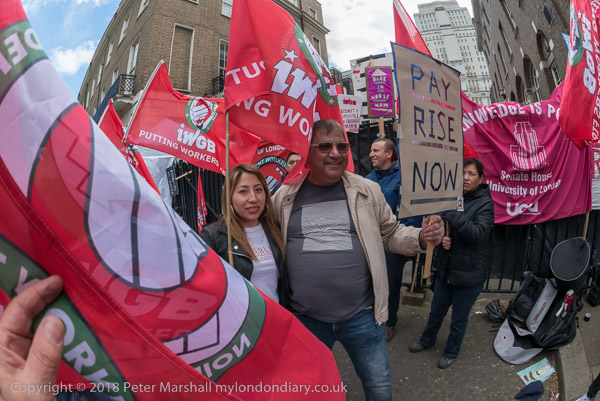
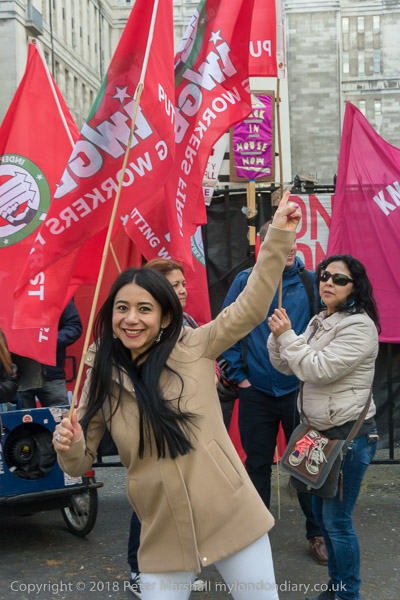
This has led to the rise of grass-roots unions, small organisations run by the workers directly such as the United Voices of the World and the IWGB, representing international workers, particularly in the cleaning sector. These unions have employed simple tactics of direct action, loud protests outside workplaces to shame employers, and have been remarkably successful in campaigns to get the London Living Wage and better conditions of service.

The IWGB at the University of London has campaigned for years getting improvements for the outsourced workers there, working with other union branches and with other small unions. At today’s protest they were supported by people from the UVW, and from SOAS Unison branch as well as students and lecturers.

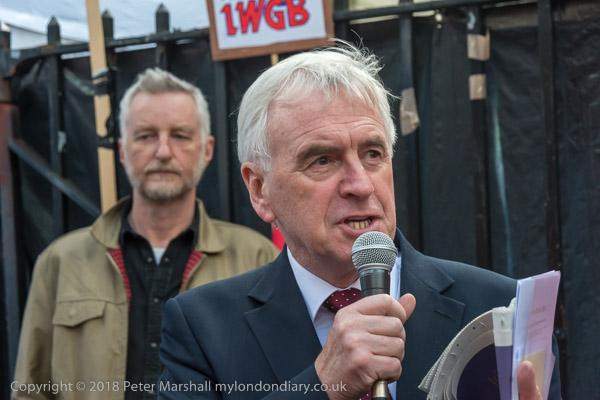
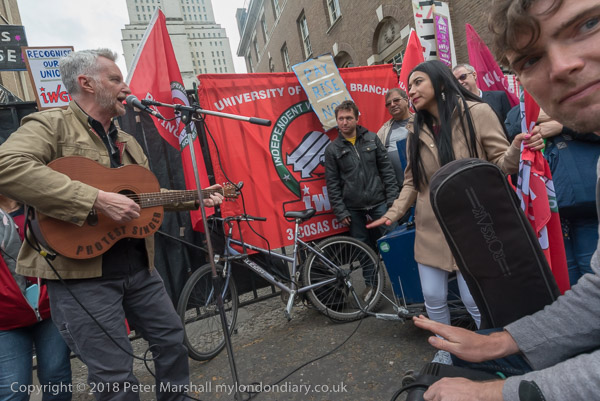
Shadow Chancellor John McDonnell MP has long supported workers such as these and came along to speak, supporting their campaign and promising that a Labour government would make important changes to unfair trade union laws.   Waiting to perform after he spoke was Billy Bragg, who sand a new song and then led the singing of several well-known worker’s songs.

There were other speeches and performances, including from Poetry on the Picket Line and then the protest ended with a march around Russell Square, blocking traffic for some time on Southampton Row.

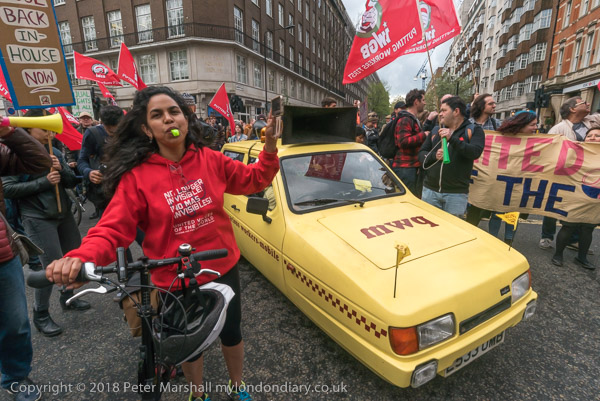
The marchers were led by the bright yellow Precarious Workers Mobile, a three-wheeler Robin Reliant with a powerful amplification system which has come out in support of other workers’ struggles, including the Brixton Ritzy strikers.

Unfortunately the PWM turned out just a little too precarious, and had to leave the road at the end of the march, leaking petrol. I hope it was soon fixed.
More on My London Diary: End outsourcing at University of London

______________________________________________________

There are no adverts on this site and it receives no sponsorship, and I like to keep it that way. But it does take a considerable amount of my time and thought, and if you enjoy reading it, a small donation – perhaps the cost of a beer – would be appreciated.

My London Diary : London Photos : Hull : River Lea/Lee Valley : London’s Industrial Heritage

All photographs on this and my other sites, unless otherwise stated, are taken by and copyright of Peter Marshall, and are available for reproduction or can be bought as prints.

To order prints or reproduce images

________________________________________________________

Windrush Brixton

It was only in 1948 that we became British citizens, or more accurately, Citizens of the United Kingdom and Colonies (CUKC), before which all those in the UK or its colonies had been British subjects. But new countries which were former colonies wanted to have their own nationalities, and so change was needed. But those who had been born in the UK or the former colonies retained the right to come here unfettered until the Commonwealth Immigrants Act 1962, introduced by a Conservative Government largely at the behest of right-wing Conservative extremists in the ‘Monday Club’.

It was, as then Labour Leader Hugh Gaitskell said, “cruel and brutal anti-colour legislation“, and later Acts made things even worse. But that 1962 law had an important exemption as Wikipedia states:

Commonwealth citizens who were residing in the UK or who had resided in the UK at any point from 1960 to 1962 were exempted, as well as CUKCs and Commonwealth citizens holding a passport issued by the British government or who were born in the UK. The exemption also applied to wives and children under 16 of these people, or any person included on these people’s passports.

That exemption was necessary  because of the huge contribution by 1962 being made to the running of our hospitals, buses and other services by immigrants particularly from the Carribean, where Minister of Health  from 1960-63 ran a very active recruiting programme for nurses.

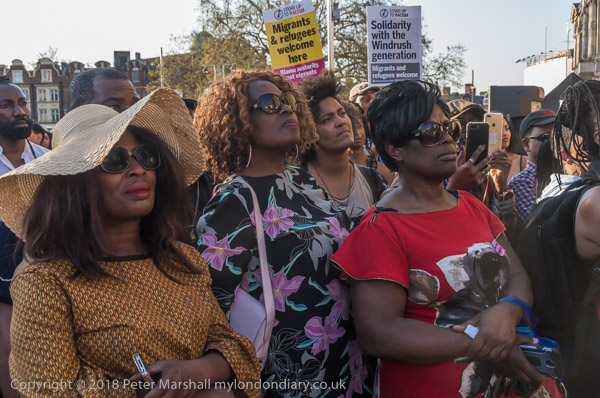
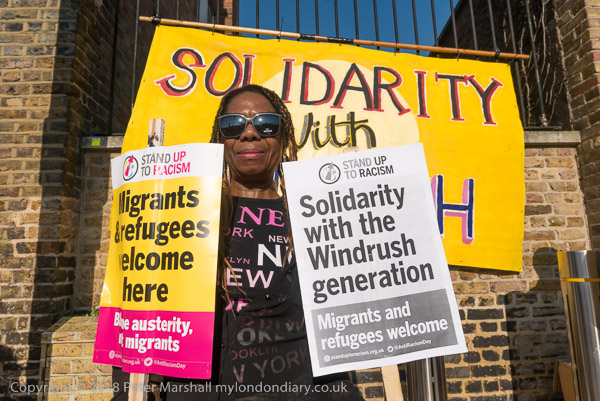
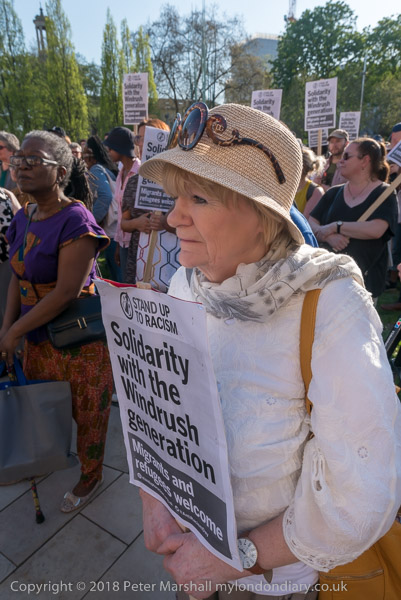
It is these people who came to the UK up to 1962 – including wives and children under 16 and others on their passports who make up what we think of as the Windrush generation, part of a process that began with the Empire Windrush docking at Tilbury in June 1948, but involves many, many more than the  492 passengers on board. Others too who arrived between the 1962 Act and the 1971 Immigration Act which gave CUKCs the ‘right of abode’, a somewhat curious concept that results in the UK being in breach of international law.  The 1981 British Nationality Act made them (and those born here) British Citizens.

More directly the problems for these people arise from then Home Secretary Theresa May’s 2014 Immigration Act which introduced draconian and discriminatory provisions and changed the legal immigration landscape. Among the speakers at the event was Labour Shadow Home Secretary Diane Abbot, one of only 8 Labour  MPs to vote against that act, pointing out then the problems it would cause.

The Home Office, with its policy of a ‘hostile environment’ for migrants has been deporting many who have British Citizen status (or refusing to allow them to return to the UK after they take a holiday or trip to visit relatives. It is doing so as a part of a racist ‘numbers game’ which has involved both major political parties in trying to appease racist pressures to cut immigration.

People who came here legally – often by invitation from the government or major employers at the time – are being asked to produce documentary proof of their residence and employment many years ago, to prove that their status was covered by the various twists of UK immigration policy over the years.

It’s a quite unnecessary and virtually impossible process, clearly designed simply as harassment. If anyone has the records that they seem to require it should be the relevant government departments as these people have paid taxes and national insurance over the years. And to learn that the Home Office has recently destroyed vital historic documents related to the Windrush generation rather than sending them to the National Record Office or the Black Cultural Archives in front of which this protest was held adds injury to the already significant insult.

More on the protest in Windrush Square Brixton on My London Diary:  Solidarity with the Windrush families
______________________________________________________

There are no adverts on this site and it receives no sponsorship, and I like to keep it that way. But it does take a considerable amount of my time and thought, and if you enjoy reading it, a small donation – perhaps the cost of a beer – would be appreciated.

My London Diary : London Photos : Hull : River Lea/Lee Valley : London’s Industrial Heritage

All photographs on this and my other sites, unless otherwise stated, are taken by and copyright of Peter Marshall, and are available for reproduction or can be bought as prints.

To order prints or reproduce images

________________________________________________________

High Ideals

The planners of post-war London were people with a vision, but it wasn’t always one that it was possible to put into practice. They were not starting with a clean sheet, but with a city that despite its devastation was still largely intact.

We can still see much of their vision in the Barbican, where a large area had been more or less flattened. It integrates the high rise blocks with lower buildings as well as a large school and an Arts Centre, as well as a medieval church remaining at its centre. Most of the movement around the area is by pedestrians on its high-level walkways, well above any road traffic. It is a system that is popular with those who live there, though casual visitors find it confusing – and it had to be given yellow lines to follow to guide those going to the Art Centre.

Bits of that ‘ped-way’ or ‘high walk’ system extended out, with bridges across London Wall and Aldersgate St, and there were small sections of similar high walks to the north of the Guildhall and around Lower Thames St, as well as across Bishopsgate and around the Nat West Tower developmetn, with developers being required for some years to provide these to get planning permission, but the whole never developed into anything like a joined up system, which would have required far too much demolition of existing buildings.

People in general like to take the easiest route, not that which looks best on the architects or planners drawing boards, and the steps required to access these upper level streets were a considerable disincentive. Although the bridge across Wormwood St was a good vantage point for photographers before its closure (in part by the IRA) most pedestrians preferred the short wait at the traffic lights.


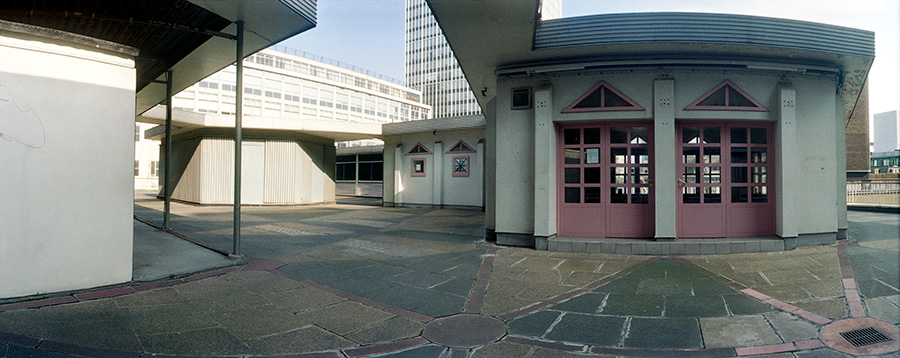
St Alphage Highwalk, 1992

Some years ago St Alphege Highwalk was closed and the bridge across London Wall to it from the Bassishaw Highwalk was demolished. It was one of a number of areas of London I had photographed for a show by London Documentary Photographers in 1992, using my newly acquired Japanese panoramic camera.

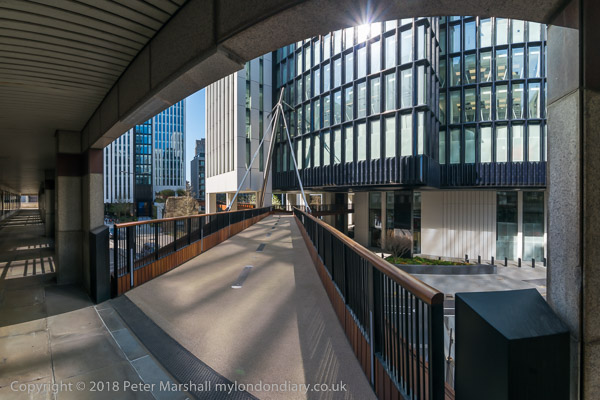
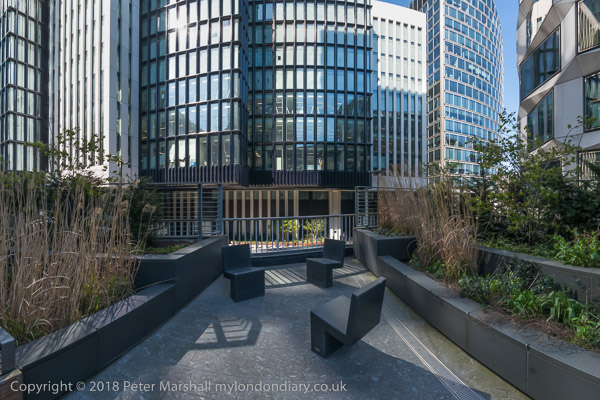
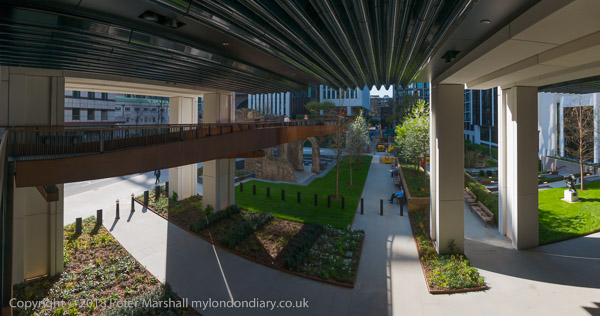
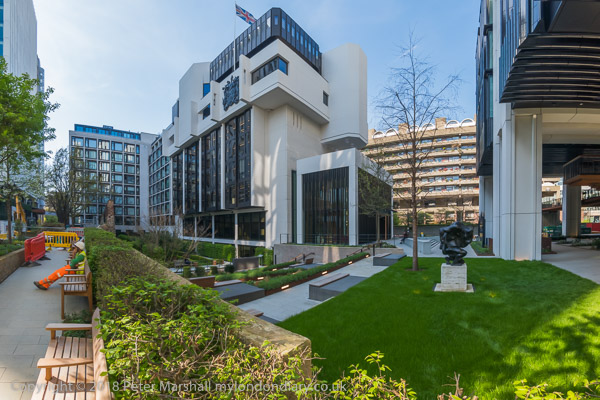
The whole site is now redeveloped, with a new bridge a few yards to the west of the former, and I again took a number of mainly panoramic images around the area, now using a digital camera.

Where the old bridge was is now a dead end – and the walkways that are left have many such dead ends. The small triangular pavilions of my 1992 picture are now large tall office blocks, rather lacking in character, though doubtless considerably more energy efficient.

These blocks apart – and they are no doubt what made it all possible – the area is a more pleasant one now, with plenty of space to stroll around at ground level, as well as on new walkways, room for the workers to eat their lunchtime sandwiches (if they can leave the screens to which they are now chained.)

It opens up also the view of Salter’s Hall, one of the better modern buildings in London, where I was once briefly involved in an innovative chemistry teaching scheme, and also the ruins of St Alphege.

The digital panoramas are considerably easier to produce than when I used film. Not only is it much easier to work hand-held (and I’ve grown to hate tripods) but the give roughly twice the vertical angle of view, producing images within the standard 1.5:1 format of 35mm film, though I often find it useful to crop them at top, bottom or both to something more recognisably panoramic.

The horizontal angle of view is a little greater than the three swing-lens panoramic film cameras I’ve used, and around 50% more than is sensibly possible with a rectilinear view. Although the verticals in the images are straight, to get such a large angle horizontal lines away from the image centre have to curve. The images from the High Walk include some rectilinear views, mainly taken with a zoom at its widest, 18mm.

Many more pictures from around the area at City Highwalk.

______________________________________________________

There are no adverts on this site and it receives no sponsorship, and I like to keep it that way. But it does take a considerable amount of my time and thought, and if you enjoy reading it, a small donation – perhaps the cost of a beer – would be appreciated.

My London Diary : London Photos : Hull : River Lea/Lee Valley : London’s Industrial Heritage

All photographs on this and my other sites, unless otherwise stated, are taken by and copyright of Peter Marshall, and are available for reproduction or can be bought as prints.

To order prints or reproduce images

________________________________________________________

Forests Aren’t Fuel

It is hard to understand why cutting down forests which have taken hundreds or thousands of years to establish to burn them as fuel could ever have been considered as a viable renewable energy source.

That we have to pay a surcharge on our electricity bills which enables ancient forests in the south of the USA to be cleared of threes, converted into woodchips and shipped to be burnt at Drax is irresponsible madness. Apart from the environmental damage in felling, wood is a dirtier fuel even than the coal it is replacing at Drax.

And there is the ‘double whammy’. As well as putting more carbon dioxide into the atmosphere, the destruction of the forests means the destruction of the only large scale method of carbon dioxide removal from the atmosphere. Without the photosynthesis that converts CO2 and water into carbohydrates, releasing oxygen in the process there would be no life on earth.

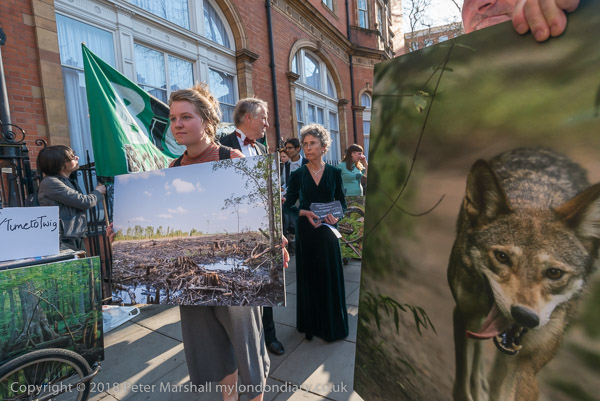
The science is clear – even to primary school children – but there are still companies promoting biomass, trying to expand their businesses and profit from contributing to global catastrophe. And some of them were holding the largest international biomass conference in the Landmark Hotel opposite Marlebone Station in London.

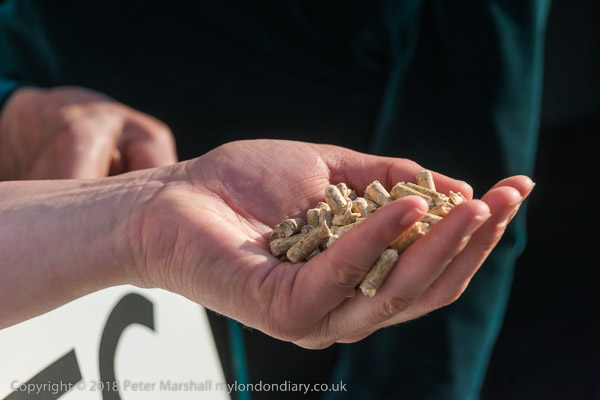
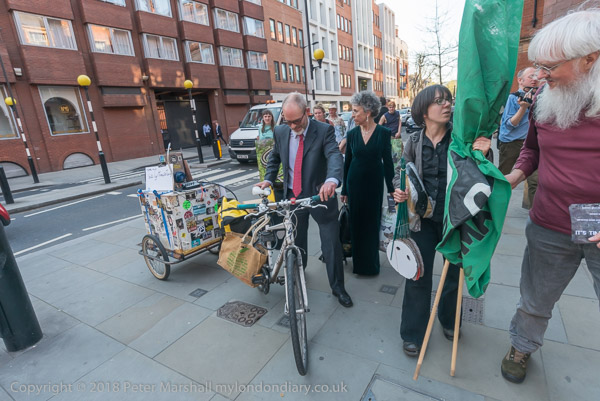
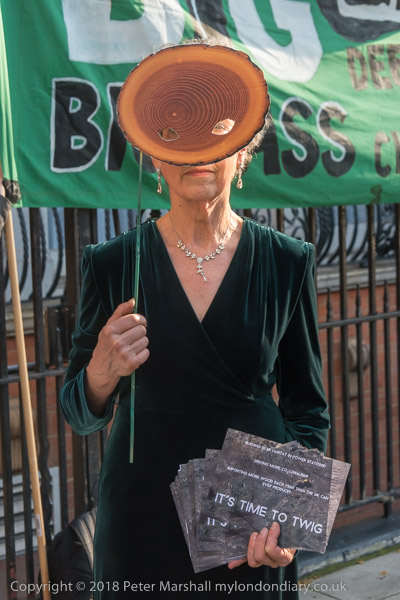
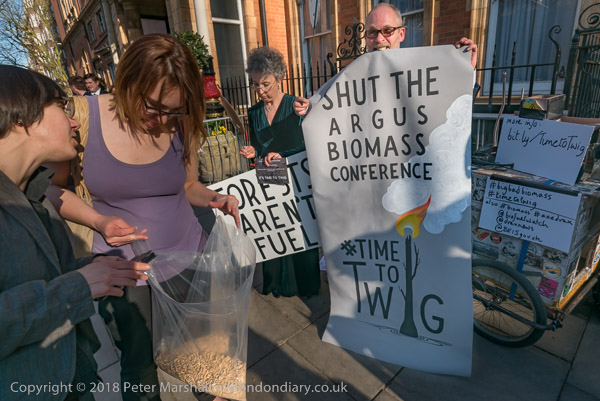
Environmental group Biofuelwatch came to the hotel in what they called a ‘Time to Twig’ Masked Ball Forest Flashmob, bringing posters showing some of the environmental degredation caused by forest felling for biofuel, banners, a bike-hauled sound system and some rather strange masks showing a cut section of a tree trunk. They had also brought a small bag of wood chips similar to those used at Drax.

There were also speeches giving more information about the destructive nature of biofuels and their impact on global warming, including from one activist who had attended the conference and talked with some of those taking part.

More pictures: ‘Time to Twig’ Masked Ball
______________________________________________________

There are no adverts on this site and it receives no sponsorship, and I like to keep it that way. But it does take a considerable amount of my time and thought, and if you enjoy reading it, a small donation – perhaps the cost of a beer – would be appreciated.

My London Diary : London Photos : Hull : River Lea/Lee Valley : London’s Industrial Heritage

All photographs on this and my other sites, unless otherwise stated, are taken by and copyright of Peter Marshall, and are available for reproduction or can be bought as prints.

To order prints or reproduce images

________________________________________________________

Modi’s Visit

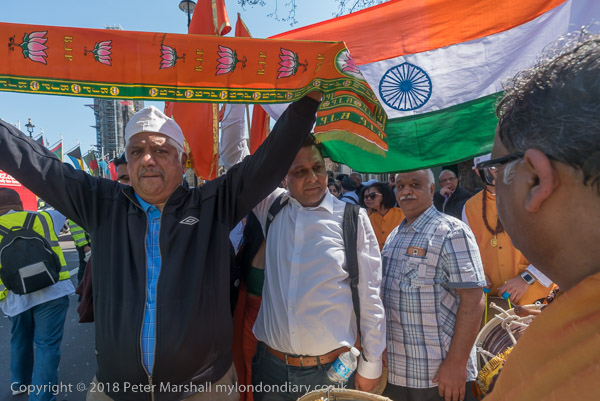
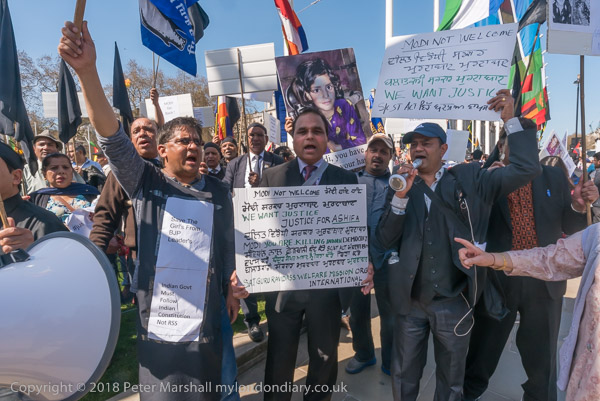
A large protest in Parliament Square included Kashmiris and Indians from many sections of the community including Tamils, Sikhs, Ravidass, Dalits, Muslims who say Indian Prime Minister Narendra Modi who is pursuing policies dictated by the ultra-right Hindu supremacist RSS.

They say Modi encourages mob violence against Muslims and Christians, protects rapists and promotes caste hierarchy and the persecution of Dalits, and attacks on both the free press and the judicial system. Modi’s policies inflame Hindus to take illegal actions and the police and army ignore them. Modi also promotes the corporate plunder of Indian resources by global mining companies such as Vedanta. Kashmiris call for an end to the military occupation of Kashmir by India, and and for an end to the atrocities committed by the Indians there.

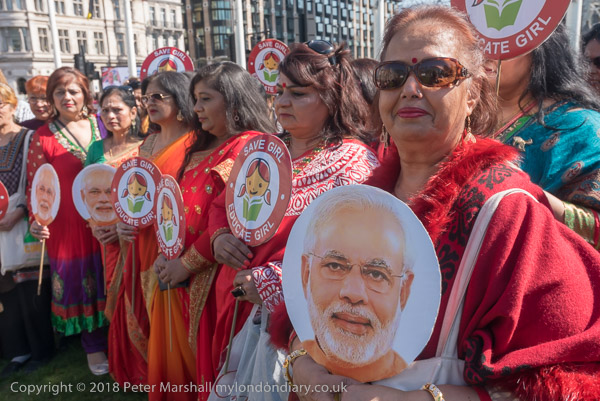
Many well-off Hindus welcome Modi’s Hindu nationalism and the benefits it brings them and their friends in India and dismiss many of the stories of atrocities or blame them on others. One was a group of Hindu women, many looking rather too well-fed, who came holding placards with a picture of Modi on one side and the logo of his ‘Beti Bachao Beti Padhao’ initiative (Save girl child, educate a girl child) on the other side.

Most of the richer Indians living in the UK are Hindu, and many are supporters and donors of the Tory party. Their representations to the government here have prevented caste discrimination being made an offence in the UK. Although outlawed by the Indian constituion, it is still rife in India, and those from the lower castes, such as the Dalits, feel that the Modi government encourages it.

And although the Sikh religion also opposes discrimination, many in the Sikh community felt that they were discriminated against by high-caste Sikhs who in 2009 were responsible for the murder of cleric Ramanand Dass in Vienna. Following this many Ravidass Gurdwaras declared themselves to be a religion fully separated from Sikhism, although some still consider themselves to be Sikhs. The two groups differ in their regard Guru Ravidas, a North Indian mystic poet-sant who lived around the 14th to 15th century and has many poems attributed to him in the Sikh scriptures.

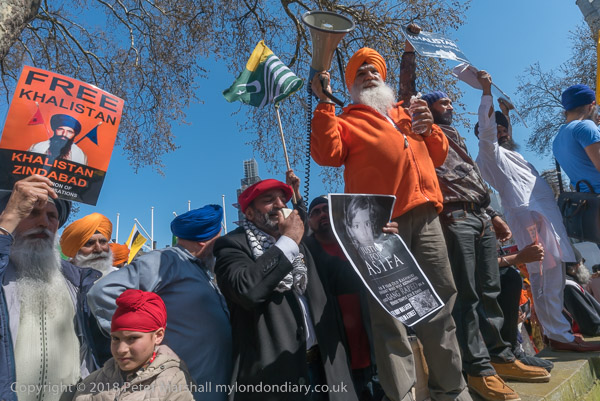
Many Sikhs, particularly since the 1984 Indian army attacks on the Golden Temple massacring many of those in the complex, and later that year government encouraged riots following the assassination of Indira Gandhi by her Sikh bodyguards in which many more Sikhs were murdered, call of the establishment of a separate Sikh state, Khalistan.

Kahmiris were there to call for India to get out of Kashmir, a country divided into three parts with three occupying powers, Pakistan, China and India, with boundaries between the Indian and Pakistani held region swhich have changed little since the British left in 1947 despite three major wars in Kashmir between the two countries and many border skirmishes. The Chinese army quickly seized the area it considered part of China in 1962, easily defeating the Indian Army.

One recent atrocity in January that united many of the protesters against Modi was the hideous rape and murder of an 8-year-old Muslim girl, Asif Bano in Indian occupied Kashmir by Hindus who kidnapped her and kept her in a temple where she was violated before her body was dumped in bushes. Not only were the details of the crime horrific but regional officials allegedly tried to cover up the crime and there was organised intimidation of those trying to get justice. Eventually 8 men were arrested, including two police officers and and former government official.

Parliament Square was surrounded with flags of the Commonwealth Countries, flying there because of the Commonwealth Conference Modi was in London to attend. Some of the protesters attempted to burn the Indian flag, but it proved to be rather fire resistant, though they did finally persuade it to melt an smoulder a little. There was quite a scrum of protesters and photographers around this group and it was difficult to get any clear pictures.

More on My London Diary:

Indians protest President Modi’s visit
Hindus support Modi
Save Girl, Educate Girl

______________________________________________________

There are no adverts on this site and it receives no sponsorship, and I like to keep it that way. But it does take a considerable amount of my time and thought, and if you enjoy reading it, a small donation – perhaps the cost of a beer – would be appreciated.

My London Diary : London Photos : Hull : River Lea/Lee Valley : London’s Industrial Heritage

All photographs on this and my other sites, unless otherwise stated, are taken by and copyright of Peter Marshall, and are available for reproduction or can be bought as prints.

To order prints or reproduce images

________________________________________________________

Famine Porn?

I hesitated to add my thoughts about the World Press Photo Instagram posts from Alessio Mamo showing villagers from Uttar Pradesh and Madhya Pradesh in front of tables with what for them would be exotic foodstuffs. Really I didn’t want to give what I felt was a misguided project any more publicity. But since every man and his dog, including The Guardian and the BBC have had their say I felt I too should say something, just in case anyone had manage to miss this and the enormous stir it has created on the web.

Firstly I think it important to state that some of the criticism has been ill-informed. The villagers that Mamo worked with were not starving or particularly malnourished, though certainly they were not the obese figures we are so used to in the west.

As Mamo has stated:

Most of the people enjoyed spontaneously to be part of this and photographed behind the table. The people I photographed were living in a village and they were not suffering from malnutrition anymore, they were not hungry or sick, and they freely participated in the project.

Mamo, as he says, “brought…a table and some fake food, and…told people to dream about some food that they would like to find on their table”. But the food on the table was not food and would not represent the dreams those people had of food.

It isn’t true to say as some critics did, that this was bringing fake food to starving people. It wasn’t although it did rather look like this, and it is that impression which matters. We make pictures but it is others who read them, and create their own meanings from them whatever our intentions.

This picture highlights the problems when photographers start doing rather gimmicky projects like this imposing a false situation on their subjects. It might be art, though I think not particularly impressive as such, but it certainly isn’t photojournalism, and should have no place at all on the World Press Photo site, whose Instagram posts Mamo was given the opportunity to takeover for a week.

The guidelines to photographers who take on this responsibility remind them that they should present “quality visual journalism and storytelling’ and “present accurate, compelling and creative work allowing people to see the world freely.”

WPP reserves the right to step in and “edit a post or a photographer’s selection”, but chose not to do so, and instead gave what many of us feel a response which fails to support any clear idea of what photojournalism is or should be.

The area into which these pictures fall is certainly not photojournalism, but rather more that of advertising, with Mamo thinking like an art director trying to sell a product to an audience than allowing “people to see the world freely”.

There have been so many comments on this work already made – with large collections of them on various web sites including Scroll and PetaPixel. For a couple more opinions you could read Allen Murabayashi of PhotoShelter and Yamini Pustake Bhalerao on ShethePeople.