John Benton-Harris – Surprise Party

We should as a photographic nation be celebrating today, with features in the colour supplements and photographic magazines, the 70th birthday of one of the most important figures for British photography in the second half of the last century, who happily is still going strong now.  But you are unfortunately unlikely to read about it anywhere but here.

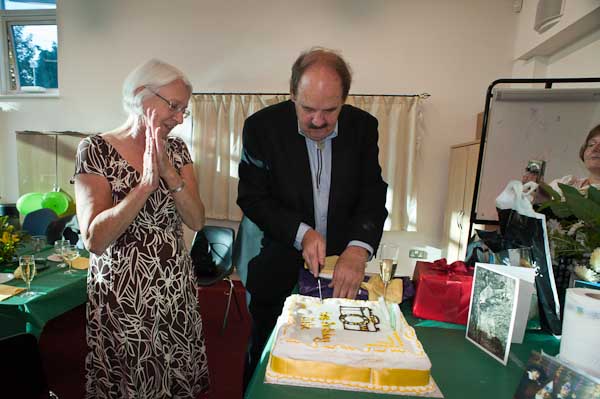
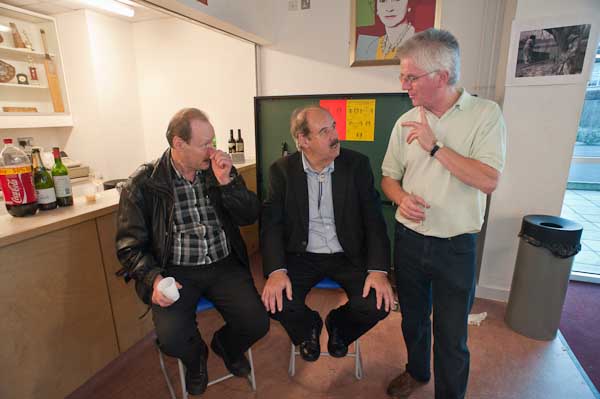
Yesterday I was privileged to attend the surprise birthday celebration for John Benton-Harris in the sports club opposite his home in Croydon, with his family and a decent smattering of photographers.
© 2009 Peter Marshall

Those of us who were around in the 1960 and 70s remember the great breath of fresh ideas that came across the Atlantic and re-vitalised the medium here. Two people in particular, both separately students of Alexey Brodovitch in New York and New Haven, played a greater role than any others by coming and working here. One was British, Tony Ray-Jones, who died tragically young – only 30 – in 1972, having produced  the work that was published posthumously as ‘A Day Off – An English Journal‘ in 1974. The other was an American from the South Bronx who took leave from his post as a photographer in the US Army in Italy to photograph Churchill’s funeral in 1965. While in London he met a young woman who changed his life, and as soon as he was able, moved to London and married her, continuing his photographic career here. You can see both of them in the picture above.
© 2009 Peter Marshall

Two years ago at the FotoArt Festival in Bielsko-Biala, Poland,  it was slightly daunting to take to the stage immediately after the notable historian and writer of ‘A World History of Photography‘, Naomi Rosenblum, particularly as the talk I was going to give had a considerable overlap with the lecture on the  history of street photography she had just given.

My  ‘On English Streets’ used illustrations from the work of John Thomson, Paul Martin, Sir Benjamin Stone, Margaret Monck, Bill Brandt, Martin Parr, Paul Trevor and of course John Benton-Harris, as well as some of my own pictures (I’d talked there about Tony Ray-Jones on a previous occasion or he too would have featured.) Here is my script for the part of the talk which was about John:

His vision of England – certainly in the early years here –  was very much based on the ideas about it he had picked up from films set in the country, particularly those made by British film studios. But his view as an outsider certainly made him more aware of the class differences here and the key ways in which they are signified – and in particular the importance and readings of hats, which appear in so many of his pictures.When John met another Brodovitch graduate, Tony Ray Jones  in London, and found they shared many ideas (Ray Jones had studied at Brodovitch’s class in New Haven, and they had not met in the USA.) Both had the experience of having worked in a supportive visual environment that they found almost completely lacking in word-centred Britain, where no one seemed to care about photography. It must have come as a shock to John to have moved from a New York where he knew everyone who was anyone to a London where there was no one to know, although Ray Jones would have known exactly what was in store when he returned here. Together they provided an energy, a dynamic, that catalysed others to shake up of the dusty world of British photography, particularly editors Bill Jay and Peter Turner, who took over from Jay at Creative Camera.  Benton-Harris curated several influential shows with Turner, particularly American Images: Photography (1945-80) at the Barbican in 1985.

The new breeze that ran though British photography affected all of us, perhaps reaching its apogee in volumes such as Creative Camera Collection 5, which featured, as the first of three major portfolios, 27 images by Benton-Harris (as well as a well hidden set of three pictures from me.)
© 2009 Peter Marshall

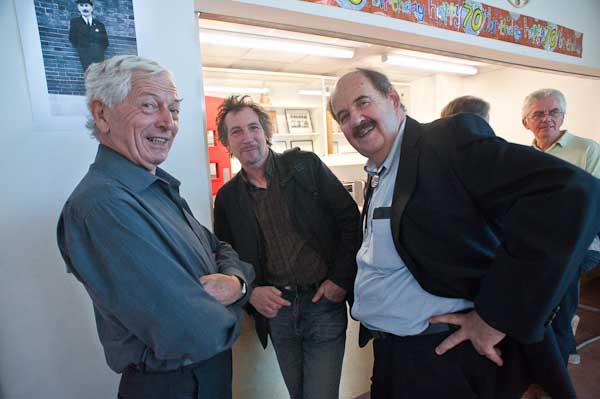
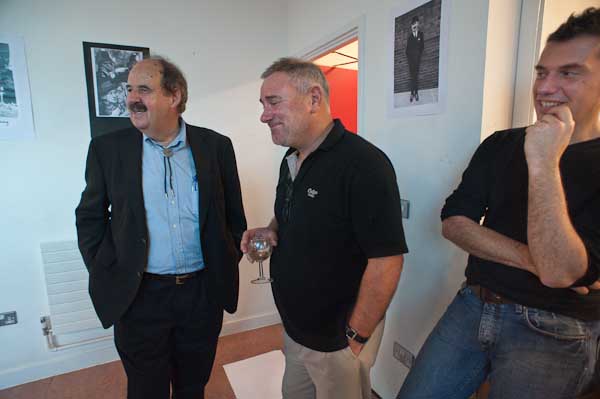
Those coming to the party had been sworn to secrecy, but were asked to nominate their favourite image by John, and these had been printed up to poster size and were stuck up around the sports hall for the party – you can see some in the background of these pictures. I’d printed out the presentation slides for his section of my talk as a small present and was pleased to see that my choice included several of other people’s favourites.

Also on display was a series of pictures of John as a young man with a camera on the streets of Rome, taken by his friend George Weitz, there at the party (I’m afraid the link to the piece I wrote on John for About.com no longer leads to it – like the several thousand other pieces I wrote for them it is no longer available on line.)

Part of the reason why John is not as highly known as he should be is that it is not easy to see his work, much only available in long out of print books and magazines. A reasonably diligent search on the web only reveals a couple of pictures of him and two poorly scanned images of St Patrick’s Day, neither his best work on the theme. We really need a well-produced book of his work from the first twenty or so years in England, as well as other publications covering his later work.
© 2009 Peter Marshall

Probably the best way publication is still the major portfolio in Creative Camera Collection 5 mentioned above, still available secondhand at a very reasonable price in the USA, though more expensive here – and prices of this and the other CC Year Books do now seem to be rising fast. (My favourite on-line bookseller lists a copy at a US bookseller for £6.47 below an ‘ex-library’ copy apparently in poorer condition from a UK store for £56, though most copies are in the £16-25 range.)

But it is also unfortunate that credit wasn’t always given to him for the things that he did do. The catalogue for the ground-breaking Barbican Show American Images 1945-80 does state in the acknowldegements “Peter Turner and John Benton-Harris have been the motivating force behind the show and without their unstinting efforts as organizers, American Images would never have happened” and it carries a short note by him and about him, but essentially it marginalises his contribution to a show which was almost entirely dependent on his contribution and insights, if slightly diluted by the efforts of others.

Unforgivably he was not even included in the index to the catalogue, and the front cover which should have stated ‘Organised by John Benton-Harris & Peter Turner‘ simply says ‘Edited by Peter Turner‘.

It is also hard to understand why use wasn’t made in the catalogue of his personal knowledge of many of the photogrphers included (which was essential in putting the show together) to provide greater insight into their lives and work. As his occasional contirbutions to this site show, John is capable of writing with considerable force and insight.

John has recently returned from another extended trip to the USA, doubtless with many interesting digital colour images as on his recent previous trips. I also hope he will write up his thoughts about some of the shows that he saw there for this site. It would be nice if here or elsewhere he would also share some of his images with us.

More pictures from the party on My London Diary.
Irving Penn (1917-2009)

Irving Penn died yesterday, October 7, aged 92. One of the great American fashion photographers of the last century, he was a great influence on many other photographers, but although I wrote a little about him, I never warmed to his work. There is a fine long obituary feature on him in the New York Times, written by Andy Grundberg, and another with a slide show of nine of his pictures on their Lens blog.

You can see more pictures on Photography Now, though it’s a site which annoys me by resizing my browser window, but it does show his work well. There are many more pictures on the Art Pages site, hosted in the Ukraine, where copyright is perhaps rather different. The site isn’t in English, but if you click on any of the thumbs to view, then clicking on it again brings up an enlarged version, and clicking on the link to the top right of the picture goes on to the next. It includes some pictures I don’t think I’ve seen before.

Lens Culture Latest

It’s always worth a visit when a new edition of Lensculture goes on line and the latest is no exception. Not that I find everything on it of interest, one of its attractions is its eclectic nature.

Among the pieces I think particularly worth looking at are Reinaldo Loureiro‘s precise and often almost symmetric square images of “the social and economic landscape of the Spanish greenhouse plains of Almeria” in his ‘Out of Season‘ and Edmund Clark‘s very different but equally precise ‘If the Light Goes Out: Home from Guantanamo‘ which finds something very new to say about this blot on the conscience of that part of America that still has one. Clark’s work is in three parts in a deliberately disjointed edit which jumps between the home of the American community in the naval basem the camps where the detainees have been held and the homes where former detainees are trying to rebuild their lives. You can see more of Clark’s work on his web site and read my post about his earlier book Still Life: Killing Time.

Another pleasant surprise was the work of Ara Güler (born 1928 in Istanbul, of Armenian descent), the leading Turkish photographer of his generation. After his military service he began work for a Turkish magazine in the early 1950s and began working for Time-Life in 1956 and Paris Match and Stern in 1958. During this period he met Henri Cartier-Bresson and became a member of Magnum. A search under “Ara Guler” on the Magnum web site returns over 500 images by him as well as 4 pictures of him by James A Fox (at the bottom of the last page.)

In 2009 he received the award for lifetime achievement in the Lucie Awards.  Although I remember seeing some of his pictures before, I have to admit that I had forgotten all about this photographer and it was good to see the work again.  There is an 8 minute video of his work on YouTube, and some details of his life on Turkish Culture.

Another Magnum photographer in this issue of Lensculture is considerably better-known to me. There are only  half a dozen images from the latest book,  In Whose Name? by Abbas on Lensculture, but you can of course see more of his work at Magnum.

These for me were among the the highlights, and there are some more great things (including Dana Popa who I’ve already written about) as well as just a few things I found lacked interest, but you may well have different tastes. But as always it’s certainly worth looking at Lensculture.

Willy Ronis Dies Aged 99

I was saddened to learn from Jim Casper of Lensculture that Willy Ronis died today, September 12, 2009, aged 99.

I met Willy Ronis in 2003 when he came to talk about his work in London, but didn’t have time to have more than a short conversation with him. But his talk was a fine introduction to his work, which I’d only really seen in isolated images before, and made me feel that his was a much more important and vital view of everyday life in Paris than that of some better-known photographers.  And in a way I got to know him better last year on my trip to Paris in November, when I picked up a copy of his La Traversée de Belleville at the Bar Floréal and followed in his footsteps only to find that his favourite stroll in Paris covered ground that was very familiar to me from a number of earlier visits.

Of course I knew from my extended essay on him in 2003 that his work centred on Belleville and Menilmontant. For contractual reasons I can’t post that essay as I wrote it, but here is a revised version of the first of five sections.

Willy Ronis was one of a small group of photographers whose pictures gave us an image of post-war Paris in the 1950s that still dominates our imagination of that city. With Doisneau, Izis, Cartier-Bresson, Boubat and others his work created a vision of this city that was very much an image of its people. His particular viewpoint was dominated by ordinary working class men and women and life outside the bright lights and the grand boulevards. Ronis photographed ordinary daily life and found in it the extraordinary.

Paris is a hilly city, with many sets of steps joining streets providing short cuts for pedestrians. In 1949 he stood looking down one of these leading to and across Avenue Simon Bolivar. As he stood there considering the view, behind him he heard the sound of a woman talking to a child, and waited for her to fill the empty space below on the steps in his view. As she came to the main road, a heavy cart pulled by a large white horse came across, as on the other side of the road a workman was climbing a ladder. Two women pushed prams carefully spaced on the opposite side of the street, and in front of one of the small shops to the right, a cobbler in a white apron stands talking to a customer. This is any day in working –class Paris at the time, ordinary people, ordinary lives, but also a magical image, arranged perfectly both in the frame of Ronis’s camera and the shapes of the steps and the street.

Ronis called Bruegel his master of composition, and this picture, perhaps more than any other, shows his debt that great painter, one of many Dutch masters of the the 16th and 17th centuries who Ronis admired in the Louvre on his day off – Sunday – when admission to the museums was free.

The scene he captured in the fleeting fraction of a second of this image has a wonderful precision but is also a miraculous creation of chance. Henri Cartier-Bresson, lauded as the master of ‘the decisive moment’, seldom achieved anything with the grace and complexity of this image. Ronis talked about his being always open to failure, photographing on the thread of chance, and this picture shows how he was open to experience and ready at the instant to attempt to snap up the opportunities it offers.

Like  Cartier-Bresson, many of his moments are the result of anticipation, of identifying a possibly fruitful situation and waiting for events to develop – or not.  Sitting waiting in a café, looking out through a window waiting for someone to come into the frame of street in its bottom right, or standing on the street at the crossing of Rue Sèvres and Rue Babylone in Paris in 1959, the sun setting in a misty distance, a shop awning creating a dramatic silhouette pointing to the street crossing beyond. Ronis waited until a sole figure was making her last-minute dash across the road, a woman in a long coat, and caught her motion just where the sinister shape above her in the picture seems to be pointing.

This sense of a moment caught in motion, a dynamic that enlivens them is common to many of Ronis’s pictures. They have a sense of life caught on the hoof that is not found in the more choreographed images of photographers such as Brassai or Brandt. He worked with similar equipment – the 120 format Rolleiflex he bought by instalments in 1937 – and worked largely on the streets with available light, observing and captureing the life he saw. In contrast, Brassai needed to set up his shots – ‘mise en scène‘ or staging of the action – working as a director as well as a photographer so that he could make use of unsynchronised flash.

I hope to publish a revised version of the rest of this essay at a later date.  One site with a nice collection of 14 of his images – including those mentioned above –  is AfterImage.

Essential Books?

Somewhere on line recently – and I can’t remember where – I came across a note about the list by Lindsay Adler published on PopPhoto in June, “26 Books Every Photographer Should Own.”

It could be where I’ve been going wrong all these years, because I only have about five of them. ‘About’ because the first three on the list are Ansel Adams‘s ‘The Camera‘, ‘The Negative’ and ‘The Print‘, and I only have the older versions of two of these before they were somewhat ‘dumbed down’ and brought up to date for the 1970s in 1981.  Given the somewhat dramatic changes in technology over the last 30 years I’d hesitate to recommend any of them now, although some of what Adams has to say about printmaking remains relevant in this digital age – and he probably said it better in the 1968 edition.

Perhaps the only book of those listed I would personally recommend would be Beaumont Newhall’s ‘The History of Photography’. My copy fell to bits through years of use in the classroom and is now in loose-leaf random format, though hardly any the worse for that. I think there are other histories which cover considerably more or give a different perspective, but Newhall for all his faults was a better writer than most (and perhaps Nancy helped.) Several of the more modern histories have their strong points, and if I pick Naomi Rosemblum‘s ‘A World History of Photography‘ it would partly be for its attempt to be more inclusive, but more because I so much enjoyed spending some time with her and her daughter at a Polish photo festival a couple of years ago.

As to the rest, it’s hard to agree with any of the choices, though I do have books by several of the photographers included – such as Henri Cartier-Bresson, Robert Capa, Eugene Smith – and those suggested are not bad.  I also have books by or about another half dozen of the photographers listed, but wouldn’t consider them essential. If their work appeals, then buy them.

Unlike Adler, I don’t feel any need to recommend volumes currently in print where better older publications are still available at reasonable price. Of course some out of print photographic books now sell for silly prices, although it is sometimes worth remembering that first editions were sometimes improved on in later publications.

The only other actual book on the list I own is Susan Sontag’s On Photography. It made a good TV programme, and if that is available it would be worth seeing, but perhaps there are other writers about photography that deserve greater attention.

Of course, any list is bound to be to some extent a personal one. I’ve never been a great fan of either Avedon or Penn, and probably wouldn’t include either in my 26 essentials (and certainly not Annie Leibovitz, Helmut Newton and several others that Adler mentions.)

Among various glaring omissions from any list of ‘must haves’, I’d begin with what are for me beyond argument the two most influential photo books of the twentieth century, Walker Evans: ‘American Photographs‘  and Robert Frank: ‘The Americans’, both reprinted various times.

John Szarkowski wrote a several interesting books and catalogues which could qualify, for example ‘The Photographer’s Eye‘, in some ways the best introduction to photographic grammar, but for me the absolute gem in his output and in some respects my favourite photographic book, is his ‘Looking at Photographs.’

I’d also include something by Cartier-Bresson, though I wouldn’t know which to recommend from those currently available. Given that the 1968 ‘The World of Henri Cartier Bresson‘ is still available second-hand at reasonable prices (at least from the USA) I might still go for that.

Another French photographer my shelves would feel empty without is Atget. Which of the many books available new or second-hand depends rather on the depth of your pocket. The four volume set from MoMA on my bookshelves is now terribly expensive, but perhaps better than the many considerably cheaper volumes.

I’d also include Bill Brandt in my essential collection, probably his ‘Shadow of Light‘. The 1976/7 edition is still reasonably cheap. Another European photographer I’d like to include is Josef Sudek, and the 1990 ‘Poet of Prague‘ is a good choice, though I prefer Sonja Bullaty‘s 1978 ‘Sudek.’

Back to the USA, I’d have to include something by both Freidlander and Winogrand. It may suprise some that I’d also add Nan Goldin‘s ‘The Ballad of Sexual Dependency‘ (though it’s better seen as a slide show.)

Personally there are certainly other works I wouldn’t like to be without, but I think after a few essentials it becomes very much a matter of your interests. It’s a list you can complete yourself – and I’d welcome any suggestions. I’m sure that as soon as I publish this and go to make myself a coffee I’ll think of volumes that I really should have included.

Rotherhithe Photographs

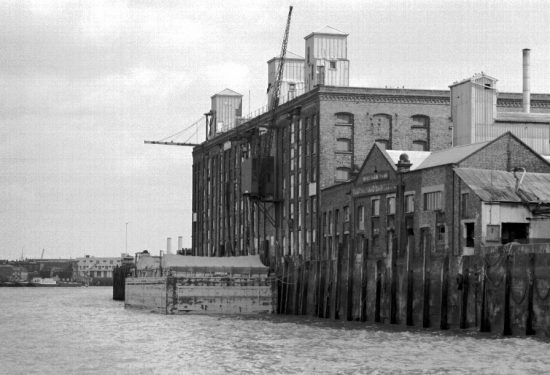
One of the more intriguing features to appear in the British Journal of Photography for a while was on Geoff Howard‘s Rotherhithe Photographs.

You can buy the book and see a preview (including the first 9 photographs taken in Rotherhithe pubs) on Blurb, where it states :

Images from “Rotherhithe Photographs” were first published in the legendary “Creative Camera” magazine in 1975, when the project ran as a cover and major portfolio, described as “a report from someone who is unquestionably one of the major talents among British photographers”.

Unseen for many years, the photographs are a personal documentation of the south London docklands, a cut-off, self-sufficient, largely working-class society; seen between the closure of the docks which had been the area’s raison d’etre, and the consumerist redevelopment of the later Thatcher years.

I don’t remember seeing his work when it was first printed in Creative Camera, though by then I was a subscriber, and the issue will be somewhere hidden under piles of papers in the shelves behind me.

Some of the more interesting images were taken inside working-class pubs in the area using a Leica, but abandoning the available light approach – because there just wasn’t any that film could capture, Howard used a big flash, moved into the right place and took a single image. Rather similar to the way that a few years later, Martin Parr started to do with a bigger camera and colour film. But Howard needed to get to know his subjects so he could get away with working like this.

Howard’s work has a particular interest for me because I was also photographing Rotherhithe – along with other areas of London – at around the same time.  You can see some of my pictures on the site ‘London’s Industrial Heritage‘.

© Peter Marshall
Rotherhithe – ©  1982, Peter Marshall

My work in Rotherhithe was more varied than the site suggests, but did mainly concentrate on the urban landscape. The better pictures on my site are probably from other riverside areas of London, such as Wapping, Southwark and Greenwich.

© Peter Marshall
Greenwich, © 1983, Peter Marshall

Julius Shulman 1910-2009

Julius Shulman, born in 1910 in Brooklyn, New York, who became America’s best known architectural photographer, largely for his pictures of the new modern architecture in California, died on 15 July aged 98. You can read obituaries in The Guardian and most other newspapers from around the world.

Shulman’s Russian parents had met in their teens when both came to New York from Russia, and soon after his birth the family moved to rural Connecticut where his father farmed on around a hundred acres, several miles from the nearest village. It was a close to nature subsistence upbringing, living on an isolated farm with a single farmhand.

In 1990 Shulman recorded an interview with Taina Rikala De Noreiga for the Smithsonian Institution Archives of American Art – and much of what I know about his life comes from this, which was a major source when I first wrote about him in 2001 for About Photography. Here he says that the farm  “was the beginning of my association with Nature” which remained important throughout his life.

When he was ten the family moved west to California, and his parent ran a dry goods store in Los Angeles, continued by his mother after his father died in 1923. Shulman joined the boy scouts and went hiking and camping and went to a high school that – very unusually for the time – included photography as one of its classes.

He started taking pictures for the class when he was 17, using the family  ‘Eastman Box Camera’, but although his work was good, didn’t consider it as a career.  He had decided to go to university and study electrical engineering, and took a year out before starting at UCLA in 1929 to earn some money and buy his first car, as well as spending as much time as possible in the outdoors.

He soon dropped out of the college course, but continued to hang out around the campus. He was given a Vest Pocket Kodak as a birthday present and began to use it to take pictures on his hikes. When a friend who was a student at Berkeley suggested he move there, he took the camera and began to make a few dollars taking portraits of students there and selling pictures of the older campus buildings through the campus shop.

In 1936 he went back to Los Angeles, where his sister ran a drug store close to architect Richard Neutra’s office. A new young draughtsman who joined Neutra took the spare room in his sister’s house and the two young men became friends. One Sunday afternoon he took Shulman to look around a house Neutra had designed that was almost finished, and Shulman took half a dozen pictures.

His new friend took some 8x10s of these pictures to show his boss who liked them and asked to meet the photographer – and on 5 March 1936 when Netra bought these prints, Shulman’s career as an architectural photographer was launched. Neutra introduced him to the other architects he knew, including Raphael Soriano, Rudolf Schindler and Gregory Ain, and commissioned him to photograph his own new buildings.

In 1937, Shulman was earning enough to buy a view camera, and he also got married.; at that time photography was a fairly easy way to earn a living and left him plenty of time to go walking and camping. The start of the war brought new commissions as new factories were built, but then his career was interrupted when he had to join the army. He worked for two years as a medical photographer on a private’s pay.

His wife kept the business going during his service, getting prints  made and selling these, particularly to the architecture collection of the Museum of Modern Art. The young architects whose work he had recorded were becoming famous, and pictures were in demand.

Shulman’s successful career as an architectural photographer resumed in the post-war years. His pictures very much shared a modernist aesthetic with those architects whose work he famously photographed, and his ‘retirement’ in 1987 was probably as much a matter of changing styles of architecture which he felt little interest in as anything else.

He did in fact continue to take photographs, but was able to choose just the best of the new buildings as his subjects, including Frank Gehry’s Guggenheim Museum in Bilbao, Spain and Richard Meier’s Getty Center in  Los Angeles. He was the only photographer to be granted  honorary lifetime membership by the American Institute of Architects.

Shulman’s best known image is picture of Pierre Koenig‘s Case Study House #22, Los Angeles, California. made at night in 1960. In it two women are suspended in a glass and steel box apparently floating over the night-time grid of the lights of Hollywood below. It was created on a single sheet of film, combining a long time exposure with a second short flash lit exposure for the interior, and you can read exactly how it was done in a fascinating Taschen feature, The Making of an Icon, which reunited the six people involved in the shot in 2001.

Also worth looking at are L A Obscura, the web site of a 1998 exhibition of his photography at the University of Southern California, and a feature for the 2005/6 show at the Getty. You can also watch a short trailer for the film ‘Visual Acoustics, The Modernism of Julius Shulman‘ which includes a little footage of the man himself.

I’m not sure that Shulman was “the greatest architectural photographer of all time“, but he was certainly a very good one, and the best-known of American architectural photographers of the 20th century.

Lensculture Audio

I’m not generally a huge fan of interviews with photographers which too often fail to illuminate their work, particularly if they are in glossy magazines and supplements. Too often interviewers fail to ask the right questions, and sometimes photographers seem to have little idea of the answers.

But over the years I’ve listened to a number of Jim Casper’s audio conversations on Lensculture with interest, and often linked to them from posts here and elsewhere. So it’s good to have a whole collection of them linked from a single page there, each with a small photograph and a transcript of an excerpt from the audio.

I’m not sure whether it’s that Jim asks the right questions or that he chooses the right photographers – but every one I’ve listened to so far is worth a listen. Or perhaps there are conversations he records that don’t make it to the site.

What I do think  is missing is an index. At the moment there are (I think) 38 photographers and it’s very easy to miss some as you scroll down the very long page, three to a row. Its a problem that can only get worse as Jim talks to more people and adds them to the page.

Subotzky Wins Barnack Award

Oskar Barnack (1879–1936) was of course the inventor of the Leica, a photographer who wanted to make use of 35mm movie film for taking still images, and his pictures of the 1920 floods in Wetzlar qualify as the first reportage series taken with a still camera on 35mm.

Leica started an annual photographic award named after him to make the 100th anniversary of his birth in 1979, and this year, the 30th award was supplemented with a Newcomer Award for photographers under 25. Both are for “photographers whose unerring powers of observation capture and express the relationship between man and the environment in the most graphic form in a sequence of up to 12 images …  in which the photographer perceives and documents the interaction between man and the environment with acute vision and contemporary visual style – creative, groundbreaking and unintrusive.” In other words very much the mode of photography that the Leica made possible. The prizes aren’t huge – 5000 and 25000 euros respectively – but the prestige is, with the prizes being presented as a part of the Arles Rencontres.

This year’s winner is South African Mikhael Subotzky (b1981) who became a Magnum Nominee in 2007  and he has more work on his own site, all of it worth a look. He was one of my ‘Top 5′ from PDN’s 30 to watch in 2008 – and again got a mention here when he won the Infinity Young Photographer award the same year.

The Newcomer award went to Swiss-born photographer http://dominicnahr.com/main/ Dominic Nahr for his photographic essay from the Congo, titled ‘The Road to Nowhere’. He was one of PDN’s ’30’ to watch this year.

These awards are easy to enter on-line and attract very many entrants from around the world, including some of the best known photojournalists. All of the entries get displayed on the site, and you can look through them in various ways. By default the page that opens in my browser includes James Nachtwey, Bruno Stevens and others whose names I recognise. You can also look at the entries sorted by name – although entrants can choose to use a nickname – a letter of the alphabet at a time, or by country.

Although British entrants are labelled ‘Great Britain’ you will find them under U, though be warned, navigating the sideways scrolling site is somewhat like riding a bucking bronco (perhaps it worked better on the designers own system, but a simpler approach would have been preferable.) Eventually I did manage to find about 30 UK entrants for the main award, covering an extremely wide range of work, with a few of the best photographers around, down to work that could have come from almost any class of students and just one or two that seemed typically Flickr. There were fewer UK entries for the Newcomer Award, but some interesting work among them.

I couldn’t see anywhere the total number of entrants, but it must be pretty huge, and it takes a while for the “Show all” file to download (certainly longer than it took me to type this paragraph.) Fortunately you can start looking through the images before it finishes, but it isn’t easy to handle. There is so much on-line here that I find it difficult to cope, and it isn’t clear how long it will remain on line. Perhaps the best way to view it is the alphabetical listing and I mean to look through perhaps a letter a day, picking a few that interest me to click on to see the whole series.

Tour de France

You can see 25 pictures from the Magnum archive of the Tour de France over the years on Slate.

For me, while I particularly admire John Vink’s pictures in this set – and you can see more in his story France Tour De France from 1985, I think it’s really the images by Robert Capa from the 1930s that have the strongest appeal. The event has changed so much over the years, and somehow back then it was all so more human and appealing.

And of course they even rode bikes rather like mine, though that dates from the late 1950s, although since then its been through several sets of wheels, new brakes, a new saddle and so on.  But the Cinelli of Milan frame and forks, the drop handlebars and even the cranks and bottom bracket are still the same as those that raced on the continent  – but only before I was given it because it was worn out after a year and its owner needed a new steed for the coming season.  It’s almost exactly the same age as my Leica M2 and had I kept it in anything approaching its original state, equally a classic, though rather more valuable.

But bikes have evolved and so have cameras, and Leica (I speak as an M8 owner) just haven’t kept up so far as cameras are concerned, though the lenses remain state of the art. Yesterday I was rather envious of one of my friends, shooting with a Panasonic DMC-G1 with an adaptor to take Leica lenses.  One drawback of it is that the Four Thirds size sensor means that a 24mm is a standard lens. Also, the body seems only available with a kit 14-45mm f3.5-5.6 lens; however, not the GH1 with movie capability is available it does seem to be selling at relatively reasonable prices around £450 (the GH1 comes with a much more expensive lens at more than twice the price.) But a cheap adapter for Leica M lenses from eBay adds another £50 or so, and the camera isn’t quite as quiet as I’d like…

So perhaps I’m still not convinced that anyone has yet produced a really viable digital replacement for that M2. I can’t bring myself to get rid of it, but neither can I persuade myself its worth shooting film any more.

I don’t often ride the Cinelli either, or at least not further than the local shops or library. Most of the cycling I’ve done in recent years has been on a Brompton.  The Cinelli is better at getting from A to B fast, but so often I want to fold the bike up and put it on a train, and in other ways the Brompton is very handy too – and a shorter wheelbase maies it a better bike in rush hour traffic.