John G Morris

I’ve not always been the greatest fan of photography’s oldest magazine, the British Journal of Photography, though I was a subscriber for over 20 years, but there are often things it does very well. One of them is a feature by Dimitri Beck, editor in chief of Polka magazine, (whose Paris gallery and offices I visited last November for a show by Daido Moryami), an interview with deservedly the best-known photographic editor of the last century,  John G Morris.

Now 96, Morris is still working with photographers, but the occasion for the article is the showing for the first time of the photographs he made himself in Normandy in 1944, a month after the Normandy landings, when, keen to see things for himself, rather than staying at the Life Magazine London offices, he invented the job of ‘pool editor for Western Front’ and went out daily with the Life photographers for 4 weeks, taking his Rolleiflex with him and shooting a dozen rolls of film.

The pictures, being shown until Sept 15 at Visa pour l’Image in Perpignan, certainly evoke the era and place from the few examples I’ve seen and show he was proficient as a photographer, but rather pale beside the iconic images from others that he edited.

If you are not familiar with the story of Morris, the film Eleven Frames, directed by Douglas Sloan gives some idea of his work and has Morris himself telling the story of Capa’s D-Day pictures. You can also see a video interview made earlier this year with him by Alessia Glaviano on Vogue Italy.

Morris’s autobiography,  Get the Picture: a Personal History of Photojournalism was first published in 1998, came out as a paperback in 2002 and has since appeared in various languages and is still available.

Capa and Leica

Thanks to dvaphoto for pointing out the great advert for the launch of the Leica Monochrom-M at the at the Sao Paulo Leica store, which is based on vignettes of the life of Robert Capa and some of his best-known images.

If you are not familiar with his work, it might be worth looking at a set of his pictures on Magnum before you view the video, and reading the profile on that page.

Capa really isn’t a great advert for Leica, although it’s true that his career started with a Leica II put in his hands by Simon Guttman who sent him to photograph Trotsky speaking in Denmark in 1932. But Capa fairly soon abandoned Leica for Contax (and sometimes Rolleiflex.)  I don’t think he used a Leica after he came back from Spain. All of his well-known World War II pictures were taken on a Contax II. When he died in Indochina he was using a Contax IIa and a Nikon S rangefinder.

Who knows what he would have thought of the M Monochrom, though it’s certainly a camera capable of fine black and white results. But were he still alive and working today – at the age of 100 – I rather doubt if he would be using Leica!

ASX Eikoh Hosoe

video on ASX of Eikoh Hosoe, a leading figure in Japanese photography talking about his work and inspirations at the launch of the exhibition ‘Eikoh Hosoe: theatre of memory’ at the Art Gallery of NSW in 2011 brought back some fond memories from meeting him in 2005.

We both had shows as a part of the first FotoArtFestival in Bielsko-Biala in Poland, which brought together work by 25 photographers from 25 countries around the world along with a group show of Polish  photoreportage of the 1970s and 80s.  It was I think a deliberately eclectic selection, including different types of photography and photographers of all ages, including a few no longer living – Inge Morath, Russian war photographer Robert Diament and Mario Giacomelli, and a mixture of well-known names and relatively unknown photographers including me.

Many of those still living had come in person to the festival to talk about their own work, and in addition I’d offered to give a couple of lectures – one on the work two rather different British photographers who had influenced me, Tony Ray Jones and Raymond Moore, both of whom were more or less unknown in Poland at the time (and Moore still is, largely because his work is still inaccessible, but Ray Jones was featured in a festival at nearby Krakow a couple of years later), and the other on the work of some of my photographer friends in London. It was something of a disappointment that neither Boris Mikhajlov and Malick Sidibe were able to attend, but great to meet the others – including Eikoh Hosoe, certainly the best known of those present.

Here’s what ASX says about him:

Eikoh Hosoe was born in Yonezawa, Yamagata in 1933 and graduated from Tokyo College of Photography in 1951. He exhibited in his first solo show in 1956 and has since established himself as an internationally acclaimed photographer. Hosoe’s figures have a Surrealist quality that is startlingly intimate, yet also render the flesh abstract and strange.”

I don’t think he was present for the initial press conference, an interesting event for me when I found myself under attack for Britain’s colonial past by one of the other photographers who had been liberally enjoying the local hospitality – I’d decided myself that the only way to survive was never to drink vodka, a resolution I think I almost managed to keep. In an exchange (which I don’t think was entirely followed by the local press) I told him that those very same people who had screwed his ancestors had liberally screwed mine too, and after a little argument we became good friends – and afterwards I helped him down the street to another bar along with some of the other photographers.


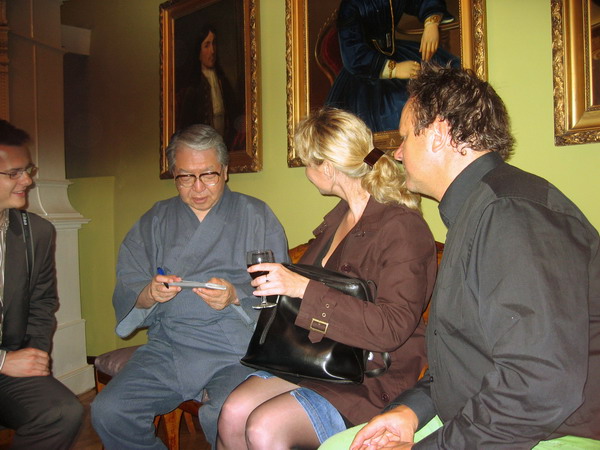
Eikoh Hosoe, Jutka Kovacs and Stefan Bremer at the reception in the castle

It was later after a grand opening ceremony with projections of the our images to a fantastic live piano accompaniment by Janusz Kohut that I first met Eikoh as we both made our way out into the foyer on the way to a party at the castle. I went up to him and told him how much I liked his work and that I’d been an admirer of his work and had written about it – it must have been a rather embarrassing moment but he remained charming and extremely courteous.


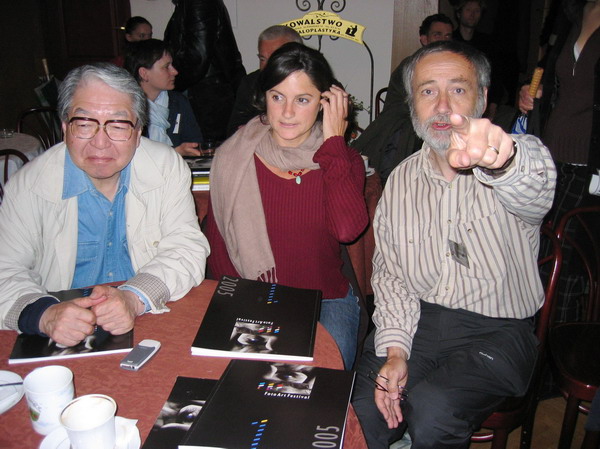
Eikoh Hosoe, Ami Vitale and me at the meeting: photo by Jutka Kovacs

Being 72 at the time (born in 1933) he didn’t join the group of photographers who went to a local bar when the wine ran out (there was still vodka, but I expect he needed some rest.) But probably his head was rather clearer than most of us the following morning for the start of the ‘author sessions’ where the photographers talked about their work, and clearly took a great interest.

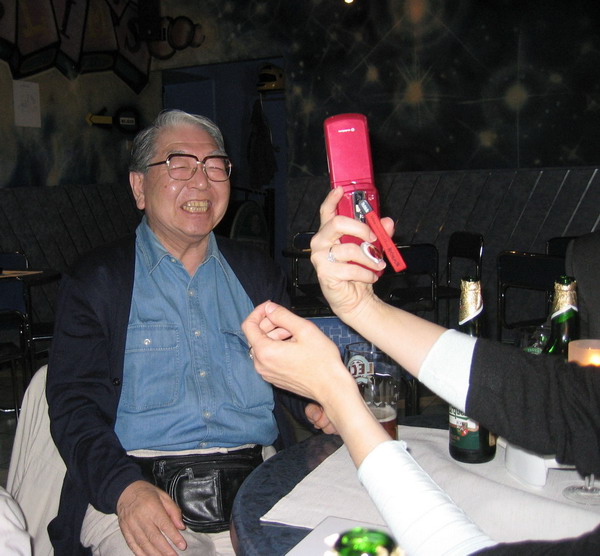
The next day the sessions all overran, and everyone decided a break was needed before my rather long performance, talking about my own work as well as the two short lectures, though I’d rather have got on with it. A group of the photographers went together for a pizza, and took him along with us. A beer or two helped to steady my nerves too, and we all indulged in taking silly pictures of each other as we waited for the food to come.

The pink phone was the only camera Eikoh Hosoe had with him, and I think it was a new toy, Fortunately someone was able to show him how to see the pictures he had been taking (which he hadn’t found how to do) and above you can see his reaction.

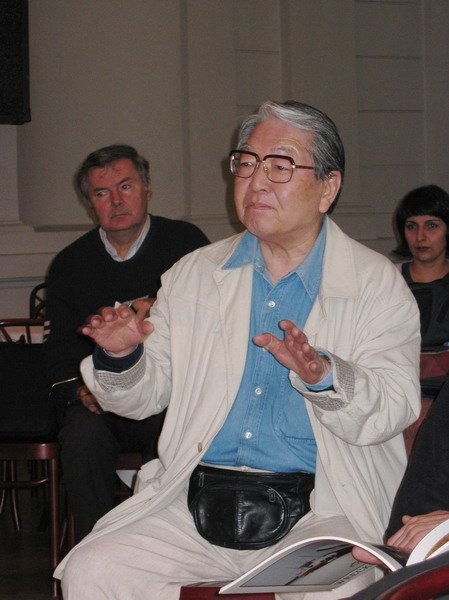
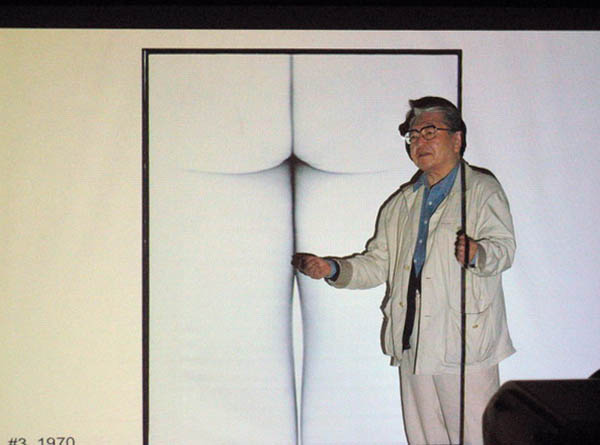
Later, after my talk, and another by Stefan Bremer, it was his turn to present work as the finale of the event. The light in the large hall came from the computer projector, and Hosoe moved into it on various occasions to talk about the work. I tried hard to catch him at just the right moment, and I think the image below was my best attempt before the battery on the small compact Canon Ixus ran out.


Eikoe Hosoe makes a point about one of his pictures

You can see a good selection of Hosoe’s work at the Howard Greenberg Gallery site. There are some more pictures with him in – as well as many others – in the FotoArtFestival Diary I wrote when I was in Poland, and I’m pleased to see that at least some of the links to the Wayback Machine with the posts I wrote at the time for About.com are now working again.

Continue reading ASX Eikoh Hosoe

Abigail Heyman (1942-2013)

Some photographers feel the camera separates them from their own feelings about people and events. To the contrary, the camera makes me closer” wrote Abigail Heyman in her 1987 Aperture book ‘Dreams & Schemes: Love and Marriage in Modern Times‘, certainly the only book of wedding photographs I own, and in which I think her pictures demonstrate the truth of her statement.

You can read her obituary, published yesterday in The New York Times, which also has  a small gallery of images, beginning with a portrait of her by Bill Jay, taken in her New York home in 1980.

When I wrote about her ten or so years ago for my ‘Directory of Notable Photographers’ (a listing no longer on line) I searched the web with little success to find anything by or about her, recording my conclusion:  ‘No useful material available on the web’, and I don’t think things have changed much, with just a few isolated images on various blogs. Information about her is also still rather sparse , and a little of what I did find and used was perhaps not absolutely accurate. It’s a shame that her work isn’t more readily available.

Her first book, ‘Growing up female; A personal photojournal’ was published in 1974 and sold many copies, becoming something of a feminist icon. Although there were a number of images I admired, I didn’t buy a copy and still consider it a less interesting work than ‘Dreams & Schemes‘. Her third book, ‘Butcher, baker, cabinetmaker : photographs of women at work‘ picturing them in occupations at least then normally thought of as male preserves seems considerably less personal than the first two. All three are available very cheaply second-hand (or, as usual if you prefer, very expensively, one of her works being offered in apparently similar condition by different sellers at around a fiver or over £99.)

The NYT obit states “She was one of the first women admitted to the prestigious photographer’s cooperative Magnum“, but she was only nine when Eve Arnold was accepted as a member and there were a number of others before Heyman become linked to them in some way. Although various sources describe her as a former member of Magnum Photos I’m not sure what her exact relationship was to the organisation as her name does not appear in the index of Russell Miller‘s Magnum book, and she is not included in the list of present and past members on Wikipedia.  Perhaps one of my readers can clarify?

She was one of the founding members of Archive Pictures, along with Mark Godfrey, Mary Ellen Mark and Charles Harbutt, who all left Magnum in 1981 as well as Joan Liftin who had been the director and editor of the Magnum Photos Library. In the mid-80s Heyman ran the Documentary and Photojournalism Department at the International Center of Photography in New York – a position later held by Liftin.

Heyman also founded Picture Project, a photography publisher which seems to have brought out two books, ‘Flesh & Blood‘, a collection of family pictures by various well-known photographers, and a second edition of her own ‘Dreams & Schemes‘, and to have been associated with the University of New Mexico Press in publishing ‘My Fellow Americans’ by Jeff Jacobsen.

Art Shay

Thinking about D-Day for the previous post led me to the work of one of America’s most prolific photojournalists, Art Shay, who at the time was the navigator on a B-24 bomber named ‘Sweet Sue’ and whose “Whitmanesque poem to my beautiful new bride” about his experiences got published in the Sunday Washington Post.

Shay, born in 1922 and still active at 91, has been described as “Chicago’s premier photojournalist” and his record of around 1,100 magazine covers is certainly impressive (and it’s around 1,099 more than me.) His work is deeply embedded in aspects of American culture, particularly of the 1950s, and there are some aspects of it that rather pass me by in the short video about him on PetaPixel, though anyone who gets the testimonial there from Studs Terkel certainly deserves and gets my respect.

Shay’s work appears on the Chicagoist blog in a regular ‘From The Vault Of Art Shay feature each Wednesday, and there is also a blog devoted to him and his work, as well as an artist’s page at the Stephen Daiter Gallery. You can also read about him in Wikipedia.

England, Normandy & the Liberation of Paris

It’s hard to resist the lure of looking at old photographs, and I’ve just spent half an hour I didn’t really have looking at some rather different pictures about the 1944 Allied advance across the Channel and on to the liberation of Paris, taken by Life photographer Frank J. Scherschel (1907-81) who life sent with his Speed Graphic (or something rather similar he is holding in his Life portrait) to record the advances in colour.

It’s hard to know exactly why Life sent him, since apparently they used few if any of his images, which seldom show anything of the actual action, but certainly record its aftermath, with one whole series of images devoted to The Ruins of Normandy, and others in the series Before and After D-Day also showing more devastation.

But the pictures say more about the time, with a wonderfully evocative image, A small town in England in the spring of 1944, shortly before D-Day,  with the village trough framed between two trees, and the lane beyond leading towards tree-covered hills, a small row of cottages to the right, the odd house on the left. Unusually – particularly for colour at the time – the view is taken towards the sun (what used to be labelled contre-jour, the French term expressing some of the transgressive nature of the act, disregarding the standard advice to photographers of the time) and the colour suits the subject in a way that perhaps isn’t always the case in this series of pictures.

No details are given about the film used – my guess would be 4×5 Kodachrome – and the colour that is now produced from other images taken on this film at around the same time seems to me to be considerably better than that in contemporary publications. Scanning and digital correct can produce superior results, and also compensate for some of the ageing of the originals. There is a nice set of pictures on 4×5 Kodachromes taken by several photographers for the Office of War Information in the 1940s selected by Pavel Kosenko for his blog from the many available on the Shorpy site, which show the excellent quality that could be obtained, though some are better than others.

The ‘small town’ image was clearly taken with the camera on a tripod, and demonstrates the lack of lens coverage with the rising front, but the vignetting perhaps improves the image. A few of the other pictures are less technically precise, and the colour at times rather odd, perhaps because less effort has been put into correcting it and some may have been made on smaller film formats.

I’m not sure what some of those who took part in the Normandy landings would have made of Scherschel’s comment “We thought it was going to be murder but it wasn’t. To show you how easy it was, I ate my bar of chocolate. In every other operational trip, I sweated so much the chocolate they gave us melted in my breast pocket.” He made it about his photography of the invasion from the air (which isn’t in the set of images) and not about his experiences once he had joined the forces on the ground, as in the picture it is below, GIs search ruined homes in western France after D-Day, the closest we get in these pictures to seeing actual action.

Perhaps devastation wasn’t the image that Life wanted to show, but it is the strongest theme that runs through his images.  Looking at – for example – his pictures from Paris, I’m reminded of the many more powerful images in black and white taken at the time.  Some of the fascination of a few of Scherschel’s images for me is that they are in a way so ordinary, pictures taken slightly randomly by a bystander rather than an active mind interpreting the situation – and of course that they are in colour.

In a Photographer’s Footsteps

Although the current series on BBC Radio 4 In a Prince’s Footsteps narrated by former hostage John McCarthy is interesting, its title and the description “John McCarthy revisits sites of the Prince of Wales’s photographic tour of 1862” rather annoy me. The important footsteps (and tripod holes) are not those of some royal prince (later better known as King Edward VII) but of photographer Francis Bedford (1816-94.)

I’m not sure how long the series of broadcasts and the image galleries that accompany them will remain on the BBC web site – and John McCarthy found some interesting people to talk with – but the Prince’s diary – which he wrote apparently in his own hand (perhaps unlike the current incumbent he actually put his own toothpaste on as well) is available in full at the Royal Collection, which also has a transcription of the pages – just as well as his handwriting would not get a gold star.

The Royal Collection entitles its exhibition more sensibly Cairo to Constantinople: Early Photographs of the Middle East, and the show continues at The Queen’s Gallery, Palace of Holyroodhouse in Edinburgh until 21 July 2013, coming to the The Queen’s Gallery, Buckingham Palace at the end of October 2014. Birmingham Library and Archive Services bought a set of these pictures a couple of years ago, and used some large version on the hoardings around the Library which was being built in Centenary Square which opens in September, and he is likely to have a major show there later – doubtless cheaper to view than in the Queens Gallery. As well as the 172 pictures from this tour they have a very large collection of 2700 glass negatives and 2049 prints by him, mostly architectural and topographical views of Great Britain in the 1970s.

Francis Bedford was the first photographer to travel on a Royal tour, and afterwards the work he took was shown in what was then described “as ‘the most important photographic exhibition that has hitherto been placed before the public’.” It was certainly work that altered ideas about the Middle East and the Holy Land in particular, and led many to follow the photographer’s example and visit these lands.

Being a Royal photographer was clearly rather different in those days, and Bedford wasn’t a press photographer but a particularly fine photographer of landscape and architecture. On the tour he had to work under difficult conditions, with at times high temperatures making the wet plate process almost unbearable to perform. The photographs are well reproduced on the site, with links to his other works in the Royal collection and a handy ‘zoom’ function to see details.

Victoria and Albert had a great interest in photography, and built up a fine collection of Victorian images. I don’t think the tradition has really been carried forward, although the current monarch has a specially monogrammed Leica M6 and almost certainly used it at times. The Duke of Edinburgh used to take pictures of birds from the royal yacht with a Hassleblad and a 250mm f4 lens, as well as a using a Minox, and although I’ve never seen it’ his 1962 ‘Birds from Brittania’ (published in the US as ‘Seabirds from Southern Waters’ and still cheap secondhand) apparently shows that either he or his valet could use it! The Minox is presumably the gold-plated version the company presented him with in 1965.

You can read more about Francis Bedford – and see more pictures – in a lengthy article by William S. Johnson.


Fred Herzog

One of the shows I went to a while ago but never got around to reviewing was
Cartier-Bresson: A Question of Colour which was the inaugural show by the Positive View Foundation at Somerset House over the Christmas period. In part I didn’t review it because I wasn’t at all convinced by it as a show; it seemed a particularly sloppy piece of curating, a rag-bag of colour photography around a less than threadbare conceit. But among the work by 15 photographers on show, there was some of particular interest, particularly by Saul Leiter, Helen Levitt, Alex Webb and someone rather less well-known to me, Fred Herzog.

Herzog was born in 1930 in Germany, where he grew up and life was pretty tough during the war and afterwards. In 1952, having become a photographer, he emigrated to Canada, settling shortly afterwards in Toronto, where he worked as a medical photographer. In his spare time he walked the city taking pictures, using Kodachrome. Although his work was included in a few mainly group shows in Toronto over the years, it was only in 2008 following a show at the Equinox Gallery the previous year that it really began to reach a wider audience around the world.

Part of the reason it didn’t become known earlier was technical. It was difficult – and expensive – to make good prints from Kodachrome, so it was hard for him to show his work. Cibachrome was the first really practical direct printmaking process from slides, and it wasn’t ideal with its high contrast added to the already high contrast of Kodachrome favouring extreme impact at the expense of subtlety. Getting truly good prints needed expensive masking or laser scanning, and it was only with the advent of high quality inkjet printing from digital scans that making good and decently archival prints from Kodachrome became reasonably cheap. And it is these inkjet prints that have made Herzog’s work available to a wider audience.

Herzog’s work interests me both because of the subjects he took but also because it shows that – like I think ther work of many other photographers – there was interesting work in colour before colour was discovered by the art photography industry in the 1970s and 80s.  Photographers who were using colour not because it was saleable and could be shown in museums and galleries, but because of their interest in recording life in colour. We now know of Herzog, but I’m sure he is the iceberg tip.

There is also an individuality about his work. Unlike that of another recently discovered ‘unknown’ photographer I don’t look at his pictures and immediately think of the work that other photographers had made earlier and disseminated widely. Herzog was making his own history, not just repeating – however well – what he had appreciated in the work of others.

You can read more about him – and about the controversy that arouse over his views about the Nazi holocaust in a couple of features, Marsha Lederman’s The collision: Fred Herzog, the Holocaust and me  in the Vancouver Globe and Mail, and Timothy Tailor’s The Way Things Are: Fred Herzog’s Art of Observation in Canadian Art.

City to Blackwall 1978-84


Millwall Inner Dock, 1984

Just published on Blurb:

City to Blackwall 1978-84 London Docklands 1
ISBN 978-1-909363-09-0


South Quay bridge and Millwall Inner Dock, 1984/

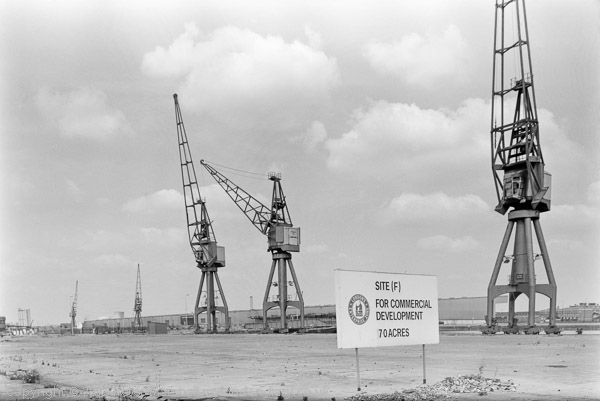
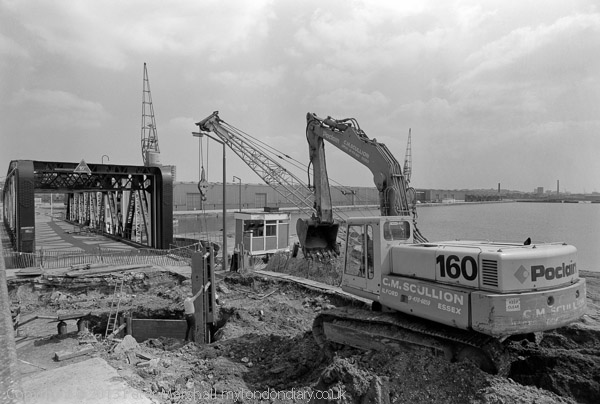
The late 1970s and early 1980s was an interesting time in London, especially in the areas where the docks which had been at the heart of London’s existence were closed down, left derelict and then began to be developed. City to Blackwall is the first of a short series of books looking at these changes through the photographs of Peter Marshall, and was made over around ten years from 1974-84 in a series of walks from the heart of the City of London, close to London’s first dock, through Wapping, Limehouse and the Isle of Dogs to Poplar and Blackwall.

80 pages, 87 black and white photographs.


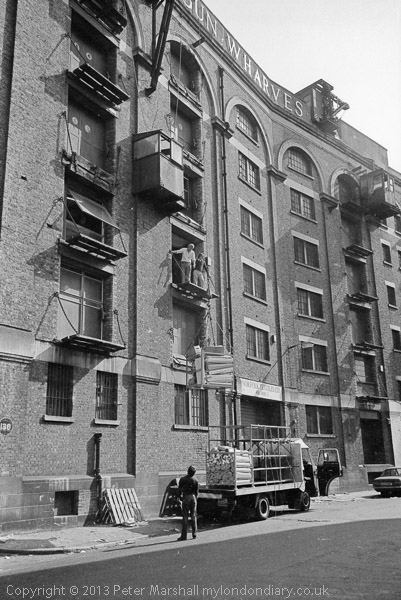
Gun Wharves, Wapping High St, 1981

Available cheaply as a PDF download (£3.99) or rather expensively as a printed paperback at £26.99 plus Blurb’s arm and a leg post and packing charges.


Limehouse, 1984

If you live in the UK, you can usually buy the print version of any of my books slightly cheaper direct from me (£25 inc p/p for most) but there can sometimes be a few weeks delay if I am out of stock as I need to order in batches to get a discount to pass on to you.


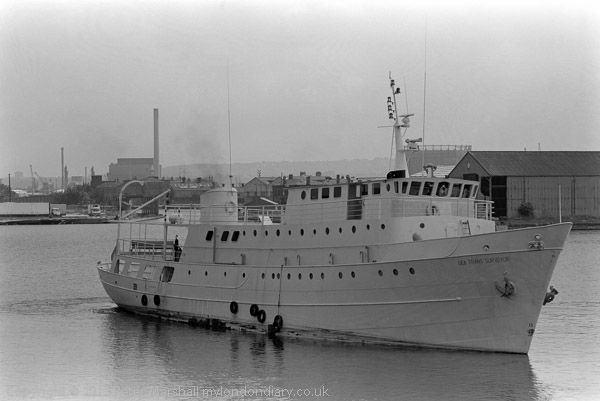
Sea Trans Surveyor leaves West India Dock, May 1984

I was photographing on Hertsmere Rd, roughly where the Museum of London now is, when men working in the dockside sheds on West India Dock invited me to come and photograph this ship leaving from the walkway overlooking the dock. I had a mug of tea with them and took a few pictures inside the shed and then walked out as the ropes were untied and the Sea Trans Surveyor cast off, turned around in the dock and made for the entrance. They told me it would be the last ship leaving before the redevelopment as the dock would be closed for some years. I took several pictures (perhaps 4 or 5 – film wasn’t cheap) as it left and two are in the book.

________________________________________________________

My London Diary : Buildings of London : River Lea/Lee Valley : London’s Industrial Heritage

All photographs on this and my other sites, unless otherwise stated are by Peter Marshall and are available for reproduction or can be bought as prints.

To order prints or reproduce images

________________________________________________________

The Marquis of Lansdowne

The Marquis of Lansdowne is not my name-dropping of a personal friend, but a former London pub, fortunately still standing in Hoxton, but not in ale since around 2000 (and possibly not a place I would have cared to frequent since it had a make-over as ‘Partners’ around ten years earlier.) Recently it has been threatened with demolition by plans for a  £13.2m expansion of the neighbouring Geffrye Museum.

Back in the 1980s I began over a project to photograph the whole fabric of London, wandering in a fairly systematic manner through the capital rather than the rather freer approach of earlier years that you can see in my recently published ‘London Dérives‘, (and the images on this post come from it and the accompanying web site.) Most if not all of the pubs and many of the shops in this earlier work were derelict.

But my ‘Buildings of London‘ project, which began long before Google’s ‘Streetview’ made it somewhat redundant, was more conceptual than literal. Although I intended to look at most of London and went about it in a fairly systematic way, I had a clear focus on photographing not everything, but the interesting and the typical.  You can still see a few images from it in the web site I built in 1996, itself now a rather decrepit relic – seventeen years is a long time on the web (though I had to make a few changes to keep it working, and added a few pictures, it still retains the essentials of its 1996 design.)

I’m not sure if I ever photographed The Marquis of Lansdowne, though I will have looked at it, and at the now demolished ‘The Flying Scud‘ nearby on my walks in the area.  It would probably take an hour or two of searching through my files to be sure. It isn’t an outstanding building, but one that is very much typical of its age and certainly that I would be sorry to see demolished. You can see what it looks like now in an article in Building.co.uk by William Palin, a trustee of the Spitalfields Historic Buildings Trust and former Secretary of SAVE Britain’s Heritage.

So I was very pleased to see in Spitalfields Life that a long campaign which has included a feature in ‘Country Life’ (not a publication usually concerned with Hoxton) as well as a series of articles in Spitalfields Life and work by the Spitalfields Trust and others has resulted in the building being saved, with Hackney Council Planning Committee telling the Geffrye Museum to rethink their development plans to include this building.

I hope the Museum will see it as an opportunity to enhance its display of period rooms (well worth a visit) to include that of a genuine neighbourhood Victorian (though the building is a little older) pub, truly a part of the living room of many among the working class of the era in overcrowded neighbourhoods such as these.  Hopefully too it will be realistic enough to have some genuine beer on tap, although the current London price per pint is at least a month’s Victorian wage.