Hiroshima: 70 Years

On the 360 Cities World Panorama site you can see an incredible 360 degree panorama of the city of Hiroshima, taken around 260m from the hypocenter less than two months after the city and much of its population was destroyed by the atomic bomb on August 6, 1945, seventy years ago. The series of pictures was taken by former army engineer Shigeo Hayashi, a Japanese photographer who had worked since 1943 for the magazine ‘FRONT’ and was one of two photographers (and an assistant) chosen by the Japan Film Corporation  to document the aftermath of the bombs on Hiroshima and Nagasaki for the Special Committee for the Investigation of A-bomb Damage organized by the Scientific Research Council of Japan (under the Ministry of Education).

In his comments on the image Hayashi states:

On October 1, 1945, I stood at the hypocenter of the Hiroshima atomic bombing and made a slow revolution. In that instant I had a difficulty grasping that this city had been felled by a single explosion. Nothing in my experience had prepared me to conceive of that magnitude of destructive force.

There is also a second panorama by Hayashi taken a little further from the hypocentre.

Other panoramic images on the site include photographs of Hiroshima again in October 1945 by Harbert F. Austin Jr, and the following month by H. J. Peterson.

You can see more of Hayashi’s images – now in the Hiroshima Peace Memorial Museum in their Shigeo Hayashi Photo Exhibition online.

I’ve written on various occasions about the photographs of Hiroshima following the dropping of the bomb and also about the annual commemoration in London which I’ll attend today. There are several posts on this site, including Hiroshima 65 Years On
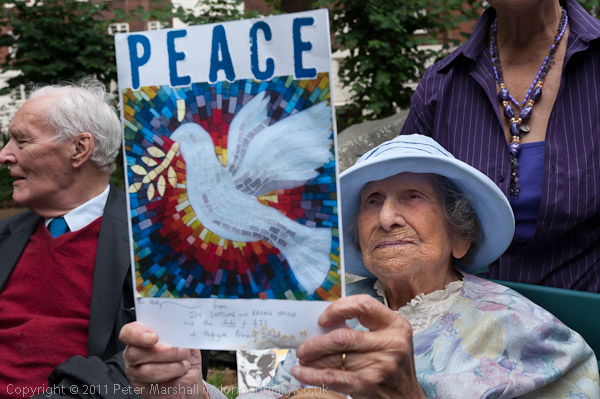
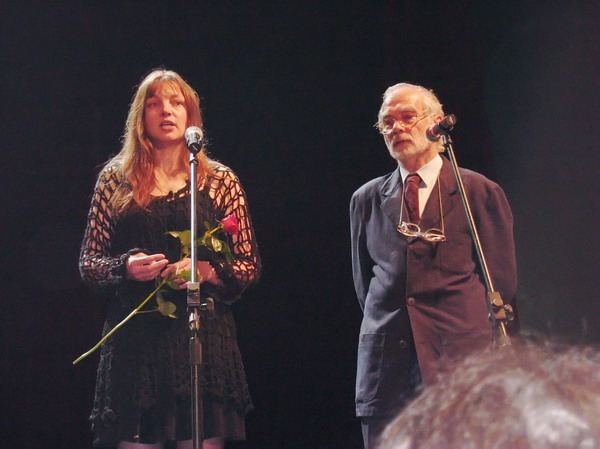
and Hiroshima Day, which included the picture at the top of this post, of the remarkable peace campaigner the late Hetty Bower, 105 when the picture was taken in 2011.
Continue reading Hiroshima: 70 Years

Things Left Unsaid

I’ve never been a great fan of either Donovan Wylie or Paul Seawright, but the video of their conversation at the opening of Seawright’s show in Paris last November with the working title of ‘Making News’ but shown as ‘Things Left Unsaid‘ at the Centre Culturel Irlandais,  held my attention, although I soon got rather fed up with looking at the two photographers and took to looking instead at the eight images and installation view which you can find on Paul Seawright’s web site.

On the web site it explains the project:

‘Exploring the theatre of war through the internal landscape of the US television news studio. Developing Virilio’s writing on electronic warfare and weapons of mass communication, Seawright focuses on the illusory nature of these spaces, where information is selectively transformed into news. Characteristically Seawright continues his exploration of contested spaces and illuminates an invisible aspect of contemporary conflict.’

(You can read an interview with Paul Virilio on Vice, and more on Wikipedia.)

The book contains – according to the talk – 26 images, and you can see a slide show of 7 images on APB where the 56 page book is on sale.

Seawright at one point says he doesn’t like taking photographs, the ‘moment’ for him is when he sees the exhibition for the first time on the gallery wall, and he comments that the book is secondary, lacking the drama of the exhibition.

WhileI feel with him and Wylie that the camera is a purely functional thing I find myself more in sympathy with Wylie’s comments about taking pictures and the experience of doing this. It may be and often is exhausting, but fore me it is also at times exhilarating. But perhaps it does account for an absence of feeling that I often feel in looking at Seawright’s pictures; something I don’t see even with the New Topographics who he relates his work to.

Near the end of the the discussion Seawright comments “We make work because we believe in the work and the idea behind the work” which seems very much, despite the differences in our ideas and approaches to photography, something with which I can wholeheartedly agree.

Looking at the various other projects on Seawright’s web site, there are others that I find rather more interesting that ‘Things Left Unsaid‘, a title which he suggests on the video could apply to all of his work.  One of the more interesting is ‘Invisible Cities‘ and the site has links to two reviews, one of which is in Socialist Worker. Although not entirely complimentary, and commenting that it fails to show the African dynamism, implying that “the legacy of colonialism in Africa is too dominant and exhausting to ever be changed”, this concludes:

Neverthless, Invisible Cities is a terrific selection of photographic art. It skillfully uses seemingly prosaic scenes of urban life to present an startlingly new image of Africa – one that is not dominated by violence and famine, but rather by human beings engaged in a day-to-day existence that is not a ­million miles away from our own.”

Donovan Wylie’s work can be seen on his Magnum page.

Thanks to Peggy Sue Amison, Artistic Direct for East Wing in Dubai for a Facebook post sharing the link to the video.

Frank & Stones

Thanks once again to Peggy Sue Amison of Picture Berlin for reposting a link to a short film edited from Robert Frank‘s Super 8 footage shot of the Rolling Stones in Los Angeles and New York, set to the soundtrack of their ‘Rock Off‘ from ‘Exile on Main St‘, a track many believe to mark the zenith of their output, a short time when they were clearly ‘The greatest rock & roll band in the world?’

Frank was hired by the Stones to make a documentary film about their 1972 American Tour and did so in cinéma vérité mode, with those taking part in the backstage antics being invited to pick up cameras and add to the record. They did so too well, providing a revealing view that led to the Stones getting a court order to prevent the release of the film; although in recognition of the rights of Frank as an artist it can be publicly shown if Frank himself if present.

You can usually find several parts – and occasionally the full film until it gets taken down fairly rapidly – on YouTube, though some of the links will be to the Stones track of the same name, their final single for Decca Records, deliberately made to be rejected (though Decca issued it by mistake in Germany in 1983, quickly withdrawing it after they realised what they had done.)

I can’t sign up to Charlie Finch’s opinion in Sockcumber Blues on Artnet when he says that rather than ‘The Americans’, “Frank’s true masterpiece is his still unreleased chronicle of the Rolling Stones’ 1972 American tour”, but it is a film that should be seen.  And ‘The Americans‘ is certainly a book every photographer should own and study, still ‘The Book That Changed Photography‘. But I’m sure I’m preaching to the converted.

While trying to find out more about the ‘Rocks Off’ video I came across a fascinating article by Bob Egan on Pop Spots NYC researching the location of photographs of Bob Dylan taken by New York musician/photographer John Cohen, who was a neighbour of Robert Frank who lived at 34 Third Avenue – and around three quarters of the way down the very long post he includes a photo of the relevant page of the NY reverse street directory showing both of them. There are also links to ‘Rocks Off’ and also mentions another of Frank’s films, Pull My Daisy, as well as more that may be of interest to fans (like me) of Jack Kerouac, who of course wrote the fine introduction to the US publication of ‘The Americans‘.

Elsewhere in various forums on the web you can glean more information about the film locations in ‘Rock Off’ video. The guy dancing on the street as he dodges traffic to wipe car windows is apparently at the corner of Houston and Bowery in New York, and the rest of the New York street scenes are in that area (including Lafayette), while Mick Jagger is shown outside the Galway Theatre at 514 South Main Street in  Los Angeles, an ‘adult’ theatre that has apparently appeared in a number of films.

August Sander (1876-1964)

I find it hard to believe that I have never published at any length about August Sander, but all I can find are  few brief notes such as one that was a part of the ‘Directory of Notable Photographers’ I was once responsible for, and a number of brief references to him in articles about other photographers.

I know that I have written in greater detail about his life and his work in general, as well as in more detail on a few of his images, and he was certainly one of the photographers whose pictures I talked about when I was teaching. If I do find what I’ve written on him, I’ll publish it in a later post.

I started hunting for my own piece after reading Rena Silverman‘s
Finding the Right Types in August Sander’s Germany in today’s Lens Blog, an article prompted by the recent acquisition by the New York Museum of Modern Art of 619 prints from his project People of the Twentieth Century which he started around 1909 and had to abandon with the rise of the Nazi party, who confiscated and burnt his preliminary publication with 60 images, Antlitz der Zeit, in 1929. A few copies survived and are now fairly expensive.

In looting that followed the end the war, some of his work was destroyed in a fire, but Sander himself survived until 1964. He didn’t entirely give up photographing people in the 1930s, but certainly concentrated more on landscape. I haven’t looked through all of the huge Sander collection at the Getty Museum – apparently 1186 images, and almost all viewable on line – but there are some fine portraits from the 1930s, including some that the Nazis would not have approved of. But most seem to be studio portraits rather than the images of people he travelled his region around Cologne to locate for his typology.

A large volume of Sander’s Menschen des 20. Jahr hunderts was published in Germany in 1980, and I have a copy of the French version published the following year, with 431 portraits from 1892-1952. In the USA it was called ‘Citizens of the 20th Century‘. It’s a very heavy book, really too heavy for its binding, and a larger publication with over 600 plates in 2002 split the work into 7 volumes.

In the article Bodo von Dewitz is quoted as saying “He was the first who worked with what we now call ‘concept’ in photography,” and I think I have several problems with that. Firstly because many earlier photographers from Fox Talbot on could be argued to have worked with ‘concept’, but mainly because what distinguishes Sander’s work is not the concept or even the scale of his work (perhaps rather small compared to say Atget) but its quality.

Although conceived as a part of a great scheme, it is the very individual quality of Sander’s response to his subjects that still holds us, whereas with most contemporary ‘concept’ works the concept overwhelms the motif, producing sets of images of stunning mediocrity. It’s largely their predictability and recognisability that makes them, along with their normal impressive scale into such ideal commercial fine art for the corporate atrium.

There are smaller and more readily appreciated sets of work by Sander elsewhere on the web, including a small and varied set at MoMA, a rather better selection of 32 from ‘People of the Twentieth Century’ at Amber Online, and 24 images at the Edwynn Houk Gallery. There are various other sites devoted to Sander, including some I found it hard to see more than one or two images on.

Charles Harbutt (1935-2015)

Charles Harbutt (who I always thought of as Charlie), died on June 29th 2015, aged 79. Although he was twice president of Magnum (leaving it in 1981 to form Archive Pictures along with others including Abigail Heyman, Mary Ellen Mark and Joan Liftin), he is perhaps not that well known as a photographer, but will be remembered warmly by all those of us who attended one of his many workshops.

It was one of his workshops back in 1976 at Paul Hill‘s Photographers’ Place in Bradbourne, Derbyshire that led a few years later in 1985 to a friend of mine, Peter Goldfield,  leaving his business as a pharmacist and purveyor of high quality photographic products – particularly fibre-based Agfa papers – under the name of Goldfinger in Muswell Hill to set up his own photographic workshop at Duckspool in Somerset, and it was there in 1996 that I spent some days at a workshop with Harbutt. (Goldfinger of course morphed into Silverprint under the guidance of Peter’s partner in crime, Martin Reed.)

I’d perhaps been around too long in photography for the workshop to totally change my life as it did Goldfield’s, but it was certainly a very enjoyable and stimulating experience, and Harbutt was one of two outstanding photographic teachers I’ve had the privilege of working with.

I’d first met Harbutt around 20 years earlier, not in person but through the pages of his 1973 book ‘Travelog‘, one of the first real photography books that I bought, though the Creative Camera bookshop in Doughty St. It was a book that pushed documentary beyond its traditional limits (Harbutt had studied at college with both Roy Stryker and Russell Lee as visiting lecturers) with images that were very personal and often left far more questions than answers.

I’ve written a little about him in a few posts here, on the occasions of his work being featured on-line in Visura magazine and in L’Oeil de la Photographie.  He also merits a mention in my post written on the death of Peter Goldfield in 2009.

Travelog I think remains his most important work, a book that is one of the classics of photography, and compared to it his two later volumes are perhaps a little disappointing, with the best work in the 2012 ‘Departures and Arrivals‘ being mainly from the earlier volumes. Travelog is unfortunately now a rather expensive second-hand purchase.

There are obituaries of Harbutt in The New York Times (which includes material from the afterword of Travelog), in Photo District News, some details in Mike Pasini’s Photo Corners article and more elsewhere. As well as the pictures on his own web site you can also see a few at the Peter Fetterman gallery and in the Visura feature mentioned above. An older web site of his web site is on the Internet Archive WaybackMachine.

Capa’s Story

I continue to be amazed at the revelations about the ten or so exposures that Robert Capa made on Omaha Beach on D-Day in the huge series of posts by A D Coleman and various guests on Photocritic International.

The series having disposed more than adequately of the legend about the darkroom mishap and the myth of the missing negatives that never were, the latest two-part contribution by military historian Charles Herrick, a former officer in various roles in the US Army and a military contractor shows convincingly that the caption and almost universally accepted interpretation of a couple of the photographs was incorrect. It’s a conclusion that also must alter our evaluation of the remaining images.

Capa himself must have known what the people he photographed were doing, but sent no information with the film. As Herrick points out, “Captioning the images was therefore left to those who had never witnessed an amphibious assault, much less the Omaha Beach landings.” The caption they wrote was to fit the story they wanted to illustrate and bears little relation to what the image actually shows to the trained eye of Herrick.

Capa had gone back to Normandy immediately after giving his film to a courier and by the time he became aware of the misleading caption, he would also have been aware of the impact the image had made, and a correction would have spoiled his story and blemished LIFE’s reputation. But it would be hard to believe he didn’t discuss it later with his picture editor in the London office along with the rest of the story when next they met.

As Herrick points out, the picture is used on an official US Navy Seals web site with a the correct interpretation. Rather than people struggling to shore in the second wave sheltering behind the obstacles on the beach under heavy fire, Capa photographed a dedicated team of engineers at work rather later in clearing these obstacles. Dangerous work that was made possible by this being “a stretch that was under relatively light fire.

Capa was fortunate to have landed on a part of the beach where the relative lack of opposition had enabled the first waves of the invading forces to make considerable progress – and the engineers were clearing the way for further troops. Working unprotected to remove the obstacles was a hazardous job – of the 175 engineers working on Omaha beach, the Seals web site states  that  31 were killed and 60 wounded, but this section was where the most progress was able to be made.

Herrick’s interpretation makes sense of some things I had been unable to understand about this image – if the soldiers were under heavy fire, why were they not more clearly sheltering in the lee of the obstacle, and what were the ropes that were clearly visible. I’d thought that perhaps they were wires that were in some way a part of the defences, though it was hard to see in that case they had not been cut through.

Herrick concludes:

What a travesty, then, that these very men who made decisive contributions to the success of the campaign, despite every danger and hindrance, should have become poster boys for lack of resolve under fire.

And all as the result of a caption in LIFE magazine that told the wrong story.”

He perhaps should have added “and those who knew the right story – the photographer and presumably his editor – failed to correct it” – and so it became a legend.

My own conclusions are also about the failures of much photographic criticism. As I’ve often found myself having to comment, it really does need to start by looking at the pictures carefully and critically. Whereas all too often it starts from false assumptions and the lazy repetition of what others have said. Most fail to consult what are after all the primary sources.

As this case demonstrates, it often also needs some specialist knowledge of the situation , enabling the recognition of the helmet markings as those of US Navy engineers and of those ropes or wires as Primacord detonation cord.

But in this case, perhaps more than anything else it needs the courage to think out loud the unthinkable, that people and institutions that have been revered for years have been deliberately repeating a lie.   Or in this case, perpetuating lies and a mistaken interpretation.

It isn’t of course unusual for photographs to be deliberately used in a misleading way, though the initial incorrect captioning was almost certainly made in good faith in this case. Regularly pictures published on social media (and often picked up from there in the mass media) alleging to show something are shown to have been taken elsewhere at a different time or place or to have been digitally altered.

M. Scott Brauer wrote an article on his dvaphoto site on 8 June with the lengthy title Bellingcat’s conflict crowdsourcing: analyzing photos and video to learn more about war. Bell¿ngcat is a web site which crowd-sources specialised information of every type from people around the world to provide a detailed analysis that has been able to produce a remarkable level of previously unknown information about some conflict images that those publishing them wished to hide.

Sensibly, Brauer concludes with a warning that you shouldn’t believe everything that you read on the web.

One wrong click and you’re down the conspiracy theory rabbit hole where there’s a political motive behind every photo, all of which are staged.

Articles like that by Herrick and the whole series by Coleman and his other guests are convincing, in part because of the experience and obvious expertise of those concerned, but also because of the careful and precise building of their case and the presentation of evidence for it. Coleman’s work has already been recognised by the 2014 Society of Professional Journalists Sigma Delta Chi (SDX) Award for Research About Journalism and being nominated for two other awards.

Max Pinckers

Thanks to a Facebook post by photographer George Georgiou for a link to Colin Pantall’s blog post Liverpool Look/15: Don’t Take Boring Pictures, a look at the current Liverpool at Look/15 Festival continuing until Sun 31 May 2015.

Were I in Liverpool I would certainly go and take a look, although the big show, Martin Parr and Tony Ray Jones in Only in England at the Walker Art Gallery is one already seen in London, and which I reviewed here last year as well as posting a link to a review by John Benton-Harris, who knew TRJ well.

While I had huge reservations about the ideas behind the show and some aspects of its presentation and John made very clear his thoughts on the misrepresentation of his friend’s work, I still concluded “It really is one of the most significant shows of photography here in the UK for some years“. In part that is a reflection on the fact that most of the more significant photography shows fail to get a showing in this country. But it is an opportunity to see around 50 vintage images taken by TRJ (if rather fewer of them actually made by him than claimed) but also as a reminder of what a good black and white photographer Martin Parr could be back in the 1970s.

But this is also a show which contains Parr’s selection of work the TRJ rejected, printed in a way he would have felt totally unsuited to his work, contradicting the clear directions he gave to people – like Benton-Harris – he got to make prints for him. It was a travesty that Benton-Harris clearly felt strongly about and makes his feelings abundantly clear in his review, and I think represents a failure to respect the work of Ray Jones by the organisation entrusted with his legacy.

What prompted me to write this post today was however the final section of Pantall’s post, about the apparently rather hard to find show of work by Belgian photographer Max Pinckers, Will They Sing Like Raindrops Or Leave Me Thirsty, a project on “the price of love in India and the stories encountered daily by the Love Commandos, a volunteer group working to prevent honour killings by providing assistance to those who have found love outside their prescribed destiny” which you can explore in greater depth on Pinckers’ own web site.

The work is the fourth self-published book by Pinckers (as well as a self-published book dummy – I’m unclear about the distinction) and copies of it are expensive, with a ‘special edition’ including a signed print still available for 320 Euros and shipping. There is an interesting interview with the photographer about his earlier highly praised book ‘The Fourth Wall’ by Taco Hidde Bakker, though this was a work that failed to arouse much of my interest.

Looking on-line at a selection of pages from the latest book and images on the web site, I find the work far more suited to the web presentation, which animates the series of images of images which on the page – which despite Pantall’s assertion – do sometimes become rather boring.

Andrzej Baturo – 50 Years

It seems a very long time ago that I first met Andrzej and Inez Baturo in Bielska-Bialo, and it’s something of a surprise when I realise it was only 10 years ago.

You can read more about my first visit to Poland and the first FotoArtFestival held in Bielsko-Biala, Poland in June-July 2005, organised by the Foundation Centre of Photography there, with Andzej, the centre’s president as Art Director and Inez, the vice president as Programme Director in my Polish diary.

It was a fine festival, with an international cast of photographers, one from each of around 25 countries, with some well-known names including Eikoh Hosoe from Japan, Boris Mikhalov from Ukraine, and Ami Vitale from the USA, as well as work by the late Inge Morath (Austria) and Mario Giacomelli (Italy) and others. There was also a strong Polish representation, with soft-focus pictoriasm by Tadeusz Wanski from the middle of the twentieth century, and the much gritter group show ‘”Unoffical Image” – Polish photoreportage of the 1970s/80s‘ which included work by Andrzej Baturo.

Last year Galeria Bielska showed ‘Andrzej Baturo – 50 Years Of Photography‘ with around 200 images over the years since he began taking pictures in 1962. You can read an English version of the page about it, which quotes Andrzej as saying:

The photograph was first invented simply to record social realities, but with time, social documentary photography and reportage photography have both been raised to the status of art, much in the same way as the journalism of Hanna Krall or Ryszard Kapuściński are now considered great literature. I feel a close affinity with both these areas, and I’ve never been sure whether I’m more of a journalist than an artist, or the other way round.

The Polish version is here. Also in Polish, but worth watching for the images even if you understand little or nothing that is being said, is the video, Andrzej Baturo – 50 lat z fotografią. There is also a page about the show with some comments on his work on the Polish site Art Imperium, which I viewed through Google Translate.

There is now a crowd funding appeal for the publication of a book Andrzej Baturo – 50 years of photography. I’m not sure how well a link to the page through Google Translate will work, and if you understand Polish or have a browser that will automatically translate, you may find the Polish original works better. And even if like me you don’t speak Polish, the pictures speak in any language.

The various rewards available for supporting the publication are of course priced in Polish Zloty (PLN) and where items are to be posted, international postage would presumably need to be added. But 150 zł (about £27) for the 240 page hard-cover book with around 200 photographs seems very reasonably priced. But registering and using the Polish crowd-funding site might need the help of a Polish speaker and charges for converting currency may add to the cost.

Fox Talbot goes on-line

WHF Talbot, one of the inventors of photography, died some 115 years too early to set up his own web site (though I think there is little doubt that had he still been around he would have been at the forefront of that scientific advance too.)

But now the Bodleian Library is about to repair that omission, with “an ambitious project to create a new web-based research tool that will allow scholars and members of the public to view and search the complete photographic works of British photographic pioneer William Henry Fox Talbot.”

There is already some material on-line at the project site, including a blog to provide updates on the development of the William Henry Fox Talbot Catalogue Raisonné” and the project is a large and lengthy one, due to be completed by 2018. It is hoped that the publication of the work in this way will lead to new information and insights into the work of WHF Talbot – and perhaps even the discovery of new images that were made by Talbot and his circle of photographic colleagues.

My only slight quibble over what appears to be a magnificent development is over the statement: “Catalogues raisonnés are common in the world of art, serving as a detailed academic inventory of an artist’s work. However, nothing of this scale has been attempted for photography.”

While the scale of this particular project may be unique, there have been a number of publications which are essentially catalogues raisonnés for the work of the photographers concerned, though bearing in mind the different natures of photography and painting or sculpture. While it may be relatively simple to cover every painting by an artist, every print and every reproduction of a photograph by even a not very prolific photographer is an virtually impossible challenge. Ours is a prolific if not profligate medium.

You can read more about some of these photographic equivalents – including the magnificent two volume edition of Alfred Stieglitz, The Key Set and the 4 volumes of ‘The Work of Atget‘ in a post Photography Catalogues Raisonné by Loring Knoblauch on Collector Daily in 2009 – and the suggestions in the comments on that piece, which include references to a number of other photographic catalogues raisonnés.

Through a Glass

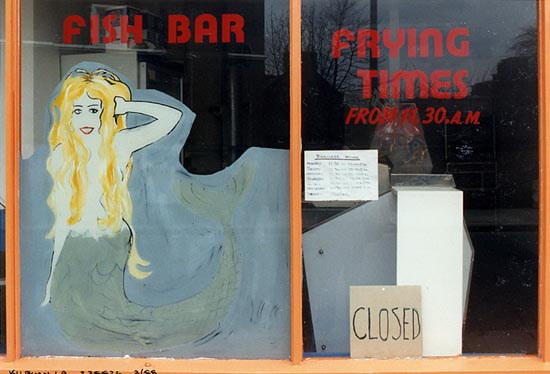
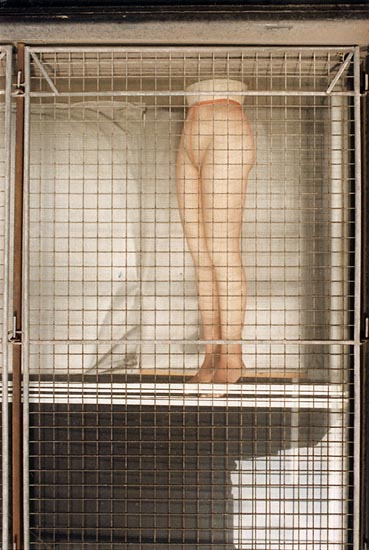
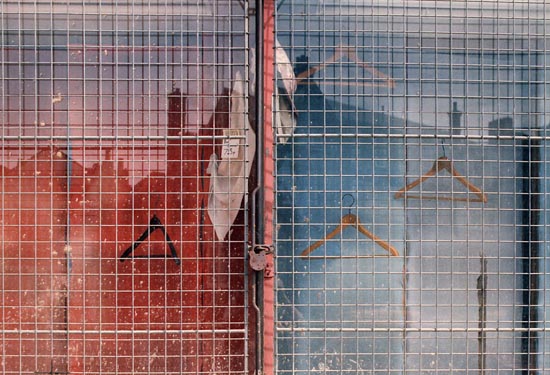
For some years in the 1980s and 1990s I worked on a project for which the great majority of images were taken through windows. Some of those images eventually made their way into an ‘artist’s book’ that I produced one year during during the Christmas break around 20 years ago, under the title Café Ideal, Cool Blondes, and Paradise.

At the time I was working with colour negative film and having these trade processed with 6×4″ prints of every exposure, or occasionally when I was feeling rich, 7½x5″ (later I processed my own C41 and only contact printed films.)  And these postcard-sized images were pasted onto sheets of 12×8¼ cotton rag with a ¾ folded at the gutter end to paste to the previous sheet, eventually with a little sewing and thick cardboard covers made into a 64 page hardback volume with a short text and 54 images. It still sits on my shelf.

I showed the work to a couple of publishers, both of whom expressed some interest, but eventually decided not to publish it, or at least not unless I could come up with at least half the cost either from my own resources or from a grant, and I lost interest. A few years later, in 2000, I put a very slightly different version of the work on the web, where it can still be seen: Café Ideal, Cool Blondes, and Paradise.

Almost all the images were taken with a 35mm shift lens on an Olympus OM4 body, with a few using a 28mm; possibly some of the earlier work on the project was made with an OM2.

Of course some of the images I made depend for their success on the reflections, but there were many where the reflections made images impossible, or detracted from those I did make.

During the project I learnt quite a lot about reflections, starting with the fact that the polarising filter I always carried and which every magazine article and technical tome told you was essential seldom actually did what you wanted it to.

For many of the pictures I was able to work close to the window glass, and used a collapsible rubber lens hood costing a couple of quid (now from £1.12 post free on Ebay) pressed on to the glass surface to eliminate all reflections.  Also essential was a cloth to clean the outside of the window through which to photograph.

Sometimes, the dust on a window – often on the inside where I couldn’t reach it – added to the image, as in this image of tables inside a café, taken a short distance from the glass with the lens well stopped down. I’m not sure now whether the scratch was on the glass or a later addition to the negative!

What led me to think again about these pictures was a post by Michael Zhang on PetaPixel, about research at MIT into the removal of reflections from images taken through glass. When working through glass, reflections normally are a double image, with a reflection from both the front and back surfaces of the glass, and by searching for parts of the image that are seen double the software is able to distinguish the reflections from the rest, and can then reduce or eliminate them. Perhaps before long we will see a ‘reflections’ filter in Photoshop.

Zhang also points out that there are products that are more elaborate (and more versatile, not to mention rather more expensive) than my cheap rubber lenshood for allowing you to work through glass – such as the Lenskirt.  The price of around $50 puts me off, and it’s also considerably larger, though it will work with almost any lens. The days of lens systems like the Zuiko, where almost every lens I used had a 49mm or 52mm filter thread are unfortunately gone.

One of the other problems I faced was that window glass is often rather coloured, and although filtration when printing with colour neg might deal with this, when using a wide angle, rays from the edges of the subject travel obliquely through the glass with a longer path, sometimes leading to a noticeable colour shift.  It’s a problem that would be much easier to solve working with digital images than in the darkroom, where I sometimes resorted to dodging and burning with different filtration. I worked on scans of some of the images and wrote about it in a post here in 2008, Cafe Ideal, Cool Blondes and Paradise revisited.

I hope to publish a revised version of Café Ideal, Cool Blondes, and Paradise at a future date, in a new edit with some extra images and a few replacements. But finding the images and scanning the negatives will be a long job.  Along the bottom edge of some of the prints in the book and on the web are details of the date and location where the images were taken, which makes finding things easier, but over the years many of the negatives that I printed from have been filed out of the date sequence I nominally used.

Continue reading Through a Glass