Fourth of July Celebrations

This morning I woke up to the news that Alan Johnston had been released in Gaza, and thought it was great that I had something to celebrate on the 4th of July. Other than getting shot of those troublesome colonials in America of course. Having spent 8 years writing for an American-owned web site (in recent years About.com has been a part of the New York Times) it was a relief to think I could write without having to keep American festivals and feast days in mind.

Although the site had many thousands of visitors from around the world, those from the USA were in a majority, and my non-American sensibilities were a problem so far as the management were concerned, though probably less of a problem than my interest in photography.

Our pleasure at the release of one brave journalist should not make us forget the others who are still in captivity – including Bilal Hussein, an AP photographer who now been held by the US military in Iraq for 448 days without being charged. You can sign a petition for his release at the ‘Free Bilal’ web site4:

According to an IFJ press release, at least 82 journalists have been kidnapped in Iraq. Of those, 28 have been killed and six are still being held, though I don’t think there statistics include people held by the US and other occupying forces
Of course many have been killed. This year so far, up to 4 July, at least 87 journalists have been killed, many of them photographers. Most – appropaching half – have died in Iraq. You can read the details, and the figures for earlier years at the News Safety Institute.
Photographers (still or video) are very much exposed and at risk, becuase they can’t work without putting their heads up above the parapet and actually confronting the motif. There are plenty of stories of people who’ve made their start in photography by picking up a camera and rushing out to cover a war, but we seldom tell of those who went out and met an early death without becoming famous. Of course many of those who did get started like this in the old days had some military training or experience, if only through national service.

Wars and many other situations are now more dangerous. Old ideas about respecting the freedom of the press and the right to report often no longer apply in modern conflicts; you are thought to be on one side or another, often because of your nationality rather than your views. With the Internet (and for photographs, the ubiquity of digital cameras) groups no longer need the press to get their views across in the old way.

If anyone is thinking of working in any hostile situations, it is vital to take advice and to get proper training. You might start by reading the book ‘A survival guide for journalists’, published in 2003 by the International Federation of Journalists, available as a PDF file.

Peter Marshall

Pride & Climate Change

London carries on, despite the terrorist threat with two car bombs left close to gay nightclubs which fortunately failed to explode early on Friday morning. Saturday’s Pride Parade was much the same as last year, and if there were more police present, it was only noticeable in the several groups of officers actually taking part in the parade.

Despite the publicity and high figures given in the media (which perhaps relate to the whole festival) the Pride parade itself is now a relatively small event, a fraction of the size of the major political marches that make their way through London largely unreported by the press perhaps half a dozen times a year, although considerably more organised and more colourful. It seems to attract considerably fewer marchers than it did a few years back, with many more simply turning up for the events in Trafalgar Square and Soho.

Ten years ago, taking part in the Pride march was an important personal and political statement for many, sometimes marking their going public about their sexuality. Now it’s largely a fun event, although a few individuals and groups still attempt to get a more serious message across.

Much of the event has now settled into a pattern, with many of the same floats and costumes as in previous years, but there are some changes, and I tried to concentrate on these. Its an event where it is hard to get away from the stereotypes, because so many of those taking part embrace them whole-heartedly.
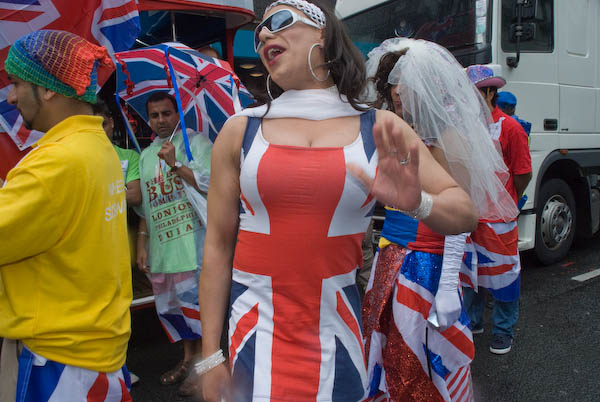
Pride 2007 (C) 2007, Peter Marshall
Many, especially from minority ethnic groups, use Pride as an occasion to stress their British identity as well as their gay identity

I seldom pose people for pictures, but at Pride, everything is a pose. Certainly as soon as people see a camera, most play to it, and its a game you can’t avoid, something you need to work with. Getting below the surface is often a problem, but at least the surface often fascinates.

What was new was ‘Bird Pride’, describing itself as a “Queer Femme Carnival”, organised by the Bird Club, whose aim is to “celebrate femininity on the queer scene”.
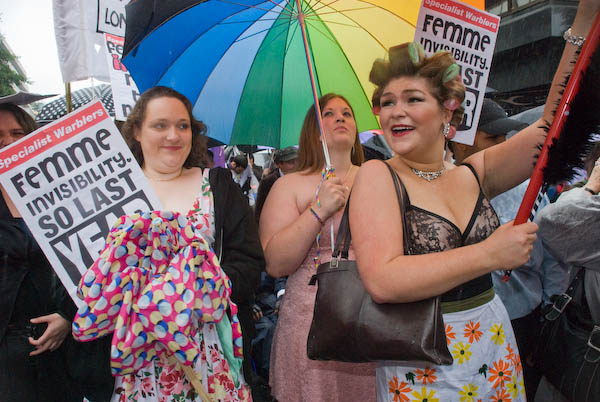
Pride 2007 (C) 2007, Peter Marshall
Bird Club ‘Specialist Warblers – Femme invisibility, so last YEAR’

More pictures from the Pride march on My London Diary shortly.

The two car bombs were on the route of the parade, and there were rumours that it was a badly failed attempt to attack the parade itself, but they didn’t appear to have put the marchers off. The crowds watching the event in Oxford St did seem rather lighter than normal for a Saturday, but this could have been more a matter of the weather, light rain interspersed with heavier downpours, which at times made taking pictures tricky, but some of the best opportunities were in pouring rain.

Photographing in the rain is a problem. In the old days, mechanical cameras such as my old Leica M2 carried on almost whatever hit them, and the standard lens at least had a lenshood that was a fairly effective rain shield. Keeping it under your coat when not in use, and an occasional wipe with a handkerchief kept you going through rain, hail and snow.

Digital cameras are more of a problem. I gave up on the Nikon D70 as unsuitable for London weather, but the D200 is much hardier. My main problems are with lenses. Larger filter sizes, more glass – in zooms in particular – mean more rain drops and more condensation inside lenses with changes in temperature and humidity. Zoom mechanisms pump in damp air, and also draw in moisture from the damp lens barrel. Increasing use of wide angle lenses is also a problem, as their lens hoods offer little or no rain protection – and the same is true of zoom lenses that start at wide angles.

Nikon’s 18-200mm VR lens is a great and very flexible lens, but becomes useless when there is even a hint of moisture in the air. Sensibly, I’d left it at home and was shooting with a Sigma 18-125 which holds up rather better. The Sigma 12-24mm has the problem of a large front element open to raindrops, but if you can keep it clear, also works well in wettish conditions. Handkerchiefs aren’t really a good idea, and in a special, otherwise unused pocket of my jacket I had a large, clean microporous cloth that saw frequent use to wipe both glass and other surfaces of lens and camera.

Sometimes I’ve improvised a plastic cover for camera and lens from a suitable bag, but such things get in the way. But these – or specially made camera rainwear – can keep you shooting in really bad weather. Unfortunately they don’t stop condensation inside the lens, which is often a problem – and all you can really do is wait for it to clear, or change lenses. ‘Pumping’ zoom lenses can sometimes help.

I decided I couldn’t face more rain to photograph the Pride rally in Trafalgar Square or the cabaret performances elsewhere, and in any case I had a mermaid to photograph.
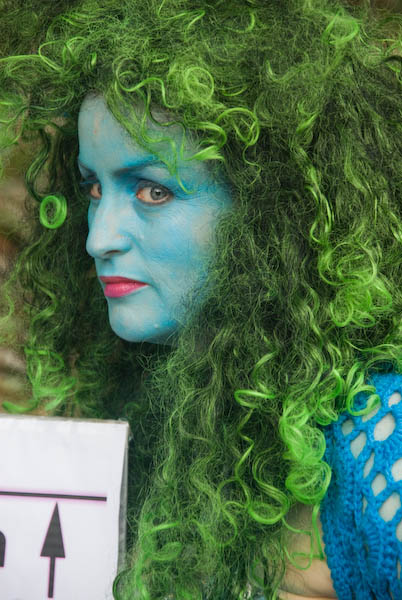
Rising Sea Levels (C) 2007, Peter Marshall
Lucy warns about the perils of global warming – her arrow indicates sea level in 2012

The climate change event was designed as a reminder to Gordon Brown that this is still the most urgent problem we face. Without a planet that is livable on, none of the rest will matter. So far the politicians have largely stayed on the edge of the pool, hanging on to ideas of technology or carbon offsets to avoid taking the real action that is needed, talking about cuts in carbon dioxide emissions while these continue to rise.

Effective action is vital, before it is too late (and we hope it is not yet too late.) Energy saving that means more than turning off the odd light or buying a more fuel-efficient car.

More pictures on My London Diary now for Pride and Climate Change Rally
Peter Marshall
Real Photography, Unreal Beer

I’m sure beer has always played an important role in photography, and it is certainly good to see the London Photographers’ Gallery getting sponsorship, just a pity that it some comes from a Japanese beer company. The bottled evidence (and I tried another last night to confirm my convictions) is that they just don’t understand beer as we know it, and it’s a feeling that I sometimes have about the gallery and photography.

(C) 2007, Peter Marshall
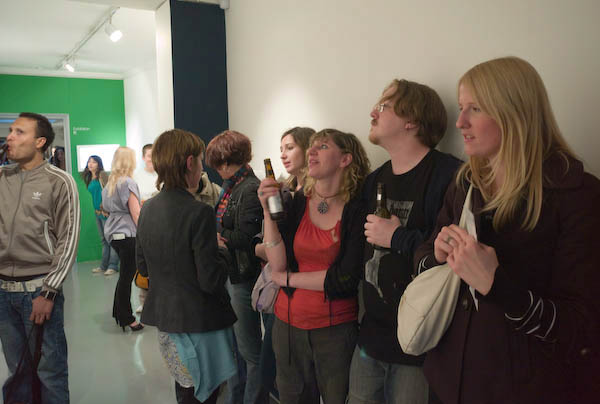
Some people at the gallery were drinking the beer

Should you go to an openings there, the best policy is to stick to the wine, which is at least cheap but not nasty, and at the “suggested donation” of a quid a glass is considerably better value than the free beer. In a not dissimilar vein, if the work showing in the ground floor gallery doesn’t stimulate, there is often something in the upstairs print room to soothe the nerves.

I decided I didn’t have time for reaching and writing a few years back, but went to the opening with a fellow photographer who still teaches in further education, and we spent some time talking about the work on the wall and also about this year’s degree shows, so much of which seemed to lack the kind of direction and creative input that our students – at a lower level – had been required to show. We do seem to be putting more and more students through photography courses but in many ways expecting and getting less and less from them. Sometimes it even seems that the higher up the educational ladder the less we expect from them – and at at least on some courses, the less we are giving to them. Many of my former students would come back to college while studying in higher education and say thank god you taught us photography, because nobody here does.

At least there was good photography on the walls for a retrospective by Keith Arnatt, still most famous for his Trouser-Word Piece (1972), a self-portrait wearing a placard with the statement ‘I’m a Real Artist‘, made when he was part of a British conceptual art movement of sometimes immense vacuity, peppered with fleeting moments of insight. It was a statement that raised many questions at the time, and was perhaps behind his move to become a ‘real photographer’ afterwards, although what truly inspired him was being introduced, in 1973, to the work of Walker Evans, August Sander and Diane Arbus.

That Arnatt was born in 1930 and had undergone an art education which had taken him to teaching sculpture at Newport College of Art and lived to the age of 43 without apparently having been exposed to some of the major artistic acheivements of the 20th century says volumes about the attitudes of the art establishment to photography. Even had he studied photography at most art colleges, he would probably not have been introduced to their work.

One of the figures in British education who did much to change this, at least on the documentary photography course he inaugrated at Newport, was Arnatt’s colleage and close friend, David Hurn, one of the best British photographers of the era, and a Magnum member since the 1960s. Hurn has both curated this show and written the accompanying book of Arnatt’s work, ‘I’m a Real Photographer, Keith Arnatt: Photographs 1974 – 2002.’

Although his earlier black and white works are interesting, it was really with colour that Arnatt began to produce works that I find most convincing, and notable among those on the walls are his ‘Miss Grace’s Lane‘ (1986 – 87), ‘Pictures from a Rubbish Tip‘ (1988 – 89), ‘The Tears of Things‘ (Objects from a Rubbish Tip) (1990 – 1991) and the delightful ‘I Wonder if Cows Wonder‘ (2002).

Of course the idea of producing beautiful images from rubbish was in no way novel, and had perhaps been more cleanly and forcibly expressed in Irving Penn‘s great platinum prints of cigarette butts and other urban detritus made in the 1970s. Arnatt’s work has the added dimension of colour, which in some respects softens the impact, but leaves us in no doubt about his abilities as a fine colourist.

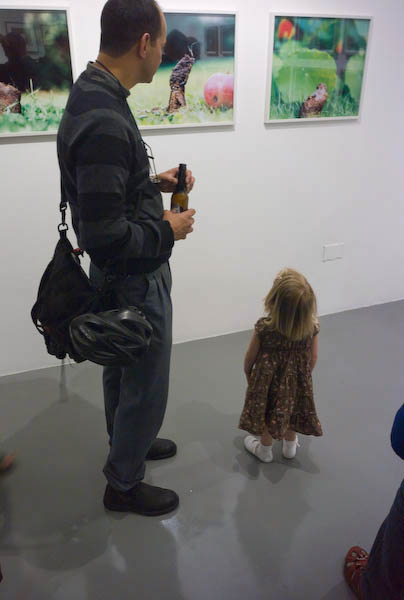
Given this, his small series of large close-up images of dog turds is surprising. These are truly images from another planet where grass has a rather different colour. Perhaps Arnatt is deliberately taking a child’s-eye view, echoing the threat to childrens’ health as they roll in the soiled grass, and perhaps these are deliberately ugly images to repel the viewer. If so, they did. It wasn’t the subject matter but the treatment that made me flinch.

(C) 2007, Peter Marshall

I also found no great photographic interest in a series of large blow-ups of notes from Arnatt’s late wife, Jo, written between 1990-94. Perhaps because I don’t really feel I want to know about the relationship between them and that these illuminate. Most importantly, because I don’t think that photography adds anything to them, and I think the actual post-it notes would have had at least as much appeal.

The selection of which notes to preserve and display appears to have been made on the basis of the textual content, and what matters is the text, not the image. A photocopier could have produced enlarged versions of them for display. There does seem to me to be something essentially non-photographic about this work, which some others seem to see as part of a debate about the nature of photography. To me its an irrelevance that just happened to be made using a camera.

Back to beer. With my lunch I had a bottle of Budvar Budweiser (known as Czechvar for legal reasons in the USA.) And if Americans ever want to try to understand Europe and the feelings that many Europeans have about America, they might well compare a bottle to the vastly inferior US Budweiser brew, as well as reflecting that the name is that of the largest city in South Bohemia in the Czech Republic. Budvar is a company who I wish would sponsor the Photographers’ Gallery.

Bernd Becher (1931-2007)

The work of Hilla and Bernd Becher was controversial to some people in the 1970s and 80s, but I came to it having sat (fleetingly) at the literal feet of Lewis Balz and studied with him and others of the work of the American New Topographics, so the kind of cool objective view embodied in their work came as no shock.

Of course their studies had a kind of ruthless scientific typology that the American work lacked, but it was something that the work of another German, August Sander had prepared me for. The kind of objective view of the Bechers fits well too with the Neue Sachlichkeit which came from Germany in the 1920s, a straightforward depiction of reality as seen in the work of Albert Renger-Patzsch or indeed of Helmut Gernsheim, whose photographic ideas rather disturbed the Royal Photographic Society when he arrived in England from Germany in the 1930s. As the title of Renger-Patzsch’s 1928 book says, ‘The World is Beautiful‘ and his work attempted to bring that out, while one of Gernsheim’s books was entitled ‘Beautiful London‘ (1951.)

The Bechers came to prominence in the rapidly developing art world in Europe, and were clearly seen as artists as well as photographers well before American dealers really began to take art seriously. They were accepted by the academic art world in Germany, and took photography into the Dusseldorf Kunstakademie, where they had met when both were studying painting. Their classes turned out a new generation of masters of photography, among them Andreas Gursky, Candida Hofer, Thomas Struth and Thomas Ruff.

Sadly, I’m prompted to think and write about the Bechers again because of the sad death of Bernd Becher, aged 75, following a heart operation. I knew the work of the Bechers in reproduction long before I saw their actual prints, and the presentation of their images in grids of small images which led to their recognition as conceptual artists had not prepared me for the quality of their work. Some of their large prints of cooling towers and other industrial structures had a truly classic beauty.

Sight and Sound‘ have republished an interesting feature on them, High precision industrial age souvenirs to mark Bernd’s death.

The Bechers became the most influential teachers of the era, not least because of the tremendous financial success of some of their students who became mega-stars of the art world (the Bechers themselves have never commanded similar prices despite the quality and influence of their work.)

I’ve always been uneasy about the great dynastic teachers such as the Bechers, Minor White and Callaghan. Sometimes their influence on their students has perhaps been too strong, turning out too many near-clones, who they have perhaps been rather too successful in promoting. Often this has meant that after the teacher’s death, the work of the students has tended to become less highly regarded. It is perhaps hard to see the market allowing this to happen in this case, although equally hard to see how some of the current art-market prices can be justified. But I suspect the work of the Bechers themselves may well be a very good investment.

More than the Olympics

Yesterday I was fortunate enough to watch what may well be the best film to be made on the Olympics. ‘The Games‘, a 15 minute colour HDV film from Optimistic Productions by Hilary Powell and Dan Edelstyn is an at times hilarious staging of an alternative and surreal Olympics filmed on the unreconstucted Olympic site, with a hand-picked team of ‘athletes’ taking part in steeplechase, hurdles, synchronised swimming and more. It starts with flaming torches and ends (more or less) with an awards ceremony. Catch it if you can.

We’ve all heard how the London Olympics is to play a vital role in the regeneration of east London, although I don’t think anyone has yet come up with any remotely credible explanation of how shutting off and concreting over large areas of land currently open for recreational use and producing large and largely unwanted sporting facilities is going to help that much.

There may be some limited infrastructure improvements, although much of those were already on board from the Channel Tunnel Rail Link, with its new Stratford International station. Most of the claimed new housing and some other facilities claimed for the Olympic effect were also already on the way as a part of the Stratford City redevelopment, described as “the most ambitious development within the M25.”

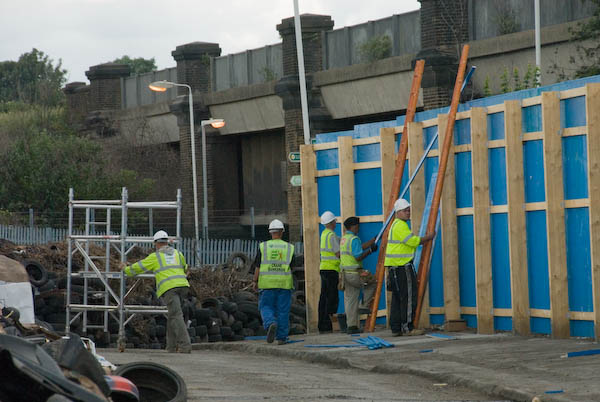
But London 2012 is here and we have to hope for the best, even if it may be madness to expect that to be very much, though we can hope that a few crumbs will fall in appropriate directions. At the moment there is only the pain, as local businesses are forced out of the area and jobs and recreational and sporting facilities are lost, as well as access being restricted. All around the site, high blue fences are being erected to keep us out from July 2. Of course some areas have long been blocked off and well-used paths have already seen lengthy closures for work associated with the games. But the loss of Carpenters Road and Waterden Road in particular will cause considerable local transport problems.


Fences being put up around the Greenway, which should be reopened shortly.

You can see some more pictures from the area taken last Thursday on My London Diary.

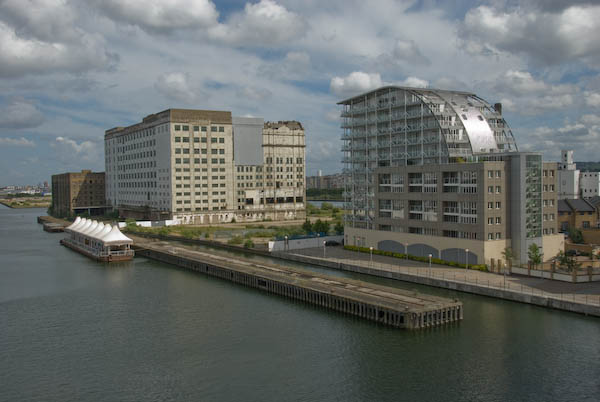
Despite all the publicity, the Olympic area is only a small and relatively insignificant part of the regeneration of East London, and a relatively minor contribution to Stratford City. Close by are other large and important projects, in particular at Canning Town and the Royal Docks. The former Pura Foods factory in a loop of the Lea has now been reduced to rubble, and plans for a mixed-use development are close to agreement, with some 1,800 homes, a primary school, shops and more. On the other side of Victoria Dock, planning approval was obtained recently for the Silvertown Quays site, with 5,000 residential units, shops, offices, workspaces, community facilities including a primary school, restaurants and bars and other leisure facilities. This also includes a vast aquarium project, Biota!, in collaboration with London Zoo.

Victoria Dock, SE
Silvertown Quay site and Eastern Quay. The Millenium Mills are to be converted to flats.

West Silvertown already has the Brittania Village development and Eastern Quays, as well as stations on the DLR North Woolwich extension, the Thames Barrier Park and flats at Barrier Point. Two further key sites, Minoco Wharf and Peruvian Wharf are likely to be re-developed before long, although arguments still continue, particularly around the continued industrial use of Peruvian Wharf, and there are more prime riverside sites still to be redeveloped, as well as considerable redevelopment that has already taken place to the east of the Barrier Park, with again more planned.

This afternoon I’m leading a tour around the area, probably in pouring rain. Shortly I’ll post a link to an on-lilne version of this which I hope will encourage others to visit this fast-changing area. It will perhaps take your mind off the Olympics.

Yes, it’s how I saw it

Here is the text of an e-mail I received today, which I will quote anonymously – but otherwise in full:

—————————————————————————–

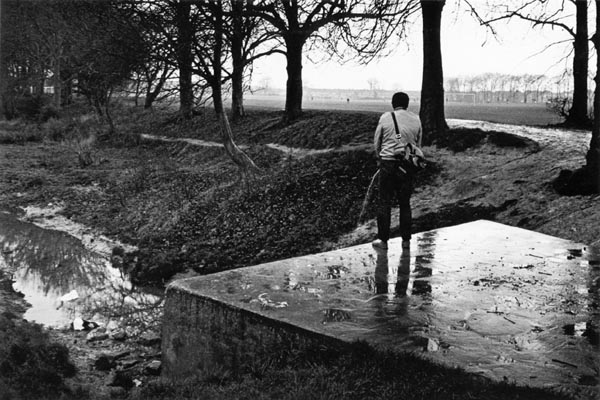
Hi in regard to you site as above, did you realise the pciture of the source of the river has a man who looks like he is relieving himself!! There is an issue of something wet and his arms are held in front, was this deliberate or have you not noticed?! OR is it yourself??

I’m not sure it is appropriate if on purpose, and if not the picture should have been checked!!

Would have been nice if the rubbish was cleared before taking the photograph too!

——————————————————————————

The site in question was named in the subject line. Its full title looks like something like this:

The Lea Valley

London’s Second River – The River Lea (or Lee)

from source to mouth – including the London 2012 Olympic site – photographed by Peter Marshall

and the second picture on the page is:

Source of the River Lea
33d56: The source of the River Lea, Leagrave, near Luton, Bedfordshire.
December 1982.TL 061 248

and is captioned as shown.

What kind of a world does my correspondent live in if he is in any doubt about what this picture shows, or somehow thinks that I might have not noticed what this guy, a few feet from me and the central point of the picture, is doing?

Had Bernard, shown here, informed me of his intentions in advance I might have got the exposure a little better, as the picture is a pig to print, and, before the advent of Photoshop, did need a little ferri to bring out its finer points.

Given the way the stream emerges – or at least did in 1982 – through a grille at the bottom of this concrete block looking far more like a sewage outfall than a sparkling rivulet, his gesture seemed appropriate. As too did the rubbish, which as a matter of good documentary ethics I would not have dreamed of touching,

I don’t often use potassium ferricyanide on prints, but applied on the tip of a fine sable brush here it made the smaller of the two streams stand out more clearly and impressively, leaving I thought no doubt as to what is was. Sometimes our work needs a little help in small ways like this, and so long as what we do is entirely in keeping with the spirit of the event I don’t think it matters.

More often I retouched prints to hide the accidents of photography – dust and scratches, but also occasionally to remove white spots that were actually present in the image. Unless I’m doing a feature on pigeons, then I have no qualms about removing or dulling down the evidence of their existence where it interfered with the reading of the image.

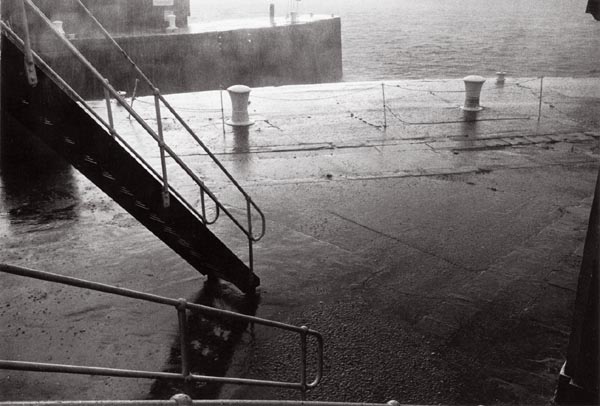
Entirely by fortunate coincidence, it was also pissing down when I started from the Thames at the other end of my journey along the Lea, though this time it was the heavens that had opened rather than Bernard’s fly:

Limehouse
33f33: Regents Canal Dock entrance to River Thames during torrential rain,
October 1982. TQ 363 808

I haven’t finished my Lea Valley web site, although there are a large number of my images on it already, starting from around 1981, and including much of my recent work, but with at the moment around a ten year gap in the middle. At the moment a significant part of the area is about to be radically changed into a giant building site, the location of the London 2012 Olympics, with the loss of significant wildlife habitats (and ironically, sporting facilities including one of London’s largest cycling centres, miles of angling along river and canal and various football and other sports pitches) along with the allotments mentioned here previously.

My pictures do give a good idea of what the area is like and things – both good and bad – that will be lost. I hope to continue photographing the Lea Valley – and my web site – to give an idea of how things have changed in the legacy of the games long after they finish.

Peter Marshall

Human Rights & Art

It was in the 1960s that I joined the National Council for Civil Liberties – now known simply as ‘Liberty‘, after seeing the way that travellers were being hounded by the police, giving up time to help prevent their eviction from otherwise unused derelict sites that had been flattened in the massive redevelopments then taking place in Manchester’s inner suburbs.

Over recent years I’ve photographed many events related to civil rights and human rights abuse in this country, as well as continuing to support ‘Liberty’ and also friends who have taken practical action to support people who our government have been denied both any benefits from the state and the right to work, leaving them destitute.

Saturday I’d hoped to see a performance by Mark McGowan, burning an effigy of Margaret Hodge as a protest against her statement that established British residents should be given precedence over economic migrants for council housing. But there were no traces of a fire on Camberwell Green at noon. Perhaps, as in Birmingham earlier this year, it had been prevented on health & safety grounds. I only hope the guys will be out stopping such things happening on November 5!

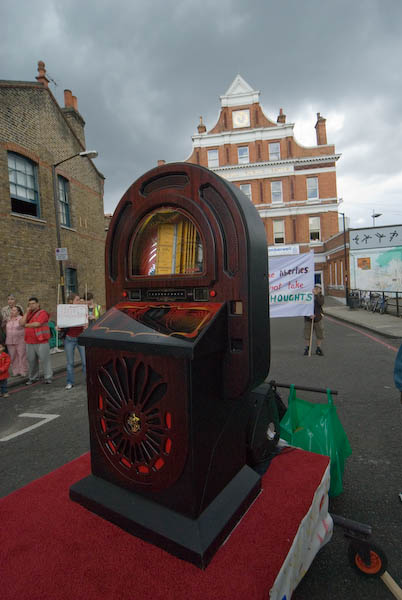
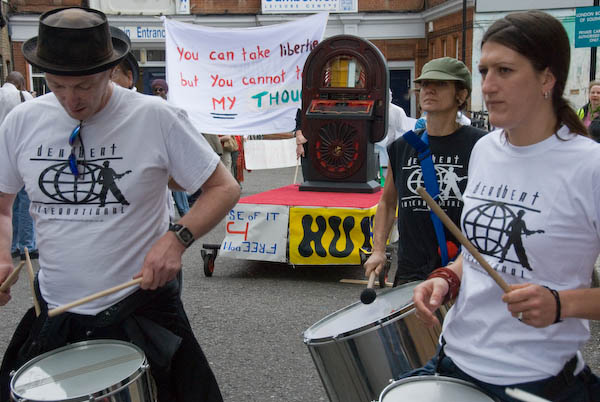
Instead I joined the ‘Human Rights Jukebox‘ in its progress from the Camberwell Magistrates Court to Peckham, another event in the Camberwell Arts Week. The ‘March of the Human Rights Jukebox’ was organised by Isa Suarez, who had a one-year artists residency in Southwark in 2006. The juke box included thoughts on people’s rights from many residents and diverse groups in Southwark, some of whom marched with banners along with it.

At the start of the event, the Dulwich Choral Society performed a specially composed piece by Suarez, including words from the ‘Jukebox’. On Clerkenwell Green we stopped for a impassioned recital (in French) by a black African poet, and in front of the old baths in Artichoke Place (now the Leisure Centre) there was a long performance by the band Deadbeat International as well as a short song by three musicians that left us wanting more. Deadbeat International also performed at various other points on route, including another energetic set at Peckham library. The march was led into peckham by a rapper, with some forthright views on human rights.

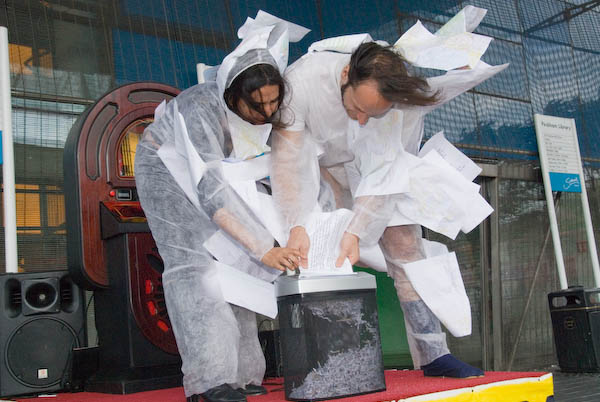
Accompanying the jukebox were the live art group ‘mmmmmm‘, Adrian Fisher & Luna Montengro, covered from head to foot in sheets of paper containing the complete text of the UN Universal Declaration of Human Rights, in both English and Spanish as well as the pages of a world atlas.


Article 11 of the UN Human Rights Declaration hits the shredder.

In front of the library at Peckham, mmmmm completed the event by unpinning the sheets from each other one by one, reading the clauses and feeding the sheets into a shredder (and when this gave up, tearing them up.) Each then poured cold water over the other and threw the shredded papers, so that they stuck to the wet clothes and skin. Finally we were all invited (in what we were informed was an Argentine custom) to jump once into the air for each of the 30 clauses of the Declaration.


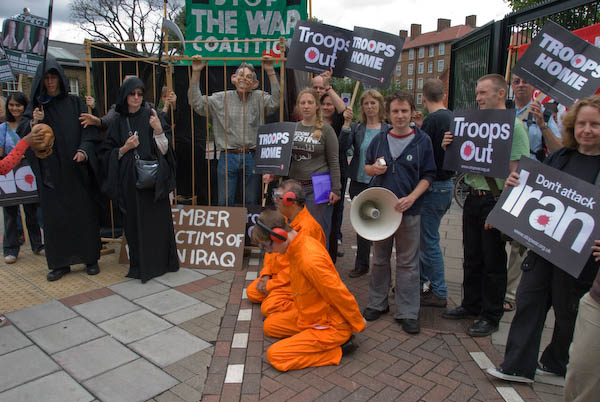
On the way to the event, I’d jumped off the bus at the Oval, where ‘Stop the War’ and other demonstrators were protesting. Gordon Brown was apparently expected to arrive at 12.00 to watch some kind of game there. It was a very different kind of action to the ‘jukebox’ though both were political and art in their different ways, although only one gets arts council funding.

The Human Rights Jukebox was more cultural than political, involving the participation of various marginalised groups, including migrants and those who have suffered from mental illness (and artists who are too in some ways marginalised.) Of course the cultural is political as I’ve long argued, and, for example, we need a huge cultural shift to make any effective action on climate change possible. The imagery of the ‘Stop the War’ demo is stereotyped and so familiar that it is perhaps hard to see it changing any minds, and a more creative approach might be more effective.

I’m a supporter of ‘Stop the War’ and have been on many demonstrations. It’s hard to stomach that we had the overwhelming majority of the British people behind us, organised the largest demonstration the country has ever seen but failed to influence events. Perhaps the underlying reason was that the leadership failed to think creatively and call for decisive action when it was needed.

Peckham has a bad reputation, and at times deserves it, but in many ways it is a vibrant place and interesting things happen there and just along the road in Camberwell. You can see more pictures of the March of the Human Rights Jukebox, as well as a few of the Oval demo, and some great kids on their bikes from track in Burgess Park who called in at Peckham Library while I was there on My London Diary.

Naked Bike Ride – Problems

I have a few problems with the WNBR. No objection to nudity, certainly no objection to environmental protest – I’ve participated in many, though keeping largely clothed.

First, I think the ride is lousy at getting it’s message across. Far too few of the riders or their bikes even carry slogans. Almost zero leafleting as the ride goes through some of the most crowded streets of the capital. People do look, but they wonder what its all about and nobody tells them. And if there was a press officer around at the start they were in hiding.

This year too, the ride seemed much faster. Last year I ran a kilometre of the route with it, going considerably faster than the riders even though stopping occasionally to photograph them. This year, though I’m fitter, I struggled to keep up for a few hundred metres. Speed makes it even harder to read the text on those bodies that do carry it.

Perhaps one answer would be to try to recruit leafleteers from those who sympathise with the aims of the ride but don’t want to strip off, and get them leafleting in key areas such as Piccadilly Circus, Covent Garden, Oxford St etc.

Secondly, the London ride has what it calls a ‘photography policy‘, but might better be called a ‘no-photography policy’. It’s main effect is to make the organisers look silly, as although it has caused a considerable controversy, it seems to have little or no effect in practice.

New this year (or so I understand) were the “photo policy enforcement boards” which riders were encouraged to print and carry, bearing the message “this photo was taken without permission“, to be held as protection against intrusive photographers. I searched long and hard, but to my disappointment failed to spot a single one.

Last year I hadn’t read the photo policy, so it didn’t inhibit my work at all. Photography for me is in any case almost always a two-way affair, involving some kind of relationship between me and my subject. Unlike the proposers of photo policies, I think photographing from my typical working distance of around 1 – 2 metres with a wide-angle is usually less intrusive than standing back and using a long lens.

Last year I photographed many of the individuals on the ride (including some I knew from other, clothed, events), and only one person declined to have a picture taken (perhaps because she had just been photographed by another photographer.) With one group I came to an interesting arrangement (I’ll leave you to speculate, but it was a very warm day and I was hot and happy to oblige) before they too were happy for me to photograph as I liked.

WNBR

If people take their kit off in public places – where they have no reasonable expectation of privacy – they also can have no reasonable objection to being photographed. No permission is required, and the policy and those boards are a nonsense.

However, unreasonable behaviour is still unreasonable, whether or not some or all of those concerned are wearing clothes. We generally deal with it by making our complaint clear rather than claiming some right we don’t legally have. There are actually laws which can be invoked to prevent nuisance, but would not apply to photographers who behave reasonably.

If the organisers of events such as this feel there is a problem, then they could make arrangements in order to prevent it happening. There are actually some suggestions as to how this could be done on the ride wiki pages. Of course riders who for some reason want to hide their identity can do so by wearing masks.

WNBR (C) 2007, Peter Marshall

As always when photographing, if asked I gave people in my pictures my web address. After I posted some of the images, quite a few e-mailed asking for more pictures or larger files of their own image to print, and of course I sent them. The ride was a significant event for them and they welcome a good photographic record.

One of the very noticeable things in the event is the number of those taking part who are wearing little but a camera, including some very professional looking DSLRs and also video cameras. They too see it as something they want to photograph.

Actually I would have nothing against a reasonable photo policy. It might say something like “Photographers are requested not to pester any individuals who make it clear they do not wish to be photographed.”

The third problem I have is usage. What do I do with the pictures after I’ve taken them? What I certainly don’t want to do is to set up My London Diary as some kind of soft-porn site, so I’m very careful about what I post there. Again, given that the images are not model-released, I think even editorial use needs to be considered very carefully.

We also live in odd times so far as nudity is concerned, and there have been many who have suffered for taking images that most of us would feel unproblematic. Even owning widely respected photographic books has at times resulted in police warnings and prosecution. Most agreements with web hosting companies have very restrictive clauses on what may be posted, and in case of complaints I’m told some find it simpler just to close accounts rather than decide if the complaint is justified. As someone who runs web sites for several other organisations, posting doubtful material is a risk I don’t wish to take.

Much of my photography is made with an eye on history. Not generally recording major events, but the kind of minor happenings that contribute to understanding how we live. Quite a few of my pictures have already appeared in books about our current era, as well in various museum shows. In a few years time more of my WNBR pictures may come out too.

Some carefully selected images from the London 2007 World Naked Bike Ride appear in My London Diary.

If you took part in the race, think I may have photographed you and would like a copy of the picture but can’t find it there, you can email me to ask.
Peter Marshall

World Naked Bike Ride – News Values

If we are honest, after reading this heading, probably half of us are at this point hoping for titillation. Or I could shorten that last word considerably. Put crudely, ‘News Values’ demand tits.

10,000 marching for Palestine. Perhaps 3,000 Orangemen and women. A thousand or so naked or near naked cyclists. No contest, not even for the BBC. When I switched on Radio 4 for the 10 o’clock news there was only one London event. And there was no one there wearing a burkha.

Naked Bike Ride
We are a culture with a problem. A fixation on TV and in at least the red-top press with sleaze and sexiness. Not of course anything too explicit. I picked up a so-called newspaper on the train on my way home from photographing. Page after page of gossipy snippets about celebrities and their trivial behaviours, the ‘sexy’ dresses they wore or fell out of, their affairs. Not only claiming to be about actual people, although few of them have much relation to their media images, but even about the characters some play in TV shows. It all made such dreary reading.

After that came pages of adverts for so-called adult services, none of which I’ve ever dreamed of paying for, despite being considerably over 21. It was almost a relief to come to the sports pages, where massage probably did mean massage.

Somewhere hidden away in the corner of a page I did find some more real news. Around 50 words on the latest from Iraq. Ditto Iran. Drugs. A judge accused as a flasher.

Papers like that employ journalists to write the crap. Pay photographers to photograph it. Nobody needs to go there, its surely not that hard to earn an honest crust?

One organization working for proper news values is Media Workers Against the War, set up at the time of the first Gulf War, but now covering wider issues, though of course with a special interest in Iraq. It’s a site worth keeping an eye on, and supporting.

More about the Naked Bike Ride, and some of the problems I have with it in a later note.

The New Panopticon

Photosynth from Microsoft Live Labs is amazing. Currently only available as a free technology preview, it gives a glimpse into a future that could completely re-draw our map of publishing and imaging and perhaps more.

If your system is up to it (Windows XP and Vista only, a fast web connection and decent graphics card), it only takes a few minutes to download and install this 5Mb ActiveX control, and although the preview is currently limited to supplied image collections, it does give some idea of the power of this technology in connecting images into truly “breathtaking multidimensional spaces with zoom and navigation features that outstrip all expectation.”

Microsoft acquired the technology by buying the Seattle company Seadragon in February. The team have also been working with the BBC for the series ‘How We Built Britain’. You can see some of the work from this country in the Your Britain in Pictures demonstration (which will also install the Photosynth control if it is not already present.) The Trafalgar Square collection is interesting as it includes archive images from the Royal Institute of British Architects and the National Media Museum, although it is perhaps a little short of images to show the full potential of the system.

You can get a better idea of its potential by watching its ‘architect’, Blaise Aguera y Arcas, demonstrating a more advanced version at TED (Technology, Entertainment, Design), a high-level annual conference sponsored by BMW, which also makes clearer some of the issues involved as well as demonstrating the incredible power of the application.

One image set was produced by searching photo-sharing site Flickr for images of Notre Dame in Paris, aggregating this incredibly disparate set of images (many typical tourist snaps) to produce a detailed highly-zoomable 3D model of the building, which also incorporates any captioning and keywording from the originals. As Blaise remarks at one point, their use of images has severe implications about copyright. Both the small print of photo-sharing sites and also proposed legislation on ‘orphan works’ are perhaps to some extent driven by the possibilities of software such as this.

At one point, Blaise throws the whole of an issue of ‘The Guardian’ on the screen, laid out page by page, then effortlessly scrolls and zooms around it, zooming at one point down to single character level to show the high resolution the system supports. Of course it needn’t just be a picture that already can provide rather superior quality to the printed version as well as being in some respects easier to browse; it would be simple to make it searchable text and to add text hotlinks to the existing image links.

This is a part of technology that can and will change the future of publishing – and lead to the end of print except as a niche fine-art medium. I think it will also change the whole economic and social structure of the industry. Probably not for the better, and almost certainly not for the benefit of those currently working in it.

Among many print journalists there still seems to be something of a head in the sand mentality. Citizen journalism, blogs, interactive web technologies and more are not going to go away. If we don’t learn more about the future we have no chance of influencing it.

At the moment, the Internet is still largely in the ‘Black and Decker’ age, where anyone can set up a site – like this one – and get their ideas out. A click of the mouse takes you from one site to another. Developments like this make the idea of huge and largely if not entirely isolated seamless commercial content conglomerations, rather more likely as the future.

Photosynth is also a glimpse of an Orwellian nightmare, linked to our increasing coverage of security cameras. This week a judge was acquitted in an indecent exposure trial because it could neither be proved nor disproved that he was the person involved. Had the CCTV images from the train been available they could have proved his innocence (or guilt), but apparently the British Transport Police had been too busy to collect them before the storage was overwritten.

The camera on the station, in the carriage, on the platform, the underground passage way, the street corner, in the bus, the workplace entry will doubtless soon all be wifi linked to network storage. Rather than tailing suspects, computers will recognise them by clothing and facial features, pulling out a collection from the giant image base, aggregating it with information from mobile phone locations and conversations. Little need for the house arrest that has got our government into trouble with the judges.

Modern technology enables us to spread Bentham’s Panopticon, with its control over minds by both the actual surveillance of individuals and the fear of the individual that they may be watched to the whole city. Photosynth and related software for handling and processing huge collections of data isn’t just going to revolutionise how we view and use images.

Peter Marshall