Paris Photo – The Empty Centre

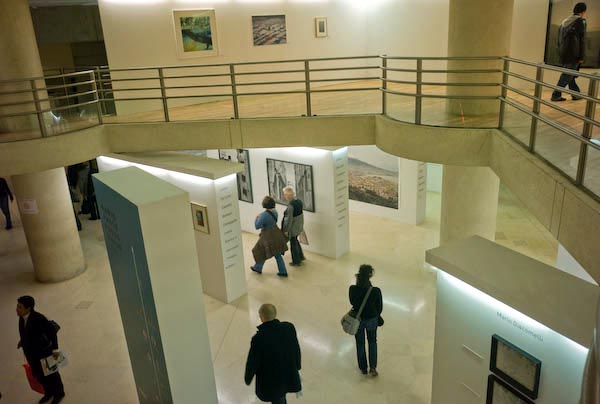
The ‘Central Exhibition‘ of this year’s Paris Photo was ‘Landscape Photography in the UniCredit Collection’, and was a part of this year’s focus on photography in Italy. The show included around 30 works by 10 photographers, some extremely large images.


Upper Level: BMW – Paris Photo Prize; Lower Level: Central Exhibition

Unfortunately, on the basis of the work presented here, the collection has not bought particularly wisely. There was plenty of evidence elsewhere on various exhibition stands that Mario Giacomelli (1925-2000) was a fine photographer, but the few prints displayed were at best unconvincing. Luigi Ghirri (1943-1992) was an interesting colour photographer at a time before colour became respectable, but the vintage prints were disappointing, perhaps due to the ravages of time. There were a couple of nice prints by Mimmo Jodice (b1934) – but again better and more appropriate work elsewhere. Most photographers will be familiar with the work of Franco Fontana (b1933), and there was a good exhibition of his work in the FotoArtFestival at Bielsko-Biala last month, but again the work here was somewhat disappointing. Perhaps the only photographer whose work in this section impressed was Gabriele Basilico (b1944), though again there was better work by him elsewhere in PP.

UniCredit, one of the major European banks, was founded in Italy and started to collect contemporary Italian art, particularly photography, in 2004. Presumably they are not short of money, and apparently the collection includes 500 photographs, but on the basis of this show, they would not appear to have spent wisely.

An Italian photographer I met at PP told me that, like many other Italian photographers she had talked to, she felt that this show – along with the two other sections of the invited Italian presence, Statement: Italy and the General Section, “an overview of Italian photography from the 1950s to today” – actually failed to provide an adequate representation of photography in Italy today, but rather reflected the artists represented by the relatively small number of Italian galleries who were taking part in PP.

I rather hope she was right, otherwise the future of photography in Italy appears depressing. The 5 photographers I’ve mentioned above were all born before 1945, and there seemed little evidence here of exciting new work.

Helen Levitt on Show – Paris

One of several highlights of my trip to Paris was a visit to the Helen Levitt show – I mentioned it and wrote a little about her last month. Paris transport is currently on strike, with restricted and unreliable services, and to reach the Fondation Cartier-Bresson a little south of Montparnasse from the city centre location of Paris Photo, was a lengthy and rather tiring experience – part of a day in which I covered over 10 miles and was largely on my feet from 9am to 3am the following morning. Fortunately this was in Paris, where almost every street has some interest (and my walks are always longer grow in the taking, as I can’t resist a detour down any street that looks particularly enticing.)

Which brings me to one small complaint about the gallery space. The exhibition was shown in two large white-walled galleries, images in a single line around the wall, the centre of the room a largely empty space (with a rather lost looking display cabinet.) Nowhere at all to sit and rest and reflect on the work. Even when I haven’t had to walk, visiting such shows is a tiring exercise. The look of the rooms would also be improved by some simple elegant benches or other seating in their centre, and it would be so much more pleasant a place for the serious contemplation of photography.

There are chairs on the top floor, up a couple more flights of stairs, in a room devoted to the work of Henri Cartier-Bresson. Here were a dozen or so of his best-known works, including 3 or 4 of his best images. The interior of the building is modernist and compliments the work of the master well, but perhaps felt just a little austere for Helen Levitt.

In the lower gallery (on the first floor) was a fine showing of her work on the streets of New York from the late 30s and early 1940s. As you can see from the feature I mentioned previously  (and also the other links in that feature) Levitt achieves a wonderful sense of capturing natural activities on the street, helped of course by the use of the relatively small and inconspicuous Leica camera (one of HC-B’s from that period is on display in a cabinet on the top floor, reminding us how much smaller they were than the current M series – I had my M8 in hand to compare.) She also made use of a device that enabled her to be looking away at 90 degrees from her subjects when taking pictures, so that although many of her subjects appear to be clear she is they, they think she is photographing something else.

It was interesting to see the several variants that she had made of some images, shown as her small reference prints she made, roughly 6×9 cm in size – a method that enabled her to see the work better. I do think it was a mistake to mount these in window matts which did not allow the viewer to see to the edge of the print and beyond, especially since the top lighting in the gallery cast a deep shadow across a significant strip across the top of each of these small images. But I also think it is an inappropriate treatment for work prints.

In the main these showed that Levitt moved relatively little when making her images, with at times a slight investigation of different framings. Often it was more a matter of taking a series of images as the children got on with their play. It was particularly intriguing to see the other versions of her image of black boys climbing and playing on the imposing porch of a otherwise rather bare brick building. In the selected image, one clings to the top of the porch, either about to climb up or let himself down , with another boy crouching down on the top looking at him, while another pair stage a boxing match to his right. The figure next to the crouching child has his fists up in a fighting stance, while the boy dead in the centre of the lintel, turned away from the photographer, apparently lands a powerful straight left to his left eye. A fifth figure hides behind the right-hand column, arms and legs on each side and peeping out at the woman with the camera. The image is a glimpse of the kind of dangerous activities that boys will get up to, emphasized by the height of the doorway and the risk of falling, both from that precarious grip of the clinging boy and the play-fighting on the top.

Another striking image of boys playing on the street shows two of them holding up the empty wooden frame for a mirror, with the broken shards in the gutter in front strong evidence as to what has rather recently happened. A couple of boys are examining them carefully as the others look on, none more intensely than the boy on a bicycle we see framed in place of the mirror. So intense that one can imagine that it was his stare (or perhaps something rather more physical, as if he had tried to ride through that mirror) had shattered it to fragments.

The show also had a few examples of Levitt’s work from Mexico, shown along with the similar images by Cartier-Bresson; it was his work – including these images – that inspired her to photograph people – after seeing it she lost interest in pictures of buildings or landscapes.

The upper floor concentrated mainly on her colour images some from the 1960s but also later work. These pictures were published as the book ‘Slide Show‘, which was also on display in the gallery. The book is actually considerably more impressive than the show, partly becuase I think the selection of images is a little different, but perhaps more importantly because of the sequencing and also the quality of the images.

It was interesting to be able to compare the actual prints on the wall with the versions on the printed page, and I spent some time doing so. In almost every case there were significant differences, and in most cases the book version was preferable. That the exceptions were mainly some of the dye transfer prints is perhaps unsurprising.

Probably some of the other colour prints may have changed significantly since they were produced. They were not so obviously poor as some of the high-priced vintage prints on offer in Paris Photo, but certainly the book prints had a ‘cleaner’ look and often had better shadow and highlight detail. I think the few prints on display in Paris Photo may have been better examples than some here.

I find her colour work uneven, with some finely captured little happenings, while a few left me rather cold and sometimes puzzled. Perhaps the images I like best are the more dynamic, where Levitt has captured the moment, such as the woman reading her newspaper on a windy street corner, rather than those that simply seem to me to be about colourful scenes.

Despite my quibbles it was really splendid to see such a collection of Levitt’s best images on display, and when I left well after an hour after I had arrived (together with the walking it meant I was rather later than I had intended at the MEP, and at the party after that) but feeling uplifted by the experience. Coming out from the Impasse in which the gallery is located and turning across the main road to the rue de la Gaite in the fading light I did feel somewhat gay, my tired steps a little lighter as I danced past the sex shops and theatres.

Watching photographers: Sang Tan

When I first started taking pictures regularly of events in London, one of the first photographers I got to know was the late Mike Cohen (1935-2002), whose pictures were regularly used in socialist publications, particularly the Morning Star. Photographers often spend considerable time waiting for things to happen, and we often found ourselves together discussing politics and photography.

You can learn a lot about other photographers by watching how they work – where they chose to stand, how they move around a situation, how they interact with the people they are photographing… Of course most of the time at events I’m busy watching the way the event is developing and thinking where I should be, and how I might get a different picture… But you can’t help seeing what other photographers are doing, and getting some idea of how they work.

And of course, they are watching you. Certainly most of us know the feeling of finding a situation and working with it, only to realise ten seconds later that there are photographers on both sides as well as one shooting over our shoulder and another crouching in front or shooting between our legs. Its best to take it as a compliment rather than worry about it, and of course it’s one we are likely to claim repayment for before too long when we see another photographer who appears to have found something interesting.

Mike was a guy who knew who everyone was – he’d photographed working class struggles for over 30 years – and was always a great source of information. He once paid me what I think was a compliment, describing my way of working as ‘fly fishing’ whearas he was a coarse angler, getting in there and working away. His approach was certainly a reliable method of landing some big fish. Unfortunately little if any of his great record of events over the years is available on-line.

Another photographer I meet occasionally at events is Sang Tan, and watching him work it is clear that he is thinks carefully and differently about his pictures, often finding a unique way to approach a subject. He seems to be keeping very busy lately – and looking at the editorial portfolio on his new web site, the reason is clear.

The pictures there include work from several events I also covered (see My London Diary) and while I may have taken some pretty decent snaps, his usually have an unusual clarity and vision. He also covers many of the kind of high-profile events I like to avoid (or can’t get into – and usually both apply) which make his work much more commercially publishable.

Also on the web site is another side of his work, black and white street photography. We’ve seen a lot of nonsense in the past couple of years about a new street photography in London, as if there were not many photographers around who have been – and still are – working in the genre. And, as this site clearly demonstrates, producing considerably more interesting work than has been in those recent ‘new‘ shows.

Of course one of the many problems that photography still suffers in the UK is extremely partially sighted curators. Speaking about John Benton-Harriss move from the USA to London in the late 1960s in Poland recently, I talked about him “moving from a New York where he knew everyone who was everyone in photography, to a country where there was nobody to know.” Forty years on I’m not sure things have really changed that much.

Peter Marshall

What do you wish you’d known?

EPUK (Editorial Photographers UK) had the great idea of asking a selection of their members what they wished they had known when they started in the business. As might be expected, they got some rather varied answers, including one from the guy who regrets keeping “the can of compressed air, the can of WD-40 and the can of spray mount on the same shelf“.


Had he read my advice, he would have known he should in any case have been using a Hurricane or Rocket Blower on his sensor and not wasting the planet on doubtful products, which are tricky to remove. And almost certainly non-archival, though that was probably the least of his worries.


You might like to guess some of the other things before you go to the article. But while there, don’t miss the link to Sqweegee’s Blog on the site. The latest posting is about the Plodshop Creative Suite, “developed by Warren Terror Software, is designed to address major security issues in industry standard photo manipulation software such as Adobe Photoshop and Tesco PhotoRestyle.”

Paris Photo

Next week I’ll be at Paris Photo, a vast trade fair for galleries and publishers held in the rather claustrophobic underground Carrousel du Louvre in the centre of Paris and open to the public 15-18 November. I’m looking forward to it, but with some trepidation – last year I suffered a panic attack at one point and had to run for the fresh air.

It is big. 104 exhibitors from 17 countries – 83 galleries and 21 publishers. Some of the stands are pretty large, with hundreds of pictures on display – others smaller or having very large pictures. 40 of the best-known photographic magazines from around the world are there too, along with a special exhibition of Italian photography, and two major photographic prizes, the Prix BMW – Paris Photo and the Prix SFR Jeunes Talents (you can click on the names to see their work.) The Prix BMW, this year on the theme of ‘water’, has an illustrious list of photographers entered by the exhibitors at Paris Photo, including Alessandra Sanguinetti, Wout Berger, Trent Parke and Boris Mikhailov, and the winner will be announced at the show.

It is also an opportunity to meet many photographers, including over 30 who will be signing their books at the show. I’ll also be hoping to see a number of friends among the artists, dealers and others at the show – and perhaps even at a party or two or in one of the bars in the area around.

I’m there for 3 days – or at least parts of 3 days, as it’s best seen in a number of visits, with some time out to stroll around the city and do other things.

You can get a little idea of the range of work on show there – even if you can’t make it to Paris – by looking at the show preview on the Lens Culture site, which includes 120 images from the show, which you can see either by using the ‘next’ button or going into gallery view to see the thumbnails.

The Golden Notebook

Notebooks have played important parts in my photography over the years, but the on that I’m thinking about now is perhaps Doris Lessing‘s finest book. I thought about it again a few weeks back when she was announced as the winner of this year’s Nobel Prize for literature, and more particularly when the author of one of the photo blogs I occasionally read celebrated the award by bemoaning the fact it had yet again not gone to his favourite American author.

As it happens Mr Colberg, I’m quite a fan of Philip Roth too, but had I been on that committee, my choice would still have gone to Ms Lessing, who after all did publish one of the more significant novels of the twentieth century 45 years ago in 1962. Her award can hardly be said to be premature.

I’m not sure what her novel itself has to tell us about photography directly, although I think it gives some interesting insights into the theme of subjectivity and the place of the artist in society which are germane, as well as more importantly, being an interesting read. With the paperback edition at almost 600 pages you do however need a fairly large pocket to carry it with you on your travels – which is where I have the time to do most of my reading.

But the author’s preface, some 16 or so pages added in 1971, is more directly relevant, because it deals – as well as with this particular book – with the role of critics and criticism, and with the stultifying effect of our worldwide systems of education on both the enjoyment and production of literature. Unless you are Rip Van Winkle and have just awoken after rather more than his 20 years, you will know that photography too has undergone a revolution, or perhaps rather a takeover by the academics, curators and critics in a not dissimilar fashion.

As Lessing describes, children from an early age are taught to think of everything in terms of success, of failure and comparison, as if literature (or photography) was a horse-race. They are also taught to mistrust their own judgement, and rather to find and rely on the opinions of authorities. What is educated out of us is the ability to be imaginative, to enjoy and to trust our own experiences and to make our own judgements.

It is a preface worth reading (although I never like to read prefaces, or at least not until after I’ve read the book. when I am in a position where I can decide what I think of the preface.) It’s also a book worth reading, but for different reasons, starting most importantly with enjoyment.

As someone who tries to write about photographs and photography, I often ask myself what I am doing and why. But certainly it has to start with the pictures and with my experience and then my analysis of that experience rather than from some kind of theoretical higher ground.
And when I read much critical writing by others, I often wonder whether the writer has ever stopped and really looked at the photographs they think they are writing about, and certainly am often sure they have never let themselves really experience them.

In my  talk in Bielsko-Biala last month, one of the many things in my performance that wasn’t in my script was reading a quotation from Lessing’s preface; partly because of its relevance to the developments in photography since the 1970s and to being a photographer, but also because what I was trying to do was to speak in a very personal manner, to share some of my own experiences and judgements about the work of other photographers as well as my own work. As I said there, unless your work is personal it isn’t worth doing, but if it is only personal it isn’t worth doing either.

Photographers’ Rights

When I was in Poland recently, I attended a meeting about the setting up of the Association of Polish Art Photographers, and my ears pricked up when there support for ‘Photographers’ Rights‘ was mentioned. I was a little disappointed to find out that they were largely concerned about copyright.

Copyright it a battle that photographers won many years ago, and our rights are generally clear and enshrined in international conventions, and even recognised in similar laws in most of those countries that have little truck with international conventions – such as the United States. Of course these are rights that need continual defence against rights grabs both direct by the big corporations and indirectly by them through the promotion of ‘orphan rights‘ and other similar proposals I’ve written about in the past.

Of course photographers often have skirmishes with individual organisations that use our work and somehow neglect to pay for the right to do so, and there are well-publicised cases of photographers who have made many thousands of pounds, often from just a few days of chasing up such abuse. Last year I made several hundred pounds myself, although mostly my work is used without permission by people with no funds to chase.

So copyright is essentially sorted, though vigilance is vital to keep it so. What interests me more are moral rights. Since I keep on coming across photographers who have no idea what moral rights are, I’ll explain them below, but unfortunately I have to start by saying that the UK 1988 Copyright Act, while introducing them, did so more or less to say that most publications – newspapers, magazines, yearbooks etc – could ignore them. News photographs were also specifically excluded from protection under the Act, and they do not exist for work which you did for which you were on a company payroll (but as with copyright will be yours if work was commissioned from you.)

Of course, where you are able to set a contract for the use of your work, such rights can be included in the terms of the contract, and certainly Magnum was set up in part to make sure that this was done.

Most Moral Rights, unlike copyright, also have to be asserted, by means of a suitable statement associated with the work – either on the work itself or in a contract or agreement for the use of the work (see below.) They also attach uniquely to the creator of the work during his/her life. Unlike copyright you cannot assign moral rights – although you can waive them by a written signed statement (read the small print on any contracts carefully, and cross out any such clauses if you can.) But while you are alive, no one else can claim them, whatever you sign. You can assign them in your will – and if you fail to do so, those you have asserted will automatically pass to whoever holds the copyright in your work.

So what are the moral rights that apply to photographers?

  • Attribution: the right to be identified as the maker of the work – to have your name clearly shown wherever and whenever the work is used.
  • Integrity / No Derogatory Treatment: the right not to have your work treated in a derogatory fashion – for example by cropping, distortion, additions or deletion.
  • No False Attribution: this right exists without the need to claim it, and covers the use of your name with work you did not create.

A further moral right which also concerns photographers is that of privacy. This restricts your use of pictures you have been commissioned by persons to produce which are of a personal or domestic nature. If you wish to show or use such commissioned work you should ensure you have written permission to cover your usage – a suitable model release.

IANAL – I’m not a lawyer – and if you want to use law you should take legal advice. But if you simply want to assert your moral rights, a statement such as ‘Peter Marshall asserts his moral rights as the creator of this work according to the Copyrights, Designs and Patents Act, 1988′ is probably sufficient.

Any newspaper will of course provide copious examples of photographs were the moral rights of photographers are ignored (and of course even though the law does not make them enforceable, moral rights still exist.) I’d like to see a concerted effort by photographers to get all publications to recognise at least some of the moral rights of the people whose pictures they use.

We should start by demanding attribution. When dealing directly with publications I always do so; some photographers I know have a policy of asking for a payment of twice there normal rate if work is not attributed.

I’d also like to see a campaign to attack a different mode of false attribution, where images taken by photographers are credited simply to agencies. Getty, Corbis, Reuters, Alamy etc never took a photograph, and, except with older work where the name of the photographer was not recorded, I’d like to see the photographer’s name always given along with the agency.

Bielsko-Biala Diary

Photo festivals tend to keep you pretty busy, with meeting and talking to other photographers, but I like to find time to take a few pictures too. While I was in Bielsko-Biala last a just over a week ago for the 2007 FotoArtFestival , I kept a diary, and took some pictures both of the place and of the festival to illustrate it.

I’ve had to censor the diary a little for publication, and get rid of the libellous remarks and wilder thoughts, but I hope there are still a few controversial passages. You can read what I really thought about some of the shows, and see a little of what photographers get up to at such events.


On my way to the theatre in Bielsko-Biala


Friday lunchtime – I was sitting next to Joan Fontcuberta and Sarah Moon


Early on Saturday morning in a smoky Gallery Wzgorge

I’ve not finished the diary – still some material from the final day of the ‘Maraton’, the final party and a couple of pieces on some of the shows to add. Then there is my own presentation, the final session in the Maraton, and I also intend to put the text and some of the pictures of it on line as well (copyright issues mean I cannot use them all – but wherever possible I’ll link to the same or similar images.)

All the pictures I made in Poland were using a Fuji Finepix F31fd. Would I buy one again? Probably not, but some of them aren’t bad. But not having a viewfinder is still a pain.
You can also read the diary – and some of my presentation – from the 2005 FotoArtFestival on line.

Paul Trevor at Rich Mix

Last week I got e-mail from Paul Trevor and realised I’d not actually been able to see his work when I called in at Rich Mix Cultural Foundation on the Bethnal Green Road at the top of Brick Lane – and I’ve since met several people who had the same experience as me.

Paul contacted the gallery after hearing from me, and whether as a result or otherwise, when I called in there on Friday, things were very different. I went down the stairs again and sat on the old sofa, and enjoyed around 300 of Paul’s pictures on the large display screen, projected at roughly six second intervals in a show lasting roughly 30 minutes.

As I sat down, one of his pictures from the ‘Battle of Lewisham‘ was on screen, and what followed was a kaleidoscope of life from London’s East End in all its rich diversity. Of course many of the pictures were familiar to me – including some of the half dozen or so I’d featured in the London Arts Cafe show a few years ago, as well as those I’d seen in various shows and publications over the years, but there was also a great deal of work new to me.

The images in the display were a selection from the 5000 scanned from Paul’s contact sheets by the London Metropolitan University as the initial step in a project to produce 500 high quality scans for his Eastender Archive. Paul obviously took rather more care over his contact than some photographers (me for example!) but there were still some that were a little too light or dark, as well as those for which a straight unmanipulated print cannot do justice. The scans were of surprisingly high quality – considerably better than those I made of my own contacts for my very first CD project, ‘London Pictures 1992’, made in 1993 when I found that none of the clients I gave the CD to had the equipment to play it. Technology has moved on considerably since then! Contacts from 35mm are 1.5×1″, and a scan at 1200 dpi gives a 1800×1200 pixel image, sufficient for most display devices.

The sofa and screen are in a hole down a set of stairs from the main floor level. There are now two large projected images on the walls above this, one at the side and one on the back wall. Although the quality of these large projections is still rather washed out – even in the dull light of approaching dusk that I was there, at least the projectors are now set up correctly without the distortion of aspect ratio and keystoning apparent in my previous vision, and the images are shown on a blank wall avoiding the ventilation duct that formed a part of every image previously,

Its a shame that my write-up here – and in my previous piece has had to concentrate so much on the practicalities rather than the images. But this is only an initial stage in the project. Paul Trevor’s work in the East End of London is certainly one of the most significant bodies of documentary work produced in the UK in the era and deserves considerably more care and respect than was shown by the gallery – and a much fuller treatment by critics – including myself – at a later date when the project is in a more complete form.

There were a few pictures in those I watched that I would be surprised to find in the final cut, knowing something of the strength and depth of Paul’s work. A few perhaps where his feeling for the people or the place or the occasion is stronger than the photographic representation, as well as a little duplication, but the overall impression is hardly diminished.

There were many places and situations that I recognised, and some – in particular the anti-racist demonstrations – where I was scanning the image to see if I was visible, at the time more as a participant than a photographer. I didn’t find myself, but Paul’s work forms a very recognisable and very intimate view of an East End that I’ve only really glimpsed over the years as an outsider.

So, get along to Rich Mix and see the show – its on until 30 Nov, and Paul’s work is by far the most interesting show in London at the moment.

The Deutsche Börse Shortlist

I’ve previously written at some length about two of the four photographers shortlisted for the 2008 Deutsche Börse Photography Prize, John Davies and Jacob Holdt. Fazal Sheikh I think I also mentioned when his work was included in the ‘Heroes of Photography‘ feature on ‘PopPhoto‘, which is an excellent introduction to the work of this ‘artist-activist’. I looked at the work of Esko Männikkö when I was revising a piece I wrote on Finnish photography, but in the end decided not to include him.

Esko Männikkö (b1959, Finland) has an impressive record of exhibitions, his Artfacts page starting with a show at White Cube, London in 1998. You can see some installation views of his 2002 “Flora & Fauna” show in Berlin at the Nordenhake archive (Nordenhake is an important art gallery in both Stockholm and Berlin.) There is a good selection of his work on the Galerie Rodolphe Janssen (Brussels) site, along with a chronology and some information (in French.)
One of the things that puts me off his work, is, that as the Photographers’ Gallery states, his work is “shown in assorted wooden frames, found and weathered by time” which they feel give his images “a timeless, almost painterly quality.” Actually they – or at least some of them – are good enough not to need that kind of crap.

Jacob Holdt (b1947, Denmark) has told his own story (and this page avoids the terrible music) at great length. He arrived in the USA from Canada in 1970 with only $40, intending to hitch to Mexico, but instead spent much of the next five years hitching around the USA, staying with anyone who would put him up, mainly the poorest people in the country, and in particular those suffering from racial prejudice.

At some point his family sent him a camera, and though he wasn’t a photographer (and the pictures sometimes gain from his lack of expertise, but at other times I can’t help wish that he had become a better photographer) he began taking pictures of the oppressed people who put him up. Eventually in 1977 he published a book using his and other pictures that exposed the depth of racism and poverty, hoping to use the profits from it to build a hospital in Angola.

When he realised how the KGB intended to use his book as propaganda he withdrew it from sale, and it was only republished after the fall of communism. He also made films using his work, and presented slide-shows at hundreds of campuses across America. His nomination comes with the publication in 2007 of ‘Jacob Holdt, United States 1970-1975‘ by Steidl in Germany.

Fazal Shiekh was born in New York in 1965 and educated at Princetown. His awards over the years include a Fulbright Fellowship, a US National Endowment for the Arts Fellowship in Photography (1994) and in 1995 a Leica Medal of Excellence, an Infinity Award from ICP, a Mother Jones International Documentary Award and two awards from the ‘Friends of Photography’. In 2003 he won ‘Le Prix Dialogue de l’Humanité‘ at Arles and in 2005 the ‘Henri Cartier-Bresson International Grand Prize‘ and a MacArthur Fellowship.

Sheikh is certainly one of the finest documentary photographers around and you can see a great deal of evidence on his web site. The nomination is for ‘Ladli‘, also published by Stiedl in 2007, which took up from his earlier book ‘Moksha‘, which investigated the mistreatment of widows in India. In Ladli he looks in particular at the problems experience by mothers and daughters in a society where a girl child is a burden, with many being aborted or killed at birth. His site contains a fine on-line version of Ladli.

John Davies (b1949, UK) is a particular favourite of mine, and one of the photographers featured on the Urban Landscape web site I run with Mike Seaborne. You can see a great deal of his work on his http://www.johndavies.uk.com/ web site, but I’d recommend buying his superb book which I reviewed at some length, The British Landscape, 2006 (Chris Boot, London ISBN 095468947X) It would be hard to think of any recent photographer of the urban landscape whose work has been more influential than him.

The jury for the prize is Els Barents, Director of Huis Marseille Foundation for Photography in Amsterdam, photographer Jem Southam, Thomas Weski, Chief Curator of Haus der Kunst in Munich along with Anne-Marie Beckmann, the curator of the Deutsche Börse Art Collection and Brett Rogers of the Photographers Gallery in the Chair. It is good to see a fine photographer, Jem Southam on the panel, and Weski was of course a photographer of some note before becoming a curator.

I’ve not had a great success in picking winners of these (or the previous Citibank) awards. But I’d be particularly happy to see either John Davies or Fazal Shiekh win, because their work is much more central to my idea of photography than that of the other two on the shortlist.