Photo Arles on Foto 8

So far it would seem there hasn’t been a great deal to report from Arles if the first batch of images in George Georgiou’s photo-diary Photo Arles is to be believed, but it’s a nice idea and there are certainly a few images that made me wish I was there among others that made me glad I wasn’t. So far the toilets don’t appeal and only Vanessa Winship’s exhibition seems worth more than a cursory glance, but some of Georgiou’s pictures certainly look better than those on some other walls. Doubtless more will appear as the week progresses, and I’m sure there will be some interesting text on the festival too.

Also on Foto 8 is news of their latest monthly competition, which has noticed that next month we will have a Friday 08/08/08, and invites anyone to submit low-res files pictures taken on that day- either by e-mail or by posting on Flickr.

Editors Don’t Look at Pictures?

When a picture of Iran’s recent missile tests hit the front pages of major US newspapers and made news services including the BBC, one thing was obvious at a glance. It was a fake, as a blog on the NY Times clearly shows (thanks to State of the Art where I first saw the story, although there is rather more about it and how it broke on PDN Newswire, as well as a later update on the story on PDN Pulse.)

An Irani Photoshop user had cloned in an extra missile, and it wasn’t a convincing job. One missile doesn’t look a lot different to another, but when several clouds of dust from the right hand missile appear identically and rather distinctively underneath the missile to its left it is a bit of an instant give-away.

(When I looked there were over 600 comments on the post, although I’ve not read them all. Some suggest there may have been further doctoring of the image.)

Yet though it was an obvious fake, not only did the picture fool Agence France Press, who picked it up from an Iranian Revolutionary Guard web site who picked it up and distributed it (and I rather doubt will be sending the licensing fees back to Iran), but editors at leading newspapers and web news sites.

If anyone in the media was seriously looking at photographs, the cloning would have been spotted immediately – it really is rather an amateur job as surely there must have been other images with the dust clouds at a different state from which they could have been borrowed – or a little intelligent reworking could have made them a less than perfect match. Of course it isn’t the only case of bad photo-manipulation – and State of the Art have also reported Fox News being caught badly uglifying a NY Times reporter recently, I think using one of the tools available for making a mess of your mates to post on your social networking site.

But the news is dominated by people whose business is words.

Friedlander in Minneapolis

It is worth reading John Camp‘s post ‘Lee Fridelander in Minneapolis‘ on The Online Photographer
not for what it tells you about the photographer and his work (rather little – as he says “Friedlander is a photographer who I never quite got hold of“) but for the questions it raises about showing photographs in galleries and in particular about print size and the current fashion for large prints. The post is also developing a lively series of comments, many of interest.

I’ve always thought that photography is at its best as an intimate medium, one best suited to presentation in a book or magazine, or by leafing through piles of prints (and – for those of us with high-quality screens – by viewing high resolution images on line, though for very obvious reasons few photographers make their pictures generally available in this way.) Most of the memorable shows I’ve seen have also been in relatively small galleries rather than the giant halls of some major museums, although these can be made to work by breaking them up in a suitable fashion.

Walking round events such as ‘Paris Photo’ where dealers from around the world display their more saleable works some stands are filled by huge images, but those more crowded with viewers are those with smaller works on display. Of course that means there is more to look at, which takes longer, but I think it is more than this. There does seem – with a few notable exceptions – to generally be an inverse relationship between size and interest in photographs.

Or perhaps it is just that there are just the same proportion of ordinary or not very interesting images irrespective of size, but that size makes the boring seem even more so?

The post also refers to the large images of Richard Prince, stolen from photographers such as Sam Abell and gives a link to a video where he talks in a very measured way about his feelings on seeing his work used in this way. When Abell says that what Prince does is legal, I wonder if that is the case in other countries where – unlike the USA – moral rights are taken more seriously. There might be some interesting and possibly rewarding work for lawyers there.

You can see an interesting selection of Friedlander‘s photographs through an image search on Google, but the best collection of his work is probably on Artnet though you can see some more organised slide shows at the Fraenkel Gallery which misrepresents the photographer and provided the work for Artnet. Unfortunately the several pieces I’ve written about his work are no longer available on line, but one day I’ll perhaps get round to a new essay.

Drop the Debt in London

Thursday I spent a day out in London, but my idea of a day out is perhaps different to most people. It started badly, when I forgot where I was supposed to be going and went to Trafalgar Square rather than Parliament Square!

I’ve changed from using my ancient and rather inconvenient diary software that produced nice neat printouts of my schedule to a rather more up-to-date piece of software, but haven’t so far managed to get it to give me such nice lists. Thursday I was in a rush and just glanced at the screen, scribbled a few notes and ran for the train. And got it wrong.

So I was late, and missed the start of the event I’d gone to photograph. Really organisation is vital, and I wasn’t the only one who had messed up, as the organisers hadn’t realised they needed permission from Westminster City Council for what they wanted to do.

The two mistakes didn’t quite cancel each other out, but it did mean I’d missed rather less than I would otherwise have done. I was able to catch up and photograph the rest of the event.

Birmingham May 2008
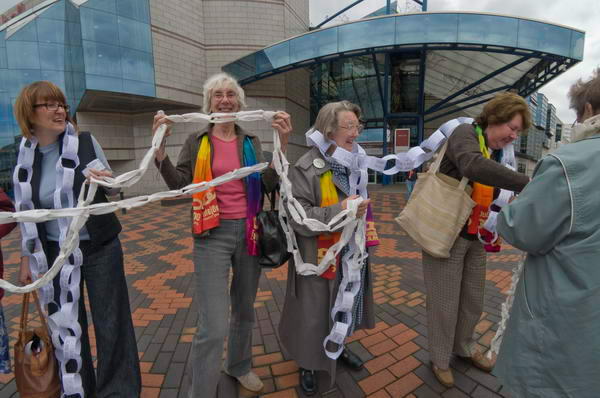
Paper chains in Birmingham

Which had started several weeks ago in Birmingham, where at the ‘Journey for Justice’ we had celebrated the 10th anniversary of the human chain which had been perhaps the most effective demonstration ever at a G8 Heads of Government meeting. Without any violence by demonstrators or police it put the cancellation of the overseas debts of the world’s poorest countries firmly on the political agenda.

There is still a very long way to go for the ‘Drop the Debt’ campaign – with only 20% of such debt yet dealt with. But that 20%, as the director of Christian Aid noted, has meant as much as the contributions collected in a thousand years of the annual fund-raising in Christian Aid week, one of this country’s major charity collections.

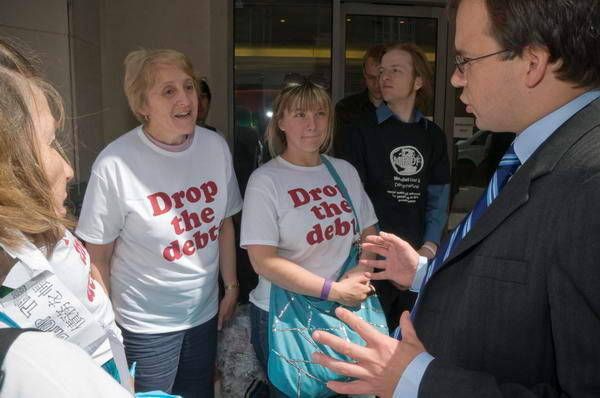
The paper links in the chains made this year in Birmingham were to take the ‘Drop the Debt’ message to the G8 meeting in Japan in July, and last week a small group of London activists carried them to the the Department for International Development in Palace St where they were met by Development Minister Gareth Thomas.

Drop the Debt, London

Photographically things were a little tricky. As you can see, the meeting took place outside on the pavement, at the entrance of the building. There was a fairly huge difference in light levels in the bright sun on the pavement and the deep shade of the entrance.

Photographers sometimes tell me that digital doesn’t have the dynamic range of film, but generally that simply means they haven’t learnt to use digital. It can really deal with much the same range as colour neg, though to do so in this kind of situation does require that you shoot RAW rather than jpeg, and also make use of some flash fill where you can.

The big plus is that with digital you can see immediately whether you have things right, not mainly from the picture display, but from the histogram, and if necessary adjust exposure and flash intensity. Here I was also moving the flash (with the plastic diffuser head that came with it) to point in the direction that needed flash and as far as possible away from the parts of the subject in bright sun.

Apart from a few pictures with my new ultra wide-angle – which I discovered was stuck wide-open and had to give up with, most of the pictures came out fine, at least so far as exposure was concerned.

On the tube to my next location I played with the stop-down lever on the back of the ultra-wide, and fortunately was able to sort out the problem. Obviously I’d changed lenses in a hurry and banged the small lever against the mount, bending it enough to prevent it moving smoothly. After straightening it out carefully the lens worked perfectly.

Having spent around thirty years working with what seem to be the best camera mounts ever designed – from Leica and Olympus – the Nikon mount does seem a little crude.

A genuine Richard Prince photograph?

I’ll let you into a secret. Richard Prince does actually take photographs, or at least I think he may. Not many – most of the time he’s happier ripping off other people’s work, to the extent of $3.4 million for his photograph of a Marlboro cowboy ad.

I don’t really understand why anyone would want to pay that sort of money. It’s not a picture I would want on my wall, but if I did why not just go out and make my own copy for considerably less. It does seem to be an awful lot to pay for what is essentially a can of the artist’s excrement (Piero Manzoni  got to that first.)

There is a nice story in an Independent feature by Charles Darwent published just before the opening of Prince’s show ‘Continuation‘ (at the Serpentine Gallery in Hyde Park, London until 7 Sept, 2008) in which he finds a rip-off of one of his ‘Girlfriend‘ series on the cover of French Vogue and reacts indignantly to them stealing ‘his’ work. (These were readers’ girlfriend photos ripped from the personal pages of biker mags and re-photographed by Prince.)

You can also read a review of the show in the same newspaper by Sue Hubbard, which I think gives an clear view of the man and his work.

I do actually think his art is of some interest, but also that photography is something rather different (and rather more important), and we shouldn’t really waste much if any of its limited cultural space on work that basically just isn’t photography.

Richard Prince isn’t a photographer. Or not much of one. Take a look at his web site, and under ‘photographs’ I think there are possibly a few that were really seen and taken by him. Perhaps the series ‘Upstate Photographs‘ is his own work (though equally it could be an album he picked up in a yard sale.)

Finally, thanks to Jörg Colberg’s Conscientious for pointing me to two rather wacky reviews, one in the Observer ‘Shame he’s a one-trick pony‘ and a second, which may, as Colberg suggests, lack logic, but I think tells the reader rather more about the work, Bidisha‘s Guardian blog, ‘Girls, cars and body parts: Richard Prince’s shallow American dream‘ – and don’t fail to read the comments. In particular arthouart writes “What really is at issue is the bankruptcy of irony in Art, like most of Prince’s work its an insider one liner, if you don’t get it you don’t belong.” Which perhaps gets to the root of why I think I’ve wasted far too much time on this already and should apologise to readers and return to the real world and photography.

Arles Rencontres

I don’t know why I’ve never been to Arles.

But as I type that sentence I realise it’s false. First because I have been there, back in the spring of 1973, visiting the city because of its associations with Van Gogh and to visit the Roman remains – and not when the Rencontres were taking place. They had started just a few years earlier and I don’t know if I had heard of them at the time. I suspect had I started going to them at that point I would still be going now.

Then, for many years there was a small matter of work. At the start of July – this year the first and important week of the Rencontres is July 8-13 – these came at an impossible time for someone working in secondary education, as I did for many years, in the last week or two of term. (Some exhibitions continue in Arles until September, so if you happen to be in the area any time in Summer it’s worth checking the program.)

Then there are other reasons. I dislike travelling and staying in new places, I’ve forgotten most of the French I once learnt and really the only important reason, I’ve always found such social events very hard to cope with at a personal level, and unless I can persuade a few friends to come with me I doubt that I would survive. Perhaps I’ll start working on some seriously with next year in mind. This year’s programme on clothes and fashion didn’t greatly attract me in any case.

You can read about the program in English at the festival web site if you want to see what you are missing, although if it is like previous years it may be better to try the French version.

But for a rather better idea of the photographic content, I suggest you take a look at Lens Culture where Jim Casper describes the festival as “a vast summer camp for adults, where you can eat and drink well, enjoy boundless art, and catch up with your like-minded friends from all over the world” and has an excellent fairly high resolution gallery of images.

Looking through these, although there is plenty of good work as you would expect, there seems little really novel and worth seeing this year. For me the outstanding pictures were by Vanessa Winship, whose work has deservedly done well in several competitions in recent years (and her ‘Albanian Landscapes‘ was screened at Arles in 2003) , and by Debbie Fleming Caffery, whose work I’ve long admired and wrote about when she had a one-person show in London in 2004. I think she first showed work at Arles in 1989.

So it probably won’t be the photography I’ll be missing in a couple of weeks time, but the “drinking cold beer in the shade with some pals“.

Love Music, Hate Racism, fed up with stewards

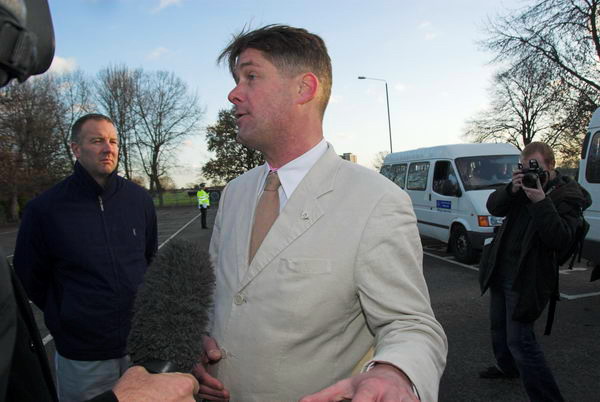
Last Saturday I went to photograph a march against the BNP, who gained a seat on the London Assembly in the elections last month. I’d photographed the man who was elected, Richard Barnbrook, speaking at an outdoor BNP meeting in Dagenham a year or so ago, and detest his politics.

Barnbrook (C) Peter Marshall
Barnbrook speaks to media at BNP rally in Dagenham, Dec 2006

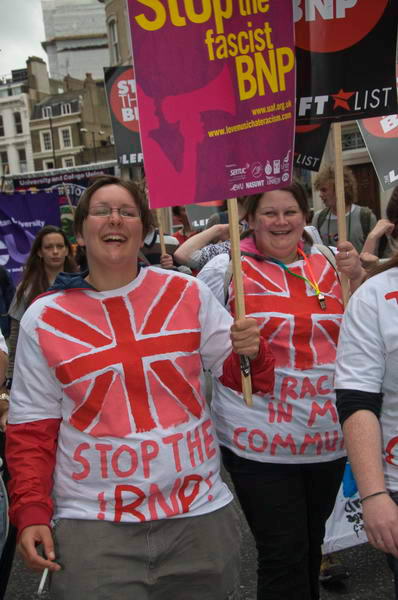
It struck me when I was taking pictures on Saturday that although the people in the demonstration were considerably more open and friendly than the small worried looking crowd in Dagenham, I was getting a lot more hassled by the stewards at Love Music Hate Racism‘s Stop the BNP march. Officiousness and threatening behaviour is no way to get good treatment from the media.

Although billed as a carnival parade, Stop the BNP was more a boring political march. If there was a samba band it was in hiding. For me the tone was set when a steward came up to the band who were just about to start playing and rather grudgingly allowed  them to do just one number before the march had to move off.

LMHR march

It wasn’t a huge march, and quite a few of those on it apparently left before the rally in Trafalgar Square (including me.) Although I’m dead against the BNP, I’m not really sure that this march was worthwhile. The Love Music Hate Racism campaign needs to convert hearts and minds not bore them. It should have been a carnival parade but was just another rather dull march.

More pictures on My London Diary as usual.

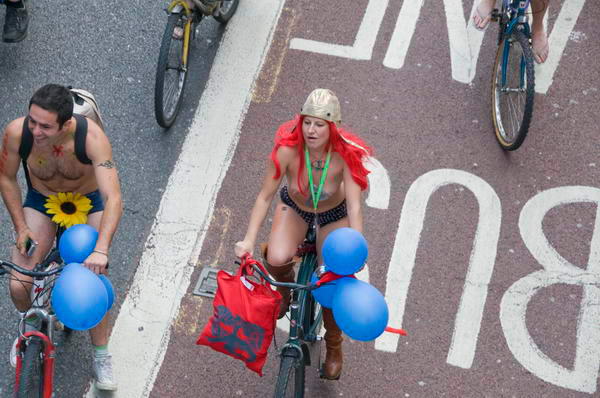
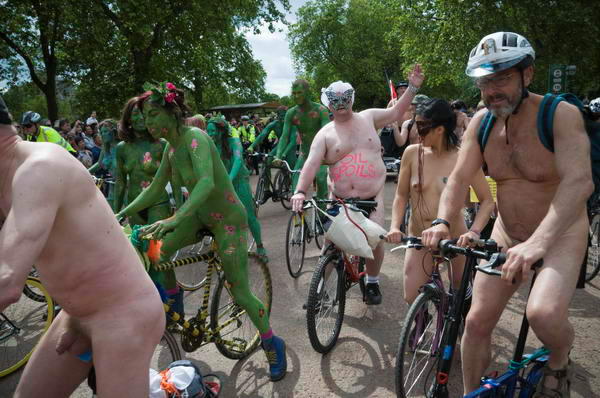
World Naked Bike Ride

I wasn’t sure if I wanted to photograph Saturday’s World Naked Bike Ride in London again. I wrote at some length last year about its ‘photography’ policy and my objections to it – it seems to be a blatant attack on the freedom of the press in particular and on individual freedoms at a time when both are under considerable fire from the law and order fascists. I won’t repeat myself – it’s still on line. But if you take part in a public event and want to hide your identity or blushes, as  I’ve said before, the answer is simple:

don’t shoot the photographer; wear a mask.

I also wrote a shorter piece about news values and nakedness after last year’s ride. There is a paragraph I rather like in it, so here it is – though you can of course use the link to read the rest.

10,000 marching for Palestine. Perhaps 3,000 Orangemen and women. A thousand or so naked or near naked cyclists. No contest, not even for the BBC. When I switched on Radio 4 for the 10 o’clock news there was only one London event. And there was no one there wearing a burkha.

Definitely not a burkha, but she made me think of both of my comments from last year.

But the World Naked Bike Ride is in several ways an interesting event, although as in previous years while bodies are very much on display environmental messages seemed at times to be rather well-hidden, leaving many of the public along the route bemused.

The two young women standing next to me at the start weren’t commenting on the state of the planet or the strangulating grip of car culture but that they had never seen so many penises before, and they were certainly glorious in their diversity. We speculated together briefly on whether the ride showed a greater proportion of circumcision than among the general public and if so why that should be and other major penis-related issues.

Later I was in the middle of a group of young men who loudly expressed the view that the whole event was “f**king out of order, innit” and that it should not be allowed, but most of the people standing around me as I photographed seemed startled but generally amused by the ride, even if few realised what it was about.

According to the web site, it is a “peaceful, imaginative and fun protest against oil dependency and car culture. A celebration of the bicycle and also a celebration of the power and individuality of the human body. A symbol of the vulnerability of the cyclist in traffic.”

I don’t know how many cyclists took part – it seemed roughly the same size as in previous years, and my guess would be a thousand or two. Of course it wasn’t just cyclists, there were some skateboards and roller blades, and some odd sort of curved metal thing. Surprisingly only two unicyclists – you have to be an exhibitionist to ride a unicycle, so I’d expect rather more. (Perhaps they are all away in Nova Scotia keeping most of their clothes on and ‘Riding the Lobster‘ along with one of my sons?) One of them was riding with the slogan “One Love, One Wheel” on his chest.

Cyclists take up quite a bit of road space compared to marchers, so it is certainly more impressive than a march with the same number of people, and of course the bared flesh greatly adds to the impact.

More pictures on My London Diary, though as always only a fairly small fraction of those I took. If you were on the ride and would like your picture (if I took one) email me and I’ll send one if I can.

More on Metadata

Thanks to a friend for pointing me at the presentations now on-line from the 2nd annual Photo Metadata Conference, held in Malta on 5 June 2008, which included the first public presentation of the refurbished IPTC Core and a new IPTC Extension set of photo metadata.

If you feel you missed out on a jolly trip to Malta (and last year’s event was in Florence) then at least you can console yourself at having missed all of the Powerpoint presentations that are now available for download. Most of them actually seem to be saying more or less the same things and at times it seems as if the main interest during the sessions will have been in the colour of the shirts or dresses worn by the presenters.

Not that this is necessarily a bad thing. If you did get there it meant you could have spent your time in the bar and not missed a lot, and it’s good for all of us that there does seem to be considerable agreement over the necessity of metadata and its future direction.

Actually there are a few points of interest, especially for me in a presentation (download it from the programme page) by David Riecks that shows just the pig’s ear that major stock distributors make of it at the moment.

And that is really the root of the problem at the moment. There isn’t a great deal of point in a campaign to get photographers to put the meta-data in if libraries and others shake it all about and remove all or most of it.

Lightroom (and some other programs – but I use Lightroom) has made it relatively easy for photographers to add some essential metadata as a matter of routine when processing their raw files (or even jpegs if you have to shoot jpeg) although I’d like the process to start even earlier with camera manufacturers getting more into the act.

Every picture we shoot digitally now has EXIF data recorded, including the date and time. No photographer should ever find themselves having to enter this data into software manually (though if – as I’ve done at times – we manage to set the wrong year or the wrong time zone, we need to be able to correct it.) Software can pick it up automatically and rewrite it wherever it’s needed.

My camera also allows me to add some user-input data to every picture. It would only add a few bytes to firmware to allow the entry of some specified fields – such as copyright (what my data always contains), e-mail address and perhaps ‘Headline’ which would then be available to software. Which could then, for example copy the files to an appropriately located and named folder when you upload these to your computer, and perhaps also choose appropriate pre-sets for other purposes.

Several of the presentations address some of the real basics that make metadata useful, such as:

  • data should never need to be entered twice
  • it should be and offence to remove metadata or edit it without permission

(Some copyright lawyers claim removal is already is an offence under copyright law.)

Keywording
Perhaps the discussion that I would have found of most interest was “Keywording versus Controlled Vocabularies” which rather strikes me as a false dichotomy. To make keywording really useful you need a controlled vocabulary, and a controlled vocabulary seems to require some way to use it, which is by keywording. This was a ‘panel discussion’, and what you can download certainly throws little light on the topic.

Perhaps one of the problems is that the same keyword needs to be able to sit in several different hierarchical trees. Yesterday I was adding the keyword ‘Haka’ to some of my images to go in a library (actually I was adding it for a second time, because it was a keyword in the file I was uploading, but the system doesn’t read most of the metadata in the files – so I spend hours and hours re-keying.)

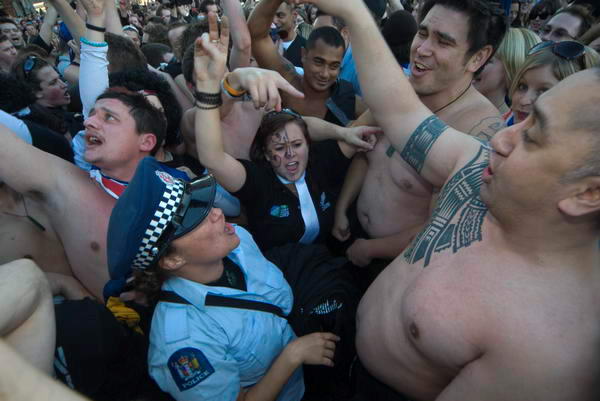
Haka in Parliament Square
Haka in Parliament Square for Waitangi Day

If I was setting up a keywording system using a controlled vocabulary I might want to include Haka in a heirachy part of which would look like this:

>Country>New Zealand>Maori>Culture>Haka

but I might also want to include it in a hierarchy that was cross-cultural and looked at various types of dance and their function, part of which would look like this:

>dance>war dance>Haka

or perhaps we might want to look at it in yet other ways.

How we make such links is important both in keywording and also even more so in developing smart methods of searching – which is really the important end of the process.

PLUS
Something that I think we will hear more about is PLUS, the Picture Licensing Universal System, which will provide a single world-wide system for describing licences and to embed licensing information as metadata in images. It won’t replace IPTC, but provides only licence-related information – including of course address and copyright details. It seems it will be free to use, although I’m not sure whether non-members of PLUS will be included in their seachable creator data-base when this is up and running. Widespread adoption of PLUS would give added protection to image creators and clarify conditions for those wanting to use images.

Of course the success of such a system depends in part on national laws. If the US does decide to do its own coach and horses over so-called “Orphan Rights” (as to some extent it has always done on copyright) it will almost certainly severely weaken the utility of PLUS. But intellectual property rights are increasingly an important part of world trade, and perhaps the age when the US can run the world is coming to an end?

Better Digital 1

The first in a short series on getting the most out of digital images

I went to a photographers meeting a couple of weeks ago where pictures taken by around 20 different photographers (including myself) were all projected. Virtually all of them were good pictures – and most of the photographers were managing to make a living from photography, but technically I felt a number were letting the people who took them down in various fairly simple ways.

Back in the darkroom age, most photographers either learnt to make at least halfway decent black and whites or, more often once they started to make some money, had their work printed for them by a decent printer. With colour, for publication we largely shot on slide film and accepted the results from the lab on our Ektachrome or whatever, handing the trannies in for publication.

Now, most publications will no longer accept prints or slides and expect digital, but there are still quite a few photographers who haven’t yet really learnt how to get the most of of what they shoot on digital.

In most respects, digital has had the result of increasing technical standards compared to film. Certainly in low light we can produce pictures with a technical quality that is way better than film. But where we used to rely on labs to get things right, we now have to do it ourselves. So here is the first part in a series with some simple advice for photographers.

Monitor

Probably you’ve stood at some time in an electrical shop looking at the same programme displayed on a whole range of different TV screens and noticed the differences in colour, brightness and contrast between them. All of them are getting the same input signal, but may produce very different pictures. Computer screens are not a lot different (especially as we move to digital TV) and your image file may display very differently on your own screen to than when viewed by an editor or projected onto a screen. Those pictures with a nasty yellow cast may have looked perfect on someone’s notebook screen.

If you work with images it is worth buying a good screen to display your pictures. Unfortunately few if any notebooks come with particularly good screens – and a really decent screen for editing your pictures can easily cost as much as a notebook.

At home I use an Eizo monitor. It cost about as much as the large box by my feet that sends it a signal, but was worth every penny. Away from home I use an Acer notebook, and the images don’t quite look the same.

Hardware Calibration

Although the notebook screen hasn’t got anything like the picture quality of the expensive Eizo (or the remarkably good ancient but fairly massive Iiyama cathode ray screen I still also use) my pictures display in a reasonably similar fashion on all three screens. And I can be confident that any editor etc who knows what they are doing will also see something pretty similar. My confidence comes from regular calibration with a suitable hardware device, in my case a Pantone (GretagMacbeth) eye-one (i1), now replaced by an improved model.
You can get by without such a device – just as you can get by on a laptop screen – and your results may well be ok, but they will not be optimum. Particularly if you want to make your own prints, the better monitor will make it easier to get predictable results.

If you can’t afford a hardware calibration device, there are some web sites that have useful pages to make a rough check on some aspects of your monitor, and you may well be able to set up your monitor roughly using these and the controls on your monitor. Usually you should set the colour temperature to 6500K and use Gamma 2.2 (both on Mac and PC.)

Camera

If you are serious about photography then you will normally be shooting on a DSLR camera with at least a “4/3” sensor, more probably one roughly half the size of a normal 35mm film frame or roughly the same size. Compact cameras (except the latest Sigma DP1) have smaller sensors, usually smaller than a fingernail. Although some of these perform near miracles, they still cannot compare for resolution and image quality with the larger sensors, and at higher ISO the noise becomes excessive.

RAW vs Jpeg

As well as a decent camera – and of course a decent lens – you also need to learn how to use it. Test after test has shown that every camera that has both RAW and Jpeg modes can produce better images when shooting RAW. Almost always there is greater dynamic range but even more important is the flexibility to alter and enhance images that RAW processing provides. The difference is in some ways similar to the difference between using colour neg and tranny, where the printing process gives you a degree of control over how your images look, while the slide you just accept and put on the light box. You can do some post-processing with jpeg, but it is sometimes at the expense of visible image degradation, while RAW allows much great control without any quality sacrifice.

Sometimes of course speed is essential, and the ability to use jpeg files straight out of the camera is vital. If possible it is a good idea to shoot both RAW – to get the best out of when you have time – and jpeg for immediate use.

Colour Depth

Digital cameras transform the minute analogue electrical signals recorded by sensor cells into digital signals. Most cameras work using 12 or 14 bits for each cell to store the value, enabling them to distinguish either roughly 4,000 or 16,000 levels. In most cameras, each cell is behind a colour filter and these are levels of either red, green or blue light, depending on the filter.

The jpeg format only allows 8 bits for each colour – 256 levels, and when your camera writes a jpeg file it has to decide how to scale the data down to fit into this smaller number of levels. Exactly how it does this will depend on various camera settings for the colour space, contrast, colour temperature etc. Once this process has been carried out, and data discarded it cannot be retrieved. The 8 bits in each of the red, green and blue channels of the image make this ’24 bit colour’, also sometimes called ‘Truecolor’

RAW files – or at least most of them – actually contain a jpeg file. In the Nikon NEF format it is a jpeg using ‘basic’ compression, and some software will quickly extract these for you. The jpg is used for the image you see on the screen on the back of the camera. The file also contains the full 12 or 14 bits of data corresponding the the sensor cells, along with information about the camera settings, including the white balance etc. One difference between different software for processing RAW files is sometimes in how much of this information is used automatically, with the camera maker’s own software sometimes understanding more than other software.

You may also have the option of outputting 16 bit TIFF files, particularly from RAW processing software. These files can essentially contain all of the image data from the raw file, but are padded out to occupy greater space. However unlike RAW files they are understood as image files by a wide range of display software.

Colour Spaces

Cameras can only record a fairly limited part of the visual range, with many colours being out of gamut. Different sensors have their own characteristics, producing different electrical values from the cells from the same scene.

The values for pixels need to be connected in some way to actual colours and two ways of doing this are in common use for camera images, sRGB and AdobeRGB (1998) ICC colour profiles, each covering a different range of the visible colours.

AdobeRGB covers a wider range of colours, and is thus usually the better choice for camera images, but the sRGB range is actually a better match to the colours that most monitors can display, and is thus the normal choice for compact cameras.

· sRGB for web use and on-screen presentations
· AdobeRGB for reproduction

It is generally more sensible to set AdobeRGB as your camera profile and to make this the basis of your workflow, converting files to sRGB if you need these for screen use. The Adobe RGB space has a wider colour range.

When supplying files for any purpose always ensure they are tagged appropriately. Unfortunately much software – including almost all web browsers – doesn’t understand ICC colour profiles and will display Adobe RGB files wrongly.

Print services for amateur use always expect sRGB. For professional printing you should consult the lab, which should also be able to supply you a printer profile you can use for ‘soft-proofing’ your images on screen in Photoshop.

Continued in ‘Better Imaging 2″